Showing posts with label Last of the Mohicans. Show all posts

October 28, 2013

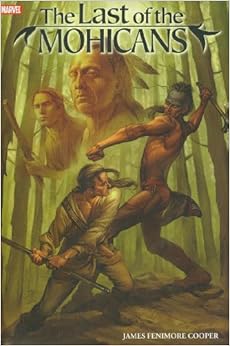
Marvel's Last of the Mohicans

Marvel Classics Comics #13--The Last of the Mohicans (1976)


The Last of the Mohicans (Marvel Illustrated)The very first Marvel Illustrated story, The House of Ideas' new foray into classic literature, featuring an adaptation of James Fenimore Cooper's renowned novel! Last of the Mohicans tells the seminal story of a race on the brink of disappearance due to the inexorable push of civilization into the wilderness of the New World. It's a tale that will touch readers of every age with both its timeless realization of an important historical period-and with its powerful action and adventure! This isn't your father's classic comics! Adapted by writer Roy Thomas, who's a Marvel classic himself (Avengers, X-Men, Conan) with stunning art by Marvel newcomer Steve Kurth. Collects Marvel Illustrated: Last of the Mohicans #1-6.

Comment:  I haven't read the first comic, but I read and reported on the second series years ago. Well, on the first issue of the series, anyway. I wasn't interested enough to keep reading.

For more on The Last of the Mohicans, see First of the Tonto Tales.

February 28, 2011

Mohican the Japanese robot

Correspondent DMarks brought this item to my attention:

Japanese Professor Builds Fantastically Impractical Anti-Wasp Robot

By Logan WestbrookSekine started working on the robot when a friend who was involved in local pest control efforts asked him to come up with an alternative to getting up close and personal with the nest. Clad in a bright yellow t-shirt, the robot--named Mohican, after its hair--is around 5'6", made of lightweight metals and wood and powered by small motors. The operator can issue commands to Mohican, such as "climb the ladder," via a small microphone and then remotely control its finer movements. The robot's hair, which started off on a barbershop mannequin, is supposed to look silly, so that people realise that the robot is friendly.Comment:  Only one problem here: "Mohican" isn't the adjectival form of "Mohawk." The Mohawks and Mohicans are two separate and unrelated tribes:

MahicanThe Mahicans (also Mohicans) are an Eastern Algonquian Native American tribe, originally settling in the Hudson River Valley (around Albany, NY). After 1680, many moved to Stockbridge, Massachusetts. During the early 1820s and 1830s, most of the remaining descendants migrated westward to northeastern Wisconsin. The tribe's name for itself (autonym) was Muh-he-con-neok, or "People of the waters that are never still."

History

The Mahican were living in and around the Hudson Valley at the time of their first contact with Europeans after 1609, during the settlement of New Netherland. The Mahican were a confederacy rather than a single tribe, and at the time of contact there were five main divisions: Mohican proper, Westenhuck, Wawayachtonoc, Mechkentowoon, and Wiekagjoc. Over the next hundred years, tensions between the Mahican and the Iroquois Mohawk, as well as Dutch and English settlers, caused the Mahican to migrate eastward across the Hudson River into western Massachusetts and Connecticut. Many settled in the town of Stockbridge, Massachusetts, where they gradually became known as the Stockbridge Indians.
For more on robots, see Aborigines in Gigantor and Racist Transformers.

November 21, 2009

King Lear as The Last of the Mohicans

King Lear“How sharper than a serpent's tooth it is to have a thankless child!”

This manga version of King Lear is set during the era of The Last of the Mohicans--circa 1759, during a crucial era of invasion and displacement along the American frontier. Lear is a venerated Mohican (Iroquois) chieftain, entering his final days. His elder daughters Regan and Goneril–-the evil pairing–-are more westernised in their looks. Lear’s youngest daughter, Cordelia, with her Native American appearance, is the lone traditionalist who cleaves to the old ways.

In this unique interpretation of Shakespeare’s tragic tale, a mighty mountaintop snowstorm for the signature setpiece makes for a dramatic backdrop where savage torture and plentiful scalpings provide and update Shakespeare’s bloody action.

"A book that's uncategorisable. King Lear is done as The Last of the Mohicans in the style of Japanese manga. The publisher has been criticised for playing it safe with its adaptations of the classics. This one is by no means safe and all the better for it."

Roger Sabin, The Observer (August 2009)
"Ilya's unique vision stands as an alternative take on the original story, shaking up the established reading of the play and asking readers to rethink their ideas about the characters and their situation. A sense of doom is created simply by casting Lear as a Native American pitted against the encroaching forces of the western world, and this in turn makes the ending yet more inevitable and tragic....This gripping adaptation brings to the table a totally unique way of looking at this classic story, and is well worth a look."

Amanda Young, NEO Magazine (July 2009)
Comment:  This sounds like a great idea in theory. But the execution is at least somewhat stereotypical.

Start with the "savage torture and plentiful scalpings." These might have been part of Mohican culture--or they might not have been. Even if they happened, you'd have to pair them with the cultural and religious context to paint a full picture.
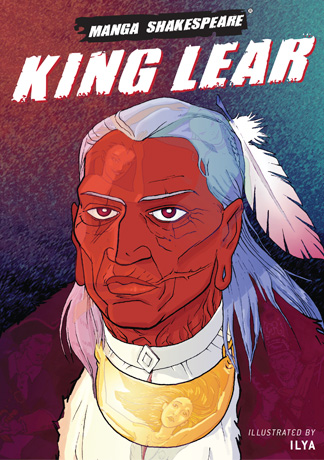


King Lear with a blood-red face and blue hair? This doesn't look like any Indian I've ever seen. Except a stereotypical Indian mascot, of course.
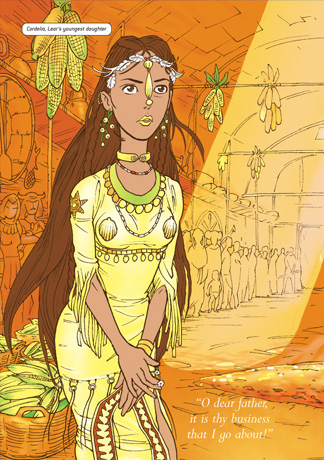


A typical Indian princess in a sexy buckskin outfit. Note the tiny nose, the lack of cheekbones, the scallops over the breasts, and the slit on the left side. This is a non-Indian's fantasy of an Indian sex object, not a real Indian woman.
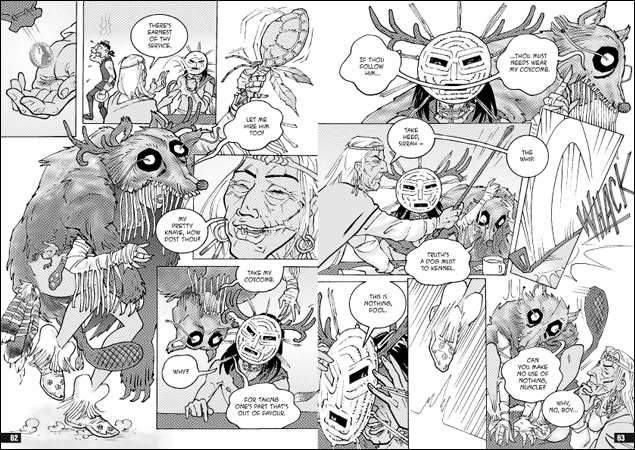


What the heck is this dancing figure at left? A wolf's head, raccoon eyes, deer antlers, bear skin, and beaver tale?! I'll go out on a limb and guess that neither the Mohicans nor anyone else had such a ceremonial figure. It looks like a pure invention to make the Indians look more savage and superstitious.

Also, how does the raccoon-wolf mask lose the antlers and the round mask gain the antlers in panel five? Oops.

The interior version of King Lear--an elder in a headband--and the warriors in the other panels look decent. So the work seems only partly stereotypical. People should read it with that in mind.

For more on the subject, see King Lear with Eskimos and Comic Books Featuring Indians.