Showing posts with label Hiawatha. Show all posts

May 21, 2016

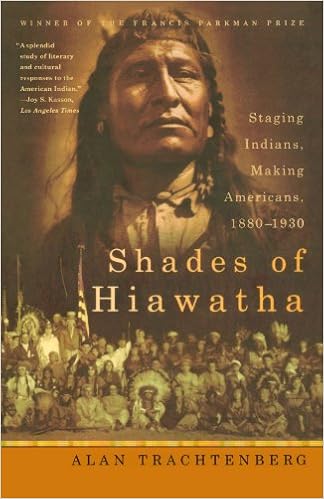
Review of Shades of Hiawatha

Shades of Hiawatha: Staging Indians, Making Americans, 1880-1930 1st Edition

By Alan Trachtenberg"A book of elegance, depth, breadth, nuance and subtlety." --W. Richard West Jr. (Founding Director of the National Museum of the American Indian), The Washington Post

A century ago, U.S. policy aimed to sever the tribal allegiances of Native Americans, limit their ancient liberties, and coercively prepare them for citizenship. At the same time, millions of new immigrants sought their freedom by means of that same citizenship. Alan Trachtenberg argues that the two developments were, inevitably, juxtaposed: Indians and immigrants together preoccupied the public imagination, and together changed the idea of what it meant to be American.

In Shades of Hiawatha, Trachtenberg eloquently suggests that we must re-create America's tribal creation story in new ways if we are to reaffirm its beckoning promise of universal liberty.

From Publishers Weekly
What does it mean to be an American? How was "Americanness" first conceived? In this fascinating study, Trachtenberg (Reading American Photographs) investigates the construction of the "American" by linking the experience of Native Americans in the late 19th century to the experiences of Eastern Europeans in the early 20th century. Ironically, the earliest Americans—the Indians—were first displaced from their own land—making them un-American—and then were offered the opportunity to become Americans by repurchasing that land and conforming to American values such as the ownership of private property. The overly mythologized image of Hiawatha, Trachtenberg argues, crystallizes the ways that American writers and American society made Indians almost invisible. In a similar way, the earliest European immigrants experienced a displacement from their own lands and a requirement to embrace American social and political values in order to become American citizens. In an exceptional final chapter, Trachtenberg juxtaposes the writings of Luther Standing Bear and Hart Crane to show how deeply the idea of being American was contested even in the early 20th century and to call for the inclusion of Native American identity in the ongoing struggle to define what it means to be an American. Although some of these ideas are not new, Trachtenberg's historical depth and lively prose make them extremely vivid.
A review by Paige Raibmon:Trachtenberg's method is to establish something of a taxonomy, holding up a wide array of cultural artifacts for display: poetry, theatre, travelogues, photography, and department store displays to name a few. Many of these were produced by well-known characters from the historical annals of American high culture: Robert Frost, Ralph Waldo Emerson, Henry Wadsworth Longfellow, Henry James, and Edward Curtis to name a few. Others were produced by figures who will be less familiar to readers: Yehoash, the Russian poet who translated The Song of Hiawatha into Yiddish, and Joseph Kossuth Dixon, who led Indian "expeditions" for the Wanamaker department stores. The book is much more about these non-Indian "stagers" of Indians than about Indians themselves. Trachtenberg's interest lies in the implications of these cultural artifacts for Americanness rather than in their impact on Indian lives.Rob's review

The Shades of Hiawatha title is appropriate. The book is kind of about how Song to Hiawatha filtered into the public consciousness and helped defined who and what was considered American. The six chapters are kind of disjointed, but Trachtenberg tries to link things back to the play and what it represents.

I'm not sure he develops any deep or meaningful thesis--at least not one that I can summarize. But he explores some little-known areas of Native history, including the origins of Song of Hiawatha and the Wanamaker Expeditions. His writing is interesting enough that I give the book an 8.0 of 10, which is good for this kind of material.
April 01, 2012

Hiawatha pageant postcard

Correspondent DMarks posts one of his old Hiawatha-themed postcards:

Hiawatha at Pipestone (Postcard)

Vesta, Minn 7/29/1961

"How!"

Saw most of this pageant but had to quit because of rain. Cousin Steve has played the part of Hiawatha for 12 years. Got home late that nite to find high winds had uprooted trees--torn branches--flattened crops. Have gotten in on a number of "Clan gatherings" and visited in Mpls also saw Twins beat Washington Senators.

See you soon,
Smiths.
DMarks also shares some lore about Hiawatha, Pipestone, Sioux Indians, and the word "how." Check it out.

For more on Hiawatha, see Three Dubious Literary Classics and Theosophy Temple Has Hiawatha Paintings.

February 26, 2011

Three dubious literary "classics"

In The Education of Little Tree, a children's "classic," generic Cherokee Indians send their boy to a boarding school to be civilized. The book was considered an authentic Indian narrative until its author was revealed to be a white supremacist.

In Little House on the Prairie, another children's "classic," Indians are intimidating and unclean "savages." What most people don't know is that Charles Ingalls was squatting illegally on Osage Indian land and that his daughter the author was a staunch conservative.

Henry Wadsworth Longfellow's Hiawatha is the classic romantic Indian and probably the best-known fictional Indian before Tonto. People have adapted the epic poem into movies, plays, music, and other genres.

For literature that put this questionable literature to shame, see The Best Indian Books

June 03, 2010

Theosophy temple has Hiawatha paintings

Life of Hiawatha captured on canvas

By Gayle CuddyTemple member Harold Forgostein, now deceased, crafted a series of 24 oil paintings that are on view by appointment.

They depict the fascinating legend of the man who brought together what would become the League of Six Nations. Its participatory democracy reportedly inspired Benjamin Franklin to use them as a model for the U.S. Constitution.
And:One of my favorite paintings shows Hiawatha in his canoe, sailing over the sunset path in the water to his home with the Great Spirit after his mission on earth was completed.

Eleanor Shumway, guardian in chief at the Temple of the People, explained the philosophy of the temple and how it is based on theosophy and integrated with American Indian ideas. The temple was founded in 1898 in Syracuse, New York, and moved to Halcyon in 1903. Halcyon was considered a center of power and a place of healing.
Comment:  Another connection between upstate New York, spirituality, and Indians.

The Hiawatha painting looks overly romantic to me--nice but nothing special. I hope these paintings tell the life of the real Hiawatha, not the legendary Hiawatha from Longfellow's poem.

For more on the subject, see The Song of Hiawatha and Romanticized Indians.

Below:  "Marti Fast, a member of the Temple of the People, stands with a Harold Forgostein painting depicting Hiawatha in his canoe. The series of oil paintings is on view by appointment at University Center Gallery of the Temple of the People in the village of Halcyon."

May 10, 2009

Sitting Bull ice cream

Correspondent Morten Krogh is leading the fight against this stereotype-based Norwegian product:

Diplom is viser ingen respekt til historisk personIn July 2008 I discovered one product in a foodshop here in Oslo that really shocked me. Sitting Bull ICE-CREAM from Diplom-IS. Therefore I made this Facebook site to stop DIPLOM ICE. Check it out, and support this group.

Here is the official DIPLOM ICE site.

SITTING BULL [link no longer works]

Please check it out, and tell me what you think about the logo, and the name.

They are also using a picture of the cartoon series called Hiawatha on the product, and they are using Sitting Bulls name.

IT'S REALLY Disrespectful.

:-( NO. If they are going to continue to sell it they can change the name.

Diplom-Is is the trademark of Diplom-Is AS, and is the best known and most popular ice-cream brand in Norway.

You can get in contact with Diplom-Is. I will...:-(
Tel: + 47 02001
Fax: + 47 67 06 66 01
E-mail: firmapost@diplom-is.no
Comment:  I assume the group's title is something like "Diplom Ice Should Give Respect to This Historic Person."

As I told Morten, I think the image is a cartoon character like Disney's old Hiawatha. I'm not convinced it is Hiawatha.

I'm not as bothered by this as I am by products such as Crazy Horse malt liquor or Crazy Horse nightclub. Unlike these products, I don't think ice cream is inherently disrespectful to Indians. Sitting Bull might appreciate or endorse this product if he were alive.

Would the ice cream be okay if it used an actual picture of Sitting Bull? If it was called L'il Sitting Bull Ice Cream? Or if it was called Hiawatha Ice Cream to match the picture? I don't know, but it would make more sense.

This product is like Pocahontas tires or Tecumseh pajamas--a meaningless and incomprehensible appropriation of a Native name. The image is a phony Indian "brave" who has nothing to do with Sitting Bull, who has nothing to do with ice cream. The only thing noteworthy about it is how mismatched the name, image, and product are.

But as offenses go, it's not at the top of my list. I see stereotypes this bad all the time. Therefore, I can't devote too much time to it.

For more on Native stereotypes, see the Stereotype of the Month contest.


March 25, 2009

Hiawatha trains and logo

Correspondent DMarks has posted this item on his Throwaway Blog:

"Twilight" DVD ReleaseThe "Hiawatha" trains of the Milwaukee Road had the logo seen to the right (image from Wikipedia). In the Milwaukee Road, "there were actually four routes carrying the Hiawatha name, Chicago-Minneapolis; Chicago-Omaha; Chicago-Wausau-Minocqua; and Chicago-Minneapolis-Seattle." A modern-day Amtrak route still bears the Hiawatha name.

The Hiawatha logo would appear to be a cross between a rendition of the Roman god Mercury and a Native American with a streamlined-back version of a Plains-style feather headdress (see this image of a Pontiac car Indian-head hood ornament for an example of something similar).
Comment:  Hiawatha used to be the most famous Indian in America, I think. I presume the trains were named after him because of his popularity, since I don't see any other connection.

July 23, 2008

Oldfield's Song of Hiawatha

An e-mail from correspondent DMarks:The recent "Hiawatha" posts reminded me of the album "Incantations" by Mike Oldfield. It came out in 1978, as a double LP record album. Most of Side 2 is a music version of part of "Song of Hiawatha." The double LP live album "Exposed" also featured another recording of "Song of Hiawatha." Oldfield is most famous for the theme for the "Exorcist," which was an out-take from "Tubular Bells." A German fanzine for Mike Oldfield took the name "Hiawatha" as well.

I think it is the most well-known adaptation of "Song of Hiawatha," alongside the Disney cartoons. Mike Oldfield has no other Native American-related content until the album "Guitars," which featured a short instrumental called "Cochise."

July 19, 2008

NYT:  Poem on "justly exterminated race"

From the Wikipedia entry on Henry Wadsworth Longfellow's epic poem The Song of Hiawatha:When the New York Times finally published a review of The Song of Hiawatha, it was scathing. The reviewer's judgment, however, seems based as much on the subject matter as on the poem. He allows that the poem "is entitled to commendation" for "embalming pleasantly enough the monstrous traditions of an uninteresting, and, one may almost say, a justly exterminated race." However, "As a poem, it deserves no place" because there "is no romance about the Indian." He complains that Hiawatha's deeds of magical strength pall by comparison to the feats of Hercules and even to those of "Finn Mac Cool, that big stupid Celtic monarch."

The reviewer writes that "Grotesque, absurd, and savage as the groundwork is, Mr. LONGFELLOW has woven over it a profuse wreath of his own poetic elegancies." But, he concludes, Hiawatha "will never add to Mr. LONGFELLOW's reputation as a poet."
Comment:  As Maxwell Smart might have said, "Missed it by that much."

As always, it's "good" to see America's historic racism documented in black and white. In this case, in the newspaper known for having "all the news that's fit to print." Evidently the NY Times considered it fit to disparage the "monstrous traditions" of the "justly exterminated" Indians.

You gotta love the reviewer's blatant Eurocentrism too. He was upset because Hiawatha outshone Hercules and Finn Mac Cool? What did he think this was, a competition between cultural icons? "My hero's better than your hero?"

Thirty-five years later, L. Frank Baum wrote an editorial in which he also seemed glad of the Indians' "extermination." People have excused Baum's genocidal thoughts because he supposedly feared the nearby Sioux would rise up and start a race war. Maybe, but what's this reviewer's excuse? No doubt he was safe in his Manhattan garret, hundreds of miles from any Indian threat, yet he used the same phraseology as Baum.

I conclude that Baum and the reviewer didn't talk about extermination because they were afraid for their lives. They talked about it because they were typical racists of their day.

Below:  Hiawatha carries Minnehaha.

Hiawatha inspired by Finnish epic

Not only is The Song of Hiawatha a romanticized version of Indian history, it's a romanticized Finnish version of Indian history.

Song of Hiawatha Kalevala's Cousin?Though some scholars disagree, Longfellow was, no doubt, influenced by the Finnish national epic, Kalevala, in creating his Song of Hiawatha, inasmuch the meter, form, and some of the legends and episodes in Hiawatha resemble very closely those in the Finnish epic. Substantial evidence can be gleaned from the works themselves: first, by observing the historical circumstances, and second, by carefully comparing the works themselves.

During his visit to Sweden in the summer of 1835, Longfellow kept in touch with the Finnish literary circles. He met people who told him about Finnish customs and traditions; he even studied the Finnish language.
And:An entry in Longfellow's journal, made on June 5, 1854, states that he did read "with great delight the Finnish epic Kalevala . . . It is charming." Only a couple of weeks later, on June 22, Longfellow made this interesting and noteworthy comment in his journal:

I have at length hit upon a plan for a poem on the Indians, which seems to me the right one, and the only one. It is to weave together their beautiful traditions into a whole. I have hit upon a measure, too, which I think is the right one and the only one for such a theme. At present it delights me. Let us see how it will prosper.
From these journal entries it is easy to come to the conclusion that it was the inspiration of Kalevala that led Longfellow to "hit upon a plan" and to finally come up with a measure suitable for his purpose.

Hiawatha sails into sunset

After 60 years, show closes on Hiawatha

Volunteers scarce, desire grows for true Indian cultureHiawatha takes his last canoe glide across the rock-quarry lake here this summer. The 60th annual "Song of Hiawatha Pageant" is ending.

Actors playing the fictional Native American prophet, along with more than 100 volunteers, have put on the outdoor pageant every year since 1948. Organizers say there are fewer available volunteers, too many competing events and a greater cultural awareness than in past decades. Consequently, the three weekend shows through the first weekend in August will be the last for this community endeavor that attracts thousands of people each summer.
Comment:  For more on the subject, see Native Plays and Other Stage Shows.