
The author of Harry Potter lost her humanist cred among Natives when she engaged in pan-Indianism and appropriation in her History of Magic in North America. Some postings on the subject:
Dear JK Rowling: We're Still Here
Pottermore problems: Scholars and writers call foul on J.K. Rowling’s North American magic
'Magic gets organized when the white people show up': Critics blast JK Rowling for appropriating Native American culture in new series
J. K. Rowling’s Unfortunate Attempts at Globalization
JK Rowling’s Anti-Native ‘Magic’ Racism – And How Authors Can Do Diversity Better
Showing posts with label literature. Show all posts
Showing posts with label literature. Show all posts
July 02, 2016


May 21, 2016
Review of Shades of Hiawatha
Shades of Hiawatha: Staging Indians, Making Americans, 1880-1930 1st Edition
By Alan Trachtenberg"A book of elegance, depth, breadth, nuance and subtlety." --W. Richard West Jr. (Founding Director of the National Museum of the American Indian), The Washington Post
A century ago, U.S. policy aimed to sever the tribal allegiances of Native Americans, limit their ancient liberties, and coercively prepare them for citizenship. At the same time, millions of new immigrants sought their freedom by means of that same citizenship. Alan Trachtenberg argues that the two developments were, inevitably, juxtaposed: Indians and immigrants together preoccupied the public imagination, and together changed the idea of what it meant to be American.
In Shades of Hiawatha, Trachtenberg eloquently suggests that we must re-create America's tribal creation story in new ways if we are to reaffirm its beckoning promise of universal liberty.
From Publishers Weekly
What does it mean to be an American? How was "Americanness" first conceived? In this fascinating study, Trachtenberg (Reading American Photographs) investigates the construction of the "American" by linking the experience of Native Americans in the late 19th century to the experiences of Eastern Europeans in the early 20th century. Ironically, the earliest Americans—the Indians—were first displaced from their own land—making them un-American—and then were offered the opportunity to become Americans by repurchasing that land and conforming to American values such as the ownership of private property. The overly mythologized image of Hiawatha, Trachtenberg argues, crystallizes the ways that American writers and American society made Indians almost invisible. In a similar way, the earliest European immigrants experienced a displacement from their own lands and a requirement to embrace American social and political values in order to become American citizens. In an exceptional final chapter, Trachtenberg juxtaposes the writings of Luther Standing Bear and Hart Crane to show how deeply the idea of being American was contested even in the early 20th century and to call for the inclusion of Native American identity in the ongoing struggle to define what it means to be an American. Although some of these ideas are not new, Trachtenberg's historical depth and lively prose make them extremely vivid. A review by Paige Raibmon:Trachtenberg's method is to establish something of a taxonomy, holding up a wide array of cultural artifacts for display: poetry, theatre, travelogues, photography, and department store displays to name a few. Many of these were produced by well-known characters from the historical annals of American high culture: Robert Frost, Ralph Waldo Emerson, Henry Wadsworth Longfellow, Henry James, and Edward Curtis to name a few. Others were produced by figures who will be less familiar to readers: Yehoash, the Russian poet who translated The Song of Hiawatha into Yiddish, and Joseph Kossuth Dixon, who led Indian "expeditions" for the Wanamaker department stores. The book is much more about these non-Indian "stagers" of Indians than about Indians themselves. Trachtenberg's interest lies in the implications of these cultural artifacts for Americanness rather than in their impact on Indian lives. Rob's review
The Shades of Hiawatha title is appropriate. The book is kind of about how Song to Hiawatha filtered into the public consciousness and helped defined who and what was considered American. The six chapters are kind of disjointed, but Trachtenberg tries to link things back to the play and what it represents.
I'm not sure he develops any deep or meaningful thesis--at least not one that I can summarize. But he explores some little-known areas of Native history, including the origins of Song of Hiawatha and the Wanamaker Expeditions. His writing is interesting enough that I give the book an 8.0 of 10, which is good for this kind of material.
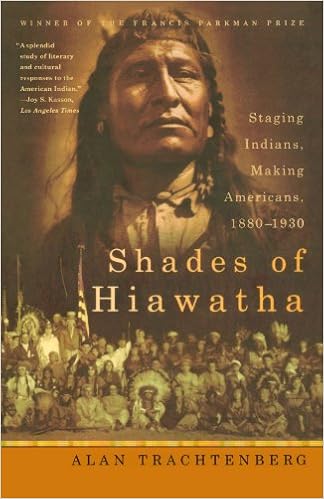
By Alan Trachtenberg
A century ago, U.S. policy aimed to sever the tribal allegiances of Native Americans, limit their ancient liberties, and coercively prepare them for citizenship. At the same time, millions of new immigrants sought their freedom by means of that same citizenship. Alan Trachtenberg argues that the two developments were, inevitably, juxtaposed: Indians and immigrants together preoccupied the public imagination, and together changed the idea of what it meant to be American.
In Shades of Hiawatha, Trachtenberg eloquently suggests that we must re-create America's tribal creation story in new ways if we are to reaffirm its beckoning promise of universal liberty.
From Publishers Weekly
What does it mean to be an American? How was "Americanness" first conceived? In this fascinating study, Trachtenberg (Reading American Photographs) investigates the construction of the "American" by linking the experience of Native Americans in the late 19th century to the experiences of Eastern Europeans in the early 20th century. Ironically, the earliest Americans—the Indians—were first displaced from their own land—making them un-American—and then were offered the opportunity to become Americans by repurchasing that land and conforming to American values such as the ownership of private property. The overly mythologized image of Hiawatha, Trachtenberg argues, crystallizes the ways that American writers and American society made Indians almost invisible. In a similar way, the earliest European immigrants experienced a displacement from their own lands and a requirement to embrace American social and political values in order to become American citizens. In an exceptional final chapter, Trachtenberg juxtaposes the writings of Luther Standing Bear and Hart Crane to show how deeply the idea of being American was contested even in the early 20th century and to call for the inclusion of Native American identity in the ongoing struggle to define what it means to be an American. Although some of these ideas are not new, Trachtenberg's historical depth and lively prose make them extremely vivid.
The Shades of Hiawatha title is appropriate. The book is kind of about how Song to Hiawatha filtered into the public consciousness and helped defined who and what was considered American. The six chapters are kind of disjointed, but Trachtenberg tries to link things back to the play and what it represents.
I'm not sure he develops any deep or meaningful thesis--at least not one that I can summarize. But he explores some little-known areas of Native history, including the origins of Song of Hiawatha and the Wanamaker Expeditions. His writing is interesting enough that I give the book an 8.0 of 10, which is good for this kind of material.
May 15, 2016
Review of Hollywood's Indians
Hollywood's Indian: The Portrayal of the Native American in FilmOffering both in-depth analyses of specific films and overviews of the industry's output, Hollywood's Indian provides insightful characterizations of the depiction of the Native Americans in film. This updated edition includes a new chapter on Smoke Signals, the groundbreaking independent film written by Sherman Alexie and directed by Chris Eyre. Taken as a whole the essays explore the many ways in which these portrayals have made an impact on our collective cultural life.
Editorial Reviews
"Raises interesting issues and challenges readers to consider the complex realities of American Indian cultures and Indian/non-Indian relations that major motion pictures often fail to communicate." ―American Graduate
"Important and groundbreaking work." ―Bookman News
"Enables readers to construct a cinematic chronology of the Hollywood Indian and to comprehend the larger cultural forces at work interpreting the Indian-white past on screen." ―Choice
"Rollins and O'Connor have skillfully blended a variety of thoughtful viewpoints." ―Chronicles of Oklahoma
"A collection of quality essays, put together by two of the leading experts in this particular topic area." ―Communication Booknotes Quarterly 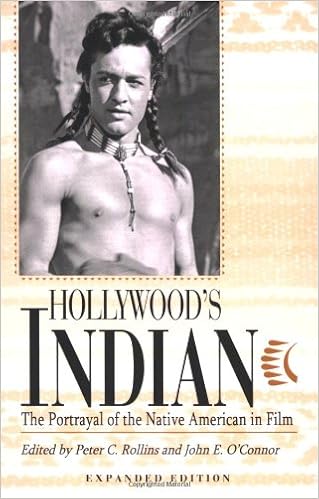
Comment: I read Hollywood's Indians and it's a solid academic-style book. Individual essays cover the usual milestones of 20th-century "Native" films: John Ford's movies, Broken Arrow, Tell Them Willie Boy Is Here, Little Big Man, Pow Wow Highway, Dances with Wolves, Last of the Mohicans, Pocahontas, Indian in the Cupboard, and Smoke Signals.
As with most anthologies, some of its essays are more compelling than others. And of course it doesn't address the independent Native filmmaking that's flourished since its 1999 publication date.
All in all, it's a useful but not essential book on Native-themed movies. Rob's rating: 7.0 of 10.
For more on the subject, see The Best Indian Movies.
Editorial Reviews
"Raises interesting issues and challenges readers to consider the complex realities of American Indian cultures and Indian/non-Indian relations that major motion pictures often fail to communicate." ―American Graduate
"Important and groundbreaking work." ―Bookman News
"Enables readers to construct a cinematic chronology of the Hollywood Indian and to comprehend the larger cultural forces at work interpreting the Indian-white past on screen." ―Choice
"Rollins and O'Connor have skillfully blended a variety of thoughtful viewpoints." ―Chronicles of Oklahoma
"A collection of quality essays, put together by two of the leading experts in this particular topic area." ―Communication Booknotes Quarterly
Comment: I read Hollywood's Indians and it's a solid academic-style book. Individual essays cover the usual milestones of 20th-century "Native" films: John Ford's movies, Broken Arrow, Tell Them Willie Boy Is Here, Little Big Man, Pow Wow Highway, Dances with Wolves, Last of the Mohicans, Pocahontas, Indian in the Cupboard, and Smoke Signals.
As with most anthologies, some of its essays are more compelling than others. And of course it doesn't address the independent Native filmmaking that's flourished since its 1999 publication date.
All in all, it's a useful but not essential book on Native-themed movies. Rob's rating: 7.0 of 10.
For more on the subject, see The Best Indian Movies.
April 18, 2016
Winged monkeys = Indians?
Winged MonkeysAccording to some writers, the Winged Monkeys of Oz represent Native Americans in the West in the late 1800s. Baum himself had clear attitudes toward American Indians and some of his earlier writings about Indians are very similar to his descriptions of the Winged Monkeys found in Oz. These selections included on this page are all from Ritter’s 1997 article about Oz.
When they are introduced in the book, the Winged Monkeys appear as a fierce fighting band that destroy the Scarecrow, damage the Tin Woodman, and capture Dorothy and the Cowardly Lion. Later, when the monkeys are no longer under the control of the Witch and are helping Dorothy and her group, the king monkey explains their origin to Dorothy:
“Once,” began the leader, “we were a free people, living happily in the great forest, flying from tree to tree, eating nuts and fruit, and doing just as we pleased without calling anybody master. Perhaps some of us were rather too full of mischief at times, flying down to pull the tails of the animals that had no wings, chasing birds, and throwing nuts at the people who walked in the forest. But we were careless and happy and full of fun, and enjoyed every minute of the day.” Another posting sees the analogies differently:
Indian-Hating in “The Wizard of Oz”
By Thomas St. JohnThe Winged Monkeys are the Irish Baum’s satire on the old Northwest Mounted Police, who were modelled on the Irish Constabulary. The scarlet tunic of the Mounties, and the distinctive “pillbox” forage cap with the narrow visor and strap are seen clearly in the color plate in the 1900 first edition of “The Wonderful Wizard of Oz”. Villagers across the Dakota territory heartily despised these British police, especially after 1877, when Sitting Bull retreated across the border and into their protection after killing Custer. And:The Wicked Witch of the West is illustrated in the 1900 first edition as a pickaninny, with beribboned, braided pigtails extended comically. Baum repeats the word “brown” in describing her. But this symbol’s real historic depth lies in the earlier Puritans’ confounding of European witches with the equally heathen American Indians.
The orphan Dorothy’s violent removal from Kansas civilization, her search for secret and magical cures for her friends, her capture, enslavement to an evil figure–and the killing of this figure that is forced on her–all these themes Baum takes from the already two hundred year old tradition of the Indian captivity narrative which stoked the fires of Indian-hating and its hope of “redemption through violence.” Comment: For more on the subject, see The Indian-Oz Connection.

When they are introduced in the book, the Winged Monkeys appear as a fierce fighting band that destroy the Scarecrow, damage the Tin Woodman, and capture Dorothy and the Cowardly Lion. Later, when the monkeys are no longer under the control of the Witch and are helping Dorothy and her group, the king monkey explains their origin to Dorothy:
“Once,” began the leader, “we were a free people, living happily in the great forest, flying from tree to tree, eating nuts and fruit, and doing just as we pleased without calling anybody master. Perhaps some of us were rather too full of mischief at times, flying down to pull the tails of the animals that had no wings, chasing birds, and throwing nuts at the people who walked in the forest. But we were careless and happy and full of fun, and enjoyed every minute of the day.”
Indian-Hating in “The Wizard of Oz”
By Thomas St. John
The orphan Dorothy’s violent removal from Kansas civilization, her search for secret and magical cures for her friends, her capture, enslavement to an evil figure–and the killing of this figure that is forced on her–all these themes Baum takes from the already two hundred year old tradition of the Indian captivity narrative which stoked the fires of Indian-hating and its hope of “redemption through violence.”
March 19, 2016
Fictional Potterverse vs. real Native religions
What J.K. Rowling’s New Story Can Teach Us About Cultural Appropriation
Rowling messed up big time. What next?
By Claire FallonReading and listening to Native American and First Nations activists, authors, and readers reacting to the treatment of their cultural heritage, certain important points keep emerging: “History of Magic in North America” relied on worn-out stereotypes that erase tribal distinctions, ignore the true cultures and traditions of different nations, and reinforce conceptions of Native American people as mystical beings rather than real people who continue to exist today. The story was shallow and poorly researched, not a detailed and thoughtful exploration of the histories of the peoples who have lived on this continent for centuries.
Scholar Amy H. Sturgis, who is of Cherokee descent, told me, “Some of her descriptions—the claim that the Native American wizarding community was ‘particularly gifted in animal and plant magic’ for instance—refer less to Native American cultural traditions than to stereotypes of the mystical Noble Savage that have been used for centuries by non-Natives to make Native Americans seem exotic and Other.”
Regarding the skinwalker narrative, which has garnered particular outrage, she noted that it was particularly troubling to see Rowling make use of a Navajo tradition “as legend, a smokescreen for ‘real’ magical history, and to divorce this tradition from its specific origins and apply it to all of Native America as a whole.”
One thing’s certain: Rowling didn’t have much idea what she was writing about, and it showed. “I don’t think she has the knowledge necessary to do justice to marginalized peoples,” Debbie Reese, a Nambe Pueblo Indian scholar, told me. (Reese writes the blog American Indians in Children’s Literature, which carefully reviews young people’s literature with representations of American Indians to tease out the often glaring misrepresentations, appropriations, and damaging stereotypes within.) The Rantin’ Raven: Harry Potter and the… WTF?
By Dana CorbyHere’s the problem, as I see it, I said: Ms. Rowling seems to be unaware that the cultures she talks about are real. That there are still living members of these still-living cultures whose cause and position in the real world are harmed by the publication of untruths about them–untruths that are too often unconsciously accepted by those not interested enough to look into them.
Most fantasy novels are set in an alternate universe, the future, the remote past, or in some other way are not part of the here-and-now. The fantasy becomes a shared game of “let’s pretend” and pretty much anything can go. But as eloquently pointed out by N.K. Jemisin in “It Could Have Been Great,” Rowling’s world purports to be a secret side of our real world, occurring in real time alongside everyday reality. The whole premise is that nobody who isn’t magical knows about those who are–with a few noted exceptions like the families of muggle-borns, of course. What a fun concept! But because it’s set in the real world, extra caution needs to be exercised not to do violence to what isn’t part of the fantasy.
It’s not just Rowling’s clueless assumption that belief in skin walkers was/is continent-wide rather than strictly a Diné belief, or her saying that “skin walker” is just an Indian word for animagus when in Diné culture they are living vectors of evil. It’s saying that non-magical Native medicine people were/are fakes. She’s talking about people outside her wizarding subculture, and suddenly it’s not fantasy anymore.
In all the Potter books, she never once so much as hints that Christianity and non-magical medicine might be fake, even when her wizarding characters are being condescending about the amazing ways muggles find to get along without magic. Christianity is assumed and respected in the Wizarding world, if not spoken of much, with crosses in the churchyard—and churches, for that matter—and St. Mungo’s Hospital. If Wizards aren’t Christians, how can there be a wizarding saint? Muggle medicine is shown to work fine for everything except magical maladies. But non-magical Indian medicine people are ‘fakes.’ Indians have been told this by Europeans for 500 years and it’s long past time we stopped doing it and they stopped being expected to tolerate it. Comment: For more on the subject, see Rowling Colonizes and Vanishes Indians and Rowling's Magic in North America. Also see:
Native People Respond to Rowling
Why it's more than fiction
Native People Respond to Jason Aaron's SCALPED and JK Rowling's Magic in North America
Rowling messed up big time. What next?
By Claire Fallon
Scholar Amy H. Sturgis, who is of Cherokee descent, told me, “Some of her descriptions—the claim that the Native American wizarding community was ‘particularly gifted in animal and plant magic’ for instance—refer less to Native American cultural traditions than to stereotypes of the mystical Noble Savage that have been used for centuries by non-Natives to make Native Americans seem exotic and Other.”
Regarding the skinwalker narrative, which has garnered particular outrage, she noted that it was particularly troubling to see Rowling make use of a Navajo tradition “as legend, a smokescreen for ‘real’ magical history, and to divorce this tradition from its specific origins and apply it to all of Native America as a whole.”
One thing’s certain: Rowling didn’t have much idea what she was writing about, and it showed. “I don’t think she has the knowledge necessary to do justice to marginalized peoples,” Debbie Reese, a Nambe Pueblo Indian scholar, told me. (Reese writes the blog American Indians in Children’s Literature, which carefully reviews young people’s literature with representations of American Indians to tease out the often glaring misrepresentations, appropriations, and damaging stereotypes within.)
By Dana Corby
Most fantasy novels are set in an alternate universe, the future, the remote past, or in some other way are not part of the here-and-now. The fantasy becomes a shared game of “let’s pretend” and pretty much anything can go. But as eloquently pointed out by N.K. Jemisin in “It Could Have Been Great,” Rowling’s world purports to be a secret side of our real world, occurring in real time alongside everyday reality. The whole premise is that nobody who isn’t magical knows about those who are–with a few noted exceptions like the families of muggle-borns, of course. What a fun concept! But because it’s set in the real world, extra caution needs to be exercised not to do violence to what isn’t part of the fantasy.
It’s not just Rowling’s clueless assumption that belief in skin walkers was/is continent-wide rather than strictly a Diné belief, or her saying that “skin walker” is just an Indian word for animagus when in Diné culture they are living vectors of evil. It’s saying that non-magical Native medicine people were/are fakes. She’s talking about people outside her wizarding subculture, and suddenly it’s not fantasy anymore.
In all the Potter books, she never once so much as hints that Christianity and non-magical medicine might be fake, even when her wizarding characters are being condescending about the amazing ways muggles find to get along without magic. Christianity is assumed and respected in the Wizarding world, if not spoken of much, with crosses in the churchyard—and churches, for that matter—and St. Mungo’s Hospital. If Wizards aren’t Christians, how can there be a wizarding saint? Muggle medicine is shown to work fine for everything except magical maladies. But non-magical Indian medicine people are ‘fakes.’ Indians have been told this by Europeans for 500 years and it’s long past time we stopped doing it and they stopped being expected to tolerate it.
Native People Respond to Rowling
Why it's more than fiction
Native People Respond to Jason Aaron's SCALPED and JK Rowling's Magic in North America
March 16, 2016
Rowling colonizes and vanishes Indians
Paquette: J.K. Rowling lifts Indigenous traditions but ignores history
By Aaron PaquetteRowling takes the more than 500 distinct Nations of North America and lumps them into a simplistic amalgam called “the Native American community.” She also appropriated the legend of Navajo skinwalkers (shape-shifters) without so much as a please or thank you and additionally painted some of the spiritual leaders of the Navajo as corrupt charlatans.
So what? The stories are fiction, right? What about books and movies about ancient Greek or Norse gods? Or leprechauns and vampires? Isn’t this the same?
Not really. No one believes in vampires.
Many Navajo take their beliefs seriously and regard knowledge of skinwalkers as sacrosanct–part of an interweaving expression of the Navajo worldview. These aren’t just stories, they’re ceremony, as significant today as they were in the past.
Rowling’s new foray is different than borrowing from old traditions no longer practised, or from cultures that are safe and thriving. She’s taking the property of a marginalized people for her own use simply because she can and wants to.
This is colonialism. Simply put, it’s cultural theft and these are not her stories to tell. The Colonization Effect In Rowling’s Magical American History
By Katie Majka“Harry Potter is fictional,” people have (and will continue to) insisted, and that’s true enough. But the history that Rowling has rewritten to suit that fictional world isn’t—that history is real and valid and important, and not to be used as a malleable narrative prop.
As a white person, I can’t sit here and say that what Rowling did was permissible; I can’t and won’t attempt to justify it, both because I don’t think it’s worthy of justification, and at the end of the day it has nothing to do with me, anyway, and everything to do with the Native peoples whom it affects. While I don’t think Rowling purposely set out to colonize Native American history, the point is that’s precisely what happened and it needs to be addressed by her. When any person sets out to explore a culture that isn’t their own, it’s that person’s responsibility to do the proper research, and that responsibility goes double for white people. We have a wide and vast history of colonization and cultural appropriation, which we still benefit from and are ignorant of (see: a few notable American sports teams/mascots, white people on Halloween, etc.) today. Native Americans to J.K. Rowling: We’re Not Magical
The author has come under fire for equating Navajo religious beliefs with the world of her fictional Harry Potter characters.
By Becky LittleThere is another, more subtle, layer to the depiction of Native Americans as magical, fictional beings—they end up being portrayed as though they don’t exist. Howe refers to this as “the trope of the vanishing Indian.”
“The vanishing American Indian is in art, it’s in stories—we’re the so-called Last of the Mohicans,” she says. “We exist in the minds of mainstream America as dead and forgotten because the white Americans won the American West.”
When native traditions are constantly depicted as relics, it gives the impression that those traditions—and the more than 5 million native people in the United States—don’t exist anymore. Think of the Native American characters you’ve encountered in books and movies. How many of them were portrayed as characters from the past, and how many of them were depicted as people in the modern world? (Modern characters that are also magical don’t count—I’m still looking at you, Twilight.)
On a more basic level, the stereotypes of the “vanishing Indian,” the magical medicine man, or even the noble savage dehumanize the people they profess to represent. Children read books to learn, but also to identify with the characters. For native children, this presents a problem if most of the images they see of themselves are otherworldly, long gone, or sports mascots.
“These stereotypes hurt us in terms of our human rights,” says Howe. “You cannot have civil rights, you can’t really have human rights or be thought of in a significant way, if you are invisible and you’re dead. So the trope of the vanishing American Indian is in a way undermining the humanity of native people because the assumption is we’re dead, or there’s just a few of us left.” Comment: For more on the subject, see Rowling's Magic in North America and Pocahontas in Harry Potter.
By Aaron Paquette
So what? The stories are fiction, right? What about books and movies about ancient Greek or Norse gods? Or leprechauns and vampires? Isn’t this the same?
Not really. No one believes in vampires.
Many Navajo take their beliefs seriously and regard knowledge of skinwalkers as sacrosanct–part of an interweaving expression of the Navajo worldview. These aren’t just stories, they’re ceremony, as significant today as they were in the past.
Rowling’s new foray is different than borrowing from old traditions no longer practised, or from cultures that are safe and thriving. She’s taking the property of a marginalized people for her own use simply because she can and wants to.
This is colonialism. Simply put, it’s cultural theft and these are not her stories to tell.
By Katie Majka
As a white person, I can’t sit here and say that what Rowling did was permissible; I can’t and won’t attempt to justify it, both because I don’t think it’s worthy of justification, and at the end of the day it has nothing to do with me, anyway, and everything to do with the Native peoples whom it affects. While I don’t think Rowling purposely set out to colonize Native American history, the point is that’s precisely what happened and it needs to be addressed by her. When any person sets out to explore a culture that isn’t their own, it’s that person’s responsibility to do the proper research, and that responsibility goes double for white people. We have a wide and vast history of colonization and cultural appropriation, which we still benefit from and are ignorant of (see: a few notable American sports teams/mascots, white people on Halloween, etc.) today.
The author has come under fire for equating Navajo religious beliefs with the world of her fictional Harry Potter characters.
By Becky Little
“The vanishing American Indian is in art, it’s in stories—we’re the so-called Last of the Mohicans,” she says. “We exist in the minds of mainstream America as dead and forgotten because the white Americans won the American West.”
When native traditions are constantly depicted as relics, it gives the impression that those traditions—and the more than 5 million native people in the United States—don’t exist anymore. Think of the Native American characters you’ve encountered in books and movies. How many of them were portrayed as characters from the past, and how many of them were depicted as people in the modern world? (Modern characters that are also magical don’t count—I’m still looking at you, Twilight.)
On a more basic level, the stereotypes of the “vanishing Indian,” the magical medicine man, or even the noble savage dehumanize the people they profess to represent. Children read books to learn, but also to identify with the characters. For native children, this presents a problem if most of the images they see of themselves are otherworldly, long gone, or sports mascots.
“These stereotypes hurt us in terms of our human rights,” says Howe. “You cannot have civil rights, you can’t really have human rights or be thought of in a significant way, if you are invisible and you’re dead. So the trope of the vanishing American Indian is in a way undermining the humanity of native people because the assumption is we’re dead, or there’s just a few of us left.”
March 10, 2016
Rowling's Magic in North America
JK Rowling's problems began with the first trailer for her expansion of the Harry Potter universe, Magic in North America:
“Magic in North America”: The Harry Potter franchise veers too close to home
By Adrienne KeeneI don’t really know what to say beyond my original letter, but I’ll reiterate it again. Native spirituality and religions are not fantasy on the same level as wizards. These beliefs are alive, practiced, and protected. The fact that the trailer even mentions the Navajo concept of skinwalkers sends red flags all over the place, and that it’s mentioned next to the Salem witch trials? Disaster. Even the visual imagery of the only humans shown in the trailer being a Native man and burning girls places the two too close for comfort.
We fight so hard every single day as Native peoples to be seen as contemporary, real, full, and complete human beings and to push away from the stereotypes that restrict us in stock categories of mystical-connected-to-nature-shamans or violent-savage-warriors. Colonization erases our humanity, tells us that we are less than, that our beliefs and religions are “uncivilized”, that our existence is incongruent with modernity. This is not ancient history, this is not “the past.” The ongoing oppression of Native peoples is reinscribed everyday through texts and images like this trailer. How in the world could a young person watch this and not make a logical leap that Native peoples belong in the same fictional world as Harry Potter? When Rowling released snippets of Magic in North America, Keene continued her analysis:
Magic in North America Part 1: Ugh.
By Adrienne KeenePart 1 of MinNA, The 14th to 17th century, starts with this:
Though European explorers called it ‘the New World’ when they first reached the continent, wizards had known about America long before Muggles (Note: while every nationality has its own term for ‘Muggle,’ the American community uses the slang term No-Maj, short for ‘No Magic’).
So first off, we’re centering Europeans, calling brutal colonizers benign “explorers” (yes, it’s written for children, but I don’t think anyone would argue the HP canon is absent of intense violence).
The Native American magical community and those of Europe and Africa had known about each other long before the immigration of European No-Majs in the seventeenth century.
“The Native American community.” Oh man that loaded “the.” One of the largest fights in the world of representations is to recognize Native peoples and communities and cultures are diverse, complex, and vastly different from one another.
The legend of the Native American ‘skin walker’–an evil witch or wizard that can transform into an animal at will–has its basis in fact. A legend grew up around the Native American Animagi, that they had sacrificed close family members to gain their powers of transformation.
What you do need to know is that the belief of these things (beings?) has a deep and powerful place in Navajo understandings of the world. It is connected to many other concepts and many other ceremonial understandings and lifeways. It is not just a scary story, or something to tell kids to get them to behave, it’s much deeper than that.
The magic wand originated in Europe.
Wands are a European invention, so basically she’s demonstrating Eurocentric superiority here–the introduction of European “technology” helps bring the Native wizards to a new level. AKA colonial narrative 101. Others quickly chimed in, often quoting Keene's remarks:
J.K. Rowling's New Story & Cultural Appropriation
By Carolyn L. Todd"No doubt you'll use the cloak of artistic license." Keene contended, "It's not 'your' world. It's our (real) Native world. And skin walker stories have context, roots, and reality."
And that, right there, is the issue, isn't it? Are we living in Rowling's world—where magic is real and all inspirations are fair game? Or are we occupying the real world, where there is a real heritage and history that merits respectful and accurate portrayals? And who gets to decide? Isn't Rowling the arbiter of her own universe? But then, aren't Native Americans entitled to ardently defend their culture and history, one that has been decimated in the real world and repeatedly mangled by pop culture?
I don't have the answer to these questions, and I won't pretend that I have the experience or knowledge to speak on the issue with any authority. What I can say for sure is that had I read this piece in a bubble, without knowing about the accusations of cultural appropriation beforehand, I probably wouldn't have thought twice about how the tale might affect Native Americans. J.K. Rowling's latest wizardry prompts criticism from Native Americans
UNDERSTANDING CULTURES: Harry Potter fans in Native American communities are disappointed with the depiction of their cultures and history in the British novelist's latest stories.
By Cathaleen ChenThe biggest challenge, Mr. Fleming tells The Monitor, was for Rowling to have recognized that charms, potions, and spirituality are already deeply entrenched in Native cultures.
“It’s very flattering that she would want to extend her world into [the Native American] world, but it’s not a very good fit, because it’s too good of a fit,” he explains. “What happens is that you’re taking an assumptive fictional community–the wizarding world–and you’re trying to apply it to a culture where it’s not an assumptive fictional world. There are elements that are believed and practiced.”
For instance, some Native tribes really do believe that “charms” have certain powers, and that “medicine men” can conjure supernatural abilities to heal wounds. But when Rowling renders such concepts in a fictional context, the pertinent cultures are thereby simplified, or even erased, to become stereotypes.
Rowling's depictions become all the more dangerous, Houska says, because these misconceptions of Native people already exist in American culture.
“Her fiction isn’t far off from what kids are learning in school books,” she says. Houska recalls being the only Native student in a school of white kids, and how discouraging it was to be taught a skewed version of her culture’s history. J.K. Rowling's History of Magic in North America Was a Travesty From Start to Finish
By Katharine TrendacostaOne of the many things that made Harry Potter so great was the specificity. Rowling was drawing on real places to create Wizarding Britain. It was all based on things she knew backward and forwards.
But American history and culture are not her fields. And the beliefs of the various Native American tribes and their histories was something she was especially not qualified to speak on. If you absolutely have to include these things, speak to some people.
Creating a second history for an existing place that is not your own is not easy. It requires a lot of research. Research Rowling clearly didn’t do. Comment: For more on the subject, see Pocahontas in Harry Potter.
“Magic in North America”: The Harry Potter franchise veers too close to home
By Adrienne Keene
We fight so hard every single day as Native peoples to be seen as contemporary, real, full, and complete human beings and to push away from the stereotypes that restrict us in stock categories of mystical-connected-to-nature-shamans or violent-savage-warriors. Colonization erases our humanity, tells us that we are less than, that our beliefs and religions are “uncivilized”, that our existence is incongruent with modernity. This is not ancient history, this is not “the past.” The ongoing oppression of Native peoples is reinscribed everyday through texts and images like this trailer. How in the world could a young person watch this and not make a logical leap that Native peoples belong in the same fictional world as Harry Potter?
Magic in North America Part 1: Ugh.
By Adrienne Keene
Though European explorers called it ‘the New World’ when they first reached the continent, wizards had known about America long before Muggles (Note: while every nationality has its own term for ‘Muggle,’ the American community uses the slang term No-Maj, short for ‘No Magic’).
So first off, we’re centering Europeans, calling brutal colonizers benign “explorers” (yes, it’s written for children, but I don’t think anyone would argue the HP canon is absent of intense violence).
The Native American magical community and those of Europe and Africa had known about each other long before the immigration of European No-Majs in the seventeenth century.
“The Native American community.” Oh man that loaded “the.” One of the largest fights in the world of representations is to recognize Native peoples and communities and cultures are diverse, complex, and vastly different from one another.
The legend of the Native American ‘skin walker’–an evil witch or wizard that can transform into an animal at will–has its basis in fact. A legend grew up around the Native American Animagi, that they had sacrificed close family members to gain their powers of transformation.
What you do need to know is that the belief of these things (beings?) has a deep and powerful place in Navajo understandings of the world. It is connected to many other concepts and many other ceremonial understandings and lifeways. It is not just a scary story, or something to tell kids to get them to behave, it’s much deeper than that.
The magic wand originated in Europe.
Wands are a European invention, so basically she’s demonstrating Eurocentric superiority here–the introduction of European “technology” helps bring the Native wizards to a new level. AKA colonial narrative 101.
J.K. Rowling's New Story & Cultural Appropriation
By Carolyn L. Todd
And that, right there, is the issue, isn't it? Are we living in Rowling's world—where magic is real and all inspirations are fair game? Or are we occupying the real world, where there is a real heritage and history that merits respectful and accurate portrayals? And who gets to decide? Isn't Rowling the arbiter of her own universe? But then, aren't Native Americans entitled to ardently defend their culture and history, one that has been decimated in the real world and repeatedly mangled by pop culture?
I don't have the answer to these questions, and I won't pretend that I have the experience or knowledge to speak on the issue with any authority. What I can say for sure is that had I read this piece in a bubble, without knowing about the accusations of cultural appropriation beforehand, I probably wouldn't have thought twice about how the tale might affect Native Americans.
UNDERSTANDING CULTURES: Harry Potter fans in Native American communities are disappointed with the depiction of their cultures and history in the British novelist's latest stories.
By Cathaleen Chen
“It’s very flattering that she would want to extend her world into [the Native American] world, but it’s not a very good fit, because it’s too good of a fit,” he explains. “What happens is that you’re taking an assumptive fictional community–the wizarding world–and you’re trying to apply it to a culture where it’s not an assumptive fictional world. There are elements that are believed and practiced.”
For instance, some Native tribes really do believe that “charms” have certain powers, and that “medicine men” can conjure supernatural abilities to heal wounds. But when Rowling renders such concepts in a fictional context, the pertinent cultures are thereby simplified, or even erased, to become stereotypes.
Rowling's depictions become all the more dangerous, Houska says, because these misconceptions of Native people already exist in American culture.
“Her fiction isn’t far off from what kids are learning in school books,” she says. Houska recalls being the only Native student in a school of white kids, and how discouraging it was to be taught a skewed version of her culture’s history.
By Katharine Trendacosta
But American history and culture are not her fields. And the beliefs of the various Native American tribes and their histories was something she was especially not qualified to speak on. If you absolutely have to include these things, speak to some people.
Creating a second history for an existing place that is not your own is not easy. It requires a lot of research. Research Rowling clearly didn’t do.
March 09, 2016
America "not a good country for gods"?
Why Adapting Neil Gaiman’s American Gods for TV Is a Bad Idea
By Abraham Riesman[P]erhaps most offensive, we'll get the book's Big Statement About America, which is bizarrely insulting to Native Americans. Near the end of the novel, a Native American with magical powers named Whiskey Jack tells Shadow he's not a god, but rather a "culture hero," because the land we call America "is not a good country for gods."
"There are creator spirits who found the earth or made it or shit it out, but you think about it: who's going to worship Coyote?" Whiskey Jack tells Shadow. "[W]e never built churches. We didn't need to."
Really? No houses of prayer? How, then, do you account for the Longhouses the Iroquois built for their prayer ceremonies? And no true gods that anyone bothered worshipping? That's an insane generalization about more than ten thousand years' worth of spiritual culture across an entire continent. American Gods by Neil Gaiman
By BrontëI wasn’t completely satisfied with the scope of the religions and cultures he represented. Of course, it would’ve been impossible for him to meaningfully represent every culture of the world in a 600-page novel, but most of the big characters from mythology were the easy choices, coming from popular European myth. It would’ve been nice to see a few more less popular, less Anglo-centric gods be given fleshed out stories or characters. There was almost nothing from South America. Does that count as part of the barren America?
Which brings me to the subject of Native American representation. Gaiman justifies his plot-integral proposition that gods don’t thrive well in the Americas by stating that Native religions were truly more about land-worship and idols than the creation of gods. I know little about most Native religions, but 1) that’s a broad statement and 2) that just doesn’t seem fair. Can we truly say that or is this a case of misrepresentation and the molding of a culture to the author’s needs? I’m inclined to say the latter. Mark Reads ‘American Gods’: Chapter 18
By Mark Oshiro“What I’m trying to say is that America is like that. It’s not good growing country for gods. They don’t grow well here. They’re like avocados trying to grow in wild rice country.”
And it proves to be a shockingly astute observation about the history of this place. There were plenty of indigenous people who lived in America long before white men came to bring disease and genocide, and I think that’s what he’s referring to. We are a nation built on imperialism and immigration, and what gods we did have that were grown here were lost in the genocide against the Native peoples. (Obviously not entirely, because there are still Native Americans living all over this country, many who still believe in the same gods, some who believe in new ones, and some who don’t believe in any at all. I’m not a fan of language about Native peoples that paints them as if they just up and ~disappeared~.) Comment: "Not entirely" is putting it mildly. Thousands of Native cultures still exist in North, Central, and South America. Their gods probably have more true believers than Thoth, Anubis, Ēostre, the Queen of Sheba, and kobolds do.
So how does Gaiman figure that America failed to produce gods while the "Old World" succeeded? The only significant religions left in Europe and the Middle East are the worldwide ones: Christianity, Islam, Judaism, Buddhism, Hinduism, Jainism, Sikhism. The indigenous or "pagan" religions are mostly gone.
For more on American Gods, see Whiskey Jack in American Gods.
By Abraham Riesman
"There are creator spirits who found the earth or made it or shit it out, but you think about it: who's going to worship Coyote?" Whiskey Jack tells Shadow. "[W]e never built churches. We didn't need to."
Really? No houses of prayer? How, then, do you account for the Longhouses the Iroquois built for their prayer ceremonies? And no true gods that anyone bothered worshipping? That's an insane generalization about more than ten thousand years' worth of spiritual culture across an entire continent.
By Brontë
Which brings me to the subject of Native American representation. Gaiman justifies his plot-integral proposition that gods don’t thrive well in the Americas by stating that Native religions were truly more about land-worship and idols than the creation of gods. I know little about most Native religions, but 1) that’s a broad statement and 2) that just doesn’t seem fair. Can we truly say that or is this a case of misrepresentation and the molding of a culture to the author’s needs? I’m inclined to say the latter.
By Mark Oshiro
And it proves to be a shockingly astute observation about the history of this place. There were plenty of indigenous people who lived in America long before white men came to bring disease and genocide, and I think that’s what he’s referring to. We are a nation built on imperialism and immigration, and what gods we did have that were grown here were lost in the genocide against the Native peoples. (Obviously not entirely, because there are still Native Americans living all over this country, many who still believe in the same gods, some who believe in new ones, and some who don’t believe in any at all. I’m not a fan of language about Native peoples that paints them as if they just up and ~disappeared~.)
So how does Gaiman figure that America failed to produce gods while the "Old World" succeeded? The only significant religions left in Europe and the Middle East are the worldwide ones: Christianity, Islam, Judaism, Buddhism, Hinduism, Jainism, Sikhism. The indigenous or "pagan" religions are mostly gone.
For more on American Gods, see Whiskey Jack in American Gods.
March 08, 2016
Whiskey Jack in American Gods
With Starz planning a TV series of Neil Gaiman's American Gods, it's a good time to review the novel's Native aspects. It's been awhile since I read it, but I believe Whiskey Jack is the most prominent Native character:
WisakedjakWisakedjak (Wìsakedjàk in Algonquin, Wīhsakecāhkw in Cree and Wiisagejaak in Oji-cree) is the Crane Manitou found in northern Algonquian and Dene storytelling, similar to the trickster god Nanabozho in Ojibwa aadizookaanan (sacred stories) and Inktonme in Assiniboine myth. He is generally portrayed as being responsible for a great flood which destroyed the world originally made by the Creator, as well as the one who created the current world with magic, either on his own or with powers given to him by the Creator for that specific purpose.
Wisakedjak is a character in the book American Gods by Neil Gaiman, where he is frequently referred to as "Whiskey Jack" as a corruption of the name. In the book, he appears as a native old man, who lives in a mobile home, somewhere near a Lakota reservation in the badlands with Johnney Appleseed. Comment: For more on Neil Gaiman, see Gaiman Wrong on Graveyard Book and Neil Gaiman on "Dead Indians."
Wisakedjak
Wisakedjak is a character in the book American Gods by Neil Gaiman, where he is frequently referred to as "Whiskey Jack" as a corruption of the name. In the book, he appears as a native old man, who lives in a mobile home, somewhere near a Lakota reservation in the badlands with Johnney Appleseed.
December 21, 2015
How accurate is Longmire?
How accurate is the portrayal of Native Americans in the series of books by Craig Johnson featuring the character Walt Longmire, and the television show Longmire?
By Robert P. CollinsMy impression is that the series has gotten better over time, as some of the Indian characters have become more central to the plot. At first, the character of Henry Standing Bear, Sheriff Longmire's Cheyenne friend, was too much like a sidekick: an updated Tonto to Walt Longmire's Lone Ranger. Some of what we learned about Henry during Season 1 seemed to draw on stereotypes. For example, I laughed out loud at the revelation that Henry was a natural born tracker. The idea of Indians as having a mystic ability to follow tracks is an old, dumb stereotype that rests on a notion that Indians are less fully human than whites, closer to wild animals, with heightened senses. It’s not as if Henry were the greatest outdoorsman around. He earns his living by running a bar.
I also felt that the first season was too formulaic in making Henry the "friendly" Indian who helped the white lawman, while Matthias, the reservation police chief, was "hostile," always erecting obstacles to the white hero's progress. But this too has gotten better over time. But:White people who hear of the sun dance are liable to be impressed (as I was at first) with the apparent macho exhibitionism of this ritual. That's certainly how Longmire played it: After Walt finds that his only child, Cady, is in the hospital in critical condition, he feels personally responsible and resolves to do something. White people (like me) are known for being spiritually indifferent until disaster strikes; then we try to make a deal with God. Walt decides to make a deal with the Great Spirit. He'll do a sun dance in exchange for his daughter's life, and he'll do it right now, because he needs results. And he'll do it solo, because he's a cowboy and that's the way he rolls.
But white people are wrong about the sun dance. It is not a macho exhibition, and it can't be done solo. A sun dancer needs to prepare himself, and he needs the support of many others or it is believed the ritual won't work. So a sun dancer can't just cowboy-waltz up to a pole and lash himself to it. He has to fast for days, pray with a pipe, and have others pray with him.
So it was hard to believe that Walt's Cheyenne best friend would encourage him not only to perform a sun dance, but to do it now and to do it solo. Sure, I know that Walt is supposed to be the ultimate rugged individualist. But this is ridiculous. Comment: For more on the subject, see Review of The Cold Dish.
By Robert P. Collins
I also felt that the first season was too formulaic in making Henry the "friendly" Indian who helped the white lawman, while Matthias, the reservation police chief, was "hostile," always erecting obstacles to the white hero's progress. But this too has gotten better over time.
But white people are wrong about the sun dance. It is not a macho exhibition, and it can't be done solo. A sun dancer needs to prepare himself, and he needs the support of many others or it is believed the ritual won't work. So a sun dancer can't just cowboy-waltz up to a pole and lash himself to it. He has to fast for days, pray with a pipe, and have others pray with him.
So it was hard to believe that Walt's Cheyenne best friend would encourage him not only to perform a sun dance, but to do it now and to do it solo. Sure, I know that Walt is supposed to be the ultimate rugged individualist. But this is ridiculous.
November 12, 2015
Review of Crazy Horse's Girlfriend
Crazy Horse's GirlfriendMargaritte is a sharp-tongued, drug-dealing, sixteen-year-old Native American floundering in a Colorado town crippled by poverty, unemployment, and drug abuse. She hates the burnout, futureless kids surrounding her and dreams that she and her unreliable new boyfriend can move far beyond the bright lights of Denver that float on the horizon before the daily suffocation of teen pregnancy eats her alive.
About the Author
Erika T. Wurth is Apache/Chickasaw/Cherokee and was raised on the outskirts of Denver. She teaches creative writing at Western Illinois University and was a writer-in-residence at the Institute of American Indian Arts.
Crazy Horse's Girlfriend: gripping, heart-wrenching narrative
By Story Circle Book Reviews on September 1, 2014
Sixteen-year-old Margaritte is constantly planning an escape route from her miserable circumstances. A mix of Apache, Chickasaw, Cherokee, and white, she finds her Idaho Springs, Colorado, home nothing less than depressing. Beyond ennui at home, Margaritte has to deal with the daily stress of her volatile alcoholic father and a mother who can be equally explosive, while helping care for her innocent six-year-old twin sisters. She's tired of living on the cusp of poverty, as well as being surrounded by teens who have no future aspirations. High on their chart of escapism is drugs and alcohol, while many girls succumb to teenage pregnancy--a statistic that Margaritte has no intention of becoming. Ironically, Margaritte, who drinks and smokes pot, sees the wads of cash she hopes to bring in as a drug dealer and her new love, Mike Walker, as the ticket out of her loathsome life. Yet the hope of a brighter future suddenly appears dismal when Margaritte learns that she's pregnant.
In her debut novel, Wurth has created a plethora of hardened teens and their means of survival in unforgiving conditions. The story's protagonist narrator is Margaritte, whose insistence on not becoming a loser truly earmarks her as an underdog, as she struggles to go against the grain of her impoverished society. The language Wurth uses, which includes Lakota terminology, is raw and visceral, reflecting just how tough these teens are, especially Margaritte.
Kudos to Wurth for producing a gripping and heart-wrenching narrative that is not only a must read for young adult and older readers, but also a wonderful addition to Native American literature.
No heroes; just choices.
By Elizabeth Harper on December 23, 2014
I thoroughly enjoyed this book and found it relevant, especially its description of the torment and ambivalence involved in making life decisions in messy, difficult, imperfect circumstances. The main character is engaging and sympathetic. Highly recommended for anyone interested in domestic violence, social policy, young adults, Native Americans, alcoholism, and drug addiction.
The prose is gritty and hard, but soul is there as well.
By D. S. Atkinson on October 4, 2014
I love the voice in this book. The prose is gritty and hard, but soul is there as well. Whether you're in it for the grit or the soul, or in it for both like me, I don't think you can help but dig this one. It's particularly impressive for a first novel. Rob's review
I'd say Crazy Horse's Girlfriend was a solid entry in the Native American category for YA fiction. It's about as good as it gets for depictions of gritty, urban Indian life. Perhaps because Wurth grew up in this environment, I could easily believe in it.
A few problems in non-Native areas kept me from deeming this an exceptional story:
Her main support system is her cousin Jake and her best friend Julia, but these characters disappear for most of the novel. Margaritte ends up relying on secondary characters and predictably bonding with them.
Margaritte is supposedly an experienced drug dealer who hangs around with druggies, but doesn't recognizes the signs of drug abuse in her boyfriend Mike. If a straight arrow like me sees the problem before she does, that's bad.
Margaritte supposedly loves reading, but she's never shown reading and spends no significant time at it. As someone who was a 16-year-old reader like her, I can tell you: you don't finish thick Stephen King novels by osmosis. You have to spend a lot of time--e.g., six hours a day on weekends--to be a serious reader.
Moreover, she says she doesn't know words such as "repugnant" and has to look them up in a dictionary. These words should be part of a teenage reader's vocabulary well before age 16.
Margaritte's overriding concern is to avoid becoming a teenage mom like her mother was. But when Mike proposes having unprotected sex because he did it once and the girl didn't become pregnant, Margaritte naively believes him. This badly contradicts what we know of her character.
The "everything's looking up" ending seems more appropriate for a sappy suburban tale than a gritty urban one. It's predictable enough for a cautionary "Afternoon Special."
The phrase "Crazy Horse's Girlfriend" is a slur applied to a gay Lakota man. It seems weirdly inappropriate to use it for a straight Lakota woman.
Despite these comments, I enjoyed Crazy Horse's Girlfriend. Rob's rating: 7.5 of 10.

About the Author
Erika T. Wurth is Apache/Chickasaw/Cherokee and was raised on the outskirts of Denver. She teaches creative writing at Western Illinois University and was a writer-in-residence at the Institute of American Indian Arts.
Crazy Horse's Girlfriend: gripping, heart-wrenching narrative
By Story Circle Book Reviews on September 1, 2014
Sixteen-year-old Margaritte is constantly planning an escape route from her miserable circumstances. A mix of Apache, Chickasaw, Cherokee, and white, she finds her Idaho Springs, Colorado, home nothing less than depressing. Beyond ennui at home, Margaritte has to deal with the daily stress of her volatile alcoholic father and a mother who can be equally explosive, while helping care for her innocent six-year-old twin sisters. She's tired of living on the cusp of poverty, as well as being surrounded by teens who have no future aspirations. High on their chart of escapism is drugs and alcohol, while many girls succumb to teenage pregnancy--a statistic that Margaritte has no intention of becoming. Ironically, Margaritte, who drinks and smokes pot, sees the wads of cash she hopes to bring in as a drug dealer and her new love, Mike Walker, as the ticket out of her loathsome life. Yet the hope of a brighter future suddenly appears dismal when Margaritte learns that she's pregnant.
In her debut novel, Wurth has created a plethora of hardened teens and their means of survival in unforgiving conditions. The story's protagonist narrator is Margaritte, whose insistence on not becoming a loser truly earmarks her as an underdog, as she struggles to go against the grain of her impoverished society. The language Wurth uses, which includes Lakota terminology, is raw and visceral, reflecting just how tough these teens are, especially Margaritte.
Kudos to Wurth for producing a gripping and heart-wrenching narrative that is not only a must read for young adult and older readers, but also a wonderful addition to Native American literature.
No heroes; just choices.
By Elizabeth Harper on December 23, 2014
I thoroughly enjoyed this book and found it relevant, especially its description of the torment and ambivalence involved in making life decisions in messy, difficult, imperfect circumstances. The main character is engaging and sympathetic. Highly recommended for anyone interested in domestic violence, social policy, young adults, Native Americans, alcoholism, and drug addiction.
The prose is gritty and hard, but soul is there as well.
By D. S. Atkinson on October 4, 2014
I love the voice in this book. The prose is gritty and hard, but soul is there as well. Whether you're in it for the grit or the soul, or in it for both like me, I don't think you can help but dig this one. It's particularly impressive for a first novel.
I'd say Crazy Horse's Girlfriend was a solid entry in the Native American category for YA fiction. It's about as good as it gets for depictions of gritty, urban Indian life. Perhaps because Wurth grew up in this environment, I could easily believe in it.
A few problems in non-Native areas kept me from deeming this an exceptional story:
Moreover, she says she doesn't know words such as "repugnant" and has to look them up in a dictionary. These words should be part of a teenage reader's vocabulary well before age 16.
Despite these comments, I enjoyed Crazy Horse's Girlfriend. Rob's rating: 7.5 of 10.
September 28, 2015
Review of Time Spike
Time Spike (The Ring of Fire)Captain Andrew Blacklock was overseeing the change of shifts at the state of Illinois’ maximum-security prison when the world outside was suddenly ripped. They thought it was an earthquake until they found that the Mississippi river had disappeared, along with all signs of civilization. Then the sun came up—in the wrong direction. And a dinosaur came by and scratched its hide against the wall of the prison . . .
Something had thrown the prison back in time millions of years. And they were not alone. Other humans from periods centuries, even millennia apart had also been dropped into the same time. Including a band of murderous conquistadores. But the prison had its own large population of murderers. They couldn’t be turned loose, but what else could be done with them? Death walked outside the walls, human savagery was planning to break loose inside, and Blacklock and the other men and women of the prison’s staff were trapped in the middle. Native aspects
The "time spike" phenomenon sends people from every era of southern Illinois back through time. They include:
"Primitive" Indians from the prehistoric Mound Builders The entire city now known as Cahokia Hernando de Soto and his band of conquistadors Cherokee refugees on the Trail of Tears and the US soldiers escorting them
Only a few of the Cherokee refugees get any significant time. They're reasonably well-fleshed out. Everyone else is one-dimensional, alas. The "primitive" Indians are scared and overwhelmed by the more modern people. The Cahokia residents (mentioned, not shown) are religious fanatics. The conquistadors are psychopathic butchers. And the Cherokee refugees include an incredibly stealthy tracker and an incredibly sensitive healer.
In short, everyone except a few exceptions is a type. The modern-day characters are almost all three-dimensional, while the characters from the past aren't.
There's also a Cherokee inmate who was wrongly convicted. He's mostly three-dimensional too, but he's especially crafty and good at surviving. I don't know if this is a subtle nod to his Native ancestry or not, but it's a shame there are no average Indians. They're all way above or below average.
As for the rest of the book, Time Spike is good overall. It deals realistically with the problems of being sent back in time with only the supplies and skill-sets on hand and 2,000 prisoners behind bars. Only toward the end does it let down a little. Most of the conflicts get settled with guns and violence, not with the intelligence and foresight seen earlier.
Rob's rating: 8.0 of 10.

Something had thrown the prison back in time millions of years. And they were not alone. Other humans from periods centuries, even millennia apart had also been dropped into the same time. Including a band of murderous conquistadores. But the prison had its own large population of murderers. They couldn’t be turned loose, but what else could be done with them? Death walked outside the walls, human savagery was planning to break loose inside, and Blacklock and the other men and women of the prison’s staff were trapped in the middle.
The "time spike" phenomenon sends people from every era of southern Illinois back through time. They include:
Only a few of the Cherokee refugees get any significant time. They're reasonably well-fleshed out. Everyone else is one-dimensional, alas. The "primitive" Indians are scared and overwhelmed by the more modern people. The Cahokia residents (mentioned, not shown) are religious fanatics. The conquistadors are psychopathic butchers. And the Cherokee refugees include an incredibly stealthy tracker and an incredibly sensitive healer.
In short, everyone except a few exceptions is a type. The modern-day characters are almost all three-dimensional, while the characters from the past aren't.
There's also a Cherokee inmate who was wrongly convicted. He's mostly three-dimensional too, but he's especially crafty and good at surviving. I don't know if this is a subtle nod to his Native ancestry or not, but it's a shame there are no average Indians. They're all way above or below average.
As for the rest of the book, Time Spike is good overall. It deals realistically with the problems of being sent back in time with only the supplies and skill-sets on hand and 2,000 prisoners behind bars. Only toward the end does it let down a little. Most of the conflicts get settled with guns and violence, not with the intelligence and foresight seen earlier.
Rob's rating: 8.0 of 10.
September 18, 2015
Review of Rocky Road to Romance
The Rocky Road to RomanceThe author of so many spectacularly successful mystery novels featuring the inimitable Stephanie Plum, #1 New York Times bestselling author Janet Evanovich displays a more playfully romantic side with The Rocky Road to Romance. Evanovich delights with a classic, pre-Plum contemporary romance novel that’s sure to please—a lighthearted tale of three-way love affair involving a radio “dog lady”-turned-traffic reporter, her handsome program director, and a huge couch potato canine named Bob.
From the Back Cover
Her tall, dark, and deliciously dangerous boss . . .
When the delightful, daffy Dog Lady of station WZZZ offered to take on the temporary job of traffic reporter, Steve Crow tried to think of reasons to turn Daisy Adams down. Perhaps he knew that sharing the close quarters of a car with her for hours would give the handsome program director no room to resist her quirky charms. He'd always favored low-slung sportscars and high-heeled women, but that was before he fell for a free spirit who caught crooks by accident, loved old people and pets, and had just too many jobs!
Loving Daisy turned Steve's life upside down, especially once he adopted Bob, a huge dog masquerading as a couch potato. But was Daisy finally ready to play for keeps? The Rocky Road to Romance (Elsie Hawkins #4)Bark's Book Nonsense rated it 3 of 5 stars
I picked this oldie out of the bag of audios rattling around in my hatch because I wanted something fluff filled for my latest car read and that’s exactly what I got. If you’ve read any of her romances you’ll know what I mean. They’re fun while you’re listening but pretty forgettable once finished.
sarafem rated it 3 of 5 stars
As with most romance novels, I found it a little condescending and obnoxious that things moved so quickly and yet so perfectly. Suspension of belief is one thing, overdoing a fairy tale that makes me uncomfortable in the first place is a whole other.
Carrie rated it 4 of 5 stars
The story contains many romance cliches which are stripped down to the bare essentials. None of the characters, including the dog, and few of the situations are believable, but they're fun. Several of these early works have a hero that falls in love instantly and decides he's going to marry the heroine. Native aspects
Steve Crow is an Indian--a full-blooded one, I think. He's described as a classic bad boy with brooding good looks.
He and his family are oil tycoons, which suggests they're Osage Indians. Judging by how Crow buys a house and an SUV for cash, they're multimillionaires. Which makes his job as a radio station manager, worrying about traffic reports, a little unbelievable.
Crow never says or does anything "Native." Daisy meets his parents, but they're no different from other rich people. The most we learn about Crow's Native background is when he talks about visiting his grandfather. Grandfather lived in a trailer on the reservation, for some reason, and imparted words of wisdom to young Crow.
Anyway, Evanovich's portrayal of Crow isn't bad. As you'd expect of a handsome young rich man, he's cocky and spoiled--used to getting his way. His main attraction to Daisy seems to be lust, not love. All this is a refreshing change from the usual stoic veteran/warrior/tortured soul.
As for the rest of the book, Steve and Daisy both seem a little shallow, so perhaps they deserve each other. Steve's macho protectiveness, which he can afford only because he's rich, gets annoying. But parts of the book are, as they say, a hoot. Rob's rating: 7.5 of 10.

From the Back Cover
Her tall, dark, and deliciously dangerous boss . . .
When the delightful, daffy Dog Lady of station WZZZ offered to take on the temporary job of traffic reporter, Steve Crow tried to think of reasons to turn Daisy Adams down. Perhaps he knew that sharing the close quarters of a car with her for hours would give the handsome program director no room to resist her quirky charms. He'd always favored low-slung sportscars and high-heeled women, but that was before he fell for a free spirit who caught crooks by accident, loved old people and pets, and had just too many jobs!
Loving Daisy turned Steve's life upside down, especially once he adopted Bob, a huge dog masquerading as a couch potato. But was Daisy finally ready to play for keeps?
I picked this oldie out of the bag of audios rattling around in my hatch because I wanted something fluff filled for my latest car read and that’s exactly what I got. If you’ve read any of her romances you’ll know what I mean. They’re fun while you’re listening but pretty forgettable once finished.
sarafem rated it 3 of 5 stars
As with most romance novels, I found it a little condescending and obnoxious that things moved so quickly and yet so perfectly. Suspension of belief is one thing, overdoing a fairy tale that makes me uncomfortable in the first place is a whole other.
Carrie rated it 4 of 5 stars
The story contains many romance cliches which are stripped down to the bare essentials. None of the characters, including the dog, and few of the situations are believable, but they're fun. Several of these early works have a hero that falls in love instantly and decides he's going to marry the heroine.
Steve Crow is an Indian--a full-blooded one, I think. He's described as a classic bad boy with brooding good looks.
He and his family are oil tycoons, which suggests they're Osage Indians. Judging by how Crow buys a house and an SUV for cash, they're multimillionaires. Which makes his job as a radio station manager, worrying about traffic reports, a little unbelievable.
Crow never says or does anything "Native." Daisy meets his parents, but they're no different from other rich people. The most we learn about Crow's Native background is when he talks about visiting his grandfather. Grandfather lived in a trailer on the reservation, for some reason, and imparted words of wisdom to young Crow.
Anyway, Evanovich's portrayal of Crow isn't bad. As you'd expect of a handsome young rich man, he's cocky and spoiled--used to getting his way. His main attraction to Daisy seems to be lust, not love. All this is a refreshing change from the usual stoic veteran/warrior/tortured soul.
As for the rest of the book, Steve and Daisy both seem a little shallow, so perhaps they deserve each other. Steve's macho protectiveness, which he can afford only because he's rich, gets annoying. But parts of the book are, as they say, a hoot. Rob's rating: 7.5 of 10.
September 12, 2015
"White" = ordinary and bland
You may have heard of this controversy. A white poet gave himself a Chinese name to get his poem published. It entered the Native consciousness because Sherman Alexie was the editor who selected the poem.
You can Google the controversy, but here's an interesting take on why so many white people wanna be something or someone else.
White guys’ yellowface envy: Underneath bizarre acts of racial subterfuge lurks a twisted desire to stand out
Michael Derrick Hudson believed he had a better shot at literary stardom as "Yi-Fen Chou"—and he's not alone
By Arthur ChuTom MacMaster’s viral hoax, interestingly, started with random posts arguing with strangers on the Internet and the skeleton of a novel–just innocently experimenting with trying on an identity more exciting than “boring white dude” and increasingly becoming addicted to it. His outing led to the outing of “Paula Brooks,” the lesbian founder of the Lez Get Real blog that hosted Arraf’s writings, as married straight man Bill Graber. Graber’s justification for his deception was similar to MacMaster’s–he was passionate on LGBT issues but felt his own stance as a sympathetic straight ally wasn’t interesting enough to hold people’s attention. He needed to fabricate a version of himself, a younger gay woman, who had life experience, who had credibility, who was less ordinary than him.
Look at the discussed-to-death case of Rachel Dolezal–keeping in mind that whatever reasons she gives for identifying as “transracial” today, she sued Howard University in 2001 because she thought her artwork was overlooked because she was white. Look at William Ellsworth Robinson, a.k.a. Chung Ling Soo, a stage magician so hungry for success that he ripped off not just the act and the shtick but the entire identity of rival Chinese magician Chung Ling Foo. Look at the stunt Kent Johnson pulled on the poetry world in the 1990s as “Araki Yasusada,” giving his poems the added historical weight of supposedly coming from the recovered notebook of a Hiroshima survivor. Take the mysterious, reclusive woman playwright who writes about women characters, Jane Martin, widely suspected to be well-known director Jon Jory using a pseudonym.
It’s an identifiable pattern. A white man in the arts trying to be someone other than a white man in the arts. A creative person, an artist, who wants their art to mean something because of their unique life experience–growing up in war-torn Syria, being taught magic by Chinese mystics, fleeing the aftermath of the Hiroshima bombing–rather than being the result of the boring, workaday process of making shit up.
“Whiteness,” after all, in our racial system simply means ordinariness, unmarkedness, blankness. Same with maleness–being a guy means getting to be the default, being just a “writer” rather than a “female writer,” being just “in tech” rather than a “woman in tech”.
Ordinariness has tons of advantages. Being seen as ordinary means you don’t get stopped for shoplifting, it means you don’t get detained or shot or left to die in prison nearly as often. People don’t think twice before reading your résumé or renting your AirBNB. It’s much easier for you to wear what you want and buy what you want and live how you want without getting shit for it.
But ordinariness that’s maintained by constantly comparing yourself to other people who are not ordinary can be stifling. “Whiteness” can mean, in people’s minds, that you’re basic–that you’re a sheltered, boring person, that your point of view is the same as the default point of view everyone else has already heard, that you’ve got nothing interesting to say compared to what an exciting exotic foreigner might say. It’s a powerful force, the force that drives this thing we call “cultural appropriation,” this thing that makes people insist their little “affirmative action” scheme is what’s getting them published, this thing that makes other people concoct elaborate hoaxes almost guaranteed to blow up in their faces. Comment: See also Ward Churchill, Elizabeth Warren, Andrea Smith, and every other wannabe who (usually) claims to be Cherokee.
For more on Indian wannabes, see Manson = West Virginia Sioux? and Andrea Smith the White Savior.
You can Google the controversy, but here's an interesting take on why so many white people wanna be something or someone else.
White guys’ yellowface envy: Underneath bizarre acts of racial subterfuge lurks a twisted desire to stand out
Michael Derrick Hudson believed he had a better shot at literary stardom as "Yi-Fen Chou"—and he's not alone
By Arthur Chu
Look at the discussed-to-death case of Rachel Dolezal–keeping in mind that whatever reasons she gives for identifying as “transracial” today, she sued Howard University in 2001 because she thought her artwork was overlooked because she was white. Look at William Ellsworth Robinson, a.k.a. Chung Ling Soo, a stage magician so hungry for success that he ripped off not just the act and the shtick but the entire identity of rival Chinese magician Chung Ling Foo. Look at the stunt Kent Johnson pulled on the poetry world in the 1990s as “Araki Yasusada,” giving his poems the added historical weight of supposedly coming from the recovered notebook of a Hiroshima survivor. Take the mysterious, reclusive woman playwright who writes about women characters, Jane Martin, widely suspected to be well-known director Jon Jory using a pseudonym.
It’s an identifiable pattern. A white man in the arts trying to be someone other than a white man in the arts. A creative person, an artist, who wants their art to mean something because of their unique life experience–growing up in war-torn Syria, being taught magic by Chinese mystics, fleeing the aftermath of the Hiroshima bombing–rather than being the result of the boring, workaday process of making shit up.
“Whiteness,” after all, in our racial system simply means ordinariness, unmarkedness, blankness. Same with maleness–being a guy means getting to be the default, being just a “writer” rather than a “female writer,” being just “in tech” rather than a “woman in tech”.
Ordinariness has tons of advantages. Being seen as ordinary means you don’t get stopped for shoplifting, it means you don’t get detained or shot or left to die in prison nearly as often. People don’t think twice before reading your résumé or renting your AirBNB. It’s much easier for you to wear what you want and buy what you want and live how you want without getting shit for it.
But ordinariness that’s maintained by constantly comparing yourself to other people who are not ordinary can be stifling. “Whiteness” can mean, in people’s minds, that you’re basic–that you’re a sheltered, boring person, that your point of view is the same as the default point of view everyone else has already heard, that you’ve got nothing interesting to say compared to what an exciting exotic foreigner might say. It’s a powerful force, the force that drives this thing we call “cultural appropriation,” this thing that makes people insist their little “affirmative action” scheme is what’s getting them published, this thing that makes other people concoct elaborate hoaxes almost guaranteed to blow up in their faces.
For more on Indian wannabes, see Manson = West Virginia Sioux? and Andrea Smith the White Savior.
August 15, 2015
Vanishing Indians in As an Oak Tree Grows
Rewriting History: American Indians, Europeans, and an Oak Tree (Loudness in the Library Year Three, Part 3)
By Bank Street College Center for Children's LiteratureI did a double-take when I cracked open As An Oak Tree Grows*, a 2014 book that inaccurately reflects the history of European and Native American interactions. In the story, which traces the life of an oak tree (planted as an acorn by a young Native boy), the Native character simply disappears as the Europeans move in. Bank Street students, who participate in extensive curricula on unlearning Native stereotypes, immediately recognized this as problematic, because it erases the conflicts and violence that arose when Native people fought to defend their homes and land from colonial invasion. As one student noted,
“Because it’s a children’s book, they wanted to make it ‘nicer.’ ”
Working together, teachers and kids identified three primary areas of concern with As An Oak Tree Grows:
The pictures show a lot of empty land, as if it was uninhabited; one wigwam appears in the first two pages, alongside a vast wilderness. 
Where is the Native child’s community? The pictures send the message that the land was largely empty and there for the taking. Students said:
“If you don’t give kids the right images, they get the wrong ideas.”
“If kids don’t see other stories, they might think this is the truth.”
“These books shape a child’s mind.”
“The illustrations should show more of the truth.”
Then, there’s this text:
“The boy grew up and moved away.”
Kids were puzzled because they knew that the larger story of Native/European interaction is one in which Europeans forcibly removed and/or killed huge portions of Native populations.
“‘The boy grew up and moved away’? That didn’t happen.”
“They were there first. It is very unlikely that the boy just moved away.” Vanishing Indian = "detail"?
This posting led to a lively exchange of views in the comments section. First, a defense of the book:I am all for diversity and truth in literature but not every single story has to contain all the details about every situation. I’ve read this wonderful book–about a tree–and if you’re concentrating on how many wigwams are in the picture or whether the boy moved away or his throat was slit and he was buried in a mud bog, you’re missing the point. The story is about a tree. A tree that is manages to live long enough to witness a lot of things, good and bad. A child, reading about this tree does not need to know the details of what went on while the tree was alive. It’s inappropriate and distracting to include so much extraneous detail when the story is meant to be so simple and beautiful. I agree that children can and should be included in the true story of what goes on in life….in the appropriate venue. G. Brian Karas is a wonderful author and a gifted artist and I hate to see his work held hostage by people who wish he’d made their choices. It’s part of the trend of censorship in the guise of political correctness. His book, his choices. Mr. Karas, you’ve created an amazing book. Don’t bend over backwards to please everyone else. You’ll only end just bending over. Followed by a rebuttal:The fact that you dismiss the history of violence that Europeans enacted against Native populations as “details” that cause me to “miss the point” of the book sends the message that you, in fact, are missing the point of this post. The point is, with simple adjustments to the pictures and the text (adjustments which the kids suggested themselves), the book could have been more respectful towards Native populations, not to mention more historically accurate–an important factor for a Non-Fiction book. Including the truth about Native/European interactions would not have subsumed the rest of the book, it would have made for a better book.
You say, “A child, reading about this tree does not need to know the details of what went on while the tree was alive.” But, a Native child might pick up this book and immediately recognize it as an erasure of his/her history.
For that matter, a Native child browsing the internet might also stumble across your comment above, in which you so blithely characterize “whether… his throat was slit and he was buried in a mud bog” as a “detail” that doesn’t matter, and is, in fact, “inappropriate and distracting.” How do you imagine a Native child would feel, upon reading that? Debbie rightly points out that this language and the sentiment behind it are extremely offensive. It sends a message that white people have the right to cling to a false, Romanticized version of history. Ultimately, it sends a message that non-Native people matter more than Native people.
Finally, your accusation of censorship is both false and hypocritical. My post makes no suggestion that any libraries or bookstores should remove AS AN OAK TREE GROWS from their shelves, nor do I suggest that anybody should not have the right to write or publish anything they desire. In fact, my first post of this series (https://bankstreetcollegeccl.wordpress.com/2015/08/10/kids-thoughts-on-censorship-loudness-in-the-library-year-three-part-1/) is all about censorship. You are confusing free speech with consequence-free speech. Just as the creators of AS AN OAK TREE GROWS had every right to publish this book, I also have every right to criticize it, and so do the children I teach. Comment: Forget the slit throat--if you can. How would Native children feel after reading that their ancestors gave up their land voluntarily? Welcomed their own destruction? Vanished willingly into the mists of time?
I dunno. How would white children feel if the Europeans sprouted horns? Laid eggs? Turned into cockroaches that swarmed across the land? If Native children have to accept lies and omissions in "nonfiction" books, why shouldn't everyone have to do it? What makes the Native-oriented falsehoods more acceptable than the European-oriented ones?
For more on vanishing Indians, see Native Artifacts Aren't Antiquities and America Constructed to Erase Indians.
By Bank Street College Center for Children's Literature
“Because it’s a children’s book, they wanted to make it ‘nicer.’ ”
Working together, teachers and kids identified three primary areas of concern with As An Oak Tree Grows:
The pictures show a lot of empty land, as if it was uninhabited; one wigwam appears in the first two pages, alongside a vast wilderness.
“If you don’t give kids the right images, they get the wrong ideas.”
“If kids don’t see other stories, they might think this is the truth.”
“These books shape a child’s mind.”
“The illustrations should show more of the truth.”
Then, there’s this text:
“The boy grew up and moved away.”
Kids were puzzled because they knew that the larger story of Native/European interaction is one in which Europeans forcibly removed and/or killed huge portions of Native populations.
“‘The boy grew up and moved away’? That didn’t happen.”
“They were there first. It is very unlikely that the boy just moved away.”
This posting led to a lively exchange of views in the comments section. First, a defense of the book:
You say, “A child, reading about this tree does not need to know the details of what went on while the tree was alive.” But, a Native child might pick up this book and immediately recognize it as an erasure of his/her history.
For that matter, a Native child browsing the internet might also stumble across your comment above, in which you so blithely characterize “whether… his throat was slit and he was buried in a mud bog” as a “detail” that doesn’t matter, and is, in fact, “inappropriate and distracting.” How do you imagine a Native child would feel, upon reading that? Debbie rightly points out that this language and the sentiment behind it are extremely offensive. It sends a message that white people have the right to cling to a false, Romanticized version of history. Ultimately, it sends a message that non-Native people matter more than Native people.
Finally, your accusation of censorship is both false and hypocritical. My post makes no suggestion that any libraries or bookstores should remove AS AN OAK TREE GROWS from their shelves, nor do I suggest that anybody should not have the right to write or publish anything they desire. In fact, my first post of this series (https://bankstreetcollegeccl.wordpress.com/2015/08/10/kids-thoughts-on-censorship-loudness-in-the-library-year-three-part-1/) is all about censorship. You are confusing free speech with consequence-free speech. Just as the creators of AS AN OAK TREE GROWS had every right to publish this book, I also have every right to criticize it, and so do the children I teach.
I dunno. How would white children feel if the Europeans sprouted horns? Laid eggs? Turned into cockroaches that swarmed across the land? If Native children have to accept lies and omissions in "nonfiction" books, why shouldn't everyone have to do it? What makes the Native-oriented falsehoods more acceptable than the European-oriented ones?
For more on vanishing Indians, see Native Artifacts Aren't Antiquities and America Constructed to Erase Indians.
August 01, 2015
Review of Blood and Thunder
Blood and Thunder: The Epic Story of Kit Carson and the Conquest of the American WestIn the summer of 1846, the Army of the West marched through Santa Fe, en route to invade and occupy the Western territories claimed by Mexico. Fueled by the new ideology of “Manifest Destiny,” this land grab would lead to a decades-long battle between the United States and the Navajos, the fiercely resistant rulers of a huge swath of mountainous desert wilderness. In Blood and Thunder, Hampton Sides gives us a magnificent history of the American conquest of the West. At the center of this sweeping tale is Kit Carson, the trapper, scout, and soldier whose adventures made him a legend. Sides shows us how this illiterate mountain man understood and respected the Western tribes better than any other American, yet willingly followed orders that would ultimately devastate the Navajo nation. Rich in detail and spanning more than three decades, this is an essential addition to our understanding of how the West was really won.
From Publishers Weekly
Although delivering little in the way of new information, Sides, an Outside magazine editor-at-large and bestselling author (Ghost Soldiers), eloquently paints the landscape and history of the 19th-century Southwest, combining Larry McMurtry's lyricism with the historian's attachment to facts. Inevitably, Sides's main focus is the virtual decimation of the Navajo nation from the 1820s to the late 1860s. Sides depicts the complex role of whites in the subjugation of the Navajos through his portrait of Kit Carson—an illiterate trapper, soldier and scout who knew the Native Americans intimately, married two of them and, without blinking, participated in the Indians' slaughter. Books about Carson have been numerous, but Sides is better than most Carson biographers in setting his exploits against a larger backdrop: the unstoppable idea of manifest destiny. Of course, as counterpoint to the progress of Carson and other whites, Sides details the fierce but doomed defense mounted by the Navajos over long decades. This culminated in their final, desperate "stand" during 1863 at Canyon de Chelly, more than a decade after a contingent of federal troops—operating under a commander whose last name of "Washington" seems ironic in this context—killed their great leader, Narbona.
From Bookmarks Magazine
Hampton Sides's Blood and Thunder is more ambitious in its sweep than his acclaimed Ghost Wars (2001), a World War II history. His recounting of harsh frontier life and the violent clashes among the Navajo, the Spanish (Mexican), and the U.S. Army offers a gripping epic while enlivening many of the era's remarkable figures, from soldiers to trappers, farmers, Indians, and pioneer women. Critics especially praised Sides's nuanced discussions of the Navajo and other Native American tribes, as well as his inclusion of maps that chart key routes and conquests. A few critics cited some factual errors, tangential discussions, and omissions of some key historical figures, but overall it's clear that "Sides knows how to tell a good story" (Milwaukee Journal Sentinel). I don't know that much about the Southwest's history during the Mexican-American War and Civil War. But I didn't catch any factual errors or omissions, and the tangential discussions weren't tangential enough to bother me.
Reader reviewThoroughly Engaging and Brilliantly Written
By John Sollami on October 3, 2006
Blood and Thunder is a blockbuster! With this sweeping and comprehensive history, Hampton Sides vividly and engagingly retells the story of James K. Polk's and the nation's drive to absorb the West and expand America from the Atlantic to the Pacific. Along with this outsized and bold tale of conquest and manifest destiny, Sides generously presents us with a whole constellation of people and events, such as the deliberately provoked (by the U.S.) Mexican-American war, the jarring clash of Native-American and Anglo cultures, the life of the great leader of the Navajos, Narbona, and his awful death, the relentless and brutal efforts of the US Army at eradication of the Navajos and other tribespeople, the coming of the Civil War to New Mexico, and the creation of one of America's first pop heros, Kit Carson. Through newspapers and trashy pulp fiction westerns, known at the time as "blood and thunders," a larger than life western Indian killer and superhero was born, which had nothing whatever to do with the real person. But Americans needed such a hero as Kit Carson to entertain them and to make them feel safe in venturing far away to the west. Sides focuses in on Kit Carson's real life as if it were almost representative of an entire era.
The historian Sides is scrupulously even-handed in the telling of this tale and spares us no details, proving that history is often a messy business where sometimes the bad and good intermingle in the same person and event, and one can perhaps never know the whole truth. Nowhere in this work is this more clearly shown than in the person of Christopher Carson, the quiet, unassuming, and illiterate central figure in this drama who had an urge at a young age to take off to parts unknown. He first apprenticed as a trapper and learned from the best of the mountain men, then took the western landscape in as if it were a part of him. He became the most reliable guide and trailblazer known and began to serve the US Army as it sought to tame not only the wild natives but the nation of Mexico as the one-dimensional president, James K. Polk, pursued his obsession of obtaining the West for America. Carson himself, Sides tells us, had a deep abiding respect for the native peoples, married first an Arapaho woman, whom he deeply loved, and, after her sad death, he married a Cheyenne, which quickly proved to be a disaster. On his farmstead in Taos, he coexisted with and accommodated nearby tribes, who knew of and respected him. And he knew and understood the customs of many of the tribes. Yet he also exhibited unbridled violence and murdered countless warriors for what he thought were just causes. Another seeming irony in Carson's life was his being a willing instrument in opening up the West to the rest of the nation, but then sensing, toward the 1850s, that the very settlers he helped were shrinking the once inexhaustible land. They wantonly and stupidly slaughtered the buffalo, were wiping out the silvertip grizzlies, and had brought smallpox and other European diseases to the defenseless tribes, helping to wipe them out as well. Carson, as Sides says, "saw the tendrils of civilization creeping in; the America he had left behind [in the East] was finally catching up with him."
This is an extraordinary book, filled with heros and villains, and richly and expertly written. Although Kit Carson's life figures prominently in this work, many other pivotal figures are brought to life to tell this tale. One can never go out West again and feel quite the same about it after reading this work. I urge you not to miss it. I have to agree with all these comments. This is a fine history book.
I can't even find much to quibble with. Maybe Sides could've provided more of an aftermath rather than ending abruptly after Carson's death. And maybe he could've explored the antipathy toward Indians a bit more.
I don't find it odd that people such as Carson liked some Indians while deeming the race as a whole inferior and unworthy of respect. Isn't that often the attitude of whites toward minorities?
Namely, that we love Bill Cosby, Oprah Winfrey, or Michael Jordan but think those other blacks are lazy, good-for-nothing bums. For Indians, that probably describes our attitudes going back to Sacagawea, Squanto, and Pocahontas. We love the "model" members while disliking or distrusting the group as a whole.
Anyway, Blood and Thunder is well worth reading. Rob's rating: 8.5 of 10.
For more on Kit Carson, see Bosque Redondo = Model for Auschwitz and Kit Carson: Hero or Villain?

From Publishers Weekly
Although delivering little in the way of new information, Sides, an Outside magazine editor-at-large and bestselling author (Ghost Soldiers), eloquently paints the landscape and history of the 19th-century Southwest, combining Larry McMurtry's lyricism with the historian's attachment to facts. Inevitably, Sides's main focus is the virtual decimation of the Navajo nation from the 1820s to the late 1860s. Sides depicts the complex role of whites in the subjugation of the Navajos through his portrait of Kit Carson—an illiterate trapper, soldier and scout who knew the Native Americans intimately, married two of them and, without blinking, participated in the Indians' slaughter. Books about Carson have been numerous, but Sides is better than most Carson biographers in setting his exploits against a larger backdrop: the unstoppable idea of manifest destiny. Of course, as counterpoint to the progress of Carson and other whites, Sides details the fierce but doomed defense mounted by the Navajos over long decades. This culminated in their final, desperate "stand" during 1863 at Canyon de Chelly, more than a decade after a contingent of federal troops—operating under a commander whose last name of "Washington" seems ironic in this context—killed their great leader, Narbona.
From Bookmarks Magazine
Hampton Sides's Blood and Thunder is more ambitious in its sweep than his acclaimed Ghost Wars (2001), a World War II history. His recounting of harsh frontier life and the violent clashes among the Navajo, the Spanish (Mexican), and the U.S. Army offers a gripping epic while enlivening many of the era's remarkable figures, from soldiers to trappers, farmers, Indians, and pioneer women. Critics especially praised Sides's nuanced discussions of the Navajo and other Native American tribes, as well as his inclusion of maps that chart key routes and conquests. A few critics cited some factual errors, tangential discussions, and omissions of some key historical figures, but overall it's clear that "Sides knows how to tell a good story" (Milwaukee Journal Sentinel).
Reader review
By John Sollami on October 3, 2006
Blood and Thunder is a blockbuster! With this sweeping and comprehensive history, Hampton Sides vividly and engagingly retells the story of James K. Polk's and the nation's drive to absorb the West and expand America from the Atlantic to the Pacific. Along with this outsized and bold tale of conquest and manifest destiny, Sides generously presents us with a whole constellation of people and events, such as the deliberately provoked (by the U.S.) Mexican-American war, the jarring clash of Native-American and Anglo cultures, the life of the great leader of the Navajos, Narbona, and his awful death, the relentless and brutal efforts of the US Army at eradication of the Navajos and other tribespeople, the coming of the Civil War to New Mexico, and the creation of one of America's first pop heros, Kit Carson. Through newspapers and trashy pulp fiction westerns, known at the time as "blood and thunders," a larger than life western Indian killer and superhero was born, which had nothing whatever to do with the real person. But Americans needed such a hero as Kit Carson to entertain them and to make them feel safe in venturing far away to the west. Sides focuses in on Kit Carson's real life as if it were almost representative of an entire era.
The historian Sides is scrupulously even-handed in the telling of this tale and spares us no details, proving that history is often a messy business where sometimes the bad and good intermingle in the same person and event, and one can perhaps never know the whole truth. Nowhere in this work is this more clearly shown than in the person of Christopher Carson, the quiet, unassuming, and illiterate central figure in this drama who had an urge at a young age to take off to parts unknown. He first apprenticed as a trapper and learned from the best of the mountain men, then took the western landscape in as if it were a part of him. He became the most reliable guide and trailblazer known and began to serve the US Army as it sought to tame not only the wild natives but the nation of Mexico as the one-dimensional president, James K. Polk, pursued his obsession of obtaining the West for America. Carson himself, Sides tells us, had a deep abiding respect for the native peoples, married first an Arapaho woman, whom he deeply loved, and, after her sad death, he married a Cheyenne, which quickly proved to be a disaster. On his farmstead in Taos, he coexisted with and accommodated nearby tribes, who knew of and respected him. And he knew and understood the customs of many of the tribes. Yet he also exhibited unbridled violence and murdered countless warriors for what he thought were just causes. Another seeming irony in Carson's life was his being a willing instrument in opening up the West to the rest of the nation, but then sensing, toward the 1850s, that the very settlers he helped were shrinking the once inexhaustible land. They wantonly and stupidly slaughtered the buffalo, were wiping out the silvertip grizzlies, and had brought smallpox and other European diseases to the defenseless tribes, helping to wipe them out as well. Carson, as Sides says, "saw the tendrils of civilization creeping in; the America he had left behind [in the East] was finally catching up with him."
This is an extraordinary book, filled with heros and villains, and richly and expertly written. Although Kit Carson's life figures prominently in this work, many other pivotal figures are brought to life to tell this tale. One can never go out West again and feel quite the same about it after reading this work. I urge you not to miss it.
I can't even find much to quibble with. Maybe Sides could've provided more of an aftermath rather than ending abruptly after Carson's death. And maybe he could've explored the antipathy toward Indians a bit more.
I don't find it odd that people such as Carson liked some Indians while deeming the race as a whole inferior and unworthy of respect. Isn't that often the attitude of whites toward minorities?
Namely, that we love Bill Cosby, Oprah Winfrey, or Michael Jordan but think those other blacks are lazy, good-for-nothing bums. For Indians, that probably describes our attitudes going back to Sacagawea, Squanto, and Pocahontas. We love the "model" members while disliking or distrusting the group as a whole.
Anyway, Blood and Thunder is well worth reading. Rob's rating: 8.5 of 10.
For more on Kit Carson, see Bosque Redondo = Model for Auschwitz and Kit Carson: Hero or Villain?
July 22, 2015
Review of Allen's Pocahontas
Pocahontas: Medicine Woman, Spy, Entrepreneur, DiplomatIn striking counterpoint to the conventional account, Pocahontas is a bold biography that tells the extraordinary story of the beloved Indian maiden from a Native American perspective. Dr. Paula Gunn Allen, the acknowledged founder of Native American literary studies, draws on sources often overlooked by Western historians and offers remarkable new insights into the adventurous life and sacred role of this foremost American heroine. Gunn Allen reveals why so many have revered Pocahontas as the female counterpart to the father of our nation, George Washington.
From Publishers Weekly
In what is presented as the first study of its kind by an American Indian scholar, Allen (The Sacred Hoop) offers a corrective to the romantic story of Pocahontas told initially by Capt. John Smith of the Virginia Company and most recently by Disney Studios. Euro-American historical accounts of Pocahontas's brief life, asserts Allen, typically depict her as a lovelorn and tragic character (she died in 1617 in the aptly named river port of Gravesend, England, at the age of 20 or 21). Allen's Pocahontas, by contrast, is a real visionary, a prodigiously gifted young woman fervently devoted to the spiritual traditions of her people: a loose-knit group of Algonquin tribes known as the Powhatan Alliance, or Tsenacommacah. When the English colonists who began establishing Jamestown in 1607 invaded the Tsenacommacah, Pocahontas immediately identified it as the fulfillment of a prophecy that foretold the end of their world and the beginning of a new one, argues Allen. It was "world change time," she writes, and Pocahontas (also called Matoaka, Amonute and finally Lady Rebecca Rolfe) was nothing if not mutable--as implied by the book's subtitle. Still, notwithstanding Pocahontas's significant role in American history, Allen's claims that Pocahontas "set in motion a chain of events that would," among other things, "liberate the starving and miserable peoples of Europe and beyond" can seem overstated. More persuasive are Allen's comments about the cultural similarities between the English and Algonquin and the idea that each group changed the other. When casting Pocahontas as "the embodiment of this dual cultural transformation," her role, and the book, are at their clearest, and are made manifest by Allen's often lyrical and powerful writing. Allen's take on Pocahontas
Some statements from Paula Gunn Allen's "Sendings" from Pocahontas: Engaging with an Unusual Reality show how Allen reinterpreted Pocahontas's life:Before Pocahontas is born, the elders receive a vision from the Manito. The Manito reveal that an influential child "possessed of a high-order of spiritual identity" will be born into the Powhatan peoples (235). That child is Pocahontas.
Pocahontas is an "adept"—one who is highly educated in Dream-Vision disciplines (21). She was granted this skill before birth by the Manito, so she could communicate more proficiently with supernaturals throughout her life.
Because of Pocahontas's Dream Vision, wherein she saw Smith's façade float to shore, Smith will be initiated into the Powhatan Alliance to be an ambassador between the English and the Powhatans; to maintain a peace; and aid the Powhatan peoples in the time of transformation.
Allen declares that Pocahontas boarded ship with Argall because "it was the occasion she was waiting for," it was "a continuance of her duties as spy and perhaps as emissary ... and the council needed eyes and ears within the [English] enclave" (131).
Pocahontas married John Rolfe, not because of "romantic impulses" (90), but because marrying him would insure the "spirit of tobacco would find a home in the new world" (235).
Pocahontas's intentions in going to England were quite different from Rolfe's. Her Manito-directed mission was to exchange "arcane knowledge" with the English occult and to deliver this knowledge back to the Native Elders (284).
Pocahontas ... successfully built a bridge between "Manito and Faerie," she introduced the shamanistic herb tobacco to the world, and "she was the mother of a new race"—there are three million mixed-blood descendants of English and Powhatan stock (305). More reviews
Some reviews from Goodreads:Meg rated it 3 of 5 stars
This book was intriguing at times, maddening at other times. I really liked the way the author just laid it out there at the beginning that she was going to mix up traditional Western linear biography narrative with a cyclical-time-based spiritual understanding of history. Her opening chapter describing this is really brilliant. While reading the rest of the book, I felt that (on the one hand) she had some super insightful ways of envisioning Pocahontas' history. It never would have occurred to me that Pocahontas was a spy but it makes total sense when put in this perspective. On the other hand, I wanted to be more clear about when she was giving known historical (Western linear etc etc) fact, when she was looking from a more cyclical-time lens, and when she was speculating. And sometimes she got really too into the whole trip of Native Americans having a unitary philosophy/way of seeing things. As a side note, I loved how she made parallels between Native American spiritual worlds and the pagan English alternative spiritual world (alchemy, ceremonial magic, fairies, etc). That was fun and unusual.
Emily rated it 3 of 5 stars
Although this book is supposed to be a biography of Pocahontas, it is unlike any biography I have read before. Rather than recount what few facts we know about her life, (and, as Allen points out, most of those facts are filtered--several times--through a foreign lens), Allen seeks to provide a context for Pocahontas, to flesh out the world she came from, so that we can reinterpret who she was and what her life meant. And as far as that goes, I though Allen did a fantastic job. In fact, the context of Pocahontas' world turned out to be far more interesting to me than the woman herself, at least as described by Allen. Sometimes the book becomes quite repetitive (Allen says she does it on purpose, as repetition in the oral tradition is meant to emphasize important points), and sometimes she makes what seem to me to be long leaps of logic (though she says she is writing from a perspective outside of the world of rationality). Nonetheless, this book is well worth the read if you're interested in learning more about what a Native American worldview might have been like during a time when tribal cultures were still strong and intact throughout the continent Comment: These postings give you an idea of what the book is like, but it's hard to pin down.
I'd say Allen's claims are provocative and compel you to see Pocahontas in a new light. But they're speculative more than persuasive. You may end up thinking none of them are true.
Allen's Pocahontas may be a must-read for Pocahontas aficionados. But I'm not sure anyone else will enjoy it. Especially if they're not interested in Native subjects in general. Rob's rating: 7.0 of 10.
For more on Pocahontas, see Fever Sexualizes Pocahontas and "In Defense of Pocahontas."

From Publishers Weekly
In what is presented as the first study of its kind by an American Indian scholar, Allen (The Sacred Hoop) offers a corrective to the romantic story of Pocahontas told initially by Capt. John Smith of the Virginia Company and most recently by Disney Studios. Euro-American historical accounts of Pocahontas's brief life, asserts Allen, typically depict her as a lovelorn and tragic character (she died in 1617 in the aptly named river port of Gravesend, England, at the age of 20 or 21). Allen's Pocahontas, by contrast, is a real visionary, a prodigiously gifted young woman fervently devoted to the spiritual traditions of her people: a loose-knit group of Algonquin tribes known as the Powhatan Alliance, or Tsenacommacah. When the English colonists who began establishing Jamestown in 1607 invaded the Tsenacommacah, Pocahontas immediately identified it as the fulfillment of a prophecy that foretold the end of their world and the beginning of a new one, argues Allen. It was "world change time," she writes, and Pocahontas (also called Matoaka, Amonute and finally Lady Rebecca Rolfe) was nothing if not mutable--as implied by the book's subtitle. Still, notwithstanding Pocahontas's significant role in American history, Allen's claims that Pocahontas "set in motion a chain of events that would," among other things, "liberate the starving and miserable peoples of Europe and beyond" can seem overstated. More persuasive are Allen's comments about the cultural similarities between the English and Algonquin and the idea that each group changed the other. When casting Pocahontas as "the embodiment of this dual cultural transformation," her role, and the book, are at their clearest, and are made manifest by Allen's often lyrical and powerful writing.
Some statements from Paula Gunn Allen's "Sendings" from Pocahontas: Engaging with an Unusual Reality show how Allen reinterpreted Pocahontas's life:
Pocahontas is an "adept"—one who is highly educated in Dream-Vision disciplines (21). She was granted this skill before birth by the Manito, so she could communicate more proficiently with supernaturals throughout her life.
Because of Pocahontas's Dream Vision, wherein she saw Smith's façade float to shore, Smith will be initiated into the Powhatan Alliance to be an ambassador between the English and the Powhatans; to maintain a peace; and aid the Powhatan peoples in the time of transformation.
Allen declares that Pocahontas boarded ship with Argall because "it was the occasion she was waiting for," it was "a continuance of her duties as spy and perhaps as emissary ... and the council needed eyes and ears within the [English] enclave" (131).
Pocahontas married John Rolfe, not because of "romantic impulses" (90), but because marrying him would insure the "spirit of tobacco would find a home in the new world" (235).
Pocahontas's intentions in going to England were quite different from Rolfe's. Her Manito-directed mission was to exchange "arcane knowledge" with the English occult and to deliver this knowledge back to the Native Elders (284).
Pocahontas ... successfully built a bridge between "Manito and Faerie," she introduced the shamanistic herb tobacco to the world, and "she was the mother of a new race"—there are three million mixed-blood descendants of English and Powhatan stock (305).
Some reviews from Goodreads:
This book was intriguing at times, maddening at other times. I really liked the way the author just laid it out there at the beginning that she was going to mix up traditional Western linear biography narrative with a cyclical-time-based spiritual understanding of history. Her opening chapter describing this is really brilliant. While reading the rest of the book, I felt that (on the one hand) she had some super insightful ways of envisioning Pocahontas' history. It never would have occurred to me that Pocahontas was a spy but it makes total sense when put in this perspective. On the other hand, I wanted to be more clear about when she was giving known historical (Western linear etc etc) fact, when she was looking from a more cyclical-time lens, and when she was speculating. And sometimes she got really too into the whole trip of Native Americans having a unitary philosophy/way of seeing things. As a side note, I loved how she made parallels between Native American spiritual worlds and the pagan English alternative spiritual world (alchemy, ceremonial magic, fairies, etc). That was fun and unusual.
Emily rated it 3 of 5 stars
Although this book is supposed to be a biography of Pocahontas, it is unlike any biography I have read before. Rather than recount what few facts we know about her life, (and, as Allen points out, most of those facts are filtered--several times--through a foreign lens), Allen seeks to provide a context for Pocahontas, to flesh out the world she came from, so that we can reinterpret who she was and what her life meant. And as far as that goes, I though Allen did a fantastic job. In fact, the context of Pocahontas' world turned out to be far more interesting to me than the woman herself, at least as described by Allen. Sometimes the book becomes quite repetitive (Allen says she does it on purpose, as repetition in the oral tradition is meant to emphasize important points), and sometimes she makes what seem to me to be long leaps of logic (though she says she is writing from a perspective outside of the world of rationality). Nonetheless, this book is well worth the read if you're interested in learning more about what a Native American worldview might have been like during a time when tribal cultures were still strong and intact throughout the continent
I'd say Allen's claims are provocative and compel you to see Pocahontas in a new light. But they're speculative more than persuasive. You may end up thinking none of them are true.
Allen's Pocahontas may be a must-read for Pocahontas aficionados. But I'm not sure anyone else will enjoy it. Especially if they're not interested in Native subjects in general. Rob's rating: 7.0 of 10.
For more on Pocahontas, see Fever Sexualizes Pocahontas and "In Defense of Pocahontas."
June 11, 2015
Hunt's views on earliest Americans
I finished the Historical Atlas of Ancient America and picked up the next Native book on the stack:
Native Americans: The Life and Culture of the North American Indian
Coincidentally, I found they were written by the same person, Norman Bancroft Hunt.
This book is denser than the other--probably because it's covering more cultures over more years. I've read only the introduction, which covers the Paleo-Indians' arrival in the Americas. But it raises some interesting points.
This book was published in 1991, but it doesn't feel dated. Hunt's position is that the first Americans came 35,000-40,000 years ago via the Bering Strait. The dates are consistent with the latest thinking, but I think many experts would say people came by several routes, not just one.
On to Hunt's observations:
Hunt notes that "powerful ultra-conservative elements," led by a scientist named Ales Hrdlicka, claimed that Paleo-Indians arrived no earlier than 8,000 years ago. Possibly as recently as 4,000 years ago.
We now know this claim is ridiculously far off the mark. But I'm not sure I've ever heard the people making this claim lambasted as "ultra-conservative." It's an acknowledgment that many scientists have political and cultural biases. Specifically, biases against recognizing Native people as full-fledged humans with a deep past.
As an article notes:
East Asian Physical Traits Linked to 35,000-Year-Old Mutation
If the Paleo-Indians came over 35,000 or more years ago, they wouldn't have had the East Asian mutation. They wouldn't have looked like the Japanese Ainu or any other Asian people.
Later waves of migrants may have brought the characteristically Asian traits to America. But the very first Americans could've looked like anybody.
Other than a couple of paragraphs about buffalo jumps, Hunt doesn't make any claims about Paleo-Indians wiping out the continent's megafauna in a fit of savagery. In fact, he lays the blame squarely on climate change.
America was much more lush 12,000 years ago, he writes. Much of the continent was like the American South is now. This was fertile ground for giant mammals like mammoths and mastodons, which used their tusks to uproot the vegetation.
Then the climate dried up and the lush vegetation disappeared. America became like it is now--desert in the West, prairie in the Midwest, etc. Giant herbivores like mammoths couldn't cope with this, so they slowly died out. Their deaths triggered the deaths of the giant predators such as the saber-toothed cats. The effect cascaded through the food chain. Larger animals became extinct and were replaced by smaller ones.
This megafauna extinction happened worldwide. Mammoths presumably died in Europe and Asia for the same reasons they died in America. About the only factor that could've killed animals around the globe was climate change.
Moreover, humans had been present in the Americas for at least 23,000 years before the extinctions began, according to Hunt. By that time, the animals would've adapted to the human presence. The two groups--animals and humans--would've reached an equilibrium.
True, a final wave of arrivals after the last Ice Age could've upset the balance. But Shepard Krech and his ilk claim the animals didn't recognize the humans or the threat they posed. If humans had been present for millennia, I doubt the animals would've been surprised and overwhelmed by the newcomers.
Anyway, Native Americans looks to be another good read. I'll let you know if I learn anything interesting.

Native Americans: The Life and Culture of the North American Indian
Coincidentally, I found they were written by the same person, Norman Bancroft Hunt.
This book is denser than the other--probably because it's covering more cultures over more years. I've read only the introduction, which covers the Paleo-Indians' arrival in the Americas. But it raises some interesting points.
This book was published in 1991, but it doesn't feel dated. Hunt's position is that the first Americans came 35,000-40,000 years ago via the Bering Strait. The dates are consistent with the latest thinking, but I think many experts would say people came by several routes, not just one.
On to Hunt's observations:
We now know this claim is ridiculously far off the mark. But I'm not sure I've ever heard the people making this claim lambasted as "ultra-conservative." It's an acknowledgment that many scientists have political and cultural biases. Specifically, biases against recognizing Native people as full-fledged humans with a deep past.
East Asian Physical Traits Linked to 35,000-Year-Old Mutation
If the Paleo-Indians came over 35,000 or more years ago, they wouldn't have had the East Asian mutation. They wouldn't have looked like the Japanese Ainu or any other Asian people.
Later waves of migrants may have brought the characteristically Asian traits to America. But the very first Americans could've looked like anybody.
America was much more lush 12,000 years ago, he writes. Much of the continent was like the American South is now. This was fertile ground for giant mammals like mammoths and mastodons, which used their tusks to uproot the vegetation.
Then the climate dried up and the lush vegetation disappeared. America became like it is now--desert in the West, prairie in the Midwest, etc. Giant herbivores like mammoths couldn't cope with this, so they slowly died out. Their deaths triggered the deaths of the giant predators such as the saber-toothed cats. The effect cascaded through the food chain. Larger animals became extinct and were replaced by smaller ones.
This megafauna extinction happened worldwide. Mammoths presumably died in Europe and Asia for the same reasons they died in America. About the only factor that could've killed animals around the globe was climate change.
Moreover, humans had been present in the Americas for at least 23,000 years before the extinctions began, according to Hunt. By that time, the animals would've adapted to the human presence. The two groups--animals and humans--would've reached an equilibrium.
True, a final wave of arrivals after the last Ice Age could've upset the balance. But Shepard Krech and his ilk claim the animals didn't recognize the humans or the threat they posed. If humans had been present for millennia, I doubt the animals would've been surprised and overwhelmed by the newcomers.
Anyway, Native Americans looks to be another good read. I'll let you know if I learn anything interesting.
June 10, 2015
Historical Atlas of Ancient America
Historical Atlas of Ancient AmericaWhen Christopher Columbus landed on the Caribbean islands, he found tribes of people still firmly rooted in the Stone Age. Within decades, however, Spanish explorers made contact with cultures in the Mesoamerican isthmus which lay beyond the Caribbean that possessed far greater technological prowess. "The Historical Atlas of Ancient America" describes in vivid detail the highly developed religious, political, economic, and agricultural systems of the wealthy and highly influential Aztec and Maya civilizations, along with those of their predecessors, the Olmec and Toltec. The key features of this title include: superb full-color photographs of temples, towns, and artifacts; timelines that compare developments in Mesoamerica to those in the rest of the world; and, specially created maps that highlight the movements and influences of the Mesoamerican people and identify their major social and cultural centers.
From Library Journal
Hunt, the author of over 15 books on Native America (e.g., People of the Totem), here presents a lay reader's overview of the Mesoamerican cultures from about 1500 B.C.E. to about 1500 C.E. (e.g., Olmec, Maya, and Aztec). After defining terms and giving a summary of the cultures to be presented in a two-page introduction, Hunt moves on to explore each culture in seven enlightening chapters. The energetic and readable text is accompanied by many color illustrations and maps (either in the first two pages of most chapters to pinpoint major sites or within the text to show building locations at given sites). Perhaps the most refreshing quality of this attractive tome is the author's uncompromising honesty whenever little is known. Suitable for both public and academic libraries. --Mary Lynette Larsgaard, Univ. of California, Santa Barbara
A very enjoyable and highly informative atlas
By timothy mulvey on February 5, 2013
This book was a joy to read, a great addition to my ancient culture and metaphysical library. I read it just before going to southern Mexico for 2 weeks, it was the perfect Mesoamerica primer for me. Beautiful book! Comment: For most people, this is a great introduction to the field. It breaks down every aspect of Mesoamerican cultures into two-page spreads of easily digestible info.
Two pages per topic is just enough to satisfy but not overwhelm a reader. If someone did a study on breaking a large subject into bite-size chunks to increase readability, this book would be Exhibit A on how to do it.
My only complaint is with the final few pages on Aztec mythology. It's a bit too much on the subject.
Why devote so many pages to the Aztec gods but not the Maya gods? It was almost as if Hunt was trying to fill his page quota. Or as if he were an expert on Aztec mythology and wanted to show off his knowledge.
But that's a minor quibble. This book is a perfect starting place for those interested in the Maya, Aztec, and other Mesoamerican peoples. Rob's rating: 8.5 of 10.

From Library Journal
Hunt, the author of over 15 books on Native America (e.g., People of the Totem), here presents a lay reader's overview of the Mesoamerican cultures from about 1500 B.C.E. to about 1500 C.E. (e.g., Olmec, Maya, and Aztec). After defining terms and giving a summary of the cultures to be presented in a two-page introduction, Hunt moves on to explore each culture in seven enlightening chapters. The energetic and readable text is accompanied by many color illustrations and maps (either in the first two pages of most chapters to pinpoint major sites or within the text to show building locations at given sites). Perhaps the most refreshing quality of this attractive tome is the author's uncompromising honesty whenever little is known. Suitable for both public and academic libraries. --Mary Lynette Larsgaard, Univ. of California, Santa Barbara
A very enjoyable and highly informative atlas
By timothy mulvey on February 5, 2013
This book was a joy to read, a great addition to my ancient culture and metaphysical library. I read it just before going to southern Mexico for 2 weeks, it was the perfect Mesoamerica primer for me. Beautiful book!
Two pages per topic is just enough to satisfy but not overwhelm a reader. If someone did a study on breaking a large subject into bite-size chunks to increase readability, this book would be Exhibit A on how to do it.
My only complaint is with the final few pages on Aztec mythology. It's a bit too much on the subject.
Why devote so many pages to the Aztec gods but not the Maya gods? It was almost as if Hunt was trying to fill his page quota. Or as if he were an expert on Aztec mythology and wanted to show off his knowledge.
But that's a minor quibble. This book is a perfect starting place for those interested in the Maya, Aztec, and other Mesoamerican peoples. Rob's rating: 8.5 of 10.
June 04, 2015
Review of Frozen Sun
I recently read this book:
Frozen Sun: A Nathan Active Mystery (The Nathan Active Mysteries)Blizzards, tundra, Eskimos, bush pilots, and bingo-loving grandmas enliven this literate ethnic mystery starring Alaska State Trooper Nathan Active, who has been assigned to the remote Arctic town of Chukchi. Though born an Inupiat Eskimo, Active was raised in Anchorage by white parents and has little knowledge of his native culture. During the long months he has spent in Chukchi, he has rallied against the icy weather and struggled to understand his two cultural identities, but he realizes how deeply he has been settling into the rhythms of community life when Grace Palmer, a local beauty queen, goes missing. The state trooper mounts a search that ultimately leads him halfway across Alaska—and gives him plenty of time to discover he is in love with Grace. Closing in on the answers, however, he discovers evidence that points to an agonizing situation: she is either dead, or she is a cold-blooded killer. Some official reviews:New York Times:
No one shows you the ugly side of Alaska the way Stan Jones does in his somber novels about Nathan Active, an Eskimo state trooper posted back to Chukchi, his native village in the Arctic Circle.
Kirkus Reviews:
That rare thing, a deftly plotted mystery that's also an irresistible love story. With it, Jones's Alaska series (Shaman Pass, 2003, etc.) takes a quantum leap forward.
Library Journal:
This third book in Jones's Alaskan series (White Sky, Black Ice; Shaman Pass) does not disappoint. The investigation turns Active's life upside down and reshuffles his beliefs.
International Noir Fiction:
Frozen Sun is, like the first two Nathan Active stories, a subtle, vivid, and effective crime novel that deserves a wide readership.
Fairbanks Daily News-Miner:
Early on, Jones offers this dead-on description of spring breakup: “The vanishing snow drifts were disclosing a winter’s worth of dog droppings, caribou bones, discarded trash bags, lost mittens, cigarette packs, and crumpled beer cans. He (Active) passed two ravens at work on the rear half of a tortoiseshell cat, the head and forelegs still frozen into a rotting snow bank.” Ah, the beauty of the Alaska we all know and love. And some Goodreads comments:As a mystery, the book is very weak, but is an interesting study of the psychology of character development.
The plot of this book generates little suspense so it's not exactly a page-turner, but the setting and characters are so interesting and unusual that it kept me reading avidly to the end.
Jones does a great job giving us a sense of the environment and the story line carries along easily.
Overall, another solid entry in the series. The setting and atmosphere are so immersive and wonderful that I will forgive a lot. I took Frozen Sun as more of a character study than a mystery. And more of a journey than a destination. I knew Nathan's obsession with Grace wasn't going to end well for his girlfriend Lucy, but I was curious how he'd get there.
And a semi-happy ending sealed the deal. If Nathan's situation had stayed the same, the story might have been disappointing. The promise of change helped make it work.
I liked Frozen Sun more than the Kate Shugak mystery I read. These books cover the same ground--"blizzards, tundra, Eskimos, bush pilots, and bingo-loving grandmas"--but the Shugak book spent too much time going on about the land and its people. Frozen Sun hit the sweet spot in terms of detail.
Since the series is supposedly improving, I'll give the fourth book a shot. Rob's rating: 8.5 of 10.

Frozen Sun: A Nathan Active Mystery (The Nathan Active Mysteries)
No one shows you the ugly side of Alaska the way Stan Jones does in his somber novels about Nathan Active, an Eskimo state trooper posted back to Chukchi, his native village in the Arctic Circle.
Kirkus Reviews:
That rare thing, a deftly plotted mystery that's also an irresistible love story. With it, Jones's Alaska series (Shaman Pass, 2003, etc.) takes a quantum leap forward.
Library Journal:
This third book in Jones's Alaskan series (White Sky, Black Ice; Shaman Pass) does not disappoint. The investigation turns Active's life upside down and reshuffles his beliefs.
International Noir Fiction:
Frozen Sun is, like the first two Nathan Active stories, a subtle, vivid, and effective crime novel that deserves a wide readership.
Fairbanks Daily News-Miner:
Early on, Jones offers this dead-on description of spring breakup: “The vanishing snow drifts were disclosing a winter’s worth of dog droppings, caribou bones, discarded trash bags, lost mittens, cigarette packs, and crumpled beer cans. He (Active) passed two ravens at work on the rear half of a tortoiseshell cat, the head and forelegs still frozen into a rotting snow bank.” Ah, the beauty of the Alaska we all know and love.
The plot of this book generates little suspense so it's not exactly a page-turner, but the setting and characters are so interesting and unusual that it kept me reading avidly to the end.
Jones does a great job giving us a sense of the environment and the story line carries along easily.
Overall, another solid entry in the series. The setting and atmosphere are so immersive and wonderful that I will forgive a lot.
And a semi-happy ending sealed the deal. If Nathan's situation had stayed the same, the story might have been disappointing. The promise of change helped make it work.
I liked Frozen Sun more than the Kate Shugak mystery I read. These books cover the same ground--"blizzards, tundra, Eskimos, bush pilots, and bingo-loving grandmas"--but the Shugak book spent too much time going on about the land and its people. Frozen Sun hit the sweet spot in terms of detail.
Since the series is supposedly improving, I'll give the fourth book a shot. Rob's rating: 8.5 of 10.
Subscribe to:
Posts (Atom)