August 14, 2014

Police militarize to stop protests

The events in Ferguson have shed an ugly light on America the police state:

All hell has broken loose: When law enforcement is law and order’s biggest threat

The debacle in Ferguson represents a near-total breakdown of our civic institutions. Here's why that's so scary

By Simon Maloy
The circumstances leading up to the fatal shooting last weekend of 18-year-old Michael Brown by Missouri police officers are in dispute. Police officers maintain that Brown attacked officers and tried to seize one of their weapons. An eyewitness to the event describes something more along the lines of an execution of a frightened and unarmed man running for his life. All that’s known for certain is that Brown is dead, and he died at the hands of the cops.

Since the fatal shots were fired, all hell has broken loose, leading up to the surreal and horrifying spectacle that unfolded in the streets of Ferguson, Missouri, last night as police in military gear transformed an American city into something approximating a war zone. What we’ve witnessed in Brown’s shooting and in the days that followed has been an almost complete breakdown, from bottom to top, of the civil institutions we empower to protect our rights and maintain order.

The police force operating in Ferguson is clearly out of control. Even if you were to buy the official explanation that Brown’s shooting was the result of a physical confrontation with officers, every action taken by law enforcement in the aftermath of the incident has served to undermine their own credibility and destabilize an already volatile situation. The identity of the officer who shot Brown is still being withheld, an act the St. Louis Post-Dispatch rightly describes as a violation of “every principle of transparency recommended by law enforcement experts.”

In response to the ongoing protests over Brown’s killing and sporadic incidences of looting, the police have made it their policy to escalate tensions further by decking out SWAT officers as soldiers, arming themselves to the teeth, pointing high-powered rifles at unarmed protesters, spraying protesters with rubber bullets, firing tear gas indiscriminately in residential neighborhoods, roughing up and arresting journalists, and shooting gas canisters at television crews. Acts of lawlessness and thuggish intimidation like these are typically practiced by state police forces in authoritarian regimes.


The Militarization of U.S. Police: Finally Dragged Into the Light by the Horrors of Ferguson

By Glenn GreenwaldThe intensive militarization of America’s police forces is a serious menace about which a small number of people have been loudly warning for years, with little attention or traction. In a 2007 paper on “the blurring distinctions between the police and military institutions and between war and law enforcement,” the criminal justice professor Peter Kraska defined “police militarization” as “the process whereby civilian police increasingly draw from, and pattern themselves around, the tenets of militarism and the military model.”

The harrowing events of the last week in Ferguson, Missouri–the fatal police shooting of an unarmed African-American teenager, Mike Brown, and the blatantly excessive and thuggish response to ensuing community protests from a police force that resembles an occupying army–have shocked the U.S. media class and millions of Americans. But none of this is aberrational.

It is the destructive by-product of several decades of deliberate militarization of American policing, a trend that received a sustained (and ongoing) steroid injection in the form of a still-flowing, post-9/11 federal funding bonanza, all justified in the name of “homeland security.” This has resulted in a domestic police force that looks, thinks, and acts more like an invading and occupying military than a community-based force to protect the public.

As is true for most issues of excessive and abusive policing, police militarization is overwhelmingly and disproportionately directed at minorities and poor communities, ensuring that the problem largely festers in the dark. Americans are now so accustomed to seeing police officers decked in camouflage and Robocop-style costumes, riding in armored vehicles and carrying automatic weapons first introduced during the U.S. occupation of Baghdad, that it has become normalized. But those who bear the brunt of this transformation are those who lack loud megaphones; their complaints of the inevitable and severe abuse that results have largely been met with indifference.

If anything positive can come from the Ferguson travesties, it is that the completely out-of-control orgy of domestic police militarization receives long-overdue attention and reining in.


Release the officer’s name: It’s time to stop shielding Michael Brown’s killer

Michael Brown, now dead, has no anonymity. His past will be excavated. What about the cop who shot him?

By Rich Benjamin
It’s a mordant case of déjà vu, this willful ignorance on our leaders’ parts. Why hasn’t the 2012 Aurora shooting and the 2012 Newtown massacre forced us all to confront the illusory sense of safety in our communities?

With “Regeneration Through Violence,” “The Fatal Environment,” “Gunfighter Nation,” Richard Slotkin delivered a masterful historical trilogy on this country’s long-standing love affair with vigilantism, cruelty and gun violence. Read carefully and Slotkin’s masterwork offers trenchant insight into these shootings, alongside the racist vitriol documented by George Zimmerman and certain cops. The penetrating trilogy uniquely exposes the ugly, barbed issues at work, from the colonial era on.

Today, the questions remain: How will law enforcement maintain “justice” in a country getting browner by the day? And in a nation that feels the need to “regenerate” itself through violence? What will this country do to keep young people safe?

Our violent frontier myth dominates our politics and culture, from the Pentagon to the trenches of local policing. We remain a gunfighter nation. From Trayvon to the kids in Newtown to Michael Brown, young people are vulnerable to mentally ill or paranoid or racist adults wielding guns. Sadly, Michael’s parents’ pain serves as a blunt reminder of who writes our laws, who enforces our laws, and the very presumptions guiding our laws.
More Fergusons are coming: Why paramilitary hysteria is dooming America

It's time for officials to stop feigning surprise at what's happening in Missouri. They've created a total monster

Comment:  Ferguson-style attacks previously occurred during the civil rights movement, the labor riots, the Indian Wars, the Civil War and Reconstruction, the War of 1812 and the Trail of Tears, and so on back to the earliest onslaught.

As always, it's about dominance and subjugation. Euro-Americans will do anything to keep themselves in power. "Savages on the warpath! Shoot to kill!" has been the cry of white people justifying their actions ever since 1492.

Some tweets on the subject:

Kam'ayaam @Kamayaam · Aug 14
Notice to shocked liberal-middle-left-citizens: Your country is BUILT on stolen land, slave labour & state violence. This is not new to us.

Eve Tuck @tuckeve · Aug 14
The rationale for using force against protesters is always the protection of private property; property is made via settler colonialism...

August 13, 2014

Colonialism inspired science fiction

Why Sci-Fi Keeps Imagining the Subjugation of White People

As much as the genre imagines the future, it also remixes the past—often by envisioning Western-style imperialism visited on the Western world.

By Noah Berlatskyapr
The link between colonialism and science-fiction is every bit as old as the link between science-fiction and the future. John Rieder in his eye-opening book Colonialism and the Emergence of Science-Fiction notes that most scholars believe that science fiction coalesced "in the period of the most fervid imperialist expansion in the late nineteenth century." Sci-fi "comes into visibility," he argues, "first in those countries most heavily involved in imperialist projects—France and England" and then gradually gains a foothold in Germany and the U.S. as those countries too move to obtain colonies and gain imperial conquests. He adds, "Most important, no informed reader can doubt that allusions to colonial history and situations are ubiquitous features of early science fiction motifs and plots."

The iconic example of colonialism-inspired sci-fi is that most important of sci-fi stories, H.G. Wells's War of the Worlds. As Rieder says, Wells begins his book with an explicit comparison of the Martian invasion to colonial expansion in Tasmania. "The Tasmanians," Wells writes,in spite of their human likeness, were entirely swept out of existence in a war of extermination waged by European immigrants, in the space of fifty years. Are we such apostles of mercy as to complain if the Martians warred in the same spirit?"Here the Martian conquest is presented as analogous to, and even as just retribution for, Britain's colonial genocide. As has been visited on them, so shall it be visited on us.

With Wells in mind, it’s easy to see colonial metaphors throughout the sci-fi that followed him. In many cases, as with Wells, these works flip the racial dynamic that characterized the most influential imperialist ventures of the last few centuries. In such stories, sci-fi is about “them” (a non-white, foreign civilization) doing to us (Western, largely white powers) as we did to them. Star Trek: The Wrath of Khan and Into Darkness, for example, imagine a non-white antagonist who preaches the colonial ideology of eugenic culling against the less biologically perfect, Western-ish protagonists.
Comment:  For more on Star Trek, see Controversies in Star Trek Into Darkness and Mistakes and Stereotypes in The Paradise Syndrome. For more on the link between speculative literature and colonialism, see:

Burroughs the conservative racist
Stereotypes in Tarzan of the Apes
Frankenstein's monster = Eskimo
Charles Dickens on "Esquimaux"
The "Other" and The Terror

August 12, 2014

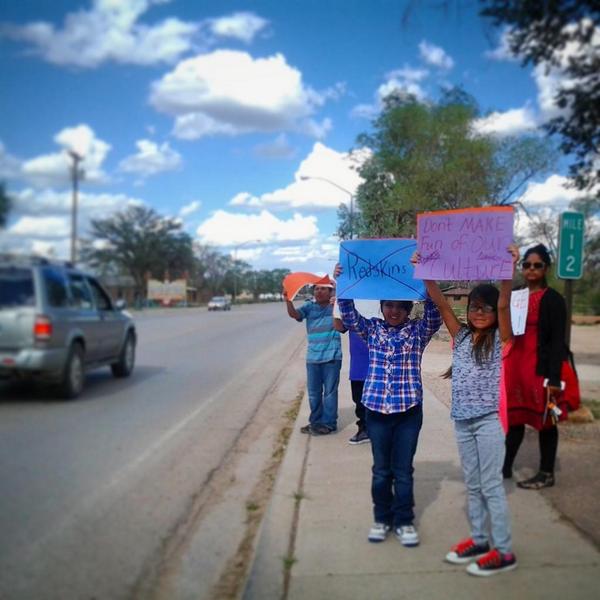
Redskins bribe Zuni for support

#NotYourRedskin: Wings Speaks Out Against Bribery and Blood MoneyWord has leaked out that the Washington Red****s so-called “First American Foundation” is seeking to buy “legitimacy” and the appearance of Indian “cover” for its continued insistence on using and profiting from a racist anti-Indian slur through a bald-faced bribery attempt.

I have written at length for many years about the inherent racism in this particular slur, and the incalculable harm that it does—most recently, here. But today, Wings has decided to take the extraordinary step of issuing this public statement in opposition to the team ownership’s continued racist use of the name; its continued attempts to co-opt Indians to use them as “cover” to further their racist and exploitative agenda; and its continued attempts to bribe and browbeat Indians into silence on this issue. This statement, and this particular blog post, are explicitly signed jointly by both of us.

From Wings:

I make this statement today as a matter of cultural and spiritual duty, of my obligation to our Native peoples, and of my obligation to my occupation as a Native artist.

I am unequivocally opposed to any and all use of Native-themed imagery, symbols, and cultural signifiers by non-Natives as mascots or for similar purposes. Appropriating such images and names steals our identity, our cultures, and that which we hold sacred—in many cases, some of the rare things left to us that have not already been stolen, warped beyond recognition, and used by unauthorized persons for improper purposes. I am especially opposed to the inherently racist use, under any circumstances, of the “Red****s” name, which is a vicious slur weighted with the scalps and skins, blood and bones of our peoples. It is a term of theft, rape, torture, murder, and genocide, and it has no place in a civilized society, particularly in so trivial a venue as a sporting event.

Zuni Pueblo is, of course, a sovereign nation, and it can do as its tribal leaders see fit. I express my hope, however, that this is merely an honest mistake on the part of someone there trying to help his or her people without knowing the backstory. Regardless of others’ motivations or intent, however, I cannot in good conscience participate as an artist, and I cannot remain silent.
We Are Not Redskins

By Jim EnoteZuni cultural leaders for years have diligently worked to correct misrepresentation of Zuni culture in museums throughout the world, concerned in part that young Zunis will be exposed to misinformation about their culture and identity. Identity is an enormous issue in tribal communities everywhere and I believe mascots, particularly the Redskins mascot undermines the work of the A:shiwi A:wan Museum and Heritage Center and deepens individual and collective confusion about identity while flaming the spread of misrepresentation of Native Americans as a whole.

Some of our own people are unconcerned about the issue of mascots. These folks say they are strong in their identity and traditions and belittle those that are offended by the Redskins mascot. If you consider yourself traditionally well adjusted then good for you. However, not everyone is so fortunate. Through the ubiquitous power of modern media many Native children are already associating with images that have little to do with their true tribal identity and I believe we should be concerned about that.

What about Native folks that are proud of the Redskins mascot? I still wonder why they could feel empowered by or proud of an image that denigrates Native peoples? Does association with a mascot image that suggests toughness or dominance make them feel better about themselves? Why not be proud of our Native educators, school principals, lawyers, doctors, military personnel, and engineers to name a few. This is 2014; we are not war whooping savages.

Tomorrow by invitation from the Zuni tribal council, representatives from the Redskins will come to Zuni to seek art made by Zuni artists, especially art that includes the Redskins logo and team colors. The visit is obviously part of spin doctoring the Redskins struggling image. Most of us easily see through the scheme. Why didn’t the Redskins approach the organizers of Santa Fe Indian Market, the Indigenous Fine Arts Market, or any number of other Native art associations representing thousands of outstanding Native artists?
Dan Snyder Seeks Original Native American Art to Redwash Foundation

By Rick CohenThat is the strategy of Snyder’s new foundation: Go to desperate poor Native American communities, offer foundation support of some sort or another that the communities are hard-pressed to reject given their needs, and connect it to the use and promotion of the Washington team’s racially disparaging name.

Some of this sounds less like charity and philanthropy and more like the history of a part of the Christian missionary outreach (actively supported by the federal government) to Native Americans in the 1800s. In return for assistance from whites, Native Americans were encouraged and expected to adopt white ways and to be assimilated into white culture. Now, through the philanthropy of Snyder’s NFL team, Native Americans are encouraged to assimilate a racially disparaging team name. That’s the chutzpah of Dan Snyder’s missionary approach to philanthropy, except that he isn’t offering food and assistance in exchange for white culture and religion. He simply wants Native Americans to take the charitable money in return, at a minimum, for turning a blind eye to the racially disparaging team name.
NFL Redskin's representatives visit Zuni Pueblo looking to buy artwork

By Joseph LynchMore than 150 artists showed up with their work, hoping to sell their hand-made pieces from Zuni Pueblo. But not everyone was happy about the visitors from Washington.

On Facebook, several people were sounding off about the letter sent out notifying artists that the Washington Redskins would be on the pueblo.

"I'm going to make a poster saying, "I am a Zuni artist and I refuse to be bought by the Washington Redskins," said Facebook user Masika.

"I can't believe it! What has happened to our government? Sadly, it has come down to money... Then there is the last line, that's sad," said another Facebook user Francine.

The last line in that letter read, "Be respectful when you arrive. Do not smell of alcohol or marijuana, or be under the influence."

Another person on Facebook took offense saying, "those lines are basically stereotyping the people of Zuni."
Below:  "Not everyone in Zuni supports this. Never too young #CantBuyOurSupport #NotYourMascot #FutureLeadersofZuni"

Steeves tries to explain wife's racism

Gord Steeves defends wife, tries to explain racist comments

Gord Steeves holds presser 4 days after wife's racist Facebook comments surfaceWinnipeg mayoral candidate Gord Steeves said his wife's racist comments were made out of fear and anger.

"My wife was scared and she was very angry and she reacted," he told reporters on Tuesday, after starting his press conference with an announcement about zoning. “The comments were not my comments. I support my wife, and I love her and I stand with her, and she made the apology, and I support her.”

The zoning announcement prompted many confused expressions and caused people on Twitter to wonder what Steeves was doing.

He was also heckled by people at Bonnycastle Park, where the press conference was made.
And:She has since apologized for the comments, but Steeves took four days to address the matter.

Despite calls for him to drop out of the mayoral race, Steeves said on Tuesday he will not do that.

"I'm a candidate in the mayoralty race but I'm also a husband and a father," he said. "She did something in poor judgment, and she acknowledges that and she apologizes. She is a good, caring, wonderful person, a great mother and a wonderful wife."​

Steeves also said the comments were made after an incident in which “one of the pandhandlers jumped up, put his finger in her face and said words to the effect of, ‘What’s the matter? Don’t you like native men?’”

Steeves said the story didn’t excuse the Facebook post, though.

“I only tell it to give it some context,” he said.
Winnipeg tweets: Steeves' address lambasted on Twitter

Comment:  Lorrie Steeves may have been scared on the downtown streets. But she went home, logged onto Facebook, and posted a rant about how she's tired of giving handouts to drunk Natives. More to the point, how Natives are lazy bums who need to stop mooching and get a job.

So I'm not sure how her alleged "fear" is an issue. Or her anger, unless you mean her anger against the entire Native population. She's sick of Natives as a whole, not just the few individuals who harassed her. It's a perfect example of racism in action.

August 11, 2014

Natives slam Steeves's comments

Spouse's comments spark big reaction

By Nick Martin and Randy TurnerManitoba Treaty Commissioner Jamie Wilson was stunned Friday by the comments posted on Facebook by Lorrie Steeves, wife of mayoral candidate Gord Steeves.

So were a lot of other people.

"I would never paint an entire ethnic group on the actions of one person--that's how racism starts," said the aboriginal educator, who works downtown. "I see racism as a huge part of the problem.

"It does nothing to help our city," said Wilson, especially coming the day after about 150 community leaders announced their annual sleepout to raise awareness about the homeless.

"I see the same four or five guys (downtown), I'm respectful to them, they're respectful to me," Wilson said.

As for Lorrie Steeves's apology: "I thought she was apologizing for being caught."
And:A lot of people commented on Facebook and Twitter:

Ryerson University Prof. Pam Palmater: "racist stereotyping hatred fails 2 reflect appreciation 4 her privileged life based on colonization n dispossesion of FNs"

Megan Benedictson: "The problem is with those who refuse to see all human beings as people."

Wab Kinew: "Tweet me when Gord Steeves does the right thing and drops out of the race."
Bannock lady challenges Gord Steeves, wife to help homeless

Aboriginal activists upset with Lorrie Steeves' 'drunken native guys' Facebook commentsGuiboche said Saturday Steeves' apology isn't good enough.

"Come and help me feed some of those people you called down," Guiboche said. "You know, I personally wouldn't want to go through what it takes to wind up on the street and keep surviving on the street."

Guiboche, who is known as the Bannock Lady because she regularly hands out food to Winnipeg's homeless, said she will be at the corner of Dufferin Avenue and Main Street Sunday at 3 p.m.

Guiboche said if the apology is sincere, Steeves should back it up with action.

"That's just completely abhorrent that somebody would post comments like this and then try to be professional after [by saying] 'Oh I'm sorry I said that.' No. No. It's too late for 'sorry.' You said it. It's out there."
Gord Steeves a no show at event to feed the homeless

But mayoral candidate says he will speak Tuesday, 4 days after wife's 'drunken native guys' comments

Homeless respond to Lorrie Steeves racist 'handout' comments

Mayoral candidate Gord Steeves’ wife Lorrie under fire for ‘drunken native’ Facebook statusGlenn Houle lives on Winnipeg’s streets and said Lorrie Steeves comments were ignorant.

Houle, who has struggled with addictions, is now sober.

He said Winnipeg’s homeless are desperate and vulnerable, and Lorrie Steeves should have more compassion.

“Try and stay on the street for a week and then you’ll find out how it is to be on the street with nowhere to go,” said Houle.
Steeves has duty to address wife's racist comment, Oullette says

Mayoral candidates addresses Lorrie Steeves 'drunken native' commentsCandidate Brian Bowman called her words deeply offensive, while Mike Vogiatzakis said the post was inappropriate and disgusting.

Vogiatzakis also called on Gord Steeves to speak on the matter.

On Monday, Aboriginal Council of Winnipeg's Damon Johnston also responded to Lorrie Steeves comments.

He said he emailed Steeves Monday morning asking him to resign his candidacy.

"Here's a person who seems highly educated, is a professional and is a spouse of someone seeking office in our country. You would think she'd know those kind of comments would hurt," said Johnston. "If individuals in your family are in the political arena, those kinds of statements are not acceptable in any way and they could be seriously damaging to his career."

August 10, 2014

Native roots of Guardians movie

Music: Native American roots of the GuardiansNow that Marvel has made another boatload of money and launched a brand new film franchise with “Guardians of the Galaxy,” there are a lot of people talking about a set of comic characters who were previously somewhat … obscure. In fact, “obscure” doesn’t quite do justice to the Guardians’ existence as a glorified footnote in the history of Marvel Comics.

Although they have had their fans over the years (including a teen-aged Craven, who once owned issue #18 of “Marvel Super-Heroes,” in which the super-team was introduced by writer Arnold Drake and artist Gene Colan in 1969), the Guardians have never sold a lot of comic books. But thanks to the incredibly canny marketing skills of the modern-day Marvel, as well as a charming cast, gorgeous CGI eye candy and the one-two punch of a delightful script and deft direction by filmmaker James Gunn, the futuristic team who could never sustain a long-living comic title have turned into cinematic superstars.

But something that has gone relatively unnoticed is the debt the new movie owes to Native American culture in general, and one of the greatest Native American rock acts in particular.

Although you’d be hard pressed to recognize it from his portrayal in the film, one of the main characters was originally (and pretty obviously) intended as an analogue for a Native American. I’m not talking about Rocket Raccoon, although his last name—and the name of his species—derives from an Algonquian word. But Yondu Udonta, the blue-skinned character played by Anglo actor Michael Rooker, was very clearly modeled on an Iroquois when he debuted in the original line-up of the Guardians of the Galaxy. The only Native American characteristics of Yondu that remain in the film are his use of an arrow and what looks a bit like a Mohawk hairdo.
Meet Redbone, the Native American Rock Band Behind That Guardians of the Galaxy Song

By Alex SuskindIf you saw Guardians of the Galaxy last weekend—and from the looks of it, that appears to be most of you—you likely found yourself grooving along with Chris Pratt’s Peter Quill to the song he plays during one of the film's opening scenes while simultaneously wondering, Who sings this again? Thanks to Star-Lord and his Awesome Mixtape No. 1, we now know more than we ever could have imagined about the track “Come and Get Your Love” and the band that brought it into the world.

Like Wild Cherry and the Weather Girls, Redbone has for years been one of those groups that tends to pop up at music trivia nights and on listicles about one-hit wonders. But let’s give it up for Redbone, shall we? The band was formed in 1969 by Pat and Lolly Vegas, two brothers of Mexican and Native American descent. The siblings’ original surname, Vasquez, was later changed to Vegas, a suggestion that allegedly came from legendary musician Robert “Bumps” Blackwell, who thought it might be more palatable to white audiences. By the early 1960s, the newly christened Vegas brothers were regulars on the Los Angeles rock circuit and recording run-of-the-mill instrumental surf-rock tracks like “Wax ’Em Down” and “Gypsy Surfer.” They also appeared on the music variety show Shindig!, performing a rousing rendition of “La Bamba.”

Three years after releasing the 1966 album Pat and Lolly Vegas at the Haunted House, the brothers rebranded the act as Redbone. As Pat and current member Raven Hernandez explained in this undated interview, the term was a reference to the Vegas brothers’ heritage. “Redbone means half-breed,” said Pat. “Anyone who has part-Indian blood, that’s a redbone. Back in the old days, if you called a Native American a half-breed, it was fighting words.”

According to Footsteps in the Dark: The Hidden Histories of Popular Music, the group began wearing colorful Native American attire onstage after drummer Peter DePoe, himself Indian, told the band their music had a Native American feel to it. (DePoe would later join the group, as would guitarist and singer Tony Bellamy.) At the time, the brothers ironically had no idea that they, too, had Indian in their blood; it’s a fact they learned later from their grandmother after informing her of their new stage act. Either way, the duo fully embraced their newfound culture.

August 09, 2014

Natives protest Nugent in Sturgis

Michael Ballard Owner of Full Throttle Saloon in Sturgis Says He Won't Invite Ted Nugent Back To Lakota-land

By Somos IndependentsTed Nugent is banned from performing at the Sturgis, South Dakota Full Throttle Saloon Bar moving forward.

Michael Ballard who has a net worth of $5 million dollars and owner of Full Throttle decided profits over principles in Lakota country in Sturgis, South Dakota. Pretty cheap and pathetic if you ask me. Even though he is a millionaire and could have done the right thing aside from the $150,000.00 he had his eyes on with the Ted Nugent concert, he is on record via Lakota Territory News TV where he states:

Nugent has made headlines recently after two casinos canceled concerts with him, citing racist remarks. The Full Throttle Saloon had Nugent on the schedule for the main stage Wednesday night. Local Native Americans gathered around the Saloon with signs to protest him.

James Swan, president of The Urban Warrior Society, says he's protesting Nugent over accusations that Nugent called natives 'unclean vermin.' "Ted Nugent, you're a slob. You're an evil, horrible being, and Native Americans don't want you to like us," said Swan. "We don't want you to wear our head dress, we don't want you to act like you're native, because you're not."
Smells Like Ted Nugent: Rocker Criticizes 'Stinkyass' Native Protesters

By Christina RoseProtesters came to Sturgis from almost all of the reservations in South Dakota, including Pine Ridge, Rosebud, Cheyenne River, Standing Rock, Crow Creek and Lower Brule as well as Rapid City. It went well, according to Doug Bissonette, Lakota, who drove up from Pine Ridge to attend. “It turned out pretty good, a lot of bikers gave us the thumbs up," Bissonette said. "The owner said he kind of regretted it (hiring Nugent) and wouldn’t do it in the future.”

Indeed, Full Throttle owner Michael Ballard stated that had he known sooner about the protest and comments Nugent has been making, he wouldn’t have booked him. But for financial reasons, the show would go on. "I can't turn around and walk away from $150,000," Ballard told KOTA. "I mean that's the nuts and bolts of it. Now that we're made aware of it, we'll listen to it next time."

The only reported negative incidents at the protest occurred when a jeep went by the protest and occupants called out, “FU!” to the protestors. “That and a couple of guys tried to come out of the concert to come after us, I think they were drunk,” Bissonette said.

James Swan, Lakota, founder of the United Urban Warrior Society of Rapid City, South Dakota, said people came from Wisconsin, as did a couple from Hawaii who were caravaning their way from Bear Butte, a sacred place of prayer that stands imposingly just two miles outside of Sturgis.

“There was a really good turnout,” Swan said. “My message to Nugent was, he is not welcome in Indian country. We asked him to quit wearing a headdress, and running around in a loincloth. Wearing the headdress and using foul language, it’s disgracing us. He just doesn’t get it, he said nobody minds if he wears the Green Bay Packers t-shirt.”

August 08, 2014

Redskins OAF seeks Zuni art

Redskins foundation seeks Native artwork with team logo

By Erik BradyWanted: Native artwork, preferably of a specific sort.

The Zuni Pueblo tribe sent notice to Native artists that representatives of the Washington NFL team's Original Americans Foundation will be in Zuni, N.M., on Monday afternoon to buy jewelry, pottery, etchings and other artwork.

"Preferred items will be those that have the Washington Redskins team logo, or use of team colors … embedded in the art work," the notice says. It also asks artists to "spread the word" to others who may have logo art to sell.

"We have a very depressed economy and the (tribal) governor wanted to help local Zuni artists," tribal administrator Hanna Weeke told USA TODAY Sports. She said buyers often insist artists cut their prices but she believes foundation buyers will pay in full.
Redskins Want Native-Made Redskins Art. No Drunk Artists, PleaseOn Monday, August 11, representatives of the Washington Redskins will be visiting Zuni Pueblo, but they're not coming to build a skate park or hand out blankets.

They want Native-made artwork and crafts, particularly stuff that promotes the Redskins team brand. A letter bearing the logo of Zuni Pueblo has invited artists to show their wares at the Zuni Tribal Conference room. After providing some details, the letter ends with the instructions "Be respectful when you arrive. Do not smell of alcohol, marijuana, or be under the influence."

On Twitter, Last Real Indians gave the following interpretation: "Hey Indians, we want to buy your trinkets esp if they have Redskins logo. but don't show up drunk or high --Dan Snyder"

"'Be respectful when you arrive.' Is there any self-awareness there?" responded another Twitter user.
Wanted: Native Art With Redskins Logo And Colors; Drunks Need Not Apply

By Sean NewellThe Zuni Pueblo's governor's office announced the event in a letter posted to its Facebook page. In the last line, the letter asks that people not show up drunk or stoned. "Be respectful," the letter directs.

People on Zuni Pueblo's Facebook page are obviously upset—when was the last time your local art fair asked the artists not to show up drunk?—and there are levels to this thing. Do you want to sell some of your art? Well, you better include a slur against yourself if you want some cash. Oh, also don't be drunk. Sell your racist-stereotype crafts, people of Zuni; just don't be one yourself.

One response to the Facebook post put a neat bow on all of it.I am tired of people claiming that there are bigger issues in Native America. Are we all so blind that we cannot see that everything is connected? We are in the positions we are in because no one in the external world views us as real human beings who deserve to be treated with respect and dignity. And guess what? Part of that problem is letting them go on pretending that we are either drunks, noble savages or mascots.

Candidate's wife slams "drunken" Natives

Gord Steeves' wife under fire for 'drunken native' Facebook post

Comes on same day mayoral candidate pledges to pick up intoxicated people downtownThe wife of mayoral candidate Gord Steeves, Lorrie Steeves, was the focus of social media today for what she posted on her Facebook page in 2010.

Her post on February 11, 2010 reads: "Lorrie Steeves is really tired of getting harrassed (sic) by the drunken native guys in the skywalks. we need to get these people educated so they can go make their own damn money instead of hanging out and harrassing (sic) the honest people who are grinding away working hard for their money. We all donate enough money to the government to keep thier (sic) sorry assess (sic) on welfare, so shut the f**k up and don't ask me for another handout!"

It comes on the same day that Gord Steeves announced that as mayor, he would commit more police cadets to the downtown area to pick up intoxicated people.

He said Winnipeg's downtown can't thrive while there is a perception it isn't safe.
And:Derek Nepinak, grand chief of the Assembly of Manitoba Chiefs, said he thought Lorrie Steeves' Facebook comment was narrow-minded.

"It's reflective of an attitude among some people from some of the privileged areas of the city that venture downtown and see some of the things they don't want to see," said Nepinak. "I think it's problematic being that it comes from the wife of one of our candidates for mayor."

Nepinak said he was offended by the comment as well as Gord Steeves announcement this afternoon.

Nepinak said Steeves' plan to beef up the cadet presence downtown was a "shortsighted" bandaid solution to a deeper social issue.
Political expert says it’s too soon to know impact of “drunken natives” commentsWhen reached by Global News by phone, Lorrie Steeves would not comment on the post, but late Friday emailed the following statement and apology: “In 2010 while I was working downtown I was regularly harassed for money and often put in a position where I feared for my safety. One day in particular 4 years ago was very bad and out of frustration I vented on my personal facebook page. I feel terrible about these comments. I am terribly sorry and I apologize. I do not clear my facebook posts or status updates with my husband.”

Michael Champagne, who founded Aboriginal Youth Opportunities, would like Lorrie to take her apology a step further and spend some time with him in the North End.

“We can explain what it is like from our perspective to experience homelessness and deal with addictions,” said Champagne.

He hopes the negative Facebook comments do not overshadow all the good work he feels is being done within the Aboriginal community.

“We as indigenous young people in this city are trying as hard as we can to break those stereotypes but we need the rest of Winnipeg to come along so they can actually change,” Champagne told Global News.

August 07, 2014

Nugent attacks "unclean dipshit" Natives

Ever since Ted Nugent's racism got him fired from two tribal casinos, he's been trying to defend himself. As long as he kept talking, it was inevitable that his own ignorance would indict him.

Here's what Nugent really thinks of Indians:

Ted Nugent: 'My Lifestyle…Is More In The Indian Tradition Than Many Of The Indians Themselves'

By Miranda BlueTed Nugent called in to Glenn Beck’s program on Friday to defend himself after a number of his shows have been cancelled by Indian tribes because of his long history of racist remarks.

Nugent told Beck that in fact “my lifestyle as a white guy—though I’m hard to accept that designation—is more in the Indian tradition than many of the Indians themselves.”

In response to reports that he called protesters at one of his recent shows "unclean vermin,” Nugent told Beck, “I have a spiritual blood-brother relationship with these Indians and then the left literally creates the nastiest, hateful lie they can, put quotes around words attributed to me, Glenn, claiming that I called my red brothers ‘unclean vermin,’ which I never said in my life. They created that out of whole cloth.”

Later in the interview, Nugent acknowledged that he had called the protestors “unclean vermin” but that they were “communists.”
Nugent defends his ‘Native credibility’ in face of protests

By Corey Morris“The media took that statement and said I said that about my Native American blood brothers, with whom I have had a wonderful, brotherhood relationship for more than 45 years,” he said.

“There’s not a tribe in this country that hasn’t invited me to their reservation to teach their children about being clean and sober, to aim small, miss small, and the history of hands-on conservation.

“I am the best friend to the Native Americans,” Nugent said.

“It doesn’t bother me on a personal level–the more idiots hate me, the better my guitar playing gets.”
Let white man Ted Nugent teach you how to be Native American

"My lifestyle as a white guy ... is more in the Indian tradition than any of the Indians themselves," he says

By Prachi Gupta
As the predictable media shitstorm around his comments continues, Nugent is apparently going into damage-control mode at the only place he’ll find sympathy: in a studio with Glenn Beck. His defense consists of three points: A) The stupid liberals misquoted me, B) I have Native American friends so how can I be racist! and C) Besides, I’m more Indian than most Indians.

Alas, here’s the kicker: “My lifestyle as a white guy—though I’m hard to accept that designation—is more in the Indian tradition than many of the Indians themselves.” Dear Native Americans: White guy Ted Nugent can’t be racist, because the white guy knows more about your culture than you do.
Obviously Nugent can't name a single tribe and thinks all Indians are the same. Strike one.

Nugent thinks of Indians as his "red brothers" and "blood brothers." His notion that he has a relationship with some five million people, all of whom are "red," is strike two.

Indeed, he thinks he's a better Indian than many of them. Which means millions of Indians are inferior at being themselves. Or simply inferior, period. Strike three and he's out.


Yep, he's a racist

But wait, it gets worse.

Native Americans Protest Flaming Lips Lead Singer Wayne Coyne & Ted Nugent in Portland, OregonWhen challenged by a young Native man, Lance Browneyes on Facebook about wearing a Plains headdress and using a sacred White buffalo in photographs he retorted, "It was a gift from an Apache spiritual elder for helping Inidan(sp) kids stop substance abuse you subhuman mongrel." (Note: these headdresses are not part of Apache culture.)Ted Nugent Previews His Appearance At Toledo Blade Concert By Attacking "Stinkyass" American Indian Protestors

Nugent: American Indians Could Have Fought Off Settlers With Less "Whoopin" And "Hollerin"

By Timothy Johnson
On August 7, Nugent took to his Facebook page to hype his "Rib-Off" appearance, but also to argue that American Indians upset about land being taken from them by white settlers need to learn about the American Dream.

Nugent wrote, "WE ARE ON OUR JET NOW HEADING FOR TOLEDO RIBFEST JAM AFTER AN INSANE INCREDIBLE OUT OF BODY ULTRAROCKOUT at the Full Throttle Saloon in Sturgis SD! Simply astonishing gig! 4 stinkyass unclean dipshit protestors that admitted they hate me AND ALL WHITE PEOPLE THAT STOLE THEIR LAND BULLSHIT!! See, it aint me they hate, they hate all Americans that produce & live the American Dream. Simply insane!"

The protestors that Nugent attacked as "stinkyass unclean dipshit[s]" were reportedly from the United Urban Warrior Society in Rapid City, SD.

Nugent made other inflammatory comments in the discussion thread on his Facebook post. One fan wrote that "Maybe the natives shoulda had better weapons ..." to which Nugent responded, "less peyote less whoopin & hollerin."
Ted Nugent mocks ‘unclean dipsh*t’ Native Americans: Whites ‘stole their land’ is ‘bullsh*t’

Redskins fib about Alabama-Coushatta support

Mark Moseley says ‘no red men have said anything derogatory to me’ about the Redskins name

By Dan SteinbergMark Moseley is one of the former Redskins players now engaged on the name issue, and he isn’t treading lightly when discussing this debate.

Moseley was on NewsChannel 8’s “SportsTalk After the Game” with Alex Parker this week, and the one-time kicker was fired up.

“It’s come up before, and it’s the most ridiculous thing that you could ever have” Moseley said of the debate. “We just thought it would blow over. But this time it hasn’t blown over. They’ve managed to get to some people that have a voice, some people with a little power, and they’ve made it into something that it’s not. And so we decided as alumni that we were going to get out and find out for sure. I mean, we don’t want to do something that’s hurting somebody’s feelings or it’s not the right thing … so we decided to take it upon ourselves to find out.

“I personally grew up with the Alabama-Coushatta Indians down in Texas,” Moseley went on. “They were 10 minutes outside of town. So I’ve been around Indians all my life, and when I came to the Washington Redskins it was elation in the reservation. They loved the fact that I was playing for the Indians. They considered it an honor.

“And so we were really upset with the fact that they’re trying to tell us that all these years we’ve been playing under a name that was derogatory to someone,” he said. “We’ve interviewed over a thousand people. We’ve talked to over a thousand Indians. And not one, not even one has said anything about it being derogatory to them. I even went up to one of them face-to-face that I didn’t even know, and I asked him, I said point blank, ‘If I came up and I called you a Redskin would you be insulted?’ And he said, ‘Absolutely not, I take great pride in being an American Indian, being called a Redskin.’ So to me, it’s bogus.”

Later, Parker asked Moseley what he thought about the people who have said they are offended by the name.

“If it was Indians, then I would be concerned,” Moseley said. “But everyone that’s said anything to me has been a white man or a black man. No red men have said anything derogatory to me about it.”
Ex-Redskins Super Bowl kicker Mark Moseley: Never, ever heard any of 'these Indians' complain about team name

No "red men" have said anything derogatory to Moseley? Well, then, the name can't be racist!

And your experiences 30 or 40 years ago when people hadn't begun to think about the issue? Totally relevant!

More Pinocchios for Redskins

Alas, Moseley's claims proved to be another in a long series of Redskins lies masquerading as Redskins facts.

Alabama-Coushatta Tribe responds to Mark Moseley, saying it does not support the Redskins name

By Dan SteinbergWell, as most things do, this story gets more complicated. Because the leadership of the Alabama-Coushatta Tribe has a slightly different view.

“The Tribe and Tribal Members took great honor in the fact that Mr. [Moseley] played in the NFL, and he played in a time when the mascot debate was not an issue,” Tribal Council Chairman Ronnie Thomas said in a statement on Thursday. “Times have changed and the Tribe has not advocated for or against the use of the Washington mascot. The Tribe has more pressing demands such as providing our Tribal people adequate health care, higher educational opportunities, struggling with unemployment and preserving our culture. While Mr. Moseley once associated with the Tribe, it is incorrect to say that the Tribe supports his efforts to maintain the mascot name.”

The Tribe’s press release further says that the National Congress of American Indians and the United South and Eastern Tribes have both “been adamantly opposed to the Washington mascot name.” The release says that the Alabama-Coushatta “is a member tribe of both organizations and the Tribal Council supports the position that NCAI and USET has taken.”

Carlos Bullock, the tribal spokesman, wrote in an email that Moseley “did grow up in Livingston, which is where our Tribe has been settled since the late 1700s,” and that he went to school with some Tribal Members.

“But to say that the Tribe supports the Redskins name is false in this day and time,” Bullock wrote. “When Mr. Moseley played for the Redskins, the Tribe did take pride in the fact that a local guy made it to the pros, and at that time the mascot debate was not even considered an issue.”

Bullock wrote that the tribe as a whole has not taken a stand on the name issue, “due to the level of real life situations we face such as health care, unemployment, education for our young people, etc.”

But he added that the notion that the Tribe has no issues with the Redskins name “is simply untrue.”
Comment:  The Washington team couldn't tell the truth if their life depended on it. Almost everything they say is a half-truth if not an outright lie.

Moseley didn't actually say the Alabama-Coushatta tribe supported the name, but he implied it. That implication was false; the truth is the exact opposite. As they have so often recently, the Redskins have lied about the widespread Native support for changing the name.

Escaping Alaska stereotypes the Inuit

Is This Reality TV Show as Racist as It Sounds?TLC's latest series, Escaping Alaska, is being compared to Breaking Amish. This time, though, the participants are five Alaska Natives (identified as "Eskimos") who have hatched a plan to leave their families and culture to experience life in the lower 48.

Escaping Alaska already has problems: The whole setup is contrived, and depends on the premise that leaving their culture and family is (as Nuala says in the clip above) "considered treason." The show's description at the TLC website says "Leaving an Inuit community for any earthly reason is the ultimate sin, so our cast members are lying about their true intentions, telling their community that they are going on a cultural/religious mission, and thus committing the highest treason." Facebook commenters have already seized upon this premise as utterly false, saying that young Alaska Natives leave home all the time. The notion of "shunning" may have been borrowed from Breaking Amish.

We are to believe that the five met on the internet and have lied to their parents about the nature of their journeys south. The "culture shock" that will play out is a little harder to trust when we know they have the internet in their Alaskan homes. One of the young ladies wants to be an actress--an Eskimo Jennifer Lawrence, she says. These kids haven't exactly been living under a rock. They're less backward than the Amish.

But viewers are supposed to see them as backward. Their dress is supposed to be funny. Their love of seal meat is supposed to be funny. Here's a clip where one of them, Qituvituaq, or "Q," discusses how he likes to "go on adventure hikes looking for mythological creatures."


Reality Check: 'Escaping Alaska' escapes reality, but other than that, it's an OK watch

By Emily FehrenbacherI missed the first episode of “Escaping Alaska,” but recently watched the second one. In this episode, the cast arrives in San Diego. They get off the plane wearing fur parkas, which was the first indicator that this show was staged, because later in the episode they have many reasonable outfits with them for a sunny California climate.

The cast later goes on a whale watching cruise, and a random, already-mic’d, horrible “stranger” approaches them. As they tell this woman about whaling and subsistence culture, she responds with complete disgust and ends up storming away. One of the two gentlemen in the cast follows her and they end up going on a date that night. I was so confused. I rewound to see if I had missed something. But I had not. In the real world you don’t end up asking out people who tell you that your way life is repulsive.

Here’s the thing: I don’t want to be the reality police. If we are judging the show on its entertainment value and not taking into account how accurately it portrays Alaska Native culture, the real-life online acting resumes of the people in it and some of the questionable filming locations, the show is totally watchable.

I found the five characters to be likable, regardless of their fabricated story arcs. One girl, Tamara from Noorvik, brings a poster of her idol, Jennifer Lawrence, and a pillow with a picture of her crush, Prince Harry, on her journey. Which is just adorable. And I will never be someone who badmouths a good fish-out-of-water storyline, especially when it involves a boyfriend back home (Mary from Tanana) and some good partying in the streets (during Mardi Gras).

But the show is also treading lightly on big, often wrenching issues--including the challenges facing rural Alaska Native young people as they make their way in the world and the disappearance of villages and traditional ways of life. In the end, it’s hard not to be the reality police when the subject matter is very real to many Alaskans.
Comment:  Let me see if I have Fehrenbacher's position straight. She's saying we should ignore the fact that 200 years of entertainment--from novels and plays to movies and TV shows--have taught us everything we know about Natives. We should ignore that Escaping Alaska will be most people's only exposure to Inuit people and culture.

When we ignore Escaping Alaska's stereotypes and the proven harm of stereotyping, she says, we can view the show as pure entertainment. And in that context--where you completely blind yourself to the real-world consequences--the show can be enjoyable.

Similarly, if you ignore the ongoing violence against Native women, you can enjoy a comedy about them as shrewish "squaws" who deserve a smack. If you ignore the hundreds or thousands of Native deaths, you can enjoy a comedy about Trail of Tears or Wounded Knee. It's all about overlooking the bad and focusing on the good.

Great argument, Emily! Do you have any other ridiculous rationales for excusing and enjoying racism?

August 06, 2014

"Russian Pow Wow People" stereotype Indians

“Indians” in Russia–It’s not a fairy tale!

By Nahnda GarlowEastern Europe is full of people who legitimately pow wow. They aren’t Ongwehowe at all but have devoted their lives to researching Ongwehowe ceremonies, traditions, crafts and dancing. The Pow Wow People of Russia have actually created an entire sub-culture of weekend indigenous life right in the middle of Europe. They have retreats where they will sleep in tipis that they make themselves, hold sweats, have naming ceremonies and hold dance contests–“just like the red man.”

This makes a lot of actual indigenous people angry. Understandably so. The story of colonization first removed the indigenous people from our territories and then forcibly separated our ancestors from our culture. Further to that, Victorian times thought it appropriate tokenize Indians and romanticize ‘savages’ through things like Peter Pan and Buffalo Bill’s Wild West Show.

Because of this history, the sight of European men and women gathering around the big drum, singing victory songs and speaking Lakota can absolutely be taken as adding insult to injury. However because they are doing so much research into what is actually authentic, there is yet a layer of separation between this kind of tokenization and things like mascotry done by professional sports teams in the USA or some idiot wearing a cartoonish replica headdress at Coachella. Just one look at the amount of work going into the Russian Pow Wow People’s regalia, all pieces handmade by themselves, and you start to get an understanding of their level of commitment to pow wow life.

Before we grab hold of the megaphone and cry out misappropriation…could it be that these Russian enthusiasts believe that they are legitimately trying to honour us–albeit in a very awkward kind of way? Is what these Russian Pow Wow People are doing different than Khloe Kardashian’s now infamous Instagram picture of herself sitting cross-legged and becoming “one with water” while wearing a replica headdress?
Why do you choose to participate in cultural things that are of a different culture other than your own?

It is a difficult question. Probably, it happened because of many reasons. Many children in that time when I was a child watched movies and read books where Indians are shown by noble, courageous people. We wanted to be similar to them. Some of us, having become adults, continued this way. But now we don’t play anymore, we study this culture. We show respect for this culture. And we don’t understand why sometimes Native people have a negative opinion about as. We don’t steal their culture. We try to inform it to people in our country.
Comment:  There may be "a layer of separation between this kind of tokenization and things like mascotry," but it's still stereotypical. Like every other wannabe in the world, these people focus on the Plains Indians of the 19th century. It's a tiny, one-dimensional slice of Native culture that misrepresents the complex and diverse whole.

The author asks if this is different from Khloe Kardashian's wearing a replica headdress? Not really. Mikhail isn't wearing a headdress because he's earned the right from a tribal elder halfway around the world. He's wearing it because he thinks it looks cool. That's exactly the reason Kardashian and every other hipster wears a faux headdress.

Back in 2000 I critiqued a Russian group calling itself the Orthodox Wannabe League (OWL). I even engaged with a couple of members, explaining how they were misrepresenting Indians. They didn't get it, of course. To them it's all about living in a romanticized, idyllic past free of disease, broken treaties, and genocidal wars.

Everything I said then still applies now. Indeed, these Russians may be the same as those Russians, for all I know.

In short, they're not helping Indians, they're harming them. They're furthering the world's ignorance of Native history and culture.

August 05, 2014

Redskins foes seek Internet clicks?

Redskins owner Dan Snyder: 'We've got to help' Indian Country

By Erik BradyDaniel Snyder said Monday that he was moved by what he found on visits to Indian Country and claimed that's why he started a foundation to help tribes on reservations across the country.

"It's sort of fun to talk about the name of our football team because it gets some attention for some of the people who write about it who need (internet) clicks," the owner of the Washington Redskins said on ESPN 980, the radio station he owns. "But the reality is no one ever talks about what goes on, on reservations."

Snyder told Chris Cooley, a former Washington tight end who conducted the interview from the team's training camp in Richmond, Va.: "What I did see that got me and touched me and really moved me, and I think you know because you've visited a lot of reservations yourself, is the plight of Native Americans. Things that people don't talk about."

Snyder ticked off a list of woes, including high unemployment and issues involving health, education and the environment.

"No one wants to talk about that stuff because it's not cocktail chit-chat talk," he said. "It's a real-life need, real-life issues. I think they don't want to focus on that, and I dedicated an effort to do that. What I saw, and listened and learned, it moved me. … We would go back to the airport afterward and say, 'We've got to do something. We've got to help.'"
Snyder digs in even deeper on name of team

By Mike FlorioIt’s been more than a year since Washington owner Daniel Snyder went all caps never when addressing the possibility of changing the team’s name, and more than six months since he wrote a letter to the team’s fans elaborating on his refusal to dump a term that has evolved into a dictionary-defined slur. On Monday, he addressed the issue again, via an interview conducted by a radio station he owns, via questions from one of its employees.

The Washington Post has the transcript. To summarize: (1) Snyder reiterates that the term connotes respect and pride, despite its current dictionary definition; (2) Snyder explains that he has visited with tribal membership and leaders in several states; (3) Snyder suggests that those expressing concern about the name are merely looking for Internet traffic; (4) Snyder laments that not enough is being done to address more important issues affecting Native Americans; and (5) Snyder insists that the effort to assist Native Americans has nothing to do with P.R.
Daniel Snyder: People who talk about the name ‘Redskins’ are missing the point

Natives slam Snyder's lies

As usual, no one but Redskins diehards are buying Snyder's spin:

Change the Mascot Campaign Responds to Washington Team Owner Dan Snyder’s Defense of R*dskins Name

By Oneida Nation Homelands (NY)Jackie Pata, Executive Director of NCAI, and Oneida Indian Nation Representative Ray Halbritter released the following statement in response:

“Washington team owner Dan Snyder’s comments are proof that he is living in a bigoted billionaire bubble. For him to claim that a racial slur is 'fun' is grotesque. For him to say that opposition to that slur is only from ‘people who need [internet] clicks adds insult to injury, considering the fact that groups representing hundreds of thousands of people of color are calling on him to change his team’s name. There is nothing ‘fun’ about his desire to continue promoting, marketing and profiting from a term screamed at Native Americans as they were dragged at gunpoint off their lands. Mr. Snyder would know there’s nothing ‘fun’ about this had he not refused to meet with the scores of Native American groups who are urging him to change the mascot and stop mocking their culture.”

“We are certainly glad to see that after decades of silence, Mr. Snyder suddenly has an interest in the plight of Native Americans. Some of the money he recently spent was for burgundy and gold parks adorned with the very mascot and epithet that Native Americans are imploring him to change. He doesn’t understand a simple fact: No matter how much of his fortune he spends trying to convince the world that slurring people of color is acceptable, it is not. The more he clings to this racist epithet, the more he walks in the footsteps of his predecessor the segregationist George Preston Marshall**, who originally gave the team this hideous name. If Mr. Snyder truly wants to help Indian Country then he could provide financial support, while at the same time ending his callous use of this racist epithet that hurts Native Americans.”
Native Americans: Daniel Snyder pushes 'bigotry' tactic

By Erik BradyThe National Congress of Americans and the Oneida Indian Nation sent a letter to Washington NFL club owner Daniel Snyder last month asking him to stop representatives of his team from speaking of the team's name controversy as an issue pushed by white elites.

Tuesday, they accused Snyder directly of using the same tactic.

"In the last few months, various employees of the Washington football team have denigrated people of color by pretending they are not part of the campaign to change the team's name," Oneida Nation representative Ray Halbritter told USA TODAY Sports.

"In deliberately ignoring the countless number of people of color who are the core of this campaign, this sadly common form of bigotry pretends people of color do not exist. As of this week, we now know this ugly tactic is being pushed directly by the owner of the Washington team."
Non-Natives agree

Dan Snyder Says PR Campaign to Defend “Redskins” Is Not PR

The Washington NFL team owner's latest attempt at sincerity falls flat.

By Benjamin Freed
Snyder probably should have stopped when he called out statistics like the 67 percent unemployment rate he says encountered on a visit to a Pueblo tribe in New Mexico, because when it comes to public relations, few people employ more spin doctors and attempt more soft-touch community initiatives than Snyder. In the past year, it’s been reported that Snyder has sought advice from the likes of über-fixer Lanny Davis, wedge-issue wordsmith Frank Luntz, and Iraq War pitchman Ari Fleischer. He also briefly employed Virginia political consultant (and occasional Washingtonian contributor) Ben Tribbett with the specific purpose of defending his team’s name.

And don’t forget to whom Snyder gave this interview: Cooley, who agreed with Snyder’s every word, works for a station owned by Red Zebra Broadcasting, which is owned by none other than Dan Snyder. The former tight end is also one of the ex-players attached to RedskinsFacts.com, ostensibly launched last month by a grassroots network of team alumni but, in actuality, set up for the team by spin factory Burson-Marsteller.

What was that about not having PR people do this stuff?
Redskins name needs to be changed

By Christopher L. GasperThere is a line between tradition and exploitation, between personal offense and institutionalized insensitivity, between capitulating to political correctness and doing what’s right. The Washington Redskins and their obstinate owner, Daniel Snyder, are on the wrong side of that line.

What’s in a name? If you’re the Redskins it’s a stubborn disregard for the feelings of Native Americans who find it demeaning and offensive and an irrational fear of losing your NFL identity.
And:It’s not surprising that Snyder is wrong about the name. He’s been wrong about most things involved with owning an NFL team since he purchased the Redskins in 1999. In Snyder’s 15 seasons as owner, the team has never won more than 10 regular-season games, has made the playoffs four times, and won two playoff games.

His defense of the name is the staunchest defense Washington has played in a few years.
O’Malley says it ‘probably is time’ for the Washington Redskins to get a new name

By John WagnerCount Maryland Gov. Martin O’Malley among the politicians who would like to see the Washington Redskins get a new name.

O’Malley (D)—who presides in the state where the Redskins’ home games are played—voiced support for a name change Monday during an appearance on the Fusion television network.

“We hope that in every generation we become more understanding of one another, more inclusive as a people, and more respectful of the dignity of every individual and every culture, so I think it probably is time for the Redskins to change their name,” O’Malley told host Jorge Ramos while a guest on his show “America.”

Aides said Tuesday that they could not immediately recall O’Malley talking about the subject publicly before.

Vogue editor in a headdress

Anna Dello Russo Posts Photos Wearing A Native American Headdress

By Aimee HoeflerAnna Dello Russo, editor-at-large and creative consultant for Vogue Japan, posted images to her Instagram account where she is wearing a Native American headdress.

As Stylecaster pointed out, for someone that is so in-tune with fashion and even fashion controversies, what could have been her thought behind posting these images?
Comment:  The article doesn't provide any clues about what she was thinking or whether she's aware of the controversy.

You'd think fashion people would be hip to the growing complaints about the misuse of Native headdresses. Instead, they seem to be more clueless than anyone.

Undoubtedly it's another case of white privilege in action. In their minds, these people don't follow trends. They do what they want and that becomes the trend.

Recall that these are the same people who hire predominantly white models. Who think "culture" means wearing tribal prints in some vaguely "wild" setting. Clearly they're as ignorant as the average person, if not more so.

For more on the subject, see Festival Bans Hipster Headdresses and SF Giants to Ban Headdresses?

August 04, 2014

Natives protest at Flaming Lips concert

Native American Rights Group Protests the Flaming Lips at Waterfront Park

Eradicating Offensive Native Mascotry also plans to protest Ted Nugent at Portland Expo Center on Tuesday.

By Matthew Singer
The free Flaming Lips concert at Waterfront Park last night drew more than just fans of the psychedelic rock veterans: A small group of activists were also in attendance, protesting the band over incidents involving frontman Wayne Coyne and the appropriation of Native American iconography.

Spearheaded by the national organization Eradicating Offensive Native Mascotry, about 20 protestors gathered near the venue's entrance, brandishing signs reading "Culture Is Not a Costume" and "You Still Owe Us An Apology" and handing out photos from Coyne's Instagram account of a dog and friends wearing feather headdresses.

"We wanted to make a statement, and make it clear we haven't forgotten," says Jacqueline Keeler, founder of EONM, which recently led a protest outside a Flaming Lips show in the band's native Oklahoma. In April, the group also protested outside Nike headquarters in Beaverton, demanding the company stop selling merchandise emblazoned with the Cleveland Indians' Chief Wahoo logo. "Basically, we want to hold accountable anyone who appropriates our culture and shows genuine disrespect to our people."
BAD DAYS: The aftermath of the Portland Flaming Lips protest

By Louis Fowler"The mood was upbeat and the energy strong in a good way. Jacqueline had it well organized,” Creel said.

“Personally, I am frustrated that we are in 2014 still teaching what racial/cultural good manners are. I saw a lot of frowns from the people but also so curiosity expressed. When I held up my sign, "Lips Frontman Wayne Coyne disrespects Native Americans”, there were a few nods of understanding.”

The mood inside, however, wasn’t as welcoming.

First, the Flaming Lips were introduced by acolyte (and former Saturday Night Live errand boy) Fred Armisen (Portlandia), who had quietly come under fire from Natives in the past for his “hipster-racism” comedy stylings, most notably for his Native comedian character featured on Weekend Update, Billy Smith, which was basically three to five minutes of the laziest Indian stereotypes thrown together to get cheap laughs from the cooler-than-thou SNL audience.

But, even more egregiously, protesters Luis Figueroa and his brother made their way into the concert with signs, upon which eyewitnesses say—and live video shows—that Lips fans not only taunted them with various slurs and insults, but also grabbed the signs out of their hands and destroyed them. Security then conveniently escorted the brothers out.


Why were the Flaming Lips protested? Native American activists speak out

By David GreenwaldAt the Tom McCall Waterfront Park on Sunday night, across the bowl from the venue’s VIP entrance, a handful of activists held signs protesting Flaming Lips singer Wayne Coyne. Two of them made it inside, one holding up his message—“Culture is not a costume”—even as Coyne rolled over him in his crowd-surfing bubble. According to Jeff Ward, an attendee at the show with his family, the peaceful protester was verbally abused by the audience around him before the abuse escalated: they tore apart his sign before he was removed from the area by event security at the MLS All-Star event.

"I was not proud of my fellow concert-goers abusing this guy like that," Ward said. The sign-tearing moment was captured on video by the MLS broadcast (pictured below). "He was doing what we’re supposed to do in this country and he was vilified for it.”

I saw a second protester, holding a green sign, escorted out of the audience by security as well, and an MLS representative did not respond to a Sunday night request for comment.

Why were they there? It’s a long story, but in the short version, Kliph Scurlock, the Lips’ former drummer, stirred up controversy in May after claiming he was fired for criticizing Christina Fallin—a friend of Coyne’s and the daughter of Oklahoma governor Mary Fallin. The younger Fallin had posted an Instagram photo of herself in a Native American headdress, leading Coyne to post a photo himself with three people and a dog wearing a headdress. Fallin’s also in a band, Pink Pony, which reportedly mocked Native Americans at the Norman Music Festival as Coyne watched.
Coyne apologized, then brought out a man in a headdress on-stage, leading to this response:“Native people pretty much regard it as a faux apology,” Jacqueline Keeler of activist organization EONM told me on Twitter after Sunday’s show, though she was under the impression that Coyne himself had worn a headdress. She organized Sunday’s protest, and in our interview on the grounds, she explained that the headdress played an important symbolic role in her culture.

“It’s not meant to be used to wear at a music festival. It's not meant to be worn in a light-hearted way," she said. “It’s really a sign of the head of state of our nation. It’s completely inappropriate to be used that way, particularly without any knowledge of our culture or even desiring any knowledge of our culture.”
And more broadly, why these protests will continue:Thanks in part to social media, American culture has shifted quickly in recent years as marginalized groups assert themselves more publicly, leaving many artists—from Coyne to Katy Perry to Miley Cyrus to Iggy Azalea—under fire seemingly every week over questions of appropriation or discriminatory behavior. It’s not just race or culture: online pressure led to Rick Ross being dropped from Reebok in 2013 after rapping about date rape, lyrics he later called “one of my biggest mistakes and regrets.”

In short, behavior that musicians and celebrities once routinely got away with—Gwen Stefani’s Harajuku dancers, for one, never inspired a trending topic—has become unacceptable.
American Indians Protest Flaming Lips Lead Singer Wayne Coyne for Disrespecting Regalia & Attacks on Native People

Comment:  I didn't know about the Fred Armisen connection. Somehow it's not surprising that a comedian who does ethnic shtick would be a Wayne Coyne supporter.

For more on the Christina Fallin controversy, see Fallin Suffers Fallout from Stereotyping and Scurlock Explains Flaming Lips Firing.

Mayonnaise manager dresses as "Indian"

Englishman quits mayonnaise-making to travel UK dressed as Native American

Les Atkins, a retired mayonnaise factory manager, plans to indulge his passion for all things American Indian full time. He’s fully immersed himself in the culture, even learning traditional sign language and dances that he performs in his garden, and plans to take his talks to schools and museums around the country.

By Caters News
A mayonnaise factory manager in England has quit his job to live as a Native American.

Les Atkins is going to follow his dream and tour his country teaching people about the American Indian way of life.

The 65-year-old from Walsall, West Midlands, retired from his job July 31 after 15 years. He plans to spend his days dressed as an indigenous American.

On weekends, Atkins, a married father of two, would dress up in traditional clothing including a head dress that he made himself. He estimates he's spent at least £5,000 (about $8418) on his obsession over the years, and adds the actual sum is likely much higher.

"I've been obsessed with the Native American way of life ever since I started watching spaghetti Westerns in the ‘50s. They really got me interested so I started learning more,” Atkins said.

"I've visited a few reserves in Arizona and Utah. On one of my visits I was lucky enough to dance with one of the tribes—they called it to ‘shake a feather.’


British Retiree Takes Cultural Appropriation to New Awkward Level

By Simon Moya-SmithGood hearted? It would appear so. Bad delivery? Quite.

A 65-year-old retiree from England has pledged to devote his remaining days to debunking sundry stereotypes of Native Americans.

But there is a problem–the man is a perpetuator of cultural appropriation.

Photographed in what he refers to as his “costume”–a faux feather headdress, breastplate, choker and a pipe, Les Atkins of Walsall, England, retired from his job as a mayonnaise factory manager on July 31 to become a full-fledged Native American, according to the British tabloid Mirror.
Comment:  So Atkins was inspired by spaghetti Westerns with their false and stereotypical images of Indians. He started off ignorant and not much has changed.

Despite visiting tribes in Arizona and Utah, his costume is pure Plains stereotyping. His headdress, breastplate, and "peace pipe" look like cheap imitations. He looks about as authentic as the cartoonish Chief Illiniwek, which means not much.

His cabinet is full of kachina-style dolls--but most of them look like cheap imitations. I don't see any that look like they were hand-carved by Hopi craftsmen. The fuzzy or feathery look suggests they were made cheaply in Asia.

He talks about the "Native American way of life" as if there's only one Native culture. Like every other ignorant wannabe in the world, he equates "Native" with "Plains." Someone this foolish has no business teaching anything to anybody.

He apparently missed every single discussion about non-Natives wearing headdresses if they haven't earned the honor. And about non-Natives practicing "redface," which is the same as blackface. He's sending the same message as every other wannabe: that Indians are primitive people of the past. That being Native is nothing more than putting on a costume, dancing and whooping, and praying to the "Great Spirit."

He even says that he'll "teach" people with his homemade costumes. In other words, he'll present himself as a generic Indian and teach generic lore. Perhaps someone in the audience will be the billionth person to conclude that Indians were nothing but colorful savages in feathers and leathers. And that they no longer exist today.

August 03, 2014

"Super Savages and Sovereign Traces"

I went down to the University of Manitoba and conducted an interview about a course looking at Indigenous people in graphic novels. The course is called "Super Savages and Sovereign Traces: Introduction to Indigenous Graphic Novels."Comment:  The course uses Scalped, Cowboys & Aliens, and Tribal Force among other comics and graphic novels.

The video doesn't mention Peace Party or Blue Corn Comics--except in the image used to introduce the class. Based on that, I imagine Peace Party gets a few mentions in the class itself.

Niigaanwewidam Sinclair is the professor. I've talked to him a couple of times, and I helped him build the Mazinbiige comic-book collection. That collection came about after the class started, perhaps because the staff realized the need to have more comics on hand.

For more on Sinclair and his work, see "From Super-Chief to Tonto."

August 02, 2014

Cody and Warren, Indian wannabes

A long posting discusses Iron Eyes Cody, possibly the most famous Indian wannabe in history. It goes on to talk about Elizabeth Warren and why people exaggerate or invent an Indian identity.

Why Do So Many People Pretend to Be Native American?

By Russell CobbIron Eyes Cody may have been a Hollywood Indian, but there’s more to the tribe than show business.

There are many subcategories of Wannabes, but the most common member of the tribe we might call the Almost Native—the white person who claims one-sixteenth blood quantum, just enough to squeak by America’s arbitrary racial standards that designate who is and is not a minority.

The most famous and most controversial Almost Native of the moment is Oklahoma City-born Elizabeth Warren, who is rumored to be a candidate for president in 2016. During her 2012 campaign for the U.S. Senate in Massachusetts against incumbent Senator Scott Brown, Warren frequently described “family lore” about her Cherokee forbearers as part of her hardscrabble, coming-of-age story. Conservatives mocked her for identifying herself as a “Native American” minority during two stints at law schools in the 1990s. While it appears that she never benefited from affirmative action for minorities and stopped listing herself as a minority lawyer by 1995, she has refused to back away from claims of Native ancestry.

When Warren’s claims to Cherokee ancestry were scrutinized closely by genealogists, no one could find her ancestors among those named on the Dawes Roll, which the government intended to be a master list of Cherokee surnames, finalized in 1906. (Although they did find one ancestor during territorial days who had actually boasted of killing a Cherokee.) Like many dubious narratives of whites passing for Native, Warren’s story takes many twists and turns, some of which receive a gloss in her new memoir, A Fighting Chance. In the book, Warren weaves her “Native American heritage” (specific references to the Cherokee have now disappeared) into a narrative of working-class struggle, with her “mamaw and papaw” handing down stories and recipes from their days in Indian Territory.

And then there’s Aunt Bee, who told Liz Warren that her papaw had inherited high cheekbones from his Indian ancestors but did not passed them down to the little girl. It’s all part of a home-spun narrative of authentic Americana: Daddy worked hard as a janitor, but had a heart attack and couldn’t pay the medical bills. Mama was devoted to her family, but sometimes didn’t have enough money to put food on the table for the four kids. Eventually, little Liz had to work, too, before she dropped out of college at age 19 to support her husband’s professional goals. Then she picked herself up by her bootstraps and put herself through law school in the wake of a divorce. It’s like a PG-rated Loretta Lynn or Tammy Wynette song with all the cheating and drinking purged from the storylines.

A lot of people scoffed at fair-skinned, blue-eyed Warren’s claim of Native American heritage. But, as an Okie myself, I instantly recognized the narrative. It has an undeniable pull and a certain degree of truthiness, as Stephen Colbert would say. The mythic Native ancestor in the white settler family lends a folksy, feel-good element to a narrative of colonization, exploitation, and plunder.

August 01, 2014

Festival bans hipster headdresses

Bass Coast festival headdress ban ruffles feathers and sparks debate

Organizers of the B.C. music festival say they're overwhelmed by the international reactionWhat started as a policy decision by the Bass Coast Music and Arts Festival in Merritt, B.C., has exploded into an international discussion on cultural appropriation and a movement to stop revellers from wearing First Nation-style headdresses to parties around the world.

The feathered headdress has become a sensitive pop culture phenomenon, springing up in fashion shows, music videos and on the heads of partygoers from Coachella to Bonnaroo.

But in a statement posted last week on Facebook, Bass Coast organizers explained that headdresses are unwelcome at this weekend's festival, which takes place on indigenous territory, and that security would be enforcing the ban.

Paul Brooks, the festival's communications manager, told CBC Arts reporter Zulekha Nathoo that the ban is about respect:

"This has been an ongoing topic of debate within electronic music and within festivals and our core team felt it was time to take a stand," he said.
It's not OK to wear a Native American headdress at this Canadian music festival

By Andrea Crossan[W]ebsites are popping up to cater to those who want to buy the feathered headgear. “You'll find hundreds of vendors selling ‘authentic headdresses’ from around $50 to $100," Brooks says. Of course, they're usually anything but the real deal. "Often they are made of chicken feathers and other cheap materials.”

A real headdress has slightly more impressive plumage. “Mostly these are eagle feathers, and eagle feathers are almost invariably treated as being very sacred objects,” says Daniel Justice, professor of First Nations Studies at the University of British Columbia. He's also a member of the Cherokee Nation.

Headdresses are traditionally worn by a community member who's been honored as a leader, so Justice says having any old concertgoer sport one, especially a low-quality replica, is a serious insult.

"It's a pretty big slap in the face," he says. "But it's also part of a much longer and much more egregious history of colonial appropriation of indigenous things that are significant—trivializing them, repurposing them for really banal and sometimes really offensive purposes.”


Approaching a tipping point?

This means war: why the fashion headdress must be stopped

The Native American headdress is a common sight at festivals. It has also been appropriated by fashion brands and stars such as Pharrell Williams. But many are now fighting back against what they see as a crude act of racial stereotyping

By Dorian Lynskey
The latest festival headwear trend finds itself on the frontlines of a much broader battle against "redface" stereotyping.

The backlash is a classic example of online activism. It has not been spearheaded by an official campaign, lobby group or celebrity spokesperson but a growing array of individual voices repeatedly making one simple demand: stop wearing headdresses as fashion accessories. Many of those making this demand, however, are surprised that it even needs to be said in 2014.

"When it first started happening, my reaction was like, really?" says Ehren Thomas, also known as Bear Witness, of the Ottawa-based dance music trio A Tribe Called Red. "I thought we were over this. I thought the politically correct age of the 90s had taught people we weren't allowed to make fun of other cultures but apparently I was wrong."

This summer, headdresses, often accessorised with fluoro warpaint, have been ubiquitous at festivals from Coachella to Latitude. Festival culture has always been drawn to the idea of tribes: consider the neo-pagan aesthetic of Burning Man, the early 90s free-party scene and the hardcore hippie enclaves of Glastonbury. Put people in a field for a weekend, sleeping under canvas (and, in some cases, teepees), possibly on drugs, and some are bound to explore fantasies of escaping modern society and embracing their "natural" selves via the otherness of older cultures. Headdresses slot comfortably into the amorphous array of "tribal" knickknacks that have been keeping festival stall-holders in business for years.

But the case against headdress chic is powerful, and it's threefold. First, the trend ignores the differences between indigenous peoples. There are 564 federally recognised tribes in the US alone, but fashion smushes them into one vague stereotype with all the sophistication of a B-grade 1950s western. "You'll see someone wearing a headdress in the same picture as a totem pole and a canoe when actually those are from three different cultures," says Bear Witness. "The totem poles are from the northwest, headdresses are from the plains and the kind of canoes you usually see are woodland canoes. So it's robbing us of our individual cultures."
Feathers aren’t fashion, lose the headdress

By Drew Hayden TaylorThe recent ban on eagle headdresses at the Bass Coast Music Festival in British Columbia’s Nicola Valley has stirred up quite the hornet’s nest. Some see it as another politically correct move to ethnically police the fine art of cultural appropriation. Organizers feel the practice of such a sacred and culturally identifiable head gear being worn randomly and without a certain amount of aboriginal awareness isn’t quite cricket. The sacred has become kitsch. Admittedly, it’s been a long time in coming. Recently, singer Pharrell Williams apologized publically for wearing one in a photo shoot. A decade ago when Outkast performed at the Grammys, they did so completely in faux green feathers, loincloths and headdresses. More than just the natives were restless.

I can understand this position, not for the usual socio-political reasons cited, but simply because wanting to wear these things as a fashion statement is stupid, with the exception of my grandfather of course. It’s not honouring anything or anybody except the “look at me, I look so cool” Nation, which is far too populous a tribe.

For one thing, I am sure this fascination is tied into the mythological power and glory of the Prairie Indians. Getting sunburned at a folk festival is so strikingly similar to hunting buffalo. Everybody wants to be Lakota, which is fine. If you’re Lakota. This also includes the Bloods, Peigans, Plains Cree and other assorted and legitimate wearers of headdresses. I don’t exactly see a rush of people in the mosh pits wearing the Iroquois gustoweh or a traditional Salish woven cedar hat. I don’t think they are considered as cool, which is odd considering that in the Native community, the Iroquois and Salish are regarded as quite cool.

The same principle applies to native people regarding the wearing of culturally unsuitable attire. It’s rare you’ll find a Cree man snowmobiling in a Kilt. Or a Mi’qmak lounging around in lederhosen. Or a Dene rocking on in a turban. There’s just not much point.
Comment:  Just look at the guy in the first photo. Between the sunglasses, the tattoo, and the smile, this is a portrait of smug satisfaction. It's a fine example of white privilege in action.

With the campaigns against Indian headdresses and mascots, people are finally starting to think about how they stereotype Natives. I'm not sure we're near a tipping point yet; we probably still have a long way to go. But in a few decades, we may reach the point we've already reached with blacks. Namely, that portraying them as savages or subhumans is wrong--even if people keep doing it.

P.S. There are 566 federally recognized tribes, not 564.