Showing posts with label Star Trek. Show all posts

September 22, 2015

Hortas in Starfleet

A continuation of the discussion begun in Thirteen Worlds in Starfleet?

"We'd love to have a Horta crew member, but they're rather unfriendly and ugly, don't you think? Besides, they don't have the necessary 'tools' to serve in Starfleet. They're better off in support positions behind the scenes."In the novels there was a Horta on Kirk's ship. Didn't need to beam down, he just entered atmo like a meteor.I don't think I've read that ST:TOS novel or novels. And I've read a good chunk of them. But there was a Horta crew member in DC's ST comic book, so I understand.

Nevertheless, the idea of a Horta crew member didn't reach Capt. Picard. Or the writers of his ST:TNG adventures.Picard is a skinhead, you know. :)I guess so!

Ah. The Horta character Naraht appeared in both the comics and Diane Duane's novels. I've read several of her novels, including The Romulan Way, so I've read about Naraht. I just didn't remember him from the books.

Another novel has an entire starship of Hortas. Which makes more sense than trying to mingle air- and rock-based crew members.

Funny how novelists think of such sci-fi ideas routinely but TV writers almost never do.

For more on Star Trek, see Is Captain Kirk a Conservative? and Miramanee in Star Trek Continues.

September 21, 2015

Thirteen worlds in Starfleet?


This image led to a Facebook discussion about the Federation's diversity or lack thereof:

Only 13? Doesn't the Federation have hundreds of worlds?Unfortunately, Picard did not believe in integration.

They do, but the Enterprise only has representatives from 13 of them.
"We are proud to include crew members from the light-skinned humanoid planets. As for the Andorians, the Tellarites, and the Orions--not to mention all the non-humanoid species--alas. Through no fault of their own, they don't quite have the 'right stuff.'

"But fear not. Some of them have their own ships in Starfleet II, aka Starfleet Jr. Others are free to hitch rides via Starfleet Uber. We make sure all species and races have equal access to the stars."A lot of those people explore space on their own (like the Vulcans) so they don't "need" to be in Starfleet to explore space. Starfleet is an organization any member of the Federation can join, but they certainly do not have to join. Enterprise was an Earth vessel that Starfleet used to explore space, but in Picard's day it was used for diplomatic missions often and had many people on board who were not crew members. It had around 1000 people on board at any given time, but only about 2/3 were crew. So 13 worlds were represented in 750 people. That's pretty good! Go on any cruise today, and you probably wouldn't have that many nationalities at once on the same ship. Also, it was a TV show. lol :-)Every Starfleet vessel ever shown was an Earth vessel.Probably because Starfleet was on Earth. It does play a big part in who decides to join Starfleet, I'm sure. ;-)Which is why Picard said, "We are proud to include crew members from our light-skinned humanoid planets."

You're explaining the reasons for my initial comment, which I already knew. But you're not giving us any reason why a fictional universe should be so Anglo-American.Oh, well that's easy! The show was shot in Hollywood, and it was just easier to make them look that way to save on the budget. ;-)

TOS made a point of including people from all different nationalities in it, but they got a little lazy when casting TNG.
It would've been easy to find 10 Asian or African actors in Hollywood and make an Earth-based starship primarily nonwhite. So the real reason here is racism. Which is my point.That's a sad point, as Star Trek was one of the most progressive shows of its day.It's sad but true, alas. And 20-30 years later, when producers could've and should've known better, Starfleet was still predominantly white.

However, bigots like Kim Davis aren't welcome in Starfleet, so that's good.

13 whole worlds!

I just think it's funny that Picard would use 13 as the measure of Starfleet's diversity. Like, "The US military has members from 13 (thirteen) countries. The other 183 countries aren't represented, but you can't have everything."The U.S. military only has members from one country (the U.S.). lolIt has naturalized citizens from other countries.Yes, but they have to become U.S. citizens to serve, so they still represent the U.S.

This does raise an interesting point though! Worf was raised on Earth by human parents, and still considered himself Klingon, but I wonder if there are aliens that live on Earth and consider themselves Terrans (people from Earth)? They could have had people like that on the Enterprise too.
Okay.

Point is that "members from other countries" doesn't mean "citizens of other countries." "From" mean they or their ancestors originally came from elsewhere. Obviously.

For more on Star Trek, see Is Captain Kirk a Conservative? and Miramanee in Star Trek Continues.

July 25, 2015

Is Captain Kirk a conservative?

Some comments on the following subject:

Ted Cruz: ‘Star Trek’s Captain Kirk was probably a Republican

Kirk is militaristic, makes up his own reality, and thinks of women in sexual terms. I wouldn't rule out his being a moderate 1960s-style Republican.

William Shatner shoots down Ted Cruz: Captain Kirk is no Republican

Shatner says Kirk is apolitical? Okay. I could see Kirk as a "rely on yourself" libertarian-leaning type. I.e., don't trust government or anyone giving orders or computers. He might not vote--but if he did vote, he might prefer a moderate Republican.

Spock, McCoy, Sulu, and Uhura would be Democrats, of course. Scotty and Chekov might lean to the conservative side just like Kirk.

Federation politics

It's funny that Star Trek is overtly apolitical--never discussing politics except on alien worlds. Yet the Federation is a utopian ideal and we know it has a president, at least. So it should be championing democracy and elections, not ignoring them.

I presume it's a democracy and people vote, although I suppose a Federation computer could pick officials using its awesome AI. Yet the characters literally never discuss this among themselves. No off-hour chats between Sulu and Chekov or O'Brien and Bashir about whom they're supporting in the next election.

You remember the TNG episode about the game that hypnotized the whole crew? The creators could've made it a political video instead of a game. Candidate X using subliminal messages to win an election and take control of Starfleet. That would've been a bold commentary on our society.Kirk has disobeyed Starfleet more times than MacArthur disobeyed Truman, but with better results. I guess that's not really political, but for some reason seemed an appropriate analogy.Old Vulcan proverb: "Only Nixon could go to China." Kirk is Nixon.

Of course, Kirk would never take Cruz's side in anything. He'd scorn a blowhard like Cruz. He'd treat him like Harry Mudd or Cyrano Jones...as a big fat joke.

Same with Cruz's other hero, Spider-Man. Except the comparison there would be to an egotistical egghead like Dr. Octopus.

For more on the subject, see The Native Spock and The Political Spock.

July 04, 2015

Miramanee in Star Trek Continues

The coolest 'Star Trek' reboot you're probably not watching

Fan production "Star Trek Continues" re-creates the original series with incredible attention to detail. Crave’s Michael Franco talks with the series creator to see how he’s helping "Trek" live long and prosper.

Star Trek Continues--Episodes

Episode 4 is titled The White Iris. The official description:Captain Kirk finds himself haunted by guilt from his past as the fate of an alien world hangs in the balance.** spoiler alert **

In particular, Kirk is haunted by three of his lost loves--the black silhouettes at the bottom of this image. One is Miramanee from The Paradise Syndrome.

Here are some details of the plot:

The White IrisPlot summary

Kirk is struck in the back of the head by an Eretrian dissident, forcing an emergency beam out.

While Spock and McCoy try to plead with Kirk, he once again has another hallucination: this time of Miramanee, the American Indian princess whom he married during a memory lapse (episode "The Paradise Syndrome"). Miramanee had became pregnant with Kirk's child, but subsequently died when Kirk was attacked by angry villagers. Kirk then experiences another seizure, but resolves to perform his duties.

In the American Indian village, Miramanee is on her deathbed. Kirk tells her he sometimes wishes that he had not been found, as he was never happier than when he was with her. She was a gift he could never repay. Miramanee tells him that he made her very happy; that her place was by his side; that one does not repay a gift.

[Kirk] begins to head to the bridge when he encounters the little girl again. He asks her name, and she says he never gave her one. She then shows him a gift–a piece of beadwork with markings from Miramanee's headband–at which point Kirk realizes she is a vision of his unborn child. Kirk imagines hugging her, and she whispers the word "Irises." Remembering now that this is the password, Kirk is able to activate the defense grid.
Rob's review

The plotting and acting in these continuances is hit and miss, but the spirit is willing. They certainly convey the look and feel of Trek, if not their quality. They come across as below average but not totally unacceptable episodes compared to the originals.

As for Miranmanee (Tiffany Brouwer), it was nice to see her again and get some closure to her story. It was especially nice to see her unborn child, who would've been Kirk's second after David Marcus.

Fortunately the episode didn't add any new stereotypes to The Paradise Syndrome's story. In fact, the little girl was less stereotypical than anything in the original.

Another take on the series and Miramanee:

A web-series any Star Trek TOS fan should love(By Les)Whenever they have to match a character seen in TOS, they’ve unfailingly found an actor/actress that not only looked identical, but sounded and acted identical. In episode 4, “The White Iris,” for instance, they had to produce 3 women from Kirk’s past: Reyna (Requiem for Methuselah), Miramanee (The Paradise Syndrome) and Edith Keeler (The Guardian of Forever). They were instantly recognizable and acted precisely as the original actresses had.

Of course, Nakia didn't exist before this episode, so it was easy to get her right. But it was a nice multicultural touch to give Kirk a black girlfriend. And it nicely filled the gap between Carol Marcus, the somewhat unbelievable "Ruth" and Janice Lester, and the original series.

For more on The Paradise Syndrome, see Clear Inferiority in The Paradise Syndrome and Mistakes and Stereotypes in The Paradise Syndrome.

March 18, 2015

Native stereotypes in Journey's End

Some talk about the non-political aspects of the Star Trek: The Next Generation episode Journey's End:

The Ars staff picks our least-favorite Star Trek: The Next Generation episodes

Turns out Trek isn't like pizza—when it's bad, it's just really really bad.

By Ars Staff
The plot feels like the result of hours of sleepless brainstorming by a bunch of people on a rapidly approaching deadline—as if, at about 3am the morning the script was due, someone yelled out "GUYS, I've got it: let's do a deep criticism of colonialism and national policy by drawing a parallel between a Federation-Cardassian dispute and government land-grabs of the late 1800s!"

And then, instead of shooting the idea down, someone else yelled "And we should have actual for-real Native Americans in it! We've had Nazi planets and Roman planets—we need a Native American planet!" And then instead of a third person punching the first two people in the face, they banged out the screenplay and turned it in and then all fell asleep at their desks.

Actually, the person most directly responsible for this episode is none other than Ronald D. Moore, who also wrote some of the greatest TNG episodes (along with, you know, Battlestar Galactica and stuff). Moore's touch shines through in a few places—the scenes with Wesley and Picard are actually quite good!—but it's hard to understand what the hell he was trying to accomplish with the colony that looks like a hastily built My First Adobe Village on a soundstage. The planet's inhabitants are a pastiche of 1950s-era "Cowboys and Indians" antagonists, and once they start nagging Wesley about pantheism and how he needs to get his Space Peyote on and do a "vision quest," I was ready to pull the eject handle and bail out.


Tim Lynch Star Trek Reviews Wiki: Journey's EndI liked the two major guest stars after Wes and Nechayev, those being Tom Jackson as Lakanta and Ned Romero as Anthwara. Both did a good job being enigmatic and frustratingly calm; while I'm not sure it's particularly realistic, it really _did_ work for dramatic purposes. (George Aguilar as Wakasa, the most hostile member of the council, however, has to go. Bleh.)

I do think the whole "look, we're including Native Americans, aren't we wonderfully multicultural!" angle of the show was a bit overdone, however. First, it stuck out like a sore thumb--I'm all for keeping cultural differences alive, but not when every scene featuring these people is saying "Look, we are a separate culture--a culture that's not yours and that's separate, got it?" That's more or less what was here; thankfully, it was rarely the majority of any given scene, some of the early ones aside. Second, I'm not certain it's a particularly accurate portrayal; I don't know why, but I have that feeling. (My own contact with Native Americans has been exceedingly limited, however, so I'd appreciate comments from those with more experience than I on how well it worked.) As I said, it worked beautifully for dramatic purposes, and since I don't know enough of the reality to comment, that's all I can really talk about.
Pan-Indian mishmash

I talked about the problems in Dorvan V's relocation conflict. Here are some problems with the Indians themselves:

  • The Indians mostly have long hair. They wear hybrid Native-meets-Renaissance clothing. They speak normally--perhaps a bit too formally--with a smattering of spiritual mumbo-jumbo.

    In other words, they're not quite modern like the Federation visitors, but they're not quite stereotypical either. In fact, they're like almost every other "alien" race in Star Trek. Their faces and hair, clothing, and mannerisms diverge slightly from the Federation norm--enough to mark them as different without requiring any real effort.

  • Dorvan V's tribe isn't named and has no specific culture. Are these people Cherokee, Navajo, Haudenosaunee, Ojibwe, or what? These tribal groups aren't the same thing--in fact, they're quite different--so it matters.

    The colony may be a pan-Indian agglomerate of several cultures. But then the people wouldn't act in unison, as if they had one set of sacred beliefs, so that isn't plausible. I imagine the colonists were meant to be a single culture, but the writers were too ignorant or scared to come up with something specific.


  • The village does look like "My First Adobe Village," but that's pretty much true of every alien race visited by the Federation. Presumably the budgets required that every outdoor scene looked like it was filmed on a "primitive village" set.

  • Probably the worst bit is the so-called "vision quest" in the Habak--whatever that is. One, the room has a jumble of Native artifacts from different cultures. That's flatly wrong. Two, vision quests typically involve going off into the wilderness and fasting for four days. They're not the same as any supernatural event involving Natives and visions.

    Vision quests aren't a part of every Native culture. And they don't occur in four-walled rooms with artifacts. The whole thing is patently phony.

    Compounding the problem, the Indian leading the vision quest, Lakanta, turns out to be the non-Native Traveler. This implies Native religion is the same as or similar to alien science-magic. It belittles such religion by suggesting a sufficiently advanced alien could imitate or even become a Native spirit.

    If a Christian prophet performing miracles turned out to be an alien, would that be an acceptable commentary on Christianity's authenticity? Because this is kind of the same thing.

  • In terms of stereotyping, Journey's End is fair to poor. The Indians aren't much better than the ones in 1960s Westerns like Bonanza, which also portrayed them sympathetically.

    Indeed, I'd say the relocation debate is more interesting than the pseudo-Indians. It might've been better to invent a fictional culture rather than give us this mishmash of Indian ideas and concepts.

    For more on Star Trek, see The Native Spock and Critique of Journey's End.

    March 17, 2015

    Relocation conflict in Journey's End

    Here's the third episode of Star Trek to deal with Indians (after The Paradise Syndrome and How Sharper Than a Serpent's Tooth):

    Journey's End (Star Trek: The Next Generation)"Journey's End" is the 172nd episode of the science fiction television series Star Trek: The Next Generation. The 20th episode of the seventh season.

    Wesley Crusher questions his future as the Enterprise is under orders to forcibly remove the descendants of native North Americans (here called 'Indians') from a planet being yielded to the Cardassians.


    Reviews

    I've mentioned Journey's End before, but I haven't done a detailed posting on it. This posting should rectify that.

    Most people thought this was an average-to-poor episode. Partly because of the muddled Native plot, but mostly because of Wesley Crusher's sendoff.

    Only the Native plot is relevant here, so let's focus on that. Some commentaries on the politics in Journey's End:

    Star Trek: The Next Generation: "Journey's End"

    By Jamahl EpsicokhanThis character thread is set against the backdrop of a Federation colony—made up of American Indians who have preserved a centuries-old culture on this far-away world—being told they are being forced off their land because of political machinations larger than themselves. While the notion of "Space Indians" feels like something that would've been fodder for TOS, the writers bring a decidedly TNG sensibility to it, with Picard wistfully noting the disturbing parallels between this assignment and what happened to Native Americans hundreds of years ago. (Less effective is the contrived guilt surrounding the claim that one of Picard's ancestors was a man who participated in a massacre of Indians, which seems superfluous while indulging the show's spiritual mumbo-jumbo as somehow able to magically provide facts that most people would need books for.)And:While it has its moments, "Journey's End" doesn't ever jell. The political solution is too easily solved, such that Picard is able to sidestep the distasteful actions we had been told the whole episode would be unavoidable.Retro Review: Journey's End

    By MichelleEven as a longtime fan, I didn’t understand what had supposedly happened during the Cardassian War until long after the fact, in Pocket Books’ novels which aren’t even considered canon. The rise of the Cardassians as the archenemy of the Federation must have been even more vexing for casual viewers. We heard about atrocities as far back as “The Wounded,” but we never got an explanation of whether there had been a declared war, a series of border skirmishes, a conflict where the official governments routinely blamed rogue factions for attacks on civilians; we never had an explanation of why, if the Federation had been at war with Cardassia, they weren’t more involved in the plight of the Bajorans before the discovery of the wormhole; we never received any retrofitting of the Cardassians into the rich fictional history of the Klingons, Romulans, Ferengi, etc. So it’s difficult from the start of “Journey’s End” to take Nechayev at her word when she tells Picard that uprooting and resettling various Federation colonists is the only way to maintain the peace with this deadly enemy. Picard isn’t much persuaded and the Indians don’t buy it for a second, which makes Starfleet look naive at best, downright stupid at worst. No wonder Wesley is thinking about leaving. The Native Americans claim they settled on this particular planet because the mountains and rivers spoke to them–their beliefs are written as a mess of tradition that comes across as both ignorant and patronizing on the part of the writers–but I can’t help wondering about the policies that drove them so far out in the first place, to a planet that must have been on the border of Cardassian space long before it was swallowed up into the Cardassian Empire itself. Did these people really feel so uncomfortable within the Federation that moving to the Cardassian border seemed like a good idea? That fact and the ease with which the Cardassians agree to let them stay suggests that we’re only getting a bit of the full picture, which remains maddeningly elusive all through the next war.Star Trek: The Next Generation: “Genesis”/“Journey’s End”

    By Zack HandlenThe episode does its best to be as respectful and open-minded as possible, and should be lauded for that. But I won’t lie—something about watching men dressed in recognizable Native America-in-the-’90s garb talking about how they don’t want to leave their home because the mountains speak to them rubs me the wrong way. I’m just not sure if my reaction is one that deserve legitimate critical analysis, or if it’s just me knee-jerking at what, to my cynical eyes, looks like a lot mystical bullcrap. I’ve always appreciated how hard TNG has worked over the years to treat all cultures (except Ferengi, because ew) with respect, and it’s not like the Indians we see here act that much differently than, say, the Klingons Worf visited when he went on a spiritual retreat. But it still feels like pandering.

    Worse, it feels like treating an issue that’s relevant in modern times—guilt over the way white settlers and the American government murdered and stole land from an indigenous people—as though it will still have the same level of relevancy 300 years into the future. On the major dramatic cruxes of the episode is Picard’s guilt over having to moving a group of Indians. These Indians having been living on the same planet for 20 years, but now, due to a new treaty signed by the Federation and the Cardassian empire, that planet no longer belongs to them. The Cardassians are coming, and before they arrive, Admiral Necheyev tasks Picard and the Enterprise with making sure the planet’s current inhabitants have been moved to a less diplomatically desirable location. Unfortunately, the Indians don’t want to move, because the place has a special meaning for them, so now Picard has a big case of the ol’ White Guilt blues. It certainly doesn’t improve his frame of mind when the tribal leader tells the captain he’s convinced this is all happening because one of Picard’s ancestors was involved in a massacre of Native Americans centuries before.

    Actually, I don’t really see how that should affect Picard’s frame of mind in the slightest, because it is ridiculous. The idea that he would feel some kind of racial culpability for a crime someone hundreds and hundreds of years dead committed is absurd, especially seeing as how he didn’t even know of the event until this episode.
    Star Trek: The Next Generation Rewatch: “Journey’s End”

    By Keith DeCandidoAnd in the end, the solution is not a perfect one. In fact, it’s a crappy one, but it’s also the only one that will work in the situation. This episode marks the beginning of a period in Trek history where the chinks in paradise will get shown (which we’ll mostly see on Deep Space Nine). The treaty between the Cardassians and Federation is a classic compromise in that it makes no one happy, and like far too many decisions made by those in the halls of power, have unintended consequences for the ordinary person. Both DS9 and Voyager will run with these (the former in actual story sense, the latter really only for its setup), but this is the episode that really set it in motion. It’s only Trek’s second shot at an ongoing story thread, and the only one that encompassed three separate TV shows.DeCandido adds some Native-related trivia:Thank You, Counselor Obvious: Troi’s interest in the “ancient west,” established in “A Fistful of Datas,” apparently extended to the history of the region as well as the stories told, as she’s familiar with the Pueblo Revolt.

    Ned Romero returns to Trek as Anthwara—he played Krell, the Klingon in “A Private Little War” on the original series, and will return as the image of Chakotay’s grandfather in Voyager’s “The Fight.” George Aguilar and Tom Jackson play, respectively, Wakasa and Lakanta.

    This episode starts an ongoing thread in both TNG and DS9 involving the Demilitarized Zone between Cardassian and Federation space, leading to the formation of a rebel group, which will be formed in the DS9 two-parter “The Maquis.”

    Although it was never stated onscreen, the intention was always for Dorvan V to be the planet that the Voyager character Chakotay came from. The post-finale Voyager novels by Christie Golden and Kirsten Beyer have made that explicit.
    Rob's reactions

    The resettlement issue was potentially rich with drama, but TNG handled it no better than any superficial TV show. Among the missed opportunities:

  • Picard never says exactly what he'll do if the colonists refuse to cooperate. What's his plan...to stun the colonists into submission? To beam them up against their will?

    What if they passively resist this effort? What if they actively fight it? Is Picard prepared to exchange phaser fire with them? To lock them up in the brig and transport them as prisoners?

    And what if the colony has 10,000 or 100,000 or a million people, which is certainly possible? How would Picard transport that many people and their possessions? Especially if they didn't line up to be transported like good little sheep?

  • On the other hand, Picard doesn't challenge the Indians' position. They've lived on Dorvan V for only 20 years. How can they claim the land is sacred to them?

    A sacred site is traditionally where an event central to the tribe's existence happened. Especially the tribe's birth--when it emerged from whatever came before. A typical example would be the Hopi Tribe's sipapu in the Grand Canyon.

    The Dorvan V tribe, whatever it is, must have a place of origin back on Earth. That's where the people came from, so that location should be sacred. Sacredness isn't a quality you carry with you in a suitcase; it's attached to particular pieces of land for particular reasons.

    American Indian history shows this. When tribes were relocated, they held fast to their traditional sacred sites, even if they were hundreds of miles away. Typically, their new homelands didn't become "sacred"--at least not for centuries, after which the old homelands might be forgotten.

    In short, "sacredness" isn't transferable. So the whole premise of a 20-year-old colony world's being "sacred" needs to be interrogated. How did Dorvan V become sacred so quickly? Must the Federation take this "sacredness" as seriously as sacredness that's 10,000 or more years old?

  • No dissension in the Federation?

  • Of course, there's no mention of the legal and political wrangling that would occur in the resettlement scenario. Turning over colony worlds to an enemy would have to be an unpopular move. People who remembered what originally happened to the Indians would surely protest. The episode might be more believable if the Federation were split into factions, not united behind Starfleet.

  • The same is true of the Enterprise itself. Picard isn't the type to blindly obey orders, yet he doesn't consider disobeying these orders. I'm pretty sure he could find a pretext in Federation law, which presumably protects an indigenous people's right to self-determination. It would be astounding if the "advanced" Federation offered fewer protections than today's international law.

    What if Picard went off-script and decided to take the colonists' side? What if the Enterprise crew split along ideological lines, with half arguing for the colonists and half for the Federation? What if Ensign Bearclaw (How Sharper Than a Serpent's Tooth), at least, advocated the colonists' position?

    I don't know how an hour-long show would resolve such an internecine conflict. Perhaps with Picard reprimanded or Bearclaw court-martialed. But it would be more dramatically interesting.

  • Like I said, Journey's End is a missed opportunity. Instead of a sophisticated political drama, the episode gives us a grade-school version of colonization. White man wants the Indians to move; Indians don't want to move. Which explains why Journey's End gets mediocre ratings.

    For more on Star Trek, see The Native Spock and Critique of Journey's End.

    March 02, 2015

    The Native Spock

    Many Natives were fans of Star Trek and Mr. Spock. For instance:

    My Vulcan Savior: NDN Geek Says Goodbye to Leonard Nimoy

    By Jeffrey VereggeI don’t know where to begin really. Star Trek has been such a big part of who I am since I was a teenager. Countless movies, hours upon hours of watching the reruns on TV and yes, dressing up as a Vulcan from time to time just because I wanted to feel like I was in there.

    Yesterday I lost what I consider an Uncle. Leonard Nimoy was more than just an actor to me. He was equal parts family and savior. His portrayal of Spock gave me a hero who could look at the impossible and find an answer, a character void of emotions but full of humanity. He was every bit as real to me as the family that surrounded me on my rez.

    Star Trek saved me, and Leonard Nimoy was one its angels.

    In my darkest hours growing up, I knew I could turn to Trek. It gave me the escape that I needed. It was a wagon train to the stars—I was swept away as soon as I turned on my TV, put in a video or opened a comic or novel. Some may ask, what about God? I would simply tell them in my most Vulcan-like tone that I believe that God knew who I was at the time and knew what would best reach and preserve my fragile state of mind. I would not be here today if it was not for Trek and more importantly Leonard Nimoy, William Shatner and Deforest Kelly.
    Why were Spock and Nimoy important to Natives? It probably wasn't because of this:


    Leonard Nimoy in Gunsmoke
    (Season 11, Episode 29) Treasure of John Walking Fox (1966)

    Some comments on the video:Even in Gunsmoke, Vulcan logic prevails.

    I thought Indians said things like "paleface" or "white man" with broken English when they were portrayed in these gunsmoke shows? Nimoy talked like a college professor in this part of the episode...dressed like an Indian?

    Damn, his acting is exactly the same here as in Trek. I was expecting to hear something about logic during the video.
    Someone said Nimoy didn't relish playing a Native and did it only for the money. At least he didn't look or sound stereotypical.

    In fact, he sounded like an East Coast Jew. I would've suggested doing something to make him sound less polished. Less like, well, Leonard Nimoy.

    The point of Spock

    No, a Facebook posting by Garrett Cook explains why Spock and Nimoy were important to Natives:Imagine being in the America depicted in Madmen and you're cast to play the voice of reason on a show that looks like it's going down in flames. Every scientist in movies is mad or an avuncular pipe puffing grandpa and reason is the province of wet blankets that the hero always proves wrong. Imagine, in a country like this one, being told "you're going to be a foreigner who looks funny and tells John Wayne to stop and think what he's doing." To be gentle and reasonable and to be the rational side of a man of action is a thankless job and it was a lot moreso in the America of the 60s. But Leonard Nimoy was serious, passionate and invested in making reason look like it's not just for squares and pipe puffing avuncular grandpas, Leonard Nimoy was invested in showing America that sometimes the cowboy can be wrong and that reason could be the most compassionate course of action. Spock is a ray of hope, Spock represents saying "no" to jingoism, violence and superstition and yes to the belief that there is some modicum of sense in existence and we must stand up for it. Bringing talent, charisma and humanity to the thankless task of reason will give generations to come something to thank Leonard Nimoy for.Another posting mentioned the biracial aspect:

    Mr. Spock: The 'Mystery of Masculinity' Embodied

    By Neda UlabyStar Trek made its debut during a turbulent moment in history—in the midst of the Vietnam War and the feminist movement—and Spock somehow spoke to the times, Jenkins says. It was rare then, he says, to see a TV character embody two very different cultures.

    "In that sense Star Trek looks ahead to the society we live in today, where so many people are mixed race, mixed cultural background," Jenkins says. "And I've been thinking about that a lot lately, looking at Barack Obama. There's something in the [Obama] mythology that seems to echo our assumption about Spock—that he's someone able to bridge worlds. And he's indebted to Vulcan philosophy of IDIC, the Vulcan philosophy of infinite diversity and infinite combination. Someone who is of mixed race is seen as being capable of understanding both races."
    Nimoy himself was aware of how Spock represented the outsider, walking in two worlds, as most Natives do:

    Leonard Nimoy's Advice To A Biracial Girl In 1968

    By Gene DembyIt wasn't supposed to be "Leonard Nimoy + Biracial Kids Day" here at Code Switch, but the news takes you where it takes you.

    BuzzFeed's Leonora Epstein uncovered this blog post from the blog My Star Trek Scrapbook, which features a letter from a 1968 issue of the defunct teen magazine FaVE! In a letter addressed to Mr. Spock, a young biracial girl laments that she doesn't fit in with either her black or her white peers.

    "I know that you are half Vulcan and half human and you have suffered because of this," the girl named F.C. wrote. "My mother is Negro and my father is white and I am told this makes me a half-breed. ... I guess I'll never have any friends."

    Nimoy was so moved by the letter that he responded at length in the next issue. "[Spock] said to himself: 'Not everyone will like me,'" Nimoy wrote. "But there will be those who will accept me just for who I am."


    For more on the subject, see The Political Spock and Leonard Nimoy Dies.

    March 01, 2015

    The political Spock

    Posted on February 27, the day Leonard Nimoy died:

    Today we're all Vulcan. Except Republicans. They're Romulan.

    I was going to say Ferengi, but I think Romulan is more apt.

    Ferengi is like the libertarian sub-class of the galaxy. Making money off people's backs without noticing that the imperial stormtroopers are threatening to take over and put everyone who disobeys in death camps.

    Talkin' about Spock

    This led to the following discussion:Suliban.I suspect no conservatives are mourning Leonard Nimoy's death. Because that would mean acknowledging science.

    Can you imagine what Mr. Spock would say about those who deny evolution and believe in angels? "Even for your species, Captain, these people are infantile."Science has its flaws as well.Yes, but liberals embrace the scientific process, flaws and all. Conservatives don't.I embrace life. Even evolution starts at a creation point. Which nobody will ever know.I don't think Spock ever took a position on God or creation. He understood that science and religion were two different fields. Unlike today's conservatives, that is.

    In fact, his credo of IDIC is the liberal credo. Which is why liberals are mourning Nimoy and conservatives aren't.Dominion.I'm not clear on the differences between the Romulans and the lesser of the "evil" races. So I'm going with the classic choice.

    An illogical Republican

    Then I tweeted the following:

    Conservatives denounce IDIC as socialist Kenyan Muslim propaganda--fail to realize it comes from a 1960s TV show. #RIP #LiveLongandProsper

    ‪#‎RepublicanSpock‬ says: Scientists like me are evil. We falsify our results for personal gain. Don't trust us; trust the Ferengi instead.

    I wouldn't have thought anyone was dumb enough to contradict this. But one Republican dared to claim Spock:

    No, GOP Rep. Bill Post, Mr. Spock Was Not A Republican (VIDEO)

    By Wendy GittlesonOregon Rep. Bill Post (R) says he is Oregon’s biggest Star Trek fan. On the floor of the Oregon Legislature, Post delivered a tribute to Nimoy, but unlike President Obama’s tribute, Post’s was self-serving and political.

    “Today,” Post said, “is a sad day in history. Today, the greatest Republican in the history of the galaxy, passed away. He was a legal alien who believed in prosperity.”


    Wow, someone seriously thought Nimoy was or Spock would be a Republican? How stupid and illogical can you get?

    While you're at it, tell us how George Takei, gay activist, and Nichelle Nichols, friend of Martin Luther King Jr., are also Republicans.

    Spock "believed in prosperity"...why, because he dedicated his life to working as a scientist and ambassador in the Federation government? Because he had zero interest in anything but pursuing truth and justice? Because he led a monkish lifestyle and literally dressed like a monk later in life?

    The Federation doesn't even use money. It freely gives food and medicine to planets in need. If anything, it's pure socialism in action. Presumably its citizens, including Spock, believe in its socialist-democratic model.

    This is right up there with claiming King was a Republican. There's no better proof that Republicans are self-deluded idiots.

    As for Nimoy, he's a Jew who did a play about a homosexual relationship in prison. Who photographed a series on women's body issues. He's like the least Republican person ever.

    Commenters rip Rep. Post

    The commenters on YouTube ripped Post to pieces:I don't get how Spock could be a Republican. "The needs of the many outweigh the needs of the few" doesn't sound very conservative to me. Spock was anti-war, pro-science and pro-evolution. Spock seemed fine in the socialist Star Trek universe, where there is no money, no poverty, and universal health care. And if you think the Federal Government is too big now, wait till you see the United Federation of Planets!

    Uh no. Leonard Nimoy was a lifelong Democrat and Spock was a socialist but thanks for reminding people how clueless the GOP is and how quickly Republicans and conservatives with capitalize on someone's misfortune in order to make their own.

    Appropriate, since you live in a fantasy. I attended a fundraiser for Barbara Boxer that Leonard Nimoy spoke at. He invoked his most famous character many times in regards to debunking GOP policies on the environment and other topics. FYI, there was universal healthcare in Starfleet.

    Nimoy was a Democrat. Star Trek is what perfect socialism would look like.
    Duh. You'd have to be a complete ignoramus, the opposite of a Star Trek fan, to think Nimoy was a Republican. Such idiocy does not compute.

    For more on the subject, see Leonard Nimoy Dies.

    February 28, 2015

    Leonard Nimoy dies

    For a longtime Star Trek fan like me, this was an unfortunate day.

    It would be illogical to mourn Leonard Nimoy's death, so we shall celebrate his life instead.


    For Leonard Nimoy, Spock’s Hold Made Reaching Escape Velocity Futile

    By Alessandra StanleyIt’s hard to think of another star who was so closely and affectionately identified with a single role. Even George Reeves, the first television Superman, was also one of the Tarleton twins in “Gone With the Wind.”

    It’s even harder to think of a television character that so fully embodied and defined a personality type. Just as Scrooge became synonymous with miser, and Peter Pan became a syndrome, Spock was dispassion personified.
    He lived long and prospered. And taught us that being cool and logical could be a way of life. Or as I tweeted:

    Everybody who learned to be more calm, rational, and logical from Leonard Nimoy's portrayal of Spock, raise your hand. ‪#‎LiveLongandProsper‬

    Leonard Nimoy Showed Us What It Truly Means To Be Human

    By Charlie Jane AndersBefore Spock came along, alien beings in mass media (and most written SF as well) were one-dimensional. They represented the "other," the strange and unknowable beings who could only throw our human characters in relief. In the hands of most actors, Spock would have been a one-note joke character: the guy who spouts off formulas and equations in a monotone. Spock could easily have become the butt of Star Trek's jokes, or just a weird side character.

    But Nimoy imbued Spock with a life and complexity that were impossible to deny. Far from being a one-note character, Spock became one of the most complex and nuanced people on television. From his inner torment to his quiet amusement at the humans around him to his occasional flashes of anger, Spock was a constantly surprising mystery, with a lot of layers.


    A 1999 column about Trek notes how the original series worked because of Shatner and Nimoy.

    The trouble with “Trek”

    Plagued by falling ratings, rampant merchandising and a boss who hates the franchise legacy, the noble "Star Trek" faces the indignities of age.

    By Robert Wilonsky
    It’s likely those of us weaned on Roddenberry’s first series view its successors through the blinding haze of a nostalgia that grows brighter the longer the original characters remain off the screen. It’s damned difficult to watch Captain Janeway try to get her “Voyager” crew home week after inexorable week when all we want to see is Shatner dust off his toupee for one last hurrah as Captain James Tiberius Kirk. Nostalgia has a way of skewing perceptions, of making us all a little giddy and unreasonable.

    “But this isn’t nostalgia,” says Mark Altman, who penned the indie comedy “Free Enterprise,” which stars Shatner and comes out on DVD Tuesday, after writing nearly a dozen “Trek”-related books. “They got all the ingredients right with the original. It was impeccably cast. Look at how brilliant Shatner and Nimoy were; look at the caliber of the scripts. This was a show written by people who fought in World War II, who had been cops, who were among the top science-fiction writers—these were people who lived life. The new shows are written by people whose only experience is writing television.”
    Remembrances

    President Obama Releases Statement On Leonard Nimoy's PassingLong before being nerdy was cool, there was Leonard Nimoy. Leonard was a lifelong lover of the arts and humanities, a supporter of the sciences, generous with his talent and his time. And of course, Leonard was Spock. Cool, logical, big-eared and level-headed, the center of Star Trek’s optimistic, inclusive vision of humanity’s future.

    I loved Spock.

    In 2007, I had the chance to meet Leonard in person. It was only logical to greet him with the Vulcan salute, the universal sign for “Live long and prosper.” And after 83 years on this planet–and on his visits to many others–it’s clear Leonard Nimoy did just that. Michelle and I join his family, friends, and countless fans who miss him so dearly today.
    Side note: Obama exemplifies why Spock would make a good ambassador but a bad politician. You want Kirk making the decisions with advice from Spock, not the other way around. When Spock makes the decisions, they often fail because they're too "logical."

    “Spock made being different cool”: Hollywood remembers Leonard Nimoy

    These Leonard Nimoy farewells from friends and fellow travelers will hit your heart-spot

    Rest in Peace Leonard Nimoy, My Honorary Space Grandpa

    Leonard Nimoy's Final Tweet Reminds Us How Much He Will Be Missed

    As Mr. Spock said to Dr. McCoy, "Remember."


    Good-bye, Leonard Nimoy and Mr. Spock. We'll always remember you.

    February 09, 2015

    Why are most aliens white?

    Here's another of my perennial discourses on science fiction and race. I started it by posting the following on Facebook:

    Would Hollywood finance Star Wars, Guardians of the Galaxy, or Jupiter Ascending if the alien races were black or Asian? I'm guessing no.

    Because that would make the aliens too "alien," presumably.

    This led to the following discussion:They have no problem making individual white characters black and/or asian, why not alien races? I'm all for it!

    Although, George Lucas caught hell for making his alien races black and/or asian stereotypes, so they'd have to be very careful about it.
    It's just funny when you think about all the sci-fi fans and creators who love Star Wars, Star Trek, Doctor Who, etc., etc. If you confronted them with a "normal" alien race that was black or Asian rather than white, they'd die of shock.

    Same thing in the fantasy genre: Harry Potter, Lord of the Rings, How to Train Your Dragon, etc., etc. There's no reason whatsoever that elves, dwarves, or fairies should be white.

    Hardcore fans say, "We love these genres as long as the most challenging thing we have to deal with is white actors in makeup."Ahhh, yes, I see what you mean. Geez. Imagine "Avatar" without the blue Na'vi. Which were really supposed to be "alien" Native Americans.Your first comment was on point. Yes, they'd have to avoid making them a race of Jar Jar Binks types. But that's easily done.

    I wish the Na'vi weren't so humanlike, but they're a step forward. If only the humans in Avatar weren't mostly white.Were there ANY black characters in Avatar?!I don't remember. Michelle Rodriguez is the biggest "ethnic" character I remember.

    The point applies to humans in sci-fi too. For instance, why wouldn't the Chinese dominate space travel 300 or 3,000 years from now? Who knows, but it's certainly possible.

    But aliens are supposed to be strange. The point of sci-fi aliens is to challenge us to think differently. So there's really no excuse for making them the white male norm seen in American media.

    A double-edged sword

    A couple of friends double-teamed me:Doctor Who had them in all colors, shapes and sizes, played by actors in all races, sizes and shapes. I am currently watching all the available episodes, and started with Season 1, episode 1, currently on season 24.

    Oh, and a lot of the actors in Lord of the Rings were Maori.
    And:See, here's the problem I can see popping up, Rob--the first time an entire alien race is depicted with black or asian as their "base," there'll be hordes of people complaining that minorities are being depicted poorly; strange, inhuman, etc. "Why can't the whites be alien and a [black or asian] as the hero?!" It's a double edged sword.Doctor Who does have a nice array of truly alien aliens. And its "human" races are often mixed. But I don't recall any "human" race that was entirely black or Asian. A white race that has some blacks and Asians isn't the same thing.

    I understand the problem of portraying minorities as aliens. You'd have to proceed carefully, but I think you could do it.

    Doctor Who visits worlds that may or may not be Earth a million years in the future. There's no reason the cast of such an episode couldn't be black or Asian.

    Firefly was set in a hybrid Anglo-Chinese universe. Many of the background characters and crew could've been Chinese.

    Some major world in Star Wars like Coruscant or Corellia could be predominantly black or Asian. Etc.

    A lot of the supporting or "guest" worlds on Star Trek could've been black or Asian. Like Betazoid in ST:TNG, Bajor in DS9, or Ocampa in Voyager. These worlds had a range of characters and wouldn't necessarily be pegged as exotic or inferior. Some characters would be good and some would be bad, creating a realistic sense of diversity.

    For more on the subject, see Missing Aliens in Star Trek and Colonialism Inspired Science Fiction.

    December 30, 2014

    Jamake Highwater developed Chakotay

    The SF Debris video noted in Review of Voyager: Tattoo also pointed out the dubious source of the Chakotay character:

    ChakotayIn developing Chakotay, the producers sought the assistance of Jamake Highwater, a writer of more than 25 books of both fiction and non-fiction related to Native American myths and traditions. Highwater was a controversial choice of advisor, having been exposed by Hank Adams and Vine Deloria, Jr. as taking a fake Native American ancestry in order to sell books. Around September 21, 1993, Highwater gave seven pages of notes to producers regarding Chakotay's backstory but his tribal ancestry was unresolved. By the end of that month, Michael Piller drafted the first version of the writer's bible for the series in which the character was named "Chakotoy." By the time Piller wrote the first draft of the story that eventually became the Voyager pilot "Caretaker," the character was known as "Chakotay" and been made a Sioux. By the third draft of the story, submitted at the start of November, he had become a Hopi, but by the following February he once again had no tribal affiliation.Jamake HighwaterJamake Highwater, also known as Jay Marks and Gregory J. Markopoulos (ca. 1942–June 3, 2001) was an American writer and journalist. He was the author of over 30 fiction and non-fiction books of music, art, poetry and history, including the children's novel Anpao: An American Indian Odyssey (1973), which received a Newbery Honor, and The Primal Mind: Vision and Reality in Indian America (1981) which was also made into a documentary. Highwater assumed a false American Indian identity in the 1960s, which had been exposed by the mid-1980s, although confusion about his life remains widespread.Comment:  I read The Primal Mind long ago, before I knew Highwater was a fake. As with the work of Ward Churchill, another fake, I think Primal Mind had some good points. As I vaguely recall, it presented a believable picture of the so-called indigenous or primal mentality.

    But I suspect it was heavy on the New Age belief that Natives are more spiritual and in touch with nature. It would've made Chakotay a novelty in 1940s and 1950s, when most Hollywood Indians were violent savages. But in the 1980s and 1990s, practically every Hollywood Indian was spiritual and in touch with nature. At that point, Chakotay wasn't much except a tired cliché.

    For more on the subject, see Star Trek Voyager: Chakotay.

    December 28, 2014

    Review of Voyager: Tattoo

    I've been watching old episodes of Star Trek: Deep Space Nine and Star Trek: Voyager. This weekend I saw Tattoo, the ninth episode of Voyager's second season. I don't remember if I saw it when it aired originally, on November 6, 1995--perhaps not.

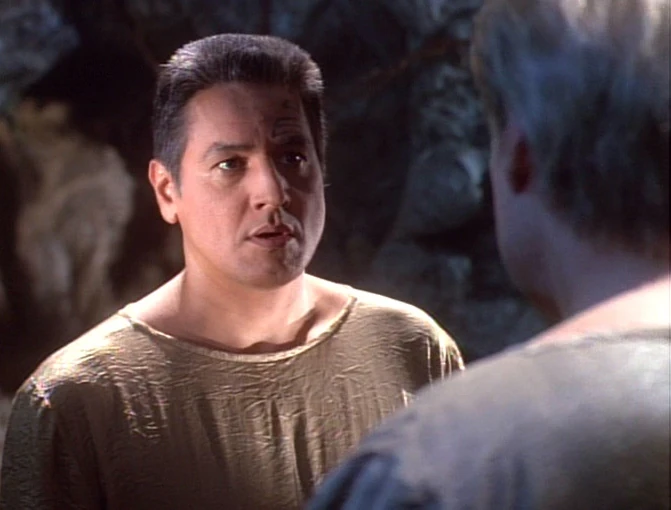
    Here's a summary of it:Chakotay's away team finds a marking very similar to one used by Chakotay's own tribe. When he experiences flashbacks from his own youth and decides to investigate, he meets an alien who claims that Chakotay's tribe were seeded on Earth by a group of spacefaring wanderers.And some reviews:

    Star Trek Voyager: TattooI’m having some trouble summing up the plot of this episode. Here’s the general gist; back when he was 15 and fighting with his dad, because that’s what TV-15-year-olds do, Chakotay and some others of his tribe met some people in a rainforest, who they were related to (speaking the same language and with the same stories of the Sky Spirits). They gave Chakotay’s father a tattoo like the one the older Chakotay has.

    Many years later, Voyager finds a planet where the same native American symbols appear, and which throws up a storm every time they try to land or beam down. Then some people with Chakotay’s tattoo turn up. It turns out they are the Sky Spirits, they’re real, they’re aliens and this is where they live. Oh yes, we also find out why Chakotay got his tattoo, to honour his father after he died. This is also why he joined the Maquis. The trouble is, he just tells us all this, without it really having any impact on the plot, such as it is.
    TattooSigh. We finally get Chakotay's backstory, and it's New Age Romantic Indian Fluff. First of all, I think there's something racist about the suggestion that all the accomplishments of Native Americans were because they had genetic and cultural influences from outer space. Moreover, I was willing to buy that Chakotay didn't have one discrete tribe because it was possible that by his century, the tribes had begun to intermarry and merge their discrete traditions on planets like Dorvan V. But to learn that he's really some vague mish-mosh of faux legend and culture...what a disappointment.Lynch's Spoiler Review: "Tattoo"As is all too typical in episodes which refer to Chakotay's ancestry, I'm also annoyed at the lack of an actual tribe being named. The more "my tribe this" and "my tribe that" gets mentioned without putting any distinct specifics on, the stronger the feeling becomes that no one wants to take the time to research those specifics and remain true to them. That's annoying, and it strikes me as the cultural equivalent of what Trek's done with biology lately: name the buzzwords without examining the meaning.Rob's review

    The first two reviews touch upon perhaps the most serious problem, which happens when Chakotay meets the alien "Sky Spirits." Memory Alpha describes the scene:45,000 years previously the group of beings visited Earth and ran across a group of primitive nomadic humans. Impressed by their respect for the land, the beings gifted the people with a genetic bond. They are the Sky Spirits Chakotay's people have worshiped for countless generations.

    The humans lacked language and culture until the aliens gave them the "gift." This also instilled "creativity and a spirit of adventure" in the humans, leading them to cross the planet and eventually to populate the Western Hemisphere. The SF Debris video review explains:So here's Star Trek's message: We have a great respect for the cultures of the Native Americans, and we show this by saying that they were backwards language-less cavemen until they were touched by white men from outer space.Yikes!

    Nor was this "message" some sort of thoughtless mistake. As Memory Alpha notes, the writer explicitly intended it:Michael Piller was intensely interested in further developing the narrative. "I'd always been attracted to the idea of the pitch," he said, "which was that Indians have these myths about sky spirits, and a natural extension of that myth was that these could have been travelers from space." (Captains' Logs Supplemental--The Unauthorized Guide to the New Trek Voyages) Piller also reminisced, "I had always had a fondness for [it] [....] The idea always appealed to me that it was part of the Native American lore that sky spirits came down and affected them or blessed them in some fashion." (Cinefantastique, Vol. 28, No. 4/5, p. 88) The opportunity to explore the character of Chakotay was another factor that appealed to Piller. He remarked, "For Chakotay to find evidence of these sky spirits seemed to be the beginning of a terrific personal journey." Piller elaborated, "Here's a man who has lost his faith, and he gets it back through this journey. That's a very interesting thing to write [....] I looked at this as an opportunity to really delve into his character." (Captains' Logs Supplemental--The Unauthorized Guide to the New Trek Voyages)Thus, "Sky Spirits." Because Piller just couldn't resist the ten-thousandth claim that Indians were too primitive to develop civilization without alien help. This condescending idea goes back hundreds of years, to the first explorers of the continent, but Piller found it fresh and interesting.

    More problems

    Tattoo has other problems besides the racist "ancient astronauts" and the lack of cultural specificity:

  • A stereotypical screeching hawk appears several times and attacks Neelix for no apparent reason.

  • If I understand the story correctly, Chakotay's people left Earth to colonize another world a couple hundred years ago. Twenty-five years ago, Chakotay and his father returned to find the Rubber Tree People, their ancestral tribe, in Central America.

    Okay, but when they find their relatives, these people all have nose ridges like the alien Sky Spirits. Why? Did the aliens impregnate the Indians? Why doesn't Chakotay's group have the nose ridges if they share a common ancestor? And why doesn't anyone comment on this issue? "Hey, these Indians look unnatural. Has anyone tested them? If they have alien DNA, the Sky Spirits must've been real, not a legend."

  • Some reviewers consider Tattoo a decent episode, even above average. I'd say it's bad. In particular, the Native aspects are handled poorly, at best. Only the subplot about the Doctor's infecting himself keeps the episode from being a complete loss.

    For more on the subject, see Star Trek Voyager: Chakotay.

    December 26, 2014

    Valley of Fire State Park

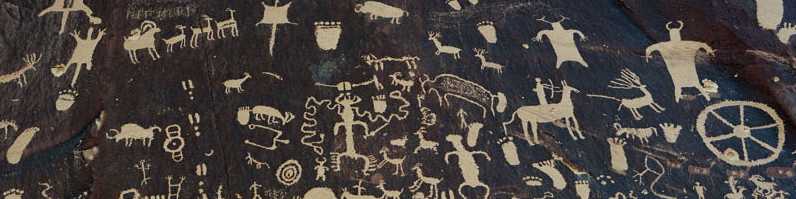
    After visiting my family Christmas Day in Las Vegas, I spent Dec. 26 in Nevada's Valley of Fire State Park. Unlike national parks such as Zion, Bryce, and Arches, Valley of Fire has a fair amount of Native lore.

    Valley of Fire State ParkThe Valley of Fire derives its name from red sandstone formations, formed from great shifting sand dunes during the age of dinosaurs, 150 million years ago. Complex uplifting and faulting of the region, followed by extensive erosion, have created the present landscape.

    Other important rock formations include limestones, shales, and conglomerates. Prehistoric users of the Valley of Fire included the Basket Maker people and later the Anasazi Pueblo farmers from the nearby fertile Moapa Valley.

    The span of approximate occupation has been dated from 300 B.C.E. to 1150 C.E. Their visits probably involved hunting, food gathering, and religious ceremonies, although scarcity of water would have limited the length of their stay. Fine examples of rock art left by these ancient peoples can be found at several sites within the park.
    Leaving Las Vegas….Thursday, again after a trip through Subway for sandwiches, we drove east on I-15 for about an hour to the Moapa Travel Plaza Exit. From there, it’s an easy 15 miles or so to the West Entrance to the Valley of Fire State Park. And, yes, the park is open on Thanksgiving day. What I hadn’t seen yet, and had been meaning to check out, were the thousands of petroglyphs and pictographs located in the park, only an hour east of town! Sites here have been dated between 300 B.C. to 1150 A.D. and possibly older. The narrow canyon leading to “Mouse’s Tank” contains one of the highest concentrations of petroglyphs I’ve seen in one place. Think Sand Island, Newspaper Rock, Horseshoe Canyon and The Procession Panel–linked together.

    If you find yourself in Las Vegas, have ingested enough secondhand smoke, and need some peace and quiet, I’d recommend a day (or more) at Valley of Fire. You’ll find quiet, private campsites, a well done, informative visitor center and a long weekend’s worth of desert hiking. Bring your camera and binoculars. Some of the rock art panels are up high and you’ll want magnification. A side-note to fellow Star Trek fans: This is the place where Captain Kirk died in Star Trek Generations!
    Comment:  This is one of the best parks I've visited--roughly equal to Zion, Bryce, Arches, Monument Valley, and Red Rock Canyon. It's well worth a day trip if you visit Las Vegas.

    November 10, 2014

    Missing aliens in Star Trek

    Back in February, a Facebook friend posted the following link with a note for me. This led to a Star Trek discussion, of all things:

    On the Killing of Jordan Davis by Michael DunnInteresting. What do you think? Has America just "grown up" racist?Yes, you could say we've grown up racist. I think that the genocide of Indians and the enslavement of blacks are fundamental to our core mythology. Which goes along the lines of, "God gave the American wilderness to the white man to conquer, tame, and develop. Anything that happened along the way was just an unfortunate byproduct."So you'd agree with the author then that "devaluation" of black lives goes back to that?Yes. Basically America wasn't an experiment in creating a melting pot of multiculturalism. It was an experiment in setting up a continent ruled by a cult of white supremacy.

    Only since the beginning of the 20th century have the two philosophies--white supremacy vs. melting pot--come into real conflict. We're somewhere in the middle of a transition that might take a few centuries. By the time the Star Trek era arrives, we may actually achieve the Star Trek ideal.

    The ideal that didn't quite make it onto the screen, that is. White males still held a preponderance of the jobs even thought that shouldn't have happened in an egalitarian society.Star Trek was still an ideal seen through the lens of 1960s television.Right.

    Just once, a Star Trek show should give us a ship with the actual demographics of Earth. Which would be half various kinds of Asians, or something like that.

    Or better yet, a ship with the actual demographics of the Federation. Which might be a quarter each of humans, Vulcans, Andorians, and Tellarites.

    I wonder if anyone would notice either of these ships and the statement it was making. I.e., how contrived the white, European, human bias of Star Trek is.

    P.S. Where are the Andorians and and especially the Tellarites? You could do several science fiction-based ST movies with wonderful new concepts and never touch the Klingons or Romulans.

    Lack of aliens okay?The alien thing has never really bothered me in the demographics on Star Trek. I always sort of saw The Federation sort of like the U.N.--you have SOME individuals from different planets serving in cross-cultural roles, but generally ships would be crewed by people from their planet of origin. And you could excuse them for not perfectly mirroring human demographics if maybe serving in Starfleet isn't a top priority in all cultures.

    However, you'd expect it to be better than it's been. Of course the original was hampered by broadcasting standards, but Next Generation was surprisingly not much better. Then you have Voyager at the other end of the extreme, looking like a J.Crew ad, with it's accidentally blended crew that just HAPPENED to include one person from each gender and ethnic group.
    All of Starfleet's ships just happen to have Earth as their planet of origin. So they're all predominantly white (but not Asian, oddly). Convenient!

    Sure, you could explain away the lack of aliens. Even the other three founding races of the Federation. For instance, the Vulcans are too busy with science, the Andorians with sex, and the Tellarites with commerce.

    They actually gave an explanation like this for the lack of Vulcans. They're too dedicated to scientific pursuits, don't believe in Starfleet's miltary aspects, and find it too illogical to work with humans. Okay, we buy that.

    But still, if you're going to explain the shortcoming, then explain it. In the stories themselves. Leaving it unexplained and implied is weak.

    Someone, perhaps a Klingon, actually accused Starfleet of being the imperialist arm of the human race. He has a point. The Federation's military might is primarily controlled by humans.

    If the other races are involved in other pursuits, then show it. For instance, if the Enterprise becomes involved in a scientific dispute, show a team of Vulcans in charge. If it becomes involved in a trade dispute, show a team of Tellarites in charge.

    In short, whatever the other races are doing, show them doing it. Otherwise, the racial charges against Star Trek are valid. If Avatar can give us an entire planet of blue-skinned Na'vi, I think Star Trek can give us alien races that aren't humans with facial ridges.

    For more on Star Trek, see Superior Powers Don't Change Society and Colonialism Inspired Science Fiction.

    August 29, 2014

    Superior powers don't change society

    A Facebook discussion began with a bit on Superman. Specifically, in the Peace on Earth graphic novel:

    Superman learns there's hunger in the world--duh!--so he decides to end it singlehandedly. He starts delivering food everywhere, but a couple of Third World forces oppose him--because it's to their advantage to keep their people hungry.

    Does Superman take out those forces? Or simply avoid those countries while he continues helping people elsewhere? No, he gives up. Because comic books can't handle the idea that god-like beings would change the world in fundamental ways.Weird.He ends up teaching kids one by one how to grow food using his childhood farming skills. Following the old "teach a person to fish" idea. This teaching project is never mentioned again.

    It obviously was a half-hearted attempt to deal with the social issues comics normally avoid. There's no good solution to this storytelling problem. Either superheroes transform the world beyond recognition, or comics remain unrealistic fairy tales for kids.It's just weird that they wouldn't go with option #2 and just blame the idea's failings on human vice. To have Superman "give up" and do nothing just seems fundamentally flawed.

    But you see the same thing in sci-fi where revolutionary new technologies are invented or discovered and then essentially have no effect on life anywhere.
    I think the in-story explanation for Superman's resignation was that "human vice" made the project untenable. I.e., that too many people would undermine his noble efforts for selfish reasons.

    Which might be a realistic outcome if he'd fought world hunger for 10-20 years and found he wasn't getting anywhere. But to literally encounter two minor setbacks and give up on saving millions of lives? No.

    Federation = paradise?

    Speaking of sci-fi and revolutionary technologies:

    Yeah, Star Trek's magic food-and-object replicator should've changed the Federation beyond recognition. No farming communities, no Quark's bar, no illegal gun-running, etc. Why bother when you can make your own food, drink, or weapons in the privacy of your home?

    Every Federation world that embraces technology should be a paradise. Which probably explains why we don't see much of Earth in Trek stories. No one dares to portray a world without poverty, hunger, or conflict.They did show Earth in a number of episodes and it IS a paradise where people, it would seem, largely do whatever they feel like doing without needing to have occupations or obligations.Outside of Enterprise, the Academy, and time-travel stories, I'd say they didn't show much of Earth. Certainly not in the 23rd and 24th centuries.

    Yeah, Earth is supposed to be a paradise. So...can people have an unlimited number of children, or what? What prevents a large number of obligation-free people from engaging in constant sex, drugs, and virtual realities? There's presumably a world government with a president...so what political issues do they fight over during elections?

    Where are all the other paradise worlds and empires, since they all have the same technology? How does the ability to replicate an infinite amount of resources affect the Klingons, Romulans, Cardassians, et al.? Why were they fighting over quadrotriticale when the Federation could whip up as much of it as anyone could eat?

    None of the shows address any of this. And the same applies to energy (antimatter power generation) and transportation (teleportation). These technologies should cause radical transformations in every known civilization.

    Trading without money?

    Let's see...there's no money, although characters have talked about saving credits and doubling salaries. No money means no real economy. So how do countries and planets engage in trade? If they need a limited resource such as dilithium, how does it get allocated to interested parties?

    Earth's government undertakes huge projects such as building and running Starfleet. Does it still tax people, and what do they pay with? If not, how do resources flow to the government? Do billions of people each donate 10% of their nonexistent money to the government voluntarily, or what?

    As I said, no one involved in Trek has even begun to describe how this so-called paradise would work. They can't because it would mean declaring capitalism is bad and unlimited sex and drugs are good. Hence my previous comment: "No one dares to portray a world without poverty, hunger, or conflict."Yes, because that would be [gasp] COMMUNISM!

    Which I gather is what The Federation essentially is. If you have 100% renewable energy and replicators that can make anything you need, why do you need an economy OR taxes?
    I assume replicators just rearrange molecules. If they can actually change lead into gold--or gold latinum--that's another whole problem. So there should still be scarce resources. Dilithium and other minerals are the usual example.

    And that means trade, which is a constant factor in the Trek stories. But trade of what? Is everything done on a barter basis? That's unworkable for any group larger than a few hundred people, but I'd love to see it explained on a planetary scale.

    An enterprise such as Starfleet requires millions of people to plan, design, build, and maintain things, even if you can replicate the raw materials. It requires ditch diggers, gardeners, plumbers, electricians, and many other jobs that aren't that popular without money. Who's doing all this dirty work?

    Are people literally choosing these careers out of love, with no remuneration other than a pat on the back? Because so many people prefer physical labor to unlimited sex and drugs? And does the number of workers needed magically equal the number of people seeking work? Yeah, right...tell me another fairy tale.

    Communism? I don't think communism has ever worked on a large scale. So again, tell me how it functions in the Federation. Show it to me on screen or in a novel and then I'll believe it.

    For more on Star Trek, see Colonialism Inspired Science Fiction and Star Trek vs. Star Wars.

    August 13, 2014

    Colonialism inspired science fiction

    Why Sci-Fi Keeps Imagining the Subjugation of White People

    As much as the genre imagines the future, it also remixes the past—often by envisioning Western-style imperialism visited on the Western world.

    By Noah Berlatskyapr
    The link between colonialism and science-fiction is every bit as old as the link between science-fiction and the future. John Rieder in his eye-opening book Colonialism and the Emergence of Science-Fiction notes that most scholars believe that science fiction coalesced "in the period of the most fervid imperialist expansion in the late nineteenth century." Sci-fi "comes into visibility," he argues, "first in those countries most heavily involved in imperialist projects—France and England" and then gradually gains a foothold in Germany and the U.S. as those countries too move to obtain colonies and gain imperial conquests. He adds, "Most important, no informed reader can doubt that allusions to colonial history and situations are ubiquitous features of early science fiction motifs and plots."

    The iconic example of colonialism-inspired sci-fi is that most important of sci-fi stories, H.G. Wells's War of the Worlds. As Rieder says, Wells begins his book with an explicit comparison of the Martian invasion to colonial expansion in Tasmania. "The Tasmanians," Wells writes,in spite of their human likeness, were entirely swept out of existence in a war of extermination waged by European immigrants, in the space of fifty years. Are we such apostles of mercy as to complain if the Martians warred in the same spirit?"Here the Martian conquest is presented as analogous to, and even as just retribution for, Britain's colonial genocide. As has been visited on them, so shall it be visited on us.

    With Wells in mind, it’s easy to see colonial metaphors throughout the sci-fi that followed him. In many cases, as with Wells, these works flip the racial dynamic that characterized the most influential imperialist ventures of the last few centuries. In such stories, sci-fi is about “them” (a non-white, foreign civilization) doing to us (Western, largely white powers) as we did to them. Star Trek: The Wrath of Khan and Into Darkness, for example, imagine a non-white antagonist who preaches the colonial ideology of eugenic culling against the less biologically perfect, Western-ish protagonists.
    Comment:  For more on Star Trek, see Controversies in Star Trek Into Darkness and Mistakes and Stereotypes in The Paradise Syndrome. For more on the link between speculative literature and colonialism, see:

    Burroughs the conservative racist
    Stereotypes in Tarzan of the Apes
    Frankenstein's monster = Eskimo
    Charles Dickens on "Esquimaux"
    The "Other" and The Terror

    April 20, 2014

    What I'm passionate about

    Someone asked me what I'm passionate about and whether I'm truly passionate about doing comic books. My answer:

    What am I passionate about? The simple answer would be: words and ideas.

    This passion expresses itself in several ways:

    1) Disseminating information. Including making up quizzes as a kid, getting a degree in library science, building a database of the LA Times, becoming a freelance journalist, blogging, and now posting on Facebook and Twitter.

    2) Creative writing: Including making up characters as a kid, taking creative writing classes, trying the Marvel Try-Out Book, developing my own comic book, and now undertaking screenplays and novels.

    The type or genre of stories I favor include science fiction, superheroes, fantasies, thrillers, and mysteries. The mediums I favor include comics, novels, movies, and TV shows. I constantly read and watch stories in these genres and mediums.

    The themes I'm most interested in include race and culture, American and Native values, liberal and conservative politics, and science and religion. Many of my efforts in points 1) and 2) touch upon one or more of these themes.

    Trek combines interests

    A good example would be Star Trek, which may be my favorite fiction franchise. Within Star Trek, you can tell a variety of stories, though they're often sci-fi thrillers. You can use a variety of mediums, though TV was obviously the starting point.

    And themes such as accepting diversity and avoiding violence are usually present in Star Trek. But these themes do not dominate or overshadow the stories in Trek and they won't in my work either.

    I'd say I love all these things in roughly equal proportions. Which also means that I don't love comics more than anything else. Yes, I love them as a vehicle to tell my stories. I'd like them well enough if I got paid to write Marvel or DC comics. But obviously I didn't focus my career on breaking into comics to the exclusion of everything else. As long as I have other creative outlets, I'm okay with not doing comics.

    I'm also gravitating from comics because I can't do them all myself. And that would be a problem if I were writing comics for the Big Two, writing TV scripts for a network, and so forth. I'd enjoy collaborating with like-minded people, but I don't want to butt heads constantly with people who don't share my vision. Nor do I like relying on people who prove to be unreliable. I'm passionate about being the one in control who can get things done and do them right.

    Probably my "natural" field is writing novels--because they're long and wordy and the product of one mind. I've been fine-tuning one SF novel concept while I've been working on Peace Party and Breaking the Code, a movie script. It may be my next big project.

    February 19, 2014

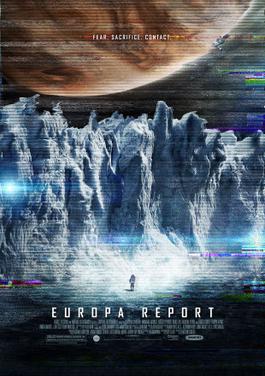
    Alternative endings for Europa Report

    Continuing the discussion of Europa Report begun in Review of Europa Report:

    ** spoiler alert **

    If Europa Report had been Star Trek....

    Assume no changes in the story until the ending. You have Kirk, Spock, and McCoy trapped in a lander about to sink into the ice. What happens?

    Spock deduces what the Europans are attracted to: light, heat, vibrations, radiation, whatever. Kirk tells Spock and McCoy to repair the lander while he lures the Europans away, nobly sacrificing himself in the process.

    Spock argues that he's the logical one to sacrifice himself, but Kirk won't have it. Spock stuns him, takes the equipment to lure the Europans, and heads off across the ice.

    Kirk and McCoy repair the lander while cursing Spock's stubbornness and bemoaning his loss. But...as the creatures grab Spock, he mind-melds with them and convinces them he's a sapient being. They didn't realize it; they thought the humans were a weird natural phenomenon.

    Just as Kirk and McCoy are about to abandon hope and blast off, the creatures return Spock to the ship. They share an interspecies moment of understanding before the humans depart. Voilà...mission accomplished, no more lives lost, and first contact with a new species established.

    True, this wouldn't have been the most original episode of Trek. But with the movie's special effects, it would've been entertaining.

    Heroes don't give up

    I wasn't expecting exactly that...but at that point, the crew knew they were dealing with a living organism. I don't know if they could've distracted it or lured it away in the short time they had. Perhaps not. But at least a mention of the possibility would've been nice.

    If you've watched a single SF show on your long trip to Europa, you know space explorers don't give up. Not until you've exhausted every option, and perhaps not even then. Creatures are attacking you for some reason, so figure it out!Well unfortunately they didn't have a Vulcan in their crew. I think also it took them quite a while to figure out that it actually WAS a living thing they were dealing with. I think they were sort of unable to even consider the possibility being so deep in their belief that such a thing couldn't possibly exist there.You've seen or heard Katya dragged under the ice. Even if it's some sort of strange natural phenomenon, you should be talking about it. Trying to understand it in a pseudo-Vulcan kind of way.

    At that point, no way do I step onto the ice without good reason. And they understood that. The two who went out were both acting like it was a death sentence. They thought something was stalking them.

    So in that situation, you go into Kobayashi Maru mode. Even if you don't know what it is, something under the ice is threatening you. What can you do to distract it or lure it away?

    Maybe turn off all your power sources. Or throw a power pack onto the ice. Worst case, one of the three of you sacrifices himself. Doing nothing and giving up is not an option.

    Back to the future

    And that's just an action-adventure story. They could've gone all science-fictiony at the end.

    You want to use a flashback structure? With a sense of foreboding? Okay. You start the story 500 years in the future. On an empty news stage, kind of like how they did it with the Europa Ventures director. So no expensive special effects.

    She tells the story of what happened to the doomed Europa mission 500 years ago. The mission has never been repeated because it was too expensive of a failure. In fact, the Earth turned inward after that. There's been no real space program since then.

    Using the same footage but in a more chronological sequence, she recounts what happened. And she makes it sound like it's breaking news. So you're wondering: Why are they revealing the truth about this mission only centuries later? What horrible thing happened on Europa?

    You go through the same events--except you don't need the year of radio silence any longer. The ship lands, people die, and the last image shows an alien being.

    And now, the big reveal: Europa has contacted Earth after 500 years. Someone or something transmitted the "lost" footage back. And a light is flashing on the landing spot, inviting--or daring--the humans to return.

    Boom! That's also ten times better than the actual ending. Score another one for Rob. I'd agree that it's surprising that they wouldn't use scientific experimentation to try to figure out the mystery. As to the rest, I'd say any of it, including giving up, is not unrealistic at least for some of them. These are scientists and engineers, not hardened Starfleet officers trained to handle themselves under attack from a hostile force.It may be realistic, but it's not effective storytelling. My alternatives would've made for a better movie.

    And I had vague thoughts along these lines while I was watching the movie. So I'm not just taking advantage of hindsight.

    To make a long story short, it's my way of saying why I consider Europa Report merely good, not great.

    Human/Europan hybridsHonestly I don't think I prefer the 500-year flashback suggestion. It pulls you out of the drama and removes the suspense of being in with the astronauts as they're facing the crisis. It would be kind of like watching someone else watch the movie.It's just one of many ideas. And you could go even more science-fictiony. Suppose one of the astronauts contacts you after 500 years. Sends the missing footage along with a voice that matches his or her voice print. How is that possible?

    Answer: The Europans kept the humans alive and bioengineered them into human/Europan hybrids. They've been living under the ice and working to repair their technology ever since. Now they're ready to resume contact with Earth. But...are they friend or foe?!

    I'm pretty sure you can make a flashback movie compelling if you use the right cinematic techniques. Like Citizen Kane or Titanic. Heck, practically any sports movie where you already know the outcome. I hated Citizen Kane. One of the dullest movies I've ever seen. So...there you go.

    I like your second idea better.

    Of course in the sequel, the Europan octopods have rebuilt the capsule and are on their way to Earth...to take over!
    And yet, Citizen Kane is one of the top five or ten movies on most people's lists. I'll go with engrossing almost everyone even if it means losing you.

    My first version was trying to take their story and make it better without violating their basic premise or requiring expensive new scenes. But yes, my second version might be better, dramatically speaking.

    Europa Report 2: Return to Earth could go in several directions. But yes, I'd save the octopods for the sequel. If you want Europa Report to go out with a bang, you end with a shot of the hybrid(s) or something equally chilling.

    February 18, 2014

    Review of Europa Report

    I watched the sci-fi thriller Europa Report recently. Afterward, Facebook friend Brad and I debated its merits. Stick with my review and I'll tie it to my usual Native themes eventually.

    ** spoiler alert **

    Finally watched Europa Report, Brad. Not spectacular, but solid.So I liked it more than you? I wouldn't have said it was Oscar material, but compared to most of the sci-fi that's come out in the last several years, I'd say it's near the top.I think you did like it better.

    I'd say it was better than movies I didn't care for, such as the two new Star Treks. On a par with decent movies such as The Hunger Games. Not as good as the top SF, which would include Inception and Chronicle.I would rank those two ahead of it, yes.Fictional science

    I could write a lengthy review of the flaws, both storytelling and scientific, that kept it from being a superior SF movie.

    For instance:

    Never mind that I doubt we have the capability to pick a good Europan landing site. The astronauts tried to land on top of a thermal vent, chosen for its thin ice or something. Not surprisingly, that proved to be a stupid choice. Gases or something interfered with the landing and blew them off course.

    But...they landed a whole 100 meters from where they intended to land. And that was a huge problem that threw off all their plans. Really? After a trip of 500 million miles or whatever, 100 meters was considered a terrible miss? Something they completely failed to anticipate?

    I'd guess that landing that close to the spot would be one of the greatest feats of targeting in space history. In comparison, Apollo 11 missed its much closer target by four miles. Curiosity missed the center of its target range on Mars by 1.5 miles. We've never planned surface landings to the nearest 100 meters and probably never will.

    And conducting science within a stone's throw of the vent was almost out of the question? The vent was a hot spot of geological and biological activity, but a mere 100 meters away was a frozen wasteland? That must be the most well-confined hot spot in the solar system.

    I would've thought a mile or two from geological activity would be the bare minimum you'd risk for safety's sake. But they wanted to land on top of a site with heat that would and did play havoc with the ice's firmness. Great plan!

    Heck, maybe they could land on one of Io's sulfur volcanoes on the way back. I mean on it, not 100 meters away from it, because that would be too far. You gotta be within inches of a hot spot if you want to do science!I didn't think any of that was a huge detractor. As I recall, they didn't know they were only a short distance away from their target. We saw from the ending they would likely have faced even bigger problems had they actually landed where they were supposed to. And the inability to pick an ideal landing site explains away all of that too. They simply ran into much larger problems than they anticipated. It happens.

    What I thought was a bigger problem was the way the astronauts kept making "horror-movie" style bad decisions that cost them their lives one-by-one, especially when we learned later that the crash doomed their escape from the beginning. That made the deaths completely unnecessary.

    AND where were the robots?! I'm surprised you didn't seize on that! Futuristic space mission and they only had the one probe to drill into the ice--no robots, no rovers, no drones?
    They knew where they landed. They had a computer graphic showing the exact 100-meter path from their landing site to the vent.

    It was my point that they would've had even bigger problems if they'd landed where they intended. In other words, their primary plan was stupid and ill-conceived. And the entire thrust of the movie was based on this ridiculous plan. That the missed landing led to a slow death rather than a quick one is still evidence of idiocy.

    Europa on the cheap

    And that was just an example. I noted many other problems. For instance:

  • They couldn't repair the comm link after a year in space, but after they crash-land, Andrei fixes it in a minute.

  • The second (crash) landing should've demolished the ship. No way do you lift off again after that. Or even live through it.

  • The whole first half of the movie was a red herring. James died mysteriously, Andrei was mysteriously depressed and uncommunicative, and the comm link was mysteriously down. An ominous indicator of something terribly wrong with the mission? Nope, just a garden-variety accident and the astronauts were sad. It had no real bearing on the rest of the movie.

  • Europa's ice is supposed to be 100 km. thick, but I gave them that one. They implied the ice was thin around the vent. And the drill that looked like a simple cylinder could've been one of several super-robotic drills that were specially designed to drill through Europa's ice.

  • In reality, any mission to Europa for the next couple of centuries will be robotic rather than manned. Unless we invent a cheap warp drive, that is. And yes, any manned mission will make extensive use of probes, robots, rovers, and so forth.

    I mean, even Curiosity the Mars rover seems better equipped than this lander. "We can't do anything this far from the vent! Katya has to go there personally and stick her hand into it!

    "If only there were some way to send scientific instruments 100 meters away...across the land...without human help. But...that's impossible!"

    But I gave them that one because a private company funded the mission. I told myself that the company somehow arranged to profit from having people do the exploring. A billion-dollar PR stunt or something like that.

    If you saw the TV series Defying Gravity, it made a point of talking about corporate sponsors. In our media-saturated future, that's probably the way it would be. ("General Motors Presents the USS Enterprise featuring Coca-Cola Captain James T. Kirk.")

    A related problem was how luxurious the lander was. It was bigger than the Enterprise's bridge. It had at least two levels and couches for all six astronauts, even though Andrei was supposed to stay in orbit. "Should we leave Andrei alone? Naw, we got room in our luxury lander for a whole Boy Scout troop. Bring him along."

    The spaceship seemed okay, although we never got a real idea of its size. But no way does a corporation invest in such a lavish lander. Or risk it by landing next to an unknown vent on an unknown surface. A compact lander with a rover that landed a mile away would be safer and more cost-effective.

    Acting like horror victims?

    Katya was the only one who really wandered off like a horror-movie victim. Daniel and Andrei had to go onto the ice to fix the lander.

    I did mind the similarity of the three deaths: alien grabs them through the ice. And I minded the lack of discussion about what was happening.

    You've got a possible source of light, heat, and radioactivity directly under the ice. Which, as already noted, is incredibly thin. This source is causing quakes bad enough to rattle the ship.

    In those circumstances, how about doing all your tests from the relative safety of the ship? If not the safety of orbit? You've got a thing under the ice and you're a prime target: a foreign source of light, heat, and radioactivity. Think about it carefully, in detail, and beware!"They couldn't repair the comm link after a year in space, but after they crash-land, Andrei fixes it in a minute."

    I thought that problem was because it would have required another space walk and after the one guy died it's understandable that they would have been iffy on doing that.

    "The second (crash) landing should've demolished the ship. No way do you lift off again after that. Or even live through it."

    Probably true.

    "The whole first half of the movie was a red herring...It had no real bearing on the rest of the movie."

    I mostly agree with you there. I think the two purposes it served were to set the stage for the "space is dangerous" premise of the rest of the film. More importantly, it was the means by which they got Andrei down to the surface with no one left on the command ship.

    "A related problem was how luxurious the lander was. It was bigger than the Enterprise's bridge."

    Again, I think the only reason they had room for Andrei was because James died. I think HE was originally supposed to go down to the surface with the team while Andrei stayed behind.

    And it was unrealistically large, sure, but I don't think it was THAT big. It had two levels, yes, but the top one just had room for the pilots. I was guessing it maybe only slightly larger than the cabin of the space shuttle. I would have guessed that the old Enterprise bridge was at least 50 feet across.

    Of course some of that has to do with the nature movie making. Sets have to be large accommodate equipment and shooting distance. Defying Gravity was kind of ridiculous that way too--spacious hallways and high ceilings. Of course a real space mission where you have heat that space and burn fuel to push it around, you'd never have that.
    Communications with earth are too important to forgo. And trained astronauts--the best people from all the space programs--should be the last ones who'd give in to fear.

    Besides, if you're depressed over a teammate's death, the last thing you should do is isolate yourself from human contact. This is Psychology 101. "We're totally alone in deep space, so let's wallow in our isolation and not fix the communications"...wrong.

    And even if you could justify that choice, you need to justify it. On screen. Like, "We could fix the communications, but no one wants to risk it. We're all too scared now." That would set up the final fix as more than sloppy storytelling.

    I understand that the filmmakers wanted to create a sense of foreboding with the initial red herring. I just disagree with how they did it. The journey to Europa took another year, which is more than enough time to get over James's death.

    And the movie never addressed why they considered Andrei untrustworthy. Because he saw his teammate die? They all saw it. A year ago. Contingency plans. Trained astronauts. Get over it.

    I was thinking James might've committed suicide. Because the long trip was making them psychotic, and that would sabotage the mission. But no, the film didn't take that approach, which would've been better dramatically. The plot and structure were flawed and I noted it.

    The luxury lander

    The lander had two couches in the upper control module and four more couches in the lower luxury lounge. The mission always allowed for all six astronauts--plus a Boy Scout troop--to go to the surface.

    In the reality of space flight, that's never a variable. If you plan for, say, four people to land, the lander has space for four people. Period.

    William the Chinese commander died because he fell from the top of the lander to the bottom. Which appeared to be 50 feet or more. So the lander was that tall, and I'd argue it was that wide too.

    It's a ridiculous amount of space to have in a lander. All that volume means an insane amount of ship you have to land safely and thrust into orbit again. Even the 1960s Star Trek understood that a small landing shuttle makes more sense.

    Apollo 13 managed to film the story in the tight confines of a realistic spacecraft. I suspect several of the film's choices were made just so the filmmakers could contrive a way to kill everyone. Nobody left in the orbiter? The guy they'd normally leave could be suicidal. Need a way to kill somebody besides falling through the ice? How about a fatal fall within the lander?

    And sure, you can come up with explanations for everything. But if audience members even think about potential flaws, it means you've lost their attention. They aren't swept away by the story, haven't suspended their disbelief.

    Since most of these errors were fixable, that's subpar storytelling. I don't "geek out" when they get some of the science right. I expect them to get the rest of the science right too.I think the deal with Andrei was that they were worried he might kill himself if they left him alone. And I thought the general "sadness" of the crew was just from the isolation of being in space that long, especially after their link with Earth went down rather than being about the death.

    I don't think it was that tall. It was a pilot cabin with a ladder down to the crew chamber. It didn't look any taller of a climb than say a two-story house to me, maybe about 13 feet from floor to floor. That would still be sufficient to kill you especially if the ship were falling fast enough and you landed on your neck or head. As you pointed out, some of the other seated crew members likely would have been injured or killed in that scenario too.

    All in all, your point is taken. A REAL mission probably would have had a small, maybe four-man, lander with room for one pilot, one engineer, and two scientists. And they definitely would have left one of the pilots on the command ship.

    MY big in-movie problem was with the behavior of the alien. Unless you assume that this cephalopod-looking creature was sentient, then its behavior was totally illogical. An animal only acts aggressively like that if it's hunting or defending its territory. And such an animal would have only evolved such a behavior if there were other organisms on the surface for it to fear or eat, which both science and the film had already established was impossible.
    Exploration always good?

    Also, speaking from my pseudo-Native perspective, it would've been nice if someone questioned the whole mission. Like, "What if Europa does have intelligent life? Is it totally wise to land on top of their home and stick a probe into their midst? What if they react the way Native Americans did--with understandable hostility to the intrusion? From their perspective, we're invading and contaminating their world, and they may not appreciate it."

    Arthur C. Clarke's 2010 implied that message with its "leave Europa alone" ending. These days it's common to talk about the hubris of human space explorers. But "Europa Report" was basically 100% pro-exploration. Its message, which it repeated a couple of times, was "the quest for knowledge is more important than individual lives."

    Well, tell that to the Natives who were decimated by European diseases. The quest for knowledge has potential downsides--ape-men learn to kill, computer goes mad--that a smart story would acknowledge. 2010 was a better Europa film because it touched upon these philosophical issues.Well I certainly would never suggest that this film was up to Clarke's level of writing to begin with. But in this case I don't think the explorers had any belief at all that there was anything more complex than micro-organisms there, if anything. In 2010, the astronauts were given several suggestions that life was out there, some more subtle than others. Certainly the Europa crew had less reason to expect complex life there than Columbus did to expect life on another part of the Earth.Yes, the explorers in 2010 knew about the Monolith. But they didn't know there was life on Europa, initially.

    You don't have to know the lesson before the story begins. You make the point by how the story unfolds. Like when you stick a probe with a light into a dark, pristine environment, it triggers a clear reaction. You discuss and learn from that reaction.

    Like, "Ohmigod, maybe we shouldn't have put that probe in the water. Maybe we should've conducted a month of tests from orbit. Now we're all gonna die!"

    You have Rosa, the pilot who had a chance to leave her thoughts on video: "Maybe we were too careless, too thoughtless. Maybe there are cases where we shouldn't quest for knowledge. I don't know, but this expedition was flawed from the beginning.

    "A corporation sent us here to make a profit, not to advance the human race. A backup communications array was too expensive, they said, so we had to go silent for a year. A rover was too expensive, they said, so we had to land near the vent. The whole mission basically failed because the company was too cheap.

    "If Europa Ventures receives this message, it'll get the payback it wanted: enough biological discoveries to start whole new product lines. Let's hope someone other than the shareholders benefit from them. Meanwhile, we'll be dead, and the Europans will consider us hostile invaders. Not exactly a perfect tradeoff.

    "This is Rosa the pilot, signing off from my tomb on Europa."

    Wow, I just made the ending of Europa Report ten times better. I pat myself on the back for my writing ability. Good job, Rob!

    P.S. See my previous posting about how Hollywood never criticizes the 1%, the powers that be, or the status quo. This would've been a great chance to question the whole American idea of progress--of exploring and searching for knowledge at all costs. Opportunity missed!