Showing posts with label lost civilizations. Show all posts

December 28, 2014

Review of Voyager: Tattoo

I've been watching old episodes of Star Trek: Deep Space Nine and Star Trek: Voyager. This weekend I saw Tattoo, the ninth episode of Voyager's second season. I don't remember if I saw it when it aired originally, on November 6, 1995--perhaps not.

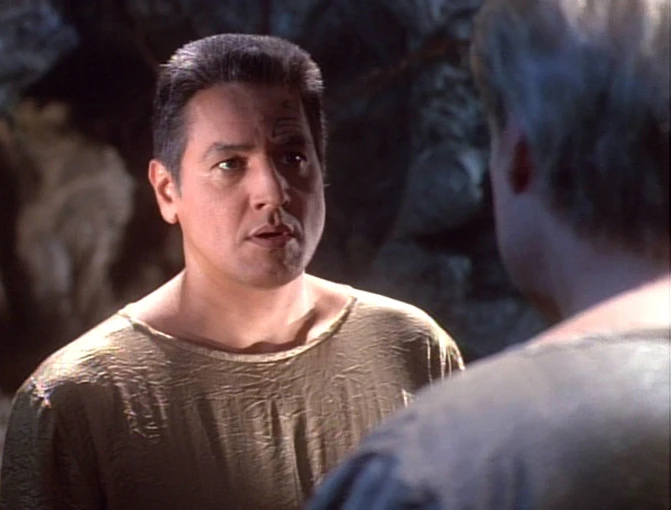
Here's a summary of it:Chakotay's away team finds a marking very similar to one used by Chakotay's own tribe. When he experiences flashbacks from his own youth and decides to investigate, he meets an alien who claims that Chakotay's tribe were seeded on Earth by a group of spacefaring wanderers.And some reviews:

Star Trek Voyager: TattooI’m having some trouble summing up the plot of this episode. Here’s the general gist; back when he was 15 and fighting with his dad, because that’s what TV-15-year-olds do, Chakotay and some others of his tribe met some people in a rainforest, who they were related to (speaking the same language and with the same stories of the Sky Spirits). They gave Chakotay’s father a tattoo like the one the older Chakotay has.

Many years later, Voyager finds a planet where the same native American symbols appear, and which throws up a storm every time they try to land or beam down. Then some people with Chakotay’s tattoo turn up. It turns out they are the Sky Spirits, they’re real, they’re aliens and this is where they live. Oh yes, we also find out why Chakotay got his tattoo, to honour his father after he died. This is also why he joined the Maquis. The trouble is, he just tells us all this, without it really having any impact on the plot, such as it is.
TattooSigh. We finally get Chakotay's backstory, and it's New Age Romantic Indian Fluff. First of all, I think there's something racist about the suggestion that all the accomplishments of Native Americans were because they had genetic and cultural influences from outer space. Moreover, I was willing to buy that Chakotay didn't have one discrete tribe because it was possible that by his century, the tribes had begun to intermarry and merge their discrete traditions on planets like Dorvan V. But to learn that he's really some vague mish-mosh of faux legend and culture...what a disappointment.Lynch's Spoiler Review: "Tattoo"As is all too typical in episodes which refer to Chakotay's ancestry, I'm also annoyed at the lack of an actual tribe being named. The more "my tribe this" and "my tribe that" gets mentioned without putting any distinct specifics on, the stronger the feeling becomes that no one wants to take the time to research those specifics and remain true to them. That's annoying, and it strikes me as the cultural equivalent of what Trek's done with biology lately: name the buzzwords without examining the meaning.Rob's review

The first two reviews touch upon perhaps the most serious problem, which happens when Chakotay meets the alien "Sky Spirits." Memory Alpha describes the scene:45,000 years previously the group of beings visited Earth and ran across a group of primitive nomadic humans. Impressed by their respect for the land, the beings gifted the people with a genetic bond. They are the Sky Spirits Chakotay's people have worshiped for countless generations.

The humans lacked language and culture until the aliens gave them the "gift." This also instilled "creativity and a spirit of adventure" in the humans, leading them to cross the planet and eventually to populate the Western Hemisphere. The SF Debris video review explains:So here's Star Trek's message: We have a great respect for the cultures of the Native Americans, and we show this by saying that they were backwards language-less cavemen until they were touched by white men from outer space.Yikes!

Nor was this "message" some sort of thoughtless mistake. As Memory Alpha notes, the writer explicitly intended it:Michael Piller was intensely interested in further developing the narrative. "I'd always been attracted to the idea of the pitch," he said, "which was that Indians have these myths about sky spirits, and a natural extension of that myth was that these could have been travelers from space." (Captains' Logs Supplemental--The Unauthorized Guide to the New Trek Voyages) Piller also reminisced, "I had always had a fondness for [it] [....] The idea always appealed to me that it was part of the Native American lore that sky spirits came down and affected them or blessed them in some fashion." (Cinefantastique, Vol. 28, No. 4/5, p. 88) The opportunity to explore the character of Chakotay was another factor that appealed to Piller. He remarked, "For Chakotay to find evidence of these sky spirits seemed to be the beginning of a terrific personal journey." Piller elaborated, "Here's a man who has lost his faith, and he gets it back through this journey. That's a very interesting thing to write [....] I looked at this as an opportunity to really delve into his character." (Captains' Logs Supplemental--The Unauthorized Guide to the New Trek Voyages)Thus, "Sky Spirits." Because Piller just couldn't resist the ten-thousandth claim that Indians were too primitive to develop civilization without alien help. This condescending idea goes back hundreds of years, to the first explorers of the continent, but Piller found it fresh and interesting.

More problems

Tattoo has other problems besides the racist "ancient astronauts" and the lack of cultural specificity:

  • A stereotypical screeching hawk appears several times and attacks Neelix for no apparent reason.

  • If I understand the story correctly, Chakotay's people left Earth to colonize another world a couple hundred years ago. Twenty-five years ago, Chakotay and his father returned to find the Rubber Tree People, their ancestral tribe, in Central America.

    Okay, but when they find their relatives, these people all have nose ridges like the alien Sky Spirits. Why? Did the aliens impregnate the Indians? Why doesn't Chakotay's group have the nose ridges if they share a common ancestor? And why doesn't anyone comment on this issue? "Hey, these Indians look unnatural. Has anyone tested them? If they have alien DNA, the Sky Spirits must've been real, not a legend."

  • Some reviewers consider Tattoo a decent episode, even above average. I'd say it's bad. In particular, the Native aspects are handled poorly, at best. Only the subplot about the Doctor's infecting himself keeps the episode from being a complete loss.

    For more on the subject, see Star Trek Voyager: Chakotay.

    February 05, 2014

    Indiana Jones in Saturday Night Live

    After much controversy, Saturday Night Live hired Sasheer Zamata, its first black woman in years. She made her first appearance January 18, 2014.

    Somewhat ironically, the same show featured a somewhat racist skit, described thusly:Audience member Rahat gets confused after being invited on stage for the Indiana Jones Epic Stunt Spectacular.

    Rahat was supposed to be some sort of ethnic person, probably Middle Eastern. She wasn't just "confused after being invited on stage." She was apparently confused by everything. She had no idea what an amusement park show was despite being at an amusement park.

    That alone is arguably racist. But then SNL inserted Rahat into the most racist aspects of the Indiana Jones movies.

    Drake played the tour guide who introduced the Indiana Jones scene. He described it as a "forbidden temple" with a "priceless ancient artifact." Okay so far.

    Then Kenan Thompson appeared in a grass skirt as a witch doctor or some other primitive savage. At least Drake called him a "native" rather than a "savage." And Rahat's reaction was to hug him and say "my friend." But still, SNL was repeating the worst stereotypes: Indians as lost races with hidden treasures that they'll protect with unholy violence. As if the problem is their defense of their religion and not the white man's destruction of it.

    It got worse when Drake tried to get Rahat to grab the artifact. Instead she bowed down and prayed to it. So she's so ignorant that she doesn't have her own religion and meekly adopts whatever's presented to her. And her idea of Native religion, which is also the show's idea, is nothing more than idol worship.

    Finally, two "evil temple guards" appear. They seem to be turbaned South Asian Indians from The Temple of Doom. No one informs us that these particular Indians were members of a death cult and thus extremely atypical. The message is that all "foreigners"--Rahat, the native, and the guards--are strange, exotic, and ignorant or evil.

    November 13, 2013

    Review of Houdini Pie

    Back in 2010, the author of the novel Houdini Pie sent me a copy to review. I previewed it and read it, but I didn't have time to post about it until now.

    The book is based on the legend of the "Lizard People" of Los Angeles. Which is why I posted something about that subject recently.

    Houdini PieBook Description

    BOOTLEGGING, BARNSTORMING and a Hard-Rock BOONDOOGLE. Los Angeles, 1934: Based on a true chapter of California history, Houdini Pie explores the depths to which a family, and a city, will sink when hard luck comes knocking and there's nothing left to lose. Young Hal Gates is a celebrated pitcher for an upstart rural ball club, and the son of a notorious booze smuggler who vanished at the end of Prohibition. At his lonely mother's urging, and with the desperate backing of the municipal powers-that-be, he teams up with a crackpot geologist to mine for a mythical Hopi treasure trove buried miles beneath the downtown streets. The deeper they tunnel the more Hal learns about loyalty, treachery, hunger and hope, and mostly--in ways he never would have imagined--about love.

    Editorial Reviews

    Michel's narrative voice [is] a perfect and enlightening use of 30's slang and patois, a condensation of all those movies we've all watched. This is a funny funny book--exhilirating and smart and sophisticated. Michel is a born storyteller, and lord knows, we need more writers like that. A guaranteed pleasure. --Lewis Buzbee

    Michel successfully captured the era in his story and was studious enough to insert historical events that would help to mesh the story with the time period. --Bookventures Book Club

    Witty, whimsical, wonderfully unpredictable, Paul Michel's wildly entertaining first novel simply shines. Houdini Pie is a fat, succulent slice of story-telling at its best. --A. Manette Ansay, author of Blue Water and Good Things I Wish You

    Paul Michel's Houdini Pie is an old fashioned romp filled with colorful characters, an implausibly plausible plot and sheer story-telling verve. Think Treasure of the Sierra Madre grafted onto Chinatown grafted onto The Natural, and the fruits are a rich, and entertaining, Houdini pie. --C.J. Hribal, author of The Company Car and The Clouds in Memphis
    The author's take

    Michel's own site gives you another take on the book:

    Houdini Pie“Houdini Pie” is a novel based on historical facts, about the efforts of a group of hapless entrepreneurs to mine for the mythical treasure of a tribe of ancient Hopi Indians under the streets of urban Los Angeles during the Great Depression. The city was in such dire straits that the City actually granted permits for the exercise, which was covered in the press—a mine shaft hundreds of feet deep right in the downtown core. The story’s real life ending is incomplete, as the project was abruptly stopped, and its chief architect essentially disappeared without (presumably) finding a lick of treasure. So go the news accounts.

    The novel picks up where the historical record leaves off. It's a tale of desperation, loyalty and love among a group of mostly fictional figures who populate the more-or-less factual tale. It follows particularly the family of Halley (“Hal”) Gates, a young man named after the comet that filled the sky at the time of his birth in 1910. Hal’s deadbeat father Charlie is a successful bootlegger during the 1920s. He leaves Hal’s home town of Oxnard when Prohibition ends. In Charlie’s absence Hal becomes a reluctant accomplice to the treasure hunt, in fulfillment of a promise to his abandoned and unbalanced mother. He also becomes a successful baseball player on a rag-tag barnstorming team that takes on the more legitimate clubs of the popular Pacific Coast League, and he falls in love with the daughter of a psychic who becomes a focus of the treasure-hunters’ desperation as the plot unfolds. Eventually competing crews are hunting for the gold, and Hal and his family are caught in the middle, along with a host of characters that includes a peripatetic Hopi chief and his mysterious trouble-making daughter, who have their own interest in the myth of the buried treasure.
    This summary is revealing. I kind of expected the story to be focused on the search for the Hopi treasure (first paragraph). But it's really about a sprawling set of characters for whom the treasure is only a plot device (second paragraph).

    So it's not really a Native-themed novel, except tangentially. But a few points are worth mentioning.

    The Native aspects

    As Michel's site notes, there are two Native characters: "a peripatetic Hopi chief and his mysterious trouble-making daughter."

    Chief Greenleaf is the more interesting of the two. He shows up mysteriously and does little besides sit and smoke. It's a welcome change from the usual wise elder who spouts greeting-card platitudes.

    Of course, the Hopi tribe, a collection of independent villages, never had a single chief. Even now, their Westernized tribal government is led by a chairperson, not a chief.

    Also, "Greenleaf" isn't a Hopi name.

    If I were Michel, I would've explained that "Chief" was an honorary title or a nickname. I also would've given him a real Hopi name and said "Greenleaf" was a translation or a nickname.

    Greenleaf's daughter is more two-dimensional--a sexy Indian temptress who seduces Hal. Given that the Hopi were traditionally conservative and isolationist, this character is highly implausible. It would be like an Amish woman leaving her farming community, moving to New York City, and sleeping her way to the top. It could happen, but it's extremely unlikely.

    In short, she's more of a stereotypical Indian princess than anything else. She's one of the book's weaker elements.

    Typical Hopi woman from the early 20th century (photo by Edward S. Curtis):


    My impression of the chief's daughter:


    Greenleaf doesn't offer many details about the "Lizard People" or their underground lair. He does say they were people who could change shape. This is more plausible than talking lizard-men, and it's consistent with Native legends.

    I won't say how Houdini Pie ends, but it's a bit unsatisfactory. I guess there was no good way to end the book without a major rewrite of Los Angeles history. And that would've turned the book into science fiction, not a rogue's tale.

    Still, it's a good book, if not a great one. Rob's rating: 8.0 of 10. Check it out if you're curious.

    September 16, 2013

    "Lizard People" of Los Angeles

    Who Were the 'Lizard People' of Los Angeles?

    A 25,000-year old civilization?

    By Terrence Aym
    Long before Los Angeles existed…long before the Spaniards built missions along the western coastline…and long before any European set eyes upon the Pacific ocean from the western shores of America, the Lizard People roamed the land—both above and below the earth.

    The Lizard People built a maze of intricate tunnels deep underground. Their subterranean passageways lay far beneath the earth for thousands of years until the tunnels were accidentally discovered in 1933 by a California engineer named G. Warren Shufelt.

    The engineer had invented an odd device he called a "radio X-ray." While prospecting for precious metals with the instrument he discovered a strange labyrinth of tunnels.

    Who were those mysterious people—those Lizard People of the underground realm? The Hopi Indians knew and related legends that provided some clues.

    A 25,000-year old civilization?

    When Shufelt learned that the Hopi Indians possessed knowledge about the strange tunnels he'd discovered, he traveled to Arizona and met with an elder of the tribe: Little Chief Greenleaf.

    Greenleaf (whose Westernized name was L. Macklin) shared an amazing tale with Shufelt.

    The chief told Shufelt that the L.A. engineer had stumbled upon one of the three great lost cities built along the Pacific coastline thousands of years in the past.

    Presumably,eons before the ancient Sumerian civilization rose 7,000 years ago, the Lizard People were already long settled in North America and had an advanced, flourishing civilization centered around trade between three giant coastal city-states. Greenleaf said that the remnants of the civilization that Shufelt found under the city of Los Angeles had been shelters built to protect the people from meteoric firestorms. Such a storm had destroyed parts of their cities when a huge fire came unexpectedly from the southwest.
    Comment:  I mentioned this story a long time ago--on my website, before I had a blog. This 2010 article covers the same subject in more detail.

    Paper trail

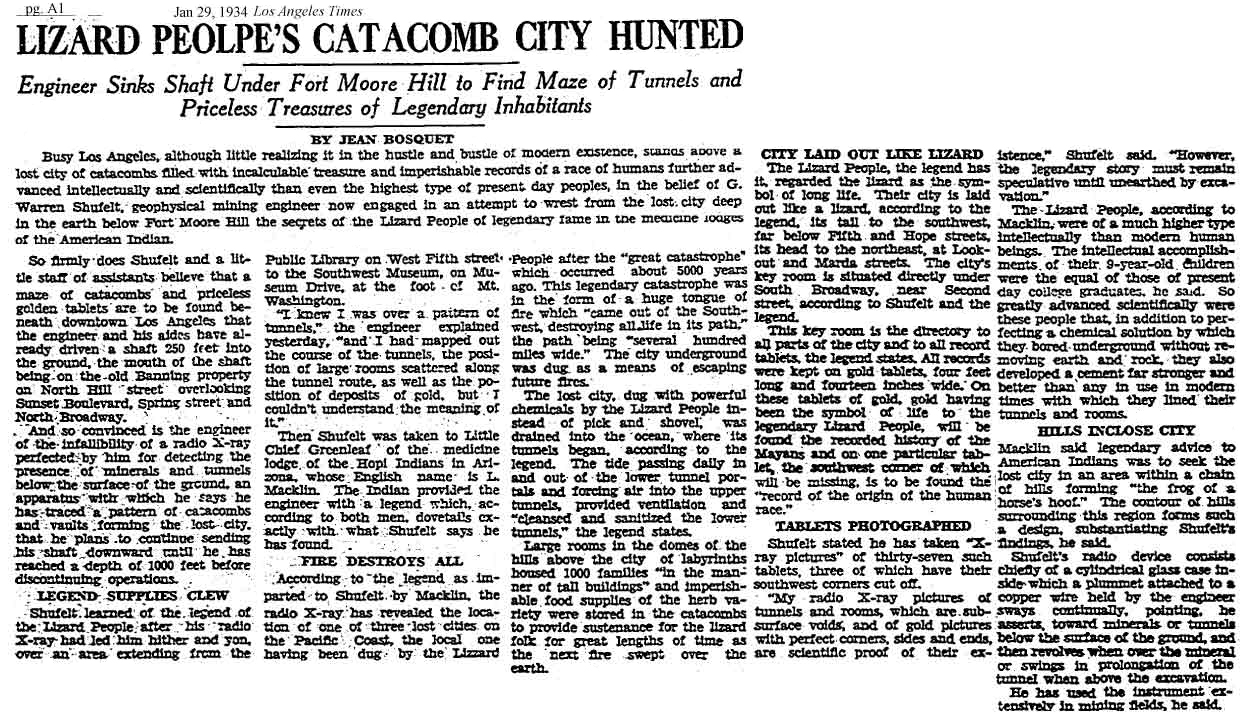
    I presume Aym got the story from the LA Times article he mentions--dated January 29, 1934. His article is mostly a rewrite of that article (below).


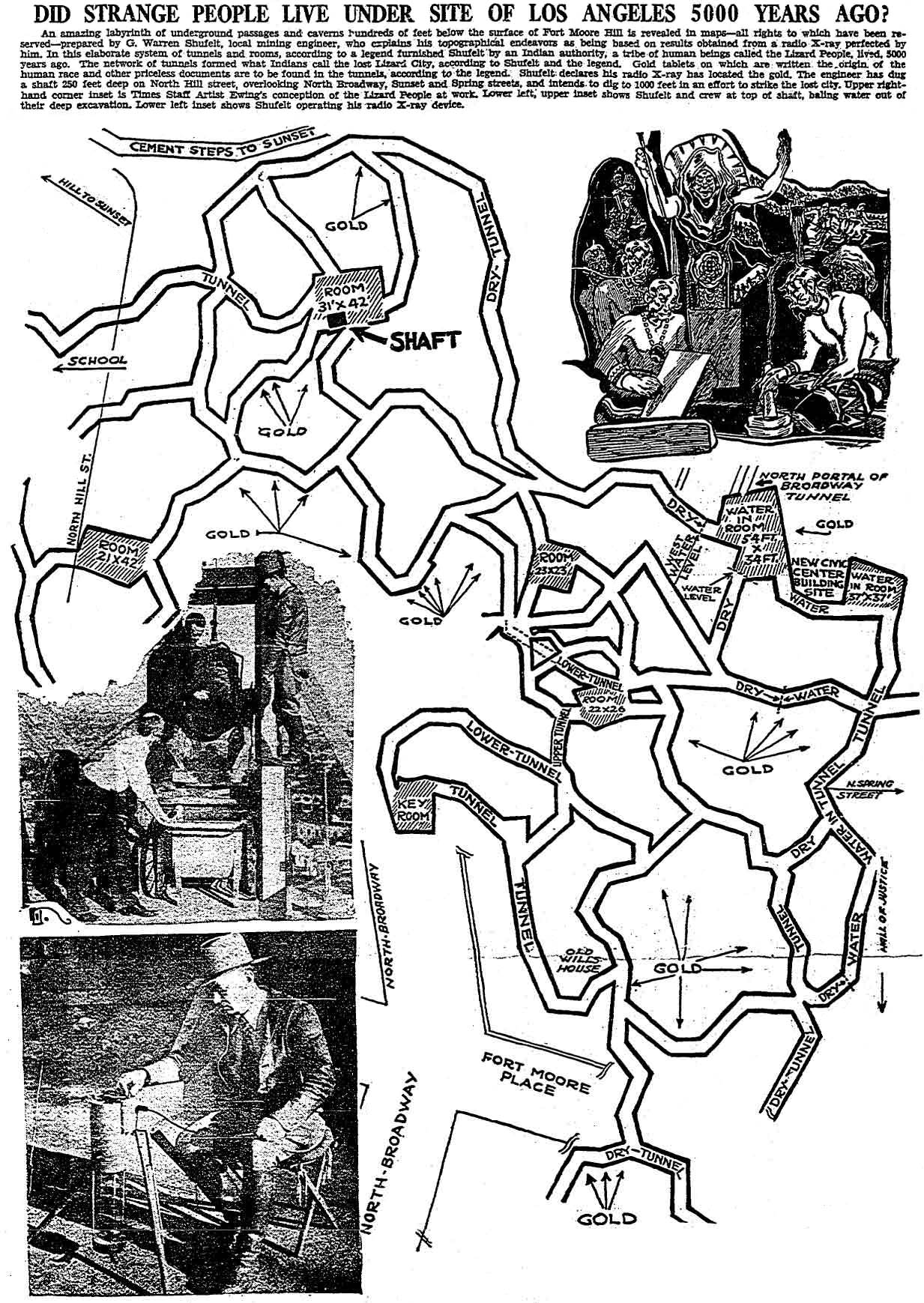
    As you can see, the old article really exists. In fact, the LA Times has articles going back to 1897 about treasure buried beneath the city. In 2009, the paper revisited the subject:

    Gold Hunters Dig for Lost Underground Empire of the Lizard People!

    By Larry HarnischI thought it would be fun to explore the story of the "Lizard People," which is to say the excavations on Fort Moore Hill in an unsuccessful search for gold. G. Warren Shufelt usually gets the credit for the enterprise, but his partners deserve equal attention. The Times reported that Rex. I. McCreery and Ray Martin provided an ancient parchment map showing the Lizard People's underground empire, which allegedly stretched from the Central Library on 5th Street to the Southwest Museum, which you must admit is a lot of digging.

    Earlier Times clips report that Shufelt had been a mining engineer employed by a mine in Kingman, Ariz., so evidently he was legitimate. Unfortunately, The Times' stories about the gold excavation are vague and conflicting about the origin of the map. Most stories say it belonged to McCreery and Martin, who presumably brought in Shufelt as a partner because he was a mining engineer. Our later story says Shufelt got the map from "Little Chief Greenleaf" alias L. Macklin.

    Aug. 15, 1897: An early story about gold buried on Fort Moore Hill.

    March 3, 1933: Gold hunters are excavating directly over the Broadway tunnel, a long-gone downtown landmark that was just north of the Hall of Justice. Evidently they didn't question why the crews digging the tunnel didn't find anything.

    March 4, 1933: Gold hunters consult their ancient map.

    March 7, 1933: Onlookers apparently heckled the diggers.

    March 9, 1933: They're close!

    March 27, 1933: The hunters are secretive about their map, attributing it to the Spanish rather than the Lizard People.

    April 10, 1933: The Board of Supervisors allows digging to continue.

    Sept. 7, 1933: Shufelt, McCreery and Martin have given up, but Alfred Scott comes forward to carry on the search.
    Spaniards or Lizards?

    Buried treasure is one thing, but the long article on January 29, 1934, raised the story to a whole new level. I think it's the only one to claim "Lizard People" rather than Spaniards buried a treasure:

    Did Ancient Lizard Cult Hide Gold Tablets in Tunnels Under L.A.? Jan. 29, 1934

    You also can read it here: Lizard People's Catacomb City Hunted


    That wasn't quite the end of the story. Harnisch's roundup of LA Times articles continues:Dec. 22, 1938: Times columnist Ed Ainsworth takes a look at various legends of lost California gold as engineer Roger J. Adams begins digging. According to The Times' clips, a fair amount of dirt from Fort Moore Hill was used as fill during construction of Union Station. The job was done mostly by hand, with men using picks and shovels as a public works project to provide jobs during the Depression.

    Sept. 21, 1949: Demolition of the Broadway tunnel failed to reveal any buried gold.
    This certainly is a colorful story. But "Little Chief Greenleaf" isn't a Hopi name, so the Native portion of it rings false. No doubt someone concocted the whole "Lizard People" thing.

    Shufelt may have invented the so-called Hopi legend himself. Perhaps he felt a need to explain his failures--e.g., "The tides washed out the Lizard People and collapsed the tunnels." Or perhaps people weren't paying enough attention to the and he felt a need to spice it up.

    For more on lost civilizations, see Lost Mesa in Fablehaven and Indiana Jones's Criminally Bad Archaeology.

    February 02, 2013

    Lost Mesa in Fablehaven

    Debbie Reese dissects another children's book in her American Indians in Children's Literature blog:

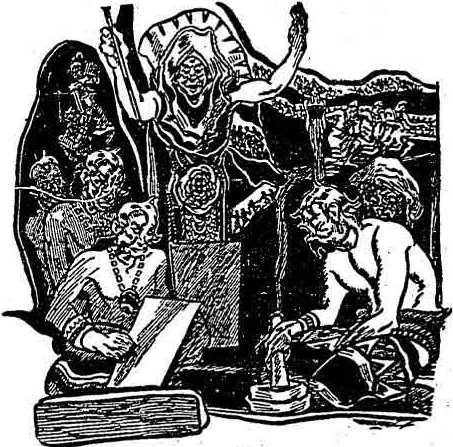
    Brandon Mull's Fablehaven: Grip of the Shadow PlagueA few weeks ago, I pointed to stereotypes in Brandon Mull's Fablehaven: Rise of the Evening Star. Today, I'm pointing to problems in his Fablehaven: Grip of the Shadow Plague.The protagonist Kendra, who is one of the "Knights of the Dawn," seeks to recover a hidden artifact.That assignment takes her to the "Lost Mesa preserve" (p. 94) in Arizona which is on Navajo land. ... In chapter 7, Kendra and the other knights arrive at Lost Mesa. Here's the illustration at top of that page:


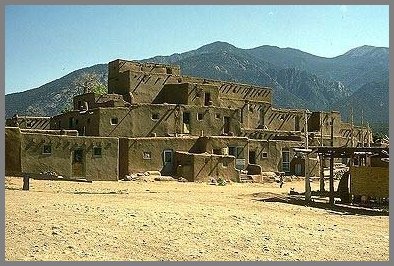
    As Reese notes, Lost Mesa is obviously based on the real Taos Pueblo (below).

    According to the book, the Navajo reservation was supposedly created to hide Lost Mesa. Even worse, "Persian magi actually established the preserve" before the Europeans arrived. The "Anasazi" and later the Pueblo and Navajo people only "managed" the "preserve" for its magical inhabitants.

    There's more, but this is enough of an insult. It reinforces the typical Eurocentric belief that Indians didn't accomplish anything themselves. Native civilizations must've been built by lost races of white men or space aliens. Indians were only "savages" who couldn't do much more than grunt and kill people.

    Actually, the Pueblos and their ancestors must've built hundreds of Pueblo-style structures throughout the Southwest over the last millennium. That demonstrates how unmagical and unremarkable the architectural skill was. It's ridiculous to turn an ordinary but "exotic" culture into a fairy-tale place inhabited by wizards or whatever.

    For more on lost civilizations, see Indiana Jones's Criminally Bad Archaeology and "Light Beam" from Maya Pyramid.

    October 24, 2012

    Indiana Jones's criminally bad archaeology

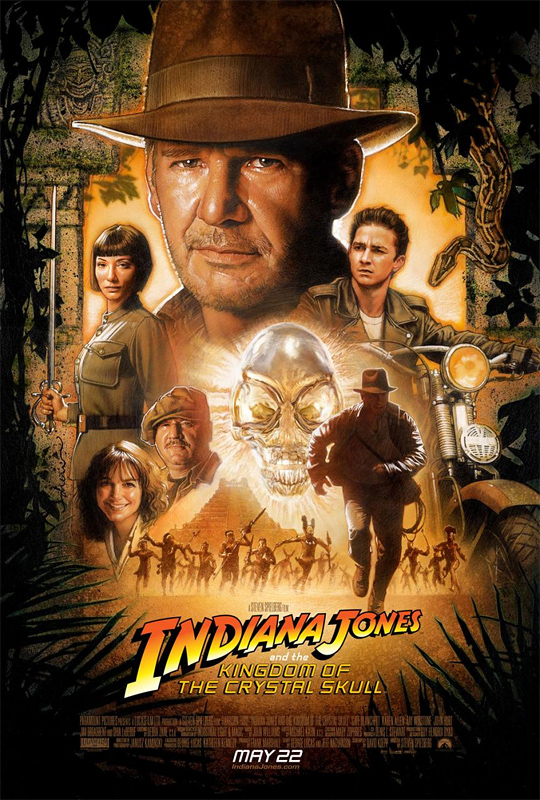
    Long-time readers know I criticized Indiana Jones and the Kingdom of the Crystal Skull when it came out in 2008. Indeed, I criticized all the Indiana Jones movies for their portrayal of indigenous people and the archaeologist's relationship to them.

    This posting makes some of the same points in a humorous way:

    Back from Yet Another Globetrotting Adventure, Indiana Jones Checks His Mail and Discovers That His Bid for Tenure Has Been Denied.

    By Andy BryanJanuary 22, 1939

    Assistant Professor Henry “Indiana” Jones Jr.
    Department of Anthropology
    Chapman Hall 227B
    Marshall College

    Dr. Jones:

    As chairman of the Committee on Promotion and Tenure, I regret to inform you that your recent application for tenure has been denied by a vote of 6 to 1. Following past policies and procedures, proceedings from the committee’s deliberations that were pertinent to our decision have been summarized below according to the assessment criteria.

    Demonstrates suitable experience and expertise in chosen field:

    The committee concurred that Dr. Jones does seem to possess a nearly superhuman breadth of linguistic knowledge and an uncanny familiarity with the history and material culture of the occult. However, his understanding and practice of archaeology gave the committee the greatest cause for alarm. Criticisms of Dr. Jones ranged from “possessing a perceptible methodological deficiency” to “practicing archaeology with a complete lack of, disregard for, and colossal ignorance of current methodology, theory, and ethics” to “unabashed grave-robbing.” Given such appraisals, perhaps it isn’t surprising to learn that several Central and South American countries recently assembled to enact legislation aimed at permanently prohibiting his entry.

    Moreover, no one on the committee can identify who or what instilled Dr. Jones with the belief that an archaeologist’s tool kit should consist solely of a bullwhip and a revolver.

    Nationally recognized for an effectual program of scholarship or research supported by publications of high quality:

    Though Dr. Jones conducts “field research” far more often than anyone else in the department, he has consistently failed to report the results of his excavations, provide any credible evidence of attending the archaeological conferences he claims to attend, or produce a single published article in any peer-reviewed journal. Someone might tell Dr. Jones that in academia “publish or perish” is the rule. Shockingly, there is little evidence to date that Dr. Jones has successfully excavated even one object since he arrived at Marshall College. Marcus Brody, curator of our natural-history museum, assured me this was not so and graciously pointed out several pieces in the collection that he claimed were procured through Dr. Jones’s efforts, but, quite frankly, we have not one shred of documentation that can demonstrate the provenance or legal ownership of these objects.

    Meets professional standards of conduct in research and professional activities of the discipline:

    The committee was particularly generous (and vociferous) in offering their opinions regarding this criterion. Permit me to list just a few of the more troubling accounts I was privy to during the committee’s meeting. Far more times than I would care to mention, the name “Indiana Jones” (the adopted title Dr. Jones insists on being called) has appeared in governmental reports linking him to the Nazi Party, black-market antiquities dealers, underground cults, human sacrifice, Indian child slave labor, and the Chinese mafia. There are a plethora of international criminal charges against Dr. Jones, which include but are not limited to: bringing unregistered weapons into and out of the country; property damage; desecration of national and historical landmarks; impersonating officials; arson; grand theft (automobiles, motorcycles, aircraft, and watercraft in just a one week span last year); excavating without a permit; countless antiquities violations; public endangerment; voluntary and involuntary manslaughter; and, allegedly, murder.
    Comment:  Academic standards were laxer in 1939. These days, Jones wouldn't just be denied tenure. He'd be kicked out of the school and academia as a whole if he committed one-tenth of these offenses.

    For more on the subject, see Indiana Jones and the Stereotypes of Doom.

    February 28, 2012

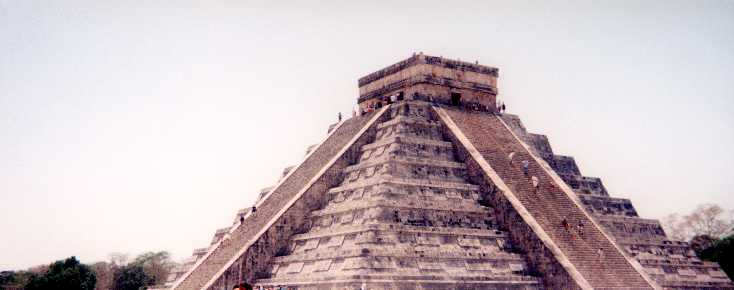
    "Light beam" from Maya pyramid

    Does Mayan photo show a sign from gods ... or iPhone glitch?

    One expert technician says it's a classic error—but still, it's 'an awesome image!'

    By Natalie Wolchover
    When Hector Siliezar visited the ancient Mayan city of Chichen Itza with his wife and kids in 2009, he snapped three iPhone photos of El Castillo, a pyramid that once served as a sacred temple to the Mayan god Kukulkan. A thunderstorm was brewing near the temple, and Siliezar was trying to capture lightning crackling dramatically over the ruins.

    In the first two images, dark clouds loom above the pyramid, but nothing is amiss. However, in the third photo, a powerful beam of light appears to shoot up from the pyramid toward the heavens, and a thunderbolt flashes in the background.
    Message or glitch?According to Jonathon Hill, a research technician and mission planner at the Mars Space Flight Facility at Arizona State University, which operates many of the cameras used during NASA's Mars missions, it is almost definitely the latter. Hill works with images of the Martian surface taken by rovers and satellites, as well as data from Earth-orbiting NASA instruments, and is fully versed in the wide range of potential image artifacts and equipment errors.

    He says the "light beam" in the Mayan temple photo is a classic case of such an artifact—a distortion in an image that arises from the way cameras bounce around incoming light.
    Comment:  For more on the Maya, see "Mayan Apocalypse" in Chevrolet Commercial and Maya Excluded from "2012" Tourism.

    Below:  "El Castillo, a Mayan temple on the Yucatan Peninsula in Mexico, with a mysterious 'light beam' emerging from the top."

    January 09, 2012

    Maya ruins in Georgia?!

    Here's a claim that got a lot of circulation around the Internet:

    Ruins in Georgia mountains show evidence of Maya connection

    By Richard ThorntonThe archaeological site would have been particularly attractive to Mayas because it contains an apparently dormant volcano fumarole that reaches down into the bowels of the earth. People of One Fire researchers have been aware since 2010 that when the English arrived in the Southeast, there were numerous Native American towns named Itsate in Tennessee, Georgia, South Carolina and western North Carolina. They were also aware that both the Itza Mayas of Central America and the Hitchiti Creeks of the Southeast actually called themselves Itsate . . . and pronounced the word the same way. The Itsate Creeks used many Maya and Totonac words. Their architecture was identical to that of Maya commoners. The pottery at Ocmulgee National Monument (c 900 AD) in central Georgia is virtually identical to the Maya Plain Red pottery made by Maya Commoners. However, for archaeologists to be convinced that some Mayas immigrated to the Southeast, an archaeological site was needed that clearly was typical of Mesoamerica, but not of the United States.

    In July of 2011, Waldrup furnished a copy of the 2000 Stratum Unlimited, LLC archaeological report to People of One Fire members. Those with experiences at Maya town sites instantly recognized that the Track Rock stone structures were identical in form to numerous agricultural terrace sites in Chiapas, Guatemala, Belize and Honduras. Johannes Loubser’s radiocarbon dates exactly matched the diaspora from the Maya lands and the sudden appearance of large towns with Mesoamerican characteristics in Georgia, Alabama and southeastern Tennessee. Track Rock Gap was the “missing link” that archaeologists and architects had been seeking since 1841.

    Archaeologists have been looking for vestiges of “high” Maya civilization in the United States, when all along it was the commoners “who got the heck out of Dodge City” when wars, famines, droughts and almost non-stop volcanic eruptions became unbearable. The Itza Maya middle class and commoners became the elite of such towns as Waka (Ocmulgee National Monument) and Etalwa (Etowah Mounds) Just as happened in England after the Norman Invasion, the separate cultures of the commoners and nobility of the indigenous Southeast eventually blended into hybrid cultures that became our current Native American tribes.
    As you can tell from the URL, the article's previous title was "Massive 1,100-year-old Maya site discovered in Georgia mountians." Someone changed it when they realized how over-the-top it was.

    This story quickly spread via Facebook, with people treating it as a revolutionary discovery. I disagreed. Thornton writes for Examiner.com, which means he's basically a blogger. His claims weren't supported by archaeologists and weren't presented in a peer-reviewed journal. This was nothing but an amateur's interpretation of some extremely skimpy evidence.

    Some people defended Thornton because they'd heard of cultural connections between Mexico and the Southeast. Cultural connections are one thing, but a hitherto-unknown Maya citadel of stone in Georgia? That conclusion requires ironclad proof, not idle speculation.

    Archaeologist says no

    Unfortunately for Thornton, the archaeologist he cited soon shot him down:

    Mayan Ruins in Georgia? Archeologist Objects, Debate Breaks Out Online

    By Ned PotterThe textbooks will tell you that the Mayan people thrived in Central America from about 250 to 900 A.D., building magnificent temples in Guatemala, Honduras, Belize and southern Mexico.

    But could they possibly have left stone ruins in the mountains of North Georgia? Richard Thornton thinks so. He says he's an architect and urban planner by training, but has been hired to research the history of native people in and around Georgia since 2003. On Examiner.com, he wrote about an 1,100-year-old archeological site near Georgia's highest mountain, Brasstown Bald, that he said "is possibly the site of the fabled city of Yupaha, which Spanish explorer Hernando de Soto failed to find in 1540."

    This might all be fairly arcane stuff, except that an archeologist he cited, Mark Williams of the University of Georgia, took exception. In the comments section after Thornton's piece, he wrote, "I am the archaeologist Mark Williams mentioned in this article. This is total and complete bunk. There is no evidence of Maya in Georgia. Move along now."
    Comment:  Thornton's claims are mainly based on the word Itsate, along with the alleged similarities in the pottery and stone structures. No one else has supported any of Thornton's claims, and he hasn't presented photographs or other evidence we could inspect for ourselves. Until he does, his speculation is next to worthless.

    In fact, it resembles the "ancient astronaut" claims by Erich von Daniken and the like. The mound builders couldn't have built the stone structures themselves, Thornton implies, so they must've had outside help. The only difference is that the alleged help came from more sophisticated Indians, not from visiting Europeans, Asians, or Africans.

    For more on lost civilizations, see Searching for El Dorado and Beck:  Indian Mounds Are Egyptian.

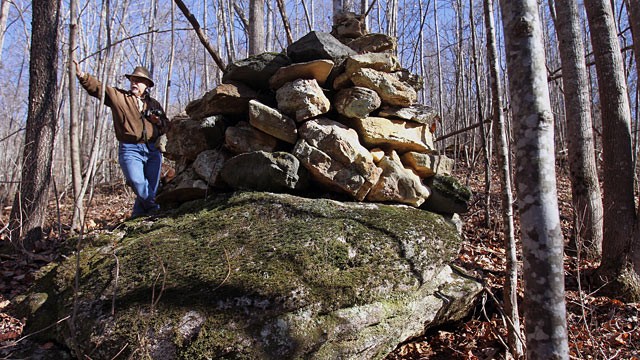
    Below:  "A rock formation in the North Georgia woods." (Vino Wong/Atlanta Journal-Constitution/AP Photo)

    November 27, 2011

    "Alien" skull may be deformed Indian's

    "Alien Skull" Found in Peru is Most Likely a Hoax

    By Julie KentThe so-called "alien skull" recently discovered in Peru might not be so alien after all. The skeletal structure features an oversized, triangular-shaped skull nearly as large as the being's small body, which have led many to conclude that it is not human and must therefore be an alien being from another planet. But even the man who discovered the remains insists that it is a human child with some type of deformity and not extraterrestrial life.
    And:The scientific community has long hypothesized that if alien life exists, it is unlikely to look similar to humans. Critics of the "alien skull" theory say that the skull could be that of a hydrocephalic child or a tribal member that underwent tribal rituals that involved skull modification, an ancient practice dating back thousands of years.

    Artificial cranial deformation has been practices as far back as 45,000 BC when it was seen in Neanderthal skulls. It's also been traced back to the Proto-Neolithic Homo sapiens from the 12th millennium BCE. Ritual cranial deformation typically begins just after the birth of a child and over the course of the next few years until the desired shape is reached or the child rejects the apparatus used for modification. The practice was generally done to signify group affiliation or to demonstrate social status.

    The recently discovered Peruvian skull has some similarities with skulls from the Andean Paracas culture. These skulls were deformed artificially.
    Comment:  People want to believe that indigenous cultures are "alien." It frees the believers from 1) treating the cultures as equals and 2) feeling guilty over their past and present destruction.

    For more on the subject, see Indiana Jones and the Stereotypes of Doom.

    Below:  "Artificially deformed skulls from the Andean Paracas culture."

    March 23, 2011

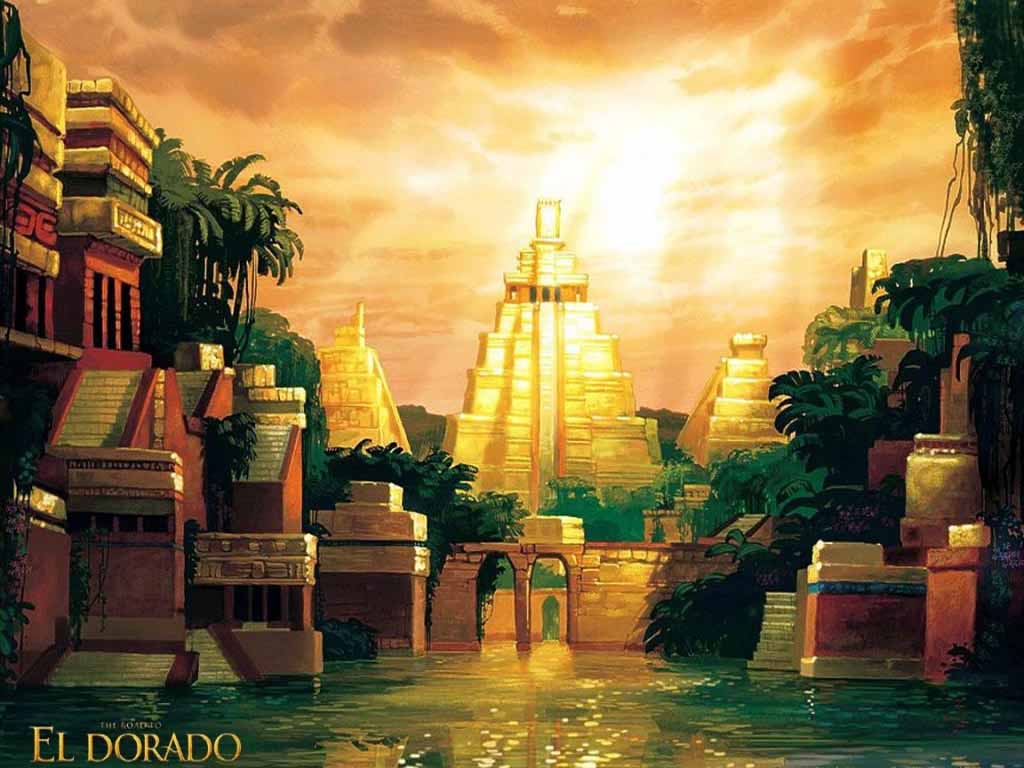
    Searching for El Dorado

    Reading David Grann's book The Lost City of Z made me curious about the history of the Amazon. Here's a bit about the legend that launched countless European expeditions into the jungle.

    Finding the lost city

    Does the Amazon jungle conceal a vanished empire?

    By David Grann
    Ever since the Spanish conquistadores descended the Amazon River, in 1542, perhaps no region on the planet had so ignited the imagination--or lured so many men to their death. For centuries, the conquistadores had searched the jungle for the glittering kingdom of El Dorado. The kingdom, which the conquistadores had heard about from Indians, was said to be so plentiful in gold that its inhabitants ground the metal into powder and blew it through "hollow canes upon their naked bodies." (El Dorado literally means the Gilded Man.) Thousands had died looking for this golden realm.Google Earth helps find El Dorado

    For nearly 500 years, explorers have hunted in vain for a lost city—now with Google Earth, it may have been found

    By Ed Caesar
    The dream of finding lost civilisations in South America has persisted for centuries, largely because of a couple of earth-shattering early successes. As John Hemming, a former director of the Royal Geographical Society, recounts in his 1978 book, The Search For El Dorado, it was the conquistadors who started the craze. In 1519 Hernan Cortes and his soldiers discovered the Aztec city of Tenochtitlan, in Mexico. In the early 1530s, Francisco Pizarro conquered the Incan empire, in what is now Peru. The idea of a “golden city” somewhere deeper in the unexplored wilds was lodged in the European imagination and never released its hold.

    Grann notes that in 1753 a Portuguese bandeirante—a soldier of fortune—emerged from the Amazon jungle and described how, “after a long and troublesome peregrination, incited by the insatiable greed of gold,” he had seen the ruins of an ancient city from a mountain top. The man walked into the city, discovering “stone arches, a statue, wide roads and a temple with hieroglyphics.” The bandeirante wrote: “The ruins well showed the size and grandeur which must have been there and how populous and opulent it had been in the age in which it flourished.”
    What the early explorers actually found:

    Dispatch #15:  The Decimation of the Amazon Indians

    By Alex ShoumatoffThe first Europeans to penetrate the Amazon basin was a Spanish expedition led by Francisco de Orellana in 1542. Hoping to find the fabled lands of El Dorado and La Canela, Orellana and his men set out from Quito, Ecuador, and descended the Napo River to its confluence with the Solimões, the Amazon’s upper section, and continued down the river for 1500 miles to where it pours into the Atlantic. At that time, several million people were living in the Amazon Valley. They belonged to some two hundred tribes and ethnic groups in four linguistic families—Gê, Tupi, Carib, and Arawak. Starting with the Omagua, an intelligent, orderly people of the Solimões, who farmed river turtles and wore cotton robes, the expedition passed one prosperous community after another along the banks of the river. So rich were the resources of the várzea, or floodplain, that some of the close-packed lines of houses went on without interruption for days, and the level of civilization of some of the riverine tribes was on a par with the Incas’, although the materials they built and worked with were perishable, and few artifacts, besides their extraordinarily refined ceramics, survive.And what it all means:

    Q&A with David Grann, author of The Lost City of Z

    By Mark MedleyWhat is it about these lost societies--El Dorado, Atlantis--that intrigue us?

    The fascination with lost cities seems eternal. I suspect that part of it, like the earlier searches for mythical kingdoms, such as Prester John, reflects a longing to find some place that is better or richer or more fabulous than the one we inhabit. In 1928, after tens of thousands of people volunteered to search for Fawcett and his missing party, an American newspaper marveled, "Perhaps if there were a sufficient number of jungles available and enough expeditions to go round, we would see the spectacle of our whole population marching off in search of lost explorers, ancient civilizations, and something which it vaguely felt was missing in its life." I also think there is a deep curiosity about how real civilizations, such as the Incas or Mayans, once flourished and eventually died out. Some of this interest is practical: What did these people accomplish that might help us navigate our way? And some of the fascination is simply wonder at how others lived in different places and ages.
    Comment:  The legend of El Dorado continues to influence us--and not in a good way. It's the inspiration for many racist or stereotypical movies: from The Road to El Dorado to National Treasure: Book of Secrets to Indiana Jones and the Kingdom of the Crystal Skull.

    The common theme is that Indians used to be smart and civilized, but now they're stupid and savage. A related belief is that they couldn't have been that intelligent so they must've had the help of "ancient astronauts."

    For more on the Amazon Indians' reality, see Amazon Indians Weren't Savages and Amazon Towns Disprove Stereotypes.

    October 24, 2010

    2008 Stereotype of the Year loser

    Stereotype of the Year loser

    Comanche Moon:  Rangers, Tramps, and Thieves

    Stereotype of the Year dishonorable mention

    Indiana Jones and the Kingdom of the Crystal Skull

    These entries "win" for propounding ugly stereotypes in a popular medium with a lot of visibility and a long shelf life.

    Felicia's choices

    For another viewpoint, here are the choices by editorial assistant Felicia Wetzig:Loser:  "Buffalo Bill and the Indians on the Beach"

    Although it also serves on a somewhat positive note since the AIM and SKINS members present were able to use the situation educate people, overall it was an exhibition of white arrogance and ignorance on the part of the artist.

    Thom Ross’s website about the show:

    From September 5-14 the show brought in around 40,000 visitors.

    "Ross's work is always based on historical facts, though the focus of the work is always much more concerned with the mythic elements then historical accuracy."

    Always based on historical facts but more concerned with mythic elements? You can’t really have both since the two are often contradictory.

    The newspaper article got mixed reviews from the public but most of them were praising the exhibit.

    Some of the more interesting comments:

    clevenger (7:05 AM on September 6, 2008) Cool, but it would have been cooler to have 100 actual Indians on 100 actual horses. That would have scared the crap out of people.

    Impeach_Bush (7:17 AM on September 6, 2008) a tribute to a working sustainable society we cut down like weeds because they got in the way of our greed.

    Dishonorable Mention:  Campbell Brown slams Indians

    This is still one of my top picks because it happened on CNN, I would think that Campbell Brown is typically someone who is generally trusted and influential and expected to have her story straight.

    Comanche Moon was also one of my top choices, but once I looked into it I found that it didn't seem to go over too well in general; even critics who are fans of this type of western gave it poor reviews.

  • Brian Lowry from Variety called it "tedious, at times cartoonishly bad."

  • Paul Mavis from DVDTalk: "Potential for tit-for-tat fairness in exploring the complicated motives of brutality on the frontier between the white man and Indians is ultimately tossed away for easy, one-sided condemnation. Worst of all for a Western, Comanche Moon is terminally slow and drawn out."

  • James Plath of DVD Town: "With so much caricature, it's no surprise that the leads are also tinged with hokum."
  • Comment:  For more on the subject, see November-December 2008 Stereotype of the Month Loser and the Stereotype of the Month contest.

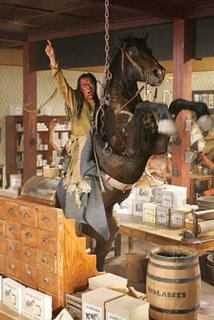
    Below:  A bucking bronco...indoors! Wes Studi shows how wild Indians can be in Comanche Moon.

    September 06, 2010

    Amazon Indians weren't savages

    Scientists find evidence discrediting theory Amazon was virtually unlivable

    By Juan ForeroTo the untrained eye, all evidence here in the heart of the Amazon signals virgin forest, untouched by man for time immemorial--from the ubiquitous fruit palms to the cry of howler monkeys, from the air thick with mosquitoes to the unruly tangle of jungle vines.

    Archaeologists, many of them Americans, say the opposite is true: This patch of forest, and many others across the Amazon, was instead home to an advanced, even spectacular civilization that managed the forest and enriched infertile soil to feed thousands.

    The findings are discrediting a once-bedrock theory of archaeology that long held that the Amazon, unlike much of the Americas, was a historical black hole, its environment too hostile and its earth too poor to have ever sustained big, sedentary societies. Only small and primitive hunter-gatherer tribes, the assumption went, could ever have eked out a living in an unforgiving environment.

    But scientists now believe that instead of stone-age tribes, like the groups that occasionally emerge from the forest today, the Indians who inhabited the Amazon centuries ago numbered as many as 20 million, far more people than live here today.
    Some of the evidence:Outside Manaus, Brazil, Eduardo Neves, a renowned Brazilian archaeologist, and American scientists have found huge swaths of "terra preta," so-called Indian dark earth, land made fertile by mixing charcoal, human waste and other organic matter with soil. In 15 years of work they have also found vast orchards of semi-domesticated fruit trees, though they appear like forest untrammeled by man.

    Along the Xingu, an Amazon tributary in Brazil, Michael Heckenberger of the University of Florida has found moats, causeways, canals, the networks of a stratified civilization that, he says, existed as early as A.D. 800. In Bolivia, American, German and Finnish archaeologists have been studying how pre-Columbian Indians moved tons of soil and diverted rivers, major projects of a society that existed long before the birth of Christ.
    Comment:  Not only does this evidence discredit old scientific theories, it discredits old Native stereotypes. And stereotypes about Amazon Indians are among the most persistent. Convincing people that North America's Indians had art, science, and culture seems easy compared to making the same case for Amazon Indians. How many jungle movies have we seen portraying them as savages, headhunters, and cannibals whose only technology is how to kill people creatively?

    The evidence also suggests that the movies portraying lost jungle civilizations have some basis in fact. But these lost civilizations didn't build massive temples so they could sacrifice people to their dark gods. They built farms, irrigation systems, and villages of wooden structures.

    When you see a movie such as The Librarian: Quest for the Spear, think about it. Where did the stones for a massive temple come from, and how did the Indians lug them through the forest? Answer: They didn't. It's illogical, and it implies the Indians were too irrational to understand the time and energy they were wasting. In reality, they had better things to do than build temples for Indiana Jones types to discover.

    For more on the subject, see What "Primitive" Indians Really Think and Amazon Towns Disprove Stereotypes.

    Below:  Historically speaking, the exception, not the rule.

    September 04, 2010

    Beck:  Indian mounds are Egyptian

    In Analyzing 8/28 Rallies and Marches Part I:  Restoring Honor and Reflections on the Native, Adair Hill covers Glenn Beck's "Restore Honor" rally. To understand why Beck chose a Native pastor to speak, she posted this video from Beck's TV show:


    Beck veers into Chariots of the Gods territory, implying the Indians came from Egypt or the Middle East. Many of these von Däniken-style theories are based on the similarity of Mesoamerican and Egyptian pyramids. We know the subtext of these claims: that Indians weren't smart enough to invent civilization or build pyramids on their own. But one man has shown how Indians could've raised monuments without help.

    Beck got most of his "information" from a DVD called The Lost Civilizations of North America. I haven't seen it, but I'm sure it's the usual mishmash of speculative theories presented uncritically. Clearly that's Beck's approach also. He admits he doesn't know anything about Indians, but he presents the DVD's claims uncritically.

    Adair's take on this:It's wacky, I don't know what else to say. He says a couple of times that "mainstream archaeologist say they debunked this" and then goes on like it's fact, and covered up by some conspiracy. It's total hogwash is what it is...but anyway, he clearly believes that Native Americans are special. Thanks, we are.Beck's views seem consistent with those of other Mormons. According to them, Indians are probably descended from a lost tribe of Israelites who helped build the pyramids. When these people came to America, they lost their holy connection, but God guided Columbus to "help" them. Most ignored the Gospel and continued their depraved and degenerate ways. Now they care only about booze and gambling. But a few have embraced the "correct" path of Christian fundamentalism.

    For more on the "lost civilization," see Lost Tribe Settled Around Great Lakes? For more on Mormons, see The Indian-Mormon Connection. For more on Beck, see Beck's Stupidity About Tribal Summit.

    Below:  Wow, they look just like Indian mounds!

    May 04, 2010

    Genius wrote about Native history

    We get e-mail:Hey Rob, thought you might find this interesting:

    William Sidis is believed, going by standardized testing, one of the smartest men who have ever lived.

    Invented his own language at the age of 8, knew 40 other ones, he was a Harvard lecturer on mathematics at the age of 12. Shortly after graduating cum laude at MIT at the age of 16 however, he was arrested for attending a socialist protest and sentenced with 18 months on charges of sedition. His parents managed to persuade the court to transfer Sidis into their own sanitorium for a year and set about to "reform" their son.

    After this ordeal, Sidis was dedicated to living the rest of his life in obscurity.
    However, he released many works (stretching from cosmology, linguistics and public transit) under psuedonyms, one of which was The Tribes and the States in 1935, much of which he read directly from wampum beads.
    Publications and subjects of researchFrom writings on cosmology, to American Indian history, to a comprehensive and definitive taxonomy of vehicle transfers, an equally comprehensive study of civil engineering and vehicles, and several well-substantiated lost texts on anthropology, philology, and transportation systems, Sidis covered a broad range of subjects. Some of his ideas concerned cosmological reversibility, "social continuity," and individual rights in the United States.

    Sidis' The Tribes and the States (ca. 1935) employs the pseudonym "John W. Shattuck," giving a 100,000-year history of North America's inhabitants, from prehistoric times to 1828. In this text, he suggests that "there were red men at one time in Europe as well as in America."
    Some excerpts from the book show Sidis's progressive beliefs:

    The Tribes and the StatesIntroduction

    There are certain definite departures from the common and well-known points of view regarding America and its past that the reader will notice. At the opening, it is obvious that the beginnings of American history are sought not in Europe but here in America, among the peoples who originally inhabited this country, and the characteristics of the various parts of the country are treated as directly traceable to the varying characteristics and customs of the early tribes in the same regions. The tribes of Indians are considered, not as savages or barbarians who created nothing of importance, but as the real founders of the best and most important parts of modern American institutions: federation, democracy, postal service, written constitutions, the idea of individual rights, are among the many things which, according to this version of history, modern America owes to its red predecessors. And, as a corollary, the coming of the white people to America, which, from the standard point of view, starting American history in Europe, was a series of discoveries, is here treated as a series of invasions from Europe by a barbarous people who understood nothing of American institutions, but who, in the very process of overrunning the continent, acquired, at least partially, many of the ways of doing things that they found on this side of the ocean, and civilized themselves, and even their original home countries, in the process.

    Chapter II: The Red Man in America

    The Different Red Stocks. America before the invasion by the whites was entirely inhabited by the red race, but it would be a mistake to suppose that that meant they were all of one language, stock, or nationality. Differences in nationality and characteristics were as pronounced as among the whites, if not more so. The mere fact that their white conquerors have lumped them all together under the incorrect heading of "Indians" does not make them all alike, and it is important to understand that pronounced national and language differences were to be found among the aboriginal inhabitants of America, and that therefore any statements about customs, forms of government, etc., applying to one red nation would be likely to be false as applied to their neighbors. There were many language groups among the red people which showed no relation to one another, beyond the common characteristics which will be mentioned in this chapter.

    Chapter V: The Great White Invasion

    An Invading Race. The new experiment in national administration, that of federation, was not to have a good chance to develop among the red people of America, where it was naturally best adapted. Almost immediately on the heels of the first trial of this new form of organization, came a most destructive series of invasions from across the Atlantic, by the same white race which, thousands of years before, had descended like a plague on Europe and wiped out the European branches of the red race. And now on they came across the Atlantic Ocean in great numbers, bringing with them the host of infections that had destroyed the red men of Europe and that was to wreak similar destruction in America. They not only brought with them weapons of warfare infinitely more destructive than any that had been known in America, but also conducted warfare with such ferocity as had never been known among red peoples from one end of America to the other. They brought over alcohol, an agent which, while destroying its victims, also in the process rendered the victim dependent on his destroyers; and, like the white man's infections, its effects were infinitely more destructive on the red man than on the whites, who had been accustomed to it for generations. Infections and alcohol were probably the most effective of the invaders' destroying agents, more than wars or other means of destruction that the white invaders brought over with them.
    Comment:  I hadn't heard of Sidis before this.

    Is it just a coincidence that someone with an IQ of 250 was critical of the standard economic, religious, and historical views? Maybe, but probably not.

    Of course, Sidis also believed in a mid-Atlantic continent of Atlantis. According to him, it formed a land bridge between America and Africa and was home to the first great "red" civilization.

    Sidis seems to imply that some Indian achievements came from Atlantis. This is a false and scurrilous view we often see in stories about Central and South American Indian civilizations.

    For more on the subject, see Indiana Jones and the Stereotypes of Doom and America's Cultural Roots.

    April 06, 2010

    Indians in The Librarian: Quest for the Spear

    As I said in my review of The Librarian: Quest for the Spear, this made-for-TV movie is pretty bad. Alas, it has two extended scenes featuring Natives or Native lore. Let's take a look:

    Amazon Indians

    Flynn Carsen (Noah Wyle) and his guardian Nicole Noone (Sonya Walger) parachute into the Amazon jungle. They're soon surrounded by Amazon Indians with bows and arrows.

  • The heroes identify the Indians as headhunters and even pass a head mounted on a pole. This is a gratuitous stereotype that adds nothing to the plot. I guess it's suppose to frighten people for a few seconds until the next scene.

  • Carsen thinks the Indians are speaking a blend of three Native languages that he names. No, it turns out, they're speaking Portuguese. This isn't stereotypical, but it's stupid. How does a language expert confuse two radically different kinds of languages?

  • The Indians' clothing and huts look reasonably authentic. I presume Mexican actors play the Indians since the jungle scenes were filmed near Veracruz, Mexico. They look reasonably authentic also.

  • Having proved to be friendly, the Indians do a "Native mating dance" called the Mongo Dance for the visitors. This doesn't look bad, but the context is problematical for several reasons:

    1) The dance conveys the stereotypical idea that the Indians have no real culture. All they have is a primitive physical ritual like something an animal would do. A strutting peacock, perhaps.

    2) Most tribal dances are about propitiating the gods and spirits. I've never heard of a tribe's having a "mating dance."

    3) It's doubtful Indians would do something as intimate as a mating dance before a pair of strangers they'd just met.

  • Later that evening, Flynn imitates the Mongo Dance by using two bell-shaped items as horns. This looks as lame as an antler dance on the old Saturday Night Live shows. It seems unlikely that someone trained in anthropology would mock a Native dance so readily.

  • The Maya

  • Flynn discovers the location of the second object they're looking for. He tells us the following legend:
  • When the Toltecs invaded Chichén Itzá, it was rumored that a group of Mayan priests fled Mexico with their entire treasury. As the story goes, they built a Mayan temple deep in the Amazon jungle to hide the treasure--never to be heard from again.A few problems with this:

    1) The Toltecs didn't conquer Chichén Itzá. Archaeologists aren't sure whether another Maya city-state conquered it or the residents simply abandoned it.

    2) Why would Maya priests flee a couple thousand miles through countless jungles and other obstacles to another continent? Why not join another Maya city-state nearby or start their own?

    3) The Maya didn't have wheeled carts or beasts of burdens. Each priest would've had to carry the heavy gold himself over the entire trek.

    4) Traveling that far on foot with a valuable treasure would be like inviting the hundreds of tribes along the way to rob and kill you.

  • Flynn and Nicole come face to face with a giant Maya pyramid. It's bigger than any Maya pyramid ever discovered and it's in plain sight, not overgrown with vegetation. Uh, has anyone heard of satellite photographs? Google Earth? No way any object this big has gone undiscovered anywhere on the planet.

  • The pyramid's exterior is covered with obviously fake Maya glyphs.

  • Trying to find a way in, Flynn says the Maya were the first to discover that "constellations make a complete revolution around the galaxy" every 25,765 years. Actually, no, the Milky Way Galaxy rotates every 255 million years.

  • The writers may have been thinking of the precession of the equinoxes, which happens about every 26,000 years. New Agers claim the Maya knew about this, but it probably isn't true:There has been speculation that the Mesoamerican Long Count calendar is somehow calibrated against the precession, but this view is not held by professional scholars of Mayan civilization.Into the Temple of Doom

  • Triggering a trap door, Flynn and Nicole fall into a "Mayan death chamber." It's a room containing a pit with spikes and a wall that starts closing in on them.

  • It's absurd that all these mechanisms are in perfect working order after 700 years of neglect. And the "death chamber" and subsequent traps imply that the Maya were as deadly as the aforementioned Amazon "headhunters." Every Indian in The Librarian is implicitly a killer.

  • Discerning the room's secret, Flynn says:
  • This chamber is an exact replica of their Great Temple of Teotihuacán. Three hundred quahuitls by 20 quahuitls.Another site helpfully picks apart this claim:Teotihuacan was not a Mayan city, but rather the hub of a separate civilization (themselves called the Teotihuacan). It was in central Mexico, hundreds of miles from the Mayan area in the Yucatan Peninsula.

    Flynn gives the size of the chamber in the Mayan temple as "300 quahuitls by 20 quahuitls." But the quahuitl was an Aztec unit of measurement, and was not used by the Maya.

    Flynn says that the chamber in the Mayan temple is 300 quahuitls long. A quahuitl is approximately 2.5 meters, so 300 quahuitls would be 750 meters, or nearly half a mile. The chamber he and the others are in is large, but not that large.
  • As we see in the death chamber and the subsequent corridor, the temple contains no fallen or crumbling stone, no accumulated dirt, no plant growth. And no bones of the many people who undoubtedly died trying to rob it. It looks as pristine as, well, a movie set.

  • To get over the pit, Flynn steps onto thin air and stands. He says it's actually an optical illusion produced by a mirror, adding that the Maya were "the first tribe in the Americas to use them."

    Maybe so, but the Maya mirrors were polished stone, not glass. I don't think they could produce optical illusions. And in one shot, we see Flynn from beneath the mirror, which implies it's transparent.

  • Down the Corridor of Death

  • In the corridor past the pit, Flynn accidentally triggers barrages of arrows and swinging pendulums. Again, they're in perfect working order after 700 years. Again, they imply how deadly the Maya were. This leads to one of the silliest scenes in the movie:


  • Flynn and Nicole reach two piles of gold artifacts. The piles aren't enormous, but still. Did 200 priests each carry 100 pounds of gold 2,000 miles? It seems unlikely.

  • Flynn triggers the last trap and an Olmec-style head almost hits them. As with the references to the Toltec and Aztec, Olmec is a different culture. Mesoamerican cultures aren't interchangeable, people.

  • The Librarian: Quest for the Spear isn't quite as ridiculous as National Treasure: Book of Secrets, but it's in the same ballpark. Compared to it, Raiders of Lost Ark look like a masterpiece of realism and authenticity.

    And the stupid thing is that the writers obviously did some research into Native culture and history. If they had the facts in front of them, how and why did they garble them so badly? Why not make a tiny additional effort to get them right?

    It's as though 12-year-olds mixed and matched an encyclopedia's entries. It's stupid, stereotypical writing that ruins the movie for anyone with more than a grade-school knowledge of science. What a pathetic waste.

    More mistakes in The Librarian: Quest for the Spear:

    Goofs for The Librarian: Quest for the Spear

    Where is the logical sense of this movie? (spoilers)

    For more on the subject, see Indiana Jones and the Stereotypes of Doom and The Best Indian Movies.

    March 13, 2010

    Egyptian mummies with tobacco and cocaine

    Someone recently mentioned a documentary called Curse of the Cocaine Mummies. I haven't seen it, but I looked into it online. I gather it appeared on the Discovery Channel in January 1997.

    It seems to be legitimate science. Here's the story:

    Sky High Egyptians?

    Were the Pharoahs Junkies?The problem started in Munich. A forensic pathologist specialising in toxins had been asked to carry out what should have been a series of routine tests on a number of whole and part mummies to determine what drugs had been used by the Egyptians and how widespread such use may have been. It has long been known that the Egyptians had and used a number of narcotics and hallucinogens including mandrake, belladonna and henbane--and lotus, one of the main icons of Egyptian art and religion, was also known to various ancient cultures as a powerful narcotic and hallucinogen.

    What came as a bombshell, therefore, was the apparent discovery of both cocaine and tobacco in the mummy of a XXIst Dynasty priestess, as well as a number of other bodies and body parts. Disbelieving this incredible result, the pathologist re-ran her tests only to obtain the same results; she then sent samples from the bodies to other laboratories expecting negative results in which case she could have explained her original results as being due to contamination of the samples tested by her. To her amazement, the results came back the same. She then published her findings, only to come up against the archaeological establishment; the results were fraudulent; the results were the caused by gross negligence due to the contamination of the mummies and/or the samples; anyway, the results were impossible. The accusations of contamination were based on the suggestion that earlier generations of Egyptologists had been heavier smokers than those of today and had been more careless in handling the mummies. Stung by these accusations, the pathologist then took further samples taken from deep inside the mummies and had these analysed as well--still with the same result.
    The evidence grows:Deeply skeptical about the results, Dr David of Manchester Museum ran similar tests on a number of mummies in the Manchester collection. To her utter amazement these also produced positive results and showed that the Munich findings were not isolated. In the past couple of years, similar tests have been carried out on on bodies in from places as far apart as China, the middle east, Germany and Austria and ranging in date from around the same date as the mummies in question through to the European Middle Ages. The presence of tobacco (if not cocaine) was found in all these areas. Nor was it found in isolates specimens, for some areas traces were found in every body tested.

    The German pathologist originally suggested that an unknown species of tobacco had once grown in Africa and Eurasia and had been used in various ways until it was driven to extinction by overuse. However, no evidence of an unknown species of tobacco has ever been found in Africa or Europe (unless Rameses II's bandages were shown to be made of tobacco fibre from an unknown specie--see below)--and besides that could not account anyway for the presence of cocaine in the mummies.
    The author's theory:The significance of the cocaine and tobacco discovery in Egypt (if it is eventually upheld and accepted by the archaeological establishment) is that it effectively blows apart current archaeological theories about the nature and scale of world trade in the ancient world. Bear in mind that, barely 40 years ago, the idea that the Vikings could have crossed the Atlantic to the Americas was considered utterly ludicrous. Here is a suggestion, however, that world trade was being carried on on a regular and organised basis some 2,000 years earlier. Impossible!

    The somewhat conservative archaeological establishment is therefore having to wrestle with the idea that international trade on a world scale was regularly being undertaken from at least as early as 1,000 bce. What is NOT being suggested by anyone, however, is that the Egyptians were trading directly across the Atlantic with the Americas--with or without the benefit of warehousing facilities on Atlantis! Rather, it is suggested that trade was being conducted across the Pacific, probably by the Chinese, and that products from the Americas were being traded westwards through south Asia and the Middle East, eventually reaching Egypt.

    Leaving aside the trans-pacific trade theory, the other possible explanations for the positive test results are downright fraud or deliberate hoax (which would involve both the German pathologist and Dr David of Manchester and which is NOT being suggested); carelessness in conducting the tests (unlikely but not impossible by a forensic pathologist with experience of working with the police); contamination of some sort yet to be clarified; or that both tobacco and cocaine in some form had once grown in the Old World, or that some other plants with similar chemical constituents had once done so. The archaeological world currently seems to be favouring the last two possible explanations, i.e. contamination or an Old World source of some kind.
    Another researcher rebuts the alternate explanations in more detail:

    American Drugs in Egyptian Mummies

    By S. A. WellsAbstract:

    The recent findings of cocaine, nicotine, and hashishin Egyptian mummies by Balabanova et. al. have been criticized on grounds that: contamination of the mummies may have occurred, improper techniques may have been used, chemical decomposition may have produced the compounds in question, recent mummies of drug users were mistakenly evaluated, that no similar cases are known of such compounds in long-dead bodies, and especially that pre-Columbian transoceanic voyages are highly speculative. These criticisms are each discussed in turn. Balabanova et. al. are shown to have used and confirmed their findings with accepted methods. The possibility of the compounds being byproducts of decomposition is shown to be without precedent and highly unlikely. The possibility that the researchers made evaluations from of faked mummies of recent drug users is shown to be highly unlikely in almost all cases. Several additional cases of identified American drugs in mummies are discussed. Additionally, it is shown that significant evidence exists for contact with the Americas in pre-Columbian times. It is determined that the original findings are supported by substantial evidence despite the initial criticisms.
    Some of this "significant evidence":“A bibliography of these early contacts is given by John Sorensen (1998) in the first issue of Pre-Columbiana. It is a good example of the kinds of evidence being uncovered by legitimate researchers and institutions. The bibliography is itself a condensation of a two-volume work of these publications and includes titles such as: The world's oldest ship? (showing evidence for a pre-Columbian ship in America) published in Archaeology; Peruvian fabrics (showing very strong similarities between Peru and Asia) published in Anthropological papers of the American Museum of Natural History; Robbing native American cultures: Van Sertima's Afro centricity and the Olmecs (showing evidence for connections between Africa and the Olmecs of Middle America) published in Current Anthropology; Possible Indonesian or Southeast Asian Influences in New World textile industries (showing at least three textile-related inventions that appear in both Indonesia and the New World) published in Indonesian Textiles; and, Genes may link Ancient Eurasians, Native Americans, published in Science.”

    “And the list goes on and on--some evidence being better than others--but as a whole it seems pretty much irrefutable. Claims to the contrary seem to be made by individuals with a vested interest in the isolationist position. The evidence, pro and con, when evaluated objectively, would seem without question, to favor the diffusionist position (which claims that pre-Columbian contacts took place).”
    Comment:  I haven't read much on pre-Columbian contacts, but I don't have a problem envisioning them. Columbus didn't succeed because he had superior shipbuilding technology. He succeeded because he believed in his theories and stuck with them rather than giving up.

    Therefore, it's quite possible to imagine Egyptians, Phoenicians, or Africans--or, later, the Welsh, Irish, or Vikings--sailing to the "New World." I also wouldn't be surprised if a few Native tribes sailed in the opposite direction. If people can invent oceangoing vessels once, they can invent them several times.

    This seems more reasonable than the Chinese alternative. Really, merchants transported tobacco and cocaine two-thirds of the way around the world without leaving a trace anywhere in-between? And we didn't have a hint of this global trade in American drugs until 1992?

    Could be, but it doesn't seem especially plausible. Occam's Razor tells us the simplest explanation is usually the best one. So I'm guessing someone from the Middle East or Africa reached the Americas first. Direct trade between the Egyptians and Indians would explain the lack of tobacco and cocaine elsewhere.

    Indians still were first

    None of this is meant to suggest that Paleo-Indians from Asia weren't the hemisphere's first inhabitants. That they didn't build great civilizations of their own without outside help. Things like the Indians' building techniques or the Mesoamerican and Egyptian pyramids probably were just coincidences. If there was a connection, it probably was in the form of barely-remembered legends.

    The contacts must've been limited or there would've been more evidence of them. Much of the trade probably was in perishable items such as food and clothing. Other than that, the visitors may have left nothing more than a pictograph here or a cuneiform tablet there.

    Even if Indians didn't cross the oceans themselves, they developed tobacco and cocaine and gave them to the world. In particular, they contributed these substances to the Egyptian practice of mummification. So civilization is more complex and multicultural than people think it is, as usual.

    For more on the subject, see Kennewick Man, Captain Picard, and Political Correctness and Multicultural Origins of Civilization.


    February 04, 2010

    Maya-style temple in Lost

    The two-hour debut of Lost's last season debuted Tuesday (airdate: 2/2/10). One prominent locale was a Maya-style pyramid they called the Temple.

    I don't think it was supposed to be a Maya pyramid, since I didn't see any Maya-specific indicators such as glyphs. But it resembled a Maya pyramid more than anything else.

    This is another example of the common Indiana Jones trope: a lost indigenous civilization in the jungle, complete with scary defenders and magical powers. In this case, an apparent fountain of youth, which is also based on Native legends.

    If Natives want to prove how strange they are, why don't they build glass-and-steel boxes like modern buildings? (In a jungle climate, that would be strange.) Why do they always build Maya-style pyramids and temples? From Yavin 4 to Lost's island, "Maya" signifies mysterious and exotic.


    [*spoilers*]

    Lost looks to be better than ever this season. Last season's nuclear blast apparently split the timeline into two: one where Oceanic 816 crashed and one where it didn't.

    I'm guessing we're going to follow both timelines all season, which should be fascinating. It'll create great "man in the mirror" comparisons. We'll see which characters would've done better and which would've done worse without the crash.

    If Lost were smart, it would have the characters in the two timelines gradually learn about each other. (That's already started with Juliet's parting words: "It worked.") Eventually, they realize they have to do something to unite the timelines. Each character must choose which one he or she prefers.

    This will lead to an incredibly fitting and happy ending. Dead characters (e.g., Charlie, Mr. Eko, Faraday) will appear in the non-crash timeline and get another chance at life. Couples (e.g., Sawyer and Juliet, Sayid and Nadia) will be reunited. The island will fade away for good and take (some of) our heroes with it.

    Just remember: You read it here first.

    For more on the subject, see TV Shows Featuring Indians.

    P.S. If J.J. Abrams wants to produce a spinoff called The Hugo and Miles Show, I'm totally on board. That could be the funniest show ever. ;-)

    January 07, 2010

    No Natives in FernGully

    Correspondent DMarks writes:Here's a movie that might be relevant as a Native-topic...due to missing Natives.It's kind of obscure and forgotten, but it gets remembered now thanks to James Cameron's Avatar.

    I don't think it ever mentions where the rain forest is. There are several, but in pop culture, "save the rain forest" always refers to the Amazon.

    So, what have we here? A rain forest peopled by primitive natives. But no Amahuaca, no Huaorani, no Yanomami....In fact, they aren't Native South Americans of any kind. This supposed Amazon rain forest contains Caucasian elves. The female love interest is even lighter-skinned than the male white-guy hero (a reversal of the situation in Walt Disney's Pocahontas).
    I remember FernGully, although I haven't seen it.

    I get your point, but Asia and other continents have rainforests too. It might be too arrogant or whatever to claim most rainforests are associated with the Amazon so the movie is "wrong" if it doesn't include Indians. I already get criticized enough for being too picky and "PC" without taking on theoretical arguments like this one.If FernGully is not intended to be in the Amazon, then the main thing that changes about my point is the name of the ethnic group of brown (or darker) skinned people who actually live there. It changes from "Indians" to something else.

    I think my point ties into something you might have said in your Rima post(s). FernGully is another example of someone placing an ancient enclave of whites in the middle of a territory that in reality is inhabited by indigenous tribes. Then the indigenous tribes take on the role of irrelevant savage interlopers. If they are even mentioned at all, and they aren't in FernGully, a tropical rain forest (central Africa, South America, or southeast Asia), inhabited only by Caucasian-looking fairies (some of them suntanned). I've not actually read the Tarzan books, but I wonder if Burroughs did this there, as well.
    Burroughs's Opar is a typical lost white kingdom. I think H. Rider Haggard invented a couple of these kingdoms, as did many other "jungle writers." The NEW MUTANTS comic posited a lost Roman empire in South America. Shangri-La was a lost white paradise in the middle of Asia. Etc.

    It's a valid point. Okay, here's a posting on it.

    For more on the subject, see Stereotyping Indians by Omission and The Best Indian Movies.

    December 15, 2008

    Golden city in National Treasure 2

    [Spoiler alert]

    Finally, we come to the climax of National Treasure: Book of Secrets:  the discovery of Cibola, the lost city of gold. It's basically a central plaza of pyramids and temples from a Classic Maya city. It's hidden in an immense underground cavern near Mt. Rushmore. The buildings are made of solid gold. (I suppose they could be gold-plated, but solid gold is implied.)

    This is stupid in so many ways that I can barely describe them. But I'll try.

    The faux Cibola contains more gold than has been mined in the history of the world. As Wikipedia reports:It has been estimated that all the gold in the world that has ever been refined would form a single cube 20 m (66 ft) on a side (equivalent to 8000 m³).This gold would fit comfortably inside one of the Maya pyramids or temples. There are perhaps half a dozen such structures in the cavern. So the city contains several times the amount of gold processed since the dawn of civilization.

    No evidence of construction

    Where's the evidence of all the mining, smelting, excavating, and constructing necessary to build a city of solid gold underground? This would've been one of the largest public works projects in human history—rivaled only by such projects as the Great Wall of China or the Panama Canal. It would've taken decades if not centuries to complete—far more time than the relatively paltry Egyptian pyramids. That no archaeological evidence of this massive construction project remains is flatly impossible.

    What exactly was the motivation of the Mesoamericans? To hide the gold? From whom, exactly? From the Europeans who weren't going to arrive for another 900 years? Or from the local Plains tribes who showed little interest in gold as an object of wealth? Not from their rivals in Central America, surely, because these rivals wouldn't have known anything about the mining activities in the Black Hills.

    If hiding the gold was the goal, why mine it in the first place? Why not leave it in the ground? Why dedicate millions of man-hours transforming the metal from gold ore to gold bricks kept underground?

    Building the city only exposed the gold to thousands of observers over decades of time. It created the legend of Cibola—a legend that didn't have to exist. The Mesoamericans could've marked an X on the spot of their large gold deposits and no one would've spent centuries fantasizing about a lost city.

    Why build a city?

    But suppose the Mesoamericans didn't think of this until after they mined the gold. In that case, why store the gold in the form of a Maya plaza? Why not just pile it up in stacks as in Fort Knox? What possible advantage was there to constructing an underground city?

    The only reason to build pyramids and temples is if you're going to use them. So are we supposed to believe the Mesoamericans actually inhabited Cibola? That would multiply the problems of constructing the city tenfold.

    Except for the magic of movies, there would be no light in the cavern. It would be freezing cold. There would be no air circulation, so fires would fill the cavern with smoke. An underground stream could provide water and waste disposal, but there would be no food. Life was tough enough for the Plains Indians on the surface; how much harder would it be to drag buffalo carcasses a mile or so through tunnels to the underground city?

    I could go on ripping this scenario to shreds, but I think you get the idea. It's one of the stupidest Native ideas ever put on film. If "ancient astronauts" had helped the Mesoamericans build Cibola, it would've been more credible.

    Indians as leprechauns

    Nor is the movie's message a good one. If you're thinking, "Wow, those Indians must've been sophisticated to build an underground city of gold," think again. Because the feat is so inhumanly impossible, it makes the Indians seem magical. It removes them from the human realm and places them in some supernatural sphere. They must've had the help of spirits, gods, or space aliens because they couldn't have done it themselves.

    Other than glimpses of their writing and architecture, these Mesoamericans have no culture or history. No government, legal system, religion, art, or science. All we know is that they existed ... they waved a magic wand and created Cibola ... and they disappeared. They're not real people, they're the Native equivalent of leprechauns. They hoard gold at the end of the rainbow not for any rational reason, but just because.

    This is a common theme with Indians in general and Mesoamerican Indians in particular. They came, they communed with their gods, and they vanished. There's nothing left of them but ruins and burial grounds filled with spirits and demons. They're just like Atlanteans--a lost race with no presence in today's world.

    For more on the subject, see Indiana Jones and the Stereotypes of Doom.

    Below:  The city of gold has no water shortage, but its plumbing needs work.