Showing posts with label monuments. Show all posts

May 17, 2016

Cornwallis statue is vandalized

Edward Cornwallis statue vandalized in downtown Halifax

Halifax council discussed this week whether to look into removing his name from city properties

By Cassie Williams
Cornwallis was a British military officer who founded Halifax in 1749 while he was governor of Nova Scotia. He also issued the so-called scalping proclamation the same year, in which he offered a cash bounty to anyone who killed a Mi'kmaq person.

Some have called for all commemorations of the man to be removed from the city. Others who oppose the move say that's akin to rewriting history.
Comment:  For more on Native-oriented monuments, see Artist Defends Scout Billboard and Quixotic Quest for The American.

February 27, 2014

"Circling the wagons" = phony

Circling the Wagons

Like the present, the past is alive with controversy.

By James W. Loewen
Images matter—especially on historic monuments and memorials. Many monuments follow an artistic convention known as hieratic scale—hier as in hierarchy. All across America they depict whites in dominant positions over American Indians. In front of Ysleta Mission in El Paso, Texas, is a monument put up by the Knights of Columbus that features an American Indian kneeling at the feet of a conquistador. On the grounds of the Illinois State Capitol in Springfield stands Father Menard—again, with an Indian depicted in subservience. Further east, in Plattsburgh, N.Y., Samuel de Champlain towers on a pedestal above an obsequious native.

Sometimes the pressure to conform to this convention has been so strong that it muddles the stories artists seek to tell. Facing west from the Iowa State Capitol in Des Moines are three figures titled The Pioneers. The artist meant them to represent a “father and son guided by a friendly Indian.” But such is the power of hieratic scale that the sculptor has shown the Indian seated subserviently looking off to the side, while the white man stands gazing capably ahead. No visitor would guess that the Indian was meant to be the guide of the group.

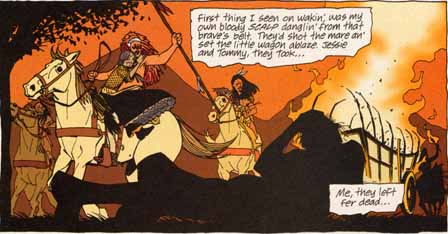
And that’s a shame, because the historical commonplace of Indian as guide to westering pioneers is a concept not very familiar to most Americans. We’ve all been influenced by the archetype of the whoop­ing Indians riding around and around the wagon train, circled for protection. It turns out that this scenario probably never happened either—even once. Of course, a moment’s thought makes evident its silliness: Why would anyone ride around and around, trying haplessly to fire accurately from his bouncing steed, while presenting such a tempting broadside target to John Wayne, lying prone with both elbows braced for best aim?

In reality, Indians rode around and around because they were in Buffalo Bill’s Wild West Show and its many imitators, and they were performing in circus tents. Circus tents are round. In the real West, not only did Indians not ride around and around, they were much more likely to make money off the newcomers by selling them fish, helping them ford the river, or, as in Des Moines, hiring on as guide. But we don’t learn that from most movies—or from most historic sites.

September 30, 2013

Artist defends Scout billboard

More on the billboard of a cowboy shooting an Indian:

Scout sculpture billboards taken down amid racism accusations

By Tony RizzoBillboards depicting a rifleman taking aim at the iconic Kansas City sculpture “The Scout” were taken down Monday after drawing a whirlwind of spirited reaction.

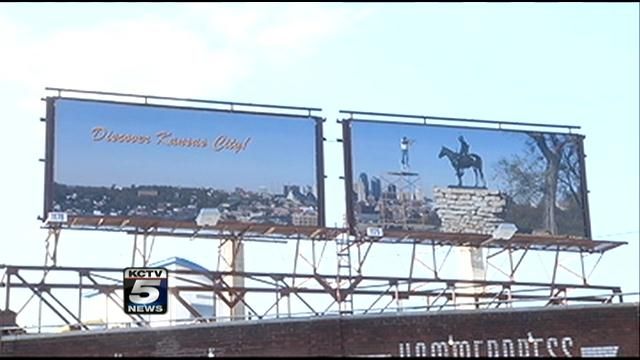
Artist A. Bitterman had rented the twin billboards near 19th Street and Baltimore Avenue in the Crossroads Arts District after Missouri Bank had accepted, but then rejected, the work for its Crossroads “Artboards” program.
And:Bitterman did not respond to an email seeking comment, but in a post on his website dated Sunday, he sought to explain his intention:

“The one thing that can not be disputed in my image is the fact that the Scout is not an indian at all, it is a depiction of an Indian, a sculpture, created by and for white culture, and it carries a historical narrative of what white people at the turn of the 20th century wanted the indian to be. The artist on the scaffolding is confronting that narrative.”
Comment:  I was wondering if this billboard might be some sort of artistic statement. It seemed a little bizarre that a city would allow a billboard perceived as racist hate message.

If I understand Bitterman, he's the rifleman on the billboard. And he's confronting the statue's stereotypical image of an Indian.

The statue supposedly is a metaphor for how mainstream culture has misrepresented, appropriated, and commodified Native cultures. And as a progressive artist, he wants to challenge the mainstream view of Indians by shooting and metaphorically destroying the stereotypes.

Okay, but there's one problem. It's a freakin' white man shooting an Indian. Few people are thoughtful enough to guess Bitterman's message, which is counterintuitive. Indeed, it's basically the opposite of what's on the surface.

And even if they glean a hint of Bitterman's message, as I did, it's ambiguous at best. It uses a racist act of hatred to allegedly counter racist acts of hatred. That's like destroying a village to save it.

This is the same problem faced by the German artist who displayed Chief Wahoo as an "ironic" commentary on mascots. And by hipsters in headdresses who are clever enough to say they're mocking racist stereotypes. Racism isn't a critique of racism just because you say or think it is.

As I've said in such cases, if a typical viewer can't tell the difference between racism and a satire of racism, there is no difference. We can't guess the instigator's intent, or read it on some placard. If the satire or commentary on racism isn't obvious, it might as well not exist.

September 28, 2013

Cowboy shoots Indian on billboard

Billboard at 19th and Baltimore causing controversy

By Laura McCallisterA billboard is getting a lot of attention at 19th Street and Baltimore Avenue.

A local artist posted a picture of a man standing on scaffolding and pointing a rifle at Kansas City's famous statue called The Scout. The actual statue is about 10 feet tall, was created by Cyrus E. Dallin and depicts a Sioux Indian on horseback surveying the landscape.

It overlooks downtown Kansas City.

A number of groups are calling the artwork offensive to Native Americans.
More on the statue:

The Scout (Kansas City, Missouri statue)The Scout is a famous statue by Cyrus E. Dallin in Kansas City, Missouri. It is more than 10 feet tall, and depicts a Sioux Indian on horseback surveying the landscape. The Scout was conceived by Dallin in 1910, and exhibited at the 1915 Panama–Pacific International Exposition in San Francisco, where it won a gold medal. On its way back east, the statue was installed on a temporary basis in Penn Valley Park. The statue proved so popular that $15,000 in nickels and dimes was raised to purchase it through a campaign called "The Kids of Kansas City." The statue was dedicated in 1922 as a permanent memorial to local Indian tribes.

Comment:  Before we even get to the billboard, The Scout has a few problems:

1) Missouri wasn't part of the Sioux's historic range.

2) A Sioux Indian doesn't honor the local tribes because the local tribes aren't Sioux. That's like having a statue of a Norwegian to honor the French.

3) The Indian is half-naked, which he might be in summer, but not in winter. Portraying him this way emphasizes his savagery--how different he is from "us," who wear clothes all the time.

4) The Scout resembles another Indian sculpted by Cyrus Dallin: Massasoit. Indeed, it could be the same Indian. A Sioux scout shouldn't resemble a Wampanoag chief.

The billboard

On to the billboard. The shooting image implies that the Indian is anonymous, an enemy, someone who's less than human and deserves what he gets. Would anyone raise a billboard showing a cowboy shooting a black man? Then why is it considered acceptable to depict shooting an Indian?

Answer: Because Indians hold a unique place in our national mythology as "the other." They're our arch-nemesis: the human "wolves" we tamed to "found" America. As with Elmer Fudd or Wile E. Coyote, they exist only to provide sport for us--or so we think. We can imitate, mock, and insult because we consider them cardboard characters from history, not real people.

August 28, 2013

Quixotic quest for The American

In Oklahoma, Sculptor Has High Hopes for 'The American'

Native Warrior Would Tower Over Statue of Liberty; Tall Order for a Small Town

By Miguel Bustillo
Many Oklahomans remain dubious. Mr. Gray's statue proposal is well traveled at this point: He presented it to Oklahoma City early last decade, then Tulsa, but says he never found the right mixture of public support and available land before settling on Sand Springs.

"Of course it was tremendously expensive—they never did get anywhere in Oklahoma City," says J. Blake Wade, the head of a state authority building an unrelated but also high-price project, the American Indian Cultural Center and Museum. The ambitious museum, expected to cost $170 million, is under way with state and private financing but remains unfinished as backers seek $40 million from the state to help complete it.

Naysayers second-guess an economic consultant's projection that 1.5 million people per year would visit "The American"—or nearly 40% of Oklahoma's entire population.

Others are simply puzzled. "What is the point of it, are you trying to attract people to a casino?" says Geoffrey Standing Bear, a legislator in the Osage Nation, which ultimately decided not to contribute $2.5 million to the project. "I thought it was a waste of our money."
Comment:  The way "The American" is looking down, this statue seems even less appealing than I remember. A half-naked Indian looking at the ground is offputting as well as stereotypical. Except for the bird, this could qualify as the most unremarkable, least interesting statue of an Indian ever.

For more on the subject, see One Small Step for American Statue and Is The American Still Feasible?

August 25, 2013

Natives want to name "Scout" statue

Aboriginal artists in Ottawa want traditional name for 'Scout' statue

Controversial bronze of kneeling navigator was moved from Champlain statue after complaintsA group of aboriginal artists in Ottawa wants to rename the controversial statue of a First Nations scout that sits tucked away in a corner of Major's Hill Park.

The bronze sculpture, known as Anishinabe scout, was created in 1918 by Hamilton MacCarthy, to go next to the statue of Samuel de Champlain at Nepean Point.

The statue was intended to show how aboriginal peoples helped the explorer navigate the Ottawa River. The figure was originally supposed to be kneeling in a canoe, but the citizen's group who commissioned the statue lacked the funds for the canoe, so it was placed kneeling beside the Champlain statue in 1924.

In the 1990s, the Assembly of First Nations took issue with its stereotypical image and what looked like a subservient position to Champlain, so the National Capital Commission responded by moving it to Major's Hill Park.

Now some members the aboriginal community in Ottawa want to reclaim the statue.

Artist and Filmmaker Howard Adler is part of a group spearheading efforts to rename it.

"It hasn't had a name for 100 years, other than unknown Indian, or Indian scout, or Anishinabe scout," said Adler. "So I think it's important to give this statue a name, and to say Indigenous have names, and we're people too. We're not just stereotypes." Adler's group asked Algonquin elder Annie Smith St. Georges to give him a new name in a ceremony.

She decided on "Gichi Zibi Omaami Winini Anishinaabe"—a traditional name for the Algonquin people.
Comment:  Statues of nameless Indians--"The Brave," "The Warrior," "The Chief," etc.--are extremely common. So are statues of Indians kneeling beside or standing behind white figures: missionaries, explorers, Lady Liberty, etc.

These statues represent how we view Indians: as a herd horde of anonymous, animal-like savages. A barbaric, "lost," and worthless people until we "discovered" them and gave them "civilization."

For more on Indian monuments, see One Small Step for American Statue and Stereotypical Whistling Warrior Statue.

August 07, 2013

Rapid City approves sculpture garden

Rapid City approves Native sculpture garden

Parks and Recreation advisory board had urged that another site be found

By The Associated Press
The City Council has unanimously approved a Native American sculpture garden in Rapid City’s downtown, despite safety and access concerns.

The sculpture garden in Halley Park proposed by the nonprofit First Nations Sculpture Garden Corp. will feature bronze statues of four prominent 20th century Native Americans: Charles Eastman, a physician who witnessed the Wounded Knee massacre; Black Elk, an Oglala holy man who was born and raised at Pine Ridge; artist Oscar Howe; and author Vine Deloria Jr.

Construction is to begin within three years, according to the Rapid City Journal.

The garden will be flanked by two of the city’s busiest roadways, raising concerns about traffic safety and available parking.

The city’s Parks and Recreation Advisory Board in July narrowly rejected the plan, urging First Nations to work with city staff to find a more suitable location. First Nations officials maintained the park probably will not draw heavy foot traffic, and the city’s Public Works Committee last week narrowly recommended approval.

“This project is not meant to be obtrusive,” project coordinator Elizabeth Cook-Lynn said. “It’s an art-history project. It has nothing to do with politics. It has nothing to do with religion. We don’t want to dig up old animosities.
Comment:  For more on the subject, see Rapid City Board Rejects Sculpture Garden and Rapid City Sculpture Garden Proposed.

July 21, 2013

Rapid City board rejects sculpture garden

First Nation’s Sculpture Garden shot down

3–3 tie vote broken by Chairman Jeff Schild

By Karin Eagle
The Rapid City Native American community, in an effort to create a place to honor their own, faced unexpected opposition to a proposed sculpture garden in Rapid City.

What was the surprise, at a recent Rapid City Parks Advisory Board meeting, was how close the vote was, and the support from a higher level of city government.

The First Nations Sculpture Garden was first envisioned by Elizabeth Cook-Lynn, a long time resident of Rapid City, who is an educator and supporter of her Dakota heritage.

Cook-Lynn's vision was to create a larger than life sculpture garden that would offer the Native community a chance to enjoy quiet contemplation on the contributions and achievements of their own ancestors.

Included in the list of sculptures are Black Elk, Oscar Howe, Charles Eastman and Vine Deloria.

Since August of 2012, Cook-Lynn and the board of the First Nations Sculpture Garden have been meeting with the advisory board in order to address the concerns that the board has identified.

One of the most argued points was whether the garden would be, in fact, a tourist attraction, which is the stand that the board took, or would remain an unadvertised venue that might attract the spill over foot traffic created by the Tour of Presidents that exists through out the downtown area of Rapid City.

The First Nations board insists that this project is not intended to be a draw for tourists, who although welcome to visit, would not be directly targeted in advertising.

At the most recent meeting, which was held on the location of the purposed park, at the former Sioux Indian Museum on West Boulevard in Rapid City, the First Nations representative, Cook-Lynn, requested a Memorandum of Understanding with the Parks Department.

"We had taken the proposal to the Mayor, Sam Kooiker, who was in support of the project, and who advised that we follow this route, seeking the MOU, from the Parks Advisory Board, which is what we are doing." explain Cook-Lynn.

In following the protocol of the meeting, the chairman of the board, Jeff Schild, allowed speakers on the topic to address their concerns, or voice their opinions. Several of the speakers made comment on the lack of parking, and the location which is located between two of the busiest street in Rapid City, connecting West to East Rapid City.

Each of the speakers against the proposal were very clear in indicating that they thought the project was a good idea, which would help in enhancing relations between the communities, but that the location was the issue that concerned them most, as they felt that the garden would naturally become a large tourist draw.

It was noted by Tim Giago, founder of Native Sun News, that there has been a museum, the Sioux Indian Museum, which operated for many years with the same amount of parking. Giago also pointed out that he had lived in the Rapid City community for several decades and had never known any of the Native community to complain about the location of the museum. Giago further remembers playing in Halley Park as a child.

"This will be a place to meditate, to contemplate, not a place for large flocks of tourists to come through," said Giago.
Covert racism or plain stupidity? That is the question

The Rapid City Department of Parks and Recreation Advisory Board voted 4-3 to deny Native Americans the opportunity to place four bronze busts of famous Native Americans in Rapid City’s Halley Park.

By Tim Giago
If you are Native American and you have lived in Rapid City for any length of time, the actions of the Department of Parks and Recreation Advisory Board recently would have come as no surprise.

After two previous meetings, the board finally voted 4-3 to deny Native Americans the opportunity to place four bronze busts of famous Native Americans in Rapid City’s Halley Park.

I felt from the moment I entered the arena of the old Sioux Indian Museum at Halley Park that we were about to face a rigged and forgone conclusion of a decision. That feeling just hung in the air. The board saw to it that five of the grandchildren of Mr. James Halley, for whom the park was named, were present. It was almost as if they collectively brought a feeling of “Oh my God, they are trying to place the busts of Indians in our precious park.”

Most of the people standing up in opposition to the plan were folks who lived in the park neighborhood. To a person they said, “Oh, the idea is a really good one, but not in our neighborhood.” One elderly lady almost uttered the racist words that seemed to be on the minds of those people opposed to the project. She said, “I’ve lived in Rapid City for 70 years and if they put those statues there the next thing you know ... Oh, I can’t even find the words.”

Every Indian in the place knew the words. They were, “The next thing you know there will be a bunch of drunken Indians panhandling and dirtying up the park in our precious neighborhood.”
Apparently the Parks and Recreation Advisory Board is just that: an advisory board without the final say. The mayor and city council can approve the park if they wish:

Backers of Native American sculpture garden pledge three year time frame

By Daniel Simmons-RitchieCouncil Member Jerry Wright said after attending the meeting that there was little reason to worry about an influx in foot traffic, which was one of the concerns raised at a recent meeting of the Parks and Recreation Advisory Board, which opposed the project on a 4-3 vote.

"This is not meant to be a magnet for people, for droves of people to be going to, but a contemplative garden-type setting," he said.

Council member Bonnie Petersen also participated in the meeting via phone.

The city's Public Works Committee will discuss the project on July 30. If they recommend it to the full council, council members could vote to approve it on Aug. 5.
Comment:  I'm always concerned about traffic, so I understand the board's concern. But I doubt a park with four statues would draw a lot of traffic. Certainly no more than the museum that stood on the same site.

Having visited downtown Rapid City, I didn't see much traffic. I'm pretty sure I saw one or two parking garages and a lot of street parking. Since the area already has 40-plus presidential statues, a few more wouldn't hurt anything.

On the other hand, I still don't understand why the garden has to be on this site. It's a narrow strip of grass about 100 ft. wide with traffic on both sides--hardly the best place for quiet contemplation. An actual park setting--you know, without run-down stores on one side and homes on the other--would seem a lot better.

Even in the artists' conception below, you can see the cars, buildings, and signs beyond the greenery. It's not what I'd call a serene site.

But the park is the closest green space to downtown. Which puts it near the presidential statues. If you want the Native statues to contrast with the presidential statues, I guess the proximity would help.

Anyway, it sounds as though the garden has some support beyond the Parks and Recreation Advisory Board. There's a good chance it may happen despite the board's opposition.

For more on Indians and Rapid City, see Natives Protest Rapid City Journal and Rapid City Sculpture Garden Proposed.

June 25, 2013

One small step for American statue

Sand Springs City Council Moves Forward On Plans For 21-Story Statue

By Tess MauneA 21-story monument that's been making headlines for nearly a decade is one step closer to becoming reality.

The Sand Springs City Council met Monday night and voted on a measure that will essentially get the ball rolling on "The American" statue.

The council unanimously approved of a $48,500 engineering study that would determine the amount of infrastructure needed for the property that's been donated to the project.
And:Rogers said a study showed the statue would bring up to 2 million visitors, and their money, to the town each year.

He said the statue's home has been secured. The Charles Page Foundation has offered to donate 40 acres, just north of town in Osage County.

Gray said the foundation has also agreed to sell 600 surrounding acres of untouched land to the project.
Comment:  In a previous posting, I discussed the study about how many visitors the statue would attract. The news here is the infrastructure study.

Note that the study hasn't produced any results yet--results that might say the project isn't feasible. All they're talking about is launching the study.

So the creator and the city have taken perhaps the 10th or 20th step on a 100-step journey. Let us know when they're more than a fraction of the way to completion, okay?

For more on the subject, see Is The American Still Feasible?

June 10, 2013

Stereotypical Whistling Warrior statue

Wedel creates sculpture to honor American Indian

By Tim HoranIt stands 10-feet tall.

It weighs about 500 pounds.

It is designed to whistle in the wind, thus the name Whistling Warrior.

It is a sculpture made by Steve Wedel of Abilene.


It's a freakin' chief throwing an arrow-like spear. So Plains chief stereotype? Check. Savage warrior stereotype? Check.

It's already a failure in terms of representation, but let's hear Wedel explain his tribute:Wedel said he has always had this great empathy for the Indian Nation.

“At one time historians say there were three to 18 million Indians living in America,” he said. “Over 90 percent of those died from the diseases brought in by the European immigrants. On our farm (25 miles south of Abilene) we have some residential artifacts. So this Indian is made to go to our cabin to honor those Indians.

“My goal was to make somebody that was proud and strong and athletic,” he added.

“One thing about the Indians, they lived in harmony with the land,” he said. “They had a great society. It’s not our fault that it happened but it did happen. They were part of the land like the animals. They didn’t dominate the land like we have done. They didn’t cut down the trees. They lived with what was there in a really pretty great society.
"The Indian Nation"...singular. As if all Indians were the same. That could be writer Horan's choice of words, but still.

"Proud and strong and athletic." I.e., primitive and animal-like, not modern and intelligent.

"Part of the land like the animals." Or just "like animals," period.

Everything about this sculpture suggests Indians as wolves in human form--kind of like the beast-men in Twilight. Thanks for the millionth example of this stereotypical and arguably racist "honor," but no thanks.

For more on Indian monuments, see Avon Buys Generic "Brave" Statue and Indian Statue for Staten Island.

March 19, 2013

Statues planned for Dakota 38

Photos sought for 38 Dakota warriors hanged at Mankato

Sculptor hopes to create busts to honor them

By Christina Rose
Larry had long known the story told by his grandmother of her grandfather’s death. He had also seen photos of the Dakota 38, but the victims of the hanging were never identified. It wasn’t until a friend came upon a book called “Plains Warrior” by Albert Morris, that he found names to some of the photos. Finally, Redwing was able to put a face to the name, and he saw his great-great-great grandfather for the first time.

Larry’s brother, Ronald Redwing, who works at the University of Wisconsin in Platteville, had several conversations about the photo until they decided it might be nice if they had a bust made from the photo. They contacted Austin Glendenning, a sculptor from the university, to make one. Ronald and Larry were so thrilled with the likeness, “We showed it to the Chairman and then the Tribal Council. “The Chairman asked if we could do all 38, so I made up a proposal for the tribe,” Red Wing said.

The bust was made of clay which is fired with a bronze finish. “It was so big, life-size. On the spot the Tribal Council and Chairman wanted all Dakota 38 plus the two who were brought back from Canada and hung later,” Larry said.

Artist Austin agreed to create the busts at a very minimal cost. Red Wing reported that there is only one problem, “We only have 19 pictures.” The small group is dedicated to tracking down family members of the Dakota 38, plus two. Redwing hopes the families will step forward and hopefully, will have photos or drawings of their lost relatives. In case they don’t, Red Wing said, “We all carry traits of them, so then what we are looking for are the male grandchildren of the ones whose names are listed below.”
Comment:  For more on the Mankato or Dakota 38, see Twin Cities: Dakota War = "Genocide" and Mankato Memorial Says "Forgive Everything."

Below:  Mahpi’ya Al’Nazin (He Who Stands on the Clouds).

February 22, 2013

100th anniversary of buffalo nickel

On Its 100th Anniversary, a Look at the History of the Indian-Head Nickel

By Rick HerediaSo why all this press for a slaughtered beast? Black Diamond was, at the time of his slaughter, one of the most famous animals in the United States. Just two years earlier, in 1913, his image was stamped onto the reverse side of the Indian head nickel. The nickel—75 percent copper and 25 percent nickel—made its debut on Washington’s birthday, February 22, 1913, 100 years ago. In the decades that followed, it became an Indian country icon.

At least one newspaper, the National Labor Tribune, believed Black Diamond had been dealt a great injustice. “The buffalo which served as a model for the nickel coin has been put to death,” it said. “Republics are notoriously ungrateful.”

The occasion for the nickel’s debut was the groundbreaking for the National American Indian Memorial, the dream/scheme (and it turns out, pipe dream) of Rodman Wanamaker, scion of the Wanamaker department store chain. Plans called for the memorial to have a colossal bronze statue of an Indian, 60 feet high on a 70-foot base, one arm raised, two fingers forming a V, greeting ships carrying immigrants and others arriving in New York. A museum and a warrior on horseback were also part of the design. The statue and all the rest were to be erected at Fort Wadsworth on New York’s Staten Island, just south of the Statue of Liberty. Staten Island, named for the Dutch parliament, the Staten-General, originally belonged to Lenape Indians, who repulsed the Dutch three times before the invaders were able to establish a settlement there.

Now, in 1913, the island was being invaded again. On a cold, bleak, wet day, just after noon, the fort’s batteries fired a 21-gun salute announcing the arrival of President William Howard Taft. Waiting to greet Taft were members of his cabinet, New York’s governor, New York City’s mayor, naval and military detachments and officers, including Lieutenant General Nelson A. Miles, who had taken part in many of the U.S. Army’s campaigns against Plains Indians, had forced the surrender of Chief Joseph and spent exhausting months in the field chasing Geronimo.

On hand, too, patiently waiting in the mist, were more than 30 Plains Indian leaders and warriors, many of whom who had fought Miles and the U.S. Army. They were dressed in beaded buckskin and wore eagle feather headdresses. They included Plenty Coups, Drags The Wolf, Crane In The Sky, Little Wolf, Black Wolf, Wooden Leg, Red Arrow, Hollow Horn Bear and Two Moons.
And:A few months later, in July 1913, Wanamaker sent out the last of three expeditions to Indian reservations promoting citizenship and fealty to the U.S. At the time, many Americans—even those who said they respected Indians, such as Wanamaker—thought American Indians were a vanishing race. Wanamaker believed that assimilation was their best hope for survival. (This, despite the Bureau of Indian Affairs (BIA) findings that the Indian population was increasing. In 1890 the BIA counted 243,000 Indians. In 1900, that figure jumped to 270,000. In 1910, it stood at 305,000.)

Speaking at a press conference held when the citizenship expedition returned to New York in December 1913, Henry Roe Cloud, Winnebago, a Yale graduate known for his speaking skills, asked the question that must have been on the minds of many Indian leaders of the day. “Today, the American Indian finds himself in the midst of a great, complex civilization, and it is a national question whether this complex civilization will bear him down or be the means of his salvation,” Roe Cloud said, as quoted in The New York Times.

Once the nickel went into circulation, it was hammered. Critics complained that it lacked the grace and beauty of previous coins, including its predecessor, the Liberty nickel. But after 25 years, that coin had run its course, and treasury officials wanted to change the design. The New York Times said the new nickel was a “striking example of what a coin intended for wide circulation…should not be.” It said the coin was not pleasing to look at when shiny and new and “will be an abomination when it is old and dull.” One Times reader, H.P. Nitsua, said, “The new nickel is certainly a travesty on artistic effect,” and called the Indian’s feathers “barbaric headgear.”

The New York Sun called it an ugly coin.
Fortunately, the nickel had a happy ending:The coin had a run of 25 years, from 1913 to 1938, when it was replaced by the Jefferson nickel. More than 1.2 billion Indian head nickels were minted; their total currency value was more than $60.5 million.

The National Indian Memorial never did get built at Fort Wadsworth. Wanamaker couldn’t come up with the money and soon enough, World War I grabbed the headlines. But the Indian head—or buffalo—nickel, outlived its critics to become one of the most admired coins the U.S. ever produced. Many have called it beautiful, and it has become iconic. In the early 1970s, an image of the nickel, Indian head showing, appeared on a protest poster that read the only Indian America ever cared about.

It has been incorporated into many types of jewelry, from earrings to belts. It adorns T-shirts, jackets and other clothing and is the logo for coin shops and other businesses. It has been made into guitar picks and used to decorate the bolt-action rifles and rifle slings. The image has been tattooed onto backs and shoulders. One artist, Peter Rocha, created a striking four-foot-by-four-foot image of the nickel in Fairfield, California using more than 9,500 jellybeans provided by Jelly Belly (see Rocha’s work at JellyBelly.com).

Many of the nickels are sold on eBay. The American Numismatic Association displayed Black Diamond’s mounted head at its 1985 convention, writes author David Lange in his book, The Complete Guide to Buffalo Nickels. The ANA, headquartered in Colorado Springs, will celebrate 100th anniversary of the nickel during National Coin Week, April 21 to 27. Its theme will be Buffalo Nickel Centennial: Black Diamond Shines Again.

Perhaps the greatest testament to the nickel’s popularity and endurance has come from the U.S. Mint, which resurrected the nickel in the form of the $50 American Buffalo gold bullion coin. When it was first sold in 2006, the mint’s price was $800. As of January 2013, the cost was $960.
Comment:  This posting links the buffalo nickel to other bits of history: the proposed Indian statue on Staten Island, and the Wanamaker expeditions mentioned in my interview with Steven Lewis Simpson. All involved Rodman Wanamaker. It was a smaller world back then; anything involving America's Indian policy probably involved the same few people.

Let's discuss these items.

1) The Indian-head or buffalo nickel is much like a modern-day mascot. Twenty-three years after Wounded Knee, it was a way to "honor" Indians after their defeat. Americans came close to exterminating both Indians and buffalo, so this was a way to salve their consciences. "Look how brave and noble the Indian (and buffalo) was," the coin seemed to say. "Think about how they symbolized the strength and majesty of America. And not how we were slaughtering them just a few years ago."

2) The Staten Island statue would've served a similar purpose. "Look at the Indian welcoming people to America," observers might say. "The Europeans weren't invaders, they were guests. White men and Indians lived in peace and harmony (see our Pocahontas and Thanksgiving myths) until something went tragically wrong."

It would've been interesting if we'd had a giant status of an Indian instead of Liberty. I'm not sure if that would've been positive or negative. On the one hand, it would've become the most iconic Indian in the world. On the other hand, it would've whitewashed the white man's responsibility for breaking the treaties and stealing the land.

3)The Wanamaker expeditions did explicitly what the coin and proposed statue did implicitly. Namely, seal off the past and make America feel good about its conquests. People like Wanamaker wanted the Indians to assimilate and vanish from our history. We could remember them as noble warriors, but we were to forget they were sovereign entities with legal rights and natural resources. Indians were to become a comforting myth (again, like Pocahontas and Thanksgiving): the friendly guides who helped us "tame the wilderness." We wouldn't have had to trouble our consciences anymore.

Most of the Native stereotypes in our culture today--and there are millions of them--serve the same purpose. Whitewashing the past...salving our consciences...erasing our crimes. In other words, maintaining the status quo in which broken treaties and stolen land are the norm. It's all about confirming the white man's power and privilege to rule according to Euro-Christian standards.

All that from one little nickel.

For more on the buffalo nickel, see Indian Head Gold Dollars and Sports Logos = US Coins?

Below:  "Chief Two Guns White Calf, nickel model."

February 17, 2013

Rapid City sculpture garden proposed

Native sculpture garden takes baby steps forward

By Aaron OrlowskiSome city officials are lukewarm on the proposal by a private group to build a sculpture garden featuring famous Native Americans in one of the most prominent spots in Rapid City: in Halley Park along two of the city's busiest throughways.

Parks & Recreation Advisory Board members and parks department staff this week said they are not fans of the proposed location because parking and access to the sculpture garden would be difficult.

But project proponents say that's not an issue since the privately funded sculpture garden isn't meant to draw significant foot traffic, and they are unlikely to accept any other location for their project.

"This is a sort of contemplative garden. It's not a tourist venue. It's not a place where people are going to come and you're going to charge them money," said Elizabeth Cook-Lynn, an organizer for the project.
Comment:  I'm not sure a sculpture garden would attract more than a few tourists at a time. On the other hand, it could be a contemplative site and a tourist attraction, so officials should plan for both.

For more on Rapid City, see Pix of My South Dakota Trip and Traversie Case Was the Catalyst

Below:  "Progress on a Native American sculpture garden in Halley Park is inching forward despite concerns about the location from Parks & Recreation board members and staff." (Benjamin Brayfield, Rapid City Journal)

January 12, 2013

Avon buys generic "Brave" statue

New ‘Brave’ statue looks over Avon football field

By Meghan HerlihyChristmas came early for Avon Central School and the entire ACS community.

After four years of dedication and hard work, the school finally managed to purchase and install a 15-foot high bronze statue of a Native American “Brave” that is now on display by the southeast end of the school’s football field.

The process of acquiring this statue started with Avon local Bill Zhe, who had spotted the statue at a local shop in town back in June 2008. Zhe and fellow Avon local Sandy Irish decided to approach Avon’s superintendent Bruce Amey about purchasing the statue and possibly displaying it as their mascot on school grounds.

“The statue was down at the Avon Trading Post and Jim Jerris owned it,” said Irish. “We saw it down there and Bill Zhe and I talked to Jim to see how much he would sell it to us for. The selling price was actually $16,000—and he had sold a similar statue for that amount—but said he would give it to us for only $12,000, which I thought was pretty generous. So at that point, which was in June of 2008, is when we started raising the $12,000 we needed to buy the statue.”
And:Irish also said that she was not surprised by the generous contributions of the community.

“I think probably because we’re the Avon Braves, here was a great statue that was a ‘Brave’ that could be like a mascot,” Irish said. “So I think a lot of people that had maybe played in Avon sports were excited to see the Brave there, not just for football, but by the track field and everything too. So I think it represents Avon, all the students, the teachers, and the faculty. We’re the Avon Braves, and now we’ve got a Brave that we can say, ‘Hey, here’s our mascot.’”

Amey summed everything up by saying that he hopes—and expects—the new statue to become a part of school lore and tradition.

“Our students are extremely proud to be Braves and our intention more than likely for next year during a football game, when we have a good crowd, will be to do some level of dedication towards that and I think that will encourage a huge sense of school spirit,” Amey said. “I can picture homecoming next year with a lot of students participating not only in the game but activities during Spirit Week where the Brave statue will likely have an integral part of that. I have nothing to do with planning Spirit Week, per se, but at the same time I can see students really having such pride in it.”


The story takes place in upstate New York, an area that's home to several tribes. Yet the people in the article seem blissfully unaware that Indians might object to this mascot.

The region's newspaper understands what the local boosters don't:

Avon ‘Brave’ sculpture does disservice to Native American cultureSince the 1960s, there has been a discussion about if these depictions of Native Americans are appropriate—with many leaders in the community arguing that these images, intentionally or not, reduce a rich and oftentimes disappearing culture into a caricature.

Mascots have the power to rob a people of their personhood and turn them into a cartoon.

Having recently read the LCN’s article about Avon Central School acquiring a statue of a ‘Brave,’ I am concerned this will ultimately perpetuate a negative stereotype of Native Americans.

I grew up in Livingston County and worked as an educator in the local schools for three years. It’s exciting how open-minded the youth in our community have become. Unfortunately, the acquisition of this statue, apparently uncritically, teaches our children to view another group of people as one-dimensional.

This ultimately undermines both the potential and integrity of our communities. The American Psychological Association released a position statement in 2005 recommending the retirement of American Indians as school mascots.

In short, American Indian Mascots can limit a child’s potential to appreciate another culture as well as silence those that are members of that culture.
Comment:  Artistically, the statue isn't bad. But the headband with feathers, the braids, and especially the tomahawk combine to make the Indian look savage.

Moreover, he's half-naked in a snowstorm, which suggests why this look is wrong. A real Indian would wear a shirt in this kind of weather. Shirtless implies he has an animal-like constitution.

I'm not sure any of the area's Indians ever looked like this statue. It could be a "brave" from the Great Lakes, the Plains, or anywhere. Really, it seems like a generic romanticized Indian. Its lack of identifying characteristics is part of the problem.

Even if the statue is culturally appropriate for upstate New York, it's still stereotypical. Why? Because Indians don't look like that these days. Like a million other stereotypical images, it's projecting the notion that Indians are dead and gone--i.e., primitive people of the past.

The editorial is right. This statue reduces Indians to a one-dimensional cartoon. Don't let the realism fool you. It's really no different from the image below, which is also a one-dimensional cartoon. It's wrong for the same reasons.

And the naivete of launching a stereotypical mascot "tradition" in this era is breathtaking. Really, not a single person thought, "What if Indians protest this mascot as they have so many others? What if New York state passes a laws banning such mascots? Is it worth a $12,000 gamble to have a mascot that was bland and unoriginal a hundred years ago?"

For more on Indian monuments, see Indian Statue for Staten Island and Generic Statue Represents Ghostly Kickapoo.

December 26, 2012

Mankato memorial says "forgive everything"

Today is the 150th anniversary of the hanging of the Mankato 38. Therefore, a posting on the subject is appropriate.

Minnesota Works on Forgiving But Not Forgetting Its Native History

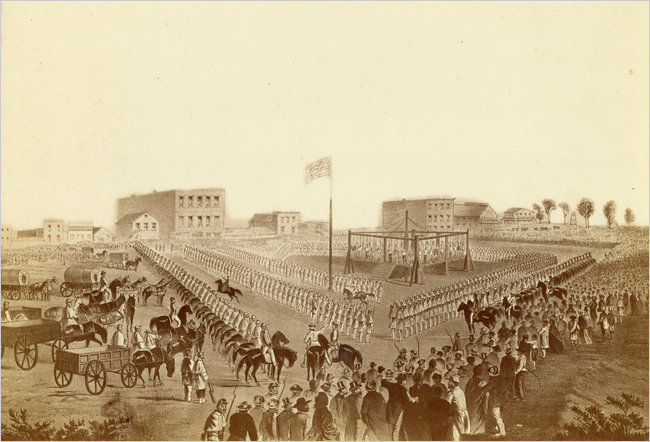
By Konnie LemayOn December 26, a memorial will be dedicated in Mankato, Minnesota’s Reconciliation Park near a white limestone buffalo that marks the spot where 38 Dakota men were hanged the day after Christmas 150 years ago. On a 10-by-4 foot leather-looking scroll will be listed the names of those men next to another scroll with a poem about the hangings and encircled by the phrase “forgive everyone everything.”

“These men fought for the Dakota way of life, trying to hang onto something, to hang onto this land for the future generations of their children and grandchildren,” Vernell Wabasha, wife of hereditary chief Ernest Wabasha, who led the move for the memorial, told the Mankato Free Press.

Dedication of the $110,000 memorial, just after the ending in Mankato that day of the Dakota Wokiksuye Memorial Ride, will wrap up a year of lectures, discussions, exhibits, newspaper articles, radio broadcasts, concerts and commemorations in the state of Minnesota acknowledging the history of the U.S.-Dakota War of 1862.

For many in Minnesota—both Native and non-Native—the events introduced them to a dark history of their state that they had never heard.

“I don’t remember learning much about the war, certainly not the aftermath,” said Minnesota author Diane Wilson, who is Dakota. “The 38 hanged in Mankato, those were the best known facts. … The fact of the removal of the Dakota was something that was so silent, especially that forced march of the 1,700 elders, children and women.”
Sounds like an appropriate and educational monument, right? Not everyone agrees:

Co-Opting the Memory of the Dakota 38+2

By WaziyatawiThe Idle No More campaign is in full-swing to the north, and Dakota people associated with the 38+2 memorial horse ride have apparently abandoned the struggle for justice for Indigenous people here with the promotion of their mantra “forgive everyone everything.” That feel-good slogan will be literally etched in stone on benches that will be placed around a new memorial in Mankato, Minnesota next summer.

This emphasis on reconciliation at the site of the largest mass hanging from one gallows in world history (yes, it used to be listed as a Guinness World Record) illuminates a deep split within the Dakota population that remains 150 years later.

Not all Dakota people are eager to offer forgiveness to the occupiers of our homeland. The crimes of genocide, ethnic cleansing and land theft are too great for time alone to heal. Furthermore, the injustices continue through the ongoing occupation of our homeland, the diaspora and exile of our people, the denial of our rights to religious freedom including access to sacred sites, the lack of access to traditional foods, the theft of our children, the mass incarceration of our population, the imposition of colonial systems and institutions on every aspect of our lives and the daily exploitation and destruction of our homeland. In 1862, Dakota warriors fought to defend our land, our people and our way of life. Thirty-eight of them were hanged in 1862 as a consequence of their resistance to occupation and two more were hanged in 1865. But the struggles remain the same today and we are still in need of warriors to achieve justice and liberation for our people.

The vision of the horse ride in honor of the 38+2 began with Jim Miller, a Lakota Vietnam veteran. He determined it was about peace, healing and reconciliation. That is, he came to Dakota people with a message about how our resistance fighters should be honored. Imagine if a Dakota person had a vision about how Crazy Horse or Sitting Bull should be honored, brought that vision to Lakota people, and then determined the honoring should be about peace and reconciliation. I hardly think such a vision would be embraced by our western relatives. Unfortunately, some Dakota people have followed his vision and the result is an absurdly extreme position (“forgive everyone everything”).

Furthermore, in all the media coverage surrounding the horse-ride memorial, it is not clear why they are honoring the 38+2. The prominence of forgiveness, healing and reconciliation in the rhetoric of the horse riders is what would better be associated with the “cut-hair,” “friendly” or Christian Indians who sided with the whites in 1862—the people who were considered traitors by Dakota standards. The message of peace and forgiveness would make sense if the riders were honoring those ancestors. It is not what one would associate with the 38 men hanged at Mankato or Wakanozanzan and Sakpe hanged at Fort Snelling. Far from being advocates of peace and reconciliation, they were Dakota men who took up arms because they believed in the righteousness of our struggle
Comment:  Good points by Waziyatawi. Yeah, I'm not down with the "forgive everyone everything" idea. Not in this context or any other context I can think of. A better approach is "criticize and correct," not "forgive and forget."

Of course, the monument's creators might say they believe in forgiving but not forgetting. But forgiving, like apologizing, is a useless gesture without some accompanying action. What are the creators doing to ensure Native rights and justice now?

Forgiving also aids the process of forgetting. "Remember the Mankato 38?" someone might ask. "Why should we? I thought the Indians forgave us for that back in 2012. That means it's over and done with."

The real-world choice is often forgiving and forgetting or not forgiving and not forgetting. Needless to say, I prefer the latter.

For more on the Mankato 38, see Mankato 38 Art Exhibit and Mankato Concert to Mourn Dakota War.

September 12, 2012

Plaque with sacrificial story removed

Controversial plaque will stay absent

By Jordan SmithThe controversial plaque that was removed last semester from the Sylvan Theatre will remain absent.

The plaque was engraved with the story of a Sioux Indian woman who was in love with a white soldier. She learned that her tribe was planning to attack his troops so she warned him of the event. Her people discovered her betrayal and threw her in a lake.

“The story appeared to be presented as a true story,” said Director of Diversity Enhancement Jaime Nolan-Andrino.

Director of Tribal Outreach Richard Meyers said the story sounds like many typical narratives at the time the plaque was created. Many conquered groups have stories blaming the women as the reason for their defeat.

Meyers said that the inscription on the plaque seems “fraternity-like, there is no citation or reference to fact.”
Comment:  Blaming women for defeat is one thing. This plaque also echoes the countless stories of Native "lover's leaps" around the country.

In these tales, a Native woman inevitably jumps off a cliff, over a waterfall, or into a lake. Sometimes she's thrown. It's almost always because she fell in love with the wrong person. Killing herself, or being killed, is an atonement for her "sin."

This is a romantic way of sanitizing our crimes against the Indians. They couldn't handle the changing world, the thinking goes, so they killed themselves.

Making it a maiden who sacrifices herself softens the blow. It wasn't a warrior who committed suicide because we took his land and culture. No, it was just a woman who sought love (how noble) but failed (how tragic).

Whatever the details, the Indians chose to die for reasons that had nothing to do with us. That's the stereotypical thinking behind all these "lover's leaps."

For more on romanticized Indians, see Peter Gabriel's San Jacinto and "Two Wolves" Story Is Phony.

Below:  "The engraving removed last semester will remain absent from Sylvan Theater."

August 24, 2012

Dalton to sing for veterans' memorial

Country Singer Lacy J. Dalton to Play Benefit for Native American Vietnam Veterans StatueLacy J. Dalton will play a concert on September 29 in Reno, Nevada, to benefit a movement that seeks to have an American Indian statue added to the Vietnam Memorial. Known for such top-10 country hits as “Takin’ It Easy,” “Everybody Makes Mistakes,” and “16th Avenue,” Dalton will perform two shows, one at 5:30 PM and another at 8:30 PM, at Reno Tahoe Comedy, located inside the Pioneer Underground on 100 South Virginia St—for more information, visit the event’s Facebook page.

The show will be emceed by actor and veterans activist Robert Primeaux, Lakota, and will benefit the American Indian Veterans Memorial Initiative, which is being spearheaded by the Florida Seminole Tribe. (Television audiences may remember Primeaux as “Indian Bob,” a friend of Gary Busey’s who made an appearance on Celebrity Wife Swap.) The initiative seeks to build a statue of an American Indian along the Vietnam Walkway near the Vietnam Wall on the National Mall in Washington D.C. The famous statue called The Three Soldiers by Frederick Hart depicts servicemen who are caucasian, African-American, and Hispanic, but does not include a Native American. You can learn more at the official AIVMI website.
Comment:  For more on Native monuments, see King Monument Honors Alaska Natives and Indian Statue for Staten Island.

Below:  "Lacy J. Dalton on the back cover of her 1981 album Takin' It Easy."

July 14, 2012

King monument honors Alaska Natives

New Martin Luther King Jr. Memorial Honors Alaska Native Cultures

By Neva ReeceUntil recently, the Martin Luther King Jr. Memorial in downtown Anchorage was a despondent-looking counterpoint to the Veteran’s Memorial at the other end of the same block on the downtown Delaney Park Strip in Anchorage, Alaska.

The memorial was installed in 1999 after a coordinated effort by the city’s African American churches and their friends throughout the community. That effort, spearheaded by local pastor Reverend Alonzo Patterson, was part of an extended effort to honor the civil rights leader in Anchorage. The centerpiece of the original installation was a bust of King facing into the park backed by a memorial garden surrounded by interpretive panels featuring King’s life and tributes to the city’s cultural diversity. However, without needed maintenance, the panels were weathered and vandalized, their message obscured by time and neglect.

On June 20, members of the original Martin Luther King Living Memorial Committee and other supporters came together to rededicate the monument’s expansion and renovation. New interpretive panels have been installed and the memorial has been expanded with additional walkways and an image of King facing a nearby street, enhancing the visibility of the memorial. This new image of King is on reflective granite reminiscent of the Vietnam Veteran’s Memorial in Washington, D.C. The new historic panels clearly feature quotes and images from a variety of cultures weaving them into tributes to moments of King’s life, with Alaska Native culture being the dominant thread.

Among the quotes and images derived from Native culture is a tribute to Alaska’s own civil rights heroine, Elizabeth Peratrovich, Tlingit. In 1945, Peratrovich played a significant role in the passage of one of the first pieces of civil rights legislation in the country. Alaska Territory’s nondiscrimination measure passed after an inspired speech by Peratrovich from the viewers’ balcony of the legislative chamber during a lively debate. Images significant to Alaska’s Native cultures and histories include a seal hunt, a traditional blanket toss, and a drum group. Other panels include significant quotes from Alaska Native leaders.
Comment:  For more on King, see Native Reflections on Dr. King and Choctaw Martin Luther King Jr. Parade.

Below:  "The centerpiece of the original installation of the Martin Luther King Living Memorial in Anchorage features a bust of King facing into the park, toward the center of park activities, including the city's annual Juneteenth Celebration of Abraham Lincoln's Emancipation Proclamation. The newly renovated Martin Luther King Living Memorial in Anchorage honors the diversity of Alaska and emphasizes Alaska Native contributions." (Neva Reece)

June 30, 2012

Indian statue for Staten Island

The Massive, Never-Built Indian Statue of Staten IslandA century ago, the U.S. Congress passed a resolution authorizing the construction of a giant statue to pay tribute to American Indians. It was to be built on the grounds of Fort Wadsworth, on Staten Island, one of the boroughs of New York City, and with a height of 165 feet would have been taller than the Statue of Liberty.

In 1913, President Wlliam Howard Taft joined a delegation of 32 Indian chiefs and other dignitaries for a groundbreaking ceremony that saw the chief executive digging up dirt with an ancient axe-head made from a buffalo bone. Following a flag-raising, the chiefs then signed a “Declaration of Allegiance to the United States.”

The statue was never built, but according to a story at SILive.com, a Native couple who live on Staten Island are trying to make it happen. The statue was a sort of premature memorial—“to honor what was thought to be a vanishing race,” says Margie Boldeagle. “Now it’s taken on a different light. It would show that we are still here.”

Boldeagle and her husband, Robert, are not proposing anything like the colossus planned a century ago. They would like to see a 25-foot statue built on the fort grounds. They say they have a sculptor and donors for the million-dollar project lined up. The National Parks Service (NPS), which has maintained the fort since it was closed in 1994, won’t allow the Boldeagles’ project, arguing that the 1911 declaration issued by Congress authorized the Secretary of War and the Secretary of the Navy—not the NPS—to construct the monument.
Comment:  I don't know what kind of headdresses Manhattan's Indians wore, but this looks more like a stereotypical chief than a genuine Indian. If someone were to do the statue now, I'd hope it would be culturally accurate.

For more on Native monuments, see Mixed Feelings About Crazy Horse Memorial and Memorial Sought for Mankato 38.

March 17, 2012

Mixed feelings about Crazy Horse Memorial

A Monument to a Sioux Warrior, Its Completion Date Somewhat Unclear

By A.G. SulzbergerThough that commitment has been much romanticized, it has also been the focus of persistent criticism, most vocally from American Indians, who have long regarded the project with a mix of support and suspicion. Many complain that the family has made millions of dollars from a project that, while carrying the name and imagined likeness of Crazy Horse, has become more of a monument to the sculptor than to his subject.

Indeed, the bearded, mountain-man profile of Mr. Ziolkowski, who is buried on the grounds, is as ubiquitous as the stern visage of the Sioux leader around the visitor complex. And the 85 full-time staff members at the Crazy Horse Memorial Foundation included more of his descendants (seven) than Indians (five), even though the nearby reservations have some of the highest unemployment rates in the nation.

“I’ve never heard a single Native American, not one, ever say I’m proud of that mountain,” said Tim Giago, the founder of Native Sun News, based in nearby Rapid City.

Thomas Shortbull, president of Oglala Lakota College, which receives a number of scholarships from the foundation, acknowledged the discontent. “But most people see the positive of filling the void of the lack of recognition that we have in this country for Indian people,” he added.
Comment:  The points in this article apply to other "honors" as well: everything from Indian mascots to Hollywood tributes to apologies for past injustices. The gestures are nice but meaningless without accompanying action. Indians want substantive change, not happy talk.

For more on the Crazy Horse Memorial, see 21st Native Americans' Day at Crazy Horse and Crazy Horse/USD Academic Partnership.