Showing posts with label Mankato. Show all posts

March 19, 2013

Statues planned for Dakota 38

Photos sought for 38 Dakota warriors hanged at Mankato

Sculptor hopes to create busts to honor them

By Christina Rose
Larry had long known the story told by his grandmother of her grandfather’s death. He had also seen photos of the Dakota 38, but the victims of the hanging were never identified. It wasn’t until a friend came upon a book called “Plains Warrior” by Albert Morris, that he found names to some of the photos. Finally, Redwing was able to put a face to the name, and he saw his great-great-great grandfather for the first time.

Larry’s brother, Ronald Redwing, who works at the University of Wisconsin in Platteville, had several conversations about the photo until they decided it might be nice if they had a bust made from the photo. They contacted Austin Glendenning, a sculptor from the university, to make one. Ronald and Larry were so thrilled with the likeness, “We showed it to the Chairman and then the Tribal Council. “The Chairman asked if we could do all 38, so I made up a proposal for the tribe,” Red Wing said.

The bust was made of clay which is fired with a bronze finish. “It was so big, life-size. On the spot the Tribal Council and Chairman wanted all Dakota 38 plus the two who were brought back from Canada and hung later,” Larry said.

Artist Austin agreed to create the busts at a very minimal cost. Red Wing reported that there is only one problem, “We only have 19 pictures.” The small group is dedicated to tracking down family members of the Dakota 38, plus two. Redwing hopes the families will step forward and hopefully, will have photos or drawings of their lost relatives. In case they don’t, Red Wing said, “We all carry traits of them, so then what we are looking for are the male grandchildren of the ones whose names are listed below.”
Comment:  For more on the Mankato or Dakota 38, see Twin Cities: Dakota War = "Genocide" and Mankato Memorial Says "Forgive Everything."

Below:  Mahpi’ya Al’Nazin (He Who Stands on the Clouds).

January 10, 2013

Twin Cities: Dakota War = "genocide"

St. Paul follows Minneapolis in labeling U.S.-Dakota War as 'genocide'

By Kevin DuchschereSt. Paul joined Minneapolis on Wednesday in labeling the 1862 U.S.-Dakota War as the start of "the genocide of the Dakota people" that included holding them after the war "in a concentration camp at the base of Fort Snelling."

The terms, disputed by many historians who believe they don't convey the complexity of the conflict, were included in a resolution that the St. Paul City Council passed unanimously to declare 2013 "the Year of the Dakota" and to show its support for an effort to identify Dakota sites along the Mississippi River.

The St. Paul resolution was patterned on a similar one passed last month by the Minneapolis City Council that pledged more dialogue on issues of "land, reparations and restitution, treaties, genocide, suppression of American Indian spirituality and ceremonies, suppression of indigenous languages, bounties, concentration camps, forced marches, mass executions and forcible removals."

The two city councils are thought to be the first major governmental bodies in Minnesota to use such provocative terms in referring to the war, which marked its 150th anniversary this fall.
A Historic and Monumental Resolution Regarding the Year of the Dakota

By Chris Mato NunpaOn Friday, December 14, 2012, the Minneapolis City Council passed a resolution titled “The Year of the Dakota: Remembering, Honoring and Truth-Telling,” which year began on December 26, 2012 through December 26, 2013. The Resolution contained such terms and phrases as: “Genocide” “Bounties” “Concentration Camps” “Forced Marches” “Mass Hangings” “Forcible Removals” etc. In my 72 “winters,” I had never seen a white governmental entity at any level–federal, state, or local–use such Truth-Telling terms in one of their official documents.

For me, it was “historic” to hear such Truth-Telling as contained in that Resolution. One Native college instructor called the document “monumental.”

This wonderful break-through event, the passing of the Resolution by the Minneapolis City Council, occurred as the Dakota People of Minnesota, along with their allies and supporters, are commemorating the 150th anniversary of the Dakota-U.S. War of 1862. We say “Dakota-U.S. War of 1862” because it was the Dakota who declared war on the Wasicu (the Dakota word for the white man). The Dakota wished to drive the invaders and the land-stealers out of the Minnesota River valley. This decision by our Dakota leaders to declare war turned out to be disastrous.

One, of the things I have learned about this history, is that it is suppressed by the white academic establishment. The Genocide of the Dakota People of Minnesota and of the Indigenous Peoples of the U.S. is “hidden.” The U.S. Euro-Americans did not, and do not, wish to talk about this disgraceful and shameful history. I began to learn this in first grade, 1947-1948, in the Granite Falls, Minnesota public schools, although I, then, was not able to articulate this new learning. The white teachers said many things that were defamatory about the Dakota. The teachers said things that dehumanized us. They said disparaging things, like we didn’t make any real contributions to the development of Minnesota or of the U.S. They obliterated our history, teaching us that history only began when they came.
Comment:  Yes, calling the war "genocide" doesn't convey the complexity of the conflict. It arguably applies to the US approach as a whole, not to individual wars, massacres, and removals. People in the midst of battle usually want to end the fighting, not end the opponents' existence.

But the words we usually use--e.g., "conflict," "tragedy," "horror"--serve a different purpose. They obscure the depth of the US depravity and disregard for human life. I'd rather emphasize the scope of the problem than gloss it over. Americans as a whole know too little about our history, not too much.

For more on the US-Dakota War, see Mankato Memorial Says "Forgive Everything" and Mankato 38 Art Exhibit. For more on genocide, see America's Culture Based on Violence and Hitler Loved Manifest Destiny.

December 26, 2012

Mankato memorial says "forgive everything"

Today is the 150th anniversary of the hanging of the Mankato 38. Therefore, a posting on the subject is appropriate.

Minnesota Works on Forgiving But Not Forgetting Its Native History

By Konnie LemayOn December 26, a memorial will be dedicated in Mankato, Minnesota’s Reconciliation Park near a white limestone buffalo that marks the spot where 38 Dakota men were hanged the day after Christmas 150 years ago. On a 10-by-4 foot leather-looking scroll will be listed the names of those men next to another scroll with a poem about the hangings and encircled by the phrase “forgive everyone everything.”

“These men fought for the Dakota way of life, trying to hang onto something, to hang onto this land for the future generations of their children and grandchildren,” Vernell Wabasha, wife of hereditary chief Ernest Wabasha, who led the move for the memorial, told the Mankato Free Press.

Dedication of the $110,000 memorial, just after the ending in Mankato that day of the Dakota Wokiksuye Memorial Ride, will wrap up a year of lectures, discussions, exhibits, newspaper articles, radio broadcasts, concerts and commemorations in the state of Minnesota acknowledging the history of the U.S.-Dakota War of 1862.

For many in Minnesota—both Native and non-Native—the events introduced them to a dark history of their state that they had never heard.

“I don’t remember learning much about the war, certainly not the aftermath,” said Minnesota author Diane Wilson, who is Dakota. “The 38 hanged in Mankato, those were the best known facts. … The fact of the removal of the Dakota was something that was so silent, especially that forced march of the 1,700 elders, children and women.”
Sounds like an appropriate and educational monument, right? Not everyone agrees:

Co-Opting the Memory of the Dakota 38+2

By WaziyatawiThe Idle No More campaign is in full-swing to the north, and Dakota people associated with the 38+2 memorial horse ride have apparently abandoned the struggle for justice for Indigenous people here with the promotion of their mantra “forgive everyone everything.” That feel-good slogan will be literally etched in stone on benches that will be placed around a new memorial in Mankato, Minnesota next summer.

This emphasis on reconciliation at the site of the largest mass hanging from one gallows in world history (yes, it used to be listed as a Guinness World Record) illuminates a deep split within the Dakota population that remains 150 years later.

Not all Dakota people are eager to offer forgiveness to the occupiers of our homeland. The crimes of genocide, ethnic cleansing and land theft are too great for time alone to heal. Furthermore, the injustices continue through the ongoing occupation of our homeland, the diaspora and exile of our people, the denial of our rights to religious freedom including access to sacred sites, the lack of access to traditional foods, the theft of our children, the mass incarceration of our population, the imposition of colonial systems and institutions on every aspect of our lives and the daily exploitation and destruction of our homeland. In 1862, Dakota warriors fought to defend our land, our people and our way of life. Thirty-eight of them were hanged in 1862 as a consequence of their resistance to occupation and two more were hanged in 1865. But the struggles remain the same today and we are still in need of warriors to achieve justice and liberation for our people.

The vision of the horse ride in honor of the 38+2 began with Jim Miller, a Lakota Vietnam veteran. He determined it was about peace, healing and reconciliation. That is, he came to Dakota people with a message about how our resistance fighters should be honored. Imagine if a Dakota person had a vision about how Crazy Horse or Sitting Bull should be honored, brought that vision to Lakota people, and then determined the honoring should be about peace and reconciliation. I hardly think such a vision would be embraced by our western relatives. Unfortunately, some Dakota people have followed his vision and the result is an absurdly extreme position (“forgive everyone everything”).

Furthermore, in all the media coverage surrounding the horse-ride memorial, it is not clear why they are honoring the 38+2. The prominence of forgiveness, healing and reconciliation in the rhetoric of the horse riders is what would better be associated with the “cut-hair,” “friendly” or Christian Indians who sided with the whites in 1862—the people who were considered traitors by Dakota standards. The message of peace and forgiveness would make sense if the riders were honoring those ancestors. It is not what one would associate with the 38 men hanged at Mankato or Wakanozanzan and Sakpe hanged at Fort Snelling. Far from being advocates of peace and reconciliation, they were Dakota men who took up arms because they believed in the righteousness of our struggle
Comment:  Good points by Waziyatawi. Yeah, I'm not down with the "forgive everyone everything" idea. Not in this context or any other context I can think of. A better approach is "criticize and correct," not "forgive and forget."

Of course, the monument's creators might say they believe in forgiving but not forgetting. But forgiving, like apologizing, is a useless gesture without some accompanying action. What are the creators doing to ensure Native rights and justice now?

Forgiving also aids the process of forgetting. "Remember the Mankato 38?" someone might ask. "Why should we? I thought the Indians forgave us for that back in 2012. That means it's over and done with."

The real-world choice is often forgiving and forgetting or not forgiving and not forgetting. Needless to say, I prefer the latter.

For more on the Mankato 38, see Mankato 38 Art Exhibit and Mankato Concert to Mourn Dakota War.
December 21, 2012

Mankato 38 art exhibit

“We Are Here:” Native American Artists Explore Pain of the Dakota War of 1862

By Allison HerreraAt first glance, Gordon Coons’ painting 1862-Mankato 38 may look like any other American flag. But it isn’t. Look closer and you’ll see a rope, the kind used to tie a noose, framing the edges. You’ll also see the names of 38 Dakota warriors who were hanged in the largest mass execution in U.S. history on December 26th, 1862. Most had been convicted by a military court of participating in the US-Dakota War that had begun in August that year. Unrepresented by any legal defense, the 38 were hanged in Mankato in front of a crowd of thousands of white spectators.

It was just the beginning of the terrible retribution that would be meted out to the Dakota, and the war and its aftermath, including a legacy of anti-Indian racism, underlie a riveting art exhibit called Ded Unk’unpi/We Are Here, on view until Jan. 13 at the James J. Hill House in St. Paul. The exhibit features the work of 20 Native American artists and reflects a wide range of responses to the war and the past 150 years.
Comment:  For more on the Mankato 38, see Mankato Concert to Mourn Dakota War and Putting US-Dakota War in Context.

Below:  "Ojibwe artist Jim Denomie tells the story of the uprising vividly in his painting, Off the Reservation/Minnesota Nice."

September 16, 2012

Mankato concert to mourn Dakota War

Mankato Symphony to Play Concert to Mourn Dakota War and HangingsOn December 26, 1862, 38 Dakota men were hanged in Mankato, Minnesota, in the largest mass execution in American history. The event was a gruesome coda to the Dakota War of 1862, which had ended on September 26 with the Dakotas’ surrender at Camp Release.

On November 18, the Mankato Symphony Orchestra will play a concert to mark the 150th anniversary of the tragic war and hangings. The performance will consist of two compositions, “Trail of Tears” by Michael Daugherty and “To Be Certain of the Dawn” by Stephen Paulus.

“Trail of Tears” was inspired be the well-known forced relocation of tribes from the southeastern U.S. to what was called Indian Territory—better known today as parts of eastern Oklahoma—as decreed by the Indian Removal Act of 1830. As described in a release about the concert, Daugherty’s piece is “a musical journey into how the human spirit discovers ways to deal with upheaval, adversity and adapting to a new environment.” The performance on November 18 will mark the first time it has been played in its entirety.

Stephen Paulus’s “To Be Certain of the Dawn” is a multimedia performance consisting of music, song and photographs projected on a screen above the 80-member Mankato Symphony. The piece was commissioned by Fr. Michael O’Connell and Rabbi Joseph from the Twin Cities, and inspired by photos of children from the Holocaust.
Comment:  For more on Mankato, see Putting US-Dakota War in Context and Dakota Walk Commemorates War's Anniversary.

August 31, 2012

Putting US-Dakota War in context

Dakota seek to put war in context

By Dan LinehanPart 1 of Sheldon Wolfchild’s documentary, on the causes of the U.S.-Dakota War, devotes five words to the conflict itself: “The war ended fairly soon.”

The rest of the hour-plus documentary focuses on what is euphemistically called the “Indian System,” the government’s plan to cheat Native Americans off their land, put them on reservations and kill those who resist.

“The ultimate goal is the land,” said Wolfchild, a Morton resident and member of the Mdewakanton community. The second and third parts of his nearly-finished documentary, “Stardreamers,” are about the 19th-century American legal system and the culture and politics of the Dakota.

Wolfchild said his documentary is a reaction to the histories that focused on the violence committed by Native Americans during the war.

“They had to make us look like savage human beings,” Wolfchild said, in order to justify treating them like savages.

The documentary, on the other hand, is all context. It relies heavily on the work of author and Minnesota native Mark Diedrich.

The “Indian System,” according to the documentary, starts with the removal of tribes from their land. For at least some of the Dakota, the most precious land was at the confluence of the Minnesota and Mississippi rivers. Wolfchild said it’s called “Bdote,” and said he believes it to be where his people were created.

Then, a treaty would require money to be paid in the compensation fund, which would be raided by traders to make up for debts both real and imagined. In this case, that meant a pair of treaties with the northern and southern bands, then called the Sioux.

Over time, their game disappeared and some Native Americans would grow dependent on the payments.

If the Dakota kept the peace, Wolfchild said, “they would be robbed.” And if they didn’t keep the peace, they would be decimated and moved.

And the treaties and negotiations were never really in good faith—the government didn’t believe it had much to lose by cheating.
Comment:  Putting the raids and massacres by Indians into context doesn't apply to just the US-Dakota War. It applies to the entire 500-year history of Indians throughout the Americas. They were all fighting to preserve their land and lives against foreign invaders. Any aggression must be seen in that context.

This lack of context is still prevalent in America's schools and media. I doubt one in 10 Americans could accurately summarize the Indians' position. They'd say something like what centuries of moral midgets have said (see Uncivilized Indians). For instance:It is universally admitted that the earth was designed for improvement and tillage, and the right of civilized communities to enter upon and appropriate to such purposes, any lands that may be occasionally occupied or claimed as hunting grounds by uncultivated savages, is sanctioned by the laws of nature and of nations.Noah Noble, governor of Alabama, 1832The US has been on both sides of the equation. When the Japanese and Al Qaeda attacked us, we didn't think twice about fighting back. We launched wars in response and called them just.

If we can do it, so can the Indians. If we can kill 200,000 civilians in Hiroshima and Nagasaki to intimidate our foes, Indians could kill a few settlers here and there for the same reason. Only a hypocrite would think otherwise.

We were fighting for our existence--at least against the Axis powers. So were the Indians. It doesn't matter that the terrorists in this case were white Euro-Christians. With few exceptions, the Indians' actions were justified by the doctrine of self-preservation.

For more on the US-Dakota War, see Dakota Walk Commemorates War's Anniversary and Memorial Sought for Mankato 38.

August 17, 2012

Dakota walk commemorates war's anniversary

Dakota cross border to a 150-year-old welcome home

By Curt BrownDennis Red Owl pushed his 86-year-old mother's wheelchair over a crack in the asphalt Friday where South Dakota Hwy. 34 meets Minnesota Hwy. 30 at the border.

Elder Ada Red Owl, wrapped in a shawl, bowed her head and swept the smoke of burning sage over her face. A "Welcome to Minnesota" sign stood just across the road.

Traffic was halted as drum beats and prayer chants filled the unseasonably crisp air among the cornfields. More than 300 people circled around Ada and seven other Dakota grandmothers--four on each side of the border--as they exchanged eagle feathers at a symbolic welcome-home ceremony for exiles on the 150th anniversary of the U.S.-Dakota War of 1862.

In the wake of the war, in which hundreds of settlers, U.S. soldiers and Dakota fighters were killed, Congress passed a law in 1863 banishing the Dakota from Minnesota. Several hundred Dakota had gone to war after broken treaties and late annuity payments left their families starving to death in a narrow reservation along the Minnesota River. Their intent was to win back their land from a wave of immigrants sweeping into early Minnesota. The federal law, although unenforced, remains on the books.
Dakota remember conflict with walk

Minnesota-S.D. border ceremony marks 1862 warAs the ceremony began, 11 horses carrying riders crested a hill on South Dakota’s Highway 34 and led a procession of walkers to the border. Winona, Minn., residents Barbi Bell and Richie Swanson held a sign that read “Welcome Home,” while Minnesota Secretary of State Mark Ritchie shouted the same greeting as walkers descended the hill.

“This is long overdue,” said Pipestone County Sheriff Dan Delaney, watching the ceremony as he stood next to the “Welcome to Minnesota” sign sitting on the state’s Highway 30.

An 1863 federal law remains that bans Dakota from living in Minnesota, though it’s not enforced. Gov. Mark Dayton issued a statement asking Minnesotans to “remember that dark past,” and he repudiated the actions of Alexander Ramsey, Minnesota’s second governor, who said after the war that the Dakota should be exterminated or driven from the state.

Dayton said, “Hostile feelings do still exist between some Native Americans and their neighbors.” He offered condolences to everyone who lost family members, and ordered all state flags flown at half-staff from sunrise to sunset Friday.
For more on the US-Dakota War being commemorated, here's the last of a six-part series:

Little Crow's legacy

And an essay in the New York Times:

Lincoln and the Sioux

For more on the subject, see Memorial Sought for Mankato 38 and 150th Anniversary of US-Dakota War.

March 13, 2012

Memorial sought for Mankato 38

Push begins for memorial to those hanged in Dakota-US WarTo Vernell Wabasha, there's something missing in the markers and memorials that recall the Dakota-U.S. War.

Battles are noted and soldiers who "gallantly resisted two formidable and protracted assaults" are named at the Fort Ridgely monument. More recently, a buffalo symbolizing reconciliation sits at the spot of the Mankato executions that ended the conflict.

"They have markers all along the road about our savage Indians attacking white people," said Wabasha, who has been married to Ernest Wabasha, a hereditary Dakota chief, for 56 years.

What's missing, in the eyes of Vernell Wabasha and others, is a memorial remembering the 38 men who died together at 10 a.m. on Friday, Dec. 26, 1862. So they've set about designing one.
Comment:  For more on Mankato, see 150th Anniversary of US-Dakota War and Annual Ride for Mankato 38.

January 29, 2012

150th anniversary of US-Dakota War

150 years later, war's wounds still cut deep

Minnesota is divided on how best to commemorate the U.S.-Dakota War, which left hundreds dead and ended in the largest mass execution in U.S. history.

By Curt BrownA 150-year-old loop of rope, knotted into a hangman's noose, sits in a climate-controlled case in the underground archives of the Minnesota History Center in St. Paul.

Some say it should be burned, buried or returned to the hands of the Dakota people.

Others argue it should be displayed, like piles of shoes at Holocaust museums, as a powerful artifact to help people confront the grim story of the U.S.-Dakota War, which erupted in Minnesota in 1862 and ended with the largest mass execution in U.S. history.

The noose, and just what to make of it, is one sign of the historical reckoning looming this year as Minnesotans wrestle with how to mark the 150th anniversary of one its ugliest, yet often overlooked, episodes.

"This will be a very challenging year--the wounds are still deep," said Republican state Rep. Dean Urdahl, a longtime history teacher whose Grove City home is three miles from where the war broke out. His great-great-grandfather buried some of its first victims. "It was our state's greatest tragedy."

Dozens of commemorative events are planned, from a major exhibit at the Minnesota History Center to programs in classrooms across the state and cellphone tours along the Minnesota River, where the war raged for six weeks. Yet, in the shadow of it all are deep rifts over how to best observe the war's sesquicentennial.
Comment:  For more on the subject, see Annual Ride for Mankato 38 and Dakota Music Tour.

December 26, 2011

Annual ride for Mankato 38

Minnesota’s Darkest Memory: The Hanging of the 38

By Nick ColemanNOTE: 2012 will mark the 150th anniversary of the most terrible event in Minnesota’s history: The war between the Dakota Sioux tribes and the new state government that followed the war with a merciless campaign of retribution and racism. My plan is to spend significant time over the coming year remembering and exploring this history and its effects on our state, then and now.

Today, the 149th anniversary of the mass execution that concluded the war, I am re-posting the piece I published Dec. 26, 2010.


Dec. 26, 1862: The execution of the 38 Dakota warriors at Mankato: Revenge and rage drove the flawed legal proceedings behind the kangaroo-court convictions of 303 Indians who surrendered after the U.S.- Dakota war of that autumn. Only President Lincoln’s aversion to mass punishment limited the hangman’s toll to 38. But the stain of those official killings, followed by the official banishment of the Dakota Sioux from their home (banishment or extermination was the state’s policy) left a mark of shame on Minnesota that has colored all the years since, and which has made it almost impossible to even talk about the events of 1862. Now, proposals have been made to extend a posthumous “pardon” to one of the hanged. Pardoning one man doesn’t even come close to an official recognition of the wrongs done to the Dakota, or to comprehending the scale of an avoidable tragedy that claimed hundreds of lives on all sides of the racial divide that was the cradle of Minnesota’s birth.
Dakota Indians Ride for Their Ancestors almost 150 Years Later

By Mallory Peebles149 years ago today 38 Dakota Indians were hung in Mankato.

It's a dark day in history but a group of American Indians are hoping to change that with a tradition that's about forgiveness.

The 330-mile ride started in South Dakota and ends here in Mankato...the site of the largest mass execution in America's history.

Miller says, "In the dream I see 38 of my ancestors being hung. The dream and I know that it came from the creator so I acted on it."
Comment:  For more on Mankato, see Dakota Music Tour and Pardon the Mankato 38?

February 04, 2011

Dakota Music Tour

"Dakota Music Tour" will feature Native composers/musicians and the Mankato Symphony Orchestra"Dakota Music Tour"--a 90-minute musical response to the Dakota-American events of 1862 in Minnesota--will feature four concerts that will reach out to Dakota and non-Dakota communities in southern Minnesota.

The tour will begin in Mankato, Minnesota, which was the site of the largest mass execution in American history when 38 Dakota men were hung on December 26, 1862.

Each concert will feature traditional American Indian music, Western classical music, music that merges the two together, and “community chats.”

Internationally renowned composer, flutist and scholar Brent Michael Davids (Mohican Nation) has composed the orchestra music, which will be performed by the Mankato Symphony Orchestra under the direction of Music Director and Conductor Kenneth Freed.
Comment:  For more on Native symphonies, see Violin Concerto with Lenape Melodies and A Suite for Native American Flute. For more on Mankato, see Pardon the Mankato 38? and Preview of Dakota 38.

Below:  Brent Michael Davids.

December 13, 2010

Pardon the Mankato 38?

Execution 150 Years Ago Spurs Calls for Pardon

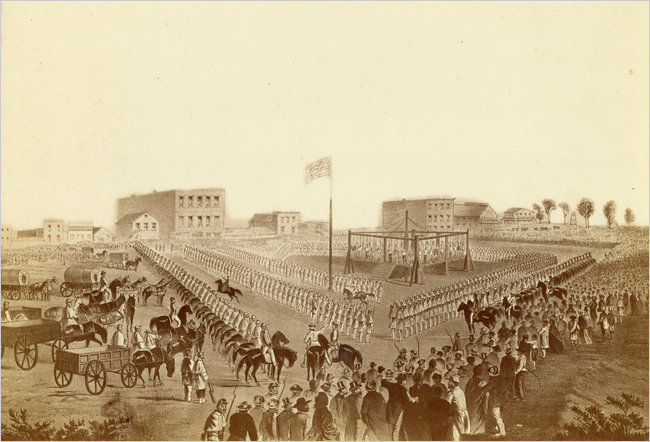
By Robert K. ElderOn Dec. 26, 1862, thirty-eight doomed Dakota Indians wailed and danced atop the gallows, waiting for the trapdoors to drop beneath them. The square scaffold, built here to accommodate the largest mass execution in United States history, swayed under their weight.

An engraving depicting the scene of the mass execution of 38 Dakota Indians on Dec. 26, 1862.

“It seemed that the purpose of the singing and dancing was only to sustain each other in their last ordeal,” a witness observed. “As the last moment rapidly approached, they each called out their name and shouted in their native language: ‘I’m here! I’m here!’”

Thirty-seven of the men were among the “most ferocious” followers of the Dakota leader Little Crow, according to the federal government. They stood accused of killing approximately 490 settlers, including women and children, in raids along the Minnesota frontier.

But one man, historians say, did not belong there. A captured Dakota named We-Chank-Wash-ta-don-pee, often called Chaska, had had his sentence commuted by President Abraham Lincoln days earlier. Yet on the day after Christmas 1862, Chaska died with the others.

It was a case of wrongful execution, Gary C. Anderson, a history professor at the University of Oklahoma and Little Crow biographer, said last week in an interview. “These soldiers just grabbed the wrong guy,” he said.

Although the story of the mass execution in Mankato is well-known locally, scholars say the case of Chaska—spared by Lincoln, then wrongfully executed—has been long overlooked by the federal government and all but forgotten even by the Dakota.

Now, an effort to keep the story alive is taking root on campuses and even on Capitol Hill as the 150th anniversary of the execution, in 2012, approaches. Commemorative events will include symposiums, museum exhibits, monument re-dedications, book publications and an original symphony and choral production.
Comment:  The article discusses the possible pardon of only one of the 38 men hanged. It doesn't go into whether the others deserve a pardon also.

Below a website discusses the problems with their convictions, including the most obvious one: whether the Dakota were members of a sovereign nation fighting a war against the US.

How Fair Were the Dakota Conflict Trials?Did the Commission allow adequate time to consider the evidence?

The order creating the Commission said that it was to"try summarily the mulatto, mixed bloods, and Indians engaged in the sioux raids and massacres." And try summarily it did. The Commission conducted 393 trials over a six-week period. On the last day alone, the Commission heard and decided nearly forty cases. The rapidity of trials increased over time.

Should the accused have been provided with counsel?

The Sixth Amendment guarantees to defendants in criminal trials the right to assistance of counsel, but Henry Sibley was of the view that the right did not apply in trials before military commissions. Sibley and the Commission turned down the only request for counsel that was made.

Were the verdicts supported by the evidence?

Most of those convicted undoubtedly committed acts described in their specifications and thus, if one assumes that the acts specified constitute crimes deserving of punishment, most were guilty. In many instances, however, the crime alleged was mere participation in a battle, so that evidence that the defendant fired a shot, supplied ammunition, or in any other way significantly aided in the combat was enough to earn him a death sentence. Mitigating evidence, such as the fact that the defendant may have prevented a rape or a murder, was generally ignored.

Were Commission members prejudiced against the accused?

The members of the Commission were all military men and local residents. The men they were asked to pass judgment on were in many cases the same men that had attacked them and their troops. One of the Commission's members, William Marshall, frankly admitted his own difficulty in viewing the evidence impartially: "[my] mind was not in a condition to give the men a fair trial."

Should the accused have been viewed as legitimate belligerents of a sovereign nation rather than as common criminals?

The use of force by individuals in a declared war between sovereign nations is generally not subject to the same treatment as would similar acts of assault or murder committed by individuals under different circumstances. Captured enemy soldiers are treated as legitimate belligerents and held as prisoners of war until hostilities cease and they are released.

Was the Commission authorized by law to conduct the trials?

The Supreme Court in 1857 upheld certain uses of military commissions, but lower court interpretations of the Court's opinion have limited commissions to situations where they were the result of military necessity. Although Minnesota was certainly going through a turbulent time in 1862, civil authority was never interrupted. State courts continued to operate and process criminal cases, and presumably could have processed charges against participants in the Dakota Conflict as well.
For more on the subject, see Preview of Dakota 38 and Jerry Fogg's Mankato 62.

Below:  "An engraving depicting the scene of the mass execution of 38 Dakota Indians on Dec. 26, 1862."

December 08, 2010

Preview of Dakota 38

'Dakota 38' movie documents U.S. hanging of Lakota Indians

The West Coast debut is scheduled Thursday for the documentary film "Dakota 38," at Seattle University's Pigott Auditorium

By Lynda V. Mapes
"Dakota 38," the rough cut, will be presented Thursday evening for its first West Coast public screening, hosted by Seattle University.

The film was inspired by Lakota spiritual leader Jim Miller, who in the spring of 2005 had a dream in which he rode 330 miles on horseback. He eventually came to a riverbank in Mankato, Minn., where he saw 38 of his own ancestors hanged. He soon discovered that he had dreamed of the actual largest mass hanging in the United States, ordered by President Lincoln in 1862.

In December 2008, Jim and others retraced the route of his dream on horseback in an effort to bring healing and reconciliation to all. "Dakota 38" is a feature-length documentary film by Smooth Feather Productions that tells the story of the 330-mile journey. To see a trailer, go online to smoothfeather.org/dakota38.
Comment:  For more on the subject, see Jerry Fogg's Mankato 62 and Art Exhibit on Minn. Statehood.

September 03, 2009

Jerry Fogg's Mankato 62

Yankton Sioux tribal artist inspired by Oscar Howe

Jay KirschenmannJerry Fogg's Native American artwork is a mixed-media world of drawing, feathers, old coins, documents and more.

The Yankton Sioux tribal artist wins top awards at art shows, he says in part thanks to his inspiration, the late native artist Oscar Howe.
Comment:  I mainly posted this item so you could see the artwork below. I think it's an interesting example of mixed-media art.

I presume the title refers to Mankato in 1862, where 38 Sioux Indians were hanged per President Lincoln's orders. Thirty-eight tassels (or whatever they are) hang across the center.

For more on mixed-media art, see Quick-To-See Smith's Art Exhibit, "Walrus Family Portraits," and Gasping at Mixed Media.

Below:  "Artist Jerry Fogg's "Mankato 62." (Lara Neel/Link)

December 26, 2008

Art exhibit on Minn. statehood

Art:  History lesson

Minnesota's 150th birthday is viewed through American Indian eyes in a show at Ancient Traders Gallery.What:  Paintings, drawings and other art on themes of Minnesota history by more than a dozen contemporary American Indian artists.

Review:  Inspired by the 150th anniversary of Minnesota statehood, "States" asserts the primacy of Indians in Minnesota, recalls broken treaties and the bitter hanging of 38 Indians at Mankato in 1862. A valuable counterpoint to official sesquicentennial celebrations, the show is more educational than confrontational, with flashes of ironic humor and quiet dignity.
Below:  Jonathan Thunder's "Every Day is a New Day."

I presume this is an example of the nonconfrontational art. The execution is okay, but it's the concept that stands out: a Native in traditional clothing set a modern setting. The message is the perennial one that Indians are still here and they've brought their beliefs and traditions with them. In other words, that they're part of two worlds.

For more on the subject, see Natives Protest Minn. Sesquicentennial.

November 21, 2008

Review of Native Nations: Standing Together

As you may recall, I posted an item on an ABC documentary titled Native Nations: Standing Together for Civil Rights. To refresh your memory, here's how the Evangelical Lutheran Church in America (ELCA) described it:Native Nations, hosted by Peter Coyote, chronicles the American Indians' struggle for civil rights, and the creation of the National Indian Lutheran Board to raise funds and awareness for that struggle. From the controversy surrounding the 1862 trial when 38 Dakota Sioux were executed in the largest single-day mass hanging in United States history, to the confrontation of the 1960s when many Indian tribes joined together to speak out with a unified voice, Native Nations tells the story of standing together for sovereignty, justice and civil rights.My thoughts on Native Nations:

  • The first part focused on the executions in Mankato, Minnesota--probably because Minnesota's Indians were the first to partner with the Lutherans in ELCA. It made the important point that Americans considered the Sioux captured in 1862 criminals, not prisoners of war.

  • The bulk of the episode focused on the civil-rights movement of the 1960s. It gave a good introduction to such AIM activities as the occupation of Alcatraz and the Trail of Broken Treaties march.

  • The documentary tried to make the case for the Lutheran church's significance. But it seems the church mainly provided money and logistical support. While these things were necessary for the movement to occur, I'm not sure the church deserved its own documentary.

  • The church's support dwindled in the 1980s and 1990s when right-wing factions questioned why the Lutherans were supporting Native rights.

  • Peter Coyote seems to be the go-to guy if you need a Native documentary narrator. I wonder if he donates his services because he believes in the cause.

  • Overall, Native Nations was a typical Native documentary of talking heads and archival images. If you already know about the Mankato executions and the '60s activism, you probably won't learn much.

  • ABC deserves kudos for putting this documentary on the air. But not too many kudos, since the network aired it Saturday, October 18, at 2:00 am (in Los Angeles). If there's a time slot that gets less of an audience, I'm not sure what it would be.

    Rob's rating:  7.5 of 10. For more on the subject in general, see Native Documentaries and News.