Showing posts with label science fiction. Show all posts

March 09, 2016

America "not a good country for gods"?

Why Adapting Neil Gaiman’s American Gods for TV Is a Bad Idea

By Abraham Riesman[P]erhaps most offensive, we'll get the book's Big Statement About America, which is bizarrely insulting to Native Americans. Near the end of the novel, a Native American with magical powers named Whiskey Jack tells Shadow he's not a god, but rather a "culture hero," because the land we call America "is not a good country for gods."

"There are creator spirits who found the earth or made it or shit it out, but you think about it: who's going to worship Coyote?" Whiskey Jack tells Shadow. "[W]e never built churches. We didn't need to."

Really? No houses of prayer? How, then, do you account for the Longhouses the Iroquois built for their prayer ceremonies? And no true gods that anyone bothered worshipping? That's an insane generalization about more than ten thousand years' worth of spiritual culture across an entire continent.
American Gods by Neil Gaiman

By BrontëI wasn’t completely satisfied with the scope of the religions and cultures he represented. Of course, it would’ve been impossible for him to meaningfully represent every culture of the world in a 600-page novel, but most of the big characters from mythology were the easy choices, coming from popular European myth. It would’ve been nice to see a few more less popular, less Anglo-centric gods be given fleshed out stories or characters. There was almost nothing from South America. Does that count as part of the barren America?

Which brings me to the subject of Native American representation. Gaiman justifies his plot-integral proposition that gods don’t thrive well in the Americas by stating that Native religions were truly more about land-worship and idols than the creation of gods. I know little about most Native religions, but 1) that’s a broad statement and 2) that just doesn’t seem fair. Can we truly say that or is this a case of misrepresentation and the molding of a culture to the author’s needs? I’m inclined to say the latter.
Mark Reads ‘American Gods’: Chapter 18

By Mark Oshiro“What I’m trying to say is that America is like that. It’s not good growing country for gods. They don’t grow well here. They’re like avocados trying to grow in wild rice country.”

And it proves to be a shockingly astute observation about the history of this place. There were plenty of indigenous people who lived in America long before white men came to bring disease and genocide, and I think that’s what he’s referring to. We are a nation built on imperialism and immigration, and what gods we did have that were grown here were lost in the genocide against the Native peoples. (Obviously not entirely, because there are still Native Americans living all over this country, many who still believe in the same gods, some who believe in new ones, and some who don’t believe in any at all. I’m not a fan of language about Native peoples that paints them as if they just up and ~disappeared~.)
Comment:  "Not entirely" is putting it mildly. Thousands of Native cultures still exist in North, Central, and South America. Their gods probably have more true believers than Thoth, Anubis, Ēostre, the Queen of Sheba, and kobolds do.

So how does Gaiman figure that America failed to produce gods while the "Old World" succeeded? The only significant religions left in Europe and the Middle East are the worldwide ones: Christianity, Islam, Judaism, Buddhism, Hinduism, Jainism, Sikhism. The indigenous or "pagan" religions are mostly gone.

For more on American Gods, see Whiskey Jack in American Gods.

March 08, 2016

Whiskey Jack in American Gods

With Starz planning a TV series of Neil Gaiman's American Gods, it's a good time to review the novel's Native aspects. It's been awhile since I read it, but I believe Whiskey Jack is the most prominent Native character:

WisakedjakWisakedjak (Wìsakedjàk in Algonquin, Wīhsakecāhkw in Cree and Wiisagejaak in Oji-cree) is the Crane Manitou found in northern Algonquian and Dene storytelling, similar to the trickster god Nanabozho in Ojibwa aadizookaanan (sacred stories) and Inktonme in Assiniboine myth. He is generally portrayed as being responsible for a great flood which destroyed the world originally made by the Creator, as well as the one who created the current world with magic, either on his own or with powers given to him by the Creator for that specific purpose.

Wisakedjak is a character in the book American Gods by Neil Gaiman, where he is frequently referred to as "Whiskey Jack" as a corruption of the name. In the book, he appears as a native old man, who lives in a mobile home, somewhere near a Lakota reservation in the badlands with Johnney Appleseed.
Comment:  For more on Neil Gaiman, see Gaiman Wrong on Graveyard Book and Neil Gaiman on "Dead Indians."

January 27, 2016

White male privilege in Chrononauts

A review of a recent comic-book series:

Chrononauts Review (Mark Millar, Sean Murphy)Spoilers--this comic is shit!

Meet the ultimate craptastic time-travel story: Chrononauts!

What happens when two meathead “scientist” dudebros invent time-travel? Dude--they use it to get babes, money and fast cars! Yah, brah, they like totally get laid tons and use their knowledge of history and their timesuits to jump into any timezone and get stuff to make their lives easier whenever they want!

They want to become emperors to 16th century people? Give them 21st century weaponry and lead them in battle against their enemies! Machine guns, planes and bombs will easily make them the victors against spears and horses and they’ll make you their ruler. Then you get gold and women and you just keep doing that everywhere in time because that’s what “rock star scientists” do!

It feels redundant to say Chrononauts is a dumb and lazily scripted comic because so much of Mark Millar’s recent output has been like that; Chrononauts is just the most brazen, to date.
Rob's review

As I told someone back in October, I got the first trade paperback becauseMillar is holding a contest to write a four-page (!) Chrononauts story. I know time travel, and now that I've seen how simplistic his stories are, it should be easy to come up with something better.

I'm thinking something about the battle of Little Big Horn. Because even though the Chrononauts go hopping through time, they mainly encountered the usual Euro-American highlights (Rome, Vikings, Columbus, the Civil War, 1920s gangsters, JFK). Most of their stops were confined to the white portions of Western civilization, and not a single Indian appeared.
Then I got into a discussion with critic Gregory Burgas:

Except for Old Man Logan and Civil War, I haven't read much Millar, Gregory. Has he always written from such a white-male perspective? This series seems like something Mickey Spillane might've written if he were tasked with doing a modern sci-fi story.Well, I've been boycotting Millar for over a decade, so I don't know about his recent work. Wanted pushed me to boycott him, and that's totally a "I'm a white male and the whole world hates me!" whining rant, through and through. It's odd, because his Swamp Thing is superb and I've heard good things about his Superman Adventures. But your assessment is not wrong at all.The "dudebro" ethos

He isn't ranting in this series. More like celebrating the greatness of strapping white males. Who are manly enough to take what they want from every era.

The two most prominent women are also people of color. They have independent careers but they're marked to be wives and mothers. The racial and sexual implications couldn't be much more obvious.

With all of history to play with, you'd think this series would be less white and male than average. But no...its view of history seems to come from a 1950s school textbook. I bet people like Donald Trump, Rush Limbaugh, and Seth MacFarlane would love this book.Ha! Well, then he's embraced the "dudebro" ethos and is just enjoying it. Is that progress? :-)Could be. But I'm thinking it's some idea from his childhood that he recently resurrected. He saw some astronauts and thought they were mighty heroes with the "right stuff." How cool would it be if chrononauts had the same rock-star vibe?

It's like doing The New Frontier or Batman '66 and unironically avoiding every social issue of the last 50 years. You can do that for a series set in that era. But this series seems to be set in the present or near future.

Final thoughts

This book is all "What fun it is to conquer people and become king!" Much like Gunga Din, which I think Millar cited as an inspiration.

Never mind all the people our heroes must've killed to accomplish this. The murder, assassination, enslavement, rape, and pillage all happen off-page.

So stupid that these guys spent 20 years becoming top scientists, then threw it all away for fame and fortune. Hey, if you wanted women and money, maybe become a race-car driver, firefighter, rock star, or soldier of fortune. You know, a profession that might appeal to adrenaline junkies and their groupies. Scientist probably isn't a top-10 choice if you're motivated by greed and lust.

Bottom line: This may be the shallowest time-travel story ever. It's as if a men's magazine wrote about all the fun things you could do with women, cars, and guns in the past.

More reviews:

CHRONONAUTS #1

October 20, 2015

"White genocide" in The Force Awakens?

Now white people are trying to ruin “Star Wars”: Racist reaction to new trailer is part Gamergate, part Donald Trump

The anti-"Star Wars" lunacy seems laughable, but it's related to the toxic male entitlement corroding our politics

By Chauncey DeVega
White racists are none too pleased with JJ Abrams’ new “Star Wars” film trilogy. In protest of last evening’s release of the much-anticipated final trailer for this December’s “Star Wars: The Force Awakens,” disgruntled members of the White Right began a Twitter hashtag “BoycottStarWarsVII.” It was a pathetic effort at getting attention; the hashtag was subsequently made popular by those who saw fit to mock it.

It is likely that the white supremacists who are upset by the supposed “anti-white propaganda” and themes of “white genocide” in the new Star Wars films will only have their ire further stoked by Monday night’s trailer that opens with an image of a young woman scavenging a crashed Star Destroyer, a voice over by an alien played by African actress Lupita Nyong’o, then proceeds to focus in on a “black” Stormtrooper turned Resistance leader and hero, and then eventually features a “Latino” X-Wing fighter pilot who valiantly fights against The New Order’s (the next iteration of the evil Empire from the earlier films) improved Tie Fighters.

Of course when viewed on the surface, this faux upset by the White Right about “diversity” and lack of “white” “male” “straight” characters in the new “Star Wars” film is laughable.

The previous “Star Wars” films, with one exception, featured an exclusively white cast. The new movie also has an all-white male cast except for John Boyega as the character “Finn,” Daisy Ridley as the presumed main character Rey; and Oscar Isaac, a Latino, as Poe Dameron. With the exception of Carrie Fisher, the remaining human characters as revealed so far are either depicting, or played by white male actors.

The writers, directors, and most of the senior creative staff for “Star Wars: The Force Awakens” are also white men. This is a reflection of Hollywood’s broader demographics where by some estimates are at least 85 percent of the producers, directors, show runners, executives, writers, and other leading creative positions are held by white men.

But when viewed in a broader context, the White Right’s childish and petty protests about “Star Wars” are a reminder of how cultural politics reflect deeper social anxieties, worries, and concerns about power in a given society.
When conservatives cry about something, some people say we should ignore them like the whiny babies they are. But one writer disagrees:

Please feed the Star Wars trolls: White supremacists need to be noticed to keep their ideas on the fringe

Yes, trolls want attention. But when you ignore hate, whether on Fox News or Twitter, it does not go away

By Amanda Marcotte
Does ignoring racism make it go away? That’s the underlying premise of Genevieve Koski’s new piece at Vox tut-tutting liberals for giving the #BoycottStarWarsVII hashtag on Twitter attention. The hashtag appears to have been started by two white supremacists who are latching onto whatever news item is trending that day—in this case, the new Star Wars trailer—and using it to push their ludicrous notion that white people are being subject to a “genocide” because the movie has people of color as stars in it. The hashtag immediately become overwhelmed by outraged liberals enjoying their moral superiority over these douchebags and Koski is disgusted by the whole thing, arguing that by giving it this attention, liberals “amplify a niche message and create controversy out of whole cloth.”

She argues that since attention is what the trolls want, the No. 1 priority of liberals should be depriving them of that attention. “Twitter trends are just another source of sustenance for trolls and hate groups,” she argues. “All #BoycottStarWarsVII has truly accomplished is giving them a nice, hearty meal.”

It’s a tempting argument. Many of us feel powerless and angry in the face of hate, and so telling people that we can, almost by magic, make it go away by simply pretending it doesn’t exist is an enticing idea. In this case, the argument is juiced by the fact that the people who started this are a couple of clowns who are afraid to show their own faces in public and who do clearly get off on the attention.

Still, what Koski’s argument fails to take into account is how fringe reactionary ideas like this, if they aren’t checked by liberals, have a tendency to start leaking into mainstream conservative circles. Indeed, a lot of what places like Fox News exist to do is clean up fringe ideas, repackage them in more palatable forms, and feed them to an audience that is most definitely not on the fringe. The only way liberals can interrupt that process is by aggressively tying these kinds of ideas to the fringe racist circles where they began, or otherwise they run a very strong risk of being subjected to this mainstreaming process.
Comment:  For more on Star Wars, see Why Are Most Aliens White? and Lucas's Prejudices in Star Wars.

September 28, 2015

Review of Time Spike

Time Spike (The Ring of Fire)Captain Andrew Blacklock was overseeing the change of shifts at the state of Illinois’ maximum-security prison when the world outside was suddenly ripped. They thought it was an earthquake until they found that the Mississippi river had disappeared, along with all signs of civilization. Then the sun came up—in the wrong direction. And a dinosaur came by and scratched its hide against the wall of the prison . . .

Something had thrown the prison back in time millions of years. And they were not alone. Other humans from periods centuries, even millennia apart had also been dropped into the same time. Including a band of murderous conquistadores. But the prison had its own large population of murderers. They couldn’t be turned loose, but what else could be done with them? Death walked outside the walls, human savagery was planning to break loose inside, and Blacklock and the other men and women of the prison’s staff were trapped in the middle.
Native aspects

The "time spike" phenomenon sends people from every era of southern Illinois back through time. They include:

  • "Primitive" Indians from the prehistoric Mound Builders
  • The entire city now known as Cahokia
  • Hernando de Soto and his band of conquistadors
  • Cherokee refugees on the Trail of Tears and the US soldiers escorting them

  • Only a few of the Cherokee refugees get any significant time. They're reasonably well-fleshed out. Everyone else is one-dimensional, alas. The "primitive" Indians are scared and overwhelmed by the more modern people. The Cahokia residents (mentioned, not shown) are religious fanatics. The conquistadors are psychopathic butchers. And the Cherokee refugees include an incredibly stealthy tracker and an incredibly sensitive healer.

    In short, everyone except a few exceptions is a type. The modern-day characters are almost all three-dimensional, while the characters from the past aren't.

    There's also a Cherokee inmate who was wrongly convicted. He's mostly three-dimensional too, but he's especially crafty and good at surviving. I don't know if this is a subtle nod to his Native ancestry or not, but it's a shame there are no average Indians. They're all way above or below average.

    As for the rest of the book, Time Spike is good overall. It deals realistically with the problems of being sent back in time with only the supplies and skill-sets on hand and 2,000 prisoners behind bars. Only toward the end does it let down a little. Most of the conflicts get settled with guns and violence, not with the intelligence and foresight seen earlier.

    Rob's rating: 8.0 of 10.

    September 22, 2015

    Hortas in Starfleet

    A continuation of the discussion begun in Thirteen Worlds in Starfleet?

    "We'd love to have a Horta crew member, but they're rather unfriendly and ugly, don't you think? Besides, they don't have the necessary 'tools' to serve in Starfleet. They're better off in support positions behind the scenes."In the novels there was a Horta on Kirk's ship. Didn't need to beam down, he just entered atmo like a meteor.I don't think I've read that ST:TOS novel or novels. And I've read a good chunk of them. But there was a Horta crew member in DC's ST comic book, so I understand.

    Nevertheless, the idea of a Horta crew member didn't reach Capt. Picard. Or the writers of his ST:TNG adventures.Picard is a skinhead, you know. :)I guess so!

    Ah. The Horta character Naraht appeared in both the comics and Diane Duane's novels. I've read several of her novels, including The Romulan Way, so I've read about Naraht. I just didn't remember him from the books.

    Another novel has an entire starship of Hortas. Which makes more sense than trying to mingle air- and rock-based crew members.

    Funny how novelists think of such sci-fi ideas routinely but TV writers almost never do.

    For more on Star Trek, see Is Captain Kirk a Conservative? and Miramanee in Star Trek Continues.

    September 21, 2015

    Thirteen worlds in Starfleet?


    This image led to a Facebook discussion about the Federation's diversity or lack thereof:

    Only 13? Doesn't the Federation have hundreds of worlds?Unfortunately, Picard did not believe in integration.

    They do, but the Enterprise only has representatives from 13 of them.
    "We are proud to include crew members from the light-skinned humanoid planets. As for the Andorians, the Tellarites, and the Orions--not to mention all the non-humanoid species--alas. Through no fault of their own, they don't quite have the 'right stuff.'

    "But fear not. Some of them have their own ships in Starfleet II, aka Starfleet Jr. Others are free to hitch rides via Starfleet Uber. We make sure all species and races have equal access to the stars."A lot of those people explore space on their own (like the Vulcans) so they don't "need" to be in Starfleet to explore space. Starfleet is an organization any member of the Federation can join, but they certainly do not have to join. Enterprise was an Earth vessel that Starfleet used to explore space, but in Picard's day it was used for diplomatic missions often and had many people on board who were not crew members. It had around 1000 people on board at any given time, but only about 2/3 were crew. So 13 worlds were represented in 750 people. That's pretty good! Go on any cruise today, and you probably wouldn't have that many nationalities at once on the same ship. Also, it was a TV show. lol :-)Every Starfleet vessel ever shown was an Earth vessel.Probably because Starfleet was on Earth. It does play a big part in who decides to join Starfleet, I'm sure. ;-)Which is why Picard said, "We are proud to include crew members from our light-skinned humanoid planets."

    You're explaining the reasons for my initial comment, which I already knew. But you're not giving us any reason why a fictional universe should be so Anglo-American.Oh, well that's easy! The show was shot in Hollywood, and it was just easier to make them look that way to save on the budget. ;-)

    TOS made a point of including people from all different nationalities in it, but they got a little lazy when casting TNG.
    It would've been easy to find 10 Asian or African actors in Hollywood and make an Earth-based starship primarily nonwhite. So the real reason here is racism. Which is my point.That's a sad point, as Star Trek was one of the most progressive shows of its day.It's sad but true, alas. And 20-30 years later, when producers could've and should've known better, Starfleet was still predominantly white.

    However, bigots like Kim Davis aren't welcome in Starfleet, so that's good.

    13 whole worlds!

    I just think it's funny that Picard would use 13 as the measure of Starfleet's diversity. Like, "The US military has members from 13 (thirteen) countries. The other 183 countries aren't represented, but you can't have everything."The U.S. military only has members from one country (the U.S.). lolIt has naturalized citizens from other countries.Yes, but they have to become U.S. citizens to serve, so they still represent the U.S.

    This does raise an interesting point though! Worf was raised on Earth by human parents, and still considered himself Klingon, but I wonder if there are aliens that live on Earth and consider themselves Terrans (people from Earth)? They could have had people like that on the Enterprise too.
    Okay.

    Point is that "members from other countries" doesn't mean "citizens of other countries." "From" mean they or their ancestors originally came from elsewhere. Obviously.

    For more on Star Trek, see Is Captain Kirk a Conservative? and Miramanee in Star Trek Continues.

    September 17, 2015

    What if Britain had won?

    Here's a subject historians and sci-fi authors have written about:

    What if Britain had won the Revolutionary War?

    By James Giago DaviesFor the first half of the 19th Century Britain was a brutal power, but by the start of the 20th Century, slavery had been outlawed, the monarchy lost actual power to Parliament, and became just a figurehead, and social reform resulted in better education, better working conditions, for the White population in Britain.

    Likely these reforms would have taken place in America.
    The outcome for Indians:The big question becomes, by the 1870’s, would the British Army have treated the Lakota better than the U.S. Army did?

    Given how they were acting in South Africa and India at the time, the answer is probably no. The reserve system in Canada gives a fair indication of how reserves would have been set up in British controlled America. It’s not a great improvement.
    The present-day situation:There would be a much more robust infrastructure, and modernized electrical grid, better public transportation, high speed rail crisscrossing the nation, making for far less dependence on fossil fuels. Health care would be free. Education would be free.

    Money would not dominate politics to the degree it does now, corrupting Congress, subverting democracy. The Lakota would have received fair restitution for the Black Hills, and the badly implemented BIA programs, would run much more efficiently because many of these programs would be a right of every citizen.
    Comment:  For more on alternate histories, see Reivew of Aquila in the New World and Native Stereotypes in Life of Brian.

    July 25, 2015

    Is Captain Kirk a conservative?

    Some comments on the following subject:

    Ted Cruz: ‘Star Trek’s Captain Kirk was probably a Republican

    Kirk is militaristic, makes up his own reality, and thinks of women in sexual terms. I wouldn't rule out his being a moderate 1960s-style Republican.

    William Shatner shoots down Ted Cruz: Captain Kirk is no Republican

    Shatner says Kirk is apolitical? Okay. I could see Kirk as a "rely on yourself" libertarian-leaning type. I.e., don't trust government or anyone giving orders or computers. He might not vote--but if he did vote, he might prefer a moderate Republican.

    Spock, McCoy, Sulu, and Uhura would be Democrats, of course. Scotty and Chekov might lean to the conservative side just like Kirk.

    Federation politics

    It's funny that Star Trek is overtly apolitical--never discussing politics except on alien worlds. Yet the Federation is a utopian ideal and we know it has a president, at least. So it should be championing democracy and elections, not ignoring them.

    I presume it's a democracy and people vote, although I suppose a Federation computer could pick officials using its awesome AI. Yet the characters literally never discuss this among themselves. No off-hour chats between Sulu and Chekov or O'Brien and Bashir about whom they're supporting in the next election.

    You remember the TNG episode about the game that hypnotized the whole crew? The creators could've made it a political video instead of a game. Candidate X using subliminal messages to win an election and take control of Starfleet. That would've been a bold commentary on our society.Kirk has disobeyed Starfleet more times than MacArthur disobeyed Truman, but with better results. I guess that's not really political, but for some reason seemed an appropriate analogy.Old Vulcan proverb: "Only Nixon could go to China." Kirk is Nixon.

    Of course, Kirk would never take Cruz's side in anything. He'd scorn a blowhard like Cruz. He'd treat him like Harry Mudd or Cyrano Jones...as a big fat joke.

    Same with Cruz's other hero, Spider-Man. Except the comparison there would be to an egotistical egghead like Dr. Octopus.

    For more on the subject, see The Native Spock and The Political Spock.

    July 04, 2015

    Miramanee in Star Trek Continues

    The coolest 'Star Trek' reboot you're probably not watching

    Fan production "Star Trek Continues" re-creates the original series with incredible attention to detail. Crave’s Michael Franco talks with the series creator to see how he’s helping "Trek" live long and prosper.

    Star Trek Continues--Episodes

    Episode 4 is titled The White Iris. The official description:Captain Kirk finds himself haunted by guilt from his past as the fate of an alien world hangs in the balance.** spoiler alert **

    In particular, Kirk is haunted by three of his lost loves--the black silhouettes at the bottom of this image. One is Miramanee from The Paradise Syndrome.

    Here are some details of the plot:

    The White IrisPlot summary

    Kirk is struck in the back of the head by an Eretrian dissident, forcing an emergency beam out.

    While Spock and McCoy try to plead with Kirk, he once again has another hallucination: this time of Miramanee, the American Indian princess whom he married during a memory lapse (episode "The Paradise Syndrome"). Miramanee had became pregnant with Kirk's child, but subsequently died when Kirk was attacked by angry villagers. Kirk then experiences another seizure, but resolves to perform his duties.

    In the American Indian village, Miramanee is on her deathbed. Kirk tells her he sometimes wishes that he had not been found, as he was never happier than when he was with her. She was a gift he could never repay. Miramanee tells him that he made her very happy; that her place was by his side; that one does not repay a gift.

    [Kirk] begins to head to the bridge when he encounters the little girl again. He asks her name, and she says he never gave her one. She then shows him a gift–a piece of beadwork with markings from Miramanee's headband–at which point Kirk realizes she is a vision of his unborn child. Kirk imagines hugging her, and she whispers the word "Irises." Remembering now that this is the password, Kirk is able to activate the defense grid.
    Rob's review

    The plotting and acting in these continuances is hit and miss, but the spirit is willing. They certainly convey the look and feel of Trek, if not their quality. They come across as below average but not totally unacceptable episodes compared to the originals.

    As for Miranmanee (Tiffany Brouwer), it was nice to see her again and get some closure to her story. It was especially nice to see her unborn child, who would've been Kirk's second after David Marcus.

    Fortunately the episode didn't add any new stereotypes to The Paradise Syndrome's story. In fact, the little girl was less stereotypical than anything in the original.

    Another take on the series and Miramanee:

    A web-series any Star Trek TOS fan should love(By Les)Whenever they have to match a character seen in TOS, they’ve unfailingly found an actor/actress that not only looked identical, but sounded and acted identical. In episode 4, “The White Iris,” for instance, they had to produce 3 women from Kirk’s past: Reyna (Requiem for Methuselah), Miramanee (The Paradise Syndrome) and Edith Keeler (The Guardian of Forever). They were instantly recognizable and acted precisely as the original actresses had.

    Of course, Nakia didn't exist before this episode, so it was easy to get her right. But it was a nice multicultural touch to give Kirk a black girlfriend. And it nicely filled the gap between Carol Marcus, the somewhat unbelievable "Ruth" and Janice Lester, and the original series.

    For more on The Paradise Syndrome, see Clear Inferiority in The Paradise Syndrome and Mistakes and Stereotypes in The Paradise Syndrome.

    June 03, 2015

    Review of Killer of Enemies

    I recently read this book:

    Killer of Enemies (Killer of Enemies Series)

    Amazon's summary is too long to repeat. Here's all you need to know: Lozen the Apache girl hunts monsters for the Ones who survived the Cloud apocalypse to ensure the safety of her family.

    I'll let some Goodreads reviewers give the book's strengths and weaknesses.

    Marg:First off, I definitely don’t think this is a bad book. There were several things about it that I enjoyed & appreciated. Its strongest aspect by far being the main protagonist, Lozen. Let’s be honest here, YA fiction is filled with some incredibly lame-ass heroines. Not only do many of them tend to be lovesick, boy-crazy, whiny damsels in distress, but they also have the annoying tendency to be…well… stupid. Lozen most certainly breaks that mold. She’s brave, tough, knows how to kick ass, and is impressively smart & resourceful. She’s also observant, levelheaded, and completely devoted to her family. Furthermore, I found her to be very likable with a strong, distinct narrative voice.

    Unfortunately, now comes the bad news, and I’m really sad to say that the book’s biggest flaw is its world-building. Without question, it had some creative, original ideas but was overall underdeveloped and very muddled to the point of being confusing & distracting. Along the same line, it seemed as though the author could not make up his mind on what genre to focus on. The world, story, and characters were all a mishmash of sci-fi, magical fantasy, dystopian fiction, post-apocalyptic fiction, neotribalism, etc. As interesting as these bits were on their own, they failed to complement each other and come together in a cohesive way.
    Daniel:Let me just pause here and note that despite a pretty strange premise--not mention some concerns about the book not really knowing what it wants to be--Joseph Bruchac seems to do a great job telling a story. It starts at a run, and it never really slows down. And that makes it worth the read. It's fast, it paces well, and it's fun to read.

    But it doesn't know what it is. There are mutant monsters, vampires, giant eagles, high tech electronics that are genetically integrated with humans (at least until the Cloud arrives and ends anything electronic), psychic powers, Big Foot, and old Apache myths and prophecies...

    Yes. The book is all over the place. I couldn't tell if Bruchac has been watching too many horror movies or if he was trying to channel his inner Larry Correia, but aimed at a younger audience than Monster Hunter International. There's really no cohesive mythology or explanation tying it all together, though, and though there is a plausible explanation each time a new creature or plot twist pops in--whether it's vampires (some plague that escaped) or Big Foot (preexisting human civilization) or psychic powers (they had been repressed during the electronic era)--in the sum, it gives me the impression that Bruchac was winging it, pulling little slips of paper out of hat to figure out what was going to be the next "miniboss" or obstacle.
    Readknitread:Reasons why I think you should pass on this book:

    Numero Uno--the counting! Lozen apparently can't have a thought about anything without making a list and counting in Spanish. And it isn't as if she speaks Spanish. She just prefers to count in it. The constant repetition of counting makes Lozen's character flat and boring. She could have been a great strong female character but having to make a list for every thought that she had makes her seem weak and ditzy.

    --The repetition in this book shows that the author had a template and followed it until the bitter end. Lozen is assigned to kill a monster, Lozen boast about how she is better than any other human being in the world, Lozen has a flashback thought about her father and/or uncle, Lozen uses a story from that memory as the baseline for her plan to kill the monster, Lozen wins. Lozen thinks about her plan to escape with her family. And repeat until you run out of chapters. Don't stray from the template. Wouldn't want to hold the interest of the reader or anything weird like that.

    --Pick a genre and stick with it. Don't try to please everyone.Don't try to make a supernatural, mythical, sci-fi, fantasy, Native American folklore, historical fiction, adventure/survival, romance, are-we-alone-in-the universe, futuristic book. Pick a genre! Don't just stick vampires in for one chapter for the sake of it being a YA book so of course we should have vampires that add nothing to the plot except to give Lozen a repetition pattern for being able to kill anything.
    I wouldn't be quite this negative, but Killer of Enemies does have flaws. For instance, after Bruchac sets up Haven as an inescapable prison a la Alcatraz, Lozen escapes rather easily. "Mr. Hairy Ally" provides a lot of convenient help--getting her out of at least one trap that would've killed her otherwise. And the story ends with a poorly choreographed slugfest against the one-dimensional villains.

    I wasn't interested enough to continue with the series. Indeed, I'm not sure whom this book is for. Maybe younger audiences who are curious about Native cultures and looking for something less sophisticated than The Hunger Games.

    Because that's what Killer of Enemies offers. It's a fun romp but ultimately lacking in substance. Rob's rating: 7.5 of 10.

    June 02, 2015

    Review of Aquila in the New World

    I recently read this book:

    Aquila in the New World (Aquiliad, No. 1)On this alternate Earth, Rome rules all . . . including the New World, known in other dimensions as America but here as Terra Novo.
    General Titus Papinianus is governor of that untamed land, and Aquila, chief of the savage Lacoti nation, is a Roman senator. But official titles aside, their duty is to Caesar. So when Caesar sends them on a quest for the fabled land of China, thought to be somewhere in Terra Novo, off they go.

    They are hardly prepared for bloodthirsty Aztecs, flying machines, time-traveling aliens, or Bigfoot—and Aquila's problem-solving strategies are unconventional to say the least!

    Before they know it, their adventures lead them into the hands of the Time Criminal, who is bent on altering all the multiple universes to suit his own evil whims. Somehow they have to stop him . . . before their world is destroyed!
    Some readers' reviews on Goodreads:This science fiction novel about an alternative history where Rome has conquered the entire Earth is disjointed, rambling, and not very funny. I think this is supposed to be humor. It's hard to tell.

    I don't want to give away too much, so I will only mention things the teaser material hints at: Aztecs, flying saucers, a Roman general's hunt for China (by crossing North America), flying saucers, Sasquatch, time-traveling aliens, Lacota Indians, etc. The Romans have cars. They cross the Atlantic like it's no big deal. It certainly isn't the best book I've ever read, but it was highly amusing and well worth a read if you find it for a buck or two at your local used book store.

    This Sucharitkul doofus has decided that because he knows five or six Latin words and has read Decline and Fall of the Roman Empire: The Cliffs Notes Version a couple times, he is an expert on ancient Rome, and furthermore, since he is a person, he is an expert on human psychology. Combining these two, he is an expert on psychohistory on the level of Hari Seldon. Therefore, he is better suited than anyone else to write an “epic” examining what would have happened had Rome not fallen.

    As a farce it was pretty good. Lampooning the romans as delusional, self-righteous war mongers. Though, the academics were the portion of the farce I most enjoyed; endlessly debating over nonsense and trying desperately to fit what they see into their limited view of the world. ... As a sci-fi book I found it severely frustrating. It was one deus ex machina after another with no real direction or specific futuristic notion.
    Rob's review

    Let's start with the setup. The story takes place around AD 100, which we know because the sequence of Roman emperors hasn't changed. Indeed, Domitian (AD 81-96) and Trajan (AD 98-117) are supporting characters.

    The Romans have exactly three new inventions, I believe: steamships, steam-cars, and bicycles. The book eventually explains where these things came from, starting with a lone scientist working in secrecy. And why no other inventions have come from the same source.

    But the book fails on other questions. Why haven't the Romans reverse-engineered the steam engine and used it in other capacities? It's not as if steam turning, say, a paddle wheel is anything complex? So why haven't these inventions transformed Roman society?

    It's not clear how long the inventions have been around. I think it's only a century or two. Any longer and they would've caused this world's history to diverge radically from our own.

    Roman conquest

    On the plus side, the Native characters--especially Aquila and Hooting-Owl--are well-realized. As well-realized as any "Old World" characters, anyway. Even if they have "comical" names such as Equus Insanus (Crazy Horse), who isn't due to be born for another 1700 years.

    These characters are relatively free of stereotypes. They don't talk or act like savages. Indeed, Aquila has a realistic capacity to roll with the punches and change with the times. He eventually becomes a respected Roman senator who wears a toga.

    Alas, there's much more on the minus side.

    The Romans have conquered the eastern part of North America. Their colonies are similar to what the US had in the early 1800s. Full control of the eastern seaboard, small towns along the Mississippi, nothing but a couple of forts further west.

    But having steamships wouldn't have helped the invading armies. Without gunpowder or mounted troops, the Indians' superior numbers would've been telling. Even with the advantage of disease, I don't think the Romans could've won.

    If they did win, it might've taken them twice as long--600 rather than 300 years--to "tame the wilderness." Rome came into existence only 850 years earlier. Could Romans conquer the same lands in Europe and Asia, plus another half a continent across an ocean, in the same amount of time? I don't think so.

    Iroquois, Lakota, and Apache?

    I don't know if Somtow read the Cliff Notes version of Roman history, but he probably read the Cliff Notes version of Native history. He set up his alternate US to resemble the well-known, "Wild West" version of Native America. Iroquois in the northeast; Cherokee, Creek, and Seminole in the southeast; Lakota on the northern plains; Comanche, Apache, and Caddo on the southern plains; Chinook, Kwakiutl, and Tlingit in the northwest. He even gave the tribes "clever" Latinized versions of their names--e.g., Apaxae for Apache.

    But this isn't how it was in AD 100. The Siouan tribes (e.g., Lakota) were still in the Carolinas, I believe. The Athabascan tribes (e.g., Apache) were still in the far north. The Seminole tribes didn't exist since they came together only in the 1800s.

    And these tribes had their own names for themselves, in their own languages. The "Iroquois" were the Haudenosaunee. The "Cherokee" were the Tsalagi, and so forth. Giving us Latinized versions of names that didn't exist is a silly mistake.

    More important, Somtow ignored the broad sweep of Native history. Here's what was really going on in AD 100:

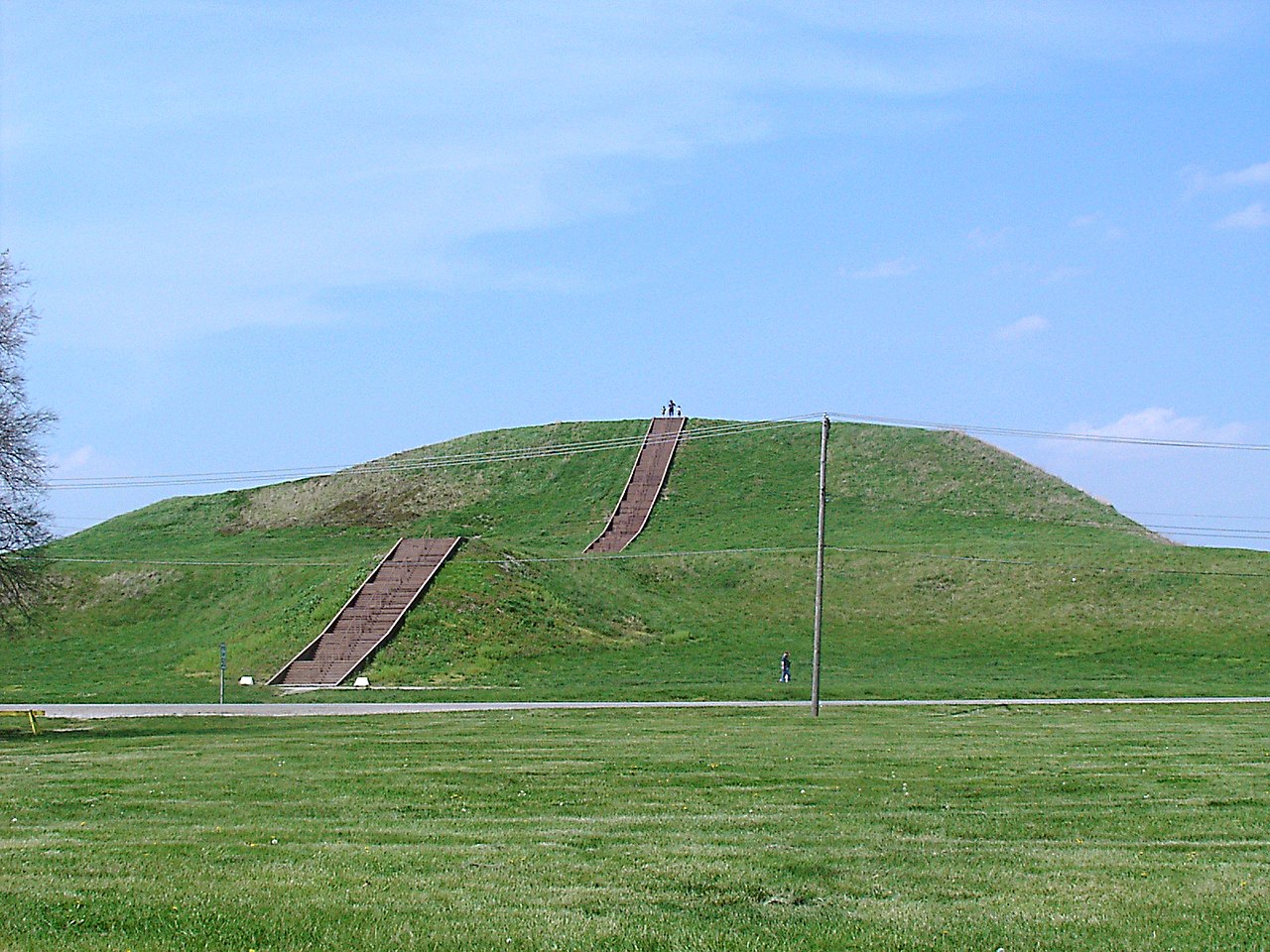
    Mound BuildersThe varying cultures collectively called Mound Builders were inhabitants of North America who, during a 5,000-year period, constructed various styles of earthen mounds for religious and ceremonial, burial, and elite residential purposes. These included the Pre-Columbian cultures of the Archaic period; Woodland period (Adena and Hopewell cultures); and Mississippian period; dating from roughly 3500 BCE to the 16th century CE, and living in regions of the Great Lakes, the Ohio River Valley, and the Mississippi River valley and its tributary waters. Beginning with the construction of Watson Brake about 3500 BCE in present-day Louisiana, nomadic indigenous peoples started building earthwork mounds in North America nearly 1,000 years before the pyramids were constructed in Egypt.None of this is evident in Aquila in the New World, but it's fundamental. Great mound-building civilizations dominated America during the Roman era, but Somtow somehow missed it.


    South of the border

    The one thing Somtow almost got right is having the Olmecs--not the Aztecs, as one reviewer said--rule in Mexico. Actually, the Olmec civilization had collapsed and the Classic Maya civilization had yet to rise in AD 100, but close enough. With a little help, the Olmecs might've lasted longer.

    ** spoiler alert **

    The Olmecs have more inventions than the Romans, including hot-air balloons, elevators, and loudspeakers. Unfortunately, it's not because they're cleverer than the Romans. Rather, an alien in the form of a were-jaguar, a revered Olmec figure, gave the Indians these gifts.

    I don't know if Somtow intended this, but he basically replicated the "ancient astronauts" theory of Erich von Däniken. Namely, that non-European civilizations arose only because aliens disguised as gods gave them knowledge and technology. That they weren't smart enough to build pyramids and other monumental structures on their own.

    True, the aliens also helped the Romans, but to a much lesser degree. Yet the Romans have conquered half the world, while the Olmecs are still in Mexico. The implication is that the Romans were smart enough to use their gifts properly, while the Olmecs squandered them on a despotic kingdom ruled by superstition and sacrifice. In short, the Europeans were rational and the Indians weren't.

    Conclusion

    Aquila in the New World has more Native problems, but these are some of the main points. It's not badly written if you go paragraph by paragraph. But its historical aspects are flawed and its "satire" fails as much as it succeeds.

    Most of all, its premise--a mishmash of concepts embodied in the phrase "flying saucers, Sasquatch, time-traveling aliens"--is unbelievable and uninteresting. It's like a child's version of science fiction--like something you'd read in a bad comic book. Like Superman goes back in time and the ignorant savages worship him as a god--that kind of bad.

    I expected more than this. If you're going to give us an alternate history, I expect some semblance of accuracy. If the South won the Civil War or the British Empire never fell, tell us how and make it plausible.

    All in all, I'd recommend skipping this book. Rob's rating: 6.5 of 10.

    April 16, 2015

    Raven in Snow Crash

    Snow Crash (Bantam Spectra Book)One of Time magazine's 100 all-time best English-language novels.

    Only once in a great while does a writer come along who defies comparison—a writer so original he redefines the way we look at the world. Neal Stephenson is such a writer and Snow Crash is such a novel, weaving virtual reality, Sumerian myth, and just about everything in between with a cool, hip cybersensibility to bring us the gigathriller of the information age.

    In reality, Hiro Protagonist delivers pizza for Uncle Enzo’s CosoNostra Pizza Inc., but in the Metaverse he’s a warrior prince. Plunging headlong into the enigma of a new computer virus that’s striking down hackers everywhere, he races along the neon-lit streets on a search-and-destroy mission for the shadowy virtual villain threatening to bring about infocalypse. Snow Crash is a mind-altering romp through a future America so bizarre, so outrageous…you’ll recognize it immediately.
    Snow CrashSnow Crash is Neal Stephenson's third novel, published in 1992. Like many of Stephenson's other novels it covers history, linguistics, anthropology, archaeology, religion, computer science, politics, cryptography, memetics and philosophy.

    Condensed narrative

    The protagonist is the aptly named Hiro Protagonist, whose business card reads "Last of the freelance hackers and Greatest swordfighter in the world." When Hiro loses his job as a pizza delivery driver for the Mafia, he meets a streetwise fifteen-year-old girl nicknamed Y.T. (short for Yours Truly), who works as a skateboard Kourier (courier), and they decide to become partners in the intelligence business (selling data to the CIC, the for-profit organization that evolved from the CIA's merger with the Library of Congress).

    The pair soon learn of a dangerous new drug called "Snow Crash" that is both a computer virus capable of infecting the machines of unwise hackers in the Metaverse and a crippling CNS virus in Reality. It is distributed by a network of Pentecostal churches via its infrastructure and belief system. As Hiro and Y.T. dig deeper (or are drawn in) they discover more about Snow Crash and its connection to ancient Sumerian culture, the fiber-optics monopolist L. Bob Rife, and his aircraft carrier of refugee boat people who speak in tongues. Also, both in the Metaverse and in Reality, they confront one of Rife's minions, an Aleut harpoon master named Raven whose motorcycle's sidecar packs a nuke wired to go off should Raven ever be killed. Raven has never forgiven the United States for the way they handled the Japanese invasion of the Aleutian Islands (see Aleutian Islands Campaign in World War II) or for the nuclear testing on Amchitka.
    Comment:  Raven is tall, dark, and handsome, of course, with long black hair. Although he's smart and well-spoken, he's a bit of a savage stereotype. He's motivated primarily by revenge, and he'll kill anyone who gets in his way.

    Many Native characters have used the name Raven--like Eagle, Hawk, Wolf, and Bear--before. Marvel's mutant villain Harpoon used the whole "Alaska Native throwing harpoons" shtick six years earlier. It's not a great power; why not use automatic pistols instead?

    Because a fanatical harpooner like Captain Ahab or Raven is a man outside civilization. He revels in hunting with primitive weapons, skewering his foes like meat on a stick. This barbaric preference suggests a basic lack of humanity.

    As does his willing to incinerate millions of people for something done to his people generations ago. This is mass-murderer territory. Although the bomb never goes off, it demonstrates a Holocaust level of depravity.

    In short, Raven is a sophisticated savage. He reminds me a little of John Rainbird, the relentless Native assassin in Stephen King's Firestarter. Both characters are more than two-dimensional cardboard but less than fully realized humans.

    Overall, Snow Crash was entertaining, although it fizzled some at the end. If it were set 50 years in the future rather than in the 1992 era, I'd say it was a provocative take on what's coming. Rob's rating: 8.0 of 10.

    March 18, 2015

    Native stereotypes in Journey's End

    Some talk about the non-political aspects of the Star Trek: The Next Generation episode Journey's End:

    The Ars staff picks our least-favorite Star Trek: The Next Generation episodes

    Turns out Trek isn't like pizza—when it's bad, it's just really really bad.

    By Ars Staff
    The plot feels like the result of hours of sleepless brainstorming by a bunch of people on a rapidly approaching deadline—as if, at about 3am the morning the script was due, someone yelled out "GUYS, I've got it: let's do a deep criticism of colonialism and national policy by drawing a parallel between a Federation-Cardassian dispute and government land-grabs of the late 1800s!"

    And then, instead of shooting the idea down, someone else yelled "And we should have actual for-real Native Americans in it! We've had Nazi planets and Roman planets—we need a Native American planet!" And then instead of a third person punching the first two people in the face, they banged out the screenplay and turned it in and then all fell asleep at their desks.

    Actually, the person most directly responsible for this episode is none other than Ronald D. Moore, who also wrote some of the greatest TNG episodes (along with, you know, Battlestar Galactica and stuff). Moore's touch shines through in a few places—the scenes with Wesley and Picard are actually quite good!—but it's hard to understand what the hell he was trying to accomplish with the colony that looks like a hastily built My First Adobe Village on a soundstage. The planet's inhabitants are a pastiche of 1950s-era "Cowboys and Indians" antagonists, and once they start nagging Wesley about pantheism and how he needs to get his Space Peyote on and do a "vision quest," I was ready to pull the eject handle and bail out.


    Tim Lynch Star Trek Reviews Wiki: Journey's EndI liked the two major guest stars after Wes and Nechayev, those being Tom Jackson as Lakanta and Ned Romero as Anthwara. Both did a good job being enigmatic and frustratingly calm; while I'm not sure it's particularly realistic, it really _did_ work for dramatic purposes. (George Aguilar as Wakasa, the most hostile member of the council, however, has to go. Bleh.)

    I do think the whole "look, we're including Native Americans, aren't we wonderfully multicultural!" angle of the show was a bit overdone, however. First, it stuck out like a sore thumb--I'm all for keeping cultural differences alive, but not when every scene featuring these people is saying "Look, we are a separate culture--a culture that's not yours and that's separate, got it?" That's more or less what was here; thankfully, it was rarely the majority of any given scene, some of the early ones aside. Second, I'm not certain it's a particularly accurate portrayal; I don't know why, but I have that feeling. (My own contact with Native Americans has been exceedingly limited, however, so I'd appreciate comments from those with more experience than I on how well it worked.) As I said, it worked beautifully for dramatic purposes, and since I don't know enough of the reality to comment, that's all I can really talk about.
    Pan-Indian mishmash

    I talked about the problems in Dorvan V's relocation conflict. Here are some problems with the Indians themselves:

  • The Indians mostly have long hair. They wear hybrid Native-meets-Renaissance clothing. They speak normally--perhaps a bit too formally--with a smattering of spiritual mumbo-jumbo.

    In other words, they're not quite modern like the Federation visitors, but they're not quite stereotypical either. In fact, they're like almost every other "alien" race in Star Trek. Their faces and hair, clothing, and mannerisms diverge slightly from the Federation norm--enough to mark them as different without requiring any real effort.

  • Dorvan V's tribe isn't named and has no specific culture. Are these people Cherokee, Navajo, Haudenosaunee, Ojibwe, or what? These tribal groups aren't the same thing--in fact, they're quite different--so it matters.

    The colony may be a pan-Indian agglomerate of several cultures. But then the people wouldn't act in unison, as if they had one set of sacred beliefs, so that isn't plausible. I imagine the colonists were meant to be a single culture, but the writers were too ignorant or scared to come up with something specific.


  • The village does look like "My First Adobe Village," but that's pretty much true of every alien race visited by the Federation. Presumably the budgets required that every outdoor scene looked like it was filmed on a "primitive village" set.

  • Probably the worst bit is the so-called "vision quest" in the Habak--whatever that is. One, the room has a jumble of Native artifacts from different cultures. That's flatly wrong. Two, vision quests typically involve going off into the wilderness and fasting for four days. They're not the same as any supernatural event involving Natives and visions.

    Vision quests aren't a part of every Native culture. And they don't occur in four-walled rooms with artifacts. The whole thing is patently phony.

    Compounding the problem, the Indian leading the vision quest, Lakanta, turns out to be the non-Native Traveler. This implies Native religion is the same as or similar to alien science-magic. It belittles such religion by suggesting a sufficiently advanced alien could imitate or even become a Native spirit.

    If a Christian prophet performing miracles turned out to be an alien, would that be an acceptable commentary on Christianity's authenticity? Because this is kind of the same thing.

  • In terms of stereotyping, Journey's End is fair to poor. The Indians aren't much better than the ones in 1960s Westerns like Bonanza, which also portrayed them sympathetically.

    Indeed, I'd say the relocation debate is more interesting than the pseudo-Indians. It might've been better to invent a fictional culture rather than give us this mishmash of Indian ideas and concepts.

    For more on Star Trek, see The Native Spock and Critique of Journey's End.

    March 17, 2015

    Relocation conflict in Journey's End

    Here's the third episode of Star Trek to deal with Indians (after The Paradise Syndrome and How Sharper Than a Serpent's Tooth):

    Journey's End (Star Trek: The Next Generation)"Journey's End" is the 172nd episode of the science fiction television series Star Trek: The Next Generation. The 20th episode of the seventh season.

    Wesley Crusher questions his future as the Enterprise is under orders to forcibly remove the descendants of native North Americans (here called 'Indians') from a planet being yielded to the Cardassians.


    Reviews

    I've mentioned Journey's End before, but I haven't done a detailed posting on it. This posting should rectify that.

    Most people thought this was an average-to-poor episode. Partly because of the muddled Native plot, but mostly because of Wesley Crusher's sendoff.

    Only the Native plot is relevant here, so let's focus on that. Some commentaries on the politics in Journey's End:

    Star Trek: The Next Generation: "Journey's End"

    By Jamahl EpsicokhanThis character thread is set against the backdrop of a Federation colony—made up of American Indians who have preserved a centuries-old culture on this far-away world—being told they are being forced off their land because of political machinations larger than themselves. While the notion of "Space Indians" feels like something that would've been fodder for TOS, the writers bring a decidedly TNG sensibility to it, with Picard wistfully noting the disturbing parallels between this assignment and what happened to Native Americans hundreds of years ago. (Less effective is the contrived guilt surrounding the claim that one of Picard's ancestors was a man who participated in a massacre of Indians, which seems superfluous while indulging the show's spiritual mumbo-jumbo as somehow able to magically provide facts that most people would need books for.)And:While it has its moments, "Journey's End" doesn't ever jell. The political solution is too easily solved, such that Picard is able to sidestep the distasteful actions we had been told the whole episode would be unavoidable.Retro Review: Journey's End

    By MichelleEven as a longtime fan, I didn’t understand what had supposedly happened during the Cardassian War until long after the fact, in Pocket Books’ novels which aren’t even considered canon. The rise of the Cardassians as the archenemy of the Federation must have been even more vexing for casual viewers. We heard about atrocities as far back as “The Wounded,” but we never got an explanation of whether there had been a declared war, a series of border skirmishes, a conflict where the official governments routinely blamed rogue factions for attacks on civilians; we never had an explanation of why, if the Federation had been at war with Cardassia, they weren’t more involved in the plight of the Bajorans before the discovery of the wormhole; we never received any retrofitting of the Cardassians into the rich fictional history of the Klingons, Romulans, Ferengi, etc. So it’s difficult from the start of “Journey’s End” to take Nechayev at her word when she tells Picard that uprooting and resettling various Federation colonists is the only way to maintain the peace with this deadly enemy. Picard isn’t much persuaded and the Indians don’t buy it for a second, which makes Starfleet look naive at best, downright stupid at worst. No wonder Wesley is thinking about leaving. The Native Americans claim they settled on this particular planet because the mountains and rivers spoke to them–their beliefs are written as a mess of tradition that comes across as both ignorant and patronizing on the part of the writers–but I can’t help wondering about the policies that drove them so far out in the first place, to a planet that must have been on the border of Cardassian space long before it was swallowed up into the Cardassian Empire itself. Did these people really feel so uncomfortable within the Federation that moving to the Cardassian border seemed like a good idea? That fact and the ease with which the Cardassians agree to let them stay suggests that we’re only getting a bit of the full picture, which remains maddeningly elusive all through the next war.Star Trek: The Next Generation: “Genesis”/“Journey’s End”

    By Zack HandlenThe episode does its best to be as respectful and open-minded as possible, and should be lauded for that. But I won’t lie—something about watching men dressed in recognizable Native America-in-the-’90s garb talking about how they don’t want to leave their home because the mountains speak to them rubs me the wrong way. I’m just not sure if my reaction is one that deserve legitimate critical analysis, or if it’s just me knee-jerking at what, to my cynical eyes, looks like a lot mystical bullcrap. I’ve always appreciated how hard TNG has worked over the years to treat all cultures (except Ferengi, because ew) with respect, and it’s not like the Indians we see here act that much differently than, say, the Klingons Worf visited when he went on a spiritual retreat. But it still feels like pandering.

    Worse, it feels like treating an issue that’s relevant in modern times—guilt over the way white settlers and the American government murdered and stole land from an indigenous people—as though it will still have the same level of relevancy 300 years into the future. On the major dramatic cruxes of the episode is Picard’s guilt over having to moving a group of Indians. These Indians having been living on the same planet for 20 years, but now, due to a new treaty signed by the Federation and the Cardassian empire, that planet no longer belongs to them. The Cardassians are coming, and before they arrive, Admiral Necheyev tasks Picard and the Enterprise with making sure the planet’s current inhabitants have been moved to a less diplomatically desirable location. Unfortunately, the Indians don’t want to move, because the place has a special meaning for them, so now Picard has a big case of the ol’ White Guilt blues. It certainly doesn’t improve his frame of mind when the tribal leader tells the captain he’s convinced this is all happening because one of Picard’s ancestors was involved in a massacre of Native Americans centuries before.

    Actually, I don’t really see how that should affect Picard’s frame of mind in the slightest, because it is ridiculous. The idea that he would feel some kind of racial culpability for a crime someone hundreds and hundreds of years dead committed is absurd, especially seeing as how he didn’t even know of the event until this episode.
    Star Trek: The Next Generation Rewatch: “Journey’s End”

    By Keith DeCandidoAnd in the end, the solution is not a perfect one. In fact, it’s a crappy one, but it’s also the only one that will work in the situation. This episode marks the beginning of a period in Trek history where the chinks in paradise will get shown (which we’ll mostly see on Deep Space Nine). The treaty between the Cardassians and Federation is a classic compromise in that it makes no one happy, and like far too many decisions made by those in the halls of power, have unintended consequences for the ordinary person. Both DS9 and Voyager will run with these (the former in actual story sense, the latter really only for its setup), but this is the episode that really set it in motion. It’s only Trek’s second shot at an ongoing story thread, and the only one that encompassed three separate TV shows.DeCandido adds some Native-related trivia:Thank You, Counselor Obvious: Troi’s interest in the “ancient west,” established in “A Fistful of Datas,” apparently extended to the history of the region as well as the stories told, as she’s familiar with the Pueblo Revolt.

    Ned Romero returns to Trek as Anthwara—he played Krell, the Klingon in “A Private Little War” on the original series, and will return as the image of Chakotay’s grandfather in Voyager’s “The Fight.” George Aguilar and Tom Jackson play, respectively, Wakasa and Lakanta.

    This episode starts an ongoing thread in both TNG and DS9 involving the Demilitarized Zone between Cardassian and Federation space, leading to the formation of a rebel group, which will be formed in the DS9 two-parter “The Maquis.”

    Although it was never stated onscreen, the intention was always for Dorvan V to be the planet that the Voyager character Chakotay came from. The post-finale Voyager novels by Christie Golden and Kirsten Beyer have made that explicit.
    Rob's reactions

    The resettlement issue was potentially rich with drama, but TNG handled it no better than any superficial TV show. Among the missed opportunities:

  • Picard never says exactly what he'll do if the colonists refuse to cooperate. What's his plan...to stun the colonists into submission? To beam them up against their will?

    What if they passively resist this effort? What if they actively fight it? Is Picard prepared to exchange phaser fire with them? To lock them up in the brig and transport them as prisoners?

    And what if the colony has 10,000 or 100,000 or a million people, which is certainly possible? How would Picard transport that many people and their possessions? Especially if they didn't line up to be transported like good little sheep?

  • On the other hand, Picard doesn't challenge the Indians' position. They've lived on Dorvan V for only 20 years. How can they claim the land is sacred to them?

    A sacred site is traditionally where an event central to the tribe's existence happened. Especially the tribe's birth--when it emerged from whatever came before. A typical example would be the Hopi Tribe's sipapu in the Grand Canyon.

    The Dorvan V tribe, whatever it is, must have a place of origin back on Earth. That's where the people came from, so that location should be sacred. Sacredness isn't a quality you carry with you in a suitcase; it's attached to particular pieces of land for particular reasons.

    American Indian history shows this. When tribes were relocated, they held fast to their traditional sacred sites, even if they were hundreds of miles away. Typically, their new homelands didn't become "sacred"--at least not for centuries, after which the old homelands might be forgotten.

    In short, "sacredness" isn't transferable. So the whole premise of a 20-year-old colony world's being "sacred" needs to be interrogated. How did Dorvan V become sacred so quickly? Must the Federation take this "sacredness" as seriously as sacredness that's 10,000 or more years old?

  • No dissension in the Federation?

  • Of course, there's no mention of the legal and political wrangling that would occur in the resettlement scenario. Turning over colony worlds to an enemy would have to be an unpopular move. People who remembered what originally happened to the Indians would surely protest. The episode might be more believable if the Federation were split into factions, not united behind Starfleet.

  • The same is true of the Enterprise itself. Picard isn't the type to blindly obey orders, yet he doesn't consider disobeying these orders. I'm pretty sure he could find a pretext in Federation law, which presumably protects an indigenous people's right to self-determination. It would be astounding if the "advanced" Federation offered fewer protections than today's international law.

    What if Picard went off-script and decided to take the colonists' side? What if the Enterprise crew split along ideological lines, with half arguing for the colonists and half for the Federation? What if Ensign Bearclaw (How Sharper Than a Serpent's Tooth), at least, advocated the colonists' position?

    I don't know how an hour-long show would resolve such an internecine conflict. Perhaps with Picard reprimanded or Bearclaw court-martialed. But it would be more dramatically interesting.

  • Like I said, Journey's End is a missed opportunity. Instead of a sophisticated political drama, the episode gives us a grade-school version of colonization. White man wants the Indians to move; Indians don't want to move. Which explains why Journey's End gets mediocre ratings.

    For more on Star Trek, see The Native Spock and Critique of Journey's End.

    March 02, 2015

    The Native Spock

    Many Natives were fans of Star Trek and Mr. Spock. For instance:

    My Vulcan Savior: NDN Geek Says Goodbye to Leonard Nimoy

    By Jeffrey VereggeI don’t know where to begin really. Star Trek has been such a big part of who I am since I was a teenager. Countless movies, hours upon hours of watching the reruns on TV and yes, dressing up as a Vulcan from time to time just because I wanted to feel like I was in there.

    Yesterday I lost what I consider an Uncle. Leonard Nimoy was more than just an actor to me. He was equal parts family and savior. His portrayal of Spock gave me a hero who could look at the impossible and find an answer, a character void of emotions but full of humanity. He was every bit as real to me as the family that surrounded me on my rez.

    Star Trek saved me, and Leonard Nimoy was one its angels.

    In my darkest hours growing up, I knew I could turn to Trek. It gave me the escape that I needed. It was a wagon train to the stars—I was swept away as soon as I turned on my TV, put in a video or opened a comic or novel. Some may ask, what about God? I would simply tell them in my most Vulcan-like tone that I believe that God knew who I was at the time and knew what would best reach and preserve my fragile state of mind. I would not be here today if it was not for Trek and more importantly Leonard Nimoy, William Shatner and Deforest Kelly.
    Why were Spock and Nimoy important to Natives? It probably wasn't because of this:


    Leonard Nimoy in Gunsmoke
    (Season 11, Episode 29) Treasure of John Walking Fox (1966)

    Some comments on the video:Even in Gunsmoke, Vulcan logic prevails.

    I thought Indians said things like "paleface" or "white man" with broken English when they were portrayed in these gunsmoke shows? Nimoy talked like a college professor in this part of the episode...dressed like an Indian?

    Damn, his acting is exactly the same here as in Trek. I was expecting to hear something about logic during the video.
    Someone said Nimoy didn't relish playing a Native and did it only for the money. At least he didn't look or sound stereotypical.

    In fact, he sounded like an East Coast Jew. I would've suggested doing something to make him sound less polished. Less like, well, Leonard Nimoy.

    The point of Spock

    No, a Facebook posting by Garrett Cook explains why Spock and Nimoy were important to Natives:Imagine being in the America depicted in Madmen and you're cast to play the voice of reason on a show that looks like it's going down in flames. Every scientist in movies is mad or an avuncular pipe puffing grandpa and reason is the province of wet blankets that the hero always proves wrong. Imagine, in a country like this one, being told "you're going to be a foreigner who looks funny and tells John Wayne to stop and think what he's doing." To be gentle and reasonable and to be the rational side of a man of action is a thankless job and it was a lot moreso in the America of the 60s. But Leonard Nimoy was serious, passionate and invested in making reason look like it's not just for squares and pipe puffing avuncular grandpas, Leonard Nimoy was invested in showing America that sometimes the cowboy can be wrong and that reason could be the most compassionate course of action. Spock is a ray of hope, Spock represents saying "no" to jingoism, violence and superstition and yes to the belief that there is some modicum of sense in existence and we must stand up for it. Bringing talent, charisma and humanity to the thankless task of reason will give generations to come something to thank Leonard Nimoy for.Another posting mentioned the biracial aspect:

    Mr. Spock: The 'Mystery of Masculinity' Embodied

    By Neda UlabyStar Trek made its debut during a turbulent moment in history—in the midst of the Vietnam War and the feminist movement—and Spock somehow spoke to the times, Jenkins says. It was rare then, he says, to see a TV character embody two very different cultures.

    "In that sense Star Trek looks ahead to the society we live in today, where so many people are mixed race, mixed cultural background," Jenkins says. "And I've been thinking about that a lot lately, looking at Barack Obama. There's something in the [Obama] mythology that seems to echo our assumption about Spock—that he's someone able to bridge worlds. And he's indebted to Vulcan philosophy of IDIC, the Vulcan philosophy of infinite diversity and infinite combination. Someone who is of mixed race is seen as being capable of understanding both races."
    Nimoy himself was aware of how Spock represented the outsider, walking in two worlds, as most Natives do:

    Leonard Nimoy's Advice To A Biracial Girl In 1968

    By Gene DembyIt wasn't supposed to be "Leonard Nimoy + Biracial Kids Day" here at Code Switch, but the news takes you where it takes you.

    BuzzFeed's Leonora Epstein uncovered this blog post from the blog My Star Trek Scrapbook, which features a letter from a 1968 issue of the defunct teen magazine FaVE! In a letter addressed to Mr. Spock, a young biracial girl laments that she doesn't fit in with either her black or her white peers.

    "I know that you are half Vulcan and half human and you have suffered because of this," the girl named F.C. wrote. "My mother is Negro and my father is white and I am told this makes me a half-breed. ... I guess I'll never have any friends."

    Nimoy was so moved by the letter that he responded at length in the next issue. "[Spock] said to himself: 'Not everyone will like me,'" Nimoy wrote. "But there will be those who will accept me just for who I am."


    For more on the subject, see The Political Spock and Leonard Nimoy Dies.

    March 01, 2015

    The political Spock

    Posted on February 27, the day Leonard Nimoy died:

    Today we're all Vulcan. Except Republicans. They're Romulan.

    I was going to say Ferengi, but I think Romulan is more apt.

    Ferengi is like the libertarian sub-class of the galaxy. Making money off people's backs without noticing that the imperial stormtroopers are threatening to take over and put everyone who disobeys in death camps.

    Talkin' about Spock

    This led to the following discussion:Suliban.I suspect no conservatives are mourning Leonard Nimoy's death. Because that would mean acknowledging science.

    Can you imagine what Mr. Spock would say about those who deny evolution and believe in angels? "Even for your species, Captain, these people are infantile."Science has its flaws as well.Yes, but liberals embrace the scientific process, flaws and all. Conservatives don't.I embrace life. Even evolution starts at a creation point. Which nobody will ever know.I don't think Spock ever took a position on God or creation. He understood that science and religion were two different fields. Unlike today's conservatives, that is.

    In fact, his credo of IDIC is the liberal credo. Which is why liberals are mourning Nimoy and conservatives aren't.Dominion.I'm not clear on the differences between the Romulans and the lesser of the "evil" races. So I'm going with the classic choice.

    An illogical Republican

    Then I tweeted the following:

    Conservatives denounce IDIC as socialist Kenyan Muslim propaganda--fail to realize it comes from a 1960s TV show. #RIP #LiveLongandProsper

    ‪#‎RepublicanSpock‬ says: Scientists like me are evil. We falsify our results for personal gain. Don't trust us; trust the Ferengi instead.

    I wouldn't have thought anyone was dumb enough to contradict this. But one Republican dared to claim Spock:

    No, GOP Rep. Bill Post, Mr. Spock Was Not A Republican (VIDEO)

    By Wendy GittlesonOregon Rep. Bill Post (R) says he is Oregon’s biggest Star Trek fan. On the floor of the Oregon Legislature, Post delivered a tribute to Nimoy, but unlike President Obama’s tribute, Post’s was self-serving and political.

    “Today,” Post said, “is a sad day in history. Today, the greatest Republican in the history of the galaxy, passed away. He was a legal alien who believed in prosperity.”


    Wow, someone seriously thought Nimoy was or Spock would be a Republican? How stupid and illogical can you get?

    While you're at it, tell us how George Takei, gay activist, and Nichelle Nichols, friend of Martin Luther King Jr., are also Republicans.

    Spock "believed in prosperity"...why, because he dedicated his life to working as a scientist and ambassador in the Federation government? Because he had zero interest in anything but pursuing truth and justice? Because he led a monkish lifestyle and literally dressed like a monk later in life?

    The Federation doesn't even use money. It freely gives food and medicine to planets in need. If anything, it's pure socialism in action. Presumably its citizens, including Spock, believe in its socialist-democratic model.

    This is right up there with claiming King was a Republican. There's no better proof that Republicans are self-deluded idiots.

    As for Nimoy, he's a Jew who did a play about a homosexual relationship in prison. Who photographed a series on women's body issues. He's like the least Republican person ever.

    Commenters rip Rep. Post

    The commenters on YouTube ripped Post to pieces:I don't get how Spock could be a Republican. "The needs of the many outweigh the needs of the few" doesn't sound very conservative to me. Spock was anti-war, pro-science and pro-evolution. Spock seemed fine in the socialist Star Trek universe, where there is no money, no poverty, and universal health care. And if you think the Federal Government is too big now, wait till you see the United Federation of Planets!

    Uh no. Leonard Nimoy was a lifelong Democrat and Spock was a socialist but thanks for reminding people how clueless the GOP is and how quickly Republicans and conservatives with capitalize on someone's misfortune in order to make their own.

    Appropriate, since you live in a fantasy. I attended a fundraiser for Barbara Boxer that Leonard Nimoy spoke at. He invoked his most famous character many times in regards to debunking GOP policies on the environment and other topics. FYI, there was universal healthcare in Starfleet.

    Nimoy was a Democrat. Star Trek is what perfect socialism would look like.
    Duh. You'd have to be a complete ignoramus, the opposite of a Star Trek fan, to think Nimoy was a Republican. Such idiocy does not compute.

    For more on the subject, see Leonard Nimoy Dies.

    February 28, 2015

    Leonard Nimoy dies

    For a longtime Star Trek fan like me, this was an unfortunate day.

    It would be illogical to mourn Leonard Nimoy's death, so we shall celebrate his life instead.


    For Leonard Nimoy, Spock’s Hold Made Reaching Escape Velocity Futile

    By Alessandra StanleyIt’s hard to think of another star who was so closely and affectionately identified with a single role. Even George Reeves, the first television Superman, was also one of the Tarleton twins in “Gone With the Wind.”

    It’s even harder to think of a television character that so fully embodied and defined a personality type. Just as Scrooge became synonymous with miser, and Peter Pan became a syndrome, Spock was dispassion personified.
    He lived long and prospered. And taught us that being cool and logical could be a way of life. Or as I tweeted:

    Everybody who learned to be more calm, rational, and logical from Leonard Nimoy's portrayal of Spock, raise your hand. ‪#‎LiveLongandProsper‬

    Leonard Nimoy Showed Us What It Truly Means To Be Human

    By Charlie Jane AndersBefore Spock came along, alien beings in mass media (and most written SF as well) were one-dimensional. They represented the "other," the strange and unknowable beings who could only throw our human characters in relief. In the hands of most actors, Spock would have been a one-note joke character: the guy who spouts off formulas and equations in a monotone. Spock could easily have become the butt of Star Trek's jokes, or just a weird side character.

    But Nimoy imbued Spock with a life and complexity that were impossible to deny. Far from being a one-note character, Spock became one of the most complex and nuanced people on television. From his inner torment to his quiet amusement at the humans around him to his occasional flashes of anger, Spock was a constantly surprising mystery, with a lot of layers.


    A 1999 column about Trek notes how the original series worked because of Shatner and Nimoy.

    The trouble with “Trek”

    Plagued by falling ratings, rampant merchandising and a boss who hates the franchise legacy, the noble "Star Trek" faces the indignities of age.

    By Robert Wilonsky
    It’s likely those of us weaned on Roddenberry’s first series view its successors through the blinding haze of a nostalgia that grows brighter the longer the original characters remain off the screen. It’s damned difficult to watch Captain Janeway try to get her “Voyager” crew home week after inexorable week when all we want to see is Shatner dust off his toupee for one last hurrah as Captain James Tiberius Kirk. Nostalgia has a way of skewing perceptions, of making us all a little giddy and unreasonable.

    “But this isn’t nostalgia,” says Mark Altman, who penned the indie comedy “Free Enterprise,” which stars Shatner and comes out on DVD Tuesday, after writing nearly a dozen “Trek”-related books. “They got all the ingredients right with the original. It was impeccably cast. Look at how brilliant Shatner and Nimoy were; look at the caliber of the scripts. This was a show written by people who fought in World War II, who had been cops, who were among the top science-fiction writers—these were people who lived life. The new shows are written by people whose only experience is writing television.”
    Remembrances

    President Obama Releases Statement On Leonard Nimoy's PassingLong before being nerdy was cool, there was Leonard Nimoy. Leonard was a lifelong lover of the arts and humanities, a supporter of the sciences, generous with his talent and his time. And of course, Leonard was Spock. Cool, logical, big-eared and level-headed, the center of Star Trek’s optimistic, inclusive vision of humanity’s future.

    I loved Spock.

    In 2007, I had the chance to meet Leonard in person. It was only logical to greet him with the Vulcan salute, the universal sign for “Live long and prosper.” And after 83 years on this planet–and on his visits to many others–it’s clear Leonard Nimoy did just that. Michelle and I join his family, friends, and countless fans who miss him so dearly today.
    Side note: Obama exemplifies why Spock would make a good ambassador but a bad politician. You want Kirk making the decisions with advice from Spock, not the other way around. When Spock makes the decisions, they often fail because they're too "logical."

    “Spock made being different cool”: Hollywood remembers Leonard Nimoy

    These Leonard Nimoy farewells from friends and fellow travelers will hit your heart-spot

    Rest in Peace Leonard Nimoy, My Honorary Space Grandpa

    Leonard Nimoy's Final Tweet Reminds Us How Much He Will Be Missed

    As Mr. Spock said to Dr. McCoy, "Remember."


    Good-bye, Leonard Nimoy and Mr. Spock. We'll always remember you.

    February 14, 2015

    Should we fear "first contact"?

    A Facebook friend posted this article:

    Scientists fear ‘first contact’ with aliens because indigenous people usually lose

    By Travis GettysSETI director Seth Shostak argued that earthlings must do more than listen for other life forms.

    “Some of us at the institute are interested in ‘active SETI,’ not just listening but broadcasting something to some nearby stars, because maybe there is some chance that if you wake somebody up you’ll get a response,” Shostak said.

    Shostak and other “active SETI” advocates want to send repeated signals from the world’s largest radio transmitter in Puerto Rico toward hundreds of stars within about 82 light-years of Earth.

    However, he admits that some scientists—including physicist Stephen Hawking—oppose “active SETI” as potentially dangerous.

    David Brin, the scientist and science fiction writer, argued during the conference against active attempts to contact alien life forms.

    “Historians will tell you that first contact between industrial civilizations and indigenous people does not go well,” he told the BBC.
    He added this note: "A reasonable concern, Rob?" My response:

    Yes and no.

    On the no side, it's likely that FTL travel isn't possible. The cost of sending slow-moving generation ships would be prohibitive, as would the cost of conquering the earth. Every solar system probably has enough minerals to satisfy any race without traveling to another system.

    On the yes side, even exchanging messages with an alien race would be hugely disruptive. But the disruption might be good rather than bad. It could sweep away old religions, provide answers for climate change and overpopulation, etc.

    If you ignore the whole genocide thing, both sides benefited from Europe's contact with the Indians. It could be like that: setting off a new renaissance for the human race. Old-school priests and politicians wouldn't like it, but who cares about them?

    To boil it down to the key questions: 1) Does distance make physical contact impossible? 2) Without the possibility of physical contact, would the cultural interaction be good or bad?"The cost of sending slow-moving generation ships would be prohibitive, as would the cost of conquering the earth."

    All they would have to send is one really big bomb.
    The same issues arise:

    1) Why do it?

    2) How many resources would it take to build a planet-killing bomb?

    3) Even if you've perfected the technology for, say, black-hole or antimatter bombs, is your engineering so good that you can develop automated spaceships that won't break down for hundreds or thousands of years of travel?

    4) What kind of culture would go for the "gratification" of destroying another civilization centuries in the future in a cataclysm they can't observe or verify?

    Yes, it's possible a planet of insane religious cultists would do anything to destroy a potential rival. Heck, we'd probably do that ourselves if aliens declared that God/Jehovah/Allah didn't exist. But such a planet is likely to destroy itself first--as we're doing a good job of proving.

    Overall, I'd say the benefits outweigh the drawbacks. The potential gains outweigh the minuscule risks. So I vote for continuing.

    The alien bomb scenario

    Someone's probably written this story already, but it could be good. Alien race receives our radio and TV transmissions, decides we're heathen monsters, and sends a bomb to kill us. Eighty years later, we receive their reply:

    "Eighty years ago we launched a black-hole bomb to destroy your monstrous planet. At near-light speed, it'll arrive in 20 years. Prepare to die!"

    The earth has 20 years to get its act together and devise a way to stop the killer bomb. I leave you to plot the rest of the story as an exercise.

    Oh, and the kicker: When the "bomb" arrives, it's a hoax. The aliens' latest transmission says:

    "A global threat to your planet was the only way to shake you out of your parochial thinking. The only way to unify your planet despite its religious and cultural differences. We learned this from bitter experience.

    "Now join us in a confederation of peaceful planets that have overcome their dark impulses and achieved enlightenment. Welcome!"

    Good story, eh?Yes I might make the delay more than 20 years. And I'm not sure I'd make the bomb a fake either. It's a test, to see if the inhabitants can cooperate peacefully AND see if they're intelligent enough to solve the problem. Fail on either count and BOOM.Yes, the period could be 50 or 100 years or more. That would make it even more of an epic--the type I doubt I could write well.

    And yes, making the bomb real but the intent good might be even more of a twist. "If you couldn't have stopped the bomb, it means you're the kind of race that would've threatened us eventually. As we know from bitter experience, again."

    So what's your answer to the question of whether this is a reasonable concern?I think you answered it pretty well. The potential good outweighs the potential bad. I also agree with the comment (I think it was in the article) that anyone advanced enough to be a threat would probably already be aware of us.Another problem...solved!

    Who knows aliens better: Stephen Hawking or us? Answer: We do!

    For more on the subject, see Why Are Most Aliens White? and Missing Aliens in Star Trek.