Showing posts with label alternate history. Show all posts

September 17, 2015

What if Britain had won?

Here's a subject historians and sci-fi authors have written about:

What if Britain had won the Revolutionary War?

By James Giago DaviesFor the first half of the 19th Century Britain was a brutal power, but by the start of the 20th Century, slavery had been outlawed, the monarchy lost actual power to Parliament, and became just a figurehead, and social reform resulted in better education, better working conditions, for the White population in Britain.

Likely these reforms would have taken place in America.
The outcome for Indians:The big question becomes, by the 1870’s, would the British Army have treated the Lakota better than the U.S. Army did?

Given how they were acting in South Africa and India at the time, the answer is probably no. The reserve system in Canada gives a fair indication of how reserves would have been set up in British controlled America. It’s not a great improvement.
The present-day situation:There would be a much more robust infrastructure, and modernized electrical grid, better public transportation, high speed rail crisscrossing the nation, making for far less dependence on fossil fuels. Health care would be free. Education would be free.

Money would not dominate politics to the degree it does now, corrupting Congress, subverting democracy. The Lakota would have received fair restitution for the Black Hills, and the badly implemented BIA programs, would run much more efficiently because many of these programs would be a right of every citizen.
Comment:  For more on alternate histories, see Reivew of Aquila in the New World and Native Stereotypes in Life of Brian.

June 02, 2015

Review of Aquila in the New World

I recently read this book:

Aquila in the New World (Aquiliad, No. 1)On this alternate Earth, Rome rules all . . . including the New World, known in other dimensions as America but here as Terra Novo.
General Titus Papinianus is governor of that untamed land, and Aquila, chief of the savage Lacoti nation, is a Roman senator. But official titles aside, their duty is to Caesar. So when Caesar sends them on a quest for the fabled land of China, thought to be somewhere in Terra Novo, off they go.

They are hardly prepared for bloodthirsty Aztecs, flying machines, time-traveling aliens, or Bigfoot—and Aquila's problem-solving strategies are unconventional to say the least!

Before they know it, their adventures lead them into the hands of the Time Criminal, who is bent on altering all the multiple universes to suit his own evil whims. Somehow they have to stop him . . . before their world is destroyed!
Some readers' reviews on Goodreads:This science fiction novel about an alternative history where Rome has conquered the entire Earth is disjointed, rambling, and not very funny. I think this is supposed to be humor. It's hard to tell.

I don't want to give away too much, so I will only mention things the teaser material hints at: Aztecs, flying saucers, a Roman general's hunt for China (by crossing North America), flying saucers, Sasquatch, time-traveling aliens, Lacota Indians, etc. The Romans have cars. They cross the Atlantic like it's no big deal. It certainly isn't the best book I've ever read, but it was highly amusing and well worth a read if you find it for a buck or two at your local used book store.

This Sucharitkul doofus has decided that because he knows five or six Latin words and has read Decline and Fall of the Roman Empire: The Cliffs Notes Version a couple times, he is an expert on ancient Rome, and furthermore, since he is a person, he is an expert on human psychology. Combining these two, he is an expert on psychohistory on the level of Hari Seldon. Therefore, he is better suited than anyone else to write an “epic” examining what would have happened had Rome not fallen.

As a farce it was pretty good. Lampooning the romans as delusional, self-righteous war mongers. Though, the academics were the portion of the farce I most enjoyed; endlessly debating over nonsense and trying desperately to fit what they see into their limited view of the world. ... As a sci-fi book I found it severely frustrating. It was one deus ex machina after another with no real direction or specific futuristic notion.
Rob's review

Let's start with the setup. The story takes place around AD 100, which we know because the sequence of Roman emperors hasn't changed. Indeed, Domitian (AD 81-96) and Trajan (AD 98-117) are supporting characters.

The Romans have exactly three new inventions, I believe: steamships, steam-cars, and bicycles. The book eventually explains where these things came from, starting with a lone scientist working in secrecy. And why no other inventions have come from the same source.

But the book fails on other questions. Why haven't the Romans reverse-engineered the steam engine and used it in other capacities? It's not as if steam turning, say, a paddle wheel is anything complex? So why haven't these inventions transformed Roman society?

It's not clear how long the inventions have been around. I think it's only a century or two. Any longer and they would've caused this world's history to diverge radically from our own.

Roman conquest

On the plus side, the Native characters--especially Aquila and Hooting-Owl--are well-realized. As well-realized as any "Old World" characters, anyway. Even if they have "comical" names such as Equus Insanus (Crazy Horse), who isn't due to be born for another 1700 years.

These characters are relatively free of stereotypes. They don't talk or act like savages. Indeed, Aquila has a realistic capacity to roll with the punches and change with the times. He eventually becomes a respected Roman senator who wears a toga.

Alas, there's much more on the minus side.

The Romans have conquered the eastern part of North America. Their colonies are similar to what the US had in the early 1800s. Full control of the eastern seaboard, small towns along the Mississippi, nothing but a couple of forts further west.

But having steamships wouldn't have helped the invading armies. Without gunpowder or mounted troops, the Indians' superior numbers would've been telling. Even with the advantage of disease, I don't think the Romans could've won.

If they did win, it might've taken them twice as long--600 rather than 300 years--to "tame the wilderness." Rome came into existence only 850 years earlier. Could Romans conquer the same lands in Europe and Asia, plus another half a continent across an ocean, in the same amount of time? I don't think so.

Iroquois, Lakota, and Apache?

I don't know if Somtow read the Cliff Notes version of Roman history, but he probably read the Cliff Notes version of Native history. He set up his alternate US to resemble the well-known, "Wild West" version of Native America. Iroquois in the northeast; Cherokee, Creek, and Seminole in the southeast; Lakota on the northern plains; Comanche, Apache, and Caddo on the southern plains; Chinook, Kwakiutl, and Tlingit in the northwest. He even gave the tribes "clever" Latinized versions of their names--e.g., Apaxae for Apache.

But this isn't how it was in AD 100. The Siouan tribes (e.g., Lakota) were still in the Carolinas, I believe. The Athabascan tribes (e.g., Apache) were still in the far north. The Seminole tribes didn't exist since they came together only in the 1800s.

And these tribes had their own names for themselves, in their own languages. The "Iroquois" were the Haudenosaunee. The "Cherokee" were the Tsalagi, and so forth. Giving us Latinized versions of names that didn't exist is a silly mistake.

More important, Somtow ignored the broad sweep of Native history. Here's what was really going on in AD 100:

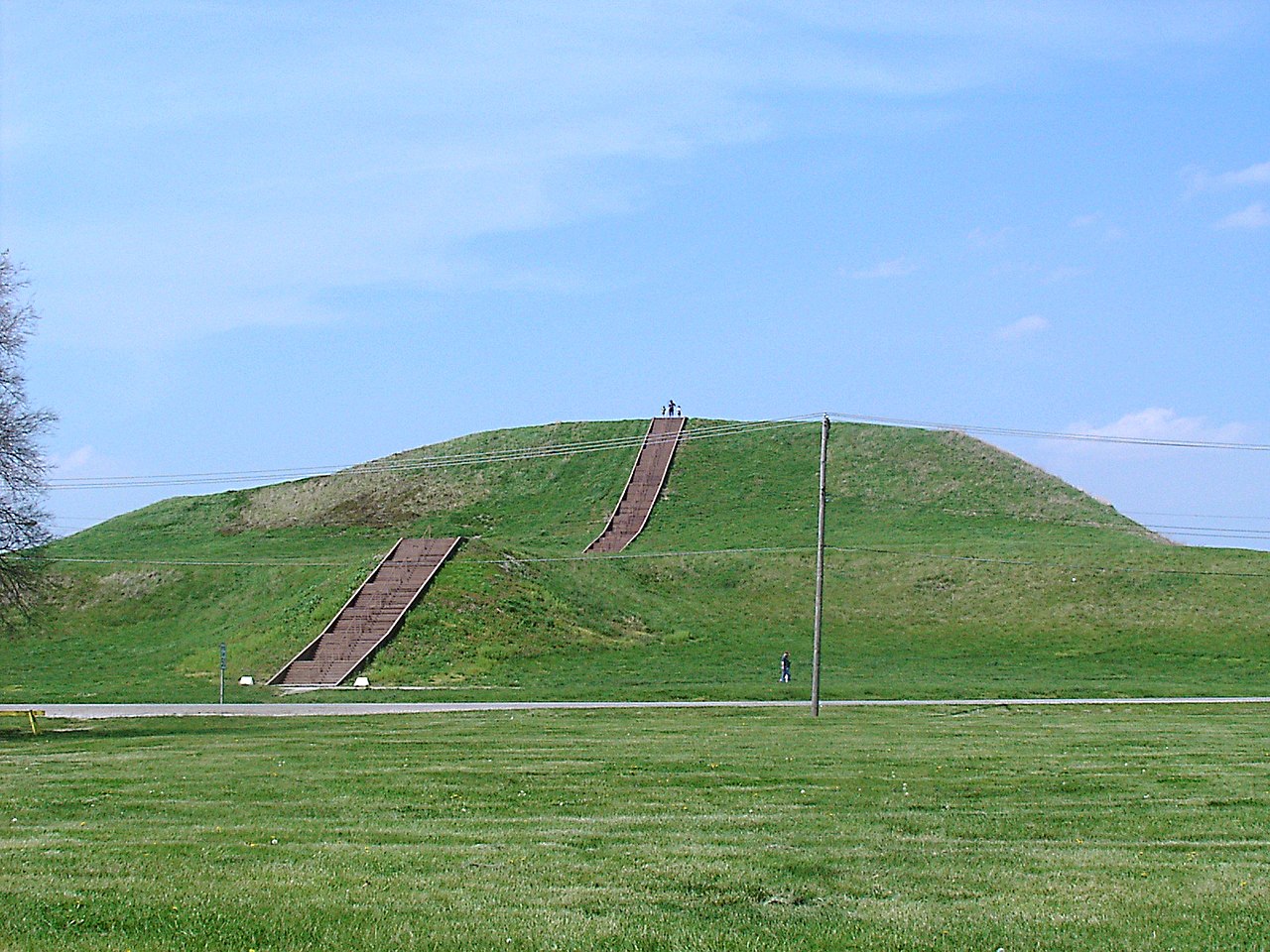
Mound BuildersThe varying cultures collectively called Mound Builders were inhabitants of North America who, during a 5,000-year period, constructed various styles of earthen mounds for religious and ceremonial, burial, and elite residential purposes. These included the Pre-Columbian cultures of the Archaic period; Woodland period (Adena and Hopewell cultures); and Mississippian period; dating from roughly 3500 BCE to the 16th century CE, and living in regions of the Great Lakes, the Ohio River Valley, and the Mississippi River valley and its tributary waters. Beginning with the construction of Watson Brake about 3500 BCE in present-day Louisiana, nomadic indigenous peoples started building earthwork mounds in North America nearly 1,000 years before the pyramids were constructed in Egypt.None of this is evident in Aquila in the New World, but it's fundamental. Great mound-building civilizations dominated America during the Roman era, but Somtow somehow missed it.


South of the border

The one thing Somtow almost got right is having the Olmecs--not the Aztecs, as one reviewer said--rule in Mexico. Actually, the Olmec civilization had collapsed and the Classic Maya civilization had yet to rise in AD 100, but close enough. With a little help, the Olmecs might've lasted longer.

** spoiler alert **

The Olmecs have more inventions than the Romans, including hot-air balloons, elevators, and loudspeakers. Unfortunately, it's not because they're cleverer than the Romans. Rather, an alien in the form of a were-jaguar, a revered Olmec figure, gave the Indians these gifts.

I don't know if Somtow intended this, but he basically replicated the "ancient astronauts" theory of Erich von Däniken. Namely, that non-European civilizations arose only because aliens disguised as gods gave them knowledge and technology. That they weren't smart enough to build pyramids and other monumental structures on their own.

True, the aliens also helped the Romans, but to a much lesser degree. Yet the Romans have conquered half the world, while the Olmecs are still in Mexico. The implication is that the Romans were smart enough to use their gifts properly, while the Olmecs squandered them on a despotic kingdom ruled by superstition and sacrifice. In short, the Europeans were rational and the Indians weren't.

Conclusion

Aquila in the New World has more Native problems, but these are some of the main points. It's not badly written if you go paragraph by paragraph. But its historical aspects are flawed and its "satire" fails as much as it succeeds.

Most of all, its premise--a mishmash of concepts embodied in the phrase "flying saucers, Sasquatch, time-traveling aliens"--is unbelievable and uninteresting. It's like a child's version of science fiction--like something you'd read in a bad comic book. Like Superman goes back in time and the ignorant savages worship him as a god--that kind of bad.

I expected more than this. If you're going to give us an alternate history, I expect some semblance of accuracy. If the South won the Civil War or the British Empire never fell, tell us how and make it plausible.

All in all, I'd recommend skipping this book. Rob's rating: 6.5 of 10.

January 12, 2014

Native stereotypes in Life of Brian

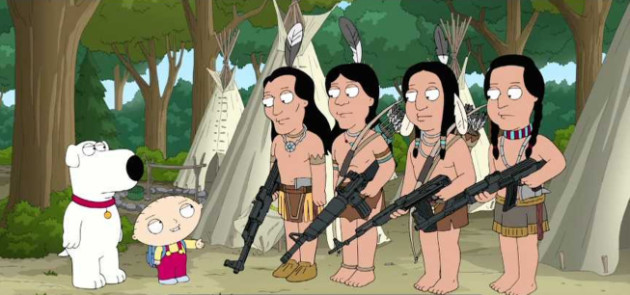
Perhaps because of Thanksgiving, a recent episode of Family Guy had a long introductory sequence about Indians:

Life of Brian (Family Guy)"Life of Brian" is the sixth episode of the twelfth season and the 216th overall episode of the animated comedy series Family Guy. It aired on Fox in the United States and Canada on November 24, 2013, and is written by Alex Carter and directed by Joseph Lee.

The episode revolves around the death of Brian Griffin, after being struck by a car, and the family coping with the loss by adopting a replacement dog, Vinny. However, Brian returned, two episodes later, in "Christmas Guy," after Stewie goes back in time to save him.

Plot

Stewie and Brian flee a band of hostile Native Americans in a Jeep. Brian explains that on a trip to Jamestown in the past, Stewie gave the Native Americans guns which were used to wipe out the Europeans, leaving the Native Americans in charge of America. Stewie finds his return pad destroyed by bullets and decides to find the alternate timeline Stewie for help. Going to the equivalent of their house, they find a new time machine and pad and return to Jamestown to set things right. As soon as their original counterparts leave, they take back the guns and return to the proper time.
You can see brief excerpts from the opening sequence below:


Changing America's history is a time-honored science-fiction theme, but this sequence was full of racist stereotypes. Among the most offensive were:

  • Half-naked Native warriors chasing Stewie and Brian. Really, in a modern city, the soldiers would be wearing loincloths?

  • A Native "doctor" dressed like a witch doctor whose idea of "medicine" is standing in awkward poses. Presumably this was a commentary on Native healing rituals.

  • A Native radio station whose no. 1 hit song for many weeks in a row is a dull, repetitive chant.

  • When Stewie and Brian return to Jamestown to take back the guns, the show tries to subvert some stereotypes. For instance, the Indians only pretend to talk like Tonto to take advantage of the strangers.

    As you can see below, the Indians' skin, hair, and clothing isn't too bad. But tipis in the Jamestown area? Even when Family Guy is trying, it still gets things wrong.


    Racism to be expected?

    As I wrote on Facebook:

    Finally watching the "Death of Brian" episode of Family Guy. I didn't know it began with a five-minute racist "satire" of Indians.

    Some people commented on this:Isn't it always a "satire"?

    Did you not see the Casino episode and you're shocked? lol I've not watched it yet but thanks for the heads up.
    I think I've seen all the Family Guy episodes. Including the one where Peter claims to be Native for some casino-related reason.

    True, that episode had a lot of stereotypes, but I'm not sure it was nonstop stereotypes. I think it made some valid points about how others view Indians stereotypically.

    This sequence seemed more like pure racist stereotyping. And Family Guy seems to have cranked up its racism and sexism quotient. It seems like half the "jokes" now involve some groups' perceived shortcomings.

    For more on the subject, see Indians in Family Guy.

    September 14, 2013

    Native technology in alternate history

    Musing about Native SteampunkA functional alternate history that has the kind of tech seen in steampunk can’t have just started one day in the 19th century. If you’re going to alter your universe, why stick with our existent timeline right up to the last second?

    What if NDN folks had, say, knowledge of vaccination? Or what if we’d had a greater number of domesticable animals and thus developed a wider profile of immunities to the kinds of communicable diseases common to Europeans? What if we’d developed advanced cross-national communications systems for the sharing of technological breakthroughs before European contact happened?

    NDN technologies have historically tended to be green and sustainable - not because NDN folks are ~magically spiritually attached to Mother Earth~ but because NDN cultures tend to value foresight and cycles, considering generational consequences of technological adoption and understanding of systems over flat utilization of resources. There’s an existent, historical emphasis on biotech (do you enjoy potatoes, tomatoes, or corn? (YOU ENJOY CORN, DO NOT LIE.) Thank NDN folks for making these plants exist, because without human intervention you’d have nightshade, nightshade, and teosinte.) I like to imagine technological development of American nations sans European contact or with non-oppressive European contact as following biotech lines and resulting in super-powerful herbal medicines, biomimcry in architecture and materials development, mycoculture and mycoplastics, and use of solar steam power. I explore NDN science extensively because I am sick and tired of the myth that prior to European contact NDNs were a stagnant neolithic monoculture. To quote Elizabeth Lameman (speaking here about her film “The Path Without End”):"We often limit ourselves and discredit our ancestors by thinking they didn’t possibly have the technology to travel when in fact they did have canoes and other forms of ships. To me, this is how we represent ourselves in steampunk, which is otherwise a very colonialist genre that stems from the Victorian mindset. We do and did have technology, but since we use(d) biodegradable materials, and thus “evidence” has faded with nature, we are told by the dominate culture that we were savage with no technology."
    Comment:  For more on Native steampunk, see So Long Been Dreaming and Developing Native Steampunk.

    July 27, 2013

    Review of A Blackfeet Encounter

    I watched the documentary A Blackfeet Encounter a couple of years ago. It tells the story of this encounter:

    Jul 27, 1806: Meriwether Lewis shoots Blackfoot IndianAttempting to stop a band of young Blackfoot Indians from stealing his horses, Meriwether Lewis shoots an Indian in the stomach.

    The voyage of Meriwether Lewis and William Clark to explore the West began in May 1804 when the two captains and 27 men headed up the Missouri River. They reached the Pacific Ocean the following year, and on March 23, 1806, began the return journey. After crossing the worst section of the Rocky Mountains, the expedition split up. Clark took most of the men and explored the Yellowstone River country to the south. Lewis, with nine men, headed west to the Great Falls of the Missouri River where he split the small party still further. Six men remained behind to make the portage around the Great Falls. Lewis took the remaining three and headed north to explore the Marias River country of present-day northwestern Montana.

    It was a risky, perhaps even irresponsible, decision. Lewis knew the Marias River country was the home of the Blackfoot Indians, one of the fiercest tribes of the Great Plains. Lewis hoped he could meet peacefully with the Blackfoot and encourage their cooperation with the United States. Yet, if they met a hostile Blackfoot band and a fight began, the four explorers would be badly outnumbered.

    On July 26, Lewis encountered a party of eight young Blackfoot braves. At first, the meeting went well, and the Indians seemed pleased with Lewis' gifts of a medal, flag, and handkerchief. Lulled into a false sense of security, Lewis invited the Indians to camp with them. In the early morning of this day in 1806, Lewis awoke to the shouts of one his men--the Indians were attempting to steal their rifles and horses.

    Lewis sped after two Indians who were running off with several of the horses, calling out for them to stop or he would shoot. One Indian, armed with an old British musket, turned toward Lewis. Apparently fearing that the Indian was about to shoot, Lewis fired first and hit him in the stomach. The Indians retreated, and the men quickly gathered their horses. Lewis then learned that one of his men had also fatally stabbed another of the Blackfoot.

    Fearing the survivors would soon return with reinforcements, Lewis and his men immediately broke camp. They rode south quickly and managed to escape any retribution from the Blackfoot. Lewis' diplomatic mission, however, had turned into a debacle. By killing at least one Indian, and probably two, Lewis had guaranteed that the already hostile Blackfoot would be unlikely to deal peacefully with Americans in the future.
    Background on the conflict

    Blackfeet IndiansFifty years before Lewis and Clark, the Blackfeet Indians had a reputation of being hospitable to Europeans, who occasionally even wintered with the tribe. By 1806, however, the world inhabited by the Blackfeet in present-day northern Montana had grown increasingly complex.

    The Blackfeet were regular commerce partners with Canadian-based British merchants, and in their frequent visits to trading posts, the Indians exchanged wolf and beaver pelts for guns, ammunition and alcohol. This relationship had lasted more than 20 years, and during that time, the Blackfeet–armed with guns–had been able to dominate their Nez Perce and Shoshone rivals.

    Eight Blackfeet warriors encountered Meriwether Lewis and a party of the Corps of Discovery in July 1806. After their initial fears of the armed strangers had subsided, the Indians decided to camp with the Americans. During this first day and night, Lewis explained the United States’ intent to bring about a comprehensive peace between all the Indian tribes of the west. He went on to add that the Shoshones and Nez Perces–mortal enemies of the Blackfeet–had already agreed to this peace, and would be receiving guns and supplies because of it.

    To the Blackfeet, American plans represented a direct threat. As far as the Indians were concerned, giving guns to their adversaries only could result in a weakening of Blackfeet power. That night, the Blackfeet attempted to steal the expedition’s guns. Their plans went awry, and in the chaos that ensued, Lewis and Reuben Field each killed a Blackfeet warrior. The incident marked the first act of bloodshed between the western Indians and representatives of the United States.

    The surviving Blackfeet returned to their tribe, and communicated what they had learned of America’s goals for the region. From that point forward, the Blackfeet regarded the Americans with hostility, and acted toward them similarly. Ironically, in the years that followed, Blackfeet war parties would be responsible for the deaths of three former members of the Corps of Discovery.


    Warriors or boys?

    A recent article spins the story a little differently:

    Untelling the Big Lie: The Murder of Two Blackfeet by Lewis & Clark PartyAccounts of what happened leading up to the shooting vary depending on who you ask, but the result was the same. When Captain Meriwether Lewis shot a Blackfoot Indian on July 27, 1806, and one of his group killed another, the Blackfeet didn’t trust whites anymore.

    In fact, the Blackfeet closed off their territory to whites for the next 80 years.

    “Lewis and Clark came from a culture based on war and encountered a very peaceful people,” tribal elder G.G. Kipp told the Blackfeet Community College Native American Scholars Program, according to a story that appeared in the Great Falls Tribune in 2003. “But they wrote the history books saying we were brutal and warlike so they could justify what they did to us.”

    Kipp is right, most accounts you find of the story of Lewis shooting a Blackfoot Indian paint Lewis & Clark as intrepid explorers and the Blackfoot as fierce and hostile. History.com even calls Lewis’s decision to explore Marias River country, the home of the Blackfoot Indians at the time, a “risky, perhaps even irresponsible decision.”

    Lewis and his party of three explorers encountered a group of eight young Blackfoot on July 26 and at first, the meeting went well. Lewis was hoping he could convince the Blackfoot to cooperate with the United States. Here is one place the accounts differ. Most places say the eight Blackfoot were “braves” or “warriors,” but Blackfeet oral histories say they were young boys from the Skunk Band.

    “They stayed with them and gambled with them,” he said. “There is a story of a race. In the morning, they went to part company and the Indians took what they had won.

    “That was it,” Kipp told the Great Falls Tribune. “That’s when they were killed.”
    Here's the source for Kipp's comments:

    "Blackfeet recollections differ from those recorded in Lewis' journal"

    My thoughts

    As I recall, the documentary portrays the Blackfeet as teenagers or young men. They were basically gallivanting about, as young men are wont to do.

    I don't recall mention of gambling or a race. I think the Indians merely wanted the guns. I don't know if they would've acted if Lewis hadn't talked about ending the Blackfeet's advantage by giving everyone guns.

    When the Indians fled, I believe one took a shot at Lewis that whizzed by his ear. Lewis fired back and killed him.

    Interesting to think what would've happened if the Indian had killed Lewis. Without Lewis's leadership, the expedition might've failed. If the expedition didn't report back, the US might've left the Indians alone for another decade or two. That might've given them enough time to build up their defenses to resist encroachment.

    Anyway, A Blackfeet Encounter does a fine job of recreating the incident and putting it in context. The documentary is split roughly into four parts: America's history leading up to Lewis and Clark, the expedition and the incident, the eventual defeat of the Indians, and the Blackfeet's survival as a modern-day people. You couldn't ask for more.

    You can watch the whole documentary here:

    A Blackfeet Encounter

    Comment:  For more on Lewis and Clark, see Manifest Destiny Comic Book and Jefferson's Indian Removal Policy.

    February 04, 2013

    Are Southern death camps plausible?

    I wrote about Harry Turtledove's SF series in which the South won the Civil War in Indians in Turtledove's Timeline-191. Now I've reached the end of the series.

    In the last few books, the US/Confederate history closely parallels our actual history with Germany. The USA defeats the CSA in the "Great War" and imposes harsh conditions. The Depression ensues a decade later. Seething with resentment, the South rises under Jake Featherston, a Hitler-like Army sergeant. It launches a war against the USA while sending its Negroes to Auschwitz-like death camps.

    It's far-fetched that this timeline would parallel our timeline so closely. Especially some 80 years after the divergence began--when you'd expect things to diverge more, not less.

    But I didn't find the details--the demagogic leader and the death camps--far-fetched. I believe something like this could've happened in reality if we hadn't been vigilant.

    War of words

    A couple of Facebook friends disagreed with my assessment, leading to a debate. It began with this tweet of mine:

    Reading Turtledove's "Southern Victory" series. The South wins the Civil War and eventually consigns blacks to death camps. Plausible?No. He's trying too hard to replicate Nazism and WW2.Did you actually read it through to the final book? I thought you didn't like the series that much.

    I agree that the Nazi parallels are a little heavy-handed, but we're talking about two things. 1) The literary merits of the Nazi parallelism, and 2) the real-world possibility of the South's emulating the Nazi example. I'd say the second point is all too plausible.Turtledove was an Ottoman historian. He does about as well as I'd do writing Ottoman history. For starters, political parties were banned by the CSA constitution. There were never any free elections. It was always an elite oligarchy, closer to a military/plantation owner dictatorship.Well, I don't remember the first few books in this very long series. Turtledove could've changed the CSA constitution somewhere along the line in his alternate history.

    If the South was an an elite oligarchy, I'd say that would make the death-camp scenario more likely, not less. I still haven't heard anything that makes the scenario implausible.Why would a South that, as outlined in the novels, was completely and utterly dependent on black labor start killing off that supply? Even the Nazis put groups other than Jews in work camps (where they were often worked to death). I don't see anything in Southern history that would indicate a predilection to anything like the Holocaust. A victorious CSA would almost certainly be a brutal, repressive dictatorship (and in many ways, it was from the end of Reconstruction until the 1960's) but there's a huge difference between that and a full-on genocidal massacre.Because cheap labor is readily available from the CSA's Mexican states? Because the USA and CSA developed automated farming machinery faster in this timeline? (Tanks in the Great War--i.e., World War I--being an example of the accelerated technology.)

    I haven't been paying enough attention to say the books treated the labor issue well, but they definitely did address it. Turtledove didn't just ignore the issue.

    Featherston's role is key

    And the genocidal massacre happened because a Hitler-like demagogue made it happen. Not because it's a natural outgrowth of the South's racist history.

    So you're saying a Hitler-like demagogue couldn't make Southerners turn against blacks because, what, Southerners are more decent and rational than the Germans under Hitler were? Sorry, I'm not buying that the Germans were uniquely "bad" and the same thing couldn't happen here.I just don't see any historical evidence to support the notion. For example, there were PLENTY of slave revolts, often very bloody. No one suggested exterminating all slaves or shipping them back to Africa. Germany had a LONG history of bloody anti-Semitism. Jews had been massacred for centuries in Europe and the Near East (by the Crusaders) for centuries. The Holocaust didn't just appear out of thin air, with no history behind it. The South would be highly highly dependent on slaves, especially in a scenario where they are desperately trying to industrialize in order to maintain the war effort. There's no plausible reason for a culture that lacked the traditional German deference to authority to suddenly decide to go along with eliminating their labor base, Mexican conscripts or no Mexican conscripts.In the books, the CSA ended slavery sometime after the Civil War. By the 1940s, the system was an apartheid-like version of Jim Crow repression, but not slavery.

    The South had a long history of brutal repression and bloody slave revolts. True, these things didn't go back to the Middle Ages, but they did go back a couple of centuries. I think that's long enough to embed a genocidal mania in the South's culture.

    Besides, Euro-Americans had a history of demonizing brown-skinned people (Indians) as pagans and devil-worshippers going back to 1492. That's the same idea as the German demonization of Jews or the English demonization of the Irish. So there's no great difference between the two European-based cultures.

    "No one suggested exterminating all slaves or shipping them back to Africa." Yes, because they were productive "property" at the time. And because a monstrous demagogue like Hitler or Jake Featherston hadn't come along. But once Hitler gave us a historical template, the idea became conceivable everywhere.

    The South didn't have the "traditional German deference to authority"? But Al characterized the Southern culture as "an elite oligarchy, closer to a military/plantation owner dictatorship." That sounds like exactly the kind of culture that would defer to a small ruling class and finally to a single demagogue.

    The Trail of Tears started in the American South. The genocidal actions continued in the American West. If these subcultures didn't have a traditional deference to authority, then this deference wasn't necessary to trigger a racial purge. In short, it happened here once so it could happen here again.

    Hitler got the Holocaust idea from past genocides, including that of the American Indian. The Southerners in Turtledove's books would've had these examples to inspire them. Heck, some of them undoubtedly participated in the near-extermination of Indians. So putting blacks in rez-like concentration camps doesn't seem far-fetched to me at all.

    Genocide there but not here?

    So you are arguing that Germany had unique traits that made genocide possible there but not here? Even though we committed similar acts of genocide that gave Hitler his inspiration for the Holocaust? Sorry, I'm still not buying it.

    Did Armenia, Cambodia, and Rwanda happen to have the same mix of cultural traits as Nazi Germany? Something the American South lacked even though it launched the Trail of Tears? That seems implausible if not impossible. So again, no sale.No, Germany wasn't unique clearly, but there were cultural conditions that contributed to it. To pretend otherwise is to ignore history. The Trail of Tears was ethnic cleaning, not extermination. Hitler did not, in fact, get the idea for the Holocaust from Native American history; he got the idea for treating Eastern Europe (driving people off their land).

    Also, in the books the South ends slavery after another war with the US in 1881. And it's done in a very unsatisfying magic wand kind of way, mostly off camera.
    Hitler referred to America and its Indians in Mein Kampf. At least one historian quoted him writing, "Neither Spain nor Britain should be models of the German expansion, but the Nordics of North America, who had ruthlessly pushed aside an inferior race to win for themselves soil and territory for the future." Stannard offers this quote:Hitler’s concept of concentration camps as well as the practicality of genocide owed much, so he claimed, to his studies of English and United States history. He admired the camps for Boer prisoners in South Africa and for the Indians in the wild west; and often praised to his inner circle the efficiency of America’s extermination--by starvation and uneven combat--of the red savages who could not be tamed by captivity.

    --P. 202, Adolph Hitler by John Toland
    I'm not sure how much of an inspiration the American model was, but it was more than zero, since Hitler was aware of it and wrote about it.

    So the South had enough of a genocidal culture to send Indians marching off through the snow to their probable deaths? But not to send them to concentration camps where only the guards knew what was really happening? The difference seems minor and inconsequential to me.

    As you know, Americans attacked and killed Indians many times. It was a fundamental part of their worldview to eliminate the brown-skinned menace one way or another. It didn't require any deference to authority; Americans from all walks of life shared this goal.

    Sending blacks to concentration camps similar to reservations is consistent with that. And again, only the South's leaders knew for sure what was happening. Which is consistent with the German model. The books do not require a genocidal rage on the part of every Southerner to work. They require only the Nazi-like command structure that Jake Featherston provided.

    Besides, this is speculative fiction, so the case doesn't have to be airtight to be plausible. I think it's close enough to airtight that it hasn't bothered me. If we can give Star Trek and Doctor Who a pass, we can give this a pass too.

    Conclusion

    Like many critics, I've compared the American Holocaust to the Nazi Holocaust many times. I've also said this genocidal urge is still present in the American mindset. Invading Muslim countries, killing foreigners with drones, ignoring hunger and disease around the world, letting minorities suffer and die without government assistance, hoarding guns to protect us from "them"...all part of the same impulse.

    Heck, we sent Japanese Americans to concentration camps in the same time frame as Featherston's purge. It's absolutely part of our DNA to "reduce the population," as Featherston put it, of troublesome minorities. All it would take is a Hitler-style demagogue to convert Bosque Redondo, Manzanar, or Guantanamo Bay into another Auschwitz.

    P.S. I don't think I read the book in which the South ended slavery. I'm not claiming the whole series is 100% plausible, since I haven't read every book. But I am claiming the Nazi-style ending is plausible--plausible enough to enjoy the ride.

    For more on alternate histories, see Saving Columbus in Infinity Ring and The Pirate Prince Carlomagno.
    August 14, 2012

    Saving Columbus in Infinity Ring

    Debbie Reese writes about a new children's adventure series in her American Indians in Children's Literature blog (8/11/12).

    The premise is simple:History is broken, and three kids must travel back in time to set it right!Reese discusses A Mutiny in Time, the first book in the series:

    The premise for Scholastic's INFINITY RINGHistory, the kids learn, "has gone disastrously off course" because Christopher Columbus was thrown overboard in a mutiny.

    Wait, wait, wait... Off course for who?!

    I guess, in this story, the entire world is a wreck because Columbus did NOT "discover" America. I wonder what this "undiscovered-by-Columbus" America looks like?! Who is making a wreck of what? Who are the "bad guys" Elizabeth refers to?!

    Well.

    Scholastic sent out some advanced reader copies (arcs) and by reading reviews at Goodreads, I gleaned a bit more info.

    Because Columbus didn't "discover America" all sorts of natural disasters are occurring because someone else--"the Amancio brothers"--have done the discovering. I guess they are to blame for the natural disasters. I wonder what the disasters are?
    Comment:  The alternative world without Columbus sounds implausible. What kind of natural disasters could be worse than what we already have: global warming, arctic ice melting, desertification, loss of biodiversity, deforestation, the Indian Ocean earthquake, Hurricane Katrina, etc.? If this world does have worse disasters, how did Columbus's actions 500 years earlier prevent them?

    Reese doesn't note it, but the Amancio brothers are the crew members who lead the mutiny against Columbus. So we're talking about the same people "discovering" America and returning to the same kingdom to report it. That sounds like Magellan's ship completing the circumnavigation of the world without Magellan. Losing a ship's captain wouldn't change the course of history overall.

    Or perhaps the mutineers didn't return and America went "undiscovered" for a few years. No matter. The reality is that if Columbus hadn't bumbled into America, someone else would've done it soon. Most likely Indians would've suffered a similar fate no matter who came first.

    But considering how lucky Cortés's conquest of the Aztecs was, it's possible the outcome would've been better. Any delay would've given the great Indian empires more time to prepare.

    The outcome is unlikely to have been much worse. How much worse could it get than the extermination of tens of millions of people?

    Let genocide proceed?

    The notion of rescuing Columbus is akin to that of rescuing Hitler or Stalin. It should lead to a serious philosophical discussion. Who decides that the present world is better than the alternative? Why should Indians have to die so that Europeans can live? Since the Europeans profited by conquest, slavery, and genocide, why should anyone give them another chance?

    I'm guessing A Mutiny in Time avoids all these questions. The no-Columbus world probably experiences floods, hurricanes, volcanoes, and earthquakes for no discernible reason. The author has to invent an over-the-top scenario to justify rescuing Columbus without hesitation. Otherwise, he'd have to address the morality of letting the genocide happen.

    Heck, if you're going with a ridiculous outcome, why not vampires, zombies, or an alien invasion? Because the Spanish didn't destroy a Maya temple, perhaps a high priest signaled to the "ancient astronauts" to return to Earth. So the lizard people conquered humanity because Columbus died.

    That's about as likely as natural disasters in 2012 prevented by Columbus in 1492.

    The publisher has prepared a study guide for A Mutiny in Time:

    Discussion Guide Infinity Ring: A Mutiny in Time

    Not surprisingly, it doesn't say anything about Indians or genocide. It doesn't ask readers to think about whether Columbus was good or evil. Whether the world would've been better without him.

    Instead it ignores the issues Reese and I have raised. Which undoubtedly means that A Mutiny in Time is part of the pro-Columbus propaganda we've endured so long. The march of (Western) civilization was right and just and godly, we're told, so there's no reason to question it. That the Indians had to die was an unfortunate historical footnote.

    For more on alternative history, see The Pirate Prince Carlomagno and Tables Turned in Assimilation.

    March 20, 2011

    The Pirate Prince Carlomagno

    We learned what happened to King Philip's son in Roger Williams, Slave Trader and King Philip's War in After the Mayflower. Here's a press release about a novel that imagines a different outcome:

    Wampum Books announces the release of The Pirate Prince Carlomagno, a Native American Pirate Adventure brought to life by award-winning journalist and author John Christian Hopkins.

    Native American Author Brings New Twist to Pirate Adventure“Metacom meets Errol Flynn! John Christian Hopkins is one of the most important indigenous writers from New England today, and here he covers the region’s painful, complex history with insight and swashbuckling originality.”

    Siobahn Senier, English Professor, University of New Hampshire
    In an exciting, action-filled adventure, author John Christian Hopkins spins a historic tale of a young American Indian boy who is captured, marked for death and eventually sold into slavery in the Caribbean.

    The Pirate Prince Carlomagno is the story of what may have happened to the actual historical figure, the son of King Philip or Metacomet of the Wampanoag tribe. The fate of the great chief’s son is lost to history, but in Hopkins’ version, the enslaved child yearns for freedom and a chance to return to his beloved New England home. With his choices limited, and enemies all around him, the young man becomes the legendary Carlomagno, fiercest of the Caribbean pirates. Immersed in action, adventure and political intrigue, and opposed by ruthless mercenary Chevalier de Fortenay, Carlomagno struggles to remain true to his Native heart as he relies on his mighty sword arm to keep his freedom. But his biggest challenge turns out to be the mysterious Anasarani.
    Comment:  For more on the subject, see King Philip Chainsaw Sculpture and Preview of Ink--A Tale of Captivity.

    December 02, 2010

    Tables turned in Assimilation

    Flipping the script:  "Assimilation"

    By Dawnell SmithIf Jack Dalton’s work in “Time Immemorial” proved the power of humor, perspective and nuance, his latest play, “Assimilation,” reveals theater as a tool of blunt force. Though not flawless or easy on the heart, the script uses a fictional future to tackle a great deal of historic material, from the Great Death in villages throughout Alaska in the 20th century to the loss of dignity when white people used school, religion and physical punishment to beat the language, traditions, ancestry and even a sense of place out of Native people.

    The play’s simple strategy of turning the tables on Alaska history creates a disturbing catharsis; here, white boys suffer the brutality of a cruel Native headmaster called “Elder.” I’m no psychologist, but the set-up seems to allow anger and shame to turn the tables as well. Through this storyline, the play asserts the necessity of empathy and apology to forgiveness.
    Comment:  Sounds like the movie White Man's Burden (1995) starring John Travolta and Harry Belafonte. Alas, that movie showed that simply flipping the races isn't enough to convey a compelling message:The premise is interesting, but the execution fails to live up to any of its potential. White Man's Burden imagines an America where black people are the ruling class and whites are underprivileged minorities. John Travolta stars as a factory worker who is fired after making a delivery to the house of the factory owner (Harry Belafonte) and accidentally peeping the man's naked wife through a window. Now jobless and unable to support his family, his wife (Kelly Lynch) leaves him. In desperation he kidnaps Belafonte. The best part of the film is seeing African American actors filling the smaller, background roles that usually go to white actors (such as police officers and wealthy suburbanites), but the movie fails in its poorly thought-out ideas.Comment:  For more examples of race-flipping scenarios, see What If Indians Conquered Europe? and "What If" Stories About Indians.

    October 10, 2010

    What if Indians conquered Europe?

    The Invasion of Europe

    By Zoltan GrossmanIt was 500 years ago that Callicoatl sailed across the ocean with three Aztec boats, and found a new continent, a new Eastern Hemisphere. The commemoration of this event is being marked with great fanfare and celebration. Every child has been taught the story: how Callicoatl convinced Montezuma II to support his journey, how the Aztec sailors nearly despaired on the journey, and how they "discovered" a strange white-skinned race in the "New World." But that is only part of the story. It is important that in this, the 500th anniversary of Callicoat's voyage, the record be set straight.What happened during this invasion:In the Pre-Callicoatlian era, great empires were ruled by the Greeks, the Romans, the Egyptians, the Moors, and many other indigenous peoples of the Eastern Hemisphere. They contributed much to the world, as attested to by the great temples and pyramids they left behind. They had detailed knowledge of astronomy, law, agriculture, and religion. True, there were wars among these peoples, and persecution of those who did not follow the state religion. But they were no more oppressive than the empires of Montezuma II or the Inca Tupac Yupanki in the "Old World" 500 years ago. And, like in the Western Hemisphere, there were many peoples still living in harmony with the land, here in our hemisphere.

    There were many other explorers who sailed to these shores, and even some who claimed to have arrived before Callicoatl--the Arawak, the Beothuk, and the Lenni-Lenape. But it was the Aztec flag of Anauak and the Inca flag of Tawantinsuyo that were first firmly planted on our soil. Soon after Callicoatl arrived, this land was named Omequauh after another Aztec-sponsored explorer. The Aztecs and Incas conquered and divided up South and Central Omequauh--the lands we call Africa, Iberia, and the islands of the Mediterranean Sea. Later, the Dakota and Ojibwe fought over and divided North Omequauh, my home continent, which we call "Europe."

    Some great "European" leaders pulled together alliances of knights to resist the settlers, but our freedom fighters were never unified enough to prevail. Some of our Native peoples--among them the Irish, Corsicans, and Sardinians--were wiped out, their cultures lost to history.

    You may know us as "Native Omequauhns," but we prefer to be called the "Original Europeans," or the "First Nations." We are not one people but many peoples, following different customs. We speak many tongues, which you may call "dialects," but we prefer to equate with your languages. We worship under different religions that were outlawed until recently, and are ridiculed to this day as mere superstition. The religion of my ancestors was known as "Christianity," and there are some of us who even today pray to a single god and his son.

    Though we are commonly called "tribes," we have historically existed as nations, with our own borders, provinces, and capitals. The capital of my ancestors, London, was as great in its time as Cuzco or Tenochtitlan, until it was sacked by the invaders. My people, the York band of the English tribe, were once citizens of Yorkshire county (or province) in the English Nation (or "England"). Many of our peoples are not even called by their original names, but by derogatory names that others have given them. The Krauts, for instance, are more properly called the "Germans," or Deutsche in their own language. Similarly, the Frogs should be called the "French," or Français in their own tongue.
    Now, in the modern era:The rebirth of our European cultures has also stimulated interest on the part of mainstream non-European society. Nowadays, some children playing "Warriors and Knights" actually want to be the knights. While this trend is welcome, we also find non-Europeans romanticizing our cultures, and trying to usurp them in the same way they usurped our land. We loathe seeing non-Europeans dressing up like our own priests, and conducting the sacred catechism ceremony, for the benefit of their own curiosity. We don't appreciate seeing ethnic Dakota wearing powdered wigs, or putting on ballroom dances. And we roll our eyes whenever one of these 'wannabes' says that their great-grandmother was a Swedish princess.

    There was a time when our land would be stolen and our people divided and relocated, with only a passive response. But no more. The European Wars are being rekindled, as more nations are defending the lands our ancestors are buried under. Many remember the armed confrontations at the Long Fjord Norwegian Reservation about two decades ago, or at the Lake Balaton Hungarian Reservation two years ago. If our sovereignty is not recognized, these skirmishes are likely to continue.
    Comment:   This reminds me of the art exhibit described in The Museum of Amexican History and The Conquest of Amexica. That exhibit went into more depth about the immediate consequences after the conquest. This essay gives a broader sense of how the conquest would've unfolded over time. So they complement each other.

    A dubious scenario

    Of course, a reverse conquest couldn't have happened like this. To put it mildly, it wouldn't have been a mirror image of the actual conquest. Here's why not:

    1) Because of their disease-ridden livestock, crowded cities, and filthy personal habits, Europeans had much more exposure to disease. Which means they had much more immunity to disease also. Epidemics that wiped out 90% of the population probably wouldn't have swept through Europe.

    If Native conquerors had arrived during the Black Plague, they might've been able to accomplish something. Assuming the Plague didn't wipe them out too, that is. Indeed, this might be the only scenario in which the Indians had a chance.

    2) Even if Indians managed to cross the ocean first, the Europeans would've had metal and guns and the Indians wouldn't have. The conquest would've been a long slow process, not the lightning strikes of a Cortés or Pizarro.

    Again, disease might be one factor that could've leveled the playing field. The only other thing I can think of is some sort of religious miracle. If Jesus had appeared and ordered the Pope to surrender all of Christendom to the pagans, would that have worked? I doubt it, but maybe.

    3) Even if the conquest happened, Indians didn't have the same imperative to destroy other cultures and religions. I imagine a Native empire would've been like an Islamic empire: with an official religion and culture but with some tolerance for other religions and cultures.

    Europeans would've been integrated into Native society, perhaps forcibly, rather than isolated on reservations. The evidence for this is that actual Native societies often integrated non-Indians (blacks, whites) without hate-based discrimination.

    For more alternate histories, see Indians in Soy La Libertad and "What If" Stories About Indians. For more on the actual history involved, see Did Natives Discover Europe First?

    October 08, 2010

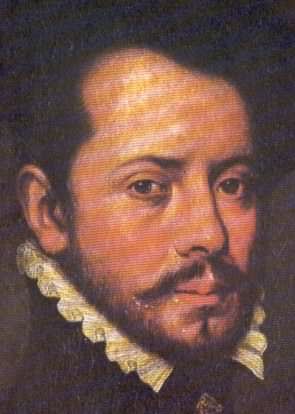
    Hernán Cortés lucked out

    I'm not sure what role disease played in Hernán Cortés's conquest of the Aztecs. I'm sure it weakened Mexico's Indian nations--destabilized their political and social institutions. Even though diseases quickly began killing Indians, they still outnumbered the Europeans by some huge margin--perhaps thousands to one.

    As I wrote in Was Native Defeat Inevitable?(Mexican Version), Cortés barely escaped with his life during the so-called Noche Triste:Upon his return in late June, Cortés realized the Mexica had elected a new Hueyi Tlatoani: Cuitláhuac. Shortly thereafter, the Mexica besieged the palace housing the Spaniards and Moctezuma. Cortés ordered Moctezuma to speak to his people from a palace balcony and persuade them to let the Spanish return to the coast in peace. Moctezuma was jeered and stones and darts were thrown at him. He fell with what was reported as a concussion. Moctezuma died a few days later; whether from his injuries or murdered by the Spaniards, it is not known.

    Under attack, with food and water in short supply, Cortés decided to break out of the city. Bridges on four of the eight causeways into the island city had been removed, so a portable bridge was devised. The gold and other booty stolen from the Mexica was packed; many of the Spaniards had looted as much gold as they could carry. Horses' hooves were muffled.

    On the night of June 30, 1520, his large army left their compound and headed west, toward the Tlacopan causeway. The causeway was apparently unguarded, and the Spaniards made their way out of their complex unnoticed, winding their way through the sleeping city. Before reaching the causeway, they were noticed by Mexica warriors, who sounded the alarm.

    The fighting was ferocious. As the Spaniards and allies reached the causeway, hundreds of canoes appeared in the waters alongside to harry the troops. The Spaniards and their native allies fought their way across the causeway in the rain, sometimes using the portable bridge to cover the gaps, although as the battle progressed some gaps had become so filled with wreckage and bodies that the fugitives were able to walk across. In some cases, the gold and equipment weighted down the conquistadores so much that they drowned.


    But a recent article notes the role of disease on this particular occasion:

    A germ of an idea

    Thirty-four years ago, William H. McNeill, AB’38, AM’39, shed new light on world history—by giving microbes their proper place in the human drama.

    By Robert Goodier
    "I read the story of Cortéz and couldn't believe it," McNeill says. The conventional story of how Tenochtitlan [modern-day Mexico City] fell to Hernán Cortéz and a small band of Spaniards in 1521 seemed to contradict common sense. At one point, the Aztecs had beaten the Spaniards back but did not press their advantage. "A considerable number of the Spanish were wounded in the retreat but there was no follow-up," McNeill says. "I couldn't figure out why the nephew of Montezuma, who organized the attack, didn't surround the Spaniards and bring them up to the top of that temple and cut their hearts out the next day. It's what should have happened."

    And yet, it didn't. Instead, the Spaniards conquered Mexico and converted millions of Aztecs to Christianity. "I was sort of mulling this over in my head," McNeill recalls, "and somebody casually remarked that smallpox had broken out in Mexico City the night of the noche triste"—the night of the Spaniards' retreat—"and Montezuma's nephew died of it that same night."
    Comment:  I'm not sure what this dead nephew refers to. Wikipedia reports the following:

    Moctezuma IIMoctezuma was then succeeded by his brother Cuitláhuac, who died shortly after during a smallpox epidemic. He was succeeded by his adolescent nephew, Cuauhtémoc.CuitláhuacAfter having ruled for just 80 days, Cuitlahuac died of smallpox that had been introduced to the New World by the Europeans.Since nephew Cuauhtémoc ruled until the empire fell, I don't know which nephew died on La Noche Triste. Wikipedia doesn't refer to any other nephew. But I think Moctezuma had many nephews, so I presume one was in position to take charge that night.

    Cortés lucked out when no arrow hit him during his escape. He also lucked out when smallpox broke out in Tenochtitlan that night. Not only did it kill Moctezuma's nephew, it undoubtedly wreaked havoc. The one time the Aztecs needed calm and order, they probably faced a panic-inducing crisis instead.

    Once Cortés escaped, he rested beyond the city. If the Aztecs had pursued him, they could've had him. But it seems they didn't have the necessary manpower or leadership. People were too busy dying to worry about Cortés.

    Conclusion

    We're talking about a turning point in world history here. If there hadn't been a smallpox outbreak that day, Cortés probably would've died. If the Cortés expedition had failed, the conquest of Mexico might've been postponed indefinitely. The epidemic hit Tenochtitlan on literally the worst possible day.

    Thus we see how capricious history is. A small change here or there could've led to a markedly different outcome. The Aztec empire might've fallen anyway, but some Native nations could've survived as small independent states. Tribes in the US and Canada remained independent a century or two after first contact, and that could've happened in Mexico too.

    For more on the subject, see Was Native Defeat Inevitable?

    September 06, 2010

    Indians in Turtledove's Timeline-191

    Timeline-191Timeline-191 is a fan name given to a series of Harry Turtledove alternate history novels, including How Few Remain as well as the Great War, American Empire, and Settling Accounts series. The name is derived from Robert E. Lee's Special Order 191, which detailed the Army of Northern Virginia's invasion of the Union in September 1862 during the American Civil War. The divergence occurs when Union forces do not find a copy of Special Order 191, on September 10, 1862. The novels detail the consequences of this until 1944 in the alternate world.Comment:  I've read How Few Remain and the American Empire trilogy. I plan to read the Settling Accounts books next.

    The biggest change for Indians comes after the US loses the "War of Secession." This happens before the Great War trilogy, which I haven't read. The Wikipedia entry seems to speculate what might've happened between books.

    1862–1881: American ChangesShortly after the conclusion of Camp Hill, Confederate general Braxton Bragg completes the conquest of Kentucky; sometime after the U.S. agreed to mediation, Kentucky becomes the twelfth state to enter the Confederacy. In addition, the pro-Confederate Five Civilized Tribes of the Indian Territory are given territory of their own in the C.S., later to become the State of Sequoyah. The Caribbean island of Cuba is subsequently purchased by the Confederate States from Spain in 1878, becoming the 14th Confederate State.And:The United States, probably in reaction to their defeat in the War of Secession, appears to have sped up the conquest and settlement of the Great Plains relative to our timeline. George Armstrong Custer and his brother Thomas Custer are still alive in 1881 because there were (presumably) no Sioux Indians around in 1876 to fight him at Little Bighorn. In reaction to the (historical) Sioux uprising of 1862, the Army conducts a war of extermination against them. Prior to the Great War, Dakota itself enters the Union as a single state, possibly either as a result of the swiftness with which the Army (necessarily larger than in this timeline because of the Confederate threat) pacifies the Dakota Territory and allows settlers to move in. (In our timeline the Dakota territory split because of an ongoing debate about the placement of the capital.)

    In addition, the USA may have had a significant and victorious Indian War prior to the Second Mexican War, suggesting that massive firepower and a national need for some kind of martial victory propelled the United States to a much quicker and clear-cut answer to their Native American question, namely the extermination or deportation of the Natives.
    US loses again

    The US also loses the Second Mexican War, with the following consequences:

    1881–1882: The Second War Between the States (Second Mexican War)In return for British and French assistance, Confederate President James Longstreet is obliged to propose the nominal manumission of the country's slaves, which proceeds throughout the 1880s.

    The defeated United States, realizing it needs powerful allies to counter the Confederate alliances with Britain and France, begins an alliance with the German Empire and adopts many of its military and economic practices.

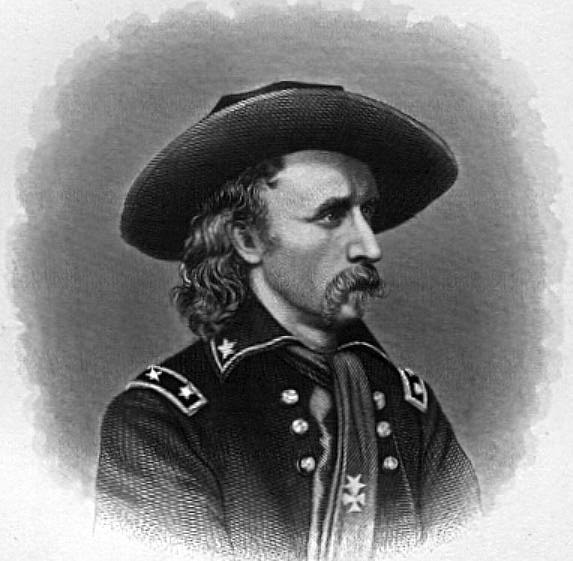
    One of the few victories for the United States in the war, a battle in the Montana Territory against the British, produces two U.S. heroes who will be rivals for the next forty years: Brigadier General George Armstrong Custer and Theodore Roosevelt, Colonel of the Unauthorized Regiment.

    Witnessing the collapse of the Republican Party, former President Abraham Lincoln, now an orator, allies with U.S. socialists and leads left-wing Republicans into their fledgling Socialist party. The Republicans soon begin a long descent into the general obscurity of becoming a solely Midwestern regional party, never again winning the presidency or a Congressional majority, losing around a third of its supporters to the Democrats, and all of its left-wingers (around one third) to the Socialists.
    Because of their two defeats, the United States commemorate Remembrance Day, have a Statue of Remembrance in New York's harbor, and name their first aircraft carrier the Remembrance. Other notable changes include the Socialist Party's success and the US occupation of Canada and Utah.

    In the Great War between the United States and the Confederate States, the US overruns and eventually wins the state of Sequoyah. The US considers Sequoyah a territory and doesn't admit it as a state.

    The CSA's defeat leads to the rise of the Freedom Party, a Nazi-like organization led by Jake Featherston. Featherston demands the return of CSA territory, including Sequoyah. In a 1941 plebiscite, Sequoyah is the only territory that votes to remain with the US. The explanation is that Sequoyah's white settlers outvoted the Indians, who would've preferred the CSA.

    Mixed results for Indians

    As always in alternate histories, it's fascinating to see what might've happened to the Indians.

    On the negative side, there's the whole extermination thing. But this scenario--that the US Army would've wiped out the Indians earlier and more easily--seems questionable to me. It's just as easy to imagine that the US would've been too weak, distracted, and demoralized to pursue the Indians. The US might've left them alone long enough to organize an effective resistance.

    On the positive side, the CSA created Sequoyah, a state primarily for Indians. And the US kept Sequoyah intact, even though it may have let whites overrun it. So the Indians did better in some cases and worse in others.

    The overall message of this and other alternate histories is that Native defeat wasn't inevitable. Most alternate histories posit that if the Euro-American powers had been more divided, the Indians would've done better. Instead of fighting a unified America, the Indians could've helped themselves during a series of internecine wars. While the Americans were killing each other, they could've established one or more Indian nations in the unsettled West.

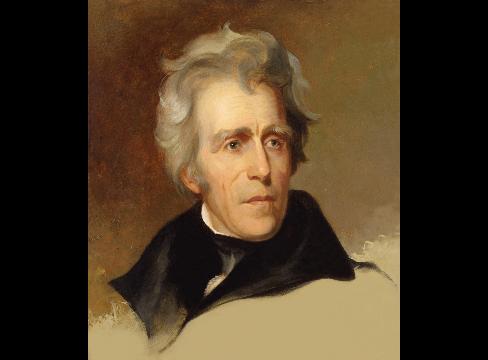
    A key point is how easily this timeline could've occurred. All it took was one piece of paper not falling into the wrong hands. In the real world, the Aztecs almost killed Cortés, the Founding Fathers almost created an Indian state, Andrew Jackson almost died in a duel, and Cherokee relocation won by only one vote in Congress. Native defeat was a lot less inevitable than most people realize.

    Rob's review

    As in many of his books, Turtledove builds Timeline-191 by shifting between a large cast of characters. We see the changed history through many eyes and slowly learn how it differs from our reality. Some critics say these books have too much characterization and not enough plot, but not me. I love the rich blend of history and fiction in these books.

    Turtledove's invented history seems totally plausible to me. There hasn't been one moment when I've said, "No, I don't believe that could've happened." When you consider that this series runs 11 books in all, it's a masterful achievement. If there's a longer alternate history with more basis in fact, I don't what it is.

    Rob's ratings for the books I've read:

    How Few Remain--8.5
    Blood and Iron--8.0
    The Center Cannot Hold--8.0
    The Victorious Opposition--8.0

    For more on the subject, see Indians in Turtledove's Worldwar and Was Native Defeat Inevitable?

    May 26, 2010

    The three anti-Indian amigos

    My posting about Custer's Last Stand and Ethnic Studies generated the following dialogue on Facebook:Custer got owned! Ha! Good riddance!

    I've had in the back of my mind to do a Custer comic, simply because he really was quite a spectacular asshole of an anti-hero.

    Him and that horrible guy who at Sand Creek...Chivington...Mr. "Nits-Make-Lice." Uff, the very name makes me squirm.

    Chivington!!! Grrrrr!!! He made me stay up all night drawing very very very angry pictures when I was a little girl, accidentally watched Soldier Blue. Man I was PISSED!!!
    Someone probably could do a good satirical comic book, video, or skit featuring Andrew Jackson, John Chivington, and Custer as the three anti-Indian amigos.*Chuckle*...jeezus, talk about Axis of Evil...Chivington probably changed his name from Smith or Jones so it would sound like knives being sharpened.

    In the novel Custer's Luck, Custer survives Little Bighorn, is elected president, and becomes a Kennedy-style leader. It's actually well-done and plausible, believe it or not.What we hear even less of than Wounded Knee and Little Big Horn is the Sand Creek Massacre. Chivington rots in hell...And HE WAS A CLERGYMAN!

    It's too easy to use Custer as a symbol. He was very complicated, and unlike many generals of his day (Sherman, Sheridan) he did not hate all Indians. He also almost missed being at the Little Bighorn because he was in Washington testifying how Indian agents were cheating the Indians. Custer is too complex to just be set up as a cardboard target.
    It may be too easy to use Custer as a symbol, but 1) he brought it on himself, and 2) Americans have been using him as a symbol of heroism ever since Little Bighorn. It's only fair that Indians get to use him as a counter-symbol.

    Besides, I'm mostly talking about the symbolism of Custer's Last Stand, not Custer himself. In mentioning Skimin's alternate history novel, I said something positive about Custer the man. I understand he's more than just a cardboard target, which is why I posted Custer's Anti-Indian Reputation.

    For more on the subject, see Custer Country in Montana and Dan Simmons Tackles Black Hills.


    May 24, 2010

    War of 1812 bicentennial without Indians?

    Natives left out of War of 1812 bicentennial planning, groups sayNatives need to play an important role in celebrations marking the bicentennial of the War of 1812, say Parks Canada documents obtained by Canwest News Service, but First Nations groups say that isn't happening yet.

    There are myriad references in 166 pages of documents to making sure natives and their "pivotal role" in the war to repel American invaders are properly recognized at historical 1812 sites and in interpretation centres.
    And:But native groups say that is precisely what hasn't happened so far.

    "Even if it's overdue, we welcome this," said Maurice Switzer, communications director for The Union of Ontario Indians, an advocacy group for 42 member First Nations across Ontario.

    "The one thing that's important is that we do be engaged in the process. We don't want a bunch of non-native academics or civil servants deciding on what's the best way to do this. It's our history. Ask us."

    Mr. Switzer says a perfect example of what is wrong with how the native role in the war has been underplayed is the famous Niagara-area memorial to British officer Sir Isaac Brock, who died resisting an American advance at the Battle of Queenston Heights in October 1812.

    "One of the most memorable monuments in Canada is the one of Sir Isaac Brock overlooking Niagara River," he said. The statue is 56 metres high. "I knew there was a little marker somewhere on the park grounds," for the native role in the battle. "I couldn't find one staffer that could identify that location for me. Way down a hillside, all overgrown with moss and weeds, was a little teeny marker that acknowledges 'harassment' by Indians of the enemy. No specific names."

    Mr. Switzer wonders if the government is reluctant to play up native involvement in helping build the country because it might strengthen land rights claims.

    "It just sort of seems to take a long, long time to get around to admitting First Nations peoples [and] Aboriginal Peoples have played a big role in contributing to Canada being the successful country it is," he adds.

    "It's quite likely that if it wasn't for the First Nations' support of leaders like Tecumseh . . . the flags that are flying over our public buildings in this country would probably be stars and stripes."
    Comment:  Interesting how we keep seeing the same story over and over. Organizations promise to include Indians in planning celebrations and commemorations, then don't do it.

    The British-Indian alliance is why many writers speculate that the Indians would've fared better under British rule.

    For more on the subject, see Winning in Tecumseh's Vision.

    May 15, 2010

    Review of The Difference Engine

    I wrote about the differences and Indians in The Difference Engine, the alternate history novel. Now here are some pertinent reviews:Despite the richness of detail, the novel drags., December 5, 1997
    By A Customer


    The novel belongs to a particular genre of science fiction called alternate history, where the writer answers the question, if such-and-such had happened (or never happened), what would the world be like now? The Difference Engine tries to imagine what the world would be like if the computer had been invented 100 years earlier. It is set in England in 1855. Sci-fi pundits have dubbed the novel "steampunk" because those who control the steam-driven computers control society.

    The structure of the novel falls into three discreet, self-contained units all concerned with a case full of rare and valuable computer cards. In the first part, Sybil Gerard, a fallen woman, inherits the cards from her boyfriend, who was murdered for them. In the long middle section Edward "Leviathan" Mallory, a scientist famous for his discovery of the Brontosaurus, takes charge of them next. And in the conclusion Lawrence Oliphant, a gentleman detective with advanced syphilis, finally solves the mystery of their whereabouts.

    Despite the raves from critics and all the wonderful detail, the novel sometimes dragged for me. As a lover of Victorian England (my graduate specialization), I perhaps should have liked it more, but I found the villain and some of the main characters, including Mallory, uninteresting. I wasn't convinced that things were much different in Gibson's and Sterlings's reality even with the addition of the computer, a noisy, mechanical, affair. The characters might as well have been fighting over an Egyptian mummy for all the difference the computer made. And the long center section with the inevitable Gibson pitched battle (I'm betting my money that Gibson wrote the middle part and Sterling wrote the bookends) didn't thrill me.

    I wanted to love it., January 10, 2003
    By frumiousb "frumiousb" (Amsterdam, the Netherlands)


    It was such a great premise for a book--what if the Babbage had realized his analytical engine and successfully created computer much earlier in our history? It was also encouraging that two of my favorite writers were involved. Unfortunately, _The Difference Engine_ never really delivers on its astounding amount of promise and the resulting book, while readable, does not hold together terribly well.

    Three sets of very different lives intersect when they all come in contact with a mysterious box of punch cards. Mix in an alternative history, lady Ada Babbage (with echos of Moorcock's Gloriana), and a staggering richness of detail and you have the book itself.

    Unfortunately, it often felt like a huge amount of talent in search of a plot. The detailing was perfect, the characters were great, but the story just never came together.

    Too bad.
    Rob's review

    I found the first section too confusing and the last section too esoteric. The middle section was pure action/adventure, using the altered landscape only as a colorful backdrop. I would've preferred less scurrying to and fro and more insight into how the computer changed the world.

    I think The Difference Engine would've worked better with one central character who experienced everything. Or perhaps with a whole cast of characters like a typical Harry Turtledove novel. Having three more-or-less equal characters was an unsatisfactory compromise.

    The Difference Engine had enough ideas that it could've been great. I'd give it something like an 8.5 for the premise and a 6.5 for the execution. Resulting rating: 7.5 of 10.

    For more on the subject, see The Best Indian Books.

    May 14, 2010

    Indians in The Difference Engine

    The Difference Engine, the alternate history novel by William Gibson and Bruce Sterling, mentions Indians about a dozen times.

    In the novel's first extended reference, "Texian" President Sam Houston, exiled after a political coup in Texas, is in England lecturing on his adventures. To illustrate his talk, he uses a kinotrope, a computerized device that displays colored tiles like a card stunt at a football game.

    The Difference EngineIn the row before Sybil, the children were fidgeting. A little girl squealed in pain as one of her brothers punched her. "And I see we have a future British fighter here, as well!" There was a ripple of surprised laughter. Houston checked his mirror quickly, then leaned over his podium, his heavy brows knitting in grandfatherly charm. "What's your name, son?"

    The wicked boy sat bolt upright. "Billy, sir," he squeaked. "Billy . . . William Greenacre, sir."

    Houston nodded gravely. "Tell me, Master Greenacre, would you like to run away from home, and live with red Indians?"

    "Oh, yes, sir," the boy blurted, and then "Oh, no, sir!" The audience laughed again.

    "When I was about your age, young William, I was a lad of spirit, like yourself. And that was the very course of action I pursued." The kino shuffled behind the General's head, and a colored map appeared, outlines of the various states of America, oddly shaped provinces with confusing names. Houston checked his mirror and spoke rapidly. "I was born in the American state of Tennessee. My family was of the Scottish gentry, though times were hard for us, on our little frontier farm. And though I was born an American, I felt little allegiance to the Yankee government in far Washington." The kinotrope displayed the portrait of an American savage, a mad-eyed staring creature hung with feathers, cheeks streaked with kino-blocks of warpaint. "Just across the river," Houston said, "lived the mighty nation of the Cherokee, a simple folk of natural nobility. I found this suited me far better than a life with my American neighbors. Alas, for their souls were pinched by the greed for dollars."

    Houston shook his head a bit before his British audience, pained at his own allusion to an American national failing. He had their sympathy, Sybil thought. "The Cherokees won my heart," Houston continued, "and I ran from home to join them, with nothing, ladies and gentlemen, but the buckskin coat on my back, and Homer's noble tale of the Iliad in my pocket." The kinotrope shuffled itself bottom-to-top, producing an image from a Grecian urn, a warrior with a crested helmet, his spear upraised. He bore a round shield with the emblem of a raven, wings outspread. There was a light pattering of impressed applause, which Houston accepted, nodding modestly, as if it were meant for him.

    "As a child of the American frontier," he said, "I can't claim to have had much fine schooling, although in later life I passed the bar and led a nation. As a youth, however, I sought my education in an ancient school. I committed every line of the blind bard's book to memory." He lifted the medal-strewn lapel of his coat, left-handed. "The heart within this scarred breast," he said, and thumped it, "still stirs to that noblest of stories, with its tales of a valor to challenge the very gods, and of unstained martial honor that endures . . . till death!" He waited for applause. At length it came, though not as warmly as he seemed to expect.

    "I saw no contradiction in the lives of Homer's heroes and those of my beloved Cherokees," Houston persisted. Behind him, the Greek's javelin sprouted the dangling feathers of a hunting-spear, and war-paint daubed his face.

    Houston peered at his notes. "Together we hunted bear and deer and boar, fished the limpid stream and raised the yellow corn. Around the campfire, under open skies, I told my savage brothers of the moral lessons that my youthful heart had gleaned from Homer's words. Because of this, they gave me the red-man's name of Raven, after the feathered spirit that they deem the wisest of birds."
    The characters describe Indians as "noble savages": brave and honorable but ruthless and deadly. This is probably how many people viewed Indians in 1855, so I can't fault the novel for that. No one sees Indians as more sophisticated than savages, but that kind of perspective was rare in that era.

    Prancing like "bedlamites"

    In the final Native-themed scene, the writer Disraeli probes the protagonist Mallory about his experiences with Indians:"Give it a rest for a moment. I'm all with your friend Huxley that we should enlighten the public ignorance, but one must throw the dog a bone every once in a while. Our readers want to know about Leviathan Mallory, the man."

    Mallory grunted.

    "That's why we must get back to the business of this Indian girl."

    Mallory shook his head. He had been dreading this. "She wasn't a 'girl.' She was a native woman . . . "

    "We've already explained that you've never married," Disraeli said patiently. "You won't acknowledge any English sweetheart. The time has come to bring out this Indian maiden. You don't have to be indecent or blunt about matters. Just a few kind words about her, a gallantry or two, a few dropped hints. Women dote on that business, Mallory. And they read far more than men do." Disraeli picked up his reservoir-pen. "You haven't even told me her name."

    Mallory sat in a chair. "The Cheyenne don't have names as we do. Especially not their women."

    "She must have been called something."

    "Well, sometimes she was called Widow-of-Red-Blanket, and sometimes she was called Mother-of-Spotted-Snake, or Mother-of-Lame-Horse. But I couldn't swear to any of those names, actually. We had this drunken half-breed Frenchie with us as interpreter, and he lied like a cur."

    Disraeli was disappointed. "You never spoke directly to her, then?"

    "I don't know. I got to where I could manage pretty well with the hand-signs. Her name was Wak-see-nee-ha-wah, or Wak-nee-see-wah-ha, something much like that."

    "How would it be if I call her 'Prairie Maiden'?"

    "Dizzy, she was a widow. She had two grown children. She was missing some teeth and was lean as a wolf."

    Disraeli sighed. "You're not cooperating. Mallory."

    "All right." Mallory tugged his beard. "She was a good seamstress; you could say that. We won her, ah, friendship, by giving her needles. Steel needles, rather than bison-bone splinters. And glass beads, of course. They all want glass beads."

    " 'Shy at first. Prairie Flower was won over by her innate love for feminine accomplishments,' " Disraeli said, scribbling.

    Disraeli teased at the edges of the matter, bit by bit, as Mallory squirmed in his chair.

    It was nothing like the truth. The truth could not be written on civilized paper. Mallory had put the whole squalid business successfully out of his mind. But he had not forgotten it, not really. As Disraeli sat scribbling his sentimental treacle, the truth surged back at Mallory with savage vividness.

    It was snowing outside the conical tents and the Cheyenne were drunk. Whooping howling drunken pandemonium, because the wretches had no real idea what liquor was; for them it was a poison and an incubus. They pranced and staggered like bedlamites, firing their rifles into the empty American heavens, and they fell on the frozen ground in the grip of visions, showing nothing but the whites of eyes. Once they had started, they would go on for hours.

    Mallory had not wanted to go in to the widow. He had fought the temptation for many days, but the time had finally come when he realized it would do his soul less damage to simply get the business over with. So he had drunk two inches from one of the whiskey bottles, two inches of cheap Birmingham rotgut, shipped over with the rifles. He had gone inside the tent where the widow sat crouched in her blankets and leathers over the dung-fire. The two children left, their round brown faces squinting bleakly against the wind.

    Mallory showed her a new needle, and did the business with his hands, lewd gestures. The widow nodded, with the exaggerated wobble of someone to whom a nod was a foreign language, and slid back into her nest of hides, and lay on her back with her legs spread, and stretched her arms up.
    This scene is a little over the top, emphasizing the Cheyenne's savagery a bit too much. True, a scene roughly like this could've happened in real life. The trick is to note what's missing as well as what's there.

    Mallory could've observed an elder telling a story, a medicine man praying, or a father teaching his son. Instead he just happens to encounter a wild Indian dance and a promiscuous sex object. All that's missing is the flickering campfire and the chief giving his daughter to the stranger.

    One senses that the authors as well as the characters view Indians as savages. There's no recognition of Indians as human beings with their own thoughts and motivations. They're nothing but stock figures in a colorful pageant of barbarism.

    For more on the subject, see Differences in The Difference Engine and "What If" Stories About Indians.

    May 13, 2010

    Differences in The Difference Engine

    Here's a science-fiction novel I read last year that tells us something about Indians:

    The Difference EngineThe Difference Engine is an alternate history novel by William Gibson and Bruce Sterling. It is a prime example of the steampunk sub-genre.

    It posits a Victorian Britain in which great technological and social change has occurred after entrepreneurial inventor Charles Babbage succeeded in his ambition to build a mechanical computer (actually his analytical engine rather than the difference engine).

    Setting

    The novel is chiefly set in 1855. The historical background diverges from reality around 1824, when it is imagined that Charles Babbage succeeded with his Difference Engine and went on to develop the Analytical Engine. He became politically powerful and at the 1830 general election opposed the Tory Government of the Duke of Wellington. Wellington staged a coup d'etat in 1830 in an attempt to overturn his defeat and prevent the acceleration of technological change and social upheaval, but was assassinated in 1831. So the Industrial Radical Party, led by a Lord Byron who had not died in the Greek War of Independence, came to power. The Tory Party and hereditary peerage were eclipsed. British trade unions assisted the ascendancy of the Industrial Radical Party (much as they aided the Labour Party of Great Britain in the twentieth century in our own world). As a result, Luddite anti-technological working class revolutionaries were ruthlessly suppressed.

    In the novel, the British Empire is more powerful than it was in our world, thanks to the development and use of extremely advanced steam driven technology in industry. In addition, similar military technology has enhanced the capabilities of the armed forces (airships, dreadnoughts, and artillery); and the Babbage computers themselves. Britain, rather than the United States opened Japan to Western trade, in part because the United States became fragmented, due to interference from a Britain which foresaw the implications of a unified United States on the world stage. Counterpart successor states to our world's United States include: a (truncated) United States; the Confederate States of America; the Republic of Texas; the Republic of California; a Communist Manhattan Island commune (with Karl Marx as a leading light); British North America (analogous to Canada, albeit slightly larger in this world); Russian America (Alaska); and terra nullius.
    Comment:  The Difference Engine mentions Indians--Cheyenne, Cherokee, Comanche--in several places. It says or implies that the Great Plains remain free, belonging to the Indians or no one.

    This has come about because the British practice a policy of "divide and conquer." They've "smuggled guns to the red-skins, to help them keep the Yankees at bay," says one character.

    The scenario is consistent with what we've seen before in works of fiction. Namely, that the British didn't have the resources or the desire to conquer all of North America. Under their rule, it's likely the continent would've remained fragmented among several powers. That would've given some tribes the leverage to form alliances and stay independent.

    British rule isn't a given, obviously. But the British narrowly lost the Revolutionary War and the War of 1812, and considered helping the Confederacy win the Civil War. Any change that stopped or slowed the US from sweeping across the continent would've aided the Indians.

    In short, The Difference Engine gives us another scenario in which Native defeat wasn't inevitable. People who claim it was inevitable don't have very good imaginations.

    For more on the subject, see 1824's Premise and Turning Points in Trail of Tears. For more on the subject in general, see "What If" Stories About Indians and The Best Indian Books.