Showing posts with label Family Guy. Show all posts

June 22, 2014

Bloody Jackson, Family Guy, and Archie Bunker

A long but must-read column addresses many of the points I've raised here over the years. Check it out.

Commentary: 'Fashionable Bigotry' Creeps into Twin Cities Theatre Scene

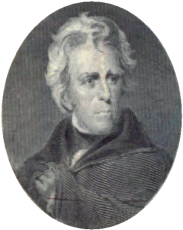
By Rob CallahanI went to see "Bloody Bloody Andrew Jackson" by Minneapolis Musical Theatre, not because I wanted to give the show any ink, or because I thought I'd have anything more to add, but because the controversy surrounding its treatment of Native people was relevant to a topic I've been tracking. In short, this was a show that pitted an emo version of America's seventh president against a bunch of white people playing Indians. They were resplendent in fringed blankets, buckskin and other such Native equivalents to the trappings of blackface. The show also had performers chanting for the death of Indians, and there was a big song and dance number celebrating genocide.

So, yeah. Pretty racist, but the company and their communication team adamantly denied that allegation and the local critics were divided on the issue, so I had to see for myself. Was this all in harmless fun, was it completely racist, or was it what the kids these days refer to as "fashionable bigotry?" That raised even more questions, not the least of which was ...

Can racism be done ironically?

Fashionable bigotry (also called "hipster racism" or "ironic racism") is this strange, newish phenomenon that's been popping up all over the arts and entertainment industry. You've got the Flaming Lips, Macklemore, Fallin, Ullman and Silverman to name a few. Count Tarantino in, too, as he's basically the modern godfather of the stuff. You pretty much see it all over.

Here in the Twin Cities, we like to think our enlightened arts scene is immune to this sort of thing, but it looks like we're wrong. We dealt with Tomahawk Tassels and 'Miss Saigon' last year, there was that one uncomfortable portrayal in "A Very Die Hard Christmas" back in December, and now we've had "Bloody Bloody Andrew Jackson." For all I know, there may be others. This is just the stuff I've seen in my time as an arts writer, so my list may not be comprehensive. I've seen a lot of shows, but I don't see them all and I haven't been in the game that long.

As for what constitutes hipster racism, there are a couple of telltale signs. Sometimes it's just the intentional evocation of racism, but in a way that's supposed to come off as edgy and self-aware. It's a brand of racism that's meant solely to get attention, to get people talking about it and bring them out to see it. In this context, it's the performing arts equivalent of clickbait. The perpetrator probably doesn't actually believe in it, but if we think they do and we can't stop talking about them, then it's served its purpose.

When it gets worse is when it's employed another way, when ironic racism gets conjured up under the premise that genuine racism simply isn't real. The perpetrator believes it's no longer taken seriously, or it's simply obsolete in our modern post-racial society. In essence, the argument is that this can't be real racism, because racism like this doesn't happen anymore. By this reasoning, the perpetrator may excuse the meanest, most offensive racist nonsense imaginable while arguing that it doesn't matter because, obviously, no one's actually offended. By extension, anyone who does claim to be offended must be wrong, or perhaps they just don't get the joke. In essence, if someone's ironic racism offends you, it's because you're not smart enough.

That's one of a few de rigueur responses you'll see trotted out whenever people raise concerns over this type of material. Another is the tried and true tactic of crying wolf (or, in this case, crying censorship,) in which the perpetrator misrepresents his critics, and yet another is one in which the perpetrator misrepresents himself or his work.

It's a kind of deflection technique, arguing that a person can get away with it because someone else did, this one time, a while back in a completely different context. Seth MacFarlane, for example, is known for defending "Family Guy" on the basis that "All in the Family" was offensive, too. To him, the clueless bigotry of Peter Griffin is analogous to the clueless bigotry of Archie Bunker. If one was just fine, so must be the other.

Does the Archie Bunker defense work?

In the case of "Bloody Bloody Andrew Jackson," MMT artistic director Steven Meerdink took a page from MacFarlane's book and called the show "kind of a 'Family Guy' viewpoint of history." He constructed a sort of Aunt Sally defense for his interpretation of the character on the merits of someone else's entirely dissimilar character. Meerdink cites Peter Griffin as this rebooted Andrew Jackson's source material, and MacFarlane defaults to Archie Bunker. The inferred argument, that Jackson is based on a perfectly acceptable different bigot who, in turn, is based on another perfectly acceptable even more different bigot, is a bit of a stretch. It only works if you stick to the most superficial similarities.

That's because there's a reason why pop culture historians laud Archie Bunker: He was a pioneering character who turned the popular American sitcom into a mainstream venue for the discussion of some serious, heavy topics. This show wanted its audience to have hard conversations, and it used humor to soften the impact and keep those conversations going. Yes, Archie Bunker was a bigot, but he was also the butt of the joke. He was awful, but his awfulness always had consequences. That was the show's moral. In every way, he was a mirror in which mainstream America could gaze upon its own reflection, comfortably acknowledge the blemishes and hopefully deal with them.
Callahan goes on to address the white privilege behind the play and the "talk-back" session the theater held:Two Hennepin Theatre Trust employees were in the audience. They cut her off two other times, alleging that she was threatening to somehow ban or censor their production, and a group of white men directly behind me displayed exactly zero qualms about interrupting her once more after that. To be clear, she wasn't raising her voice. She wasn't making accusations. I never once heard her so much as allude to bans or censorship. Each time she was interrupted, she was calmly responding to a direct question. (Or trying to, anyway.)

If you've followed the follow up chatter out there, you've seen a lot of talk about the effects of privilege on that talk-back session: the privilege of ignorance of consequences, the privilege to silence your detractors, to cloak that silence under the guise of an open forum, and so on. Regardless of where you fell in the debate, you couldn't deny that privilege fueled it.

That's the thing about privilege. It shows itself in many ways. This time, it just happened to pop up as a group of authoritative white people publicly tag-teaming a lone woman of color, and being so oblivious to the prevailing power dynamic that it never occurred to them that this was a problem, or that the reporter in the room might notice.

How Are We Privileged?

The fact that "Bloody Bloody Andrew Jackson"'s first act couldn't make it five minutes (literally, I timed it) without a racial slur is troubling. That the critics in town can't agree over whether or not the show was racist? That's more than troubling. It's also ignorant and, as much as I hate to say it, cowardly.

Pay attention, fellow critics, because this is what people mean when they call us privileged: We have the privilege of watching ninety uninterrupted minutes of dictionary definition racism, then going back to the public and telling them we didn't see anything wrong. We ought to try and shake that privilege off. Now is as good a time as any to shed the subjectivity and pomp of the values dissonance that muddles our work.
Comment:  For more on white privilege, see Whites Are Blind to Their Privilege and Conservatives Champion White Privilege.

January 25, 2014

Village People in Family Guy

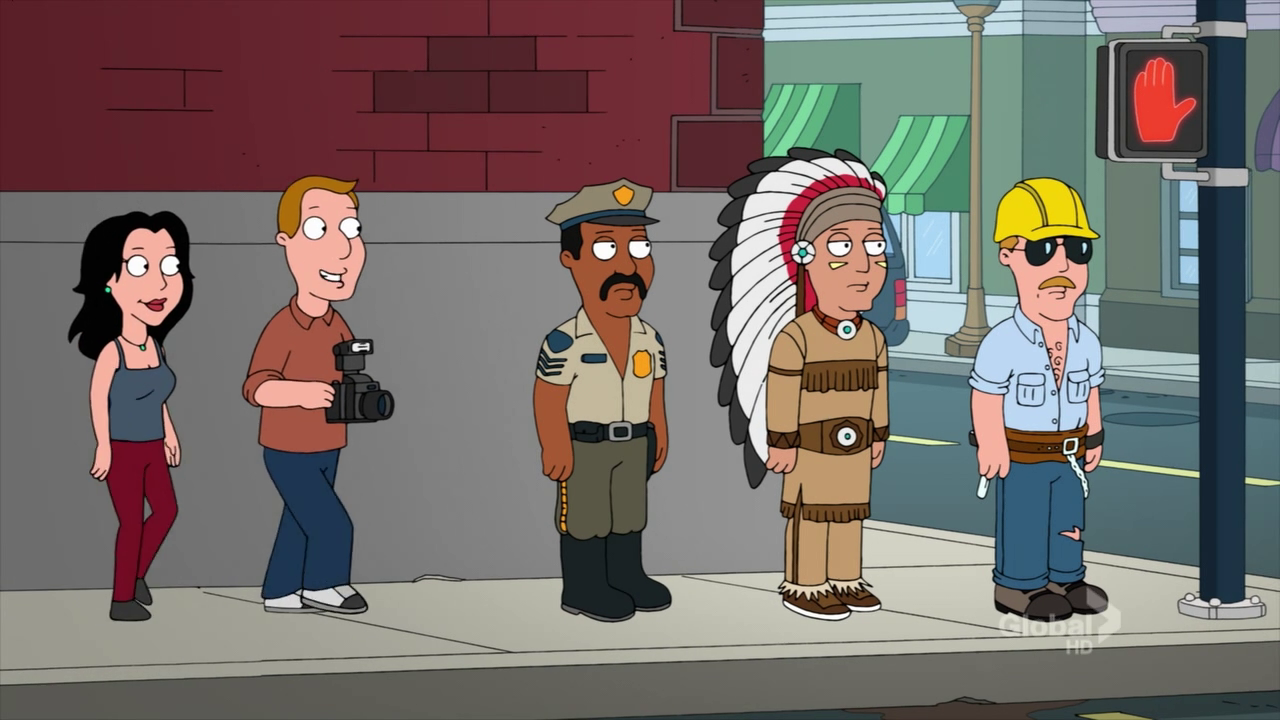
In an episode of Family Guy, titled Tea Peter (airdate: 6/13/12), Peter and his friends become enraged at the government. Their diatribe leads to this cutaway gag:PETER: Yeah, those bastards have ruined everything. The same way the Village People ruined any gathering of a cop, an Indian chief, and a construction worker.

BYSTANDER: Oh, my God! Can we get a picture with you guys?

COP: We're not those guys.

CHIEF: Yes, please leave us alone. We're very busy.

WORKER: Now where were we? Oh, yeah. We've got to solve that security problem for the Indian casino we're constructing.


Again, a TV show presents a mixed message. On the one hand, the gag undercuts the idea that a real Indian is a member of the Village People playing dress-up. On the other hand, it implies this is what a real Indian looks like. A Plains chief...standing in regalia for no reason...in Rhode Island.

The Narragansetts are the only recognized tribe in Rhode Island. Here's how they look these days:


A Narragansett chief might wear a Plains headdress on a special occasion--because many tribes have (mis)appropriated the Plains iconography. But a headdress plus buckskins? No. That's pure stereotyping.

January 12, 2014

Native stereotypes in Life of Brian

Perhaps because of Thanksgiving, a recent episode of Family Guy had a long introductory sequence about Indians:

Life of Brian (Family Guy)"Life of Brian" is the sixth episode of the twelfth season and the 216th overall episode of the animated comedy series Family Guy. It aired on Fox in the United States and Canada on November 24, 2013, and is written by Alex Carter and directed by Joseph Lee.

The episode revolves around the death of Brian Griffin, after being struck by a car, and the family coping with the loss by adopting a replacement dog, Vinny. However, Brian returned, two episodes later, in "Christmas Guy," after Stewie goes back in time to save him.

Plot

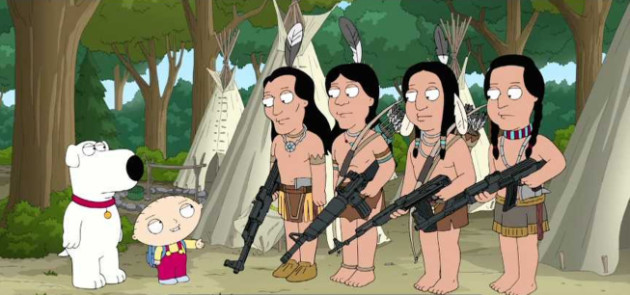
Stewie and Brian flee a band of hostile Native Americans in a Jeep. Brian explains that on a trip to Jamestown in the past, Stewie gave the Native Americans guns which were used to wipe out the Europeans, leaving the Native Americans in charge of America. Stewie finds his return pad destroyed by bullets and decides to find the alternate timeline Stewie for help. Going to the equivalent of their house, they find a new time machine and pad and return to Jamestown to set things right. As soon as their original counterparts leave, they take back the guns and return to the proper time.
You can see brief excerpts from the opening sequence below:


Changing America's history is a time-honored science-fiction theme, but this sequence was full of racist stereotypes. Among the most offensive were:

  • Half-naked Native warriors chasing Stewie and Brian. Really, in a modern city, the soldiers would be wearing loincloths?

  • A Native "doctor" dressed like a witch doctor whose idea of "medicine" is standing in awkward poses. Presumably this was a commentary on Native healing rituals.

  • A Native radio station whose no. 1 hit song for many weeks in a row is a dull, repetitive chant.

  • When Stewie and Brian return to Jamestown to take back the guns, the show tries to subvert some stereotypes. For instance, the Indians only pretend to talk like Tonto to take advantage of the strangers.

    As you can see below, the Indians' skin, hair, and clothing isn't too bad. But tipis in the Jamestown area? Even when Family Guy is trying, it still gets things wrong.


    Racism to be expected?

    As I wrote on Facebook:

    Finally watching the "Death of Brian" episode of Family Guy. I didn't know it began with a five-minute racist "satire" of Indians.

    Some people commented on this:Isn't it always a "satire"?

    Did you not see the Casino episode and you're shocked? lol I've not watched it yet but thanks for the heads up.
    I think I've seen all the Family Guy episodes. Including the one where Peter claims to be Native for some casino-related reason.

    True, that episode had a lot of stereotypes, but I'm not sure it was nonstop stereotypes. I think it made some valid points about how others view Indians stereotypically.

    This sequence seemed more like pure racist stereotyping. And Family Guy seems to have cranked up its racism and sexism quotient. It seems like half the "jokes" now involve some groups' perceived shortcomings.

    For more on the subject, see Indians in Family Guy.

    May 15, 2011

    Home schooling in Family Guy

    In Sunday's episode of Family Guy, titled Foreign Affairs (airdate: 5/15/11), Peter removes his kids from school to avoid the "goat flu." This leads to several references to American history.

    Peter begins by saying, "All right, class, this course is gonna cover all the significant moments in human history. Startin' with the settling of the Old West, where brave pioneers survived against long odds."

    The scene shifts to a Daniel Boone-style pioneer in a log cabin. The pioneer begins: "Honey, I have to go into town to get some supplies, so I'm probably going to die."

    Peter's introduction is pure American propaganda, of course. He's touting the white Christian pioneers against the heathen Indian savages. There's no irony or sarcasm here; viewers are supposed to think that noble Americans did "settle" the untamed wilderness.

    The scene ends with a bear mauling the pioneer, but I doubt anyone was fooled. No one thinks bear attacks were the primary problem faced by "brave pioneers." Everyone thinks Indian attacks were the primary problem. And Family Guy has subtly reinforced that belief.

    Later Peter conducts an outdoor class and takes things "a step further" by having them "do peyote in the desert." Which is part of traditional Native religions, of course. Although no Indians are shown, the location is a stereotypical Indian environment of cacti and mesas. And a stereotypical hawk screeches overhead.

    Finally, Peter quizzes Chris with a lightning round of dates. One of the things he asks is "Trail of Tears," to which Chris responds, "Never heard of it." Another is "Cortés reaches South America," to which Chris responds, "Pumping a dry well." A third is "Wounded Knee," to which Chris responds, "Stop!"

    So the segment is infused with Native history, but no one ever mentions Indians or tribes by name. This seems to be Seth McFarlane's way of being "politically correct." He knows Indians were important in US history, and he probably wants to mock them. But for once he wisely resists the temptation.

    For more on the subject, see Indians in Family Guy and TV Shows Featuring Indians.

    November 08, 2010

    Halloween joke in Family Guy

    In Sunday's episode of Family Guy, titled Halloween on Spooner Street (airdate: 11/7/10), son Chris dresses up in mod clothing and blackface to go trick-or-treating as Bill Cosby. His mother Lois chastises him:LOIS:  Chris, you can't just walk around in blackface. It's racist. Now go upstairs and put on that Indian chief costume I bought you.Sounds like creator Seth McFarlane has been reading Newspaper Rock!

    McFarlane has rightly equated blackface with redface--i.e., dressing up as a phony Indian. Even as a "joke," this makes a valuable point seldom seen in the mainstream media. Almost no one gets that one practice should be as socially unacceptable as the other.

    Of course, the joke was subtle enough that viewers still may not get it. And I'm not sure McFarlane believes believes both practices are wrong. He might claim he was satirizing political correctness and thinks both practices are okay.

    After all McFarlane has given us The Cleveland Show with a white guy voicing a buffoonish black character. And Mort the Jewish pharmacist is about the only ethnic character on Family Guy. Otherwise it's pretty much a bastion of whiteness.

    Proving McFarlane's insensitivity, he has Quagmire claim he's part Japanese in this episode. This provides an excuse for several racist "jokes" about Asians. And in the latest degradation of daughter Meg, he has Chris and Meg commit incest by kissing and groping each other in a closet.

    For more on the subject, see Nanookwaffe in Family Guy and Rapacious Cavalryman in Family Guy.

    October 12, 2010

    Nanookwaffe in Family Guy

    In Sunday's episode of Family Guy, titled Welcome Back Carter (airdate: 10/10/10), Lois's mother Babs reminisces about how she met Lois's father Carter. They met as young adults at a beach resort for the rich.

    The timeframe is unspecified but it's meant to be the big-band era of the late 1930s and 1940s. One clue is that Carter sends Babs a tape of Jeepers Creepers, a 1938 song.

    Then Carter is drafted to fight a war with...Alaska. I dreaded to see what "enemy" the US would be fighting in Alaska, and sure enough, it was bad. Angry-looking Eskimos wearing parkas, waving rifles, and riding walruses...the Nanookwaffe.

    So the Eskimos are stupid and primitive because they're wearing parkas into battle. They're savage and warlike because they're attacking US soldiers. They're strange and exotic because they're riding walruses. And they're equivalent to Nazis, or employed by Nazis, because of the Nanookwaffe name.

    Why Eskimos?

    I guess creator Seth McFarlane invented a war because he didn't want to tie Family Guy to a specific timeframe. Nevertheless, this choice is an epic fail.

    If Carter is in his 60s or 70s, he would've fought in Vietnam. If he's in his 80s, he would've fought in the Korean War. (He's not old enough to have fought in World War II.) But, oooh, I guess that would've been too real for Family Guy.

    If you're going to fabricate history, why not a war with the blue-bloods of Virginia? The Jews of Florida? Or the surfers of California? Because those are "normal" states with "normal" people in them. There are no uncivilized savages like the Eskimos of Alaska.

    Why not a war with a real country: Canada, Mexico, France, Germany, or the USSR? Because people know that didn't happen. Or a fictional country in South America, Eastern Europe, or Africa--the usual locations for fictional countries? Because that would smack of xenophobia or racism.

    But I guess it's okay to make up a war with the Eskimos. Because there are only a few of them left and they don't watch TV in their igloos. Heck, they're too busy riding dog-sleds and harpooning seals to know anything about the modern world. They probably don't speak English and don't even realize they're part of the US now. Am I right?

    (For Geno the cowardly commenter, this is sarcasm, stupid.)

    What it tells us

    The Nanookwaffe appear on screen for only a second or so. But still, it shows
    the mainstream Hollywood mentality at work. "We need an enemy for Carter to fight," McFarlane or his writers probably thought. "Who can we pick without offending any pressure groups? How about the Eskimos? They're silly and comical and hardly exist anymore. They're more like legends--like Blackbeard, Paul Bunyan, or Bigfoot--than real people. Right?"

    McFarlane proceeded with this racist choice because, well, who would disagree with him? Almost everyone at Fox TV, in Hollywood, and in mainstream America would agree: Eskimos are primitive savages. Few if any of them exist anymore. They're too ignorant and backward to care how a TV show portrays them.

    This is a fine example of how America's myth-making process works. McFarlane has learned that Eskimos are primitive savages from thousands of depictions in the media. On his nationally televised platform, he repeats what he's seen and heard. And so a new generation gets the same message: Eskimos are primitive savages.

    Even when it's not portraying indigenous people, Family Guy contributes to this myth-making. "Normal" is a white middle-class family living in the suburbs with two parents, 2.4 kids, and a dog. There are no minorities on the show except Cleveland the buffoonish black and Mort the buffoonish Jew.

    Indeed, in Welcome Back Carter, the only minorities besides Eskimos are a Hispanic maid and her obese son, a black waiter, and an Asian sex object. It's pretty much pure racial (and racist) stereotyping.

    As the opening montage demonstrates, Family Guy is McFarlane's twisted homage to white-bread sitcoms such as Leave It to Beaver and The Brady Bunch. Compared to it, The Simpsons and King of the Hill are giants of multicultural diversity. In Family Guy, white people may screw up sometimes, but they always remain front and center as the norm.

    For more on Eskimos, see The Experimental Eskimos Trailer, "Eskimo Sisters" in Indian Headdresses, and Ólöf the Eskimo Wannabe. For more on Family Guy, see Indians in Family Guy.

    April 13, 2010

    Rapacious cavalrymen in Family Guy

    In Sunday's episode of Family Guy, April in Quahog (airdate: 4/11/10), everyone thinks the world is going to end. Peter decides to act out his long-held fantasies, leading to this scene in the kitchen:BRIAN:  What the hell are you doing with a musket?

    PETER:  Last day on Earth. I've always wanted to save a Native American family from rapacious cavalrymen.
    We see a peaceful Indian camp attacked by the US cavalry. An officer chases and grabs an Indian maiden.OFFICER:  Yeah, this one'll do nicely.Peter "saves" her by shooting her, causing her head to explode and spattering the officer with blood.PETER:  Let her go.

    PETER [whispering to the headless corpse]:  You don't have to be afraid of him anymore.
    Killing Indians is a joke?

    Most people thought this episode wasn't funny in general and the Native scene wasn't funny in particular. Some reactions to this "joke":The bad jokes continued with Peter shooting the head off of a Native American woman with a musket. It wasn't even dark comedy...it's not even comedy, it's just dark and odd, and another example of the show's hit-or-miss cutaway shtick missing far wide of the mark.

    The scene with the Battle of Hastings was boring and Peter shooting a Native American was just horrible humor.

    Peter "Saves" Native Americans from the Calvary: In trying to "save a Native American family" from the Cavalry (circa 1880), Peter shoots a Native American woman's head off with a musket. I'm not kidding, it's not funny...so many nopes! Grade: F
    Everyone agrees: It wasn't funny.

    So many potentially bad messages here for people to absorb. Men accost women because they're temptingly attractive. Attacks happened because of "bad men," not genocidal government policies. Murdering Indians is okay, even beneficial.

    Peter might as well have said, "Kill the Indian, save the (wo)man." Making this explicit by blowing up the woman's head may be ironic, but it isn't funny. Not even close.

    Summing up the stereotypes

    The camp consists of tipis, so we immediately know we're in Plains stereotype territory. Other than that, the images aren't too bad.

    There's a variety of Indians: male and female, young and old. Their skins are light brown, not red. They're dressed in simple buckskin outfits. A couple men have a single feather each, but there's no stereotypical chief. The older one is smoking a pipe.

    The other faux pas is the Pocahontas-style maiden. Hollywood can't resist Indian women who are young and beautiful--i.e, exotic sex objects. If they've ever given us a Plain-Jane princess, I don't remember it.

    No other ethnic group gets stereotyped as savage and uncivilized. Only Indians. Sure, Family Guy insults other groups occasionally, but not with the same level of bias. Showing every Indian as a Plains denizen is equivalent to showing every black as a slave.

    Of course, the larger stereotype is showing 150-year-old Indians in the middle of a contemporary story. Viewers learn from the umpteenth source that Indians are primitive people of the past. And as we learn from other shows, any remaining Indians are casino owners.

    It's a classic case of stereotyping by omission. No modern-day Indians exist in the Family Guy universe, so primitive Indians are the norm. White people live in suburban tract homes and Indians live in tipis.

    What audiences learn

    Is this just a harmless TV show? Let's do a pre- and post-test of people's knowledge of Indians. Here's the question:

    "True or false: Most Indians lived it tipis?"

    How much do you want to bet the percentage of wrong answers goes up after watching April in Quahog? Does anyone think the percentage wills stay the same or go down? Of course not. People will vote "true" for "most Indians lived it tipis" even if Family Guy is a piece of fiction.

    For more on the subject, see Indians in Family Guy and TV Shows Featuring Indians.

    Below:  "The family gathers around the television as the end of the world approaches."


    The entire episode:

    May 19, 2009

    Rob "uptight" about Family Guy?

    In Indian Poltergeist in Family Guy, Akira Oni wrote:I'm sorry, I just find it hard to believe that you would get so uptight about native American stereotypes in Family Guy. They are there for the sake of satire, to make people talk about these things. If nobody acknowledges them, we may as well sweep any growth potentials we might have under the rug. If you are a watcher of family guy, then you'll know the show is regularly offensive to all groups of people. It's like Issac Hayes voicing chef through years of insults to race and religion, and quitting over the episode that portrayed Scientology. Anyway, that's my two cents.My response:

    Criticizing something doesn't mean I'm "uptight" about it. It means it's wrong and therefore deserves criticism.

    I also criticize people when they say 2+2 equals something other than four. I'm not uptight about these mathematical mistakes either. I'm simply correcting them so people will know better next time.

    You said the so-called satire exists to make people talk about stereotypes? Okay, I've talked about them. So what's the problem? I've pointed out that they're wrong in reality and in Family Guy, too.

    Was there something else about these stereotypes I was supposed to talk about? If so, what was it? I'm not a mind reader, so spell it out.

    Equal-opportunity offender?

    I think I've seen every episode Family Guy, so I know it has attacked Indians more often than other minorities. You'd know this too if you'd watched the show as much as I have.

    FYI, it's stereotyped Indians half a dozen times, which is a huge number for a series with 124 episodes (so far). Given that Indian make up only 1% of the US population, they should've been targets in only 1-2 episodes, not 6-7.

    Your claim that the series insults everyone equally demonstrates that you haven't thought about it enough. In particular, you haven't tried to quantify the insults as I have. That's why I can say Family Guy has attacked Indians more than their fair share.

    Incidentally, your Isaac Hayes analogy fails because I haven't accepted Family Guy's attacks on other minorities. I've criticized them too whenever they came up in conversation--which admittedly isn't often. Unlike Hayes, therefore, I'm consistent.

    For more on the subject, see Family Guy Offends Everybody? and Equal Opportunity Offenders

    May 18, 2009

    Quahog colonists in Family Guy

    In Peter's Progress (airdate: 5/17/09), the season finale of Family Guy, Peter learns how his hometown--Quahog, Rhode Island--was founded. Here's the plot:Peter has a psychic palm reading and discovers he led a past life as Griffin Peterson, a dignified gentleman who followed the beautiful Lady Redbush from 17th century England, where the fierce King Stewart III reigned supreme, to the newly founded American colony of Quahog to win her heart.This episode was a pretty good satire of the British monarchy and the American colonists. But...when Peter first sets foot upon America, his friend Quagmire calls it a "wilderness." They immediately claim it for their own and start building a town.

    The problem with this? No Indians. Any program that calls America a wilderness and then show plucky colonists "taming" and "civilizing" it is a falsification of history. It's the umpteenth example in a long line of pro-colonizing propaganda.

    A clever person might respond, "Well, if they had included Indians, wouldn't you have criticized that too?" Answer: Yes, if they were stereotypical. But Peter's Progress could've included non-stereotypical Indians in the story's context.

    How to fix Family Guy

    Here's one way the creators could've done it. Every time a colonist uttered something such as "It's a wilderness," a chorus of authentic-looking Indians could've popped up and contradicted them. This could've been a quick 'n' easy running joke throughout the episode.

    Examples:

    Colonist: "It's a wilderness." Indians: "No it's not."

    Colonist: "Our beautiful home in our beautiful land." Indians: "Our home, our land."

    Colonist: "And so everyone lived happily ever after." Indians: "No we didn't."

    The Indians could say a lot more about the colonists' genocidal actions, but that probably wouldn't be funny. What would be funny is Peter's pushing them back into the bushes they came from. It would almost be like a game of Whack-a-Mole.

    Incidentally, don't waste my time telling me Family Guy is just a TV show. I know that. I also know that every form of entertainment--from books to plays to movies to TV shows--has contributed to our national mythology. These ideas don't materialize out of thin air; they're conveyed from generation to generation through the media.

    For more on the subject, see TV Shows Featuring Indians.

    Below:  The colonists discover a "wilderness."

    July 22, 2008

    Indian casino in Family Guy

    In The Son Also Draws episode of Family Guy (Season 1, episode 6), the Griffins visit an Indian casino. Here's the story:

    The Son Also DrawsThe family stops at a Native American casino when Peter needs to use the bathroom (because Peter had a prune smoothie and saw a lot of signs that reminded him of going to the bathroom), but Lois quickly becomes addicted to gambling and loses the car. After hearing that Lois has gambled the family car away, Peter tries to get the car back by claiming to be Native American ("My great-grandfather's name was Chief Grand Cherokee"), and the doubtful elders demand that he go on a vision quest to prove his heritage.

    Chris accompanies Peter into the wilderness, hoping to tell him that he only wants to draw instead of being in the Scouts. Delirious from hunger, Peter begins talking to trees and sees a vision of his spiritual guide, The Fonz.

    He finally listens to Chris's complaints and realizes his son is a talented artist. They return to the casino and reclaim their car. The episode ends with a parody of NBC's "The More You Know" public service announcements. Lois, Stewie, and Meg counteract stereotypes about Natives, Mexicans, and Swedes, respectively. But when Peter continues about Canadians ("Canada sucks"), he doesn't correct himself and "The More You Know" logo doesn't appear.
    Comment:  The Griffins are driving from Rhode Island to New York City when they see a sign adverting "Craps...Craps...Craps." They turn to go to an Indian casino. Presumably they're in Connecticut and the casino is a stand-in for Foxwoods or Mohegan Sun.

    How bad is this episode? Pretty bad. Here are some of the mistakes and stereotypes:

  • The casino is named Geronimo's Palace.

  • Its main sign is a faux totem pole.

  • The casino itself looks like a cluster of giant teepees.

  • The Indian employees wear feathered headbands and vests over their naked chests.

  • The Indians have offensively "funny" names such as Change for a Buck, Watches You Pee, and Leonard Cornfeathers.

  • The slot machines use corn and teepee symbols and have tomahawk handles.

  • An animatronic chief and "brave" greet the guests.

  • Behind the scenes, the Indians who own the casino all wear headbands.

  • Peter pretends to be an Indian and they take him semi-seriously. Clearly, tribal membership is such a joke to Family Guy that any Irish-looking guy who wants money can claim to be a previously unknown Indian.

  • In Peter's flashback to his alleged ancestor, he envisions the usual Plains Indians and teepees.

  • The Indians send Peter on a vision quest, even though it isn't part of New England's Indian cultures. They have no idea how long it's supposed to last.

  • Peter's "spirit guides" turn out to be wisecracking trees and a cloud that mimics the Fonz. Clearly, Indian religion is a joke to Family Guy.

  • The Indians seem insincere about their culture, saying they wouldn't sell it except for $6 million.

  • Wow. This episode is more ignorant than the Simpsons and King of the Hill episodes about Indian casinos and almost as bad as the South Park episode. About the only thing missing is the Indian waitresses in skimpy Pocahontas outfits.

    What is it with all these TV shows doing episodes about Indian casinos? Is it the imagined conflict between traditional cultures and modern commerce? Or perhaps it's imagined insincerity of Indians trying to earn a living like everyone else.

    Yes, I think that's it. No TV show has dared to spend an entire episode mocking a black Juneteenth or Kwanzaa celebration, a Latino quinceañera, a Chinese New Year, or a Jewish bar mitzvah. That would come across as pure racism.

    But as I've said before, Indians are the last safe target. In a perfect example of "hipster racism," creative people can mock Indians to demonstrate that they're not "PC." That they're "equal opportunity offenders" who will criticize "everyone"--meaning Indians but not blacks, Latinos, Asians, or Jews.

    For more on the subject, see TV Shows Featuring Indians.

    June 29, 2008

    More Indian bits in Family Guy

    In "He's Too Sexy for His Fat" (Season 2, episode 17), a throwaway scene shows a group of parka-clad Eskimos saying good-bye to a youth on an ice floe. They have harpoons and there are igloos in the background. The young Eskimo says he's headed to Hollywood, where he'll get plastic surgery and become a star. His name is "Jennifer Love Hewitt." (In other words, Hewitt the actress was once a male Eskimo.)

    In "Blind Ambition" (Season 4, episode 3), a throwaway scene has Cleveland auctioning a Comanche headdress at Sotheby's. It's apparently an Indian auction because a pottery bowl, a canoe, and a totem pole are on display.

    In "Stewie Loves Lois" (Season 5, episode 1), a throwaway scene presents an Indian version of What's Happening? Two black guys in loincloths stand in front of teepees, talk slowly, and say "How."

    The first and third bits are stereotypical. They reinforce existing stereotypes and don't do anything to counteract them. The second bit is neutral. The mixing of artifacts from different cultures makes sense since it's an auction.

    For more on the subject, see Indians in Family Guy.

    June 28, 2008

    Family Guy roundup

    Family Guy is competing with The Simpsons and King of the Hill as the animated series most likely to feature Indians. Here's a roundup of links on the show.

    For more on the subject, see TV Shows Featuring Indians.

    June 15, 2008

    Season 4 of Family Guy

    Interesting that "Blind Ambition" (episode 3), "Jungle Love" (episode 13), "PTV" (episode 14), "Deep Throats" (episode 23), and "Petergeist" (episode 26) all occurred in the 2005-2006 season. So Indians made two major and three minor appearances in the span of 24 episodes.

    If you include "Stewie Loves Lois" (Season 5, episode 1), that's two major and four minor appearances in the span of 29 episodes. Indians averaged more than one appearance every five episodes during that span.

    Overall these appearances were stereotypical, but at least Indians got some screen time. That's arguably better than nothing.

    Also interesting that four different writers or writer teams came up with the six episodes. Was that just a coincidence? Or is creator Seth McFarlane asking his writers to include Indians?

    For more on the subject, see TV Shows Featuring Indians.

    June 14, 2008

    Indian poltergeist in Family Guy

    In "Petergeist," the May 7, 2006, episode of Family Guy, Peter unearths an Indian skull that unleashes an angry poltergeist. Here's the story:

    "Petergeist""Petergeist" is an episode from season four of FOX animated series Family Guy. The title, and the episode itself, is a parody of Poltergeist. Some segments of the movie's musical score are even used.

    Plot summary

    After Joe builds a home theatre system, Peter tries to build a multiplex in his backyard just out of spite. While digging, Peter finds the skull of a dead Native American buried in the backyard. This resembles the haunted skeleton seen in "Ready, Willing, and Disabled." Brian urges him to put the skull back, but Peter decides to use it as a novelty (playing with it, peeing in it, using it as an athletic cup, etc).

    That night the Griffins start experiencing strange paranormal activity, such as Stewie talking to the TV static, the chairs and refrigerator being stacked upside down on the kitchen table, and Chris getting attacked by an evil tree before being saved by Herbert in the same fashion as Gandalf saves the rest of the Fellowship from the Balrog in The Lord of the Rings: The Fellowship of the Ring. Lois is in denial (and Peter is oblivious) of the events that are happening, until Stewie gets sucked into his closet and disappears.

    To find Stewie, the Griffins hire a spiritual medium to contact the other side, and learn that the entrance to spirit world is Stewie’s closet, while the exit is Meg's ass. After they eventually rescue Stewie, the spirits ravage the Griffin house and suck it into their world. As the Griffins drive off, Peter dumps the Native American skull in a garbage can.

    Now homeless, Peter and Lois try and find a way to get their house back, and learn the Native American skull has to be put back in its resting place. After searching through the city dump, a garbage man tells them that the skull would be in the human remains bin, but it was cleaned out by Carrot Top for things to use as props. They go to Carrot Top's mansion and, after a chase through a hall of mirrors, they retrieve the skull and rebury it, thus getting back their house and life returning to normal.
    Comment:  The Indian skull is wearing a chief's headdress. This is just as wrong and stereotypical as it was in "Ready, Willing, and Disabled."

    Peter makes a complete mockery of the Indian skull, even using it as a urinal. This is (barely) tolerable, since Peter represents the ignorant American. But except for Brian's half-hearted try, no one else corrects him. And it's hard to imagine the show offending any other minority for most of an episode.

    Worse is the tired cliché that Indian burials and remains are tied to black magic. This basically tells viewers that Indian religions are unholy if not evil. Of course, the show also mocks Christianity, but our culture supports and honors Christians in countless ways. Indian religions get no such respect from the mainstream.

    Even if this scenario happened in Poltergeist, that's no reason to repeat it. If you want to satirize Poltergeist, go ahead and start with finding an Indian skull. But maybe a buried voodoo doll or monkey's paw causes the supernatural events instead. An expert tells the Griffins they were foolish to attribute the magic to an angry Indian spirit.

    You can view the episode here. For more on the subject, see TV Shows Featuring Indians.

    Indian folk song in Family Guy

    In the "Deep Throats" episode of Family Guy, which aired April 9, 2006, Peter and Lois recall a song they performed when they were hippie folksingers:

    Noble Indian ChiefNoble Indian Chief,
    Bring us back your ways.
    You Indians were so awesome
    In oh, so many ways.
    They all loved each other
    Regardless of the tribe.
    One Comanche needs a cup of sugar
    And the Blackfoot would oblige.
    Lois: Oblige.
    The only cause of death
    Was drifting off to sleep.
    And they left this piece of wisdom
    That we hope you all will keep.
    And they said...
    [whooping] Wah wah wah wah wah, wah wah wah wah wah, wah wah wah wah wah wah wah
    Wah wah wah wah wah, wah wah wah wah wah, wah wah wah wah wah wah wahwahwahwaaah.
    Lois: They're gone now.
    Peter: How could this have happened?
    Both [hands raised in faux Indian greeting]: How.
    Comment:  Indians weren't as peaceful as this New Age-style songs portrays them, of course. But this is an acceptable example of stereotyping. Why? Because it puts the naive beliefs about Indians in the mouths of naive hippies. The song makes them look foolish, not Indians.

    For more on the subject, see TV Shows Featuring Indians.

    June 04, 2008

    Apache Chief in Family Guy

    In the "PTV" episode of Family Guy, the Super Friends' Apache Chief shows up to place a satellite dish on the Griffins' roof. After that, he says, "Well, that was the high point of my day. Guess I'll go gamble."

    This is a lame way to make the point that Indians own casinos. It also reinforces the idea that Indians are pure brawn over brains. Apache Chief was already a walking cliché, so this appearance only reinforces his clichéd aspects.

    Better would've been an exchange like this:

    CHIEF:  Anything else I can help you with?

    PETER:  No, Chief, but we'll call you if anyone needs a haircut.

    CHIEF:  I have a PhD in engineering, you know.

    PETER:  Really? I thought all you Indians did was drink and gamble.

    CHIEF:  I thought all you white people did was invade countries and spread diseases.

    PETER [suspicious]:  Yeahhhhh...what's your point?

    The original version seems to be saying that Indians are non-intellectuals who do nothing but gamble. This version makes it clear that (some) white people think Indians are non-intellectuals who do nothing but gamble. See the difference? One version asserts this as objective reality--at least the cartoon's objective reality. The other puts it in the subjective reality of a biased observer.

    Anyway, it was fun seeing Apache Chief again. And the rest of the episode was an excellent satire of TV's values. Here's how Wikipedia describes it:“PTV” was originally released as the fourteenth episode from season four of the Fox animated television series Family Guy. The episode dealt with censorship on television, and specifically the Federal Communications Commission (FCC). The episode was nominated for an Emmy Award for Outstanding Animated Program.Any episode that satirizes such icons as Osama bin Laden, George W. Bush, Bob Hope, and the Lincoln Memorial gets my vote. I'd say this is the best episode of Family Guy I've seen. As I watching it, I was thinking, "This should get some kind of award." So I'm glad to see it was nominated for an Emmy.

    For more on the subject, see TV Shows Featuring Indians.

    May 29, 2008

    "Jungle Love" in Family Guy

    The main action in the 2005 "Jungle Love" episode of Family Guy takes place in an Amazon Indian village. Here's a summary of the show:

    Jungle Love (Family Guy)“Jungle Love” is the thirteenth episode from the fourth season of the Fox animated television series Family Guy.

    Plot summary

    Chris is excited to become a freshman at the local high school, until Joe tells Chris about the "Freshman Hunt," a hazing ritual in which the freshmen are beaten with paddles by everyone. ... Chris asks Brian for advice. Brian tells Chris about his time in the Peace Corps. Chris decides to join the Corps and goes to South America, where he becomes popular with the natives. When he gets the tribe to dance, he is married to the chief’s daughter, as dictated by the tribe’s customs.

    When Lois learns of the marriage, she immediately travels down to South America with the rest of the family. Disillusioned with his new job, Peter is as eager to go there as anyone else. Upon their arrival Peter is seen as the richest man in the country with just $37. Many of the natives of the country then become Peter’s slave for just nickels and dimes. When Chris accuses Peter of “using” the natives to escape his troubles, Lois points out that that is also what Chris did. Chris then decides to return to Rhode Island, telling his wife that he must leave her, casually referring to his status as a freshman. The natives respond exactly as the upperclassmen in Quahog do, so they chase the Griffins in a very hostile manner. The Griffins escape on a seaplane a la Raiders of the Lost Ark, but forget Meg, who is impaled by darts and arrows.
    Comment:  How many ways is this episode stereotypical? Let's see:

  • The Indians speak English. This is better than speaking gibberish, but worse than speaking their own language. It denies their rich cultural heritage.

  • The Indians all look young and handsome or beautiful. In particular, the women all look like Hollywood sex objects.

  • The Indians all look like each other. This denies that they're unique individuals.

  • Loka, the chief's daughter, is a classic princess character. Just once it would be nice if the only significant female weren't the chief's daughter.

  • That the chief gives his daughter to Chris after Chris dances suggests how unsophisticated and primitive the Indians are. Again, it denies their rich cultural heritage.

  • The Indians treat Peter like a god after he flashes $37 at them, making him the richest person in the tribe. Even if they understood and bought into the concept of money, it's ridiculous that they'd prostrate themselves to outsiders. I.e., that they'd passively accept masters who have no redeeming qualities.

  • Just as ridiculously, the Indians change from obedient lackeys into spear-wielding maniacs when they learn Chris is a freshman. Whether they're simpleminded children or simpleminded savages, they're simpleminded.

  • Although Family Guy occasionally makes fun of other minorities (blacks, Asians, the handicapped), it's usually only one brief bit. In contrast, "Jungle Love's" Indian subplot takes up half the show. Conclusion: Indians are fair game compared to other minorities.

    For more on the subject, see Skeletal Chief on Family Guy and TV Shows Featuring Indians.

    Below:  Chris dances in front of showgirl-style Indians, proving himself worthy of marriage.


    Peter and company turn the Indians into killers by saying the wrong word.