Showing posts with label Jamestown. Show all posts

January 12, 2014

Native stereotypes in Life of Brian

Perhaps because of Thanksgiving, a recent episode of Family Guy had a long introductory sequence about Indians:

Life of Brian (Family Guy)"Life of Brian" is the sixth episode of the twelfth season and the 216th overall episode of the animated comedy series Family Guy. It aired on Fox in the United States and Canada on November 24, 2013, and is written by Alex Carter and directed by Joseph Lee.

The episode revolves around the death of Brian Griffin, after being struck by a car, and the family coping with the loss by adopting a replacement dog, Vinny. However, Brian returned, two episodes later, in "Christmas Guy," after Stewie goes back in time to save him.

Plot

Stewie and Brian flee a band of hostile Native Americans in a Jeep. Brian explains that on a trip to Jamestown in the past, Stewie gave the Native Americans guns which were used to wipe out the Europeans, leaving the Native Americans in charge of America. Stewie finds his return pad destroyed by bullets and decides to find the alternate timeline Stewie for help. Going to the equivalent of their house, they find a new time machine and pad and return to Jamestown to set things right. As soon as their original counterparts leave, they take back the guns and return to the proper time.
You can see brief excerpts from the opening sequence below:


Changing America's history is a time-honored science-fiction theme, but this sequence was full of racist stereotypes. Among the most offensive were:

  • Half-naked Native warriors chasing Stewie and Brian. Really, in a modern city, the soldiers would be wearing loincloths?

  • A Native "doctor" dressed like a witch doctor whose idea of "medicine" is standing in awkward poses. Presumably this was a commentary on Native healing rituals.

  • A Native radio station whose no. 1 hit song for many weeks in a row is a dull, repetitive chant.

  • When Stewie and Brian return to Jamestown to take back the guns, the show tries to subvert some stereotypes. For instance, the Indians only pretend to talk like Tonto to take advantage of the strangers.

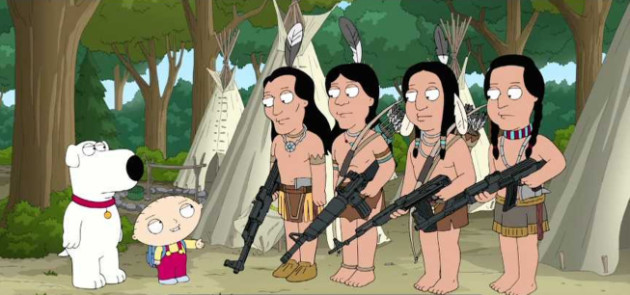
    As you can see below, the Indians' skin, hair, and clothing isn't too bad. But tipis in the Jamestown area? Even when Family Guy is trying, it still gets things wrong.


    Racism to be expected?

    As I wrote on Facebook:

    Finally watching the "Death of Brian" episode of Family Guy. I didn't know it began with a five-minute racist "satire" of Indians.

    Some people commented on this:Isn't it always a "satire"?

    Did you not see the Casino episode and you're shocked? lol I've not watched it yet but thanks for the heads up.
    I think I've seen all the Family Guy episodes. Including the one where Peter claims to be Native for some casino-related reason.

    True, that episode had a lot of stereotypes, but I'm not sure it was nonstop stereotypes. I think it made some valid points about how others view Indians stereotypically.

    This sequence seemed more like pure racist stereotyping. And Family Guy seems to have cranked up its racism and sexism quotient. It seems like half the "jokes" now involve some groups' perceived shortcomings.

    For more on the subject, see Indians in Family Guy.

    April 30, 2013

    Jamestown settlers were cannibals

    Starving Settlers in Jamestown Colony Resorted to Cannibalism

    New archaeological evidence and forensic analysis reveals that a 14-year-old girl was cannibalized in desperation

    By Joseph Stromberg
    The harsh winter of 1609 in Virginia’s Jamestown Colony forced residents to do the unthinkable. A recent excavation at the historic site discovered the carcasses of dogs, cats and horses consumed during the season commonly called the “Starving Time.” But a few other newly discovered bones in particular, though, tell a far more gruesome story: the dismemberment and cannibalization of a 14-year-old English girl.

    “The chops to the forehead are very tentative, very incomplete,” says Douglas Owsley, the Smithsonian forensic anthropologist who analyzed the bones after they were found by archaeologists from Preservation Virginia. “Then, the body was turned over, and there were four strikes to the back of the head, one of which was the strongest and split the skull in half. A penetrating wound was then made to the left temple, probably by a single-sided knife, which was used to pry open the head and remove the brain.”

    Much is still unknown about the circumstances of this grisly meal: Who exactly the girl researchers are calling "Jane" was, whether she was murdered or died of natural causes, whether multiple people participated in the butchering or it was a solo act. But as Owsley revealed along with lead archaeologist William Kelso today at a press conference at the National Museum of Natural History, we now have the first direct evidence of cannibalism at Jamestown, the oldest permanent English colony in the Americas. “Historians have gone back and forth on whether this sort of thing really happened there,” Owsley says. “Given these bones in a trash pit, all cut and chopped up, it's clear that this body was dismembered for consumption.”

    It’s long been speculated that the harsh conditions faced by the colonists of Jamestown might have made them desperate enough to eat other humans—and perhaps even commit murder to do so. The colony was founded in 1607 by 104 settlers aboard three ships, the Susan Constant, Discovery and Godspeed, but only 38 survived the first nine months of life in Jamestown, with most succumbing to starvation and disease (some researchers speculate that drinking water poisoned by arsenic and human waste also played a role). Because of difficulties in growing crops—they arrived in the midst of one of the worst regional droughts in centuries and many settlers were unused to hard agricultural labor—the survivors remained dependent on supplies brought by subsequent missions, as well as trade with Native Americans.

    By the winter of 1609, extreme drought, hostile relations with members of the local Powhatan Confederacy and the fact that a supply ship was lost at sea put the colonists in a truly desperate position. Sixteen years later, in 1625, George Percy, who had been president of Jamestown during the Starving Time, wrote a letter describing the colonists’ diet during that terrible winter. “Haveinge fedd upon our horses and other beastes as longe as they Lasted, we weare gladd to make shifte with vermin as doggs Catts, Ratts and myce…as to eate Bootes shoes or any other leather,” he wrote. “And now famin beginneinge to Looke gastely and pale in every face, thatt notheinge was Spared to mainteyne Lyfe and to doe those things which seame incredible, as to digge upp deade corpes outt of graves and to eate them. And some have Licked upp the Bloode which hathe fallen from their weake fellowes.”

    Despite this and other textual references to cannibalism, though, there had never been hard physical evidence that it had occurred—until now.
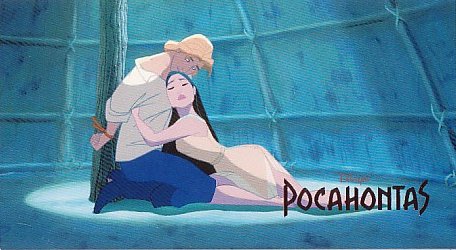
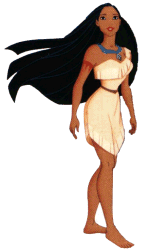
    Comment:  I'm reminded of the song Savages from Disney's Pocahontas. It's about the same Jamestown settlers now revealed as cannibals:[Powhatan]
    This is what we feared
    The paleface is a demon
    The only thing they feel at all is greed

    [Kekata]
    Beneath that milky hide
    There's emptiness inside

    [Native American]
    I wonder if they even bleed

    [Native Americans]
    They're savages! Savages!
    Barely even human
    Savages! Savages!

    [Powhatan]
    Killers at the core
    Yes, the white man was a cannibal. Please refer to this article whenever someone claims the so-called Anasazi were cannibals. Their alleged cannibalism may have happened under similar circumstances for similar reasons.

    For more on Indians as cannibals, see Caribbean Cannibal in I Love Lucy and Cannibal Indians in Green Inferno.

    Below:  "Detail of cut marks found on the girl’s jaw, or lower mandible in a stereo-microscopic photo." (Smithsonian Institution/Don Hurlbert)

    November 02, 2010

    Henricus was no. 2

    400th commemoration continues at Henricus Historical ParkHenricus Historical Park continues its 400th commemoration with the second major event in a series called “The Year of Henricus” with “Pocahontas and the Powhatan People” Nov. 6 and 7. Pocahontas lived and met John Rolfe at the Citie of Henricus, the second permanent English settlement in North America. Leaders of Henricus developed the first English hospital, chartered the first college in North America and established tobacco as the first cash crop in Virginia. This event examines the significant impact neighboring Virginia Indians had on the English colonists and explores the life of Pocahontas at Henricus.

    Set among a recreated Arrohateck Indian village and English settlement, visitors to Henricus Historical Park are encouraged to step back in time and experience life in 1611 Colonial Virginia demonstrated by period-dressed interpreters. American Indian activities will include historical recreations of daily Virginia Indian life and scheduled ceremonial dance and music demonstrations. Visitors to the English settlement can meet John Rolfe and other colonists as they discuss the upcoming marriage of Pocahontas to John Rolfe.
    Comment:  Talking about no one remembering who came in second place! I don't think I've ever heard of Henricus. Jamestown gets all the publicity and Henricus gets none.

    For more on the subject, see Pocahontas Bastardizes Real People.

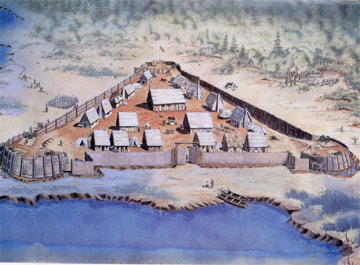
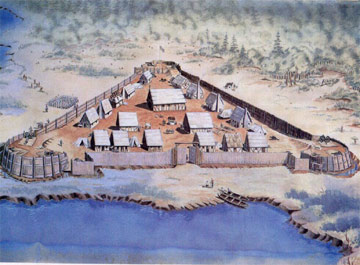
    Below:  Jamestown, not Henricus.

    September 22, 2010

    Polemical Break the Whip

    Theater review:  'Break the Whip' at the Ivy Substation

    By Charles McNulty“Break the Whip,” the piece Robbins developed through a series of improvisational workshops with his Actors’ Gang company, teems with cast members in a production at the Ivy Substation that’s like a social studies pageant devised by a teacher who lets his sympathies dictate his storytelling. Set in the Jamestown colony in Virginia, the first lasting English settlement in North America, the narrative is told from the point of view of what the play calls “the anonymous, the indentured and enslaved, the muted voices, the vanquished.”

    The plot boils down to a love story between an indentured servant and a newly arrived black slave, whose only hope as a couple is to be given refuge by a Native American tribe. Because the bad guys (the racist, power-mongering and generally unneighborly English settlers) and the good guys (everyone under their heel) are so clearly defined, the ensuing conflict (unfolding in super-slow motion) is a melodramatic one. The Jamestown movers and shakers are indeed such a bigoted and hypocritical lot that it’s hard to feel sorry that so many under their jurisdiction are dropping dead from starvation.
    Comment:  For more on the subject, see Native Plays and Other Stage Shows.

    June 23, 2010

    Hitler = greatest threat since Indians?

    Here's a quote from Franklin Delano Roosevelt's "The Great Arsenal of Democracy" speech delivered December 29, 1940:We met the issue of 1933 with courage and realism. We face this new crisis, this new threat to the security of our nation, with the same courage and realism. Never before since Jamestown and Plymouth Rock has our American civilization been in such danger as now.Comment:  Let's look at what FDR was saying here:

    1) American civilization began with Jamestown and Plymouth Rock--i.e., when white Anglo-Saxon Protestants came from England to settle the Atlantic coast. FDR didn't think the Spanish who explored and colonized the South, or the French who explored and colonized the Great Lakes area. And of course he didn't think about the millions of Native people who'd been here for 10,000 years or more. To him, American civilization = British civilization.

    2) What exactly was the previous danger faced by the English colonizers? Who weren't Americans, by the way, and wouldn't be for another 169 years. The harsh climate? Maybe, although calling that a "danger" is a stretch. The colonizers could've rectified any setbacks caused by cold winters and failed crops with more people and supplies. These problems were technical in nature and spending enough time and money would've resolved them. (Which is what did happen, in fact, as more and more ships arrived.)

    No, the real danger these colonies faced were the "savage" Indians. You know, the people who owned and occupied the land the foreigners wanted to appropriate. The people who welcomed the strangers and kept them alive until they realized the strangers were planning to take over their fields and streams.

    The implication is pretty clear. Hitler was the greatest threat to Euro-Americans since the "merciless Indian savages." The Nazis were the barbarians of the 20th century and FDR wanted us to be equally resolute against their evil.

    Alternate version of the speech

    Here's what FDR could've said instead. What a Native leader might've said in his place:Never before since Jamestown and Plymouth Rock has our American civilization been in such danger as now. The Native inhabitants of this land faced an unprecedented assault by covetous Europeans bent on world domination. Now we face the same threat from their like-minded descendants. Sure of their biological and cultural superiority, Anglo-Saxons are once again on the march. Once again they're trying to establish an empire of the so-called master race.For more on the subject, see Adolf Hitler:  A Good American.

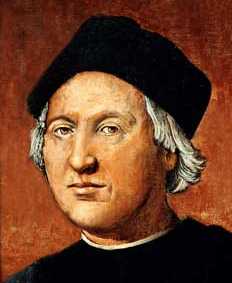
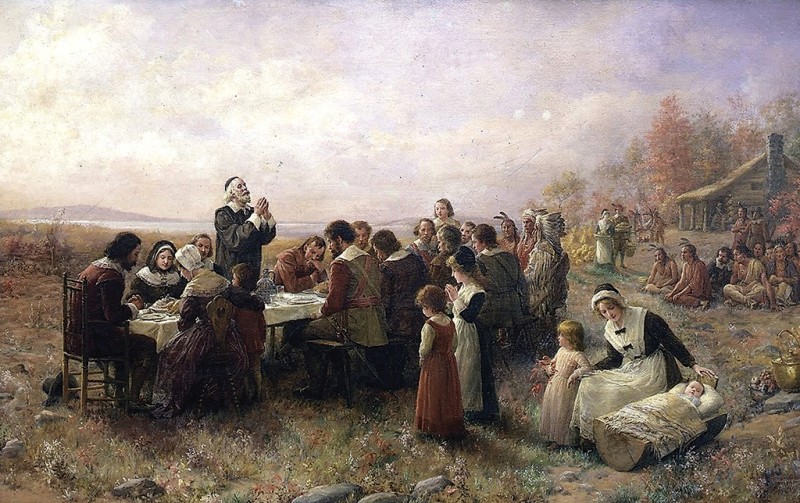
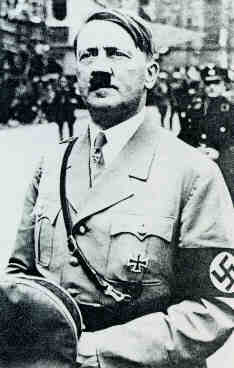
    Below:  Three milestones of Western imperialism.


    February 16, 2009

    Was Jamestown massacre justified?

    In Blame Government, Not Settlers? I tried to explain the 1622 Indian massacre of the English settlers at Jamestown. In response, an anonymous reader wrote:Are you justifying a mass murder then? Mass murder is just that no matter who commits it (Anglo or Indian) and whether or not there as a legimate reason or not. To me there is no justification of mass murder by either side.My response:

    I wrote about killing during wartime in Diplomacy Works, Violence Doesn't, Anonymous. My position is that violence is justified only as a last recourse, when all other options have failed. Which is rarely if ever the case.

    To give three examples: Americans didn't try every other option before nuking Japan. Or before invading Afghanistan and Iraq. Similarly, Osama bin Laden didn't try every other option before attacking the World Trade Center. As far as I'm concerned, they're all guilty of unjustified acts of murder.

    How to respond to invaders

    Now let's look at the Jamestown massacre of 1622. Did the Indians try every diplomatic and military option short of a massacre? Did they try surrounding Jamestown and starving it into submission? Did they try holding some Englishmen hostage until the others agreed to submit?

    I believe they tried things of this nature. I don't know if they gave them enough of a chance to work. Do you?

    But wait...there are more points to consider. The Indians knew the Englishmen's goal was to colonize and "settle" their land. They may have guessed the Englishmen were carriers of mysterious diseases--i.e., walking germ-warfare weapons. In their negotiations, they may have sensed what was undoubtedly true: that the Englishmen would never give up their plans to take America.

    Given these factors, I could see cases where no other options existed but all-out war. I suspect the Indians believed this was such a case even if that wasn't literally true. When they thought the choices came down to "kill or be killed," they chose to kill.

    In that sense, I claim their actions were morally defensible. If someone invades your house and threatens to kill you...sure, it would be nice if you could subdue him nonviolently. But that means taking a risk and giving him a chance. If there's a clear and present danger--an American legal standard--you're justified in killing him in self-defense.

    What would Texans do?

    These cases occasionally come up in the news--usually in Texas. I say that if you find someone trespassing in your house and he's clearly unarmed, you're absolutely not justified in killing him. But if he is armed, you absolutely are justified in killing him. (The Texas courts may say you're justified in both cases, but I'm more moral than they are.)

    Needless to say, the Indians were dealing with armed invaders in their home(land)s. Once it was clear that the Euro-American colonizers weren't going to leave, the Indians were justified in using any measure to get rid of them. That includes killing them as a last resort.

    January 04, 2009

    Shoot first, ask questions later?

    In Review of Pocahontas Revealed, someone took me to task for what I wrote:"When Smith and company arrived in Virginia, the Indians attacked them with bows and arrows. They knew about the white man from Roanoke and prior Spanish explorations. Their arrows seemed to be an explicit message: Go home...you're not wanted here...no trespassers allowed."

    Sounds like a perfect example of the 'shoot first ask questions later' mentality you're always ranting about.
    Ideally, you're right. People should ask questions first and shoot later. I've said as much in postings such as Winning Through Nonviolence and Diplomacy Works, Violence Doesn't.

    But I think the Englishmen's first attempts to colonize America were an exception. Violence was a reasonable response to these attempts. Let me explain why.

    Consider: If unknown armed foreigners tried to enter the US, we'd order them to stay out and shoot them if they didn't. The situation in Virginia was roughly analogous to that.

    Similarly, the Iraqis were justified in shooting the US soldiers who came to "liberate" them in 2003 without discussing it first. This was an unprovoked and unwarranted invasion and the natives had every right to repel it.

    What the Indians knew

    From what they'd heard, Powhatan's Indians knew that the Europeans were coming to occupy their territory. That they had superior firepower to make up for their small numbers. That they spoke in an incomprehensible tongue.

    Faced with this, what were the Indians supposed to say? "Go ahead and build an impregnable fort on our land while we try to figure out what you want. If we haven't reached an agreement with you in six months, you'll leave voluntarily and without violence. Deal?"

    Heck, the Indians may have realized that the Europeans brought death (i.e., disease) with them wherever they went. Perhaps they intuitively understood the need to keep the white men away from them (i.e., quarantined). This would've required an immediate response, not an interminable set of negotiations. Again, "Go home...you're not wanted here...no strangers possessed by evil spirits allowed."

    Where's the evidence that any Europeans would do the bidding of heathens and "savages"? That they'd give up their dreams of wealth if asked to? When exactly did white men make a promise to Indians and keep it?

    The white man's syndrome

    The Europeans were already making their mark throughout the Caribbean region. I suspect Powhatan's Indians were trying to avoid a repeat of the deadly "white man's syndrome." I can just imagine what they were thinking:

    First Indian:  "The last 20 times the white men landed on our shores, a malevolent force killed most of our people. The white men easily subdued the remainder. Now our people are nothing but vassals and slaves."

    Second Indian:  "Yes, but maybe the 21st time will be different. Maybe these white men won't turn out to be devils."

    First Indian:  "Have you been smoking something besides tobacco leaves? Don't be a naive idiot."

    Any questions? For more on the subject, see Those Evil European Invaders.

    December 29, 2008

    Review of Pocahontas Revealed

    Pocahontas Revealed is an excellent Nova documentary on America's "Indian princess." Even though I've read a lot about Pocahontas, I learned things. Telling you things you didn't know, filling the gaps in your knowledge, is a mark of good filmmaking.

    Pocahontas Revealed focuses on the discovery of Werewocomoco, the home of Powhatan and Pocahontas. It explores several mysteries about the site. What was the purpose of two 700-foot-long ditches? Do a few post holes show the location of Powhatan's longhouse? Do the bits of copper found come from Native sources in the Great Lakes or from Great Britain? Can tree rings tell us why the Indians stopped helping Jamestown after seven months of cooperation?

    So the documentary isn't just a laundry list of "this happened, this happened, and this happened," which inevitably gets boring. Rather it presents a series of revelations as the information is uncovered. Moreover, it uses computer graphics and staged recreations to enhance the narrative, making the story fun.

    What I learned

    Here are some of the things I gleaned from Pocahontas Revealed.

  • When Smith and company arrived in Virginia, the Indians attacked them with bows and arrows. They knew about the white man from Roanoke and prior Spanish explorations. Their arrows seemed to be an explicit message: Go home...you're not wanted here...no trespassers allowed.

  • The Englishman set up camp at Jamestown anyway. They ignored the warning and settle in Indian territory without permission. Here's a clear indication of their immoral intent. Regardless of how the Indians felt about it, the Englishmen were going to take what they wanted from them.

  • The Englishmen were all tradesmen and craftsmen. They were there to take resources, shape them into useful products, and ship them home. The only freedom they cared about was the freedom to profit from Indian land.

  • There were no farmers among the English. Their plan was to buy food from the Indians, not grow it themselves. When the Indians refuse to trade, this turned out to be a tragic mistake.

  • Pocahontas's role

  • When Smith first recounted his capture by the Powhatan Indians, he wrote that they feasted him, interviewed him, and sent him to bed. He didn't say anything about Pocahontas rescuing him until 17 years later. As the narrator notes, accounts written closer to the time of an incident are almost always more accurate.

  • In the documentary, Pocahontas is played by 13-year-old granddaughter of the Rappahannock chief. She's cute but not Hollywood beautiful; she looks her age. This makes it harder to imagine a romance between her and Smith.

  • The copper bits found at Werewocomoco are industrial waste from the mills in England. The Englishmen traded this scrap metal with the Indians for food. To the Indians, the gleaming copper probably seemed like gold to us.

  • Left unsaid is the exact nature of the trade. The Englishmen were trading what they considered worthless refuse for valuable foodstuffs. But the Indians may have thought, "Look at this highly processed metal ore. Think how much effort it took to mine it, smelt it, pound it into sheets, and ship it overseas. For this they want a few baskets of food they could easily grow themselves? Suckers!"

    Horn dogs and Englishmen

  • Artifacts showed that Indian women stayed at Jamestown with the settlers. The English said nothing about these women, but they probably had sexual relations with them. In fact, Spanish records suggest that there were some 50 marriages between English men and Indian women at Jamestown.

  • Tree rings indicate there was a drought from 1606 to 1612. Apparently it was drier than any other seven-year stretch in the Chesapeake area in the last 800 years. This may explain why the Indians stopped trading with the Englishmen: They didn't have any surplus food. It may also explain why the Englishman failed so miserably at growing their own crops.

  • Faced with hunger, Smith and the others began burning down villages and killing Indians to get what they wanted. Forget all the talk about disease. The English not only had a genocidal intent, they acted upon it. From the very beginning, their plan was to kill or conquer anyone who got in their way.

  • In short, Pocahontas Revealed is about as good as historical documentaries get. If you have a chance, see it. Rob's rating: 8.5 of 10.

    For more on the subject, see Native Documentaries and News.

    August 04, 2008

    Plains chief at Stonetown


    In a Saturday Night Live skit that aired in October 2007, Seth Rogen played the founder of Stonetown, a rival to Jamestown. The local Indians supposedly gave the colonists marijuana, not tobacco, and everyone got stoned. When an Indian appeared to delivery Indian takeout food, he was a stereotypical Plains chief.

    Not a big deal, but a typical example of how the mainstream views Indians. To most people, every Indian is a Plains chief or brave.

    Comment:  For more on the subject, see The Basic Indian Stereotypes.

    May 19, 2007

    Jamestown as foundation tale

    The Jamestown ProjectOne result of our historical favoring of Plymouth is that most Americans remain ignorant of basic Jamestown facts, a lacuna that Kupperman fills, as does prizewinning British author and broadcaster Benjamin Woolley in his jazzier Savage Kingdom. The story of the Pilgrims comes back to us when we eat turkey at Thanksgiving. Since we don’t annually eat rats or a salted, murdered, pregnant wife—both part of Jamestown’s “creation story from hell,” in Kupperman’s phrase—we’re foggy on details. For every American familiar with Capt. John Smith’s supposed romance with the 10-year-old Indian princess Pocahontas—by all accounts apocryphal, though she did marry Smith’s fellow colonist John Rolfe and die at 21—few know the miseries of Jamestown’s “Starving Time.”

    The historical minutiae Kupperman and Woolley provide tell us much about America’s ethos, then and now. Like almost all European ventures in the New World, Jamestown started as a business project by venture capitalists, meant to return quick profit to investors. It succeeded because the people involved in it—the “rank and file,” according to Kupperman, rather than the elites—wouldn’t let it fail. Yet an ugly part of Jamestown’s survival is that it came only after colonists, following the 1622 massacre, dropped the Virginia Company’s “policy of appeasing the Indians” (in Woolley’s language) and decided to wreak whatever violence on them that they considered necessary, largely destroying them through superior numbers and arms.

    May 15, 2007

    The real message of Jamestown

    The emperors have no clothesIn fact, it was the clan-based, longhouse-dwelling people who had knowledge of the land of the so-called New World. And after the colony's establishment, it was African slaves who tended the real "seed of freedom": tobacco. If the foreigners grew anything for themselves, it was the early model of American imperialism--exploiting shared resources to gain wealth for the state. This model flourishes today, the state's hypocrisy honed by consumer-citizens who generally feel no sense of responsibility for the original sins committed by their own ancestors. No doubt this would been a source of resentment for any Native people attending the White House gala, had any been invited.

    Just as the legend of Pocahontas as Jamestown's princess heroine persists in the American psyche, so does the myth of the "founding" of an American society based on the rights and dignity of the individual. Pocahontas, the young daughter of Powhatan, is almost always depicted as a love-struck teen who willingly aided the hungry settlers. Rarely is she imagined as a child captive of an unhygienic man twice her age. She is one among the handful of internationally famous Native Americans because she helped the Europeans in their quest to tame the New World. The message is loud and clear: The only good Indian is one who can be honored as a symbol of colonization, of a better life through white "civilization."

    May 12, 2007

    Commemorative Jamestown coins

    2007 Jamestown 400th Anniversary Commemorative CoinsAuthorized by Public Law 108-289, the commemorative coins are limited to maximum mintages across all product options of 500,000 for the silver dollar and 100,000 for the $5 gold coin. The coins will be sold by the United States Mint through the end of 2007 or until the coins sell out.

    The coins tell the story of Jamestown as America’s first permanent English settlement that established democracy, free enterprise and a culturally diverse society in what became the United States.

    The obverse of the $5 gold coin depicts Captain John Smith conversing with a Virginia Indian. The coin’s reverse pictures the Jamestown Memorial Church—the only structure remaining from the settlement’s earliest years. The gold coin sells for $255.
    Comment:  This coin easily could have been Virginia's state quarter. Instead, the state went with a safer choice.

    May 09, 2007

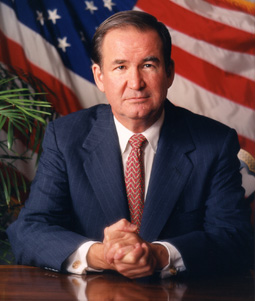
    Pat Buchanan on Jamestown

    Jamestown as it Never WasAt Jamestown, "Three great civilizations came together for the first time--Western European, native American and African."

    Well, that is one way to put it. Except that the Jamestown settlers were not Western Europeans but English Christians. And the first thing they did was build a fort to protect themselves from Powhatan's tribe, whom they thought might massacre them--as they suspected Indians had massacred the Roanoke colony. Their leader, Capt. John Smith, barely escaped execution by Powhatan. Or so Smith tells it.

    As for the Africans, they arrived in 1620 in slave ships, and were not freed for 145 years. Then they were segregated for 100 years. There was no coming together of African, Indian and European civilizations. The African slaves were uprooted from their civilization and had to became part of ours.

    Jamestown was no coming together of civilizations, but the opening of a war of imperial conquest by self-confident Christians who defeated and destroyed the pagan Indian tribes, drove them westward, repopulated their lands, and imposed their own faith and laws.

    When we came, the Indians had the land. We took it.
    So is Buchanan glad that our society has become more diverse since the Queen's last visit? Not necessarily:[A]re we better societies now than 50 years ago?

    The latest reminder of diversity in Virginia was the massacre of 32 students and teachers at Virginia Tech by a berserk Korean. And now that London is Londonistan, Muslim imams openly preach hatred of the West in mosques. Pakistani subway bombers find support in their community. Race riots are common in the northern industrial cities. Crime rates have soared. In areas of London, people fear to walk. Is this better than it was in 1957?
    Answer to Buchanan's question:  Yes, we're better societies now than 50 years ago. For starters, we've largely banished overt racism and discrimination. We no longer treat women and minorities as second-class citizens. We criticize rather than celebrate white cheerleaders such as Rush Limbaugh, Don Imus, and Buchanan.

    For more of Buchanan's racist take on the Virginia Tech massacre, see Oh Pat, You So Craaaazy!

    May 08, 2007

    Commemorating Jamestown, then and now

    The unexpected appearance of the truth in Jamestown

    Last time the Queen visited, 50 years ago, the ugly side of colonialism's legacy was easily hidden. Today, that is impossible

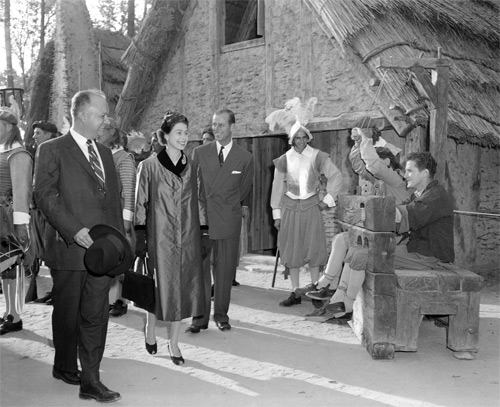
    Then:The visit was a triumph. For some, it was a model of how national anniversaries should be marked, in a robustly patriotic mood, free of moral relativism and political correctness. But that, of course, was achieved by ruthlessly excising complicating or compromising factors. The scene had been set some weeks before the Queen's arrival. At a commemorative dinner hosted by Governor Stanley in Virginia's state capital, Richmond, seven of the "distinguished sons and daughters of the Old Dominion" invited to attend found themselves unceremoniously excluded when it was discovered they were black. Meanwhile, in Jamestown the festivities got under way without a Native American in sight, the only hint being a white drama teacher from a local school dressed as Pocahontas.Now:Fifty years on, the picture is very different. When the Queen arrived in Richmond on Thursday, she could barely move for Native Americans, meeting representatives of each of Virginia's eight tribes, before moving on to make a speech in which she endorsed "the 'melting pot' metaphor" as capturing "one of the great strengths" of the modern US.

    As for the anniversary of Jamestown itself, the word celebration has been banned. Instead we have "America's Anniversary Weekend", in the hope that what sounds like a wholesome family outing will create the right melting pot mood. James Earl Jones has duly been invited to perform, Chaka Kahn to sing, and the Richmond Indigenous Gourd Orchestra (who grow their own instruments) to play.
    What it means:Meanwhile, the darker, more complex dimensions of the Jamestown story have if anything flourished. The way the colonists treated Native Americans, the importing of Angolans pirated from Portuguese slave ships, the exploitation of the land to grow tobacco, the chronic infighting that nearly destroyed the settlement in its first months--these have become potent elements in attempts to make sense of the combination of high principles and base motives that are such a feature of American history--no more so than the country's recent history of engagement with the Middle East.

    As a result, a theme that is not usually much in evidence around the time of national anniversaries has made an unexpected appearance in Virginia: history. There has been an outpouring of books (to which I have contributed), films and articles about those first English settlers. The result has been a profound shift of understanding--unseating, at least for the moment, those pious latecomers the Pilgrim Fathers (the Mayflower arrived in North America 13 years after the Jamestown settlers) from their privileged perch. Despite its faults--perhaps because of them--Jamestown has, at last, emerged as the birthplace of America.

    Indians at Jamestown, then and now

    Local Indians fight for role in celebration

    People of the Powhatan River remind whites they were in Jamestown before the EnglishIn the 1907 Jamestown exposition, the Indian section was relegated to the amusement area, a la Buffalo Bill's Wild West show, with an invitation to "Put on Your Warpaint."

    At the 1957 celebration, a couple of Indians were hired to wear Mohawk wigs. No one seemed to know that Powhatan men shaved the right side of their heads, so as not to get hair tangled in their bows, and wore their hair long and tied in a knot on the left.

    This time, Virginia Indians sit on panels responsible for planning the events. They have held symposiums and given lectures on their histories. They have edited scripts, getting National Geographic to issue a disclaimer on a video that John Smith did not "discover" the Indians.

    They have made sure that tribal flags are included in every processional. They have worked with the tourism industry to create a Virginia Indian Heritage Trail and have helped develop curricula about Virginia Indian history.

    "We told them, 'You can't just approach us and ask us to ride on a float and wave,' " Wood said.
    What people should know:When John Smith arrived, the Powhatan weren't a bunch of naked savages awaiting civilizing, as the English thought. They were already civilized, Wood said. They were part of a complex society with established trade patterns, cultivated land and a political structure. They thought the Earth was circular and flat, like a plate, and that Tsenacomoco was at its center. In a good year, there were five seasons. And the god they worshiped, Okeus, was fearsome and severe.

    More than 15,000 people from 30 tribes were ruled by a man named Wahunsunacock. He had more than 100 wives. His subjects paid him 80 percent of what they grew or hunted every year. And he expected his warriors to be fierce. Boys practiced target shooting every morning. If their arrows missed, they got no breakfast.

    The English called him Powhatan, the name he took as chief.
    What people do know:These days, about the only thing Americans know about the Powhatan is the highly idealized story of Pocahontas, one of Powhatan's daughters. Legend has it that she saved John Smith's life, became a Christian, married an Englishman and died young in England.

    So many of Virginia's leading families have claimed the Indian "princess" as an ancestor that officials wrote a "Pocahontas" exception for those with 1/16 Indian blood into segregationist laws that defined what it meant to be white.
    Comment:  These days, most people get their knowledge of the Powhatan Indians from Disney's Pocahontas, of course.

    May 05, 2007

    Learning from Jamestown

    American Indians See Opportunity in Jamestown Anniversary

    In the spotlight, American Indians seek to educate the broader publicThe dialogue between native and non-native peoples is "not just looking back at where we were and what happened to us, but using that as a point to look at and get public attention to what needs to happen more at this point," she said.

    Tayac also wants educators to take a hard look at the curriculum in U.S. schools and incorporate not only the American Indian point of view, but also the results of more recent historical scholarship, including archaeological excavations of native sites.

    She said she hopes that future American schoolchildren will consider figures like Powhatan chief Wahunsunacock, or his brother and successor Opechancanough, "as just as much of a founder [of the United States] as John Smith," and that they will view the natives of the Chesapeake region as "intelligent, thinking, tremendously intellectual people who were on this landscape, who had civilizations that had a population worthy of respect."

    Protesting at Jamestown

    Voices of a history unfit to celebrate"Oppose Queen Elizabeth's visit and say NO to celebrating imperialism. Genocide and slavery are not causes for celebration," the leaflet read.

    On the back, under the headline, "God Can't Save the Queen!," was a list of grievances related to the queen and the Jamestown anniversary. They include the killing of millions of indigenous people, the importation of the first African slaves to North America and the birth of North American homophobia, in the form of the execution for sodomy of Richard Cornish at Jamestown in 1624.

    That some chose to protest "was a reminder to think critically about the larger 400th anniversary of Jamestown, and all the ways that it will be commemorated in the coming year," said Adria Scharf, executive director of the Richmond Peace Education Center. Scharf wasn't at the protest, which was not organized or co-sponsored by the center.

    April 30, 2007

    Jamestown 50 years later

    Queen Elizabeth II will revisit Jamestown history

    The Virginia colony she'll return to for its 400th anniversary has quite a different spin from the place she saw in 1957.When Queen Elizabeth II visited Jamestown, Va., in 1957 to commemorate the 350th anniversary of the first British settlement in North America, she was 31 years old and had been on the throne for less than five years.

    A lot has happened since, to her and to Jamestown.

    On Friday, when the queen returns for the 400th anniversary of the settlement's founding, she will see a much different representation of the colony, complete with Indians and blacks whose fortunes crossed there.

    "She got the sanitized version in 1957," said Peter Wallenstein, a Virginia Tech historian whose book "Cradle of America" focused on the convergence of Europeans, American Indians and black slaves at Jamestown. "Now she'll see a more inclusive view of all three of the great racial groups that met there. Jamestown represents the origins of democracy and slavery."
    More on the point:[T]o historians, the fanfare over Jamestown's 400th anniversary is an occasion to remark on what has been learned since the last major commemoration.

    "The queen and the president are celebrating the journey of democracy, trying to put a pleasant spin on Jamestown," said Peter Mancall, a USC professor of history and anthropology. To scholars, he said, what was significant about Jamestown were the important markers in the history of three peoples.

    Despite horrific costs, including the deaths of most of the settlement's 214 people during the "starving time" in 1609-1610, Mancall said, the English discovered an economic basis for survival: tobacco. In a harbinger of the conflicts that would come to dominate the continent's politics, settlers also clashed with the Powhatan Indians and brought Africans from Angola.

    As a result, historians also see the 400th anniversary of Jamestown as a prelude to a larger debate over divergent views of U.S. origins. Who were the prototypical Americans, the Pilgrims at Plymouth Rock with their quest for personal religious freedom, or settlers at Jamestown who came to make money?

    "The people who came to Massachusetts Bay already knew who they were but wanted a more congenial environment," Wallenstein said. "In Virginia, to the extent they came voluntarily, they came to reinvent themselves."

    On some level, he said, "that is far more quintessentially American."
    And more:"The very essence of modern America took root on the banks of the James River in 1607, at Jamestown, Virginia ... 13 years before the pilgrims founded Plymouth in Massachusetts," said a promotional message by organizers at www.jamestown2007.org

    For all the efforts to highlight the historic primacy of the British settlement, it may be that Jamestown's very unsavory tale makes it more appealing to a reality TV generation. As film noir, said anthropologist Seth Mallios, "Jamestown has it all: unprovoked attacks, cannibalism [one of the colonists killed and salted his wife during the starving time], disease, treachery, and mutiny; and here I am only describing the English colonists."
    Comment:  Jamestown sure has grown up in the last 50 years. What a sterling example of how "revisionist history" is real history.

    Let's not forget that the Pilgrims were the original Christian fundamentalists. They left for America because the English wouldn't tolerate their brand of fanaticism.

    I see the makings of a new Thanksgiving holiday here. Family members stab each other in the back for a monetary prize, then gather 'round the table to eat a (symbolic) corpse.

    This is so typical of our selfish society that it could be a reality show on TV. Yes, Jamestown sounds like America to me....

    April 29, 2007

    Jamestown represents America

    Where did it all begin?  Jamestown

    For good or ill, Virginia colony laid ground for America to comeIf you're looking for America's cozy creation narrative—pious settlers, friendly Indians and "the first Thanksgiving," all blessedly lacking the stain of our original sin, slavery—then go visit that rock where the Pilgrims landed.

    But if you want the whole story of the white man in America—the full-tilt frenzy of near-starvation and cannibalism, salvation through entrepreneurial enterprise, importing slavery, overrunning Indians and the nation's first step toward representative democracy—then come to Jamestown.

    For it's here, on a swampy peninsula between the James and York rivers of southeastern Virginia, that the first permanent English settlement in North America was established on May 14, 1607. The initial 1-acre, triangular fort was built 13 years before the Mayflower landed in Massachusetts, bearing its solemn flock of families in search of religious freedom.

    "Jamestown is much more typical of American society in the intervening 400 years, as opposed to Plymouth, which was an eccentric experiment but not really what America would be about," said James Kelly, the director of museums for the Virginia Historical Society. "It (Jamestown) never had any idealistic pretensions."

    April 26, 2007

    Jamestown ignores Pocahontas

    Pocahontas is missing 'star' in Jamestown, Virginia

    Despite her legendary status, the Indian princess is all but ignored.Rachel Secan came to Jamestown wearing her Pocahontas costume and pink snow boots. She was hoping to see something about her favorite Indian princess.

    Why the fascination with Pocahontas?

    "She sings good," said the 4-year-old redhead from Raleigh, N.C., who owns a well-worn DVD of the Disney movie.

    Although I didn't dress in fringed, faux deerskin, I came to Jamestown expecting what Rachel expected: Pocahontas. She is, after all, the only reason many Americans have even a vague notion of the first permanent English settlement in North America.

    But as Jamestown commemorates its 400th anniversary this year, the former colony is all but ignoring the singing Indian maiden and her purported rescue of colonist John Smith. It's all part of an effort to be historically accurate and to acknowledge that Jamestown's history included slavery and the taking of Indian lives and land.
    Comment:  Rachel is probably the millionth child who thinks Disney's Pocahontas is real and the real Pocahontas is phony. "What, she wasn't an Indian princess and she didn't love John Smith? Can't be...we saw it in the movie."

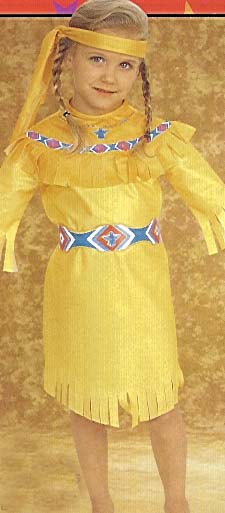
    P.S. The girl below is supposed to be dressed as Pocahontas.