Showing posts with label cannibals. Show all posts

October 02, 2015

Green Inferno = racist torture porn

"The Green Inferno" – Even Worse Than We Anticipated

By Andrew E. MillerWhat are our key take-aways from "The Green Inferno"?

The inherent racism of an Amazonian cannibal movie is on full display. A false stereotype of the animalistic and brutal indigenous savage is a central conceit of the film. Other than the fake name of the tribe, no indigenous person has a name, nor says anything intelligible, nor is otherwise humanized–the one exception being the young girl who miraculously transcends her people's mob mentality and liberates Justine. The experience of the white people, who have names and motivations–as shallow as they might be–is entirely central to the plot. The degree to which the film evokes any emotional response, it's supposed to be some kind of horror at harm befalling the gringos. In dialogue between the activists, there are various references to "what they are doing to us." This is a classic example of othering.

Roth's portrayal of activism is absurd and cartoonish. Ostensibly, the film's social subtext is a critique of "slactivism," inspired by what Roth apparently observed around phenomenon like Occupy Wall Street and Kony 2012. But, as numerous reviewers have noted, "slactivists" wouldn't travel to Peru and carry out a direct action in the middle of the rainforest. The extreme naivete or venality of members of this group reaches caricature proportions. In all, it's not a serious social commentary, between being incoherent and hyperbolic. Unfortunately, this makes it all the more pointless, because there are cogent critiques to be made of well-meaning but clueless activists who ultimately do more harm than good, protected by their privilege from paying any consequences–like Roth himself.

There are some real-life issues illustrated in the film, but to such exaggeration that any prospective value in raising awareness about the Amazon is completely lost. Yes, there are gas and other extractive projects in the Amazon menacing indigenous peoples within their own territories today. But the lethal threat is generally not armed mercenaries that will shoot indigenous natives, instead risks posed by foreign disease or adverse health effects from pollution are far more likely to have an impact. Yes, Amazonian indigenous peoples tend to resist unwanted incursions into their territories, but they don't systematically mutilate and murder the invaders. In the overwhelming preponderance of cases, indigenous peoples defend themselves through nonviolent and often sophisticated means using lawsuits, protests, and their own media campaigns.
'The Green Inferno' Review: Lousy Film, Plenty Racist

By Tara HouskaUnsurprisingly to everyone but Roth, numerous indigenous peoples and organizations have denounced the film. He has argued that criticism about the manner in which he chose to portray Native people is unfounded; the tribe is fictional and correlating any real-world effects is "absurd." One would hope a filmmaker grasps the impact of media on public perception, particularly when those rare representations are largely dehumanizing. At this moment, existing isolated tribes in the Amazon face enormous pressures from resource-hungry extractive industries. The fate of no-contact legislative protections is uncertain, increasing the very real threat of disease and destruction of lands.

Roth himself has switched tacks on the intent of the film—these days he's touting monetary donations he's made to indigenous and environmental groups, and recalling tales of how much the tribe he featured loved the film crew. It's a far cry from prior interviews where he joked, "We [had] to tell them what a movie is ... They've never even seen a television ... [B]y the end they were all playing with iPhones and iPads. We've completely polluted the social system and fucked them up."

"The Green Inferno" not only trivializes grassroots efforts to draw attention to the plight of Amazonian tribes, it further entrenches the understanding that tribes are uncivilized relics from the past. Controlled contact and assimilation efforts aren't as unpalatable when tribes are viewed as "other" and incapable of self-determination.

Roth fails to realize that Native peoples and cultures have survived despite all odds; our fights are sophisticated and ongoing. Relegating us to the dregs of society is no longer acceptable. Simon Moya-Smith, Culture Editor of Indian Country Today, summed it up: "'The Green Inferno' is the 21st century cinematic demonstration of white fear ... they are right to fear us, but not for the reason this Jewish filmmaker would suggest."

With any luck, this lackluster horror film and its primitive depiction of indigenous peoples will quickly fade into unprofitable obscurity.
Comment:  For more on The Green Inferno, see Cannibal Film to Spark Discussion? and From Tiger Lily to Green Inferno.

August 22, 2015

Cannibal film to spark discussion?

A 'Savage Cannibal' Movie in 2015? We Can Do Better

By Tara Houska[I]n the midst of competing interests to protect indigenous peoples or capitalize on the Amazon’s natural resources, out comes a film portraying tribes as bloodthirsty savages.

Despite Roth’s assertion that a fictional film causing harm to existing peoples is “absurd,” presenting an at-risk population as cannibalistic beasts feeds into the mantra of saving, assimilating and educating uncivilized tribes for their own good (and the good of resource-hungry corporations). Stereotypes and dehumanization have very real consequences.

Roth himself joked about the impact of his film crew to the isolated Amazonian tribe he located and featured in his film, “We [had] to tell them what a movie is…They’ve never even seen a television…[B]y the end they were all playing with iPhones and iPads. We’ve completely polluted the social system and f*cked them up.”

These days, Roth is attempting to soothe the many environmental and indigenous rights organizations that have denounced his pending film. He’s joined a campaign to preserve the rainforest and partnered with a charity to start a journalism fund highlighting the issues faced by indigenous peoples.

On Wednesday, he told Variety he “made ‘The Green Inferno’ to spark discussion and bring awareness to the devastation these tribes face at the hands of corporations.” That’s a far cry from a man who earlier stated that he wanted to make a cannibal film but needed the right storyline.
Comment:  The only discussion The Green Inferno is like to spark is a discussion like this one. Namely, pointing out how racist and stereotypical the movie is. How the reality not depicted by Roth the racist is much different.

For more on The Green Inferno, see "From Tiger Lily to Green Inferno" and Cannibal Indians in Green Inferno.

April 30, 2013

Jamestown settlers were cannibals

Starving Settlers in Jamestown Colony Resorted to Cannibalism

New archaeological evidence and forensic analysis reveals that a 14-year-old girl was cannibalized in desperation

By Joseph Stromberg
The harsh winter of 1609 in Virginia’s Jamestown Colony forced residents to do the unthinkable. A recent excavation at the historic site discovered the carcasses of dogs, cats and horses consumed during the season commonly called the “Starving Time.” But a few other newly discovered bones in particular, though, tell a far more gruesome story: the dismemberment and cannibalization of a 14-year-old English girl.

“The chops to the forehead are very tentative, very incomplete,” says Douglas Owsley, the Smithsonian forensic anthropologist who analyzed the bones after they were found by archaeologists from Preservation Virginia. “Then, the body was turned over, and there were four strikes to the back of the head, one of which was the strongest and split the skull in half. A penetrating wound was then made to the left temple, probably by a single-sided knife, which was used to pry open the head and remove the brain.”

Much is still unknown about the circumstances of this grisly meal: Who exactly the girl researchers are calling "Jane" was, whether she was murdered or died of natural causes, whether multiple people participated in the butchering or it was a solo act. But as Owsley revealed along with lead archaeologist William Kelso today at a press conference at the National Museum of Natural History, we now have the first direct evidence of cannibalism at Jamestown, the oldest permanent English colony in the Americas. “Historians have gone back and forth on whether this sort of thing really happened there,” Owsley says. “Given these bones in a trash pit, all cut and chopped up, it's clear that this body was dismembered for consumption.”

It’s long been speculated that the harsh conditions faced by the colonists of Jamestown might have made them desperate enough to eat other humans—and perhaps even commit murder to do so. The colony was founded in 1607 by 104 settlers aboard three ships, the Susan Constant, Discovery and Godspeed, but only 38 survived the first nine months of life in Jamestown, with most succumbing to starvation and disease (some researchers speculate that drinking water poisoned by arsenic and human waste also played a role). Because of difficulties in growing crops—they arrived in the midst of one of the worst regional droughts in centuries and many settlers were unused to hard agricultural labor—the survivors remained dependent on supplies brought by subsequent missions, as well as trade with Native Americans.

By the winter of 1609, extreme drought, hostile relations with members of the local Powhatan Confederacy and the fact that a supply ship was lost at sea put the colonists in a truly desperate position. Sixteen years later, in 1625, George Percy, who had been president of Jamestown during the Starving Time, wrote a letter describing the colonists’ diet during that terrible winter. “Haveinge fedd upon our horses and other beastes as longe as they Lasted, we weare gladd to make shifte with vermin as doggs Catts, Ratts and myce…as to eate Bootes shoes or any other leather,” he wrote. “And now famin beginneinge to Looke gastely and pale in every face, thatt notheinge was Spared to mainteyne Lyfe and to doe those things which seame incredible, as to digge upp deade corpes outt of graves and to eate them. And some have Licked upp the Bloode which hathe fallen from their weake fellowes.”

Despite this and other textual references to cannibalism, though, there had never been hard physical evidence that it had occurred—until now.
Comment:  I'm reminded of the song Savages from Disney's Pocahontas. It's about the same Jamestown settlers now revealed as cannibals:[Powhatan]
This is what we feared
The paleface is a demon
The only thing they feel at all is greed

[Kekata]
Beneath that milky hide
There's emptiness inside

[Native American]
I wonder if they even bleed

[Native Americans]
They're savages! Savages!
Barely even human
Savages! Savages!

[Powhatan]
Killers at the core
Yes, the white man was a cannibal. Please refer to this article whenever someone claims the so-called Anasazi were cannibals. Their alleged cannibalism may have happened under similar circumstances for similar reasons.

For more on Indians as cannibals, see Caribbean Cannibal in I Love Lucy and Cannibal Indians in Green Inferno.

Below:  "Detail of cut marks found on the girl’s jaw, or lower mandible in a stereo-microscopic photo." (Smithsonian Institution/Don Hurlbert)

March 31, 2013

Caribbean cannibal in I Love Lucy

I recently stumbled across the Desert Island episode of I Love Lucy. It was the eighth episode of Season 6 and first aired November 26, 1956.

Here's a brief synopsis from IMDB:While filming a movie, actor Claude Akins, dressed in wild native costume, meets with Ricky and agrees to scare Lucy and Ethel for playing a trick that got them stranded on the island earlier.Here's an image from the show's climax:


And a snippet of dialogue that tells you what the characters are thinking:Ethel: (seeing Claude Akins dressed as native) Hey, Lucy, he's friendly. He wants us to have dinner.

Lucy: HAVE dinner?! He wants us to BE dinner!
The first problem is that Akins has a buffalo helmet, warpaint, furs, and a tomahawk. Not of these are remotely close to appropriate for Caribbean Indian.

The second and bigger problem is that the characters are one speedboat ride away from Miami Beach. What's the normal range of a speedboat on the open seas--10 or 20 miles? I'm pretty sure there are no islands, deserted or otherwise, that close to Miami.

Not unless they're chock full of resort hotels, that is. The idea that you could have a "desert island" within hailing distance of Miami Beach is ridiculous. Every island for miles would be owned, occupied, and developed.

That this ridiculous notion of a desert island could be inhabited by man-eating Indians is even more ridiculous. There are no uncontacted tribes in the Caribbean. No reservations where life continues unchanged. Caribbean Indians have been (forcibly) assimilated into European-style living for 500 years. The last "primitive savage" probably died a few decades after the Spanish started colonizing the islands.

Yet Lucy and Ethel are so ignorant they believe a wild Indian will eat them?! Would they expect an English doctor to bleed them if they were sick? A Japanese official to skewer them with a sword if they broke the law? No, but they have no problem envisioning Indians as throwbacks to another century.

It's one thing to be wary or fearful of a stranger, but I presume they've heard of Sitting Bull and Geronimo, at least. You'd have to be beyond ignorant to think cannibals still exist in America or its immediate vicinity. Yet Lucy and Ethel--or the writers who put the words in their mouths--believed this.

The fact that it's a white man in a costume is irrelevant. Other than as an example of the prevailing redface of the era. Lucy and Ethel believed he was real--believed cannibal Indians were roaming just off the coast of Miami.

What it tells us

Another episode I saw had a black man as a train porter. That's also stereotypical, but it's infinitely better than an Indian as a cannibal. The equivalent would be an half-naked African in a grass skirt--but people knew enough in 1956 not to do that. But they didn't know or care enough about Indians to avoid this blatant racism.

This episode is a classic example of how stereotyping works. Most of Lucy's viewers probably didn't think much about the Caribbean. They may not have paid much attention to this episode or its depiction of an Indian. But it undoubtedly influenced their perceptions anyway.

If you asked them about Caribbean Indians after the show, I bet they'd spout the usual stereotypes. Even if they discounted the show, it reinforced what they already believed. Indians were killers and cannibals--and if any are still around, they're still savages.

For more on cannibal Indians, see Cannibal Indians in Green Inferno and Cannibal Indians in My Ghost Story.

March 03, 2013

Cannibal Indians in Green Inferno

Gory First Look at Eli Roth's Cannibal Thriller 'The Green Inferno'

By Erin WhitneyIt's been six years since we've had a slice of horror from director Eli Roth, instead only getting him as a producer on various projects since his 2007 "Hostel: Part 2." While Roth is making his way to TV (on Netflix) with the anticipated new series "Hemlock Grove," the gore-loving filmmaker is finally making his directorial return to the big screen not with torture nor a flesh-eating virus, but this time just good ol' human eating.

"The Green Inferno," co-written by Roth and Guillermo Amoedo, follows a group of New York City students traveling to Peru with means to stage a protest only to end up in the hands of a tribe of cannibals. The first image of "The Green Inferno" has finally hit the web and it's saturated in blood and terror that is sure to satiate the long-awaited cravings of any Roth fan. The nearly unknown cast includes Lorenza Izzo and Ariel Levy (both in the upcoming "Aftershock," produced by and starring Roth), Sky Ferreira ("Putty Hill"), Daryl Sabara ("Spy Kids"), and Kirby Bliss Blanton ("Project X").

The film has yet to get a distributor or a release date.
IMDB helpfully adds:Storyline

A group of student activists travel from New York City to the Amazon to save a dying tribe but crash in the jungle and are taken hostage by the very natives they protected.

Did You Know?

According to director Eli Roth, "The Green Inferno" is conceived as a homage to "Cannibal Holocaust."
Comment:  Great. So one racist movie pays homage to another racist movie. And so the racism continues.

For more on cannibal Indians, see Cannibal Indians in My Ghost Story and Sadistic Indians in Cannibal Holocaust.

November 11, 2012

Cannibal Indians in My Ghost Story

A note from a Facebook friend:OMG. Moronic episode of "My Ghost Story" where white land owner is horrified to find "evil spirits" of "cannibal" Miami Indians on "his" land. Thinks he stirred them up by finding arrowheads and tries to propitiate them by planting a fruit tree as a "nature sacrifice." Give me strength...The official summary of the Biography channel TV show:"My Ghost Story" features true and astonishing stories of the paranormal, told by the people who lived through them--and actually caught them on tape. From moving furniture to dark apparitions to violent poltergeists, these harrowing eye-witness accounts of the unexplainable are transformed into more than tales with terrifying visual evidence. Everybody has a ghost story, but these people have theirs on film.And the segment, titled "Little Dead Riding Hood":After a homeowner discovers arrowheads in his yard, his life unravels and his children's lives are even threatened.

Cannibalism among the Miami

The supernatural claim is undoubtedly bunk, but you can find some talk of the Miami Indians practicing cannibalism:

Miami Indians

Very little has been recorded of the customs or general ethnology of the Miami. They were organized upon the clan system, with, according to Morgan, ten gentes. One of their dances has been described, the feather dance, in which the performers, carrying feathered wands, imitated the movements of birds. They had a cannibal society—or possibly a clan—upon which devolved the obligation of eating the body of a prisoner upon occasion of certain great victories. Such ceremonial cannibalism was almost universal among the northern and eastern tribes.CannibalismThe 1913 Handbook of Indians of Canada (reprinting 1907 material from the Bureau of American Ethnology), claims that North American natives practicing cannibalism included "...the Montagnais, and some of the tribes of Maine; the Algonkin, Armouchiquois, Iroquois, and Micmac; farther west the Assiniboine, Cree, Foxes, Chippewa, Miami, Ottawa, Kickapoo, Illinois, Sioux, and Winnebago; in the South the people who built the mounds in Florida, and the Tonkawa, Attacapa, Karankawa, Caddo, and Comanche (?); in the Northwest and West, portions of the continent, the Thlingchadinneh and other Athapascan tribes, the Tlingit, Heiltsuk, Kwakiutl, Tsimshian, Nootka, Siksika, some of the Californian tribes, and the Ute. There is also a tradition of the practice among the Hopi, and mentions of the custom among other tribes of New Mexico and Arizona. The Mohawk, and the Attacapa, Tonkawa, and other Texas tribes were known to their neighbours as 'man-eaters.'" The forms of cannibalism described included both resorting to human flesh during famines and ritual cannibalism, the latter usually consisting of eating a small portion of an enemy warrior.

As with most lurid tales of native cannibalism, these stories are treated with a great deal of scrutiny, as accusations of cannibalism were often used as justifications for the subjugation or destruction of "savages."

Miami Indian CultureFrom the Miamis came one of the greatest chiefs and warriors in United States history--Me-che-can-noch-qua--Little Turtle. He was a man of many talents and he was very courageous(noted at a young age). He became a tribal leader at an early age. He carried himself with a dignity that caused both Indians and whites to respect him. From the time that he reached the head of his nation until his death there was none to equal his influence.

He visited Philadelphia where his portrait was painted by one of the most well known artists of that time. President Washington once presented him with a sword.

He was a clever and strategic warrior against the Americans for a number of years. Once peace was established, however, he accepted it and honored it. He is said to have done the most to bring the practice of cannibalism to an end.

Comment:  Even if this information is true, the ritualistic eating of parts of dead warriors isn't what most people would call "evil." Therefore, to claim that the Miami Indians are haunting a house because they're evil cannibals is a rank example of stereotyping.

For more on Indians and the supernatural, see UFOs = Navajo Fact of Life and "Medium" Smudges in Priceline Commercial.

February 26, 2012

Cannibals in ALL-STAR WESTERN #6

Comic Book Review: ‘All-Star Western’ #6

By Scott West‘All-Star Western’ #5 left bounty hunter Jonah Hex and his unlikely partner, Doctor Amadeus Arkham, trapped in a cave beneath Gotham City. Hounded by a cannibalistic tribe of natives and facing monstrous subterranean creatures, all will be lost if the pair can’t find their way back to the surface.

As the issue opens, Hex is facing off against the enormous prehistoric bat that attacked at the finale of last issue. The vicious killer makes short work of the flying rodent. His victory earns him the respect of the cannibal tribe and the natives lead Hex and Arkham back to an opening to the surface.
Confirming that the "natives" are Indians:

ALL-STAR WESTERN #6Jonah Hex fights a giant bat to the death! But even with his winged foe slain, will he and Amadeus Arkham survive being trapped in a cave with the lost tribe of Miagani Indians?Comment:  How many stereotypes can we find in these brief descriptions?

1) A lost tribe of cannibal Indians. Not in Central America but (presumably) in the New York area where Gotham City is located.

2) Living underground because they're creatures of darkness and mystery. Like, well, bats. Unlike people, I guess the "Miagani" don't need the surface with its food and sunshine.

3) Probably fearing and worshiping the giant bat. You know, the way natives supposedly worshiped King Kong, volcanoes, and anything else they didn't understand. Because they're ignorant and superstitious--unlike civilized white men.

4) From the cover, it appears they're half-naked and wearing bat hoods. Because barbaric cannibals wouldn't think of climbing out of their holes and joining the world of 2012 with its cars and computers. No, they're happier living in perpetual blackness and eating people.

Sheesh. How come it's never a sophisticated Indian with technology and a PhD who discovers a primitive race of Caucasians? Oh, yeah...because that would contradict our dominant American narrative and make white people uncomfortable. Never mind.

For more on the subject, see BATMAN INC. #7's Cover and Anthro in RETURN OF BRUCE WAYNE #1.

September 14, 2011

Perry's "Response" broke cannibal curse?!

Jacobs:  'The Response' Broke The Curse Of Native American Cannibals

By Brian TashmanAs we’ve been reporting, self-proclaimed prophet Cindy Jacobs has dedicated her show God Knows to discussing how lands are cursed by sins like abortion, adultery and homosexuality, calling on Christians to literally take control over the weather and reverse the curse. In the fourth part of the series, Jacobs claims that lands are cursed with violence because they were previously inhabited by Native Americans who “did blood sacrifice” and “were cannibals and they ate people.”

Fortunately, Jacobs maintains, Texas Gov. Rick Perry’s The Response prayer rally in Houston broke the curse and “the land is starting to rejoice, you see, because of that prayer.”

This concept of curses left by Native Americans has a large foothold in the New Apostolic Reformation, and today Bruce Wilson reported that NAR figures Chuck Pierce, John Benefiel, Tom Schlueter and Jay Swallow recently participated in an event in Teas that involved “smashing of Native American art objects” in order to “divorce and tear down the principalities of Baal, Asherah and Leviathan.” Like Benefiel and Swallow, Jacobs was an official endorser of The Response.


Here's the complete quote:You study the area and you find out what happened? What did the indigenous people worship? If they did blood sacrifice, like we found some areas that were very, very violent because the former culture was a murderous, violent area, like in Texas here and all of the coast around Houston and Galveston and some of that area, the Native American people were cannibals and they ate people. And so you can see a manifestation of that in the churches where people turned against people and kind of cannibalized other people’s ministries. So there’s been a lot of prayer over that in Houston, Texas, they’ve done a lot of intercession over that and broke the curses on the land. We just had a prayer meeting in Houston a little a week ago, the governor of Texas, really as an individual instigated this, and 35,000 people showed up to pray and it was only a prayer meeting called within three months, three month period of time. So what happened? The land is starting to rejoice, you see, because of that prayer.Comment:  Wow. We knew these people--conservative Christian Tea Party Republicans--were bigots and racists. Their views range from mild--blacks don't quite fit in--to extreme--Latinos/Jews/Muslims/Indians/gays are trying to take over and impose their monstrous one-world agenda on us.

Even so, it's amazing to see their prejudice so nakedly displayed. Because the Aztecs and a few others practiced human sacrifice, thousands of cultures spread over tens of thousands of years are evil. According to these racists, Indians are devil-worshiping demons from hell. When we broke our treaties with them, rounded them up like cattle, and massacred them, they only got what they deserved. When you're faced with rabid dogs and mass-murdering Indians, all you can do is exterminate them.

Why Perry is no. 1

Jacobs isn't just some fringe figure. She endorsed Rick Perry's event and he accepted her endorsement. He proudly attended the event knowing people like Jacobs and Bryan Fischer were behind it. And Rick Perry is the leading Republican candidate for president in the polls.

Perry isn't the most popular Republican candidate these days despite his racist supporters. He's the most popular Republican candidate these days because of his racist supporters. When he attacks Social Security, illegal immigration, or global warming--when he talks about everyone he's executed under "Texas justice"--his supporters know what he means. He's protecting "us" from "them"--the brown-skinned un-American "traitors" who would destroy our way of life.

In other words, he's telling white Christian conservatives that he understands their racist fears. He'll man the barricades against the minorities, liberals, secularists, and "elitists" who would force "his" people to give up their privileged positions. He'll make sure that "equal protection under the law" doesn't apply to anyone except the "right" people. You know, Sarah Palin's "real" Americans.

And where are the Limbaughs and Becks on this issue? Has anyone in the right-wing media denounced Cindy Jacobs for her racist screed against Indians? No, of course not. Pundits like Rush Limbaugh and Glenn Beck share Jacobs's views. They've each made racist assertions many times before.

This is standard dogma in the Republican Tea Party: that blacks, Latinos, and other minorities are inferior. That they're poor and uninsured only because they're lazy, good-for-nothing bus. Jacobs has simply said what others think: that dark-skinned minorities have equally dark souls.

For more on the subject, see:

Whites think they're discriminated against
Teabaggers seek white Christian rule
Rick Perry promotes Christian bigotry
Conservatives use "language of savagery"
Stossel:  Indians are biggest moochers
Whites feel like a minority
Fischer:  Indians were thieves

Below:  How conservative Christians see Indians. How they see all minorities, really.

April 29, 2011

Sadistic Indians in Cannibal Holocaust

Movies We Love:  Cannibal Holocaust

By J.L. SosaSynopsis

A small band of American filmmakers departs for the Amazon to document the lives of warring cannibal tribes. Two months after they’ve vanished into the so-called Green Inferno, a rescue team led by anthropologist Harold Monroe (Robert Kerman) discovers the documentary crew died at the hands of the Yanomamo tribe. Monroe retrieves the crew’s footage and brings it back to New York. The found footage depicts an orgy of shocking sadism--perpetrated by both the cannibals and the “civilized” Americans.
Some comments on this movie:Greg

It’s too bad that they used the “Yanomamo” name because there wasn’t anything authentic about the portrayal of them. They really could have incorporated some aspects of Yanomamo culture and given the film another dimension. But basically it’s just a sexed up horror flick. That genre doesn’t accurately represent hotels, funeral homes etc. so this is forgivable.

Anonymous

I always thought that was really unfortunate too. I can’t imagine why they would do that? To lend credence to the film as “reality?” It would have been far better just to create a fake tribal name. I doubt anyone would have noticed, known, or cared. Great comment.

Jorge Sosa

I agree, Greg. I guess I’m so used to insensitive depictions of indigenous people in movies of this ilk that I didn’t really focus on that. Nobody is really portrayed in a positive light, for that matter. Caucasians, Latin Americans, TV execs are all basically bastards in this film.
Comment:  I haven't seen this movie, but Sosa's defense of it is problematical. A small group of anthropologists and filmmakers obviously doesn't represent the entire Caucasian race. Moviegoers have seen millions of other white characters, so they know these characters aren't typical.

Moreover, these characters are far from their "natural habitat." If they're acting horribly, they (and moviegoers) can blame it on the environment. "Jungle fever" is a commonplace excuse for whites who have gone bad.

In contrast, moviegoers have seen only a few other Native characters, and those characters probably acted like savages too. So moviegoers have no reason to believe these sadistic cannibals are anything other than the norm. The movie presents no "good Indian" to balance out its bad Indians.

Moreover, these Indians are acting horribly in their natural environment. They haven't been driven to evil, they are evil. It's not evenhanded to say Indians are naturally depraved and whites who live like them become depraved. The underlying message is still a racist one: that Indians are (naturally) savage and uncivilized.

For more on the subject, see Review of Fierce People and The Yanomami Scandal.

October 09, 2010

Columbus the cannibal

Columbus Day Celebration? Think Again...

By Thom HartmannDr. Jack Forbes, Professor of Native American Studies at the University of California at Davis and author of the brilliant book "Columbus and Other Cannibals," uses the Native American word w?tiko (pronounced WET-ee-ko) to describe the collection of beliefs that would produce behavior like that of Columbus. W?tiko literally means "cannibal," and Forbes uses it quite intentionally to describe these standards of culture: we "eat" (consume) other humans by destroying them, destroying their lands, taking their natural resources, and consuming their life-force by enslaving them either physically or economically. The story of Columbus and the Taino is just one example.

We live in a culture that includes the principle that if somebody else has something we need, and they won't give it to us, and we have the means to kill them to get it, it's not unreasonable to go get it, using whatever force we need to.
And:This w?tiko type of theft and warfare is practiced daily by farmers and ranchers worldwide against wolves, coyotes, insects, animals and trees of the rainforest; and against indigenous tribes living in the jungles and rainforests. It is our way of life. It comes out of our foundational cultural notions. So it should not surprise us that with the doubling of the world's population over the past 37 years has come an explosion of violence and brutality, and as the United States runs low on oil, we are now fighting wars in oil-rich parts of the world.

That is, after all, our history, which we celebrate on Columbus Day. It need not be our future.
Comment:  We make a fetish out of eating human flesh, which some indigenous tribes apparently did. But they'd be much more appalled at our clearcutting whole forests or exterminating whole species. Why is one act "immoral" or "evil" but not the other? Because our culture arbitrarily says so.

For more on the subject, see Why We Believe in Columbus and What a Native Utopia Looks Like.

P.S. The "?" stands for a character that isn't readable. I don't know what it's supposed to be.

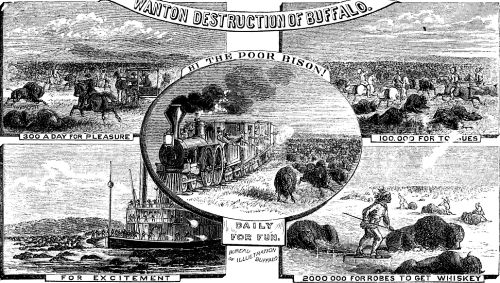
Below:  Let's kill all the buffalo...because they're there!

June 13, 2010

Savage electronics in Radio Shack ad

Radio Shack has a new commercial out just in time for Father's Day. It's titled Shipwreck.


Blogger Stephen Bridenstine, who brought this to my attention, shares his thoughts on it:

Electronic Handheld Island IndiansThe RadioShack commercial plays on the classic stereotype of the tropical island savage. This stereotype says that people living on isolated tropical islands are primitive, unsophisticated natives ready to either cook and eat or worship the first white guy who washes ashore.

It has been worked and reworked in literature, film, and television for centuries. Ever since the first Europeans set foot in the Caribbean and the South Pacific, we have heard tales of half-naked, blood-thirsty, idol-worshiping savages that have lit our imaginations on fire. These tales of encounters between civilization and savagery are so powerful, they will probably never go away.

These same tales also serve to reinforce stereotypes about native people. While it is easy to laugh away these stereotypes as silly ideas about far away people from some long lost past, the truth is they still affect the way we deal with real people today. Ask yourself, how much do you know about the native peoples of the Caribbean or South Pacific? How many of your responses can be traced to something you saw in a movie or on TV?

Lastly, these advertisements once again demonstrate America's cultural obsession with the exotic Other. Whether they be natural/spiritual Indians or cannibalistic savages, our culture can't help but keep drawing on those Indians.
Comment:  First let's try to place the ad. Hmm...the island could be any tropical island. The spear-waving "electronics" could be any generic savages. The giant heads suggest Easter Island, of course. But the white guy and the Radio Shack brand suggest a Caribbean island near the US. So it's fair to discuss these savages as Native analogues.

Note that the white guy is afraid until he sees the giant heads of himself. The implication is that the island "Dadtopia" is a utopia where Dad rules. In other words, the primitive "electronics" serve the white master. Even when the savage is a multifaceted computer gadget, the white man is more civilized.

White man always better

These ads are the opposite of the Zagar and Steve ads I wrote about a few years ago. In that case, the "primitive" Amazon Indian had to function in the modern world. Here the modern man has to function in the primitive world.

Yet in both cases, the white man comes off as superior. Funny how advertisers can't envision a scenario in which the Natives have the upper hand.

In reality, the white man probably would die on a desert island. If he encountered Natives, they'd treat him as a guest or take him prisoner. It's unlikely they'd worship him--a poor wretch who couldn't fend for himself. More likely they'd laugh at him for being as helpless as a baby.

For more on the subject, see Cannibals of the Caribbean and Indians as Cannibals.

May 22, 2009

Pelegostos in Pirates

A posting on the cannibals in Pirates of the Caribbean: Dead Man's Chest,which aired this week on TV:"Ma boogie snickle-snickle. Toot de suite, come on!"
―Jack Sparrow speaking the Pelegostos language

The Pelegostos were a tribe of cannibals native to Pelegosto.

Culture

"The feast is about to begin. Jack's life will end when the drums stop."
―Joshamee Gibbs

The Pelegostos were a warlike people, and relished the taste of "long pork," or human flesh. Sailors were known to trade valuable spices for long pork, and some may even have lured unwitting victims onto the island.

Behind the scenes

  • Around 130 members of the Kalinago Nation—the original inhabitants of many Caribbean islands—were used as extras in the Pelegostos scenes.

  • Walt Disney Pictures has been questioned by the National Garifuna Council, a representative body of the Garifuna people, for what they feel is a racist portrayal of the Calinago, or Caribs, as cannibals in Dead Man's Chest. The Council called for what they considered to be a fair and accurate representation, and Disney responded that the script could not be altered. No known changes were made to the film regardless of the council's concern.
  • Comment:  For more on the subject, see Picking on Pirates and Pirates Parodies Indians.

    October 02, 2008

    Anasazi Cannibal Woman for sale

    It was a bad week for the "Anazasi" (Ancestral Puebloans) but a good week for people profiting from them. To be specific, for people profiting from stolen Anasazi rock art and naked Anasazi female art.

    Anasazi back in the newsIt’s not often that the Anasazi break into the news anymore—the ancient people disappeared from their ancient homelands in the Great Basin and other western regions, including what is now southern Nevada, in the 12th or 13th centuries. But they hit the news twice last week.

    A federal land management plan drew fire for exposing Anasazi ruins in southeastern Utah to hikers, cyclists and off-roaders by changing their Bureau of Land Management designation from “areas of critical environmental concern” to “special recreation-management areas.” Protests can be lodged with the BLM.

    And Ebay has posted a sale of a painting purportedly of an Anasazi woman by painter Thomas Baker. The accompanying text emphasizes a cannibalism theory about the Anasazi. The painting portrays a svelte and shapely woman and could be an airbrushed Playboy image if it weren’t for the two human skulls between her legs. Shayne del Cohen of Reno, an activist on Native American issues, calls it “a disturbing image.”
    Here's more on the painting from its eBay listing:History and art combine in this original, museum-quality print of an oil painting by the noted artist and archaeologist Thomas Baker (the painting may be seen at his website thomasbakerpaintings.com. where it and other original oil paintings may be purchased, and portraits commissioned). This print is 11 X 14 inches, unframed, print #14 of an edition of 500. It is direct from the artist and cannot be bought anywhere else. Entitled "Anasazi Kitchen," it shows an Anasazi Indian cannibal woman stewing skulls by firelight in an underground pithouse (the Anasazi were prehistoric Native Americans living in what is now the southwestern United States). The composition contrasts the beauty of the human female form with the horror of violent death and cannibalism, and is historically accurate in every detail (the artist also holds a Master's Degree in archaeology).

    Apparently a favorite Anasazi method of cooking a human body was to chop it into small pieces which could fit into a pot of boiling water. As the lumps of meat containing bone tumbled around in the boiling water, the bone rubbed against the insides of the pot, and thereby acquired a characteristic type of abrasion that archaeologists call “pot polish.” Pot-polished human bone fragments are a common find at Anasazi dig sites.
    Comment:  I believe the painting in question is below. If it's not clear this painting is promoting the cannibalism theory, the title makes it clear: "Anasazi Cannibal Woman (nude) limited edition print."

    Unfortunately for Baker, the evidence isn't as clearcut as he thinks:

    Researchers Divided Over Whether Anasazi Were CannibalsArchaeologists argue bitterly over whether the ancient Anasazi, the ancestors of today's Pueblo Indians, routinely killed and ate each other. From one point of view, the evidence seems overwhelming: piles of butchered human bones, some of which were apparently roasted or boiled. In one instance, ancient human feces even seem to contain traces of digested human tissue.

    But from another standpoint, Anasazi cannibalism doesn't make sense. Eating people obviously isn't part of modern Pueblo culture, and local tribes are deeply offended by the suggestion that their Anasazi ancestors may have been cannibals. Many researchers argue that the marks attributed to flesh-eating could instead be created during slightly less gruesome activities, such as the public execution of suspected witches.
    Dying for dinner?

    A debate rages over desert cannibalismSome archaeologists and Indians accuse Turner of recklessly ignoring native beliefs. "One of the worst things you can do in Pueblo society is to eat flesh," says Andrew Darling, an archaeologist with the Gila River Indian Community in Arizona. "That's how you become a witch, and the penalty for witches is death." Suspected Pueblo witches were killed and their corpses ravaged to find the so-called evil heart. Darling believes those actions could leave the same bone signature as cannibalism. He says Turner's theory revives racist stereotypes of savage Indians.

    Other archaeologists point out that little is known about how the Anasazi normally treated their dead. Standard burial practices could have caused the skeletal damage ascribed to cannibalism. Ventura Perez, a doctoral student at the University of Massachusetts-Amherst, found faint marks around the jaws of some of Turner's skulls. Perez suspects the marks are light because the skulls had been stripped long after the flesh had begun to decompose–suggesting that meat removal was a burial practice.

    Peabody's LeBlanc thinks a more likely explanation is that the Chaco Anasazi brutalized a subclass of their own people. Healed bone fractures suggest that many Anasazi were beaten repeatedly. Others were dumped on garbage heaps after they died. And still others may be Turner's cannibal victims, butchered like game animals but not necessarily served for dinner.
    So Baker went for the worst interpretation of the data in his painting. And he portrayed the woman's breasts because, well, sex and controversy sell. Nice.

    September 03, 2008

    Crusoe and cannibals on TV

    Once again, Indians get the shaft on TV. If they're not portrayed as rogues, savages, or people without culture, they're omitted altogether.

    Fall TV preview:  New shows for fallTHURSDAY

    “Crusoe” (NBC)
    Premieres 7 p.m., Oct. 17
    Genre: Action-adventure drama
    Description: A retelling of the classic Daniel Defoe tale, with Robinson Crusoe washing up on the shores of a desert island and attempting to survive with the help of his friend Friday.
    CrusoeFrom Power, Muse and Moonlighting Films comes an ambitious adaptation of Daniel Defoe's masterpiece, "Crusoe," a new NBC primetime series for a 21st Century audience. Following the novel and its treasured tale of adventure, this high-action, fast-paced, thirteen-part series will combine for the first time the pace and energy of network television while remaining faithful to the author's original classic story.

    "Crusoe" explores the perils and challenges facing the world's most famous castaway as Crusoe (Philip Winchester, "Flyboys," "Thunderbirds") and his native friend Friday (Tongayi Chirisa) struggle to survive on a desert island with little more than their wits. Overcoming marauding militias, hungry cannibals, wild cats, starvation and apocalyptic lightning storms, Crusoe dreams of the day he will be reunited with his beloved family.

    Allowed to develop away from the bonds of 17th Century life, the ingenious Crusoe builds a breathtaking and altogether modern home high up in the trees to elude his enemies. Friday and Crusoe's deep friendship is pushed to the limit as opportunities to escape their island paradise, and the people they meet there, consistently challenge them to choose between loyalty and freedom.
    Robinson Crusoe pilot coming to NBCNBC is going classic, with a twist. The network has ordered 13 episodes of a new drama series based on the Daniel Defoe classic Robinson Crusoe. This is far from the first time Defoe's 1719 novel has been filmed. The most recent incarnation was a 1997 Pierce Brosnan feature. In 1964, it was the basis for a French TV series.

    This version is going to be a new take on the old story of a man who sets sail from England, his ship is wrecked in a storm and he's thrown overboard winding up alone on a deserted island where he has to fen for himself. In time, he is joined by an escaped slave whom he names Friday. Ben Silverman, NBC's head honcho, described the proposed series in this way: "It's part MacGyver, part contemporary morality tale about race and personal discovery, part comedy and part Castaway meets Survivor." As envisioned, this Robinson Crusoe will need to be clever indeed. It's going to keep the time period 1650s, but when Crusoe finds Friday, he'll presumably be treating him as if it were today with regard to race relations.
    Comment:  A few major problems with this adaptation. For one, Friday was a Caribbean Indian, not an escaped black slave. For another, the "cannibals" in Robinson Crusoe ate only prisoners of war. According to the text, they didn't harm other Natives or white men who hadn't attacked them first.

    So the latest version of Crusoe eliminates the good Indian and emphasizes the "bad" Indians. What else is new? We saw similar distortions of real and literary history in Bury My Heart at Wounded Knee and Comanche Moon.

    Once again, Latin American Indians get stereotyped as killers and cannibals. If they live anywhere in the vicinity of the Caribbean Sea, it's a good bet they'll sacrifice their victims and eat the remains. These Indians didn't build complex cities or civilizations, they munched people.

    Incidentally, the word "hungry" in NBC's description is flatly wrong. No Indians practiced cannibalism routinely because they were hungry. If they did it, they did it as a religious ritual akin to eating the body of Christ. By ingesting their enemies, they hoped to gain power from them.

    This apparent bastardization of Defoe's novel is especially annoying to me because I've read it several times. Along with The Wizard of Oz, Stand by for Mars (the first book in the "Tom Corbett, Space Cadet" series) and Robert Heinlein's Tunnel in the Sky, it was one of my childhood favorites. It probably was one of the subtle influences that led me to specialize in Indians and multiculturalism.

    For more on the subject, see The Best Indian Books.

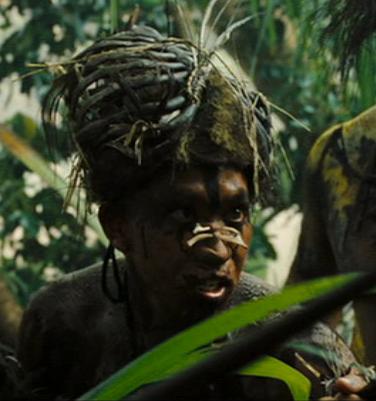
    Below:  Friday the non-Native (Tongayi Chirisa on NBC's Crusoe).