Showing posts with label values. Show all posts

October 08, 2015

The White Privilege of Cows

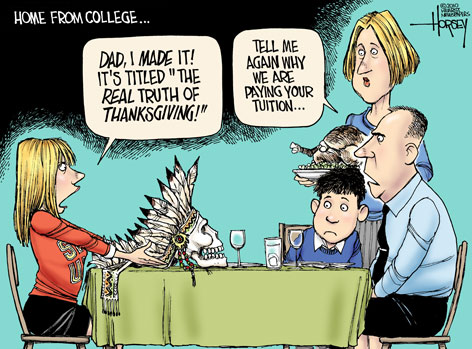
Brown Student Newspaper Is Sorry For Op-Ed Offensive To Native Americans

Native Americans' ancestors were slaughtered, but they should be thankful anyway, the op-ed suggested.

By Amy Anthony
The Brown University campus newspaper apologized Wednesday after publishing what it says were two "deeply hurtful" and racist columns.

The Brown Daily Herald's editorial board published an editor's note saying it regretted the hurt caused by the two opinion columns, both written by student M. Dzhali Maier.

One titled "The white privilege of cows," which was published Monday, "invoked the notion of biological differences between races," while "Columbian Exchange Day," published Tuesday, argued that Native Americans should be thankful for colonialism, according to the editor's note.

"The white privilege of cows" column was left on The Herald's website "in an effort to be transparent," according to an editor's note later added to it. The "Columbian Exchange Day" column was removed and replaced by an editor's note. That column was "unintentionally published due to an internal error," according to the note. It was online for about an hour before it was taken down.
Maier's first controversial op-ed:

Ivy League Student Paper: Native Americans Should be Thankful for Columbus

The Daily Herald has published racist content three times in as many weeks.

By Amanda Girard
The White Privilege of Cows made the argument that European societies that developed agriculture were more capable than hunter-gatherer societies, and that a steady supply of crops and livestock allowed colonial empires to build up a military, develop technological advancements, and use those developments to sail the world in search of new lands to conquer.

Even though the concept of racial superiority has been repeatedly debunked, the author of the column went a step further. Maier suggested that native populations who were enslaved and systematically eradicated by these colonists ultimately benefited by assimilating into the agriculture-based lifestyle forced on them through colonial oppression, and that society was ultimately better off due to the technological developments that took place after colonization.

“Where is this all going? It is the strong who trample the weak, the rich who trample the poor,” Maier wrote. “Colonialism simply allows those who come from a history of being well-fed enough to let experimentation happen, conquering those who have not had that luck.”

The Brown University student also suggested that pre-colonial native populations were inferior due to not having domesticated animal populations. Maier’s op-ed also proposed the idea that colonists in Africa and the Americas did everyone a favor by taming and domesticating animals (after the enslavement and genocide of native populations, which was left out).

“It does stand as fact that English colonists in Africa were able to tame zebras to be ridden or driven,” Maier wrote. “It is also fact that wild animals in Africa and the New World were left untapped, while some wild Eurasian animals were domesticated.”


Analysis

Maier spends almost half this column talking about racial differences. She then switches to cultural differences, a completely different topic.

As noted in the first paragraph above, she talks about the amazing things accomplished by Near Eastern civilizations. One, the civilizations of the Americas produced many of the same things: agriculture, writing and math, art, religion, philosophy, architecture, astronomy, medicine, etc. Two, these accomplishments had nothing to do with racial characteristics. Maier talks about biology, but the only biology in play here is access to better crops and livestock.

Near the end, Maier asks whether the link between race and culture is correlation or causation. In her final paragraphs, she implies it's causation. For instance, British colonists domesticated zebras, she claims, whereas African natives couldn't.

But as Jared Diamond pointed out in Guns, Germs, and Steel, this is mostly wrong:

The Story of... Zebra and the Puzzle of African AnimalsPerhaps the most puzzling question Jared Diamond encounters as he investigates animal domestication is: Why were no large mammals ever domesticated in tropical Africa?

Africa, south of the Sahara, is home to the richest diversity of animal life on the planet, including some of the largest mammals on earth. So why did the Africans never domesticate the rhino? Why did they never farm the hippo? The elephant? Or the giant wildebeest? Perhaps most strangely of all, given the importance of the horse to European history, why did tropical Africans never domesticate their own species of wild horse, the zebra?

Zebra are closely related to the domesticated horse, sharing a genus (Equus) and a common ancestor. They stand nearly five feet at the shoulder, live in small family groups or herds, are sociable herbivores who breed well in public and live in harmony with their mammalian neighbors, like antelopes and wildebeest. They are even strong enough to carry an adult human on their backs.

Zebras are also notoriously difficult to catch. They have evolved superb early-warning mechanisms, such as peripheral vision far superior to other horses. Often bad tempered, they grow increasingly antisocial with age and once they bite, they tend not to let go. A kick from a zebra can kill—and these creatures are responsible for more injuries to American zookeepers each year than any other animal.

Pity the poor human, therefore, who might try to domesticate a zebra in the wild. During the colonial era, some adventurous Europeans tried to harness this African horse. Lord Rothschild famously drove a zebra-drawn carriage through the streets of Victorian London. Yet these creatures were never truly domesticated—they were never bred and sustained explicitly under human control.
Western Civ is best?

Maier is basically gushing about Western Civilization while pooh-poohing non-Western civilizations. There's no attempt at balance here--no mentions of European horrors such as the slave trade, the extermination of native populations, and the Holocaust. Her goal is to tout the superiority of white civilizations.

She tries to fudge this by referring to "Eurasians," but there are no specifics about the great cultures of China or India. With the notable exception of the Mongols, these civilizations did not try to colonize the world. Why not? Because being "well-fed" and "strong" like these Asian cultures doesn't necessarily lead to conquest.

What leads to conquest is a religious or philosophical belief that you're a chosen people who deserve to rule. That it's your God-given duty to bring the "light" of "civilization" to the dark (-skinned) corners of the globe. It's that kind of attitude that drove all the soul-crushing civilizations of Europe, including Rome, Britain, America, Germany, and the USSR.

For more on Western Civilization, see King Touts "Values Columbus Brought" and Alternatives to "Got Land?" Shirt.

June 15, 2015

To solve problems, change values


Exactly, which is why we fight for cultural change on every issue from religion to energy and the environment to race and gender. These issues are all connected to our core values, so changing our values is the core solution.

For more on our values, see America's Toxic Masculinity and America's Culture Based on Violence.

June 08, 2015

America's toxic masculinity

Here's a great article on our national cult(ure) of male dominance aka machismo:

Masculinity is killing men: The roots of men and trauma

By Kali HollowayDespite its logic-empty premise, our society has fully bought into the notion that the relationship between maleness and masculinity is somehow incidental and precarious, and embraced the myth that “boys must be turned into men…that boys, unlike girls, must achieve masculinity.”

Little boys internalize this concept early; when I spoke to Real, he indicated that research suggests they begin to hide their feelings from as young as 3 to 5 years old. “It doesn’t mean that they have fewer emotions. But they’re already learning the game—that it’s not a good idea to express them,” Real says. Boys, conventional wisdom holds, are made men not by merely aging into manhood, but through the crushing socialization just described. But Real points out what should be obvious about cisgender boys: “[they] do not need to be turned into males. They are males. Boys do not need to develop their masculinity.”

It is impossible to downplay the concurrent influence of images and messages about masculinity embedded in our media. TV shows and movies inform kids—and all of us, really—not so much about who men (and women) are, but who they should be. While much of the scholarship about gender depictions in media has come from feminists deconstructing the endless damaging representations of women, there’s been far less research specifically about media-perpetuated constructions of masculinity. But certainly, we all recognize the traits that are valued among men in film, television, videogames, comic books, and more: strength, valor, independence, the ability to provide and protect.

While depictions of men have grown more complicated, nuanced and human over time (we’re long past the days of “Father Knows Best” and “Superman” archetypes), certain “masculine” qualities remain valued over others. As Amanda D. Lotz writes in her 2014 book, Cable Guys: Television and Masculinities in the 21st Century, though depictions of men in media have become more diverse, “storytelling has nevertheless performed significant ideological work by consistently supporting…male characters it constructs as heroic or admirable, while denigrating others. So although television series may have displayed a range of men and masculinities, they also circumscribed a ‘preferred’ or ‘best’ masculinity through attributes that were consistently idealized.”

We are all familiar with these recurring characters. They are fearless action heroes; prostitute-fucking psychopaths in Grand Theft Auto; shlubby, housework-averse sitcom dads with inexplicably beautiful wives; bumbling stoner twentysomethings who still manage to “nail” the hot girl in the end; and still, the impenetrable Superman. Even sensitive, loveable everyguy Paul Rudd somehow “mans up” before the credits roll in his films. Here, it seems important to mention a National Coalition on Television Violence study which finds that on average, 18-year-old American males have already witnessed some 26,000 murders on television, “almost all of them committed by men.” Couple those numbers with violence in film and other media, and the numbers are likely astronomical.

The result of all this—the early denial of boy’s feelings, and our collective insistence that they follow suit—is that boys are effectively cut off from their feelings and emotions, their deepest and most vulnerable selves. Historian Stephanie Coontz has labeled this effect the “masculine mystique.” It leaves little boys, and later, men, emotionally disembodied, afraid to show weakness and often unable to fully access, recognize or cope with their feelings.
Comment:  As I've said before, Americans lionize manly men: explorers, pioneers, cowboys, cops, soldiers, action heroes, superheroes, and so forth. Heck, we capitalize the term "Founding Fathers" because of their secular but holy importance.

The consequences for indigenous people and other ethnic groups are profound. "Taming the wilderness," aka the Frontier Thesis, is our national myth. We're great because we hunted and killed savage beasts and Indians like virile cavemen providing for their mates.

We're still great because of our manly ability to defeat our enemies: Nazis, Japs, Commies, terrorists, disease, crime, drugs, etc. We wage war on people, places, and things until they're dead and gone because that's what men do. That's why we elected and reelected Bush and invaded Iraq and Afghanistan: to prove our manhood to ourselves.

Anyway, read the whole article. It's worth it.

For more on the subject, see America the Warrior Society and America's Cultural Roots.

Below:  Superman aka America's self-image.

February 26, 2014

King touts "values Columbus brought"

Rep. Steve King: Obama should impose Christendom on Latin America like Columbus

By Scott KaufmanLast night, Iowa Representative Steve King went before the House of Representatives and delivered a long speech in which, among other things, he bemoaned that President Obama doesn’t believe in “the pillars of American exceptionalism” as instantiated in “the values that Christopher Columbus brought here across the ocean.”

“It has caught my attention, Mr. Speaker, when I listen to the circumstances taking place in Venezuela, I can’t help but think about essentially the sister state of Cuba and how they have led the Marxist socialist regime in the Western Hemisphere since about 1959,” King said.

“I think of this Western Hemisphere, all of it, as the domain of, as Churchill described it from this hemisphere, Western Christendom; the foundation of Western civilization, Judeo-Christianity; the values that come from the Old and New Testament; the values that Christopher Columbus brought here across the ocean,” he continued.

The “values” that Columbus—who was sailing under the aegis of the Catholic Spanish monarchy—brought to what would become the Americas included the idea, as articulated in his own journals, that he could “conquer the whole of [the natives] with 50 men, and govern them as I pleased.” His pleasure involved the kidnapping and enslaving of native “Indians,” the majority of whom died on the return trip to Spain.
Comment:  So conquering and killing are the values that make America exceptional? Okay, if you say so, King.

I demolished a version of this argument in Multicultural Origins of Civilization. Among the stupidities in King's statement:

  • Judeo-Christian religion came from the Middle East, not Europe. As did most of the foundations of our civilization.

  • Remember the Spanish Inquisition? Europe consisted mainly of absolute monarchies and fanatical religions in Columbus's time. The United States was a revolution against the tyrannical European model, not an adoption of it.

  • The Spanish found Columbus's cruelty and barbarism so abhorrent that they threw him in jail after his third voyage. His murderous "values" were too inhuman even for the despots who hated and killed "heathens."

  • For more on Columbus, see Columbus Day Celebrates White Superiority and Columbus Day Celebrates Conquest.

    July 08, 2013

    America = Captain Ahab

    In a Nation in Decline, a Lust for Hatred

    By Chris HedgesThe most prescient portrait of the American character and our ultimate fate as a species is found in Herman Melville’s “Moby Dick.” Melville makes our murderous obsessions, our hubris, violent impulses, moral weakness and inevitable self-destruction visible in his chronicle of a whaling voyage. He is our foremost oracle. He is to us what William Shakespeare was to Elizabethan England or Fyodor Dostoyevsky to czarist Russia.

    Our country is given shape in the form of the ship, the Pequod, named after the Indian tribe exterminated in 1638 by the Puritans and their Native American allies. The ship’s 30-man crew—there were 30 states in the Union when Melville wrote the novel—is a mixture of races and creeds. The object of the hunt is a massive white whale, Moby Dick, which, in a previous encounter, maimed the ship’s captain, Ahab, by biting off one of his legs. The self-destructive fury of the quest, much like that of the one we are on, assures the Pequod’s destruction. And those on the ship, on some level, know they are doomed—just as many of us know that a consumer culture based on corporate profit, limitless exploitation and the continued extraction of fossil fuels is doomed.

    “If I had been downright honest with myself,” Ishmael admits, “I would have seen very plainly in my heart that I did but half fancy being committed this way to so long a voyage, without once laying my eyes on the man who was to be the absolute dictator of it, so soon as the ship sailed out upon the open sea. But when a man suspects any wrong, it sometimes happens that if he be already involved in the matter, he insensibly strives to cover up his suspicions even from himself. And much this way it was with me. I said nothing, and tried to think nothing.”

    We, like Ahab and his crew, rationalize madness. All calls for prudence, for halting the march toward environmental catastrophe, for sane limits on carbon emissions, are ignored or ridiculed. Even with the flashing red lights before us, the increased droughts, rapid melting of glaciers and Arctic ice, monster tornadoes, vast hurricanes, crop failures, floods, raging wildfires and soaring temperatures, we bow slavishly before hedonism and greed and the enticing illusion of limitless power, intelligence and prowess. We believe in the eternal wellspring of material progress. We are our own idols. Nothing will halt our voyage; it seems to us to have been decreed by natural law. “The path to my fixed purpose is laid with iron rails, whereon my soul is grooved to run,” Ahab declares. We have surrendered our lives to corporate forces that ultimately serve systems of death. Microbes will inherit the earth.

    In our decline, hatred becomes our primary lust, our highest form of patriotism and a form of eroticism. We are made supine by hatred and fear. We deploy vast resources to hunt down jihadists and terrorists, real and phantom. We destroy our civil society in the name of a war on terror. We persecute those, from Julian Assange to Bradley Manning to Edward Snowden, who expose the dark machinations of power. We believe, because we have externalized evil, that we can purify the earth. We are blind to the evil within us. Melville’s description of Ahab is a description of the bankers, corporate boards, politicians, television personalities and generals who through the power of propaganda fill our heads with seductive images of glory and lust for wealth and power. We are consumed with self-induced obsessions that spur us toward self-annihilation.
    Comment:  For more on Indians and Moby Dick, see Queequeg the Indian? and Tashtego in Moby-Dick.

    January 28, 2013

    Native values in Assassin's Creed 3

    An analysis goes deeper into Assassin's Creed 3's Native history and culture than previous postings have done:

    Indigenous Representations in Assassin’s Creed III

    By Beth Aileen DillonFeminine Strength: Kaniehti:io (Connor’s Kanien’kehá:ka mother) is an intelligent, suspicious, and tactical woman who helps to free enslaved “Natives,” arranges alliances across Indigenous nations, and saves the life of Haytham Kenway (by being totally badass and strong herself).

    Ubisoft does still occasionally get iffy, like the Clan Mother who gets too close to the “Mystic Savage” trope in her shamanistic powers and tone. However, given the Assassin’s Creed series’ science fiction time traveling storyline, the elder’s knowledge of the “portal” adds an element to the growing recognition of Indigenous science fiction.

    The game generally has an anti-colonialist tone. Kaniehti:io rightfully doesn’t trust Haytham. Even the non-player characters question their role, such as a British soldier who comments about the expedition: “Slap a fancy name on something and all is excused.” Interestingly, the game is mindful of (what to the Anishinaabe is known as) Weendigo nature of the colonizers—Weendigo being a spirit of endless consumption that can enter someone prone to that way of being and mount to cannibal nature. As a youth, Connor predicts of westward expansion: “In time they will swallow us whole.” Haytham, being self-reflective, states, “We’re cruel and desperate creatures, set in our conquering ways” and acknowledges his own “desire for more, and more, and more.” Kaniehti:io worries about the “same dark hunger” being passed down in her son.

    Overall, the game balances the bloodiness necessary for a game about assassination with Indigenous ways of knowing, such as when Connor points out when hunting, “We must return nature’s kindness with our own.”

    Props to Ubisoft and Aboriginal Territories in Cyberspace for these strides.
    Comment:  For more on Assassin's Creed 3, see Assassin's Creed 3's Mohawk Advisers and Noah Watts as Mohawk Assassin.

    December 24, 2012

    America's culture based on violence

    Some postings put America's mass shootings by angry men into context.

    Celebrating the Prince of Peace in the Land of Guns

    By Michael MooreI am sorry to offer this reality check on our much-needed march toward a bunch of well-intended, necessary–but ultimately, mostly cosmetic–changes to our gun laws. The sad facts are these: Other countries that have guns (like Canada, which has 7 million guns–mostly hunting guns–in their 12 million households) have a low murder rate. Kids in Japan watch the same violent movies and kids in Australia play the same violent video games (Grand Theft Auto was created by a British company; the UK had 58 gun murders last year in a nation of 63 million people). They simply don't kill each other at the rate that we do. Why is that? THAT is the question we should be exploring while we are banning and restricting guns: Who are we?

    I'd like to try to answer that question.

    We are a country whose leaders officially sanction and carry out acts of violence as a means to often an immoral end. We invade countries who didn't attack us. We're currently using drones in a half-dozen countries, often killing civilians.

    This probably shouldn't come as a surprise to us as we are a nation founded on genocide and built on the backs of slaves. We slaughtered 600,000 of each other in a civil war. We "tamed the Wild West with a six-shooter," and we rape and beat and kill our women without mercy and at a staggering rate: every three hours a women is murdered in the USA (half the time by an ex or a current); every three minutes a woman is raped in the USA; and every 15 seconds a woman is beaten in the USA.

    We belong to an illustrious group of nations that still have the death penalty (North Korea, Saudi Arabia, China, Iran). We think nothing of letting tens of thousands of our own citizens die each year because they are uninsured and thus don't see a doctor until it's too late.

    Why do we do this? One theory is simply "because we can." There is a level of arrogance in the otherwise friendly American spirit, conning ourselves into believing there's something exceptional about us that separates us from all those "other" countries (there are indeed many good things about us; the same could also be said of Belgium, New Zealand, France, Germany, etc.). We think we're #1 in everything when the truth is our students are 17th in science and 25th in math, and we're 35th in life expectancy. We believe we have the greatest democracy but we have the lowest voting turnout of any western democracy. We're biggest and the bestest at everything and we demand and take what we want.

    And sometimes we have to be violent m*****f*****s to get it. But if one of us goes off-message and shows the utterly psychotic nature and brutal results of violence in a Newtown or an Aurora or a Virginia Tech, then we get all "sad" and "our hearts go out to the families" and presidents promise to take "meaningful action." Well, maybe this president means it this time. He'd better. An angry mob of millions is not going to let this drop.

    While we are discussing and demanding what to do, may I respectfully ask that we stop and take a look at what I believe are the three extenuating factors that may answer the question of why we Americans have more violence than most anyone else:

    1. POVERTY. If there's one thing that separates us from the rest of the developed world, it's this. 50 million of our people live in poverty. One in five Americans goes hungry at some point during the year. The majority of those who aren't poor are living from paycheck to paycheck. There's no doubt this creates more crime. Middle class jobs prevent crime and violence. (If you don't believe that, ask yourself this: If your neighbor has a job and is making $50,000/year, what are the chances he's going to break into your home, shoot you and take your TV? Nil.)

    2. FEAR/RACISM. We're an awfully fearful country considering that, unlike most nations, we've never been invaded. (No, 1812 wasn't an invasion. We started it.) Why on earth would we need 300 million guns in our homes? I get why the Russians might be a little spooked (over 20 million of them died in World War II). But what's our excuse? Worried that the Indians from the casino may go on the warpath? Concerned that the Canadians seem to be amassing too many Tim Horton's donut shops on both sides of the border?

    No. It's because too many white people are afraid of black people. Period. The vast majority of the guns in the U.S. are sold to white people who live in the suburbs or the country. When we fantasize about being mugged or home invaded, what's the image of the perpetrator in our heads? Is it the freckled-face kid from down the street–or is it someone who is, if not black, at least poor?

    I think it would be worth it to a) do our best to eradicate poverty and re-create the middle class we used to have, and b) stop promoting the image of the black man as the boogeyman out to hurt you. Calm down, white people, and put away your guns.

    3. THE "ME" SOCIETY. I think it's the every-man-for-himself ethos of this country that has put us in this mess and I believe it's been our undoing. Pull yourself up by your bootstraps! You're not my problem! This is mine!

    Clearly, we are no longer our brother's and sister's keeper. You get sick and can't afford the operation? Not my problem. The bank has foreclosed on your home? Not my problem. Can't afford to go to college? Not my problem.

    And yet, it all sooner or later becomes our problem, doesn't it? Take away too many safety nets and everyone starts to feel the impact. Do you want to live in that kind of society, one where you will then have a legitimate reason to be in fear? I don't.

    I'm not saying it's perfect anywhere else, but I have noticed, in my travels, that other civilized countries see a national benefit to taking care of each other. Free medical care, free or low-cost college, mental health help. And I wonder–why can't we do that? I think it's because in many other countries people see each other not as separate and alone but rather together, on the path of life, with each person existing as an integral part of the whole. And you help them when they're in need, not punish them because they've had some misfortune or bad break. I have to believe one of the reasons gun murders in other countries are so rare is because there's less of the lone wolf mentality amongst their citizens. Most are raised with a sense of connection, if not outright solidarity. And that makes it harder to kill one another.


    In Europe, fewer mass killings due to culture not guns

    By Oren DorellThe USA leads the world in gun ownership, but it's our individualistic culture that puts us at greater risk of mass shootings compared with other countries where guns are prevalent, according to a British criminologist who has studied gun violence in different nations.

    Mass shooters in any nation tend to be loners with not much social support who strike out at their communities, schools and families, says Peter Squires of the University of Brighton in the United Kingdom, who has studied mass shootings in his own country, the United States and Europe.

    Many other countries where gun ownership is high, such as Norway, Finland, Switzerland and Israel, however, tend to have more tight-knit societies where a strong social bond supports people through crises, and mass killings are fewer, Squires said.

    "In a sense they're less private" than in the USA, "but privacy and individualism is where some of the causes of crime and revenge can be found," he said.

    "What stops crime above all is informal social controls," he says. "Close-knit societies where people are supported, where their mood swings are appreciated, where if someone starts to go off the rails it's noted, where you tend to intervene, where there's more support."

    Squires favors controls on gun ownership but says there's more to mass killings than the prevalence of guns.
    One missing point from Dorell's analysis: Gun regulations not only prevent some deaths, they help foster a culture in which guns don't equate to manhood.

    It's similar to what happened with cigarette smoking and drunk driving. When you collectively pass laws against them, people start getting the idea that they're bad, not good. It shifts the national dialogue on what's acceptable or not.

    Blame the Bible

    Another column traces our Euro-Christian culture back to the Bible:

    Does the Bible make Americans more violent?

    Our love-hate-love affair with violence goes way back--perhaps as far as the Old Testament

    By Valerie Tarico
    Our peculiar hierarchy of priorities may be due in part to the influence of Abrahamic religion on Western Civilization and the unique standing accorded to the Bible in American Christianity specifically. The Bible amalgamates the mythology and legal codes of a specific kind of culture: a clan-based tribal society in which herdsmen struggling for survival in an arid and increasingly denuded environment. Males competed to control females and territory while maintaining the purity of bloodlines and inheritance; gods that were modeled on warlords competed for fealty. Consequently, while codes governing sexuality and blasphemy were strict, codes governing violence were complicated.

    Yahweh himself originated as a war god. Non-Hebrews were regarded with hostility and indeed, much of the founding story of the Israelite people comprises tales of triumphal genocide. The violence in in the Bible is so extreme that it defines vast portions of the book:[Edmund Leach] looked at the Bible through the eyes of a communications engineer and asked: what message are these authors trying to get through to the reader? The answer, Leach thought, was that they were trying to obscure the fact that mankind began through incest (Adam and Eve) and so the strategy was to compile a list of atrocities so heinous that, in the end, the original incest would come to look like a harmless act.Whether history or mythology or some fusion of the two, the Bible stories, when tallied, include an estimated 25 million violent deaths. And yet, like any people, the internal narrative of God’s Chosen Ones is one of yearning for peace and prosperity, the dream of an idyllic past in which the lion lay down with the lamb; an idyllic future in which men will beat their swords into plowshares and the lamb and lion will lie down together again.

    Like the ancient Israelites, we Americans see ourselves as peacemakers. During the midwinter holiday season, Peace on Earth is sung from choir lofts and hung in shopping malls. We complain about our role as “policeman to the world.” And yet, if we could see ourselves as others see us, we would see a people who, like the ancient Israelites have created unparalleled archetypes of violence: the Rambo, the mushroom cloud, the Tommy Gun, the Cowboy. Hollywood ensures that, even independent of the world’s best funded military, violence is one of our top exports.
    Comment:  I wrote about America's penchant for macho heroes--cowboys, gangsters, soldiers, et al.--in Why Write About Superheroes? Check it out.

    For more on the subject, see Mass Shooters Think They're Victims, Gun Nuts Need "Man Card," and Changing Our Gun Culture.

    December 23, 2012

    Mass shooters think they're victims

    How America’s toxic culture breeds mass murder

    Mass shooters in the U.S. are almost always men—angry men who can get guns more easily than mental health care

    By Andrew O'Hehir
    I was actually surprised to learn that there was one female mass shooter in recent American history, a disgruntled postal worker in Goleta, Calif., who shot a neighbor and several co-workers. But the other 61 people who have so tragically acted out their twisted private fantasies on people around them have all been male. While some element of sexual or misogynistic drama was frequently involved–a mother or ex-wife or girlfriend; a rejection or divorce or suggestions of closeted homosexuality–the one thing you can point to in almost every case is perceived humiliation.

    Over and over again you read stories of workplace shootings–at technology companies, aircraft factories, day-trading firms, fast-food franchises, maintenance yards and (infamously) post offices–in which some guy who got fired or lost a promotion or generally felt that everybody hated him goes and gets a gun, or several, and acts out his revenge fantasy. Of course there’s no possible justification for such an act, and it seems reasonable to conclude that anybody who shoots a lot of people has suffered a mental breakdown, probably one with deep roots and multiple causative factors. Nonetheless I suspect that economic realities play a role. It’s plausible that these grotesque events are by-products of the downward pressure on wages, especially in the working class and lower fringes of the middle class, and reflect what has sometimes been called the “crisis of masculinity,” meaning the perceived emasculation and loss of privilege felt by some men in an age of increasing sexual equality.
    What Drives Suicidal Mass Killers

    By Adam LankfordThere appears to be a triad of factors that sets these killers apart. The first is that they are generally struggling with mental health problems that have produced their desire to die. The specific psychiatric diagnoses vary widely, and include everything from clinical depression and post-traumatic stress disorder to schizophrenia and others forms of psychosis. The suicide rate was 12.4 per 100,000 people in the United States in 2010 (the highest in 15 years). Suicide is relatively rare, but it is rarer still in most Muslim countries. This is a very limited pool from which most suicide terrorists and rampage shooters come.

    The second factor is a deep sense of victimization and belief that the killer’s life has been ruined by someone else, who has bullied, oppressed or persecuted him. Not surprisingly, the presence of mental illness can inflame these beliefs, leading perpetrators to have irrational and exaggerated perceptions of their own victimization. It makes little difference whether the perceived victimizer is an enemy government (in the case of suicide terrorists) or their boss, co-workers, fellow students or family members (in the case of rampage shooters).

    The key is that the aggrieved individual feels that he has been terribly mistreated and that violent vengeance is justified. In many cases, the target for revenge becomes broader and more symbolic than a single person, so that an entire type or category of people is deemed responsible for the attacker’s pain and suffering. Then, the urge to commit suicide becomes a desire for murder-suicide, which is even rarer; a recent meta-analysis of 16 studies suggests that only two to three of every one million Americans commit murder-suicide each year.

    The third factor is the desire to acquire fame and glory through killing. More than 70 percent of murder-suicides are between spouses or romantic or sexual partners, and these crimes usually take place at home. Attackers who commit murder-suicide in public are far more brazen and unusual. Most suicide terrorists believe they will be honored and celebrated as “martyrs” after their deaths and, sure enough, terrorist organizations produce martyrdom videos and memorabilia so that other desperate souls will volunteer to blow themselves up.
    Comment:  For more on why white boys keep shooting, see Time to Profile White Men? and Why Americans Keep Killing.

    Gun nuts need "man card"

    Advertisements confirm that spree shooters and other gun nuts are using firearms to prove their manhood.

    Assault rifle company issues “man cards”

    The maker of the assault weapon that killed 27 people in Connecticut quizzes its customers on their manhood

    By Alex Seitz-Wald
    There are lots of reasons to own guns: Hunting, self-defense, clinging purposes, but also to bolster your deflated sense of masculinity. This is not some glib liberal notion about how men only buy guns to compensate for their inadequacies, this is the explicit aim of an ad campaign from Bushmaster, the maker of the assault rifle that was used to kill 27 people last week in Connecticut.

    You see, you’re not officially a man until Bushmaster tells you you are. “To become a card-carrying man, visitors of bushmaster.com will have to prove they’re a man by answering a series of manhood questions. Upon successful completion, they will be issued a temporary Man Card to proudly display to friends and family,” a press release for the campaign reads.
    Not man enough? Buy a gun

    By Paul Waldman[I]f you're anxious about your masculinity, if you aren't quite sure whether those around you find you sufficiently strong and potent, the Bushmaster corporation has an answer for you. If you buy one of their semi-automatic rifles--like the kind Adam Lanza used to murder 20 children and six adults last week--you may "Consider your Man Card reissued."

    That's the message of ads the company has been running, along with a particularly ridiculous social media campaign. Until today--the page has apparently been taken down, but parts of it are visible here--you could learn on the "Man Card" section of Bushmaster's website that "In a world of rapidly depleting testosterone, the Bushmaster Man Card declares and confirms that you are a man's man." Then you could fill out a little form to bust on your buddies for not being manly enough, to "Revoke a Man Card." Just enter a brief description of the offense and put it into one of five categories: "Cry baby," "Cupcake," "Short leash," "Coward," or "Just unmanly."

    The symbol for the last is the female restroom icon (a stick figure wearing a dress), but "Short leash" gets some of the best action, like "Steve A. missed a much-anticipated poker night to attend a movie musical instead," or "Heath K, where 'Yes I will' always becomes 'If she'll let me.' " All it takes to get that Man Card back is to get yourself a Bushmaster.
    You don't have to be a Freudian analyst to grasp the hidden meaning. It's not even subtext--it's text. As we begin a long-overdue examination of where gun culture in America has gone, we can't avoid the way guns have become so entwined with masculine anxiety, as so many men seek to find their identity in instruments of destruction.

    This isn't particularly new, of course. Male anxiety has produced backlashes before, enacted through our fantasies as the world changes and tradition gender roles are challenged. A 1959 cover story in Time magazine described how at that time there were no fewer than 30 westerns on the three networks in prime time. For the post-war American male, an office job and a house in the suburbs offered few opportunities to prove one's manhood, so tales of two-fisted cowboys wielding six-guns became irresistible. "How long since you used your fists?" Time quoted one sociologist saying by way of explanation of the western's popularity. "How long since you called the boss an s.o.b? The western men do, and they are happy men."


    As author Tim Wise put it:Here's what: right wingers wouldn't support ban on guns even if it were possible and would WORK…they fetishize guns as substitute manhood.Or as I put it:

    Can we put all the gun nuts in a reality show a la The Hunger Games and let the best man win? That's really what they want, isn't it?

    For more on gun control, see Changing Our Gun Culture and Sensible Gun Control.

    December 19, 2012

    Changing our gun culture

    Changing our gun laws are about changing the perception of guns as much as reducing access to them. Long-term, changing the perception may do more than any particular laws.

    As some people have said, we need to make guns the new cigarette or drunk driver--i.e., a social pariah without mainstream support. When that happens, gun deaths will become a small and manageable problem.

    Here's a column that makes a similar point.

    Death to all guns

    By Mark MorfordIs it time? Can we just say it outright? Let’s try it:

    Guns are, socially and ethically, devastating. Worthless. They add nothing of positive, intrinsic value to a culture, a people, a country. They only diminish, destroy, display an awesome sense of malformed ego and disastrously warped humanity.

    Too much? Too far? Not really. I’m sure you already sense that all those cartoonish action movies, thuggish hip-hop songs, clunky old westerns, ultra-violent video games and the racks of high-caliber weaponry over at Cabela sporting goods and the local gun show – all of which we’ve been led to believe are so essential to our national identity – none of them offer anything of deep worth to the culture; no authentic masculinity, no real patriotism, no genuine power or strength or class. Heart, soul or integrity? Don’t be absurd.

    It’s all a vulgar illusion, Hollywood glitter-bombing, manufactured mythology in service of shameless capitalism and a false, bloody American ideology that’s never served us well and only made us the ugly, violence-drunk stepchild of the civilized world. Don’t you already know?

    Here is the truth: Guns are pain. Guns are impotence masquerading as virility, shame masquerading as valor, the devil disguised as an outrageously misinterpreted chunk of the Constitution that was never meant to suffer what the fat lords of the gun lobbies have made it suffer.

    Do you wish to speak of false gods? Things virulently anti-Christian? The antithesis of everything a peaceful, advanced country is ideally supposed to be founded on? Because guns are all that and more. Jesus would be disgusted.

    Perhaps you think guns and the current cluster of feeble laws on the books are generally fine, and it’s the mental health industry that needs the help? Perhaps you think Sandy Hook, Aurora, Colorado, Virginia Tech, et al could be better prevented by improved treatment for the mentally ill?

    Maybe. But a culture of gun fanaticism feeds insanity. Put the other way: insanity loves guns. They are interlinked and inextricable. Too-easy access to guns is a huge part of the problem, but even bigger is the gun fetishism so brutally interwoven into our society and popular culture, from childhood on up, that provides the hateful lie that guns aren’t just macho and all-American, they’re downright required for ensuring your sadism is remembered forever.

    Sandy Hook isn’t just about mental illness. It’s about mental illness shot through with endless images of ultra-violence and 300 million guns currently in American hands. It’s about insanity allowed to multiply its destructive powers by a factor of 61 mass murders in the past 30 years. It’s about gun-loving survivalist mothers of mentally ill kids stockpiling weapons for herself, teaching her kids to shoot, preparing for society’s collapse, all surely fed by right-wing fearmongers and idiots.

    Do not misunderstand. I’m well acquainted with the sporting thrill. I know the supposed nobility and beauty to be found in ethical and honest hunting (which I believe still exists, despite the canned hunts and the repulsive Texas exotic game preserves). I know the outright fun to be had shooting beautifully made, powerful weaponry at paper targets, clay pigeons, bottles and beer cans out in the woods. I get it.

    Do you know what else is fun? Piloting tanks into buildings. Shooting meth. Driving my car 150 MPH through busy streets, drunk. Throwing bowling balls off of skyscrapers and watching them demolish parked cars 300 feet below. Smashing windows with metal bats. Joining a Venezuelan rebel militia.

    This does not mean we should indulge in them, or that they deserve a prized place in society. This does not mean the tiny adrenaline rush afforded by gun sports is worth the overall cost, or is in some way unique or precious, and therefore must be defended by men so terrified of losing their thin hold on masculinity that they must strap firearms to their giant bellies to go to Wal-Mart, just in case the terrorists want to steal their ‘97 Corolla.

    Shall we ask the NRA and the gun lobby to prove it? If they have any evidence that guns are the slightest bit helpful or necessary to human development, progress, industry, spiritual development, love, family? Has any culture in the history of the civilized world ever evolved toward more munitions and antipathy, and flourished, healthy, calm and full of love?

    Of course not. There is no single argument for guns that holds up, that makes any sense whatsoever, that cannot easily be disproven by fact, ancient spiritual wisdom, or common sense.

    Guns do not protect more than they destroy. They do not save more lives than they kill. They do not safeguard more families than they devastate. They do not add security more than they add fear, suspicion, antagonism and hate. As has been pointed out again and again: Guns, by their very existence, insist on their own use. And their use is, singularly and without reservation, death.

    So let us fantasize. Let us leave the talk of “reasonable” gun control legislation that no one really believes will come to pass to the wan politicos and scowling talking heads, and bequeath only a floating hypothetical question to the right-wing senators, NRA members and gun lobbyists right now whining about all the anger and sadness being aimed at them by a mournful nation: If one of those kids at Sandy Hook Elementary had been your kid, would you change your mind? Your heart? Your worldview?

    Let us instead propose a pure and wild fantasy that has little chance of existing in our lifetime, but is all sorts of beautiful to imagine nonetheless. It goes like this:

    All guns in the United States are banned outright tomorrow. Through some marvel of cultural apocalypse and social cataclysm, a new law passes and suddenly all civilian-owned firearms are forbidden forevermore. Can you imagine? Do you know what would happen next?

    Nothing. Nothing would happen, save for huge torrents of panic and gun hoarding (particularly in the petrified, undereducated South), spurts of violence, a massive surge in black market sales, an insane scramble to arm up because surely the liberal zombies are coming.

    There are, after all, 300 million registered guns in America, and countless more unregistered. There are stockpiles a mile high, warehouses and bunkers and shops full of death. The culture is so saturated with gun porn, it would be many years before it eased. Bottom line: An outright gun ban would have no notable effect on gun violence whatsoever, and might even serve to briefly exacerbate crime.

    At first.

    But then, a surefire miracle. As manufacturing halted, as the black markets slowly dried up, as availability diminished, as advertising vanished, as the virus of easy-access weaponry began to pass through the national bloodstream, why, the entire culture would shift, whole and true.

    It would be nothing short of astonishing. In a short generation or two, guns and the bleak fantasy they invoke would devolve into a strange and sickly memory, a dark folklore, like looking back on the Red Scare or cigarette ads or slavery.

    Gun deaths would plummet. Shooting sprees would nearly vanish. The national mood would brighten. In just a few short decades–a blink of an eye, in the long view–guns would all but disappear from the national consciousness.

    And then? A weird sense of disbelief, a warped nostalgia: Was that really us? Did we really fetishize deadly weaponry so appallingly, so disastrously? Were some horribly lost Americans actually calling for teachers to carry guns into elementary schools? How many kids had to die before we finally woke up? What the hell took us so long?
    Comment:  For more on gun control, see Sensible Gun Control and Mental Health Services Needed.

    December 14, 2012

    Newtown shootings show America's pathology

    Another good posting by Adrienne Keene in her Native Appropriations blog:

    We live in a culture of violence, and it needs to stopI sat in my apartment in a daze today, thinking about the poor babies in Connecticut, and how many families' lives were irreversibly changed. I kept thinking about my mom, a second grade teacher in California, and how her only responsibility as a teacher for 23 beautiful 7 year olds should be to help her students create, learn, and grow, not to protect them from an armed shooter, or even have to think about such a thing. When you look at the statistics, and see that eleven of the 20 worst mass shootings in the last 50 years took place in the United States--it points to a deeper problem. We live in a culture of violence, and it needs to stop.

    Watching the incredible collective action occurring in Canada through the Idle No More movement over the last few days, I've become increasingly angry. I'm angry that Indigenous peoples in the US and Canada are in a position that we've been forced to march en mass, go on hunger strikes, and blockade roads just to get our voices heard--and that the national and international media is all but ignoring it. Our Native brothers and sisters to the north are fighting against a history of maltreatment and ongoing attacks against Native rights and sovereignty through acts of congress, and have turned to collective action as a means to give voice to the movement.

    And I'm angry that here in the US, the Violence Against Women Act is about to expire any minute now, and GOP hold outs like John Boehner and Eric Cantor are keeping the bill from moving forward solely due to the tribal provisions that would protect Native women on reservations.

    These are forms of violence. Systemic, real, deep and hateful violence. Violence against our land, our people, and our cultures. The United States and Canada were both founded on violence against and genocide of Native peoples. These nations would not exist were it not for the systematic and government sanctioned attempts of eradication of the Indigenous peoples of these lands. Though we espouse founding values of freedom and liberty, that freedom and liberty came at the cost of millions of Indigenous lives. Is it any wonder that even now, hundreds of years later, we still live in a culture of violence?


    The Heart of Darkness: The River of America's Violence Runs Through Newtown

    By Mark KarlinAs a nation, we have historically always been in search of killing the "enemy": Native-Americans, Mexicans, Blacks, "geeks" in Vietnam, drone killings of civilians in Afghanistan and elsewhere. It's an endless list. It's a list of the "other," a list of anyone an angry male has a grievance against. In the last few years, more than a few Tea Party members have advocated armed revolt and killing of "liberals."

    It is the subterranean river of America's history of violence, facilitated and made more effective with guns. It is the context in which Newtown and our regular litany of mass shootings occur–and the suicides in rural areas that happen with regularity and urban, domestic, and "routine" killings and gun injuries.

    We glorify the violence of "how the West was won." We cheer for lone gun men in movies who mow down mobs of bad guys. Our teens wallow in the murder and mayhem of video games.

    Most of all we see the rabid hatred that leads to violence in the faces and bilious statements of the gun guys who fear the government, who fear a non-white majority, who fear just about anything that psychologically threatens their male prerogatives and sense of manhood.
    And his conclusion:Nations create their own destinies. The United States expanded to the West via a right to violence based on a sense of entitlement.

    We need to accept that, as a nation, we need to end our destructive love affair with the power to decide who shall live and who shall die.

    What it reaps in blowback is an ongoing and growing death count, a trail of tears and lives denied.


    A couple of my tweets on the subject:

    While #Newtown is the 2nd largest massacre by one shooter, recall that the US Army has collectively massacred hundreds of Indians at a time.

    Eliminating people you don't like with a gun: from Columbus to Sand Creek, Wounded Knee, Columbine, and now Newtown, it's the American way.

    A brief exchange on this point:This incident has very little to do with God or the US Army's history with Indians for Satan's sake or even the availability of firearms--the sole issue here (and with the other shooting incidents) are the mentally disturbed members of this sick society who simply go off on other people. But true to form, as soon as news of this horrific event was reported, every deranged flack, hack and dupe in the country jumped on the stinky ass, mass political bandwagon to moan about "how bad guns are."I'd say gun-nuttery and our treatment of the mentally ill are flip sides of American culture. We don't help those in need, like the mentally ill, because that would make us seem "weak." We do tout the cult of rugged individuality, where everyone solves his own problems, often with a gun.

    And these same factors heavily influence our approach toward Indian tribes. We don't give them the help they need, even though we're contractually obligated to via our treaties. And we do (or did) shoot them when they were a pesky problem in the way of progress.

    So yes, it's all related. This incident is related to every other incident throughout American history, starting with the first Indian Columbus killed.

    For more on the subject, see Sikh Shootings Reflect White Supremacy and Aurora Shooting Shows America's Pathology.

    November 22, 2012

    Students hold "anti-Thanksgiving" potluck

    ‘Anti-Thanksgiving’ potluck sparks controversy on UVA campus

    By Oliver DarcyAn “anti-Thanksgiving potluck” planned for Monday night is stirring controversy on the University of Virginia (UVA) campus.

    The event, hosted by the American Indian Student Union (AISU), aims to “discuss Thanksgiving from a Native American perspective” over a potluck dinner.

    The anti-Thanksgiving celebration will provide a “contrast…with the typical American view of Thanksgiving,” AISU president Katelyn Krause promised an NBC affiliate.

    Krause declined an interview with Campus Reform.

    Nicole Bailey, Executive-in-Chief of the conservative newspaper, The Virginia Advocate, however, told Campus Reform that she understands the intent of the group’s potluck, but disagrees with this particular event as a means to convey their message.

    “They think that by doing events that put down what people understand to be modern American’s realization of the American dream and American story is a way to raise awareness about the less glamorous parts of America’s history,” said Bailey.

    “That’s frankly not true,” she added.
    Since hundreds of commenters protested this potluck, calling it false, "politically correct," and un-American to question Thanksgiving, I posted the following notes:

    The Real ThanksgivingThe Pilgrim crop had failed miserably that year, but the agricultural expertise of the Indians had produced twenty acres of corn, without which the Pilgrims would have surely perished. The Indians often brought food to the Pilgrims, who came from England ridiculously unprepared to survive and hence relied almost exclusively on handouts from the overly generous Indians--thus making the Pilgrims the western hemisphere's first class of welfare recipients.

    Contrary to the fabricated lore of storytellers generations since, no Pilgrims prayed at the meal, and the supposed good cheer and fellowship must have dissipated quickly once the Pilgrims brandished their weaponry in a primitive display of intimidation. What's more, the Pilgrims consumed a good deal of home brew. In fact, each Pilgrim drank at least a half gallon of beer a day, which they preferred even to water. This daily inebriation led their governor, William Bradford, to comment on his people's "notorious sin," which included their "drunkenness and uncleanliness" and rampant "sodomy."

    Contrary to popular mythology the Pilgrims were no friends to the local Indians. They were engaged in a ruthless war of extermination against their hosts, even as they falsely posed as friends. Just days before the alleged Thanksgiving love-fest, a company of Pilgrims led by Myles Standish actively sought to chop off the head of a local chief. They deliberately caused a rivalry between two friendly Indians, pitting one against the other in an attempt to obtain "better intelligence and make them both more diligent." An 11-foot-high wall was erected around the entire settlement for the purpose of keeping the Indians out.
    And:

    There sure are a lot of racists in this thread. Singing the usual refrain of white supremacists everywhere: You lost, get over it, assimilate, you're lucky the whites won, America is great, love it or leave it, etc.

    None of this has much to do with the Native students' right to hold a potluck and examine the myths surrounding Thanksgiving. But it's revealing how many people can barely keep their racist impulses in check.


    Drudge to blame

    I was vaguely surprised that this posting garnered hundreds of comments, many from people off-campus. The following article explains why this happened.

    Drudge Targets Native American Students on Thanksgiving; Follows Similar Move By Mary Bono Mack

    By Rob CapricciosoPopular conservative website aggregator Matt Drudge is using Thanksgiving 2012 to target Native American students who want to add their perspectives to the American dialogue on what the holiday signifies to them and their tribes and families.

    In a top-of-the page headline, titled “’Anti-Thanksgiving' event sparks controversy on campus...,” posted on November 19, Drudge links to a story published on the conservative CampusReform.org website that highlights voices of conservatives who say Native students are wrong for promoting Indian values on Thanksgiving.
    And:Many Native American college student groups, tribal organizations, and Indian advocates hold such events yearly around the nation in an effort to remind American society that Indians played an important role in the founding of America, and that Native American perspectives are alive and well.

    But Bailey does not see such events as a chance to learn from and about Native Americans; rather, she sees them as an attack on American values.
    And:Such attempts to paint American Indian awareness as somehow anti-American are common in American society, but they sometimes backfire, as was the case for U.S. Rep. Mary Bono Mack, R-Calif., who tried to use her Democratic opponent’s participation in a similar pro-Native Thanksgiving event when he was in college in the 1990s against him in their recent race for a California U.S. House seat.

    That Democratic challenger, Raul Ruiz, ended up unseating Bono Mack in a very close race where the number of Native American voters in their district likely played a significant role, political analysts say.
    And:Tribes and Indian organizations are widely decrying attempts to politicize support for Indian causes as somehow anti-American.

    The National Congress of American Indians issued a statement this fall against hateful words used by outgoing U.S. Sen. Scott Brown’s staff to mock Sen.-elect Elizabeth Warren’s alleged Native ancestry. And the Agua Caliente Band of Cahuilla Indians lambasted Bono Mack’s political strategy in particular: “[W]e call on Rep. Bono Mack to unequivocally repudiate this attempt to portray standing up for Native Americans as somehow un-American.” Tribal Council Chairman Jeff L. Grubbe said in October.


    Ignorance is an American value?

    Columnist Steven Newcomb notes exactly what "values" people like Bailey are trying to protect:

    Fear and Loathing of History on Thanksgiving

    By Steven NewcombOn November 19, the Drudge Report linked to a story about a Native student group at the University of Virginia, a group that decided to deal with the Thanksgiving holiday by holding a potluck dinner where students and speakers would discuss “Thanksgiving from a Native American perspective.” Reportedly, Ms. Nicole Bailey, executive-in-chief of the campus newspaper The Virginia Advocate, “stands firm against the plans of the student group.”

    According to a report at Indian Country Today Media Network, “Bailey does not see such events as a chance to learn from and about Native Americans; rather, she sees them as an attack on American values. The most likely reason for Ms. Bailey’s attitude is that, like far too many self-proclaimed conservative Americans, she has a life-long and deeply ingrained learning disability when it comes to Indian history.

    However, in this instance, when I think about the underlying meaning of “America” and “American values, I find Ms. Bailey’s feeling of an attack to be somewhat understandable. That feeling is the natural result of a psychological condition called denial, and a fear of cognitive dissonance. After all, a truthful discussion of America’s treatment of the originally free and independent nations and peoples of this continent, and of this hemisphere reveals the actual “American values,” not the professed ones. I will elaborate.

    The word America is the result of a combination of two Latin terms: ame (love!) and rica (riches and wealth). The result is a strange command: Love riches and wealth! This reveals the deeper and hidden meaning of American values and The American Dream that Ms. Bailey extols. The original American Dream is of riches and wealth to be derived from Indian lands; to realize that dream as God’s “chosen people” all you had to do was get rid of (extirpate) the Indians in the spirit of the Old Testament. This is why their dream of riches and wealth to be derived from our traditional lands and territories is our nightmare.
    Comment:  Given that this story has raised "awareness about the less glamorous parts of America’s history," Bailey's "not true" claim is ludicrous. She's an idiot to mistake her opinion for a fact.

    And it's funny how many people want to shut down this debate. Their impulse is to censor the historical facts rather than refute them. What the hell are they so scared of, you have to wonder. A worldview based on a fairy tale of white Euro-Christian supremacy is like a child's belief in Santa Claus. Grow up, you little babies.

    For more on Thanksgiving, see 43rd National Day of Mourning and Bono Mack:  Pro-Indian = Anti-American.

    November 04, 2012

    Ryan:  Obama threatens Western values

    Paul Ryan Says Obama Would Compromise 'Judeo-Christian Western Civilization Values'

    By Shushannah WalshePaul Ryan squeezed in time on a four-stop, five-state day for a conference call with evangelical voters Sunday evening, issuing a warning about a second Obama term saying the president is putting the country on a "dangerous path" that compromises "Judeo-Christian, Western civilization values."

    Evangelical leader Ralph Reed's influential group, the Faith and Freedom Coalition, hosted the call and Reed said "tens of thousands" of Evangelical Christians were listening in.

    The GOP vice presidential nominee said in the "critical battleground states" it will make a "big difference" if people "are worried about…whether or not we're going to go down the path the president has put us on."

    "It's a dangerous path," Ryan said on his opening remarks on the call, which has been rescheduled at least once. "It's a path that grows government, restricts freedom and liberty, and compromises those values, those Judeo-Christian, Western civilization values that made us such a great an exceptional nation in the first place."
    Translation: Ryan says Obama would compromise the tyrannical rule of white lords and bishops. Because that's what most of Western Civilization has been.

    What Ryan meant

    Here's what Romney and Ryan are really fighting for:

    Who Are You Better Than?

    By Pile[N]ow the way the cards were dealt 18 months ago [in 2008] has upset a huge segment of the population. They no longer know who they are better than. They are lashing out. And there is f*ck-all for a safety valve and it does run 24/7 in a perpetual echo chamber.

    They say it is about "freedoms"...but they can point to no freedoms that have been lost over the last 14 months.

    They say the Constitution is being destroyed, but when you ask them what parts of The General Welfare Clause or Congresses' power to regulate Interstate Commerce are being violated...they stand mute with rage.

    They say it is about taxes...but they can find no drastic tax increases in the last 14 months.

    Come to think of it, I don't really remember anyone getting speared with an assegai thirty years ago either. But that didn't stop people screaming about the danger.

    And they say they want their Country Back.

    Well, Bing-f*cking-O.

    Now we have it. They want to return to a time and place where they at least knew who they were better than.

    And the fact that most of this spittle is flying from the mouths of the poor, the semi-educated, the low information voter, and from By-God Dixie...well, that is only because it is your turn. A lot of the rest of the Country has already gone through this exercise 20-30 years ago. And the same spittle flew from the same confused lips when it was our turn.

    So we don't look on Tea-hatists with scorn because they are alien and unfathomable. We do so because we recognize these very traits as ours and those of our neighbors. "All in the Family" wasn't the most popular show in the Northeast because Archie Bunker was despised. It was popular because he was comfortably familiar. But at least he was a character. Nobody tried to run him for President.
    Comment:  To sum it up, it's really about a black man's thinking he's better than "us."

    In other words: The white man is no longer on top! The women, gays, and Muslims are coming! Man the barricades! They're out to destroy our civilization!

    For more on the subject, see Majority of Americans Are Racist and Republicans:  White People Own America.

    October 28, 2012

    Republicans lie about "apology tour"

    Why “no apologies” Mitt needs to grow up

    Sorry, Mitt--Obama doesn't "apologize for America." But if he occasionally did, would that be so horrible?

    By David Sirota
    Truth-wise, “The Apology Tour” is about as factual as “Love Actually”—which is to say that, yes, there is a president of the United States, and this president does travel abroad and make speeches, but just like our president did not create a diplomatic crisis by leering at a British secretary, he did not travel abroad and give speeches apologizing for America. As CNN’s fact-checkers summarize, when Obama took the international trip in question in 2009, he “never uttered an apology for the United States.” This was previously confirmed by PolitiFact, which gave “The Apology Tour” its “Pants on Fire” rating, which is nothing short of the Academy Award for political lying.

    To know the fact checkers are right is to simply go to Glenn Beck’s website and watch the collage of Obama video clips that Republican “Apology Tour” promoters insist is the documentary evidence supporting their hysterical agitprop. In those clips, of course, you won’t see any apology or contrition at all. Instead, you will merely see honesty and a recounting of indisputable facts. You will, for instance, see a president admit that “we sometimes make mistakes” that “we have not been perfect” and that we “at times have sought to dictate our terms” rather than work multilaterally. You will see him admit that when it comes to Europe, “There have been times where America has shown arrogance and been dismissive even derisive.” You will see him speak frankly about the United States, saying the country is “still working through some of our own darker periods in our history” and making some “required some course corrections.” You will even see him echo conservative libertarian critics of the Patriot Act by saying that, “In some cases (9/11) led us to act contrary to our traditions and ideals.”

    In short, you won’t see contrition, you will merely see a president do what Affleck did—merely acknowledge basic contextual facts that, whether we like it or not, define and shape our ongoing foreign and national security policy challenges. Because that is even more rare and taboo in politics than it is in Hollywood, Obama has been excoriated by a completely fictitious story that has absolutely no connection to reality.

    Considering its mendacity, why has “The Apology Tour” nonetheless metastasized into a talking point that is repeated so much that it has become unquestioned assumption? Because it taps into a virulent strain of jingoism that has been ascendant on the political right—a strain that got a public boost in the 1980s with Jeanne Kirkpatrick’s “Blame America First Crowd” speech and now categorizes any recitation of inconvenient historical facts or truisms as akin to “hating America.” Indeed, only a few years after George W. Bush rightly apologized for the atrocities at Abu Ghraib, the right’s “Apology Tour” catechism now effectively posits that the only way for a president to love America and build relationships in the world is for that president to never admit we’ve made mistakes and to use trips to foreign capitals as occasions to give the world a big Old-Glory-wrapped middle finger.

    This raises another, even more troubling question: Even if Obama had actually apologized for American mistakes in the past (which, again, he didn’t), would that have been so horrible? The right says yes, arguing—as Romney did during the debate—that the world looks at contrition and sees “weakness.” This is a reiteration of the belief most clearly articulated by Sarah Palin, who said that no matter what happens or what we do, we have “nothing to apologize for.”

    But, then, was Bush harming America when he apologized for Abu Ghraib? Was President Ronald Reagan showing “weakness” and unpatriotically undermining the country when he apologized to Japan, France, China and Soviet-controlled Poland for various international episodes? Hardly. They were instead showing the world that an exceptional nation is one that is mature enough to recognize problems and mistakes and to, yes, pursue what Obama would call a “course correction.” They were also showing their comprehension of the most coldly calculating truism in statecraft: Preserving important relationships and/or opening the possibility of bilateral reconciliation often means copping to the mistakes we’ve made.

    Doing so doesn’t mean we are denigrating ourselves or even assuming blame for a soured international relationship. It just means we are fessing up to our past errors in the hopes of building trust and alliances in the future. Had Obama not merely noted disturbing facts but apologized for some of them, he would have deserved the same bipartisan support his predecessors received when they rightly expressed contrition. After all, if the weakening of history’s run-of-the-mill empires typically has been marked by hubris and an aversion to admitting mistakes, then those most interested in strengthening a truly Exceptional America should heartily embrace the opposite: namely, humility and a willingness to apologize for obvious transgressions.
    Why Obama and Romney really do see the world differently

    Don't be fooled by the moderate Mitt of last night's debate. His worldview is radically different from Obama's

    By Kevin Mattson
    Obama has ingested his Niebuhr, and it shows in various foreign policy areas. It animates the so-called “lead from behind” doctrine (a term an Obama adviser used in an interview with the New Yorker) and his continued faith that we must hold open discussions even with enemies like Iran. It animates his belief that America should not act alone in the world but build alliances—the sort of alliances his predecessor George W. Bush eschewed. The resultant view of American power is: Yes, America can stand for good abroad but must be cautious and act with a sense of humility. Obama has channeled his inner-Niebuhr ever since he made ending the Iraq War so central to his foreign policy.

    Mitt Romney, on the other hand, projects a dangerous philosophy that America can reshape history to its liking. Throughout the campaign, Romney has tried to depict Obama as tentative and almost embarrassed by American power. Last night, he reiterated his bizarre charge that Obama went on an “apology tour” in the Middle East. Romney last night talked more about “peace” than about war, but in his key statement on foreign policy, an Oct. 8 address at the Virginia Military Institute, he talked up a president’s right and duty “to use America’s great power to shape history,” and cited the need for “confidence in our cause” and “resolve in our might.”

    For Romney, any hint of concern that America might make mistakes, overextend itself or submit to virtually any constraint projects an image of weakness.
    And:I’m not sure if Romney has read Chambers the way Obama has read Niebuhr. But his blithe confidence—a near-religious faith—in America’s dominant role in the world certainly colors everything Romney stands for. He channels the Cold War conservative tradition of self-certainty and rollback when he calls for renewing enemy-status for Russia, sending more troops to Iraq, arming rebels in Syria, getting tougher on Iran (though how he could get any tougher than Obama has been on this one is unclear). And of course most of his top foreign policy advisers—and presumably, in a Romney administration, top appointees—are neocon blowhards like Dan Senor and (God help us) John Bolton.

    In an election where slipperiness on a range of issues is the hallmark of Romney’s candidacy, President Obama would have done voters a service by laying out his larger vision of America’s role in the world, and highlighting the deep gulf between his philosophy and Romney’s. The choice before us is too consequential to let such fundamental differences slip by without debate.
    Comment:  As pundits have said, this debate is merely a continuation of the Manifest Destiny argument that's dominated America for 150-plus years.

    For more on the subject, see Obama vs. Romney on Manifest Destiny and Hitler Loved Manifest Destiny.

    August 19, 2012

    How hippies helped Indians

    Hippies and Indians: Pathway to the Mainstream

    By Adrian JawortSherry L. Smith is the author of Hippies, Indians and the Fight for Red Power (Oxford University Press, 2012), which covers the period from the mid-1960s Northwest “fish-ins” through the 1973 Wounded Knee standoff and explores the alliance of leftists, hippies and other whites who supported Native American–led Red Power movements. Indian Country Today Media Network spoke with Smith, distinguished professor of history at Southern Methodist University, about how citizens of all colors united to give American Indians a stronger voice in their own land.

    What was it about American Indians that drew hippies to them?

    I think there was this perception that Indian people lived outside the mainstream of American culture, and in that perception of what Indian values were—I’m not talking about realities here, but stereotypes even—these were people who lived simply, lived off the land, and lived lives of deep spirituality. Also, hippies were seeking alternative ways of living. They were rejecting suburbia and white middle-class values, capitalism and they looked around the landscape and latched upon Indians—or their own ideas of what they assumed they were all about. In some cases the peyote movements brought some Indians and hippies together—a ‘long-hair convergence’—but some Natives were really willing to engage with them because they saw them as politically useful.

    What made Indians realize they needed the help of whites?

    Those Indians most politically active realized having allies was essential for several reasons. As you know, the Native American population in this country is small percentage-wise, so they simply didn’t have the political power to change things without any non-Indian allies. There was also the whole matter of educating Natives about political issues, so they also used non-Indians as conduits into the process of political change. They found people sympathetic to write about Indian issues to help give greater attention to them. They also found lawyers—of course Native American lawyers were involved as well—to get issues into the courts.
    Comment:  For more on the subject, see Indians = Hippies and Rainbow Gatherings Based on Hopi Prophecy?

    August 16, 2012

    Reconstructing Iraq and Indians failed

    Why American reconstruction fails

    Our efforts in Iraq and Afghanistan have caused more harm than good, and we have only ourselves to blame

    By Peter Van Buren
    By 2010, when I wrote “We Meant Well: How I Helped Lose the Battle for the Hearts and Minds of the Iraqi People,” the possibility that some level of success might be close by still occupied some official minds. American boots remained on the ground in Mesopotamia and looked likely to stay on for years in at least a few of the massive permanent bases we had built there. A sort-of elected government was more or less in place, and in the press interviews I did in response to my book I was regularly required to defend its thesis that reconstruction in Iraq had failed almost totally, and that the same process was going down in Afghanistan as well. It was sometimes a tough sell. After all, how could we truly fail, being plucky Americans, historically equipped like no one else with plenty of bootstraps and know-how and gumption.

    Now, it’s definitive. Reconstruction in Iraq has failed. Dismally. The U.S. couldn’t even restore the country’s electric system or give a majority of its people potable water. The accounts of that failure still pour out. Choose your favorites; here are just two recent ones of mine: a report that a $200 million year-long State Department police training program had shown no results (none, nada), in part because the Iraqis had been completely uninterested in it; and a long official list of major reconstruction projects uncompleted, with billions of taxpayer dollars wasted, all carefully catalogued by the now-defunct Special Inspector for Iraq Reconstruction.

    Failure, in fact, was the name of the game when it came to the American mission. Just tote up the score: the Iraqi government is moving ever closer to Iran; the U.S. occupation, which built 505 bases in the country with the thought that U.S. troops might remain garrisoned there for generations, ended without a single base in U.S. hands (none, nada); no gushers of cheap oil leapt USA-wards nor did profits from the above leap into the coffers of American oil companies; and there was a net loss of U.S. prestige and influence across the region. And that would just be the beginning of the list from hell.
    Van Buren continues with the question, "Why reconstruction at all?":While, dollar-for-dollar, corruption and contractor greed account for almost all the money wasted, the idea that, deep down, we want the people we conquer to become mini-versions of us accounts for the rest of the drive and motivation. We want them to consume things as a lifestyle, use nice sewer systems, and send everyone to schools where, thanks to the new textbooks we’ve sponsored, they’ll learn more about…us. This explains why we funded pastry-making classes to try to turn Iraqi women into small business owners, why an obsession with holding mediagenic elections in Iraq smothered nascent grassroots democracy (remember all those images of purple fingers?), why displacing family farms by introducing large-scale agribusiness seemed so important, and so forth.

    By becoming versions of us, the people we conquer would, in our eyes, redeem themselves from being our enemies. Like a perverse view of rape, reconstruction, if it ever worked, would almost make it appear that they wanted to be violated by the American military so as to benefit from being rebuilt in the American fashion. From Washington’s point of view, there’s really no question here, no why at all. Who, after all, wouldn’t want to be us? And that, in turn, justifies everything. Think of it as an up-to-date take on that classic line from Vietnam, “It became necessary to destroy the town to save it.”

    Americans have always worn their imperialism uncomfortably, even when pursuing it robustly. The British were happy to carve out little green enclaves of home, and to tame—brutally, if necessary—the people they conquered. The United States is different, maybe because of the lip service politicians need to pay to our founding ideals of democracy and free choice.

    We’re not content merely to tame people; we want to change them, too, and make them want it as well. Fundamentalist Muslims will send their girls to school, a society dominated by religion will embrace consumerism, and age-old tribal leaders will give way to (U.S.-friendly, media-savvy) politicians, even while we grow our archipelago of military bases and our corporations make out like bandits. It’s our way of reconciling Freedom and Empire, the American Way. Only problem: it doesn’t work. Not for a second. Not at all. Nothing. Nada.
    Why does remaking foreigners into Americans inevitably fail?Once it becomes clear that reconstruction is for us, not them, its purpose to enrich our contractors, fuel our bureaucrats’ vanity, and most importantly, justify our imperial actions, why it fails becomes a no-brainer. It has to fail (not that we really care). They don’t want to be us. They have been them for hundreds, maybe thousands of years. They may welcome medicines that will save their children’s lives, but hate the culture that the U.S. slipstreams in like an inoculation with them.

    Failure in the strict sense of the word is not necessarily a problem for Washington. Our purpose is served by the appearance of reconstructing. We need to tell ourselves we tried, and those (dark, dirty, uneducated, Muslim, terrorist, heathen) people we just ran over with a tank actually screwed this up. And OK, sure, if a few well-connected contractors profit along the way, more power to them.
    Comment:  It's uncanny how closely this situation parallels that of the American Indian after the Indian Wars. The following is almost exactly how US officials thought at the end of the 19th century:

    Heathen Indians will send their children to school, a society dominated by religion will embrace consumerism, and age-old tribal leaders will give way to (U.S.-friendly, media-savvy) politicians, even while we grow our archipelago of military bases and our corporations (railroads, mines, and ranches) make out like bandits.

    Alas, some things never change. American imperialism seems to be one of them.

    For more on the subject, see Indians Say "Unoccupy America" and US Policy = Seeking Terror-tory.

    Below:  Two conquerors who invaded foreign territory to remake the inhabitants in their image.

    August 15, 2012

    "Why Indigenous Literatures Matter"

    Guest Blogger Daniel Heath Justice: Why Indigenous Literatures MatterBelow I’ve listed seven broad qualities that now represent to me the significance of Indigenous literary expression. These thoughts are always evolving, but I’m hopeful that they provide a good foundation for guiding our reflection on this topic.

    Perspective

    There’s a lot of good work by ethical and thoughtful individuals in the archive of writing about Indigenous peoples, but there’s also a great deal of bad work by non-Indigenous writers with a vested interest in either Indigenous deficiency or diminishment, often with the assumption (or outright assertion) that all Indigenous peoples are the same in some set of essential values, perspectives, or characteristics. Indigenous writing–by Indigenous peoples, with self-determined concerns, ideas, and priorities at the center–offers an important corrective to these reductive ideas.

    Beauty

    Beauty is as much a purpose of Indigenous writing as anything else; beauty is multidimensional, as much about language and structure as content, theme, or form. With the dominant narratives about Indigenous peoples in popular and political discourse being largely stories about Indigenous deficit and dysfunction, we can’t underestimate the importance of other stories, the ones that show the full, rich depths of Indigenous humanity and creative spirit, and which offer both Indigenous and non-Indigenous readers, viewers, and listeners the possibility of encountering and perhaps being changed by the diverse aesthetic practices and traditions at work in these texts.

    Empowerment

    This is an overused and sometimes hackneyed term, but it nevertheless seems entirely appropriate here. At its best, literature can reflect back an image of ourselves that affirms our humanity and dignity, even when it might also articulate the challenges and painful woundings that impact our lives. To see ourselves as complex and richly textured people–individually and collectively–is to see ourselves beyond the narrow and pathologizing limits of the settler imaginary, where Indigenousness is generally a “problem” to be ignored, dealt with, or fixed, until commodifying modernity triumphs and Indigenous peoples vanish.

    Empathy

    In her 2009 book, Taking Back our Spirits: Indigenous Literature, Public Policy, and Healing, Métis scholar and educator Jo-Ann Episkenew has made an important argument about the capacity for Indigenous literature to not only help Indigenous individuals and communities to heal from the generational assaults of colonialism, but also for its potential in creating empathy between Indigenous and non-Indigenous peoples.

    Legacy

    Indigenous literatures aren’t simply a contemporary phenomenon: Indigenous peoples have always been textually expressing their dreams, fears, visions, ceremonial practices, and aesthetic priorities in alphabetic as well as non-alphabetic forms. Literature, then, is an ancient legacy, one that connects us to the past and extends well into the future. It’s an inheritance.

    Continuity

    Indigenous texts also affirm our textualized presence in the world. The “Vanishing Indian” of stereotype and colonial myth is as fleeting as a breath in the wind; alone and isolated, this figure passes away without leaving a mark on the land or on memory (except, perhaps, settler nightmares of the Poltergeist kind). Real, dynamic, and fully present Indigenous peoples are fully part of the world, not apart from it in some nebulous space of eternal stasis.

    Possibility

    The last area of significance I want to offer here (though certainly not the last to consider, as there’s much more than I can cover in this piece) is the possibility inherent in Indigenous literature: that of imagining otherwise, of considering different ways of abiding in and with the world that are about Indigenous presence, not absence, Indigenous wholeness, not fragmentation, Indigenous complexity, not one-dimensionality. When Indigenous writers take up pen or keyboard or carving knife or bead and sinew, they bring their talents and visionary capacity to the work, and in so doing help to create a different world for themselves, for their communities, and for their neighbors (friend, foe, and unaffiliated alike).
    Comment:  Some of these apply to why I created PEACE PARTY, a comic book with a pseudo-Native point of view. I want people to see the possibilities in indigenous values and perspectives. In other words, to look at things from a vantage point other than the mainstream American one.

    For more on the subject, see Tucson's Mexican American Studies Rejected and Why Write About Native Americans?