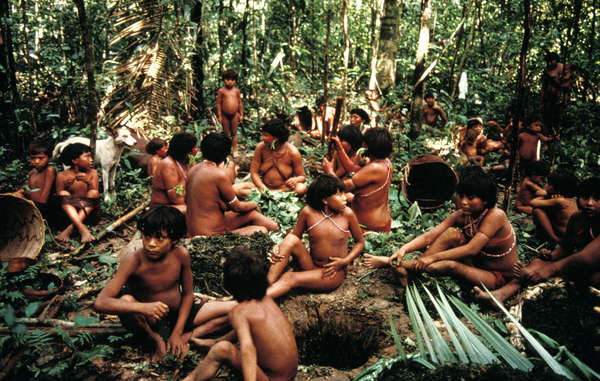
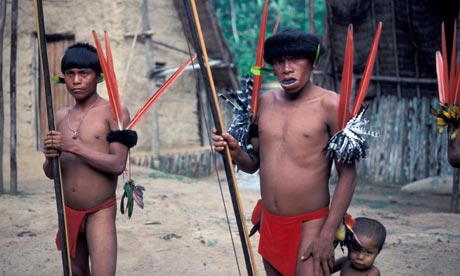
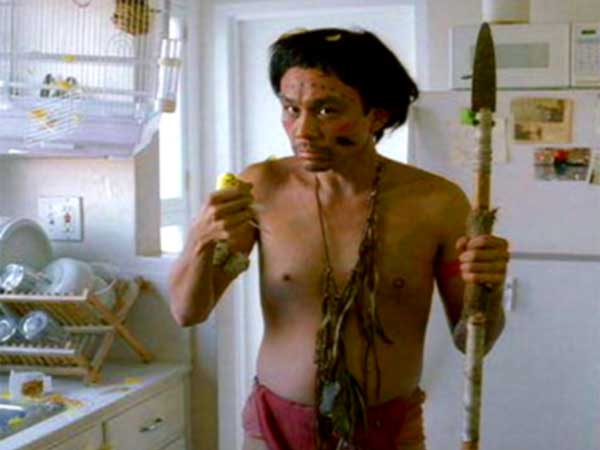
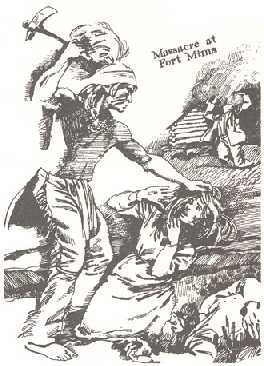
Anthropologist Napoleon Chagnon is famous for portraying the Yanomami Indians as "fierce people"--i.e., violent savages. Recently he came out with his autobiography, so the subject is in the news again.
I've posted on Chagnon and the Yanomami before, and I didn't want to rehash the old controversies. Fortunately, someone sent me a posting that's done the work for me.
The myth of the ‘Brutal Savage’Portrayals of Indians as violent savages remain common. Perhaps the worst recent example of this characterization comes from the controversial US anthropologist Napoleon Chagnon, who carried out fieldwork with the Venezuelan Yanomami from the 1960s.
In his book, Yanomamö: The Fierce People, Chagnon constructed a sensationalist image of the tribe, describing them as ‘sly, aggressive, and intimidating’, ‘fierce’, ‘continuously making war on each other’, and living in a ‘state of chronic warfare’.
The Fierce People was a best-seller in the USA and is still a standard text for anthropology students today. It is also a key source in many recent popular science books by writers such as Jared Diamond and Steven Pinker, which also promote the myth of the ‘Brutal Savage’.
Controversy
Despite the popularity of The Fierce People, Chagnon’s findings have been severely criticized by others who have extensive experience of the Yanomami. Many anthropologists, doctors and missionaries that have worked over many decades with the Yanomami simply do not recognize Chagnon’s characterizations, and profoundly disagree with his depiction of the tribe.
On 19 February 2013, Chagnon released his autobiography, Noble Savages: My Life Among Two Dangerous Tribes--The Yanomamö and the Anthropologists.
Many anthropologist specialists in the Yanomami of Venezuela and Brazil have signed an open letter condemning Chagnon’s characterization of the Yanomami.
Eminent anthropologist Marshall Sahlins explains how Chagnon exploited his Yanomami subjects to achieve his aims. Sahlins recently resigned from the US National Academy of Sciences in protest at Napoleon Chagnon’s election to the Academy.
Leading Brazilian professor of anthropology Eduardo Viveiros de Castro says the Yanomami are anything but the nasty, callous, sociobiological robots Chagnon makes them look like.
Prominent anthropologists Philippe Descola and Manuela Carneiro da Cunha have issued statements about Chagnon’s work and Sahlins’s resignation.
Experts wrote to the Daily Telegraph, to protest at an article repeating Chagnon’s views in 2001.
Carlo Zacquini, a Catholic lay missionary who has worked and lived among Yanomami for nearly 50 years, ‘never found them to be violent’.Comment: The article has links to more articles for further information.
By Erin WhitneyIt's been six years since we've had a slice of horror from director Eli Roth, instead only getting him as a producer on various projects since his 2007 "Hostel: Part 2." While Roth is making his way to TV (on Netflix) with the anticipated new series "Hemlock Grove," the gore-loving filmmaker is finally making his directorial return to the big screen not with torture nor a flesh-eating virus, but this time just good ol' human eating.
"The Green Inferno," co-written by Roth and Guillermo Amoedo, follows a group of New York City students traveling to Peru with means to stage a protest only to end up in the hands of a tribe of cannibals. The first image of "The Green Inferno" has finally hit the web and it's saturated in blood and terror that is sure to satiate the long-awaited cravings of any Roth fan. The nearly unknown cast includes Lorenza Izzo and Ariel Levy (both in the upcoming "Aftershock," produced by and starring Roth), Sky Ferreira ("Putty Hill"), Daryl Sabara ("Spy Kids"), and Kirby Bliss Blanton ("Project X").
The film has yet to get a distributor or a release date.IMDB helpfully adds:Storyline
A group of student activists travel from New York City to the Amazon to save a dying tribe but crash in the jungle and are taken hostage by the very natives they protected.
Did You Know?
According to director Eli Roth, "The Green Inferno" is conceived as a homage to "Cannibal Holocaust."Comment: Great. So one racist movie pays homage to another racist movie. And so the racism continues.
Ever since Guns, Germs, and Steel, Jared Diamond has been writing about the history of civilization in general and indigenous people in particular. One critic says Diamond's latest book is fatally flawed.
By Stephen CorryJared Diamond’s new book, The World Until Yesterday, is completely wrong, writes Stephen Corry. Diamond argues that industrialized people (‘modern’) can learn from tribal peoples (‘traditional’) because they show how everyone lived until a few thousand years ago. Corry agrees that ‘we’ can learn from tribes, but counters they represent no more of a throwback to our past than anyone else does. He shows that Diamond’s other—and dangerous—message is that most tribes engage in constant warfare. According to Diamond, they need, and welcome, state intervention to stop their violent behavior. Corry argues that this is merely a political opinion, backed by questionable and spurious data. He sees Diamond’s position as one of supporting colonial ideas about ‘pacifying savages’ and says it is factually and morally wrong.Diamond makes two noteworthy claims that Corry disputes:
Tribal societies are staticIt is true that Diamond does briefly mention, in passing, that all such societies have “been partly modified by contact,” but he has still decided they are best thought about as if they lived more or less as all humankind did until the “earliest origins of agriculture around 11,000 years ago in the Fertile Crescent,” as he puts it. That is his unequivocal message, and the meaning of “yesterday” in his title. This is a common mistake, and Diamond wastes little of his very long book trying to support it. The dust jacket, which he must agree with even if he did not actually write it, makes the astonishingly overweening claim that “tribal societies offer an extraordinary window into how our ancestors lived for millions of years” (my emphasis).
This is nonsense. Many scientists debunk the idea that contemporary tribes reveal anything significantly more about our ancestors, of even a few thousand years ago, than we all do. Obviously, self-sufficiency is and was an important component of the ways of life of both; equally obviously, neither approach or approached the heaving and burgeoning populations visible in today’s cities. In these senses, any numerically small and largely self-sufficient society might provide something of a model of ancient life, at least in some respects. Nevertheless, tribal peoples are simply not replicas of our ancestors.
Britain’s foremost expert on prehistoric man, Chris Stringer of London’s Natural History Museum, for example, routinely cautions against seeing modern hunter-gatherers as “living fossils,” and repeatedly emphasizes that, like everyone else, their “genes, cultures and behaviors” have continued to evolve to the present. They must have changed, of course, or they simply would not have survived.
It is important to note that, although Diamond’s thesis is that we were all once “hunter-gatherers” and that this is the main key to them being seen as our window into the past, in fact most New Guineans do little hunting. They live principally from cultivations, as they probably have for millennia. Diamond barely slips in the fact that their main foodstuff, sweet potato, was probably imported from the Americas, perhaps a few hundred or a thousand years ago. No one agrees on how this came about, but it is just one demonstration that “globalization” and change have impacted on Diamond’s “traditional” peoples for just as long as on everyone else. Disturbingly, Diamond knows these things, but he does not allow them to spoil his conclusions.Tribal societies are violentThe real problem with Diamond’s book, and it is a very big one, is that he thinks “traditional” societies do nasty things which cry out for the intervention of state governments to stop. His key point is that they kill a lot, be it in “war,” infanticide, or the abandonment, or murder, of the very old. This he repeats endlessly. He is convinced he can explain why they do this, and demonstrates the cold, but necessary, logic behind it. Although he admits to never actually having seen any of this in all his travels, he supports his point both with personal anecdotes from New Guinea and a great deal of “data” about a very few tribes—a good proportion of it originating with the anthropologists mentioned above. Many of his boldly stated “facts” are, at best, questionable.
How much of this actually is fact, and how much just personal opinion? It is of course true that many of the tribes he cites do express violence in various ways; people kill people everywhere, as nobody would deny. But how murderous are they exactly, and how to quantify it? Diamond claims that tribes are considerably more prone to killing than are societies ruled by state governments. He goes much further. Despite acknowledging, rather sotto voce, that there are no reports of any war at all in some societies, he does not let this cloud his principal emphasis: most tribal peoples live in a state of constant war.
He supports this entirely unverifiable and dangerous nonsense (as have others, such as Steven Pinker) by taking the numbers killed in wars and homicides in industrialized states and calculating the proportions of the total populations involved. He then compares the results with figures produced by anthropologists like Chagnon for tribes like the Yanomami. He thinks that the results prove that a much higher proportion of individuals are killed in tribal conflict than in state wars; ergo tribal peoples are more violent than “we” are.
There are of course lies, damned lies, and statistics. Let us first give Diamond the benefit of several highly debatable, not to say controversial, doubts. I will, for example, pass over the likelihood that at least some of these intertribal “wars” are likely to have been exacerbated, if not caused, by land encroachment or other hostilities from colonist societies. I will also leave aside the fact that Chagnon’s data, from his work with the Yanomami in the 1960s, has been discredited for decades: most anthropologists working with Yanomami simply do not recognize Chagnon’s violent caricature of those he calls the “fierce people.” I will also skate over Kim Hill’s role in denying the genocide of the Aché Indians at the hands of Paraguayan settlers and the Army in the 1960s and early 1970s. (Though there is an interesting pointer to this cited in Diamond’s book: as he says, over half Aché “violent deaths” were at the hands of nontribals.)
I will also throw only a passing glance at the fact that Diamond refers only to those societies where social scientists have collected data on homicides, and ignores the hundreds where this has not been examined, perhaps because—at least in some cases—there was no such data. After all, scientists seeking to study violence and war are unlikely to spend their precious fieldwork dropping in on tribes with little noticeable tradition of killing. In saying this, I stress once again, I am not denying that people kill people—everywhere. The question is, how much?
Awarding Diamond all the above ‘benefits of doubt’, and restricting my remarks to looking just at “our” side of the story: how many are killed in our wars, and how reasonable is it to cite those numbers as a proportion of the total population of the countries involved?
Is it meaningful, for example, to follow Diamond in calculating deaths in the fighting for Okinawa in 1945 as a percentage of the total populations of all combatant nations—he gives the result as 0.10 percent—and then comparing this with eleven tribal Dani deaths during a conflict in 1961. Diamond reckons the latter as 0.14 percent of the Dani population—more than at Okinawa.
Viewed like this, the Dani violence is worse that the bloodiest Pacific battle of WWII. But of course the largest nation involved in Okinawa was the U.S., which saw no fighting on its mainland at all. Would it not be more sensible to look at, say, the percentage of people killed who were actually in the areas where the war was taking place? No one knows, but estimates of the proportion of Okinawa citizens killed in the battle, for example, range from about 10 percent to 33 percent. Taking the upper figure gives a result of nearly 250 times more deaths than the proportion for the Dani violence, and does not even count any of the military killed in the battle.
Similarly, Diamond tells us that the proportion of people killed in Hiroshima in August 1945 was a tiny 0.1 percent of the Japanese people. However, what about the much smaller “tribe” of what we might call “Hiroshimans,” whose death toll was nearly 50 percent from a single bomb? Which numbers are more meaningful; which could be seen as a contrivance to support the conceit that tribespeople are the bigger killers? By supposedly “proving” his thesis in this way, to what degree does Diamond’s characterization differ significantly from labeling tribal peoples as “primitive savages,” or at any rate as more savage than “we” are?
If you think I am exaggerating the problem—after all, Diamond does not say “primitive savage” himself—then consider how professional readers of his book see it: his reviewers from the prestigious Sunday Times (U.K.) and The Wall Street Journal (U.S.) both call tribes “primitive,” and Germany’s popular Stern magazine splashed “Wilde” (“savages”) in large letters across its pages when describing the book.
Seek and you shall find statistics to underscore any conceivable position on this. Diamond is no fool and doubtless knows all this—the problem is in what he chooses to present and emphasize, and what he leaves out or skates over.Comment: Diamond repeats the claims about murderous indigenous savages popularized in books such as War Before Civilization. I criticized this book in Methodology of War Before Civilization and Indians in War Before Civilization. I'm glad to see that Stephen Corry's arguments tally with mine.
A small band of American filmmakers departs for the Amazon to document the lives of warring cannibal tribes. Two months after they’ve vanished into the so-called Green Inferno, a rescue team led by anthropologist Harold Monroe (Robert Kerman) discovers the documentary crew died at the hands of the Yanomamo tribe. Monroe retrieves the crew’s footage and brings it back to New York. The found footage depicts an orgy of shocking sadism--perpetrated by both the cannibals and the “civilized” Americans.Some comments on this movie:Greg
It’s too bad that they used the “Yanomamo” name because there wasn’t anything authentic about the portrayal of them. They really could have incorporated some aspects of Yanomamo culture and given the film another dimension. But basically it’s just a sexed up horror flick. That genre doesn’t accurately represent hotels, funeral homes etc. so this is forgivable.
Anonymous
I always thought that was really unfortunate too. I can’t imagine why they would do that? To lend credence to the film as “reality?” It would have been far better just to create a fake tribal name. I doubt anyone would have noticed, known, or cared. Great comment.
Jorge Sosa
I agree, Greg. I guess I’m so used to insensitive depictions of indigenous people in movies of this ilk that I didn’t really focus on that. Nobody is really portrayed in a positive light, for that matter. Caucasians, Latin Americans, TV execs are all basically bastards in this film.Comment: I haven't seen this movie, but Sosa's defense of it is problematical. A small group of anthropologists and filmmakers obviously doesn't represent the entire Caucasian race. Moviegoers have seen millions of other white characters, so they know these characters aren't typical.
Moreover, these characters are far from their "natural habitat." If they're acting horribly, they (and moviegoers) can blame it on the environment. "Jungle fever" is a commonplace excuse for whites who have gone bad.
In contrast, moviegoers have seen only a few other Native characters, and those characters probably acted like savages too. So moviegoers have no reason to believe these sadistic cannibals are anything other than the norm. The movie presents no "good Indian" to balance out its bad Indians.
Moreover, these Indians are acting horribly in their natural environment. They haven't been driven to evil, they are evil. It's not evenhanded to say Indians are naturally depraved and whites who live like them become depraved. The underlying message is still a racist one: that Indians are (naturally) savage and uncivilized.
Fierce People is a 2005 movie I watched in April. Here's the basic plot:
Fierce PeopleTrapped in his mother's Lower East Side apartment, sixteen-year-old Finn Earl (Anton Yelchin) wants nothing more than to escape New York. He wants to spend the summer in South America studying the Ishkanani Indians (called "Fierce People"), with the anthropologist father he's never met. Finn's dreams are shattered when he is arrested in a desperate effort to help his drug-dependent mother, Liz (Diane Lane), who works as a massage therapist. Determined to get their lives back on track, Liz moves the two of them into a guesthouse for the summer on the vast country estate of her ex-client, the aging aristocratic billionaire, Ogden C. Osbourne (Donald Sutherland).
In Osbourne's close world of privilege and power, Finn and Liz encounter the super rich, a tribe portrayed as fiercer and more mysterious than anything they might find in the South American jungle. (Dirk Wittenborn, the author of the novel on which the film is based, grew up a poor outsider among the super rich in an upper-crust New Jersey enclave.)
While Liz battles her substance abuse and struggles to win back her son's love and trust, Finn falls in love with Osbourne's beautiful granddaughter, Maya (Kristen Stewart). He also befriends her older brother, Bryce (Chris Evans); and wins the favor of Osbourne. When a shocking act of violence shatters Finn's ascension within the Osbourne clan, the golden promises of this lush world quickly sour. Both Finn and Liz, caught in a harrowing struggle for their dignity, discover that membership in a group comes at a steep price.Here are some of the movie's tribal hijinks:
Surviving in That Rain Forest East of the Delaware River
By Stephen HoldenUntil the drug bust, Finn had planned to spend the summer with his father, “the Elvis of anthropologists,” studying the Ishkanani, a primitive people in the Amazon rain forest known for their cruelty and barbarism. The intriguing conceit of “Fierce People” is that the idle superrich and the Ishkanani, whose rituals are shown on reels of film sent from South America by Finn’s father, are equally vicious.
This is a nifty idea that is laboriously overworked. As “Fierce People” nervously skitters between documentary scenes of the Ishkanani and the story of a mother and son absorbing the tribal customs of the New Jersey gentry, your instinct is throw up your hands and shout, “Enough already; we get it!”Fierce People--Review
By Lexi FeinbergEven more tiresome are the eyebrow-raising, arbitrary things that take place in Dirk Wittenborn’s absurd script, based on his book. Finn starts dating Osbourne’s granddaughter Maya (Kristen Stewart) after getting maimed by a deer trap--a lovely way to meet a romantic prospect. When they hang out with her yuppie brother Bryce (Chris Evans) to watch one of his dad’s tribal documentaries, it turns into a dance where everyone chants “fuck and kill!” followed by, naturally, some making out. Finn and his lady get in the mood by smearing paint all over each other’s bodies--it’s just that kind of movie.Fierce People
It's just fiercely bad
By Geoff BerkshireSkip it: Osborne is fond of saying “out of bad comes good.” That’s definitely not the case here. Originally filmed in 2004 and shelved for several years, “Fierce People” should’ve gone straight to video. Miscalculated at every level, it’s a vacant drama full of ineptly drawn characters. Things actually get worse after the first hour when a preposterous violent act sends the narrative spinning wildly out of control. Not even talented actors like Lane and Sutherland can make a difference when the material is this bad.
Catch it: For unintentional laughs. Finn’s obsession with the Amazonian Ishkanani tribe (his absent father made a documentary about them) is supposed to translate to the over-privileged world he finds himself in. It only leads to a lot of risible situations, including a particularly bad acid trip and a really creepy love scene with the very young, underwear-clad Yelchin and Stewart rubbing body paint all over each other.Comment: The Ishkanani are a fictional Amazonian tribe, but the filmmakers say they based the tribe on several real tribes. Obviously the Ishkanani are meant to evoke the Yanomami, whom Napoleon Chagnon labeled the "fierce people."
Let's parse the movie's use of tribal people a bit.
If the Ishkanani are based on several tribes, the filmmakers have taken the worst tribes they could find and picked the worst aspects of them. I suspect the filmmakers simply read something about the Yanomami ("Fierce People"), decided they knew all about Amazon Indians, and invented tribal scenes out of thin air. Either way, their choice is prejudiced and stereotypical.
The faux documentary scenes show bare-breasted women (naturally), a couple of Yanomami Ishkanani ambushing and killing someone in a river, and a crowd of Ishkanani chanting in some sort of incomprehensible dance. From this, the movie's characters deduce that the Indians care only about sex and death. This becomes their excuse for their bad behavior.
The faux documentaries give no hint that the Indians might have a complex religion and philosophy...extensive knowledge of the flora and fauna...tender relations between children, parents, and elders...etc. These Indians are pure savages. By emulating their worst aspects, the movie's characters reinforce this perception. "We're as savage as the worst savages in the world. You know, the barbaric, beastlike Ishkanani. They're horrible and so are we!"
Real Amazon Indians paint their bodies with symbols that have deep meanings for them. Maya and Finn smear paint on each other like kids doing fingerpainting. Real Amazon Indians take hallucinogens for profound religious reasons: to enter dream states where they can communicate with the spirits. Finn takes a hallucinogen because someone gives it to him, because it seems like a good idea, or just because.
In short, Fierce People stereotypes Indians as mindless savages. In that regard, it's not much different from Indiana Jones and the Kingdom of the Crystal Skull, King Kong, or countless potboilers set in primitive jungles. Few people have met an Amazon Indian, so it's movies like this that tell us what they're like.
As the reviews I've quoted indicate, most critics slammed Fierce People. As usual, the critics are right. Rob's rating: A poor 6.0 of 10.
A groundbreaking operatic spectacle puts Brazil's Yanomami tribe in the spotlight–and highlights the destruction of the rainforest
By Jan RochaIt has taken four years and more than £3m to produce a remarkable production called Amazonas, a multimedia, transcultural German-Brazilian tragic opera, developed in four languages, that will have its world premiere this weekend.
Perhaps unsurprisingly, a lot of transatlantic to-ing and fro-ing was involved. Five shamans from the Amazonian Yanomami tribe took part in a workshop in Karlsruhe to explain their skills to composers Klaus Schedl, Ludger Brümmer and Tato Taborda. In turn, the composers made several trips to a Yanomami village to record the sounds of the forest.
For Laymert Garcia dos Santos, the Brazilian philosopher and sociologist who masterminded the whole thing, this epically ambitious undertaking has been a nerve-wracking experience. But the politics have made it worth it. "It is an attempt to arouse a reaction to the destruction of the Amazon rainforest through emotion, rather than through the cold numbers of statistics," he says. "It's a scientifically established fact that the forest's destruction will have repercussions on the entire planet, but this still hasn't shocked people into stopping the process. So the idea is to immerse the spectator in the situation, so they can feel with their senses what is happening and be affected by it."
One of the largest indigenous groups in the Amazon, the Yanomami have only recently had regular contact with outsiders, but they actively participated in the development of the opera. "They're not in the opera as exotic objects, or as an archaic group," says dos Santos, "but they possess ancestral knowledge which is at the same time completely relevant to the modern world."
The libretto is based on the letter sent by Sir Walter Raleigh to Queen Elizabeth I in 1595, written when he was attempting to find the mythical El Dorado. He ended travelling up the Orinoco river in present-day Venezuela, where many Yanomami now live, and described discovering the "large, rich and bewtiful empyre (sic) of Guiana."
Despite being based on a historical source, the first act of Amazonas takes place in the future, after the rainforest has been destroyed, "in a time after the end of time." In the second act, the Yanomami shaman fails to prevent the triumph of the Xawara, the evil spirits, and is killed by them; the act ends with nothing less than the fall of the sky, the Yanomami's central myth, represented here by (lightweight) panels crashing down on the audience. The final act, created by multimedia artist Peter Weibel, takes place around a conference table where politicians, economists, scientists and missionaries argue about the future of the Amazon.Comment: Another article described the production as a musical. That sounded silly--like a spoof you're read in the Onion. A tragic opera is more like it.
As usual, it's good to see Natives involved in the creative process. Will Natives also play the Yanomami characters? Somehow, I doubt it.
The story seems interesting, but I have doubts. Isn't the shaman's death unnecessarily fatalistic? Both the rainforest and the Yanomami are still around, after all. And are there any indigenous voices at the conference table? Or are a bunch of white people deciding the Indians' fate?
In the news recently, we've seen that Amazon Indians are willing to fight their own battles. For instance, in Dam Suspended with Cameron's Help and Cofan Leader Visits Chevron CEO. The question is whether this opera will show the Yanomami as anything other than superstitious savages battling "evil spirits."
This is a German production, which suggests an extra reason to doubt. Many Germans are hobbyists who embrace traditional Indians while ignoring modern ones. Will they recognize that some Yanomami are able to speak and act in their own defense?
By David Maybury-LewisTThe Yanomami (who are also called Yanamamo, Yanomam, and Sanuma) are a remote group of some twenty to thirty thousand Indians who live in over a hundred villages scattered on both sides of the border between Venezuela and Brazil. They are famous in the anthropological literature because of a long-running debate about whether or not they are particularly violent. Napoleon Chagnon, an anthropologist who recently retired from the University of California at Santa Barbara, has studied the Venezuelan Yanomami for most of his professional life, and has argued that they are indeed violent, so much so that he subtitled his book about them "The Fierce People" and maintained the subtitle through three editions of the work. In more recent editions he has dropped the subtitle, but continues to defend the thesis that the Yanomami are fierce, warring with each other to capture women, so that their best warriors can maximize their reproductive success. Napoleon Chagnon’s sometime teacher and longtime mentor was James Neel, a distinguished human geneticist (now dead) at the University of Michigan. Neel became especially interested in studying the genetics of remote tribal populations and for that reason went with Chagnon and others to work among the Yanomami of Venezuela in the late 1960s and early 1970s.
Now, in a recently published book whose advance copies and excerpts in The New Yorker have created a furor, Patrick Tierney, an investigative journalist, has accused both Neel and Chagnon of committing serious abuses against the Yanomami.And:He claims that Chagnon interfered massively with the lives of the Yanomami in all sorts of ways. He claims that the films he made about them were particularly intrusive and many of the scenes in them were staged to show off the Yanomami as both fierce and primitive. The warfare which he highlighted as characteristic of Yanomami culture resulted more often than not from their battles over the trade goods that Chagnon distributed. His behavior in the field was insensitive and often deliberately so, as when he bribed or pressured children or other susceptible Yanomami to give him information on taboo topics. In sum, Tierney indicts the harmful effects of Chagnon's activities among the Yanomami, together with his portrayal of them as warlike savages and the competition between Chagnon and other filmmakers and TV crews to bring back footage of just contacted primitives.And:The charges against Napoleon Chagnon ... are, essentially, that he has damaged the Yanomami by his activities in the field but most of all by his insistence on portraying them as primitive savages when the evidence does not clearly support his conclusions. These charges are not new. They have in fact been made repeatedly by numbers of anthropologists over the years and in a letter sent by the Brazilian Anthropological Association to the American Anthropological Association in the early 1980s. Chagnon has responded to them by suggesting that he has the scientific evidence to prove his assertions, and that his critics only attack him on ideological grounds.
Chagnon interprets his evidence to show that the Yanomami are fierce and warlike and that they fight over women. These conclusions are enthusiastically believed by many sociobiologists who know little about the Yanomami or about South American Indians but welcome Chagnon’s analysis as lending support to their theories about the nature of primitive man and of human nature. Chagnon poses as the scientist "telling it like it is," but since the way he tells it is challenged by large numbers of reputable anthropologists, including some who have also studied the Yanomami, Chagnon’s interpretation should not be accepted without question.Comment: Why is the Chagnon controversy significant? Chagnon has suggested Indians in their "primitive" or "natural" state are incredibly violent. People have generalized from the Yanomami to all Amazon Indians or even all Indians. As this stereotypical belief filters into the public consciousness, you get results such as the Zagar and Steve commercials, End of the Spear, and Indiana Jones and the Kingdom of the Crystal Skull.
Correspondent DMarks writes:Here's a movie that might be relevant as a Native-topic...due to missing Natives.It's kind of obscure and forgotten, but it gets remembered now thanks to James Cameron's Avatar.
I don't think it ever mentions where the rain forest is. There are several, but in pop culture, "save the rain forest" always refers to the Amazon.
So, what have we here? A rain forest peopled by primitive natives. But no Amahuaca, no Huaorani, no Yanomami....In fact, they aren't Native South Americans of any kind. This supposed Amazon rain forest contains Caucasian elves. The female love interest is even lighter-skinned than the male white-guy hero (a reversal of the situation in Walt Disney's Pocahontas).I remember FernGully, although I haven't seen it.
I get your point, but Asia and other continents have rainforests too. It might be too arrogant or whatever to claim most rainforests are associated with the Amazon so the movie is "wrong" if it doesn't include Indians. I already get criticized enough for being too picky and "PC" without taking on theoretical arguments like this one.If FernGully is not intended to be in the Amazon, then the main thing that changes about my point is the name of the ethnic group of brown (or darker) skinned people who actually live there. It changes from "Indians" to something else.
I think my point ties into something you might have said in your Rima post(s). FernGully is another example of someone placing an ancient enclave of whites in the middle of a territory that in reality is inhabited by indigenous tribes. Then the indigenous tribes take on the role of irrelevant savage interlopers. If they are even mentioned at all, and they aren't in FernGully, a tropical rain forest (central Africa, South America, or southeast Asia), inhabited only by Caucasian-looking fairies (some of them suntanned). I've not actually read the Tarzan books, but I wonder if Burroughs did this there, as well.Burroughs's Opar is a typical lost white kingdom. I think H. Rider Haggard invented a couple of these kingdoms, as did many other "jungle writers." The NEW MUTANTS comic posited a lost Roman empire in South America. Shangri-La was a lost white paradise in the middle of Asia. Etc.
The Yanomami, a tribe that has thrived in the rainforests of South America for thousands of years, would perform in the pavilion, said Facundo Teran, its chief architect.
During an online debate, someone referred me to a book called War Before Civilization. I hadn't heard of it, so I looked it up.War Before Civilization: the Myth of the Peaceful Savage (Oxford University Press, 1996) is a book by Lawrence H. Keeley, an archeology professor at the University of Illinois who specialises in prehistoric Europe. The book deals with warfare conducted throughout human history by societies with little technology. In the book, Keeley aims to stop the apparent trend in seeing civilisation as bad.
Summary
Professor Keeley conducts an investigation of the archaeological evidence for prehistoric violence, including murder and massacre as well as war. He also looks at nonstate societies of more recent times—where we can name the tribes and peoples—and their propensity for warfare. It has long been known, for example, that many tribes of South America's tropical forest engaged in frequent and horrific warfare, but some scholars have attributed their addiction to violence to baneful Western influences.
Keeley says peaceful societies are an exception. About 90-95% of known societies engage in war. Those that did not are almost universally either isolated nomadic groups (for whom flight is an option), groups of defeated refugees, or small enclaves under the protection of a larger modern state. The attrition rate of numerous close-quarter clashes, which characterize warfare in tribal warrior society, produces casualty rates of up to 60%, compared to 1% of the combatants as is typical in modern warfare. Despite the undeniable carnage and effectiveness of modern warfare, the evidence shows that tribal warfare is on average 20 times more deadly than 20th century warfare, whether calculated as a percentage of total deaths due to war or as average deaths per year from war as a percentage of the total population. "Had the same casualty rate been suffered by the population of the twentieth century," writes Nicholas Wade, "its war deaths would have totaled two billion people." In modern tribal societies, death rates from war are four to six times the highest death rates in 20th century Germany or Russia.
One half of the people found in a Nubian cemetery dating to as early as 12,000 years ago had died of violence. The Yellowknives tribe in Canada was effectively obliterated by massacres committed by Dogrib Indians, and disappeared from history shortly thereafter. Similar massacres occurred among the Eskimos, the Crow Indians, and countless others. These mass killings occurred well before any contact with the West. In Arnhem Land in northern Australia, a study of warfare among the Indigenous Australian Murngin people in the late-19th century found that over a 20-year period no less than 200 out of 800 men, or 25% of all adult males, had been killed in intertribal warfare. The accounts of missionaries to the area in the borderlands between Brazil and Venezuela have recounted constant infighting in the Yanomami tribes for women or prestige, and evidence of continuous warfare for the enslavement of neighboring tribes such as the Macu before the arrival of European settlers and government. More than a third of the Yanomamo males, on average, died from warfare.
According to Keeley, among the indigenous peoples of the Americas, only 13% did not engage in wars with their neighbors at least once per year. The natives' pre-Columbian ancient practice of using human scalps as trophies is well documented. Iroquois routinely slowly tortured to death and cannibalized captured enemy warriors. In some regions of the American Southwest, the violent destruction of prehistoric settlements is well documented and during some periods was even common. For example, the large pueblo at Sand Canyon in Colorado, although protected by a defensive wall, was almost entirely burned; artifacts in the rooms had been deliberately smashed; and bodies of some victims were left lying on the floors. After this catastrophe in the late thirteenth century, the pueblo was never reoccupied.
For example, at Crow Creek in South Dakota, archaeologists found a mass grave containing the remains of more than 500 men, women, and children who had been slaughtered, scalped, and mutilated during an attack on their village a century and a half before Columbus's arrival (ca. A.D. 1325). The Crow Creek massacre seems to have occurred just when the village's fortifications were being rebuilt. All the houses were burned, and most of the inhabitants were murdered. This death toll represented more than 60% of the village's population, estimated from the number of houses to have been about 800. The survivors appear to have been primarily young women, as their skeletons are underrepresented among the bones; if so, they were probably taken away as captives. Certainly, the site was deserted for some time after the attack because the bodies evidently remained exposed to scavenging animals for a few weeks before burial. In other words, this whole village was annihilated in a single attack and never reoccupied.Rob's response
Wow. Sounds pretty horrific, and bad for the world's indigenous people.
I asked correspondent Al Carroll if he knew of this book. His reply:I've heard of it. Keeley doesn't outright lie, he just makes some pretty questionable distortions.
1. He frequently cites discredited works, such as studies on the Yanomami, supposedly once thought to be the most violent tribe ever, but now known to not be at all like that.
2. He groups together as "primitive" any nonwestern society, whether agricultural or hunter gatherer. So a lot of what he claims is proof that "primitives" were also violent is really proof of just how "civilized" groups could be violent earlier on.
3. Some of the conclusions he draw from stats he uses are unwarranted. For example he claims that a quarter of all young males who died in one tribe were from warfare. Then he later admits but downplays that this happened over three decades. Compare that to the losses of European nations in WW I, sometimes the majority of young males dead in less than four years.Whew. That makes me feel a little better.
This Wikipedia summary seems inflammatory. For instance, it jumps from "mass killings [that] occurred well before any contact with the West" to "a study of warfare among the Indigenous Australian Murngin people in the late-19th century." But the latter occurred well after contact with the West. Any reports of intertribal conflict after Europeans stole most of their resources and forced them to compete for the remainder should be viewed with suspicion.
Skepticism warranted
In fact, there are several things to be skeptical of here:
1) The fragmentary nature of pre-contact physical evidence. Data for most of history's prehistoric tribes either doesn't exist or hasn't been uncovered yet.
2) The collection bias of pre-contact physical evidence. Violent cultures may have left clear evidence of their nature behind while peaceful cultures didn't.
3) The European observers' bias against "savages" and "heathens." This may have tainted any post-contact reports of violence.
4) The collapse of traditional social structures through disease and warfare with the invaders. As in the Murngin case, this may have tainted any post-contact evidence.
Summing up this summary, we have:
A few possibly isolated incidents, including the Sand Canyon attack and Crow Creek massacre.
Scary claims about scalping and torture--which prove Indians were violent toward captives and victims, but not they they engaged in violence more often than others.
A few sweeping claims about what most tribes did.
In short, don't believe everything you read. It remains to be seen whether War Before Civilization offers a solid case against indigenous cultures.