Showing posts with label Amazon Indians. Show all posts

October 02, 2015

Green Inferno = racist torture porn

"The Green Inferno" – Even Worse Than We Anticipated

By Andrew E. MillerWhat are our key take-aways from "The Green Inferno"?

The inherent racism of an Amazonian cannibal movie is on full display. A false stereotype of the animalistic and brutal indigenous savage is a central conceit of the film. Other than the fake name of the tribe, no indigenous person has a name, nor says anything intelligible, nor is otherwise humanized–the one exception being the young girl who miraculously transcends her people's mob mentality and liberates Justine. The experience of the white people, who have names and motivations–as shallow as they might be–is entirely central to the plot. The degree to which the film evokes any emotional response, it's supposed to be some kind of horror at harm befalling the gringos. In dialogue between the activists, there are various references to "what they are doing to us." This is a classic example of othering.

Roth's portrayal of activism is absurd and cartoonish. Ostensibly, the film's social subtext is a critique of "slactivism," inspired by what Roth apparently observed around phenomenon like Occupy Wall Street and Kony 2012. But, as numerous reviewers have noted, "slactivists" wouldn't travel to Peru and carry out a direct action in the middle of the rainforest. The extreme naivete or venality of members of this group reaches caricature proportions. In all, it's not a serious social commentary, between being incoherent and hyperbolic. Unfortunately, this makes it all the more pointless, because there are cogent critiques to be made of well-meaning but clueless activists who ultimately do more harm than good, protected by their privilege from paying any consequences–like Roth himself.

There are some real-life issues illustrated in the film, but to such exaggeration that any prospective value in raising awareness about the Amazon is completely lost. Yes, there are gas and other extractive projects in the Amazon menacing indigenous peoples within their own territories today. But the lethal threat is generally not armed mercenaries that will shoot indigenous natives, instead risks posed by foreign disease or adverse health effects from pollution are far more likely to have an impact. Yes, Amazonian indigenous peoples tend to resist unwanted incursions into their territories, but they don't systematically mutilate and murder the invaders. In the overwhelming preponderance of cases, indigenous peoples defend themselves through nonviolent and often sophisticated means using lawsuits, protests, and their own media campaigns.
'The Green Inferno' Review: Lousy Film, Plenty Racist

By Tara HouskaUnsurprisingly to everyone but Roth, numerous indigenous peoples and organizations have denounced the film. He has argued that criticism about the manner in which he chose to portray Native people is unfounded; the tribe is fictional and correlating any real-world effects is "absurd." One would hope a filmmaker grasps the impact of media on public perception, particularly when those rare representations are largely dehumanizing. At this moment, existing isolated tribes in the Amazon face enormous pressures from resource-hungry extractive industries. The fate of no-contact legislative protections is uncertain, increasing the very real threat of disease and destruction of lands.

Roth himself has switched tacks on the intent of the film—these days he's touting monetary donations he's made to indigenous and environmental groups, and recalling tales of how much the tribe he featured loved the film crew. It's a far cry from prior interviews where he joked, "We [had] to tell them what a movie is ... They've never even seen a television ... [B]y the end they were all playing with iPhones and iPads. We've completely polluted the social system and fucked them up."

"The Green Inferno" not only trivializes grassroots efforts to draw attention to the plight of Amazonian tribes, it further entrenches the understanding that tribes are uncivilized relics from the past. Controlled contact and assimilation efforts aren't as unpalatable when tribes are viewed as "other" and incapable of self-determination.

Roth fails to realize that Native peoples and cultures have survived despite all odds; our fights are sophisticated and ongoing. Relegating us to the dregs of society is no longer acceptable. Simon Moya-Smith, Culture Editor of Indian Country Today, summed it up: "'The Green Inferno' is the 21st century cinematic demonstration of white fear ... they are right to fear us, but not for the reason this Jewish filmmaker would suggest."

With any luck, this lackluster horror film and its primitive depiction of indigenous peoples will quickly fade into unprofitable obscurity.
Comment:  For more on The Green Inferno, see Cannibal Film to Spark Discussion? and From Tiger Lily to Green Inferno.

August 22, 2015

Cannibal film to spark discussion?

A 'Savage Cannibal' Movie in 2015? We Can Do Better

By Tara Houska[I]n the midst of competing interests to protect indigenous peoples or capitalize on the Amazon’s natural resources, out comes a film portraying tribes as bloodthirsty savages.

Despite Roth’s assertion that a fictional film causing harm to existing peoples is “absurd,” presenting an at-risk population as cannibalistic beasts feeds into the mantra of saving, assimilating and educating uncivilized tribes for their own good (and the good of resource-hungry corporations). Stereotypes and dehumanization have very real consequences.

Roth himself joked about the impact of his film crew to the isolated Amazonian tribe he located and featured in his film, “We [had] to tell them what a movie is…They’ve never even seen a television…[B]y the end they were all playing with iPhones and iPads. We’ve completely polluted the social system and f*cked them up.”

These days, Roth is attempting to soothe the many environmental and indigenous rights organizations that have denounced his pending film. He’s joined a campaign to preserve the rainforest and partnered with a charity to start a journalism fund highlighting the issues faced by indigenous peoples.

On Wednesday, he told Variety he “made ‘The Green Inferno’ to spark discussion and bring awareness to the devastation these tribes face at the hands of corporations.” That’s a far cry from a man who earlier stated that he wanted to make a cannibal film but needed the right storyline.
Comment:  The only discussion The Green Inferno is like to spark is a discussion like this one. Namely, pointing out how racist and stereotypical the movie is. How the reality not depicted by Roth the racist is much different.

For more on The Green Inferno, see "From Tiger Lily to Green Inferno" and Cannibal Indians in Green Inferno.

October 27, 2013

O Guarani

The GuaraniThe Guarani: Brazilian Novel (Portuguese: O Guarani: Romance Brasileiro) is a 1857 Brazilian novel written by José de Alencar. It first came out as a feuilleton in the newspaper Diário do Rio de Janeiro, but due to its enormous success Alencar decided to compile his writing in a volume. A plausible explanation for this success might be in the fact that novel spoke of freedom and independence, arguing for a nativeness that could be found in tropical Nature and in the indigenous people of Brazil.

O Guarany is set back in 1604, a period when Portugal and its colonies submitted to Spanish dominion due to a lack of heirs to ascend to the throne. Alencar takes advantage of this dynastic complication to resurrect the historical figure of D. Antônio de Mariz, a nobleman connected to the foundation of the city of Rio de Janeiro and a pioneer settler. This historical (factual) background, which orients the novel throughout, is set in the first two chapters; then fantasy, both violent and erotic, starts to prevail.

The novel is still widely read nowadays, especially at Brazilian schools as an introduction to novel reading, but also by anyone who enjoys a thrilling adventure story. Literary criticism has tended to link O Guarani to the works of Fenimore Cooper, Chateaubriand and the noble savage from the Rousseauesque tradition. However, this interpretation of the novel has become outdated as recent academic works show also how dark, sexual, gothic and lyrical (over narrative, unlike the Fenimore Cooper model) the novel is.

The Guarani is the Brazilian novel with the largest number of adaptation for comics.

October 26, 2013

Two Amazon Indian comics

O Fruto--Roteiro de Rafael Corrêa e Desenhos de João Azeitona


The Fruit...apparently a short story casting pre-Columbian Amazon Indians as Adam and Eve in the Garden of Eve. Eating the forbidden fruit brings the evils of the Spanish conquest.

Interesting idea, but it ends up blaming the victim for being victimized. The Spanish would've came and conquered whether the Natives ate the fruit or no.

El Despertar De La Bestia


A beast attacks an Indian village in the early Spanish era. But it's just a dream...or is it? Perhaps the Spanish adventurers are the real beasts.

The art and stories on both of these look decent. I imagine the Indians are presented generically and superficially, with no real culture. But the portrayals seem positive; the Indians aren't headhunting cannibals.

July 27, 2013

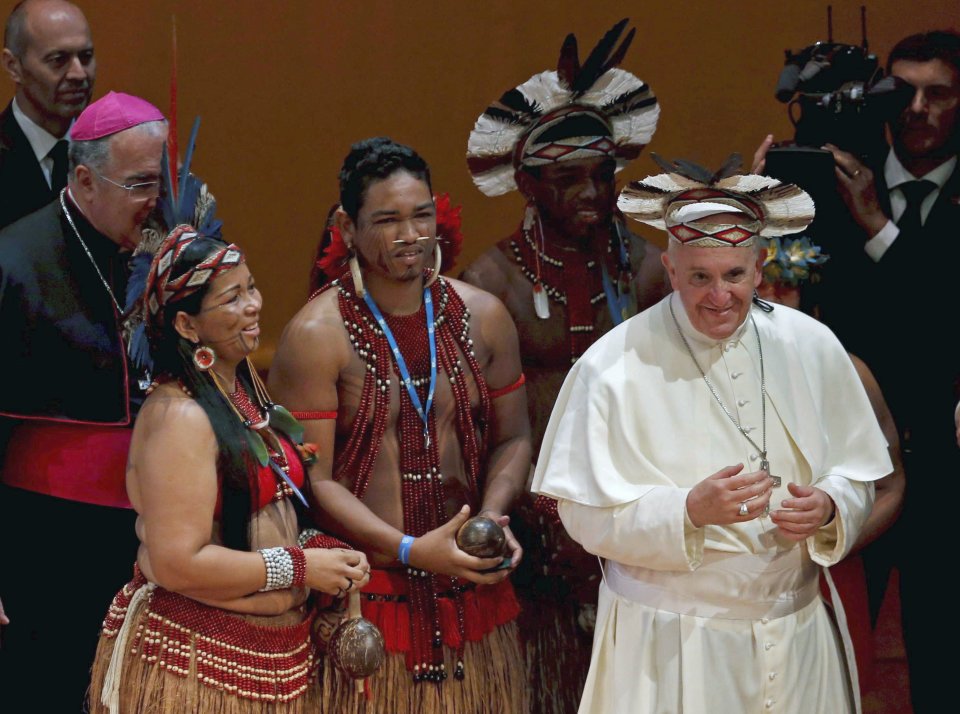
Pope dons Pataxo headdress

Pope delights crowds with his informality, message of reform

By Janet Tappin CoelhoIn one of the most inclusive gestures of his visit here, Pope Francis donned a headdress offered to him from an indigenous South American Indian at a ceremony in the city's grand municipal theater.

The gesture was greeted with shouts of surprise initially. Then the audience of Brazilian politicians and business people erupted into roars of approval and thunderous applause.

It was a compelling moment. Moments earlier, the pope had spoken about the state's responsibility to respect and encourage "peaceful coexistence between different religions."

"Between selfish indifference and violent protest there is always another possible option, and the key to developing a just and fair society as a leader is dialogue, dialogue, dialogue," he said.
Pope dons Indian headdress after Brazil speechPope Francis has delighted a crowd in Rio de Janeiro by donning a colorful Indian headdress handed to him by a member of a Brazilian tribe.

It came after the pontiff spoke Saturday at Rio's Municipal Theater to an audience mostly made up of Brazil's political, business and cultural elite.

After the talk, he was greeted by well-wishers on stage, including a few Indians.

A bare-chested man named Ubirai Matos from the Pataxo tribe met the pope while wearing a reed skirt, ornate red-bead necklace and large nose and ear piercings.

Matos took off his feather headdress and handed it to the pontiff.

Francis promptly placed it on his own head and flashed the crowd a smile.
Pope speaks out on Amazon during Brazil trip

By Bradley BrooksPope Francis took on the defense of the Amazon and the environment near the end of his weeklong trip to Brazil, as he donned a colorful Indian headdress Saturday and urged that the rainforest be treated as a garden.

The pontiff met with a few thousand of Brazil's political, business and cultural elite in Rio de Janeiro's Municipal Theater, where he also shook hands with Indians who said they were from a tribe that has been battling ranchers and farmers trying to invade their land in northeastern Bahia state.

In a separate speech to bishops, the pope called for "respect and protection of the entire creation which God has entrusted to man, not so that it be indiscriminately exploited but rather made into a garden."

He also urged attention to a 2007 document by Latin American and Caribbean bishops that he was in charge of drafting, which underscored dangers facing the Amazon environment and the native people living there. The document also called for new evangelization efforts to halt a steep decline in Catholics leaving for other faiths or secularism.

"The traditional communities have been practically excluded from decisions on the wealth of biodiversity and nature. Nature has been, and continues to be, assaulted," the document reads.

Several of the indigenous people in the audience hailed from the Amazon and said they hoped the pope would help them protect land designated by the government as indigenous reserves but that farmers and ranchers illegally invade for timber and to graze cattle. In fact, grazing has been the top recent cause of deforestation in Brazil.
Comment:  For more on Pope Francis, see Pope Meets Qom and Indians Ask Francis to Revoke Papal Bull.

June 09, 2013

Amazon Indians protest via Facebook

Indigenous Brazilians use web to fight for rights

By Joao FelletWhen Terena tribesman Oziel Gabriel was shot dead in a clash with police forces in Sidrolandia, in the Brazilian state of Mato Grosso do Sul, last week, it only took minutes for videos and pictures to appear on Facebook accusing the Federal Police (PF) of responsibility.

Fellow members of his indigenous group who had witnessed the incident quickly passed on the images to a wide network of supporters.

It took only hours for the case to make headlines abroad. And, in an unusually swift reaction, Brazilian Justice Minister Jose Eduardo Cardozo promised a thorough investigation.

Brazilian indigenous groups say they are increasingly using social media websites to spread their views and to counter what they say are the prejudiced views about them in local media.
Comment:  Once again, the stereotype of Amazon Indians as savage spearchuckers gets blown out of the water.

For more on Amazon Indians, see Natural History Museum in Bob's Burgers and Tech-Savvy Surui Chief.

Below:  "Indigenous Brazilian are using the latest technology to their advantage."

May 05, 2013

Natural history museum in Bob's Burgers

In tonight's episode of Bob's Burgers, Carpe Museum (airdate: 5/5/13), Bob and his kids take a field trip to a natural history museum. I wondered how they'd handle the issue of commingling animals and "primitive" humans--a perennial one for this type of museum. The answer: not well.

To its credit, Bob's Burgers didn't show any indigenous humans. What it did show was cavemen, Vikings, and pioneers in a covered wagon. All had light-colored skin, so the only racial group on display were Caucasians.

This is a bit silly, since natural history museums generally don't feature Vikings or pioneers. It seemed like a contrived effort to be "politically correct."

But the show undercut this by presenting one boy's list of exhibits with "boobs." The list read:Boobs

Viking boobs
Eskimo boobs
East Timor boobs
Micronesian boobs
Samoan boobs
Egyptian boobs
Then there's an Amazon rainforest exhibit still under construction. A thatched Indian hut is the only human artifact in it.

What's wrong?

For starters, the boobs list implies that indigenous people are nothing but sexual objects of interest. Whoever wrote this episode probably learned about these people from old National Geographics.

The thatched hut sends a similar message. Namely, that indigenous people are part of nature, not part of humanity. That they're closer to trees and monkey than they are to doctors and lawyers.

Summing up Bob's take: Wild animals = primitive white men = modern indigenous people. In other words, "Eskimos," Amazon Indians, and other brown-skins belong in a museum with extinct species (dinosaurs, woolly mammoths) and civilizations (Egyptians, Vikings).

Bob's Burgers suffers from the same mentality seen in Indians in Natural History Museums, Indians in Bailey at the Museum, and Eurocentrism in Night at the Museum 2. That's stereotypical if not racist.

For more on Bob's Burgers, see Navajo Mask in Bob's Burgers.


March 27, 2013

Tech-savvy Surui chief

Brazilian chief uses technology to help save his tribe and curb deforestation

By Juan ForeroAs a small boy in the early ’80s, Almir Surui hunted monkeys with a bow and arrow, wore a loincloth and struggled with Brazil’s official language, Portuguese.

At 38, he is the tech-savvy, ­university-educated chief of the Paiter Surui, or “the real people,” of this western corner of Brazil.

He can still handle a bow. But Chief Almir Narayamoga Surui says his weapon of choice is technology: Android phones to monitor illegal logging, hand-held Global Positioning System devices to map territory and Google Earth Outreach to show the world what a well-managed forest looks like.

Wielding the tools of the 21st century, the 1,300-member tribe has delved into a complex scheme in which governments or companies pay for forest preservation, contributing to a system that, if fully realized, would help end large-scale deforestation. By determining how much carbon is prevented from being released if the trees on Surui lands are left standing, the tribe hopes to sell carbon credits internationally to offset greenhouse gas emissions in developed countries.
From The Stone Age To The Digital Age In One Big Leap

By Juan ForeroRebecca Moore of Google was among the first to come on board, back in 2007. She describes Chief Almir as "very savvy. I've never seen anyone who could say 'no' to him."

She recalled how Chief Almir told Google executives that his father's way of defending the Surui was obsolete.

"He realized that the time had come, he says, to put down the bow and arrow and pick up the laptop, that that was the future for defending their territory and strengthening their tribe," she says. "How could you say 'no'?"

Beto Borges, a Brazilian-born environmentalist who works at Forest Trends based in Washington, D.C., says Chief Almir knows how to get people's attention, whether it's in Rio de Janeiro or New York.

"Walking with the crowds with Almir is like walking with a pop star," says Borges, the company's director of the Communities and Markets Program. "All of a sudden here's an indigenous person from the Amazon. And not only an indigenous person, but he's a chief, wearing this huge headdress with feathers."

But what wins over converts to the Surui cause, says Borges, is Chief Almir's ability to lay out a cogent argument and persuade.

"All of a sudden, they're facing an indigenous person who can speak at the same level that they can, who can talk about strategic vision, for the companies as well as for his people," says Borges. He says it often leaves listeners astonished.

"I think that really shocks people to the point that they fall in love with him," Borges says. "'Oh, this guy is fantastic, so we want to do something with him.'"
Comment:  These stories alone are enough to explode the myth of Amazon Indians as primitive, spear-chucking savages. It's the 21st century and these people are part of it.

For more on the Amazon Indians, see Chagnon Autobiography Reignites Controversies and Cannibal Indians in Green Inferno.

Below:  "To save the forest home of his people, Chief Almir Surui has turned to modern technology, like Android phones, and alliances with the likes of Google and Wall Street financiers." (Juan Forero/TWP)

March 06, 2013

Chagnon autobiography reignites controversies

Anthropologist Napoleon Chagnon is famous for portraying the Yanomami Indians as "fierce people"--i.e., violent savages. Recently he came out with his autobiography, so the subject is in the news again.

I've posted on Chagnon and the Yanomami before, and I didn't want to rehash the old controversies. Fortunately, someone sent me a posting that's done the work for me.

The Fierce People?

The myth of the ‘Brutal Savage’Portrayals of Indians as violent savages remain common. Perhaps the worst recent example of this characterization comes from the controversial US anthropologist Napoleon Chagnon, who carried out fieldwork with the Venezuelan Yanomami from the 1960s.

In his book, Yanomamö: The Fierce People, Chagnon constructed a sensationalist image of the tribe, describing them as ‘sly, aggressive, and intimidating’, ‘fierce’, ‘continuously making war on each other’, and living in a ‘state of chronic warfare’.

The Fierce People was a best-seller in the USA and is still a standard text for anthropology students today. It is also a key source in many recent popular science books by writers such as Jared Diamond and Steven Pinker, which also promote the myth of the ‘Brutal Savage’.

Controversy

Despite the popularity of The Fierce People, Chagnon’s findings have been severely criticized by others who have extensive experience of the Yanomami. Many anthropologists, doctors and missionaries that have worked over many decades with the Yanomami simply do not recognize Chagnon’s characterizations, and profoundly disagree with his depiction of the tribe.

On 19 February 2013, Chagnon released his autobiography, Noble Savages: My Life Among Two Dangerous Tribes--The Yanomamö and the Anthropologists.

Many anthropologist specialists in the Yanomami of Venezuela and Brazil have signed an open letter condemning Chagnon’s characterization of the Yanomami.

Eminent anthropologist Marshall Sahlins explains how Chagnon exploited his Yanomami subjects to achieve his aims. Sahlins recently resigned from the US National Academy of Sciences in protest at Napoleon Chagnon’s election to the Academy.

Leading Brazilian professor of anthropology Eduardo Viveiros de Castro says the Yanomami are anything but the nasty, callous, sociobiological robots Chagnon makes them look like.

Prominent anthropologists Philippe Descola and Manuela Carneiro da Cunha have issued statements about Chagnon’s work and Sahlins’s resignation.

Experts wrote to the Daily Telegraph, to protest at an article repeating Chagnon’s views in 2001.

Carlo Zacquini, a Catholic lay missionary who has worked and lived among Yanomami for nearly 50 years, ‘never found them to be violent’.
Comment:  The article has links to more articles for further information.

For more on the Yanomami, see Cannibal Indians in Green Inferno and Why The World Until Yesterday Is Wrong.

March 03, 2013

Cannibal Indians in Green Inferno

Gory First Look at Eli Roth's Cannibal Thriller 'The Green Inferno'

By Erin WhitneyIt's been six years since we've had a slice of horror from director Eli Roth, instead only getting him as a producer on various projects since his 2007 "Hostel: Part 2." While Roth is making his way to TV (on Netflix) with the anticipated new series "Hemlock Grove," the gore-loving filmmaker is finally making his directorial return to the big screen not with torture nor a flesh-eating virus, but this time just good ol' human eating.

"The Green Inferno," co-written by Roth and Guillermo Amoedo, follows a group of New York City students traveling to Peru with means to stage a protest only to end up in the hands of a tribe of cannibals. The first image of "The Green Inferno" has finally hit the web and it's saturated in blood and terror that is sure to satiate the long-awaited cravings of any Roth fan. The nearly unknown cast includes Lorenza Izzo and Ariel Levy (both in the upcoming "Aftershock," produced by and starring Roth), Sky Ferreira ("Putty Hill"), Daryl Sabara ("Spy Kids"), and Kirby Bliss Blanton ("Project X").

The film has yet to get a distributor or a release date.
IMDB helpfully adds:Storyline

A group of student activists travel from New York City to the Amazon to save a dying tribe but crash in the jungle and are taken hostage by the very natives they protected.

Did You Know?

According to director Eli Roth, "The Green Inferno" is conceived as a homage to "Cannibal Holocaust."
Comment:  Great. So one racist movie pays homage to another racist movie. And so the racism continues.

For more on cannibal Indians, see Cannibal Indians in My Ghost Story and Sadistic Indians in Cannibal Holocaust.

February 09, 2013

Why The World Until Yesterday is wrong

Ever since Guns, Germs, and Steel, Jared Diamond has been writing about the history of civilization in general and indigenous people in particular. One critic says Diamond's latest book is fatally flawed.

Savaging Primitives: Why Jared Diamond’s ‘The World Until Yesterday’ Is Completely Wrong

By Stephen CorryJared Diamond’s new book, The World Until Yesterday, is completely wrong, writes Stephen Corry. Diamond argues that industrialized people (‘modern’) can learn from tribal peoples (‘traditional’) because they show how everyone lived until a few thousand years ago. Corry agrees that ‘we’ can learn from tribes, but counters they represent no more of a throwback to our past than anyone else does. He shows that Diamond’s other—and dangerous—message is that most tribes engage in constant warfare. According to Diamond, they need, and welcome, state intervention to stop their violent behavior. Corry argues that this is merely a political opinion, backed by questionable and spurious data. He sees Diamond’s position as one of supporting colonial ideas about ‘pacifying savages’ and says it is factually and morally wrong.Diamond makes two noteworthy claims that Corry disputes:

Tribal societies are staticIt is true that Diamond does briefly mention, in passing, that all such societies have “been partly modified by contact,” but he has still decided they are best thought about as if they lived more or less as all humankind did until the “earliest origins of agriculture around 11,000 years ago in the Fertile Crescent,” as he puts it. That is his unequivocal message, and the meaning of “yesterday” in his title. This is a common mistake, and Diamond wastes little of his very long book trying to support it. The dust jacket, which he must agree with even if he did not actually write it, makes the astonishingly overweening claim that “tribal societies offer an extraordinary window into how our ancestors lived for millions of years” (my emphasis).

This is nonsense. Many scientists debunk the idea that contemporary tribes reveal anything significantly more about our ancestors, of even a few thousand years ago, than we all do. Obviously, self-­sufficiency is and was an important component of the ways of life of both; equally obviously, neither approach or approached the heaving and burgeoning populations visible in today’s cities. In these senses, any numerically small and largely self-­sufficient society might provide something of a model of ancient life, at least in some respects. Nevertheless, tribal peoples are simply not replicas of our ancestors.

Britain’s foremost expert on prehistoric man, Chris Stringer of London’s Natural History Museum, for example, routinely cautions against seeing modern hunter-­gatherers as “living fossils,” and repeatedly emphasizes that, like everyone else, their “genes, cultures and behaviors” have continued to evolve to the present. They must have changed, of course, or they simply would not have survived.

It is important to note that, although Diamond’s thesis is that we were all once “hunter-­gatherers” and that this is the main key to them being seen as our window into the past, in fact most New Guineans do little hunting. They live principally from cultivations, as they probably have for millennia. Diamond barely slips in the fact that their main foodstuff, sweet potato, was probably imported from the Americas, perhaps a few hundred or a thousand years ago. No one agrees on how this came about, but it is just one demonstration that “globalization” and change have impacted on Diamond’s “traditional” peoples for just as long as on everyone else. Disturbingly, Diamond knows these things, but he does not allow them to spoil his conclusions.
Tribal societies are violentThe real problem with Diamond’s book, and it is a very big one, is that he thinks “traditional” societies do nasty things which cry out for the intervention of state governments to stop. His key point is that they kill a lot, be it in “war,” infanticide, or the abandonment, or murder, of the very old. This he repeats endlessly. He is convinced he can explain why they do this, and demonstrates the cold, but necessary, logic behind it. Although he admits to never actually having seen any of this in all his travels, he supports his point both with personal anecdotes from New Guinea and a great deal of “data” about a very few tribes—a good proportion of it originating with the anthropologists mentioned above. Many of his boldly stated “facts” are, at best, questionable.

How much of this actually is fact, and how much just personal opinion? It is of course true that many of the tribes he cites do express violence in various ways; people kill people everywhere, as nobody would deny. But how murderous are they exactly, and how to quantify it? Diamond claims that tribes are considerably more prone to killing than are societies ruled by state governments. He goes much further. Despite acknowledging, rather sotto voce, that there are no reports of any war at all in some societies, he does not let this cloud his principal emphasis: most tribal peoples live in a state of constant war.

He supports this entirely unverifiable and dangerous nonsense (as have others, such as Steven Pinker) by taking the numbers killed in wars and homicides in industrialized states and calculating the proportions of the total populations involved. He then compares the results with figures produced by anthropologists like Chagnon for tribes like the Yanomami. He thinks that the results prove that a much higher proportion of individuals are killed in tribal conflict than in state wars; ergo tribal peoples are more violent than “we” are.

There are of course lies, damned lies, and statistics. Let us first give Diamond the benefit of several highly debatable, not to say controversial, doubts. I will, for example, pass over the likelihood that at least some of these intertribal “wars” are likely to have been exacerbated, if not caused, by land encroachment or other hostilities from colonist societies. I will also leave aside the fact that Chagnon’s data, from his work with the Yanomami in the 1960s, has been discredited for decades: most anthropologists working with Yanomami simply do not recognize Chagnon’s violent caricature of those he calls the “fierce people.” I will also skate over Kim Hill’s role in denying the genocide of the Aché Indians at the hands of Paraguayan settlers and the Army in the 1960s and early 1970s. (Though there is an interesting pointer to this cited in Diamond’s book: as he says, over half Aché “violent deaths” were at the hands of nontribals.)

I will also throw only a passing glance at the fact that Diamond refers only to those societies where social scientists have collected data on homicides, and ignores the hundreds where this has not been examined, perhaps because—at least in some cases—there was no such data. After all, scientists seeking to study violence and war are unlikely to spend their precious fieldwork dropping in on tribes with little noticeable tradition of killing. In saying this, I stress once again, I am not denying that people kill people—everywhere. The question is, how much?

Awarding Diamond all the above ‘benefits of doubt’, and restricting my remarks to looking just at “our” side of the story: how many are killed in our wars, and how reasonable is it to cite those numbers as a proportion of the total population of the countries involved?

Is it meaningful, for example, to follow Diamond in calculating deaths in the fighting for Okinawa in 1945 as a percentage of the total populations of all combatant nations—he gives the result as 0.10 percent—and then comparing this with eleven tribal Dani deaths during a conflict in 1961. Diamond reckons the latter as 0.14 percent of the Dani population—more than at Okinawa.

Viewed like this, the Dani violence is worse that the bloodiest Pacific battle of WWII. But of course the largest nation involved in Okinawa was the U.S., which saw no fighting on its mainland at all. Would it not be more sensible to look at, say, the percentage of people killed who were actually in the areas where the war was taking place? No one knows, but estimates of the proportion of Okinawa citizens killed in the battle, for example, range from about 10 percent to 33 percent. Taking the upper figure gives a result of nearly 250 times more deaths than the proportion for the Dani violence, and does not even count any of the military killed in the battle.

Similarly, Diamond tells us that the proportion of people killed in Hiroshima in August 1945 was a tiny 0.1 percent of the Japanese people. However, what about the much smaller “tribe” of what we might call “Hiroshimans,” whose death toll was nearly 50 percent from a single bomb? Which numbers are more meaningful; which could be seen as a contrivance to support the conceit that tribespeople are the bigger killers? By supposedly “proving” his thesis in this way, to what degree does Diamond’s characterization differ significantly from labeling tribal peoples as “primitive savages,” or at any rate as more savage than “we” are?

If you think I am exaggerating the problem—after all, Diamond does not say “primitive savage” himself—then consider how professional readers of his book see it: his reviewers from the prestigious Sunday Times (U.K.) and The Wall Street Journal (U.S.) both call tribes “primitive,” and Germany’s popular Stern magazine splashed “Wilde” (“savages”) in large letters across its pages when describing the book.

Seek and you shall find statistics to underscore any conceivable position on this. Diamond is no fool and doubtless knows all this—the problem is in what he chooses to present and emphasize, and what he leaves out or skates over.
Comment:  Diamond repeats the claims about murderous indigenous savages popularized in books such as War Before Civilization. I criticized this book in Methodology of War Before Civilization and Indians in War Before Civilization. I'm glad to see that Stephen Corry's arguments tally with mine.

As Corry notes, many of the claims for warlike Indians come from Napoleon Chagnon's study of the Yanomami people. For more on that subject, see Review of Fierce People and The Yanomami Scandal.

Finally, for more on Diamond's work, see Diamond Wrong About Easter Island and Educating Tony About Genocide.

January 14, 2013

Brazil threatens to evict indigenous squatters

Rio public defender urges law to be respected in controversial indigenous eviction casePublic defenders in Brazil are criticizing the attempted eviction of a group of indigenous people living near Maracana stadium in Rio de Janeiro.

The Indian settlement is adjacent to the legendary stadium that is being refurbished to host the opening and closing ceremonies of the 2016 Olympics and the final match of the 2014 World Cup. Officials say it must be demolished as part of the work.

The public defender’s office said Monday that the government cannot evict the group without a court order.

On Saturday, police in riot gear surrounded the settlement where indigenous people have been squatters for years on the site of an abandoned Indian museum.

The tense standoff lasted about 12 hours before the police dispersed late Saturday. They’ve not returned.
Brazil: Indigenous squatters living by Rio’s Maracana stadium resist eviction; police close inThe governor of Rio de Janeiro, Sergio Cabral, told a news conference in October that the building’s razing is necessary for hosting the World Cup.

“The Indian Museum near the Maracana will be demolished,” Cabral said then. “It’s being demanded by FIFA and the World Cup Organizing Committee. Long live democracy, but the building has no historical value. We’re going to tear it down.”

However, a letter from FIFA’s office in Brazil to the federal public defender’s office published in the newspaper Jornal do Brazil said that the soccer authority “never requested the demolition of the old Indian Museum in Rio de Janeiro.”

The indigenous have been resisting their possible eviction for months, operating with little or no information from authorities about what to expect, or what alternatives are available to them, said their leader Carlos Tukano.

“I know they are going to come in, and our proposal is to remain firm, but without moral or physical aggression,” he said. “We cannot fight them with bows and arrows; they are armed.”

Most of the approximately 30 Indians who live there and about 200 sympathizers packaged the compound Saturday to discuss how to peacefully deal with a possible police action. Several men, masking their faces with shirts, climbed high into the upper floors of the tumble-down building and surveyed the scene with professional bows and arrows.

The squatters believe they have history and the law on their side.

The crumbling mansion with soaring ceilings that housed the old museum was donated by a wealthy Brazilian to the government in 1847 to serve as a center for the study of indigenous traditions.

After the museum closed more than three decades ago, Indians of various ethnicities started using it as a safe place to stay when they came to Rio to pursue an education, sell trinkets in the streets or get medical treatment.

“They would come here without money, without knowing anyone, and sleep in the streets,” Tukano explained. He himself is from a village deep in the Amazon. “We made this our space.”
Comment:  No doubt indigenous people get evicted from their homes all the time. But the World Cup and Olympics connections are what make this story interesting.

It's such a Western approach to a problem. Sweep the indigenous troublemakers under the rug. Progress before people. Pave paradise and put up a parking lot.

This is one of our continuing postings on how Amazon Indians interact with modern society. Most Indians, like indigenous people everywhere, are dealing with schools, jobs, television, computers, and so forth. Any narrative that portrays them as primitive savages living in jungle huts is probably false or misleading.

For more on Amazon Indians, see Amazon Massacre in The Mentalist and Firth Video Generates Protest E-Mails.

November 12, 2012

Amazon massacre in The Mentalist

In Sunday's episode of The Mentalist, titled If It Leads, It Bleeds (airdate: 11/11/12), Volker, a wealthy industrialist, may have killed Cassie, an investigative journalist. Cassie's publisher, Berman, explains why to detectives Cho and Rigsby:BERMAN: Volker had a geothermal project in the Amazon rainforest which was going to double his presence in the emerging markets. But when an indigenous tribe claimed the land sacred, it threatened to kill his deal. So...he made them disappear.

CHO: A whole tribe.

BERMAN: A whole village...found in a mass grave. The killing was blamed on fighting between drug traffickers and leftist rebels, a terrible tragedy that just so happened to remove all opposition to Volker's project.

RIGSBY: Come on. Nobody could get away with something like that.

BERMAN: Volker did. Look, he's smart. He does anything possible to keep his hands clean. He'll get other people to do his dirty work. But Cassie, she caught him anyway.
Comment:  Funny how movies and TV shows always invent something "exotic" like a geothermal project in these situations. In reality, most Amazon conflicts are likely to be over your basic natural resources: gold, oil, or water.

That aside, this scenario is painfully close to reality. Miners and ranchers are encroaching on Native land. Indians who try to stop them sometimes get killed. The corporate and governmental powers behind the encroachment are rarely held accountable.

Indeed, this storyline probably was inspired by this news story in September:

Venezuela’s tribe massacre mystery

Eighty Yanomami were reportedly killed by Brazilian miners. Evidence suggests this may not be the case

The attack probably didn't occur, but it's still a plausible storyline. Kudos to The Mentalist's writers for using it. It may be the first and last time Amazon land rights get mentioned in a network TV drama.

The Native issue comes up again only peripherally, when Agent Lisbon accuses Volker of the crime. But bringing it up at all puts The Mentalist ahead of other shows.

Recall that one TV show, Off the Map, was set in the Amazon rainforest, possibly Venezuela. Yet I don't think it ever mentioned Indians, much less Amazon land rights. Another show, The River, treated Indians mainly as spooky savages.

I believe this is the fourth time The Mentalist has featured or mentioned indigenous issues. Someone on the staff is thinking about Indians, and that's good.

For more on The Mentalist, see Treaty Payments in The Mentalist and Maya Artifacts in The Mentalist.

October 24, 2012

Indiana Jones's criminally bad archaeology

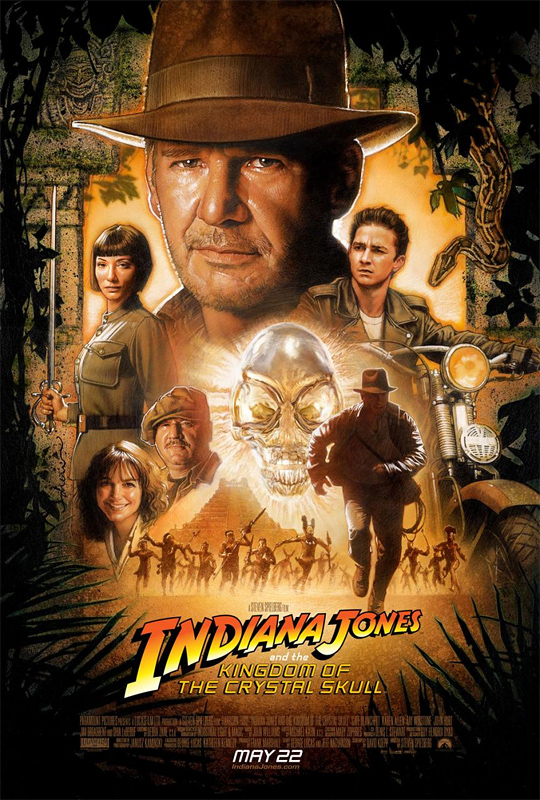
Long-time readers know I criticized Indiana Jones and the Kingdom of the Crystal Skull when it came out in 2008. Indeed, I criticized all the Indiana Jones movies for their portrayal of indigenous people and the archaeologist's relationship to them.

This posting makes some of the same points in a humorous way:

Back from Yet Another Globetrotting Adventure, Indiana Jones Checks His Mail and Discovers That His Bid for Tenure Has Been Denied.

By Andy BryanJanuary 22, 1939

Assistant Professor Henry “Indiana” Jones Jr.
Department of Anthropology
Chapman Hall 227B
Marshall College

Dr. Jones:

As chairman of the Committee on Promotion and Tenure, I regret to inform you that your recent application for tenure has been denied by a vote of 6 to 1. Following past policies and procedures, proceedings from the committee’s deliberations that were pertinent to our decision have been summarized below according to the assessment criteria.

Demonstrates suitable experience and expertise in chosen field:

The committee concurred that Dr. Jones does seem to possess a nearly superhuman breadth of linguistic knowledge and an uncanny familiarity with the history and material culture of the occult. However, his understanding and practice of archaeology gave the committee the greatest cause for alarm. Criticisms of Dr. Jones ranged from “possessing a perceptible methodological deficiency” to “practicing archaeology with a complete lack of, disregard for, and colossal ignorance of current methodology, theory, and ethics” to “unabashed grave-robbing.” Given such appraisals, perhaps it isn’t surprising to learn that several Central and South American countries recently assembled to enact legislation aimed at permanently prohibiting his entry.

Moreover, no one on the committee can identify who or what instilled Dr. Jones with the belief that an archaeologist’s tool kit should consist solely of a bullwhip and a revolver.

Nationally recognized for an effectual program of scholarship or research supported by publications of high quality:

Though Dr. Jones conducts “field research” far more often than anyone else in the department, he has consistently failed to report the results of his excavations, provide any credible evidence of attending the archaeological conferences he claims to attend, or produce a single published article in any peer-reviewed journal. Someone might tell Dr. Jones that in academia “publish or perish” is the rule. Shockingly, there is little evidence to date that Dr. Jones has successfully excavated even one object since he arrived at Marshall College. Marcus Brody, curator of our natural-history museum, assured me this was not so and graciously pointed out several pieces in the collection that he claimed were procured through Dr. Jones’s efforts, but, quite frankly, we have not one shred of documentation that can demonstrate the provenance or legal ownership of these objects.

Meets professional standards of conduct in research and professional activities of the discipline:

The committee was particularly generous (and vociferous) in offering their opinions regarding this criterion. Permit me to list just a few of the more troubling accounts I was privy to during the committee’s meeting. Far more times than I would care to mention, the name “Indiana Jones” (the adopted title Dr. Jones insists on being called) has appeared in governmental reports linking him to the Nazi Party, black-market antiquities dealers, underground cults, human sacrifice, Indian child slave labor, and the Chinese mafia. There are a plethora of international criminal charges against Dr. Jones, which include but are not limited to: bringing unregistered weapons into and out of the country; property damage; desecration of national and historical landmarks; impersonating officials; arson; grand theft (automobiles, motorcycles, aircraft, and watercraft in just a one week span last year); excavating without a permit; countless antiquities violations; public endangerment; voluntary and involuntary manslaughter; and, allegedly, murder.
Comment:  Academic standards were laxer in 1939. These days, Jones wouldn't just be denied tenure. He'd be kicked out of the school and academia as a whole if he committed one-tenth of these offenses.

For more on the subject, see Indiana Jones and the Stereotypes of Doom.

September 10, 2012

Venezuelan "massacre" didn't happen

I almost reported on this "massacre" a couple of weeks ago. I'm glad I held off.

Reported Venezuelan massacre didn't happen, activists now sayThe nonprofit that pushed last month for Venezuelan officials to investigate reports of a massacre in an Amazon indigenous community said Monday that it now believes there was no attack there.

"Having received its own testimony from confidential sources, Survival now believes there was no attack by miners on the Yanomami community of Irotatheri," said Stephen Corry, director of Survival International.

The statement comes after Venezuelan state media over the weekend published several reports detailing officials' accounts from the area, also concluding that no massacre had occurred.

An aerial flyover and ground operation to the community in a remote region along the Brazil-Venezuela border showed no signs of an attack, Venezuelan Brig. Gen. Jesus Zambrano told state-run VTV.

"We can testify that nothing happened," he said. Investigators "also visited other communities in the region, before reaching Irotatheri, and also nothing happened there."

On Saturday, Venezuela's government ombudswoman said the report was fueled by second-hand hearsay.

"It was a false, biased report," Gabriela Ramirez told reporters. "The report was made by an indigenous person that heard that another organization had said it."
Comment:  Another case of botched reporting, but this time the blame falls squarely on Survival International. One Indian heard it from someone else...and you reported it as fact? You had no eyewitness testimony--indeed, nothing but a third-hand report?

Wow. Next time, try checking your sources before alarming the world about a potential atrocity. Try to get at least a secondhand report--e.g., "He described the dead bodies to me in vivid detail." A third-hand report is basically useless as evidence.

For more on the subject, see Firth Video Generates Protest E-Mails and Sunday Night Probed Over "Freakshow."

Below:  "Yanomami natives perform a ritual dance at an Irotatheri community, located in southern Venezuela near the border with Brazil, on September 7."

August 05, 2012

Race in Revealing Eden

Here's the first book in a new young-adult fantasy series. First, let's have a summary and critique of the book from Amazon.com:

Revealing Eden (Save the Pearls Part One)Eden lives in a dystopian world where the darker your skin, the more desirable you are because those with dark skin can more easily stand the excessively hot environment that the earth now nurtures. Eden is a Pearl, a white person, which pretty much categorizes her as the dregs of society. Eden can only hope that a desirable Coal, a black person, will pick up her mate-option. But the story really begins when Eden and her father are swept away by Ronson Bramford, one of the most desirable and wealthiest Coals, and taken to a secluded part of the rainforest. This is after Eden compromises her father's vital experiments and Bramford is turned into something between beast and man. But Bramford's new transformation might be the key to helping society gain a semblance of what it once was, with everyone on more equal footing and with a better adaption to the environment.Revealing Eden has a two-star average rating, with 167 of 224 reviewers giving it one star as of this writing. Some of the comments:Julie
This book is nothing more than racist drivel.

Halobium
I'm not sure how this novel is supposed to be dystopian fantasy and/or sci fi. It purports to 'reverse racism' while, yes, it does invert today's racial heirarchies, it actually just serves to be a modern day expression of racism today.

First...the blackface. Blackface is a relic of old American minstrel shows. It is considered very offensive and racially charged today.

Second, and other reviewers have mentioned this, a true inversion of today's racial hierarchies would not involve calling people with white skin 'pearls' and people with very dark and/or Black skin 'coals.' Rather than an inversion, this is really an invocation of common, everday notions of beauty, where light skin is heavily prized and often seen as the most beautiful. Pearls are more beautiful than coals. It is clearly seen from the fact that one is considered a precious jewel and the other is not.

The entire concept of this novel is unoriginal and trite. It is poorly executed with little sensitivity or understanding of how racism operates in the real world.

KJ
Blackface is not edgy or progressive.

Naming a race of people "Coal" is not a compliment.

Telling us that "Pearl" is a slur does not make it so.

Claiming that the world's hierarchy is dependent on skin tone does not mean that you can separate people based on race while ignoring their actual skin color.

Calling your heroine's love interest a "beast" does not imply his supposed beauty and high status.

Questioning the existence of an African-American community of readers will make me side-eye you damn hard.

We get it--you believe that special white snowflakes always deserve to be the heroine because their lives are oh so hard. Why not just come out and admit to all the racist imagery and insulting propaganda you'll publishing? This book is disgusting.

There is never a reason to make racism about white people. Repeat that as many times as you have to before it finally sinks in.
Has Foyt ever heard of black pearls? If she really wanted to subvert our expectations, she could call the blacks "pearls" and the whites something unpleasant. Perhaps "spit wads" or "bird turds." Then we'd start to get the message that whites are worthless in this society.

The Native aspects

Debbie Reese discusses the Native aspects in her American Indians in Children's Literature blog (8/5/12):

Indigenous peoples in Victoria Foyt's REVEALING EDENWriting about Foyt's book lets me call attention to the ways that Foyt (and those who like the book) are caught up in stereotypical ideas about Indigenous people.

Yeah... Indigenous people are in her book, too.

But they don't have a category like Coal or Pearl. They don't live in the tunnels. Instead, they're on the surface near the equator, and they're the Huaorani. Somehow, they've made it into Foyt's future, but she doesn't tell us how they were able to survive the Meltdown.
And:When they land, Eden sees "a half-dozen, short, muscular Indians wearing a rag-tag assortment of clothes" (p. 50). Some have machetes, some have blowguns (and poison darts), and, "Despite fanciful feathers tucked into simple bowl-cut hairstyles, the warriors appeared fierce" as they stood by their vehicles (p. 50).So...the Huaorani are a bunch of savage warriors. You might think they, as the sole surface race, would be smarter, more advanced, more technologically savvy. Apparently not.Anyway, it turns out that the Huaorani think Bramford is El Tigre ("the Jaguar Man") who is the "long-awaited Aztec God" and because Eden is with him, they look upon her with "equal reverence" (p. 51). I guess Foyt want us to think that the Huaorani and Aztec have the same gods. Indigenous people, whether we're in North or South America...some writers think our ways are the same, no matter our location or history. Monolithic, ya' know! Interchangeable!Not only are the Huaorani primitive, they're superstitious. They worship Aztec gods even though they live thousands of miles from Mexico and the Aztec culture is mostly extinct even now.

And unlike everyone else, they're too ignorant to understand the concept of a mutated human. Apparently they haven't watched Avatar or other movies available to Amazon Indians. Just like the stereotypical Indians who met the Spanish, anyone strange or exotic is a god.The Huaorani take Bramford, Eden, and her father to a village where (p. 54):Native women and children in tattered rags stood by, staring blankly at the arrivals. They looked ill with patchy hair, and red, scaly rashes on their brown skin. Their stomachs were swollen, their eyes lifeless. Two drunken men sprawled in a heap of garbage. One of them raised his head, eyed the commotion, then spit and turned over.Blank stares and lifeless eyes? This portrayal of the Huaorani isn't consistent across the novel. Here, it sounds like she's looking at a 'save the children' commercial. And drunken men?! Why is THAT there?Reese's review continues in that vein.

As the movie White Man's Burden demonstrated, you don't learn much simply by reversing the races. You have to have a plausible explanation how one race came to power and continues to rule. Revealing Eden doesn't seem to have that.

In this context, I don't know if blackface is bad. But how about if the "Pearls" go outside and expose themselves to deadly radiation to darken their skins? That would be more thought-provoking.

Seems like Revealing Eden would've better if there were no racial distinctions at all. The ruling class could've been scientists or simply the wealthy. The "Save the Pearls" subtitle seems like a big unpleasant clue about where the series is headed.

Indeed, the whole series seems to exist so Eden can have a "forbidden" love with a vampire werewolf were-jaguar. Where have we seen something like that before?

For more of Debbie Reese's reviews, see Brave Mr. Buckingham and Hanging from Jefferson's Nose.

April 29, 2012

Firth video generates protest e-mails

Colin Firth Campaign for Brazilian Tribe Breaks RecordsColin Firth's appeal has generated more than 10,000 protest emails.

A campaign launched by Colin Firth to save the world’s most threatened tribe has generated more than 10,000 protest emails to the Brazilian government in just three days–a record for protest action for tribal peoples anywhere in the world.

The Survival International campaign aims to save the Awá tribe, whose lands are being illegally invaded and destroyed.

In a video appeal, Colin Firth asks viewers to send a protest message to Brazil’s Justice Minister, who has the power to send in federal police to evict the loggers, ranchers and settlers who are ravaging the tribe’s land.
Comment:  For more on the subject, see Firth Campaigns for Amazon Tribe.

April 27, 2012

Firth campaigns for Amazon tribe

Actor in push to save Amazon tribeOSCAR-WINNING British actor Colin Firth has launched a major drive by Survival International to save "Earth's most threatened tribe," the Awa of the Brazilian Amazon.

Survival International, a leading advocate for tribal peoples' rights worldwide, said the small tribe's territory had been invaded by illegal loggers, ranchers and settlers, and the group is threatened with extinction. The aim of the campaign is to persuade Brazilian Justice Minister Jose Eduardo Cardozo to send in police to remove the loggers, ranchers and settlers and keep them out.

A short film by Survival International features an appeal by Firth to sign a petition calling on Mr Cardozo to act to save the tribe.

"The Awa's forest is being illegally cut for timber. When the loggers see them, they kill them. Their bows and arrows are no match for guns. And at any other time in history, that's where it would end. Another people wiped off the face of the Earth, forever," Firth says in his appeal. "But we're going to make sure the world doesn't let that happen."


We can save the Awá tribe

As the successful survival of other Amazon Indian tribes shows, protecting their way of life rather than imposing that of the west is the best way to keep them intact

By Stephen Corry
The Awá of Brazil are the world's most threatened tribe. Years of illegal logging and land grabs have brought them to the brink of extinction. But apart from the loggers and their guns, one of their biggest problems is the fallacy that Amazon Indians must inevitably conform to "modernity."

Although people have been saying it for generations, it isn't true: tribes are destroyed by labelling them backward, and pretending they stand to benefit from "civilisation". It's fundamentally racist, and the evidence points, glaringly, and to our shame, in exactly the opposite direction.

When land is taken, tribes simply don't survive. On the other hand, when it's protected, most of their problems evaporate. That can happen if no one else wants the land, it's inaccessible to outsiders or, most importantly, there's the political will and strength to ensure it remains with the Indians.

On their own territory, they can adapt to change as they wish. Some individuals might leave to explore the outside, but most will return home to its invaluable advantages: free food and housing, as opposed to scraping a living in shantytowns and slums, where life is usually nasty, brutish and short.

The "integration" of these peoples is the theft of their self-sufficiency, and their condemnation to the lowest rung of a steep and greasy ladder–or worse, death. However, we believe, profoundly, that there will still be Amazon Indians at the end of the century. It merely entails respecting the laws and rights which governments claim to uphold. Cynics might argue that it won't happen, that the fast buck will always triumph, but that's really an admittance that we are the savages, unfettered by any rule of law, common decency or humanity.

We have seen tribal peoples' lands protected repeatedly over the last 40 years. The largest little-contacted tribe in Amazonia, the Yanomami, survived because a 20-year campaign secured the protection of their lands in 1992. They remain steadfastly Yanomami.

The Awá will doubtless survive as well, but only if the campaign in defence of their land is similarly vociferous. In the words of Colin Firth, who is supporting our campaign: "One man can stop this: Brazil's minister of justice. He can send in the federal police to catch the loggers, and keep them out for good. But right now it's just not his priority.

"We have to change that before it's too late. We need enough people to message him that he takes notice… You, me, our friends, our families. Everyone counts. But we don't have much time. When the rains stop, the loggers will be back. This is our chance, right now, to actually do something. And if enough people show they care, it will work."


More background on the issue:

Group hopes to save world's 'most threatened' tribe in Brazil

Legal wrangling and deforestation projects leave the Awá tribe scrambling for safety.

By Stephanie Pappas
The Awá's right to their land was formally recognized in 2005, making mining and other activities by outsiders illegal; but satellite photos of the forest reveal that these rights are not being honored. Illegal logging has left the scar of deforestation on the land. This is especially devastating to the Awá, who depend on the forest for their survival, Watson said.

"When you talk to the Awá, it's just so clear how much the forest means to them," she said. "They just get everything from it."

That includes food—babaçu nuts and açaí berries as well as fresh meat—and medicines and supplies, such as the resin of the maçaranduba tree, which is used to make torches.

As the forest vanishes, the Awá are trapped in a legal battle to save it. In 2009, a federal judge ruled that illegal settlers had to leave the Awá territories within 180 days. A legal appeal by one of the largest cattle ranchers in the region delayed the ruling. In December 2011, a second federal judge ruled that colonists and ranchers had to leave the land by December 2012. Survival fears that continued legal wrangling will delay these departures, too. If the case continues in the legal system, it could take 20 or 30 years for the Brazilian Supreme Court to decide it. By that time, it will be too late for the Awá.

"Time is not on their side," Watson said.
Comment:  The stereotyping of Amazon Indians in particular and Indians in general is a big contributor to this problem. When people think Indians are primitive, savage, or extinct, their rights become less important. It's easier to ignore people if you think they're like children or dogs.

For more on Amazon Indians, see Sunday Night Probed Over "Freakshow" and Ya'Wara in AQUAMAN.

March 19, 2012

Sunday Night probed over "freakshow"

Sunday Night probed over tribe's infanticide portrayal

By Amanda MeadeSEVEN'S current affairs flagship Sunday Night is under investigation by broadcasting authorities for a story which depicted a Brazilian tribe of Suruwaha Indians as a suicide cult that encouraged the murder of disabled babies.

The story, broadcast in September, featured Seven video journalist Tim Noonan and writer and adventurer Paul Raffaele, who famously claimed in 2006 on Nine's 60 Minutes that a child called Wa-Wa had to be rescued from cannibals. Raffaele accompanied Seven's Today Tonight host Naomi Robson on a rescue mission to Indonesia's Papuan province.

Raffaele said in his blog about the Sunday Night broadcast: "Being with the tribe was the peak of my career. But the experience was not only enthralling but deeply disturbing. The Suruwaha practise a bizarre suicide cult, unlike anything I'd ever seen before, where many of the tribe kill themselves with a deadly poison made from tree bark before they reach old age."

Survival International director Stephen Corry said it was "freakshow TV" at its very worst. "The Indians are made out to be cruel and inhuman monsters," he said.
Comment:  For more on the subject, see "Freakshow TV" Campaign Targets Stereotypes.

March 10, 2012

Ya'Wara in AQUAMAN

First Look at Aquaman’s Other Team: Ya’Wara

By Michael "Skitch" MaillaroFrom DC Blog:

“There isn’t much we want to say yet about Ya’wara. She is a member of the Tapirape, an indigenous tribe of Brazil living in deep in the Amazon rainforest, she has a jaguar, she has a unique power and she has a connection with Aquaman that isn’t going to make Mera very happy.”

Skitch Commentary: I imagine the arguement “she’s from the jungle” is not going to tame the backlash on this one. I can’t help but think that certain parties in DC either don’t care about controversy or they are actively pursuing it.
Comment:  Ya’Wara is half-naked in a sexy lingerie outfit. Her hair and features look Caucasian, not Native. She has mystical powers. In short, she's a typical fictional Amazon Indian. Completely stereotypical. Completely divorced from reality.

The real Tapirapé

Curiously, the Tapirapé are a real tribe:

Tapirapé people

A few facts about the tribe as it was when Europeans first contacted it:The Tapirapé lived from slash and burn horticulture, hunting and fishing. Patches of forest were cleared and then burned to produce fertile soil that was planted only once or twice before clearing another patch. Each Tapirapé loghouse, hosting four or five families related through maternal links, owned its own garden; however both agricultural and hunting products could be shared among people from other houses.

The Tapirapé didn't use any clothing whatsoever in their daily life; but men were ashamed of their penis glans, which they covered with a small cone attached to the prepuce. Women squatted and sat with their legs together. Both women and men painted their bodies with diverse designs according to age and gender. On special ceremonies and dances they would also use skirts, anklets and wrist bands.

Their religion was based on shamanism. There were all sorts of spirits, some good and some unfriendly, that the shamans could communicate with. Spirits came to live in the Takana on a cyclic basis; each “belonged” to a particular Bird Society. When one of the spirits was present, two members of the corresponding Bird Society impersonated and attached himself to the spirit by wearing a special mask and other pieces of clothing until their whole body was covered; they then went dancing around the village and received good kawi (a manioc drink) from every loghouse.
Will any of these details appear in the Aquaman comics? Probably not.

What about the fact that they went naked? Doesn't that justify Ya'Wara's sexy outfit?

Well, no. The culture changed as it increased contact with the outside world:By 1965, the Tapirapé were concentrated in New Village, created by the Brazilian Government in order to protect them and just a few miles from the nearest trading post; this however increased contact with whites and furthered cultural influence. Loghouses had shrunk in size and some of them had become single-family houses built with mortar. The takana and the Bird Societies still existed, although the takana activities now included manufacturing Indian artifacts for trade. Some women had started to use skirts and blouses and men had begun to wear shorts at least when receiving visitors or trading goods. Brazilian music in addition to Tapirapé music was beginning to be heard at parties, and alcoholic drinks were starting to be drunk despite strong protests from the Little Sisters and the Indian Protection officers. Although the gift system persisted, some men possessed Brazilian bank notes and had started to understand the value of these pieces of paper.In short, the Tapirapé are like most Amazon Indians now. They live in Western-style houses, wear Western-style clothing, etc. They aren't "lost" in the jungle doing spooky dances untouched by "civilization."

Fiction vs. reality


Compare with a real Tapirapé woman:


She's not tall and flowing. She doesn't have voluptuous curves or a wild mane of hair. Her tattoos cover her face and body in unattractive ways by Western standards.

So a typical Native woman is transformed into an otherworldly huntress/priestess type. And the stereotyping of Natives continues. This is why people think Indians don't exist anymore--because an Indian like Ya'Wara never existed except in mists of legend.

For more on stereotypical Amazon Indian women in DC comics, see Hidalgo in FIRST WAVE #4 and Rima the "Native" White Girl.