Showing posts with label princesses. Show all posts
Showing posts with label princesses. Show all posts
September 17, 2016
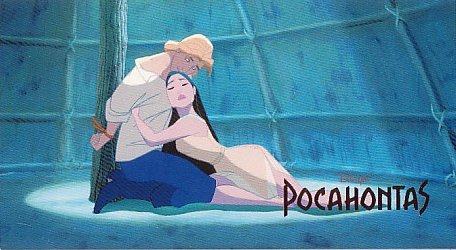
Pocahontas by Dingo Pictures
Pocahontas (Dingo Pictures)Dingo Pictures bring us their horrid take on Pocahontas but more importantly this is Wabuu’s origin story!


May 22, 2016
Lewis and Clark in Saturday Night Live
The May 21 episode of SNL featured another of its comedic classroom experiences. This time, some terrible white actors performed a terrible "educational" skit about Lewis and Clark:
Comment: In the phony historical "lesson," Lewis and Clark are mostly interested in sleeping with Sacagawea. She isn't opposed to this and at one point does a sexy dance.
The skit within the sketch is definitely racist, with Sacagawea as nothing but a sex object who speaks Tonto talk. The sketch itself is borderline racist as well.
On the one hand, the actors are supposed to be buffonish, so you're not supposed to take them seriously. On the other hand, the teacher encourages them and is moved to tears by their performance. Other than Sasheer Zamata's frowns, no one is really rejecting the lesson.
This leaves viewers unclear about how accurate the lesson is. Obviously Lewis and Clark didn't want to have a ménage à trois with anyone. But was Sacagawea a sexy and savage Indian princess? No, she was a teenage girl with a husband and a baby.
Call it another example of hipster racism. The sketch kind of mocks anti-Indian racism, but also kind of supports it. If you didn't know better, you might swallow some of its points.
Not funny
For fans of SNL, the sketch also was completely unfunny. Whether it was racist or not, it should've been axed for that reason alone.
It's a good bet Fred Armisen had something to do with its creation. He may be SNL's leading purveyor of racist stereotypes in the last decade.
How do stupid things like this sketch get on the air? Because ignorant white people, many of them liberals, control the airwaves.
For more on Saturday Night Live, see Anchor Babies in Saturday Night Live and Peyote, "Firewater" in Saturday Night Live
December 11, 2015
Scathing reviews for Ridiculous 6
The early reviews of Adam Sandler's The Ridiculous Six weren't good:
Review: 'The Ridiculous 6' Starring Adam Sandler, Rob Schneider, Taylor Lautner, Nick Nolte, Will Forte, Vanilla Ice, More
By Nick SchagerHumor is murdered over the course of 119 deathly minutes by Adam Sandler in “The Ridiculous 6,” a Western spoof that, like its protagonist’s feats of magical heroism, is best described as “some mystical shit.” Mired in pre-release controversy over its supposedly offensive characterizations of Native Americans—which drove some extras to abandon the project—Sandler’s first of four exclusive features for Netflix turns out to be distasteful in every regard, an abysmal riff on “The Magnificent Seven” in which hoary stereotypes and oater clichés are exploited for equally groan-worthy gags. Without an amusing instinct in its cowboy-hatted head, this painfully protracted, puerile effort meanders about the Old West as if it were making up its nonsense on the fly. The result is a torturous genre joke that marks a new low not only for the star, but for the art of cinematic comedy.
Boasting a stoic countenance and monotone voice that vacillates between Native American broken-English and cowpoke-y American twanginess, Sandler is Tommy, aka White Knife, a white man raised by the Apache, who taught him how to both handle a blade and fight with superhuman speed. More on Sandler's stereotyping:Native American women possess names such as “Wears No Bra,” “Smoking Fox,” and “Beaver Breath;” Ramon talks about the deliciousness of tacos; and white people are ridiculed for being bad dancers—Sandler and co-writer Tim Herlihy’s script performs cultural mockery with all the incisive skill of a blind surgeon wielding a hammer. Not helping matters is a cavalcade of Sandler pals appearing in dim, one-note cameos. Will Forte is the leader of a gang of eye-patched bandits who utters things like “Kemo-slobby” and “Poca-hot-tits.” 'The Ridiculous 6' Review: Should You Watch Adam Sandler's New Netflix Movie?
By Alex GarofaloFor "Aloha," "Entourage," "Mortdecai," and others, the arrival of Adam Sandler's "The Ridiculous 6" on Netflix Friday must seem like a Christmas miracle. Those films are off the hook. "The Ridiculous 6" is the worst movie of the year. And:Everything that has been written about the movie's clumsy treatment of Native Americans is pretty much true. That several Native American actors and a cultural adviser walked off the set of the movie in protest is well documented and it is not easy to see why they were offended. The reliance on stereotypes and the blunt novelty of Sandler playing a borderline mystical Native American warrior wear thin quickly and feel awfully dated for 2015. 
Stereotypes galore
The reviews that followed weren't good either. Most of them mentioned the racist stereotyping:
The Ridiculous Six': How the West was wan with Adam Sandler
By Richard RoeperYeah, one can see that, given Sandler is playing a white man named White Knife, a.k.a Tommy, who speaks like a 1940s-movie version of the American Indian because he grew up with a tribe of Native Americans, including Screaming Eagle (Saginaw Grant), who is like a father to Tommy.
One of the women in the tribe is named Never Wears a Bra, because—well, you get it. In the world of “The Ridiculous Six,” Native Americans whoop it up and dance at night, and don’t seem to do much of anything in the day other than wait around for White Knife/Tommy to bring them supplies.
Tommy has mystical powers, including the ability to move at the speed of light, turn himself into a tumbleweed and literally castrate a buzzing fly with a knife. Sure. Why not. Adam Sandler Keeps On Offending Everyone In The Ridiculous 6
By Courtney E. SmithWe meet Sandler's wife, the dutiful Smoking Fox (Julia Jones), a Native American woman with a name that manages to be both racist and sexist. That's the theme for all the Native American women we meet, who get one-note lines of introduction. They include Screaming Eagle, Never Wears Bra (a woman in the tribe who desperately wants to do it with Sandler for no apparent reason), and Beaver Breath (a woman whom a rival gang finds unattractive). The objections of the Native American community to this movie were well documented while it was still in production. Adam Sandler’s ‘Ridiculous Six’––so, how racist is it?
By Larry CarrollIs the film racist, is it harmless—or is it just business-as-usual Happy Madison?
Below is every instance of racism in “The Ridiculous Six”—read on, and then you make the call. 
Year's worst movie?
Adam Sandler's 'The Ridiculous 6' Is Getting Some of the Year's Most Hilariously Scathing Reviews
Don't watch Sandler's two-hour Netflix slog, but enjoy reviews funnier than anything in it.
Comment: For more on Adam Sandler, see Adam Sandler Defends Ridiculous 6 and Adam Sandler's History of Racism.
Review: 'The Ridiculous 6' Starring Adam Sandler, Rob Schneider, Taylor Lautner, Nick Nolte, Will Forte, Vanilla Ice, More
By Nick Schager
Boasting a stoic countenance and monotone voice that vacillates between Native American broken-English and cowpoke-y American twanginess, Sandler is Tommy, aka White Knife, a white man raised by the Apache, who taught him how to both handle a blade and fight with superhuman speed.
By Alex Garofalo
Stereotypes galore
The reviews that followed weren't good either. Most of them mentioned the racist stereotyping:
The Ridiculous Six': How the West was wan with Adam Sandler
By Richard Roeper
One of the women in the tribe is named Never Wears a Bra, because—well, you get it. In the world of “The Ridiculous Six,” Native Americans whoop it up and dance at night, and don’t seem to do much of anything in the day other than wait around for White Knife/Tommy to bring them supplies.
Tommy has mystical powers, including the ability to move at the speed of light, turn himself into a tumbleweed and literally castrate a buzzing fly with a knife. Sure. Why not.
By Courtney E. Smith
By Larry Carroll
Below is every instance of racism in “The Ridiculous Six”—read on, and then you make the call.
Year's worst movie?
Adam Sandler's 'The Ridiculous 6' Is Getting Some of the Year's Most Hilariously Scathing Reviews
Don't watch Sandler's two-hour Netflix slog, but enjoy reviews funnier than anything in it.
Comment: For more on Adam Sandler, see Adam Sandler Defends Ridiculous 6 and Adam Sandler's History of Racism.
October 10, 2015
Montreal Alouettes stereotype Indians
Montreal Alouettes assailed for 'Cowboys and Indians' costume party
Critics say costume party smacks of cultural appropriation and promotes stereotypesA 'Wild Wild West' costume party attended by some Montreal Alouettes' football players last Monday in Montreal has sparked an online backlash from First Nations people and others who say it smacks of cultural appropriation and promotes stereotypes.
The issue came to light after Alouettes' linebacker Kyries Hebert appeared in photo posted to Instagram, decked out in face paint, a feather headdress, a bone-choker necklace and a suede loincloth. In the photo, a woman at his side sports a low-cut fringed dress and headdress, while both clutch the same hunting spear.
The costume promotes unhelpful stereotypes, said Jessica Deer, a columnist and reporter at the Mohawk territory of Kahnawake weekly, The Eastern Door.
"It just contributes to a one-dimensional representation of indigenous people, but there are so many different First Nations across Canada," she told CBC News Friday. 
Critics say costume party smacks of cultural appropriation and promotes stereotypes
The issue came to light after Alouettes' linebacker Kyries Hebert appeared in photo posted to Instagram, decked out in face paint, a feather headdress, a bone-choker necklace and a suede loincloth. In the photo, a woman at his side sports a low-cut fringed dress and headdress, while both clutch the same hunting spear.
The costume promotes unhelpful stereotypes, said Jessica Deer, a columnist and reporter at the Mohawk territory of Kahnawake weekly, The Eastern Door.
"It just contributes to a one-dimensional representation of indigenous people, but there are so many different First Nations across Canada," she told CBC News Friday.
September 26, 2015
Mike's Tribe in My Wife and Kids
I recently watched this old episode of a TV show:
My Wife and Kids: Season 3, Episode 14
Michael's Tribe (18 Dec. 2002)Michael (aka: Chief Bald Eagle) is recruited to camp out with Kady and her friends and teach them Native American lore. Meanwhile, Clare and "the new Tony" plan to stay out all night themselves: they're plotting to sneak out to a "rave." The Brady Braves blog ripped this episode apart:
My Wife and Kids "Michael's Tribe," Part IWhen he hears that his daughter’s “Indian” Princesses group will be camping at the house of a family he does not know, Michael demands that the camping be at his house. As he tells his wife Jay/Janet (portrayed by Tisha Campbell), “I’ll be the chief. I’ll watch the game and then I’ll go out there and play ‘Indian.’” And:As the rest of the episode unfolds, he shows that he is clueless about as well as racist towards Indigenous Peoples. The only clue he has is being well-versed in Hollywood “Injun” stereotypes, which suffices for the sitcom’s “Indian.” A typical example of the episode's racism:
"Michael's Tribe," Part IIMichael tells the Princesses of Claire’s plan and asks them to help make sure Claire stays “here in the village” (i.e., at home). Next, the Princesses prepare for what Bald Eagle labels as “war” while dancing senselessly and chanting “hi-ya uh-ya-ha hi-ya uh-ya-ha” with their chief. Chief Bald Eagle also leads the Princesses in a rendition of “the sacred song of our Indian People.” In unison, they sing “three little, two little, one little Indian” from the well-known Septimus Winner nineteenth-century minstrel song (and later nursery rhyme) “Ten Little Indians.” Comment: I agree with these analyses. The episode actually was worse than the "Brady Braves" comments indicated.
Recall that this aired in 2002, or 12 years after Dances with Wolves in 1990. It's significantly worse than Running Zack in Saved by the Bell, which also aired in 1990. There's no excuse for this level of stereotyping appearing so recently.
Damon Wayans has a history of making racist and sexist comments. He was the executive producer of the show and co-wrote Mike's Tribe. There's no getting around it: Wayans is responsible for the episode's racism.

My Wife and Kids: Season 3, Episode 14
Michael's Tribe (18 Dec. 2002)
My Wife and Kids "Michael's Tribe," Part I
"Michael's Tribe," Part II
Recall that this aired in 2002, or 12 years after Dances with Wolves in 1990. It's significantly worse than Running Zack in Saved by the Bell, which also aired in 1990. There's no excuse for this level of stereotyping appearing so recently.
Damon Wayans has a history of making racist and sexist comments. He was the executive producer of the show and co-wrote Mike's Tribe. There's no getting around it: Wayans is responsible for the episode's racism.
August 30, 2015
Los Angeles Magazine's "Going Native"
ICYMI: “Fall Fashion: Your Guide to Going Native”: Los Angeles Magazine Celebrates Cultural Misappropriation
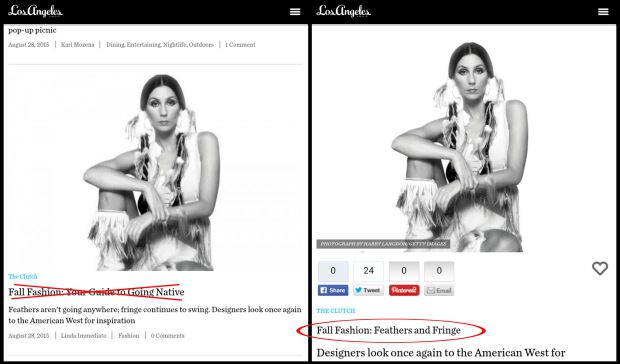
By Kelly HolmesTwo days ago, Los Angeles Magazine posted an article sharing what’s trending this fall with a headline that certainly rang cultural appropriation.
The style article, which was posted under the magazine’s ‘The Clutch‘ column, displayed the apparent Native-inspired trend craze set for fall with the initial title “Fall Fashion: Your Guide to Going Native.”
The article claimed “Feathers aren’t going anywhere; fringe continues to swing. Designers look once again to the American West for inspiration,” accompanied by a Boticca feather necklace, Burberry fringe clutch, and DSquared2 sandals.
As the post came to light, Los Angeles Magazine received backlash for the offensive headline and article.
Concepción Lara @lowsell
"Going Native" implies Indigeneity is 1) chosen and 2) temporary. Utilizing Cher's photo furthers the erasure of Native people. @LA_mag
In response, the magazine changed their headline to “Fall Fashion: Feathers and Fringe” with the explanation “An earlier version of this story had a poorly phrased headline. We apologize.”
However, they did not address or remove the photo of Cher dressed as the stereotypical “Pocahottie” nor did they address their glorification of cultural misappropriation. Despite their claim of “We’ve heard your feedback, and you’re right,” they missed the point of the initial backlash, which did not escape the notice of Twitter.
Mariana @MarianaThinks
@LA_mag oh no. Take the whole article down. Why not support authentic Native American designers? Not overpriced and fake products. Comment: The tweets above are just examples of the criticism the magazine received.
Using Cher was kind of silly since the photo was 40-50 years. It may have represented the concept of "going Native," since Cher has tried to pass as Native over the years. But it didn't represent "fall fashion" unless they meant some fall in the late 1960s.
And yes, using Cher as a "Pocahottie" only furthers the sexualization of Native women. No real Native women dress this way, so it's not "going Native" so much as "going stereotypical." It's nothing more than a white man's (or woman's) fantasy of Native fashion.
For more on Cher, see Cher in a Headdress, Again.
By Kelly Holmes
The style article, which was posted under the magazine’s ‘The Clutch‘ column, displayed the apparent Native-inspired trend craze set for fall with the initial title “Fall Fashion: Your Guide to Going Native.”
The article claimed “Feathers aren’t going anywhere; fringe continues to swing. Designers look once again to the American West for inspiration,” accompanied by a Boticca feather necklace, Burberry fringe clutch, and DSquared2 sandals.
As the post came to light, Los Angeles Magazine received backlash for the offensive headline and article.
Concepción Lara @lowsell
"Going Native" implies Indigeneity is 1) chosen and 2) temporary. Utilizing Cher's photo furthers the erasure of Native people. @LA_mag
In response, the magazine changed their headline to “Fall Fashion: Feathers and Fringe” with the explanation “An earlier version of this story had a poorly phrased headline. We apologize.”
However, they did not address or remove the photo of Cher dressed as the stereotypical “Pocahottie” nor did they address their glorification of cultural misappropriation. Despite their claim of “We’ve heard your feedback, and you’re right,” they missed the point of the initial backlash, which did not escape the notice of Twitter.
Mariana @MarianaThinks
@LA_mag oh no. Take the whole article down. Why not support authentic Native American designers? Not overpriced and fake products.
Using Cher was kind of silly since the photo was 40-50 years. It may have represented the concept of "going Native," since Cher has tried to pass as Native over the years. But it didn't represent "fall fashion" unless they meant some fall in the late 1960s.
And yes, using Cher as a "Pocahottie" only furthers the sexualization of Native women. No real Native women dress this way, so it's not "going Native" so much as "going stereotypical." It's nothing more than a white man's (or woman's) fantasy of Native fashion.
For more on Cher, see Cher in a Headdress, Again.
August 03, 2015
Tomahawk in Swamp Thing
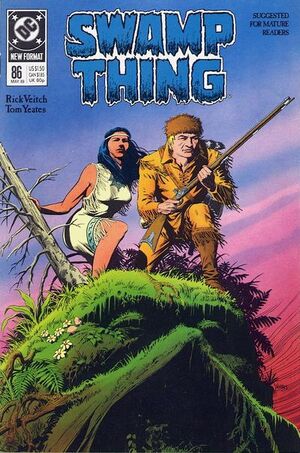
A 1989 issue of Swamp Thing featured Tomahawk, the Revolutionary War hero who resembled Daniel Boone and Natty "Hawkeye" Bumppo. It also featured several Native characters. You can read a plot summary here:
Swamp Thing Vol 2 86
Whether I read the comic book or this summary, the story initially makes little sense. But I'll try to summarize it.
** spoiler alert **
Swamp Thing has been sent bouncing back through time. He's now trapped in a crystal in the Old West in the year 1800.
The former Tomahawk is now a middle-aged tax collector, weary and cynical. His old foe Gerald Shilling, a master of disguise, takes him to a slave ship to collect its tax. It's not clear what Shilling has planned for Tomahawk, or why he'd help Tomahawk do his job. The only hint is that Shilling is playing some sort of role he isn't aware of.
Meanwhile, Moon Fawn and Wise Owl paddle to the ship and hides a crystal in Tomahawk's rowboat. It's not clear what they're doing either, except perhaps fulfilling some prophecy. When Tomahawk returns to his boat, he discovers the crystal and realizes who Shilling is. After a battle involving magic and a giant bat, Tomahawk gives the crystal--now attached to Shilling's arm--back to the Indians.
About all the Indians have accomplished is to meet Tomahawk when he's in a proper frame of mind. Oh, and to convert the crystal without a hand into a crystal with a hand. Which I guess is part of the prophecy.
From a Native perspective, the last six pages are the most interesting part. Tomahawk says he's tired of city life and wants to return to the wilderness. He accompanies Moon Fawn and her people as they travel west, growing sharper and fitter as they go. Eventually, he and Moon Fawn fall in love and give birth to a boy Hawk. Tomahawk also uses the crystal hand to free Swamp Thing and send him through time.
Years later, Tomahawk's son Hawk stars in the Hawk, Son of Tomahawk series. Hawk writes an autobiography that ends up in the hands of Abby, the girlfriend and wife of Swamp Thing. And the circle is complete, or whatever.
Basically, this issue provides an origin for Tomahawk's later years and for his son Hawk. Since I'm not a big Tomahawk or Hawk fan, I don't know if Hawk's first appearance in Tomahawk #131 covered his history. It may have mentioned his father's journey west, but I doubt it explained how Swamp Thing brought Tomahawk and Moon Fawn together.
Generic Indians
Moon Fawn and Wise Owl, sister and brother, are generic Indians all the way. When we first see them, they're wearing buckskin outfits and paddling a canoe. Wise Owl has a headband with feathers in it.
The cover below shows Moon Fawn in a sleeveless dress, but she was more demurely dressed in the story. The hint of sexiness is only a cheap marketing ploy.
Tomahawk and the others go west to the Indians' home in Echo Valley. It's a village of tipis, of course. Chief Grey Elk is the father of Moon Fawn and Wise Owl, of course, and wears a feather bonnet, of course. So Moon Fawn is a typical Indian "princess," though the story doesn't call her that.
The names Moon Fawn and Wise Owl may be the most stereotypical thing about them. Could their names possibly be more of an on-the-nose clicheé? She's soft like a fawn; he's wise like an owl. Get it?
Fortunately, the Indians don't engage in war-whooping dances or other "savage" practices. They don't go off half-naked or in warpaint. In their brief appearances, they seem like real people.
This was a common approach to depicting Indians in the "relevance" era of the 1960s and 1970s. They weren't mindless savages anymore; they exhibited some measure of humanity. But they were mostly generic Plains Indians with no distinct culture or religion. Not terrible, but not great either.
For more on the subject, see Comic Books Featuring Indians.
Swamp Thing Vol 2 86
Whether I read the comic book or this summary, the story initially makes little sense. But I'll try to summarize it.
** spoiler alert **
Swamp Thing has been sent bouncing back through time. He's now trapped in a crystal in the Old West in the year 1800.
The former Tomahawk is now a middle-aged tax collector, weary and cynical. His old foe Gerald Shilling, a master of disguise, takes him to a slave ship to collect its tax. It's not clear what Shilling has planned for Tomahawk, or why he'd help Tomahawk do his job. The only hint is that Shilling is playing some sort of role he isn't aware of.
Meanwhile, Moon Fawn and Wise Owl paddle to the ship and hides a crystal in Tomahawk's rowboat. It's not clear what they're doing either, except perhaps fulfilling some prophecy. When Tomahawk returns to his boat, he discovers the crystal and realizes who Shilling is. After a battle involving magic and a giant bat, Tomahawk gives the crystal--now attached to Shilling's arm--back to the Indians.
About all the Indians have accomplished is to meet Tomahawk when he's in a proper frame of mind. Oh, and to convert the crystal without a hand into a crystal with a hand. Which I guess is part of the prophecy.
From a Native perspective, the last six pages are the most interesting part. Tomahawk says he's tired of city life and wants to return to the wilderness. He accompanies Moon Fawn and her people as they travel west, growing sharper and fitter as they go. Eventually, he and Moon Fawn fall in love and give birth to a boy Hawk. Tomahawk also uses the crystal hand to free Swamp Thing and send him through time.
Years later, Tomahawk's son Hawk stars in the Hawk, Son of Tomahawk series. Hawk writes an autobiography that ends up in the hands of Abby, the girlfriend and wife of Swamp Thing. And the circle is complete, or whatever.
Basically, this issue provides an origin for Tomahawk's later years and for his son Hawk. Since I'm not a big Tomahawk or Hawk fan, I don't know if Hawk's first appearance in Tomahawk #131 covered his history. It may have mentioned his father's journey west, but I doubt it explained how Swamp Thing brought Tomahawk and Moon Fawn together.
Generic Indians
Moon Fawn and Wise Owl, sister and brother, are generic Indians all the way. When we first see them, they're wearing buckskin outfits and paddling a canoe. Wise Owl has a headband with feathers in it.
The cover below shows Moon Fawn in a sleeveless dress, but she was more demurely dressed in the story. The hint of sexiness is only a cheap marketing ploy.
Tomahawk and the others go west to the Indians' home in Echo Valley. It's a village of tipis, of course. Chief Grey Elk is the father of Moon Fawn and Wise Owl, of course, and wears a feather bonnet, of course. So Moon Fawn is a typical Indian "princess," though the story doesn't call her that.
The names Moon Fawn and Wise Owl may be the most stereotypical thing about them. Could their names possibly be more of an on-the-nose clicheé? She's soft like a fawn; he's wise like an owl. Get it?
Fortunately, the Indians don't engage in war-whooping dances or other "savage" practices. They don't go off half-naked or in warpaint. In their brief appearances, they seem like real people.
This was a common approach to depicting Indians in the "relevance" era of the 1960s and 1970s. They weren't mindless savages anymore; they exhibited some measure of humanity. But they were mostly generic Plains Indians with no distinct culture or religion. Not terrible, but not great either.
For more on the subject, see Comic Books Featuring Indians.
July 14, 2015
David Guetta's racist Pocahottie promotion
David Guetta Releases Highly Racist Video Promo for "F*** Me I'm Famous"
By Matthew MeadowIt wasn’t even a week ago (3 days to be precise) that deadmau5 called out Pacha Ibiza and David Guetta for bringing a live horse into their club, endangering not only the horse, but the patrons who could have been injured were the horse sensitive to loud noises. It seems that wasn’t enough to keep the island tourist destination and Parisian DJ on their toes, as Guetta’s signature “F*** Me i’m Famous” residency just released an extremely racist depiction of Native American culture.
This video goes far beyond the already tired argument concerning war bonnets at music festivals. People, we presume, are now aware that it’s wrong–they just do it anyway to remain “fashionable,” and that’s a completely separate issue. The issue in this video is the actual depiction of Native American cultural practices, rather than attire.
The video depicts women carrying a totem pole (not the raving kind) on the beach, while enacting war cries and wearing face paint. That doesn’t even begin to describe the racist stage decorations within Pacha itself, or the dressed up women hanging from adorned horseshoes wearing pasties. The aforementioned horse stunt:
David Guetta Subjected a Live Horse to His Native American Themed Club Party
Swift backlash
Natives and their allies quickly responded:
F*** Me I'm Famous videos receive backlash from indigenous community
Spanish nightclub being called out for racist images of First Nations women
By Kim WheelerA nightclub in Spain is getting a lot of buzz from Canada on its Facebook page.
Videos that were released on July 1 to promote the F*** Me I'm Famous DJ shows featuring David Guetta at the Pacha nightclub in Ibiza, Spain, are being criticized for their racist and stereotypical images of indigenous women.
The scantily clad women in the video are shown wearing headdresses, face paint and other indigenous-inspired designs while doing "war whoops."
Ojibwe hip-hop artist Cody Coyote has started his own Facebook page called End F*** Me I'm Famous.
"I started the group because after seeing the images and videos posted on their page, I felt offended," Coyote said in an interview.
"For this kind of stuff to exist, it makes me absolutely sick to my stomach, and it frustrates me knowing that some people think it's OK to do this kind of thing." 
This Ibiza Nightclub's Native American Theme Parties May Be Worst We've Ever SeenOn the Mediterranean party island of Ibiza, off the coast of Spain, a nightclub and famous French DJ are perpetrating a display of tasteless cultural appropriation, trivialization, and female sexualization that may rival any other we've seen in recent years.
David Guetta is the headliner of "F**k Me I'm Famous," a summer-long series of parties at the Ibiza club Pacha that are using a Native American theme that incorporates face-painted models in buckskin bikinis and headdresses (often called "warbonnets") and male models in similar outfits. Props hanging on the walls in Pacha include huge dreamcatchers and a pearl-handled revolver; in a photo shoot conducted on a beach, faux-Native models planted a mock totem pole in the sand to the sound of war whoops.
As if this mockery of Native culture wasn't enough, Guetta and Pacha have outraged animal activists as well with one stunt that was posted to YouTube (scroll to the bottom of this article to see it). During a loud, chaotic dance-music set, a faux-Native model rides a real horse out onto the stage, subjecting the animal to a noise level that many humans would deem painful.
For those unfamiliar with dance music: Guetta is one of the most famous DJs in the world. Wikipedia states that he has sold over 9 million albums and 30 million singles worldwide. Billboard magazine named his 2009 single "When Love Takes Over," made with Kelly Rowland of Destiny's Child, the greatest dance-pop collaboration of all time.
Reaction to these antics has been intense. On the YouTube page hosting the video and the "F**k me I'm Famous" Facebook photo galleries hosting the dozens of photos, Natives and other concerned parties are calling the DJ and nightclub out as racist and condemning the smiling participants as idiots. Here's one choice response:
F*** Me I'm Famous? More like F*** Me I'm Racist and Misogynist!!!! DJ culturally appropriates sacred regalia and objects and organises an event which will be little more than a huge piss-up involving the worst common denominator of all kinds of mindless, soulless trash in Spain. I'm sure Ibizans are sick of this as well. Now, to literally wipe your white supremacist ignorant arrogance over all over 500+ years of genocide and genocidal misogyny... that takes a whole new level of wilful ignorance, because I doubt that someone marketing himself as "hip" and "edgy" is unaware of the issues. Bravo, David Guetta!!! Visit the link above to see many of the offensive images.
Here's another typical response from Facebook:Here' what I posted on his page... I absolutely love your music ....but I am fkg furious at your racist and misogynistic usage of MY PEOPLE'S SACRED REGALIA! Shame on you! Please be better...how many more Native and First Nations women have to be raped and killed and our kids committing suicide... before Americans & Europeans stop sexualizing and demeaning our culture! Wasn't 2 million dead ENOUGH for the bloodlust? 500 yrs of this crap...never ends FFS! #StopNativeAppropriation #NotYourMascot #NotYourCostume 
The inevitable outcome
A day later....
David Guetta deletes offensive promo video after massive fan backlash
By Nick JarvisDavid Guetta’s ‘Wild West’-themed F**k Me I’m Famous residency at Pacha Ibiza has received a whole lot of coverage in the past week, but not for a good reason. The mainstage star has been soundly chastised by the internet for two major faux pas. And:The culturally-offensive promo video has since been quietly removed from Facebook, while the gallery from the Thursday 2 July FMIF party shows that the club seems to have dropped the cultural-appropriation angle in favour of ‘Sexy Cowgirl’ costumes, so that’s something. FMIF continues its weekly residency until Thursday 27 August, with guests like Showtek, R3hab and Chuckie still to come. Based on FMIF's latest photos, the Wild West theme continued with gun and dreamcatcher signs, plus a few sexy cowgirls, but nobody in faux Indian costumes. Good enough.
By Matthew Meadow
This video goes far beyond the already tired argument concerning war bonnets at music festivals. People, we presume, are now aware that it’s wrong–they just do it anyway to remain “fashionable,” and that’s a completely separate issue. The issue in this video is the actual depiction of Native American cultural practices, rather than attire.
The video depicts women carrying a totem pole (not the raving kind) on the beach, while enacting war cries and wearing face paint. That doesn’t even begin to describe the racist stage decorations within Pacha itself, or the dressed up women hanging from adorned horseshoes wearing pasties.
David Guetta Subjected a Live Horse to His Native American Themed Club Party
Swift backlash
Natives and their allies quickly responded:
F*** Me I'm Famous videos receive backlash from indigenous community
Spanish nightclub being called out for racist images of First Nations women
By Kim Wheeler
Videos that were released on July 1 to promote the F*** Me I'm Famous DJ shows featuring David Guetta at the Pacha nightclub in Ibiza, Spain, are being criticized for their racist and stereotypical images of indigenous women.
The scantily clad women in the video are shown wearing headdresses, face paint and other indigenous-inspired designs while doing "war whoops."
Ojibwe hip-hop artist Cody Coyote has started his own Facebook page called End F*** Me I'm Famous.
"I started the group because after seeing the images and videos posted on their page, I felt offended," Coyote said in an interview.
"For this kind of stuff to exist, it makes me absolutely sick to my stomach, and it frustrates me knowing that some people think it's OK to do this kind of thing."
This Ibiza Nightclub's Native American Theme Parties May Be Worst We've Ever Seen
David Guetta is the headliner of "F**k Me I'm Famous," a summer-long series of parties at the Ibiza club Pacha that are using a Native American theme that incorporates face-painted models in buckskin bikinis and headdresses (often called "warbonnets") and male models in similar outfits. Props hanging on the walls in Pacha include huge dreamcatchers and a pearl-handled revolver; in a photo shoot conducted on a beach, faux-Native models planted a mock totem pole in the sand to the sound of war whoops.
As if this mockery of Native culture wasn't enough, Guetta and Pacha have outraged animal activists as well with one stunt that was posted to YouTube (scroll to the bottom of this article to see it). During a loud, chaotic dance-music set, a faux-Native model rides a real horse out onto the stage, subjecting the animal to a noise level that many humans would deem painful.
For those unfamiliar with dance music: Guetta is one of the most famous DJs in the world. Wikipedia states that he has sold over 9 million albums and 30 million singles worldwide. Billboard magazine named his 2009 single "When Love Takes Over," made with Kelly Rowland of Destiny's Child, the greatest dance-pop collaboration of all time.
Reaction to these antics has been intense. On the YouTube page hosting the video and the "F**k me I'm Famous" Facebook photo galleries hosting the dozens of photos, Natives and other concerned parties are calling the DJ and nightclub out as racist and condemning the smiling participants as idiots. Here's one choice response:
F*** Me I'm Famous? More like F*** Me I'm Racist and Misogynist!!!! DJ culturally appropriates sacred regalia and objects and organises an event which will be little more than a huge piss-up involving the worst common denominator of all kinds of mindless, soulless trash in Spain. I'm sure Ibizans are sick of this as well. Now, to literally wipe your white supremacist ignorant arrogance over all over 500+ years of genocide and genocidal misogyny... that takes a whole new level of wilful ignorance, because I doubt that someone marketing himself as "hip" and "edgy" is unaware of the issues. Bravo, David Guetta!!!
Here's another typical response from Facebook:
The inevitable outcome
A day later....
David Guetta deletes offensive promo video after massive fan backlash
By Nick Jarvis
July 08, 2015
Fever sexualizes Pocahontas
Some of the lyrics of Fever--originally sung by Peggy Lee and covered by Madonna:Cap'n Smith and Pocahontas
Had a very mad affair
When her daddy tried to kill him
She said, "Daddy, oh, don't you dare!
"He gives me fever
"With his kisses
"Fever when he holds me tight
"Fever! I'm his missus
"Daddy, won't you treat him right?" Comment: This is a great example of how our culture has sexualized Native women such as Pocahontas. And why Disney's Pocahontas is problematical: for perpetuating a "storybook romance" that never existed.
For more on the subject, see "In Defense of Pocahontas."
Had a very mad affair
When her daddy tried to kill him
She said, "Daddy, oh, don't you dare!
"He gives me fever
"With his kisses
"Fever when he holds me tight
"Fever! I'm his missus
"Daddy, won't you treat him right?"
For more on the subject, see "In Defense of Pocahontas."
June 27, 2015
"In Defense of Pocahontas"
The following posting raised a ruckus on the Internets. The headline says it all:
In Defense of Pocahontas: Disney's Most Radical Heroine
20 years after the movie’s release, its character and premise still feel notably progressive.
By Sophie GilbertPocahontas was something different entirely. The success of Beauty and the Beast spurred studio chairman Jeffrey Katzenberg to push for another romance, and directors Mike Gabriel and Eric Goldberg wanted to pursue a story that had its origins in early American history, while also incorporating the Romeo and Juliet-esque elements of two people from very different backgrounds falling in love. But unlike the naive and uncertain Ariel and Belle, Pocahontas would be far more confident—“a woman instead of a teenager,” as supervising animator Glen Keane put it. As the producer Jim Pentacost says in Disney’s 1995 documentary about the making of the feature, “Pocahontas is the strongest heroine we’ve ever had in a Disney film.”
The main problem with Pocahontas—as expressed by several Native American groups, including the Powhatan Nation, which traces its origins back to Pocahontas herself—is that over time, she’s come to embody the trope of the “Good Indian,” or one who offers her own life to help save a white settler. “Her offer of sacrifice, her curvaceous figure, and her virginal stature have come to symbolize America’s Indian heroine,” wrote Angela Aleiss in an op-ed in The Los Angeles Times. Aleiss goes on to criticize how female Indian characters are defined by their male relationships, are “tossed aside by the white man” for a woman of his own race, and have nothing in their appeal beyond their “on-screen pulchritude.”
But Pocahontas as a character is much more complex than Aleiss allows. She does throw herself on John Smith as he’s about to be executed, emphasizing the value of human life and the destructive nature of war, but her move is reciprocated minutes later, when Smith then positions himself between Pocahontas’s father and the furious head of the English settlers, Governor Ratcliffe, and gets shot in the process. The injured Smith decides to return home, and begs Pocahontas to go with him, but she chooses to stay with her tribe in her homeland. Instead of sacrificing something for love (like Ariel giving up her voice, or Belle her freedom), Pocahontas puts her identity and heritage first. It’s a bold ending, and one that deliberately subverts real history, which saw the real Pocahontas marry a different Englishman, John Rolfe, and travel to London with him, where she was feted as an example of the “civilized savage” before dying at the age of 21 shortly before her husband was due to sail back to Virginia.
Powhatan Nation has a page on its website in which it also criticizes Disney for propagating the “Good Indian/Bad Indian” theme and basing a movie on what is largely believed to be a lie told by John Smith to enhance his own mystique. “Euro-Americans must ask themselves why it has been so important to elevate Smith’s fibbing to status as a national myth worthy of being recycled again by Disney,” the page says. “Disney even improves upon it by changing Pocahontas from a little girl into a young woman.” But an animated feature about the relationship between a 10-year-old (as Pocahontas is believed to have been at the time she met John Smith) and an adult male would presumably have horrified audiences. “We had the choice of being historically accurate or socially responsible,” Glen Keane said. So other than being historically inaccurate, it was a great movie? Okay!
An unrelated posting inadvertently echoes some of Gilbert's arguments:
17 reasons why Pocahontas is the best Disney film
Natives respond
Many Natives didn't like this full-throttled defense of Pocahontas. Debbie Reese posted the first response I saw in her American Indians in Children's Literature blog:
A Native Response to Sophie Gilbert's Article "In Defense of Pocahontas"Gilbert is doing the same thing Disney did. She is promoting this dishonest and self-serving myth at the expense of the Powhatan Nation and all the people who are led astray by the narrative of that film.
By focusing on "female agency" and an "environmentalist message," Gilbert is throwing millions of people under the bus. Reese linked to the Powhatan Nation's statement on the movie but didn't go into it. Her point, if I read it correctly, is that a Native viewpoint should be central to any critique of Pocahontas. You wouldn't critique Birth of a Nation without noting its racism against blacks. This is the same kind of thing.
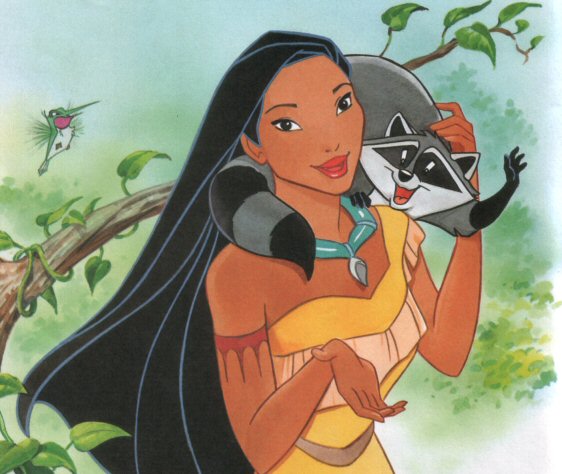
A roundup of responses included the one below from Kenzie Allen. She goes deeper into the issue of a white frame vs. a Native frame:
Does Disney's Pocahontas Do More Harm Than Good? Your Thoughts
Sophie Gilbert found the film progressive and feminist. Readers feel it whitewashes a horrific past. Perhaps it’s both.
By Chris BodennerI’ve struggled with Disney’s Pocahontas as a source of pain and stereotype. Both Pocahontas and Sacagawea are often held up as heroines in the Western perspective, their stories reduced to kinder details rather than serving the interest of the dominant culture. Yes, there is visibility in telling their stories, but it is a tainted visibility, a false reality rendered through the dominant culture, which seeks to ameliorate, always, the horrific methods by which they came to occupy an entire nation’s worth of landmass.
Nobody wants to feel like a settler. Disney’s Pocahontas gives just enough of a flogging to the “real” bad guys to leave the non-native viewers coming away feeling as though they’ve done the good work of recognizing their own faults, while the pain of forced assimilation and erasure continues for the Powhatan Nation and others.
It is the Western lens that sees a progressive narrative in the way the settlers of Disney’s movie are mocked (but eventually befriended), the way Pocahontas rejects a voyage overseas (but was in reality kidnapped—and in the sequel, even this part of the story is made family-friendly and song-worthy), and the way she chooses family over love (when in reality her “choice” was anything but).
Disney goes so far as to try to turn the narrative around by having the Powhatans call the settlers the “savages,” but it’s only done half-way. Much like coverage of mascot issues often features white voices in the interest of “fair and balanced coverage,” the movie ends with the two groups considered even, with no indication of the devastation yet to come.
If Disney’s choice was between being “accurate” or “socially responsible,” my question would be: socially responsible to whom? Native Barbie doll
These critiques touch upon portraying Pocahontas as an attractive young woman rather than a preteen girl. An old posting discusses how phony Disney's representation of her was:
Representations of PocahontasGertrude Custalow, a Powhatan Indian, remarks, “The real Pocahontas was a child, not a voluptuous woman. And one thing’s for sure—she didn’t own an uplift bra (quoted in Tillotson C8)” (Edwards 154). This stresses the sexualized nature of representations of Pocahontas not only in art but also in children’s movies. This also addresses Disney’s indifference to what Pocahontas actually looked like. Instead, they make her into a “brown-skinned Barbie Doll” (154).
The artist who created Disney’s Pocahontas concerned himself less with recreating what Pocahontas must have looked like in reality and more with creating a generic racial other. He literally combines women of various non-white races to generate a very sexualized representation of Pocahontas. Edwards states, “Pocahontas becomes an historically-impossible multiethnic body—an anachronistic image composed of ‘aesthetically-pleasing’ body parts drawn from American Indian, African American, Asian American, and Caucasian models. Disney animator Glen Keane describes his Pocahontas drawing as ‘an ethnic blend whose convexly curved face is African, whose dark, slanted eyes are Asian and whose body proportions are Caucasian’ (qtd. In Tillotson C8). In addition to historical representations of Pocahontas herself, the visual models of various ethnicities that Keane used for his drawing included Irene Bedard, the American Indian actor who provides Pocahontas’s voice, American Indian consult to the film Shirley ‘Little Dove’ Custalow McGowan, Filipino model Dyna Taylor, black supermodel Naomi Campbell, and white supermodels Kate Moss and Christy Turlington” (151-152). Okay, Disney animator Glen Keane. Thanks for letting us know how fake your version of Pocahontas was!
Rob's reaction
I liked Pocahontas, but I knew her real story. I took the movie as a fantasy largely divorced from reality. Like The Hobbit but with characters who vaguely resembled historical figures.
In fact, I suggested that Disney should've changed the characters' names to show audiences this wasn't history. Make the characters generic Anglos and Indians, or even generic fantasy figures--e.g., dwarves and elves.
Of course, that would've ruined Disney's marketing plans, so no way was it going to happen. But it was the kind of solution I would've liked.
As for the question of how progressive Pocahontas was, I'd say it moved the dial from near zero, in Disney's older movies, to maybe 25. That's only 1/4 of the way to a goal of 100.
So you could say the glass was one-quarter full or three-quarters empty. But ignoring the three quarters for the one quarter isn't exactly responsible writing. It's like saying the Titanic's initial voyage was great except for the iceberg.
For more on the subject, see Pocahontas Bastardizes Real People.

In Defense of Pocahontas: Disney's Most Radical Heroine
20 years after the movie’s release, its character and premise still feel notably progressive.
By Sophie Gilbert
The main problem with Pocahontas—as expressed by several Native American groups, including the Powhatan Nation, which traces its origins back to Pocahontas herself—is that over time, she’s come to embody the trope of the “Good Indian,” or one who offers her own life to help save a white settler. “Her offer of sacrifice, her curvaceous figure, and her virginal stature have come to symbolize America’s Indian heroine,” wrote Angela Aleiss in an op-ed in The Los Angeles Times. Aleiss goes on to criticize how female Indian characters are defined by their male relationships, are “tossed aside by the white man” for a woman of his own race, and have nothing in their appeal beyond their “on-screen pulchritude.”
But Pocahontas as a character is much more complex than Aleiss allows. She does throw herself on John Smith as he’s about to be executed, emphasizing the value of human life and the destructive nature of war, but her move is reciprocated minutes later, when Smith then positions himself between Pocahontas’s father and the furious head of the English settlers, Governor Ratcliffe, and gets shot in the process. The injured Smith decides to return home, and begs Pocahontas to go with him, but she chooses to stay with her tribe in her homeland. Instead of sacrificing something for love (like Ariel giving up her voice, or Belle her freedom), Pocahontas puts her identity and heritage first. It’s a bold ending, and one that deliberately subverts real history, which saw the real Pocahontas marry a different Englishman, John Rolfe, and travel to London with him, where she was feted as an example of the “civilized savage” before dying at the age of 21 shortly before her husband was due to sail back to Virginia.
Powhatan Nation has a page on its website in which it also criticizes Disney for propagating the “Good Indian/Bad Indian” theme and basing a movie on what is largely believed to be a lie told by John Smith to enhance his own mystique. “Euro-Americans must ask themselves why it has been so important to elevate Smith’s fibbing to status as a national myth worthy of being recycled again by Disney,” the page says. “Disney even improves upon it by changing Pocahontas from a little girl into a young woman.” But an animated feature about the relationship between a 10-year-old (as Pocahontas is believed to have been at the time she met John Smith) and an adult male would presumably have horrified audiences. “We had the choice of being historically accurate or socially responsible,” Glen Keane said.
An unrelated posting inadvertently echoes some of Gilbert's arguments:
17 reasons why Pocahontas is the best Disney film
Natives respond
Many Natives didn't like this full-throttled defense of Pocahontas. Debbie Reese posted the first response I saw in her American Indians in Children's Literature blog:
A Native Response to Sophie Gilbert's Article "In Defense of Pocahontas"
By focusing on "female agency" and an "environmentalist message," Gilbert is throwing millions of people under the bus.
A roundup of responses included the one below from Kenzie Allen. She goes deeper into the issue of a white frame vs. a Native frame:
Does Disney's Pocahontas Do More Harm Than Good? Your Thoughts
Sophie Gilbert found the film progressive and feminist. Readers feel it whitewashes a horrific past. Perhaps it’s both.
By Chris Bodenner
Nobody wants to feel like a settler. Disney’s Pocahontas gives just enough of a flogging to the “real” bad guys to leave the non-native viewers coming away feeling as though they’ve done the good work of recognizing their own faults, while the pain of forced assimilation and erasure continues for the Powhatan Nation and others.
It is the Western lens that sees a progressive narrative in the way the settlers of Disney’s movie are mocked (but eventually befriended), the way Pocahontas rejects a voyage overseas (but was in reality kidnapped—and in the sequel, even this part of the story is made family-friendly and song-worthy), and the way she chooses family over love (when in reality her “choice” was anything but).
Disney goes so far as to try to turn the narrative around by having the Powhatans call the settlers the “savages,” but it’s only done half-way. Much like coverage of mascot issues often features white voices in the interest of “fair and balanced coverage,” the movie ends with the two groups considered even, with no indication of the devastation yet to come.
If Disney’s choice was between being “accurate” or “socially responsible,” my question would be: socially responsible to whom?
These critiques touch upon portraying Pocahontas as an attractive young woman rather than a preteen girl. An old posting discusses how phony Disney's representation of her was:
Representations of Pocahontas
The artist who created Disney’s Pocahontas concerned himself less with recreating what Pocahontas must have looked like in reality and more with creating a generic racial other. He literally combines women of various non-white races to generate a very sexualized representation of Pocahontas. Edwards states, “Pocahontas becomes an historically-impossible multiethnic body—an anachronistic image composed of ‘aesthetically-pleasing’ body parts drawn from American Indian, African American, Asian American, and Caucasian models. Disney animator Glen Keane describes his Pocahontas drawing as ‘an ethnic blend whose convexly curved face is African, whose dark, slanted eyes are Asian and whose body proportions are Caucasian’ (qtd. In Tillotson C8). In addition to historical representations of Pocahontas herself, the visual models of various ethnicities that Keane used for his drawing included Irene Bedard, the American Indian actor who provides Pocahontas’s voice, American Indian consult to the film Shirley ‘Little Dove’ Custalow McGowan, Filipino model Dyna Taylor, black supermodel Naomi Campbell, and white supermodels Kate Moss and Christy Turlington” (151-152).
Rob's reaction
I liked Pocahontas, but I knew her real story. I took the movie as a fantasy largely divorced from reality. Like The Hobbit but with characters who vaguely resembled historical figures.
In fact, I suggested that Disney should've changed the characters' names to show audiences this wasn't history. Make the characters generic Anglos and Indians, or even generic fantasy figures--e.g., dwarves and elves.
Of course, that would've ruined Disney's marketing plans, so no way was it going to happen. But it was the kind of solution I would've liked.
As for the question of how progressive Pocahontas was, I'd say it moved the dial from near zero, in Disney's older movies, to maybe 25. That's only 1/4 of the way to a goal of 100.
So you could say the glass was one-quarter full or three-quarters empty. But ignoring the three quarters for the one quarter isn't exactly responsible writing. It's like saying the Titanic's initial voyage was great except for the iceberg.
For more on the subject, see Pocahontas Bastardizes Real People.
June 16, 2015
Take back Tiger Lily?
"What's There to Take Back"
By Tiffany MidgeRecently, an online indie publication put out a call for submissions based on the theme of “Taking Back Tiger Lily.”
“This project seeks submissions from Native American artists, re-creating Tiger Lily to fit a real model of Indigenous womanhood…”
The way I see it, what this call for submissions is suggesting, and bear with me because I’m being sarcastic here, is that somehow Indian people are in such dire need, are apparently at such a loss for Native American role models to look up to, have no cultural heroes or icons to claim as their very own, that the only solution is to exhume from the mausoleum of twentieth century relics, the Disney cartoon character Tiger Lily–who, in the 1950s, was brought to universal consciousness, ushered into the hearts and imaginations of millions; shrink-wrapped, merchandised, packaged and delivered by a much-rumored-to-be-anti-Semite and a gender-bigot. Fast forward to 2015, this call for submissions proposes that Tiger Lily be resuscitated, repurposed, attempt a re-prescriptive and re-appropriated identity. Here she is, Ms. America-n Indian! 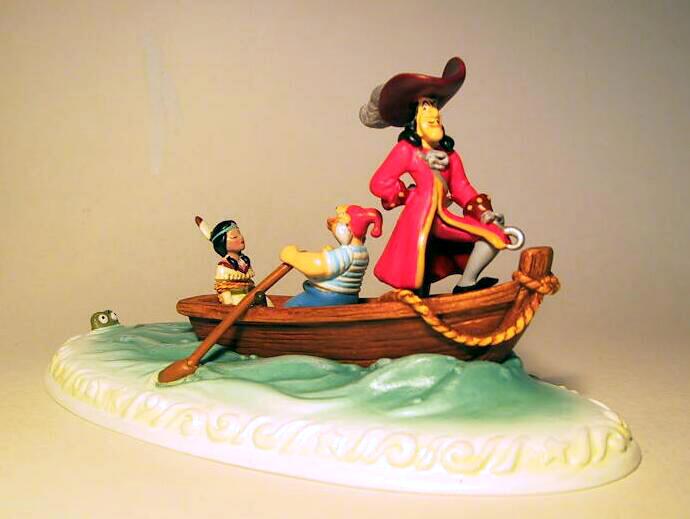
Midge does not agree with this project's goals:It’s difficult for me to visualize Tiger Lily as any sort of symbol of empowerment considering she never spoke a word. If this image is being used as a symbol, speechlessness and victimhood is pretty symbolic. Throughout most of the film she was tied up and at the mercy of pirates, so I fail to see how her legacy would arouse anyone’s admiration beyond that as an exotic rival for Peter Pan’s affections. Add that to the fact that she is a projected piece of celluloid; she bears no resemblance to anyone or anything remotely Indigenous, and certainly bears no resemblance to anyone or anything remotely real. I find this “project,” at best, fetishistic and essentializing, and at worst, apologist and racist. It upholds and privileges a white supremacist power structure.
There is no “taking back,” no “reclamation” of an idea that never belonged to Indians in the first place. A writer friend of mine noted, “Reclaim Sambo? Taking back Sambo for whose sake?” I echo that. Would anyone want to reclaim Frito Bandito? Aunt Jemima? Charlie Chan? God, no. These images are analogous to images of Tiger Lily. They are made from the same poison. The same polluted well. The suggestion is unsettling, volatile and creates a something’s-very-wrong-about-this, sick-to-my-stomach kind of feeling. Comment: For more on Tiger Lily, see Native Stereotypes in Peter Pan Live! and Natives Protest Tiger Lily Casting.
Below: Take back these stereotypical images? And do what with them?


By Tiffany Midge
“This project seeks submissions from Native American artists, re-creating Tiger Lily to fit a real model of Indigenous womanhood…”
The way I see it, what this call for submissions is suggesting, and bear with me because I’m being sarcastic here, is that somehow Indian people are in such dire need, are apparently at such a loss for Native American role models to look up to, have no cultural heroes or icons to claim as their very own, that the only solution is to exhume from the mausoleum of twentieth century relics, the Disney cartoon character Tiger Lily–who, in the 1950s, was brought to universal consciousness, ushered into the hearts and imaginations of millions; shrink-wrapped, merchandised, packaged and delivered by a much-rumored-to-be-anti-Semite and a gender-bigot. Fast forward to 2015, this call for submissions proposes that Tiger Lily be resuscitated, repurposed, attempt a re-prescriptive and re-appropriated identity. Here she is, Ms. America-n Indian!
Midge does not agree with this project's goals:
There is no “taking back,” no “reclamation” of an idea that never belonged to Indians in the first place. A writer friend of mine noted, “Reclaim Sambo? Taking back Sambo for whose sake?” I echo that. Would anyone want to reclaim Frito Bandito? Aunt Jemima? Charlie Chan? God, no. These images are analogous to images of Tiger Lily. They are made from the same poison. The same polluted well. The suggestion is unsettling, volatile and creates a something’s-very-wrong-about-this, sick-to-my-stomach kind of feeling.
Below: Take back these stereotypical images? And do what with them?
December 09, 2014
Debating Peter Pan Live!
While I watched Peter Pan Live!, I did a bit of live-blogging on Facebook. I didn't plan to debate the production, but a couple of people responded and we were off.
Things started innocuously enough:
Off to Neverland
Watching Peter Pan Live!--the must-see event of the year!
I have a radical new idea for a remake: Cast a teenage boy to play Peter Pan the teenage boy. You know, instead of a grown woman.
Yes, I'm brilliant, I know. Thank you, thank you.
Didn't Christopher Walken used to sound normal when he was young? Now he sounds like he's doing a Christopher Walken impression.Casting a teenage boy presents a lot of issues from a musical theater perspective. It can't be much worse than trying to convince oneself that 26-year-old Allison Williams is a teenage boy. I'm not buying it.
I bet Daniel Radcliffe could've nailed it.Of course, a 25 year old man is much more convincing...it's about the voice, for one, and the ages of the Darling children. I meant when he was a teenager. "Cast a teenage boy [such as Radcliffe when he was a teenager] to play Peter Pan the teenage boy."
Problems arise
Race in #PeterPanLive: Nine of the ten Lost Boys are white. The first four of Tiger Lily's tribe look brown-skinned and ethnic.
Even if the "tribal" actors are white, they're adorned with broad stripes of brown color. This conveys the impression that they're brown.
The tribesmen wear bone chokers and breastplates, and round pendants--like Indians. They tend to creep on all fours--like animals. #PeterPanLive
The Lost Boys, including Michael Darling dressed as an Indian, reject Wendy's attempt to teach them how to avoid war. That's because Lost Boys, like Indian savages, are uncivilized.As near as I can tell, the Natives are also generic (tribally too unspecific). Yes, they're generic. But making them so doesn't solve the problem, it only redirects it.
The problem is that Peter's Lost Boys are wild, undisciplined, and ignorant because they have no rules, responsibilities, or parents. No law and order. In a word, they're uncivilized. And Tiger Lily's tribesmen are the same.
The message is that Lost Boys = indigenous people = savages. Whether the tribe is from the Americas, Africa, or Asia and the Pacific Islands doesn't really matter. The story is an indictment of all indigenous cultures. It suggests they're akin to children frolicking in the jungle, or animals in human form.As someone who grew up with this kind of unfounded, blatant, erroneous picture of Natives, I have only been condemning specific issues in these cases. But I am thrilled that we are finally at a place where we can finally address the broader ignorance issues that needs to be ended. Especially in popular media and entertainment. On the other hand:For heaven's sakes, it's FANTASY, it's silliness, it's choreographed -- did you notice how realistic the plants and trees were? *not*
Maybe you can go after "Santa Claus is Coming to Town" next time. Are you seriously going to argue that people haven't gotten their ideas about Indians from Western movies, sports mascots, and corporate logos--all of which are forms of fiction? In fact, people absorb messages about reality from whatever they see, including fiction. As a few centuries of novels, plays, movies, TV shows, and comic books have proved.
So we should say nothing about racist stereotypes in movies or TV shows because they're "fantasies"? How about school plays, paintings and statues, or songs? Did you miss the last ten thousand times I criticized racist stereotypes in our culture?
A blackface minstrel show is just a fantasy. As is a Halloween party with Pocahotties and "Nava-hoes." Really, you expect me to give these a pass because they're "fantasies" like Peter Pan? As the last 20 years of my work has demonstrated, that's not gonna happen.
Lost Boys = Lord of the Flies?Haven't missed a one of your criticisms, and most often agree with them (although I'm protesting your NIGA group for its abominable acronym). I guess you've protested Peter Pan for 30 or more years now?
The Halloween analogy is false -- stupid women wanting to be "Nava-hoes" doesn't compare to Barrie's play, nor the musical. And if you knew the story, you would not put = between Lost Boys and the Indians in the show -- the Lost Boys are a different group altogether.
We've had plenty of literature, that for better or worse, deals with issues like this. Do we ban it all, or do we learn? Would you remove Lord of the Flies from the libraries (after all, they were certainly "Lost Boys" who became quite savage)? The Indian savages perform the same function as the Lost Boys. They run and play in the forest, follow Peter Pan, and fight the pirates. They're different but equivalent groups.
That's why I said the message is that they're the same. Not that they're literally the same.
I didn't say my examples--the minstrel show and Halloween party--were alike in terms of "quality." But they're all examples of employing fictional or fantasy characters. They're alike in that regard.
And saying my analogy is "false" isn't much of an argument. Explain why it's false if you can.
In fact, anyone can present a racial stereotype and claim they're just "play-acting" or "pretending." If racism in "fantasy" is harmless, it's harmless whether it's a minstrel show, a Halloween party, or "Peter Pan." I say it's harmful in all these cases so the "fantasy" defense is rubbish.
I don't think the Lord of the Flies boys dressed specifically like Indians. Tiger Lily's tribe did. We're talking about characters who use racial stereotypes to represent a particular group--in this case, Indians or indigenous people. We're not talking about anyone who becomes "savage" in any way.
We're also not talking about censoring or removing Peter Pan. You invented that straw man because I didn't say a word about it. My solution is to fix the racist and sexist elements of this play and then present it.
If you want to present the original story with its racism and sexism, go ahead. You do that and I'll criticize it, just as I've done here.
Do we ban it or do we learn from it? I'm helping people learn from it by educating them about its racism and sexism. You're doing the opposite: telling people to ignore its problems and simply enjoy it as a "fantasy." Don't talk to us about "learning" when you're advocating the opposite.
P.S. My official critique of Peter Pan is 10 years old:
Tiger Lily in Peter Pan: An Allegory of Anglo-Indian Relations
I found every line about Indians in Barrie's original book to make sure I didn't miss anything. I understand his racist stereotyping well.
No doubt I mentioned the play and the Disney movie before then. And yet Peter Pan is only one of a thousand topics I've dealt with over the years. The facts prove there's no "obsession" here, so your claim is false and insulting.
You say you haven't missed my criticisms, yet you're surprised I criticized Peter Pan. Criticized it the same way I've criticized countless comic books, cartoons, video games, and other things that qualify as fantasies for children. So why are you surprised?
To reiterate, I've criticized Peter Pan and movies, TV shows, and plays like it many times before. My actions have been completely consistent so your surprise is illogical. In fact, the only surprise would be if I ignored a spectacle featuring Indians in prime-time television.
Racist and sexist, too
On the gender front, #PeterPanLive may be even worse. Girls = mothers = caretakers and servants = nags and scolds = killers of fun and freedom.
Wendy should slap some sense into Peter. "You say you want a mother, but you don't want to do anything I say? What do you think a mother is, you stupid twit?
"If you want someone to serve you, go hire a maid or a butler. I've got better things to do than to babysit babies."
Now she's singing about how she wants to kiss Peter Pan. Even a century ago, girls went for the charming bad boys who would love 'em and leave 'em. All Peter needs is a leather jacket and motorcycle to seal the deal.
Back to the racial issues:
If you want a race of animal-like savages, make them bestial for real. Centaurs, cat people, talking bears, etc. Or make them toy soldiers come to life a la Toy Story. There's really no excuse to equate savages with indigenous people. #PeterPanLive
Getting a closer look at Tiger Lily's tribe as they dance. Perhaps half the actors are nonwhite. All have dark hair and several have dreadlocks. Shoes look like moccasins. Definitely an Afro-Indian vibe. #PeterPanLive
And they're mixing the Wyandotte song title with "Hickory dickory dock" and "Tweedledee, tweedledum." Well, gee, thanks for making it clear that Native languages aren't just singsong nonsense words.
Not to mention the tom-tom beats and chanting that echo a thousand old Westerns. They aren't even subtle. This is obviously an "Indian" song in everything but name.
And Tiger Lily says Peter is the sun and the moon. Good thing she praised the "great white father" only once in this scene, or it would be unbearable.
Peter is mystified that Wendy, Tinkerbell, and Tiger Lily all want more from him. Why are girls so needy and clingy? Why can't they be strong and independent, like boys?! #PeterPanLiveDo you know when this story was written, what society was like at the time? It was written around the time when Dorothy traveled to Oz, took command of her destiny (more or less), and proceeded without any thought of clinging to a man or becoming a mother.
That was several decades after Alice had her solo adventures in Wonderland. A couple of centuries after Jane Austen's heroines showed what strong, independent women could do. Are you seriously arguing that having all three female characters long for Peter was a sign of the times? That authors like Barrie couldn't conceive of any other way of thinking?
And the producers are putting the play on in 2014, not 1902 when it was written. They're responsible for how its sexist message plays today. If you or they don't want anyone criticizing the sexism, don't put it on the air now. Leave it and the racist savages in the dustbin of history where they belong.
Next up: How Santa's message of toys for everyone obscures the structural poverty built into our society.
Tinkerbell must die
Captain Hook's "brilliant" plan to kill Peter Pan is to poison him. He puts the poison in Peter's medicine while he sits next to the sleeping Peter. How about stabbing him in the chest instead? #PeterPanDead
But Tinkerbell drinks it instead! What a bumbler that Hook is!
Tweet to save Tinkerbell? #TinkerbellMustDie
Now Peter is speaking to the audience, telling us to clap if we believe in fairies. Die, you little piece of CGI fakery!!
Odd. The swelling music seems to indicate we should be filled with joy, not laughter at this silliness.You must have had a very sad childhood -- and I'm not trying to insult. That a grown man is so obsessed with a little musical that children love is worrisome. When I was a little girl, I thought Mary Martin was speaking directly to me. I found joy in the show, and still do. Lovely music, great dancing, lots of fun. As I said, I've posted critiques and analyses of thousands of Native stereotypes. I'm not sure Peter Pan is even in the top 25 or 50 of the subjects I've covered. Despite the fact that it's one of the longest-running and most prominent purveyors of Native stereotypes in existence.
If you're worried that I spent a couple of hours posting a few comments about one play, I'd hate to see your reaction to the subjects I've actually focused on. You know, things like the Washington Redskins and other mascots, The Lone Ranger and Twilight, and hipster headdresses. I guess you'd be amazed at my rock-solid opposition to racist stereotypes wherever they occur.
P.S. My childhood was stunningly normal, not "sad." I'm incredulous that you've suddenly discovered that I criticize things. If you somehow missed my last 10,000 postings, check them again. You'll see a decades-long pattern of denouncing racism, sexism, and other forms of prejudice.
If you don't like that, sorry, but that's what I do. I thought it was obvious, but now you know.
Here are some of the criticisms directed at this production:
http://nativenewsonline.net/currents/notyourtigerlily-nine-months-later-still-dont-get-point/
https://indiancountrytodaymedianetwork.com/2014/12/05/keene-why-fix-tiger-lily-why-cant-we-just-let-her-go-158155
http://americanindiansinchildrensliterature.blogspot.com/2014/12/true-blood-brothers-in-nbcs-production.html
http://www.salon.com/2014/12/05/the_boggling_mixed_signals_of_peter_pan_live_why_on_earth_did_nbc_decide_to_stage_this_show/
http://www.salon.com/2014/12/06/the_7_worst_things_about_nbcs_peter_pan_live_partner/
I guess a lot of people are "obsessed" or had "sad" childhoods. Which are obvious codewords for, "Stop criticizing my beloved fairy tale, you can't make me think about its racism and sexism, la la la la la I can't hear you!"
A tweet to sum up the racial issues:
Tiger Lily's tribe in #PeterPanLive: brown skins, body paint, bone chokers and breastplates, crawling on all fours--but not stereotypical?!
For more on Peter Pan, see Native Stereotypes in Peter Pan Live! and Peter Pan Live! Reviewed.
Things started innocuously enough:
Off to Neverland
Watching Peter Pan Live!--the must-see event of the year!
I have a radical new idea for a remake: Cast a teenage boy to play Peter Pan the teenage boy. You know, instead of a grown woman.
Yes, I'm brilliant, I know. Thank you, thank you.
Didn't Christopher Walken used to sound normal when he was young? Now he sounds like he's doing a Christopher Walken impression.
I bet Daniel Radcliffe could've nailed it.
Problems arise
Race in #PeterPanLive: Nine of the ten Lost Boys are white. The first four of Tiger Lily's tribe look brown-skinned and ethnic.
Even if the "tribal" actors are white, they're adorned with broad stripes of brown color. This conveys the impression that they're brown.
The tribesmen wear bone chokers and breastplates, and round pendants--like Indians. They tend to creep on all fours--like animals. #PeterPanLive
The Lost Boys, including Michael Darling dressed as an Indian, reject Wendy's attempt to teach them how to avoid war. That's because Lost Boys, like Indian savages, are uncivilized.
The problem is that Peter's Lost Boys are wild, undisciplined, and ignorant because they have no rules, responsibilities, or parents. No law and order. In a word, they're uncivilized. And Tiger Lily's tribesmen are the same.
The message is that Lost Boys = indigenous people = savages. Whether the tribe is from the Americas, Africa, or Asia and the Pacific Islands doesn't really matter. The story is an indictment of all indigenous cultures. It suggests they're akin to children frolicking in the jungle, or animals in human form.
Maybe you can go after "Santa Claus is Coming to Town" next time.
So we should say nothing about racist stereotypes in movies or TV shows because they're "fantasies"? How about school plays, paintings and statues, or songs? Did you miss the last ten thousand times I criticized racist stereotypes in our culture?
A blackface minstrel show is just a fantasy. As is a Halloween party with Pocahotties and "Nava-hoes." Really, you expect me to give these a pass because they're "fantasies" like Peter Pan? As the last 20 years of my work has demonstrated, that's not gonna happen.
Lost Boys = Lord of the Flies?
The Halloween analogy is false -- stupid women wanting to be "Nava-hoes" doesn't compare to Barrie's play, nor the musical. And if you knew the story, you would not put = between Lost Boys and the Indians in the show -- the Lost Boys are a different group altogether.
We've had plenty of literature, that for better or worse, deals with issues like this. Do we ban it all, or do we learn? Would you remove Lord of the Flies from the libraries (after all, they were certainly "Lost Boys" who became quite savage)?
That's why I said the message is that they're the same. Not that they're literally the same.
I didn't say my examples--the minstrel show and Halloween party--were alike in terms of "quality." But they're all examples of employing fictional or fantasy characters. They're alike in that regard.
And saying my analogy is "false" isn't much of an argument. Explain why it's false if you can.
In fact, anyone can present a racial stereotype and claim they're just "play-acting" or "pretending." If racism in "fantasy" is harmless, it's harmless whether it's a minstrel show, a Halloween party, or "Peter Pan." I say it's harmful in all these cases so the "fantasy" defense is rubbish.
I don't think the Lord of the Flies boys dressed specifically like Indians. Tiger Lily's tribe did. We're talking about characters who use racial stereotypes to represent a particular group--in this case, Indians or indigenous people. We're not talking about anyone who becomes "savage" in any way.
We're also not talking about censoring or removing Peter Pan. You invented that straw man because I didn't say a word about it. My solution is to fix the racist and sexist elements of this play and then present it.
If you want to present the original story with its racism and sexism, go ahead. You do that and I'll criticize it, just as I've done here.
Do we ban it or do we learn from it? I'm helping people learn from it by educating them about its racism and sexism. You're doing the opposite: telling people to ignore its problems and simply enjoy it as a "fantasy." Don't talk to us about "learning" when you're advocating the opposite.
P.S. My official critique of Peter Pan is 10 years old:
Tiger Lily in Peter Pan: An Allegory of Anglo-Indian Relations
I found every line about Indians in Barrie's original book to make sure I didn't miss anything. I understand his racist stereotyping well.
No doubt I mentioned the play and the Disney movie before then. And yet Peter Pan is only one of a thousand topics I've dealt with over the years. The facts prove there's no "obsession" here, so your claim is false and insulting.
You say you haven't missed my criticisms, yet you're surprised I criticized Peter Pan. Criticized it the same way I've criticized countless comic books, cartoons, video games, and other things that qualify as fantasies for children. So why are you surprised?
To reiterate, I've criticized Peter Pan and movies, TV shows, and plays like it many times before. My actions have been completely consistent so your surprise is illogical. In fact, the only surprise would be if I ignored a spectacle featuring Indians in prime-time television.
Racist and sexist, too
On the gender front, #PeterPanLive may be even worse. Girls = mothers = caretakers and servants = nags and scolds = killers of fun and freedom.
Wendy should slap some sense into Peter. "You say you want a mother, but you don't want to do anything I say? What do you think a mother is, you stupid twit?
"If you want someone to serve you, go hire a maid or a butler. I've got better things to do than to babysit babies."
Now she's singing about how she wants to kiss Peter Pan. Even a century ago, girls went for the charming bad boys who would love 'em and leave 'em. All Peter needs is a leather jacket and motorcycle to seal the deal.
Back to the racial issues:
If you want a race of animal-like savages, make them bestial for real. Centaurs, cat people, talking bears, etc. Or make them toy soldiers come to life a la Toy Story. There's really no excuse to equate savages with indigenous people. #PeterPanLive
Getting a closer look at Tiger Lily's tribe as they dance. Perhaps half the actors are nonwhite. All have dark hair and several have dreadlocks. Shoes look like moccasins. Definitely an Afro-Indian vibe. #PeterPanLive
And they're mixing the Wyandotte song title with "Hickory dickory dock" and "Tweedledee, tweedledum." Well, gee, thanks for making it clear that Native languages aren't just singsong nonsense words.
Not to mention the tom-tom beats and chanting that echo a thousand old Westerns. They aren't even subtle. This is obviously an "Indian" song in everything but name.
And Tiger Lily says Peter is the sun and the moon. Good thing she praised the "great white father" only once in this scene, or it would be unbearable.
Peter is mystified that Wendy, Tinkerbell, and Tiger Lily all want more from him. Why are girls so needy and clingy? Why can't they be strong and independent, like boys?! #PeterPanLive
That was several decades after Alice had her solo adventures in Wonderland. A couple of centuries after Jane Austen's heroines showed what strong, independent women could do. Are you seriously arguing that having all three female characters long for Peter was a sign of the times? That authors like Barrie couldn't conceive of any other way of thinking?
And the producers are putting the play on in 2014, not 1902 when it was written. They're responsible for how its sexist message plays today. If you or they don't want anyone criticizing the sexism, don't put it on the air now. Leave it and the racist savages in the dustbin of history where they belong.
Next up: How Santa's message of toys for everyone obscures the structural poverty built into our society.
Tinkerbell must die
Captain Hook's "brilliant" plan to kill Peter Pan is to poison him. He puts the poison in Peter's medicine while he sits next to the sleeping Peter. How about stabbing him in the chest instead? #PeterPanDead
But Tinkerbell drinks it instead! What a bumbler that Hook is!
Tweet to save Tinkerbell? #TinkerbellMustDie
Now Peter is speaking to the audience, telling us to clap if we believe in fairies. Die, you little piece of CGI fakery!!
Odd. The swelling music seems to indicate we should be filled with joy, not laughter at this silliness.
If you're worried that I spent a couple of hours posting a few comments about one play, I'd hate to see your reaction to the subjects I've actually focused on. You know, things like the Washington Redskins and other mascots, The Lone Ranger and Twilight, and hipster headdresses. I guess you'd be amazed at my rock-solid opposition to racist stereotypes wherever they occur.
P.S. My childhood was stunningly normal, not "sad." I'm incredulous that you've suddenly discovered that I criticize things. If you somehow missed my last 10,000 postings, check them again. You'll see a decades-long pattern of denouncing racism, sexism, and other forms of prejudice.
If you don't like that, sorry, but that's what I do. I thought it was obvious, but now you know.
Here are some of the criticisms directed at this production:
http://nativenewsonline.net/currents/notyourtigerlily-nine-months-later-still-dont-get-point/
https://indiancountrytodaymedianetwork.com/2014/12/05/keene-why-fix-tiger-lily-why-cant-we-just-let-her-go-158155
http://americanindiansinchildrensliterature.blogspot.com/2014/12/true-blood-brothers-in-nbcs-production.html
http://www.salon.com/2014/12/05/the_boggling_mixed_signals_of_peter_pan_live_why_on_earth_did_nbc_decide_to_stage_this_show/
http://www.salon.com/2014/12/06/the_7_worst_things_about_nbcs_peter_pan_live_partner/
I guess a lot of people are "obsessed" or had "sad" childhoods. Which are obvious codewords for, "Stop criticizing my beloved fairy tale, you can't make me think about its racism and sexism, la la la la la I can't hear you!"
A tweet to sum up the racial issues:
Tiger Lily's tribe in #PeterPanLive: brown skins, body paint, bone chokers and breastplates, crawling on all fours--but not stereotypical?!
For more on Peter Pan, see Native Stereotypes in Peter Pan Live! and Peter Pan Live! Reviewed.
December 08, 2014
Native stereotypes in Peter Pan Live!
Let's turn from the overall production of Peter Pan Live! to its Native aspects. First, the problems in the source material:
What's up, Tiger Lily? Peter Pan and the Native American stereotype that has certainly grown old
NBC featured an actress of Cherokee descent, but some say Rooney Mara’s forthcoming film turn will merely be ‘redface’. Is there any way to redeem JM Barrie’s most dated character?
By Alan YuhasIn the 1904 play and 1911 novel that brought Peter Pan to fame, Barrie calls Tiger Lily a princess of a “Piccaninny tribe.” She has all the trappings we now recognize from the worst sort of Native American stereotype. Tiger Lily puts her ear to the earth, breaks out a peace pipe, and speaks with her cohorts in guttural gibberish. Most uncomfortably, Barrie is not only prolific with the word “redskin” but also has Tiger Lily rapturously declare Peter “the Great White Father,” after he saves her life.
There is, however, “something about Peter that captivated everyone and let Barrie get away with a lot,” said Anne Hiebert Alton, a professor at Central Michigan University and the editor of a scholarly edition of Peter Pan. From Barrie’s perspective, she said, the world divided easily between the British and everyone else.
“He’s not being consciously racist,” she said. “But we still can’t let him off the hook.”
Barrie’s works do stink of their era. He turns Tiger Lily into a hero but makes sure she is subservient to Peter; he treats her tribe as better than the true enemy (pirates, adults) but not nearly as important as the heroes (boys, kids, not girls). Alton also pointed out that Barrie died in 1937–long before anyone thought to take issue with his portrayal of Native Americans. 
The production tried to fix the problems:
Ugg-A-Wha? Updating Stereotypes in ‘Peter Pan’
By Jeremy EgnerAll of which put the casting of Tiger Lily and a reworking of the song “Ugg-A-Wugg” near the top of the list of things NBC’s new “Peter Pan Live!,” which debuts at 8 p.m. Thursday Eastern time, had to get right.
“Tiger Lily needed to be Native American—that’s how Barrie conceived the role,” said Neil Meron, an executive producer. But the treatment can’t be “insulting to the Native American community,” he said.
Enter Alanna Saunders, 22, who graduated from the University of Miami in May and had lived in New York for roughly two weeks before she saw a flyer seeking Native American actors to audition for Tiger Lily. Ms. Saunders, a descendant of the Cherokee Nation, won the part and is thus starting her professional career on a live network extravaganza before an audience of millions, sharing the stage with the likes of Christopher Walken (as Captain Hook).
“It feels so ridiculous that I got this opportunity,” she said from the set last week.
Ms. Saunders brought no expectations to the production, she said, mostly because she had so little experience to draw upon. But she was curious about how “Peter Pan Live!” was going to handle one of the musical’s most famous numbers.
“I was thinking, ‘There’s no way they can do “Ugg-A-Wugg,”’” she said. “Because the lyrics are gibberish, and they’re pretty offensive in terms of trying to be any sort of authentic Native American reference.”
The song is a duet between Tiger Lily and Peter Pan, in which the islanders and Peter’s Lost Boys form an alliance against Captain Hook. To refresh it for modern sensibilities, the songwriter Amanda Green, the daughter of an original “Peter Pan” lyricist, Adolph Green, and David Chase, the production’s music director, worked with Jerod Impichchaachaaha’ Tate, an Emmy-winning composer and member of the Chickasaw Nation in Oklahoma. The nonsense lyrics were replaced with nursery rhymes and the rhythms were shifted to make the song less stereotypical and more authentically Native American. (Mr. Tate discussed the process in more detail in recent interviews.) Natives still criticize production
From Debbie Reese's American Indians in Children's Literature blog:
"True Blood Brothers" in NBC's production of Peter PanThe take away? Lot of stereotyping:
Indians with crossed arms: check
Scantily clad Indians: check
Playing drum with hands: check
Kids playing Indian: check
Hollywood Indian music: check
Overrepresentation of men: check
So--a question.
"O-a-hey" is supposed to be a Wyandotte word. Does that make this all better? No. Not at all. 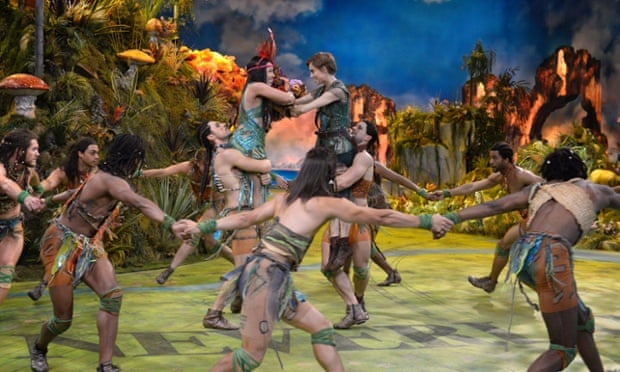
#NotYourTigerLily: Nine Months Later and They Still Don’t Get the Point
By Johnnie JaeHaving seen the production, I cannot even begin to understand how anyone could think that this gross misappropriation of our indigenous identities and culture is a step forward in diminishing harmful and racist stereotypes. It’s still the same disappointing, exploitative and racist characterization of indigenous women and people that it has always been. What’s really disheartening is that they took the same approach that Warner Bros. has decided to take with their feature film, Pan.
“They created a non-Native “tribe” that faux-headdress-loving Coachella fans would be proud of, while simultaneously engaging in an activity mainstream society is adept at—silencing Native peoples,” says Tara Houska of Not Your Mascots. “There are plenty of Native actors and actresses to fill Native roles, and plenty of Native writers to consult. If Hollywood feels the need to bring back a character entirely based on racist stereotypes, one would think the smartest approach would be involving Natives as much as possible in the character’s re-imagination.”
Let’s be honest. Peter Pan is one of the most racist and misogynistic literary classics and so are the cartoons, plays and films inspired by the novel. The world of Peter Pan is fiction, but the harm done through the blatantly racist treatment and portrayal of Indigenous people in the story is our reality.
I asked Not Your Mascots’ Maggie Hundley why it was important to discuss the issues with Tiger Lily and her Tribe in the Neverland Universe and she replied:
“Unfortunately, as a kid, I bought into the Indian ‘maiden’ and ‘princess’ caricatures that I saw in movies and cartoons and used them to judge myself. Things need to change. By calling out the degrading and exploitative character of Tiger Lily in Peter Pan movies and plays, we are challenging institutionalized stereotyping of indigenous girls and women in entertainment. It is important to call out these mockeries and create a new narrative to replace the false ones that are force-fed to us by major companies such as Warner Brothers and NBC.” While Johnnie Jae wanted Native creators to fix the Native portrayals, Adrienne Keene suggested another approach:
Keene: Why 'Fix' Tiger Lily? Why Can't We Just Let Her Go?
By Dr. Adrienne KeeneThose who may have followed my writings on Tonto and Disney’s 2013 Lone Ranger film might see this as a marked switch from my attitude at the beginning of that journey. I argued, very strongly, that Disney should have cast a Native in the role of Tonto, that Comanche advisors and other Native peoples should have been involved much earlier in the process to shape and develop portrayals of Native peoples on the screen.
After watching that long saga unfold, I have a different opinion. I don’t want Native peoples to be forced into a role of trying to put band-aids on a gaping wound of racism. I want Hollywood to stop resurrecting these racist characters.
Think of the world created by the story of Peter Pan. Neverland is inhabited by mermaids, pirates*, fairies…and Indians. Fantasy creatures, meant to show how different Neverland is than the world the Darling children inhabit. The problem is, Native peoples aren’t fantasy creatures, nor are we something of the past, like pirates. We’re real, contemporary human beings. We don’t all live in tipis and smoke peace pipes and say things like “squ*w gettum firewood.”
So my advice the next time that a high school wants to put on Peter Pan or the next studio wants to make another remake: Cut the “Indians” out. Completely. Be creative. Find some other fantasy creature to replace them with. My colleagues last night came up with the idea of space aliens, which I kinda love. A completely fictional “other,” allowing for full creativity. Make up some shiny silver blobs for them to live in. Make up a language. Wrap them in foil or something. Just don’t call them Indians. Comment: For more on Peter Pan, see Peter Pan Live! Reviewed and A 21st-Century Peter Pan and Peter Pan's Racist History.
What's up, Tiger Lily? Peter Pan and the Native American stereotype that has certainly grown old
NBC featured an actress of Cherokee descent, but some say Rooney Mara’s forthcoming film turn will merely be ‘redface’. Is there any way to redeem JM Barrie’s most dated character?
By Alan Yuhas
There is, however, “something about Peter that captivated everyone and let Barrie get away with a lot,” said Anne Hiebert Alton, a professor at Central Michigan University and the editor of a scholarly edition of Peter Pan. From Barrie’s perspective, she said, the world divided easily between the British and everyone else.
“He’s not being consciously racist,” she said. “But we still can’t let him off the hook.”
Barrie’s works do stink of their era. He turns Tiger Lily into a hero but makes sure she is subservient to Peter; he treats her tribe as better than the true enemy (pirates, adults) but not nearly as important as the heroes (boys, kids, not girls). Alton also pointed out that Barrie died in 1937–long before anyone thought to take issue with his portrayal of Native Americans.
The production tried to fix the problems:
Ugg-A-Wha? Updating Stereotypes in ‘Peter Pan’
By Jeremy Egner
“Tiger Lily needed to be Native American—that’s how Barrie conceived the role,” said Neil Meron, an executive producer. But the treatment can’t be “insulting to the Native American community,” he said.
Enter Alanna Saunders, 22, who graduated from the University of Miami in May and had lived in New York for roughly two weeks before she saw a flyer seeking Native American actors to audition for Tiger Lily. Ms. Saunders, a descendant of the Cherokee Nation, won the part and is thus starting her professional career on a live network extravaganza before an audience of millions, sharing the stage with the likes of Christopher Walken (as Captain Hook).
“It feels so ridiculous that I got this opportunity,” she said from the set last week.
Ms. Saunders brought no expectations to the production, she said, mostly because she had so little experience to draw upon. But she was curious about how “Peter Pan Live!” was going to handle one of the musical’s most famous numbers.
“I was thinking, ‘There’s no way they can do “Ugg-A-Wugg,”’” she said. “Because the lyrics are gibberish, and they’re pretty offensive in terms of trying to be any sort of authentic Native American reference.”
The song is a duet between Tiger Lily and Peter Pan, in which the islanders and Peter’s Lost Boys form an alliance against Captain Hook. To refresh it for modern sensibilities, the songwriter Amanda Green, the daughter of an original “Peter Pan” lyricist, Adolph Green, and David Chase, the production’s music director, worked with Jerod Impichchaachaaha’ Tate, an Emmy-winning composer and member of the Chickasaw Nation in Oklahoma. The nonsense lyrics were replaced with nursery rhymes and the rhythms were shifted to make the song less stereotypical and more authentically Native American. (Mr. Tate discussed the process in more detail in recent interviews.)
From Debbie Reese's American Indians in Children's Literature blog:
"True Blood Brothers" in NBC's production of Peter Pan
Indians with crossed arms: check
Scantily clad Indians: check
Playing drum with hands: check
Kids playing Indian: check
Hollywood Indian music: check
Overrepresentation of men: check
So--a question.
"O-a-hey" is supposed to be a Wyandotte word. Does that make this all better? No. Not at all.
#NotYourTigerLily: Nine Months Later and They Still Don’t Get the Point
By Johnnie Jae
“They created a non-Native “tribe” that faux-headdress-loving Coachella fans would be proud of, while simultaneously engaging in an activity mainstream society is adept at—silencing Native peoples,” says Tara Houska of Not Your Mascots. “There are plenty of Native actors and actresses to fill Native roles, and plenty of Native writers to consult. If Hollywood feels the need to bring back a character entirely based on racist stereotypes, one would think the smartest approach would be involving Natives as much as possible in the character’s re-imagination.”
Let’s be honest. Peter Pan is one of the most racist and misogynistic literary classics and so are the cartoons, plays and films inspired by the novel. The world of Peter Pan is fiction, but the harm done through the blatantly racist treatment and portrayal of Indigenous people in the story is our reality.
I asked Not Your Mascots’ Maggie Hundley why it was important to discuss the issues with Tiger Lily and her Tribe in the Neverland Universe and she replied:
“Unfortunately, as a kid, I bought into the Indian ‘maiden’ and ‘princess’ caricatures that I saw in movies and cartoons and used them to judge myself. Things need to change. By calling out the degrading and exploitative character of Tiger Lily in Peter Pan movies and plays, we are challenging institutionalized stereotyping of indigenous girls and women in entertainment. It is important to call out these mockeries and create a new narrative to replace the false ones that are force-fed to us by major companies such as Warner Brothers and NBC.”
Keene: Why 'Fix' Tiger Lily? Why Can't We Just Let Her Go?
By Dr. Adrienne Keene
After watching that long saga unfold, I have a different opinion. I don’t want Native peoples to be forced into a role of trying to put band-aids on a gaping wound of racism. I want Hollywood to stop resurrecting these racist characters.
Think of the world created by the story of Peter Pan. Neverland is inhabited by mermaids, pirates*, fairies…and Indians. Fantasy creatures, meant to show how different Neverland is than the world the Darling children inhabit. The problem is, Native peoples aren’t fantasy creatures, nor are we something of the past, like pirates. We’re real, contemporary human beings. We don’t all live in tipis and smoke peace pipes and say things like “squ*w gettum firewood.”
So my advice the next time that a high school wants to put on Peter Pan or the next studio wants to make another remake: Cut the “Indians” out. Completely. Be creative. Find some other fantasy creature to replace them with. My colleagues last night came up with the idea of space aliens, which I kinda love. A completely fictional “other,” allowing for full creativity. Make up some shiny silver blobs for them to live in. Make up a language. Wrap them in foil or something. Just don’t call them Indians.
November 05, 2014
British model dresses as dead chief
Is This Model Wearing the Most Disgusting Native American Halloween Costume Ever?Leilani Dowding, a British model who appeared on the 2011 VH-1 reality series Tough Love Miami, has worn what may be the most offensive Native American Halloween costume we've seen.
Dowding posted photos of herself in the shocking outfit to her Facebook page. The garments and accessories are typically trivializing of a living culture that remains sacred to many Natives—as we've discussed often, the wearing of a warbonnet-style feather headdress on Halloween is appropriation of a deeply meaningful object for an essentially meaningless occasion.
With the makeup, though, Dowding has taken a run-of-the-mill offensive look to a new level of cultural and historical insult. Nearly half her face is covered in fake blood; a patch of the oozy red stuff runs from her hairline to her chin, and fingers of it drip down her neck and onto her chest.
In the photos' caption, she provides an explanation of her getup, and a reassurance to some who might find the image disturbing:
"I just got massacred by a cowboy. Note Fur is FAKE!!!"
That's right, she has dressed as Genocide for Halloween, and she wants her fans to know that no animals were harmed. If you're wondering who she is, she has her own Wikipedia page:
Leilani DowdingLeilani Dowding (born 30 January 1980) is an English former Page 3 girl, glamour model, television celebrity, and the UK representative at Miss Universe 1998.
Dowding grew up in Bournemouth, and has a younger sister Melanie. They were brought up Roman Catholic by their Filipina mother Zena, and British father Chris. 
Backlash
Dowding soon posted the following "apology" on Facebook:Sorry if I offended anyone with my halloween costume. I had no idea that a head dress and face paint would get the same kind of horrible negative reactions that I would expect wearing a swastika or dressing as hitler would receive.. I'm aware of the genocide and have always sided with the natives who were here 1st.. I would have thought dressing as a bloody cowboy would be far more offensive... I thought the purpose of halloween is to remember all the dead.. Thank you for the news article bringing. The Filipino genocide to my attention, I am embarrassed to say I didn't know about it. I wish I had and I would probably have gone as that so that more of my friends are aware of what has been swept under the carpet To which people responded:Clearly you missed the point if you thought "dressing up" as a Filipino would have been a better costume. "Dressing up" as any culture is wrong. Period. And that whole "bring awareness" mumbo jumbo is stinks of bull shit.
You're definitely not understanding the magnitude of your choice.
After all that has been said how can you say 'Sorry if I offended anyone'. Of course you have offended, hurt, degraded and butchered the Aboriginal culture around the world. There is no sincerity in your apology. I will say that at least you have embarrassed yourself by not knowing your own heritage. You are a beautiful, sad little woman. Comment: For more on the subject, see Ellie Goulding in a Headdress and Gerard Butler's Girlfriend in a Headdress.

Dowding posted photos of herself in the shocking outfit to her Facebook page. The garments and accessories are typically trivializing of a living culture that remains sacred to many Natives—as we've discussed often, the wearing of a warbonnet-style feather headdress on Halloween is appropriation of a deeply meaningful object for an essentially meaningless occasion.
With the makeup, though, Dowding has taken a run-of-the-mill offensive look to a new level of cultural and historical insult. Nearly half her face is covered in fake blood; a patch of the oozy red stuff runs from her hairline to her chin, and fingers of it drip down her neck and onto her chest.
In the photos' caption, she provides an explanation of her getup, and a reassurance to some who might find the image disturbing:
"I just got massacred by a cowboy. Note Fur is FAKE!!!"
That's right, she has dressed as Genocide for Halloween, and she wants her fans to know that no animals were harmed.
Leilani Dowding
Dowding grew up in Bournemouth, and has a younger sister Melanie. They were brought up Roman Catholic by their Filipina mother Zena, and British father Chris.
Backlash
Dowding soon posted the following "apology" on Facebook:
You're definitely not understanding the magnitude of your choice.
After all that has been said how can you say 'Sorry if I offended anyone'. Of course you have offended, hurt, degraded and butchered the Aboriginal culture around the world. There is no sincerity in your apology. I will say that at least you have embarrassed yourself by not knowing your own heritage. You are a beautiful, sad little woman.
November 04, 2014
Ellie Goulding in a headdress
Ruffling feathers! Ellie Goulding's Halloween fancy dress sets off a race row with critics saying her Native American costume is 'no different to wearing black face'
Ellie Goulding posed for a picture in a Native American outfit for Halloween
Within minutes of sharing snap on internet, singer had been branded 'racist'
She was told wearing costume was 'no different than wearing black face'
Singers Sinitta and Cher have been seen in similar outfits in recent weeks
But Conservative MP Philip Davies called on the singer to ‘stick to her guns’
Miss Goulding said she wore the 'beautiful' headpiece for about five minutes
27-year-old to donate to campaign supporting Native American young people
By Sam CreightonWhen Ellie Goulding posed for a picture in her Halloween costume, she probably expected fans to admire her ‘beautiful’ Native American outfit.
What she might not have expected was to find herself at the centre of a race row.
But within minutes of sharing the snap on the internet, the Duke and Duchess of Cambridge’s wedding singer had been branded ‘racist’, ‘ignorant’, ‘insensitive’ and ‘deeply offensive’, and was told that wearing a Native American costume was ‘no different than wearing black face’.
Miss Goulding, 27, was following the example of dozens of stars–including singer Sinitta, Coleen Rooney, Cher, Harry Styles and Pharrell Williams–who have been pictured wearing Native American headdresses in recent months. Some background on Goulding:
Ellie GouldingElena Jane "Ellie" Goulding (born 30 December 1986) is an English singer-songwriter, multi-instrumentalist and actress from Lyonshall, Herefordshire, England. Her career began when she met record producer Starsmith and Frankmusik, and she was later spotted by Jamie Lillywhite, who later became her manager and A&R. After signing to Polydor Records in July 2009, Goulding released her debut extended play, An Introduction to Ellie Goulding, later that year. 
Outcome
As usual, non-Indians stuck up for the "right" of white people to be racist. A couple of brave souls went beyond the usual trolling in comments sections:
Here's Why I'll Be Wearing a Native American Headdress Next HalloweenOf course, if she'd actually wanted to be offensive, she might have donned the more recognisable modern Native American costume of a fleece jacket, vodka breath, a betting slip and a pair of jeans from Big and Mighty straining under the effects of a Taco Bell paunch. But I digress. Ellie Goulding's Native American costume defended by Conservative MP Philip Davies in racism rowThe Shipley MP–who recently accused Channel 4’s Jon Snow of behaving like a “playground bully” in a heated office row–has defended the singer, calling anyone ‘offended’ “idiots.” Short version of Davies: Indians are idiots. Yes, judging by these two examples, white people are racists.
Goulding didn't apologize for her Pocahottie costume, but unlike the racists above, she apparently recognized she did something wrong.
Ellie Goulding pledges to support Native American charity after picture mishapAnother Twitter user brought Goulding's attention to the Running Strong grant program for Native American youths and asked her to donate or support the charity, to which she replied, "Then I shall! Thank you." Of course, talk is cheap. I wouldn't bet a lot on her actually making a donation.
For more on the subject, see Gerard Butler's Girlfriend in a Headdress and Glenn Beck in a Headdress.
Ellie Goulding posed for a picture in a Native American outfit for Halloween
Within minutes of sharing snap on internet, singer had been branded 'racist'
She was told wearing costume was 'no different than wearing black face'
Singers Sinitta and Cher have been seen in similar outfits in recent weeks
But Conservative MP Philip Davies called on the singer to ‘stick to her guns’
Miss Goulding said she wore the 'beautiful' headpiece for about five minutes
27-year-old to donate to campaign supporting Native American young people
By Sam Creighton
What she might not have expected was to find herself at the centre of a race row.
But within minutes of sharing the snap on the internet, the Duke and Duchess of Cambridge’s wedding singer had been branded ‘racist’, ‘ignorant’, ‘insensitive’ and ‘deeply offensive’, and was told that wearing a Native American costume was ‘no different than wearing black face’.
Miss Goulding, 27, was following the example of dozens of stars–including singer Sinitta, Coleen Rooney, Cher, Harry Styles and Pharrell Williams–who have been pictured wearing Native American headdresses in recent months.
Ellie Goulding
Outcome
As usual, non-Indians stuck up for the "right" of white people to be racist. A couple of brave souls went beyond the usual trolling in comments sections:
Here's Why I'll Be Wearing a Native American Headdress Next Halloween
Goulding didn't apologize for her Pocahottie costume, but unlike the racists above, she apparently recognized she did something wrong.
Ellie Goulding pledges to support Native American charity after picture mishap
For more on the subject, see Gerard Butler's Girlfriend in a Headdress and Glenn Beck in a Headdress.
October 31, 2014
Cultural appropriation for Halloween 2014
It wouldn't be Halloween without the racist and stereotypical appropriation of ethnic cultures. As usual, Indians noted many examples of people selling or dressing up in inappropriate costumes:
17 Redface Costumes You Can Buy: Walmart Really, Really Doesn't Get ItChange comes slowly, and while many in the United States are waking up to the racism of Native-themed sports mascots and Halloween costumes, it is the lumbering giants of commerce who will probably be the last to see the light. The NFL won't take action on the Redskins until advertisers and the media reach a tipping point. We can analogize that with a big-box mega-lo-mart like Walmart, which isn't likely to do the progressive thing about Halloween costumes until it's the best business decision.
How far out of touch is the U.S.'s largest retailer? Inspired by the "fat girl" Halloween costume fiasco, we rooted around the "Native American/American Indian" costumes and found dozens of stereotypical getups—that was expected. But the product descriptions! It's the voice of white privilege smirking at the quaintness of a minority culture. Were these written in the Mad Men era? 
15 People Who Plan to Be a Native American This HalloweenWell, it's nearly Halloween, which means it's that time of year again when cultural misappropriation runs amok; when you end up at a party and some one comes clad in faux Native American garb, i.e. a chicken-feathered headdress and multi-colored racing stripes on his face. Invariably, the man's date comes costumed as a "Pocahottie," and is completely oblivious to the plague of violence against indigenous women in North America. So, folks, here are 15 people who have publicly expressed their interest in dressing up as a Native American this year. 
Analyses
As usual, several postings denounced dressing up as Indians for Halloween and explained why it's wrong. Here's a selection of them:
I am NOT a costume![W]hen you wear an “Indian” or “Savage” or “Native American” costume you are basically stereotyping a culture, you are also making their culture a historical reference that sends a message to everyone: Native Americans no longer exist, only in history books and old western films. You are not recognizing the present day Native people who are professors, doctors, actors, and nurses who still identify with their Native culture and are successfully existing in the modern world. Is your costume racist?‘Indian Squaw’ outfits are almost always sexualised. To wear this is to ignore the fact that for Native American women, the rate of sexual assault is twice that of the national average in the USA. Women of colour are more likely to experience violence and sexual abuse than white women. And if their cultures and traditions are constantly sexualised and objectified, if they continue to be considered ‘exotic’ rather than human, this won’t change anytime soon. What Hazmat Suits, Ray Rice, and the Washington Redskins Have in Common With Human TraffickingIn a study titled "Of Warrior Chiefs and Indian Princesses: The Psychological Consequences of American Indian Mascots," researchers found that high school students who were exposed to common American Indian images (e.g., Chief Wahoo, Pocahontas, Chief Illinwek) had lower self-esteem and lower sense of worth to the community; and college students exposed to these same images identified fewer achievement-oriented goals. The images and portrayals that society offers marginalized populations may have implications for youth development, and they may invoke a larger discussion of the role that these images play. Halloween: The Season for Culturally-Insensitive FashionThe argument that you can "try on" a cultural identity for a day and then discard it speaks to the ability of being able to return to your special place of privilege. You can take off your headdress and sleep at night, knowing that you don't have to wake up the next morning to confront a history of colonialism and genocide that has left your community living in an impoverished reservation, having to deal with segregation, racism and gross cultural misrepresentation in the form of films, sports mascots and holidays. As the "We're a Culture, not a Costume" Campaign put it, "You wear the costume for one night, we wear the stigma for life." The Perils of Culturally Appropriative Halloween Costumes“Aren’t there bigger issues to worry about,” my Facebook acquaintance asked at one point. Part of my essay addressed this question like this: reducing a minority group to a Halloween costume is only one symptom of the majority culture’s inability to see us as people, and tendency to reduce us to stereotypes. There are other symptoms, many of them more present, more real, more hurtful. But an insult is not painless just because it is not a slap, a kick, a police dog sicced on you at a protest march. Comment: For more on Halloween, see Gerard Butler's Girlfriend in a Headdress and Party City Stereotypes Indians.

17 Redface Costumes You Can Buy: Walmart Really, Really Doesn't Get It
How far out of touch is the U.S.'s largest retailer? Inspired by the "fat girl" Halloween costume fiasco, we rooted around the "Native American/American Indian" costumes and found dozens of stereotypical getups—that was expected. But the product descriptions! It's the voice of white privilege smirking at the quaintness of a minority culture. Were these written in the Mad Men era?
15 People Who Plan to Be a Native American This Halloween
Analyses
As usual, several postings denounced dressing up as Indians for Halloween and explained why it's wrong. Here's a selection of them:
I am NOT a costume!
Gerard Butler's girlfriend in a headdress
Gerard Butler and girlfriend are perfectly in sync as a cowboy and Indian while Mel Gibson shirks costume altogether at pre-Halloween party in LA
By Carolyn HiblenHere's hoping his new love has some Native American Indian in her otherwise she'll find herself at the centre of the kind of racially insensitive uproar for her outfit choice so many have faced before her.
The leggy brunette left very little to the imagination as she put her lean and toned physique on display in a tan leather bra, a tan animal skin loincloth-like skirt that was only tied at the sides, revealing her entire legs and thighs.
She wore a bone chestpiece over the top, offering a small amount of coverage, while she added height to her already impressive stature with tan suede peep-toe booties with fringing on the backs and carried a tan leather satchel over one shoulder.
She wore her long locks in plaited pigtails and kept her make-up fresh and natural, with a huge traditional colourful feathered headdress on over the top adding plenty of drama and ensuring she stood out from the pack. Comment: It wouldn't matter if the mystery woman had some Native heritage. Nobody should wear headdresses as a costume, and women shouldn't wear them at all.
For more on the subject, see Glenn Beck in a Headdress and Sinitta in a Headdress.

By Carolyn Hiblen
The leggy brunette left very little to the imagination as she put her lean and toned physique on display in a tan leather bra, a tan animal skin loincloth-like skirt that was only tied at the sides, revealing her entire legs and thighs.
She wore a bone chestpiece over the top, offering a small amount of coverage, while she added height to her already impressive stature with tan suede peep-toe booties with fringing on the backs and carried a tan leather satchel over one shoulder.
She wore her long locks in plaited pigtails and kept her make-up fresh and natural, with a huge traditional colourful feathered headdress on over the top adding plenty of drama and ensuring she stood out from the pack.
For more on the subject, see Glenn Beck in a Headdress and Sinitta in a Headdress.
September 28, 2014
Kaley Cuoco as Indian maiden
Kaley Cuoco Dresses Like Native American During Show Jumping CompetitionAccording to Refinery 29, celebrities teamed up with pro riders for the charity competition, and each pair of competitors chose a costume theme. You’d think that Kaley Cuoco and her partner would have chosen to dress like superheroes—after all, Kaley’s horse was named Thor, and she stars on a TV series loaded with superhero references. However, The Big Bang Theory star and her partner decided on a “Cowboy and Indians” theme instead. Kaley was the “Indian” and her partner was the cowboy. Needless to say, some people weren’t impressed with her choice of dress.
“How many times do people have to rail against Pharrell or Khloe Kardashian for wearing headdresses before it starts to sink in that cultural appropriation is completely unacceptable?” Refinery 29 writer Erin Donnelly wrote. A few of Cuoco’s Instagram followers also complained about the costume.
“My culture is not your costume,” one follower wrote.
“The decorative attire used to portray ‘Indian-ness’ in popular media often has sacred and religious significance,” another pointed out. Why Did Kaley Cuoco Have To Go & Wear A Native American Costume?
By Erin DonnellyAnd, here is Cuoco's costume...
Yep, full-on Pocahontas. The actress donned a long dark wig and a fringed and feathered Native American-inspired costume to play the "Indian" opposite her pro partner's cowboy. Like we really need to open up that culturally sensitive bag of worms at a charity event.
How many times do people have to rail against Pharrell or Khloe Kardashian for wearing headdresses before it starts to sink in that cultural appropriation is completely unacceptable? You don't want to go there, even if Johnny Depp and a million other Westerns make you think otherwise.
Okay, okay, lecture over, Kaley. It is cool that you named your horse Thor, however. Next time, maybe take your inspiration there and dress up as the Thunder God? Comment: Kaley Cuoco is cuckoo!

“How many times do people have to rail against Pharrell or Khloe Kardashian for wearing headdresses before it starts to sink in that cultural appropriation is completely unacceptable?” Refinery 29 writer Erin Donnelly wrote. A few of Cuoco’s Instagram followers also complained about the costume.
“My culture is not your costume,” one follower wrote.
“The decorative attire used to portray ‘Indian-ness’ in popular media often has sacred and religious significance,” another pointed out.
By Erin Donnelly
Yep, full-on Pocahontas. The actress donned a long dark wig and a fringed and feathered Native American-inspired costume to play the "Indian" opposite her pro partner's cowboy. Like we really need to open up that culturally sensitive bag of worms at a charity event.
How many times do people have to rail against Pharrell or Khloe Kardashian for wearing headdresses before it starts to sink in that cultural appropriation is completely unacceptable? You don't want to go there, even if Johnny Depp and a million other Westerns make you think otherwise.
Okay, okay, lecture over, Kaley. It is cool that you named your horse Thor, however. Next time, maybe take your inspiration there and dress up as the Thunder God?
May 17, 2014
Thanksgiving costumes in Castle
The Good, the Bad & the Baby episode of Castle (airdate: 11/25/13) had a Thanksgiving theme. A reviewer describes the relevant parts:
‘Castle’ season 6, episode 10 ‘The Good, the Bad & the Baby’ recap: Baby on boardThe opening sequence features Kate and Rick discussing Thanksgiving. Rick tells Kate that they all wear costumes for Thanksgiving. Kate is less than enthusiastic about the idea but before they could discuss further, Kate gets a phone call for a murder. And at the end:Rick and Kate are setting up for Thanksgiving dinner, and Kate comes out wearing her Pocahontas costume. Interestingly, no one else is wearing a costume. Rick confesses that he was joking about the costumes, and Kate said she wasn’t sure so she got him a costume to wear as well. Kate definitely gets one up on Rick in this situation. 
Comment: To be specific, Beckett got Castle a Pilgrim costume.
These bits are lame for several reasons:
1) Beckett doesn't ask Castle if he's serious? She doesn't double-check with Castle's mother or daughter? She doesn't ask if she's supposed to be a Pilgrim or an Indian?
Really? Ridiculous. Her lack of common sense sets up the predictable and unworthy "joke" at the end.
2) Castle or his writers should know that neither Pocahontas nor a generic Pocahottie was part of the first Thanksgiving. According to reports, Chief Massasoit and 90 warriors showed up at the feast uninvited. We don't know for sure, but it's likely that no Wampanoag women were present. And certainly not young maidens in buckskin dresses.
3) Castle or his writers should know that dressing up as Indians is frowned upon. Sure, he was supposedly joking, but it's not something to joke about.
Would he have jokingly suggested Beckett dress as a black woman--perhaps a mammy from slave times? Dressing as a false and stereotypical Native woman is the same idea. And it's wrong for the same reasons.
The only way Castle could "joke" about this is if he immediately let the others in on the joke. Like, "Just kidding. I wouldn't ask you to dress as an Indian maiden for real because that would involve the offensive practice of redface." But that didn't happen.
Castle has been one of the better network TV shows in terms of Native references. But this episode was a fail.
For more on Castle, see Bigfoot in Castle and Counting Coup in Castle.

‘Castle’ season 6, episode 10 ‘The Good, the Bad & the Baby’ recap: Baby on board
Comment: To be specific, Beckett got Castle a Pilgrim costume.
These bits are lame for several reasons:
1) Beckett doesn't ask Castle if he's serious? She doesn't double-check with Castle's mother or daughter? She doesn't ask if she's supposed to be a Pilgrim or an Indian?
Really? Ridiculous. Her lack of common sense sets up the predictable and unworthy "joke" at the end.
2) Castle or his writers should know that neither Pocahontas nor a generic Pocahottie was part of the first Thanksgiving. According to reports, Chief Massasoit and 90 warriors showed up at the feast uninvited. We don't know for sure, but it's likely that no Wampanoag women were present. And certainly not young maidens in buckskin dresses.
3) Castle or his writers should know that dressing up as Indians is frowned upon. Sure, he was supposedly joking, but it's not something to joke about.
Would he have jokingly suggested Beckett dress as a black woman--perhaps a mammy from slave times? Dressing as a false and stereotypical Native woman is the same idea. And it's wrong for the same reasons.
The only way Castle could "joke" about this is if he immediately let the others in on the joke. Like, "Just kidding. I wouldn't ask you to dress as an Indian maiden for real because that would involve the offensive practice of redface." But that didn't happen.
Castle has been one of the better network TV shows in terms of Native references. But this episode was a fail.
For more on Castle, see Bigfoot in Castle and Counting Coup in Castle.
April 25, 2014
Sorority performs Pocahontas dance in costumes
UNCC Apologizes for Sigma Kappa Redface Act, but Sorority Remains Mum
By Vincent SchillingOn Friday April 11th, members of the Sigma Kappa Sorority at the University of North Carolina at Charlotte performed a “Disney Dancing with the Princesses,” for an event called "Air Band Dance," part of the campus' Greek Week activities. The presentation included a Pocahontas dance in which sorority members wore in Indian costumes and were painted with "tribal" markings.
Photographs of the event hit social media and drew criticism from the school’s Native students as well as at a National level. In response to the event, Arthur Jackson, the Vice Chancellor of Student Affairs issued a statement via the UNCC Public Relations website that read, in part:Regrettably, as part of the Pocahontas dance, the dancers wore Native clothing and displayed tribal-like markings on their faces and arms. The symbolic representations proved offensive to Native Americans in North Carolina and nationally, some of whom have contacted the University or the Sigma Kappa sorority.
We apologize. Although we have every reason to believe that the sorority intended no offense, we consider this a teachable moment for them and for our entire campus community to deepen our sensitivity on issues of race and culture, and to ensure that we maintain a welcoming campus environment for all people. Being Lakota, Becoming Greek
By Megan Red Shirt-ShawWere there girls on my own campus who dressed up as Native Americans for Halloween? Yes. Was it an incredible feeling when another sister came to me asking about conversations surrounding having a “Cowboys and Indians” themed party a year after I had graduated? How it was stopped in its tracks because of their understanding of everything I had taught them? Absolutely. Should it take a Native girl joining the sorority chapter for these things to be acknowledged and identified? Absolutely not.
On behalf of other Native American girls who stepped out of their comfort zone and to those who someday will too in order to join the Greek system, I implore and encourage the Sigma Kappa chapter and Nationals to apologize to the UNCC Native American Student Organization for promoting “Redface” and war-paint. Pocahontas has never been a reflection of who I am as a Native woman and it is not a reflection of contemporary Indigenous people today. As young Natives, we have a right to stand our ground and protect what makes us proud to be who we are--which was something I was always comfortable doing within my chapter of Sigma Kappa. I cannot imagine being a soon to be Native freshman at UNCC and seeing those women promoting cultural appropriation--it makes me very sad to see this coming from girls who, if we had been at Penn or UNCC together, might have, been my “sisters.” That is not and never could be the sisterhood I came to know. Comment: For more on the subject, see Thanksgiving Pub Crawls in Indian Costumes and Pocahotties Show Depth of Microaggressions.

By Vincent Schilling
Photographs of the event hit social media and drew criticism from the school’s Native students as well as at a National level. In response to the event, Arthur Jackson, the Vice Chancellor of Student Affairs issued a statement via the UNCC Public Relations website that read, in part:
We apologize. Although we have every reason to believe that the sorority intended no offense, we consider this a teachable moment for them and for our entire campus community to deepen our sensitivity on issues of race and culture, and to ensure that we maintain a welcoming campus environment for all people.
By Megan Red Shirt-Shaw
On behalf of other Native American girls who stepped out of their comfort zone and to those who someday will too in order to join the Greek system, I implore and encourage the Sigma Kappa chapter and Nationals to apologize to the UNCC Native American Student Organization for promoting “Redface” and war-paint. Pocahontas has never been a reflection of who I am as a Native woman and it is not a reflection of contemporary Indigenous people today. As young Natives, we have a right to stand our ground and protect what makes us proud to be who we are--which was something I was always comfortable doing within my chapter of Sigma Kappa. I cannot imagine being a soon to be Native freshman at UNCC and seeing those women promoting cultural appropriation--it makes me very sad to see this coming from girls who, if we had been at Penn or UNCC together, might have, been my “sisters.” That is not and never could be the sisterhood I came to know.
Subscribe to:
Posts (Atom)