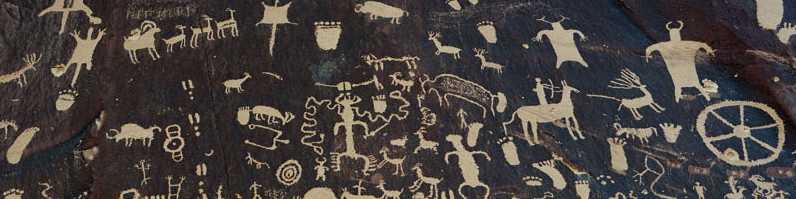
This week's episode of Castle, titled What Lies Beneath, had a Native bit. Here's a recap:
'Castle' Recap: Beckett Gets Closer to the Truth
The victim was supposedly PJ Moffett, a reclusive writer a la JD Salinger or Harper Lee. He'd written exactly one classic novel a la Catcher in the Rye or To Kill a Mockingbird. Moffett's masterpiece, a favorite of Castle's was titled The Butcherbird's Song.
Castle noted how Moffett was known for going undercover to do extensive research on his subjects. For The Butcherbird's Song, says Castle, "He spent seven years as a drug-addicted Eskimo."
Wow. Let's count the number of ways this single line is wrong.
1) There's little or no chance of a white man like Moffett passing as an "Eskimo." Forget about seven years. After seven days, people would start asking him where he was born, who his family was, etc.
2) If Moffett had spent seven years in an Arctic culture, he would've called it by its Native name--e.g., Inuit, Yup'ik, or Iñupiat. He would not have used the generic and sometimes pejorative term "Eskimo."
3) The butcherbird is native to Australia. The odds of an Arctic Native having a connection to an Australian bird are vanishingly small.
4) The concept of a "drug-addicted Eskimo" is stereotypical, of course. It may be true-to-life, since many "Eskimos" have substance abuse problems. But Castle uses the phrase without an explanation--e.g.,"an Eskimo addicted to drugs because of his tragic upbringing." Offering nothing but the stereotype only reinforces the stereotype.
What Lies Beneath was an average episode and the Eskimo reference didn't change that. It's just funny how Castle tries to get it right but fails much of the time. Give it one point for a Native reference but take away the point for making the reference stereotypical.
Showing posts with label Castle. Show all posts
Showing posts with label Castle. Show all posts
October 13, 2015


November 18, 2014
Yavapai in Castle
For the second week in a row, Castle featured a Native subplot. This time, the episode--Once Upon a Time in the West (airdate: 11/17/14)--included several mentions of Yavapai Indians.
The story starts with a murder victim, Whitney, who was poisoned while visiting a dude ranch in Arizona. Castle and Beckett head there to investigate her death.
The Indians come up when Castle and Beckett learn a Yavapai tribe lives nearby and had a river dammed in the 1920s. Whitney had been fooling with dynamite, and I wondered if she planned some eco-terrorism against the dam. No, as it turns out.
Castle Season 7 Episode 7 Review: “Once Upon a Time in the West”Whitney’s trail led to both the New York Historical Society and a Native American reservation, both giving her information on the Yavapai people, who live in that area of Arizona. Castle orders a horse and buggy (he names the horses Ryan and Esposito) and they drive out to meet with the Yavapai consultant who teases them about being dressed as cowboys rolling up to Native American land. He tells them them Whitney wanted to know the definition of a word, the meaning being either river or stream. That’s all she wanted. Castle and Beckett ride up to a wooden fence with a big "Yavapai Reservation" sign on it. On the other side are a couple of men wrangling horses near what could be a corral. These are Yavapai Indians and they're wearing typical ranch clothes, which is what you'd expect.
There actually are three recognized Yavapai tribes: the Yavapai-Apache Nation, the Yavapai-Prescott Indian Tribe, and the Fort McDowell Yavapai Nation. None are called simply the Yavapai Tribe, but that's a minor detail. That Castle used an actual tribal name is impressive enough. Using an appropriate name for southern Arizona, where the ranch presumably is, and avoiding the commonplace "Apache" and "Navajo," is a real feat.
It's kind of farfetched that the tribe would have a sign identifying itself in the middle of nowhere, but that's another minor detail.
The "consultant"--more properly called an elder--is played by Eloy Casados. His biography doesn't say anything about his being Native, although he's presumably Latino. But he has played a Native at least a couple of times. The most notable example is Ishi: The Last of His Tribe (1978), a made-for-television biopic.
River or stream?
According to one site, the word in question is aha gah hel’la. For all I know, that could be a real Yavapai word.
The word is a clue that Whitney was searching for gold bars stolen by the Peacock Boys gang. But the puzzle doesn't quite make sense.
Castle and Beckett deduce that people were searching in the wrong place because of the mistranslated word. But are they searching for the present-day river or stream, or the original river or stream? They don't say--or if they do say, it isn't clear.
Any stream they found now would be the wrong one because the dam changed the water's course. They'd have to look for the original river or stream, not the present-day versions. Since they never set eyes on any actual water, I guess that's what they're doing.
But finding an old stream bed after a century of erosion would require geology expertise and advanced technology. It's not something Castle and Beckett could do on their own. And yet they do find whatever it is they're looking for.
The whole dam thing seems like an unnecessary complication. Just say everyone searched near the river when they should've searched near the stream. If the film location doesn't have a stream, say the drought dried it up. Or it's just over the hill.
Incidentally, there actually was a Yavapai dam conflict:
Orme Dam conflictResponding to growth in the Phoenix area, in the early 1970s Arizona officials proposed to build a dam at the point where the Verde and Salt Rivers meet. The dam would have flooded two-thirds of the 24,000-acre (97 km2) reservation. In return, the members of the tribe (at the time consisting of 425 members) were offered homes and cash settlements. But in 1976, the tribe rejected the offer by a vote of 61%, claiming that the tribe would be effectively disbanded by the move. In 1981, after much petitioning of the US government, and a three-day march by approximately 100 Yavapai, the plan to build the dam was withdrawn. If Castle's writers learned about this incident and used it as inspiration, good for them.
Yavapai boy remembers
'Castle' Recap: Castle and Beckett Go on Their HoneymoonThe Peacock Boys are a local legend and staple of the ranch, but they really did exist. In the 1800s, they robbed a train and got away with 50 bars of gold. The story intersects with the Yavapai because the Boys kidnapped a guide named Blackfox. The Boys allegedly stashed the gold somewhere near a river and were later killed, but the gold was never found. The Peacock Boys supposedly abducted a Yavapai boy to be their servant. When they went to bury the gold, they tied the boy to a tree.
The boy eventually told the story to missionaries, who wrote it down. So the Yavapai are responsible for remembering an incident that otherwise would've been forgotten.
This bit is unnecessary since a gang member could've told the story to anybody. I suppose it serves to integrate the Yavapai into the plot a little better. And the details, such as they are, are plausible. White folks did use Indians as servants or slaves, and missionaries did preserve the Indians' lore in writing.
All in all, Once Upon a Time in the West was a decent episode. The Indians didn't play much of a role, but the details were reasonably accurate. Castle may be the prime-time network leader when it comes to including Native lore on TV.

The story starts with a murder victim, Whitney, who was poisoned while visiting a dude ranch in Arizona. Castle and Beckett head there to investigate her death.
The Indians come up when Castle and Beckett learn a Yavapai tribe lives nearby and had a river dammed in the 1920s. Whitney had been fooling with dynamite, and I wondered if she planned some eco-terrorism against the dam. No, as it turns out.
Castle Season 7 Episode 7 Review: “Once Upon a Time in the West”
There actually are three recognized Yavapai tribes: the Yavapai-Apache Nation, the Yavapai-Prescott Indian Tribe, and the Fort McDowell Yavapai Nation. None are called simply the Yavapai Tribe, but that's a minor detail. That Castle used an actual tribal name is impressive enough. Using an appropriate name for southern Arizona, where the ranch presumably is, and avoiding the commonplace "Apache" and "Navajo," is a real feat.
It's kind of farfetched that the tribe would have a sign identifying itself in the middle of nowhere, but that's another minor detail.
The "consultant"--more properly called an elder--is played by Eloy Casados. His biography doesn't say anything about his being Native, although he's presumably Latino. But he has played a Native at least a couple of times. The most notable example is Ishi: The Last of His Tribe (1978), a made-for-television biopic.
River or stream?
According to one site, the word in question is aha gah hel’la. For all I know, that could be a real Yavapai word.
The word is a clue that Whitney was searching for gold bars stolen by the Peacock Boys gang. But the puzzle doesn't quite make sense.
Castle and Beckett deduce that people were searching in the wrong place because of the mistranslated word. But are they searching for the present-day river or stream, or the original river or stream? They don't say--or if they do say, it isn't clear.
Any stream they found now would be the wrong one because the dam changed the water's course. They'd have to look for the original river or stream, not the present-day versions. Since they never set eyes on any actual water, I guess that's what they're doing.
But finding an old stream bed after a century of erosion would require geology expertise and advanced technology. It's not something Castle and Beckett could do on their own. And yet they do find whatever it is they're looking for.
The whole dam thing seems like an unnecessary complication. Just say everyone searched near the river when they should've searched near the stream. If the film location doesn't have a stream, say the drought dried it up. Or it's just over the hill.
Incidentally, there actually was a Yavapai dam conflict:
Orme Dam conflict
Yavapai boy remembers
'Castle' Recap: Castle and Beckett Go on Their Honeymoon
The boy eventually told the story to missionaries, who wrote it down. So the Yavapai are responsible for remembering an incident that otherwise would've been forgotten.
This bit is unnecessary since a gang member could've told the story to anybody. I suppose it serves to integrate the Yavapai into the plot a little better. And the details, such as they are, are plausible. White folks did use Indians as servants or slaves, and missionaries did preserve the Indians' lore in writing.
All in all, Once Upon a Time in the West was a decent episode. The Indians didn't play much of a role, but the details were reasonably accurate. Castle may be the prime-time network leader when it comes to including Native lore on TV.
November 11, 2014
Inca artifact in Castle
Last night's episode of Castle, Times of Our Lives (airdate: 11/10/14), featured the long-awaited "Caskett" wedding. This happy event came about because of a mystical Native artifact.
Here's the story with the Native aspects noted:
Castle S7 Ep6–Times of Our LivesThe murder this week is of a courier, found with his hand cut off so that the bad guys could steal the case he was handcuffed to. But when Rick & Kate find the missing case at an abandoned coal factory, it turns out to hold a mysterious Incan artifact that Rick picks up for some reason. Has he never seen Indiana Jones??? The bad guys burst in, and Castle hits his head while still holding onto the artifact–and thus ends up in an alternate universe. Castle Recap–Becket and Castle Say I Do: Season 7 Episode 6 “The Time of Our Lives”Alexis says maybe he’s in alternate universe and they tell him to go lie down. ... He searches for parallel universes and watches videos that describe circumstances similar to his and there’s the artifact he touched! The headline asks if it could be the gateway to another world. In the morning, he shows a print out to his mom and daughter. It’s an article about the Incan artifact that connects to the Incan gateway of the Gods. 'Castle' Recap: Castle and Beckett Get MarriedCastle impresses Beckett with his knowledge of the Incan artifact, so she allows him to accompany Ryan and Esposito in their search for armed criminals. Another constant is Castle's inability to follow simple instructions, which leads to him finding the artifact but being held at knifepoint. In the ensuing struggle the artifact is broken.
Beckett decides to let Castle go with a semi-stern talking-to and the team focuses on questioning he woman who held him at knifepoint. Her name is Maria Sanchez, and she and her cousin were trying to return the artifact to the Incan people. She says they had nothing to do with the murder. Castle: The Time of Our Lives (Recap and Review)On his way to the station Rick is kidnapped by the men who stole the artifact and it turns out that the villain has worked out that Castle is in the wrong world because of the artifact and he wants Rick to tell him how it works. Beckett shows up and after a brief shootout, Rick gets the artifact back and leaps in front of Kate to keep her from getting shot. As he dies, Rick comes back to “my you.” 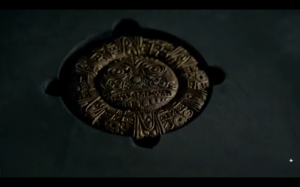
Analysis
The mystical Native artifact is a well-worn plot device. It's stereotypical, of course, since real artifacts don't have supernatural powers.
Why don't European artifacts have as much magic as Native ones? Because Native cultures are more fantastical and unreal--at least to us.
At least Castle tried to link the artifact to the Inca religion--claiming it was a portal between universes and not just an evil talisman created by a shaman's curse. And the disk actually resembles the Inca's golden sun disk. As Wikipedia explains:
IntiInti is the ancient Incan sun god. He is revered as the national patron of the Inca state.
Inti is represented as a golden disk with rays and a human face. Many such disks were supposedly held in Cuzco as well as in shrines throughout the empire, especially at Coricancha, where the most significant image of Inti was discovered by anthropologists. This representation, adorned with ear spools, a pectoral, and a royal headband, was known as "punchao," meaning 'day.' So an actual Inca artifact, more or less, was used in this story. That's almost enough to make the gimmick acceptable.

One article claimed Maria Sanchez was "a notorious stolen-artifact smuggler." Turns out she's stealing artifacts to repatriate them, which is a better cause than stealing them for profit. So the Latina or indigenous criminal is actually a good guy of sorts. Nonstereotypical minority characters aren't uncommon on TV, but it's always good to see another one.
Castle has addressed artifact smuggling--an important topic in indigenous communities--before. Now it's hinting at the subject again. Nice job, Castle.
Anyway, this wedding episode was good if not great. Even though I guessed the bad guy the moment I saw him, as usual.
Here's the story with the Native aspects noted:
Castle S7 Ep6–Times of Our Lives
Beckett decides to let Castle go with a semi-stern talking-to and the team focuses on questioning he woman who held him at knifepoint. Her name is Maria Sanchez, and she and her cousin were trying to return the artifact to the Incan people. She says they had nothing to do with the murder.
Analysis
The mystical Native artifact is a well-worn plot device. It's stereotypical, of course, since real artifacts don't have supernatural powers.
Why don't European artifacts have as much magic as Native ones? Because Native cultures are more fantastical and unreal--at least to us.
At least Castle tried to link the artifact to the Inca religion--claiming it was a portal between universes and not just an evil talisman created by a shaman's curse. And the disk actually resembles the Inca's golden sun disk. As Wikipedia explains:
Inti
Inti is represented as a golden disk with rays and a human face. Many such disks were supposedly held in Cuzco as well as in shrines throughout the empire, especially at Coricancha, where the most significant image of Inti was discovered by anthropologists. This representation, adorned with ear spools, a pectoral, and a royal headband, was known as "punchao," meaning 'day.'
One article claimed Maria Sanchez was "a notorious stolen-artifact smuggler." Turns out she's stealing artifacts to repatriate them, which is a better cause than stealing them for profit. So the Latina or indigenous criminal is actually a good guy of sorts. Nonstereotypical minority characters aren't uncommon on TV, but it's always good to see another one.
Castle has addressed artifact smuggling--an important topic in indigenous communities--before. Now it's hinting at the subject again. Nice job, Castle.
Anyway, this wedding episode was good if not great. Even though I guessed the bad guy the moment I saw him, as usual.
May 17, 2014
Thanksgiving costumes in Castle
The Good, the Bad & the Baby episode of Castle (airdate: 11/25/13) had a Thanksgiving theme. A reviewer describes the relevant parts:
‘Castle’ season 6, episode 10 ‘The Good, the Bad & the Baby’ recap: Baby on boardThe opening sequence features Kate and Rick discussing Thanksgiving. Rick tells Kate that they all wear costumes for Thanksgiving. Kate is less than enthusiastic about the idea but before they could discuss further, Kate gets a phone call for a murder. And at the end:Rick and Kate are setting up for Thanksgiving dinner, and Kate comes out wearing her Pocahontas costume. Interestingly, no one else is wearing a costume. Rick confesses that he was joking about the costumes, and Kate said she wasn’t sure so she got him a costume to wear as well. Kate definitely gets one up on Rick in this situation. 
Comment: To be specific, Beckett got Castle a Pilgrim costume.
These bits are lame for several reasons:
1) Beckett doesn't ask Castle if he's serious? She doesn't double-check with Castle's mother or daughter? She doesn't ask if she's supposed to be a Pilgrim or an Indian?
Really? Ridiculous. Her lack of common sense sets up the predictable and unworthy "joke" at the end.
2) Castle or his writers should know that neither Pocahontas nor a generic Pocahottie was part of the first Thanksgiving. According to reports, Chief Massasoit and 90 warriors showed up at the feast uninvited. We don't know for sure, but it's likely that no Wampanoag women were present. And certainly not young maidens in buckskin dresses.
3) Castle or his writers should know that dressing up as Indians is frowned upon. Sure, he was supposedly joking, but it's not something to joke about.
Would he have jokingly suggested Beckett dress as a black woman--perhaps a mammy from slave times? Dressing as a false and stereotypical Native woman is the same idea. And it's wrong for the same reasons.
The only way Castle could "joke" about this is if he immediately let the others in on the joke. Like, "Just kidding. I wouldn't ask you to dress as an Indian maiden for real because that would involve the offensive practice of redface." But that didn't happen.
Castle has been one of the better network TV shows in terms of Native references. But this episode was a fail.
For more on Castle, see Bigfoot in Castle and Counting Coup in Castle.

‘Castle’ season 6, episode 10 ‘The Good, the Bad & the Baby’ recap: Baby on board
Comment: To be specific, Beckett got Castle a Pilgrim costume.
These bits are lame for several reasons:
1) Beckett doesn't ask Castle if he's serious? She doesn't double-check with Castle's mother or daughter? She doesn't ask if she's supposed to be a Pilgrim or an Indian?
Really? Ridiculous. Her lack of common sense sets up the predictable and unworthy "joke" at the end.
2) Castle or his writers should know that neither Pocahontas nor a generic Pocahottie was part of the first Thanksgiving. According to reports, Chief Massasoit and 90 warriors showed up at the feast uninvited. We don't know for sure, but it's likely that no Wampanoag women were present. And certainly not young maidens in buckskin dresses.
3) Castle or his writers should know that dressing up as Indians is frowned upon. Sure, he was supposedly joking, but it's not something to joke about.
Would he have jokingly suggested Beckett dress as a black woman--perhaps a mammy from slave times? Dressing as a false and stereotypical Native woman is the same idea. And it's wrong for the same reasons.
The only way Castle could "joke" about this is if he immediately let the others in on the joke. Like, "Just kidding. I wouldn't ask you to dress as an Indian maiden for real because that would involve the offensive practice of redface." But that didn't happen.
Castle has been one of the better network TV shows in terms of Native references. But this episode was a fail.
For more on Castle, see Bigfoot in Castle and Counting Coup in Castle.
September 19, 2013
Bigfoot in Castle
In The Fast and the Furriest episode of Castle (airdate: 4/15/13), Native actress Marisa Quinn guest-starred as a homicide victim. Here's how her character was introduced:RYAN: Name is Anne Cardinal. Twenty-seven years old. She was Native American. Grew up on the Onondaga Reservation in central New York.
BECKETT: Any next of kin?
RYAN: No. She had no siblings, and both of her parents are gone. She lived in off-campus housing for Hudson University, where she was working towards a PhD in evolutionary biology. The detectives learn she worked part-time at a primate sanctuary. But she was more than a primate caregiver:DR. MEEKS: Anne was studying evolutionary biology. She was an honors student at the university. But she was actually a hugely respected Bigfoot expert. She even gave me the extremely rare yeti finger.
CASTLE: Are you saying Anne was a Bigfoot hunter?
DR. MEEKS: N-N-No, no, no, uh, no, not a hunter. No, uh, Anne was, uh, Native American. And, uh, in her tribe's culture, a Bigfoot was considered...benevolent, or a protector. When she was a child, she actually saw a Bigfoot, and, so, after that, she devoted her life to their study. Comment: Alas, Quinn's character Anne appeared for only a few seconds as a corpse and a few seconds on a video recorded before her death.
After half an hour exploring the Bigfoot angle, the episode went in another direction. Turns out Anne wasn't hunting Bigfoot in New York City. She was looking for evidence to exonerate a friend accused of an earlier murder.
The key point here is how well the show treated the Native character. Her cultural beliefs were given respect, and she was described in positive, nonstereotypical terms. How often does a Native earn a PhD on television...never?
Castle continues to include Natives occasionally in a mostly respectful way. That puts it ahead of almost every other show on network TV.
For more on Castle, see Counting Coup in Castle and "Sacagawea" in Castle.
Below: Marisa Quinn with Jonathan Frakes, who directed the episode.

BECKETT: Any next of kin?
RYAN: No. She had no siblings, and both of her parents are gone. She lived in off-campus housing for Hudson University, where she was working towards a PhD in evolutionary biology.
CASTLE: Are you saying Anne was a Bigfoot hunter?
DR. MEEKS: N-N-No, no, no, uh, no, not a hunter. No, uh, Anne was, uh, Native American. And, uh, in her tribe's culture, a Bigfoot was considered...benevolent, or a protector. When she was a child, she actually saw a Bigfoot, and, so, after that, she devoted her life to their study.
After half an hour exploring the Bigfoot angle, the episode went in another direction. Turns out Anne wasn't hunting Bigfoot in New York City. She was looking for evidence to exonerate a friend accused of an earlier murder.
The key point here is how well the show treated the Native character. Her cultural beliefs were given respect, and she was described in positive, nonstereotypical terms. How often does a Native earn a PhD on television...never?
Castle continues to include Natives occasionally in a mostly respectful way. That puts it ahead of almost every other show on network TV.
For more on Castle, see Counting Coup in Castle and "Sacagawea" in Castle.
Below: Marisa Quinn with Jonathan Frakes, who directed the episode.
April 24, 2010
Counting coup in Castle
Castle mentions Indians for the third week in a row. In this week's episode, Den of Thieves (airdate: 4/19/10), crime boss Joey Racine explains where he was when a murder occurred.RACINE: Home. And I have round-the-clock bodyguards who can attest to my whereabouts. But you don't think I killed Finch. You assume I had somebody do it for me, so you're here just to [touches Castle with a golf club] count coup, aren't you?
DEMMING: Sorry. What was that?
CASTLE: The Plains Indians considered it an act of bravery to get close enough to one of their enemies to touch them with a coup stick. Is my hair...?
DEMMING: Looks good.
CASTLE: Thanks. Castle has a nice streak going. Let's see if it continues next week. This could be a record for most Indian mentions in a row by a TV show without regular Native characters.
Incidentally, I checked who wrote the episodes. Three different writers did them. Either it's a coincidence or someone--the producers? Nathan Fillion?--is inserting the Indian references.
For more on the subject, see Sacagawea in Castle and Maya Mummy in Castle.

DEMMING: Sorry. What was that?
CASTLE: The Plains Indians considered it an act of bravery to get close enough to one of their enemies to touch them with a coup stick. Is my hair...?
DEMMING: Looks good.
CASTLE: Thanks.
Incidentally, I checked who wrote the episodes. Three different writers did them. Either it's a coincidence or someone--the producers? Nathan Fillion?--is inserting the Indian references.
For more on the subject, see Sacagawea in Castle and Maya Mummy in Castle.
April 14, 2010
"Sacagawea" in Castle
This week's episode of Castle, The Late Shaft (airdate: 4/12/10), included a couple mentions of Indians. Castle called his daughter "Sacagawea" when she went camping, and Beckett observed that a suspect was gambling at Mohegan Sun.
Normally I might not mention anything so minor, but this episode follows last week's Maya mummy mystery. The writers seem to have taken a sudden interest in Native lore. If it's not a coincidence, I want to give them credit for trying.
For more on the subject, see Maya Mummy in Castle and TV Shows Featuring Indians.
Normally I might not mention anything so minor, but this episode follows last week's Maya mummy mystery. The writers seem to have taken a sudden interest in Native lore. If it's not a coincidence, I want to give them credit for trying.
For more on the subject, see Maya Mummy in Castle and TV Shows Featuring Indians.
April 12, 2010
Maya mummy in Castle
Last week's episode of Castle, Wrapped Up in Death (airdate: 4/5/10), featured a Mesoamerican plot. Here's the story:Castle’s Life Is in Danger--from a Curse?--on ABC’s “Castle”
“Wrapped Up in Death”–The investigation into the shocking death of a museum curator, crushed by a falling gargoyle, takes a bizarre turn when Castle and Beckett learn that he isn’t the first member of a recent archeological expedition to die. It turns out there was a legend inscribed over the burial chamber the team unearthed warning that “all who gaze upon the face of the mummy are doomed.” Was the curator just the latest victim of “The Mummy’s Curse”? And if so, what does that mean for Castle, who snuck a peek at the mummy when no one was looking? Rob's review
The episode offered several moments of Native lore, most of them less than stellar. Among them:
The museum where the story takes place is unnamed, but it seems to be New York's American Museum of Natural History. This museum does have Cultures Halls: "a series of exhibition halls that explores the traditional cultures of Asia, Africa, North and South America, and the Pacific," so it might hold an exhibit on Maya mummies.
But the idea of including indigenous cultures in natural history, as if Natives are close to animals, is a relic from a previous era. Since Castle didn't name the museum, why not make it an anthropology or (human) history museum instead? Heck, why not make it the National Museum of the American Indian in the Gustav Heye Center in lower Manhattan?
The mummy lies in a stone sarcophagus in a workroom. There are no sterile facilities or climate controls. A winch that anyone can operate lifts the lid off. Anyone can take some or all of the mummy, and a couple people do.
It's ridiculous to treat a valuable mummy, the centerpiece of a major exhibit, so cavalierly. Would a museum leave King Tut's mummy unprotected in a workroom? I don't think so.
After searching the Internet, I don't think Maya mummies exist. If they do exist, they're rare. Building an episode around something that's (practically) nonexistent is misleading. Our culture associates mummies with evil, so this feeds into the stereotype of the savage, bloodthirsty Mesoamericans.
The show mentions a couple archaeologists finding gold Maya treasures and returning them from Mexico. This is the "Indiana Jones" version of archaeology. Actually, archaeologists are scientists, not treasure hunters. A great discovery is more likely to be a new site, a mural, or a written record than a gold object.
The curse stereotype
The whole curse theme is obviously phony. I'm pretty sure archaeologists have never found an actual Maya curse.
Naturally, Castle and company don't believe the curse. But a series of accidents and deaths makes them wonder. Even if the episode uses the curse for comedy, it still reinforces the stereotype: Indians place curses on burial grounds. Black magic happens whenever their remains are disturbed.
The curse bolsters the evil Maya theme in a few ways:
1) Someone says the Maya king sacrificed so many people that his followers hid his body so his spirit wouldn't find them. Actually, I believe most Maya practiced their religion as fervently as their rulers did. If they didn't, they were free to walk away.
2) Castle shows a photograph of human skulls that supposedly comes from the Maya tomb. I believe the image is a version of this one.
But this comes from the Great Ball Court at Chichén Itzá. The producers have cherry-picked an image from another part of Maya culture to make the Maya look worse.
So...nothing about the Maya's achievements. Just mummies, curses, human sacrifice, murders, and skulls. What would the typical viewer conclude from this? That the Maya had a sophisticated civilization? Or that they were bloodthirsty savages?
Guest star Gil Birmingham
Gil Birmingham plays a Maya Indian who's in town for some event. He has only two scenes: one when the police bring him in for questioning and another when they let him go.
In the first scene, he makes a nice little speech. He says the Maya still live and are seven million strong. They're the rightful owners of the Maya artifacts, not the Mexican government.
This is a good approximation of what a Zapatista-style activist might say. It's one of the few times we've heard a movie or TV show state this position--maybe the only time.
Someone on Facebook said, "Gil Birmingham's character wasn't exactly a hero." That's fine with me. I was afraid he was going to be a wise shaman type who imparts Maya wisdom with inscrutable aphorisms. This approach is better.
Birmingham's character's name is Cacaw Te. This looks like a genuine Maya name. More important, it's pronounced like "Chakotay"--an obvious reference to Star Trek: Voyager. Since Chakotay supposedly came from a Maya-like tribe in Central America, this reference is acceptably cute.
We might even read it as an attempt to "correct" Voyager by giving Chakotay a real Mesoamerican name. In other words, "Chakotay" might be the anglicized or bastardized version of the name "Cacaw Te."
After the initial setup, the rest of the episode gives us comedic hijinks over the curse while it unravels the murder. Fortunately, the mystery doesn't involve the supernatural. It evolves from drug smuggling to artifact smuggling to something more personal.
All in all, I'd say Wrapped Up in Death was a typical example of Indians in a TV show. Give it one point for Birmingham's role and take away two points for the stereotypical curse and the museum and mummy mistakes. It was better than The Librarian: Quest for the Spear, but that's not saying much.
For more on the subject, see Indiana Jones and the Stereotypes of Doom and TV Shows Featuring Indians.
"Indiana" Castle examines fake Maya artwork:

A short promo:
The full episode:
“Wrapped Up in Death”–The investigation into the shocking death of a museum curator, crushed by a falling gargoyle, takes a bizarre turn when Castle and Beckett learn that he isn’t the first member of a recent archeological expedition to die. It turns out there was a legend inscribed over the burial chamber the team unearthed warning that “all who gaze upon the face of the mummy are doomed.” Was the curator just the latest victim of “The Mummy’s Curse”? And if so, what does that mean for Castle, who snuck a peek at the mummy when no one was looking?
The episode offered several moments of Native lore, most of them less than stellar. Among them:
But the idea of including indigenous cultures in natural history, as if Natives are close to animals, is a relic from a previous era. Since Castle didn't name the museum, why not make it an anthropology or (human) history museum instead? Heck, why not make it the National Museum of the American Indian in the Gustav Heye Center in lower Manhattan?
It's ridiculous to treat a valuable mummy, the centerpiece of a major exhibit, so cavalierly. Would a museum leave King Tut's mummy unprotected in a workroom? I don't think so.
The curse stereotype
Naturally, Castle and company don't believe the curse. But a series of accidents and deaths makes them wonder. Even if the episode uses the curse for comedy, it still reinforces the stereotype: Indians place curses on burial grounds. Black magic happens whenever their remains are disturbed.
The curse bolsters the evil Maya theme in a few ways:
1) Someone says the Maya king sacrificed so many people that his followers hid his body so his spirit wouldn't find them. Actually, I believe most Maya practiced their religion as fervently as their rulers did. If they didn't, they were free to walk away.
2) Castle shows a photograph of human skulls that supposedly comes from the Maya tomb. I believe the image is a version of this one.
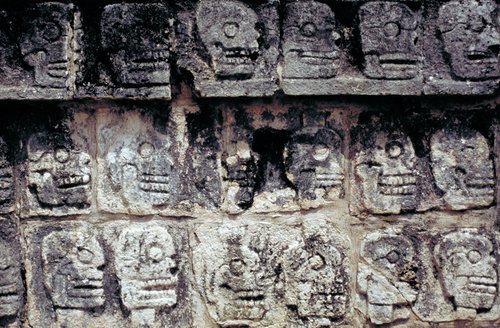
But this comes from the Great Ball Court at Chichén Itzá. The producers have cherry-picked an image from another part of Maya culture to make the Maya look worse.
So...nothing about the Maya's achievements. Just mummies, curses, human sacrifice, murders, and skulls. What would the typical viewer conclude from this? That the Maya had a sophisticated civilization? Or that they were bloodthirsty savages?
Guest star Gil Birmingham
In the first scene, he makes a nice little speech. He says the Maya still live and are seven million strong. They're the rightful owners of the Maya artifacts, not the Mexican government.
This is a good approximation of what a Zapatista-style activist might say. It's one of the few times we've heard a movie or TV show state this position--maybe the only time.
We might even read it as an attempt to "correct" Voyager by giving Chakotay a real Mesoamerican name. In other words, "Chakotay" might be the anglicized or bastardized version of the name "Cacaw Te."
After the initial setup, the rest of the episode gives us comedic hijinks over the curse while it unravels the murder. Fortunately, the mystery doesn't involve the supernatural. It evolves from drug smuggling to artifact smuggling to something more personal.
All in all, I'd say Wrapped Up in Death was a typical example of Indians in a TV show. Give it one point for Birmingham's role and take away two points for the stereotypical curse and the museum and mummy mistakes. It was better than The Librarian: Quest for the Spear, but that's not saying much.
For more on the subject, see Indiana Jones and the Stereotypes of Doom and TV Shows Featuring Indians.
"Indiana" Castle examines fake Maya artwork:
A short promo:
The full episode:
Subscribe to:
Posts (Atom)