'The Darkness,' 'The Shining,' And The Persistent Myth of The "Indian Burial Ground"
Redsploitation Horror has a long tradition in American cinema. Kevin Bacon's new horror flick continues the trend.
By Matt Kim


But here's a synopsis with my comments:
Parks and Recreation recap: “Harvest Festival”
By Megan Gilbert
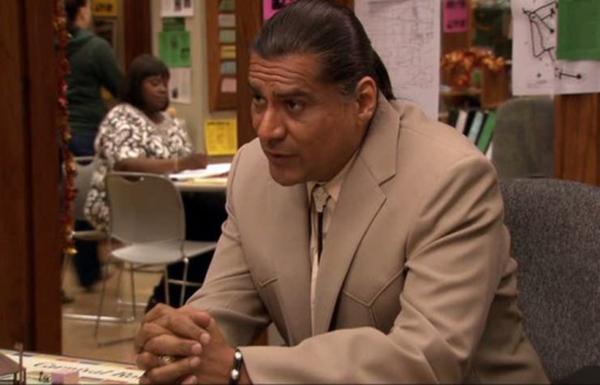
She, Ben, and Tom discuss the nerdiness vs. non-nerdiness of Star Wars (Tom and Leslie: nerdy; Ben: not-nerdy) while they wait for Ken, the leader of the Wamapoke tribe, who is sporting a slicked-back ponytail, a bolo tie and a festival-related grievance. Tom gets in a “Dope bolo” before Leslie addresses Ken in his native language. But this does little to assuage Ken’s grievance: the “carnival” is being held on the site of the Battle of Indian Hill, and its shooting galleries and fried dough stands need to be moved.
The Wamapokes supposedly lost the battle because they didn't have any weapons, which is a bit insulting. Describing them as hapless children isn't much better than describing them as savage killers. Actually, as Allan W. Eckert's A Sorrow in Our Heart makes clear, Indiana's Indians were sophisticated defenders of their rights and cultures.
Clearly Hotate has invented the "curse" to achieve his political goals. The idea that an Indian would place a curse in 2011 is silly. It would be like accusing someone of being a witch--a practice that died out centuries ago. But it's also silly that most of the townspeople believe him. The joke is primarily on them, not on him.
The "curse" takes hold
Things start to go wrong the day before the festival:
That seems offensive to me. Even in this fictional context, it shows non-Indians conveying their stereotypical beliefs about how Indians act. In the real world, people would condemn this as a racist depiction of Indian spirituality.
For starters, the show has never mentioned that some Wamapokes survived. It definitely hasn't mentioned that there's a Wamapoke Casino in Pawnee. The casino doesn't fit with some of the previous claims made: that the town is broke, that its biggest attraction is a giant turnip or whatever, etc. A cash cow like a casino would be a major factor in the government operations of a town like Pawnee. See the Agua Caliente Casino Resort Spa in Palm Springs or the Chumash Casino in Santa Ynez for examples.
To obtain the generator, Leslie offers to "put the Wamapoke history exhibit inside the carnival grounds, right past the entrance turnstyle, so that you have to look at it before you start having fun." Funny, but the white folks still haven't addressed the Wamapokes' demands. Except for the shooting gallery, the bulk of the carnival still sits on the burial ground.
Clearly no one is taking the Indians' spirituality seriously. Not even Hotate, who finds Leslie's offer "interesting" and agrees to lift the curse. It's as everyone knows the white man's wishes trump the Indians', and all that matters is how to pay off a special interest group.
In the Wamapoke "ceremony," Hotate's Native song is subtitled in English. "I am not saying anything," he intones. "No one can understand me anyway. Doobee. Doobee. Do." Even though Hotate's actions are a spoof--he's lifting the "curse" he made up--this is really a slam against Native ceremonies. "We" don't understand what "they" mean, so perhaps the Indians are babbling nonsense. Perhaps their religious beliefs and ceremonies are nothing more than stunts to impress gullible non-Indians.
Joss speaks about his role
Wish granted: Joss lands Parks role
By Jeanne Jakle
Whoops. Once the muckraking host of a local newsmagazine (Mo Collins) gets wind of this development, it quickly explodes into a huge story.
What a great role for Joss, marked by lots of fun, hilarity--even snappy clothes.
"I got to wear a suit," Joss said. He also spouts choice lines. For example: "There are two things I know about white people. They love Matchbox Twenty, and they're terrified of curses."
Joss said he was thrilled to work again with executive producer Greg Daniels, who co-created King of the Hill "And I really liked that they put so much thought into my story line," he said, adding the show was careful not to offend Native Americans. When his character performs an over-the-top ceremonial bit, for instance, the prop master brought over a bag to sprinkle over the crowd and "took care not use any actual ceremonial ingredients."
Despite these criticisms, the episode is decent overall. The details--particularly the depictions of Indian ceremonies--are stereotypical, but the main points are solid. The producers cast an Indian to play an Indian. He's wearing a suit and tie, not some sort of costume. He has a normal name, not a funny Indian name.
Other than the phony curse, he doesn't offer any "wise" or "mystical" nonsense. He pulls the wool over the white man's eyes, but not in a "shifty casino owner" kind of way. Nothing about him suggests he's savage, uncivilized, or anything but a solid businessman and community leader.
For more on Parks and Recreation, see Wamapoke Wedding in Parks and Recreation and Spirit of Pawnee in Parks and Recreation.