Showing posts with label Geronimo. Show all posts

January 19, 2016

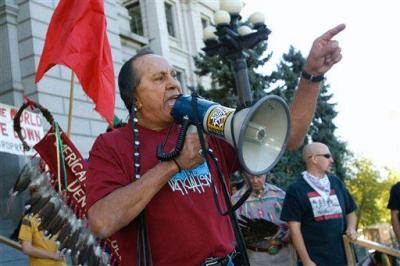
Means: Geronimo had 100+ errors

Hollywood v. Indians: Russell Means, The Great Mystery and Adam Sandler's Dreck

By Bayard JohnsonRussell came over for dinner one evening and sat down at the table, hardly speaking, staring into space. He was in another world. After a while he sat up straighter, cleared his throat, and came back to our kitchen table. “Got a look at the GERONIMO script,” he said. “It’s the worst piece of trash I’ve ever seen.” I can’t remember how many factual errors about Indians were written into the script. It was a staggering number, over 100. Everything about the script reflected an attempt by non-Indians, who knew nothing about Indians or their culture or beliefs or ways of life, to make money off the popular current interest in movies about American Indians. There was no attempt by the filmmakers to learn anything factual about Indians, or to represent them on screen with any accuracy whatsoever, according to Russell’s reading of the script.Means said he wouldn't do anything about it. The Great Mystery would take care of the problem:How was the Great Mystery going to take care of GERONIMO? I must’ve looked dubious. “If you look at the history of Hollywood,” said Russell, “you’ll see that recent movies that have treated Indians with respect—LAST OF THE MOHICANS, LITTLE BIG MAN, THE OUTLAW JOSIE WALES, DANCES WITH WOLVES—have all done well at the box office. Those like GERONIMO, which trampled roughshod over Indian culture, were box office disasters. Just wait, said Russell. You’ll see.

The numbers became clear later in 1993. GERONIMO cost $35 million to produce. The picture grossed $18 million, meaning that everyone who tried to exploit Indian culture to make money lost their ass instead.
Of course, Means also told us what he thought the best Native movies of the 1990s were:Last of the Mohicans and the best one of them all, Pocahontas.Not Dances with Wolves or Smoke Signals but Pocahontas, which must've had hundreds if not thousands of historical errors. So take his claims with a grain of salt.

For more on Russell Means, see Means on His Acting Career and Means on Native Movies.

December 30, 2015

Atlantic's "influential" list omits Indians

Here's another list of the "top" Americans along with my comments:

Atlantic Magazine Listed the “100 Most Influential Figures in American History” And Didn’t Put a Single Native American on the List

A good list in some ways; a bad list in others.

They seem to have confused "important" and "influential." As these lists often do. They aren't the same thing.

They also seem to have confused the person and the accomplishment. The telegraph may have influenced the course of the country, but Samuel Morse didn't. Not enough to put him on the list.

They gave artists and "pop" celebrities short shrift. And despite Elvis, went mostly for establishment figures. Herman Melville? P.T. Barnum? Stephen Foster? William Faulkner? Louis Armstrong? How about Bob Dylan, John Wayne, Michael Jackson, Marilyn Monroe, or Michael Jordan? I'd put one or two of these choices against all five of Atlantic's choices in terms of influence.

The Native alternatives

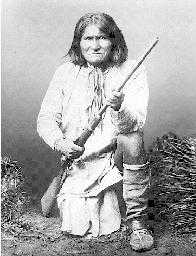
As for Natives, who would be the no. 1 choice? Perhaps Geronimo. From both sides--Native and non-Native--he must be the icon of Indianness. Natives see him as a savage resistance fighter determined to be free. Non-Natives see him as simply the ultimate savage.

Who else? Siting Bull? Pocahontas? I'm not sure how much they accomplished, but they were hugely influential as symbols. One or both of them could go on the list also.

Tecumseh may qualify as the most accomplished Native in American history. But his accomplishment--building a widespread tribal coalition--fell apart at the end. So I'm not sure how much influence it had on the course of US history.

Anyone else? Sacagawea? She had one big accomplishment: keeping Lewis and Clark alive during the winter of 1805-6. But that was a single small role in a major expedition, and it's not clear how influential the expedition was. I wouldn't include her.

Jim Thorpe? He was hugely accomplished, but I'm not sure how his accomplishments influenced anyone else. Or changed the course of history. The historians may have been right to limit sports figures to people like Jackie Robinson and Babe Ruth.

The code talkers? Maybe if one of them had singlehandedly created and operated the group. But you can't have a group of 400 or whatever in a list like this. Otherwise you'd have to nominate George Washington's or FDR's Cabinet. Or the soldiers who landed at Normandy.

Why Indians?

Despite the "influential" tag, much of this list is about symbolism. For instance, Jackie Robinson didn't integrate baseball or other sports by himself. He's important as the first person to break the color--as a symbol of change. But if he hadn't been first, someone else would've been.

Like Neil Armstrong walking on the moon, Robinson didn't cause the change himself. He represented the forces of change working their way through society. He "influenced" history by being in the right place at the right time.

For the first century, most of America's "foreign" policy concerned the Indian question. Turner's Frontier Thesis argued that we defined ourselves in relation to the wild West--i.e., Indians. Taming the wilderness, turning "savagery" into civilization, is America's founding myth.

Symbolically, Indians loomed huge in our imagination. They played a much greater role than their actual numbers or accomplishments suggested. Therefore, you could easily argue for including one or more of them on the list. They were prominent for half our history, so they deserve some spots.

For more on the subject, see 100 Most Significant Americans? and Indians in the Celebrity 100.

October 22, 2014

Killing "terrorists" = killing Indians

Why do we ignore the civilians killed in American wars?

By John TirmanWhy the American silence on our wars’ main victims? Our self-image, based on what cultural historian Richard Slotkin calls “the frontier myth”—in which righteous violence is used to subdue or annihilate the savages of whatever land we’re trying to conquer—plays a large role. For hundreds of years, the frontier myth has been one of America’s sturdiest national narratives.

When the challenges from communism in Korea and Vietnam appeared, we called on these cultural tropes to understand the U.S. mission overseas. The same was true for Iraq and Afghanistan, with the news media and politicians frequently portraying Islamic terrorists as frontier savages. By framing each of these wars as a battle to civilize a lawless culture, we essentially typecast the local populations as the Indians of our North American conquest. As the foreign policy maven Robert D. Kaplan wrote on the Wall Street Journal op-ed page in 2004, “The red Indian metaphor is one with which a liberal policy nomenklatura may be uncomfortable, but Army and Marine field officers have embraced it because it captures perfectly the combat challenge of the early 21st century.”

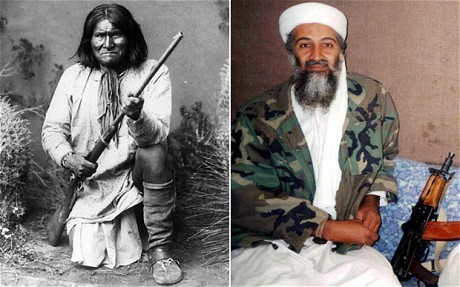
Politicians tend to speak in broader terms, such as defending Western values, or simply refer to resistance fighters as terrorists, the 21st-century word for savages. Remember the military’s code name for the raid of Osama bin Laden’s compound? It was Geronimo.

The frontier myth is also steeped in racism, which is deeply embedded in American culture’s derogatory depictions of the enemy. Such belittling makes it all the easier to put these foreigners at risk of violence. President George W. Bush, to his credit, disavowed these wars as being against Islam, as has President Obama.
Comment:  For more on the subject, see Indians, Terrorists = US Enemies and Bin Laden Codenamed Geronimo.

March 05, 2014

Assimilation in 1950s movies

I watched three old 1950s Westerns recently. As usual, they had some authentic elements but were mostly inauthentic.

Together they spun a clear message of assimilation. America's "Indian problem" would go away if only the Indians joined the mainstream and became good white Christians.

The Far HorizonsPlot

An ambitious, historic attempt to explore and document an untamed American frontier unfolds in this rousing adventure drama. In 1803, Meriwether Lewis and William Clark, with President Thomas Jefferson's blessing, embarked on the government-sponsored Lewis & Clark Expedition–an attempt to discover a water route connecting St. Louis, Missouri, with the Pacific Ocean. Their trek takes them through the magnificent, danger-filled territory of the Pacific Northwest, with guidance from the Shoshone maiden Sacagawea.

Reception

In 2011, Time Magazine rated The Far Horizons as one of the top ten most historically misleading films, in part due to its casting of Caucasian Donna Reed as Native American Sacagawea, and the creation of a romantic subplot between her character and William Clark despite the fact that Sacagawea's husband, French-Canadian trader Toussaint Charbonneau, was in real life also a member of the expedition.


The explorers' first encounter with a tribe is reasonably accurate. The white man approach the Indians in full dress uniforms, present them with medals and other trinkets, and declare they're now subjects of the Great Father in Washington. The Indians pretend to go along, but after the white men leave, the chief throws down his medals and declares his opposition. No one can own the land, he says.

So far, so good...but then the angry Indians stalk the explorers and try to kill them. Uh, no. Lewis and Clark encountered several friendly tribes and stayed with them for a couple of winters. No one made a concerted effort to kill them.

The unavoidable message is white men good, Indians bad. The noble explorers are just innocently surveying the land. The evil savages can't stand the idea of sharing the country, so they go into a murderous rage. They don't plan intelligent counteroffensives like Tecumseh's confederation of tribes, which happened only a few years later. They lash out like wild beasts threatened with captivity.

The whole love subplot is ridiculous too. And it contributes to the overall message. Sacagawea journeys to Washington DC with Clark, but she can't fit into white society, so she leaves. Although you could take that as advocating separatism, I didn't. I took it to mean Indians can't be part of the mainstream unless they eliminate what makes them unique and become plain-vanilla Americans.

Walk the Proud LandPlot

This is the true story of Indian agent John Philip Clum (Audie Murphy) as told by Clum's son in the 1936 biography Apache Agent. The film begins in 1874, as Clum, an Eastern government representative, arrives in San Carlos, Arizona. He is sent to try a new approach to peace with Apaches based on respect for autonomy rather than submission to Army. He faces suspicions from the white settlers, the Army and the Indians, especially Geronimo.

Reception

The film was not a success at the box office, something attributed to the fact that Murphy played a pacifist rather than an action hero. This ended Murphy's plans to make his dream project, a biopic of painter Charles Marion Russell.


I saw only the final half of this, but I think I got the idea.

Clum plays the usual role of the white savior who knows what's best for the Indians. His "new approach" is to tell them to stop fighting and settle down as farmers. Many of the Apache agree, but Geronimo (Jay Silverheels!) and his renegades say they'll never give up their independence.

Needless to say, this isn't exactly a pro-Indian message. It's "pacifist" only in the sense that Clum isn't the one hold a gun to the Apaches' heads. But an implied threat is there. If the Indians don't do it Clum's way, the Army will enforce it their way.

Clum manages to trick Geronimo into submission. He approaches Geronimo with a small number of men and puts them in Geronimo's hands. But other men in the hills fire their guns, and the echoes make it seem as if Geronimo is outnumbered and surrounded. He finally surrenders.

So it's not Clum's pacifist message that carries the day. It's more of the white man's deception. The "bad" Indians are forced to accept the white man's way as the best and only possible existence.

ApacheApache was based on Paul I. Wellman's novel Broncho Apache, which in turn was inspired by a true story. Burt Lancaster plays Massai, a lieutenant of the great Apache warrior Geronimo (here depicted as an old man, played by Monte Blue). Though his tribe has signed surrender terms with the conquering whites, Massai refuses to do so. He escapes from a prison train and conducts a one-man war against the white intruders-and against some of his own people. Along the way, he claims Nalinle (Jean Peters), whom he previously regarded as a traitor to his cause, as his wife.

John McIntire plays famed Indian scout Al Sieber, who-in this film, if not in real life-is sympathetic to the Indians' plight and Massai's single-purposed cause. The real-life counterpart to Massai was killed by Sieber's minions after agreeing to call off the hostilities; United Artists objected to this, forcing producer/star Burt Lancaster to shoot an unconvincingly happy ending. --Hal Erickson, Rovi


Lancaster looks silly as an Indian, and initially sounds silly too. I guess he eventually grows into the role. But that's neither here nor there.

Apache shows what happened to Geronimo and his men when they surrendered to "pacifist" white men. They were sent to a prison camp in Florida and never saw their homeland again. So much for peace and reconciliation.

Massai escapes and, on the way home, meets a Cherokee farmer who touts the value of settling down and growing corn. Massai is scornful, but the man insists he hasn't given up his Cherokee identity. Massai takes some corn with him when he leaves.

When he reaches his own people, the weak-willed appeaser of a chief turns him in to the white men. He escapes and begins his one-man battle to remain free. Nalinle tries to help him and eventually they hole up in a remote cabin, where he angrily tosses the corn away.

The next spring, he's surprised to find a corn crop growing near the cabin. The white men track him down, and he and Sieber play a silly cat-and-mouse game in the corn patch while the others surround it. The white men have scorned the idea that wild savages could become tame farmers, but Sieber sees the corn patch as proof that they can. Amazingly, he lets Massai return to his cabin and live as a newly minted man of the soil.

Conclusion

So the implied assimilationist message of The Far Horizons becomes explicit in Apache. Become a farmer or go to prison and die. Even the boldest and most independent warrior must bend to this inevitable outcome. There's no place for Indians in America unless they give up their old ways and become good Christian workers.

True, these movies didn't come out in this order. But in different ways, white filmmakers were trying to present the same message. They each came up with pieces of the puzzle.

Put them together and you can see the whole assimilationist narrative. Indians were wild and savage. Americans just wanted to live with them in peace. Eventually the Indians agreed and gave up their uncivilized ways.

For more on the subject, see The Best Indian Movies.

November 14, 2013

Burroughs's The War Chief

Because of the John Carter movie, there's been a renewed interest in the work of Edgar Rice Burroughs. In recent years, I've posted a few links about him and his ideas about race. For instance:

Burroughs the conservative racist
Review of Warlord of Mars #1

But while talking about Martians as analogues of Indians, I neglected a more direct link. Burroughs wrote a whole novel about the Apache:

The War Chief

SynopsisTHE WAR CHIEF is a realistic historical novel about life and death on an Apache reservation during the final years of the Apache wars until the death of Cochise and the surrender of Geronimo. The story focuses on Andy MacDuff, an infant kidnapped by the Apaches in a raid, adopted by Geronimo and renamed Shoz-Dijiji, or Black Bear. He is given a proper Apache upbringing, including initiation into all the rites and responsibilities of Indian Manhood. He excels at the crucial skills of hunting and warfare, shows himself to be strong and courageous, and soon is made a highly prized war chief. During his apprenticeship, Shoz-Dijiji falls in love with Ish-Kay-Nay, an Apache maiden, who, unfortunately is coveted by another Apache chief, Juh, who hates Shoz-Dijiji for being Geronimo’s favorite. Burroughs’ great respect for the West and compassion for the exploitative treatment of the Indians the hands of the treacherous pin-dah-lickoyee (“white eyes”) is manifested throughout this honest, vivid, and sympathetic portrait of the West that does credit to both the Indians and Edgar Rice Burroughs.Project Gutenberg has posted the whole story online if you want to read it:

Title: The War Chief

Author: Edgar Rice Burroughs
* A Project Gutenberg of Australia eBook *
CHAPTER 1

GO-YAT-THLAY

NAKED but for a G-string, rough sandals, a bit of hide and a buffalo headress, a savage warrior leaped and danced to the beating of drums. Encircling fires, woman-tended, sent up curling tongues of flame, lighting, fitfully, sweat-glistening shoulders, naked arms and legs.

Distorted shadows, grotesque, mimicking, danced with the savage and his fellows. Above them, dark and mysterious and weirdly exaggerated by the night, loomed the Grampian Hills.

Rude bows and arrows, stone-shod spears, gaudy feathers, the waving tails of animals accentuated the barbaric atmosphere that was as yet uncontaminated by the fetid breath of civilization--pardon me!--that was as yet ignorant of the refining influences of imperial conquest, trained mercenaries and abhorrent disease.
But wait...it's a trick! These are the Scottish ancestors of the white men who will soon invade the land of Go-yat-thlay (Geronimo). How they came to have a buffalo headdress, I don't know, but the point is that they reek of savagery.

A few paragraphs later we meet Geronimo as he spies on a covered wagon:Go-yat-thlay had never before seen this wagon, but he had seen its dust from a great distance; he noted its volume and its rate of progress, and he had known that it was a wagon drawn by two mules, for there was less dust than an ox-drawn vehicle would have raised, since oxen do not lift their feet as high as horses or mules, and, too, its rate of progress eliminated oxen as a possible means of locomotion. That the wagon was drawn by mules rather than horses was but a shrewd guess based upon observation. The Apache knew that few horses survived thus far the long trek from the white man's country.

In the mind of Go-yat-thlay burned a recollection of the wrongs that had been heaped upon his people by the white man. In the legends of his fathers had come down the story of the conquests of the Spaniards, through Coronado and the priests, three-hundred years before. In those days the Apache had fought only to preserve the integrity of his domain from the domination of an alien race. In his heart there was not the bitter hatred that the cruelty and injustice and treachery of the more recent American invaders engendered.
So Burroughs treats the Indians decently. He makes a point of saying white men are just as savage as Indians.

But the story centers on a white man raised as an Apache. Needless to say, he becomes a great chief and woos a beautiful "princess." No doubt he's a classic "white Indian" who acts as savior of the savages.

War Chief comic strip

I was reminded of The War Chief when I saw the following images on Facebook:


Apparently, Edgar Rice Burroughs Inc. is producing "All New Weekly Comic Strips" of Tarzan, Pellucidar, Carson of Venus, and other Burroughs properties. With all the talent involved, I imagine they're pretty good.

November 04, 2013

Did Indians inspire Jack Kirby?

Did Native Americans Give Us Spider-Man?

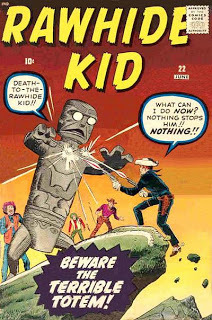
By Will NixonA young artist named Jack Kirby, born in 1917, grew up with an enduring fascination with world mythology and with comics. Kirby was especially interested in the Hopi, and imitated Hopi designs and patterns in his drawing style. Over time, he became known as "King of the Comics," and his enduring interest in ancient Hopi myths influenced millions. Kirby's most personal work of genius, the unfinished "Four Worlds" series, was based on the Hopi myth of Creation by the same name. One can also see his devotion to the Hopi in the creation of his Terrible Totem villain, a wooden character that is an amalgam of several Hopi kachinas and monsters.

At that time, comic book story writers saw themselves as part of a tradition of heroic fiction, and so did not usually extract wholesale from existing myths but used elements creatively according to their particular genius. This was the way in which Jack Kirby brought the spirit of the Hopi hero myths to millions of young Americans in the 1950s and 1960s during a time in which people were struggling to find more earth-friendly values.

Jack Kirby (with Stan Lee) invented Spider-Man, who embodies many of the qualities of Grandmother Spider, also known as Spider Woman. Kirby and Lee also invented X-Men, whose original characters included The Beast (the forerunner of Beast Boy, a shape-shifter based on Hopi mythology), Ice Man (somewhat like the North Wind of Ojibway stories), Marvel Girl (who is telepathic, and can "talk in someone's ear" without being seen, but in a different way than Spider Woman can), and the Cyclops (from Greek myth). Later X-Men included Mystique, who is a shape-shifter. Kirby then invented the Incredible Hulk, who is perhaps like Man-Eagle in many respects, only good.

Then he created the Fantastic Four, an arch-enemy of whom was called the Mole Man. Unlike the helpful Mole Man in "Son of Light Defeats the Monster," this one is a subterranean menace who controls and unleashes huge monsters upon the Fantastic Four. The Four include the Thing, a rock creature not unlike the Dene (Navajo) Rock Monster Eagle, Tse ninahaleeh, who lives on Shiprock Mountain; Mr. Fantastic, who stretches; Invisible Girl, essentially like Grandmother Spider who makes herself so small she becomes invisible; and the Human Torch, similar to the Kokosori Zuni fire kachina who descends from the hills to start the Zuni ceremony of shalako on the first week of December. Perhaps contact with these characters has opened our subconscious minds to the teachings of the Hopi, the "Peaceful People."
Comment:  Alas, Nixon's theory is weak. Among its flaws:

  • I've never seen any Hopi designs or patterns in his drawings.

  • Kirby modeled the Terrible Totem on totem poles (duh) from the northwest, not kachinas from the southwest.

  • Beware Terrible Totem Rawhide Kid Tale By Jack Kirby


  • When Kirby took over the Green Arrow series in the mid-1950s, he turned Green Arrow and his sidekick Speedy into Batman and Robin clones. He downplayed or ignored Speedy's Navajo origin--not what you'd expect if he was infusing everything with Native lore.

  • Kirby was only briefly involved with Spider-Man. His version was a gadget-using guy like the Human Fly, with suction cups and a web gun. It was the opposite of a nature- or mythology-based spider hero.

  • Stan Lee was involved in the creation of all the heroes mentioned, so it's doubtful how much rein Kirby had to use his alleged interest in the Hopi.

  • Nixon claims the heroes derived from Navajo, Zuni, and Ojibway legends. None of these are Hopi. How could their legends influence Kirby if he was interested in the Hopi? Learning about one tribe doesn't make you an expert on several hundred other tribes.

  • The Fantastic Four's power almost certainly came from the Greek belief in the four elements: air, water, fire, and earth.

  • Kirby's Fourth World

    I'll concede that the Hopis' "fourth world" concept may have inspired Kirby. The basic idea of worlds dying and being reborn could be Native, even if the details aren't. The other claims seem farfetched.

    But Kirby probably had some familiarity with Native lore. As much as the average American, at least. He drew all kinds of comics, especially Westerns, where Indians were bound to appear.

    A few instances:

  • Kirby created or co-created Wyatt Wingfoot and his Keewazi tribe in Fantastic Four #50. Wingfoot was one of the first modern-day Indians in comics.

  • He pitted the Fantastic Four and Wingfoot against Tomazooma in Fantastic Four #80. Tomazooma was a giant robot based on Keewazi legend. It vaguely resembled a Hopi kachina.


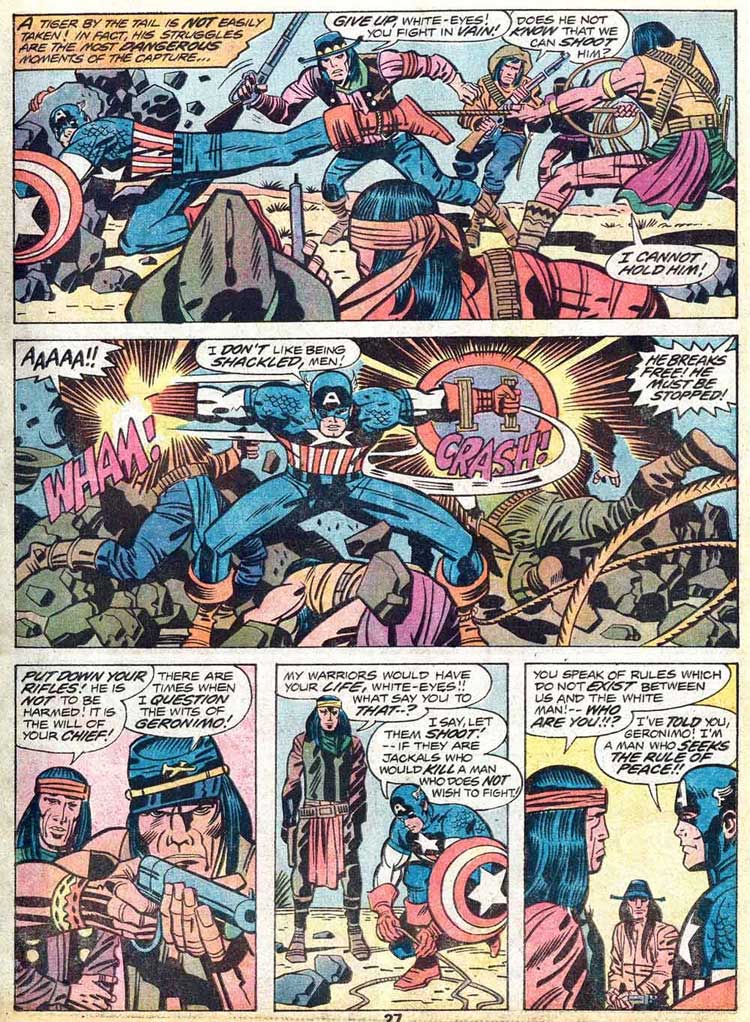
  • In Captain America's Bicentennial Battles, Kirby had Captain America meet Geronimo. Cap tries to stop a battle between the Apaches and the US Army.

  • And Now, Bicentennial Kirby Captain America--Lost In Time!


  • Kirby's Eternals series was based on the "ancient astronauts" premise--the idea that aliens came to earth long ago and aided nascent civilizations, especially those in the Americas. The series begins with an archaeologist discovering alien artifacts in an Inca tomb.

  • Whether these few examples signify a special interest in Indians is hard to say. These are a few comics out of the thousands Kirby produced. Probability suggests Indians should've appeared about 1% of the time, so that's all this may be.

    Here's a note about a Western comic by Kirby featuring Indians:

    Bullseye #6, The Missing Tomahawks

    October 23, 2013

    Geronimo and Black Hawk comics

    Some Native-themed comics from around 1950.


    The Savage Raids of Chief Geronimo v1 #4


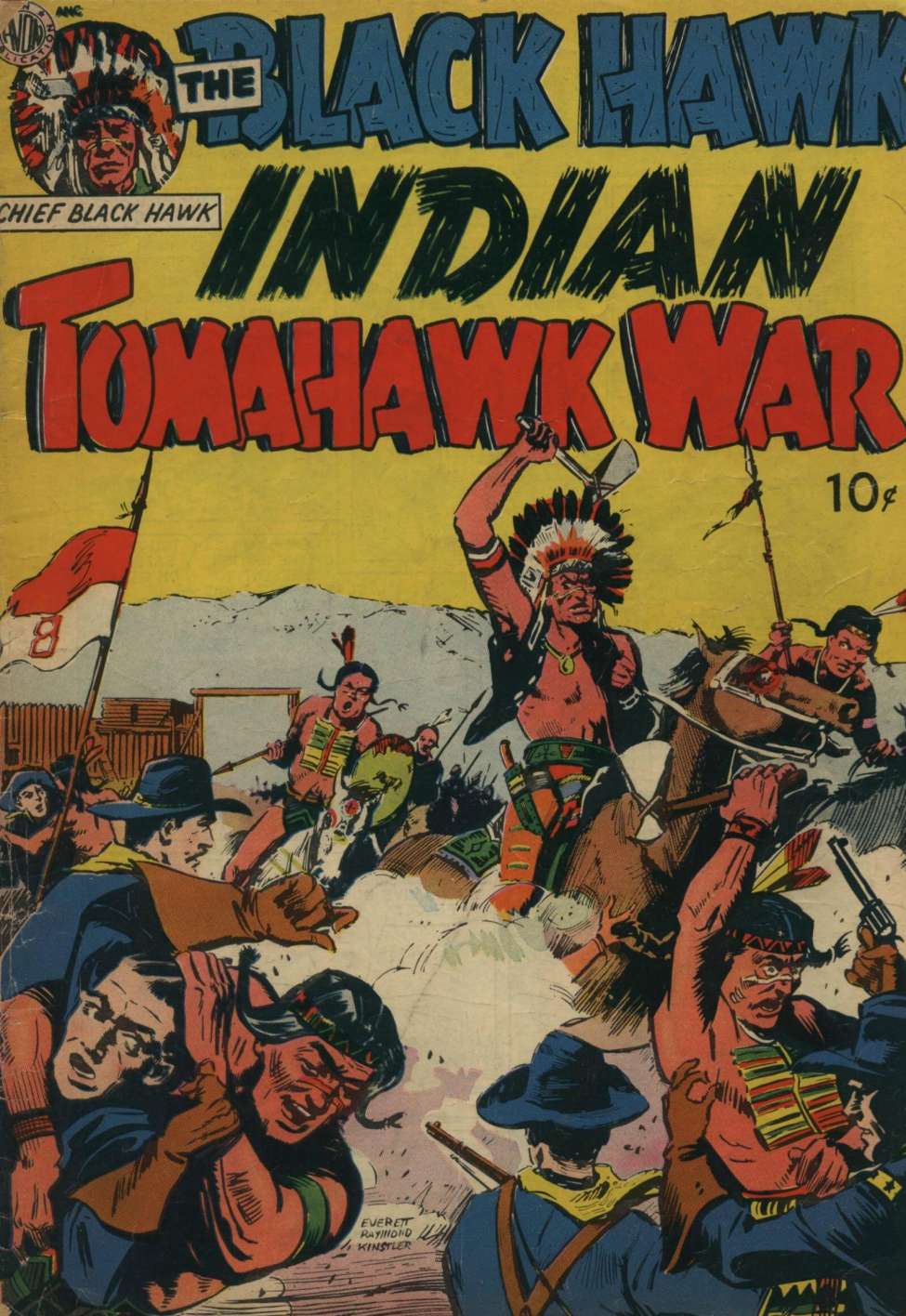
    Black Hawk--Tomahawk Indian War [nn]

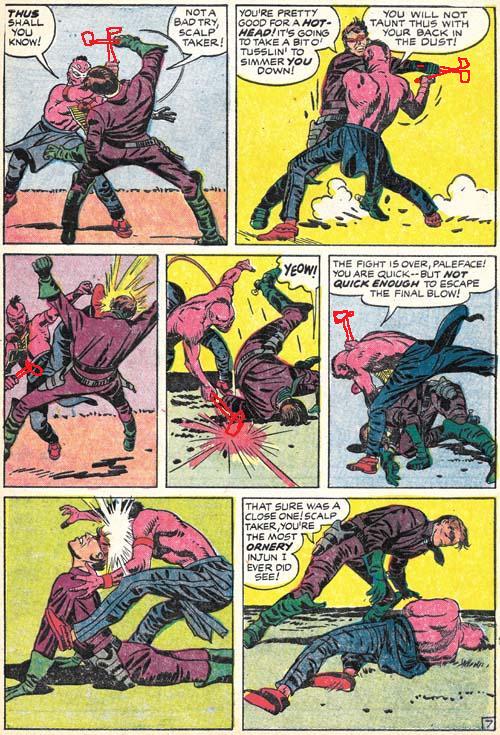
    Blackhawk Indian Tomahawk War (1951-oneshot)Avon Periodicals, 1951. Chief Black Hawk in Ambush: Black Hawk wants peace and breaks with the British, but they send two guys after him to kill him. He escapes. The Battle with the Osage Indians: This story tells how Black Hawk got his name. This kind of a story also shows how the Native American tribes were pretty much constantly at war with each other. If they had ever really totally united they might have been able to stop the white man from taking over the land. The Black Hawk Indian Tomahawk War: More on Indian wars, and how various tribes made pacts with the British, which were not honored, and the Americans, which were not honored. General Fremont: Another story showing the dishonesty of the white men as they plan to survey Indian territory to build a new railroad. Kit West and the Prince of Pioneers: Again, the typical woman, large-breasted and short-skirted, this time in buskins. A guy claims to be a prince of a foreign country but seems to bring trouble to the wagon train. He's exiled from the train and then the truth gets revealed.Comment:  Geronimo wasn't a chief and Black Hawk didn't wear a Plains headdress. Neither leader looked much like these drawings.

    Obviously the main selling point is the brutal savagery of the Indians. Complete with a damsel in distress in Geronimo's case.

    But this was the beginning of the revisionist era, so the contents may not reflect the covers. Around then, stories begin to admit that the white men--a few bad apples, anyway--had cheated the Indians. And the Indians--however savage and barbaric they were--were victims as much as victimizers.

    October 07, 2013

    Mohawk shaman in Sleepy Hollow

    The third episode of Sleepy Hollow, titled For the Triumph of Evil (airdate: 9/30/13), had a Native theme. Here's a recap with my comments:

    ‘Sleepy Hollow’ season 1, episode 3 recap: ‘For the Triumph of Evil’

    By Tasha Meares

    The episode begins with a dream demon (aka the Sandman) driving people to madness and suicide. In their basement office, Ichabod Crane and Abbie Mills research dream mythology.
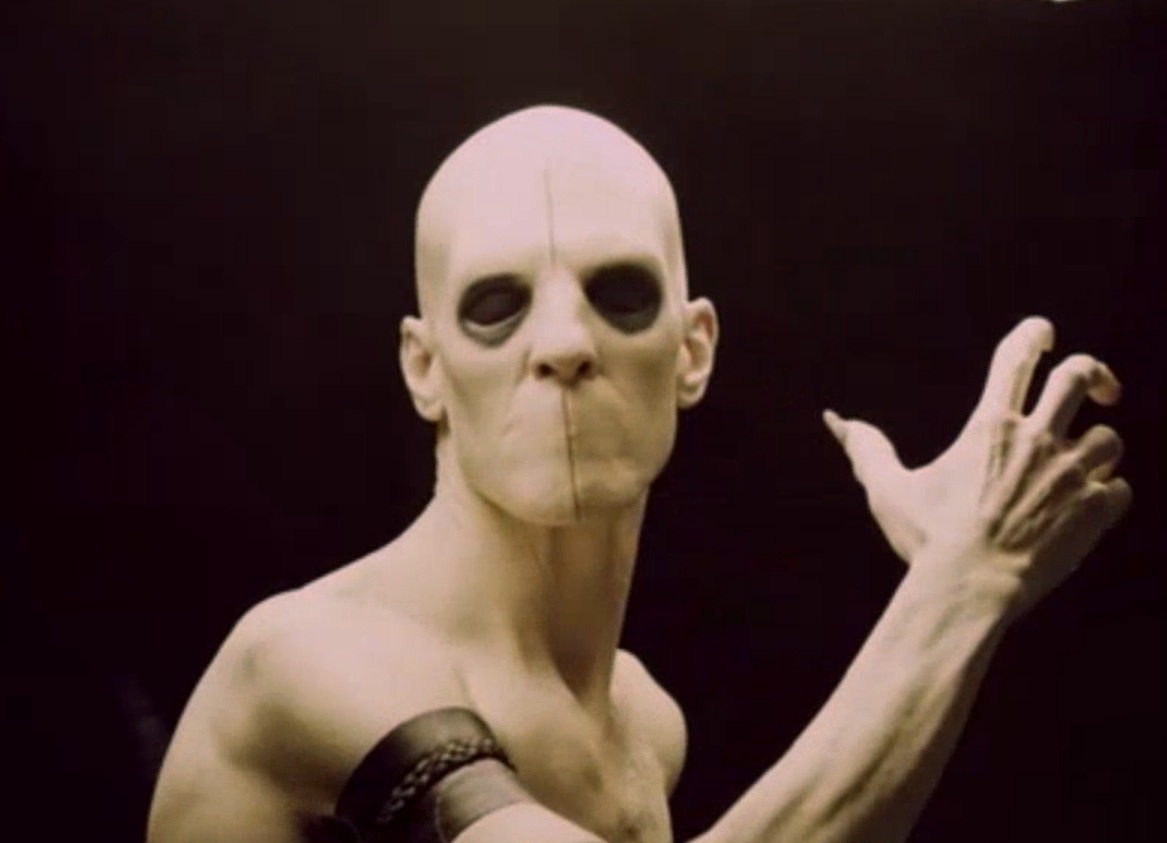
    She explains to him that dream spirits have been around for centuries, but most of them were harmless. She continues to explain that there are those out there that are less friendly; dream demons.

    She shows him a picture and asks him if he knows him. Ichabod asks her if the creature that she saw in her dream and big hollow eye sockets, of which he did.

    He begins to tell her of the first time he heard of this myth that has become all too real. He explains that he heard of this while fighting alongside the Mohawks during the Revolutionary War. The symbol that they would draw on the ground would be the same symbol that appeared in the old manuscript Abbie had shown him.
    On the bad side, Abbie's symbol is an hour-glass shape bisected by an arrow. It looks like some medieval rune; it doesn't look remotely Native

    On the good side, Ichabod names the demon Ro'kenhrontyes. At least that sounds like a Mohawk word. Alas, the legend is apparently made up:

    Was Ro’kenhrontyes a real part of Mohawk folklore?No and it is frustrating when Hollywood writes fiction and then attributes it to a real living culture. Most people don't bother to ask if something is real as you have done. They simply assume it is and then it gets repeated so often it becomes truth in the minds of the general population. I can't tell you how many times I (a traditional Mohawk) have been "corrected" by a non-Native on my own culture because they saw it in a movie or they read a book.The Mohawk camp

    Back to Meares's review:The Mohawk spoke of the dream demon killing his father because he had turned a blind eye on his neighbor’s plight. Hmm…does that sound familiar?

    She asks Ichabod what she should do.
    Good: In a brief flashback, the Mohawks and their camp look reasonable. There are no tipis or chiefs in feather bonnets--nothing too stereotypical.


    Bad: The Mohawks look underdressed for a cool New England night. I'm guessing they wore shirts most of the time.He tells her that they need to visit a Mohawk Shaman. She tells him how after the new government took hold a lot of the new government and the Native Americans fought, and a lot of their land was taken away. She told him that there were not a lot of their people left around. Ichabod is shocked, claiming that those people were his friends.Ichabod claims more than that. He claims their "nation" (singular) stretched across the continent. Not quite, since there wasn't one Indian nation.

    He claims the Indians' system of governance formed the basis of the laws of the 13 colonies. One, I'm not sure how he could say that before the writing of the Constitution. Two, this is an unproven theory that he almost certainly wouldn't have been familiar with.

    He also says the Mohawks fought with him against the British. Maybe a few did, but most of the Iroquois tribes sided with the British against the Americans. The Oneida were the only tribe who fought on the American side. But I guess "Mohawk" is more familiar than "Oneida" so they went with that.

    So Ichabod reaction is superficially good, though it hews to a liberal line unheard of for an 18th-century man. But it's laced with problems.

    GeronimotorsWith that, they take off to Geronimotors to the sweet tune of Mister Sandman. I am not even going to discuss the cheesy irony in all of this.

    The owner introduces himself and proceeds to try to sell them something. Stereotypical used car salesman type. They tell him that they are the police, and immediately, he jumps a little matter of toxic waste that he has in the back. After she tells him that this is not what they are there for, he softens up a little. They tell him that they need his help in combat the dream spirit.
    Good: The owner's name is Seamus Duncan. No stereotypical John Black Wolf or Joe White Eagle here.

    He's dressed in a suit and bolo tie and talks like a regular guy with a snarky attitude. In other words, he doesn't look or act like a stereotypical Indian.

    Bad: He's played by Michael Teh, an actor from Australia. He look and his name suggest he's Asian--perhaps Chinese. That they couldn't find a Native actor to play the role is lame.


    Ambivalent: The Geronimotors car lot with its chopping tomahawk sign.

    I think Duncan the Mohawk owner and the show's creators are trying to have it both ways. One the one hand, Duncan and they are mocking the average American' ignorance. They presumably know better, and Duncan seems like the kind of shrewd businessman who would exploit his Native heritage.

    On the other hand, the difference between using stereotypes to mock ignorance and using them, period, is subtle. I inferred the creators' intent, but not that many Americans will make the effort. They may well believe that Mohawks, shamans, Geronimo, and tomahawks are part of one big Native culture.

    What if a white man owned this used-car dealership? Then the sign clearly would be offensive because of the stereotypes. Having a Native owner may change a few viewers' perceptions, but it doesn't change the equation significantly. Most people will read the stereotypes superficially, so the show probably should've omitted them.

    The lot also has one or two wooden Indian as decorations. This is taking the gag a little far, I'd say. Even if Duncan thinks he's mocking his customers, at some point he's contributing to the stereotypes just like an ignorant non-Native.

    Duncan the shamanAt first, he rebels against them as if they are mocking him. They assure him that they are not kidding. Ichabod follows him as he walks away. He tells him that he saw the look in his eyes when he mentioned the dream spirit. He said that he saw the same look in his ancestors’ eyes when he mentioned the name to them as well.

    Ichabod tells him that the dream spirit is coming for his friend, and asks him what he will do when the spirit comes for him. Suddenly, he stops.

    After some intense persuasion he agrees to help them.
    Duncan tries to disabuse them of any stereotypes they may have. He doesn't live in a teepee or dance in powwow. Ichabod says that's too bad, because he rather liked powwows.

    Uh, what we now call powwows didn't occur till a century after Ichabod's time. From Powwows.com:The first legitimate intertribal powwow in Oklahoma was the Ponca Powwow. It began in northern Indian Territory around 1879.Sure, there might have been other tribal gatherings, but they probably weren't for festive dancing, and they probably weren't called "powwows." Duncan is referring to the modern powwow concept concept and Ichabod is referring to something else. But the episode again suggests that there's one Indian nation that has celebrated the same way for centuries.He asks them to get in his truck, and he takes them for a long drive out to the middle of nowhere to a building that looks much more befitting of a Native American Shaman.

    Bad: Most Native cultures, including the Mohawk, don't have shamans. A shaman is a particular kind of spiritual practitioner, not any indigenous person who does magic.

    Bad: The lodge is dim and smoky and hung with furs, blankets, and oil lamps. It conveys the idea that the "shaman" is engaged in something dark and unnatural, like black magic.

    Scorpion magicHe tells them that this is no run of the mill demon. This one will drive you to a pain so unimaginable that you will take your own life. He explains that some souls go to heaven, some souls go to hell. Those souls who are not claimed go straight to hell with the demon.

    He tells her that there is nothing she can do while on this plain. He explains that if she drinks the tea he has placed in front of her, she will travel into his dream world. Then the real fight begins.

    She raises her glass before drinking the whole thing. He explains to her that once she enters the dream world, the demo will pick what challenge she has to face. She is a living soul in the valley of death. He explains that if she dies in the dream world, she dies in reality as well.

    Almost immediately, Crane takes a sip of the same tea. He tells her that he is coming with her.

    The Shaman explains to them that the tea will put them to sleep while the venom will allow them to control their actions while they are asleep.

    Whose venom, you may ask? He shows them the scorpion caged in the glass jar.

    The Shaman straps both Crane and Mills to tables. He says it is for their own protection. He stresses how much the scorpion’s sting hurts.

    He informs them that once they enter the dream world, the tea will keep them connected. Only they will know what they have to do.

    The shamans open the jars and place them on Ichabod and Abbie’s stomachs.

    Almost simultaneously, the scorpions sting, and they are off to the dream world.
    Bad: It wasn't enough to send them into the dream state with drugged tea? It required a scorpion's sting to give them "control"? That seems unnecessarily dark. It implies that Native religion is unhealthy if not dangerous--not "safe and sane" like Western religions.


    Even if the show is supposed to be scary, the creators could've done something else. Like give them "magic mushrooms" and send them on a "bad acid trip." There's no reason a trip to the dream world should require deadly venom. The tea alone could've sent them and given them control.

    Conclusion

    Rebecca Pahle of TheMarySue.com sums up the episode's Native bits:Is it just me, or did Sleepy Hollow handle Native Americans with a liiiiiittle less cultural sensitivity than it did when it refused to make Ichabod a special snowflake for disapproving of slavery back in the day. Granted, Seamus did say to cut it out with the stereotype schtick, because he doesn’t live in a teepee or a participate in pow-wows, thank you very much. And that was cool. But the way the Native American of course believes in the dream demon and of course knows how to defeat it using “ancient Mohawk knowledge” had me wincing big-time.

    But on the positive side: Seamus’ car lot is called Geronimotors, and he asks Ichabod and Abbie whether they’re into time travel, because he has a mint-condition DeLorean he can sell them. *deep breath* I love the smell of bad puns and “I see what you did there” in-jokes in the morning.
    My thought: If you're gonna have a Mohawk demon, it makes sense to have a Mohawk involved in its defeat. But that means having a medicine man or the equivalent doing supernatural stuff, which is generally stereotypical.

    I'm not sure there's a good solution to this problem. You could have several Mohawks, some of whom don't believe in the demon. You could make the demon non-Native and use the Mohawks in another story.

    Overall, I'd say the Native bits are another mixed bag, like those of the recent Modern Family and The Crazy Ones. Bringing Indians into Sleepy Hollow's world, and having a young Native business owner with a modern attitude, are great. But the ignorance about Mohawk lore, the Geronimotors car lot, the non-Native actor, and the whole supernatural scene cancel that out. One step forward, two steps back.

    P.S. In the next episode, Sleepy Hollow briefly dramatized the Boston Tea Party. Kudos to it for not showing stereotypical Indian "braves," even though some were present. They weren't necessary for the story, so it was smart to avoid potential problems and leave them out.

    For more on Sleepy Hollow, see "Shaman" Filmed for Sleepy Hollow.
    July 08, 2013

    Geronimo = Hollywood's favorite Native

    Geronimo: Hollywood's Favorite Native for Over 100 Years

    By William A. ClementsHis compelling story, his enduring reputation and even his physical appearance make Geronimo ideal for film treatment. As a wire service item that was making the rounds in 1939 with the showing of the film Geronimo! noted, “There certainly was never a more appalling one [figure from the Southwest] than Geronimo, arch fiend and war lord of the Apache Indian tribe which fought the United States to the death for the arid wasteland they know as home.”

    Geronimo’s first cinematic appearance occurred only three years after his death in 1909. Now lost to the disintegrating effects of time, Geronimo’s Last Raid came out in 1912. But Geronimo has enjoyed considerable subsequent screen exposure, usually in secondary roles. He has also been a character in episodes of several television series, especially those broadcast during the heyday of the Western in the late 1950s and early 1960s. He even inspired a cartoon character, Geronimoo, in an ABC-TV offering, The C.O.W.-Boys of Moo Mesa. In fact, Geronimo has probably appeared in more “Hollywood oaters,” as one historian calls Westerns, than any other American Indian, including Crazy Horse and Sitting Bull.

    Early in his cinematic career, Geronimo took the role of what Michael T. Marsden and Jack Nachbar call the “Savage Reactionary,” a stereotypical villain. Of the two dimensions the “Hollywood Indian” was capable of representing—“the old bloodthirsty savage and his alter ego, the noble savage”—Geronimo usually assumed the role of the former. For example, he is the principal menace threatening the passengers in John Ford’s classic Stagecoach (1939).

    Victor Daniels (using the performance name Chief Thundercloud) took the title role in Geronimo!, the film that reintroduced the figure to American popular culture and is generally credited with inspiring World War II military paratroopers to yell “Geronimo!” as they leaped from airborne troop carriers, along with the many children who continue to yell his name as they jump from lesser heights. Daniels was born in 1899 in Muskogee, Oklahoma, and may have been a member of the Cherokee Nation. His looks guaranteed him roles among the extras in many western films during the 1930s. He also originated the role of Tonto in the first Lone Ranger films.
    Comment:  This book excerpt goes on to discuss movie and TV portrayals of Geronimo at length. Check it out if you're interested.

    For more on Geronimo, see Code Name: Geronimo to Be Released and Beyond Geronimo at the Heard.

    Below:  "This excerpt was taken from Imagining Geronimo: An Apache Icon in Popular Culture, by William A. Clements, 2013."

    February 23, 2013

    Heliographs helped capture Geronimo

    Trail Dust: Army used 'talking mirrors' to help track Geronimo

    By Marc SimmonsDuring the last campaign against Geronimo in 1886, the U.S. Army introduced a heliograph system for the rapid transmission of messages across the Southwestern deserts.

    The heliograph was a small, round mirror mounted on a movable bracket and a tripod. By catching the sun, it could flash coded signals great distances.

    The British had pioneered military use of heliographs in India during the 1860s. When Gen. Nelson A. Miles was chasing Montana Indians in 1878, he had six of the devices and found them very effective. Upon his transfer to Arizona, he decided to use them there.

    By the time Geronimo and his handful of warriors made their final raid, the telegraph had been strung from Tucson to El Paso.

    The trouble was, the Apaches had learned to cut the wire and then false-splice it with rawhide, so that repair crews could not see the break from the ground.

    The heliograph, which flashed from mountaintop to mountaintop, was far more reliable. In a short time, Miles saw to the establishing of a series of signal stations from Robledo Peak above Fort Fillmore in the Mesilla Valley, westward to the main forts of Arizona.
    And:Scholars have long argued over just how important the heliograph was in bringing about Geronimo’s final surrender in September of 1886.

    Gen. Miles was convinced that it played a key role, and he stated that on more than one occasion. He may also have started a story saying that when the wily Geronimo came to understand how the white men were communicating his movements by the talking mirrors, he realized that his cause was hopeless and sent orders to his scattered warriors to give up.

    Said one historian: “The heliograph was a decisive factor. Flashing all day from mountain summits, the mirrors kept the soldiers fully informed of Indian movements. The Apaches had not a moment’s rest.”

    But other, skeptical writers declare that the case on behalf of the heliograph has been badly overstated. Geronimo, they say, grasped the nature of the signals right away—for after all, it was not unlike his own smoke signaling.
    Comment:  A couple of points worth noting:

    1) Cutting the telegraph wires and then false-splicing them with rawhide is a nice sabotage technique. I'm not sure I heard about the fake-wire twist before.

    Regardless, it shows how clever and adaptable the Apache were. They weren't just circling the wagons and whooping--as every old Western showed them doing. They were using modern guerrilla warfare tactics.

    2) The US Army relied on communications similar to the Indians' smoke signals. What about all the cartoons showing "primitive" Indians using smoke signals while "civilized" white men used the telegraph or, well, nothing?

    In reality, the white man was hardly more advanced than the Indian. Take away his telegraph and he had few advantages other than numbers.

    So much for the stereotypical cartoons that lampoon Indians as savages.

    For more on Geronimo, see Code Name: Geronimo to Be Released and Beyond Geronimo at the Heard.

    October 04, 2012

    Code Name: Geronimo to be released

    ‘Code Name: Geronimo’ movie to be released in theaters

    By Roscoe PondAn exact replica of Osama Bin Laden's compound in Pakistan was built at the New Mexico state prison just south of Santa Fe. It served as a location shoot for the new action movie, “Code Name: Geronimo.” Filming wrapped production last February 2012. The movie follows a team of 6 Navy ‘Seals’ as they trained for the mission to assassinate Osama Bin Laden. The film is tentatively scheduled for U.S. release October 2012.

    This new film is the second to tackle the controversial subject of Bin Laden. ‘Oscar’ winning director Katherine Bigelow (The Hurt Locker) helmed, “Zero Dark Thirty” which will open in U.S. theaters Dec. 19, 2012. John Stockwell directed, “Code Name: Geronimo” which was bought by the Weinstein company at the ‘Cannes’ film festival last May. It premiered in theaters at the country of Brazil on Sept. 28.

    The killing of Osama Bin Laden in 2011 was considered a victory for the U.S. Native Americans were insulted that the ‘Navy Seals’ used the operation code name of ‘Geronimo’ to kill Bin Laden.
    Comment:  For more on the subject, see Code Name: Geronimo the Movie and Bin Laden Codenamed "Geronimo."

    July 25, 2012

    Nakotah Larance in Geronimo video

    Hoop Dancer Nakotah Larance Jazzes Up ‘Geronimo’ by The Knocks and Fred FalkeThe video for a new dance track, “Geronimo,” features an impressive display by champion hoop dancer Nakotah Larance.

    New York-based electronic duo The Knocks teamed with German-born producer Fred Falke (he is based in Paris) to create “Geronimo,” the title of which, Knocks member B-Rock told Rolling Stone, was inspired by a portrait of the Apache leader in their New York recording studio. “When Fred was trying to think of a name for the record [before we did the vocals],” B-Rock says, “he looked up and saw the picture and said, ‘Who’s that?’ We told him it’s Geronimo and he said ‘Perfect!’… That inspired the concept and lyrics later.”

    Nakotah Larance was recruited by the video’s director, Daniel Pappas. “He had worked with [Larance] before for some project he was doing, and the second he heard the song, he had the concept,” B-Roc says. “When he told us the idea, we knew it was too good to pass up. He went through a lot to lock down the dancer and the location and everything, but it definitely paid off. We think it’s cool that the video makes a reference to rave culture. You see hundreds of these ‘hoopers’ of all ages at these dance festivals, so it’s a cool thing to touch on.”

    According to Hooping.org, Larance is a six-time world champion hoop dancer. The video for “Geronimo” is the second we know of in recent months to feature hoop dancing; in May, singer Nelly Furtado released a video for her single “Big Hoops” in which brothers Tony and Kevin Duncan both displayed their hoop dancing skills, and Tony’s wife Violet showed off some shawl dancing as well.
    Comment:  I don't know what the song has to do with Geronimo, since I can't understand it. The high-energy tone doesn't match my impression of Geronimo, whom I think of as stealthy and quietly lethal.

    The initial scenes of Larance getting up and getting ready for the day don't do anything for me either. But once he starts dancing, his moves fit the song well.

    For more on the subject, see Hoop Dancers in Furtado Video.

    February 13, 2012

    Beyond Geronimo at the Heard

    Legendary Apache warrior subject of Ariz. exhibit

    By Felicia FonsecaA new exhibit at the Heard Museum in Phoenix draws on the popularity of the Geronimo name but also highlights the not-so-recognizable stories of Apaches who did and did not share his Chiricahua heritage. The exhibit "Beyond Geronimo: The Apache Experience," runs through January.

    A piece that Craig has on exhibit is a tribute to the Apache scouts who spent years looking for Geronimo throughout the Southwest. The canvas shows an Apache man wearing the ammunition belt issued by the U.S. military but carrying a drum instead of a weapon in a moment of calmness. It is surrounded by four skateboard decks--two with identical images of an Apache man with his eyes tightly closed, and the other two with an Apache man wielding a gun and walking through a meadow.
    Geronimo exhibit gives window into history of Apache people

    By Raquel VelascoJanet Cantley, curator of the show, gives some insight into the story that’s become a keystone of Apache history.

    Q: What’s the back story on “Beyond Geronimo”?

    A: We want to illuminate a dramatic and often misunderstood chapter in American history and culture. I think a lot of people don’t understand the true history of the Apache people, especially Geronimo. We want to tell the story that has not been told, in terms of trying to dispel some of the myths of the Geronimo image by focusing on who he was as an individual.

    Q: Why is it important to know the truth about Geronimo’s legacy and the Apache people?

    A: Geronimo and the Apache people are part of Arizona’s history. It is one of the stories of the native people of Arizona. It is the story of how there are six distinct Apache tribes. I think it’s really important that people do understand a little about the experience of Geronimo and his life. How he acted in the final surrender in 1886. He and all of the Chiricahua were taken as prisoners to Florida and Alabama and Fort Sill (Okla.). The children, ages 12 to 25, were taken in groups to boarding schools, so they were further removed from their families. The Chiricahua were never allowed back to the state officially.
    Comment:  For more on Geronimo, see Code Name: Geronimo the Movie and Did Prescott Bush Steal Wrong Skull?

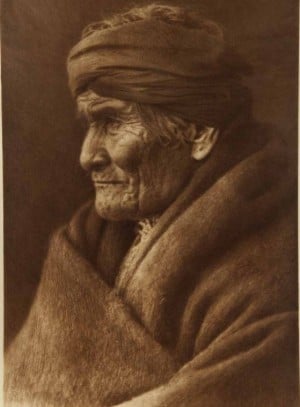
    Below:  "Geronimo–Apache, age seventy-six, taken at Carlisle, Pennsylvania, the day before he participated in President Roosevelt’s inauguration, 1905, Edward S. Curtis. RC 28(1):2, Heard Museum."

    February 02, 2012

    Code Name: Geronimo the movie

    The insult to Geronimo and Indians continues:

    Code Name: Geronimo shoot gets underway in New Mexico

    By Jeremy KayFilming began on Wednesday (Feb 1) on Voltage Pictures’ story about the Navy SEAL mission to kill Osama Bin Laden.

    Cam Gigandet, Robert Knepper, Anson Mount, Freddy Rodríguez, Xzibit and Kenneth Miller will play the special operatives who undertake the clandestine mission.
    Comment:  Add this movie to the two graphic novels already announced. Plus whatever books, plays, TV specials, museum exhibits, etc. will have the codename "Geronimo" in the title.

    This is an excellent example of how the media perpetuates stereotypes. It doesn't matter that thousands of Indians protested the "Geronimo" codename. Or that military apologists tried (and failed) to justify it. What matters is the overriding message: Bin Laden = Geronimo. In other words, Indians = terrorists.

    The news reports got the ball rolling. This movie will cement the message. For generations to come, people will associate Bin Laden with Geronimo. They'll continue to think of Indians as murderous savages who fought against freedom and democracy...just like the terrorists.

    For more on the subject, see Killing Geronimo Graphic Novel and Afterword in Code Name: Geronimo.

    January 05, 2012

    Time afraid to name Person of Year

    Where’s Time Magazine’s Cojones?

    By Ruth HopkinsTime magazine selected “The Protestor” as its 2011 Person of the Year. The seminal publication’s decision as to who or what is worthy of the title of Person of the Year is based upon what person or thing they feel most influenced the news and global culture over the past year. Time said protestors involved in The Tea Party Movement, The Arab Spring, Occupy Wall Street and other demonstrations across Europe and the U.S. “redefined people power” and changing the shape of global politics.

    I’m hardly dazzled by their selection. As a native woman I’m turned off by anything that appears half-hearted or cowardly. By naming “The Protestor” as its Person of the Year, Time attempted to appease the masses by using a nonspecific catch-all descriptor. In reality such a short-sighted, anesthetized, blanket acknowledgement only serves to water down the potency of the historic, meaningful deeds of those it meant to honor. Time pulled this stunt before: most recently in 2006, when it named “You” its Person of the Year, meaning the millions of people who anonymously contribute user-generated web content to Wikipedia, YouTube, MySpace (remember Myspace?), Facebook, and other similar websites, cause you know, we, i.e. “You” use the internet and occasionally buy magazines and stuff. What’s the point of selecting a Person of the Year if millions of people, all with different motives and levels of sincerity, are lumped together into one faceless heap? It’s like giving everyone in class an ‘A’ regardless of whether or not they turned in their homework or studied for the final.
    Hopkins names some alternatives to "The Protestor":Mohammed Bouazizi, a Tunisian street vendor, would have been a good choice for Time’s Person of the Year. He was the catalyst for the Tunisian Revolution and the Arab Spring. Conditions in the Arab world have been ripe for revolution for awhile, but it was when Mr. Bouazizi set himself on fire after a policewoman confiscated his unlicensed vegetable cart, spat on him, and insulted his dead father, that his countrymen decided they could take no more. Mohammed had gone to the local authorities to object to his mistreatment, but they refused to see him. When he died in the hospital several weeks later, the Tunisian people took to the streets. As a result, then-President Zine El Abidine Ben Ali stepped down after 23 years in power.

    Indian Country presented its own heroes in 2011. Debra White Plume, a Lakota grandmother, has become a prominent figure in the Environmental movement. She protests uranium mining on Tribal lands, and was arrested at the White House during protests against the Keystone XL pipeline this year. 102 years after his death, Geronimo made international headlines after it was revealed that his name was used as a code for Osama bin Laden in the Navy Seal operation to dispose of the terrorist. There was a public outcry throughout Indian country and the world, yet President Obama refused to issue an apology for the slight. If Time magazine intended to honor the spirit of defiance of protestors, they could have done no better than naming Geronimo their 2011 Person of the Year.
    Comment:  For more on Indians as pop icons, see Indians in the Celebrity 100 and No Time for Indians.

    Below:  An alternate cover for Time magazine's announcement. Since I protest more than almost anyone, I should've been Time's Person of the Year.

    October 18, 2011

    Killing Geronimo graphic novel

    Bluewater turns THE HUNT FOR OSAMA BIN LADEN into graphic novelPublishing giant Simon & Schuster has tabbed independent comic book publisher Bluewater Productions to produce a graphic novel version of the events surrounding the hunt and killing of Osama bin Laden.

    "Killing Geronimo: The Hunt for Osama bin Laden," takes its title from the code name given the notorious Al-Qaeda leader during the secret action named Operation Neptune Spear carried out on May 2, 2011. The 96-page original graphic novel documenting the mission is scheduled for spring 2012 release.

    "This is an epic story nearly ten years in the making," said co-author and journalist Jerome Maida, "It's like a true-to-life Jason Bourne novel. And like those Ludlum books, it's a complex labyrinth of intrigue, danger and politics culminating in an action-packed ending."

    Bluewater, who has a successful track record of developing non-fiction comic books and graphic novels, is basing its account on the publicly released details surrounding the mission and the historical lead up to its successful resolution.
    Comment:  Oops. Apparently Bluewater didn't get the military/media memo that claims we didn't label Osama bin Laden "Geronimo." Apparently they're going with the facts--you know, like the quotes calling him "Geronimo." How dare they!

    This book shows exactly what's wrong with the military's choice of codename. Would anyone authorize an operation to kill "George Washington"? Or publish a book with the title "Killing George Washington"? Probably not.

    But "Killing Geronimo" seems perfectly acceptable to most Americans. He was just a "dirty redskin," not a human being, right? Killing him was like killing a mangy dog, a skunk, or some other varmint.

    For more on the subject, see Afterword in Code Name: Geronimo and Code Name: Geronimo Graphic Novel.

    October 15, 2011

    Afterword in Code Name: Geronimo

    I finally saw the Code Name: Geronimo graphic novel in my local shop last week. I skimmed through it to see how it handled the huge "Geronimo" controversy from earlier this year. In the story, some soldier utters the word single word "Geronimo" minutes after the SEALs kill Osama bin Laden. it's not directly linked to bin Laden--or indeed, to anything. It's not clear in the story why the soldier says it.


    Nice way to skirt the controversy...except the book includes an afterword by John M. Del Vecchio. Here are a couple of quotes on this afterword:There's even an essay addressing the use of the name "Geronimo," in the hopes of answering concerns from Native Americans about the book's title.

    Finally, there's an afterword by John M. Del Vecchio, who famously wrote "The 13th Valley," one of the 2 or 3 finest novels of the Vietnam War; the content of this is bound to please some and anger others.
    Yes. Del Vecchio takes the standard pro-military line that "Geronimo" was something other than a codename for bin Laden. He says it stood for Step G in the operation, one of several conflicting explanations offered by apologists.

    Spin, baby, spin

    This claim is as stupid as it was before. One, President Obama himself said bin Laden was "Geronimo." So did a couple other sources.

    Two, who cares if the step to kill the world's greatest terrorist was named "Geronimo," not the terrorist himself? "We killed the terrorist named 'Geronimo'" is similar to "We killed the terrorist with the process named 'Geronimo.'" Either way, the operation links the name "Geronimo" to bin Laden.

    Three, "Geronimo" could've been the codename for the killing process and the target of that process. So Del Vecchio's explanation is almost worthless. Until someone produces a document saying "Geronimo" was the step but not the target, it isn't worth discussing.

    Del Vecchio's rationalization for this offense is also the standard pap. He says the "Geronimo" codename honored the bravery and determination of America's fighting forces. Yeah, and it's just an incredible coincidence that a "step" to kill a terrorist was named after an Indian many considered a terrorist.

    I'm sure the other "honorable" name considered for Step G was "George" for George Washington. Because he was an incredibly brave and determined warrior who fought against impossible odds too. And no one would object to linking George Washington's name with the world's greatest terrorist, right? Even though Washington terrorized and destroyed many Seneca villages--kind of like bin Laden.

    Below:  Honoring our military by linking the kill step, but not the target, with a evil terrorist great American. I'm sure nobody could misunderstand this as a swipe against George Washington, Town Destroyer Father of Our Country.


    Del Vecchio doesn't give any sources for his information, and it's contradicted by the evidence. I wouldn't be surprised if he had no firsthand information and is just repeating what he read somewhere. In short, until you can prove your case, spare us the spin, buddy.

    What the publisher meant

    That the publisher devoted an afterword to this controversy, while avoiding it in the story, shows what's really going on. We could sum up the afterword thusly:

    "We realize that the Code Name: Geronimo is grossly insensitive, but it's a great marketing tool. As a sop to Native Americans, we'll throw in this afterword. We won't apologize for our insensitivity, but at least we'll acknowledge it. Readers will understand how we're trying to kiss up to the military while not totally giving Natives the finger."

    For more on the subject, see Indians, Terrorists = US Enemies and How People Get Labeled "Terrorists."

    September 17, 2011

    Did Prescott Bush steal wrong skull?

    Marc Wortman reviews a popular legend about Geronimo. He tackles the burning question: "Did a group from Skull and Bones break into Geronimo’s tomb and ship his skull back to the society’s clubhouse at Yale?" Below he offers a possible answer.

    The Skull—and the Bones

    By Marc WortmanTowana Spivey, the museum curator, was adamant: “The facts on the ground here just don’t line up with the story being told.” I’ve been involved in the Geronimo story, more or less accidentally, for a number of years, and agree with Spivey. That’s not to say that I don’t accept the story about Prescott Bush—in fact, I do. The circumstantial evidence suggests that Bush and his friends did indeed mount a grave-robbing operation, and that they came away with something. But with what? The historical rec­ord is clear that in 1918, when the “most spectacular ‘crook’” took place, Geronimo’s body was not lying in the kind of vault described in the Skull and Bones logbook. It had been buried in an unmarked grave, precisely to deter would-be grave robbers. The pres­ent monument was not built until 1930. There’s no iron door on it, like the one the Bones history describes. Assuming that Prescott Bush and his friends did smash open a burial vault, there are only two possible candidates at Fort Sill.

    One of them straddles the grave of a Kiowa chief named Kicking Bird. It sits in a cemetery just a few hundred yards from the barracks where the Bonesmen were quartered. Spivey believes this was the grave they struck. I have my doubts. It’s so close to a main road that it’s hard to believe they wouldn’t have been observed.

    The other site is three or four miles away—it’s the small Otipoby Comanche Cemetery, on a rise overlooking the prairie. A burial vault lies at its center. A modern stone marker next to it bears the words “Mark ‘Thomas’ Perconnic / Comanche Tribe / Son of Perconnic.” There’s evidence of past tampering: bricks now seal what once must have been a doorway. I suspect that the young men from Yale ended up here, having assumed that this very prominent grave must hold “the worthy Geronimo the Terrible.” If they took anything away, it was not Geronimo’s head. It was Tom’s.
    Kicking Bird was the name of Graham Greene's character in Dances with Wolves, of course.

    Below:  "Two burial vaults that the tomb raiders may have mistaken for Geronimo's. Left, the crypt of Kiowa chief Kicking Bird, in the Post Cemetery at Fort Sill, Oklahoma. Right, the tomb of Mark 'Thomas' Perconnic, in the Otipoby Comanche Cemetery, three or four miles away." (Marc Wortman)


    Who is Harlyn Geronmio?

    Another interesting aspect of the story is the role of Harlyn Geronimo. I've mentioned him before when the subject of Geronimo's bones came up. But now his story seems more suspect than it did before:Harlyn Geronimo, the lead plaintiff in the lawsuit, was born Harlyn Via. Now 63 years old, he is a sometime actor and a self-proclaimed Apache medicine man who lives in Mescalero. Harlyn is also a sculptor and has said that he would like the new Geronimo grave site to be marked by a monumental sculpture of his own creation. About 15 Years ago, Harlyn and his brother Joseph legally changed their surname to Geronimo. According to at least one credible Geronimo biographer, their grandmother was Geronimo’s daughter from a brief marriage during the period of his exile in Alabama. Released by the army, the mother went to Mescalero with the baby and soon remarried.

    Whatever the nature of Harlyn’s kinship, he has certainly exploited the name. As Harlyn Geronimo, he has acted on television and been featured in documentaries. He has traveled to France and Germany, where fascination with America’s cowboys-and-Indians history is high. A book he co-authored, Sur les pas de Geronimo ( In the Footsteps of Geronimo ), was published in France in 2008. For his televised interviews and appearances at public events and festivals, (sometimes) on horseback he wears the type of feathered headdress used by the Plains Indians, not by the Apaches. When in Paris, you have to give the Parisians what they’re expecting. I have encountered Harlyn only once—in a shared television appearance in the aftermath of my discovery of the Winter Mead letter. His anger seemed genuine. I attempted to reach Harlyn many times over the course of several months, to ask him about the Ramsey Clark lawsuit, but he seemed always to be traveling in Europe, and unreachable. I finally contacted his brother Joseph, in Mescalero. Joseph was not interested in pursuing a conversation. What he in fact said was “I ain’t giving anything away for a handful of beads. Mail me a check, and if it’s enough and don’t bounce, I’ll talk.”


    For more on the subject, see:

    Geronimo vs. Geronimo Over Geronimo
    Apaches don't want Geronimo moved
    Geronimo sues Skull and Bones

    August 06, 2011

    Code Word: Geronimo graphic novel

    IDW and Charlie Foxtrot Entertainment Announce Code Word: Geronimo Graphic Novel

    In-depth retelling of the SEAL Team 6 raid on Osama Bin Laden’s compound Available in SeptemberIDW Publishing and Charlie Foxtrot Entertainment today have the honor of announcing CODE WORD: GERONIMO, an original graphic novel illustrating the raid on Osama bin Laden’s compound by SEAL Team 6 on May 1, 2011. Expertly written by Captain Dale Dye (USMC, Ret.) and Dr. Julia Dye, Ph.D., CODE WORD: GERONIMO offers the amazing, moment-by-moment inside story of the clandestine raid that rid the world of this terrorist mastermind.

    “Due to entirely appropriate security concerns, there is some creative license in our script,” said Captain Dye. “But I think readers will be gratified with the detail and thrilled with our take on one of the most daring and successful commando raids in American military history.”

    This historical keepsake details the bravery and valor of SEAL Team 6 as it descends into Abbottabad, Pakistan and achieves the near impossible. Joining the Dyes to bring this incredible graphic novel to life are artists Gerry Kissell (The A-Team: War Stories, Iron Sky) and Amin Amat (Buckaroo Banzai, Iron Sky).
    Comment:  As predicted, "Geronimo" is being immortalized as the codename for the worst terrorist in modern history. Sigh.

    For more on the subject, see Indians, Terrorists = US Enemies and Obama:  Bin Laden was "Geronimo."

    P.S. Amin Amat is one of the artists on the PEACE PARTY graphic novel (still in progress).

    July 14, 2011

    Billy Ray Cyrus gets Native tattoos

    Billy Ray Cyrus--Cyrus Pays Tattoo Tribute To Native American LegendsCountry star Billy Ray Cyrus has paid tribute to his Native American heroes with tattoos on his forearms.

    The Achy Breaky Heart singer reveals he had Chief Joseph and Geronimo inked last year (10) during a 48-hour period.

    He says, "I've just always had a great deal of respect for Native Americans; I'm part Cherokee myself."
    Comment:  For more on the subject, see Miley Cyrus, Cherokee? and Miley Cyrus Loves Dreamcatchers.