Showing posts with label totem poles. Show all posts

September 14, 2016

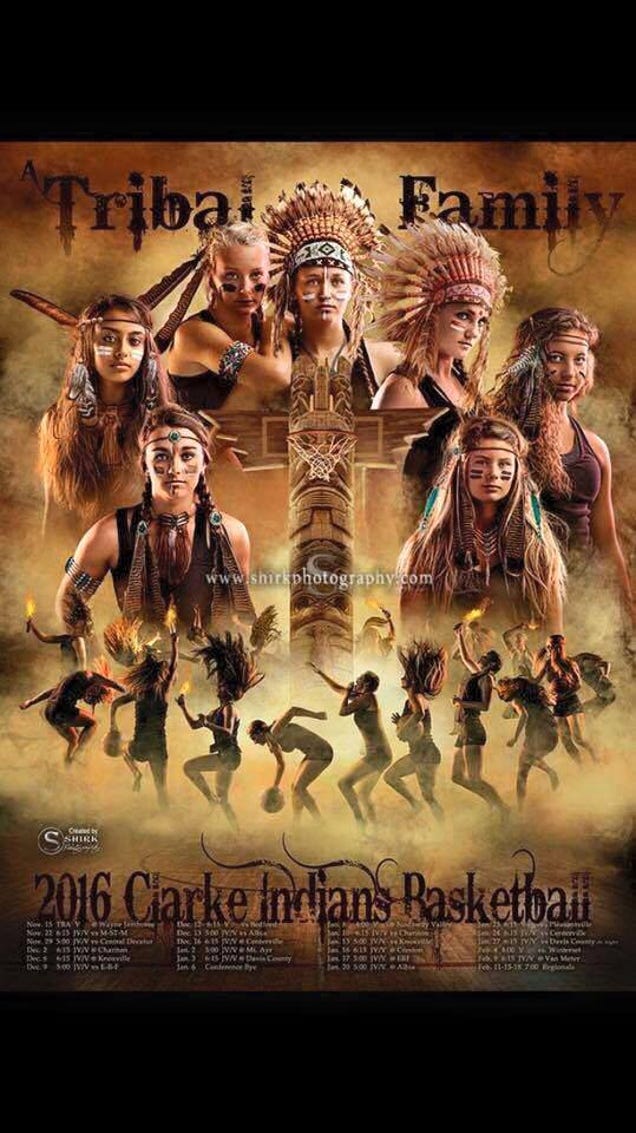
Clarke Indians' "Tribal Family" poster

Girls High School Basketball Team's Poster Is Very Good And Very Bad

By Nick MartinThe poster, taken from the Facebook page of KCCI’s Andy Garman, has attracted anger from Native Americans, who are rightfully calling the poster out for its blunt appropriation of Native American culture. (Sloppy too! The totem pole, war dance, and headdresses mix and match from traditions of widely varying tribes.)

September 12, 2016

Red Rock Tomahawk video game

Game review: Flick'em Up, Red Rock Tomahawk: Don't mess with the Native Americans

By Ryan MorgeneggFlick'em Up is a game all about the pieces. In the box, a gamer gets the added scenery of three forests, a totem pole, a red rock mountain and one tipi. There are five native American figures, two bows, six arrows, a Tomahawk, a Gatling gun and six bullets.Comment:  Tipis, totem poles, and tomahawks in one setting? That's stereotypical.

By the time of the Gatling gun--1861 and after--Natives were using rifles as much as bows and arrows. The whole idea of modern soldiers fighting primitive warriors is stereotypical.

August 30, 2016

Totem Vodka

Totem Vodka and Indigenous Cultural Appropriation

When, if ever, is it acceptable to adopt the cultural icons of an outside group?

By Alexandra Rodney
Totem poles are important symbolic creations of some First Nations families in Canada’s Pacific Northwest. They are symbols of family lineage that serve to document stories or histories of people, communities, or clans. The Totem Vodka bottle and marketing images erases these families while appropriating their symbols.

The bottle stopper is shaped like a Thunderbird, a supernatural bird that causes thunder and lightning according to First Nations mythology. The Thunderbird crest is traditionally carved on the totem poles of people from the Thunderbird clan of the Kwakwaka’wakw nations (on Vancouver Island).

January 02, 2016

Demon spirits in Totem Topple

A description of the new Totem Topple game for Nintendo:Build your totem pole up into the sky and stars beyond in Totem Topple, a fresh twist on the tower defence genre!

Wolves, bears, deer and more--stack different totem heads on your tower, each with their own strengths and weaknesses. Add protective wings and arrow-firing bird beaks to fend off the demon spirits trying to knock your totem pole down!
And a review:

Totem Topple Review

By Alex SeedhouseThe publisher over promises in saying that Totem Topple presents “a fresh twist on the tower defence genre,” falling way short of achieving such admirable ambition. Players are tasked with defending a totem pole from demon spirits hell bent on knocking it down, which is certainly a concept that most won’t have come across before. But the underlying game mechanics lack refinement, resulting in an experience that overwhelms in the challenge hidden by its otherwise simplistic facade.

The structure is easy enough to understand, with players left to steadily construct their totem pole by selecting from beak, wing and head components. These fire arrows, grant protection and increase your totem’s height respectively, and managing your resources to create them becomes a focal challenge. Supplies are earned through defeating demon spirits, and the cycle completes in which you either strengthen your defences or rapidly move to replace anything that has been destroyed.


Comment:  The reviewer doesn't mention any problems with basing a game on a totem pole, but I will.

1) The game treats the totem pole as a decorative object, an accessory, not as important part of Native culture and religion. I don't know if Natives would consider poles sacred or not, but they may be akin to Christian icons or paintings. You generally wouldn't turn those into angry games.

2) The nasty faces, sharp beaks, and black color of the totem pole suggest that Native culture is dark and violent. Actually, the totems on a pole represent clan stories and origins. They aren't meant to scare people.

3) I guess the "demon spirits" are the little round objects with eight spikes. Those actually look like sun symbols. In any case, they reinforce the idea that Native religion is demonic and evil, with deadly forces lurking in every shadow. Actually, Native religions are no worse than Christianity, with Satan influencing every decision. They're probably a lot better, on average.

For more on totem poles, see Miss Canada in a Totem-Pole Loincloth and Cultural Appropriation of Totem Poles.

Below:  I'm not sure what this human pterodactyl has to do with Totem Topple. Is it supposed to be a thunderbird? Whatever it is, it's scary!

December 23, 2015

Do Dominican totem poles exist?

People are still talking about Miss Universe Canada's costume:

Miss Universe Canada's totem pole dress shocks First Nations people

Torontonian Paola Nunuz Valdez wore the offending dress at this week’s Miss Universe contestIn a statement, Valdez said the dress was a "misunderstanding" and that the design was meant to refer to her own heritage as a Dominican, not to reflect on Canada's aboriginal culture.

She was born in the Dominican Republic, which shares with Haiti the large Caribbean island east of Cuba. While totem poles may exist there, they don't play as prominent role in the culture as they do on Canada's west coast.

Callingbull, in a Facebook post, suggested Miss Universe Canada hire a cultural consultant in the future to avoid hanging an important symbol from a future contestant's crotch.

She also criticized the organization's attempt to cover up its error.

"I'd like to see these so called 'west coast Dominican Republic Totem Poles.' They are really trying to protect themselves and didn't even have the heart to simply apologize," she wrote.


One totem pole online

Someone posted this link and image on Facebook:

Dominican Carnival Totem Pole YAGU-TO2Hand carved and painted Dominican Carnival Totem Pole. Made from the palm trees leaf stem which is called Yauga (pronounced "Jagua").

Approximate size: 8.5x1.5


To which I responded:

This kind of proves the point. There's only one item online that matches a "Dominican totem pole" search. Totem poles aren't a part of that culture or there'd be more of them.

Also, the fact that the item is labeled "Dominican" doesn't mean it's authentically Dominican. It could've been made in Asia for all we know.

More important, it looks nothing like Miss Canada's loincloth. If it is authentically Dominican, her costume isn't.

In fact, the Dominican Creations company is headquartered in Quebec and says it'sServing Canada, United States and the Dominican RepublicThis makes it less likely the company is selling genuine Dominican artifacts. And again, even if this pole were genuine, it doesn't look like the pole on the dress.

Final comment

Someone else added this comment on Valdez's dress:Ummm...totally not the same as Dominican 'totem poles'. And last time I checked she was representing Canada. This would imply that she is misusing First Nations totem culture.Yes, it's ridiculous to say she's honoring her Dominican heritage when that has nothing to do with her role as Miss Canada. Plus her raven costume and the totem pole have nothing to do with the Dominican Republic.

December 20, 2015

Miss Canada in a totem-pole loincloth

Miss Canada and the Free Bin

By Jessica R. MetcalfeWell, I was hoping this wasn't true, but alas, Miss Canada, Paola Nuñez, wore this lil "Totem Pole" number for the Miss Universe Preliminaries held two days ago in Las Vegas. The pageant will be televised live on Sunday, Dec 20, on FOX.

The past costumers for Miss Canada seem to have an identity crisis of sorts, not really knowing how to authentically represent their unique national identity in a flamboyant soundbite of an ensemble.

What makes Canada unique? In the past, they've featured Mounties, maple leaves, and even hockey sticks, but they always come back to old standby: "the Native."
An update:Well, you may or may not like what I have to say. We've found the designer of this costume. He's actually a young Dominican designer who also designed Miss Canada's evening gown and the outfit for her talent portion. In fact, she is also from the Dominican Republic and immigrated with her mother to Canada at the age of 10. As a newcomer to Canada, she was bullied and teased because of her dark skin and big lips. In addition, from reading the designer’s meaning behind this costume, it is clear that he genuinely tried to do research (if only we could all get gold stars for trying) and he found significance in the totem pole; he writes, "honoring these tribes which we pay tribute to the indigenous peoples of these Nations.”

So here we have a young lady wishing to represent Canada in the best way and make the nation proud. We also have a young designer wanting to honor Canada’s Aboriginal population through his garments. Why, then, when we have so many good intentions on the table, do we still come up shorthanded when it comes to representing Native people and our cultures appropriately and accurately? (And, as a sidebar, how does a person, who wants to win a global title, make this kind of cultural faux pas?) What’s the big hang-up? Where’s the glitch in the system? Why are we consistently excluded from having a say in how our cultures are being represented?


Some commenters on Facebook were more scathing than Dr. Metcalfe:This is ridiculous and super offensive...this is an example of why some Canadians need to learn more about our First Peoples...whoever organizes the pageant and chooses the wardrobe is obviously completely ignorant and very disrespectful!

My first problem with this is the use of a designer from the Dominican (as Miss Canada a Canadian designer should have been used). My second problem with this is if they wanted to showcase First Nations culture they should have gone with a First Nations designer. This is offensive!!

Did the pageant committee set her up for fail? Why wasn't her outfit made with a tasty beaded, deerskin dress and head band. I am an Alberta native and the ugly mask outfit is an insult to my Cree heritage. The whiteman wins again.
Dominican totem pole?!

Finally, the Miss Universe Canada organization offered a ridiculous explanation of its ridiculous stereotyping:

‘There’s been a tremendous misunderstanding’: Miss Universe Canada carved over totem pole outfit

By Tristin HopperBut after the 2015 contestant elicited cringes by donning a glittery totem pole costume, organizers tried to head off outrage by explaining that it was a Dominican-inspired totem pole.

“Unfortunately, there’s been a tremendous MISUNDERSTANDING regarding the context about Miss Canada’s National Costume,” reads an official statement by Miss Universe Canada.

“Yes, there are many different totem poles, NOT just First Nations totem poles.”
And:On Sunday, Miss Universe Canada put out a statement responding to “all of the negative comments.”

Despite earlier claims that Miss Canada had been embracing “native culture,” the statement said that they actually meant to say that she was “embracing her ethnic heritage of being a Dominican-born Canadian.”

When a commenter pointed out that the Dominican Republic is not known for its totem poles, Miss Universe Canada responded “her costume was not meant to depict First Nations people but rather the people of the Dominican.”
Comment:  Get freakin' serious, pageant people. The totem pole looks like a touristy version of typical Native totem pole. The animals appear to be an eagle, bear, and wolf--animals not found in the Dominican Republic.

Moreover, the rest of her costume resembles a giant raven--again a clearcut symbol of Canada's First Nations, not the Dominican Republic. If people realized the costume turned this revered being into a sex object, they might be even more upset.

Finally, the designer explicitly wrote that he intended to "pay tribute to the indigenous peoples of these Nations." So he lied? Or he's too stupid to realize what he said? Because his statement blatantly contradicts the pageant's statement.

Somebody's not telling the truth here. I'm guessing it's Miss Universe Canada.

For more on the subject, see Miss Universe Canada in a Headdress.

July 14, 2015

David Guetta's racist Pocahottie promotion

David Guetta Releases Highly Racist Video Promo for "F*** Me I'm Famous"

By Matthew MeadowIt wasn’t even a week ago (3 days to be precise) that deadmau5 called out Pacha Ibiza and David Guetta for bringing a live horse into their club, endangering not only the horse, but the patrons who could have been injured were the horse sensitive to loud noises. It seems that wasn’t enough to keep the island tourist destination and Parisian DJ on their toes, as Guetta’s signature “F*** Me i’m Famous” residency just released an extremely racist depiction of Native American culture.

This video goes far beyond the already tired argument concerning war bonnets at music festivals. People, we presume, are now aware that it’s wrong–they just do it anyway to remain “fashionable,” and that’s a completely separate issue. The issue in this video is the actual depiction of Native American cultural practices, rather than attire.

The video depicts women carrying a totem pole (not the raving kind) on the beach, while enacting war cries and wearing face paint. That doesn’t even begin to describe the racist stage decorations within Pacha itself, or the dressed up women hanging from adorned horseshoes wearing pasties.
The aforementioned horse stunt:

David Guetta Subjected a Live Horse to His Native American Themed Club Party

Swift backlash

Natives and their allies quickly responded:

F*** Me I'm Famous videos receive backlash from indigenous community

Spanish nightclub being called out for racist images of First Nations women

By Kim Wheeler
A nightclub in Spain is getting a lot of buzz from Canada on its Facebook page.

Videos that were released on July 1 to promote the F*** Me I'm Famous DJ shows featuring David Guetta at the Pacha nightclub in Ibiza, Spain, are being criticized for their racist and stereotypical images of indigenous women.

The scantily clad women in the video are shown wearing headdresses, face paint and other indigenous-inspired designs while doing "war whoops."

Ojibwe hip-hop artist Cody Coyote has started his own Facebook page called End F*** Me I'm Famous.

"I started the group because after seeing the images and videos posted on their page, I felt offended," Coyote said in an interview.

"For this kind of stuff to exist, it makes me absolutely sick to my stomach, and it frustrates me knowing that some people think it's OK to do this kind of thing."


This Ibiza Nightclub's Native American Theme Parties May Be Worst We've Ever SeenOn the Mediterranean party island of Ibiza, off the coast of Spain, a nightclub and famous French DJ are perpetrating a display of tasteless cultural appropriation, trivialization, and female sexualization that may rival any other we've seen in recent years.

David Guetta is the headliner of "F**k Me I'm Famous," a summer-long series of parties at the Ibiza club Pacha that are using a Native American theme that incorporates face-painted models in buckskin bikinis and headdresses (often called "warbonnets") and male models in similar outfits. Props hanging on the walls in Pacha include huge dreamcatchers and a pearl-handled revolver; in a photo shoot conducted on a beach, faux-Native models planted a mock totem pole in the sand to the sound of war whoops.

As if this mockery of Native culture wasn't enough, Guetta and Pacha have outraged animal activists as well with one stunt that was posted to YouTube (scroll to the bottom of this article to see it). During a loud, chaotic dance-music set, a faux-Native model rides a real horse out onto the stage, subjecting the animal to a noise level that many humans would deem painful.

For those unfamiliar with dance music: Guetta is one of the most famous DJs in the world. Wikipedia states that he has sold over 9 million albums and 30 million singles worldwide. Billboard magazine named his 2009 single "When Love Takes Over," made with Kelly Rowland of Destiny's Child, the greatest dance-pop collaboration of all time.

Reaction to these antics has been intense. On the YouTube page hosting the video and the "F**k me I'm Famous" Facebook photo galleries hosting the dozens of photos, Natives and other concerned parties are calling the DJ and nightclub out as racist and condemning the smiling participants as idiots. Here's one choice response:

F*** Me I'm Famous? More like F*** Me I'm Racist and Misogynist!!!! DJ culturally appropriates sacred regalia and objects and organises an event which will be little more than a huge piss-up involving the worst common denominator of all kinds of mindless, soulless trash in Spain. I'm sure Ibizans are sick of this as well. Now, to literally wipe your white supremacist ignorant arrogance over all over 500+ years of genocide and genocidal misogyny... that takes a whole new level of wilful ignorance, because I doubt that someone marketing himself as "hip" and "edgy" is unaware of the issues. Bravo, David Guetta!!!
Visit the link above to see many of the offensive images.

Here's another typical response from Facebook:Here' what I posted on his page... I absolutely love your music ....but I am fkg furious at your racist and misogynistic usage of MY PEOPLE'S SACRED REGALIA! Shame on you! Please be better...how many more Native and First Nations women have to be raped and killed and our kids committing suicide... before Americans & Europeans stop sexualizing and demeaning our culture! Wasn't 2 million dead ENOUGH for the bloodlust? 500 yrs of this crap...never ends FFS! ‪#‎StopNativeAppropriation‬ ‪#‎NotYourMascot‬ ‪#‎NotYourCostume‬

The inevitable outcome

A day later....

David Guetta deletes offensive promo video after massive fan backlash

By Nick JarvisDavid Guetta’s ‘Wild West’-themed F**k Me I’m Famous residency at Pacha Ibiza has received a whole lot of coverage in the past week, but not for a good reason. The mainstage star has been soundly chastised by the internet for two major faux pas.And:The culturally-offensive promo video has since been quietly removed from Facebook, while the gallery from the Thursday 2 July FMIF party shows that the club seems to have dropped the cultural-appropriation angle in favour of ‘Sexy Cowgirl’ costumes, so that’s something. FMIF continues its weekly residency until Thursday 27 August, with guests like Showtek, R3hab and Chuckie still to come.Based on FMIF's latest photos, the Wild West theme continued with gun and dreamcatcher signs, plus a few sexy cowgirls, but nobody in faux Indian costumes. Good enough.

August 24, 2014

Cultural appropriation of totem poles

Appropriation (?) of the Month: First Nation Totem Poles

By Robin R. R. Gray[T]he appropriation of totem poles in the market economy occurred at the same time that government agents and others who were eager to exploit Indigenous vulnerability were confiscating First Nations cultural heritage. Between 1884 and 1951, the Potlatch Ban in Canada created the conditions to support the mass expropriation of First Nations cultural heritage, and this is how many totem poles became displaced from their origins and confined in places like museums across the world. This is the first major appropriation of totem poles—taking the creations of the ancestors out of their contexts to be sold and scattered across the landscape in museums, in parks, in world fairs and in major tourist areas in spite of Indigenous peoples basic human rights. In fact, there was a rush to acquire as many tangible Indigenous artifacts because racist theories of human development suggested that somehow our people were destined to disappear into extinction. Thus, totem poles came to be associated with primitive and universal Indigeneity.

Meanwhile, in true paradoxical fashion, the image of the totem pole was being appropriated by the state as a signifier of Canadian-ness and the task of achieving this level of image making was accomplished mainly through the mass-production of miniature totem poles for the tourist art market. Thus, while Northwest Coast First Nations were being penalized for practicing their so-called “backward” cultures, non-Indigenous peoples were commodifying their cultural heritage, like the totem pole, for monetary gain. In so doing, the totem pole has been taken out of context through displacement, through the Western curatorial practice of preservation and through the misrepresentation of its image as a symbol of primitive and universal Indigeneity or as an icon of Canadian identity. When anything is taken out of context, misrepresentation is bound to occur. No people know this more than Indigenous peoples.
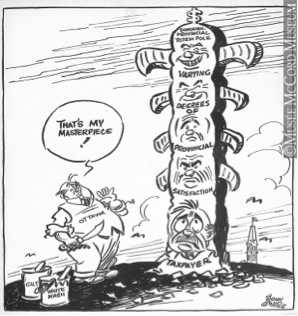
"Low man on totem pole"

What about the phrase "low man on the totem pole"?Over the past half century, the phrase, "low man on the/a totem pole," has been used in an attempt to communicate a sense of disempowerment and hierarchy (image at left). This phrase is especially prevalent in corporate culture, but occurs in everyday talk between friends and peers, and circulates via various media like print, radio, television and online forums. I hear the phrase being used, uncritically, from students and teachers to characters on popular TV shows like Grey's Anatomy or NCIS, for example. In this seemingly innocent everyday utterance, the totem pole has been appropriated to convey information that is unassociated with its origin, meaning or utility. Yet those who use this phrase imply that they “know” totem poles to be vertical columns that organize images in a linear hierarchy. Essentially, non-Indigenous ways of knowing and being have been superimposed upon the totem pole through discourse, thereby redefining totem poles on non-Indigenous terms, and robbing them of their Indigenous meaning and context.

In fact, in one online forum a commenter asks whether it is appropriate or not to use the phrase. Multiple responses arose but they all utilized a linear model for explanation. For example, to avoid being labeled discriminatory many of the anonymous online forum participants simply inverted the linear hierarchy to state that they “heard” that the lowest figure is actually most revered since it is “closest to the land.” Therefore, the commentators insisted, they are actually being “respectful” to a monolithic “Native American culture,” so it is okay to use the phrase, “low man on the/a totem pole.” Yet, following this logic, people would then start saying “high man on the totem pole,” in order to convey what they intended: hierarchy and disempowerment. One must ask, why won’t “lowest rung on the ladder” suffice? Doesn’t this make more sense? Ladders you actually climb, totem poles you don’t.
Comment:  For more on totem poles, see Big Heap Herman in The Munsters and Jeremy Scott's Yellow-Crotch Designs.

July 04, 2014

Big Heap Herman in The Munsters

The Munsters: Big Heap HermanWhen the Munsters go on vacation to Buffalo Valley, Herman gets off at rest stop in Indian Flats, where he gets left behind. When he wanders into a Indian Village, an elder of the tribe thinks that Herman is an ancient spirit leader, back to revitalize his tribe's way of life.

Episode Info

Episode number: 2x18
Production Number: 27028
Airdate: Thursday January 20th, 1966


Comment:  Needless to say, this episode is ridiculous, for several reasons:

  • The name "Buffalo Valley" and the "Indian Flats" train station are meant to suggest a remote and "wild" West. This is the only place where Indians exist, according to many Americans.

    Indeed, when Herman discovers the tribal village, he says it's one of the "lost Indian tribes" he was reading about. Implying that normal Indian tribes don't exist anymore.

  • The "tribe" has the usual teepees, headdresses, buckskins, warpaint, and drums, but also a totem pole topped by an image of Herman. Because all tribes are defined by teepees and totem poles, I guess.

  • The actors playing the Indians include Ned Romero ("Wonga"), whose ancestry is Chitimacha Native American. The rest are whites in makeup and wigs.

    Romero's sidekick "Manikoo" is played by Len Lesser, a Jewish actor who often portrayed Eastern European types. Manikoo even sounds like a fast-talking hustler from New Jersey. It's a ridiculous characterization for an Indian.

    The Indians reveal that they're 1960s hep cats who are just pretending to be traditionalists for the tourists. Apparently this is an attempt to inoculate the creators from charges of racist stereotyping.

    In other words, the creators wanted to assure viewers they were "just kidding." Like any good hipsters these days, they presented the racism, then tried to wink it away. Like, "We wanted you to laugh at the Indians, but not to criticize us, because we know the faux Indians were laughable."

  • Seeing that Herman resembles an ancient god or "spirit leader" the tribe decides to marry him to an Indian maiden. Herman is a big goof, but he acts even more stupidly than usual. He goes along with the Indians without a qualm, despite the fact that he's happily married.

    Wonga is uncertain about this gambit. Maybe Herman really will bring the tribe good fortune. If not, he says, the Indians can perform the marriage ceremony three times a day for the tourists.

    The whole concept of the tribe as a tourist destination is ridiculous. What tourists? They're in the middle of nowhere, six miles from a lonely train station where no one stops. How could this possibly be a money-making venture?

  • The episode is a curiosity. On the one hand, it presents a traditional tribe based on dozens of the most blatant stereotypes. On the other, a couple of its Indians talk like regular people: modernists who mock their own traditions.

    As I said before, it's like trying to have your cake and eat it too. But it signals a transition in movies and TV: from Indians as primitive people of the past to Indians who are nominally part of the present.

    November 04, 2013

    Did Indians inspire Jack Kirby?

    Did Native Americans Give Us Spider-Man?

    By Will NixonA young artist named Jack Kirby, born in 1917, grew up with an enduring fascination with world mythology and with comics. Kirby was especially interested in the Hopi, and imitated Hopi designs and patterns in his drawing style. Over time, he became known as "King of the Comics," and his enduring interest in ancient Hopi myths influenced millions. Kirby's most personal work of genius, the unfinished "Four Worlds" series, was based on the Hopi myth of Creation by the same name. One can also see his devotion to the Hopi in the creation of his Terrible Totem villain, a wooden character that is an amalgam of several Hopi kachinas and monsters.

    At that time, comic book story writers saw themselves as part of a tradition of heroic fiction, and so did not usually extract wholesale from existing myths but used elements creatively according to their particular genius. This was the way in which Jack Kirby brought the spirit of the Hopi hero myths to millions of young Americans in the 1950s and 1960s during a time in which people were struggling to find more earth-friendly values.

    Jack Kirby (with Stan Lee) invented Spider-Man, who embodies many of the qualities of Grandmother Spider, also known as Spider Woman. Kirby and Lee also invented X-Men, whose original characters included The Beast (the forerunner of Beast Boy, a shape-shifter based on Hopi mythology), Ice Man (somewhat like the North Wind of Ojibway stories), Marvel Girl (who is telepathic, and can "talk in someone's ear" without being seen, but in a different way than Spider Woman can), and the Cyclops (from Greek myth). Later X-Men included Mystique, who is a shape-shifter. Kirby then invented the Incredible Hulk, who is perhaps like Man-Eagle in many respects, only good.

    Then he created the Fantastic Four, an arch-enemy of whom was called the Mole Man. Unlike the helpful Mole Man in "Son of Light Defeats the Monster," this one is a subterranean menace who controls and unleashes huge monsters upon the Fantastic Four. The Four include the Thing, a rock creature not unlike the Dene (Navajo) Rock Monster Eagle, Tse ninahaleeh, who lives on Shiprock Mountain; Mr. Fantastic, who stretches; Invisible Girl, essentially like Grandmother Spider who makes herself so small she becomes invisible; and the Human Torch, similar to the Kokosori Zuni fire kachina who descends from the hills to start the Zuni ceremony of shalako on the first week of December. Perhaps contact with these characters has opened our subconscious minds to the teachings of the Hopi, the "Peaceful People."
    Comment:  Alas, Nixon's theory is weak. Among its flaws:

  • I've never seen any Hopi designs or patterns in his drawings.

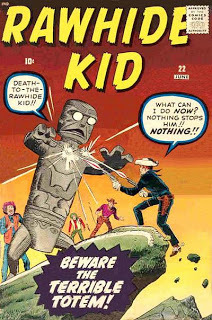
  • Kirby modeled the Terrible Totem on totem poles (duh) from the northwest, not kachinas from the southwest.

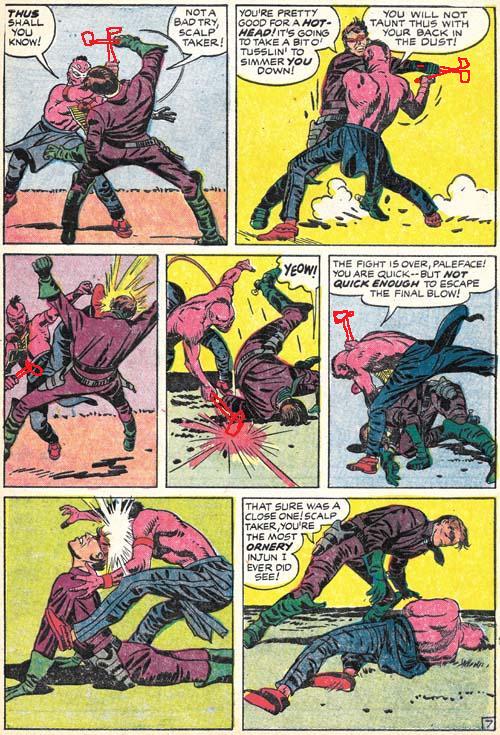
  • Beware Terrible Totem Rawhide Kid Tale By Jack Kirby


  • When Kirby took over the Green Arrow series in the mid-1950s, he turned Green Arrow and his sidekick Speedy into Batman and Robin clones. He downplayed or ignored Speedy's Navajo origin--not what you'd expect if he was infusing everything with Native lore.

  • Kirby was only briefly involved with Spider-Man. His version was a gadget-using guy like the Human Fly, with suction cups and a web gun. It was the opposite of a nature- or mythology-based spider hero.

  • Stan Lee was involved in the creation of all the heroes mentioned, so it's doubtful how much rein Kirby had to use his alleged interest in the Hopi.

  • Nixon claims the heroes derived from Navajo, Zuni, and Ojibway legends. None of these are Hopi. How could their legends influence Kirby if he was interested in the Hopi? Learning about one tribe doesn't make you an expert on several hundred other tribes.

  • The Fantastic Four's power almost certainly came from the Greek belief in the four elements: air, water, fire, and earth.

  • Kirby's Fourth World

    I'll concede that the Hopis' "fourth world" concept may have inspired Kirby. The basic idea of worlds dying and being reborn could be Native, even if the details aren't. The other claims seem farfetched.

    But Kirby probably had some familiarity with Native lore. As much as the average American, at least. He drew all kinds of comics, especially Westerns, where Indians were bound to appear.

    A few instances:

  • Kirby created or co-created Wyatt Wingfoot and his Keewazi tribe in Fantastic Four #50. Wingfoot was one of the first modern-day Indians in comics.

  • He pitted the Fantastic Four and Wingfoot against Tomazooma in Fantastic Four #80. Tomazooma was a giant robot based on Keewazi legend. It vaguely resembled a Hopi kachina.


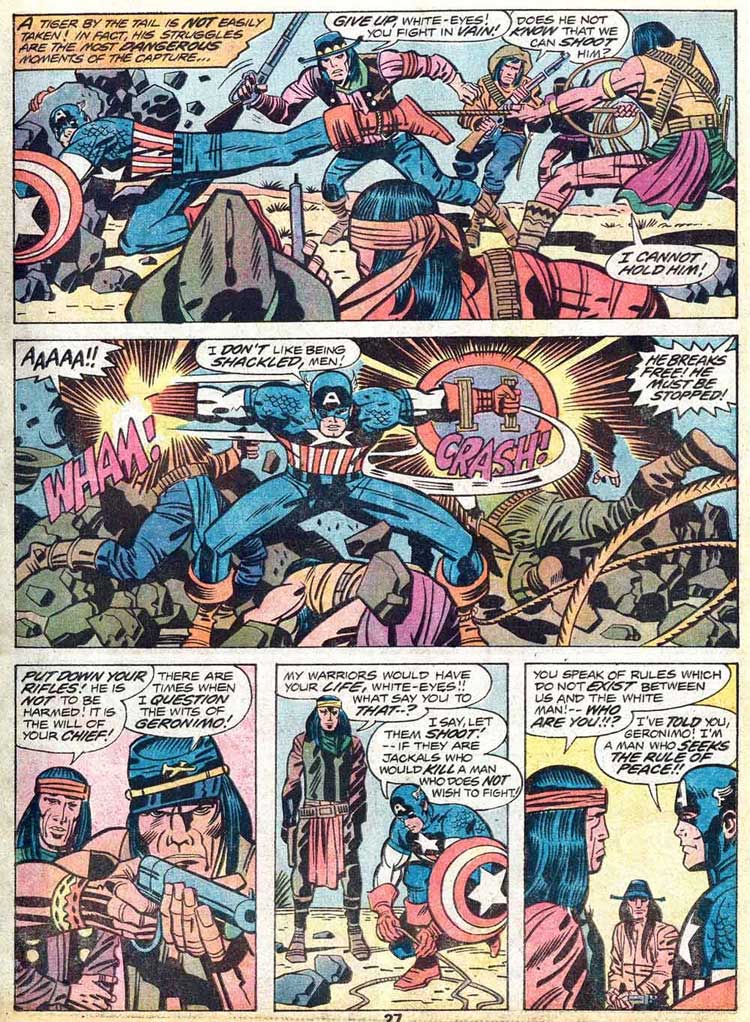
  • In Captain America's Bicentennial Battles, Kirby had Captain America meet Geronimo. Cap tries to stop a battle between the Apaches and the US Army.

  • And Now, Bicentennial Kirby Captain America--Lost In Time!


  • Kirby's Eternals series was based on the "ancient astronauts" premise--the idea that aliens came to earth long ago and aided nascent civilizations, especially those in the Americas. The series begins with an archaeologist discovering alien artifacts in an Inca tomb.

  • Whether these few examples signify a special interest in Indians is hard to say. These are a few comics out of the thousands Kirby produced. Probability suggests Indians should've appeared about 1% of the time, so that's all this may be.

    Here's a note about a Western comic by Kirby featuring Indians:

    Bullseye #6, The Missing Tomahawks

    August 08, 2013

    Sweetwater tourist act blurs cultures

    Do the Sweetwaters blur the lines of Native American culture?

    By Simon Moya-SmithIt's 1 p.m., and already the temperature has swelled to 90 degrees — but the show must go on. These are tough times, says Kenny Sweetwater, the patriarch of this troupe and a member of the Southern Cheyenne and Osage tribes. Three wildfires—Waldo Canyon, which raged last summer, and the recent Black Forest and Royal Gorge fires—have kept tourists from the area. But times will be tougher this winter if the family doesn't put away some money.

    To do so, they'll dance in their traditional regalia for the few tourists who come by, then offer to paint their pale faces. Red, yellow, green and black geometric shapes—none of the traditional images that warriors would paint on their faces before taking on the U.S. Cavalry in those bloody nineteenth-century battles that still stain American soil.

    This face painting "is more modern and commercialized," says Elvira Sweetwater, who's Diné (Navajo). "It all relates to art."

    She charges $4 a face, and says that other Native Americans will demand $18 to do the same. "Mine's not that high. I just share it," she explains. "You know what I mean?"

    But academics and activists alike say they wish she wouldn't share the revered practice of face painting with non-Native Americans at all, and would stop putting on these performances so that non-Indian tourists can play cowboys and Indians outside a trading post owned by other non-Indians.
    I didn't know face-painting was considered "revered," but some claim it is:Theodore Van Alst, a Lakota who's director of the Native American Cultural Center at Yale University, read about the Sweetwaters' performances in an article in the Cañon City Daily Record, and they fall in a "dicey area," he says.

    "On the one hand, you've got to make a living," he notes. The Sweetwater family is "playing a role that is an expected one. They're playing a role created by America and the American West, in particular. They're filling a spot."

    Still, he explains, it's never acceptable for a Native American to paint the faces of white kids for profit. "There are certain precursory ceremonies to the painting of faces," he says. "So that's problematic. To expect some non-Native family to be able to differentiate between some random geometrics and a pattern that could be related to a particular ceremony is not an easy thing for them to grasp."

    Traditional Native American face-painting designs are spiritual and not strictly geometric. The designs are either familial or a representation of the individual who wears them.

    The face-painting portion of the Sweetwaters' show "should probably be something that they should stay away from," Van Alst says. "Eating candy and getting your face painted, that's carnival. But don't confuse Indian people with carnival."

    Had certain events in history not occurred—for example, had Christopher Columbus not landed here in 1492—Native Americans today wouldn't be in a position where they sell their culture just to pay a bill, he notes. "Is it entirely on them, or does the legacy of colonialism have a role to play in this?" Van Alst asks. "All of the films, the cartoons, the cultural representation of Native American people has brought us to where we are today."
    Comment:  So the father is Southern Cheyenne and Osage and the mother is Navajo. They perform in Cañon City, which is in Colorado.

    I'd say the Sweetwaters' act is problematical at best. A tipi with Kokopelli on it, a totem pole, powwow dances, and face-painting. It's sort of like the greatest hits of generic "Native culture." If the trading post sells dreamcatchers, headdresses, and toy bow-and-arrow sets, it would be just about "perfect."

    The headline sums it up pretty well. Not teaching Native culture, but blurring the lines of Native culture. That's not the kind of education Americans need.

    Is this educational?

    Elvira the mother talks about education:"The performances also educate the audience," Elvira stresses, noting that she spends countless hours teaching about Native American culture. "I work with kids," she says "I do a lot of after-school programs. I do things like beadwork, making shawls. I teach all the cultural stuff to the kids. Most are Native kids. Some are half-breeds."Sounds good, but what exactly is she teaching them? "My tribe is Navajo, and we traditionally did not have tipis, totem poles, powwow dances, or face-painting. Our performance is phony as far as the Navajo are concerned."

    If that's what she's teaching--that most of her act is false--then great. But wouldn't it be easier to change the act than have to explain it away.

    If she's not teaching that most of her act is false, that's another problem. I'm guessing she's not.

    For more on face-painting, see Half-Naked Drummer Dressed as Indians and "War Paint for Today's Business World."

    January 22, 2013

    Jeremy Scott's yellow-crotch designs

    Misappropriation and the Case of the Yellow Crotch

    By Jessica R. MetcalfIn numerous previous posts, I have brought up why cases of Native American misappropriations are bad. They are unethical, and in some cases illegal. In this case, at first we presume that Jeremy Scott was inspired by totem poles carved by Northwest Coast tribal members, but it appears instead he aimed to be in the same ballpark as cheap, non-Native-made, tourist souvenir shop, Taiwan-made, knock-offs. His (above) lacks the sophistication and knowledge that is evidenced in the pole to the bottom right.

    Totem poles tell stories, and relay information about our lineage, heritage, and history. They tell important stories about who we were and who we are now. The images on these poles are owned by the various families and clans they represent, and unauthorized copies are seen as infringements upon rights.
    And:Bizarre, garish, unpleasant and disgusting were several terms used to describe this outfit by people in the Native American community (and what's with that distasteful neon yellow crotch?). Several individuals noticed that his inspiration was unoriginal, and that his take on Northwest Coast formline was ignorant, disrespectful and badly construed (in other words, Scott needs to work on his ovoids and u-forms). He produced this collection with little to no knowledge of the complex stylistic conventions of Northwest Coast. Designs such as his actively work to reduce public respect for the deep cultural knowledge and artistic skill needed to design, create, and carve a pole. This last statement is particularly important because one reviewer noted that Scott's collection was all about "expanding your cultural horizons."

    No, it doesn't expand our cultural horizons, it's just lazy work.
    Comment:  For more on Native fashion, see Mohawk Designer on Victoria's Secret and Gong Launches Mockups.

    October 14, 2012

    Kachina video game

    Debbie Reese writes about a children's video game in her Americans Indians in Children's literature blog:

    Ben Esposito's "Kachina"IndieCade, or, the International Festival of Independent Games was held last week, October 4-7, 2012.

    Ben Esposito's "Kachina" (which I gather is still in development) was designated as a 2012 Official Selection. Here's a screenshot from the website:
    Here's what the description says. See, in particular, the text I put in bold:

    Kachina is a physics-based toy that evokes Katamari Damacy's sense of order & scale mixed with Windowill's childlike wonder. Drawing as readily from Hopi folklore as it does Bruce Springsteen, Kachina invites you to play with the creatures and artifacts of North American mythology.
    Reese sums up what's wrong with this game:Esposito and the IndieCade people who selected it as an Official Selection must not know that teepees and totem poles have nothing to do with the Hopi people. They obviously have no idea what kachinas mean to the Hopi people, and they also likely have no idea that calling the religious traditions of an Indigenous people "folklore" is derogatory.Comment:  We should note that Hopi isn't the only tribe with kachinas. The Zuni and few other Pueblo tribes have them as well.

    Looking at the video of the game, there seems to be no Native content besides the teepee and totem pole. No kachinas, which is good, since the Hopi undoubtedly would object. No other artifacts. Maybe a couple of animals.

    Basically, it looks like there's no justification for the "Kachina" name. Or for the summary implying the game has substantial Native content. The Native concept appears to be a gimmick to make the game seem more educational and meaningful than it really is.

    For more on Native video games, see Assassin Creed 3's Mohawk Origin and Evolution Video Game Features Lakota.

    February 27, 2012

    Williams Memorial Totem Pole

    New totem pole is raised in honor of slain carver John T. Williams

    Family and friends raised a memorial to John T. Williams at Seattle Center after carrying the 34-foot totem pole through downtown Sunday

    By Amy Martinez
    After several hours, the 34-foot monument was raised into place at Seattle Center near Fifth Avenue North and Broad Street, just yards from the Space Needle.

    The event, which occurred on the eve of what would have been Williams' 52nd birthday, followed Native tradition, with the pole carried to its final destination amid singing and dancing to drums.

    "To me, it was a healing and a blessing," said Roger Miller, 48, who traveled from his home on the Muckleshoot reservation to carry the pole. "We stopped here and there, but we had determination."

    Williams, a First Nations woodcarver, was fatally shot by Seattle police Officer Ian Birk in August 2010 when Birk saw him walking with a knife near downtown.

    Birk later resigned from the force after a review board found the shooting unjustified.
    From Tragedy Comes Beauty: Memorial Pole Erected for John T. Williams

    By Richard WalkerOn February 26, a 34-foot totem pole was raised at Seattle Center, near the city’s famous Space Needle.

    Through it all, Williams’s brother, Rick, was a standard-bearer for peace. He devoted his time to creating a monument to his brother that will, after the players in this drama are long gone, tell of what happened in Seattle in 2010, how an injustice brought people together. “Anger doesn’t serve anything,” Williams said one chilly December morning on the Seattle waterfront. “They took something beautiful from my family. I want to give something beautiful back.”

    The John T. Williams Totem Pole Project features the main totem pole that was carried from Waterfront Park to Seattle Center and raised at a spot between the Space Needle and the Experience Music Project. Jay Westwind Wolf Hollingsworth, Mohegan, chairman of the project organizing committee, said a minimum of 64 people will be needed to carry the pole; according to the Seattle Times, 90 people lent a hand on Sunday. Some of the volunteers carried stands that the pole could be set on during rest periods, and helped raise the pole using ropes. According to Williams, ten chiefs had committed to attend. A second memorial pole carved by Williams family members and others will be erected later at Seattle’s Victor Steinbrueck Park, northwest of the famous Pike Place Market; a third pole will be erected at a site yet to be determined.

    John T. Williams was intimately familiar with the streets his poles will loom over. His ancestors were too; his family has been in the Seattle area since the early 1900s, Rick Williams said. It’s fitting that the Native imagery of the main pole was be carried down these streets, home to Native peoples now and since time immemorial, a history and a future that cannot be erased with a bullet.
    Comment:  For more on the subject, see Leschi Play Mirrors Woodcarver's Killing.

    Below:  Space Needle and Memorial Totem Pole. (Victor Pascual/DigitalNavajo.com)

    July 27, 2011

    Jasper totem pole should go

    When I posted about the Haida totem pole being raised in the Shuswap Nation's territory, I neglected a couple of issues. The situation is more complex than I thought.

    New totem raised in Jasper, in place of nearly century-old landmark

    Artists put the finishing touches on the Two Brothers Totem Pole, days before it was erected Saturday, July 16.

    By Julia Parrish
    The town of Jasper has been without one of its most well-known landmarks after it was found to be unstable. Now a new totem pole stands in its place.

    The Jasper Raven Totem Pole was acquired by the Grand Trunk Pacific Railway when it opened a rail line across the mountains to Prince Rupert, British Columbia in 1914.

    It was one of a set attained to be erected at the Prince Rupert and Jasper railway stations.

    The Raven totem pole was built by a master carver in the Queen Charlotte Islands in the 1870s or 1880s.

    Parks Canada tried to save the original totem pole, but it was not salvageable.
    First, there's the fact that the pole is almost a century old. Even if it's from the "wrong" tribe, it commemorates a historic event. No doubt it's become part of Jasper's culture and life. It's probably a tourist attraction, found on postcards and t-shirts, and so forth.

    This case reminds me of the Massasoit statue in Utah. As you may recall, Utah-born sculptor Cyrus Dallin created a statue of Massachusetts sachem Massasoit. Utah put it in front of its state capitol to "honor" Indians and Dallin.

    I'd say the same thing in this case that I did in that case. You shouldn't eliminate the art because it's in the "wrong" place. But you can do a couple of things.

    One, label it properly so there's no chance of a misunderstanding. It's a Haida pole, from hundreds of miles away, with no connection to local tribes. It's in Jasper, Alberta, for a particular reason. Make sure Jasper's residents know about it. Post the info in city hall and the visitor center, teach it in schools, spread the word online, etc.

    Two, move it to a less prominent position. Jasper National Park is too official a location for a cultural error. It makes the pole's existence seem like a government endorsement.

    Put it in some unofficial location like a local plaza, park, or schoolyard. Then you have the best of both worlds. Jasper still has its totem pole, but it's not the town's centerpiece. The move serves to deemphasize it.

    In its place, put some art or exhibits from the local Shuswap Nation. They should be at the center of Jasper's Native culture, not the distant Haida. As with the Massasoit statue, it's no honor to spotlight Indians if they're the wrong ones. The British wouldn't accept a statue of Napoleon in front of Buckingham Palace, so why should the Shuswap accept this Haida pole?

    Pole confirms government's position?

    The next article confirms that the Simpcw First Nation, a member of the Shuswap Nation Tribal Council, considers the pole a form of government endorsement:

    Haida totem pole raises territorial questions for Shuswap band

    A totem pole carved by two Haida brothers is erected in Jasper National Park on July 16. The pole has caused concern for the Simpcw First Nation near Barriere because Jasper, Alta., is part of their traditional territory, not that of the Haida.Simpcw First Nation wants the federal government to confirm its territorial status in Jasper National Park.

    Chief Nathan Matthew said Sunday the band did not attend the July 16 Parks Day in Jasper that included the erection of a new Haida-carved totem pole to replace a 94-year-old one that had become unsafe.

    The area is considered part of the traditional territory of the Simpcw First Nation, but it's hundreds of kilometres from Haida lands.

    Matthew said the band has evidence of occupation in Jasper before it was made into a park. If the federal government has proof that has changed, he wants to see it.

    "They're denying we have any rights in the park. They're saying the rights were extinguished or surrendered. If they were extinguished, they have to tell us how they did that. If we've surrendered, there should be some documentation. There's nothing on our side of the fence," he said.

    Installing a Haida pole in Simpcw traditional territory is seen as non-recognition of the local First Nations' rights, he said. Matthew has written to the federal Environment Minister Peter Kent to get an explanation, as well as making calls to the Haida, who haven't responded.
    Yes, it sounds like the pole really should go somewhere else. For political as well as cultural reasons.

    The government denies that the pole has anything to do with the Shuswap claim. I think we know what a government's word is worth when it comes to Indians. Not much.

    And we know how this kind of situation usually plays out. In 10 or 20 or 50 years, a different government says: "Hey, you didn't protest the pole when you had a chance. Now it's too late. The pole's continued presence proves you didn't care about this land. Therefore, you've forfeited your claims."

    For all these reasons and the original one--that it's stereotypical--the pole should go. Move it and replace it with something that belongs there.

    For more on totem poles, see Spokane Tribe Replaces "Totem" Art and Goofy Moments in GREEN LANTERN #79.

    Below:  "Artists put the finishing touches on the Two Brothers Totem Pole, days before it was erected Saturday, July 16."

    July 16, 2011

    Alberta tribe doesn't want totem pole

    Another totem-pole story points out the folly of lumping all Indians together.

    New Jasper totem pole angers area First Nations group

    By Lana CuthbertsonParks Canada erected a striking new totem pole in Jasper on Saturday but the monument is causing frustration for a local First Nations group.

    The new pole was carved by two brothers from the Haida nation, which is hundreds of kilometres away, off the north coast of B.C.

    Chief Nathan Matthew of the Shuswap Nation Tribal Council said there is no cultural significance for the Jasper region in the totem pole.

    “We have no problem with the Haida, we respect them and they produce iconic, world class art,” Matthew said. “But the local First Nations groups should be represented.”
    Comment:  Most people associate the entire Pacific Northwest with totem poles. It's a stretch to include Alberta in that region, but that's apparently what the residents have done.

    In response, the local tribe is saying no. "Totem poles aren't part of our culture. You're stereotyping us as if we're all the same."

    In America the stereotypical choice is the Plains culture with its chiefs and tipis. In western Canada, it's the Pacific Northwest culture with its totem poles.

    For more on totem poles, see Spokane Tribe Replaces "Totem" Art and Goofy Moments in GREEN LANTERN #79.

    Below:  "A new totem pole is erected in Jasper, Alberta, in July 2011. It tells the story of two brothers who travel from the west coast to the Rockies."

    July 05, 2011

    Spokane Tribe replaces "totem" art

    Tribe raised $25,000 to replace cultural blunderA cultural blunder at a North Spokane park is getting a $25,000 replacement.

    The Spokane Tribe and community leaders raised the money to purchase a new monument for Chief Garry Park in North Spokane. Tribal leaders want the current statue removed.

    An art installment resembling a totem pole now sits in Chief Garry Park. The city installed the current statue a couple of years ago. City leaders removed the Chief Garry statue in 2008 because it was deteriorating. Tribal leaders call the totem pole art inappropriate.

    Leaders told KREM 2 News that the totem pole does not represent any Eastern Washington tribes.
    Comment:  I'm always saying totem poles have specific roles and meanings in Native cultures. You can't put random figures and shapes on a pole and call it totem pole. Not a Native one, anyway.

    Now here's evidence of that. Even though this pole is genuine art, it's not genuinely Native. As a totem pole, it's phony. So the Spokane Tribe is paying to replace it. They want a real totem pole, not totem-style art.

    For more on the subject, see "Low Man on Totem Pole" in NCIS and Goofy Moments in GREEN LANTERN #79.

    June 20, 2011

    "Low man on totem pole" in NCIS

    In this TV episode, NCIS investigators discover a murder victim: a lowly seaman dressed as a captain. The following bit occurs:

    NCIS:  "Two-Faced" 4/4/11 Recap

    By Matthew BraswellAutopsy: Palmer wonders how someone so low on the totem pole could be so decorated. Ducky corrects the usage of totem pole, saying Native Americans regarded individuals low on totem poles in high regard.Some fact-checking on this claim:

    Totem poleVertical order of images is widely believed to be a significant representation of importance. This idea is so pervasive that it has entered into common parlance with the phrase "low man on the totem pole." This phrase is indicative of the most common belief of ordering importance, that the higher figures on the pole are more important or prestigious. A counterargument frequently heard is that figures are arranged in a "reverse hierarchy" style, with the most important representations being on the bottom, and the least important being on top. Actually there have never been any restrictions on vertical order, many poles have significant figures on the top, others on the bottom, and some in the middle. Other poles have no vertical arrangement at all, consisting of a lone figure atop an undecorated column.Someone asked about the NCIS scene on an English Language and Usage website. One respondent repeated the Wikipedia info above. Another added this:

    “Low on the totem pole”?  Good or bad?Well, there is always some confusion about this idiom here. This idiom was introduced by an American named Fred Allen some where in the mid 1940s. He actually used it to depict something of least importance, which was evidently proved to be wrong.Comment:  I don't have any independent evidence for these claims. But I've read books on totem poles and don't remember anything about the order mattering.

    If I had to guess, I'd say the order isn't a matter of "importance." The poles are telling stories so they may be in a chronological order.

    For more on totem poles, see Goofy Moments in GREEN LANTERN #79 and Cowboys & Findians in The Dudesons.

    June 18, 2011

    Goofy moments in GREEN LANTERN #79

    Here's a comic book from September 1970 that was impressive at the time and still looks pretty good compared to today's comics:

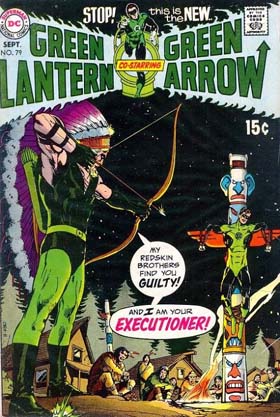
    Green Lantern #79Green Lantern and Green Arrow get involved in a dispute over logging rights on Native American land. While GL searches for documentation for the Indians' claim, GA tries to inspire them with the ghost of their ancestor. Though the heroes are able to prevent all-out conflict between the loggers and the Natives, and the leaders of the loggers are arrested, only time will tell if the Indians' claim will hold up in a court of law.

    One critic liked it well enough:

    Green Lantern/Green Arrow #79Despite the obvious "mystery" in this issue, I like it for several reasons: 1) it does bring attention to Native American rights issues, which don't usually receive that much attention even from self-professed liberal quarters, and 2) Green Arrow and Green Lantern finally get around to duking it out, although the fight does end in something of a cop-out since the two knock each other out.

    But blogger Brian Cronin nominates its climax as the second goofiest moment in the first 10 issues:

    Ten Goofiest Moments in Green Lantern #76-85

    2. Green Arrow’s Burden…

    Perhaps the epitome of Green Arrow’s patronizing sermonizing happens in #79, when he dresses up as the ghost of a famous tribal leader to inspire the members of the tribe to stand up to the white man… You have to wake up pretty early in the morning to get more patronizing, Ollie…

    Comment:  Yes, Green Arrow's approach is extremely patronizing. On the other, it's possible a group of mild-mannered Indians might be unwilling to fight a powerful businessman. And only one Indian takes the "ghost" seriously; the rest scoff at it.

    What's goofy are a few things Cronin doesn't mention:

    1) The story takes place in the Pacific Northwest--note the pine trees. But Green Arrow dresses up as a stereotypical Plains chief. The Indians should've shouted, "You can't be the ghost of Ulysses Star because you don't look anything like him."

    2) Most of the Indians wear headbands and vests. It's a modified stereotypical look that's supposed to seem modern but Native. In reality, roughly zero Indians wear headbands in their everyday lives.

    3) The Indians have dark pink skins. Which was kind of par for the course in comics back then. Asians usually had yellow-brown skin. Only blacks were rendered with reasonable accuracy.

    Cover is goofiest

    For a truly goofy moment in this comic, you have to go to the cover:

    It's a symbolic moment that doesn't happen in the story, but it's still stupid. Green Arrow wears a full headdress from a culture located hundreds of miles away. He uses the slur "redskin." The Indians wear traditional buckskins and feathers around a campfire even though they're seated near wood-frame buildings.

    Perhaps worst of all Green Lantern is tied to a totem pole with fearsome human faces. Totem poles usually feature animals that tell a story. They aren't random collections of scary little men.

    With GA acting like a savage Indian chief and GL tied to a savage-looking totem pole, guess what the message is. Yes, that Indians are savages, again.

    For more on Green Lantern, see Taika Waititi as Tom Kalmaku and The Seminal Moment in Green Lantern #76.

    May 15, 2010

    Cowboys & Findians in The Dudesons

    The DudesonsThe Dudesons is a Finnish television series, which originally started in January 2001 under the Finnish name Extreme Duudsonit. A combination of extreme stunts, comedy and reality, the show has become the most widespread Finnish TV-series of all time. The show follows the every day life of four best friends, who have a tendency for chaos and perilous situations.

    The Dudesons in America: 2010

    After a multi-million dollar deal with MTV, a new show called The Dudesons in America was green lit. With a budget of six million dollars, it would consist of the same line-up of all four Dudesons, and is set to be produced by both Johnny Knoxville and Jeff Tremaine.

    The first episode was shown on MTV May 6th, 2010, to widespread critical acclaim. The show has so far been very successful.
    Cowboys & Findians is the second episode of The Dudesons in America. Here's the official description:The Dudesons want to know if they can hack it like the original Americans once did, so they have found a Native Indian mentor named Saginaw who has agreed to lead them through seven painful rites of passage. Ranging from a canoe ride from hell to a game of ball busting dominoes with totem poles--even a 911 trip to the hospital won't stop the Dudesons from pursuing their goals of becoming honorary members of the tribe.A blogger named Stephen gives us his take on it:

    "The Dudesons" Mark a New Low...I thought the Hipster headdresses were weird enough and our new "Indian" friends at the Stanford Powwow equally awkward. But ladies and gentlemen, there is a new winner. And I'm still trying to pick my jaw up off the floor.

    Meet The Dudesons--four Finnish friends whose new MTV television show combines wild stunts and outrageous comedy...

    ...and the most unbelievable ignorant and disturbing take on Native culture seen in decades!
    Rob's review

    The four Dudesons appear in front of teepees wearing phony feathers and facepaint. One has a toy bow and arrows. They're joined by actor Saginaw Grant, who plays "Saginaw, King of All Indians."

    Right off you know this is going to be bad. It combines the most common Plains stereotypes with a strong implication that all Indians are the same.

    Stephen describes the action:Not only do they dress in outrageous Indian headdresses and outfits but they make a complete mockery of Native spirituality and culture. They rescue their "Indian" brothers in jail from the evil cowboys by being yanked off a horse. They attempt to fly like the eagles by driving an SUV off a ramp and into a moving target. And as "Saginaw" instructs them, they must only catch fish with their mouths like "real Indians" using a rotating fish slapping machine of course.Here's a slideshow of the show's lowlights:

    The Dudesons | Ep. 2 | 'Cowboys & Findians'


    "Some Cowboys and Findians."


    "Jukka and Native Indian mentor, Saginaw, share some gossip."


    A Dudeson shows his mastery of canoe paddling in mid-air.


    "Jarppi: Finnish Dudeson turned Native Indian Male Model." This is just before the idiot jumps onto a barrel to prove his horse-mounting skills. The totem pole is a prop that has nothing to do with the rest of the show.


    Jarppi the Dudeson tries to catch a fish in his mouth. Saginaw (Grant) claims this is a Native practice, but it's not one I've ever heard of.


    Being dragged by a horse is another alleged Native rite of passage.


    "Flying like an eagle" is the final alleged Native rite of passage.


    Jarppi and other Dudesons receive golden feathers from Grant, who says they've earned honorary membership in his (unspecified) tribe.

    Conclusion

    I don't know if I'd call this a new low in stereotyping. I've seen a lot of terrible stereotypes in my time. But it's probably the worst stereotyping of the month, if not the year. It's probably the worst mockery of Indians on TV in several years. And the final "ceremony" may be the most repugnant misuse of feathers ever.

    At least the Dudesons didn't try to kill, torture, or scalp anyone. That might've made them the stupidest stereotypers ever. Alas, I suspect these wannabes think they're "honoring" Indians by fabricating their "rites of passage."

    Then there's Saginaw Grant's role. I don't know what his situation is, but no self-respecting Indian should've participated in this idiocy unless he was desperate for money. Grant seems like a tool or a fool for giving this modern-day minstrelry a veneer of respectability.

    It goes without saying that this show is racist. Can you imagine the Dudesons play-acting as primitive Africans in grass skirts and bones? No, of course not. Singling out one race for stereotyping is a textbook example of racism.

    For more on the subject, see TV Shows Featuring Indians.