Showing posts with label Hopi. Show all posts

January 04, 2016

Hopis protest Koshare Dancers

Hopis say Boy Scout performances make mockery of tradition, religion

By Anne ConstableFor decades, Boy Scouts from Southern Colorado have been performing Indian dances during the holiday season at the Koshare Indian Museum in La Junta, Colo.

The Koshare Dancers, named for a Pueblo Indian clown society representing ancestral spirits, have visited 47 states and three different countries, attended Pueblo powwows and feast days, and even traveled to the White House and Madison Square Garden in New York. According to their website, they have been “recognized and accepted by the Native American community—the highest honor bestowed on a non-Indian group.”

But when Leigh Kuwanwisiwma, the director of the Hopi Office of Cultural Preservation in Kykotsmovi, Ariz., learned recently about the program and saw video online of some of the performances, he was disturbed. The performers, he said, were “mimicking our dances, but they were insensitive, as far as I’m concerned.”

Many other members of the tribe agreed with him, some of them posting their views on Facebook. “They’re making a mockery of our native religion,” one person said on the group’s Facebook page, while another wrote, “I can’t believe this Boy Scout troop thinks this is ok.”

Kuwanwisiwma wrote to the board of the museum asking for the dances to cease, and he followed up with phone calls. He called the Boy Scout performances “commercial exploitation” and said they were “mimicking the Hopi butterfly, buffalo and Tewa ceremonial clowns.”

Kuwanwisiwma said he got no response. But when he went to the Koshare Indian Museum’s website, he saw an announcement that the 2015 Winter Night Dances, scheduled to begin Dec. 19, had been canceled “for this year out of respect for our Native American friends and until there has been an opportunity to discuss the Hopi’s concerns in a timely manner.”
Comment:  Just looking at the photos, you can see several problems. The white boys are wearing powwow-style regalia associated with Plains tribes, not pueblos. A drum circle is also associated with Plains tribes. As is the boy dressed as a chief. One of the dancers has faux war paint, which I don't think is part of the powwow dance regalia.

All this is happening under the Koshare name. The koshares belong to a Pueblo clown society whose members don't dress up in regalia to dance. It's like a group of "Greek" dancers doing a Scottish number in kilts--inappropriate and inauthentic. I.e., stereotypical.

There's no word on exactly who in the "Native American community" approved the dances, if anyone. There are hundreds of Native communities, of course--not just one. But only some of them are relevant. Unless the dancers got wide-ranging approval from the two dozen Pueblo communities in Arizona and New Mexico, I wouldn't brag about it.

In these cases, "approval" often came decades ago from someone who didn't know any better. That's not close to being good enough. If present-day Pueblo leaders have approved these dances, please...let us know who they are.

For more on the subject, see Boy Scout "Indian Dance Teams."

July 27, 2014

Albert Einstein at Hopi House

Albert Einstein at Hopi HouseAlbert Einstein made his second trip to the United States in the period between December 1930 and March 1931 to spend some time at California Institute of Technology, one of the institutions that was courting him to join their staff. It was on the return trip across the U.S. by train that the above photograph was taken. There are several striking things about this photograph that deserve mention. It is clear that the headdress that has been placed on Professor Einstein's head and the pipe he has been given to hold have no relationship to the Indians in this photograph. These Indians are Hopis from the relatively nearby Hopi pueblos while the headdress and pipe belong to the Plains Indian culture. The actual location of the photograph is Hopi House, a part of the Fred Harvey concession at the Grand Canyon.


Another posting suggests what Einstein thought about Indians:


But a Google search shows up only one instance of this quote. That suggests it's not real.

June 15, 2014

Native stereotypes in Mandala

The publisher or someone sent me the first issue of Mandala, a new comic-book series. They did it because they think Blue Corn Comics is a retailer, not a publisher. Wrong!

Anyway, Mandala features a Native subtext, so it's worth a look. Here's the official site:

MandalaARE YOU AWAKE?

Earth--here and now. Humankind is secretly enslaved by a global mind-control system called the GRID. Mike Morningstar and his spiritual spec-ops unit, the Thirteen, must alter time and take down the GRID before it's too late.

As fiction meets reality, the Thirteen need your help if they are to succeed in awakening humanity and changing the future...

Enter the Mandala...


And a couple of reviews:

Mandala by Stuart Moore and Bruce Zick

By Brad HawleyMandala is the story of Michael Patrick Murphy who has the potential to be a mythic hero, Morningstar, savior of all mankind, but often he is just Michael, a confused man, or even worse, he turns into his lower, demonic self. Borrowing a page from Michael Moorcock, author Stuart Moore has Morningstar drift from one reality to another, trying in each new plane of existence to fight the serpents and evil gods who control all humans in a post-apocalyptic world. He fights alongside the rest of “The Thirteen,” an organization made up of men and women similar to Michael Morningstar: They all have a human side and must learn to “wake up” their higher selves to unite and defeat serpents who are led by the evil Natasmia.

Moore borrows the time-traveling part of the plot from the Hawkman and Hawkgirl storyline at DC: Hawkman and Hawkgirl keep struggling to find each other again and again, but every time they do, they die and are reborn to seek each other out again—star-crossed lovers doomed by their rebirth-induced amnesia. Morningstar has his female counterpart in Mary Lozen Many Colors, or Raven. Raven’s Grandfather acts as spiritual guide for Michael and the rest of “The Thirteen.” He teaches Michael about the Empyrean and transformation, part of which has to be Michael’s willingness to be the “hanged man,” a familiar image seen in most Tarot decks.
Evil Geek Book Report--Mandala

By C-MartMandala is the story of how human evolution has been stopped dead in it’s tracks by an invading entity know as Natasmia and the mysterious world enveloping energy field known as the GRID. The Mayans predicted that humanity would take a great leap forward in terms of development and evolution in 2012, but thanks to Natasmia, that leap forward never came to be. Natasmia has her sights set on ruling all of humanity for the rest of existence and as anyone who’s ever dabbled in mind control knows; it’s easier to control a simpleton than it is to control a highly evolved being.And:Michael’s more evolved form, known as the Morningstar, is a superpowered demon king, destined to lead a group of other superpowered individuals known as the Thirteen into battle against Natasmia. With the help of his love Mary Lozen and her shamanic grandfather, the Morningstar is awakened within Michael and slowly he learns to use his powers in an attempt to save different timelines from the invading evil.Moore Tackles a Multiverse's Nightmarish Future in "Mandala"

The Native aspects

Angels, shamans, mandalas, Tarot, prophecies...if that sounds like a New Age mishmash to you, you probably have the right idea. I'd say the above descriptions give you a fair notion of how sprawling and mixed-up the story is.

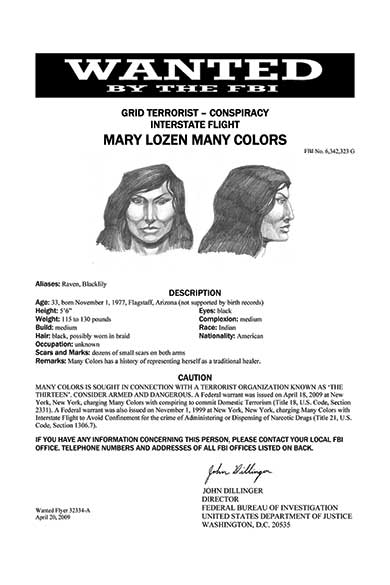
In the story's centerpiece, we meet Mary Lozen Many Colors and her grandfather Charlie Many Colors--both supposedly Hopi. First, the names...oh my!

For starters, Lozen is an Apache name, and the Apache were traditionally enemies of the Hopi. It's unlikely that any Hopi would use the name Lozen.

Then there's the last name Many Colors. Really?! That's even worse than the usual stereotypical names such as Grey Wolf or White Eagle. It reeks of trying to give the Hopi a multicultural flavor--as if they represent all the "multicolored" tribes of the world. In other words, pure New Age claptrap.

FYI, real Hopi names include Honanie, Humetewa, Masayesva, Selestewa, Batala, Talayumptewa, and Keevama. You can see they follow a style that does not include English phrases such as "Sitting Bull" or "Crazy Horse." The "Many Colors" kind of name is found mostly among Plains tribes, not Southwestern tribes.
Michael and Mary materialize on the Hopi reservation--to find themselves in an Anasazi-style dwelling under a cliff. No. The Hopi's ancestors used to live in such dwellings, but that was 800 years ago. Such dwellings are uninhabited ruins now--protected and off-limits. And there are no ruins this well-preserved on the Hopi rez.

The whole concept conveys the unavoidable impression that the Hopi people are prehistoric, not modern. Even the furnishings visible in one panel--a wooden chair and cot--could be pre-modern. There's no hint that the Hopi have done anything since the 18th or 19th century.

Then Charlie, Michael, and Mary descend a ladder into what could be a giant underground kiva. Let's hope it isn't one, because that would be a gross violation of Hopi religion. No one's supposed to know what happens in a kiva except the Hopi themselves.

What they actually find isn't a Hopi shrine, but rather a warehouse of religious icons from around the world. Including an Aztec sun stone, a Plains headdress, and a phony totem pole:
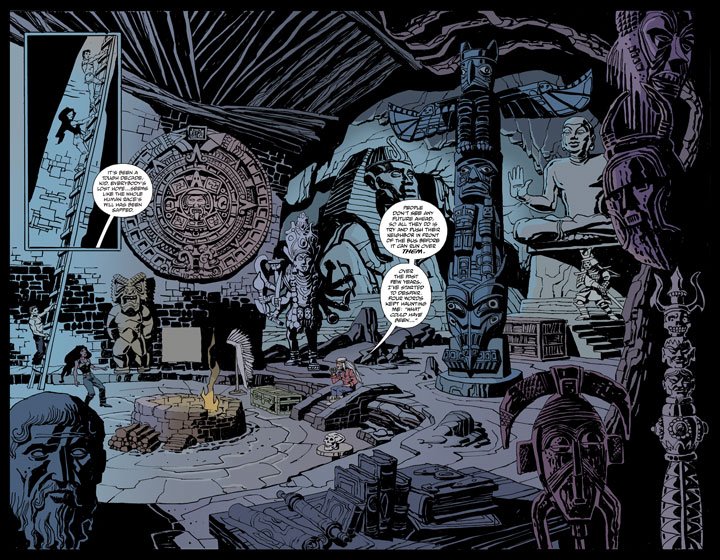


The message is that non-Western and indigenous religions are somehow related--part of the "nexus" or "multiverse" or interdimensional whatever. That they're not complete, standalone religions like Christianity, Judaism, and Islam. Instead, these religions are exotic, unfathomable, and otherworldly--perhaps literally. They're part of some vast, mysterious, cosmic sphere beyond the comprehension of modern minds.

This is a classic New Age belief, and it's an insult to all these religions. They're not exotic or unfathomable to their adherents. They don't require blood or virgin sacrifices to demons in the middle of the night.

Really, they're no stranger than the religions we're familiar with. To hide them away in an underground vault as some sort of dark secret is badly stereotypical. It's an Indiana Jones mentality from the racist era of tomb-robbing--but people should know better in 2014.

In a later issue, a Hopi sun god (below) leads the other "ancient" gods in holding hands and singing "Kumbaya." Or something. But don't expect the Christian God to show up and join them. Unlike these "mythical" gods, he's "real."
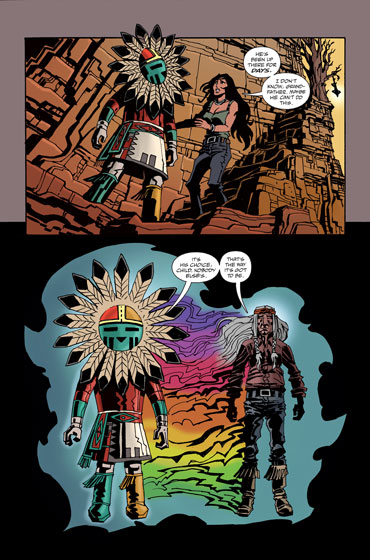


As the kicker, Charlie mentions a Hopi legend that a "true white brother" will appear to lead the everyone into the light. Yes, it's the "white savior" complex, uttered explicitly by a Native character, in 2014. Save us, Great White Father and Jesus Christ substitute! Only you are strong and brave and true enough to conquer evil.

I believe the Hopi do have such a legend. But it's one of many legends, not all Hopi believe it, and they certainly don't emphasize it. Author Stuart Moore easily could've avoided it and chosen some other legend to use. Instead, he's invented a pretext for why a white men should lead the "Thirteen," who are mostly nonwhite characters from non-Western cultures. Another white American to the rescue...yay!

I get a strong impression that Moore knows little or nothing about Native cultures. He probably skimmed a couple of books or websites before putting together this muddled stew of Hopi and Native lore. The result isn't much different from what you could read in any bad comic from the mid-20th century. If the scary masked figures and statues came alive and tried to kill our heroes, I wouldn't be surprised.

Like the previous image, the scene below wasn't in the issue I read. But it tells you all you need to know about Moore's ignorance. A Hopi "shaman" in a Plains headdress fighting a demon with a tomahawk: pure supernatural pan-Indian stereotyping.
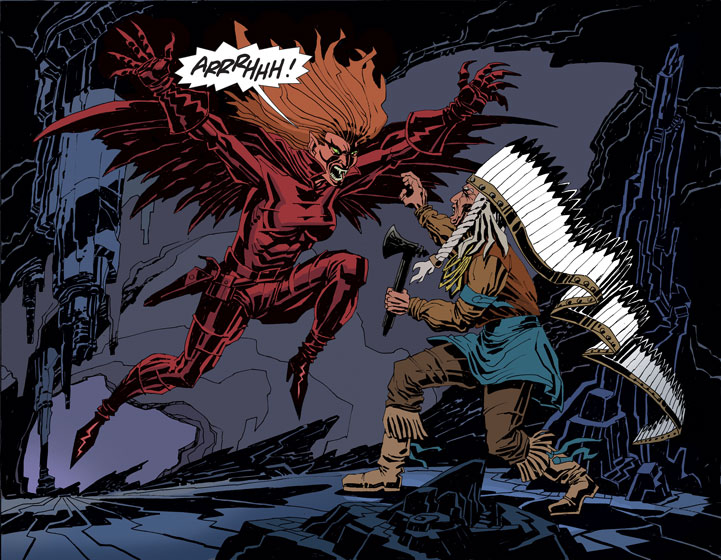


This is something I might've done in the first few months of putting together my Peace Party comics. But I soon realized how much I didn't know and kept studying. It was only after years of research that I felt I had a solid concept that didn't violate or trivialize the Hopi culture.

If I were Moore, I'd go back to the drawing board and start over. But he's invested too much time and energy in this venture to do that, of course. So we're left with another wrongheaded take on Native cultures in comics.
December 11, 2013

Annenberg Foundation returns Hopi artifacts

A couple of headlines tell the tale of another unfortunate event:

Sad But True: Another Hopi Katsinam Auction Planned in Paris

Paris Auction House Owner: Katsinam 'Not Entitled to Specific Rights'

Fortunately, this auction had a happier outcome:

Annenberg Foundation and Hopi Nation Announce Return of Sacred Artifacts to Native American Hopi TribeAnnenberg Foundation Vice President and Director Gregory Annenberg Weingarten today announced that the Annenberg Foundation has purchased 24 sacred Native American artifacts from an auction house in Paris–totaling $530 thousand–for the sole purpose of returning them to their rightful owners. Twenty-one of these items will be returned to the Hopi Nation in Arizona, and three artifacts belonging to the San Carlos Apache will be returned to the Apache tribe.

"This is a great day for not only the Hopi people but for the international community as a whole," said Sam Tenakhongva, a Hopi cultural leader. "The Annenberg Foundation set an example today of how to do the right thing. Our hope is that this act sets an example for others that items of significant cultural and religious value can only be properly cared for by those vested with the proper knowledge and responsibility. They simply cannot be put up for sale."

The positive development came after efforts, including those of the U.S. Embassy, were made to delay the auction of the Hopi and San Carlos Apache items. Acting on behalf of the advocacy group Survival International and the Hopi, attorney Pierre Servan-Schreiber went last week before a judge in Paris in an attempt to have the sale of the Hopi items blocked, but on December 6, the court ruled against him. That's when Weingarten made the unprecedented decision to intervene.

"As an artist, I was struck by the awesome power and beauty of these objects," said Weingarten. "But these are not trophies to have on one's mantel; they are truly sacred works for the Native Americans. They do not belong in auction houses or private collections. It gives me immense satisfaction to know that they will be returned home to their rightful owners, the Native Americans."
Comment:  For more on the subject, see Auctioned Mask Returned to Hopi and Auction House Sells Hopi Masks.

Below:  "Lawyer Pierre Servan-Schreiber met two katsina priests when a katsina was returned to the Hopi in July 2013."

November 13, 2013

Review of Houdini Pie

Back in 2010, the author of the novel Houdini Pie sent me a copy to review. I previewed it and read it, but I didn't have time to post about it until now.

The book is based on the legend of the "Lizard People" of Los Angeles. Which is why I posted something about that subject recently.

Houdini PieBook Description

BOOTLEGGING, BARNSTORMING and a Hard-Rock BOONDOOGLE. Los Angeles, 1934: Based on a true chapter of California history, Houdini Pie explores the depths to which a family, and a city, will sink when hard luck comes knocking and there's nothing left to lose. Young Hal Gates is a celebrated pitcher for an upstart rural ball club, and the son of a notorious booze smuggler who vanished at the end of Prohibition. At his lonely mother's urging, and with the desperate backing of the municipal powers-that-be, he teams up with a crackpot geologist to mine for a mythical Hopi treasure trove buried miles beneath the downtown streets. The deeper they tunnel the more Hal learns about loyalty, treachery, hunger and hope, and mostly--in ways he never would have imagined--about love.

Editorial Reviews

Michel's narrative voice [is] a perfect and enlightening use of 30's slang and patois, a condensation of all those movies we've all watched. This is a funny funny book--exhilirating and smart and sophisticated. Michel is a born storyteller, and lord knows, we need more writers like that. A guaranteed pleasure. --Lewis Buzbee

Michel successfully captured the era in his story and was studious enough to insert historical events that would help to mesh the story with the time period. --Bookventures Book Club

Witty, whimsical, wonderfully unpredictable, Paul Michel's wildly entertaining first novel simply shines. Houdini Pie is a fat, succulent slice of story-telling at its best. --A. Manette Ansay, author of Blue Water and Good Things I Wish You

Paul Michel's Houdini Pie is an old fashioned romp filled with colorful characters, an implausibly plausible plot and sheer story-telling verve. Think Treasure of the Sierra Madre grafted onto Chinatown grafted onto The Natural, and the fruits are a rich, and entertaining, Houdini pie. --C.J. Hribal, author of The Company Car and The Clouds in Memphis
The author's take

Michel's own site gives you another take on the book:

Houdini Pie“Houdini Pie” is a novel based on historical facts, about the efforts of a group of hapless entrepreneurs to mine for the mythical treasure of a tribe of ancient Hopi Indians under the streets of urban Los Angeles during the Great Depression. The city was in such dire straits that the City actually granted permits for the exercise, which was covered in the press—a mine shaft hundreds of feet deep right in the downtown core. The story’s real life ending is incomplete, as the project was abruptly stopped, and its chief architect essentially disappeared without (presumably) finding a lick of treasure. So go the news accounts.

The novel picks up where the historical record leaves off. It's a tale of desperation, loyalty and love among a group of mostly fictional figures who populate the more-or-less factual tale. It follows particularly the family of Halley (“Hal”) Gates, a young man named after the comet that filled the sky at the time of his birth in 1910. Hal’s deadbeat father Charlie is a successful bootlegger during the 1920s. He leaves Hal’s home town of Oxnard when Prohibition ends. In Charlie’s absence Hal becomes a reluctant accomplice to the treasure hunt, in fulfillment of a promise to his abandoned and unbalanced mother. He also becomes a successful baseball player on a rag-tag barnstorming team that takes on the more legitimate clubs of the popular Pacific Coast League, and he falls in love with the daughter of a psychic who becomes a focus of the treasure-hunters’ desperation as the plot unfolds. Eventually competing crews are hunting for the gold, and Hal and his family are caught in the middle, along with a host of characters that includes a peripatetic Hopi chief and his mysterious trouble-making daughter, who have their own interest in the myth of the buried treasure.
This summary is revealing. I kind of expected the story to be focused on the search for the Hopi treasure (first paragraph). But it's really about a sprawling set of characters for whom the treasure is only a plot device (second paragraph).

So it's not really a Native-themed novel, except tangentially. But a few points are worth mentioning.

The Native aspects

As Michel's site notes, there are two Native characters: "a peripatetic Hopi chief and his mysterious trouble-making daughter."

Chief Greenleaf is the more interesting of the two. He shows up mysteriously and does little besides sit and smoke. It's a welcome change from the usual wise elder who spouts greeting-card platitudes.

Of course, the Hopi tribe, a collection of independent villages, never had a single chief. Even now, their Westernized tribal government is led by a chairperson, not a chief.

Also, "Greenleaf" isn't a Hopi name.

If I were Michel, I would've explained that "Chief" was an honorary title or a nickname. I also would've given him a real Hopi name and said "Greenleaf" was a translation or a nickname.

Greenleaf's daughter is more two-dimensional--a sexy Indian temptress who seduces Hal. Given that the Hopi were traditionally conservative and isolationist, this character is highly implausible. It would be like an Amish woman leaving her farming community, moving to New York City, and sleeping her way to the top. It could happen, but it's extremely unlikely.

In short, she's more of a stereotypical Indian princess than anything else. She's one of the book's weaker elements.

Typical Hopi woman from the early 20th century (photo by Edward S. Curtis):


My impression of the chief's daughter:


Greenleaf doesn't offer many details about the "Lizard People" or their underground lair. He does say they were people who could change shape. This is more plausible than talking lizard-men, and it's consistent with Native legends.

I won't say how Houdini Pie ends, but it's a bit unsatisfactory. I guess there was no good way to end the book without a major rewrite of Los Angeles history. And that would've turned the book into science fiction, not a rogue's tale.

Still, it's a good book, if not a great one. Rob's rating: 8.0 of 10. Check it out if you're curious.

November 04, 2013

Did Indians inspire Jack Kirby?

Did Native Americans Give Us Spider-Man?

By Will NixonA young artist named Jack Kirby, born in 1917, grew up with an enduring fascination with world mythology and with comics. Kirby was especially interested in the Hopi, and imitated Hopi designs and patterns in his drawing style. Over time, he became known as "King of the Comics," and his enduring interest in ancient Hopi myths influenced millions. Kirby's most personal work of genius, the unfinished "Four Worlds" series, was based on the Hopi myth of Creation by the same name. One can also see his devotion to the Hopi in the creation of his Terrible Totem villain, a wooden character that is an amalgam of several Hopi kachinas and monsters.

At that time, comic book story writers saw themselves as part of a tradition of heroic fiction, and so did not usually extract wholesale from existing myths but used elements creatively according to their particular genius. This was the way in which Jack Kirby brought the spirit of the Hopi hero myths to millions of young Americans in the 1950s and 1960s during a time in which people were struggling to find more earth-friendly values.

Jack Kirby (with Stan Lee) invented Spider-Man, who embodies many of the qualities of Grandmother Spider, also known as Spider Woman. Kirby and Lee also invented X-Men, whose original characters included The Beast (the forerunner of Beast Boy, a shape-shifter based on Hopi mythology), Ice Man (somewhat like the North Wind of Ojibway stories), Marvel Girl (who is telepathic, and can "talk in someone's ear" without being seen, but in a different way than Spider Woman can), and the Cyclops (from Greek myth). Later X-Men included Mystique, who is a shape-shifter. Kirby then invented the Incredible Hulk, who is perhaps like Man-Eagle in many respects, only good.

Then he created the Fantastic Four, an arch-enemy of whom was called the Mole Man. Unlike the helpful Mole Man in "Son of Light Defeats the Monster," this one is a subterranean menace who controls and unleashes huge monsters upon the Fantastic Four. The Four include the Thing, a rock creature not unlike the Dene (Navajo) Rock Monster Eagle, Tse ninahaleeh, who lives on Shiprock Mountain; Mr. Fantastic, who stretches; Invisible Girl, essentially like Grandmother Spider who makes herself so small she becomes invisible; and the Human Torch, similar to the Kokosori Zuni fire kachina who descends from the hills to start the Zuni ceremony of shalako on the first week of December. Perhaps contact with these characters has opened our subconscious minds to the teachings of the Hopi, the "Peaceful People."
Comment:  Alas, Nixon's theory is weak. Among its flaws:

  • I've never seen any Hopi designs or patterns in his drawings.

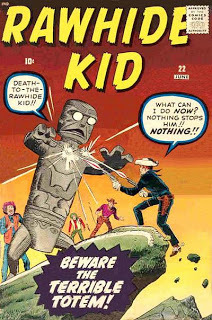
  • Kirby modeled the Terrible Totem on totem poles (duh) from the northwest, not kachinas from the southwest.

  • Beware Terrible Totem Rawhide Kid Tale By Jack Kirby


  • When Kirby took over the Green Arrow series in the mid-1950s, he turned Green Arrow and his sidekick Speedy into Batman and Robin clones. He downplayed or ignored Speedy's Navajo origin--not what you'd expect if he was infusing everything with Native lore.

  • Kirby was only briefly involved with Spider-Man. His version was a gadget-using guy like the Human Fly, with suction cups and a web gun. It was the opposite of a nature- or mythology-based spider hero.

  • Stan Lee was involved in the creation of all the heroes mentioned, so it's doubtful how much rein Kirby had to use his alleged interest in the Hopi.

  • Nixon claims the heroes derived from Navajo, Zuni, and Ojibway legends. None of these are Hopi. How could their legends influence Kirby if he was interested in the Hopi? Learning about one tribe doesn't make you an expert on several hundred other tribes.

  • The Fantastic Four's power almost certainly came from the Greek belief in the four elements: air, water, fire, and earth.

  • Kirby's Fourth World

    I'll concede that the Hopis' "fourth world" concept may have inspired Kirby. The basic idea of worlds dying and being reborn could be Native, even if the details aren't. The other claims seem farfetched.

    But Kirby probably had some familiarity with Native lore. As much as the average American, at least. He drew all kinds of comics, especially Westerns, where Indians were bound to appear.

    A few instances:

  • Kirby created or co-created Wyatt Wingfoot and his Keewazi tribe in Fantastic Four #50. Wingfoot was one of the first modern-day Indians in comics.

  • He pitted the Fantastic Four and Wingfoot against Tomazooma in Fantastic Four #80. Tomazooma was a giant robot based on Keewazi legend. It vaguely resembled a Hopi kachina.


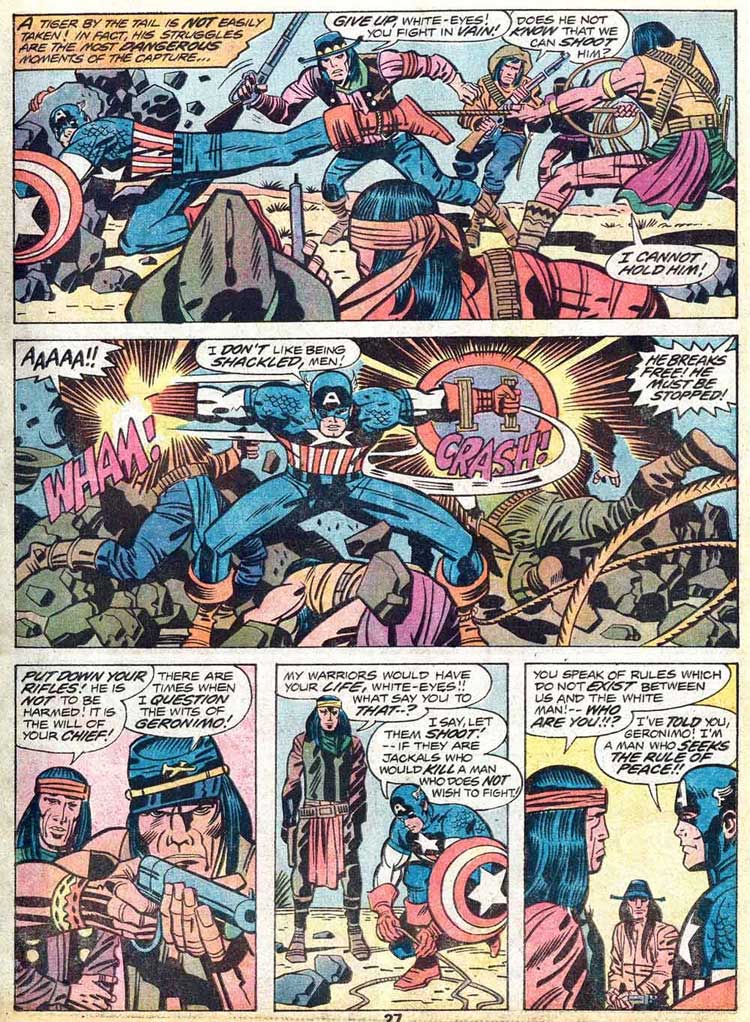
  • In Captain America's Bicentennial Battles, Kirby had Captain America meet Geronimo. Cap tries to stop a battle between the Apaches and the US Army.

  • And Now, Bicentennial Kirby Captain America--Lost In Time!


  • Kirby's Eternals series was based on the "ancient astronauts" premise--the idea that aliens came to earth long ago and aided nascent civilizations, especially those in the Americas. The series begins with an archaeologist discovering alien artifacts in an Inca tomb.

  • Whether these few examples signify a special interest in Indians is hard to say. These are a few comics out of the thousands Kirby produced. Probability suggests Indians should've appeared about 1% of the time, so that's all this may be.

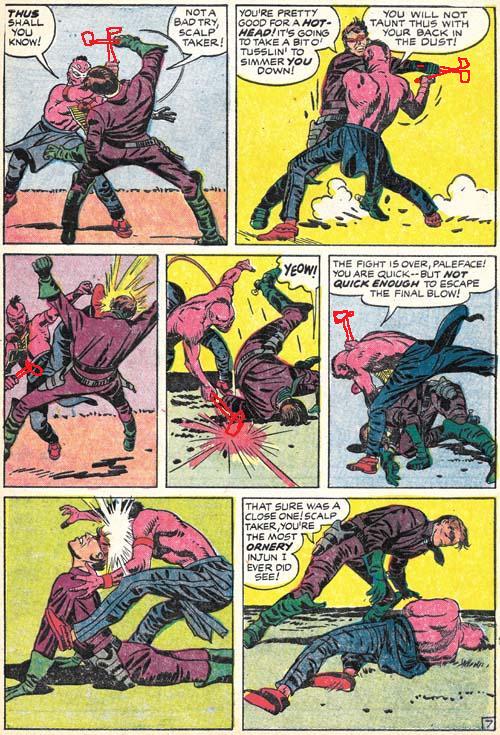
    Here's a note about a Western comic by Kirby featuring Indians:

    Bullseye #6, The Missing Tomahawks

    September 16, 2013

    "Lizard People" of Los Angeles

    Who Were the 'Lizard People' of Los Angeles?

    A 25,000-year old civilization?

    By Terrence Aym
    Long before Los Angeles existed…long before the Spaniards built missions along the western coastline…and long before any European set eyes upon the Pacific ocean from the western shores of America, the Lizard People roamed the land—both above and below the earth.

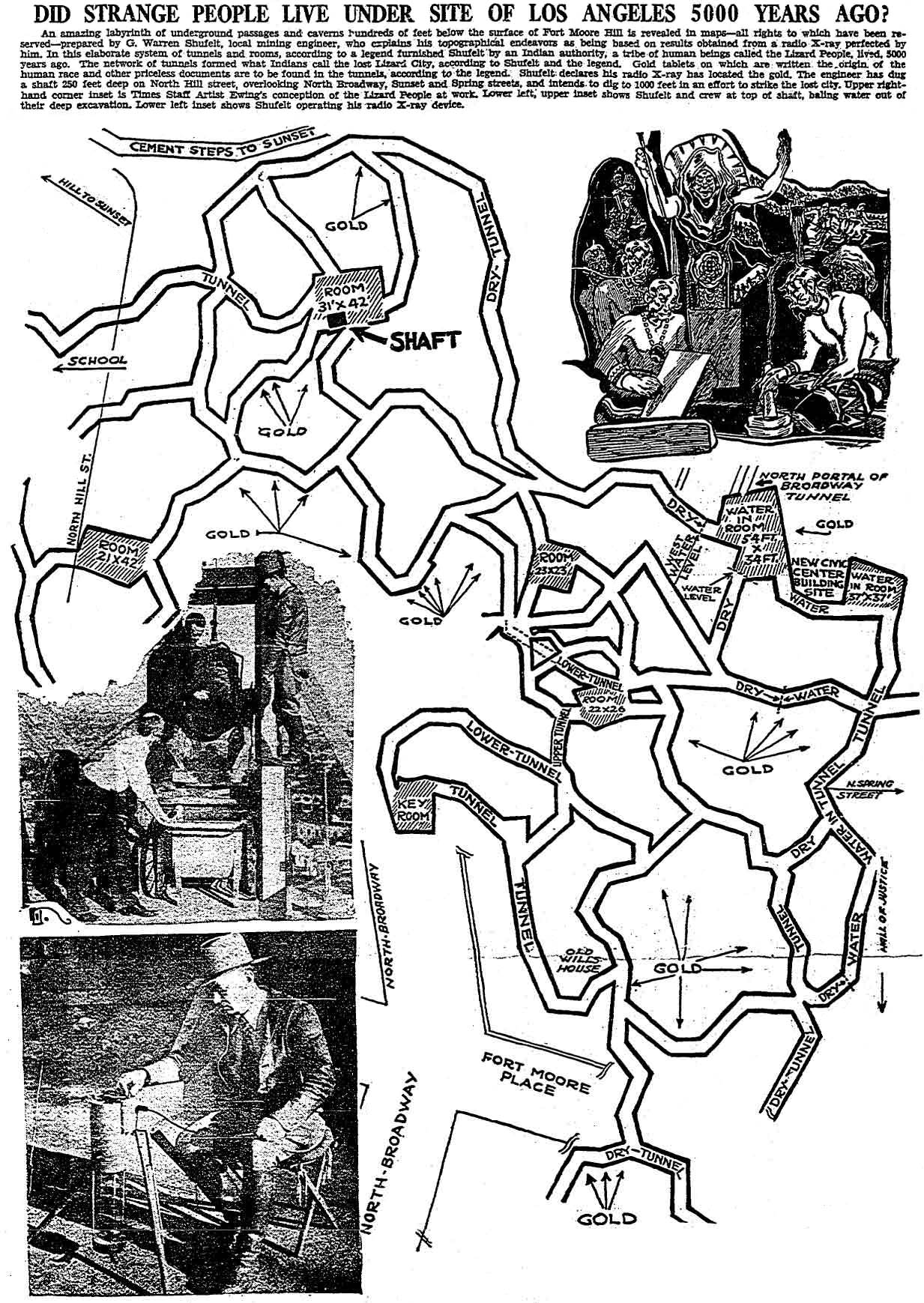
    The Lizard People built a maze of intricate tunnels deep underground. Their subterranean passageways lay far beneath the earth for thousands of years until the tunnels were accidentally discovered in 1933 by a California engineer named G. Warren Shufelt.

    The engineer had invented an odd device he called a "radio X-ray." While prospecting for precious metals with the instrument he discovered a strange labyrinth of tunnels.

    Who were those mysterious people—those Lizard People of the underground realm? The Hopi Indians knew and related legends that provided some clues.

    A 25,000-year old civilization?

    When Shufelt learned that the Hopi Indians possessed knowledge about the strange tunnels he'd discovered, he traveled to Arizona and met with an elder of the tribe: Little Chief Greenleaf.

    Greenleaf (whose Westernized name was L. Macklin) shared an amazing tale with Shufelt.

    The chief told Shufelt that the L.A. engineer had stumbled upon one of the three great lost cities built along the Pacific coastline thousands of years in the past.

    Presumably,eons before the ancient Sumerian civilization rose 7,000 years ago, the Lizard People were already long settled in North America and had an advanced, flourishing civilization centered around trade between three giant coastal city-states. Greenleaf said that the remnants of the civilization that Shufelt found under the city of Los Angeles had been shelters built to protect the people from meteoric firestorms. Such a storm had destroyed parts of their cities when a huge fire came unexpectedly from the southwest.
    Comment:  I mentioned this story a long time ago--on my website, before I had a blog. This 2010 article covers the same subject in more detail.

    Paper trail

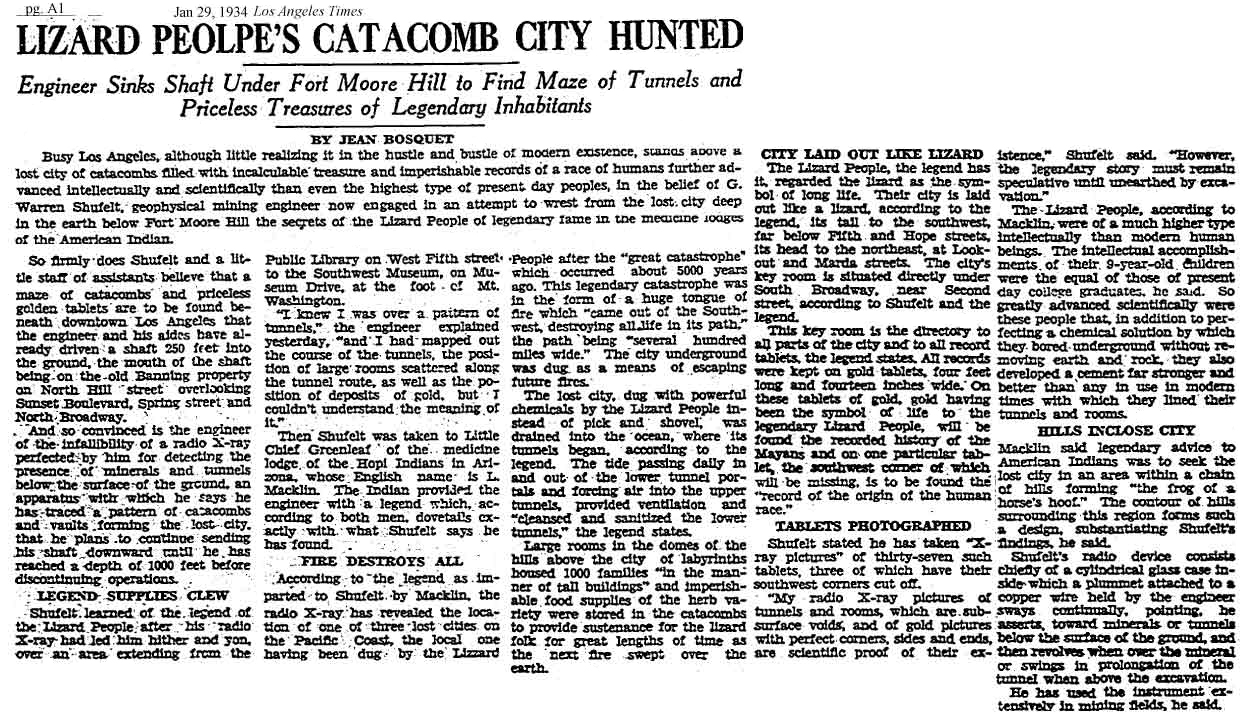
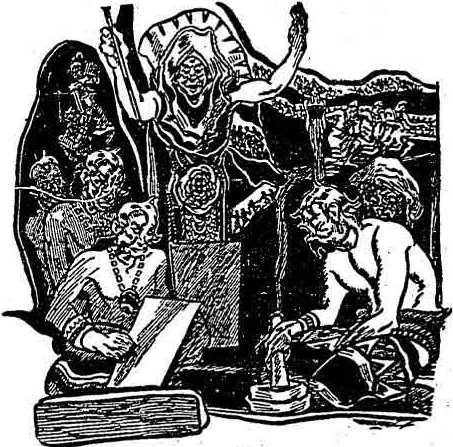
    I presume Aym got the story from the LA Times article he mentions--dated January 29, 1934. His article is mostly a rewrite of that article (below).


    As you can see, the old article really exists. In fact, the LA Times has articles going back to 1897 about treasure buried beneath the city. In 2009, the paper revisited the subject:

    Gold Hunters Dig for Lost Underground Empire of the Lizard People!

    By Larry HarnischI thought it would be fun to explore the story of the "Lizard People," which is to say the excavations on Fort Moore Hill in an unsuccessful search for gold. G. Warren Shufelt usually gets the credit for the enterprise, but his partners deserve equal attention. The Times reported that Rex. I. McCreery and Ray Martin provided an ancient parchment map showing the Lizard People's underground empire, which allegedly stretched from the Central Library on 5th Street to the Southwest Museum, which you must admit is a lot of digging.

    Earlier Times clips report that Shufelt had been a mining engineer employed by a mine in Kingman, Ariz., so evidently he was legitimate. Unfortunately, The Times' stories about the gold excavation are vague and conflicting about the origin of the map. Most stories say it belonged to McCreery and Martin, who presumably brought in Shufelt as a partner because he was a mining engineer. Our later story says Shufelt got the map from "Little Chief Greenleaf" alias L. Macklin.

    Aug. 15, 1897: An early story about gold buried on Fort Moore Hill.

    March 3, 1933: Gold hunters are excavating directly over the Broadway tunnel, a long-gone downtown landmark that was just north of the Hall of Justice. Evidently they didn't question why the crews digging the tunnel didn't find anything.

    March 4, 1933: Gold hunters consult their ancient map.

    March 7, 1933: Onlookers apparently heckled the diggers.

    March 9, 1933: They're close!

    March 27, 1933: The hunters are secretive about their map, attributing it to the Spanish rather than the Lizard People.

    April 10, 1933: The Board of Supervisors allows digging to continue.

    Sept. 7, 1933: Shufelt, McCreery and Martin have given up, but Alfred Scott comes forward to carry on the search.
    Spaniards or Lizards?

    Buried treasure is one thing, but the long article on January 29, 1934, raised the story to a whole new level. I think it's the only one to claim "Lizard People" rather than Spaniards buried a treasure:

    Did Ancient Lizard Cult Hide Gold Tablets in Tunnels Under L.A.? Jan. 29, 1934

    You also can read it here: Lizard People's Catacomb City Hunted


    That wasn't quite the end of the story. Harnisch's roundup of LA Times articles continues:Dec. 22, 1938: Times columnist Ed Ainsworth takes a look at various legends of lost California gold as engineer Roger J. Adams begins digging. According to The Times' clips, a fair amount of dirt from Fort Moore Hill was used as fill during construction of Union Station. The job was done mostly by hand, with men using picks and shovels as a public works project to provide jobs during the Depression.

    Sept. 21, 1949: Demolition of the Broadway tunnel failed to reveal any buried gold.
    This certainly is a colorful story. But "Little Chief Greenleaf" isn't a Hopi name, so the Native portion of it rings false. No doubt someone concocted the whole "Lizard People" thing.

    Shufelt may have invented the so-called Hopi legend himself. Perhaps he felt a need to explain his failures--e.g., "The tides washed out the Lizard People and collapsed the tunnels." Or perhaps people weren't paying enough attention to the and he felt a need to spice it up.

    For more on lost civilizations, see Lost Mesa in Fablehaven and Indiana Jones's Criminally Bad Archaeology.

    August 21, 2013

    Hopi in Human Fly #18-19

    My good buddy Ron Joseph posted this to the Blue Corn Comics page on Facebook


    This comes from Human Fly #19 (March 1979), the last issue of the series.

    I bought the first few issues of Human Fly, but quit before Human Fly #18-19, which apparently was a two-parter featuring Indians.

    You can see Indians and a pueblo in the cover of #18 below. The Hopi had homes like this once, but now I believe you can see them only at Taos Pueblo in New Mexico.


    Another page provides an idea of the story:This time, the Fly and crew are at a Hopi Indian reservation, and the tribal elders are all drunks under the thumb of the local bar owner (hey! *i* didn't write this!).

    The Elders are shaken out of their stupor when a member of the tribe uses a movie projector to display the Hopi Gods on the clouds during the Human Fly's stunt.
    See the first image.

    Analysis

    Sotuknang is the name of the chief Hopi deity--akin to the "creator." But I think he's an abstract force, not a god in a human form. Spider Woman does appear in human form sometimes, but I think she's more of a holy being than a god. She might be akin to an angel in Christianity--i.e., someone who intervenes on behalf of the gods, but isn't a god herself.

    Traditional Hopis did wear scarves around their heads, but not narrow headbands. I'm pretty sure they didn't wear hats with feathers. By 1979, their clothing was almost totally Western.

    The plot sounds phony. The Hopis' reservation is in the middle of nowhere. I don't think they permit alcohol on the rez, and there are no local bars just outside the boundaries.

    The Hopi "elders" live in three villages separated by 15 or 20 miles. This is in a tribe that must've had 5,000-plus members in 1979. The point is that one white man couldn't control or even reach all the elders. And if somehow he did, there would be thousands of other Hopis to contend with. Not to mention the tribal government, the tribal police, the Bureau of Indian Affairs, and so forth.

    The "projected gods"

    I don't know how the plot unfolds, but based on the clues, I can guess. Cha'tima is an earnest or angry young Indian who opposes the bar owner. She tries to rally the others, but no one will listen to her. In desperation, she projects images of the Hopi gods in the sky.

    Seeing and perhaps hearing these "gods," the other Indians gain courage and resolve. They throw away the booze and confront the bar owner. With the Human Fly's help, they toss him in jail or kick him off the rez.

    If this isn't the exact plot, it's the plot of many similar stories. Let's take a minute to see why it's flawed.

    For starters, many Indians have converted to Christianity. Perhaps even a majority. On the Hopi rez, I believe Mormonism is predominant.

    True, the traditional gods and beliefs coexist with the Christian God. But as I indicated before, there's no standard representation for Hopi deities. I don't think there's even a standard list of gods everyone agrees on. Different villages, clans, and societies have different beliefs.

    Between Christianity and the lack of uniform beliefs, I doubt most Hopi would recognize the projected images. They'd say, "Who's that supposed to be?" Or, "Whoever that is, it's not Jesus."

    But let's say everyone recognized the images. Perhaps the "gods" announced themselves with projected voices. Would that be enough to spur the Indians to act?

    Well, if Jesus appeared in the clouds and ordered white Christians to confront a bar owner, would they? Some might, but many would recall recent movies such as Star Wars and Star Trek: The Motion Picture. They'd probably realize the stunt was a cinematic special effect, not a genuine apparition.

    There's no reason for Indians to react differently. So let's hope they realized Cha'tima was manipulating them but rallied anyway. If they rallied because they believed the projections were real, that's bad. It would imply Indians are more gullible and superstitious than non-Indians.

    Conclusion

    Human Fly #18-19 seem like typical comic books from the 1960s and 1970s. The Indians are good--"noble savages" of a sort--while white men are the villains. The stories avoid Plains stereotypes and cliché, but the Indians are isolated, primitive, and easily manipulated. There's no hint that they're modern people who go to school and work, drive cars, watch TV, etc.

    The writer's intent was as noble as the Indians he wrote about, I'm sure. He wanted to explain why they were downtrodden and lost--because of the white man's oppression. And to show them rebounding and taking charge--with the help of a white savior. It probably didn't occur to him that they were already doing okay: electing officials, signing agreements for water and coal, hiring lawyers, arguing with their Navajo neighbors, lobbying for help in Washington, etc.

    People need to get over the idea that a reservation means a few dozen Indians huddled in a small village. Living as they did at the beginning of the 20th century with no technology except maybe trucks and guns. Having no contact with the outside world except when white men come to exploit or rescue them. That's simply wrong.

    For more on Native-themed comic books, see Yakari the Noble Savage and Scooby-Doo Meets Native "Shaman."

    July 15, 2013

    Auctioned mask returned to Hopi

    Sacred object handed back to Hopi tribe after ‘shameful’ Paris auctionIn a historic handover ceremony, an object sacred to the Hopi people has been returned to Hopi after dozens of katsinam (‘friends’) were sold at a Paris auction house in April 2013 despite repeated requests and litigation.

    Representatives of tribal rights organization Survival International and lawyer Pierre Servan-Schreiber returned the katsina to Hopi.

    The katsinam are of cultural and religious significance to the Hopi, who were vehemently opposed to the auction and asked the Paris auction house Neret-Minet Tessier & Sarrou to cancel the sale on the grounds that the objects are considered sacred to Hopi.
    After failing to stop the auction:M. Servan-Schreiber then bought one katsina at the auction to return it to the Hopi. He said, ‘It is my way of telling the Hopi that we only lost a battle and not the war. I am convinced that in the future, those who believe that not everything should be up for sale will prevail. In the meantime, the Hopi will not have lost everything since two of these sacred objects* have been saved from being sold.’

    A second katsina was acquired by the family of the deceased French singer Joe Dassin, and will be returned to the Hopi later this year.
    Comment:  For more on the subject, see Auction House Sells Hopi Masks and Auction House vs. Hopi on Masks.

    Below:  "The katsina was handed over to Hopi chairman and religious leaders by lawyer Pierre Servan-Schreiber and Survival International's Jean Patrick Razon (no photography was allowed during the handover itself)."

    June 10, 2013

    Navajo and Hopi protest Escalade

    Navajo and Hopi oppose plan dubbed the Escalade

    By Katherine SaltzsteinConfluence Partners, LLC of Tucson, Arizona hopes to build a museum, restaurant and walking path at the Grand Canyon with a gondola connecting the rim to the Canyon floor.

    Dubbed the Escalade, the project, which would begin on Navajo land on the western rim of the canyon, has met with mixed reactions. Confluence Partners say it will create jobs and revenue for the tribe. But some Navajos oppose the plan and the Hopi Tribe passed a resolution opposing it. Also, the National Park Service does not approve of projects in the canyon and some environmental groups have spoken out against it.
    Dueling views:“The Canyon was and still is home to several Native American tribes including the Hopi, Havasupai, Hualapai, Kaibab-Paiute, Navajo and Zuni,” the Hopis said in the press release. “Sacred sites dot the river and canyons, one of the most important areas being the confluence where the Colorado River meets the Little Colorado River. The sacred area serves as a connection to the Hopi tribes’ ancestral past and is home to ceremonial trails, shrines and ruins.

    Driven by the lure of tourist dollars, the Confluence Partners is threatening the beauty of this natural wonder While they expect a large economic impact to come from the development, it is clear that the developers value the potential dollars to be made from this sacred area rather than respecting the beauty and sanctity of a pristine location that is so dear to many tribal communities.”

    The resolution states that many Navajos oppose the Escalade project along with a river guide company, the Grand Canyon Trust, and local groups formed to oppose it.

    The Hopis urge people to oppose the plan and say “construction of the Grand Canyon Escalade will irreversibly compromise this natural wonder for many generations to come.”

    Asked about the Hopi tribe’s objections, Hale said “Escalade is not close to the Hopi sacred sites. The majority of their sites are along the Salt Trail within the Little Colorado gorge and their other sites on the Colorado River are significantly downstream of Escalade. The Sierra Club offers a Salt Trail trip. Strangely enough the Hopi have remained silent.”

    “The Salt Trail on the Navajo Reservation is our route into the Grand Canyon and is an ancient one used by the Hopis, Navajos, Prehistory puebloans and prospectors,” Hale continued. He added that “our days will be spent enjoying seldom-seen views of spectacular scenery unparalleled in the world.” The Grand Canyon has been inhabited for about 13,000 years, Hale said and “tools figurines, petroglyphs, pictographs, baskets, pithouses, and other archaeological artifacts have been found sprinkled throughout the area. Archaeologists estimate that there are 50,000 archaeological sites distributed throughout the Canyon and prehistoric ruins can be seen along our route.”
    Comment:  Naturally, I side with the presevationists on this issue. Once you develop something, it's almost impossible to undevelop it.

    For more on the Grand Canyon and tourism, see Tightrope Walk Over Grand Canyon Planned and Navajos Split on Grand Canyon Flights.

    Below:  "Navajo water walkers, Save the Confluence, are struggling to protect the pristine region at Bodaway Gap, Arizona, the Confluence, on the Navajo Nation, where the Colorado and Little Colorado Rivers meet. They walked to Window Rock this week to protest a plan to develop the area for tourists. Those leading the assault on the Dine' sacred area include former Navajo President Albert Hale who resigned during a financial corruption probe and was appointed to the Arizona legislature by the governor to fill a vacancy."

    April 12, 2013

    Auction house sells Hopi masks

    Despite objections from Hopi tribe, Native American masks sold off at auction in France

    By Thomas AdamsonIn a chaotic auction repeatedly interrupted by protests, dozens of Native American tribal masks were sold Friday after a French court ignored the objections of the Hopi tribe and the U.S. government.

    The total tally was 931,000 euros ($1.2 million), with the most expensive, the "Mother Crow," selling for 160,000 euros ($209,000)—more than three times the pre-sale estimate.

    Of the 70 masks up for sale, one was bought by an association to give back to the Hopis, the Drouot auction house said.

    Advocates for the Hopi tribe had argued in court the masks have special status and are not art—they represent their dead ancestors' spirits. The Hopis, a Native American tribe whose territory is surrounded by Arizona, nurture the masks as if they are the living dead.
    Hopi tribe masks fetch record prices at Paris auctionOne buyer who acquired four masks said he was delighted to be adding to his collection of Hopi artefacts.

    "One day I might give some back," the collector, who declined to be identified, told Reuters news agency.

    "But if it had not been for collectors in the 19th Century who contributed to the field of ethnology, there would very little knowledge of the Hopi."

    Two museums in Arizona and members of the Hopi tribe had demanded the sale be called off.

    The actor Robert Redford has also been supporting the 18,000-strong Hopi tribe and describes himself as their "close friend."
    Comment:  For more on the subject, see Auction House vs. Hopi on Masks and French Plan to Auction Hopi Masks.

    Below:  "An American exchange student, member of the Hopi tribe, Bo Lomahquahu, speaks to the media as he protests outside of the Druout's auction house to protest the auction of Native American Hopi tribe masks in Paris, Friday, April 12, 2013. A contested auction of dozens of Native American tribal masks went ahead Friday afternoon following a Paris court ruling, in spite of appeals for a delay by the Hopi tribe, its supporters including actor Robert Redford, and the U.S. government." (AP Photo/Michel Euler)

    April 09, 2013

    Auction house vs. Hopi on masks

    Hopi Katsinam Auction in Paris: A Conversation with the Auctioneer

    By Dominique GodrecheOn Friday, April 12, the Parisian auction house Néret-Minet Tessier & Sarrou plans to sell 70 Hopi katsinam, commonly referred to as masks, to the highest bidder. This sizable auction of objects considered sacred by the Hopi has created quite an international furor, with Hopi and other Natives, as well as museum curators, calling on the auction house to cancel the auction and return the pieces to the Hopi.

    Auctioneer Gilles Néret-Minet has found himself at the center of the controversy. He has received a stream of angry correspondence, and even threats. He spoke with an ICTMN reporter on the condition that his words not be changed. We have attempted to keep the responses below as close as possible to Néret-Minet’s original French answers.

    Does all this buzz about the sale change your plans?

    No--because France is a country of rights! All the mail in the world will not change anything. I am answering through my lawyer; and either I get the auction, or I do not. But if not, it would be a reconsideration of the nature of private property in France, which would have a huge impact on this issue. These objects are not “protected” in France, or in Europe. Only in the United States; and particularly in those two states, Arizona and New Mexico, where the Hopi tribes live. Also, those masks are only sacred when used in a dance. They are not sacred afterward. They are put aside, or destroyed. So the Hopi want to claim these objects, and we don’t know where they will go--they might just disappear. This is unbelievable! If they can claim these objects now, then African art is over, and the Cluny museum [of medieval objects, in Paris] would give back all of its pieces to the churches. If we are questioning the principle of “religious art,” we should question the entire notion of art. I think this issue should be addressed to the Americans, and that is what the New York Times article says: There is no bi-national agreement of restitution. That’s it!
    And:Then you maintain that the tribe’s position is not legitimate?

    It is extremist! And legally, France is not a province of the United States! We cannot apply North American law in France. Moreover, before asking for the return of items from France, they should ask the American museums to return their pieces. The same with the American collectors. Because all those collections come from the United States, from the 19th century: they are not from the '70s. Many Native Americans sold their masks, and so did the missionaries who were converting them.

    How do you feel about the comparison of these Hopi items with art looted by Nazis in World War II?

    Oh yes, I did receive some letters like that, where I was treated in an extremist way. But it has nothing to do with this issue: Hopis used to sell their masks to the tourists! And now about a dozen Hopis are in jail for having sold masks. Like in Africa, all that comes down to business. If the Natives would deal with experts, they would have exhibitions in the great museums, and that would honor their culture.
    Sounds sort of definitive, right? US law doesn't apply to France? Read on.

    You Can’t Convey What You Don’t Have

    By C. Timothy McKeownMonsieur Néret-Minet might be interested in knowing that a number of US Federal laws may also be implicated in the proposed sale. Taking the auction house representative’s statement that the items were “legally” bought in the US on its face, we can assume that none of the masks–many of which have been identified by the Hopi Tribe as objects of ongoing historical, traditional, or cultural importance central to the tribe and which could not be alienated, appropriated, or conveyed by any individual–were obtained after 1990 from tribal lands or from a museum receiving Federal funds. Section 4 of the Native American Graves Protection and Repatriation Act (NAGPRA) made the sale, purchase, use for profit, or transport for sale or profit of any such cultural items a criminal offense. To date, 13 individuals have been convicted of trafficking items similar to those being offered at the Paris auction. Most were fined and the cultural items confiscated and repatriated. Several were also imprisoned. The list of convicted criminals includes mostly tribal members, intermediaries, and dealers in the American Southwest. Missing are the collectors who fuel the market, though several have stepped forward, including one reportedly connected to the Hollywood community, to aid the law enforcement and avoid prosecution themselves.

    Taking the auction house representative’s statement that the items were legally bought in the US on its face, we can also assume that none of the masks over 100 years old were sold, purchased, exchanged, transported, received, or offered for sale, purchase, or exchange in interstate or foreign commerce after 1979 in violation of any provision, rule, regulation, ordinance, or permit in effect under Federal, State, local, or tribal law. Section 6 of the Archaeological Resources Protection Act makes such transactions a criminal offense.

    Finally, to accept the conclusion that the masks were legally acquired under US law, we must assume that none of the masks were originally purchased or received from an Indian in Indian Country between 1796 and 1953. Section 9 of the Act to Regulate Trade and Intercourse with the Indian Tribes and to Preserve Peace on the Frontiers (and its successors) made such transactions involving articles of clothing a criminal offense. A court explained in 1911 that “the whole purpose [of section 9] was to prevent the Indian from improvidently parting with his indispensable articles, either to the government or to anyone else.”
    And:To summarize: 1) all of the masks are dated to the period prior to 1953, meaning that their original acquisition was not just reprehensible to the tribes involved, but a violation of the Federal restriction on acquisition of articles of clothing from Indians; 2) under US legal principles, no subsequent purchaser of the masks acquired good title since good title was not conveyed by the original thief; 3) under US law, the burden of proof rests with the non-Indian whenever the Indian makes out a presumption of title in himself; and 4) the most recent acquisition of the masks by Monsieur L.S. may have also violated specific criminal provisions of ARPA and NAGPRA.

    The refusal to respond to the Hopi Tribe, delay the auction, and provide documentation regarding the provenance of the masks to the tribe and US authorities not only casts a cloud on Monsieur L.S.’s title to the masks he is trying to sell, but also raises suspicions regarding the honesty of Néret-Minet Tessier & Sarrou’s efforts to peddle such items.

    And to potential buyers:

    Caveat emptor.
    The legal outcome

    Friends of the Hopi filed a suit and a Paris judge ordered a hearing, as you can see below. That means the legal issues weren't so flimsy that the auction house could dismiss them with the wave of a hand.

    Paris Judge Orders Hearing on Auction Sale of Hopi Artifacts

    French auction firm faces court test over sale of Hopi tribal masks

    Paris Judge Sets Hearing On Auction Of Hopi Items

    Unfortunately, the judge ruled that the auction could proceed. I believe it was on narrow grounds: that there was no lawful reason to delay the auction.

    One question left unanswered: Even if Seller A obtained the items legally from Seller B, how do we know Seller B obtained them legally? And so forth back to the original owners. If any transaction along the way was illegal, the seller's present ownership is arguably illegal.

    Also left unanswered, at least from what I read, was whether the auction violated international law on trafficking in antiquities. I'd be amazed if there weren't several laws that applied to this situation.

    In other words, I doubt it was solely a matter of US law not applying to the French or vice versa. International laws apply to everyone who has ratified them.

    But I don't think the judge ruled on these issues. Or even acknowledged them. Alas.

    For more on the subject, see French Plan to Auction Hopi Masks.

    April 07, 2013

    Tightrope walk over Grand Canyon planned

    Tribes Have Mixed Feelings About Tightrope Walker Coming to the Grand Canyon

    By Anne MinardFamed tightrope walker Nik Wallenda last made headlines in June 2012 by tightrope walking across Niagara Falls. This year, he’s headed for a remote section of the Grand Canyon on the Navajo Nation—which also happens to house a site held deeply sacred by the Hopi and other tribes.

    The Discovery Channel will air the stunt live on June 23, as Wallenda tightrope walks higher than he’s ever attempted before—1,500 feet above the Little Colorado River near its confluence with the Colorado River in the Grand Canyon. His walk over Niagara Falls was only 200 feet off the ground. There’s another difference: he wore a safety harness over Niagara Falls, but will not do so over the Grand Canyon. That’s allowing publicists at the Discovery Channel to advertise the stunt as a “nail-biting” event, and “one of the most daring and captivating live events in history.”

    Navajo Nation Parks and Recreation officials say they welcome the event as a chance to showcase their portion of the Grand Canyon. The tribe operates two viewpoints along Highway 64, which runs west from Cameron, Arizona to the Grand Canyon’s oft-visited South Rim in Grand Canyon National Park.

    “Our visitation in this part of the Canyon is very low,” said Geri Hongeva, Navajo Parks and Recreation spokeswoman. “We would like families to come visit this area someday. There’s a lot of history; there’s a lot of culture there. We don’t have the budget to reach out to 13 million viewers. This is a great opportunity for us.”
    But:Not everyone is as thrilled. Leigh Kuwanwisiwma, director of the Hopi Cultural Preservation Office, said his biggest concern is a cultural one. The Hopi Tribe has identified the Little Colorado River Gorge as a significant clan migration route.

    “The Gorge and the Canyon are not about taking lives,” he said. “They’re about life, especially the spiritual lives of our ancestral people.”

    Kuwanwisiwma said when a base jumper died in the area last year due to a parachute failure, it presented a cultural burden to the Hopi people—and, he suspects, to the Navajos living nearby.

    “We were told that this guy is not wanting to wear a safety harness,” Kuwanwisiwma said. “What if he does fall? It’s another cultural dilemma for the Hopi people.”
    Comment:  Actually, Wallenda walked a tightrope in Atlantic City in August 2012 and in Sarasota, Florida, in January 2013. Niagara Falls wasn't his last headline performance.

    For more on Indians and the Grand Canyon, see Top Chefs Cook for Hualapai and Navajos Split on Grand Canyon Flights.

    Below:  "Tightrope walker Nik Wallenda plans to walk across a section of the Grand Canyon held sacred by the Hopi and other tribes on June 23."

    April 02, 2013

    French plan to auction Hopi masks

    French plan to auction Hopi masks stirs furor

    A French auction house will auction off this Hopi kachina face depicting Crow Mother.

    By Dennis Wagner
    The Heard Museum and the Museum of Northern Arizona have joined Hopi cultural officials in urging a French auction house to cancel the planned sale this month of about 70 ceremonial kachina faces, known to tribal members as “friends.”

    In Hopi theology, kachinas are supernatural messengers depicted in fantastical costumes worn during religious ceremonies. There are several hundred spirit characters in the pantheon representing wildlife, plants, human qualities, weather and other facets of nature or society.

    Also known as katsinas, these characters are more commonly depicted in smaller form as carved doll-like figures.

    Plans to auction the dramatic facial representations on April 12 spawned a protest from the Hopi Cultural Preservation Office and calls for the French government to intercede.

    The Museum of Northern Arizona’s director, Robert Breunig, posted a letter Friday to the Paris auction house on Facebook, urging that the iconic, masklike visages be returned to Hopis of Arizona and the related New Mexico pueblos of Acoma, Zuni and Jemez.

    “I can tell you from personal knowledge that the proposed sale of these katsina friends, and the international exposure of them, is causing outrage, sadness and stress among members of the affected tribes,” Breunig wrote. “For them, katsina friends are living beings. ... To be displayed disembodied in your catalog, and on the Internet, is sacrilegious and offensive.”
    Museums join United States tribe to oppose Paris artifact sale at Neret-Minet Tessier and SarrouTwo museums in the southwestern US state of Arizona have joined an effort by Hopi cultural officials to halt the sale of sacred Hopi kachina artifacts at a Paris auction house next week.

    In messages on social media, the Heard Museum and the Museum of Northern Arizona said the scheduled April 12 sale by Neret-Minet Tessier and Sarrou has triggered outrage within the indigenous Hopi community.
    And:Robert Bruenig, director of the Museum of Northern Arizona, appealed for the objects' return to Arizona, in an open letter to the auctioneers posted on the Flagstaff institution's Facebook page.

    "The proposed sale of these katsina friends, and the international exposure of them, is causing outrage, sadness and stress among members of the affected tribes," he said, using an alternative spelling for kachina.
    Comment:  For more on the Hopi, see River Phoenix as Hopi Indian and Kachina Video Game.

    February 20, 2013

    River Phoenix as Hopi Indian

    River Phoenix Plays Indian in Never-Seen Film 'Dark Blood'Twenty years after his death, River Phoenix is hitting the screen one last time in Dark Blood, an unfinished film in which he plays a Hopi Indian.

    Phoenix died with just a few weeks of shooting remaining, and, as recounted in a Reuters report, the film's negatives were comandeered by the production's insurers. In 1999, they were about to be destroyed, but director George Sluizer was able to swoop in and save them. A few more years went by, and in 2007, following an illness, Sluizer resolved to finish what he'd started. A version of the film--stitched together with still photography and voiceovers--is now being shown.

    In the film, Phoenix plays a hermetic part-Native widower who develops an obsession for stranded traveler (played by Judy Davis), despite the presence of her husband (Jonathan Pryce). As described in a Hollywood Reporter review of the film from the Berlin International Film Festival, Dark Blood is "an engagingly modest low-key thriller, a curio item that’s half art house, half genre-jumper and entirely watchable despite the absence of several key scenes."

    Also appearing in the film are Native actors T. Dan Hopkins, John Trudell, Julius Drum, Rodney A. Grant, and George Aguilar, according to its entry at IMDB. Reports suggest that a theatrical release is unlikely, but it may see further showings at festivals and an eventual DVD release.
    Comment:  I guess they could excuse casting Phoenix by saying the character is only part Native. That's a common tactic used to avoid casting minority actors. But it's still wrong.

    For more on casting issues, see Depp "Too Pretty" to Play Natives?! and Revolution and TV Diversity.

    October 14, 2012

    Kachina video game

    Debbie Reese writes about a children's video game in her Americans Indians in Children's literature blog:

    Ben Esposito's "Kachina"IndieCade, or, the International Festival of Independent Games was held last week, October 4-7, 2012.

    Ben Esposito's "Kachina" (which I gather is still in development) was designated as a 2012 Official Selection. Here's a screenshot from the website:
    Here's what the description says. See, in particular, the text I put in bold:

    Kachina is a physics-based toy that evokes Katamari Damacy's sense of order & scale mixed with Windowill's childlike wonder. Drawing as readily from Hopi folklore as it does Bruce Springsteen, Kachina invites you to play with the creatures and artifacts of North American mythology.
    Reese sums up what's wrong with this game:Esposito and the IndieCade people who selected it as an Official Selection must not know that teepees and totem poles have nothing to do with the Hopi people. They obviously have no idea what kachinas mean to the Hopi people, and they also likely have no idea that calling the religious traditions of an Indigenous people "folklore" is derogatory.Comment:  We should note that Hopi isn't the only tribe with kachinas. The Zuni and few other Pueblo tribes have them as well.

    Looking at the video of the game, there seems to be no Native content besides the teepee and totem pole. No kachinas, which is good, since the Hopi undoubtedly would object. No other artifacts. Maybe a couple of animals.

    Basically, it looks like there's no justification for the "Kachina" name. Or for the summary implying the game has substantial Native content. The Native concept appears to be a gimmick to make the game seem more educational and meaningful than it really is.

    For more on Native video games, see Assassin Creed 3's Mohawk Origin and Evolution Video Game Features Lakota.

    July 22, 2012

    No such thing as rain dances

    A Navajo blogger discusses the drought afflicting the US and whether Natives can summon rain.

    I Know Why a Rain Dance Won’t End The Drought

    By Johnny P. FlynnThe biggest fire in Arizona history is slowly burning itself out and Colorado has seen fires devastate the fringes of urban areas south of Denver.

    The American consumer is looking at higher prices as corn crops across the Midwest are dying in the fields. This is the context in which Secretary of Agriculture Tom Vilsack recently said: “I get on my knees every day... and I’m saying an extra prayer now. If I had a rain prayer or a rain dance I could do, I would do it.”

    As an American Indian all my life I have been cursed with the myth of the “Indian rain dance.” I am here to say there is no such thing. Not in my Potawatomi tribe or in any other tribe across the Americas.
    And:The weather pattern, called the ‘monsoon’ in Arizona, is predictable (monsoon actually comes from the Arabic word for season). Arizona’s monsoon may deposit only a few tenths of an inch of rain, but there may be 2-3 storms a week in the dry summer, just enough to water the corn at a critical time in its growth cycle.

    Because the Hopi plant their crops in the mouths of washes, any runoff also waters the crops. For centuries Hopi farming techniques have utilized every drop of moisture and they remain one of the most culturally conservative native groups in the United States.

    Every summer the Hopi hold late summer dances—but not to bring the rain. Like the ax in the tree, the rain is coming or not regardless of the ax or the dance. The dances are held to welcome the rain.
    Comment:  I wouldn't swear that not a single tribe dances to attract rain. But I'll take Flynn's word for the general rule.

    Most tribes don't even have dances related to rain. So projecting the Hopi Snake (Rain) Dance onto 500 tribes is badly stereotypical.

    For more on the subject, see Cartoon:  Natives Are the Best Strippers.

    July 11, 2012

    Fred and Mary: An Unconventional Romance

    Arizona writer's 'Fred and Mary' re-creates architectural history

    By Kerry LengelIn the John Wayne view of history, the West was won by steely-eyed heroes who faced down outlaws and "Injuns" and made the frontier safe for civilization.

    A rather different vision is expounded in "Fred and Mary: An Unconventional Romance," a new historical drama by Arizona playwright Micki Shelton. It premiered Saturday, July 7, at the newly renovated Elks Opera House in Prescott.

    A character study bordering on hagiography, "Fred and Mary" is about Mary Elizabeth Jane Colter, who spent the first half of the 20th century working as an architect and designer for the Harvey Company, which brought fine dining to the Wild West at its famed Harvey Houses. A notorious perfectionist, Colter followed a philosophy of "invented authenticity" in her Southwestern designs for landmark buildings such as La Posada Hotel in Winslow and a series of tourist stops on the south rim of the Grand Canyon, including the Hopi House and the Desert View Watchtower, a 70-foot faux ruin with a hidden steel framework.

    In all her work, she aimed to honor the culture and the artistry of the Southwest's Native tribes. It was a passion she shared with company founder Fred Harvey, who died in 1901, the same year Colter got her first design commission from his heirs. History says the two never met, but in this play they do, because, as narrator "Old Mary" (Gail Mangham) puts it, "I've always invented histories for my buildings, so why not tell my story however I want?"
    But the play didn't blow away this reviewer:While "Fred and Mary" offers a fascinating history lesson, it doesn't offer much in the way of dramatic conflict. As the man with the purse strings, J.F. is no match for Mary's prickly determination, and far too affectionate of her to serve as a proper antagonist anyway. We do hear a fair amount about Colter's struggle for recognition, both for herself and for the Native artists she championed, but her only real enemies, sexism and racism, remain offstage abstractions.

    Onstage, the only character who is Mary's equal in talent and ambition is the imaginary Fred (Jonathan Perpich), but rather than challenging her in any way, and despite the "romance" promised in the title, he is more of a kindly father figure.
    Apparently the play also includes a prominent Hopi character:

    Fred and Mary: An Unconventional Romance opens this weekend

    Play focusing on architect Mary Colter and artist Fred Kabotie runs July 6-8 and 13-15 at the historic Elks Opera House in Prescott

    By David Yankus
    Straddling the border between historical and alternate realities, their story is interwoven with the beauty and culture of the indigenous people of the Southwest. Among the most vibrant examples of their vision are those at the Grand Canyon--buildings such as the Hopi House, the Watchtower, Hermit's Rest, and the Lookout Studio; which will be shown on stage through projection and lighting effects.

    Hopi artist and painter Filmer Kewanyama steps into acting for the first time to play Fred Kabotie, a Native artist who worked with Mary Colter on the Watchtower. Working with Kabotie and other Native artists, Colter recognized the Southwest's first people by introducing indigenous themes in her designs. Visitors to the Watchtower today continue to be awed by Kabotie's extensive wall paintings and remarkable sand painting, which dominates the central floor.

    After arriving in Prescott, playwright Micki Shelton found Kewanyama through his art two years ago and upon meeting with him discovered that as a young child he actually knew Kabotie.

    "Fred Kabotie is from the same village that I'm from, Shungopavi on Second Mesa," said Kewanyama. "My dad was a silversmith and an artist, and Fred Kabotie used to manage the Hopi Cooperative Guild on Second Mesa. Sometimes my father would bring me with him to help polish the silver, and that's how I would be able to see my father working and watch Fred Kabotie managing the gallery."
    Comment:  The second article mentions Fred Harvey only once and devotes the rest of its space to Fred Kabotie. This is a bit confusing. It makes one think the play is about Colter and Kabotie, not Colter and Harvey.

    For more on Native theater, see Native Performers in Cirque du Soleil and Farmer's Of Mice and Men Reviewed.

    Below:  "Cecily Overman (portraying Mary Colter) and Filmer Kewanyama (portraying Fred Kabotie) rehearse for the play."

    February 12, 2012

    Newspaper Rock threatened!

    Current events threaten 'newspaper rock'

    My blog is under attack?! Refudiate!!

    Actually, this is the same article I posted in The Hopi's "Newspaper Rock." I just liked the catchy headline.

    For more on rock art, see Red Rock Vandal Sentenced and "Not Cool" to Deface Rock Art.

    Below:  "Hopi preservationist Wayne Lomayestewa examines petroglyphs near Tuba City, Arizona." (Pauline Arrillaga/Associated Press)

    January 29, 2012

    The Hopi's "newspaper rock"

    Tribes join forces to save petroglyph site

    By Pauline ArrillagaIn the far reaches of northern Arizona, where city sprawl gives way to majestic canyons and a holy place is defined not by steeple and cross but rather by earth and sky, lies a monument to a people’s past and a symbol of the promise of peace between two long-warring Indian nations.

    The Hopi people call it Tutuveni (tu-TOO-veh-nee), meaning “newspaper rock,” and from a distance this place is just that–a collection of sandstone boulders set on a deserted swath of rust-stained land outside of Tuba City, some 80 miles from the Grand Canyon and a four-hour drive north of Phoenix.

    It is only when you step closer that you begin to understand what Tutuveni really is: a history of the Hopi Indian tribe carved into stone.

    The site contains some 5,000 petroglyphs of Hopi clan symbols, the largest known collection of such symbols in the American Southwest. According to researchers with the Hopi Cultural Preservation Office, the many etchings on the boulders of Tutuveni date as far back as far back as A.D. 1200.

    On the dark desert varnish of the boulders are rows of bear paws, corn stalks, spiders, coyotes, kachinas, clouds, cranes. Some of the symbols represent various aspects of Hopi cultural life, but most are the markings of the Hopi clans, or family systems, which are usually named for animals or other natural objects.

    The Hopi made these engravings during ceremonial pilgrimages from their land to the Grand Canyon to mark the passage into adulthood for Hopi young men.

    “They would stop at Tutuveni and camp there, and they would peck their clan symbols on those rocks to mark their participation in that pilgrimage. And they did this for four or five centuries at least,” said Wes Bernardini, an archaeologist and professor at the University of Redlands who has been studying Tutuveni for years. “When people from the same clan would visit the site, they would put their symbols next to the previous symbol that somebody had left earlier. There’s no other site that we know of like that, that shows these repeated visits.

    “It’s a very important place.”

    It is also a place threatened by modern-day vandals who view Tutuveni not as the sacred site and archaeological treasure that it is, but rather a canvas for their own graffiti.

    Scattered among the many ancient impressions are the markings of lovers, history buffs and random visitors looking to leave their mark with etchings such as: “Aaron Myrianna 07,” “The Victor 10-20-85,” “Van.B,” “Ramon Albert,” “Ariz. Hy. Dept.” Even: “1969-Man Land on Moon.”

    On one rock is a carved image of the two World Trade Center towers, with a plane heading for them. Elsewhere, clan symbols have been chiseled away or spray-painted over.
    Hopi Petroglyph SitesSite Description

    Tutuveni is an important site along the Hopi pilgrimage route to Ongtuvqa, also known as the Grand Canyon. The site lies west of the Hopi Reservation in Arizona, and within the neighboring Navajo Nation. Meaning Newspaper Rock in Hopi, Tutuveni contains 5,000 petroglyphs of Hopi clan symbols and is the largest known collection of clan symbols in the American Southwest. Among Tutuveni's 150 sandstone boulders are the records of more than 1,000 years of Hopi history and culture.

    Hopi clan petroglyphs completely cover the sides and tops of a number of towering sandstone blocks up to 5 meters tall and are found sporadically on the surfaces of smaller boulders along the base of a small mesa that forms part of the Echo Cliffs. The style of the petroglyphs at Tutuveni is remarkably consistent: iconic symbols, typically of recognizable animals, plants, or cultural items, and of moderate size (about 10x10cm). Unlike most large petroglyph sites, the symbols at Tutuveni rarely overlap. Even more atypical is the fact that the symbols appear in rows of repeated images--up to 20 or more in a line--representing repeated visits by members of the same clan.

    History

    The concentration of clear-cut clan symbols at Tutuveni, corresponding to known historic and extinct Hopi clans, is absolutely unique in the American Southwest. The site was a stopping point on a pilgrimage to the Grand Canyon undertaken by male initiates of the Hopi village (kitsoki) initiation ceremony, the Wuwtsim. Traditionally, all Hopi men underwent Wuwtsim initiation between adolescence and marriage. Ceramics associated with the site, the dating of ancestral Hopi villages in the surrounding area, and the very heavy repatination of the petroglyphs at Tutuveni point to the use of the site by ancestral Hopi populations beginning in at least the 1500s, and perhaps as early as 1200 CE. As a record of clan activity over the past several centuries, the Tutuveni site is vital in educating younger generations of Hopis about the traditional cultural history of the tribe.

    Preservation

    Considering their age and relatively close proximity to well traveled roads, the Tutuveni petroglyphs survived in a remarkably well-preserved condition into the mid-twentieth century. Unfortunately, in the last few decades, the site has suffered from increasing vandalism, including painting, scratching, and chiseling of petroglyphs. The sheer number of petroglyphs present at Tutuveni means that most of the site is still intact, but a recent study indicates that up to 10% of the symbols have been damaged. Analysis of datable graffiti shows that almost 80% of the vandalism at Tutuveni happened recently, between 1980 and 2005. In 2010, Arizona Public Services funded the installation of a fence to surround and protect the site. Fortunately, two relatively complete sets of photographs from the 1930s and 1970s allow most of the site to be digitally reconstructed back to its pristine, early 20th-century condition using the highly accurate 3D model and high-resolution photographs generated by CyArk.
    Comment:  I used to read the Hopi Tutuveni newspaper every week. That was years before I started my Newspaper Rock blog. But I didn't realize the name "Tutuveni" meant "newspaper rock."

    I was thinking of the more famous Newspaper Rock in southern Utah when I named my blog. I knew there were other "newspaper rocks," but I didn't know the Hopi had one. It's a small world after all!

    For more on rock art, see Red Rock Vandal Sentenced and "Not Cool" to Deface Rock Art.

    Below:  "Photograph of the petroglyphs along Boulder 17's north face."