Showing posts with label rock art. Show all posts

December 26, 2014

Valley of Fire State Park

After visiting my family Christmas Day in Las Vegas, I spent Dec. 26 in Nevada's Valley of Fire State Park. Unlike national parks such as Zion, Bryce, and Arches, Valley of Fire has a fair amount of Native lore.

Valley of Fire State ParkThe Valley of Fire derives its name from red sandstone formations, formed from great shifting sand dunes during the age of dinosaurs, 150 million years ago. Complex uplifting and faulting of the region, followed by extensive erosion, have created the present landscape.

Other important rock formations include limestones, shales, and conglomerates. Prehistoric users of the Valley of Fire included the Basket Maker people and later the Anasazi Pueblo farmers from the nearby fertile Moapa Valley.

The span of approximate occupation has been dated from 300 B.C.E. to 1150 C.E. Their visits probably involved hunting, food gathering, and religious ceremonies, although scarcity of water would have limited the length of their stay. Fine examples of rock art left by these ancient peoples can be found at several sites within the park.
Leaving Las Vegas….Thursday, again after a trip through Subway for sandwiches, we drove east on I-15 for about an hour to the Moapa Travel Plaza Exit. From there, it’s an easy 15 miles or so to the West Entrance to the Valley of Fire State Park. And, yes, the park is open on Thanksgiving day. What I hadn’t seen yet, and had been meaning to check out, were the thousands of petroglyphs and pictographs located in the park, only an hour east of town! Sites here have been dated between 300 B.C. to 1150 A.D. and possibly older. The narrow canyon leading to “Mouse’s Tank” contains one of the highest concentrations of petroglyphs I’ve seen in one place. Think Sand Island, Newspaper Rock, Horseshoe Canyon and The Procession Panel–linked together.

If you find yourself in Las Vegas, have ingested enough secondhand smoke, and need some peace and quiet, I’d recommend a day (or more) at Valley of Fire. You’ll find quiet, private campsites, a well done, informative visitor center and a long weekend’s worth of desert hiking. Bring your camera and binoculars. Some of the rock art panels are up high and you’ll want magnification. A side-note to fellow Star Trek fans: This is the place where Captain Kirk died in Star Trek Generations!
Comment:  This is one of the best parks I've visited--roughly equal to Zion, Bryce, Arches, Monument Valley, and Red Rock Canyon. It's well worth a day trip if you visit Las Vegas.

November 19, 2012

Petroglyph theft is "worst act of vandalism"

Petroglyph thefts near Bishop stun federal authorities, Paiutes

At least four ancient petroglyphs were cut from cliffs at the Volcanic Tableland and dozens of others damaged in 'the worst act of vandalism ever seen' on federal lands in the area.

By Louis Sahagun
Ancient hunters and gatherers etched vivid petroglyphs on cliffs in the Eastern Sierra that withstood winds, flash floods and earthquakes for more than 3,500 years. Thieves needed only a few hours to cut them down and haul them away.

Federal authorities say at least four petroglyphs have been taken from the site. A fifth was defaced with deep saw cuts on three sides. A sixth had been removed and broken during the theft, then propped against a boulder near a visitor parking lot.

Dozens of other petroglyphs were scarred by hammer strikes and saw cuts.

"The individuals who did this were not surgeons, they were smashing and grabbing," U.S. Bureau of Land Management archaeologist Greg Haverstock said last week as he examined the damage. "This was the worst act of vandalism ever seen" on the 750,000 acres of public land managed by the BLM field office in Bishop.

The theft required extraordinary effort: Ladders, electric generators and power saws had to be driven into the remote and arid high desert site near Bishop. Thieves gouged holes in the rock and sheared off slabs that were up to 15 feet above ground and 2 feet high and wide.

Visitors discovered the theft and reported it to the BLM on Oct. 31. BLM field office manager Bernadette Lovato delivered the bad news to Paiute-Shoshone tribal leaders in Bishop.

"It was the toughest telephone call I ever had to make," Lovato said. "Their culture and spiritual beliefs had been horribly violated. We will do everything in our power to bring those pieces back."
Comment:  Another horrible crime against humanity.

The article concludes:Damaging or removing the petroglyphs is a felony. First-time offenders can be imprisoned for up to one year and fined as much as $20,000, authorities said. Second-time offenders can be fined up to $100,000 and imprisoned up to five years.How about multiplying the first-time penalties by five and the second-time penalties by two? That would seem fairer to me.

For more on looting of Native sites, see Kincaid Mounds Vandalized and "Digger" Shows Promote Archaeological Looting.

February 12, 2012

Newspaper Rock threatened!

Current events threaten 'newspaper rock'

My blog is under attack?! Refudiate!!

Actually, this is the same article I posted in The Hopi's "Newspaper Rock." I just liked the catchy headline.

For more on rock art, see Red Rock Vandal Sentenced and "Not Cool" to Deface Rock Art.

Below:  "Hopi preservationist Wayne Lomayestewa examines petroglyphs near Tuba City, Arizona." (Pauline Arrillaga/Associated Press)

January 29, 2012

The Hopi's "newspaper rock"

Tribes join forces to save petroglyph site

By Pauline ArrillagaIn the far reaches of northern Arizona, where city sprawl gives way to majestic canyons and a holy place is defined not by steeple and cross but rather by earth and sky, lies a monument to a people’s past and a symbol of the promise of peace between two long-warring Indian nations.

The Hopi people call it Tutuveni (tu-TOO-veh-nee), meaning “newspaper rock,” and from a distance this place is just that–a collection of sandstone boulders set on a deserted swath of rust-stained land outside of Tuba City, some 80 miles from the Grand Canyon and a four-hour drive north of Phoenix.

It is only when you step closer that you begin to understand what Tutuveni really is: a history of the Hopi Indian tribe carved into stone.

The site contains some 5,000 petroglyphs of Hopi clan symbols, the largest known collection of such symbols in the American Southwest. According to researchers with the Hopi Cultural Preservation Office, the many etchings on the boulders of Tutuveni date as far back as far back as A.D. 1200.

On the dark desert varnish of the boulders are rows of bear paws, corn stalks, spiders, coyotes, kachinas, clouds, cranes. Some of the symbols represent various aspects of Hopi cultural life, but most are the markings of the Hopi clans, or family systems, which are usually named for animals or other natural objects.

The Hopi made these engravings during ceremonial pilgrimages from their land to the Grand Canyon to mark the passage into adulthood for Hopi young men.

“They would stop at Tutuveni and camp there, and they would peck their clan symbols on those rocks to mark their participation in that pilgrimage. And they did this for four or five centuries at least,” said Wes Bernardini, an archaeologist and professor at the University of Redlands who has been studying Tutuveni for years. “When people from the same clan would visit the site, they would put their symbols next to the previous symbol that somebody had left earlier. There’s no other site that we know of like that, that shows these repeated visits.

“It’s a very important place.”

It is also a place threatened by modern-day vandals who view Tutuveni not as the sacred site and archaeological treasure that it is, but rather a canvas for their own graffiti.

Scattered among the many ancient impressions are the markings of lovers, history buffs and random visitors looking to leave their mark with etchings such as: “Aaron Myrianna 07,” “The Victor 10-20-85,” “Van.B,” “Ramon Albert,” “Ariz. Hy. Dept.” Even: “1969-Man Land on Moon.”

On one rock is a carved image of the two World Trade Center towers, with a plane heading for them. Elsewhere, clan symbols have been chiseled away or spray-painted over.
Hopi Petroglyph SitesSite Description

Tutuveni is an important site along the Hopi pilgrimage route to Ongtuvqa, also known as the Grand Canyon. The site lies west of the Hopi Reservation in Arizona, and within the neighboring Navajo Nation. Meaning Newspaper Rock in Hopi, Tutuveni contains 5,000 petroglyphs of Hopi clan symbols and is the largest known collection of clan symbols in the American Southwest. Among Tutuveni's 150 sandstone boulders are the records of more than 1,000 years of Hopi history and culture.

Hopi clan petroglyphs completely cover the sides and tops of a number of towering sandstone blocks up to 5 meters tall and are found sporadically on the surfaces of smaller boulders along the base of a small mesa that forms part of the Echo Cliffs. The style of the petroglyphs at Tutuveni is remarkably consistent: iconic symbols, typically of recognizable animals, plants, or cultural items, and of moderate size (about 10x10cm). Unlike most large petroglyph sites, the symbols at Tutuveni rarely overlap. Even more atypical is the fact that the symbols appear in rows of repeated images--up to 20 or more in a line--representing repeated visits by members of the same clan.

History

The concentration of clear-cut clan symbols at Tutuveni, corresponding to known historic and extinct Hopi clans, is absolutely unique in the American Southwest. The site was a stopping point on a pilgrimage to the Grand Canyon undertaken by male initiates of the Hopi village (kitsoki) initiation ceremony, the Wuwtsim. Traditionally, all Hopi men underwent Wuwtsim initiation between adolescence and marriage. Ceramics associated with the site, the dating of ancestral Hopi villages in the surrounding area, and the very heavy repatination of the petroglyphs at Tutuveni point to the use of the site by ancestral Hopi populations beginning in at least the 1500s, and perhaps as early as 1200 CE. As a record of clan activity over the past several centuries, the Tutuveni site is vital in educating younger generations of Hopis about the traditional cultural history of the tribe.

Preservation

Considering their age and relatively close proximity to well traveled roads, the Tutuveni petroglyphs survived in a remarkably well-preserved condition into the mid-twentieth century. Unfortunately, in the last few decades, the site has suffered from increasing vandalism, including painting, scratching, and chiseling of petroglyphs. The sheer number of petroglyphs present at Tutuveni means that most of the site is still intact, but a recent study indicates that up to 10% of the symbols have been damaged. Analysis of datable graffiti shows that almost 80% of the vandalism at Tutuveni happened recently, between 1980 and 2005. In 2010, Arizona Public Services funded the installation of a fence to surround and protect the site. Fortunately, two relatively complete sets of photographs from the 1930s and 1970s allow most of the site to be digitally reconstructed back to its pristine, early 20th-century condition using the highly accurate 3D model and high-resolution photographs generated by CyArk.
Comment:  I used to read the Hopi Tutuveni newspaper every week. That was years before I started my Newspaper Rock blog. But I didn't realize the name "Tutuveni" meant "newspaper rock."

I was thinking of the more famous Newspaper Rock in southern Utah when I named my blog. I knew there were other "newspaper rocks," but I didn't know the Hopi had one. It's a small world after all!

For more on rock art, see Red Rock Vandal Sentenced and "Not Cool" to Deface Rock Art.

Below:  "Photograph of the petroglyphs along Boulder 17's north face."

August 13, 2011

Red Rock vandal sentenced

Teen gets prison in Red Rock graffiti case

By Jeff GermanThe desecration last year of prehistoric artwork at the Red Rock Canyon National Conservation Area sparked outrage and focused attention on the spread of graffiti throughout the Las Vegas Valley.

This week, the 17-year-old youth charged with defacing the Red Rock area received his punishment behind closed doors in federal court, ending a case that rallied the community to help remove the spray-painted graffiti.

U.S. District Judge Kent Dawson on Wednesday sentenced the unidentified youth to nine months behind bars, which he already has served. The judge also placed him on nine months of supervised release and ordered him to pay $23,775 in restitution to the U.S. Bureau of Land Management.

The defaced rock art panels on Aztec sandstone slabs and walls contain pictographs, painted symbols, the BLM estimates are 1,000 years old. One slab has a petroglyph, stone etching, that might be older.
Comment:  A nine-month sentence he's already served? A couple of years would be more like it.

For more on rock art, see "Not Cool" to Deface Rock Art and Rock Art = 3rd-Grade Doodling? For more on Red Rock Canyon, see 2010 Christmas Pix.

Below:  "Wyatt Mulvey, a volunteer with Friends of Red Rock Canyon, sprays water May 19 to restore an ancient rock art site near Lost Creek that was damaged by graffiti vandals in November." (K.M. Cannon/Las Vegas Review/Journal)

March 17, 2011

Smith's petroglyph-inspired art

Indian artist’s work joins exhibit at N.D. Museum of ArtThe North Dakota Museum of Art is featuring the work of American Indian artist Jaune Quick-to-See Smith in its current exhibit, “Language: Concrete and Abstract.”

The exhibit features drawings and prints that defined the Smith’s earliest mature work: art pieces that grew out of native tradition of picture writing. Living in the Southwest, she was surrounded by examples of petroglyphs—images incised in rock that were an important form of pre-writing, a news release from NDMOA said.

She also explored the world of pictographs or images drawn or painted on a rock face and their later expression in ledger drawings and winter counts. A handful of artists began to convert the historic picture writing traditions into contemporary art. Smith, along with Randy House, was a driving force among them.

After a time, Smith—who had relied entirely on visual symbols to tell complex stories—began to integrate traditional native imagery with contemporary symbols. A drawing might contain both tipi and truck, house and coyote story, Appaloosa and geometric symbol, mountain range and airplane.

Gradually, the work began to look less and less like traditional pictographs as ideas from the Western painting tradition crept in. This included the abstract expressionist’s loose handling of paint.
Comment:  For more on the subject, see Feminist Art with Native Themes, Pop Art at Heard Museum, and Quick-to-See Smith's Art Exhibit.

Below:  "This untitled work by Jaune Quick-to-See Smith, pastel on paper circa 1980, is on exhibit at North Dakota Museum of Art in Grand Forks.

March 14, 2011

"Not cool" to deface rock art

Guest Commentary:  No, it's not "cool" to deface Native rock art

By Chip Colwell-ChanthaphonhHidden deep in the winding valleys of the Grand Canyon are thousands of painted and pecked images. These were made by countless generations of Native Americans who used the canyon as their canvas, to document their world and communicate the contents of their souls.

Recently, a National Park Service employee visited a rock art site known as the "Descending Sheep" panel, below the Grand Canyon's Glen Canyon Dam. Scratched into the artwork was the name "Trent." The employee had noticed a guided fishing boat there a little before. A quick-acting ranger found the boat downstream and the guide pointed him to Trenton Ganey of North Carolina. When confronted, Ganey told the ranger he defaced "Descending Sheep" because he thought it would be "cool."

Not cool. Ganey pleaded guilty to one felony violation of the Archaeological Resources Protection Act. He will pay $10,000 in restitution.

The last several months have seen an increase in reports of damage to America's most ancient art. In Idaho, two men were charged with spray painting an ancient panel in Hells Gate State Park. In Arizona's Agua Fria National Monument, unknown vandals damaged Native art with white paint and scrawled obscenities. In fact, this recent spate of wreckage represents a historic epidemic. Most rock art sites across the American West have been despoiled by modern graffiti, gang tags, and bullet holes.

While the looting of the Egyptian Museum made front-page news and became part of the national dialogue, only one newspaper even reported on the Ganey case. We have become immune to the everyday destruction of heritage in our own backyard.

But how would Americans react if vandals regularly used Mount Rushmore for target practice? What would the world do if "Trent" was scratched not across "Descending Sheep" but across the "Mona Lisa"?
Comment:  "Not cool" is putting it mildly. These acts are a crime against humanity. We should punish them just as if someone defaced Mt. Rushmore or the Mona Lisa.

Only a $10,000 fine? How about a $100,000 fine and a year in jail? Or more. And perhaps a year or two of probation involving community service: helping a tribe preserve its cultural resources.

I suspect people deface rock art for the same reason they commit other attacks on Indians. Which is a subset of the reason they attack women, minorities, and gays. To refresh your memory on what that reason is, see Whites Feel Like a Minority, Pro-Tribal Legislation Spurs Conservative Threats, and Fischer Worships "God" of Racism.

For more on rock art, see Oprah to Visit Aboriginal Rock Art and Rock Art = 3rd-Grade Doodling?

Below:  More rock art deserving protection.

January 01, 2011

Horned frogs in Native lore

In honor of Texan Christian University's victory in the Rose Bowl today, here's some lore about their mascot, the Horned Frog:

Horned lizardHorned lizards (Phrynosoma) are a type of lizards that are a genus of the Phrynosomatidae family of lizards. The horned lizard is popularly called a "horned toad," "horny toad," or "horned frog," but it is neither a toad nor a frog. The popular names come from the lizard's rounded body and blunt snout, which make it resemble a toad or frog.

In culture

Some Native American peoples regarded horned lizards as sacred. The animal is a common motif in the art of many Native Americans in the Southwestern U.S. (namely, Navajo) and in Mexico. In the Clint Eastwood film The Outlaw Josey Wales, the character played by Chief Dan George decides to go to Mexico based on signs given to him by a horned toad.

The horned lizard is the state reptile of both Texas and Wyoming, and the horned frog is the mascot of Texas Christian University (TCU).

The legend of Ol' Rip, a horned toad (allegedly) discovered alive in the cornerstone of a demolished courthouse in Eastland, Texas in 1928, has been well-publicized. A horned toad had been placed there in 1897 as part of a time capsule.

The story of Ol' Rip is thought by some to have inspired the Looney Tunes short One Froggy Evening. Presumably, creator Michael Maltese, being from outside the lizard's range, either took the amphibian nomenclature literally, or just went with it because it made a better story.
What's a Horned FrogIn stories of Native Americans in the Southwest, horned frogs are depicted as ancient, powerful and respected. Archaeologists find horned frogs on petroglyphs, pottery and other crafts painted hundreds of years before Columbus set sail for America. In some parts of Mexico, folklore persists that these creatures which weep tears of blood are sacred.Comment:  For more on Native rock art, see Oprah to Visit Aboriginal Rock Art and Rock Art = 3rd-Grade Doodling?

October 25, 2010

Oprah to visit Aboriginal rock art

Oprah to sing the praises of ancient Aboriginal rock art

By Lindsay MurdochOne of the destinations of Oprah Winfrey's Australian tour is stunning Aboriginal rock art that has been seen by only a few non-indigenous people.

Plans are being made to show Winfrey's worldwide audience a centuries-old Aboriginal shelter in a remote part of the Northern Territory's west Arnhem Land.

Discovered only three years ago, the site provides a fascinating insight into one of the world's oldest living cultures.

Since Winfrey announced last month that she would celebrate her farewell season by bringing The Oprah Winfrey Show to Australia, she has spoken of her wish to learn about Aboriginal people and their culture.
Comment:  For more on related subjects, see Aborigines Want Uluru Closed and Quileute Chairwoman Visits Oprah.

Below:  "The Aboriginal artwork in remote Arnhem Land."

January 10, 2010

Rock art = 3rd-grade doodling?

Ancient sketches graffiti or art?

By Lee Benson[T]he announcement this week from the State Capitol of an agreement hammered out after months and years of discussion among numerous public and private agencies, including apparently everyone but the BCS, which protects the rock artwork in Nine Mile Canyon from natural gas developers gave me pause when I saw some photos of the endangered rock artwork.

What's the big deal? I found myself thinking. If any of this gets lost we can put some third graders to work on nearby unmarked rocks.

I am aware that such thinking constitutes blasphemy among lovers of ancient Indian pictographs, so let me quickly apologize to them for not seeing what they are seeing and not appreciating what they are appreciating.

But I am only being honest here. I am one of the worst artists in the world and I could draw sheep on roller skates and men with no necks as well as the ones on those rocks. Maybe better.
Naturally, some commenters took umbrage with this article:Anonymous | 12:40 a.m. Jan. 8, 2010

wow that might be the worst article ive ever read.

its kinda like saying why do we still preserve the pyramids in egypt, we could obviously build better ones now, so whats the big deal.

Anonymous | 7:21 a.m. Jan. 8, 2010

Wow, how short-sighted. "Beautiful" or not, much of the "rock art" in Nine Mile is religously significant to many Native Americans, especially the Hopi who consider it sacred. But who cares what they think and feel, right?

Although by now it shouldn't be, it still surprises me when people from a state who take such pride in their history and religion have absolutely no respect for those of others.

Kat Johnson | 8:21 a.m. Jan. 9, 2010

Shame, shame, shame on the writer of this column, and the editors of this paper, for the publication of this disrespectful and racist article. Yes, of course, we must always have "Freedom of Speech", always, and humor, too, but this crosses the line into a dark no-man's land of bigotry and prejudice. The Deseret News appears to be thumbing its collective nose at Native American religious belief...and Native Americans themselves.

This article will likely make national news, and once again, Utah will be in the limelight...not for any positive reason.

Again, shame, shame, shame on you!

Robert | 10:23 a.m. Jan. 9, 2010

Our history is replete with similar examples of short sighted thnking where the true power, financial gain, always trumps art, history, culture or anything else that stands in its way.

MM | 12:21 p.m. Jan. 9, 2010

Q: How can a person be racist in 700 words or less?
A: Read this article.

I guess you get what you paid for.

Anita | 1:29 p.m. Jan. 9, 2010

You look down on the things that are sacred to the Native Americans and their destruction would mean nothing to you. I think you would feel differently if it were something cherished by your family and culture. Shame on you. These things are precious and should be protected. They are all that is left of their ancestors.

Disappointed | 2:08 p.m. Jan. 9, 2010

I (an American Indian) am very disappointed in your third grade insight, Lee. I thought you had better knowledge, judgment, and insight. People like you have a very superficial view of the Indigenous peoples of this area whom preceded you and your people.

Phillip Gottfredson - Oregon | 2:42 p.m. Jan. 9, 2010

I am not Native American and yet I find your words arrogant, offensive and racist. And ditto to the church owned newspaper for allowing such to be printed.
Comment:  The article didn't include examples of Nine Mile Canyon's rock art, but it's probably similar to the Newspaper Rock petroglyphs at the top of this blog.

The Indians who created the rock art may not have considered it sacred or even artful--but since we'll never know, it's stupid to speculate about it. If today's Indians consider it important, that's enough of a reason to preserve it.

Benson has set up a false dichotomy: The rock art is either great art or worthless graffiti. It's quite possible the truth is somewhere in-between. The rock art is clearly a form of communication and it may include important cultural or historical markers.

If we had a whole library of such markers, it might not be so critical to protect this rock art. But since we have only a tiny fraction of these people's heritage left, it's vital to preserve every bit of it.

And to answer Benson's charge directly: If scrawled graffiti was all we had left of Western civilization after it disappeared, I'd say it would be vital to preserve that too. The same would be true of any messages from a lost or little-known people. Save 'em all.

For more on the subject, see Rock Art Inspires Nevada Artists and Rock Art in the 'Burbs.

Below:  Another example of rock art (not from Nine Mile Canyon).
March 21, 2009

The first Captain America

More on the Comic Art Indigène exhibit now appearing at the NMAI in Washington, DC:

Native comic artists inspire, amaze and amuseIn 1940, two young Jewish Americans who were outraged about Nazi atrocities created a comic-book icon, Captain America.

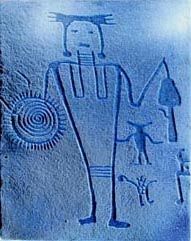
Captain America carries a red-white-and-blue shield, but it is an older heroic figure that introduces Comic Art Indigène, an exhibition that runs until May 31 at the Smithsonian's National Museum of the American Indian.

This hero, also bearing a red-white-and-blue shield with stripes reminiscent of the American flag, was drawn 800 years ago by an unknown Pueblo artist on the wall of a cave in what is now Utah.

"The first time I saw that pictograph, I immediately drew that comparison between it and Captain America," said Tony Chavarria, the curator of ethnology at the Museum of Indian Arts & Culture in Santa Fe, N.M. "It comes from a time of drought and mass exodus of the Pueblo peoples from the Four Corners region. Like Captain America, it became an icon."
Comment:  For more on Captain America and Indians, see Captain America Meets Geronimo and Black Crow to Replace Captain America? For more on the subject in general, see Comic Books Featuring Indians.