Showing posts with label uncivilized Indians. Show all posts

June 15, 2016

Savage Indians in The Little Dictator

Another stereotypical episode of Gilligan's Island:

"Gilligan's Island": The Little Dictator (TV Episode 1965)
Episode aired 30 September 1965A Latin American dictator is exiled to the island, and he immediately declares himself dictator of the island, with Gilligan as his puppet leader in training.A video of the episode:

Gilligan's Island The Little Dictator S02E03

You can see Indians at the 21:32 mark.

The setup is that Gilligan is dreaming about being a Latin American dictator. Everyone shows him glimpses of "his" country through a window, including Ginger aka Secret Agent 0036. The scene goes like this:DICTATOR: And I say the country is in great shape.

GINGER: And I say it's in terrible shape. Take a look.

Gilligan looks at her bikini-clad body.

GINGER: Not at me. At the state of the country.

GILLIGAN: Oh.

He looks out as whooping and yelling fill the air. He sees rampaging Indians on horseback, many wearing headdresses, from an old Western movie.

GILLIGAN: That must be the window facing the west.
So Indians = a country in terrible shape. Chaos and destruction. The decline and fall of civilization.

That's stereotypical.

December 07, 2015

Coke pulls racist hipster ad

WATCH: Coke Pulls 'Racist' Hipster Ad, Issues Apology

By Jonathan WheelhouseThe Coca-Cola Company has a issued an apology for its new Christmas video showing young, jubilant white hipsters distributing Coke bottles to a community of indigenous peoples in Mexico.

The video opens with shots of sullen indigenous peoples, young hipsters happily quaffing Coke, and statistics, specifically that 81.6-percent of the indigenous peoples of Oaxaca, Mexico, feel marginalized because they don't speak Spanish.

Coke has since pulled the video from its YouTube channel, though it is still available online.

"Our intention was never to be insensitive to or underestimate any indigenous group," Coke said in a statement, Latino USA reported. "We have now removed the video and apologize to anyone who may have been offended."


Or as one tweeter put it:


Comment:  The stereotype here is that poor Natives want and need the help of white folks. It's a variation of the age-old belief that Natives are children who can't take care of themselves.

November 30, 2015

Depp goes "sauvage" in commercial

This Dior Sauvage commercial is a couple of months old, but I just saw it the other day. I think one or two people mentioned it when it came out, but it didn't register with me then.

Here's the scoop:

Some find new Johnny Depp commercial a little confusing

By Dallas FranklinDior recently debuted a new television commercial that has a lot of people talking.

Dior’s new spot for its cologne “Sauvage,” features Johnny Depp leaving a city in a vintage car.

“I gotta get out of here,” he says.

After seeing a buffalo out in the middle of nowhere, Depp pulls over and starts walking through the desert.

“What am I looking for?” he asks.

Then, he digs a hole in the desert and takes off all his accessories.

“It’s something I can’t see,” he says. “I can feel it.”

He ends the commercial saying, “It’s magic…Sauvage.”


Johnny Depp For Dior Sauvage Commercial Doesn't Skimp On Drama Or Eyeliner—VIDEO

By Renata Certo-WareDior has been teasing us all summer, first with news of a Hollywood leading man as the face of Sauvage, the house's first new fragrance in a decade, and then with a 15-second trailer for the commercial. Now, the Dior Sauvage commercial with Johnny Depp is finally here in full, and it's basically a Depp-fueled fashion fever dream.

There were a lot of distinctly Depp-ian elements at play here—eyeliner and rows of hoop earrings a la Jack Sparrow, an electric guitar solo evocative of his Viper Room days, and that goatee-and-purple-shades look that's been more or less omnipresent since right around the time Blow came out. Even the appearance of animals like a buffalo, a wolf, and a hawk seem to be referential of Depp's claims to Native American ancestry. Most striking, perhaps, are the undeniable Fear and Loathing in Las Vegas vibes, from the sleek classic car making a lone desert crossing to the slightly hallucinogenic animal cameos.
Comment:  Certo-Ware notes the "Native" animal references, but I'd say the Native theme goes deeper than that. Indeed, I'd call the commercial a Native fantasy of sorts.

Let's recap:

  • Depp leaves civilization--represented by the big city--looking for something better.

  • He heads for the desert--the Mohave Desert, I believe--the stereotypical home of Indians.

  • He passes oil derricks, a common sight in Indian country (Oklahoma, North Dakota and Montana). Call it a transitional scene between the white man and nature.

  • He sees a buffalo, hawk, and wolf (or coyote), which together symbolize Native culture and only Native culture. Like stereotypical "spirit animals," they suggest he's on the right track.

  • He hears the hawk cry, a classic Native trope of movies and TV shows.

  • He sheds his accessories--basically everything that's loose and metallic. These items presumably stand for wealth or manufactured goods.

  • Finally, having left his material life behind, he declares his state "sauvage" (savage).

  • The commercial's message is clear: Depp = Indians = savages = people unconnected to civilization. Since today's Indians are lawyers and doctors, this is false and stereotypical.

    Depp the "star" presumably approved the commercial's plot and theme. This is more evidence that he knows little or nothing about real Indians. And doesn't care to alleviate his ignorance.

    Everything he says and does indicates he thinks of Indians as nothing but clichés. You know...the noble warrior, the wise elder, the trickster. Much like his portrayal of Tonto, his stereotypical thinking comes straight from the era of Sacheen Littlefeather and the crying Indian.

    For more on Johnny Depp, see Johnny Depp, White Man and Depp's Other Native Movies.

    September 10, 2015

    Stereotypical Reading Horizons textbooks

    Publisher Of Children’s Books Blasted Over Texts Filled With Racial Stereotypes

    By Andrew BradfordParents and members of the educational system in Minneapolis, Minnesota, are extremely upset by some books which were recently delivered to the school system from publisher Reading Horizons.

    The books in question, which are intended for children, feature characters such as Lazy Lucy, an African girl, and Nieko the Hunting Girl, who is Native American and lives in a cave. The books also refer to Christopher Columbus’ “discovery” of America, which is historically inaccurate.

    And as if that isn’t bad enough, in a book entitled Kenya, the residents of the African nation are said to be:

    “Able to run very fast.”


    Negative or positive stereotypes

    A page from the Kenya book showed it was all about running. This led to a brief discussion on the nature of stereotypes:Kenya's runners are a negative stereotype?

    What Makes Kenya's Marathon Runners The World's Best?
    If it's a whole book about Kenyans and their centuries of history and culture, including a page about their running, great. If it's only about their running and nothing else, not so great.

    Not for a grade-school primer, anyway. If you're writing an in-depth book on Kenyan runners, that would be another matter.

    A stereotype doesn't have to be "negative" to be a problem, you know.

    P.S. If I were a publisher, I'd avoid making the lazy character black or Latino. The smart character Asian. The violent character Native. And so forth.

    September 08, 2015

    Conservative labels Callingbull a "monster"

    Conservative director booted from riding board over comments describing ‘Indians’ as ‘self-loathing’

    By Jorge BarreraJust recently, MacDonell posted a link from right-wing shock website The Rebel Media about Ash Callingbull, the Cree woman recently crowned Mrs. Universe. The article said Callingbull compared Harper to Hitler.

    MacDonell wrote that Callingbull was an “entitled liberal pet” and a “monster.” After one poster said the pageant should take back the crown over the Hitler comparison, MacDonell blasted all First Nation people.

    “From an Indian??? LOL!!!! They’re allowed to break every law we have and bankrupt the country,” wrote MacDonell.

    MacDonell has also posted her own ideas about how to end racism.

    “If Indians want to eradicate racism, then assimilate. Ditch the Halloween costumes…and adopt 20thCentury dress, leave the reserves, stop acceding to demands made by chiefs who live like millionaires while their subjects live in poverty, find unemployment, stop demanding money you haven’t earned, become educated and join our society,” she said in a Jan. 24 Facebook post.

    MacDonell has been consistently posting comments along the same themes since as far back as 2012, according to several screen grabs obtained by APTN National News.

    “Indians loathe us and have no self-respect,” said MacDonell, who referred to right-wing agitator Ezra Levant in her 2013 Facebook post.

    NDP candidate Niki Ashton, who is the party’s Aboriginal affairs critic, said the comments were “disgusting” and “clearly racist.”
    Comment:  For more on Ashley Callingbull, see Beaverton Satirizes MMIW Crisis.

    October 29, 2014

    Native stereotyping = anti-Indian propaganda

    You Think Team Names Are Bad? 12 Images of Propaganda Against Natives

    By Christina RoseRacist team names and mascots get their fair share of media play, so why is it still so hard for the mainstream to get it? One look at these historic images makes it clear, the extermination of Native peoples was glorified in toys, books, films, even in the town seal of Whitesboro, New York. The town still uses an image of a Native being bested (they say it’s a wrestling match, but most agree the Native looks as if he is being strangled) by a white dude.

    A Wisconsin-based exhibit called “Bittersweet Winds” takes some of the worst historic propaganda and lays it out amidst beautiful items of traditional Native life. Richie Plass, the exhibit’s director, said it helps expose stereotypes for what they are, and allows the viewer to come to that conclusion on their own.
    And:According to Coates, when students learn about the way historic propaganda has formed mainstream ideas of Natives, they ask, ‘Did that really happen?’”

    “They don’t understand that it was embedding racism and ethnic degradation into white society. It made whites seem like superior beings, and that is exactly what you see in these types of toys,” Coates said. “Students are shocked. After we view his exhibit, it takes us two to three days to get back into our routine. There is so much to discuss.”
    Comment:  Mascots are nothing but live-action versions of these propaganda pieces. The message: Indians are savage and thus don't deserve the same rights as "real Americans."

    Note: The first image comes from my Blue Corn Comics website.


    Choke, I mean wrestle with, that savage!!

    August 31, 2014

    "Lazy" cultural stereotypes in Totem

    Janet McAllister: Let down by 'lazy stereotypes'When she went to Cirque du Soleil's Totem last week, artist and curator Melissa Laing was impressed by the acts' "phenomenal" technical brilliance. But that's not her overwhelming memory of the show. Instead, she says "the performers were profoundly let down by the artistic director."

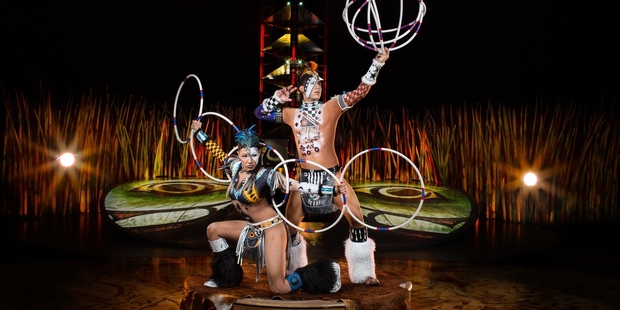
    Onstage, the Native American woman on roller skates appears almost naked. The Scientist and all the "normal" people in contemporary costumes are white. Laing was appalled by this "lazy" use of cultural and gender stereotypes.

    Overseas reviews agree (including a couple from audience members on Cirque's official website). "The show's treatment of world cultures is alarming," says the online news site Huffington Post, noting performers are costumed "like the singing dolls at Disneyland's It's a Small World" ride. Canada's The Globe and Mail points out that Cirque has a history of such cringe, wondering if James Cameron's noble savage in Avatar was inspired by a Cirque show.

    Poor Robert Lepage. Totem's director may have thought he had circumvented such criticism this time: reportedly, Cirque consulted with "numerous First Nations elders," and principal singer and Huron-Wendat lyricist Christian Laveau has said the show was careful not to include sacred elements.

    Costumes aside, such measures seem to have at least helped. Although otherwise scathing, the Portland Monthly reviewer expressed surprise and delight "that the act I expected to find most offensive from the press photos turned out to feel like the most authentic part"--that is, the Native American hoop dancing by Eric Hernandez, already a 12-year veteran at age 22.

    But the problem is that such enlightening moments are packaged into a broader arc that pits us vs them, white vs exotic, "spectacularising a cultural other," as Laing puts it. Sometimes "attempts to celebrate a culture can actually add to the harm done to that culture," if those attempts are unconsciously patronising or simply clueless. Non-Western cultures are often presented as historically frozen "add-ons" to the dynamic Western default setting.


    Comment:  I posted about Totem in Native Performers in Cirque du Soleil. I've seen pictures of Hernandez performing. I didn't say anything else about the show because I didn't have any more information.

    But the outfits seen above--presumably worn by Shandien Larance (Hopi) and Eric Hernandez (Hopi)--are questionable. The hoop dancers I've seen don't perform as half-naked savages. They don't have strange checkered patterns on their arms, or a slash of paint across their faces. I'd say Cirque du Soleil is doing exactly what writer McAllister said: "spectacularising a cultural other."

    If they performed in powwow-style regalia, they'd be less like the primitive people of countless old Westerns. The effect would be less "othering."

    Normal vs. exotic

    Here are some "characters" from Totem:

    The Amerindian Dancer

    The young Amerindian dancer takes us into a magical world, tracing the history of the evolution of species with his rings.


    The Tracker

    Environmentally conscious, a friend of the animals, he guides and assists the Scientist in his explorations. Angered by the thoughtless, polluting actions of a clown, he transforms before our eyes into a Toreador.


    The Scientist

    A Darwinesque Explorer who visits the different worlds of the show. In his advanced laboratory, aided by his assistants and a monkey, he dazzles us with his amazing physics experiments.


    Clown Misha

    Misha, a practical man, is wary of fuss and extravagance. He finds a silver lining (or a steel pot) for every situation life throws his way.


    Hmm. Two white guys wearing more-or-less normal clothes. Two brown guys in exotic "tribal" costumes. Even if the Western guys are causing the problems and the non-Western guys are solving them, that's stereotypical.

    Does Totem understand that Natives are on the leading edge of environmental issues: politically, legally, economically, culturally, and scientifically? They aren't just dancing to confront climate change and related issues. Because they're modern people, hey're conducting studies, filing legal briefs, and developing strategies on the Internet--just like everyone else.

    In any show, if the characters from Africa, Asia, and other non-Western places wear colorful costumes and do colorful dances, that's a problem. There's no reason the Western characters should look and act modern while the others wear "ethnic" costumes and perform "tribal" rituals.

    Indeed, you could make a whole show out of oddball Americans from a Coachella music fest, a Sturgis bike rally, or a Tea Party protest. These would be as representative as the usual stereotypical world characters: sombrero-wearing Mexicans, Hindu snake-charmers, Japanese geishas, et al.

    July 21, 2014

    Betty Boop in Rhythm on the Reservation


    This cartoon has the usual compendium of racist stereotypes. The worst may be the Tonto talk, the teepees, and the complete ignorance of modern life. This cartoon was set in 1939, when Indians were wearing Western clothes, working in factories, and enlisting in the military. They weren't dressing in buckskins or blankets and beating tom-toms.

    June 29, 2014

    Is "off the reservation" offensive?

    Should Saying Someone Is ‘Off The Reservation’ Be Off-Limits?

    By Kee MaleskyThe Original Meaning of the Term

    In its literal and original sense, as you would expect, the term was used in the 19th century to describe the activities of Native Americans:

    “The acting commissioner of Indian affairs to-day received a telegram from Agent Roorke of the Klamath (Oregon) agency, dated July 6, in which he says: ‘No Indians are off the reservation without authority. All my Indians are loyal and peaceable, and doing well.” (Baltimore Sun, July 11, 1878)

    Many of the news articles that used the term in a literal sense in the past were also expressing undisguised contempt and hatred, or, at best, condescension for Native Americans—“shiftless, untameable…a rampant and intractable enemy to civilization” (New York Times, Oct. 27, 1886).

    Native Reaction to the Term

    Rob Capriccioso, citizen of the Sault Tribe of Chippewa Indians, and Washington D.C. Bureau Chief for Indian Country Today writes:

    “I bristle when I hear the phrase because many of the people who use it nonchalantly have likely never thought about its origin, nor have they probably ever visited a reservation.”

    “It’s not about political correctness, either, it’s about helping the majority realize that there is a minority point-of-view that holds weight that the majority is giving too little credence. To me, there are indeed many more offensive words involving American Indians than this phrase—including the name of the Washington football team—but I believe it is the common use of phrases like ‘off the reservation’ that allows people to end up being comfortable going further—to the point of using a slur to name a football team that supposedly honors Indians, but not realizing that it is actually a slur.”
    Comment:  Several Natives said they didn't like the phrase. But they focused on how it makes them feel, not why it's wrong.

    It's wrong because it conveys a 19th-century impression of Natives. That they should stay on the reservation where we put them. That they're dangerous if they leave the reservation with their marauding, murderous ways. That the only way to turn them into peaceful Americans is to tame them like animals in cages.

    Even if those using the phrase aren't referring to actual Natives, they're reinforcing an outdated image. Today, 70% of Natives live off the reservation, so leaving a rez isn't an issue. They're already well-integrated into society with no major problems. To imply they've done something wrong or are out of control is stereotypical.

    To be sure, "off the reservation" is a minor wrong. It's akin to "too many chiefs" or "low man on the totem pole," which are also minor problems. Still, people should think about their choice of words. They should avoid phrases like this one.

    For more on the subject, see Commissioner: Indians Should Get Off the Rez.

    June 28, 2014

    Native military names assuage guilt

    A writer lays out the problem with using Native names for killer missiles and aircraft:

    The U.S. military’s ongoing slur of Native Americans

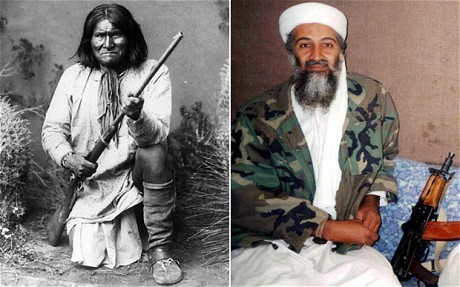
    By Simon WaxmanIn the United States today, the names Apache, Comanche, Chinook, Lakota, Cheyenne and Kiowa apply not only to Indian tribes but also to military helicopters. Add in the Black Hawk, named for a leader of the Sauk tribe. Then there is the Tomahawk, a low-altitude missile, and a drone named for an Indian chief, Gray Eagle. Operation Geronimo was the end of Osama bin Laden.

    Why do we name our battles and weapons after people we have vanquished? For the same reason the Washington team is the Redskins and my hometown Red Sox go to Cleveland to play the Indians and to Atlanta to play the Braves: because the myth of the worthy native adversary is more palatable than the reality—the conquered tribes of this land were not rivals but victims, cheated and impossibly outgunned.

    The destruction of the Indians was asymmetric war, compounded by deviousness in the name of imperialist manifest destiny. White America shot, imprisoned, lied, swindled, preached, bought, built and voted its way to domination. Identifying our powerful weapons and victorious campaigns with those we subjugated serves to lighten the burden of our guilt. It confuses violation with a fair fight.

    It is worse than denial; it is propaganda. The message carried by the word Apache emblazoned on one of history’s great fighting machines is that the Americans overcame an opponent so powerful and true that we are proud to adopt its name. They tested our mettle, and we proved stronger, so don’t mess with us. In whatever measure it is tribute to the dead, it is in greater measure a boost to our national sense of superiority. And this message of superiority is shared not just with U.S. citizens but with those of the 14 nations whose governments buy the Apache helicopters we sell. It is shared, too, with those who hear the whir of an Apache overhead or find its guns trained on them. Noam Chomsky has clarified the moral stakes in provocative, instructive terms: “We might react differently if the Luftwaffe were to call its fighter planes ‘Jew’ and ‘Gypsy.’”
    Comment:  The long debate over Osama bin Laden's codename is the perfect example of Waxman's argument. We didn't code-name him "Geronimo" because we were honoring him. We did it because we considered Geronimo a ruthless savage, killer, and terrorist--like Bin Laden.

    We're saying the same thing with Apache helicopters, Tomahawk missiles, and the other deadly weapons and aircraft. The're pure lethal force with no saving grace such as intelligence or compassion. They do nothing but kill.

    For more on the subject, see Indians in the Military.

    June 15, 2014

    Native stereotypes in Mandala

    The publisher or someone sent me the first issue of Mandala, a new comic-book series. They did it because they think Blue Corn Comics is a retailer, not a publisher. Wrong!

    Anyway, Mandala features a Native subtext, so it's worth a look. Here's the official site:

    MandalaARE YOU AWAKE?

    Earth--here and now. Humankind is secretly enslaved by a global mind-control system called the GRID. Mike Morningstar and his spiritual spec-ops unit, the Thirteen, must alter time and take down the GRID before it's too late.

    As fiction meets reality, the Thirteen need your help if they are to succeed in awakening humanity and changing the future...

    Enter the Mandala...


    And a couple of reviews:

    Mandala by Stuart Moore and Bruce Zick

    By Brad HawleyMandala is the story of Michael Patrick Murphy who has the potential to be a mythic hero, Morningstar, savior of all mankind, but often he is just Michael, a confused man, or even worse, he turns into his lower, demonic self. Borrowing a page from Michael Moorcock, author Stuart Moore has Morningstar drift from one reality to another, trying in each new plane of existence to fight the serpents and evil gods who control all humans in a post-apocalyptic world. He fights alongside the rest of “The Thirteen,” an organization made up of men and women similar to Michael Morningstar: They all have a human side and must learn to “wake up” their higher selves to unite and defeat serpents who are led by the evil Natasmia.

    Moore borrows the time-traveling part of the plot from the Hawkman and Hawkgirl storyline at DC: Hawkman and Hawkgirl keep struggling to find each other again and again, but every time they do, they die and are reborn to seek each other out again—star-crossed lovers doomed by their rebirth-induced amnesia. Morningstar has his female counterpart in Mary Lozen Many Colors, or Raven. Raven’s Grandfather acts as spiritual guide for Michael and the rest of “The Thirteen.” He teaches Michael about the Empyrean and transformation, part of which has to be Michael’s willingness to be the “hanged man,” a familiar image seen in most Tarot decks.
    Evil Geek Book Report--Mandala

    By C-MartMandala is the story of how human evolution has been stopped dead in it’s tracks by an invading entity know as Natasmia and the mysterious world enveloping energy field known as the GRID. The Mayans predicted that humanity would take a great leap forward in terms of development and evolution in 2012, but thanks to Natasmia, that leap forward never came to be. Natasmia has her sights set on ruling all of humanity for the rest of existence and as anyone who’s ever dabbled in mind control knows; it’s easier to control a simpleton than it is to control a highly evolved being.And:Michael’s more evolved form, known as the Morningstar, is a superpowered demon king, destined to lead a group of other superpowered individuals known as the Thirteen into battle against Natasmia. With the help of his love Mary Lozen and her shamanic grandfather, the Morningstar is awakened within Michael and slowly he learns to use his powers in an attempt to save different timelines from the invading evil.Moore Tackles a Multiverse's Nightmarish Future in "Mandala"

    The Native aspects

    Angels, shamans, mandalas, Tarot, prophecies...if that sounds like a New Age mishmash to you, you probably have the right idea. I'd say the above descriptions give you a fair notion of how sprawling and mixed-up the story is.

    In the story's centerpiece, we meet Mary Lozen Many Colors and her grandfather Charlie Many Colors--both supposedly Hopi. First, the names...oh my!

    For starters, Lozen is an Apache name, and the Apache were traditionally enemies of the Hopi. It's unlikely that any Hopi would use the name Lozen.

    Then there's the last name Many Colors. Really?! That's even worse than the usual stereotypical names such as Grey Wolf or White Eagle. It reeks of trying to give the Hopi a multicultural flavor--as if they represent all the "multicolored" tribes of the world. In other words, pure New Age claptrap.

    FYI, real Hopi names include Honanie, Humetewa, Masayesva, Selestewa, Batala, Talayumptewa, and Keevama. You can see they follow a style that does not include English phrases such as "Sitting Bull" or "Crazy Horse." The "Many Colors" kind of name is found mostly among Plains tribes, not Southwestern tribes.
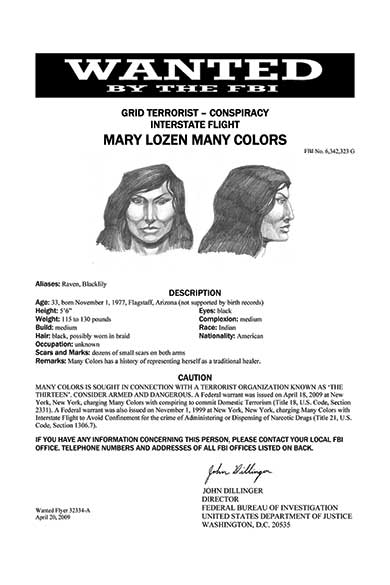
    Michael and Mary materialize on the Hopi reservation--to find themselves in an Anasazi-style dwelling under a cliff. No. The Hopi's ancestors used to live in such dwellings, but that was 800 years ago. Such dwellings are uninhabited ruins now--protected and off-limits. And there are no ruins this well-preserved on the Hopi rez.

    The whole concept conveys the unavoidable impression that the Hopi people are prehistoric, not modern. Even the furnishings visible in one panel--a wooden chair and cot--could be pre-modern. There's no hint that the Hopi have done anything since the 18th or 19th century.

    Then Charlie, Michael, and Mary descend a ladder into what could be a giant underground kiva. Let's hope it isn't one, because that would be a gross violation of Hopi religion. No one's supposed to know what happens in a kiva except the Hopi themselves.

    What they actually find isn't a Hopi shrine, but rather a warehouse of religious icons from around the world. Including an Aztec sun stone, a Plains headdress, and a phony totem pole:
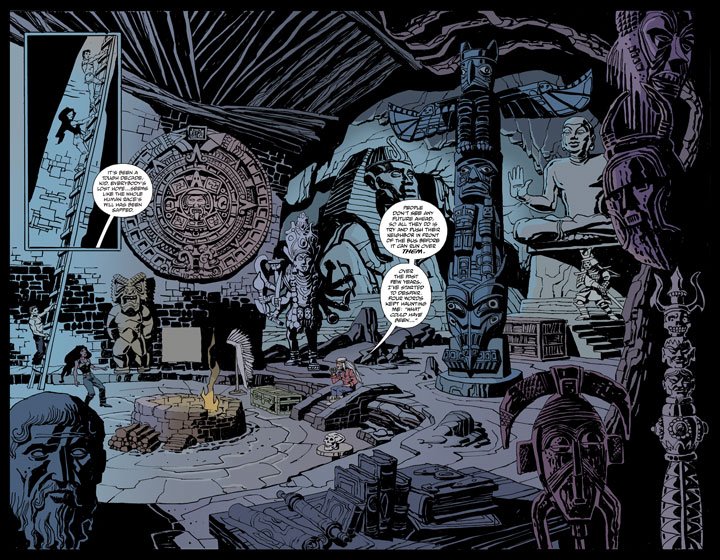


    The message is that non-Western and indigenous religions are somehow related--part of the "nexus" or "multiverse" or interdimensional whatever. That they're not complete, standalone religions like Christianity, Judaism, and Islam. Instead, these religions are exotic, unfathomable, and otherworldly--perhaps literally. They're part of some vast, mysterious, cosmic sphere beyond the comprehension of modern minds.

    This is a classic New Age belief, and it's an insult to all these religions. They're not exotic or unfathomable to their adherents. They don't require blood or virgin sacrifices to demons in the middle of the night.

    Really, they're no stranger than the religions we're familiar with. To hide them away in an underground vault as some sort of dark secret is badly stereotypical. It's an Indiana Jones mentality from the racist era of tomb-robbing--but people should know better in 2014.

    In a later issue, a Hopi sun god (below) leads the other "ancient" gods in holding hands and singing "Kumbaya." Or something. But don't expect the Christian God to show up and join them. Unlike these "mythical" gods, he's "real."
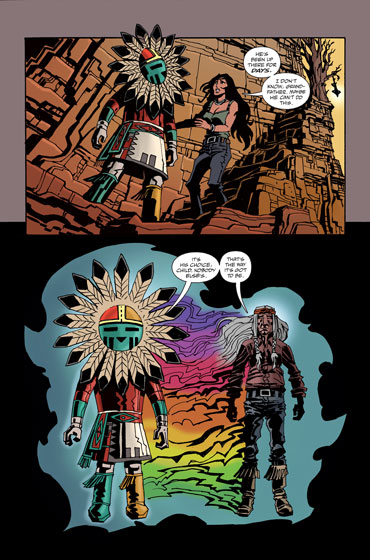


    As the kicker, Charlie mentions a Hopi legend that a "true white brother" will appear to lead the everyone into the light. Yes, it's the "white savior" complex, uttered explicitly by a Native character, in 2014. Save us, Great White Father and Jesus Christ substitute! Only you are strong and brave and true enough to conquer evil.

    I believe the Hopi do have such a legend. But it's one of many legends, not all Hopi believe it, and they certainly don't emphasize it. Author Stuart Moore easily could've avoided it and chosen some other legend to use. Instead, he's invented a pretext for why a white men should lead the "Thirteen," who are mostly nonwhite characters from non-Western cultures. Another white American to the rescue...yay!

    I get a strong impression that Moore knows little or nothing about Native cultures. He probably skimmed a couple of books or websites before putting together this muddled stew of Hopi and Native lore. The result isn't much different from what you could read in any bad comic from the mid-20th century. If the scary masked figures and statues came alive and tried to kill our heroes, I wouldn't be surprised.

    Like the previous image, the scene below wasn't in the issue I read. But it tells you all you need to know about Moore's ignorance. A Hopi "shaman" in a Plains headdress fighting a demon with a tomahawk: pure supernatural pan-Indian stereotyping.
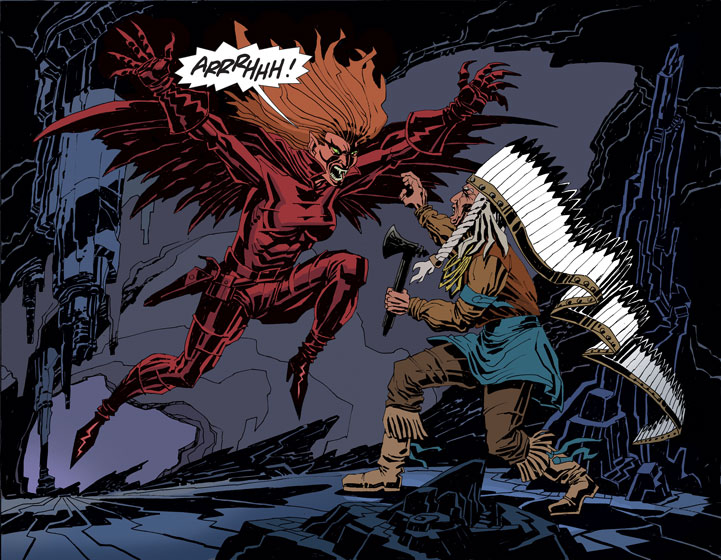


    This is something I might've done in the first few months of putting together my Peace Party comics. But I soon realized how much I didn't know and kept studying. It was only after years of research that I felt I had a solid concept that didn't violate or trivialize the Hopi culture.

    If I were Moore, I'd go back to the drawing board and start over. But he's invested too much time and energy in this venture to do that, of course. So we're left with another wrongheaded take on Native cultures in comics.
    April 08, 2014

    Peruvian TV character Paisana Jacinta

    Indigenous Lawmaker Wants Racist Anti-Indigenous TV Show Off the Air

    By Rick KearnsThe Peruvian TV character known as “Paisana Jacinta” is racist and insulting to indigenous people according to Congresswoman Hilaria Supa, a Quechua leader and human rights activist.

    Supa publicly called on the Frequencia Latina Channel on March 24 to remove the “Paisana Jacinta” show from the air.

    According to various sources, the character Jacinta is an indigenous Andean woman who comes from the mountains to the city of Lima to find work. The story arc of each episode involves Jacinta getting fooled, tricked or swindled by a variety of people. The role of Jacinta is played by comedian Jorge Benevides who has been accused of racism for his role as “El Negro Mama” (the Black Mama in English) as part of a general comedy show.

    As “El Negro Mama” Benevides wore blackface and used a prosthetic nose and lips to portray the character who was described as being dishonest and stupid according to sources. The character was taken off the air and in 2013 Frequencia Latina was fined 74,000 Soles (approximately $27,000 U.S. dollars) for its failure to apologize to the Afro-Peruvian community. But Benevides and Frequencia Latina returned with the controversial indigenous character this year.

    March 05, 2014

    Assimilation in 1950s movies

    I watched three old 1950s Westerns recently. As usual, they had some authentic elements but were mostly inauthentic.

    Together they spun a clear message of assimilation. America's "Indian problem" would go away if only the Indians joined the mainstream and became good white Christians.

    The Far HorizonsPlot

    An ambitious, historic attempt to explore and document an untamed American frontier unfolds in this rousing adventure drama. In 1803, Meriwether Lewis and William Clark, with President Thomas Jefferson's blessing, embarked on the government-sponsored Lewis & Clark Expedition–an attempt to discover a water route connecting St. Louis, Missouri, with the Pacific Ocean. Their trek takes them through the magnificent, danger-filled territory of the Pacific Northwest, with guidance from the Shoshone maiden Sacagawea.

    Reception

    In 2011, Time Magazine rated The Far Horizons as one of the top ten most historically misleading films, in part due to its casting of Caucasian Donna Reed as Native American Sacagawea, and the creation of a romantic subplot between her character and William Clark despite the fact that Sacagawea's husband, French-Canadian trader Toussaint Charbonneau, was in real life also a member of the expedition.


    The explorers' first encounter with a tribe is reasonably accurate. The white man approach the Indians in full dress uniforms, present them with medals and other trinkets, and declare they're now subjects of the Great Father in Washington. The Indians pretend to go along, but after the white men leave, the chief throws down his medals and declares his opposition. No one can own the land, he says.

    So far, so good...but then the angry Indians stalk the explorers and try to kill them. Uh, no. Lewis and Clark encountered several friendly tribes and stayed with them for a couple of winters. No one made a concerted effort to kill them.

    The unavoidable message is white men good, Indians bad. The noble explorers are just innocently surveying the land. The evil savages can't stand the idea of sharing the country, so they go into a murderous rage. They don't plan intelligent counteroffensives like Tecumseh's confederation of tribes, which happened only a few years later. They lash out like wild beasts threatened with captivity.

    The whole love subplot is ridiculous too. And it contributes to the overall message. Sacagawea journeys to Washington DC with Clark, but she can't fit into white society, so she leaves. Although you could take that as advocating separatism, I didn't. I took it to mean Indians can't be part of the mainstream unless they eliminate what makes them unique and become plain-vanilla Americans.

    Walk the Proud LandPlot

    This is the true story of Indian agent John Philip Clum (Audie Murphy) as told by Clum's son in the 1936 biography Apache Agent. The film begins in 1874, as Clum, an Eastern government representative, arrives in San Carlos, Arizona. He is sent to try a new approach to peace with Apaches based on respect for autonomy rather than submission to Army. He faces suspicions from the white settlers, the Army and the Indians, especially Geronimo.

    Reception

    The film was not a success at the box office, something attributed to the fact that Murphy played a pacifist rather than an action hero. This ended Murphy's plans to make his dream project, a biopic of painter Charles Marion Russell.


    I saw only the final half of this, but I think I got the idea.

    Clum plays the usual role of the white savior who knows what's best for the Indians. His "new approach" is to tell them to stop fighting and settle down as farmers. Many of the Apache agree, but Geronimo (Jay Silverheels!) and his renegades say they'll never give up their independence.

    Needless to say, this isn't exactly a pro-Indian message. It's "pacifist" only in the sense that Clum isn't the one hold a gun to the Apaches' heads. But an implied threat is there. If the Indians don't do it Clum's way, the Army will enforce it their way.

    Clum manages to trick Geronimo into submission. He approaches Geronimo with a small number of men and puts them in Geronimo's hands. But other men in the hills fire their guns, and the echoes make it seem as if Geronimo is outnumbered and surrounded. He finally surrenders.

    So it's not Clum's pacifist message that carries the day. It's more of the white man's deception. The "bad" Indians are forced to accept the white man's way as the best and only possible existence.

    ApacheApache was based on Paul I. Wellman's novel Broncho Apache, which in turn was inspired by a true story. Burt Lancaster plays Massai, a lieutenant of the great Apache warrior Geronimo (here depicted as an old man, played by Monte Blue). Though his tribe has signed surrender terms with the conquering whites, Massai refuses to do so. He escapes from a prison train and conducts a one-man war against the white intruders-and against some of his own people. Along the way, he claims Nalinle (Jean Peters), whom he previously regarded as a traitor to his cause, as his wife.

    John McIntire plays famed Indian scout Al Sieber, who-in this film, if not in real life-is sympathetic to the Indians' plight and Massai's single-purposed cause. The real-life counterpart to Massai was killed by Sieber's minions after agreeing to call off the hostilities; United Artists objected to this, forcing producer/star Burt Lancaster to shoot an unconvincingly happy ending. --Hal Erickson, Rovi


    Lancaster looks silly as an Indian, and initially sounds silly too. I guess he eventually grows into the role. But that's neither here nor there.

    Apache shows what happened to Geronimo and his men when they surrendered to "pacifist" white men. They were sent to a prison camp in Florida and never saw their homeland again. So much for peace and reconciliation.

    Massai escapes and, on the way home, meets a Cherokee farmer who touts the value of settling down and growing corn. Massai is scornful, but the man insists he hasn't given up his Cherokee identity. Massai takes some corn with him when he leaves.

    When he reaches his own people, the weak-willed appeaser of a chief turns him in to the white men. He escapes and begins his one-man battle to remain free. Nalinle tries to help him and eventually they hole up in a remote cabin, where he angrily tosses the corn away.

    The next spring, he's surprised to find a corn crop growing near the cabin. The white men track him down, and he and Sieber play a silly cat-and-mouse game in the corn patch while the others surround it. The white men have scorned the idea that wild savages could become tame farmers, but Sieber sees the corn patch as proof that they can. Amazingly, he lets Massai return to his cabin and live as a newly minted man of the soil.

    Conclusion

    So the implied assimilationist message of The Far Horizons becomes explicit in Apache. Become a farmer or go to prison and die. Even the boldest and most independent warrior must bend to this inevitable outcome. There's no place for Indians in America unless they give up their old ways and become good Christian workers.

    True, these movies didn't come out in this order. But in different ways, white filmmakers were trying to present the same message. They each came up with pieces of the puzzle.

    Put them together and you can see the whole assimilationist narrative. Indians were wild and savage. Americans just wanted to live with them in peace. Eventually the Indians agreed and gave up their uncivilized ways.

    For more on the subject, see The Best Indian Movies.

    January 12, 2014

    Native stereotypes in Life of Brian

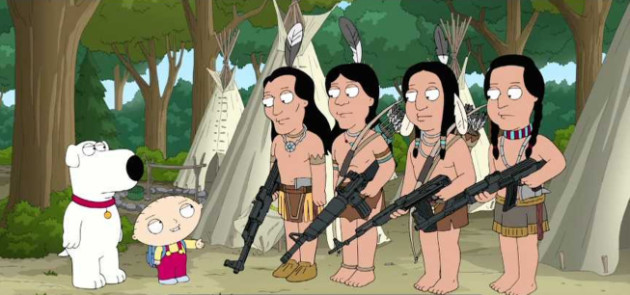
    Perhaps because of Thanksgiving, a recent episode of Family Guy had a long introductory sequence about Indians:

    Life of Brian (Family Guy)"Life of Brian" is the sixth episode of the twelfth season and the 216th overall episode of the animated comedy series Family Guy. It aired on Fox in the United States and Canada on November 24, 2013, and is written by Alex Carter and directed by Joseph Lee.

    The episode revolves around the death of Brian Griffin, after being struck by a car, and the family coping with the loss by adopting a replacement dog, Vinny. However, Brian returned, two episodes later, in "Christmas Guy," after Stewie goes back in time to save him.

    Plot

    Stewie and Brian flee a band of hostile Native Americans in a Jeep. Brian explains that on a trip to Jamestown in the past, Stewie gave the Native Americans guns which were used to wipe out the Europeans, leaving the Native Americans in charge of America. Stewie finds his return pad destroyed by bullets and decides to find the alternate timeline Stewie for help. Going to the equivalent of their house, they find a new time machine and pad and return to Jamestown to set things right. As soon as their original counterparts leave, they take back the guns and return to the proper time.
    You can see brief excerpts from the opening sequence below:


    Changing America's history is a time-honored science-fiction theme, but this sequence was full of racist stereotypes. Among the most offensive were:

  • Half-naked Native warriors chasing Stewie and Brian. Really, in a modern city, the soldiers would be wearing loincloths?

  • A Native "doctor" dressed like a witch doctor whose idea of "medicine" is standing in awkward poses. Presumably this was a commentary on Native healing rituals.

  • A Native radio station whose no. 1 hit song for many weeks in a row is a dull, repetitive chant.

  • When Stewie and Brian return to Jamestown to take back the guns, the show tries to subvert some stereotypes. For instance, the Indians only pretend to talk like Tonto to take advantage of the strangers.

    As you can see below, the Indians' skin, hair, and clothing isn't too bad. But tipis in the Jamestown area? Even when Family Guy is trying, it still gets things wrong.


    Racism to be expected?

    As I wrote on Facebook:

    Finally watching the "Death of Brian" episode of Family Guy. I didn't know it began with a five-minute racist "satire" of Indians.

    Some people commented on this:Isn't it always a "satire"?

    Did you not see the Casino episode and you're shocked? lol I've not watched it yet but thanks for the heads up.
    I think I've seen all the Family Guy episodes. Including the one where Peter claims to be Native for some casino-related reason.

    True, that episode had a lot of stereotypes, but I'm not sure it was nonstop stereotypes. I think it made some valid points about how others view Indians stereotypically.

    This sequence seemed more like pure racist stereotyping. And Family Guy seems to have cranked up its racism and sexism quotient. It seems like half the "jokes" now involve some groups' perceived shortcomings.

    For more on the subject, see Indians in Family Guy.

    December 31, 2013

    Florida high school stereotypes Indians

    Video: Florida High School's Horrific Display of Cultural StupidityA video posted to YouTube on November 25, 2013, has been making the rounds and upsetting to some. In it the Baker County High School History Club in northern Florida is supposedly sharing Native American culture with pre-schoolers. But what happens in the video can only be described as a racially ignorant display.

    It opens to one student reading how tribal men and women spend their time, then pans over to a group of white girls dressed in fringed dresses in front of a teepee.

    They whoop when the men—white high-school boys wearing fake headdresses and “war paint”—return.

    The pre-schoolers have also been dressed in construction paper headdresses and are then taught a “traditional dance.” The dance looks something like the chicken dance and includes music with lyrics like “turkey time” and “gobble gobble gobble jump.”

    October 04, 2013

    "Chief Dan George" in The Crazy Ones

    In The Crazy Ones, Robin Williams plays Simon Roberts, the attention-challenged head of a father-and-daughter advertising agency. In the pilot episode (airdate: 9/26/13), the agency is about to lose the McDonald's account, which comprises 60% of its business.

    After learning of the impending loss, Roberts laments his inability to save the company. Doing a fine impression of Chief Dan George, he says:It is over, little one. You must treat this like a cleansing fire. You will rebuild from the ashes. And I, like a tribal elder, shall climb onto the ice floe and drift to my death in the Arctic night. It is a good thing. It will be a circle of life. [mumbles Native-sounding nonsense.]Comment:  Like the recent Modern Family episode, this is another ambiguous depiction of Native culture and history.

    On the one hand, Roberts is obviously mocking himself. And he's using Chief Dan George, who famously mocked himself in Little Big Man. So on one level, we're not supposed to take his comments seriously.

    On the other hand, nothing in his comments themselves is obviously false. Roberts suggests that Indians abandoned their elders to die, and who knows if they did or not? Not me.

    Indeed, some tribes may have done this, although I'm guessing most didn't. But the idea feeds into the common perception that Indians were uncivilized and barbaric. We would never abandon our elders, the thinking goes, but those subhuman savages probably did.

    So the character's tone his mocking, but his claim is plausible. What would the average viewer think? That because Robin Williams was doing his usual shtick, the Indian lore must be inauthentic? Or that Williams was using authentic Indian lore to put down his character?

    I don't know, and I don't think it's clear. That's why I say this bit is ambiguous.

    Then there's the "circle of life" line. And the use of a 19th-century character, Chief Dan George in Little Big Man, to impart this "wisdom." The implication is that Indians were wise stewards of nature.

    Which is partly true, but it stereotypes Indians as primitive people of the past. Who have nothing else to offer--indeed, who have vanished from the scene since the Indian Wars ended.

    Overall, the bit is a nice try to include Native culture. With a little tweaking, the writers could've made it work. As it stands, though, I'd say it ultimately fails.

    August 19, 2013

    Indians go from devil to mascot

    In John Marshall's follow-up story about death certificates at Auschwitz, a reader makes the following point:

    They Didn’t Want to Forget Either

    By Josh MarshallThe Germans didn’t want to forget about the Jews. I think they wanted and intended to take credit for erasing them. They only kind of hid some of what they were doing while they did it—but mostly they were wide open about it, almost boastful. All the photography and diary keeping by Nazis engaged in extermination operations—this isn’t seen as stupidly self-incriminating swagger, the way the documentation done by the soldier-photographers of Abu Ghraib is typically seen.

    One key to understanding the double-determination to exterminate and remember is to wrap one’s mind around the idea that the Nazis planned, once they got done with the Jews, to make a big Jewish museum in Prague. They were collecting artifacts and warehousing them for this grand exposition: torah scrolls and Sabbath candelabras and other ritual and/or folkloric objects. I guess they had something in mind like the American Indian collections and exhibits at the Smithsonian and the Natural History museum.
    Marshall then reaches the same conclusion I've reached many times:If you look over the swath of four centuries of North American settler history there is an unmistakable change in settler or white American perceptions of Native Americans before and after they become a totally militarily defeated people and largely vanish from the physical landscape of North America. Before they range from frightening to literally satanic to a permanent ‘other’ counterpoised against America’s civilizing, industrializing mission. But after the Indian becomes part of the past, in the American national psyche, there’s a great change. The image and memory undergo a profound transformation. The idealized figure of the Indian warrior—as opposed to the marginalized and impoverished Native Americans pent up on reservations—becomes something like a mascot for the American character, supposedly embodying various American national virtues.

    Remember, the US Army has a tradition of naming all its aircraft after Native American tribes. We take these things for granted. They’re natural somehow in the texture of American national memory. From an historical perspective, though, there is something a little odd and paradoxical about this. It is frightening though I must confess interesting to consider how a victorious Nazi regime might have remembered an annihilated Jewry.
    Comment:  Marshall nails it. This is the same subject I explored in The Political Uses of Stereotyping.

    In the American imagination, Indians are like the lion or bear trophy over the mantelpiece. Celebrating their strength and courage really means celebrating ours. As a museum piece, trophy, or mascot, Indians remind us how "wonderful" we were to conquer the "savages" and then allow them to join our "civilization."

    The animal analogy is good one for how we view and treat Indians. We hate wild wolves but love domesticated dogs. Indeed, we admire many dangerous animals as long as they're safely locked in zoos (reservations). But if they show up without chains around their necks, we scream bloody murder, call Animal Control, or simply shoot them.

    Don't let anyone fool you about how mascots and other stereotypical images are "harmless." America has a cultural and political agenda for remembering Indians as "noble savages." It's all about promoting the myth of Euro-Christian superiority so we can justify our crimes against humanity.

    For more on the subject, see:

    Why Warren wants to be Native
    Indian place names = mascots
    Mythical Indian = "national mascot"

    July 03, 2013

    Adrienne Keene reviews Lone Ranger

    Spoiler alert! Don't read this if you don't want to know what The Lone Ranger is about.

    Here's Adrienne Keene's take on the movie. She's as reliable as me on the subject of Native stereotyping, so you can take her criticisms to the bank.

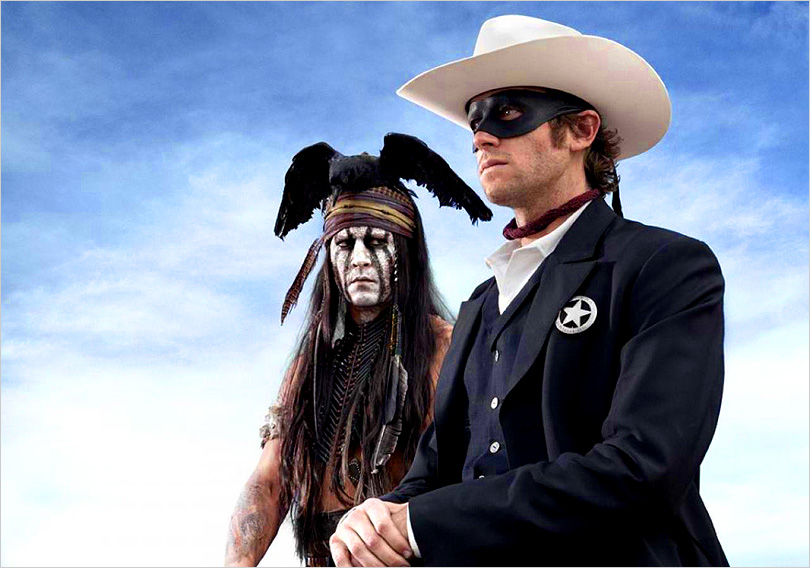
    I saw The Lone Ranger so you don’t have toThe very first scene we are presented with an image of a Native person, in a museum–which presumably we’re supposed to critique, but there’s no questioning of Tonto’s position there. To me it reinforces the idea that all the Indians are dead, relics of the past, which is actually a theme throughout. This Indian is so silly and backward he trades a dead mouse for a bag of peanuts, doesn’t even know how to eat peanuts, and is feeding a bird, but it’s dead. Even the child knows that’s wrong. So this is the “new” Tonto? Definitely an improvement, amiright? (That was sarcasm. In case you missed it.)

    Here’s the part you wanted to hear about, and I’m trying to think of the best way to frame it. Despite the Comanche involvement in the film, there’s still a lot of problems with conflating all Indians together. First off, we’re in “Texas,” except Texas is set in the iconic Monument Valley–Navajoland. Tonto from the start talks about being a “Wendigo hunter” and that the bad guys are “Wendigos” and that “nature is out of balance.” Wendigos are a Eastern Woodlands (Algonquian/Cree/Ojibwe) thing. Though they did get the stories kinda right, despite it being the completely wrong region/tribe. I’m not trying to argue that the movie should have been 100% “authentic”–whatever that means–but to tout your Native involvement and have a central plot point be totally wrong just felt weird to me.

    Also general Tonto comments: Depp’s “accent” is hilariously inconsistent, and whenever he has more than a few words to say, it would veer into an almost stereotypical Italian-sounding thing, and for not speaking English, his vocab is great. He’s also very much the mystical-magical-Indian, an early scene shows him in jail making his bird come alive by singing and flapping his arms, he talks to the horse (and the horse talks back), he talks about LR being a “spirit walker,” etc.

    After a false start where we see Rebecca (Lone Ranger’s love interest and his brother’s widow) protecting her homestead from raiding Comanches complete with war whoops and flaming arrows–but wait, they weren’t really Indians, it was Cavenish’s (the bad guy) men just playing Indian, we finally get to meet the Comanche camp after they capture the LR and Tonto. Here’s where we get to see the Native actors involved in the film, and the first glimpse of any Indians besides Tonto. Guess what they’re doing? Preparing for war, dancing around a fire, of course. Lots of yelping, lots of drumming, lots of masked, painted, and darkened Native faces.

    Skipping forward, we watch the Comanche attack come over a hillside in the shadows, you know what it looks like, and there’s a moment as a viewer of “ohhh damn, watch out you silly railroad and calvary dudes, you’re about to get owned by some Comanches!” because they look so intimidating and like there are far more of them then the white guys. But no, the Cavalry mows them down with an early machine gun, and we watch as all of the Comanches are slaughtered, including a close up of Saginaw getting stabbed.

    It’s very much a Guns, Germs, and Steel type moment–even though the Indians outnumber the whites, they’re not technologically advanced enough to win, and they are too dumb (or full of backward “honor”) to realize they’re headed for a death trap.

    Finally we come to the end of the story. Tonto finishes telling it all to the little boy in the museum, and we see that he has put on a suit, holds a suitcase, and places a bowler hat over his crow (which he has continued to “feed” throughout the film). The boy gets momentarily distracted, turns back, and OMG again, Tonto’s gone! In return, a (live) crow flies out of the exhibit and at the screen. Then we cut to credits. Then, a few minutes later, we see Tonto wandering off into the vastness of Monument Valley, hobbling along, carrying his suitcase. He continues to walk, back to the camera, for the next 10 minutes as the credits go on, and on, and on. I guess we’re to assume his time as a “Noble Savage” has passed, and he’s returning to his unbridled wilderness, alone–but dressed as a white guy this time? This, like most of the movie, didn’t make any sense.

    My theater had a bunch of kids in it. I kept thinking about what images they were leaving the theater with–and that left me upset and worried. Now an entire new generation is going to play the Lone Ranger and Tonto at recess, thinking Indians talk in incomplete and inconsistent pidgin English, think all Indians are dead, and that it’s ok to dress as an “Indian” for Halloween. While this might be a flash-in-the-pan film, it solidifies the continuing views of Native peoples as lesser, as relics of the past, as disappearing, as roadblocks to “progress.” Tonto might have been less of a sidekick and running the show, but in the end, the LR gets the girl and the glory, and Tonto ends up in a museum. How's that for a re-imagining?
    Comment:  Here's the beautiful Comanche territory in Texas per The Lone Ranger. Because all Indians are the same and live in the desert wilderness. In fact, I think I can see the Lakota, Cheyenne, and Apache from here.


    For more on Johnny Depp, see Critics Agree: Lone Ranger Is Bad and New Tonto as Racist as Old Tonto

    May 19, 2013

    Comanche LEGOs based on Lone Ranger

    Indian Country Today's posting about actor Gil Birmingham (below) alerted us to the existence of a Comanche Camp LEGO set. Naturally, it' based on Johnny Depp's Lone Ranger.

    The Lone Ranger--Comanche CampVisit the Comanche Camp with the Lone Ranger and Tonto!

    Journey to the Comanche Camp with the Lone Ranger and Tonto! Visit Red Knee in the teepee with removable canopy and campfire. Check out the weapon rack then jump in the canoe and go fishing. Watch out for the scorpions as they launch a surprise attack from the rocky outcrop with the attack function! Includes 3 minifigures with weapons: the Lone Ranger, Tonto and Red Knee.

    • Includes 3 minifigures with weapons: the Lone Ranger, Tonto and Red Knee
    • Features teepee, weapon rack, canoe with oar, and rocky outcrop with scorpion attack function
    • Teepee features small campfire, entrance flap and removable canopy
    • Weapons include 2 revolvers, tomahawk, spear and a bow with quiver
    • Also includes a fish, 3 scorpions and 3 bones
    • Survive the scorpion attack!
    • Go fishing in the canoe!
    • Remove the teepee canopy and play inside!
    • Teepee measures over 6" (16cm) high, 3" (10cm) wide and 4" (12cm) deep
    • Canoe measures over 4" (12cm) long and less than 1" (2cm) high and wide
    • Weapon rack measures over 1" (3cm) high, and less than 1" (2cm) wide and 1" (1cm) deep
    • Rocky outcrop measures over 2" (7cm) high, 3" (10cm) wide and 2" (7cm) deep


    If you're wondering who Red Knee is, here's an answer:

    Yes, Gil Birmingham is in 'The Lone Ranger'--Here's the LEGO that Proves ItWhen ICTMN contacted a representative for Birmingham yesterday, hoping to verify that the actor is in the film despite his omission from the IMDB listing, she replied that yes, absolutely, Gil Birmingham is in this movie. He plays a character named Red Knee.

    She further informed us that Birmingham has a figure in the Lone Ranger Comanche Camp LEGO playset alongside the figures based on Tonto and the Lone Ranger as played by Depp and Hammer.
    Comment:  A brief discussion about this LEGO set with Kevin Gover, director of the NMAI:

    Get your Johnny Crow-Head LEGOs while they last! Weapons! Canoe! Guy in buffalo hat! Scorpions! It's a totally authentic representation of Comanche culture!

    Your kids will have fun learning about Indians for years! They'll want to pass these LEGOs on to their children too!How else are you going to get a Comanche canoe?

    And the two-pole tipi. An engineering marvel!
    I presume the tipi's cone could stand on its own without any poles. It might be interesting if you actually had to build your own tipi. You know, tie four poles--the Comanche standard--together and drape the covering around them. But I imagine that's not the case.

    I presume the "weapons rack" is the item on the left that looks like a headless Indian. I guess there was no room for cooking utensils, tobacco pipes, or other nonlethal aspects of Comanche culture.

    I'm not sure the Comanche had or used tomahawks, which are associated primarily with eastern tribes. Moreover, the original Tonto used guns, not a tomahawk or bow and arrow. If Johnny Depp's Tonto uses a tomahawk, that's another step backward.

    Comanche buffalo hunting?

    I'd guess the buffalo headdress was found only on the northern plains, not the southern plains or Texas. But I can't swear that the Comanche didn't wear such headdresses. Do you know anything about that, Kevin?

    P.S. This could be a big-selling item in the NMAI's gift shop. I say go for it!They mighta had buffalo headdresses. Certainly had plenty of buffaloes.A plausible chronology says the Lone Ranger donned his mask in 1874. I don't think Texas had a lot of buffalo then.

    Masked Men: A Chronology of the Lone Ranger and the Green Hornet

    The buffalo were on their way to near-extinction by then. But I suppose there were enough left for someone to fashion a buffalo headdress.

    Comanche history--Buffalo hunting

    As for the canoe, I presume it's made of genuine birch bark from a Texas birch tree.

    For more on Johnny Depp, see Lone Ranger Has Comanche Adviser and Depp's Tonto: True or False?

    May 05, 2013

    Natural history museum in Bob's Burgers

    In tonight's episode of Bob's Burgers, Carpe Museum (airdate: 5/5/13), Bob and his kids take a field trip to a natural history museum. I wondered how they'd handle the issue of commingling animals and "primitive" humans--a perennial one for this type of museum. The answer: not well.

    To its credit, Bob's Burgers didn't show any indigenous humans. What it did show was cavemen, Vikings, and pioneers in a covered wagon. All had light-colored skin, so the only racial group on display were Caucasians.

    This is a bit silly, since natural history museums generally don't feature Vikings or pioneers. It seemed like a contrived effort to be "politically correct."

    But the show undercut this by presenting one boy's list of exhibits with "boobs." The list read:Boobs

    Viking boobs
    Eskimo boobs
    East Timor boobs
    Micronesian boobs
    Samoan boobs
    Egyptian boobs
    Then there's an Amazon rainforest exhibit still under construction. A thatched Indian hut is the only human artifact in it.

    What's wrong?

    For starters, the boobs list implies that indigenous people are nothing but sexual objects of interest. Whoever wrote this episode probably learned about these people from old National Geographics.

    The thatched hut sends a similar message. Namely, that indigenous people are part of nature, not part of humanity. That they're closer to trees and monkey than they are to doctors and lawyers.

    Summing up Bob's take: Wild animals = primitive white men = modern indigenous people. In other words, "Eskimos," Amazon Indians, and other brown-skins belong in a museum with extinct species (dinosaurs, woolly mammoths) and civilizations (Egyptians, Vikings).

    Bob's Burgers suffers from the same mentality seen in Indians in Natural History Museums, Indians in Bailey at the Museum, and Eurocentrism in Night at the Museum 2. That's stereotypical if not racist.

    For more on Bob's Burgers, see Navajo Mask in Bob's Burgers.