Showing posts with label Johnny Depp. Show all posts

November 30, 2015

Depp goes "sauvage" in commercial

This Dior Sauvage commercial is a couple of months old, but I just saw it the other day. I think one or two people mentioned it when it came out, but it didn't register with me then.

Here's the scoop:

Some find new Johnny Depp commercial a little confusing

By Dallas FranklinDior recently debuted a new television commercial that has a lot of people talking.

Dior’s new spot for its cologne “Sauvage,” features Johnny Depp leaving a city in a vintage car.

“I gotta get out of here,” he says.

After seeing a buffalo out in the middle of nowhere, Depp pulls over and starts walking through the desert.

“What am I looking for?” he asks.

Then, he digs a hole in the desert and takes off all his accessories.

“It’s something I can’t see,” he says. “I can feel it.”

He ends the commercial saying, “It’s magic…Sauvage.”


Johnny Depp For Dior Sauvage Commercial Doesn't Skimp On Drama Or Eyeliner—VIDEO

By Renata Certo-WareDior has been teasing us all summer, first with news of a Hollywood leading man as the face of Sauvage, the house's first new fragrance in a decade, and then with a 15-second trailer for the commercial. Now, the Dior Sauvage commercial with Johnny Depp is finally here in full, and it's basically a Depp-fueled fashion fever dream.

There were a lot of distinctly Depp-ian elements at play here—eyeliner and rows of hoop earrings a la Jack Sparrow, an electric guitar solo evocative of his Viper Room days, and that goatee-and-purple-shades look that's been more or less omnipresent since right around the time Blow came out. Even the appearance of animals like a buffalo, a wolf, and a hawk seem to be referential of Depp's claims to Native American ancestry. Most striking, perhaps, are the undeniable Fear and Loathing in Las Vegas vibes, from the sleek classic car making a lone desert crossing to the slightly hallucinogenic animal cameos.
Comment:  Certo-Ware notes the "Native" animal references, but I'd say the Native theme goes deeper than that. Indeed, I'd call the commercial a Native fantasy of sorts.

Let's recap:

  • Depp leaves civilization--represented by the big city--looking for something better.

  • He heads for the desert--the Mohave Desert, I believe--the stereotypical home of Indians.

  • He passes oil derricks, a common sight in Indian country (Oklahoma, North Dakota and Montana). Call it a transitional scene between the white man and nature.

  • He sees a buffalo, hawk, and wolf (or coyote), which together symbolize Native culture and only Native culture. Like stereotypical "spirit animals," they suggest he's on the right track.

  • He hears the hawk cry, a classic Native trope of movies and TV shows.

  • He sheds his accessories--basically everything that's loose and metallic. These items presumably stand for wealth or manufactured goods.

  • Finally, having left his material life behind, he declares his state "sauvage" (savage).

  • The commercial's message is clear: Depp = Indians = savages = people unconnected to civilization. Since today's Indians are lawyers and doctors, this is false and stereotypical.

    Depp the "star" presumably approved the commercial's plot and theme. This is more evidence that he knows little or nothing about real Indians. And doesn't care to alleviate his ignorance.

    Everything he says and does indicates he thinks of Indians as nothing but clichés. You know...the noble warrior, the wise elder, the trickster. Much like his portrayal of Tonto, his stereotypical thinking comes straight from the era of Sacheen Littlefeather and the crying Indian.

    For more on Johnny Depp, see Johnny Depp, White Man and Depp's Other Native Movies.

    March 20, 2014

    Johnny Depp, white man

    Every time I mention Johnny Depp on the NativeCelebs page in Facebook, people claim he's Native. No, he isn't. Let's put this myth to rest once and for all.

    First, let's see what Depp has claimed. Because his claims are the only source for his alleged Native ancestry.

    Inside the Actor's Studio

    BRAVO TV--September 8, 2002JL: Now a question that has come up more frequently than I would have expected on this stage. Do you have any Native American ancestry?

    JD: Yeah, apparently, yeah. My family comes from Kentucky. They've been there for many … you know … many, many generations. And my grandma … my great-grandmother … was … had a lot of Cherokee blood.
    Johnny Depp wants 'The Lone Ranger' to back off Tonto: Why is the f–––ing Lone Ranger telling Tonto what to do?'

    By Anthony BreznicanTonto’s treatment especially bugged him because Depp had always been told his family was part Indian. “I guess I have some Native American somewhere down the line,” he says. “My great grandmother was quite a bit of Native American, she grew up Cherokee or maybe Creek Indian. Makes sense in terms of coming from Kentucky, which is rife with Cherokee and Creek.”And...that's it. If any statements of his ethnicity exist other than these, I can't find them. Two flimsy claims, period.

    How flimsy? Well, he's been told. He guesses. "Apparently."

    In other words, he has no evidence whatsoever that he's Cherokee. No facts, no documentation, nothing. All he's doing is repeating family stories just like every other Indian wannabe in America.

    What do real Indians think of wannabes who claim Cherokee heritage--exactly as Depp has done? Most Indians scorn these people as fakes and poseurs. Some examples of what they think:

    Ask an Indian: How to Spot American Indian Wannabes and A Counterfeit Culture: Too Many Cherokees to Count

    ...My Grandmother Was a Cherokee Indian Princess...

    I Hate All Dem Fake Ass Wannabe Cherokees Out There

    Of Wannabes and Indians

    The truth about Depp

    Apparently Depp took a DNA test at some point. Alas, that and some genealogical research offer zero evidence that he has any Native ancestry.

    Johnny Depp

    By EthnicEthnicity: English, along with smaller amounts of Irish, Northern Irish (Scots-Irish), Scottish, Welsh, French, Dutch, Belgian (Flemish), German, as well as 3/2048 African.

    Both of Johnny’s parents, as well as all of Johnny’s grandparents, great-grandparents, and great-great-grandparents, were born in Kentucky. Johnny Depp has stated, on several occasions, that he has or likely has Native American ancestry (of varying tribes, most often Cherokee). It does not appear that this Native American ancestry has been documented. All of Johnny’s grandparents and great-grandparents are listed as “White” on United States Censuses. No verified Native American ancestry has been produced for Johnny Depp.
    The Cherokee Princess Phenomenon, and Other Tall Tales of the West

    By Ehud WouldAnother such case to recently garner national media attention is that of Harvard Law professor and Democratic Senator, Elizabeth Warren: she, like the majority of White Americans today, claims some Cherokee background. But the New England Historical Genealogical Society found no evidence of any American Indian lineage in her.

    Actor Johnny Depp has apparently made public claims of Cherokee and/or Creek Indian heritage, but all genealogical and DNA research of his line has proven otherwise; he was found to possess no Indian blood whatsoever. He was quite disappointed to find that he was just a vanilla White man.
    That would seem to be conclusive. Until Depp provides hard evidence that one of his ancestors was Cherokee, the facts indicate they were white. Which mean he's white too.

    Dissembling helps Depp's career

    If Depp isn't Native, why hasn't he said so plainly? Because it would hurt his mystique...and more important, cost him money. He couldn't get street cred for following in Marlon Brando's footsteps, and couldn't play potential blockbuster roles like Tonto.

    Some thoughts on Depp's flimsy claims and why he keeps them in circulation:

    Disney Exploiting Confusion About Whether Depp Has Indian Blood

    By Angela AleissThe actor has said he hopes to fix years of Indian misrepresentations in Hollywood and has repeatedly stated that his great grandmother had mostly Cherokee blood.

    But Native American leaders and educators are not buying it. They question Depp’s claims of Cherokee heritage, particularly the studio’s attempt to keep it ambiguous.

    “Disney relies upon the ignorance of the public to allow that ambiguity to exist,” says Hanay Geiogamah, Professor of Theater at UCLA’s School of Theater, Film and Television. Geiogamah (Kiowa/Delaware) was a consultant for Disney’s Pocahontas and served as producer and co-producer for TBS’ The Native Americans: Behind the Legends, Beyond the Myths aired in the 1990s.

    “If Depp had any legitimate blood of any tribe, Disney would definitely have all the substantial proof of that already. It’s not that hard to establish tribal connections,” Geiogamah says.

    Richard Allen, Policy Analyst for the Cherokee Nation in Tahlequah, Oklahoma, agrees. He says that many celebrities have claimed Cherokee heritage—often based upon family stories they’ve heard—but like Depp they never try to verify it. “They all tell me they have high cheekbones,” Allen says.
    An Open Letter to Johnny Depp's Tonto

    By Natanya Ann PulleyIs Johnny Depp Native American or Native enough? Does he, like so too many others, have a distant Indian princess in his lineage? He’s said his great grandmother is Creek or Cherokee. Creek or Cherokee. He’s not sure which—this Creek-or-Cherokeeness of him amounts to one line on his Wikipedia page. Can casually embracing being part of this-or-that tribe somehow carry us forward?For more on Johnny Depp, see Johnny Depp Looks Indian? and Johnny Depp, Cherokee?

    March 03, 2014

    Results of the #NotYourTonto storm

    No Oscar for redface–but is that progress?

    By Adrienne KeeneLast night, when the category came up for Best Makeup and Hairstyling, I held my breath. Luckily, the award went to Dallas Buyers Club, which had an overall budget of $250 FOR THE WHOLE MAKEUP FOR THE WHOLE MOVIE (ETA: Dallas Buyers Club is not without controversy over representations as well. There are folks in the trans* community who are very unhappy about the ways their community was portrayed in the film). Not that it looked like Lone Ranger spent any more than that with JD’s day-after-halloween-slept-in-your-facepaint look. But anyway.

    So does that mean anything? Hooray, a movie didn’t win an Oscar for its brilliant use of redface? Not really, but it does bring to light some bigger issues. Before and during the Oscars, a group of Native activists organized a “twitter storm” using the hashtag #NotYourTonto to focus on the ongoing issues of misrepresentation of Native peoples in Hollywood. The series of tweets from everyone last night was really powerful, and shows how in 2014, the one-sided stereotypes that represent Native peoples in mainstream film really haven’t progressed at all. In 1973 Marlon Brando famously refused his Oscar and had Sacheen Littlefeather take the stage to protest the treatment of American Indians in Hollywood, and I think this portion of the speech, which didn’t air, is incredibly pertinent:Perhaps at this moment you are saying to yourself what the hell has all this got to do with the Academy Awards? Why is this woman standing up here, ruining our evening, invading our lives with things that don’t concern us, and that we don’t care about? Wasting our time and money and intruding in our homes.

    I think the answer to those unspoken questions is that the motion picture community has been as responsible as any for degrading the Indian and making a mockery of his character, describing his as savage, hostile and evil. It’s hard enough for children to grow up in this world. When Indian children watch television, and they watch films, and when they see their race depicted as they are in films, their minds become injured in ways we can never know.
    1973. Forty one years ago. And those are words I could have easily written on my blog today. Rob Schmidt from Bluecorn Comics pointed out on twitter that the image of Tonto was the only Native the entire audience would see last night.


    #NotYourTonto Sparked an Internet Backlash for All the Right Reasons

    By Andrea Garcia-VargasIndigenous activist and writer Jacqueline Keeler came up with hashtag #NotYourTonto to respond to the nomination. Keeler, who had also organized the hashtag #NotYourMascot to protest the Washington Redskins during the Super Bowl, teamed up with fellow indigenous activist Ethan Keller to organize a Facebook event and Twitterstorm starting the night of March 2. The National Congress of American Indians and EONM (Eradicating Offensive Native Mascotry) also signed on to help promote the movement.

    It seemed to work. As the Oscars got underway on Sunday, the hashtag began to really take off.

    Soon, it was trending all over the U.S.

    In fact, Keeler noted that by the end of the night 1.8 million people were involved.
    In a tweet Keeler added:@bluecorncomics @AndreaGarVar Our latest analytics say 2.5 million reached by #NotYourTonto! Thanks for all your help!What the NotYourTonto Twitter Storm Looked Like [24 Images]


    For more on the subject, see Faux Indians at the 2014 Oscars and Before the #NotYourTonto Storm.

    March 02, 2014

    How Disney promotes the status quo

    Dani Miller takes Johnny Depp and Disney to task for hurting or failing to help Indians:

    Earth to Johnny Depp

    By Danielle MillerSoon after word of Lone Ranger filming, a video was released of Johnny Depp announcing the Gathering of Nations Pow wow. Was this truly an act of good faith, or just a Public Relations stunt meant to assuage his role of perpetuating red face? Many critiqued the video saying the way he acted seemed contrived. Others said his demeanor was an attempt to be cautious and respectful. My deduction of his actions is that Johnny Depp is misguided in his perceptions of Native Americans, like many celebrities and Americans.

    Another rumor of a PR Stunt has created buzz online and through the moccasin telegraph; the claim that Johnny Depp is looking to buy Wounded Knee. In Episode 3 of “Rez Round up” Chase Iron Eyes was effective in summing up how many Natives feel about those claims. If this rumor was started as another PR stunt to generate buzz for Lone Ranger, then that is shameful. Of course if the purchase is made it will be appreciated. But it is very frustrating to see claims published with no action.

    Chase made the great suggestion to Johnny Depp that he put money towards building an interpretive center to allow tribes to tell their stories. Allowing tribes to tell their own stories is very effective in healing from historical trauma and genocide. It is also effective in decreasing current instances of stereotyping and marginalization. That historical burden of our past is inevitable, but it’s not until we own our own history that we will truly be able to heal and move forward. Historical trauma doesn’t have to keep us feeling victimized or stagnant; it is a reminder to move forward and be empowered for the future we seek. Part of owning our history and identities is also about asserting respect for ourselves and how we are represented. Stereotypes erase culture; they keep natives stagnant and frozen in time. Stereotypes lead to dehumanization which escalates from racism to larger acts of violence. NOW is the time to address these issues to ensure respect, safety and equality for future generations.

    In conclusion, some Natives are fans of Johnny Depp, and that’s what made the Lone Ranger so difficult to address. Opinions vary across communities. However, one can still be a fan of Johnny Depp while fighting for respectful representations of their people. True display of respect and honor is showing that you are willing to do what you can to correct situations of injustice. It’s never too late to do the right thing.
    From Donald Duck to the Wooster group: Di$ney Imperialism Propaganda Hidden in Plain Sight

    By Dani MillerThe study “How to Read Donald Duck” analyzed Disney comics to find the effects it had on Chilean children. The results were truly disturbing. What’s even more disturbing is how relevant much of this research still is to Disney cartoons today. Although comics are a different medium many of the individualistic and imperialist attitudes still persist in Disney films. Many critique Disney for their lack of accurate representation of people of color in their films and the absence of parents reflecting the individualistic ideologies they push.

    According to NY Times “Mr. Dorfman and Mr. Mattelart concluded the comics taught Chilean children not to rebel against their country’s dependent position in the international capitalist economic system…their conclusion was upheld when the general who overthrew the Government gained support by appealing too many of the values and cultural images imbued in the Disney texts.” It also encompasses the dichotomy of the savage vs. civilization. The book was so controversial that it was banned when it was published.

    Could this same concept of propaganda against resistance be occurring in American media? Perhaps this is the reason that Disney continues to push imagery which stereotypes and marginalizes Native Americans. Many Native cultures encourage the best interest of the collective community. Sense of community and kinship systems are a threat to the individualistic “American Dream” that US society and Disney pushes.

    Stereotypes are perpetuated by some of the largest corporations prevalent throughout all aspects of the mainstream. Disney, the NFL, and big fashion names such as Chanel and Victoria’s Secret are a few perpetuators. Artist from multiple genres: Kesha, Snoop Dogg, Wiz Kahlifa, Miley Cyrus, and Kanye West all have profited off of stereotypical depictions. The fact that Natives have become more vocal in opposition but these stereotypes still persist shows the extent to which institutional racism towards Native Americans is engrained.
    Comment:  I'd add Johnny Depp to the lineup of corporate interests who don't have Indian interests at heart. Recall:

  • As one of the "Lone Ranger's" producers, Depp conceived or pushed the whole project.

  • He insisted on playing Tonto rather than hiring a Native actor and finding another role for himself.

  • He invented a fantasy Tonto who bore no resemblance to actual Indians.

  • His character was "touched in the head," so the Native "hero" was atypical and abnormal.

  • Tonto's role in the movie was mostly to empower the Lone Ranger to act against a railroad tycoon.

  • The rest of Tonto's Comanche tribe rode to their deaths against the US Army.

  • So the movie gives us a slightly mad "lone wolf" fighting a futile rearguard action to stop progress. Followed by the last remaining Indians vanishing into the sunset. Except for Tonto, who lives a few more decades before also vanishing into the sunset.

    This is an extremely limited view of Native activism. Remember how Tecumseh rallied dozens of tribes to join a confederation that almost stopped US expansion in its tracks? Tecumseh didn't wander around looking for a white savior, he rallied thousands of Indians to his cause.
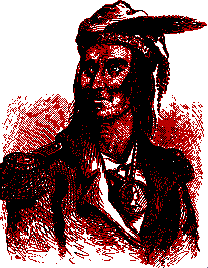


    If Depp wanted to inspire Indian youth, why didn't he have Tonto do something similar?

    Indeed, how is any half-crazed person supposed to be a role model for youngsters? Is Depp advising modern Indians to hit their heads, leave their tribes, and "go crazy" with solo stunts against the military-industrial complex? Uh, thanks but no thanks.

    Challenging the status quo

    In the modern era, Native activists occupied Alcatraz and Wounded Knee. Marlon Brando supported these Indians, and Depp supposedly admires both them and Brando. So why didn't his Tonto do something equally rebellious?

    The 19th-century equivalent of a radical protest might be the Ghost Dance movement. Suppose Tonto found a magical artifact that would let him dance the white man back to Europe. Suppose a villain wanted the artifact to become ruler of America. There's a movie for you. Life-and-death consequences for the entire country--exactly what Hollywood supposedly likes.

    Suppose Tonto vanquishes the villain but decides not to go through with the Ghost Dance. Or suppose he does go through with it and the white man disappears. At the end, we learn the entire 20th century was nothing but a present-day Indian's nightmare dream.

    There's a movie with a pro-Indian message.

    Even acting alone, in a traditional Western, Tonto could've begun a guerrilla campaign against settlers a la Geronimo. He could've gone to Washington and tried to assassinate the president. Or if you prefer a nonviolent approach, he could've gone to Congress and demanded his people's rights.

    Fighting a single evildoer is nothing compared to that. It's basically accepting the reality of Euro-American conquest. Which is why critics say most entertainment products--from old Westerns to Karl May's novels to The Lone Ranger--are pro-American and anti-Indian. They don't challenge the fundamental status quo.

    That status quo means exploiting the land, water, and other natural resources for profit. Which is the corporate version of the "American Dream." That's what Disney wants and Depp apparently wants. Namely, to lament the past while lining their pockets and doing little or nothing to change the present.

    Except for a few scholarships, even helping Indians seems beyond Disney's and Depp's means. For instance, can they find a few million dollars to buy Wounded Knee for the Lakota, as Depp has hinted at? Apparently not.

    Cartoon characters don't deserve America

    Throughout its history, Disney has portrayed Indians as comical, clown-like buffoons. Most Native stereotypes--from sports mascots to hipsters in headdresses--do something similar.


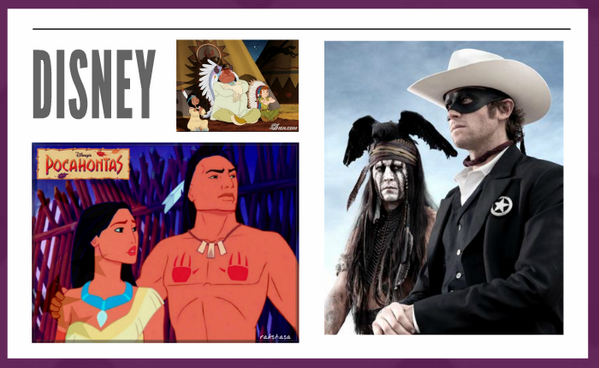
    Even if the portrayals are dignified--as in Disney's Pocahontas--they have two things in common. The Indians are primitive and in the past.

    The message of these stereotypes is the same. It's to celebrate the American way...maintain the status quo...protect the power and privilege of the white Christian elite. Civilization won and savagery lost, and the spoils go to the victors.

    Just look at Tonto or a prancing mascot or a pop star in a headdress. Should we let these weird, backward barbarians stop the march of progress and keep their land and resources? People who go around half-naked, dance and drink, and wear birds on their heads?

    That would be crazy, so no. America belongs to the sober, hard-working Christians who "tamed" it, not to heathens who waste their lives partying in skins and feathers. The Disney/Depp message is that Indians were too "different" to own the country, so they had to go.

    For more on the subject, see Onion's Take on Lone Ranger Fiasco and Depp and Bruckheimer Blame Critics.
    Faux Indians at the 2014 Oscars

    After the run-up to the Oscars:

    Twitter storm planned for Oscars
    Before the #NotYourTonto storm

    Here's what I tweeted before and during the ceremony:

    Who wants to bet that the only "Indian" we'll see at the Oscars tonight is a shot of Johnny Depp playing Tonto in redface? #NotYourTonto

    Naturally, Johnny Depp as Tonto in #redface was the first (and only?) Indian or faux Indian to appear at the #Oscars. #NotYourTonto

    2nd appearance of an Indian or faux Indian at the Oscars: Johnny Depp as Tonto in redface in a visual effects clip. #NotYourTonto

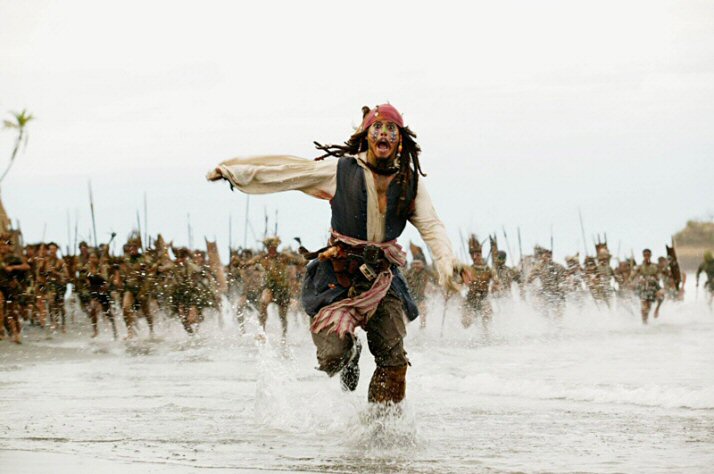
    3rd appearance by Indians or faux Indians: the savage cannibals in "Pirates of the Caribbean." Also starring Johnny Depp. #NotYourTonto


    4th and 5th appearances by Indians or faux Indians: Tom Laughlin as Billy Jack and a hint of Will Sampson in "Cuckoo's Nest." #NotYourTonto

    No real Indians

    My first tweet was retweeted several dozen times. And it proved to be accurate, of course.

    At least The Lone Ranger didn't win for it makeup or visual effects. That's something, I guess.

    If you stretched, you could claim Angelina Jolie and Jessica Biel represented Natives at the ceremony because they supposedly have a tiny amount of Native blood. But I don't count them.

    Someone noted that actor August Schellenberg, who died last year, wasn't included in the "In Memorium" section. Since Russell Means wasn't included the year before, I wouldn't expect the Academy to include the lesser-known Schellenberg.

    Oddly, Schellenberg is included in the longer memorium list at http://oscar.go.com. But not in a similar listhttp://www.oscars.org/academy/members/memoriam.html. I have no idea what's up with that.

    For more on the subject, see Indians at Previous Oscar Ceremonies and Racism at the 2013 Oscars.

    March 01, 2014

    Before the #NotYourTonto storm

    Native Americans Protest 'The Lone Ranger' Oscar Nomination for Redface

    By bahesmamaEradicating Offensive Native Mascotry, a group of Native parents from across the country are protesting the nomination of 'The Lone Ranger' for an Academy Award in makeup, basically, for Redface. To this end, they are conducting a “Twitterstorm” under the hashtag #NotYourTonto and will try to trend the hashtag both the Saturday night before the Oscars and during the Oscar broadcast.Some of the better tweets on Saturday and Sunday before the storm, and the links they shared:Debbie Reese ‏@debreese Mar 1
    #Parents! #Librarians! Reject racist toys: http://www.lego.com/en-us/theloneranger/characters/tonto #NotYourTonto
    The Lone Ranger

    Debbie Reese ‏@debreese Mar 1
    Native film prof calls Depp's Tonto "major setback" http://www.examiner.com/article/ucla-professor-says-depp-s-tonto-reinforces-native-american-stereotypes #NotYourTonto
    UCLA professor says Depp's Tonto reinforces Native American stereotypesLisa Tatonetti ‏@lisatatonetti Mar 1
    No one is hurt? Research shows Indigenous children shown Native stereotypes lose "self esteem" and "belief in achievement." #NotYourTonto

    tara zhaabowekwe ‏@zhaabowekwe Mar 1
    Talented Native actors are available, why the need for #redface? We're capable of representing ourselves onscreen. #NotYourTonto

    Debbie Reese ‏@debreese Mar 1
    Spinoff bk 4 kids: "He had never seen a real Comanche Indian." That wasn't a real Comanche Indian! That is Depp in redface #NotYourTonto

    Jessica Deer ‏@Kanhehsiio Mar 1
    Indigenous people are #NotYourTonto #NotYourPocahontas & #NotYourBigChief pic.twitter.com/wmiwP2bVrK
    Jessica Deer ‏@Kanhehsiio Mar 1
    The Lone Ranger reinforces & perpetuates the ideology that Indigenous ppl are one stereotyped monolith rooted in colonialism #NotYourTonto

    Mags ‏@Creekleo Mar 1
    Art and words by powerful artists @WhatTRIBE @apachesk8boards change the status quo and turn big heads #notyourtonto pic.twitter.com/KbIfCWIFn4

    Frank Waln ‏@FrankWaln Mar 2
    Johnny Depp is nominated for best makeup in his portrayal of a white man dressed like what white ppl think an NDN looks like #NotYourTonto
    My contribution

    I also contributed to the pre-Oscar fun with the following tweets:

    Native movie roles (guesstimate): Lakota, Cheyenne, and other Plains Indians 70%; Navajo and Apache 30%; other tribes 10%. #NotYourTonto

    "The Lone Ranger" wins a Razzie award for worst remake/rip-off or sequel. Johnny Depp is shut out. #NotYourTonto http://www.latimes.com/entertainment/envelope/moviesnow/la-et-mn-movie-43-named-worst-film-of-2013-razzie-awards-20140228,0,5893779.story

    'Movie 43' is named worst film of 2013 at the 34th Razzie Awards

    Old white men of the Academy have an abysmal track record of honoring the work of minorities. #NotYourTonto #Oscars http://nyti.ms/1pk0H3S

    The Academy and Diversity, by the Numbers

    For more on the subject, see Twitter Storm Planned for Oscars and Razzie Nominations for Lone Ranger.

    February 27, 2014

    Twitter storm planned for Oscars

    The Twitter Storm Before the OscarsI am #NotYourTonto, complementary to #NotYourMascot, references Gore Verbinski’s July 2013 movie The Lone Ranger, which has been nominated for best makeup in this year’s Academy Awards.

    The hashtag will be used starting Saturday evening before the Oscars on Sunday to protest Johnny Depp’s depiction of Tonto, the Lone Ranger’s Native sidekick, as a poor example of how Hollywood is “playing Indian.”

    The protest is being organized by Eradicating Offensive Native Mascotry, a group that started on Facebook to campaign against inappropriate Native images in the media, film and sports.

    “There is a double standard regarding Native people and this dehumanizes us to our fellow Americans and reduces their actual knowledge of who we are today,” wrote Jacqueline Keeler, one of the group's members, in an email to ICTMN. “Very few of those engaging in Redface understand we are sovereign nations and this leads to confusion regarding public policy and funding for education and healthcare in our communities and the creation of bad laws and bad judicial decisions.”
    Comment:  For more on a related Twitter storm, see Inside #NotYourMascot and Twitter Storm Against "Redskins."

    January 16, 2014

    Razzie nominations for Lone Ranger

    Hollywood's worst honored with Razzie Award nominations

    By Todd LeopoldForget the Oscars.

    Johnny Depp, Adam Sandler, Lindsay Lohan and "Movie 43" are among the esteemed company that will be battling for one of Hollywood's most widely shunned awards: the Razzies.

    The nominations for the 34th annual Golden Raspberry Awards were announced Wednesday morning, and the list included some new names--including Depp, a first-time Razzie nominee for "The Lone Ranger"--as well as some old favorites, such as Sandler, Lohan and Sylvester Stallone.

    Sandler's "Grown Ups 2" led all films with eight nominations.
    The 34th Annual RAZZIE® Awards
    Summer Bummers, Taunting Tonto...and Going "INDIEGOGO"

    A complete lists of The Lone Ranger's nominations:

    WORST PICTURE
    The Lone Ranger

    WORST ACTOR
    Johnny Depp: The Lone Ranger

    WORST DIRECTOR
    Gore Verbinski: The Lone Ranger

    WORST SCREENPLAY
    The Lone Ranger: Screen Story & Screenplay by Ted Elliott, Justin Haythe & Terry Rosso

    WORST REMAKE, RIP-OFF or SEQUEL
    The Lone Ranger

    Will The Lone Ranger win more Oscars (2) or Razzies (5)? The odds favor the Razzies, but we'll find out.

    October 18, 2013

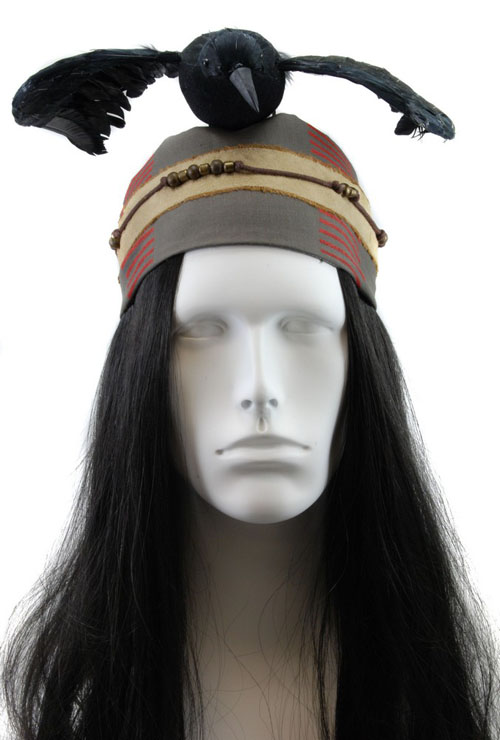
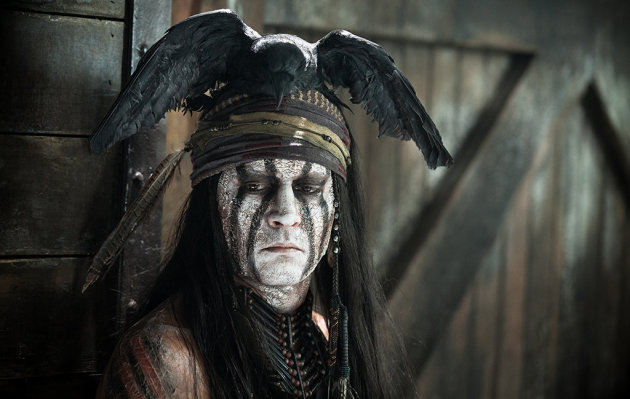
    Tonto's craziness justifies crow headdress?

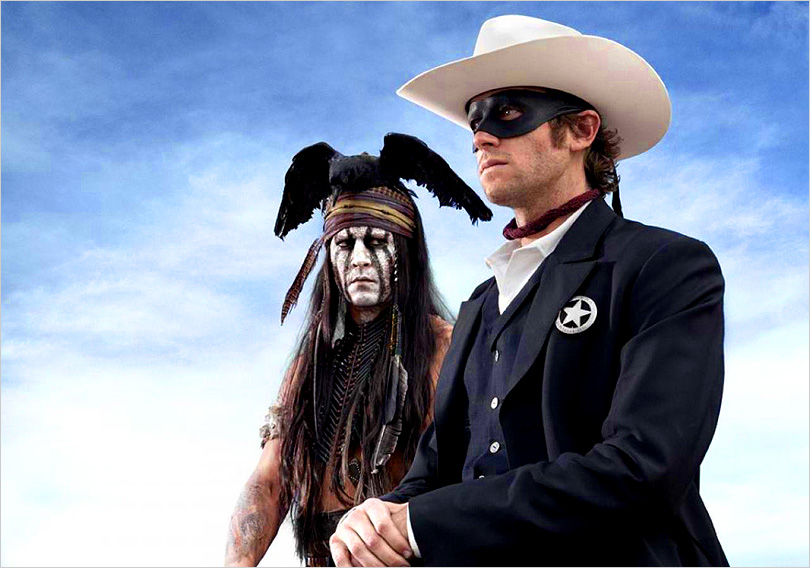
    Johnny Depp's Tonto supposedly is half-crazed because of a childhood trauma. Does that excuse the bird on his head and other oddities?

    *** spoiler alert ***

    I saw The Lone Ranger so you don’t have toI think this was the “twist” everyone kept telling me would “explain everything.” Saginaw’s character tells the LR about how, as a child, Tonto showed the bad guys where all the silver was, in exchange from a pocketwatch from “Sears and Roebuck” (a weird detail that stuck out–product placement? ha). The bad guys come back and murder his entire village to keep the location a secret–of which they show the aftermath. They show the village burnt to the ground, dead women and men everywhere, and then Tonto picks up his dead raven from the rubble and stripes his face with the soot. Saginaw tells us all this (starting with “many moons ago”–I kid you not) and that now Tonto is a “man apart (or departed? I can’t read my notes. It was dark.)” and has basically gone crazy and taken on this “Wendigo hunter” thing as a means to cope with what he did. So, I think this whole thing was supposed to excuse his crazy antics and look, because his own people don’t endorse it. But I’m pretty sure most movie audiences aren’t going to pick up on that nuance.I'm not buying the movie's excuse that Tonto isn't right in the head. Fact is, there's almost always an excuse for the uncivilized or savage Indian:

  • The hunter is trapped in a world of dinosaurs, so of course he's a savage Indian.

  • The white man killed his wife and children, so of course he's a savage Indian.

  • The burial ground is haunted, so of course he's a savage Indian (ghost).

  • The military veteran was traumatized by war, so of course he's a savage Indian.

  • The tribe was cursed by an evil shaman, so of course he's a savage Indian (werewolf).

  • What do these tropes have in common? The Native character is uncivilized or savage every time.

    Sure, there's a reason, but the reason is an invention to justify the savagery. It's not historically or culturally valid. Whether they're Native or not, half-crazed people don't act out their mental problems by wearing strange headgear.

    In short, we want a character who isn't a half-naked warrior in facepaint and a (crow) headdress, not another excuse for the same old stereotypes.

    Commenters debate issue

    A debate on this issue in the comments section of this posting:karen
    In Thomas King's Inconvenient Indian he discusses the portrayal of "dead Indians" (preferred) and the avoidance of any decent, realistic representation of live, modern-day Indians. This is the reference I am making in the above comment. I stand by my comment.

    RapidDescent
    Why on earth would the movie have any representation of modern-day natives when the movie itself doesn't take place anywhere near present day? The framing device, that is decidedly locked in place in the 1930's fair--in a tent, no less--isn't exactly the best place to feature anything of the sort.

    It is your peragotive to be offended, if you want, but I hope you realize that it's not because of the movie--it's because you're looking for excuses to be offended.

    Terrie_S
    And you seem to be looking for reasons to excuse the problems with the movie. You can't defend writer choices with the in-story justification, because the writers CREATED that justification. Maybe they came up with trauma reason after they decided that Tonto would speak broken English (problematic), or maybe they decided to have Tonto speak broken English because they wanted a way to show he was traumatized (not as problematic, though, psychologically, that doesn't make any sense), but either way, they made the CHOICE to have the main Indian character speak broken English when there was no objective reason to do so.

    Terrie_S
    Let's back up. Everything we see in a movie is a deliberate choice on the part of someone. Some choices are required by the story. If you're going to make a movie about the Lone Ranger, there are somethings that are objectively required for it to be the story of the Lone Ranger. You need the white horse. You need Tonto. You need the Ranger. You do not need a senile old guy in a fair tent. You don't need a narrator who casts himself in a supporting role. You don't need broken English. All of those are deliberate choices by the writers, the actors, the director, etc. The decision to have Tonto speak in broken English was obviously not driven by a desire for historical accuracy. Otherwise, someone (not the Comanche, but someone) if not multiple someones would speak Spanish. So you can't defend that choice by pointing to history. Nor can you defend it based on Tonto's trauma history, because 1) that history is another deliberate choice by the writers, not an objective requirement of the story and 2) it is not the only way to show a trauma history. IMO, it is a very bad way of showing such.

    The fact that people who claimed they were trying to challenge stereotypes instead made a movie full of them shows the problem with these pervasive images. When this is all they see, they are unable to imagine anything else.
    What's the alternative to an aged Tonto narrating the story from his point of view? It would've been easy to have a modern Indian--Tonto's grandson or great-grandson--serve as the framing device. But that wouldn't have conveyed the same message about the tragic, vanishing Indians.

    As Terrie S. said, having Depp play a sideshow freak in the 1930s was a choice, not a necessity. This choice "solidifies the continuing views of Native peoples as lesser, as relics of the past, as disappearing, as roadblocks to 'progress.'"

    Depp's Tonto = sidekick?

    The debate continued with a similar issue:Terrie_S
    Since I was replying to your comments on his speech, that's why I focused on his speech. It's not my main concern, its simply the topic of the discussion. And I'd say Tonto's still a sidekick. Maybe not as low ranking, but still a sidekick. I would argue that, in some ways, this is worse, because Tonto is the one telling the story, yet is not the focus of the movie. He casts himself in the supporting role. This is not the story of how Tonto, with the help of a white guy, got justice for the slaughter of his people. It's the story of how John Reid, with the help of a crazy Indian guy with a bird on his head, became the Lone Ranger. Which would be fine, except that, again, this is apparently how Tonto himself thinks of his own story--that it's the story of someone else.

    RapidDescent
    No, that is not fact, that is how you want to view the story--which is simply inaccurate. Tonto tells the story exactly how it happened in his view. He is never a sidekick--he even has a big scene where he SMACKS DOWN Reid and calls him out for being a coward. He SAVES Reid not once, not twice, but three times in the story. He has his own story of vengeance come to a close because he managed to work together with a person he initially didn't want to work with.

    To call him a sidekick is to knowingly tear down the character to make a point in an argument that is only created by you.

    Terrie_S
    He can do all those things and still be a sidekick. After all, DC gave Robin leadership of the Titans, with his own stories and moments of awesomeness but he was still Batman's sidekick. Understand, I'm looking at this from a meta, narrative level, not the level of character actions. The story starts with John Reid on a train, setting in motion the events which will result in him meeting Tonto. From a narrative perspective, this places Tonto's story subordinate to his. This is something that (again, narratively) is very hard to avoid. The movie Rush Hour is a good example of how writers might try to avoid this in the buddy movie--start with one character, but have the story take places on the other character's home territory. But that's not an option here, so one story must be given more weight than the other and the writers chose to give more weight to Reid. And, by using the framing device they did, they gave that view to Tonto. Ironically, it would have not been an issue had they dropped the framing, but they didn't make that choice, so that's simply a case of what might have been. Which leads me back to what you said.

    Tonto does not tell the story as how it happened in his view, because Tonto does not exist. The writers and actors and directors made all those choices. They are the ones who made the choice to have a movie where a Native character tells a story that follows the arc of someone else. They made the choice to make Tonto, narratively, the sidekick and to combine that with the choice to make him the "narrator" of the story.

    Terrie_S
    My most basic problem with the movie is this: Depp talked about wanting to move Tonto and Native characters out of the role of sidekick, yet when the character of Tonto has a chance to tell the story, it's the story of... the white guy. The character casts himself as the sidekick. And we, the audience, are told this from the get-go. Most stories that use the framing device of "And it was told by X side character" reveal this at the end, which makes us relook at what we've just seen, read or heard, to reconsider that "side" character or wonder if what we've been told is reliable. But we're not given any of that, so the framing device just reinforces all the issues of the movie.
    To reiterate the point, you can justify anything within a movie's "logic." The black guy had to die and the woman had to be taken hostage because they were the only characters available. These things "had" to happen so the white guy could be the hero.

    But again, these are choices by the creators, not immutable facts. If you look for and find an excuse to portray a savage Indian, you're not giving yourself a valid out. You're still portraying a savage Indian. And that's still stereotypical if not racist.

    September 26, 2013

    Del Toro: Redface is "tradition"

    The movie Jimmy P. is about to debut in the US. Indian Country Today is running interviews with the principals, including these two:

    Benicio Del Toro: 'Native Americans Are the Real Americans'It's controversial when any non-Indian actor takes on the role of a Native American (as was discussed at length on this site this summer, with Johnny Depp playing Tonto). Was that an issue on your mind when you were considering Jimmy P.?

    I am aware of the lack of representation of Native Americans in TV and movies, and when Arnaud Desplechin brought the idea of this movie to me, my instinctive reaction was: Why me? Because I really do believe that Native Americans could have played the part better, different… It could have been done. But there is a money issue in doing movies, and the fact that I have a career created the chance of the movie being made. That is a fact of life at this moment in time. So, when I read the story, I just felt it was a really strong story that should be out there. And, with all due respect, I dared to do it. There have been actors playing outside their groups; it is a tradition in acting. In the history of theater, even women were played by men.
    Yeah...the tradition of men playing women is called sexism. The tradition of whites playing blacks is called blackface, aka racism. The tradition of whites--Rock Hudson, Burt Lancaster, Charles Bronson--playing Indians is called redface, also known as racism.

    Not exactly something to crow about in the year 2013.

    Del Toro the next Depp?

    I'm not buying the money rationale either. Is this movie gonna be a blockbuster with Del Toro in the title role? I mean, a period piece about an Indian undergoing psychotherapy? Who wouldn't want to see two guys talking about their feelings for a couple of hours?

    Yeah, I imagine this movie will make five or 10 times its cost with Del Toro in the lead. Much more than a Native actor would've drawn. All those bottom-line investors can retire with the bucks they rake in.

    Not.

    Disney used the same thinking when it paid Johnny Depp to play Tonto. The company probably will lose around $200 million for its horrible casting decision. So tell me why someone would risk their money on Del Toro? He's not a big box-office draw. His movies usually lose money domestically and only recoup their costs in foreign markets.

    Director Talks About 'Jimmy P.: Psychotherapy of a Plains Indian'Did you come to make Jimmy P. because of a specific interest in Native issues?

    It came from my interest in psychoanalysis, as I am a great reader of psychoanalytical books, as well as for the Native culture, which I discovered as an adolescent when I read Bury My Heart at Wounded Knee.

    We have those childhood dreams—When I grow up I will be a cowboy, or an Indian. I wanted to become an Indian! Then, there is the issue of genocide, and the Native tragedy; my parents were activists, and followed the events in the media after the Alcatraz occupation. We were aware of what was going on.
    Comment:  For more on Jimmy P., see What's Wrong with Del Toro and Depp and Negative Reviews of Jimmy P.

    September 01, 2013

    NECA's Lone Ranger toys

    The commercialization of Johnny Depp's Tonto continues. Apparently Disney has licensed this company NECA to make all sorts of "Lone Ranger" junk items.

    Indeed, licensing may have been a major factor in convincing Disney to make the movie. A hot property can be a cash cow, enriching the studio with sales of video games, toys, costumes, action figures, jewelry, etc.

    The Lone RangerNative American spirit warrior Tonto recounts the untold tales that transformed John Reid, a man of the law, into a legend of justice.Here are some of the worst offenders among the items:

    The Lone Ranger–7″ Scale Action Figure–Series 2
    The Lone Ranger–1/4 Scale Figure–Tonto (Case 2)
    The Lone Ranger–Head Knocker–“Tonto”
    The Lone Ranger–Men’s “Tonto” Costume
    The Lone Ranger–Women’s “Tonto” Costume
    The Lone Ranger–Prop Replica “Tonto” Headdress

    Needless to say, these items perpetuate the movie's false and stereotypical representation of Indians. And the items don't include any explanations of Tonto's character--nothing about how he's half-crazed and not a typical Indian. Buyers have no reason to believe this Tonto isn't a genuine Indian--especially if they recall the assurances from Disney, Depp, and the Comanche Nation.

    For more on Johnny Depp and Tonto, see Tonto Costume at Comic-Con, Racist Car Ad Features Tonto Ripoff, and Disney Store Sells Tonto Costumes.

    August 18, 2013

    Lone Ranger ignores Comanche atrocities

    The truth Johnny Depp wants to hide about the real-life Tontos: How Comanche Indians butchered babies, roasted enemies alive and would ride 1,000 miles to wipe out one family

    Comanche Indians were responsible for one of the most brutal slaughters in the history of the Wild West

    However, Johnny Depp wants to play Tonto in a more sympathetic light

    By Jonathan Foreman
    S C Gwynne, author of Empire Of The Summer Moon about the rise and fall of the Comanche, says simply: ‘No tribe in the history of the Spanish, French, Mexican, Texan, and American occupations of this land had ever caused so much havoc and death. None was even a close second.’

    He refers to the ‘demonic immorality’ of Comanche attacks on white settlers, the way in which torture, killings and gang-rapes were routine. ‘The logic of Comanche raids was straightforward,’ he explains.

    ‘All the men were killed, and any men who were captured alive were tortured; the captive women were gang raped. Babies were invariably killed.’

    Not that you would know this from the new Lone Ranger movie, starring Johnny Depp as the Indian Tonto.

    For reasons best know to themselves, the film-makers have changed Tonto’s tribe to Comanche—in the original TV version, he was a member of the comparatively peace-loving Potawatomi tribe.

    And yet he and his fellow native Americans are presented in the film as saintly victims of a Old West where it is the white settlers—the men who built America—who represent nothing but exploitation, brutality, environmental destruction and genocide.

    Depp has said he wanted to play Tonto in order to portray Native Americans in a more sympathetic light. But the Comanche never showed sympathy themselves.
    Foreman's conclusion:By casting the cruelest, most aggressive tribe of Indians as mere saps and victims of oppression, Johnny Depp’s Lone Ranger perpetuates the patronising and ignorant cartoon of the ‘noble savage’.

    Not only is it a travesty of the truth, it does no favours to the Indians Depp is so keen to support.
    From what I've read, The Lone Ranger does indeed sanitize its Comanches to the point of blandness.

    The movie probably is doing Indians a favor by not portraying the Comanches as "the cruelest, most aggressive tribe." We don't need the umpteenth flick featuring Indians as merciless savages.

    But Depp and company had a range of options between portraying Indians as saintly victims and merciless savages. The best choice might've been to make Tonto something other than a Comanche.

    "Fierce" tribes get attention

    This article raises a valid point that I hadn't thought about enough. The Comanches weren't just your average tribe. They had one of the "worst" reputations for ferocity.

    It's one reason I've said storytellers should stop relying on the same old tribes: the Sioux, Cheyenne, and Apache. Start showing the range of tribal cultures, not just the most warlike cases. Focusing on these tribes makes all Indians look bad, since everyone thinks all Indians were and are the same.

    If you're going to pick the Comanches, make them historically accurate--atrocities and all. If you don't want a tribe guilty of atrocities, don't pick the Comanches. Whatever you do, don't portray the tribe as The Lone Ranger did: as a generic set of Plains Indians.

    For more on the savage Indian stereotype, see Aide Calls Indians "Arrow Throwers" and Indians in The Lost Colony.

    Below:  "Real-life: White Wolf, a Comanche Chief, pictured in the late 19th century."

    August 05, 2013

    Depp and Bruckheimer blame critics

    Johnny Depp, Bruckheimer Blame Critics for ‘Lone Ranger’ Disaster

    Armie Hammer adds: the reviews 'slit the jugular' of Disney feature

    By Stuart Oldham
    Johnny Depp and producer Jerry Bruckheimer have spoken out for the first time since mega-budget Western “The Lone Ranger” crumbled at the global box office, blaming U.S. critics for one of the biggest Hollywood trainwrecks of the year.

    “I think the reviews were written seven to eight months before we released the film,” Depp proclaims in a new interview.

    Disney’s costly feature, which could lose as much as $190 million, never stood a chance of succeeding because of overtly negative press, according to the Oscar-nominated actor.

    “I think the reviews were written when they heard Gore (Verbinski) and Jerry (Bruckheimer) and me were going to do ‘The Lone Ranger’,” Depp said. “They had expectations that it must be a blockbuster. I didn’t have any expectations of that. I never do.”

    Bruckheimer, who made millions off the “Pirates of the Caribbean” franchise with Depp, agreed when it came to the press’ coverage.

    “I think they were reviewing the budget, not reviewing the movie,” Bruckheimer told Yahoo U.K.-Ireland. “The audience doesn’t care what the budget is—they pay the same amount if it costs a dollar or 20 million dollars.”
    These claims are ridiculous, of course. A child could point to big-budget movies that critics loved, and movies that made big profits despite negative reviews.

    One writer easily swatted away the claims of Depp and company. His conclusion:

    Johnny Depp, Don't Shoot the Messenger for 'Lone Ranger' Flop

    By Alonso DuraldeIt’s admittedly very flattering, gentlemen, that you think that the critical establishment is responsible for the catastrophic domestic box-office performance of “The Lone Ranger,” but it’s also hilarious.

    If film critics could destroy a movie, Michael Bay and Adam Sandler would be working at Starbucks. If film critics could make a movie a hit, the Dardenne brothers would be courted by every studio in town.

    “The Lone Ranger” stunk so much so that audiences got an immediate whiff and stayed away.

    End of story.
    'The Lone Ranger' to Cost Disney $160-$190M in Q4

    By Lucas ShawDisney will take a write-down of $160 to $190 million in the next fiscal quarter, the company said during its earnings call on Tuesday.

    "The Lone Ranger" has grossed just $175.5 million at the global box office, a pittance for a movie that cost more than $200 million to produce–and millions more to market. Though it opened in theaters in the third quarter, its main hit to the company's bottom line will not be reported until the next quarter given recent changes in reporting standards.

    The marketing costs of that film still submarined profits at the company's film studio, which reported a 36 percent decline in profits for the third quarter on Tuesday.
    In reality, critics have never had less influence over a movie's success. Duralde rightly put the blame where it belongs: on Depp and his stupid filmmaking moves. Including his stereotypical portrayal of Tonto.

    For more on Johnny Depp and Tonto, see Skyhawk: Depp Dishonored Indians and Why The Lone Ranger Flopped.

    July 26, 2013

    Depp's other Native movies

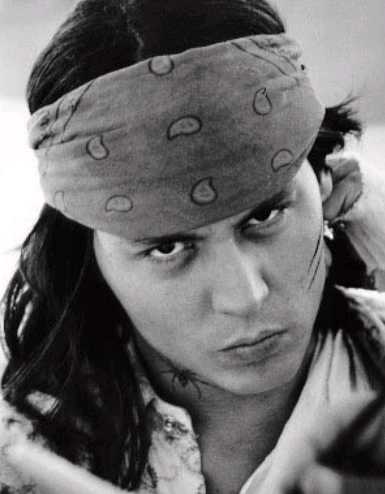
    Johnny Depp previously starred as an Indian in his little-known indie film The Brave. If these old reviews are accurate, The Brave foreshadows Depp's unrealistic, fantasy portrayal of Tonto in The Lone Ranger.

    Review: “The Brave”

    By Godfrey CheshireDirecting, co-writing and starring in “The Brave,” a turgid and unbelievable neo-Western, Johnny Depp offers further proof that Hollywood stars who attempt to extend their range are apt to exceed it. In this case, the main fault lies with the writing. Lacking both a realistic grounding and compelling internal momentum, pic wastes its handsome mounting and capable cast on a plodding tale that eludes either psychological or allegorical sense. Overlong and unexciting, it will be a tough sell in all areas except epicenters of Depp devotion.

    That the story, scripted by Depp, his brother D.P. Depp and Paul McCudden from Gregory McDonald’s novel, supposedly takes place among Native Americans must be counted as pic’s first problem. There’s no specificity or authenticity to the characters; they’re simply generic modern Indians, which understandably could be taken as exploitative or insulting.

    In this regard, Depp simply combines age-old Hollywood bad faith toward native peoples with the worst tendencies of two of his obvious mentors, Jim Jarmusch and Emir Kusturica, who often mask cultural condescension with arty pretension.

    Similarly vague, tale’s setting is Morgantown, location unknown, a desert outpost perched on the edge of a huge garbage dump. With a wife and two kids, loser Raphael (Depp) is looking for a way out when a trip to town leads him to Larry (Marshall Bell), apparently a businessman. Promising work, Larry sends him to a mysterious figure named McCarthy (Marlon Brando), who meets Raphael in a dark warehouse and offers him a terrible bargain: $50,000 for his agreement to be murdered a week hence.
    He also starred in the Native-themed movie Dead Man, though he didn't play an Indian in it.

    Equal Status, Kemo Sabe

    Johnny Depp Revises Tonto in ‘The Lone Ranger’

    By Chris Wallace
    Based on the novel by Gregory McDonald, “The Brave” follows this wastrel-with-a-heart-of-gold (played by Mr. Depp with a David Foster Wallace bandanna) in the last week of his life as he makes peace with his family and spends the $50,000 he has accepted to be tortured and murdered by a spiritual sadist (Marlon Brando). Though it had its premiere at Cannes and, as is typical there, received both a standing ovation and abysmal reviews, the film was never released Stateside. (I bought a Korean import on eBay for about $4.)

    The movie isn’t terrible, exactly—it’s not good—but it does raise the question: Why? Why spend the celebrity capital (not to mention the financial kind) he had so carefully, if eccentrically, amassed to make it? To get anything done in Hollywood, even if you are Johnny Depp, takes years of often heartbreaking obsession, not to mention millions of dollars. So for him to step behind the camera to make “The Brave,” bringing a historically underrepresented perspective to the screen, suggests he thought it was worth the trouble.
    And:So too, apparently, was Jim Jarmusch’s quiet little black-and-white western “Dead Man,” for which Mr. Depp reportedly turned down the lead roles in “Speed,” “Legends of the Fall” and “Interview With the Vampire.” After suffering an ultimately fatal gunshot wound, his character, an accountant from Cleveland named William Blake, is led through a spiritual wilderness and Mr. Jarmusch’s elegant allegory by an Indian named Nobody (Gary Farmer). Much of the poetry and tender comedy in “Dead Man” comes from Mr. Farmer’s post-Tonto Nobody, winking all the while at cinema’s “savage” past portrayals of American Indians.

    Beneath the howling Neil Young score and the deadpan comedy, “Dead Man,” is, like “The Brave,” inflected with deep sensitivity to, if not reverence for, native American (and Native American) culture. But, unlike “The Brave,” “Dead Man” is a great film—possibly both Mr. Depp’s and Mr. Jarmusch’s best—the most significant entry in Depp’s catalog of Native Americanalia until “The Lone Ranger” rides into theaters on Wednesday.
    Comment:  Depp didn't write, direct, or play an Indian in Dead Man but did in The Brave. Dead Man is considered great while The Brave is considered awful. I wonder why.

    With his superficial and generic understanding of Indians, it seems Depp isn't qualified to make movies about them. Not if he has creative control, anyway. The Lone Ranger proves the point.

    For more on Johnny Depp and Tonto, see Skyhawk: Depp Dishonored Indians and Shawnee Professor Justifies Tonto's Stereotypes.

    July 20, 2013

    Racist car ad features Tonto ripoff

    Racist Car Ad in Texas Features Depp-Tonto RipoffCourtesy of Deadspin comes a ridiculous commercial for Charlie Clark Nissan in Brownsville, Texas. In it, an actor dressed as Johnny Depp's character Tonto in The Lone Ranger, speaks like the old caricatures we used to see in Hollywood decades ago. How offensive is it? See for yourself:
    Oh, and don't think Charlie Clark is only bigoted toward American Indians. No, he's happy to drag the Japanese and Italians through the racism wringer, too.Comment:  Unfortunately for us, Charlie Clark Nissan has removed the "Tonto" video. But you can see the other videos featuring a Japanese sensei and his pupil, a la The Karate Kid, and an Italian chef.

    Judging by those two videos, white man Charlie Clark plays all the ethnic characters himself. In each case, he demands a Sentra from a "Typical Dealership" for $9,999. Apparently Charlie Clark offers that price and other dealers don't.

    Of course, the point is how people are (mis)using Johnny Depp's stereotypical portrayal. Thanks, Johnny, for mainstreaming racist caricatures of Indians!

    Proving this isn't some one-time fluke, below is an image from this year's San Diego Comic-Con. As I've said before, Depp's Tonto may be the most common "Indian" image we see for the next few years.


    For more on Johnny Depp and Tonto, see Skyhawk: Depp Dishonored Indians and Shawnee Professor Justifies Tonto's Stereotypes.

    July 18, 2013

    Skyhawk: Depp dishonored Indians

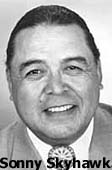
    Sonny Skyhawk on 'The Lone Ranger': 'Heads Should Roll at Disney'

    By Gale Courey ToensingYou know how they say even bad publicity is good because it creates so much buzz and sells things? Well, this movie had so much bad publicity but it’s still a flop according to the reviews and box office receipts. How do you account for that?

    Well, I don’t know that there’s been bad publicity with regard to the Hollywood machine. The Hollywood machine would have you believe that this is a fantastic movie and what’s all the negativity about? That’s the unfortunate part--they don’t have a clue. They didn’t have a clue at the beginning in my talks with Disney...

    You talked to them at the beginning?

    ...I had teleconferences with them when we discussed some of these things. I told them I thought it would go south. I expressed at the time what my feelings were and the fact that having Johnny Depp play Tonto was due for a total crash. And they said, "No, we don’t think so. We have our ducks in a row and we think that Johnny Depp is going to do great.” And I said, "Well, ok! Next point. Why don’t you try and involve the American Indian community if you’re going to shove this down their throat? I would advise that you at least try to get them on your side before you invest in trying to convince them that Johnny Depp is Indian,” and so on. And they said, “No, we have that pretty much in hand also. Johnny Depp is part Indian and we’re going to roll with that” and I said, “Well, you know, the Cherokee Nation, one of the tribes he claims to be from, has vetted his ancestry and none of them are located on their rolls.” And they said, “Well, he thinks he is and so we’re going to roll with that.” I said, “Ok! Good luck!” Those conversations were with a Disney vice president and also a lady by the name of Dawn Jackson, an American Indian who works for Disney in the merchandising department. She’s the go to Indian at Disney when they have a question, like about Pocahontas.

    So, they didn’t hear you?

    We’re not gloating, but we are doing an I-told-you-so, kind of thing. The problem is that we’ve (American Indians) come this far and we’re still seeing this kind of approach. We had Johnny Depp saying, “I’m going to honor you” and then we end up being dishonored again. The only thing that I can take satisfaction in is that they’re not going to make any money out it. In my experience and in my professional view the $325 million spent on it might make somewhere in the vicinity of copy25 million. So among the powers that be who forwarded this movie, heads should roll at Disney because in my best estimation they’re going to lose close to $200 million on this film.
    Comment:  For more of Sonny Skyhawk's take on Johnny Depp, see What's Wrong with Del Toro and Depp? and Skyhawk: Depp Is a Charlatan.

    July 13, 2013

    Reactions to Depp's Wounded Knee talk

    Some of the many reactions to the news that Johnny Depp may buy Wounded Knee:

    Johnny Depp interest in purchasing portion of Wounded Knee causes a stir

    For months, questions have swirled about whether developers, activists or tribes would be willing to plunk down millions to buy a portion of the Wounded Knee National Historic Landmark. Now there's a new potential buyer in the mix: Johnny Depp.

    By Kristi Eaton
    Oglala Sioux President Bryan Brewer, whose tribe lives on Pine Ridge, said he has not been contacted by anyone in Depp’s camp and was first notified of the actor’s interest when someone from England called him for reaction. Brewer said he and a group of descendants of Wounded Knee survivors are hoping to meet with Czywczynski soon.

    The possibility of the celebrity purchase is generating debate in Native American communities. Some question Depp’s motives due to the timing of “The Lone Ranger” release, which debuted with a dismal $19.5 million in ticket sales on its opening weekend in early July. Depp, who plays the part of the Native American character Tonto in the film, has been accused of playing into stereotypes and misappropriating Native American culture. Tonto speaks broken English, wears a stuffed crow on his head and has a face painted with white and black stripes. Some Native Americans view the character as a parody.

    Depp’s also been criticized for saying that he does have Native American ancestry, but he’s unsure if it’s Cherokee or Creek.

    “People I’ve talked to think he’s in it for redemption because he’s gotten bad reviews,” said Oglala Sioux tribal member Dawn Moves Camp, 30.
    And:"Honestly, I don't think it would be a bad thing if Johnny Depp would purchase it with the cooperation of the tribes," he said. What's most important, he said, is that the land is preserved and an accurate account of what happened is shared with visitors through a monument.

    Tribal members have disagreed over the years about how to commemorate the lives lost at Wounded Knee. While there is a small monument listing some of the names of those killed in 1890, some tribal members think a larger statue or structure is needed to educate the public.

    Sonny Skyhawk, a Sicangu Lakota actor and founder of American Indians in Film and Television, said although he was not a fan of Depp playing Tonto in "The Lone Ranger," purchasing the land would be a "great opportunity" for Depp to step forward and do something for Native Americans.

    "If it's from the heart, we accept it. If it's not from the heart, we'll accept it anyways because it's such a meaningful undertaking when you look at the significance of what the sacred ground next to it is," he said.
    Divided opinions over Johnny Depp's offer to buy Wounded Knee

    By Daniel Simmons-RitchieTribal officials have repeatedly called Czywczynsk's price inflated to the point of extortion. Shannon County has appraised the combined value of the parcels at $14,000 by county appraisers.

    But now Depp's offer has caused the Oglala to reassess their position.

    "You see these celebrities with a lot of money and a lot of times you hear about the useless spending they do, this is something different, something that's unbelievable," said Garfield Steele, a council representative for the Wounded Knee District, who believes the tribe should take Depp's offer.

    But others were less convinced. Nathan Blindman, a descendant of the survivors of the Wounded Knee massacre, said that, although Depp's offer is well-intentioned, the hearty profit that Czywczynski would make from the sale would be disrespectful to those who died.

    "The bottom line is it's still selling the tragedy and violence," he said. "It's still making money off it, no matter who buys it."
    And:While he agreed that Depp has good intentions, Stainbrook said Depp's best approach would have been to privately offer a contribution to the Oglala and ask them how they could best use the money.

    Instead of 80 acres, he said, the Oglala could use $4.9 million to buy thousands of acres of reservation land from non-natives.

    "There's plenty of land not in Indian ownership that they could have used," he said.
    My Image is Not For Sale

    By Taté WalkerDepp is offering Indian Country, especially those of us in South Dakota--the poorest communities in the entire nation (cue violins)--a wonderful gift. Is it a peace offering for that terribly offensive movie? Maybe, but I’m willing to let that go. A gift is a gift. But it’s like the generic body wash set your Christmas visitors get you (“Oh, I love the smell of strawberry passion!”); if you know anything about me, you’d know NOT to get me body wash. And there’s the rub: Johnny knows nothing about Indian Country, so much so that he based his whole Tonto look off of a painting whose creator acknowledged was NOT historically accurate. Like, at all. If Depp got to know his newly adopted brothers and sisters of the Plains, he’d realize there’s a TON that could be done with $5 million. Scholarship endowments, capital-building projects, infrastructure development…

    So, yes, thank you for this gesture, Mr. Depp. But, please, look into how you can really help us. Pump some funding into programs trying to dig us out of crippling poverty and unemployment; advertise and promote ventures trying to get traditional foods back into our diets; talk to the dozens of kids who contemplate suicide every day; visit our underfunded schools and hospitals. Don’t want to get too deep too fast? That’s OK. Produce a Native-led film project. Start an arts program. Protest Big Oil with us. Be #idlenomore
    Harriman: Is Johnny Depp really going to save Wounded Knee?

    By Peter HarrimanDepp said he might buy Czywczynski’s land for the tribe, evidently undeterred by a price approaching $4 million.

    Perhaps not coincidentally, Depp has a movie in theaters this summer in which he plays the Lone Ranger’s iconic sidekick. In interviews, Depp has said he might be a descendant of Cherokee or Creek ancestors, and in New Mexico last year, where “The Lone Ranger” was in production, Depp was adopted into the Comanche Nation.

    But Depp has not traded on a tribal past until now, and his painted-face portrayal of Tonto has raised eyebrows. Is his Wounded Knee offer in the nature of appeasement?
    And:Depp might be entirely well motivated. But instead of spectacularly overpaying for land recent Shannon County sales suggest is worth about $300 an acre, if Depp wants to write a big check on the tribe’s behalf, he should give them a stake in the 21st century Black Hills.

    Economic development at Pine Ridge is nearly impossible, in part because of its remote location. But the Black Hills are thriving. A cursory check of Rapid City realtors’ commercial listings shows a 10-building tract with an accompanying liquor license and 300 slot machines on Deadwood’s Main Street is available for $4.5 million.

    There is an ice plant in Rapid City for sale for $3.2 million. A 105-room Rodeway Inn on the road to Mount Rushmore is being offered for $2.25 million. About 200 acres of development land near Sheridan Lake can be had for $1.59 million. Any or all of these would be of greater tangible benefit to the Oglala Sioux in 2013 than overpriced rangeland at Wounded Knee.
    Johnny Depp's Wounded Knee offer called generous, but some think it's misguided

    By Leslie ReedChuck Trimble of Omaha, a Native American rights advocate and journalist who is an enrolled member of the Oglala Lakota nation, is among those who think Depp should do something else with his money.

    “I think it's very generous of him, but there are quite a number of people who wish he wouldn't do this,” Trimble said. “If he wants to give millions, he should give it to a cause, and not pay it to a man who is holding the Wounded Knee site for a price—and it's very questionable how he got it in the first place.”
    And:Trimble said the pain of Wounded Knee remains fresh.

    “The sore just won't heal,” he said. “Poor Johnny Depp. He's still trying to sell his Tonto role and hoping there won't be a backlash from Indian country. He's doing his best—he meant well. He still means well.”
    Why Johnny Depp spending anything more than a few thousand bucks for Wounded Knee would be a big mistake

    And finally:

    Indians to Johnny Depp: 'Keep Your Word, Buy Wounded Knee'Neither party has heard from Depp yet, but an online petition at Change.org directed at Depp and his agent seeks to push the actor to make good on his statements. Referencing Native peoples' history of disappointment at empty promises, the petition reads as follows:

    "Keep your word. Promises to indigenous people are frequently made and broken. You promised to buy Wounded Knee and give it to the Sioux Nation. The owners want to sell. Keep your word. Buy Wounded Knee and gift it freely to the Sioux Nation."
    Comment:  The consensus seems to be that regardless of Depp's motives, buying Wounded Knee would be a good thing to do. But he could help more by donating money to other causes rather than wasting it on overpriced land.

    The more cynical among us thought, "If Depp wants to purchase Wounded Knee, why doesn't he pick up the phone and do it? In fact, why didn't he do it in June, when the property went on the market? It's a mighty big coincidence that he mentioned this idea only after The Lone Ranger started tanking."

    For more on Johnny Depp and Tonto, see Why The Lone Ranger Flopped and Ranger too Racist to Reboot.

    July 12, 2013

    Shawnee professor justifies Tonto's stereotypes

    Here's an article that's been reprinted a few placed. Because it purports to be culturally accurate, it's worth going through line by line.

    History vs. Hollywood: Does 'The Lone Ranger' Accurately Represent Native Americans?

    UC Professor and Native American expert Ken Tankersley offers his take on Tonto in the new Disney movie.

    By Allison Stigler
    The Lone Ranger and his trusty Native American sidekick Tonto are racing across film screens this week. Starring Johnny Depp, the movie adaptation of the old TV and radio shows is a box office hit, but does the film accurately portray American Indians?

    Actually, yes. Several details in the movie realistically captured Native American customs, traditions and dress, according to University of Cincinnati's Native American expert Kenneth Tankersley, a Piqua Shawnee and an anthropology professor for the McMicken College of Arts and Sciences.
    Whatever a Piqua Shawnee is, it's not a federally recognized tribe. Not that it necessarily matters, but it makes you wonder.

    Oh, here it is:

    Welcome to the home of the Piqua ShawneeWelcome to the Piqua Shawnee website. Our tribe has approximately 300 members, and is a recognized tribe by the State of Alabama.So Tankersley is an Alabama "Indian" who works in Ohio? He's about as far removed from Tonto's Comanches as I am, and about as qualified to talk about them.

    Back to the article:After watching the film during its opening week, he declared the movie to be a “quantum leap” over other many previous film and television depictions. “They did a really good job.”

    Tankersley noted that, although not a “card carrying” member of a Native American tribe, Depp does have Native American ancestry. “He is from Kentucky and Melungeon by ancestry.

    “Melungeons were Sephardic Jews and Muslims, escaping to religious freedom in the New World. When they arrived, they married into the Native American community.”
    Did Tankersley study Depp's family tree and find a Melungeon ancestor? Being from Kentucky doesn't necessarily mean Depp is Melungeon, much less Native.To prepare for the role, Depp immersed himself in the Native American culture. He listened to stories from descendants of Quanah Parker, a dominant figure in the Comanche tribe, and was adopted into the tribe by LA Donna Harris, a Comanche social activist.That's the first we've heard of Depp's reading about Quanah Parker. If it's true, it doesn't show in his performance, according to all the reports.

    It's LaDonna, not "LA Donna." She adopted Depp into her family, not the tribe. And being adopted after the movie was done doesn't make Tonto any more authentic.With the exception of Tonto speaking pidgin English, the film employed authentic Native American details, many of which could be missed by the casual viewer, Tankersley said. Below are some he noticed. (Warning: spoilers ahead!)With the exception of perhaps the biggest flaw, Depp's portrayal isn't flawed? Wow, thanks for that unqualified endorsement.

    Professor gets schooled

    Let's examine Tankersley's claims one by one:Tonto drops corn on the ground and appears to feed it to the dead raven he uses as a headdress. Tankersley said this is actually a blessing, because corn is sacred.Did the movie explicitly call the act a blessing? Did it call the foodstuff corn? Because every review that mentioned the foodstuff labeled it birdseed, not corn.The raven is a symbolic messenger in both Native American culture and the film to signify impending events. Tonto’s raven headdress comes from a painting Depp saw that depicted a warrior.Weak reference to "Native American culture," not Comanche culture. Not true of many Native cultures. And the headdress came from a white man's fantasy painting, which means it's false and stereotypical.A few Native American practices were borrowed from other tribes including the windigo, an evil cannibal spirit that is the villain in the movie. The windigo comes from Algonquian mythology, rather than the Comanche tribe."Borrowed" = stupidly and wrongly misappropriated. Mixing of Native cultures = false and stereotypical because it implies all Natives are the same.

    To give you an idea how far off this is, would you borrow centaurs or Medusa for a story about Norse mythology? Greek is to Norse as Algonquian is to Comanche.Tonto frequently calls the Lone Ranger "kemo sabe." The word is from the Potowatomi language and means “friend,” according to Tankersley.Actually, the origin of "kemosabe" is unknown. The best guess is that it comes from a camp's name that may or may not be a corruption of an Ojibwe word.

    In the old Lone Ranger series, what did "kemosabe" mean?

    And we should give the movie credit for repeating a 75-year-old concept from the original radio show? Big freakin' deal.The Spirit Horse (which the Lone Ranger rides) is white, symbolic of the Spirit of the North Wind, which provides guidance and wisdom of the ancestors.Why would the Comanche care about some northern wind thousands of miles away? Sounds like more generic Indian nonsense, at best. Since Tankersley didn't even attribute it to generic Indians this time, he may have made it up.Tonto remains in face paint through most of the film. Typically, Native Americans donned the paint only during ceremonies. Because Tonto felt threatened by the windigo through much of the movie, the paint served as a mask to protect him from the evil windigo spirits. The paint does not appear in scenes that took place after the threat was eliminated.More generic Indian nonsense. Not applicable to Tonto since he's supposed to be Comanche, not Algonquian. And did the movie state this, or is Tankersley making it up again, like the "spirit horse"?

    Breastplate and feathersTonto’s costume includes a typical Comanche breastplate. Filmmakers took artistic license with its color and composition (they typically were white bone or shell, but Tonto’s is black water buffalo horn).It's a "typical Comanche breastplate" except for its color and composition? What's the typical part? And water buffalo are found only in Asia, not America.Tankersley also noted that the Comanche actors wore real eagle feathers, while the non-Native American characters donned painted turkey feathers, since only Native Americans are permitted to have eagle feathers.Again, did the movie state this? If not, how does he know?

    Even if true, it's a trivial detail that no one--not even a Native reviewer--has noticed. That makes it irrelevant.Tankersley hopes the film’s portrayal of Tonto will spur more accurate depictions of Native Americans in future movies and will help Native American children take pride in their heritage.Yes, let's hope future portrayals are better than this false and stereotypical portrayal.

    Every one of Tankersley's points is either wrong, misleading, unsubstantiated, or unimportant. If I were grading his review, I'd give it a C or C- at most.

    For more on Johnny Depp and Tonto, see Depp Justifies Tonto's Stereotypes and Comanche Chairman Justifies Tonto's Stereotypes.

    Depp may buy Wounded Knee

    A Facebook friend said she'd heard a rumor about Johnny Depp's buying Wounded Knee. I found the article below and the story took off.

    'The last few years have been a bit bumpy': Johnny Depp on life after Vanessa Paradis--and cheating death on his new movie

    By Martyn PalmerSuch is Depp’s commitment to the Native American cause, he is planning to spend millions of his own money to return land, Wounded Knee, in South Dakota, to their ownership.

    The site, the scene of an 1890 massacre, is up for sale for $3.9 million. Local Native Americans say they cannot afford to buy it. Depp is outraged.

    ‘It’s very sacred ground and many atrocities were committed against the Sioux there. And in the 1970s there was a stand-off between the Feds (Federal government) and the people who should own that land. This historical land is so important to the Sioux culture and all I want to do is buy it and give it back. Why doesn’t the government do that?’’

    Is he really prepared to pay for the land?

    ‘I am doing my best to make that happen. It’s land they were pushed on to and then they were massacred there. It really saddens me.’
    The Last Real Indians website confirmed that Depp's statement wasn't a complete fiction:

    Explosive White Clay, Walking out on Nebraska’s Gov. & Johnny Depp buying Wounded Knee --Oglala President Bryan Brewer[LRI] *pause* [awkward silence from interviewer as the goosebumps settle] Uhhh, is that all Mr. President about White Clay for now [President Brewer chuckles], how about Johnny Depp, is it true you’ve been in contact with him about possibly buying Wounded Knee?

    [BREWER] Yes! Johnny Depp, I’ve been put in contact with his representatives and we had a talk. They expressed to me that he’s interested in potentially securing Wounded Knee for us and all I can say is that I would love for Johnny Depp to come out, the Lakota Nation would welcome him for a sit-down to see that our name “Lakota” truly means Allies or Friends.
    The media quickly picked up on this potential blockbuster news:

    Johnny Depp wants to buy the site of Wounded Knee massacre and give it back to the Native Americans

    By Meghan KeneallyThe Lone Ranger opened on July 3 and is estimated to lose between $150million and $200million due to the film's $215million production budget and additional $175million for marketing.

    The money is no matter to Depp, however, as he plans to make the move for Wounded Knee using his own personal savings.

    Depp's standard salary is said to be around $20million per picture, and his total net worth is in the $200million to $300million range.

    With that deep of a bank account, Wounded Knee's asking price of $3.9million should not cause a second glance.
    This article states what many people are thinking about the connection between The Lone Ranger and buying Wounded Knee:

    Johnny Depp 'Tonto' Racist? 'Lone Ranger' Actor Spending Millions On Wounded Knee Massacre Site to Give Back to Native Americans (PHOTOS)

    By Julia Lynn Rubin"Without an accurate pop-culture idea of a real-life Native American in moviegoers' heads, Tonto is less of an individual character than he is a key piece of the popular image of a large and diverse population. The stereotype is particularly detrimental for its fantastical elements," pointed out Adrienne Keene of Native Appropriations.

    However, it appears as though Depp wants to reverse this idea, or at the very least, try to do something positive for the Native American community. "It's very sacred ground and many atrocities were committed against the Sioux there," he said of Wounded Knee in a recent interview with Mail On Sunday.
    Yeah, Depp wants to reverse the idea...that he created with his version of Tonto. Because his stereotypical portrayal is causing the movie to tank.

    For more on Johnny Depp and Tonto, see Why The Lone Ranger Flopped and Ranger too Racist to Reboot.