Showing posts with label comic strips. Show all posts

November 14, 2013

Burroughs's The War Chief

Because of the John Carter movie, there's been a renewed interest in the work of Edgar Rice Burroughs. In recent years, I've posted a few links about him and his ideas about race. For instance:

Burroughs the conservative racist
Review of Warlord of Mars #1

But while talking about Martians as analogues of Indians, I neglected a more direct link. Burroughs wrote a whole novel about the Apache:

The War Chief

SynopsisTHE WAR CHIEF is a realistic historical novel about life and death on an Apache reservation during the final years of the Apache wars until the death of Cochise and the surrender of Geronimo. The story focuses on Andy MacDuff, an infant kidnapped by the Apaches in a raid, adopted by Geronimo and renamed Shoz-Dijiji, or Black Bear. He is given a proper Apache upbringing, including initiation into all the rites and responsibilities of Indian Manhood. He excels at the crucial skills of hunting and warfare, shows himself to be strong and courageous, and soon is made a highly prized war chief. During his apprenticeship, Shoz-Dijiji falls in love with Ish-Kay-Nay, an Apache maiden, who, unfortunately is coveted by another Apache chief, Juh, who hates Shoz-Dijiji for being Geronimo’s favorite. Burroughs’ great respect for the West and compassion for the exploitative treatment of the Indians the hands of the treacherous pin-dah-lickoyee (“white eyes”) is manifested throughout this honest, vivid, and sympathetic portrait of the West that does credit to both the Indians and Edgar Rice Burroughs.Project Gutenberg has posted the whole story online if you want to read it:

Title: The War Chief

Author: Edgar Rice Burroughs
* A Project Gutenberg of Australia eBook *
CHAPTER 1

GO-YAT-THLAY

NAKED but for a G-string, rough sandals, a bit of hide and a buffalo headress, a savage warrior leaped and danced to the beating of drums. Encircling fires, woman-tended, sent up curling tongues of flame, lighting, fitfully, sweat-glistening shoulders, naked arms and legs.

Distorted shadows, grotesque, mimicking, danced with the savage and his fellows. Above them, dark and mysterious and weirdly exaggerated by the night, loomed the Grampian Hills.

Rude bows and arrows, stone-shod spears, gaudy feathers, the waving tails of animals accentuated the barbaric atmosphere that was as yet uncontaminated by the fetid breath of civilization--pardon me!--that was as yet ignorant of the refining influences of imperial conquest, trained mercenaries and abhorrent disease.
But wait...it's a trick! These are the Scottish ancestors of the white men who will soon invade the land of Go-yat-thlay (Geronimo). How they came to have a buffalo headdress, I don't know, but the point is that they reek of savagery.

A few paragraphs later we meet Geronimo as he spies on a covered wagon:Go-yat-thlay had never before seen this wagon, but he had seen its dust from a great distance; he noted its volume and its rate of progress, and he had known that it was a wagon drawn by two mules, for there was less dust than an ox-drawn vehicle would have raised, since oxen do not lift their feet as high as horses or mules, and, too, its rate of progress eliminated oxen as a possible means of locomotion. That the wagon was drawn by mules rather than horses was but a shrewd guess based upon observation. The Apache knew that few horses survived thus far the long trek from the white man's country.

In the mind of Go-yat-thlay burned a recollection of the wrongs that had been heaped upon his people by the white man. In the legends of his fathers had come down the story of the conquests of the Spaniards, through Coronado and the priests, three-hundred years before. In those days the Apache had fought only to preserve the integrity of his domain from the domination of an alien race. In his heart there was not the bitter hatred that the cruelty and injustice and treachery of the more recent American invaders engendered.
So Burroughs treats the Indians decently. He makes a point of saying white men are just as savage as Indians.

But the story centers on a white man raised as an Apache. Needless to say, he becomes a great chief and woos a beautiful "princess." No doubt he's a classic "white Indian" who acts as savior of the savages.

War Chief comic strip

I was reminded of The War Chief when I saw the following images on Facebook:


Apparently, Edgar Rice Burroughs Inc. is producing "All New Weekly Comic Strips" of Tarzan, Pellucidar, Carson of Venus, and other Burroughs properties. With all the talent involved, I imagine they're pretty good.

August 17, 2011

Haudenosaunee passport = "fantasy document"?

Canadian Border Agent Confiscated Haudenosaunee Passport, Called It ‘Fantasy Document’A Mohawk woman is preparing a complaint against the Canadian Border Services Agency (CBSA) and has asked for surveillance video of a recent incident in which her Haudenosaunee passport was seized by a border official who called it “a fantasy document.” Joyce King, a citizen of the U.S. federally acknowledged St. Regis Mohawk Tribe, says she plans to file a complaint against the agency for discriminatory actions. “If my Haudenosaunee passport is a fantasy document, I’m a fantasy person living in a fantasy land and looking at a fantasy border,” King says.

The passport was seized on June 18 as King was travelling from Akwesasne Territory in New York to Cornwall, Ontario. King, the director of the Mohawk Council of Akwesasne’s Justice Department, said the border agent asked for identification and when she handed him her Haudenosaunee passport, she was told to get out of the car for a “secondary inspection” in the CBSA office. After a while, the border agent returned and asked her to present her identification. “They still hadn’t informed me that the Haudenosaunee passport was not acceptable, so I showed them the passport and they said they were confiscating it,” King said. “The agent said, ‘It’s a fantasy document,’ and I started asking questions, like ‘Is it the law or a policy you are enforcing here?’ He said it was the law and he could confiscate my passport under the Canadian Customs Act.” The agent gave her a receipt for her passport and a copy of the Customs Act, which lists 71 “fantasy passports” or travel documents. The list includes the Iroquois, Haudenosaunee and Anishinabek indigenous nations; countries that no longer exist under their former names, such as “Czechoslovakia”; decolonized countries, such as British Honduras; and some unexplained entries, such as Wisconsin and Principality of Vikingland.
Comment:  Political cartoon idea:

Native couple confronts a Canadian border agent. He holds a document labeled "Haudenosaunee passport." They hold documents labeled "US Constitution" and "Native treaties." One of the Natives is speaking. Caption: "We have our own fantasy documents."

For more on the subject, see US Hypocrisy Over Lacrosse Players and Iroquois Team to Use Tribal Passports.

Below:  "King has used her passport for international travel for years." (Marc Halberstadt)

July 27, 2011

Cagle's Tea Party cartoon


Comment:  I agree with this cartoon's message, but the image is borderline stereotypical. The original Tea Party protesters were angry at the British--but with reason. They threw the tea overboard as a calculated stratagem, to send a message, not in a fit of madness.

Today's Tea Partiers are this irrational--witness their lies and hypocrisies on a host of issues. But the cartoon equates their irrationality with the alleged "wildness" of Indians. Again, the original protesters weren't this "savage," but Indians supposedly are. The cartoon plays on that stereotype.

I'm not sure how Cagle could've done the cartoon without using the stereotype. And I think it conveys a useful message. I guess I have mixed feelings about it.

For more on political cartoons, see 19th-Century Cartoons About Indians and Indians Shoot Arrows in New Yorker Cartoon.

July 16, 2011

Native violence political cartoon

Political cartoon on Native violence: Abused Native woman on the left. Angry, abusive Native man on the right. Between them, historical figures such as Hiawatha, Tecumseh, and Sitting Bull. These Indians shield the woman and brandish weapons at the man.

Caption (spoken by the central figures to the man):

"You're not one of us."

For a previous political cartoon idea, see White Buffalo Political Cartoon. For more on violence against Native women, see Deer Receives Dept. of Justice Award and Conspiracy of Silence Stigmatizes Native Women.

July 03, 2011

White buffalo political cartoon

Since Lightning Medicine Cloud is supposedly the "hope of all nations," here's an idea for a political cartoon:

Sacred white buffalo calf stands at podium at next tribal summit. Lectures lawmakers on sovereignty, trust relationship, Cobell settlement, overlapping crime jurisdictions, underfunded health services, off-reservation gaming, suicide rates, etc. Caption: "White buffalo offers hope to Indian country."

For more on the subject, see White Buffalo in Popular Culture and White Buffalo = Third of Its Kind?

February 13, 2011

The last acceptable racism

A good posting suggests how our society uses stereotypes to keep Indians in their place:

The Last Acceptable Racism:  Native Americans

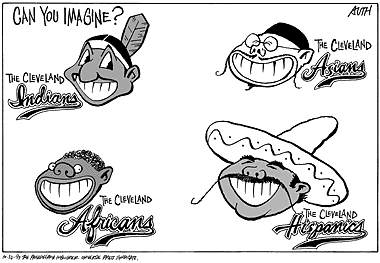
By David KimelbergTwo disturbing developments recently hit my radar. The first was an announcement from Washington's NFL team that it's planning to change its name and logo. Okay, that seems innocuous enough. Washington Politicos? Nope. The new name is the Washington Jews. The re-worked logo is equally alarming: it consists of a profile of what appears to be a stereotyped Jewish person, complete with the physical features exploited by Sasha Baron Cohen in his film Borat.

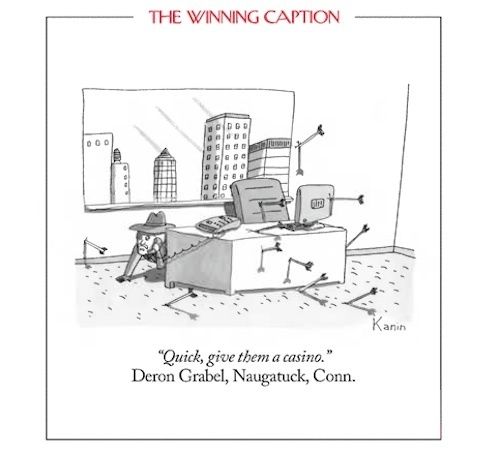
The second was the result of a New Yorker cartoon caption contest. Normally a source of great wit and cleverness, this one was just plain distasteful: the cartoon pictured an SS guard taking cover behind a desk against a barrage of "throwing stars" clearly in the shape of the Star of David. While avoiding the onslaught of Jewish-themed steel weapons hitting the desk and everything else around him, he's speaking to someone on the phone. In the New Yorker's caption contests, readers are asked to submit witty captions to accompany the cartoon, with winners announced in a subsequent issue. So, what was the winning caption? Get ready, here's the punchline: "Quick, give them the banks." Not only is the caption just not funny, its racist angle is obvious. Has the liberal and renowned New Yorker gone off the deep end?

Shocked by this news? Of course you are. And, of course, they're not true. If they were, both organizations would be dealing with a deluge of warranted criticism and outrage from all corners. What is truly shocking is that Native Americans are subject to analogous assaults and no one seems to care.

Of course, Washington's NFL team is actually the Washington Redskins. The term "redskins" is highly offensive to Native Americans and is equivalent to the "n-word" for African Americans. Not only is the team's name insulting, its logo is also a slap in the face for Natives. It attempts to depict a profile of an "Indian," complete with braids, feathers and a stoic gaze. It's pure stereotyping and nothing more. It perpetuates a caricature of Native people, and is another societal movement to turn Native Americans into a historical footnote, frozen in time as a cowboy western prop, and not allow recognition of us for who we really are. In the category of "irony of all ironies," the Redskins' owner, Dan Snyder, recently sued a Washington news outlet for including a picture of him with devil horns. His complaint? That, as a Jew, the news outlet depicted him in a blatantly anti-Semitic way, which caused him great harm. Really? Can you not see the clear racist parallels with your own NFL franchise, Mr. Snyder?

The New Yorker obviously doesn't get it either. Instead of my theoretical SS guard, a recent New Yorker cartoon caption contest actually depicted a cowboy seeking refuge behind a desk peppered with arrows. The scene includes him on the phone, behind the desk in an office overlooking a cityscape. The New Yorker, the de facto leader of liberal literary intellectualism, decided that the winning caption should be: "Quick, give them a casino." Instead of highbrow wit, the New Yorker decided that lowbrow overt racism should carry the cartoon caption day. The fact that only a couple commentators took issue with this (all Native Americans) speaks volumes. The message is that racism against Native Americans is acceptable and universally embraced under the guise of alleged humor.


Comment:  Critics have compared the Washington Redskins to the Washington Honkies, Coonskins, Chinks, Wetbacks, et al. many times. People haven't gotten the message yet.

The cartoon comparison is a fresh one, and many people might not think of it. That makes it worth posting.

Kimelberg also makes the intent behind these images clear:This type of verbal and pictorial violence has only one goal in mind: to dehumanize the subject group so they're viewed as a subclass not worthy of respect or acknowledgment as a distinct people.Yes, that's it, all right. By keeping Indians in their place, we don't have to acknowledge the moral crimes of our white Christian ancestors. We can go on thinking we deserve our wealth and power because we earned them. Truly acknowledging what we did to the Indians would mean overturning centuries of white privilege, the foundation of our society. It would mean putting sovereign Indian nations and their treaty rights at the center of political debates, which would decimate the present liberal/conservative playing field.

Since the white Christian powers-that-be aren't going to give up their power, they encourage or allow the stereotyping of Indians. Portraying them as primitive people of the past is America's way of keeping them out of current affairs. If we treat them as a joke, we don't have to take them seriously.

For more on the subject, see:

Stereotypes drive racism in South Dakota
Stereotypes as mental maps
Indians shouldn't act uppity?
"Broken windows" theory of racism
Stereotypical thinking causes racist results

January 24, 2011

Adam Martin's political cartoons

Adam Martin--CVLocated in Regina, Saskatchewan Adam Martin is originally from Six Nations, Ontario (Mohawk). Skilled in many artistic mediums primarily painting and drawing, realizes influences from the Woodland School as well as other abstract expressionistic practices. Also maintains and addresses contemporary First Nation's concerns and perspectives of identity, cultural awareness and related issues.RANK Comix


Comment:  Check out Martin's fine art too.

For more on the subject, see Native Comic Strips vs. Comic Books.

December 13, 2010

19th-century cartoons about Indians

Super I.T.C.H., the International Team of Comics Historians, presents 19th-century images of Indians in comic strips and periodicals. Since there were no comic books then, I presume they mean "comic" as in "humorous." Most of these appeared in newspapers and magazines.

Selling Out the Red Man: American Advertisers Portray the NativesTo close out our series on Native American Heritage Month (until next year), we bring you artist Livingston Hopkins’ Big Scalper & Big Smoker.Thanksgiving with the NativesFor Thanksgiving Day and Native American Heritage Month, we bring you a few sample images from late nineteenth-century comic periodicals.Buffalo Bill & Queen Victoria, at Her Golden Jubilee, 1887For those who may have missed it, we re-present for Native American Heritage Month an article from this past spring, on how comic periodicals covered the 1887 tour of England by Buffalo Bill’s Wild West Show.Dime-Store Novel Kid Indian FightersFor Native American Heritage Month, we’ve been showing examples of how 19th-century American and European comic publishers presented indigenous people to the European-derived public.1870s:  The U.S. Government’s Wars Against Native AmericansWith the Civil War ended, the Union Army was free to concentrate on the conquest of Western native tribes (plus the re-conquest of tribes that had become “western”, by virtue of being forcibly re-settled west, after their lands in the east had been stolen).Cham’s “History of a Savage Nation,” 1846November is Native American Heritage Month, and so for the next several Mondays, I’ll be presenting early comic strip and cartoon depictions of the first Americans. As to be expected, these comics—created by and for the culture that was actively engaged in stealing native lands and decimating its population—tend to be racist and insulting.Comment:  Follow the links to see all the images.

A couple of interesting points:

1) The stereotypes we're familiar with today hadn't coalesced into convention then. At least half the images used a different set of stereotypes. These Indians were bald with a few feathers somehow rising from their heads. They had big ears and noses with rings in both. They were shirtless but covered with loosely draped robes rather than buckskin.


To me the key is the rings in the noses--a classic trait of black "savages." My guess is the artists were trying to make the Indians look as much like the dark, scary Africans we were "discovering" around the same time. As we learned from countless jungle movies, cartoons, and comics, these devils liked to boil people alive before eating them.

Long-haired Indians on horseback didn't necessarily have the "savage" cachet we associate with them now. The artists apparently reckoned that modeling Indians after Africans who were subhuman ape-men and cannibals would maximize the horror. Now these pseudo-Indians just look comically wrong.

2) Even then people understood the connection between stereotypes in the media and people's perceptions. How could they not, since it's self-evident?

Dime novels were the main form of mass entertainment then. They fed people, especially youngsters, a steady diet of titles such as "Ike the Indian Killer." This convinced people that Indians were relentless marauders and killers. Children grew up with these beliefs and stuck with them in the face of contradictory evidence.


The same thing happens today, of course. The funny thing is how some people (e.g., "Public" Causes Stereotypes? and Valenti:  Movies Are Just Movies) try to deny it. In the 19th century, Americans understood that stereotypes came from the media and influenced people's perceptions. How stupid do you have to be not to realize this 150 years later?!

This also contradicts the notion in Stereotypes Are Irrational But Normal and Stereotypes Okay in "Cultural Commons"?--that stereotypes are somehow a natural part of life. Wrong. The media created these stereotypes and force-fed them to the public for political and cultural reasons. Without this force-feeding, the stereotypes probably wouldn't exist. And people would see Indians as different but not necessarily inferior or evil.

For more on the subject, see Stereotypes Drive Racism in South Dakota, Why Minstrel Shows Are Wrong. For more on the subject in general, see A Brief History of Native Stereotyping and The Harm of Native Stereotyping:  Facts and Evidence.

December 07, 2010

Only codetalkers can stop Wikileaks?


Comment:  I'm not sure this makes much sense. The government has many encryption systems more unbreakable than the Navajo language. But it's a nice homage to the codetalkers anyway.

For more on Wikileaks, see Conservatives Hate Wikileaks and Indians. For more Native-themed political cartoons, see Native Comic Strips vs. Comic Books..

September 20, 2010

Indians shoot arrows in New Yorker cartoon

Gawker Zings New Yorker's 'Racist' Caption

'You chose this as contest finalist?'

By Mary Papenfuss
Gawker is slamming a New Yorker cartoon that's part of the magazine's weekly caption contest as "pretty racist." The cartoon shows an apparent executive in a cowboy-like hat talking on the phone and crouched behind his desk as he's being fired at with arrows. The winning caption? "Quick, give them a casino." We're all "post-racial liberal elites here who love us some New Yorker cartoons," notes writer Adrian Chen. But "seriously, New Yorker cartoon editors? You chose this as a finalist? And, seriously, New Yorker readers, you voted for it?"

Gawker suggests a caption that probably very nearly made the cut: "Dang redskins tryin' to steal my Blackberry!" Oh, the magazine probably intended an "ironic commentary on the half-hearted reparations Indians have received ... or something," Chen adds. "But still—it's just dumb."


Comment:  Yep, this cartoon is pretty racist, all right. And don't blame the caption. That only adds an extra layer of racism: "The Indians are shooting arrows because they want a casino. They're so violent and warlike they can't get one any other way."

The main racism is implying that today's Indians would try to kill someone for any reason. Whether it's a casino, a Blackberry, or frybread, the implication is wrong. It stereotypes Indians as primitive people of the past. As savages incapable of diplomacy, reason, or calm.

And New Yorker readers are supposedly America's liberal elite. This demonstrates how pervasive Native stereotypes are. Even people who know (or should know) better are okay with Indians shooting arrows. It's like having a white man as president or a marriage between a man and a woman--i.e., something Americans have assumed to be true.

For more on the subject, see Native Comic Books vs. Comic Strips.

P.S. It would be difficult to salvage this racist cartoon, but how about this caption:

"No, no Indians. Just angry white readers trying to make a point in an ironic way."

July 29, 2010

"Sick" cartoonist Callahan dies

Someone posted the following on my Facebook wall:John Callahan 1951-2010. Ave atque vale.

This led to the following exchange:

A lot of his cartoons were stupid, weren't they?Sick, twisted, perverted, offensive, depraved, yes. Stupid, no.Then this one must've been an exception. A lame pun on the word "squaw"...this would've been a second-rate idea for a cartoon 50 or 75 years ago. It's like something a third-grader would've come up with.

P.S. I think you forgot racist and sexist.You think?

From the LA Times obituary:

John Callahan dies at 59; politically incorrect cartoonist was a quadriplegic

Among his better-known efforts:

Two Ku Klux Klansmen heading out at night in their white sheets. Says one: "Don't you love it when they're still warm from the dryer?"

A beggar in the street wearing a sign that reads, "Please help me. I am blind and black, but not musical."

A sign in the window of a small, street-side restaurant says: "The Anorexic Cafe, Now Closed 24 Hours a Day!!!"

An imposing woman glares at a small man and says: "This is a feminist bookstore! There is no humor section!"

A small boy and his father look at a dog lying on its back with a large shard of glass embedded in its chest. "How much is that window in the doggie?" asks the boy.

Callahan was not swayed by hate mail blasting him for being racist, sexist, ageist, sick, depraved and disgusting.

My favorite features two store-front businesses: A Tourette-Syndrome clinic with a neighboring pet store advertising a 90% discount on all parrots.
Good cartoons vs. bad cartoons

I'm not swayed by racists who think they're not racists. I could've kicked Callahan's butt in a debate just like I do with everyone online.

These examples are probably among his best known cartoons because they're decent. As I recall, about half his jokes were good and the other half were stupid and sophomoric. Such as the "squaw-tistic" joke above.

The black and feminist jokes are arguably about the stereotypes. They arguably don't use the stereotypes to insult blacks or women in general. That's the difference you seem to have missed.

The "squaw-tistic" joke isn't a commentary about what Americans think about Indians. The cartoon shows a white man describing an actual Indian girl. The girl is dressed stereotypically and the man uses a vulgarism without irony. There's no "humor" except the semi-racist epithet.

What's the funny part: comparing being an Indian to having a developmental disorder like autism? Ha ha. That isn't just unfunny, it's insulting. It's a not-so-veiled way of saying Indians are inferior.

Show me a cartoon where Callahan spoofed a black person in a similar manner. For instance, a doctor returns a black girl to her parents. "She's not a ninny," he says, "she's a pickaninny!" Again, no commentary on people's beliefs about blacks, just a straightforward use of a semi-racist epithet.

I guess these subtle distinctions are lost on Boobus Americanus--i.e., people like you who think the Three Stooges are funny. To this type, racism seems to be okay as long as it's the form of a "joke." Have you ever seen an example of ethnic humor you found offensive?

For more on the subject of "harmless humor," see Ethnic Humor Suggests for MTV, Irish Band Is Just Harmless Fun?, and Deadliest Warrior vs. The Dudesons.

May 21, 2010

Cartoon:  Natives are best strippers

Adrienne Keene of Native Appropriations nails another stereotypical item:

"The sexiest rain dance ever":  Cyanide and Happiness cartoon

It took me a minute to even get the joke in this cartoon. Let's break it down:

We all know all Indians do rain dances, right? (riiiight)

And high roller strip club patrons "make it rain" by throwing money up in the air so it falls down like rain on the stripper.

Therefore, it's funny, get it?

When they dance, it's making it rain (cause they're Native), but instead of rain, it's money (cause they're a stripper)!

ZOMG so funny.

And all the stereotypes managed to be jam packed in one little cartoon (caution: sarcasm ahead):

  • The lovely warbonnet. since we all know ALL Natives wear those (especially the women, duh).

  • The rain dance. I mean, at least for me anyway, I can't even bust a move outside without running the risk of starting a thunderstorm! It's a real problem. No outdoor wedding for me.

  • The tomahawk. Cause we know Natives are war-like people that like to scalp teh whitez (watch me as I war whoop! Awooo!)

  • The casinos. Cause we ALL are super rich and make lots and lots of untaxed money! And we steal it all from you!

    And on a serious note (/sarcasm):

  • The bikini and stripper theme generally, cause Native women haven't been sexualized enough throughout history. Makes me so mad.

    Don't you dare get on my case about "it's a comic, it's just a joke, it's satire"--it's not. Images like these are what create the false stereotypes to which Native people are expected to ascribe. Because if all of the world thinks that Indians wear headdresses, carry tomahawks, do rain dances, or own casinos; it erases our current existence as a diverse group of contemporary people living contemporary lives and trivializes the continued struggles of Native peoples. Just because a tribe has a casino doesn't mean everything is all better after 500+ years of mistreatment and historical trauma.
  • Some comments on Facebook:Wow, that cartoon is offensive on so many levels. Thanks for pointing it out.

    *headdesk*

    When do we get to the funny part? :(

    Wow...just, wow.

    Yes I got the joke and No I did not find it remotely funny.

    Unfortunately you left out "It's edgy, you're just humorless and overly sensitive, that's why you don't get it" in your list of excuses people will make for this. "Edgy" and "ironic" seem to be the new politically correct terms for "racist," "sexist," "misogynist," "homophobic," etc.
    Comment:  Stick figures are appropriate here since that's all Indians are to most people: one-dimensional cartoon characters.

    Good point about the tomahawk. I think of it as just another weapons and tool, but it's associated with scalping in the public's mind. Whenever a stereotypical image includes a tomahawk, it's an extra hint about Indian savagery.

    And of course Adrienne's key point is right on. "Images like these are what create the false stereotypes"...bingo. People believe what they see because...well, seeing is believing.

    If you see a thousand images of Indians in headdresses, you may not think that every Indian wears a headdress. But you won't think that no Indians wear headdresses except on special ceremonial occasions. You'll think, "Even if many Indians don't wear headdresses, some do. Not all, but maybe 5% or 10% or 20% of them."

    "Edgy" = "racist"

    The last Facebook comment is especially astute. Yes, "edgy" and "ironic" are today's code words for "racist," "sexist," and so forth. If people admit their racism, say they're doing it intentionally, claim it's some sort of statement, then that excuses them.

    And gullible idiots eat it up. "These people are famous," they say to themselves. "They're on TV. They told us they didn't mean any harm. They just thought the racist stereotypes were funny.

    "We believe them because we like racist stereotypes too. We prefer to laugh at minorities rather than learn about them. All that tragedy they've gone through is a downer. It's much easier to blame them for being savage and uncivilized than to do something about their problems."

    For more on the subject, see Okay to Stereotype in "Satires"? and Native Comic Strips vs. Comic Books.

    April 21, 2010

    Brave Play comic strip debuts

    New comic strip by A. David Lewis!

    By Greg BurgasA. David Lewis, the writer of last year's best graphic novel, Some New Kind of Slaughter, has a nifty new webcomic strip running in The Boston Phoenix. It's called Brave Play, and it's drawn by Matt Roscetti. It takes place over the course of the 1948 baseball season (it began running just when the season began) and is about certain teams manipulating Native American spirits to benefit their clubs. So far we've seen a few spooky things, the introduction of the main characters, and some machinations of the plot.And:Twenty-four strips have been published as of this afternoon, but each are 3-4 panels and you can get caught up fairly quickly. Lewis is a fine writer, and there's already a lot going on in the strip, both plot-wise and metaphysical-wise (baseball always seems to bring out the romantic nature of writers). Roscetti's art is rough but works pretty well for the rough-and-tumble days of the late 1940s. I encourage you to go check it out!Comment:  The series is up to 27 strips now.

    I agree you should check it out, but I'll give you my take on the series. "A lot going on in the strip" means too much going on in the strip. There are too many characters and plotlines for us to follow easily. "Roscetti's art is rough" means Roscetti's art is too rough. I don't find this scratchy, scribbled style at all attractive.

    I'm also uneasy about the whole "manipulating Native American spirits" theme. I'm not sure where Burgas got this from; it's only vaguely implied in the strips themselves. But assuming it's true, is that a good idea? Will each team have a "shaman" who calls up spirits buried under the stadium to help the home team and harass the opponents? Because that could really be stereotypical.

    I guess the story takes place in New York City. The Indians use a few Native words I don't recognize, but they appear to be out west somewhere. Will we learn what culture they're from? Will spirits from different tribes appear at different stadiums? Or will these Indians and their spirits just be generic?

    A. David Lewis is an acquaintance who has an interest in multicultural and Native issues. He was an early supporter of PEACE PARTY years ago. I'm sorry to have to criticize his work, and I hope it gets better.

    For more on the subject, see Native Comic Books vs. Comic Strips.

    March 05, 2010

    "Mind your own genocide"

    A political cartoon makes an obvious comment on the US House of Representatives passing a resolution condemning the Turkish genocide of Armenians.

    The cartoon has a point. Our genocidal actions against Indians were much worse than the Turks' genocidal actions against Armenians. "Let he who is without sin cast the first stone" and all that.

    But the cartoon overlooks a couple points:

    1) The US government and many Americans have acknowledged our past crimes. True, some people are in denial about calling it genocide, but most people admit we were guilty of something. That's more than we hear most Turks saying.

    2) As long as we're not in total denial about our own sins, there's nothing wrong with condemning the sins of others. We have every right and responsibility to tell the world about mass killings--whether they occurred in Rwanda, Sudan, the Balkans, Cambodia, Russia, Turkey, or the US. Helping people understand that genocide happened before and can happen again is one way to prevent it.

    For more on the subject, see Armenian and Indian Genocides and Remembering Our Genocidal History.

    January 15, 2010

    Thanksgiving/Sarah Palin cartoon

    Correspondent DMarks sent a political cartoon by Mike Luckovich from the latest issue of Newsweek:


    Comment:  Hmm. The feathered headbands are stereotypical. So is the tomahawk. So are the vests, although you don't see them as often.

    Not a bad cartoon, since it depicts the Pilgrims as more violent and aggressive than the Indians. Could be better, could be worse.

    For more on the subject, see Ten Little Pilgrims and Indians and Native Comic Strips vs. Comic Books.

    December 28, 2009

    Bizarro joke about 2012


    Comment:  Dan Piraro isn't the first one to make a 2012 joke like this one. But he does it without stereotypes, which is rare for him and for cartoonists in general.

    For more on 2012, see 2012 Joke on Tonight Show and Maya Fed Up with 2012. For more on Native-themed comic strips, see Native Comic Strips vs. Comic Books.

    May 23, 2009

    Bizarro mocks Indian names

    Another stereotypical Bizarro cartoon. First, it uses the standards Plains imagery to represent all Indians. Second, it mocks Indian names, which have nothing to do with temporary emotions.

    This "funny name" humor is even older than casino-based humor. I bet stage shows had Indians with "funny names" a century ago. I can just imagine the warrior Big Nose asking Chief Drinks-a-Lot for the hand of his daughter, Princess Hot-Cha-Cha.

    This so-called humor is older, but it isn't any better. Cartoonists should've retired it decades ago along with jokes about Jews, Poles, and other ethnic groups.

    For more on the subject, see "Funny" Indian Names and Native Comic Strips vs. Comic Books.

    January 23, 2009

    Piraro reports on Eiteljorg trip

    Dan Piraro, creator of the Bizarro newspaper strip, reports on his visit to the Eiteljorg Museum this weekend. A couple of highlights and lowlights:

    Indy BlogosphereGood: The Eiteljorg Museum is much larger and of higher quality than I expected. Before I came, I figured it to be some small, 7/11-sized outfit in a strip mall with a few tomahawks, moccasins and cowboy paintings. In truth, the architecture of the impressively enormous building is top notch, and the immense collection of art and artifacts inside is astounding.Also Good: I found out from this old Indian print that I might have some Native American blood in me. I may even be the descendant of a chief. Very cool.Comment:  Oddly, I don't find Piraro's pretending to be an Indian at all "cool" or funny. I guess that's why he's the big-name cartoonist and I'm not.

    For more on the subject, see Native Comic Strips vs. Comic Books.

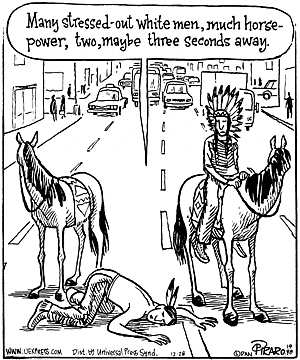
    Below:  More of Piraro's Native-themed "humor." Stereotypical Plains Indians...too stupid to notice the oncoming traffic...ho-hum.

    January 17, 2009

    Dan Piraro at the Eiteljorg

    Museum explores Western and Native portrayals in comicsArtist Dan Piraro, creator of the award-winning, syndicated comic strip Bizarro, and writer John Ostrander (Batman, Star Wars, Wolverine, The Kents, Apache Skies) will be the featured artists at the Eiteljorg Museum of American Indians and Western Art's "Western and Native Portrayals in Comics," from 10 a.m. to 4 p.m., Saturday, Jan. 24. The day features an in-depth look at how comics throughout history have handled portrayals of Western and Native American people and cultures. Highlights include panel discussions, gatherings of collectors, comic giveaways and sales, signings by well-known writers/artists and leading industry experts including Steve Sanderson (Cree) and Michael Sheyahshe (Caddo).

    10 a.m.-4 p.m.--Comic giveaways, sales, demonstrations, meet and greet artists, writers and experts

    1 p.m.--Panel Discussion: "Native Americans in Comics" featuring Michael Sheyahshe, Steve Sanderson, John Ostrander and Dan Piraro

    3 p.m.--Panel Discussion: "Western and Native Reflections in Comics" featuring John Ostrander, Dan Piraro, Michael Sheyahshe and Steve Sanderson
    Comment:  Dan Piraro's Bizarro often features cowboys and Indians. Unfortunately, his Indians are often stereotypical. When I was reading the daily comic strips, I found something like 20 examples of Native stereotyping.

    For more on the subject, see 2009 Eiteljorg Comics Event.

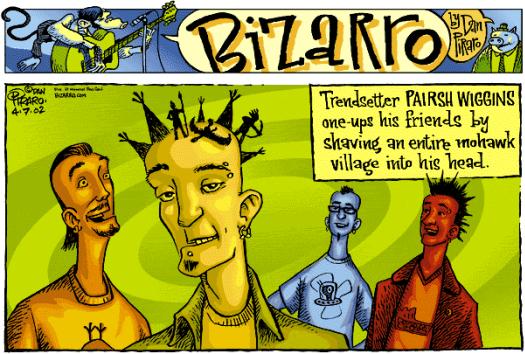
    Below:  A typical example of Piraro's work. Note the Plains teepees and chief in the so-called "Mohawk village."

    December 11, 2008

    Stereotypical Baxendale cartoon

    Here's an old political cartoon I came across at random. It's by British cartoonist Leo Baxendale. I believe he did it after the end of WW II.


    The cartoon shows several common stereotypes. Indians as warlike savages who wield knives, axes, and spears. The fat Indian chief. The headbands with feathers. The red and pink colors. And the Tonto talk.

    For more on the subject, see The Basic Indian Stereotypes.