Showing posts with label stereotype harm. Show all posts

May 05, 2015

Natives to Hollywood: Stop stereotyping

People are still criticizing Adam Sandler for his racist Ridiculous 6 movie:

Adam Sandler, You Don’t Represent Me

By Amalia RubinOne would hope that you, Mr. Sandler, would realize how important it is as a Jew, especially as a Jew in public, to recognize that the struggles and horrors our people have suffered should inspire solidarity with others who faced and continue to face the same. From the unspeakable nightmares of genocide to the daily attacks of racism, what we have suffered has been suffered by innumerable others.

That is why your disgusting treatment of Native Americans in your upcoming Netflix film release The Ridiculous Six is so abhorrent. Like your fellow Jews, the indigenous people of America have suffered a massive genocide. Like your fellow Jews, they were demonized by the media and press. Even American children’s cartoons only a few years ago, like the ones published by Nazi Germany about Jews, showed Native Americans as barbarians who deserved to be killed. Like the Jewish boys kidnapped into the Czar’s armies, Native American children were forced away from their families into boarding schools where they were forcibly stripped of their cultures, faiths, and languages. And much the same as my father was beaten up as a kid for being a k***, native kids are attacked by fans at sports games, wearing fake head dresses, hooping and hollering “war chants,” dumping drinks on them, and calling them r*******. Like our Jewish grandmothers who were raped in the pogroms and shtetls of Europe with no legal recourse, Native American women are two and a half times more likely to be raped or sexually assaulted than your average American woman.

So for you to make a film where you hire native actors then mock them by promoting racist depictions: showing them as dirty and uncivilized, demeaning the women by giving them names like “no-bra” and “beaver breath,” mocking and profaning their ceremonies and cultures, is unforgivable. For you to still defend a project so offensive that a dozen Native American actors and cultural consultants walked off the set is a sign of either willful ignorance or overt racism. When we have fought to be depicted as something other than the hooked nose ganef and the miserly, conniving Shylock, you make a movie showing stereotyping Native Americans as “savages.” You, as an actor and a Jew, of all people, should understand. I stand with each and every actor that walked off the set that day. And as a Jew, Mr. Sandler, you should have too.
Racism hurts

They're pointing why the movie is harmful:

The Reason Adam Sandler’s Racist Depiction of Native American Women Matters

By Jacqueline KeelerThe promotion of these outdated stereotypes is particularly harmful considering a 2010 Department of Justice report that found Native American women have two and a half times the rate of rape and murder of any ethnic group of women in the country. And the report found that in nearly 70 percent of the assaults on Native women the assailants were white men. This is unusual as most women in the United States are assaulted by men of their own race/ethnicity. If it were not for the additional assaults by white men, Native women’s rates of murder and rape would be closer to average of other American women.

On many Native American reservations, gaps in jurisdiction mean no one is prosecuted for these assaults. A recent revision in the Violence Against Women’s Act (2013) expanded tribal jurisdiction over non-Indians for Domestic Violence offenses but the law is still only being implemented.

For many Native American women the question is not if, but when women in their family will be raped. Lisa Brunner, an advocate for survivors of domestic violence and sexual assault in her community, the White Earth Nation in Minnesota, told The Guardian, “I call it hunting—non-natives come here hunting. They know they can come onto our lands and rape us with impunity because they know that we can’t touch them.” Tragically, her teenaged daughter was also gang raped by four men from off the reservation before the new VAWA law was passed.

On her Facebook page, a former Miss Navajo Nation (and the first African-American/Navajo winner) wrote, “We have to control how we are satirized and make fun of ourselves. We need to stop allowing Hollywood to perpetuate unoriginal, antiquated, racist stereotypes that have long been used by media in general, or since the settlers first made contact with us … As for Netflix defending Adam Sandler and his movie, this shows that they themselves care little about being original or creative when it concerns Indigenous people.”


Native American Actors Work to Overcome a Long-Documented Bias

By Cara BuckleyThe walkout prompted a rhetorical “What do you expect from an Adam Sandler film?,” and a Netflix spokesman said that in the movie, blacks, Mexicans and whites were lampooned as well. But Native American actors and critics said a broader issue was at stake. While mainstream portrayals of native peoples have, Mr. Wente said, become “incrementally better” over the decades, he and others say, they remain far from accurate and reflect a lack of opportunities for Native American performers. What’s more, as Native Americans hunger for representation on screen, critics say the absence of three-dimensional portrayals has very real off-screen consequences.

“Our people are still healing from historical trauma,” said Loren Anthony, one of the actors who walked out. “Our youth are still trying to figure out who they are, where they fit in this society. Kids are killing themselves. They’re not proud of who they are.” They also don’t, he added, see themselves on prime time television or the big screen. Netflix noted while about five people walked off the “The Ridiculous Six” set, 100 or so Native American actors and extras stayed.

But in interviews, nearly a dozen Native American actors and film industry experts said that Mr. Sandler’s humor perpetuated decades-old negative stereotypes. Mr. Anthony said such depictions helped feed the despondency many Native Americans feel, with deadly results: Native Americans have the highest suicide rate out of all the country’s ethnicities.

The on-screen problem is twofold, Mr. Anthony and others said: There’s a paucity of roles for Native Americans—according to the Screen Actors Guild in 2008 they accounted for 0.3 percent of all on-screen parts (those figures have yet to be updated), compared to about 2 percent of the general population—and Native American actors are often perceived in a narrow way.
Stop the stereotyping

And they're demanding that Hollywood change:

How do we stop misrepresenting First Nations culture? Just ask

Television shows and movies are the biggest culprits

By Don Marks
Perhaps these people believe in the old adage, "There's no such thing as bad publicity"—if the controversy draws attention to your product or event, you get free "advertising."

Then there could be those who are simply arrogant enough to think they are above the fray; they believe they can brush off the critics by saying they are "too sensitive."

And then there are those who are naive enough to think they can convince First Nations they meant no harm and/or the image is actually good for them.

So what can we do to prevent this calamity from creeping up time and again? Ask First Nations people what they think about the appropriateness of the action you are planning beforehand.

And take the time to listen to and understand the concerns First Nations are raising. Perhaps there is a way to compromise and work together for the common good.


A turning point for Native Americans in Tinseltown?

By Esther CepedaSo far, Rolling Stone reports, a producer promised the cast that a disclaimer at the end of the movie would reiterate that Sandler's movie is not an accurate portrayal of Native American culture.

Understatement of the year.

The truth is that the 500-nation Native American culture is richly diverse--with different regional customs and beliefs--and will never be accurately portrayed in the media until Native Americans are integral parts of the production and creative teams that tell stories about individuals, not a monolithic Indian people.

There will probably always be ridiculous portrayals of Native American culture in entertainment, but for some, this felt like a precedent.

Maybe this headline-grabbing Native American uprising will end up making filmmakers think twice next time--even for a fleeting moment. Or maybe inspire more Native American actors to bypass Hollywood and start creating and promoting their own authentic content.

This would be, at least, a start.
Listen Up Hollywood: It’s Time To Let Native Americans Tell ‘Our Own Stories In Our Own Words’

"I would love as a Native actress to be able to go out and audition for the lead in a superhero film."

Comment:  For more on Adam Sandler, see Ricky Lee Defends Ridiculous 6 and Adam Sandler's History of Racism.

April 01, 2015

Stereotypes threaten academic achievement

Professor affirms effects of Indian mascots

By Jack RooneyStephanie Fryberg, a visiting professor of psychology at the University of Washington, presented her research Tuesday on the psychological effects of American Indian sports mascots, which affirmed these types of social representations depress the self-esteem of American Indian students.

Fryberg’s lecture, titled “From Stereotyping to Invisibility: The Psychological Consequences of Using American Indian Mascots,” highlighted several studies she and her colleagues have performed.
And:All of the studies, though, concluded that essentially any American Indian mascot representations harmed the self-esteem of American Indian students, Fryberg said.

“Consistent with the past two studies, it turns out that being exposed to any one of these mascots decreased achievement-related possible selves,” she said. “So what it means is if they saw the Indian mascot, then any possible selves they had related to achievement in school were depressed.”


Indians and blacks too

Some related research on stereotypes:

Stereotype Threat Widens Achievement GapSteele, Aronson and Spencer, have examined how group stereotypes can threaten how students evaluate themselves, which then alters academic identity and intellectual performance. This social-psychological predicament can, researchers believe, beset members of any group about whom negative stereotypes exist.

Steele and Aronson gave Black and White college students a half-hour test using difficult items from the verbal Graduate Record Exam (GRE). In the stereotype-threat condition, they told students the test diagnosed intellectual ability, thus potentially eliciting the stereotype that Blacks are less intelligent than Whites. In the no-stereotype-threat condition, the researchers told students that the test was a problem-solving lab task that said nothing about ability, presumably rendering stereotypes irrelevant. In the stereotype threat condition, Blacks--who were matched with Whites in their group by SAT scores--did less well than Whites. In the no stereotype- threat condition--in which the exact same test was described as a lab task that did not indicate ability--Blacks' performance rose to match that of equally skilled Whites. Additional experiments that minimized the stereotype threat endemic to standardized tests also resulted in equal performance. One study found that when students merely recorded their race (presumably making the stereotype salient), and were not told the test was diagnostic of their ability, Blacks still performed worse than Whites.

Spencer, Steele, and Diane Quinn, PhD, also found that merely telling women that a math test does not show gender differences improved their test performance. The researchers gave a math test to men and women after telling half the women that the test had shown gender differences, and telling the rest that it found none. When test administrators told women that that tests showed no gender differences, the women performed equal to men. Those who were told the test showed gender differences did significantly worse than men, just like women who were told nothing about the test. This experiment was conducted with women who were top performers in math, just as the experiments on race were conducted with strong, motivated students.
Stereotypes found to affect performance on standardized testSteele's theory is that stereotype vulnerability, the unsettling expectation that one's membership in a stigmatized group will limit individual ability, may be at the root of lower grades and SAT scores for African Americans. Stereotype vulnerability raises interfering anxiety during testing or classroom situations, Steele wrote. The same dynamic also could explain why highly skilled women at the university level drop out of programs in math, engineering and the physical sciences, he added.

"Surprisingly, you don't have to believe in the stereotype to be vulnerable to it," he pointed out to his audience at the APA convention.

"Everyone in a collective knows the stereotypes about a given target group, including the group members themselves, and everyone knows that everyone knows," Steele wrote in a paper prepared for the convention. "Thus the predicament of 'stereotype vulnerability': The group members then know that anything about them or anything they do that fits the stereotype can be taken as confirming it as self-characteristic, in the eyes of others, and perhaps even in their own eyes. This vulnerability amounts to a jeopardy of double devaluation: once for whatever bad thing the stereotype-fitting behavior or feature would say about anyone, and again for its confirmation of the bad things alleged in the stereotype.
Yes, it makes sense that any kind of stigmatizing--e.g., "You're a girl, so you have to try harder"--would increase anxiety and decrease performance. So there's no rational way to spin a racist stereotype as an "honor" that helps Native children. It would be like encouraging me with an 18th-century image of a dirt-poor farmer in an log cabin.

How would that relate to my experience in the 21st century? Try harder and I can be a dirt-poor farmer too?

If a school had a program that honored real live Natives, that might be different. But few if any schools have that.

This point could generate a whole article. An article ripping the idea that centuries-old images are supposed to help Natives in general and Native students in particular.

It obviously wouldn't work if you showed black students pictures of half-naked African spearchuckers. How exactly is the Native case different?


Be all that you can be, African Americans! Aim for the stars!

Anthropological Association Takes a Stand in Native American Mascot Debate

By Rob StottThough the American Anthropological Association has been a vocal proponent of indigenous rights throughout its history, the group had remained quiet on the Native American mascot debate. That changed last week when AAA released a statement on the issue.

Anthropologists have joined a long line of groups to call on professional and college sports communities to rethink their use of Native American mascots and nicknames. Except in instances where tribes or key stakeholders have been consulted (see Florida State University and San Diego State University), sports organizations should “denounce and abandon the use of American Indian” imagery, the American Anthropological Association said in a statement [PDF] released last week.

“While these organizations may feel they are honoring Native Americans, many in that community view it to be a degrading and painful symbol of racism,” Monica Heller, AAA president, said in the statement. “Research has established that the continued use of American Indian sports mascots harms American Indian people in psychological, educational, and social ways. Frankly, I don’t see where the honor is in that.”
Comment:  For more on the subject, see The Harm of Native Stereotyping: Facts and Evidence.

October 25, 2014

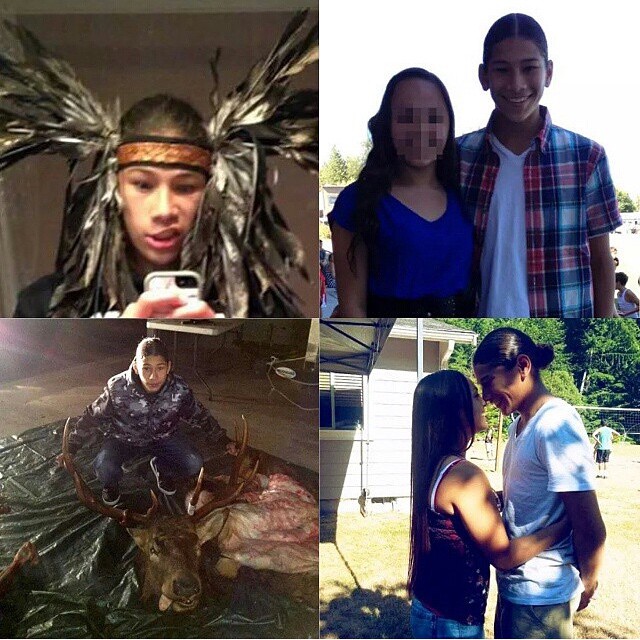
Tulalip Indian shoots "Tomahawk" students

Most reports on the tragic murders at Marysville-Pilchuck High School noted that Jaylen Fryberg was a member of the Tulalips Tribes--an Indian. None suggested that his Indian status was a cause of the shooting spree--except this one:

Jaylen Fryberg Is Not Your Indian Savage

By Taté WalkerIf you’ve spent any time among Natives in their own communities, you realize quickly that a Native kid living among his people will invariably grow up learning how to feed his family (whether that’s hunting or farming or gathering). This is normal in our Native societies and an important way we pass down cultural teachings.

But that explanation doesn’t rate as news precisely because it doesn’t fit into the narrative of Natives the Western world is primed to accept. The image associated with Native men is that of an aggressive warrior or savage. Redskin. Chief. Indian. Brave. Seminole. Fighting Sioux.

We are mad. We are bloodthirsty. We will stop at nothing to win. We’re told these images of us used by sports teams are honorific. Be proud, we’re told. We’re honoring the only part of you we can accept: The way you looked centuries ago when we defeated you. But, hey, your team wins and gets millions in advertising so let’s just ignore the unrestrained racism on your helmets.

For those of us who have spent years studying the effects of mascots and Native representation in mass media, it’s no coincidence that Jaylen turned to violence when his own football team was the Marysville-Pilchuck Tomahawks, a nickname that came under fire several times over the past couple of decades as school boards across the country became hip to the fact Native-associated mascots are damaging in ways that utterly dehumanize and erase Native youth identities.


Claims debated

Taté Walker aka Missus Wrackspurt seems to be making two claims. One, that the media characterized Fryberg as an Indian warrior or "savage." And two, that Fryberg thought of himself as a warrior or savage.

I read a lot of the news coverage. I didn't see any sign of the first claim.

Showing him with a gun is what the media would've done with a shooter of any race. It's not an image tied to his being Native.

An early posting on Fryberg's background was this one:

Jaylen Fryberg: 5 Fast Facts You Need to Know

It noted he owned guns and was an Indian, but didn't dwell on these facts or combine them into a "warrior" or "savage" meme. I'd say this was the norm for the reporting on this story.

As for Walker's second claim, it's impossible to know without knowing Fryberg's history and psychology. But it's not uncommon for minority shooters to feel angry because they think society has prevented them from achieving the American dream.

In any case, Walker's readers criticized her claims and she defended them in the comments:Student
I knew jaylen, and despite all of your “research” this was not a crime born from racism. Natives are 100% equals at our school, generally being very well liked, as jaylen was. This crime was not the result of bullying as you seem to think. Now, nobody but his family who may or may not have read a suicide note that he may have left knows for sure, but from every knowledgable source I have heard ANYTHING from, this was completely the result of a severe depression from relationship problems. I know that your post was in good taste and had no bad intentions, however I think you are over looking possible serious mental disorders this child may have had and are instead placing partial blame on things such as school mascots. Ask any native person in OUR community and you will see clearly that natives were extremely well respected in our city and one horrible decision/incident does not reflect on us as a whole.

Missus Wrackspurt
Student: I am so sorry for your loss. My prayers to you, your family and community.

Nothing about my commentary was in any way related to who Jaylen was as a person, positive or negative. Obviously, I don’t know him. Will never know him. His motives were his own and unknowable, as they are for all individuals.

That said, I am constantly looking at the intersections of race and society, especially as those issues relate to Indian Country, because I work with Native youth and understand the struggles they face, even if they might not know some of the *systemic* causes themselves. If you are willing to learn more, please check out the links toward the end of my piece. This “research” is scientific, nonpartisan, and proved over and over again. In this scenario, systemic racism IS mascots, IS the media’s portrayal of Jaylen, as a teen, as an outdoorsman, and as a tribal citizen. We must address these issues and have these conversations if we want things to get better. As a mother, this is of the utmost importance to me.

Thank you for taking the time to read and comment.

Anna
OUR community not yours! this is not a native issue. Do not let it become one

Missus Wrackspurt
I’d normally trash a comment like this, because it adds nothing to the conversation. But since you’re the millionth person to say this to me in the last two days (and since you didn’t call me a derogatory word – thanks), I’m putting it up to say it is indeed a Native issue. You are part of the problem in erasing Native identity with comments like this. Do better, Anna, which for people like you means shutting up and listening to the many marginalized voices trying to tell you how to make things incrementally better.
Comment:  Without knowing anything, I'd speculate that the warrior mentality prevalent in Native cultures did influence Fryberg. Being a football player, a homecoming prince, and a Tomahawk all may have contributed to a toxic sense of entitlement.

That is, he may have felt he was an alpha male who deserved the girl (his girlfriend). When he didn't get her, that may have shattered his "warrior" pride and led to the shootings.

For more on the subject, see Santa Barbara Shootings Show America's Pathology and Dunn Trial Shows America's Pathology.

August 21, 2014

Why your intentions don't matter

Intent vs Impact: Why Your Intentions Don’t Really Matter

When you’ve hurt someone, whether you meant to or not, what matters is how you repair the situation.

By Everyday Feminism
Imagine for a moment that you’re standing with your friends in a park, enjoying a nice summer day.

You don’t know me, but I walk right up to you holding a Frisbee.

I wind up–and throw the disc right into your face.

Understandably, you are indignant.

Through a bloody nose, you use a few choice words to ask me what the hell I thought I was doing.

And my response?

“Oh, I didn’t mean to hit you! That was never my intent! I was simply trying to throw the Frisbee to my friend over there!”

Visibly upset, you demand an apology.

But I refuse. Or worse, I offer an apology that sounds like “I’m sorry your face got in the way of my Frisbee! I never intended to hit you.”

Sound absurd? Sound infuriating enough to give me a well-deserved Frisbee upside the head?

Yeah.

So why is this same thing happening all of the time when it comes to the intersection of our identities and oppressions or privileges?

Intent v. Impact

From Paula Deen to Alec Baldwin to your annoying, bigoted uncle or friend, we hear it over and over again: “I never meant any harm…” “It was never my intent…” “I am not a racist…” “I am not a homophobe…” “I’m not a sexist…”

I cannot tell you how often I’ve seen people attempt to deflect criticism about their oppressive language or actions by making the conversation about their intent.

At what point does the “intent” conversation stop mattering so that we can step back and look at impact?

After all, in the end, what does the intent of our action really matter if our actions have the impact of furthering the marginalization or oppression of those around us?

In some ways, this is a simple lesson of relationships.

If I say something that hurts my partner, it doesn’t much matter whether I intended the statement to mean something else–because my partner is hurting.

I need to listen to how my language hurt my partner. I need to apologize.

And then I need to reflect and empathize to the best of my ability so I don’t do it again.

But when we’re dealing with the ways in which our identities intersect with those around us–and, in turn, the ways our privileges and our experiences of marginalization and oppression intersect–this lesson becomes something much larger and more profound.

This becomes a lesson of justice.

What we need to realize is that when it comes to people’s lives and identities, the impact of our actions can be profound and wide-reaching.

And that’s far more important than the question of our intent.

We need to ask ourselves what might be or might have been the impact of our actions or words.

And we need to step back and listen when we are being told that the impact of our actions is out of step with our intents or our perceptions of self.
Comment:  For more on the subject, see The Magical Power of Intent.

July 22, 2014

Mascots create hostile learning environment

Missing the Point

The Real Impact of Native Mascots and Team Names on American Indian and Alaska Native Youth

By Erik Stegman and Victoria Phillips
Much of the recent debate has centered on issues such as economics. Many fans and media commentators have debated the cost of changing the name for the team and the league. Others have focused on the “legacy” and memories that fans will lose with a new name. And perhaps the most referenced issue is the team’s supposed lack of racist or derogatory intent. But too much of the debate misses the point. It is not just about a name, a logo, a business, or a matter of intent. Racist and derogatory team names have real and harmful effects on AI/AN people every day, particularly young people.

AI/AN students across the country attend K-12 and postsecondary schools that still maintain racist and derogatory mascots. Research shows that these team names and mascots can establish an unwelcome and hostile learning environment for AI/AN students. It also reveals that the presence of AI/AN mascots directly results in lower self-esteem and mental health for AI/AN adolescents and young adults. And just as importantly, studies show that these mascots undermine the educational experience of all students, particularly those with little or no contact with indigenous and AI/AN people. In other words, these stereotypical representations are too often understood as factual representations and thus “contribute to the development of cultural biases and prejudices.”

These are some of the many compelling reasons why major professional organizations have already weighed in. For example, the American Psychological Association called for the “immediate retirement of all American Indian mascots, symbols, images, and personalities by schools, colleges, universities, athletic teams, and organizations” nearly a decade ago. Similarly, the American Counseling Association passed a resolution in 2011 calling on their members to advocate for the elimination of these stereotypes where they are employed, and the American Sociological Association called for the elimination of AI/AN names, mascots, and logos in 2007.

The need to eliminate these derogatory representations and stereotypes is urgent and long past due. Racist team names and mascots provide a misrepresentation of AI/AN people that masks the very real and continuing hardships that these communities endure today. For example, AI/AN communities struggle with poverty at nearly double the national rate, have some of the lowest high school graduation rates in the country, and suffer from extreme health disparities. Perhaps most disturbing, suicide is the second leading cause of death for AI/AN youth ages 15 to 24—a rate that is 2.5 times higher than the national average.
How Washington's Football Team Creates A Hostile Environment For Native American Students

By Amanda TerkelMuch of the debate over whether to keep the Washington football team's name has centered around whether it's actually offensive to Native Americans. Owner Dan Snyder has searched high and low to find American Indians who aren't put off by the term "Redskins" as justification for keeping it.

But according to Erik Stegman, an author of a new report on Native mascots and team names, that discussion misses the point.

"This entire debate is being spun in the wrong direction, and it doesn't really matter whether or not one Native person you talk to supports or doesn't," Stegman said in an interview with The Huffington Post. "When you have kids in schools who are getting harassed, who are feeling a lack of self-worth because they themselves have become a mascot for someone else, I think that's really what the point is all about. We need to stop having this debate over which Native people are offended because it's a ridiculous debate."
And:Native students face more challenges starting out than non-Native individuals. For Native young adults ages 15 to 34, for example, the suicide rate is 2.5 times higher than the national average. These communities also have some of the country's highest rates of poverty and poor health and lowest educational outcomes.

"So they're starting from a really challenging place," said Stegman. "And when they have to go to school every day and see their culture and their communities boiled down to a logo or a mascot, and when ... those are actually used against them in negative ways, it's pretty hard to understand how that contributes to their ability to learn successfully."
One student verifies what the research says: that mascots cause harm.

If You Want To Understand Why Mascots Like ‘Redskins’ Are A Problem, Listen To This 15-Year-Old Native American

By Travis Waldron“For as long as I can remember, I’ve always gone to my high school football games, and once I got into high school, it made it that much more fun being on the field,” Brown said Tuesday. “But there has always been one game I dreaded going to. One of our school’s biggest rivals is the Calaveras Redskins. Calaveras has always had an obscene amount of school pride, but little do they know how damaging their routines are, not only to the Natives in attendance, but most likely to the Native Americans who attend their own school.”

Brown, a 15-year-old Native American student from California, told the story of playing against Calaveras High School in a powerful speech about the effects of Native American mascots and imagery in sports during an event on the subject at the Center for American Progress (full disclosure: I participated in a panel discussion at the event; the Center for American Progress is the parent company of this site).

Calaveras games feature stereotypical behavior, Brown said: war paint, drums, buckskin outfits on cheerleaders, and faux-Native chanting. Calaveras’ opponents can be even worse, Brown said, using the “Redskins” nickname to justify all sorts of behavior that makes Native American students and players like him more than uncomfortable.

“All of these actions, along with many more, hurt my heart. With so many around me, I feel ganged up on,” he continued. “At the same time, all of these screaming fans don’t know how offensive they are. Or that they are even in the presence of a Native. Most of the time, they don’t even know that Natives still exist.”
Comment:  For more on the subject, see The Harm of Native Stereotyping: Facts and Evidence.

July 09, 2014

SF Giants to ban headdresses?

Sell Out, Die, or Survive: What We've Learned From the SF Giants Fiasco

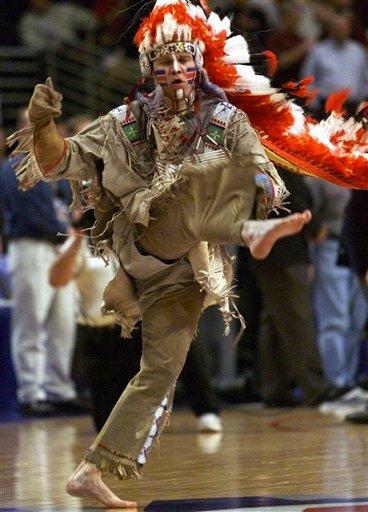
By April NegretteLast week at a San Francisco Giants game, I and a male friend, Kimball Bighorse, were thrown out of AT&T Park. We were not thrown out for being drunk and obnoxious towards other fans; nor for starting a fight or laying hands on anybody. We weren’t even thrown out for being that one person who doesn’t know you don’t touch a ball from the stands while it’s still in play. We were thrown out for telling a non-Native fan to take his costume headdress off, on “Native American Heritage Night” of all nights.

Although I wish this had been an isolated event of racism towards Native people, it’s only one of many examples of the issues we are trying to combat currently. Dan Snyder, owner of the Washington R*dskins, has stated that there are “real issues” and “real-life needs” of Native people that we should be focusing on, not this trivial name. He’s simultaneously right and wrong.

Of course there are other, more physical, needs of Native people. But how are we supposed to combat youth suicide rates, depression, and drug and alcohol abuse when our children grow up seeing themselves are as inferior and their cultures depicted as comical? How are we supposed to be taken seriously when trying to negotiate land, water and treaty rights when society views us as subhuman? High school students make posters for homecoming that say things like "Go Bulldogs, Beat the Indians." Without those land, water and treaty rights, how are we suppose to combat poverty and homelessness when we have no means to do so? You either sell out to American society and culture, you die, or you survive to fight another day.

Fighting another day to me looks like standing up in the face of ignorance and the misunderstandings because of our cultural barrier. It’s like what they say at the airport—If you see something, say something. I’m not saying to start a brawl or humiliate some stranger who doesn’t understand the implications of their actions; educate them instead. If you come at people from a loving place you are more likely to be heard. One man I approached actually took his headdress off—without me asking—and gave me a hug and thanked me for explaining it to him.
San Francisco Giants Made Colossal Error in Warbonnet Fiasco

By Andre CramblitThis year they seem to be doing well on the field. It is off the field that they have problems. Ironically on Native American Heritage Night two American Indians (April Negrette and Kimball Bighorse) were accosted by SF Giants security over a headdress that was being worn by a non-Native fan. They were wronged and physically harmed during this unnecessary and preventable event. Both parties should have been treated in the same manner by Security: Bighorse and Negrette should not have been the only participants to be forcefully handcuffed, detained, and asked to leave the game. I feel that Mr. Bighorse and Ms. Negrette, were punished for speaking out about the harms of Native mascotry while the true wrong-doers were allowed their dignity, their bodies and their well-being to be uninjured.

Native Americans should be able to not only attend events free of harmful cultural misappropriation, in addition to being able to speak out about the desecration of Native cultures, people, and sacred items. American Indians have the same right and protection of the 1st amendment, as do other US citizens. Additionally, we have the Indian Civil Rights Act and the American Indian Religious Freedom Act. These acts provide additionally support to Natives in exercising their rights. Speaking up should not have to be an act of courage.

Security for the Giants organization at ATT Park treated the parties involved in this dispute differently. Ignoring the concerns of the Native peoples involved in this incident highlights the lack of awareness around freedom of speech concerning Native Americans. It is my hope that the Giants organization will educate their personnel on how this has been an example of HATE SPEECH, as much as wearing blackface, and should be treated as such.
Below:  The headdress in question as photographed by Negrette.


Change in policy?

This incident could lead to a first in major league sports:

San Francisco Giants considering ban on culturally insensitive attire

By Erik BradyThe San Francisco Giants are considering a policy that could prohibit fans from wearing items such as fake headdresses in what American Indian activist Suzan Shown Harjo believes would be a first for a major-league sports franchise.

The proposed policy, which is still in the working stages, could potentially say that fans who wear culturally insensitive attire to games or use culturally insensitive language could be asked to stop by Giants security or potentially be asked to leave the stadium.

Staci Slaughter, Giants senior vice president, communications, and senior advisor to the CEO, said the Giants have policies about obscene language and offensive signs.

“We are considering expanding the policy to be more explicit about culturally insensitive signs and articles of clothing,” she told USA TODAY Sports.
A critic tries to question the proposed policy:

Without Feathers: The Flap Over Native American Regalia at the Ballpark Reveals a Deeper Hypocrisy

By Joe Eskenazi[I]n a hypothetical situation resembling the one on Native American Heritage Night, a ballpark ethicist is in for a challenge. If a person who appears to be a Native American and a person who appears to be some other race are wearing identical Native American outfits, would it be considered "arbitrary" to single out solely the second individual as "culturally insensitive"?

Perhaps so, says Moskovitz. "That might be deemed arbitrary. They're both expressing something. There's a vagueness problem."

That vagueness would allow the Giants to potentially take action against fans wearing just about anything. But, in all likelihood, the people wearing the most offensive clothing of all will get a free pass.

Giants' spokeswoman Shana Daum admits that, "given what transpired on Native American Heritage Night," ballpark policy was due for a change. So, what would happen if a fan gallivanted into the stadium wearing a shirt or a cap depicting a caricature of a leering, Indian Sambo with fire engine-red skin?

Well, Daum says, that could be a problem. "If it was offensive to someone in the park, we'd have to take a look," she says.

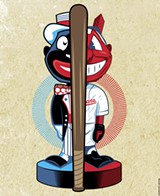
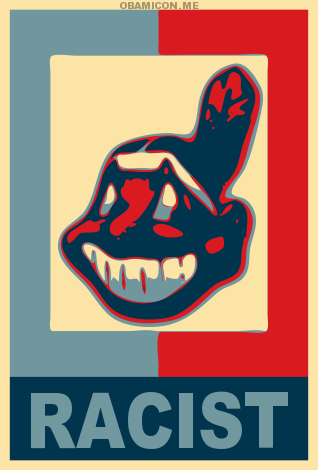
Well, it is offensive. To a lot of people in the park. And it's also the Major League-licensed logo of the Cleveland Indians.
Comment:  Eskenazi seems to think this change in policy would be difficult to enforce. But is it really a change? I bet the stadium security would object to shirts showing a lynched black man, an aborted fetus, Muhammad as a terrorist, a long list of racial and sexual epithets, etc. I'd be amazed if they were free-speech purists who let people wear literally anything.

What Eskenazi seems to object to is adding racist and stereotypical Native images to the (probable) class of banned words and images. Because he isn't used to thinking of his beloved Native icons as racist and stereotypical. Well, too bad for him. His ignorance of what constitutes a racist or stereotypical problem is his problem, not ours.

Case studies

Let's go through the hypothetical examples he offers.

Eskenazi's first case is easily answered. The issue is stereotyping Natives by wearing Plains headdresses. The vast majority of Natives aren't from a Plains culture. And if they were, they wouldn't have earned the right to wear a headdress anywhere, much less to a casual sporting event.

So it doesn't matter if the wearer is Native or not. In something like 99.99% of the cases, the person shouldn't be wearing a headdress, period.

A rule that correctly targets the 9,999 people out of 10,000 who shouldn't wear a headdress isn't "arbitrary." On the contrary, it's so well-defined and precise that it may be the least arbitrary rule in the stadium.

Again, don't wear a headdress unless you're a Plains Indian who's earned the right to wear one. That includes any young non-Plains Indians who think it's hip to wear one.

Eskenazi's second case is the interesting one. Should the Giants ban apparel with Chief Wahoo logos? I'd say yes, because they're racist and stereotypical.

But I doubt the Giants would agree. They suffer from the same myopia as the Cleveland Indians and everyone else in Major League Baseball. That will change as the protests against Chief Wahoo continue.

July 05, 2014

Debating an "Arab" parade float

Facebook friend Brad posted a 2013 photo of an "Arab" float in a St. Patrick's Day parade. He added a caption:Like the original Irish emigrants to America--old white men pretending to be Arabs.


My immediate response: That's racist.

This led to an interesting debate with Brad and Cx. Brad spoke up early:Oh, that's not even the worst of it. Unfortunately I totally missed getting a photo of the float with two white women dressed as "black" basketball players!And then Cx and I were off to the races, beginning with her comment:And what, people can't satirize anymore without someone getting butt-hurt somewhere? Is theater dead then? Are red-nosed big-shoed clowns a stereotype too? Don't tell the thespians. It's a parade for cripes sake. Oh wait, no offense to the cripes. Have their people call my people. Keep pushing the word racism in the wrong context, it looses its meaning in the right contexts.One, I doubt anyone intended this to be a satire. Two, no, you can't satirize an entire ethnic group. Unless you're a member of that group, maybe, or the group as a whole has abused its power.

So you're saying there are contexts where racism is acceptable? Hell, no.There are contexts--theatrics as storytelling being one--in which apparel items and set design items are inherent in the telling of the story. People of other races can't portray each other without the label of racism? "Group that has abused its power" being a variable, and one of opinion.

Justifying when (and how) portrayal, parody or even sincere attempts to tell a story & use of items in the telling is not the answer to ending racism, if that's your goal. The old adage: *The honor of one is the honor of all.*
Defending and justifying racism by making up a label such as "parody" or "satire" isn't the answer either. If the so-called parody isn't obvious, it doesn't exist except in the racists' minds.

Doing nothing except applauding racism like this example certainly won't do anything to end the scourge. My critiques are far more likely to do the trick.

"Art" excuses racism?

Theatrics or storytelling for what purpose? The purpose is the context. If it's to educate or enlighten, maybe. If it's merely to entertain by parading racism, literally, so observers will laugh at the funny nonwhite people...again, no.

So you're in favor of people in minstrel shows performing in blackface? Because that's exactly the same thing.

"People of other races can't portray each other without the label of racism?" Depends on the context and purpose. If it's to portray people falsely, with stereotypes, no. That's almost always unacceptable.

Perhaps you need to (re)read the documented harm of stereotyping as proved in psychology studies. Here you go:

The Harm of Native Stereotyping: Facts and Evidence

As one recent example of the harm, the "savage Indian" stereotype promoted by hipsters in headdresses tells Americans that tribal courts are unfair and violence against Native women is to be expected. Hence the conservatives' unwillingness to pass VAWA.You implying what I'm "saying" rather than focusing on what I'm questioning for the PURPOSE of questioning isn't necessary, Your responses are sufficient rather than implying what I mean. But your page, your pic, have at it.I addressed what you said and what you implied. If you think I got something wrong, feel free to address that point. Until you do, I'd say my interpretation stands.

Yes or no: This performance is equivalent to a minstrel show in blackface. If no, how is it different?The survey you link above being relevant to American Indian stereotypes specifically, can we keep the focus on THIS photo please? I don't know that it's satire, that's one assumption, but being I wasn't there and have never talked to these people to learn their intent, did you or Brad ask them?You're the one who wrote: "Keep pushing the word racism in the wrong context." This isn't the wrong context, it's the right context. You're mistaken if you think otherwise, and I've explained why.

If you have to ask someone if their racism is "satire," the satire has failed. If the satire isn't evident to observers, it doesn't exist except in the satirists' minds.

As I've explained dozens of times, the outcome is what matters, not the intent. People who malign women or gays or minorities don't get a free pass because they didn't "intend" to insult people. If they committed the offense, they're responsible regardless of what they intended.

P.S. Any research specific to Native stereotypes obviously applies to other minorities. More important, it's the tip of the iceberg. There's much more research about the harm to other minorities that I didn't cite.

Don't need no intentThis is a still photo. Without knowing the context or the persons' intent(s), you call it racism. Did you think to ask a person--better yet, take a survey of many (as opinions within a racial group vary)--from this way of dressing if they believe this is racism? Or are you the arbitrary the decider of racism in America, Rob?Intent is irrelevant. You don't understand racism and stereotyping if you think they exist only when people intend them to exist. Try again.

Again, their opinions on what they were doing are irrelevant. What matters is the outcome.

Is this a fair and accurate portrayal of Arabs or Muslims as a whole? If not, it's stereotypical. If they're singling out Arabs or Muslims for this treatment, it's racist.

Still waiting for an answer to my blackface question.

Every American can and should decide what's racist and speak out when something obviously is. If a person doesn't, she's part of the problem, not part of the solution.

Same as if they see a rape happening in Steubenville or on a military base. Those boys didn't mean to hurt anyone, and neither did those soldiers. Shall we give them a pass because of their intent?"Try again" I often see you do this when your point becomes validly challenged and you attempt to make your opinion right over the other person. "The outcome" to whom? See, that assigning of whose effects are important (and decisive) and whose are not--now there's a clue!You haven't "validly challenged" anything. I've raised a dozen legitimate points and I'm not seeing your answer to any of them. What are you waiting for, an invitation? Answer the blackface question, for starters.I say I have validly challenged. Now who gets to be the decider? Opinion leaders? Isn't this fun? :-)Challenging questions with questions such as "the outcome to whom?" is the weakest sort of debate tactic. It's what pathetic people do when they don't have any arguments of their own. "The evidence supports evolution or climate change? Says whom?"

Yes or no: Is this performance equivalent to a minstrel show in blackface?

Yes or no: Is this a fair and accurate portrayal of Arabs or Muslims as a whole?

Yes or no: We should judge military rapes by whether the rapists intended to cause harm?Questions means I don't have an answer--yet. And therefore I reserve judgement and labeling until I know more. I don't see a debate to be won or lost here, Rob, I see an exchange of opinions. In your opinion, these folks dressed as they are in the context of a parade is racism, is that correct?You stated that this is the "wrong context" in which to attack or judge racism. That's not a question, it's a judgment.

Yes, this performance is racist. I wasn't kidding when I wrote that in my first comment.Yes, in my opinion, which at this time in this context I am voicing, calling or labeling this racism--judging simply on this being people of one race portraying another--without you being an "opinion leader" or whatever representative (debatable) of persons of this type of dress or culture is the wrong context, that's correct, you heard me right.Brad chimes in

Finally Brad returned to the debate:I'll happily be the "opinion leader"!

I would concur that you have to consider "intent", however not at the expense of "result". I think the rape example is a poor one, because while intent can serve as a mitigating factor the end result is always unquestionably harm. With racism that's considerably more of a gray area.

I think it's possible for one race to portray another in the context of education, performance art, or historical commentary without necessarily being racist. So I would say that's a point for Cx's argument on the issue. One example would be if a theater company in Norway were putting on a production of Othello, I wouldn't expect them to hunt down a black actor capable of playing the part. So it would probably be forgivable if they put an actor in blackface even though it wouldn't be absolutely necessary.

In this example, however, I think I'd have to side with Rob because the intent clearly doesn't meet the standard of being educational or informative. Nor are these people "satirizing" Arab culture. I think the comparison in this case to the "borrowing" of Native American culture is a good one. These people are pretty clearly lampooning Arab dress for their own purpose. I wouldn't put it on the same level as someone stereotyping, such as portraying an Arab as a crazy terrorist, but I would probably say it's on par with white people dressing in inaccurate Native attire and holding a pow wow. ;-)

Here's some factual background to consider:

Abdallah Shrine: A Brief History

Shriners
Cx responded:Oh lookie, it's Brad. Yea well who the heck asked your opinion buddy? Oh it's your pic on Rob's wall haha ok seriously. So we have context here, Brad, this a group of Shriners, an organization whose purpose or effect is fundraising for its support of children's hospitals, is that correct?Stereotypes can be positive (Asians are brains), neutral (blacks like watermelon), or negative. This example is closer to neutral than negative, but it's still stereotypical.

"Arabs are terrorists" or "Indians are savages" is negative. "Arabs ride camels" or "Indians wear feathers" is neutral. But again, all these claims are stereotypical.

And if you persist in making these claims after you've been informed of the facts, I'd say they're racist too.

As for Brad's claim, I thought I said portraying a different ethnic group may be acceptable in certain circumstances. This isn't one of them. As you put it, Brad, it serves no purpose as "education, performance art, or historical commentary."

Therefore, agreeing with Cx means agreeing with me on this limited subset of the debate. On the main point, though, you're right that I'm right. There's no question that this parade float is stereotypical and arguably racist.

With its talk of priests and mosques, the Abdallah Shrine looks like a whole "homage" to (i.e., mockery of) Islam. It brings to mind such faux "Native" groups as the Order of the Red Men and the Y-Indian Guides. These groups appropriated and abused Native culture; this group seems to have done the same for Islamic culture.

Brad reaches a verdictBrad
Ha! Ha! O.k. I think I see what you're getting at Cx. Yes, the result of this situation is that they raise money to help sick children. Are you suggesting that they couldn't achieve the same result without the pageantry or phony "tradition". I think they probably could.

In a parallel example, the Washington Redskins are civic organization which has won football championships and no doubt helped the Washington D.C. community in numerous economic and philanthropic ways. Does that make their use of Native culture and iconography acceptable because there's a positive outcome?

Cx
Brad, I'm still comprehending what this is exactly. At first I thought this was a music performance in costumes, and perhaps a parody. I've since learned from the link you included that these are a group of shriners. That's where we left off. I don't think that simply because shriners as a group are philanthropic affects is this racism or not. I see it more as a theatrical effort. I still don't know if they are a parody or satire or serious from the still photo alone. Donning the clothing common to another area of the world or culture isn't in itself racism either. I look forward to picking up where we left off, Brad.
Racism and entertainment aren't two mutually exclusive categories. Something can be both.

For instance, the minstrel shows I mentioned. The performers thought they were just being "entertaining." But observers could see that their so-called entertainment was racist.Brad
My position on this particular affair Cx is that it's racist. I think the two things clouding the issue are that it's a culture that's considerably less familiar to us and that the origins of their misuse are so long removed from the current practice.

On face, I'd say this no different than the hipster "pow wows" The origin of this civic group was in a "secret" society or club of white folks who used the Arabian imagery and mythos for their club strictly because it was old and "cool" and gave their organization the air of being something ancient and mystical.

As if that weren't bad enough, the current members are appropriating the cultural hallmarks of Arab society and wearing them in a mocking or cartoonish way, again much as the pretend Indians do. In that sense, I'd say Rob's example of the minstrel shows isn't parallel however as these people aren't attempting to actually portray Arabs.
The rape example is a good one if there's no physical damage. The psychological harm of rape and racism is an apples-to-apples comparison.

In both cases, the act can cause painful mental trauma. Yes, rape is usually worse, but people have committed suicide over racist taunts and bullying, just as they've done over rape. The only "gray area" here is how severe the trauma is, not whether it exists.

And in both cases, you can't be sure of the perpetrator's intent. A rapist could've seriously thought he was "making love" to his victim and you can't prove him wrong. As with racism, we judge rape by the results because the intent is irrelevant. Harm is harm whether the perpetrator intended it or not.

As for the Shriners, I suspect they thought they were portraying actual Arabs. And I doubt minstrel performers were any less aware then than they are now. They were spoofing or caricaturing blacks for "fun," exactly as these Shriners are doing to Arabs.

Therefore, all my examples are good ones. Other than that, I agree with Brad since he agrees with me. ;-)

For more on the subject, see Bloody Jackson, Family Guy, and Archie Bunker, Hipster Racism, and The Magical Power of Intent.
April 04, 2014

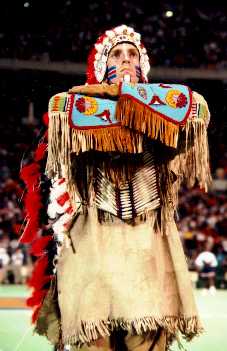
Student contemplates suicide over Chief Illiniwek

Native American student writes letter to UI administration in an effort to ban the Chief

By Megan JonesAs depicted in a letter sent to University administration last week, Xochitl Sandoval, a Native American student, struggles everyday with the remnants of the University’s former mascot: Chief Illiniwek.

While administrators stopped supporting the Chief in 2007, students and the local community have continued to keep the mascot alive with apparel, accessories and unofficial appearances of the Chief at sporting events. Additionally, the Chief’s performance music, such as the “Three in One,” still plays at sporting events.

“I don’t go to sports events because I know that that is where pro-Chief people will be congregating at and where they will be playing the music,” Sandoval, a senior in LAS, said. “I see Chief T-shirts and even though the official symbol has been removed, there are still people who are able to get their hands on the official logo, and every year Unofficial always has some kind of spin on the Chief.”

Sandoval struggles with the lingering mascot, specifically in regard to the “disrespect and racism” the mascot represents to her.
Indigenous Student Discusses Public Suicide Over Chief Illiniwek Pain

By Vincent SchillingAn indigenous student has written an open letter to University of Illinois at Urbana-Champaign administrators and all indigenous and Native peoples of the world saying she wants to commit suicide. She says she would use a gun on the school’s quad because of the painful burden she experiences in dealing with the Chief Illiniwek mascot.

Xochitl Sandoval, an indigenous student at the university, posted the letter on Facebook and explains that the letter is very personal and sacred and about her life and the legacy of disrespect and racism towards herself and the indigenous people who lived on this land and who continue to bear the unbelievable burden of having to fight for respect.

In a conversation with Sandoval, she said she has no plans to harm herself, but she was at her last wit’s end and thought, “What else can I do? I will condense my lived experience in a letter since nothing else has changed.”

In the letter Sandoval states the following:

“On March 11, I had the thought that I should commit suicide. On March 11, 2014, I specifically thought ‘blow your brains out on the quad.’ My process was as follows: Write a letter to Mr. Jamie (the UIUC Director of the Native American House) and explain that this whole Chief situation was so unbearable, and the apathy on behalf of Administration so painful, that it was obvious that nothing was going to change. Maybe suicide was the way. I would then purchase a gun, load it, go onto the quad, stand facing Union, bring the gun up to my temple, and pull the trigger.

Maybe by committing suicide, you, Chancellor Phyllis Wise, the Board of Trustees, and the University of Illinois at Urbana Champaign Administration will realize that no, I am not exaggerating about the emotional, physical and spiritual pain that seeing the former-yet-still-lingering Chief mascot has on me.”

March 27, 2014

Research affirms harm of mascots

Critics: Redskins' Snyder misguided with foundation

By Erik BradyClinical psychologist Michael Friedman thinks Daniel Snyder is running a classic misdirection play with his newly created foundation that will give money for select American Indian causes.

Snyder said in a letter to fans of his Washington NFL team that the foundation, formally announced Tuesday, was born of his discovery that American Indians live with high rates of poverty, suicide and alcoholism.

"Racial discrimination is one of the things that perpetuates these kinds of problems," Friedman told USA TODAY Sports. "It is a false dichotomy to say Native Americans have to decide between either working on problems like poverty or being concerned about a dictionary-defined racial slur. By juxtaposing that, he seems to be trying to say that you can't do both."

Friedman's social science research shows a link between use of racial epithets such as the one he calls the R-word and the self-esteem of native peoples, which he said is precisely what's at stake with such pernicious issues as suicide and alcoholism.
Professor affirms effects of Indian mascots

By Jack RooneyStephanie Fryberg, a visiting professor of psychology at the University of Washington, presented her research Tuesday on the psychological effects of American Indian sports mascots, which affirmed these types of social representations depress the self-esteem of American Indian students.

Fryberg’s lecture, titled “From Stereotyping to Invisibility: The Psychological Consequences of Using American Indian Mascots,” highlighted several studies she and her colleagues have performed.
One of Fryberg's studies:

Of Warrior Chiefs and Indian Princesses: The Psychological Consequences of American Indian Mascots

Comment:  For more on the subject, see The Harm of Native Stereotyping: Facts and Evidence.

August 28, 2013

Stereotypes unhealthy for Natives

Aboriginal Stereotypes Can Be Deadly

By Craig and Marc KielburgerWhen Jane walked into emergency to make sure her abdominal pains didn't signal problems with her pregnancy, she rubbed at a speck of dirt irritating her eye. The nurses took a look at Jane and leapt to their own conclusion: a pregnant aboriginal teen with reddened eyes? She must be on drugs or abused. They interrogated her and, ignoring her explanations, called for a social worker. It was hours before anyone even looked into her abdominal pains.

When Anne visited a Vancouver Island hospital for a routine pregnancy check-up, a nurse read in her medical record that she was Métis, and saw a notation from years before about a child welfare issue, long since resolved. The nurse immediately called in child welfare. Anne's routine hospital visit turned into a Kafkaesque drama.

Jane and Anne are made-up names, but their stories are real. They are among those gathered by Sara Wolfe, a registered midwife in Toronto, and Dr. Don Wilson, who practices obstetrics and gynaecology in Comox, B.C. and works with First Nations people from across Vancouver Island. Both Wolfe and Wilson are members of Canada's First Nations, and they have helped the Society of Obstetricians and Gynaecologists of Canada (SOGC) update guidelines for providing culturally sensitive health care services for aboriginal women.

Wolfe and Wilson have seen many such examples of the unfair stereotypes and cultural misunderstandings that aboriginal women all too often face in Canada's health care system. Most Canadians walking into a hospital or doctor's office would never face what Jane and Anne did.
Comment:  These are typical cases of how Native stereotypes can cause harm and affect lives. We protest them for this reason, not because it feels good to be "politically correct."

For more on the harm of Native stereotyping, see Native Is Prejudiced Against Natives and Mithlo's TEDx Talk on Stereotypes.

August 22, 2013

Native is prejudiced against Natives

I Admit It: I Hold Racist Views About Native People In Canada

By Lou JamesI admit it. I have deep-rooted and ugly prejudices about native people in Canada. When I think of native people, I immediately think of alcoholic, jobless and homeless people who abuse themselves and others in every imaginable way. For all of my life I have seen these images and I continue to see native people this way.

Here's the catch: I'm native.

I grew up in a small native community. My home was stereotypically native: abusive relationships dominated my younger years and permeate every aspect of my life today. My family, friends, and community have seen, and continue to see, disproportionate levels of murder, suicide, violence, sexual abuse, prostitution, alcoholism, drug addiction, emotional abuse, homelessness, and poverty and the criminality that follows from all of this.

We feel the intergenerational effects of residential schools, dislocation, and many other policies designed to civilize and assimilate us at best, and to exterminate us at worst. Every native person I know has, to varying degrees, lost his or her language, traditional knowledge, and sense of identity and belonging as native people.

I grew up in a town, province, and country that reinforced this as the dominant narrative about native people, except when we parade out a few traditional-looking natives to show off an integral part of the rich tapestry of the Canadian identity and imagination, and then congratulate ourselves for being so tolerant and multicultural.

When I moved to an urban centre to attend university, I noticed that the native people I saw in the city fit the stereotype: they were homeless, jobless, hopeless.

Not me.

I was healthy, studious, goal-oriented, ambitious, and eventually I achieved my goals. Successful, I guess you could say.

As a result, I denied to others and to myself that I was native. It was the only way that I could process the cognitive dissonance that arose when I contemplated my success as a native person and the thought that in order to be a real native, I had to be all of those ugly things.

People around me reinforced that "success" and "native" were mutually exclusive concepts. Some said that despite my native heritage, I was a darn good student. A credit to my race! They were the well-meaning ones. The less sensitive people belittled me by making mean jokes about native people. In either case, they reinforced the idea that to be native, I could not be healthy, successful, and well-adjusted.

One of the hardest things for me to realize is that I have internalized these deeply-rooted prejudices about native people, and that I have to fight myself to shake them off. When I see a healthy, well-adjusted and successful native person, not only do I think that this is exceptional--I find it hard to believe. Due to my internalized prejudices against my own people, I find it very difficult, and perhaps sometimes even impossible, to see excellence in native artists, academics, advocates, and even parents. One way to make sense of it is to conclude that these individuals are not "really" native. It's hard for me to realize and admit this.
Comment:  This posting proves the powerful and pernicious effects of stereotyping. If an intelligent and successful Native, who can look at himself and other successful Natives, still falls for the stereotypes, what hope does an ignorant non-Indian have against them?

For more on the harm of Native stereotyping, see Mithlo's TEDx Talk on Stereotypes and Pocahontas Poster Shows Movies' Influence.

June 09, 2013

Mithlo's TEDx talk on stereotypes

Nancy Marie Mithlo's TEDxAlbuquerque Talk on Images of Native WomenNancy Marie Mithlo, Chiricahua Apache, is an Associate Professor of art history and American Indian studies at the University of Wisconsin-Madison who recently gave a TEDx talk in Albuquerque regarding images of Native women in popular culture. She specifically addressed a number of recent incidents that received significant coverage here at ICTMN.com--Paul Frank Industries, No Doubt, and Victoria's Secret.

She ended her talk by citing the title of a column by Sasha Houston Brown: "Nothing Says Native American Heritage Month Like White Girls in Headdresses."

It's an informative presentation that all Americans ought to hear--we recommend forwarding this one.


Comment:  I'd say Mithlo should talk faster, but this is an excellent talk on the harm of Native stereotyping.

As Mithlo (below, center) says, fake Indians are why people are confused when they meet her. Because of media stereotypes, they don't recognize her as a real Indian.

Are you seriously going to argue that stereotypes aren't a problem when a real Indian can't even be recognized? Go ahead and explain how this complete lack of recognition doesn't and can't affect employment, law enforcement, healthcare, education, self-image and self-esteem, etc., etc. Good luck with your answer...you'll need it.

Mithlo noted the violence against Native women and how that's linked to images of "sexy squaws." She added that the connection between media stereotypes and actual harm to Indians is hard to prove. True, but it's also hard to deny.

Indeed, I'd say the onus should be on the deniers. You think Native stereotypes don't influence how we think about Indians? Prove it. Because the anecdotal evidence overwhelmingly suggests that people believe what they see.

Incidentally, Mithlo contacted me via e-mail to let me know of the video. She lists BlueCornComics.com at the end as a further resource. Yay for me and her!

She referred to Native activists "and their allies," which means people like me. I take that and her listing of Blue Corn Comics as an endorsement. Meaning that it's fine for non-Natives like me to speak on Native issues if our positions are smart and well-informed.

For more on the subject, see Pocahontas Poster Shows Movies' Influence and Nugent "Tomahawk Chops" Mascot Critics.

May 06, 2013

Pocahontas poster shows movies' influence

Here's a good example of what kids think about Indians. I wonder where they got their ideas?


Oh, wait...the source is right there in the presentation. From a movie--namely, Disney's Pocahontas.

So much for the asinine belief that movies don't influence our perceptions because they're just "fiction" and "entertainment." Wrong.

On Facebook, one person thought the poster was about the Spokane Tribe because of the central photograph. With Pocahontas, a thunderbird, and a dreamcatcher? I don't think so.

The original photo was labeled: "And this is what middle school students think about Native Americans in Ohio." So I doubt the poster was supposed to be about a tribe in Washington.

The student probably found a picture of the Spokane and decided they were as good as any tribe. Especially since Ohio doesn't have any recognized tribes, or tribes that posed for photographs.

Teaching about IndiansOk, as a retired teacher I have to comment here. First off, I am not Native. However, even I know this is not a good representation of Native American culture. Instead, it is mainly a poster about a movie/cartoon with a few other things thrown in. Were this child in my class, and he/she was interested in Pocahontas as part of the project, I would have encouraged the child to do more research into the "real" woman and the history of her people. Using "Native Americans" as a project theme is extremely broad in scope. Instead, I would have suggested researching one specific Native Nation, or perhaps comparing and contrasting Plains Culture as opposed to Woodland, etc. A lot depends on the age and grade level, guidelines for the project, and so on. Sadly, some teachers/schools are not very sensitive as to cultural stereotyping.Good idea to use this as a teaching moment. But consider another point. There's no evidence that anyone, including parents and teachers, thought anything was wrong with this. For all we know, every adult on the scene approved of it.That is the point I was trying to make. No one saw anything wrong here or in the continual stereotyping that is still used in our classrooms today. Case in point at my school. Not the administration, nor my teacher peers saw anything wrong with suggesting having a "Cowboys and Indians" dress up day during what we call Spirit Week, usually the last full week of the school year. I was the only one to stand up and say it was wrong. Our school at that time was over 90% Hispanic, many naturally of a wide mix of races, some nearly pure indigenous. (Naturally, in Mexico they don't have any blood quantums, but the people generally know their ancestry.) It is the responsibility of those of us that know better, to stand up and "try" to educate others.A couple of people said Pocahontas spurred them to do their own research on Indians. To which I responded:

That a movie spurred some of you to do your own research is good. But Pocahontas had the opposite effect on this student. And his teachers and parents, apparently. They saw the movie and repeated it as if it were fact.

And that's how many people treat movies. They know vaguely about Pocahontas and John Smith. They assume movies like this are based on history. They make no effort to separate fact and fiction, so the two blur together in their minds.

For more on the subject, see "Pocahontas" in Gossip Girl and Artist Reimagines Disney's Pocahontas.

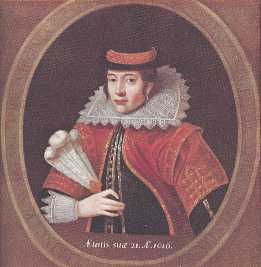
Below:  The real Pocahontas.

April 10, 2013

Nugent "tomahawk chops" mascot critics

A Tomahawk Chop to Political Correctness

Exclusive: Ted Nugent asserts changing team names won't help his 'Indian BloodBrothers'

By Ted Nugent
Every so often some numbskull beats the politically correct war drum protesting the names of sports teams.

The terminally disconnected claim the names of the some teams and their mascots are insensitive, even offensive, to Native Americans. Classic names like the Washington Redskins, Atlanta Braves, Cleveland Indians, Kansas City Chiefs, Chicago Blackhawks.

My advice: Don’t swing at their politically correct spitballs.

If there are Native Americans whose feathers are ruffled over the names of sports teams, I submit that they are sorely focused on all the wrong things.

But that’s what too many Americans do–waste time and energy focusing on things that matter about as much as a giant ball of string.

There are many other issues that should demand our attention instead of talking about how insensitive the “Tomahawk Chop” is to Native Americans.

If we want to focus on the plight of Native Americans, call me crazy horse, but maybe we should start by addressing issues that truly matter most and would actually save Indian’s lives.

The high school dropout rates for American Indians is the highest in the nation.

How about focusing on the disastrous unemployment rate of American Indians, which is near 15 percent?

Suicide rates of American Indian males are twice that of other American males.

Alcoholism rates among American Indians are double that of other ethic groups.

The infant mortality rates among Native Americans are the highest in the nation. No one reports on that.

Abject poverty is the norm on reservations.

These brutally ugly and heartbreaking conditions are the real modern trail of tears, but what’s really disgusting is that a Motown guitar player has to shine a light on the tragedy.

According to the politically correct numbskulls, focusing on the supposedly insensitive names of sports teams somehow matters, and changing the names of the teams will somehow miraculously improve the lot of American Indians.

They are wrong as usual.

There are wafting smoke signals of real distress coming from the American Indian community that are being ignored. These are the life and death issues that actually matter, not pushing a brain-dead agenda to get sports teams to change their names.

Political correctness doesn’t fix anything. The cult of denial that is political correctness masks what matters most, which is why I refer to it as a social cancer that should be eradicated.

Because of my clean and sober, hands-on conservation bowhunting lifestyle and song “The Great White Buffalo,” Native American tribes have invited me to teach their young people how to reconnect with the land and teach them how to bow hunt the mighty American bison. It was in their midst that I learned firsthand about the terrible problems facing my Indian BloodBrothers.

We have a choice: actually doing good by focusing on real issues, or just feeling good by lobbying to get the names of sports teams changed.

Those of you who focus on feel-good issues aren’t helping one bit. More often than not, genuine quality-of-life upgrade comes from facing the painful demons and putting forth honest effort to rectify entrenched mistakes.

“Above the canyon walls, strong eyes did glow. It was the leader of the land, the Great White Buffalo! So listen everybody to what I got to say. There’s hope for tomorrow if we wake up today!”


Some comments on Indian Country Today's write-up of this column:

Ted Nugent: Don't Change Redskins and Other Native Sports Team Nicknames, Won't Help 'My Indian BloodBrothers'Why even bother giving this idiot coverage? I'm from Detroit, and he does not represent the Motor City and its citizens. He has long fought against the hunting and fishing rights guaranteed by treaty to tribes in Michigan, and is pretty well despised by many folks in the Detroit metro Native community. As long as he can get media coverage, he will continue to spout his racist bile. I, for one, would prefer NOT to see his opinions in my favorite Native newspaper.

I think nobody really wants him speaking for us...at all...no thanks...jerk!!

When will someone shut this Lunatic up?

That white guy needs to face the truth about how he came to live the life of white privilege on Native peoples lands.

More of the Republican minority outreach initiative...

Funny I didn't invite Mr. Nugent to help my oyate, nor do I have to authority to if I wanted to. He is spot on the issues facing mine and other Native Peoples, but what are his solutions beside stopping frequently outdated and dehumanizing misappropriate use of our ancestors images?

We do not need your help to "teach us" to reconnect with the land and teach us how to hunt buffalo. This is truly an insult and I would love to know which Native American tribes asked for such things. Freaking ridiculous!
Comment:  Once again, a conservative shows what he thinks of Natives and their concerns.

You gotta love how Nugent used half a dozen stupid stereotypes to explain how stupid stereotypes aren't a problem. If he knows anything about Indians beyond "Redskins," "Braves," and "Chiefs," I'd be surprised.

How stupid do you have to be not to understand the concept of multitasking? One can care about and address Indian mascots while doing the same re other issues.

No one claims Nugent stopped being a musician because he spent a few hours supporting mascots in this column. Why wouldn't the same apply to someone who spends a few hours opposing mascots?

Not to mention the fact that stereotypes are connected to all the serious issues Nugent mentions. As I've demonstrated many times.

If you're ignorant of the proven harm of stereotyping, you're too ignorant to write a column on the subject. Stick to music, Ted, and leave the deep thinking to the rest of us.

Coincidentally, Sherman Alexie explained one of the problems with Native stereotypes around the same time as Nugent's screed:

The Absence of Native American PowerIn an extended clip from this weekend’s Moyers & Company, writer Sherman Alexie, who was born on a Native American reservation, talks to Bill about feeling “lost and insignificant inside the larger culture,” and how his culture’s “lack of power” is illustrated in stereotypical sports mascots.

“At least half the country thinks the mascot issue is insignificant. But I think it’s indicative of the ways in which Indians have no cultural power. We’re still placed in the past. So we’re either in the past or we’re only viewed through casinos,” Alexie tells Bill. “I know a lot more about being white than you know about being Indian.”
One literally could find a thousand statements from Natives about the harm of stereotypes. Nugent hasn't addressed any of these claims; indeed, he's dismissed them. Once again, the Great White Father knows best.

For more on Ted Nugent, see 13 Rock Stars in Headdresses and Nugent's Implied Death Threat.

March 31, 2013

Stereotypes influence kids' views of Natives

The Impact of Stereotyping on Young PeopleCanadian Cayuga actor Gary Farmer is most concerned with the effect of such portrayals on young Aboriginal people themselves. "Consider the impression left when they see themselves portrayed this way time and time again. It’s hard for them to have a positive image of themselves." Even Disney’s arguably positive portrayal of Pocahontas, Farmer says, "will have kids walking away with the stereotype of the 'sexual savage.'" It’s worth noting that Pocahontas’ appearance falls well within white mainstream media norms. In fact, her facial features were a composite of several non-Aboriginal models, one of whom was British fashion star Kate Moss.

Anyone who understands or studies the social development of children and young people knows that attitudes, values and self-esteem are well developed by the mid-teen years, or even earlier. What young people see and hear in the media helps them to figure out how the world works and who and what is valued in our society.

If the media’s take on Aboriginal people is interpreted at face value, then kids are growing up with a biased vision of what it means to be part of a First Peoples society. If they get their impressions from the news, they’ll likely view Aboriginal people as a negative force. And if their impressions come from films and TV programs, they’ll learn to think of Aboriginal people as inferior (passive, aggressive or drunk) or simply as non-entities, obliterated by omission.

When young Aboriginal people read the newspaper or turn on the TV, how often do they see their own life experiences reflected? Almost never, says Children Now, the U.S. research organization that analyzed the presence of Native American children on TV in 1999, and conducted focus groups with children from 20 tribes. Furthermore, they contend, those children have learned to associate positive attributes with white television characters, and negative attributes with non-white characters.

"The media have a lot of power to endorse stereotypes," says Susan Swan, an Ojibway from the Lake Manitoba First Nation. "We go into First Nations communities to talk to youth about gangs. When asked, the kids estimate that about 95 per cent of Aboriginal youth is involved in gangs. The actual number is three per cent. Why do they think these numbers are so high? It’s because this is what they get from television and newspapers."

The popular media are "cool" in the eyes of most kids. If the existence and value of a group of people is not affirmed by inclusion in media information and entertainment, the message is clear—they’re not important. In Aboriginal communities, this can contribute to, as one community sociologist calls it, "learned helplessness, alienation and a sense of having no control."

In Canada, new sensitivities and support for cultural diversity have brought some positive changes. Aboriginal children are periodically featured or interviewed in children’s after-school television, the National Film Board has made films for years that document current First Nations life, the CBC has broadcast many successful dramas that focus on Aboriginal communities and Aboriginal entertainers have been "going mainstream" for two decades. (See Aboriginal Expression in the Arts and Media.) These measures, along with the establishment of Aboriginal television and radio networks, all contribute to a more balanced view and more diverse voices.

Practically speaking, though, these voices still represent only a small proportion of the popular media that kids consume today. The evening news, the "Indian" images in sports-culture hype, the products of the Disney empire, and the misrepresentation (and non-representation) of Aboriginal people in most mainstream media—all continue to influence kids’ views of Aboriginal cultures and peoples.
Comment:  Newspaper Rock readers have heard all this before, but it's still a good (re)statement of the problem. It focuses on the key problem: children who are ignorant and impressionable.

Who cares if an adult is sophisticated enough to shrug off a "whooping savage" cartoon or a "redskins" or "squaw" insult? A more important question is how it affects kids. Native kids who are forming their self-impressions and are sensitive to outside opinions, and non-Native kids who are learning what to think about Indians.

The research says that stereotypes can and do affect young minds. Until you can counter that research, don't bother arguing that stereotypes are harmless. You don't have a leg to stand on.

For more on the harm of Native stereotyping, see Indians Testify About Negative Images and Long-Term Effects of Stereotyping.

March 12, 2013

Reese: Illinois wanted "dancing Indian"

I quote educator Debbie Reese's American Indians in Children's Literature blog occasionally. Now here's an article about the woman herself:

Reese talks Native American stereotypes

By Rawan SalamehIn 1994, Reese and her husband drove from the reservation in New Mexico to Illinois to begin graduate school with their young daughter, Liz. She said they left because they did not fit the description of a typical Native American.

“This place insisted on us not being the kind of Native Indian we actually are, they wanted a certain kind of Indian, they wanted a dancing Indian,” said Reese.

According to Reese, people wanted her to come dance for them or tell stories, but they did not want to learn about the culture.

“We were dealing with very powerful expectations in Illinois,” said Reese. “This was a struggle that has been going on for decades and is still happening.”

Chief Illiniwek, the former mascot of the University of Illinois, was a big reason why it was so hard for natives to feel at home.

According to Reese, the mascot represented stereotypes of the culture that were too offensive to accept.

After a long struggle with the native people, the university finally retired the mascot after 80 years of representing the Fighting Illini.

Reese stressed that the problem with the mascot is that he mimicked traditional and sacred native rituals. Most of what the mascot performed were inaccurate stereotypes of native people and were offensive to the native culture.

Studies show that these stereotypes have a negative effect on the education of Native American students.

Reese said native students drop out of college because they stop caring and lose motivation, which is caused by the misrepresentations of their culture.

“We are not just a people of color, we are nations,” said Reese. “We have state-to-state relations and our leaders have government state to state negotiations with leaders from U.S., France and other country so there is a different kind of status that goes with Native Americans because we are not just people of color, we are nations.”
Some reports from Reese on her lectures:

Cal State Polytechnic University: Talking about Playing Indian

Inspired by Students at University of Redlands and Sherman Indian School

Comment:  If I understand Reese, this is a surprising story. College-level students expected her to be a "dancing Indian" like their former mascot Chief Illiniwek. They couldn't deal with a real Indian who didn't fit their stereotypical notions. Their dissatisfaction with her was so great that it basically forced her to quit.

Wow. If an experienced Native professional feels pressured to change or leave, think what it must be like for young Native students. What are you supposed to do when people constantly challenge you? You can fight back, but that may cause stress and exhaustion. Or you can give up and go home where people understand you.

For more of Reese's thoughts, see Blue Dolphins Begins with Massacre and Lost Mesa in Fablehaven.

Below:  Notice the resemblance between Debbie Reese and Chief Illiniwek next to her? No?