Showing posts with label codetalkers. Show all posts
Showing posts with label codetalkers. Show all posts
December 16, 2015
My Breaking the Code gif
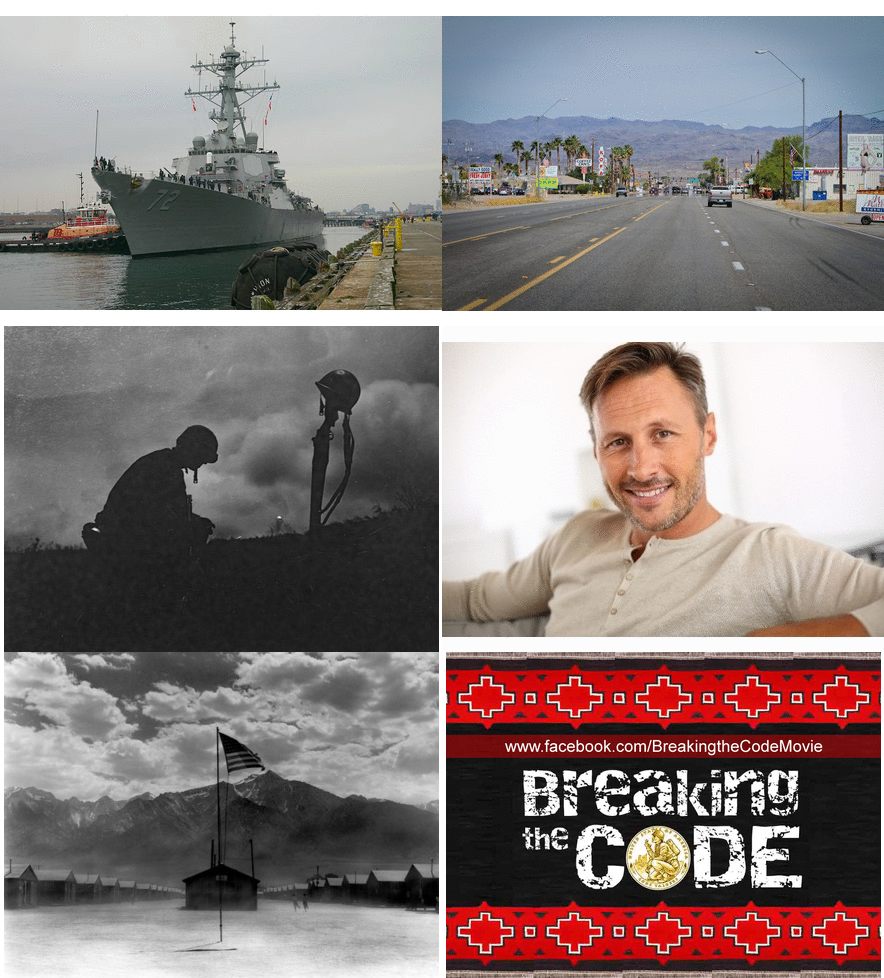
Progress continues on Breaking the Code, my first effort to make a movie. Here's a gif that tells the whole story in a nutshell.


August 04, 2015
Breaking the Code in progress
I don't know if I've mentioned it before, but I'm working on my first screenplay. It's titled Breaking the Code.
My elevator pitch is NCIS meets Do the Right Thing and my logline goes:A Navajo code talker's long-buried secret threatens to destroy two families. For all the news on this project, including the latest developments, follow its Facebook page:
Breaking the Code

My elevator pitch is NCIS meets Do the Right Thing and my logline goes:
Breaking the Code
February 08, 2015
Review of Annumpa Luma
Comic's First Issue Tells of World War I Code-Talkers
By Charlie SherpaThe comic book "Tales of the Mighty Code Talkers," recently released by the Indigenous Narratives Collective, Austin, Texas, helps introduce readers to a rich history of Native American soldiers on 20th century battlefields.
The comic is written and illustrated by Arigon Starr. A series and/or collected volume of comics is planned.
Arigon Starr's ANNUMPA LUMA--CODE TALKER
By Debbie ReeseStarr's comic reaches back to World War I. In Annumpa Luma, she deftly provides readers with a solid chunk of history. The comic opens with Choctaw soldiers in the trenches. They're talking Choctaw to each other... and the idea of their language as a code begins to take shape. They wonder if anyone will be open to their idea, because in government boarding schools, they were punished for speaking their language. Meetings take place, a test is devised, and the code is implemented. This is all conveyed through the perspective of Corporal Solomon Louis. His reunion with his wife, when he returns home, is heartwarming.
On the final pages of her comic, Starr lists the names of the Choctaw soldiers, and says that in 2013, the Choctaw Code Talkers received the Congressional Gold Medal of Honor. New Indigenous Superheroes Save the Day
Speaking tribal languages is just one superpower among heroes gracing the pages of comic books.
By Taté Walker“One of the main goals, to be sure, is Native folks are at the center of these stories. They aren’t the sidekicks, not some shaman helping the hero,” Lee insists. “We want to make sure we’re representing in a way that is respectful, appropriate, and real, and comics is a medium where we can change a lot of the negative stereotypes that proliferate mainstream entertainment, because comics is where young people read. Native kids are searching for heroes who look like them… And here comes Captain Paiute, who screws up anyone who comes trying to hurt the rez–that’s his job.”
Information about Tales of the Mighty Code Talkers, Vol. 1, and other titles, including Captain Paiute, Pueblo Jones and Kaui (Indigenous Fairy Tales), can be found at the INC Comics website, www.inccomics.com. The group also invites and encourages indigenous writers and artists to join INC Comics. Inquiries can be made on the site’s Contact page. Comment: All this is good, but $5.00 is a steep price for a 12-page comic. You can find the information online in many locations--for instance:
Choctaw code talkers
Choctaw Indian Code Talkers of World War I
Choctaw Code Talkers Association
Choctaw Code Talkers
Therefore, I can't recommend the comic except for Native-comics aficionados like me. For most people, it's a pricey way to learn about the codetalkers.

By Charlie Sherpa
The comic is written and illustrated by Arigon Starr. A series and/or collected volume of comics is planned.
By Debbie Reese
On the final pages of her comic, Starr lists the names of the Choctaw soldiers, and says that in 2013, the Choctaw Code Talkers received the Congressional Gold Medal of Honor.
Speaking tribal languages is just one superpower among heroes gracing the pages of comic books.
By Taté Walker
Information about Tales of the Mighty Code Talkers, Vol. 1, and other titles, including Captain Paiute, Pueblo Jones and Kaui (Indigenous Fairy Tales), can be found at the INC Comics website, www.inccomics.com. The group also invites and encourages indigenous writers and artists to join INC Comics. Inquiries can be made on the site’s Contact page.
Choctaw code talkers
Choctaw Indian Code Talkers of World War I
Choctaw Code Talkers Association
Choctaw Code Talkers
Therefore, I can't recommend the comic except for Native-comics aficionados like me. For most people, it's a pricey way to learn about the codetalkers.
January 29, 2015
Review of Code Talker
Code Talker: The First and Only Memoir By One of the Original Navajo Code Talkers of WWIIHe is the only original World War II Navajo code talker still alive—and this is his story . . .
His name wasn’t Chester Nez. That was the English name he was assigned in kindergarten. And in boarding school at Fort Defiance, he was punished for speaking his native language, as the teachers sought to rid him of his culture and traditions. But discrimination didn’t stop Chester from answering the call to defend his country after Pearl Harbor, for the Navajo have always been warriors, and his upbringing on a New Mexico reservation gave him the strength—both physical and mental—to excel as a marine.
During World War II, the Japanese had managed to crack every code the United States used. But when the Marines turned to its Navajo recruits to develop and implement a secret military language, they created the only unbroken code in modern warfare—and helped assure victory for the United States over Japan in the South Pacific.
Editorial Reviews
"From Guadalcanal through Bougainville to Peleliu, Nez relates a riveting tale of jungle combat and his personal struggle to adapt to civilian life following the most cataclysmic war in our nation’s history. Gripping in its narrative, Code Talker is history at its best." --Colonel Cole C. Kingseed, U.S. Army (Ret.), co-author of Beyond Band of Brothers
"A fascinating inside look at one of WWII’s most closely guarded secrets…This is an important book, a previously untold piece of our history." --Marcus Brotherton, author of Shifty's War
"You don’t need to be a fan of World War II literature to appreciate this memoir…a fascinating melange of combat in the Pacific theater, the history of the Navajo people and the development of a uniquely American code." --The Associated Press
"A unique, inspiring story by a member of the Greatest Generation." --Kirkus Reviews Comment: I just finished reading this for my Breaking the Code screenplay. Some thoughts:
I'd say "riveting" is an overstatement. Unlike some readers, I had no trouble putting the book down.
Code Talker is maybe 1/3 Nez's childhood, 1/2 the war, and 1/6 the rest of his life. So the bit about his "personal struggle to adapt to civilian life" is also an overstatement. That wasn't Nez's big issue. His real challenge, which I wouldn't call a struggle, was leaving the sheltered Navajo life for boarding schools and the big city.
The book is fine on Nez's childhood. Especially if you haven't read biographies of Southwestern Indians in the pre-war years, when contact with the white man was still rare. It's great on the war years, where you get a real sense of what soldiers had to endure in the Pacific. I'd say it rushes through the post-war years...but nobody's necessarily interested in that part of Nez's story, so it's okay.
My main cavaet is that nothing terribly dramatic happens. You want heartwrenching personal conflicts in stories like these. Nez overcoming the cruel boarding-school master! Nez overcoming the racist Marine sergeant! Nez in hand-to-hand combat with a deadly Banzai enemy!
Nothing like that happened. If Nez hadn't been at ground zero during the formation and deployment of the Navajo codetalkers, we might not care about his story. What he witnessed is the interesting part--but witnessing isn't quite as compelling as struggling oneself.
Those points aside, Code Talker tells you everything you'd like to know about the origin of the codetalkers. It's a must-read on that subject. And it's a solid entry in the broader category of Native memoirs.
Rob's rating: 8.0 of 10.

His name wasn’t Chester Nez. That was the English name he was assigned in kindergarten. And in boarding school at Fort Defiance, he was punished for speaking his native language, as the teachers sought to rid him of his culture and traditions. But discrimination didn’t stop Chester from answering the call to defend his country after Pearl Harbor, for the Navajo have always been warriors, and his upbringing on a New Mexico reservation gave him the strength—both physical and mental—to excel as a marine.
During World War II, the Japanese had managed to crack every code the United States used. But when the Marines turned to its Navajo recruits to develop and implement a secret military language, they created the only unbroken code in modern warfare—and helped assure victory for the United States over Japan in the South Pacific.
Editorial Reviews
"From Guadalcanal through Bougainville to Peleliu, Nez relates a riveting tale of jungle combat and his personal struggle to adapt to civilian life following the most cataclysmic war in our nation’s history. Gripping in its narrative, Code Talker is history at its best." --Colonel Cole C. Kingseed, U.S. Army (Ret.), co-author of Beyond Band of Brothers
"A fascinating inside look at one of WWII’s most closely guarded secrets…This is an important book, a previously untold piece of our history." --Marcus Brotherton, author of Shifty's War
"You don’t need to be a fan of World War II literature to appreciate this memoir…a fascinating melange of combat in the Pacific theater, the history of the Navajo people and the development of a uniquely American code." --The Associated Press
"A unique, inspiring story by a member of the Greatest Generation." --Kirkus Reviews
I'd say "riveting" is an overstatement. Unlike some readers, I had no trouble putting the book down.
Code Talker is maybe 1/3 Nez's childhood, 1/2 the war, and 1/6 the rest of his life. So the bit about his "personal struggle to adapt to civilian life" is also an overstatement. That wasn't Nez's big issue. His real challenge, which I wouldn't call a struggle, was leaving the sheltered Navajo life for boarding schools and the big city.
The book is fine on Nez's childhood. Especially if you haven't read biographies of Southwestern Indians in the pre-war years, when contact with the white man was still rare. It's great on the war years, where you get a real sense of what soldiers had to endure in the Pacific. I'd say it rushes through the post-war years...but nobody's necessarily interested in that part of Nez's story, so it's okay.
My main cavaet is that nothing terribly dramatic happens. You want heartwrenching personal conflicts in stories like these. Nez overcoming the cruel boarding-school master! Nez overcoming the racist Marine sergeant! Nez in hand-to-hand combat with a deadly Banzai enemy!
Nothing like that happened. If Nez hadn't been at ground zero during the formation and deployment of the Navajo codetalkers, we might not care about his story. What he witnessed is the interesting part--but witnessing isn't quite as compelling as struggling oneself.
Those points aside, Code Talker tells you everything you'd like to know about the origin of the codetalkers. It's a must-read on that subject. And it's a solid entry in the broader category of Native memoirs.
Rob's rating: 8.0 of 10.
March 18, 2014
2016 Sacagawea dollar designs
After the "Mohawk ironworkers" theme for the 2015 Sacagawea dollar, the 2016 theme was extremely predictable:
CCAC Releases 2016 Native American Dollar Candidate DesignsThe Citizens Coinage Advisory Commission (CCAC) has released the following candidate design images for the 2016 Native American dollar coin. The 2016 Native American dollar reverse will recognize the heroic contributions of the Native American Code Talkers of World Wars I & II.
Native American Code Talkers from more than thirty tribes served with distinction and played an important role in concealing the nature of secret communiques between American forces. 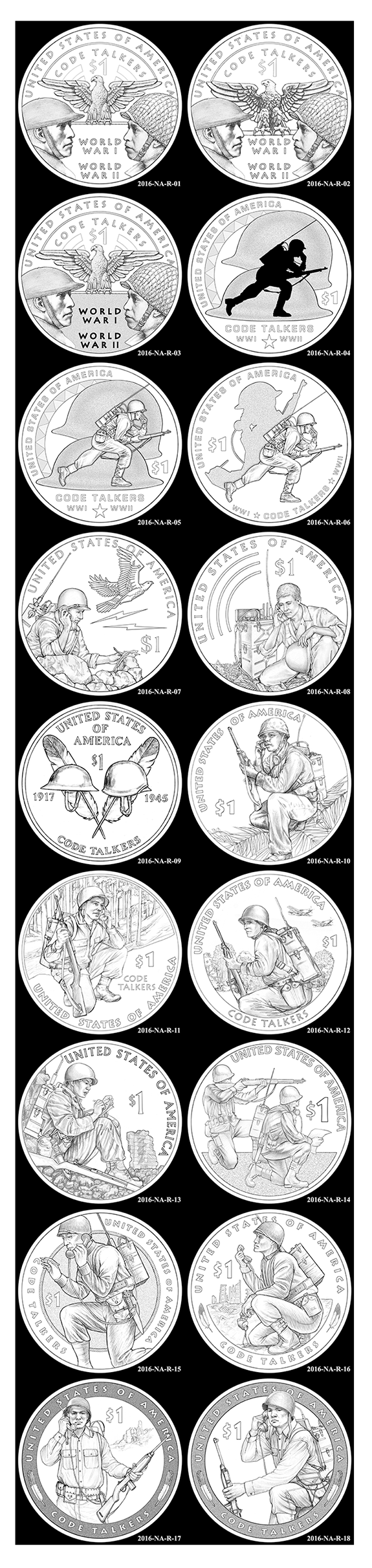
I'd probably go with one of the more abstract ones: 1, 2, 3, 6, or 9. With a slight preference for 6. The others seem a little too specific and busy, although 10, 11, and 16 are okay.
CCAC Reviews 2016 Native American Dollar Designs
By Les PetersAfter the authorizing legislation for the dollar (Public Law 110-82) was read by April Stafford from the Mint, the 18 designs were culled by Chairman Marks, leaving designs 1, 2, 3, 4, 6, 9, 13, 16, and 17. The preferences of the stakeholders were designs 1 and 2 (Congressional Native American Caucus of the House of Representatives), 3 (Congressional Native American Caucus of the House of Representatives and the Senate Committee on Indian Affairs), 4 (National Congress of the American Indian), 9 (National Congress of the American Indian and the Senate Committee on Indian Affairs), 16 (Senate Committee on Indian Affairs). The committee favorites were 9 with 19 votes and 6 with 14 points. Design 9 received the committee's recommendation.

For more on the subject, see 2014 Dollar to Honor Lewis and Clark and 2013 Sacagawea Dollar Reverse Unveiled.
CCAC Releases 2016 Native American Dollar Candidate Designs
Native American Code Talkers from more than thirty tribes served with distinction and played an important role in concealing the nature of secret communiques between American forces.
I'd probably go with one of the more abstract ones: 1, 2, 3, 6, or 9. With a slight preference for 6. The others seem a little too specific and busy, although 10, 11, and 16 are okay.
CCAC Reviews 2016 Native American Dollar Designs
By Les Peters
For more on the subject, see 2014 Dollar to Honor Lewis and Clark and 2013 Sacagawea Dollar Reverse Unveiled.
November 25, 2013
Redskins honor Navajo codetalkers
Redskins honor members of the Navajo Code Talkers Association
By Mike JonesAs a joint celebration of the NFL’s Salute to Service month and Native American Heritage month, the Washington Redskins recognized four members of the Navajo Code Talkers Association.
The code talkers were a group of Native American service members who transmitted secret communications beginning in World War II.
Four representatives—Navajo Code Talkers Association President Peter MacDonald Sr., Vice President Roy Hawthorne and members George James Sr. and George Boyd Willie Sr.—were recognized during a commercial break during the first quarter of the Redskins’ game vs. the San Francisco 49ers. They stood in the end zone nearest the tunnel that leads to the Redskins’ locker room and received a round of applause while a video tribute to the code talkers played. 
People quickly deemed this a PR stunt exploiting the codetalkers. The codetalkers didn't necessarily agree:
Navajo Code Talker says Redskins name not derogatoryA leader of the Navajo Code Talkers who appeared at a Washington Redskins home football game said Wednesday the team name is a symbol of loyalty and courage--not a slur as asserted by critics who want it changed.
Roy Hawthorne, 87, of Lupton, Ariz., was one of four Code Talkers honored for their service in World War II during the Monday night game against the San Francisco 49ers.
Hawthorne, vice president of the Navajo Code Talkers Association, said the group's trip was paid for by the Redskins. The four men met briefly with team owner Dan Snyder but did not discuss the name, Hawthorne said.
Still, he said he would endorse the name if asked, and the televised appearance in which three of the Indians wore Redskins jackets spoke for itself.
"We didn't have that in mind but that is undoubtedly what we did do," Hawthorne said when asked if he was intending to send a statement with the appearance. "My opinion is that's a name that not only the team should keep, but that's a name that's American." Apparently this Navajo's word skills include overruling the dictionary...impressive!
Natives condemn stunt
From LastRealIndians on Facebook:Washington Redskins host the SanFran 49ers tonight on Monday night football then apparently this happened: Navajo Code talkers were honored by the Redskins. With all due respect to the elderly vets Dan Snyder and the redskins are exploiting our people on national TV--they're pissing down our backs and telling us it's raining + throwing in free redskin jackets now and press time. Lol GTFOH with this B.S. Snyder's time has come, his era is gone just like the Indian as mascot practice. And again:Here's a Redskins promo video that very obviously exploits Navajo elders (narrated by war criminal George W.) Next we are going to be demanding more free Redskins jackets and that Dan Snyder's racist org actually hire a real Indian to be the mascot. I guess this is the state we are in relatives; we are so starved of true internal dignity we'll clap happily and blindly for Obama as our treaty rights are violated and we'll take the spotlight even if it means trampling on our current and future children's self esteem and right to a human (non-objectified) existence. Let the masters give their subjects some attention and watch some line up for the head pets. Again this is not personal to our honorable elder code talkers. ShameOnSnyder: here's the vid. Navajo Code Talkers Attend Game
Suzan Shown Harjo, the veteran critic of Indian mascots, wasn't buying it:
Red*kins 'Honor' Codetalkers—How Low Will They Go?
By Suzan Shown HarjoThe Red*kins’ “honoring” of Navajo codetalkers consisted of four frail veterans standing in the end zone and receiving a round of applause. Three of the four Navajo elders wore Red*kins jackets, with the new-clothes price tags still hanging at their wrists. These seniors probably thought this was another in a long line of recent recognitions of their WWII achievements some 70 years ago, rather than any implied endorsement of the team’s name.
But as soon as the Monday Night Football cameras picked up images of the veterans, a commentator began to remark on the split in Native American opinion about the team’s disparaging name. And:The Washington franchise is sniffing around Indian country, sending scouts before them, looking for people who might be enticed to smile upon their name and logo. They also are bargaining for little pieces of racism by exploring keeping the logo and renaming the team the “Warriors.” A lesser stereotype is still a stereotype, and would give rise to the same abhorrent painted pig faces and dyed turkey feathers as the current stereotype.
The Washington franchise’s first stop was Poarch Band, the only tribe in the country that is building a casino on another nation’s sacred place–a known ceremonial ground, burials and historical site in Wetumpka, Alabama, the last capitol of the Muscogee (Creek) Nations before forced removal to Indian Territory (now Oklahoma). The franchise’s second big idea was to “honor” the four elderly veterans by having them stand in Red*kins jackets, so the money shot and story was not about their valor in war, but about supposed support for something most Native people are against. I can’t wait to see how low the franchise will go next. Blackhorse Says That Code Talkers Honor 'Sugarcoats' RacismThe lead petitioner in a federal trademark case against the Washington Redskins says that the NFL team was disingenuous when they honored the Navajo Code Talkers during Monday Night Football.
"As a Navajo person, I understand the symbolic meaning of our Navajo Code Talkers, and we will continue to honor them for their service," Amanda Blackhorse wrote in an email to USA Today Sports. "The Code Talkers deserved a more genuine honor, not just 30 seconds of media time so the Washington team can sugarcoat their racism."
Blackhorse also had a message for Dan Snyder. "Using four Navajo elders does not justify what they are doing and does not change anything. At the end of the day, the name is still inappropriate and disparaging toward Native American people.” She also said, “Our views have not changed. Nothing has changed. We are still offended and outraged that he would parade around our elders and use them as a shield against the growing number of people who want him to do the right thing." Others agree
Redskins Owner Dan Snyder Says ‘Some of My Best Friends Are Navajo Code Talkers!’
By Dave ZirinThere is an argument that a reason to oppose Native American mascots is not only because they are racist. It is not only because they are an act of minstrelsy opposed by Native American groups for decades. It is not only because they celebrate the savage, warlike nature of the Native American people, which for decades has been done—in books, theater, movies, and sports—as a way to justify the bravery and necessity of European conquest. There’s an argument that it collectively just makes us all stupider.
This was on display last night when Dan Snyder, owner of the Washington Redskins and under fire for profiting off a dictionary-defined racist name, used the national television cameras of ESPN to honor the Navajo Code Talkers. These were Navajo soldiers during World War II who used their language to create coded messages to be used over radio that could not be cracked by the Axis Powers. Their presence last night allowed Mike Tirico to bring up the entire “name controversy” on a terrain that made Dan Snyder look like he was honoring their heritage. Tirico also said that NFL Commissioner Roger Goodell had met with Native American leaders, which was not true. There was a meeting between the NFL and Native American leaders but Goodell did not show. Tirico also made no mention of Amanda Blackhorse, a Navajo woman who is currently leading a legal trademark challenge to get the name changed. Tirico also made no mention of the fact that the original “code talkers” were the Choctaw Nation in World War I, which for a decade has had a formal position voted upon by the tribal council to get the name changed. Instead, we were treated to the spectacle, three days before Thanksgiving, of Dan Snyder saying to America, “some of my best friends are Navajo Code Talkers!”
Make no mistake about it: wrapping yourself in World War II veterans is the last refuge of scoundrels. Just as the Republican Party during the government shutdown chose to make the World War II Memorial the great symbol of Barack Obama’s lack of patriotism and the true horrors of the government shutdown (forget about those kids not getting the cancer treatments at NIH), Dan Snyder was rushing for cover behind “the greatest generation.”
This was Dan Snyder trolling and lifting a big middle finger to the Oneida Nation, the American Indian Movement, the Choctaw Nation, the San Francisco Chronicle, Bob Costas, Cris Collinsworth, Sports Illustrated’s Peter King, USA Today’s Christine Brennan, The Washington Post’s Mike Wise, the Capital News Service located at the University of Maryland, his alma mater, Charles Krauthammer, Republican Congressman from Oklahoma Tom Cole (one of two Native Americans in Congress), the DC City Council, the thousand people who marched outside the Redskins last nationally televised game against Minnesota chanting “Little Red Sambo Has Got to Go” and everyone who is said the name is racist and belongs nowhere but the dust bin of history. Decoding Dan Snyder's message
By Tim Keown[T]his is no longer about a nickname. Instead, it's about stubbornness and arrogance and a ham-fisted public-relations campaign on behalf of the stubborn and arrogant. It's about people who are accustomed to getting their way arching their backs and curling their lips and telling the world they aren't about to stop getting their way. It's about entrenchment.
Snyder trots out the Code Talkers while refusing to sit down and discuss the nickname issue with Oneida tribal leaders who are interested in helping him understand their concerns. He trots out the Code Talkers while refusing to acknowledge the legitimate opposition to the Redskins name -- an Oneida nation poll of Washington-area adults cited in USA Today showed 59 percent believed Native Americans would be justified in feeling offended by being called "redskin." He trots out the Code Talkers emboldened by NFL commissioner Roger Goodell, who has made support of the nickname into an official league stance with Congress and who didn't attend a league meeting with Oneida representatives. And:The most strident members of the meritocracy will tell you that Snyder runs a private company, and therefore he has the right to call it what he wants and spit in the eye of anyone who disagrees. Don't listen to any of that. Before he owned his team, it accepted $70 million in public funding to build FedEx Field. At bare minimum, his presence within that structure carries an obligation to consider public opinion.
But from a sociological and common-sense perspective, here's a pertinent question: How can this nickname--or any nickname, really--be considered so sacred? How much of your remaining dignity are you willing to shed for the cause? If the people you are attempting to "honor" with the name would like to speak to you about dishonor, hear them out. If it offends the people it is intending to "honor," change it. It's a nickname, not a religion. The Bullets are now the Wizards and the Hornets are now the Pelicans and when you get right down to it, this is all pretty low-level stuff. The Redskins Honor Navajo Code Talkers, Still Go By "Redskins"The Redskins' decision to feature the Navajo Code Talkers was seen by some as a public relations move at a moment when many people are calling for the Redskins to change their name. Because it's frickin' 2013, and they're still calling themselves the Redskins, which is a name that, were it to be proposed for an expansion team, would earn the person who suggested it an instant shitcanning. Comment: So 80 years after the the team chose the name to "honor" Indians, it actually honored some actual Indians. Can you say "too little, too late"?
By Mike Jones
The code talkers were a group of Native American service members who transmitted secret communications beginning in World War II.
Four representatives—Navajo Code Talkers Association President Peter MacDonald Sr., Vice President Roy Hawthorne and members George James Sr. and George Boyd Willie Sr.—were recognized during a commercial break during the first quarter of the Redskins’ game vs. the San Francisco 49ers. They stood in the end zone nearest the tunnel that leads to the Redskins’ locker room and received a round of applause while a video tribute to the code talkers played.
People quickly deemed this a PR stunt exploiting the codetalkers. The codetalkers didn't necessarily agree:
Navajo Code Talker says Redskins name not derogatory
Roy Hawthorne, 87, of Lupton, Ariz., was one of four Code Talkers honored for their service in World War II during the Monday night game against the San Francisco 49ers.
Hawthorne, vice president of the Navajo Code Talkers Association, said the group's trip was paid for by the Redskins. The four men met briefly with team owner Dan Snyder but did not discuss the name, Hawthorne said.
Still, he said he would endorse the name if asked, and the televised appearance in which three of the Indians wore Redskins jackets spoke for itself.
"We didn't have that in mind but that is undoubtedly what we did do," Hawthorne said when asked if he was intending to send a statement with the appearance. "My opinion is that's a name that not only the team should keep, but that's a name that's American."
Natives condemn stunt
From LastRealIndians on Facebook:
Suzan Shown Harjo, the veteran critic of Indian mascots, wasn't buying it:
Red*kins 'Honor' Codetalkers—How Low Will They Go?
By Suzan Shown Harjo
But as soon as the Monday Night Football cameras picked up images of the veterans, a commentator began to remark on the split in Native American opinion about the team’s disparaging name.
The Washington franchise’s first stop was Poarch Band, the only tribe in the country that is building a casino on another nation’s sacred place–a known ceremonial ground, burials and historical site in Wetumpka, Alabama, the last capitol of the Muscogee (Creek) Nations before forced removal to Indian Territory (now Oklahoma). The franchise’s second big idea was to “honor” the four elderly veterans by having them stand in Red*kins jackets, so the money shot and story was not about their valor in war, but about supposed support for something most Native people are against. I can’t wait to see how low the franchise will go next.
"As a Navajo person, I understand the symbolic meaning of our Navajo Code Talkers, and we will continue to honor them for their service," Amanda Blackhorse wrote in an email to USA Today Sports. "The Code Talkers deserved a more genuine honor, not just 30 seconds of media time so the Washington team can sugarcoat their racism."
Blackhorse also had a message for Dan Snyder. "Using four Navajo elders does not justify what they are doing and does not change anything. At the end of the day, the name is still inappropriate and disparaging toward Native American people.” She also said, “Our views have not changed. Nothing has changed. We are still offended and outraged that he would parade around our elders and use them as a shield against the growing number of people who want him to do the right thing."
Redskins Owner Dan Snyder Says ‘Some of My Best Friends Are Navajo Code Talkers!’
By Dave Zirin
This was on display last night when Dan Snyder, owner of the Washington Redskins and under fire for profiting off a dictionary-defined racist name, used the national television cameras of ESPN to honor the Navajo Code Talkers. These were Navajo soldiers during World War II who used their language to create coded messages to be used over radio that could not be cracked by the Axis Powers. Their presence last night allowed Mike Tirico to bring up the entire “name controversy” on a terrain that made Dan Snyder look like he was honoring their heritage. Tirico also said that NFL Commissioner Roger Goodell had met with Native American leaders, which was not true. There was a meeting between the NFL and Native American leaders but Goodell did not show. Tirico also made no mention of Amanda Blackhorse, a Navajo woman who is currently leading a legal trademark challenge to get the name changed. Tirico also made no mention of the fact that the original “code talkers” were the Choctaw Nation in World War I, which for a decade has had a formal position voted upon by the tribal council to get the name changed. Instead, we were treated to the spectacle, three days before Thanksgiving, of Dan Snyder saying to America, “some of my best friends are Navajo Code Talkers!”
Make no mistake about it: wrapping yourself in World War II veterans is the last refuge of scoundrels. Just as the Republican Party during the government shutdown chose to make the World War II Memorial the great symbol of Barack Obama’s lack of patriotism and the true horrors of the government shutdown (forget about those kids not getting the cancer treatments at NIH), Dan Snyder was rushing for cover behind “the greatest generation.”
This was Dan Snyder trolling and lifting a big middle finger to the Oneida Nation, the American Indian Movement, the Choctaw Nation, the San Francisco Chronicle, Bob Costas, Cris Collinsworth, Sports Illustrated’s Peter King, USA Today’s Christine Brennan, The Washington Post’s Mike Wise, the Capital News Service located at the University of Maryland, his alma mater, Charles Krauthammer, Republican Congressman from Oklahoma Tom Cole (one of two Native Americans in Congress), the DC City Council, the thousand people who marched outside the Redskins last nationally televised game against Minnesota chanting “Little Red Sambo Has Got to Go” and everyone who is said the name is racist and belongs nowhere but the dust bin of history.
By Tim Keown
Snyder trots out the Code Talkers while refusing to sit down and discuss the nickname issue with Oneida tribal leaders who are interested in helping him understand their concerns. He trots out the Code Talkers while refusing to acknowledge the legitimate opposition to the Redskins name -- an Oneida nation poll of Washington-area adults cited in USA Today showed 59 percent believed Native Americans would be justified in feeling offended by being called "redskin." He trots out the Code Talkers emboldened by NFL commissioner Roger Goodell, who has made support of the nickname into an official league stance with Congress and who didn't attend a league meeting with Oneida representatives.
But from a sociological and common-sense perspective, here's a pertinent question: How can this nickname--or any nickname, really--be considered so sacred? How much of your remaining dignity are you willing to shed for the cause? If the people you are attempting to "honor" with the name would like to speak to you about dishonor, hear them out. If it offends the people it is intending to "honor," change it. It's a nickname, not a religion. The Bullets are now the Wizards and the Hornets are now the Pelicans and when you get right down to it, this is all pretty low-level stuff.
September 05, 2013
Highway stretch honors Choctaw codetalkers
Oklahoma highway stretch to honor Choctaw Code TalkersOklahoma is honoring a group of World War I Choctaw Code Talkers by renaming a stretch of highway near where many of the men lived.
The Choctaw Nation and the Choctaw Code Talkers Association are hosting a dedication ceremony for the event on Friday.
The state is renaming 55 miles of Highway 3 between Antlers and Broken Bow in their honor.
Fourteen of the 19 original Choctaw Code Talkers lived in the area and often walked along the highway, and many family members still live in the area. Comment: For more on the codetalkers, see Muscogee Creek Codetalker Medal and Radio Marathon for Comanche Codetalkers.
The Choctaw Nation and the Choctaw Code Talkers Association are hosting a dedication ceremony for the event on Friday.
The state is renaming 55 miles of Highway 3 between Antlers and Broken Bow in their honor.
Fourteen of the 19 original Choctaw Code Talkers lived in the area and often walked along the highway, and many family members still live in the area.
May 13, 2013
Muscogee Creek codetalker medal
Muscogee Creek Tribe Code Talkers Medal Designs Reviewed
By Michael ZielinskiThe Commission of Fine Arts (CFA) and Citizens Coinage Advisory Committee (CCAC) recently reviewed design alternatives for a Congressional Gold Medal to be issued honoring the Code Talkers of the Muscogee Creek Nation.
Under the Navajo Code Talkers Congressional Gold Medal Act passed in 2000, the Congressional Gold Medal was awarded to Navajo Code Talkers for their contributions during World War II. Under the Code Talkers Recognition Act of 2008, additional tribes will be recognized for their contributions during World War I and World War II. As of late January 2013, an updated list of Native American Code Talkers who served in the armed forces during both wars has grown to include 32 different tribes. So far, the CFA and CCAC have reviewed design alternatives for medals honoring 12 of these tribes. Comment: I gather the Treasury hasn't decided on a design yet. The article shows the alternatives for the obverse and reverse sides.
Two groups voted on these designs. The groups recommended a different design for each side. I'd go with the CCAC's choices--the ones described as getting the highest vote totals. They're shown below.
For more on the codetalkers, see Codetalker Congressional Gold Medals.


By Michael Zielinski
Under the Navajo Code Talkers Congressional Gold Medal Act passed in 2000, the Congressional Gold Medal was awarded to Navajo Code Talkers for their contributions during World War II. Under the Code Talkers Recognition Act of 2008, additional tribes will be recognized for their contributions during World War I and World War II. As of late January 2013, an updated list of Native American Code Talkers who served in the armed forces during both wars has grown to include 32 different tribes. So far, the CFA and CCAC have reviewed design alternatives for medals honoring 12 of these tribes.
Two groups voted on these designs. The groups recommended a different design for each side. I'd go with the CCAC's choices--the ones described as getting the highest vote totals. They're shown below.
For more on the codetalkers, see Codetalker Congressional Gold Medals.
May 08, 2013
Radio marathon for Comanche codetalkers
Radio marathon honors Comanche code talker history
By Ty AlbinWhen U.S. soldiers landed several miles off of Utah Beach during World War II's Normandy invasion on D-Day, Comanche code talker Larry Saupitty was there. He sent the first message back to Allied Forces in a code based on the Comanche language, telling command they had made a good landing but in the wrong place.
Comanche soldiers all from within a few miles of Lawton were vital to the secrecy of the effort against the Axis powers. On Wednesday, Victory in Europe Day, the Comanche Nation Museum, the Lawton-Fort Sill Amateur Radio Club and the Eisenhower Middle School Amateur Radio Club chose to honor the Comanche code talkers by starting a four-day amateur radio marathon during which they will contact people all over the world via short wave radio and tell the code talkers' story.
The radio enthusiasts are broadcasting from a mobile unit set up behind the museum.
"It's an excellent opportunity to tell the Comanche code talker story," said Candy Morgan, director of marketing and public programs for the museum. Comment: For more on codetalkers, see Charles Bronson in Never So Few and Japanese Photographer Specializes in Codetalkers.

By Ty Albin
Comanche soldiers all from within a few miles of Lawton were vital to the secrecy of the effort against the Axis powers. On Wednesday, Victory in Europe Day, the Comanche Nation Museum, the Lawton-Fort Sill Amateur Radio Club and the Eisenhower Middle School Amateur Radio Club chose to honor the Comanche code talkers by starting a four-day amateur radio marathon during which they will contact people all over the world via short wave radio and tell the code talkers' story.
The radio enthusiasts are broadcasting from a mobile unit set up behind the museum.
"It's an excellent opportunity to tell the Comanche code talker story," said Candy Morgan, director of marketing and public programs for the museum.
April 14, 2013
Charles Bronson in Never So Few
Video: Charles Bronson: Navajo Code Talker?Legendary actor Charles Bronson, the son of Lithuanian immigrant parents and raised in Pennsylvania, was the prototypical big screen tough guy and star of films Death Wish and The Dirty Dozen. Perhaps his most interesting role, at least for Indian country, was that of Sgt. John Danforth, a Navajo Code Talker, in the 1959 picture Never So Few. And this is really interesting:
Stephanie Allen found and posted to her YouTube page a clip from the film, which she describes thusly:
"Navajo Code Talker portrayed by Charles Bronson in the 1959 film Never So Few. Quite rare simply because the code wasn't declassified until 1968. Listen to the radio's response, Bronson's Navajo might be fake, but the Navajos on the radio responding are real Navajo dialects." Comment: For more on the Navajo codetalkers, see Japanese Photographer Specializes in Codetalkers and Codetalker Congressional Gold Medals.
Stephanie Allen found and posted to her YouTube page a clip from the film, which she describes thusly:
"Navajo Code Talker portrayed by Charles Bronson in the 1959 film Never So Few. Quite rare simply because the code wasn't declassified until 1968. Listen to the radio's response, Bronson's Navajo might be fake, but the Navajos on the radio responding are real Navajo dialects."
March 26, 2013
NIGA 2013 (Day 2)
For once we made it to the trade show on time to see the opening ceremony. The celebrities there to cut the ribbon included Evander Holyfield, Ben Nighthorse Campbell, Adam Beach, and Billy Mills.
I took an early break to meet Greg Burgas, a comic-book critic whose columns I read. We met in front of the convention center, where a "sacred lands" protest was taking place. Over Starbucks coffee, we talked about Indians and comics.
Back on the floor, I stopped by a neighboring booth to see Peter MacDonald, the former chairman of the Navajo Nation. He's now president of a codetalker foundation and was there to represent them. We talked briefly about his working at Hughes in Culver City, my home town.
With Chad and Lucy, a Facebook friend who volunteered to help us, we had people to spare at the Pechanga.net booth. Therefore, I was able to take an initial cruise around the floor with Lucy. After that, we spent most of the day in the booth.
After the show closed, we headed to the Sheraton Hotel to see Victor speak to the "Emerging Leaders of Gaming." On the way there, we met filmmaker Steven Lewis Simpson, who soon joined us.
I went with Victor to a celebration that evening at the Copper Blues bar, but soon returned to the hotel. For dinner we had a nice salad via room service.
Pix of the day:
NIGA (Day 2)--March 26, 2013
For more on NIGA, see NIGA 2013 (Day 1) and Off to NIGA 2013.


I took an early break to meet Greg Burgas, a comic-book critic whose columns I read. We met in front of the convention center, where a "sacred lands" protest was taking place. Over Starbucks coffee, we talked about Indians and comics.
Back on the floor, I stopped by a neighboring booth to see Peter MacDonald, the former chairman of the Navajo Nation. He's now president of a codetalker foundation and was there to represent them. We talked briefly about his working at Hughes in Culver City, my home town.
With Chad and Lucy, a Facebook friend who volunteered to help us, we had people to spare at the Pechanga.net booth. Therefore, I was able to take an initial cruise around the floor with Lucy. After that, we spent most of the day in the booth.
After the show closed, we headed to the Sheraton Hotel to see Victor speak to the "Emerging Leaders of Gaming." On the way there, we met filmmaker Steven Lewis Simpson, who soon joined us.
I went with Victor to a celebration that evening at the Copper Blues bar, but soon returned to the hotel. For dinner we had a nice salad via room service.
Pix of the day:
NIGA (Day 2)--March 26, 2013
For more on NIGA, see NIGA 2013 (Day 1) and Off to NIGA 2013.
November 12, 2012
Japanese photographer specializes in codetalkers
The Lensman Who Devoted His Career to Photographing the Code Talkers Is Still Capturing History on Navajo Land
By Alysa LandryKawano arrived on the reservation six years after the Navajo-based wartime code was declassified in 1968, which led to the long-overdue recognition and celebration of a group of more than 400 Navajo heroes. “We were not very much aware of the real significance of the Navajo language as a code,” recalls Peter MacDonald, 84, a Code Talker and president of the Navajo Code Talkers Association. “We didn’t know until much later the significance until it was declassified in 1968.
“The Japanese were a very smart, intelligent enemy,” says MacDonald, who later became the chairman of the Navajo tribe. “They were breaking every code out there except Navajo. It was the only code that was never broken… but we learned this only after it was declassified much later.”
Kawano worked as photographer for the tribe and took photos for the Navajo Times before he discovered the subject that would change his life. His introduction to the Code Talkers came as he was hitchhiking from Ganado, Arizona, to the Navajo Nation’s capital in Window Rock, Arizona, and Carl Gorman, one of the original 29 Code Talkers, offered him a ride.
“At that time, no one was taking photos of the Code Talkers,” Kawano says. “I started photographing them in 1987 for a book. In 1993, I had an exhibit in Tokyo, and people wanted to know more about the Code Talkers. I followed the Code Talkers to Washington, D.C., to San Diego, to ceremonies, fairs and other gatherings.”
Kawano’s name soon became synonymous with the Code Talkers, and his work was shown throughout the U.S. and Japan. His photos also helped the Code Talkers claim their place in national and military history, MacDonald says. “He’s probably the one who has spread the most word about the Code Talkers with his beautiful photographs. He’s a good person and he needs to be recognized for the role he played in publicizing the Code Talkers.”
In 2001, nearly 60 years after the Code Talkers served, they received the Congressional Gold Medal. By the time that recognition came, however, about 300 of the Code Talkers had died. Kawano has photographs of about 125 of the men, he said. Comment: For more on Indians and photography, see Project to Photograph 562 Tribes and Greatest Photographs of the American West.
Below: "Kenji Kawano in his Window Rock, Arizona darkroom. (Alysa Landry)

By Alysa Landry
“The Japanese were a very smart, intelligent enemy,” says MacDonald, who later became the chairman of the Navajo tribe. “They were breaking every code out there except Navajo. It was the only code that was never broken… but we learned this only after it was declassified much later.”
Kawano worked as photographer for the tribe and took photos for the Navajo Times before he discovered the subject that would change his life. His introduction to the Code Talkers came as he was hitchhiking from Ganado, Arizona, to the Navajo Nation’s capital in Window Rock, Arizona, and Carl Gorman, one of the original 29 Code Talkers, offered him a ride.
“At that time, no one was taking photos of the Code Talkers,” Kawano says. “I started photographing them in 1987 for a book. In 1993, I had an exhibit in Tokyo, and people wanted to know more about the Code Talkers. I followed the Code Talkers to Washington, D.C., to San Diego, to ceremonies, fairs and other gatherings.”
Kawano’s name soon became synonymous with the Code Talkers, and his work was shown throughout the U.S. and Japan. His photos also helped the Code Talkers claim their place in national and military history, MacDonald says. “He’s probably the one who has spread the most word about the Code Talkers with his beautiful photographs. He’s a good person and he needs to be recognized for the role he played in publicizing the Code Talkers.”
In 2001, nearly 60 years after the Code Talkers served, they received the Congressional Gold Medal. By the time that recognition came, however, about 300 of the Code Talkers had died. Kawano has photographs of about 125 of the men, he said.
Below: "Kenji Kawano in his Window Rock, Arizona darkroom. (Alysa Landry)
May 29, 2012
Codetalker Congressional Gold Medals
CFA Design Recommendations for Four Code Talker Congressional Gold Medals
By Michael ZielinskiThe Commission of Fine Arts recently reviewed design candidates for Congressional Gold Medals which will be issued to recognize four Native American tribes whose members served as code talkers during World War I or World War II.
In 2001, Navajo Code Talkers had been recognized with a Congressional Gold Medal for their contributions during World War II. Under the Code Talkers Recognition Act of 2008 (Public Law 110-420), there will be 22 additional tribes recognized.
The gold medals shall be accepted and maintained by the Smithsonian Institution, which is encouraged to create a standing exhibit for Native American code talkers or Native American veterans. Silver duplicate medals will be awarded to members (or their next of kin or other personal representative) of the recognized Native American tribes who served in the Armed Forces as a code talker during any foreign conflict in which the United States was involved during the 20th century. Bronze duplicate medals may be struck and sold to the public. Comment: For more on the codetalkers, see Navajo Nation Code Talkers Week and Guitar Honors Navajo Codetalkers.
Below: The Kiowa Tribe's medal design.

By Michael Zielinski
In 2001, Navajo Code Talkers had been recognized with a Congressional Gold Medal for their contributions during World War II. Under the Code Talkers Recognition Act of 2008 (Public Law 110-420), there will be 22 additional tribes recognized.
The gold medals shall be accepted and maintained by the Smithsonian Institution, which is encouraged to create a standing exhibit for Native American code talkers or Native American veterans. Silver duplicate medals will be awarded to members (or their next of kin or other personal representative) of the recognized Native American tribes who served in the Armed Forces as a code talker during any foreign conflict in which the United States was involved during the 20th century. Bronze duplicate medals may be struck and sold to the public.
Below: The Kiowa Tribe's medal design.
August 17, 2011
Navajo Nation Code Talkers Week
Navajo Nation Code Talkers week declaredFor the first time in history, Navajo Nation President Ben Shelly announced that he has issued a proclamation declaring, Aug. 14-19, 2011 as "Navajo Nation Code Talkers Week,' in collaboration with 'National Code Talkers Day.'"
The Shelly-Jim Administration supports our Navajo Code Talkers Association and all veterans. "This year we support and honor our heroes, the Navajo Code Talkers for the week Aug. 14-19, 2011 and recognize them for their bravery, the Navajo military voice code, military service and for saving countless lives," the president said. "We are asking all our tribal members to give thanks to our warriors and to encourage families to teach our children to speak Navajo and carry on our language." Comment: For more on the codetalkers, see Guitar Honors Navajo Codetalkers and Only Codetalkers Can Stop Wikileaks?
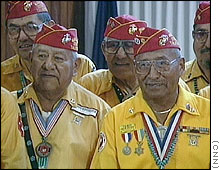
The Shelly-Jim Administration supports our Navajo Code Talkers Association and all veterans. "This year we support and honor our heroes, the Navajo Code Talkers for the week Aug. 14-19, 2011 and recognize them for their bravery, the Navajo military voice code, military service and for saving countless lives," the president said. "We are asking all our tribal members to give thanks to our warriors and to encourage families to teach our children to speak Navajo and carry on our language."
January 11, 2011
Guitar honors Navajo codetalkers
Navajo artist creates guitar to honor Navajo Code TalkersTo honor the Navajo Code Talkers, Shonie De La Rosa has created and dedicated a very special, custom made guitar to the Navajo Code Talkers. A limited run of only four Navajo Code Talker guitars will be built, one for each of the four traditional Navajo cardinal directions. De La Rosa was inspired by these local heroes--farmers and sheep herders--on the Navajo Nation who used the Navajo language as an unbreakable code during the most intense days of conflict during World War II.
Navajo Code Talker guitar serial No. CT001 will grace the floor of the Native American Pavilion at NAMM 2011 in Anaheim, Calif. At 2:30 p.m. on Saturday, Jan. 15, Holiday will make a very special appearance to sign the Navajo Code Talker guitar. Comment: For more on the codetalkers, see Only Codetalkers Can Stop Wikileaks? and Navajo Codetalker Writes Memoir.
Below: "Navajo Code Talker Samuel Tom Holiday holds up a one-of-a-kind guitar created by Navajo artist Shonie De La Rosa in honor of the Navajo Code Talkers and their distinguished military service during WWII. The guitar, which will be signed by all surviving Navajo Code Talkers, will be placed on display at the Navajo Code Talkers Museum in Window Rock."

Navajo Code Talker guitar serial No. CT001 will grace the floor of the Native American Pavilion at NAMM 2011 in Anaheim, Calif. At 2:30 p.m. on Saturday, Jan. 15, Holiday will make a very special appearance to sign the Navajo Code Talker guitar.
Below: "Navajo Code Talker Samuel Tom Holiday holds up a one-of-a-kind guitar created by Navajo artist Shonie De La Rosa in honor of the Navajo Code Talkers and their distinguished military service during WWII. The guitar, which will be signed by all surviving Navajo Code Talkers, will be placed on display at the Navajo Code Talkers Museum in Window Rock."
December 07, 2010
Only codetalkers can stop Wikileaks?

Comment: I'm not sure this makes much sense. The government has many encryption systems more unbreakable than the Navajo language. But it's a nice homage to the codetalkers anyway.
For more on Wikileaks, see Conservatives Hate Wikileaks and Indians. For more Native-themed political cartoons, see Native Comic Strips vs. Comic Books..
November 20, 2010
Navajo codetalker writes memoir
Navajo Code Talker Writes Memoir
Only Two of Heroic Group Remain AliveOne of the original Navajo Code Talkers became the first of the group to write his own memoir in hopes that their story will live on after all of them are gone.
During World War II, the United States developed a code in Navajo that couldn't be cracked by the Japanese.
Only two of the original 29 Navajo Code Talkers are still alive. Chester Nez, 89, recently finished his memoir that was picked up by Berkley Press last Friday.
"It's something that I remember for a long time, being one of the Navajo Code Talkers," Nez said. Comment: Once again we see the "original codetalker" label. Is that really a distinction worth making? Didn't the originals develop the code at Camp Pendleton or somewhere in the States? That was important, but so was implementing the code under fire. Which may explain why many articles don't make the original/unoriginal distinction.
I believe something like 100 of the 400 Navajo codetalkers (original and unoriginal) are still alive. It's not clear whether Nez is the first Navajo codetalker or the first original Navajo codetalker to write a memoir. If he's the first original but the second or fifth or tenth overall, it's not quite as noteworthy.
For more on the subject, see Codetalkers at the Stock Exchange and Choctaw Codetalker Documentary.
Only Two of Heroic Group Remain Alive
During World War II, the United States developed a code in Navajo that couldn't be cracked by the Japanese.
Only two of the original 29 Navajo Code Talkers are still alive. Chester Nez, 89, recently finished his memoir that was picked up by Berkley Press last Friday.
"It's something that I remember for a long time, being one of the Navajo Code Talkers," Nez said.
I believe something like 100 of the 400 Navajo codetalkers (original and unoriginal) are still alive. It's not clear whether Nez is the first Navajo codetalker or the first original Navajo codetalker to write a memoir. If he's the first original but the second or fifth or tenth overall, it's not quite as noteworthy.
For more on the subject, see Codetalkers at the Stock Exchange and Choctaw Codetalker Documentary.
November 11, 2010
Codetalkers at the Stock Exchange
Navajo Code Talkers honored for WW II efforts
By Marisol BelloAs the numbers dwindle—fewer than 100 Code Talkers of the 400 trained by the U.S. military are believed to be alive—the Navajo veterans are being recognized. Today, Veterans Day, a group of them will ring the opening bell at the New York Stock Exchange. New Mexico dedicated a 16-mile stretch of highway to them on Wednesday.
Now, 65 years after serving mostly in the Pacific, the men are trying to establish their legacy on the Navajo reservation in Arizona. Through a foundation, they are about to launch a $42 million fundraising campaign for a museum and veterans center.
"We are all old, and we want to see the result of our efforts," says Little, 86, a retired logger.
The museum has been more than 10 years in the making, says Willetto, 85. The group had the land but no money. Their efforts were boosted in 2008 with a grant of about $900,000 from the Navajo tribal government to help them form the foundation, design the project and conduct geological tests on the land. Code Talkers honored in New York City
By Alysa LandrySurviving Code Talkers, now in their 80s or 90s, will participate Thursday in a national Veterans Day event in New York City. The men are guests of NativeOne Financial, an American Indian firm at the New York Stock Exchange.
The Code Talkers will be presented on the floor of the stock exchange prior to the annual Veterans Day parade.
"We have three Code Talkers scheduled to come out," said Dennis Smith, co-founder and director of NativeOne Financial. "We're hoping everyone is healthy and can make it out here."
Interest in the Code Talkers has climbed as the warriors have aged, leaving fewer of them to push for more publicity of their history. One such project is the Code Talkers museum and veterans center, a $42.6 million endeavor that would preserve the memories of these distinguished men. Comment: For more on the codetalkers, see Choctaw Codetalkers Documentary and How the Codetalkers Won the War. For more on Native contributions to the US military, see American Indians Fought and Bled for Nation that Fought Them and Indians in the Military.
Below: "Frank Chee Willetto, pictured at the Gallup Cultural Center in New Mexico, is working to raise funds for a Code Talkers museum." (Rick M. Scibelli/USA Today)

By Marisol Bello
Now, 65 years after serving mostly in the Pacific, the men are trying to establish their legacy on the Navajo reservation in Arizona. Through a foundation, they are about to launch a $42 million fundraising campaign for a museum and veterans center.
"We are all old, and we want to see the result of our efforts," says Little, 86, a retired logger.
The museum has been more than 10 years in the making, says Willetto, 85. The group had the land but no money. Their efforts were boosted in 2008 with a grant of about $900,000 from the Navajo tribal government to help them form the foundation, design the project and conduct geological tests on the land.
By Alysa Landry
The Code Talkers will be presented on the floor of the stock exchange prior to the annual Veterans Day parade.
"We have three Code Talkers scheduled to come out," said Dennis Smith, co-founder and director of NativeOne Financial. "We're hoping everyone is healthy and can make it out here."
Interest in the Code Talkers has climbed as the warriors have aged, leaving fewer of them to push for more publicity of their history. One such project is the Code Talkers museum and veterans center, a $42.6 million endeavor that would preserve the memories of these distinguished men.
Below: "Frank Chee Willetto, pictured at the Gallup Cultural Center in New Mexico, is working to raise funds for a Code Talkers museum." (Rick M. Scibelli/USA Today)
August 20, 2010
Choctaw codetalkers documentary
Choctaw Code Talkers DocumentaryNative American Public Telecommunications, Inc. (NAPT) announces the release of a new documentary to premier on national television is fall.
The 56 minute documentary examines the pivotal role Choctaw soldiers played in helping shape an earlier end of World War I. “The government had sworn them to secrecy about what they did” said Evangeline Wilson, relative of Code Talkers Mitchell Bobb and James Edwards, Sr.
Co-produced by Red-Horse Native Productions, Inc., Valhalla Motion Pictures and NAPT, Choctaw Code Talkers portrays intimate and engaging look into the lives of the brave men, their families, their dreams and their patriotism to a country who would remember them as heroes. Comment: For more on the codetalkers, see How the Codetalkers Won the War and Mythologizing the Codetalkers. For more on documentaries, see Native Documentaries and News.
Below: "Choctaw soldiers return to the United States from fighting in WWI on June 7, 1919. Courtesy Stacy Mahoney."

The 56 minute documentary examines the pivotal role Choctaw soldiers played in helping shape an earlier end of World War I. “The government had sworn them to secrecy about what they did” said Evangeline Wilson, relative of Code Talkers Mitchell Bobb and James Edwards, Sr.
Co-produced by Red-Horse Native Productions, Inc., Valhalla Motion Pictures and NAPT, Choctaw Code Talkers portrays intimate and engaging look into the lives of the brave men, their families, their dreams and their patriotism to a country who would remember them as heroes.
Below: "Choctaw soldiers return to the United States from fighting in WWI on June 7, 1919. Courtesy Stacy Mahoney."
November 11, 2009
How the codetalkers won the war
Here's the first concrete statement I've seen on the role the codetalkers played:
Veterans who 'gave' their language
By John Wilson These Marines' precise impact of the code on the course of the war is impossible to measure; several historians think the US would have lost the crucial battle of Iwo Jima in early 1945 without it.
Even some code talkers dispute that claim--though there's no question their role was key. Navajo Marines coded more than 800 messages in the first two days of the battle alone.
Code talker Bill Toledo remembers his battalion commander at Iwo Jima waiting more than an hour to transmit a routine advance-and-report order to a forward company while the message was being encrypted by traditional means--eventually abandoning the effort. Then-Pfc. Toledo, speaking with a code talker at the advance position, transmitted the message in minutes.
As it was, more than 20,000 Japanese troops mounted a ferocious, 36-day defense of the island, using a network of tunnels to frustrate Marine advances.
Clearly, the rapid-but-secure communication that only the Navajo code could provide was crucial. Comment: In most articles about the codetalkers, you can't tell if they played a moderate role in 20 battles, a major role in one battle, or what. Apparently a major role in one battle is closest to the truth.
For more on the subject, see Mythologizing the Codetalkers and Congressional Medal for Codetalkers.
Below: "American heroes: Navajo 'code talkers' like brothers Preston and Frank Toledo played a key role in World War II."

Veterans who 'gave' their language
By John Wilson
Even some code talkers dispute that claim--though there's no question their role was key. Navajo Marines coded more than 800 messages in the first two days of the battle alone.
Code talker Bill Toledo remembers his battalion commander at Iwo Jima waiting more than an hour to transmit a routine advance-and-report order to a forward company while the message was being encrypted by traditional means--eventually abandoning the effort. Then-Pfc. Toledo, speaking with a code talker at the advance position, transmitted the message in minutes.
As it was, more than 20,000 Japanese troops mounted a ferocious, 36-day defense of the island, using a network of tunnels to frustrate Marine advances.
Clearly, the rapid-but-secure communication that only the Navajo code could provide was crucial.
For more on the subject, see Mythologizing the Codetalkers and Congressional Medal for Codetalkers.
Below: "American heroes: Navajo 'code talkers' like brothers Preston and Frank Toledo played a key role in World War II."
Subscribe to:
Posts (Atom)