Showing posts with label radio. Show all posts

May 08, 2013

Radio marathon for Comanche codetalkers

Radio marathon honors Comanche code talker history

By Ty AlbinWhen U.S. soldiers landed several miles off of Utah Beach during World War II's Normandy invasion on D-Day, Comanche code talker Larry Saupitty was there. He sent the first message back to Allied Forces in a code based on the Comanche language, telling command they had made a good landing but in the wrong place.

Comanche soldiers all from within a few miles of Lawton were vital to the secrecy of the effort against the Axis powers. On Wednesday, Victory in Europe Day, the Comanche Nation Museum, the Lawton-Fort Sill Amateur Radio Club and the Eisenhower Middle School Amateur Radio Club chose to honor the Comanche code talkers by starting a four-day amateur radio marathon during which they will contact people all over the world via short wave radio and tell the code talkers' story.

The radio enthusiasts are broadcasting from a mobile unit set up behind the museum.

"It's an excellent opportunity to tell the Comanche code talker story," said Candy Morgan, director of marketing and public programs for the museum.
Comment:  For more on codetalkers, see Charles Bronson in Never So Few and Japanese Photographer Specializes in Codetalkers.

April 10, 2013

DJ unsure if Lumbees are tribe

Foxy 99 DJ apologizes for question posed by listener about Lumbee Tribe; back on air today

By Ali RockettJane Dough, a popular daytime disc jockey for Foxy 99, wasn’t on air Tuesday following backlash from a controversial question posed by a caller about the Lumbee Tribe.

The on-air caller asked: Are Lumbee Indians a real tribe?

Jane Dough, via Facebook, said the phone lines immediately lit up.

The question was posted to the station’s and Jane Dough’s Facebook pages.

Due to the heated comments on both sides of the argument, the station deleted the post but not before it got nearly 1,000 comments. Many people threatened to boycott the station and filed complaints with the Federal Communications Commission.

Jane Dough issued the following apology, again on Facebook Monday afternoon, which was posted to the station’s page and website:

“I would like to apologize for playing the call from a listener who questioned if Lumbee Indians were a real tribe & I didn't know the answer to his question. This caused so much pandemonium & controversy that some people have filed complaints & have even taken steps to boycott the station. I sincerely & truly say sorry for all those who felt offended by that listener's question. But I'm the one who played the call, so boycott me & not my Foxy Fam. Once again, I apologize.”
Comment:  This is a minor problem because a caller posted the question, not the DJ. Because no one said anything overtly negative. And because many people, even North Carolina residents, don't know about the Indians in their midst.

For more on the Lumbees, see Lumbee Rocker's Album to Be Reissued, Indians Suffer Prejudice Against Blacks, and Beck Ridicules Lumbee Woman.

January 16, 2013

Mvskoke Media

Muscogee (Creek) Nation reinvents communications department

The department has evolved into Mvskoke Media, a multimedia arm providing information through print, radio, television and printing services to better serve the nation's citizens.

By Karen Shade
Mvskoke Media makes programs like NNT [Native News Today] for Willits and others in the tribe. MM is also behind Mvskoke Radio and Muscogee Nation News, the bi-monthly tribal newspaper.

Along with a graphics and printing services division, the three programs that make up Mvskoke Media push to provide news and information to all segments of the tribe’s population.

“We encompass all forms of media for the tribe,” said Christina Good Voice, Mvskoke Media manager. Formerly the multimedia editor for the Cherokee Phoenix, she was recruited by Muscogee (Creek) Nation Principal Chief George Tiger.

For many years, the Muscogee Nation had a communications department that was a catch-all for many functions--from public relations to newspaper production to audio-visual tech services. In July, the communications department evolved into Mvskoke Media, a multimedia arm providing information through print, radio, television and printing services.
Comment:  For more on Native journalism, see Top Native Stories of 2012 and Gary Farmer on Native Media.

Below:  "Host Jason Salsman interviews a subject for a story about adoption for Native News Today, a weekly TV news show produced by Mvskoke Media. The show airs Saturdays on KQCW, Tulsa’s CW Network."

December 08, 2012

Gary Farmer on Native media

Gary Farmer: Empowering authentic Native media

Gary Farmer speaks out in Tucson on the fear and oppression of authentic Native voices

By Brenda Norrell
Native actor and blues man Gary Farmer was welcomed to Tucson, the ancestral territory of the O'odham, by Ofelia Rivas, who sang a traditional O'odham blessing for Gary Farmer and the Troublemakers, and Pomo film director Tim Ramos.

Between the screenings of Ramos' new film California Indian and Depp and Farmer's Dead Man, Gary spoke of the lack of free press in Indian country and the potential for empowerment through media.

Gary said the United States and Native governments are failing to recognize the importance of Native Americans and their vital place in the media. He described the lack of free press within Indian communities, and the lack of access to electronic media in the US and Canada, during the Native Eyes Film Showcase at the Loft Cinema.

During questions from the audience, Gary said there is a lack of vision by Native leadership to bring about change.

"Native people don't have any access to any form of media that reflects them. I think its quite significant in terms of our own self esteem and why we have such a high rate of suicide."

Describing his life long efforts in radio and television, he said, "I find radio is the more honest form."

"Radio is a way to re-language the people," he said, adding that small radio stations provide for Native languages, and urban radio stations have a great deal of information to share, like AIDS education.

Referring to APTN, Gary said the television network has made a great deal of difference in Canada, in socializing non-Native people to Native issues and stories.

However, he said there's been very little interest in authentic Native media in the US.

"We haven't been able to spark any interest in the US."
Comment:  Norrell apparently took these comments to be a criticism of the Indian Country Today magazine and online sources such as Pechanga.net (where I work) and Indianz.com. Because these sources are funded by casino-operating tribes (Indian Country Today and Indianz.com) or casino advertising (Pechanga.net), she questions their independence.

I'd say the "lack of free press within Indian communities" refers mainly to tribally owned and operated newspapers, which tend to publish only the company line. I'm not sure the same restrictions apply to Indian Country Today and Indianz.com, and they definitely don't apply to Pechanga.net.

If a business unaffiliated with a tribe owned a Native news outlet, the outlet still would be subject to censorship. Every media owner decides what it will and won't publish, based on its own or its advertisers' interests. And every media owner tends to quash criticism of itself.

In other words, a totally independent Native news source is an impossible dream. Even self-made entrepreneurs running publications or websites have their biases. A better solution is to have multiple sources of information, not to expect any particular source to be independent and cover "all" the news.

For more on Native journalism, see Indians Connect Via Social Media and Pine Ridge Gets Media Attention.

August 29, 2012

Native Pulse goes multimedia

'The Native Pulse' goes multimediaOver a decade ago, Seventh Generation Fund President and CEO Chris Peters started the radio show “Native Pulse” at 90.1 KHSU on the Humboldt State University campus in Arcata.

Now, the radio show has been transferred to a studio in the SGF Media Department and transformed into a multimedia outlet featuring news and current events concerning Seventh Generation Fund's work with projects and affiliates.

It now includes a variety of media forms including publications, short video messages and radio spots. The fund's media department has been actively producing video and radio spots, and leading media trainings in many indigenous communities.

The most recent video, produced under contract, was with the Cheyenne River Youth Project of the Cheyenne River Tribe in Montana. “The SGF Media Department has produced a good amount of positive media on some tough issues in Indian country, challenging issues like domestic violence and diabetes prevention. Next month, we are starting a meth awareness media campaign video production with the Cheyenne River Lakota Tribe,” said Media Director Christopher (Mo) Hollis after traveling to the Cheyenne River Indian Reservation for a week of filming and dialogue.
Comment:  For more on Native radio, see Houma Radio Station and Native Voice 1 Celebrates 5th Anniversary.

August 15, 2012

Chef Wolfman's Aboriginal fusion

Chef Wolfman's Aboriginal fusion inspires Native restaurantsChef David Wolfman is a culinary arts professor at George Brown College in Toronto and the star of his own TV show Cooking with the Wolfman, which just wrapped its 8th season. He has made a career out of developing new ways of cooking traditional Aboriginal foods and in the process creating a new food trend: Aboriginal fusion.

Trailbreakers host Don Kelly talks with the chef about how he infuses his cooking with advice on healthy eating, exploring Aboriginal foods and practicing what he preaches by taking his techniques out into the community.
Comment:  I gather Trailbreakers is a radio show. Follow the link to listen to the Wolfman interview.

The article goes on to list several Canadian restaurants that specialize in Native dishes.

For more on Native food, see Owners Plan to Franchise Tocabe and Navajo Runs Turkish Restaurant in San Francisco.

Below:  Wolfman and Kelly.

February 15, 2012

Cody wins black history award

Navajo recording artist and anti-domestic violence advocate wins Initiative Radio Award

Cody named National Treasure and Icon of Cultural Unity for proudly embracing both her rich culturesEvery February "Initiative Radio with Angela McKenzie" observes Black History Month, with the month-long "Salute to Black History Makers" series and the presentation of the Initiative Radio Black History Makers Award to a noteworthy person whose life journey represents black history in the making.

This year, Radmilla Cody takes home the honor for having survived harsh racial discrimination since early childhood, to become a leading voice for the Navajo Nation and for women who are dealing with domestic violence on Navajo and for raising awareness of the existence of Black Native Indians in our society. In 1997 Cody became the 46th Miss Navajo Nation and was the first and is thus far the only Miss Navajo Nation who is part black. Winning the crown was a bittersweet victory for Cody because Navajo purists believed that being part black disqualified her from being a legitimate ambassador for the Navajo people--regardless of the fact that Navajo is her native tongue and she is exceptionally skilled in the traditional practices of her tribe.
Comment:  For more on Radmilla Cody, see Black/Red: Related Through History and Documentary About Hearing Radmilla.

November 26, 2011

Houma radio station

Houma Indian station hits airwaves

Tribal leaders see it as a way to communicate with members, especially during hurricanes.

By Nikki Buskey
United Houma Nation members can now turn their radio dials to a station of their own.

The American Indian tribe has launched a project years in the making, going on-air with its first radio station aimed at providing a place members can go for news during times of disaster, said Kirk Cheramie, station manager.

“It’s awesome,” said United Houma Nation Chief Thomas Dardar. “It’s going to give us the opportunity to reach our citizens with information and updates during a hurricane.”

The station went on the air three weeks ago as KUHN 88.9 FM, Voice of the United Houma Nation, Cheramie said. The signal, broadcast from the United Houma Nation tribal office in Golden Meadow, can only reach about 6 or 7 miles now, and residents of south Lafourche from Larose to Fourchon can pick it up, as well as residents of Pointe-aux-Chenes and Lafitte.

But tribal members anywhere in the world can also listen to the radio station online at the United Houma Nation’s website, unitedhoumanation.org.
Comment:  For more on Native radio, see Thundercloud Radio and Native Voice 1 Celebrates 5th Anniversary.

November 14, 2011

"White Journalists" on Native America Calling

A couple of weeks ago, I wrote a column on Hidden America: Children of the Plains, the ABC 20/20 special. Because of it, I got an e-mail about appearing on Native America Calling, the premiere Native radio show. The subject was this:Thursday, November 10, 2011–White Journalists in Native America:

The recent ABC television show 20/20 featured a show called “Children of the Plains” shed light on the plight of Indian children on the Pine Ridge reservation in South Dakota. It turned out to be the highest rated show for the network in months. It begs the question about the role of white journalists in Native America. Can we befriend our neighboring journalists to help us out with getting our message out? Why aren’t more white journalists doing stories on Native America? Invited guests include journalist Catherine Robbins, author of “All Indians Do Not Live in Teepees (or Casinos).”
I did the show Thursday and managed not to sound incoherent. Below is the audio file. Click on the link to download the file; click on the file to start playing it.

http://www.nativeamericacalling.com/ram/2011/nov/111011.m3u

My segments were relatively brief. You can listen to the whole hour-long show or skip to my portions. I spoke from 36:20 to 42:00 and 54:15 to 56:15, with a final mention of me before the 57:00 mark.

For more on the subject, see Children of the Plains Political Cartoon, Children of the Plains Is a Hit, and Poverty Porn in Children of the Plains.

September 10, 2011

Thundercloud Radio

Native radio station promotes voices of Native musicians/rappers

By Jacob CroonenberghsThundercloud Radio is an Internet radio station that plays Native Hip Hop, Native Soul, Native Rap, Native R&B, and Native Reggae. Featuring Native tracks from Hawaii to Greenland, Thundercloud Radio plays both upcoming and established artists on their show. The station's goal is to someday become the world leader in Native radio.

The radio station's producer, Simon Roberts, has been devoted to creating and facilitating the Native radio station. Roberts, also known by his Disk Jockey handle "Big Bad," has helped design Native social networks such as tlingit.me, and search engines to find Native artists on the Internet.
Comment:  For more on Native radio, see Native Voice 1 Celebrates 5th Anniversary and Pala's Rez Radio.

August 05, 2011

Native Voice 1 celebrates 5th anniversary

Native Voice one celebrates fifth year

By Stan BindellNative American radio broadcasters recently celebrated the fifth anniversary of Native Voice 1 (NV1).

NV1 is a Native American programming distribution service that supplies national radio programs to radio stations throughout the nation. NV1 comes to Hopi, Navajo and other reservations through KUYI in Polacca and KGHR in Tuba City. NV1's most well-known shows include Native America Calling, Native American News and Undercurrents.

Burt Poley, who serves as network manager for NV1, said he loves his job because it allows him to work with native and non-native radio stations. Poley came on board more than five years ago when NV1 took over the reins from American Indian Radio On Satellite (AIROS).

Poley, who previously worked as operations manager at KUYI on Hopi, said NV1 has improved the billing since taking over from AIROS. He said this helps bring more money into NV1 in order to keep the programs going.
Comment:  For more on Native radio, see Pala's Rez Radio and Navajo DJ on Station of the Year.

Below:  "Burt Poley getting interviewed by Hopi High School’s Otivia 'Big O' Puhuhefvaya on KUYI." (Stan Bindell)

February 21, 2011

"Native American rejects" on KWYR-FM

Native Americans still dealing with insensitivity in media

By Vi WalnLast week I got an email from a Rosebud Sioux Tribal member. She wrote, “Good morning Vi, So just sharing a tidbit with a huge verbal implication. This morning on the Winner radio station [KWYR-FM] 93.7, the radio disc jockey Scott Schramm, was referencing a band called the [All] American Rejects and instead changed the words to say “the Native American rejects”! Really! C’mon, you would think after all these years the non-Natives would have a bit more couth when implicating anything to do with our tribe or just Native people in general."Waln contacted the station and got a perfunctory response. Then:Later in the day I received another email, this time from Scott Schramm. He wrote: “I am rather confused. I am on the air on both the AM and FM stations each day. Was this comment heard on the FM or the AM station this morning? Can I ask what the comment was about? I am the Owner of the Radio Station, and would never approve of anything such as this. Furthermore, I am one of the people on the air. I have no idea what I could have said. Could you please elaborate? This is bothering me.”

Now, the fact that “this is bothering” him should tell us something. Perhaps he knows deep down that he said something he shouldn’t have. And he had “no idea” what he “could have said.” Schramm’s email to me proves my point. The non-Indians residing in the border towns of our reservations make statements every day but they have “no idea” what they are saying or how we are going to perceive their comments.
Comment:  Radio DJs can't seem to help saying stupid things about Indians.

Calling Indians "rejects" is a shorthand version of the usual insults: that they're savages, lazy bums, or welfare moochers.

For more on the subject, see Magic FM Mocks Indian Names and DJs Learn Not to Satirize Natives.

February 18, 2011

Pala's Rez Radio

Pala Band hits the airwaves

By J. Harry Jones“Rez Radio. KOPA FM, Pala. KOPA 91.3.”

With that announcement last week, the first radio station owned and operated by an Indian tribe in Southern California went on the air.

Rez Radio, a commercial-free station that operates out of a small building behind the Pala Band of Mission Indians’ administrative center just off state Route 76, now broadcasts 24 hours a day, seven days a week and streams live over the Internet.
And:The station is now airing a wide mix of music—Southern rock, country, reggae, blues, soul. At night, the station is on autopilot, but as time goes on, and volunteers come forward, more extensive live broadcasting is planned.

KOPA soon plans to offer a variety of programming. Some shows of general interest to Native Americans will be purchased from national Native American radio service groups, but most will be locally generated by volunteers. Topics could include native language courses, recordings of elders that have been taken for posterity and archived, home improvement shows, cooking shows, even political shows if someone wants to tackle controversial issues. Fox said anyone is welcome to approach the station with programming ideas. Being a reservation resident isn’t a requirement. The station also has the ability to broadcast from remote locations, such as from softball games.
Comment:  For more on the subject, see "Tribal Priority" for Radio Stations and Increasing Tribal Radio Opportunities.

Below:  "Tribal Chairman Robert Smith (right) is interviewed Tuesday by John Fox at Pala's new radio station." (Charlie Neuman)

February 02, 2011

Navajo DJ on Station of the Year

Radio host breaking the stereotypes

By David BurgerThere are some ugly stereotypes about members of the Navajo tribe. For one, that they are silent pushovers, said Courtney Begaye, who is Navajo.

But every weekday morning, on local hip-hop radio station U92, Begaye—the brash, vocal, Oakland Raider-loving host—is changing the stereotype.

Better known to his listeners as Poetik C, he hosts “The Navajo on the Radio” show from 6 to 10 a.m., waking up nearly 150,000 people from Provo to Ogden to Tooele.

Begaye, who has hosted the morning show for six years, has helped make U92 one of the area’s most listened-to stations. The 34-year-old is one of the reasons U92 was recently named Rhythmic Station of the Year by the respected national trade publication FMQB. In previous years, the award was bestowed on New York City and Los Angeles stations in New York City and Los Angeles.
Comment:  For more on Native radio, see Rockwired Radio Seeks Native Artists and "Tribal Priority" for Radio Stations.

January 28, 2011

Natives in Flying Wild Alaska

The TV show Flying Wild Alaska has more Native substance than just a theme song and soundtrack:

Native Hip-hop Wraps Alaska Reality TV Show

By Doug MeigsThe Discovery Channel’s new reality TV series Flying Wild Alaska follows Jim Tweto’s family and crew of bush pilots as they provide a lifeline to Alaska’s most remote locales. Tweto’s wife and daughters are local Inupiaq, and their family business services many Native villages. Discovery Channel producers thought a Native soundtrack fitting, so they approached ThunderCloud Radio for help last summer. ThunderCloud Radio is dedicated to indigenous hip-hop, soul, reggae and R&B. The online station began broadcasting from Washington State in 2008 to showcase artists “from Alaska to Greenland,” says DJ Pamela Rae. The TV show producers wanted an Inuit rapper’s words to introduce each episode. And Rae knew just the artist: Peand-eL.

But Peand-eL isn’t Alaskan.

“When they approached me, at first it was strange, because the show is in Alaska and I speak Greenlandic, but I was very happy they chose me,” he said. Peand-eL (aka Peter Lyberth—his artist name comes from his initials “P” and “L”) is Kalaalleq from Greenland. He has two albums with Atlantic Records, and recently formed an indie studio for this upcoming third album, Taallineq, which translates to “Silhouette” (due to be released in May).
Comment:  For more on the subject, see TV Shows Featuring Indians.

January 27, 2011

Magic FM mocks Indian names

Local radio show causing controversy

By John RomeroA Colorado Springs radio station has stirred quite a controversy in the Native American community. Skuya Fasthorse, a Lakota Sioux was listening to the George McFly Experience, the Monday morning radio show on Magic KKMG 98.9 Magic FM. The topic of discussion on Monday was Native American names. "They were talking about it and kind of laughing about the names that they were given," says Fasthorse.

Fasthorse was furious over what she heard. "Immediately my senses went up and I thought this is wrong. This is wrong for them to be making fun of native names." She says "It made me mad ... It hurt."

A slew of angry listeners took to Magic FM's Facebook account to protest the radio show. Those posts have since been taken off the station's page. Fasthorse says Natives go through sacred ceremonies to receive their spiritual names and those names are very dear to them. "It's very sacred to us," she says. "We don't go and make it public. We don't make fun of that."

Fasthorse has filed a formal complaint with the FCC.
Comment:  Disc jockeys who mock Indian names are the same as t-shirt vendors who mock them. Both groups are guilty of racial attacks under the guise of "having fun."

I don't understand why these people don't get it. A few decades ago it may have been okay to make fun of ethnic names--Lipschitz, Pollack, Fukiyama, Dong, or whatever--but it isn't any more.

The public would be outraged if someone sold a t-shirt saying "My black name is Cotton Picker" or "My Jewish name is Golddigger." How is mocking Indian names any different?

Answer: It isn't, of course. That people think it's okay to make fun of Indians only demonstrates how invisible they are. If a group of Indians lived next door, you can bet the Archie Bunkers of the world soon would stop making fun of them.

For more on the subject, see Michigan Opposes "Indian Name" T-Shirts and AIM Fights "Runs with Beer" T-Shirt.

January 12, 2011

Inuit theme song for Flying Wild Alaska

Native Musicians on "Flying Wild Alaska"

By thundercloudradiThe Discovery Channel's new show "Flying Wild Alaska," is a show about pilots and the small villages in Alaska that they serve (http://dsc.discovery.com/videos/flying-wild-alaska-episode-1-videos/). Native Kalaallit rapper Peand-eL from Greenland is rapping the theme music, there will be Jana Mashonee & other Native musicians of all genres for their background music.

ThunderCloud Radio, a Native hip hop & Native urban music radio (www.thundercloudradio.com), was contacted by producer D.J. Nurre of the Discovery Channel, on June 17th 2010, to help them find an Inuit hip hop artist for a song sung either entirely or partially in the Inuit language. He was delighted with Peand-eL's music which is sung in Kalaallisut, to which Nurre then opened the invitation to other Native hip hop musicians. Very excited with the response from the Native hip hop community, D.J. Nurre opened the opportunity for all Native Music from all genres.
Comment:  For more on Native rappers, see Cherokee Rapper Signs with Eminem's Label and A Tribe Called Red.

November 26, 2010

Rockwired Radio seeks Native artists

Native-owned music website seeks artistsSince April, the online radio show Rockwired Radio Profiles has featured bands and solo recording artists from around the world. In its transition from a weekly to a daily show, Rockwired Radio Profiles has broadened the musical styles and the number of artists that it features.

Upon archiving the 60 shows that have streamed up to that point, the show’s host Brian Lush noticed something. There weren’t enough Native artists represented.

“There is absolutely no excuse for it,” he said. “There are tons of great artists throughout Indian Country, and now Rockwired is committed to shining a light on this rich, vibrant music community.”
Comment:  The article notes that Lush is Yankton Sioux. It's interesting that he didn't think of promoting Native artists until six month after launching his Rockwired Radio.

For more on the subject, see Online Radio for Native Hip Hop and InnerTribal Beat on the Radio.

September 04, 2010

DJs learn not to satirize Natives

When the conflict is race, don't feed the fire

By Julia O'MalleyIt began in May, when Rochene Rowan-Hellén, who is Alaska Native, was listening to their show in her car and happened to catch a radio comedy skit called "Cash for Tlingits." Bob and Mark are not known for being politically correct, but the skit took it too far, she said. It was more than off color, it was cruel and degrading, tapping into a current of anti-Native feelings in the city. She fired off an e-mail to the press and Alaska Native leaders. She was tired of Alaska Natives being the butt of the joke.

At this point, something predictable could have happened, along the lines of what happened to KBFX personalities Woody and Wilcox, who made a similar on-air gaffe in 2008. That provoked rebuke statewide, from the Alaska Federation of Natives, to the mayor, to the Anchorage School District. The dee-jays were suspended and ordered to sensitivity training. And people whispered that Alaska Natives couldn’t take a joke.
And:[A]s criticism rolled in at the station, Lester and Colavecchio were caught off guard. They have Native friends, they didn’t think of themselves as racist.

“It was catchy, clunkers and Tlingits, it just sounded like it would be funny,” said Lester, who wrote the skit. “At the time you don’t think about how your words could be hurtful while you’re in the mode of humor.”

But when they realized how their skit came across, they felt sick. Along with Anchorage Media Group General Manager Dennis Bookey, they agreed to go to a meeting with 20 people from the Native community, including Rowan-Hellén.
And:At KWHL, they reviewed all their radio skits and deleted the ones that had racial overtones. They apologized formally. They started planning some outreach events in the Alaska Native community. They discussed the possibility of having an Alaska Native intern on their show. And, the two guys, who over the years have flirted with shock-jock status because of edgy humor, thought hard about what it means to be funny. Funny can be irreverent. Funny can poke at public figures. Funny doesn’t have to rely on stereotypes.

“If I’m going to have fun, it’s with my arm around somebody,” Lester said. “I’m not going to punch them in the face.”

“You can’t satirize a culture,” Colavecchio said. “If nobody ever tells you that, you don’t know that. You are ignorant.”
Comment:  "You can't satirize a culture"...wow, brilliant deduction, Sherlock. After a century or two of minstrel shows and other racist "satires"...followed by 30 or 40 years of their being socially unacceptable if not taboo...you finally figured that out? What was the big clue? The last episode of Good Times fearing JJ Evans as a black buffoon? The last episode of Get Smart featuring a Charlie Chan knockoff? The last episode of F Troop featuring a comical Indian tribe?

This incident shows you what we're up against. People who don't consider themselves racists, who wouldn't think of satirizing blacks or Latinos, somehow think Indians are fair game. It's as if they can't think straight on the subject.

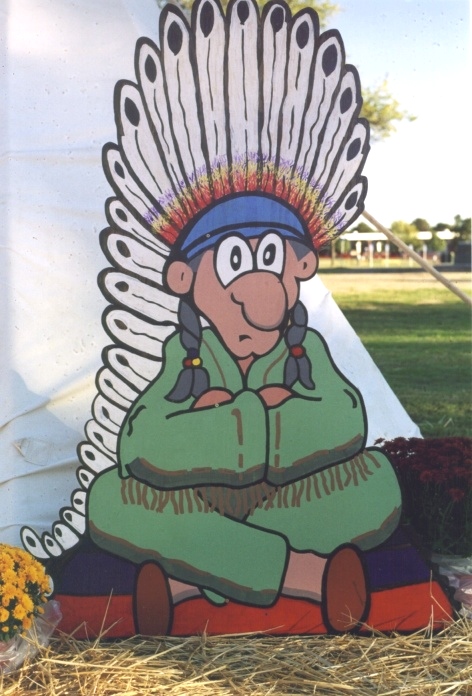
Intellectually they seem to know that Indians still exist. But in their hearts, they consider Indians to be what they've seen in movies, TV shows, cartoons, books, and paintings. These imagined Indians have no thoughts, feelings, beliefs, or values. They're the sum of what one can see--feathers, buckskins, tomahawks, and warpaint--and nothing more. They're basically two-dimensional cardboard characters--like sports mascots or product advertisements--not three-dimensional people.

"Me stoic Injun chief. Not real person, just big-nosed cartoon. Go ahead and make'um fun of me. Me no care."


This is what happens when you repeat stereotypes thousands of times. We've associated blacks with crime so often that we believe blacks are criminals. For similar reasons, we believe Latinos are illegal immigrants and Muslims are terrorists. And we've associated Indians with savagery so often that we believe they're wolfish animals in human form.

Our thought patterns mirror what we've seen and experienced. For every impression that tells us Indians are real, a thousand impressions tell us they're primitive people of the past. Why would anyone expect one true impression to dominate a thousand false impressions? Even if you "know" better, as these DJs supposedly did, that's not how the human mind works.

This may explain why the Quileute werewolves in Twilight are so appealing. They have no culture, religion, or history to make them real, so you don't have to think about them or their plight. Like their vampire counterparts--or the Smurfs or the Simpsons--they're just colorful pieces of fiction. Cartoon characters. You can't hurt Wile E. Coyote by abusing him, and Indians are no different. Or so people think.

For more examples of radio "humor," see DJs Lampooned Makah Whalers and DJs Whoop Over Running Bear. For more on the subject in general, see Background Research on Native Stereotypes and The Harm of Native Stereotyping:  Facts and Evidence.

Below:  "Bob Lester talks about what he's learned from a working group on race relations, after an on-air skit offended some in the Alaska Native community."

August 23, 2010

DJs lampooned Makah whalers

We get e-mail:Ran into a particularly heinous stereotype some time ago. Local radio station would do little skits on the news of the day, at that time the Makah Whale Hunt. The DJ who apparently wrote the skit, Johnny Manson (a vile little creep if ever there were one), obviously hates Natives...well, anyone not white. I'd already warned the station once before about their Native stereotyping (don't remember the details now), but this skit was over the top...featured "Natives" in a Three-Stooges style behavior, "Light Cloud" and "Little Feather" talking about being drunk, using shotguns instead of harpoons, which was not "traditional"—"tradition, schmadition, I just want me some of that blubbah!!!!" I recorded it, as they were dumb enough to play it several more times over a few days. I wrote a letter and CC'd it to every tribe on the Washington Coast, and warned the station I was doing so. Soon, the DJ was no longer employed there. BUT...the other DJ, Pat Anderson, should have at least been reprimanded, since he was in on the sketch, as well.The e-mailer adds:It was KDUX FM in Aberdeen, WA. I'd e-mailed the station director once before about racist skits...another was a CK One spoof, "The Scent of Juan," about how you could sniff out those filthy illegal Mexicans.Comment:  For previous radio controversies, see DJs Whoop Over Running Bear and NCAI Denounces Radio Jocks.

Below:  The controversial Makah whale hunt of 2008.