Showing posts with label food. Show all posts

November 08, 2013

Natives protest Yum Yum logo

Krispy Kernels snacks slammed over 'Little Indian' logo

Quebec potato chip company says loincloth-clad mascot is 'retro,' not racist“It's just like ‘look at that, I'm pretending to be an Indian,’” said Beljaars.

“You're just perpetuating racial stereotypes. You're just continuing to mock us by doing things like this.”

Beljaars said other members of the province's aboriginal community have contacted the company about the campaign, asking for the logo to be removed.

In response, Krispy Kernels released a statement saying the packaging is a nod to the founder of the potato chip, who was native.

The company said the caricature on the package is a return to the company's roots, and is not meant to be mocking.


A myth debunked: No, “yum yum” is not the Algonquin word for “potato”

By Don MacphersonYum Yum’s marketing director told TVA the mascot is based on a child’s drawing for a contest. It was chosen by the company’s founder, who was of aboriginal descent, to go with the name he had given the company, “which, I am told, means ‘potato’ in Algonquin.”

Really? The familiar expression “yum, yum” also happens to be the Algonquin word for “potato?”

That sounded too good to be true. So, doing my duty as a journalist to, er, dig up the truth about the “yum yum,” I sent an email to the Algonquin Anishinabeg Nation Tribal Council, which comprises Quebec’s seven Algonquin communities.

“That’s a good one,” replied Norm Odjick, the Algonquin council’s director-general. “I’ve never heard of ‘yum yum’ as the word for potato in Algonquin. For us it’s ‘padak’ for ‘potato,’ and ‘padakan’ for ‘potatoes.’ Another word that can be used is ‘opinig.’

“Thanks for your email. I needed a laugh today.”
Comment:  Let's go through the company's excuses:

It's a racist nod to the founder that looks nothing like the founder.

It's not meant to be mocking, but it's mocking anyway. It portrays real people as childish cartoon characters.

The claim that "Yum Yum" is an Algonquin word is false. Is the founder's aboriginal heritage also false?

Does the company have any other defenses for this insulting move? Because we haven't heard a legitimate one yet.

For more on the subject, see Yum Yum Revives "Little Indian."

Below:  "The original Yum Yum mascot was introduced in 1959 when the potato chip company was founded." (Krispy Kernels)

A Native boy who looks like a chipmunk or a beaver? And that isn't a complete mockery of Native people? Yeah, right.

November 06, 2013

Yum Yum revives "little Indian"

A photo on Twitter caught my eye:


A Quebecois article, roughly translated from the French, gives an explanation:

Yum Yum returns the "little Indian"

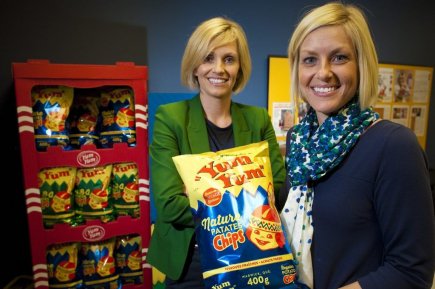
By Isabelle MasséDuring a fall, Chips Yum Yum back to the forefront of its bags of chips Nature and BBQ's "famous Indian" less visible on the packaging in the late 90s. Go back is betting the company has done Warwick to attract attention.

The new bags are inspired by the graphics of the 60s. "The vintage trend is in many areas, note the marketing director, Renee-Maude Jalbert. It was launched in 2009 vintage packaging for our 50th anniversary with success. We wanted to ride all year round and the bags have gone faster."

In time for the start of the holiday season, the company has brought to market hundreds of thousands of bags of 400 g, instead of the traditional 235 g. Due to the positive response from retailers, the company was able to add 150 stores to its already expanded to several hundred outlets distribution.

Offensive marketing

"The Nature and BBQ flavors remain the two most popular on the market, notes Renee-Maude Jalbert. And we see an increase in sales of chips during the holiday season, compared to other months of the year, about 20%."

"This is a very important offensive to us in terms of image and marketing," says Valérie Jalbert, CEO of Yum Yum Chips and Krispy Kernels. It plans to sell more, even if we do not talk about planned special sales."
Comment:  You gotta love the phrase about "offensive marketing." Yep, this is offensive marketing, all right.

Below:  "Valérie Jalbert, CEO of Yum Yum Chips and Krispy Kernels, and Renee-Maude Jalbert, marketing director."

September 08, 2013

Waitress implies Indians don't tip

Famous Dave's Waitress Canned For Powwow PoutWhat happens when you work for a massively famous Indian-owned restaurant and go on Facebook and say Indian customers are bad tippers?

Well, if you're this woman from Bismarck, North Dakota, you no longer work for said restaurant! Yes, this young former waitress at the Famous Dave's in Bismarck thought it would be funny to complain about the influx of customers during the United Tribes International Powwow.

Maybe she thought she'd get away with it but Indians are on the Internet these days (surprise!) and word spread quickly about her inappropriate use of social media and she was just as quickly canned by the owner of the franchise.


Employees fired for Facebook post

By Jessica HoldmanTwo employees at Famous Dave’s in Bismarck were fired after posting a photo to Facebook complaining about tips during the United Tribes International Powwow.

The photo depicted one employee holding a cardboard sign that read, “Help I’m a server at Famous Dave’s on Pow Wow weekend! Anything helps! 5 cents 25 cents! It’s more than my tips.”

The employee pictured was in the restaurant and wearing her uniform in the photo. She and the employee who took the photo were both fired.

“Like many employers, we employ many people. People have opinions. Social media allows an outlet for these opinions,” owner Mike Wright said in a statement on Facebook. “Sadly, for reasons unknown to me, often times bitter employees also try to embarrass the employers and taint the businesses where they work. Clearly a recent post by a now former employee fits this description.”
Some comments on the first posting:Sad. She may not have realized she was essentially making a racist remark when she complained so publically that on a very busy weekend tips were poor: I see similar complaints from waitstaff all over the country on busy weekends of all kinds, but she had the bad luck to whine about one such that is definitely about one race. Would she have been fired for making the same comment about a concert weekend? or a rodeo weekend? I hope she realizes she made not just one but TWO serious errors in judgement: first, she cast her business in a poor light by complaining about how cheap her customers were while in company uniform; and second, she potentially did her employer serious harm by making his business look as though it employs racists. Hoo, boy, I can only hope she learns something form this instead of blaming everyone but herself. It's just a shame she may have made herself look like some racist POS without necessarily being one.

I am saddened to see a person's business tarnished by this young woman's inappropriate post. He post signal that there is much work needed to be done to combat racism and negative stereotypes. I am sure she was socialized perhaps by her peers, family and to some extent, the stereotypes in the media, to view Natives in this regard.
Comment:  Some people commented that Indians really don't tip well. One, that may be true in some parts of the country, but not everywhere. Two, it may because they're poor and can't afford it. Three, her negative attitude may have something to do with her lack of tips.

For more on restaurant-oriented racism, see Happy Meal Characters Stereotype Indians and Restaurant Serves "Half-Breed" Hamburgers.

September 03, 2013

Hoka! Coffee on Pine Ridge

HOKA! Coffee is a-brewing on the Rez

By David MichaudSome people are lucky enough to find a job that stimulates their passions, Sharice Davids just happens to be one of those people.

Sharice’s recently created a coffee company on the Pine Ridge Indian Reservation. Taking inspiration from the Lakota language she decided to name her company Hoka! Coffee.

“I made a list of things I am passionate about and there were just a few things on it–economic development in Indian country, martial arts and coffee,” said Davids.

To this point in time Hoka! has been attempting to spread their name throughout the reservation by making appearances at various events. The first event Hoka! appeared at was the OLC graduation pow wow and after that they attended Oglala Nation Pow Wow, with great results.
Comment:  For more on Native coffee businesses, see Chukchansi Coffee Company and Tribal Grounds at Mitsitam Coffee Bar.

Below:  "Sharice Davids poses in front of her booth at the Oglala Nation Pow wow."

August 21, 2013

In-N-Out Burger at Morongo

In-N-Out comes to Morongo

By Debra GruszeckiEarth was getting pushed around Wednesday for construction of the nation’s first In-N-Out Burger on tribal lands.

The scene unfolded to the west of Morongo Casino Resort & Spa on the Morongo Band of Mission Indians Reservation along Interstate-10 in Cabazon.

The popular 1950′s styled restaurant is set to open in 2014. It will be within walking distance from the casino resort and the tribe’s Travel Center, a fueling station that’s equipped with competitively priced gasoline, diesel fuel and slot machines.

In-N-Out will join two other fast-service eateries, Ruby’s Diner and the A&W Restaurant. Hadley’s Date Garden is also located nearby.
In-N-Out Coming To Morongo Indian Reservation, A First For Burger ChainIn a milestone for Southern California's beloved hamburger chain, In-N-Out will be opening its first ever location on tribal lands: the Morongo Indian Reservation.

The restaurant location, adjacent to the Morongo Casino off the 10 freeway in Cabazon, Calif., is set to open some time in 2014. The new restaurant is part of a larger development plan along the 10 freeway in the area on the way to the casino and outlets, reports Banning-Beaumont Patch.

“We are delighted that In-N-Out Burger has chosen the Morongo Indian Reservation as the home for its first restaurant ever on tribal land,” said Chairman Robert Martin of the Morongo Band of Mission Indians in a press release. "Given the current economic environment, Morongo is happy to be developing a new project that will not only bring new business activity and jobs to our region but will also generate future economic development opportunities.”

Fast food workers make a median wage of just $8.94 an hour nationwide, which is why it may seem strange that the tribe is hailing the addition as an economic development opportunity.

But fans of In-N-Out know that the restaurant stands out not only for its freshly-made food, but also for the way it treats its employees. An In-N-Out employee starts at $10.50 per hour, significantly higher than California's minimum wage of $8 or federal minimum wage at $7.25. According to the company's site, even part-timers are eligible for flexible schedules, paid vacations, free meals and a 401K plan.
Comment:  For more on Indians and restaurants, see Owners Plan to Franchise Tocabe and Mitsitam Wins DC Restaurant Award.

July 19, 2013

Chukchansi coffee company

Chukchansi tribe launches line of coffee in bid to diversify businesses

By Bethany CloughFrom casinos to coffee, economic development by the Chukchansi tribe is taking on a more flavorful flair.

The Picayune Rancheria of the Chukchansi Indians is now selling Native American Coffee, a product Chukchansi leaders hope will bring greater prosperity to the Madera County tribe, and eventually others.

The coffee beans are grown by indigenous tribes in South and Central America and roasted in Mariposa with a Native American-influenced process the coffee roaster says makes for a smoother, purer cup of coffee.

Selling coffee is an unusual business for a tribe to get into, but it's no surprise that the Chukchansi are trying to vary their economic efforts, says Troy Vanderhule, director of marketing for the nonprofit National Center for American Indian Enterprise Development. Seeing competition from Internet gambling in the future, many tribes are changing up the ways they make money.
Comment:  For more on Native coffee businesses, see Tribal Grounds at Mitsitam Coffee Bar.

June 14, 2013

Popcorn drives Lower Brule economy

Popcorn Sovereignty: Growing the Lower Brule Tribe's Economy

By Tanya LeeThe Lower Brule Tribe in South Dakota hopes to leverage its popcorn enterprise into a driver of inter-tribal economic development, and the U.S. Department of Agriculture has just awarded the tribe a $300,000 Value-Added Producer Grant to help.

The tribe's USDA Value-Added Producer grant was one of 110 such awards totaling $16.9 million given out this year to help agricultural producers increase earnings by expanding their markets, creating new products or developing new uses for existing products.

Lower Brule Tribal Chairman Michael Jandreau says the tribe will use the funding, which it will match with $310,000 of its own money, to develop a robust marketing program for the renewable resource and create more jobs for the 3,800-member tribe.

While many tribes are using casino profits to diversify their economies, Jandreau said that is not the case here. The tribe does have a gaming enterprise, the Golden Buffalo Casino & Motel, but it began its agriculture business in 1977, long before the Indian Gaming Regulatory Act was even passed.

So far, the farm has provided $30 million in revenues to the tribe. That money has produced not only jobs, but also provided a steady income stream for the tribe and made it possible to buy back several thousand acres of homeland within the external boundaries of the reservation, says Jandreau.
Comment:  In related news, Indian reservations have economies that aren't based totally on casinos. Who knew?

For more on the subject, see Lower Brule Popcorn Company.

Below:  "Lakota Foods also sells six-ounce bags of flavored popcorn, like butter, cheddar and white cheddar."

April 15, 2013

NativeFoodSystems.org

NativeFoodSystems.org Launches Today, Reconnects Natives to Traditional Foods, Cultural PracticesToday First Nations Development Institute unveiled its new website geared at helping Natives reconnect with traditional foods and reinforcing cultural practices and customs.

By providing a valuable resource to a wide audience—Native American food producers, processors and consumers including Native families and growers—NativeFoodSystems.org aims to promote food sovereignty while improving Native health and nutrition.

The website serves as a unique portal for agricultural and gardening information. Videos cover a variety of topics, such as hunting and food gathering as a spiritual experience, creating local economies around agriculture, and reducing food expenses with community gardens. Other short films spotlight organizations like the Northwest Indian Treatment Center, which is using traditional foods and medicines to reintroduce Natives to working with the land and their culture. The process plays a role in their recovery from alcohol and drug addictions.

NativeFoodSystems.org additionally provides up-to-date news on food sovereignty conferences and more. It spotlights positive food movements by tribes and Native organizations. And it hits on historical trauma and the need to reverse a tide of unhealthy eating resulting from the loss of land, nutritious foods and traditional lifeways. Other resources range from farms and markets, to youth programs and farm-to-school efforts, to seed saving, to traditional plants and medicine, to food marketing and handling, to home gardening, canning and healthy family eating.
Comment:  For more on Indians and the Internet, see Internet Library on Pine Ridge and Google Street View in Nunavut.

April 02, 2013

Lower Brule popcorn company

Lower Brule popcorn manufacturer making a name for itself

By Kristi EatonTucked away in central South Dakota, Lakota Foods may not yet compete with popcorn’s biggest brand names, but the tribal-owned popcorn manufacturer is gaining lots of accolades from agriculture officials for its products and job opportunities.

Situated on the Lower Brule Indian Reservation, Lakota Foods is the first and only Native American-owned company that grows, packages and distributes popcorn—about 17 million pounds each year.

“It’s unique because it’s raised, cleaned and packaged right here in South Dakota, but people don’t realize that and there are other people trying to copy it,” Barry Heiss, manager of the Lower Brule Farm Corp., said.

The Lower Brule Sioux Tribe started the business about seven years ago. It buys the popcorn seed and then raises it on 8,000 acres of irrigated land, Heiss said.
Comment:  For more on the subject, see Pine Ridge = "Food Desert" and Tanka Bar Company Wins Innovation Award.

February 19, 2013

Bakery to rename squaw bread

Old Town Baking Company in Rancho Cucamonga to rename its squaw bread

By Neil NisperosA bakery in this city is changing the name of its popular squaw bread after some Native Americans deemed it offensive.

Old Town Baking Company owners have received emails and Facebook messages in recent weeks demanding that the name be changed.

Native American groups consider "squaw" a deeply derogatory term, said USC professor David Treuer, an acclaimed novelist who writes Native American-themed literature. Treuer said he was taken aback when he saw the bread during a recent visit to a local grocery store.

"I saw the bread and I was a little stunned," said David Treuer, who is from the Leech Lake Band of Ojibwe Indians in Minnesota.

"I know it's a type of bread, and they're not the only company that makes that bread. I was sort of surprised to see a bread with that name in the bakery aisle of the local supermarket. It is universally understood, particularly with native people as a slur. It has been used as a slur for a couple hundred years."

Treuer sent an email to Old Town Baking Company officials on Feb. 8 informing them of the offensive nature of the word.

Treuer's brother Anton, a professor of Native American studies at Bemidji State University in Minnesota, created a Facebook page calling on Old Town Baking Company to change the name of the bread.

A debate soon erupted on the Old Town Baking Company Facebook page over the term. The commentary included Anton Treuer posting a message that said, "We can't demand respect with disrespect."

The owners of the bread company said some of the messages were hurtful.

Don Bishop had tears in his eyes when he recently discussed his family being characterized as racist. His grandmother was Cherokee and was born on the Oconaluftee Reservation in North Carolina.

Bishop's grandfather used the phrase "sweet squaw" as a term of endearment for his grandmother, and the sweet wheat bread baked by his grandmother was referred to by her as "squaw."

Bishop said he was shocked when he learned about the offensive nature of the term. A post on the company's Facebook page said, "We have always known this word to mean 'woman.'"

"My father-in-law remembers his grandfather using the term in a loving and respectful way and perfected the recipe as a tribute to the Native American culture," Bishop said.

"We ... are heartbroken and so sad that we would unknowingly have a name of one of our products that could be offensive to the Native American community."
Comment:  Once again, it's nice to see a Native protest via social media produce quick results.

This protest began a week or two after I posted Native Stereotypes in Breakfast Foods and Milton's Squaw Bread. But this is a different company and I don't think there's a connection.

I gather squaw bread is a type of bread and many people and companies make it:

Does anyone know what Squaw Bread is?All it is, is a slightly sweet bread.Where Did All the Squaw Bread Go?

So these bakeries didn't choose the name "Squaw" because they thought it sounded cool. They were merely offering a type of bread commonly known as squaw bread.

So nobody meant to slur Natives with this term. But the fact remains that Natives don't like it. There's no reason to use a term that few people are familiar with, and a good reason to change it. So give up "squaw bread" and call it "Grandmother's Bread" or something.

For more on "squaw," see Columnist Defends Mummers Parade and Limbaugh Calls Warren "Squaw Indian Giver."

Winnemem Wintu oppose "frankenfish"

Winnemem Wintu Chief says Frankenfish must be stopped

By Dan BacherCaleen Sisk, Chief and Spiritual Leader of the Winnemem Wintu Tribe, said the Tribe strongly opposes the tentative approval of genetically engineered salmon by the Food and Drug Administration (FDA).

"Salmon is in our traditional stories, songs and dances,” said Sisk. “We must stay pure to exist in the ancient circle connecting our tribal customs to salmon. The Winnemem Wintu have a right to protect salmon, and certainly NOT allow them to be genetically modified in anyway. They must not have their genes and DNA subject to exploring ideas.”

“It must be recognized as an inherent right of Indigenous Peoples for the Winnemem Wintu to hold the salmon as a relative that is so intrinsic to our culture. There are complete eco systems based on the clarity, knowledge and health of the salmon,” said Sisk.

“The Winnemem Wintu object to GE production, as it would certainly impact our obligation to salmon and would change the traditional responsibility to salmon and our relationship that exists for thousands of years. It is also the right of the tribes to expect the same engagement of the omega 3's to maintain a quality of health to traditionally exchange with the Winnemem Wintu, the trees, birds, animals, plants and soils as they purify the waters on each of their once in their life journey,” she concluded.
Comment:  For more on Indians and salmon, see Nisqually Cooking in Man Fire Food and Tsleil-Waututh Professional Chef's Program.

February 14, 2013

Chickasaw chocolate company

Spirit of Enterprise: The Chickasaw Nation Sweetens its Business Holdings by Dipping Into Chocolate

By Lynn ArmitageThe Chickasaw Nation is quite the enterprising tribe. In addition to business interests in energy, retail, media, gaming, banking and medical services—to name just a few of the markets in their portfolio—they have sweetened the pot as the proud owners of a chocolate company called Bedré Fine Chocolate, based in Pauls Valley, Oklahoma.

“We were familiar with the product and we liked the idea of having a Native-owned chocolate company,” explains Patrick Neeley, the chief business officer for the Chickasaw Nation Division of Commerce. Neeley says the tribe bought Bedré—a Norwegian word meaning “better”—back in 2000 from a local entrepreneur who started the company many moons ago and wanted to retire.

“Acquiring Bedré had less to do with the business and more to do with being a good community citizen,” says Neeley, who added the tribe was keenly interested in keeping the business locally owned and operated, because it was located within Chickasaw territory.

What made the deal even more delectable is that the Chickasaws inherited all Bedré’s original, tried-and-true recipes. “But since then, we’ve added some things to the product mix and taken some out based on taste tests and things we wanted to do,” Neely says. He is quick to add that they do not use any wax, paraffin or additives in the chocolate.
Comment:  For more on Indians and chocolate, see Greek Gods Gave Us Chocolate? and Pueblo Pot-Shaped Chocolates.

February 03, 2013

Native stereotypes in breakfast foods

In this posting:

I eat stereotypes like you for breakfast

Adrienne Keene notes that she could have a breakfast made only of Native-themed products: Calumet Baking Powder, Indian Head Corn Meal, Squaw Bread, Land O'Lakes Butter, Sue Bee Honey, Orangina drink, etc. She continues:The sad thing is I could keep going and going…I’m sure you come across other products in your daily life as well (feel free to share in the comments). And this is just food. In isolation, each of these would seem like no big deal–these are the “good” stereotypical images. The “noble savage.” No wild eyes or big noses, just headdresses and Indian maidens. But when taken as a collective, is it any wonder that most people in the world think of Native peoples as headdress-wearing Plains chiefs or buckskin-clad Indian women? I’m not saying there isn’t stereotypical imagery of other racial/ethnic groups in branding, but the ubiquity of Native imagery is striking.

Many/most of these products have “historic” ties to the logo, but that’s no excuse. If you look in the “about” pages of the companies, many of them mention the wish of the founders of the company to “honor” the local Native peoples. But, for example, sorry Umpqua Ice Cream, the Cow Creek Band of Umpqua Indians don’t wear plains headdresses. It’s 2012. I think it’s time to critically examine the way that Native peoples are represented in branding and advertising. Why is this still socially acceptable?

Much like Indian mascots, these images are not “honoring,” they serve to collapse hundreds of distinct nations and cultures into one stereotypical lump, and perpetuate stereotypes of Native peoples living like they did in the 1700′s, rather than modern people who are shopping at the local Star Mart (without a headdress on). Truly, for many people, these are the only representations of American Indians that they see. Add on to that Indian mascots, hollywood stereotypes like Tonto and Twilight, and is it any wonder that Native peoples and issues continue to be marginalized and forgotten? How is a small child supposed to know that all Indians don’t say “how” and wear feathered headdresses everyday, when every morning they are putting Land ‘O Lakes butter and Sue Bee Honey on their squ*w bread?

I don’t know about you, but this breakfast didn’t sit too well with me. Turns out racial inequality isn’t so yummy, it just makes my stomach hurt.
Comment:  For more on food stereotypes, see Thunderbird Energetica Energy Bars and Plains Chief on Pemmican Package.

January 16, 2013

Pine Ridge = "food desert"

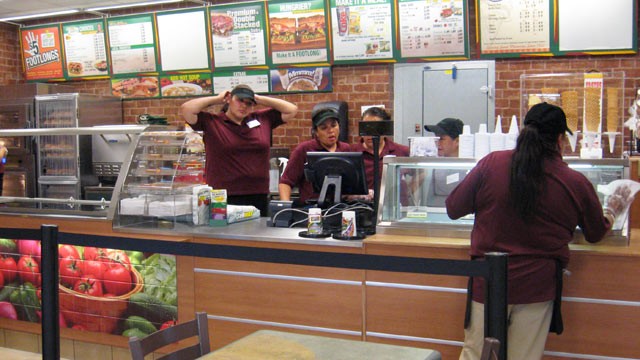
Stuck in 'Food Desert,' Pine Ridge Locals Look to Subway to Meet Nutrition Needs

By Astrid RodriguesAn area the size of Delaware and Rhode Island combined, the reservation is considered a "food desert," defined by the U.S. Department of Agriculture as a low-income community without ready access to healthy and affordable food. Ecoffey, who is also the Bureau of Indian Affairs superintendent for the Pine Ridge Agency, tells ABC News that healthy foods like fresh fruits and vegetables are unavailable because of what he says are limited resources.

"The opportunity just doesn't exist for many people across the reservation," he said.

Ecoffey said Subway offers that opportunity.

Tashina Banks, a member of the Cheyenne River Sioux tribe, is the hiring manager at the Pine Ridge Subway. She shared with ABC News the story of an elder woman from the community who was moved to tears during the store's grand opening week.

"She came in here and literally was crying because of what having this kind of a store or food restaurant in the community meant," Banks said. "Not only because you see people investing in our own community, but also because, she said, 'I haven't eaten a cucumber in years because they're so expensive.'"

There's only one large supermarket and typically the price of staple items across the reservation are more expensive because of its remote location.
Comment:  This article appeared before ABC's Children of the Plains special and my trip to South Dakota, but I just came across it.

For more on the subject, see Economic Development on Pine Ridge and Poverty Porn in Children of the Plains.

December 16, 2012

Navajo tacos at "pop-up" Philly restaurant

Navajo tacos debut at "Shiprock" restaurant in PhiladelphiaThe Four Corners gastronomical staple is making its debut in the Pennsylvania metropolis more often known for its beloved Philly Cheese Steak sandwiches.

Can the Navajo taco compete?

Philadelphians will find out during a one-night extravaganza Dec. 21 when three Philly chefs come together and put together a menu that will include the fry bread, lettuce, tomato, bean and meat mess that we all have come to love, as well as a few extras to pair with the main dish.

"Hopefully, Philadelphians will catch on," said Mexican food chef Lucio Palazzo, who joined the effort alongside "hot dog artist" Hawk Krall and beef jerky entrepreneur extraordinaire Marcos Espinoza.

"We all bring something different to the table," Palazzo said.

The cuisine will be served in a bar that none of the chefs own, but instead will be borrowing. The event is part of a trend known as the "pop-up," a temporary restaurant that uses a non-traditional venue as a restaurant for a few days at the most.
Comment:  One posting I saw said the date was January 21, not December 21. If that matters to anyone.

For more on frybread, see 3 Stars for More Than Frybread and Fry Bread House Wins Restaurant "Oscar."

November 24, 2012

Salish traveling food exhibit

Salish Bounty: Tulalip Tribes Host Traveling Food History Exhibit to Illustrate its Correlation to Indian Health

By Jackleen De La HarpeA new exhibit at the Tulalip Tribes’ cultural center looks at food to explain the history of Northwest tribes and to imagine a future that revives the Coast Salish food traditions that support the good health of families and communities.

Salish Bounty: Traditional Native American Foods of Puget Sound opened November 3 at the Tulalip Hibulb Cultural Center in Marysville, Washington. The traveling exhibit, which will run through January 2013, is elegant in its brevity and positive approach to the serious issues of food and health in Indian country—soaring rates of diabetes, hypertension and obesity. Salish Bounty focuses briefly on three periods through the lens of food—traditional tribal hunting and gathering prior to the Point Elliott Treaty of 1855; the confinement of Indian people to reservations, assimilation and the lack of access to traditional hunting and gathering places; and a future of blended new and old food traditions.

Historic photographs, maps, media, dried plants and shellfish of the Pacific Northwest tell the rich story of food in the local, indigenous foods. Even in mid-November, raised garden beds, a greenhouse, and organic gardens continue to produce vegetables. The tribe offers gardening classes, and a newsletter “The Greens of the Earth,” as well as other programs that emphasize the positive aspects of growing and cooking food as a pathway to good health. And, in the spring 2013, the Natural History Preserve will open with more than 40 acres of walking trails.

Salish Bounty is part of an international exhibit, Hungry Planet: What the World Eats, that demonstrates how the food we eat has changed over time from the perspectives of families around the world. Elizabeth Swanaset, Nooksack/Cowichan/Laq’amel Tribes, and Warren King George, Muckleshoot/Upper Skagit Indian Tribe, co-curated the exhibit in partnership with the Tulalip Tribes and the Burke Museum in Seattle.
Comment:  For more on the subject, see Tseleil-Waututh Professional Chef's Program, Salishan Catering Serves Native Cuisine, and Off the Rez Food Truck.

Below:  "Salish Bounty Co-curator Elizabeth Swanaset holds clams collected on a Puget Sound beach last summer. The clams were then smoked and preserved for winter use." (Courtesy Warren King George)

November 17, 2012

Nisqually cooking in Man Fire Food

Celebrity chef Roger Mooking cooked with the Nisqually Tribe

By Jackie FenderIt would seem that the South Sound region is making it big as far as culinary broadcasts are concerned. Two weeks ago, Guy Fieri bopped around Tacoma, Olympia, Puyallup and Lakewood. This past week celebrity chef Roger Mooking visited Olympia.

Canadian chef, and super approachable Mooking is a man of many talents. Mooking is the co-owner and executive chef of several fine-dining establishments in Canada. He's authored a cookbook. Hell, the man even has an R&B album! Not to mention being host to several cooking shows, Everyday Exotic, Heat Seekers (with co-host Aaron Sanchez also on the popular Chopped series) and Man Fire Food. In each endeavor he seems to genuinely have a good time.

"I like to make things whether it's a dish, a cookbook or an album," Mooking told me over the phone. "Being able to do the two things I love so much is quite a blessing."

The Cooking Channel's Man Fire Food is exactly what it sounds like. Mooking visits locations throughout the nation discovering different ways that man (and woman) use fire to cook. Open flame, smokers, BBQing and other options use the primal element to infuse flavor into our feasts. While in Olympia, Mooking and crew visited with the Nisqually Tribe for a MFF episode centered on seafood feasts.

"It was really amazing to get a sense of what happens locally there," said Mooking. "The Nisqually Tribe has been cooking this certain way for centuries and generations and preparing these king salmon. They catch them from this body of water, skin them and smoke them over a fire. They let us in on that world, which was really special."

They also prepared clams, mussels and oysters underground--much like a clambake.
TV chef takes lesson from Nisqually

Celebrity chef Roger Mooking makes his living by giving cooking instructions and inspiration to millions of viewers through his three TV shows on the Food Network and the Cooking Channel. But last summer, it was Mooking who got the cooking lesson when he spent a day with members of the Nisqually tribe as they cooked salmon and other local seafood.

By Craig Sailor
Celebrity chef Roger Mooking makes his living by giving cooking instructions and inspiration to millions of viewers through his three TV shows on the Food Network and the Cooking Channel. But last summer, it was Mooking who got the cooking lesson when he spent a day with members of the Nisqually tribe as they cooked salmon and other local seafood.

That visit will be broadcast on Tuesday as part of Mooking’s new show “Man Fire Food” on the Cooking Channel. In the show, Mooking travels the country discovering inventive ways to cook with fire.
And:Mooking called in from Toronto:

What did you learn during your visit with Nisqually tribal members Reuben Wells Sr., Reuben Wells Jr., John H. Scott IV and Hweqwidi Hanford McCloud?

They really welcomed us and they showed us all the secrets they’ve been holding on to dearly for centuries and generations. I got a little insight into their tribal history and their food history: how they fish, their techniques, what it means to them as a culture and a people.

I understand they showed you how to roast king salmon on hazelnut branches over an open fire.

They put it in the ground over the fire and it gets kissed by the smoke. It’s really good. It’s the first time I’ve ever done that technique. It’s all stuff they harvest locally on their reserve land (oysters, mussels and clams). They brought it all in and cooked it up.
Comment:  For more on Native cooking, see Tsleil-Waututh Professional Chef's Program and Eden Eats Visits Pima-Maricopa Rez.

November 10, 2012

Tsleil-Waututh professional chef’s program

Aboriginal chefs in training

By Mia StansbyYou might wonder, why there aren’t more First Nations food in a city where local cuisine reigns supreme. (I know of one: Salmon ‘n’ Bannock.)

You might wonder, too, why there aren’t First Nations chefs or cooks in restaurant kitchens, especially as native culture is steeped in creative expression and feasts are central to communal celebrations.

Acknowledging this, the Tsleil-Waututh Nation (slay-wa-tuth) celebrated the first graduating class of its professional chef’s program earlier this week. It’s a step towards seizing opportunities too long untapped.

“Cooking wasn’t a career option before,” says Andrew George the lead chef instructor for the program. “Racism is a cop-out but it’s part of the picture. There’s not a lot of natives involved in the culinary industry and we have a fast-growing population of people under the age of 25. We have always welcomed people to our lands through food. First Nations people work with their hands, they’re very artistic and are hard workers. It’s a perfect fit for food.”
Comment:  As someone noted, the first sentence is slightly misleading. There's plenty of "First Nations food" in Vancouver and elsewhere. Something like half the world's food products come from Native sources.

But this is a column about restaurants in Vancouver. It was undoubtedly talking about restaurants that prepare Native dishes using Native recipes. In that sense, there may be only one establishment in Vancouver serving "Native food."

For more on chefs, see Eden Eats Visits Pima-Maricopa Rez and Top Chefs Cook for Hualapai.

Below:  "Local chef Andrew George (top centre and aboriginal students, Eugene Crain, (left) and Lawrence George (right) show off their prepped elk dish, lettuce wraps and other tradional dishes, at the Tsleil-Waututh Nation school, in North Vancouver." (Mark van Manen/PNG Staff)

September 03, 2012

Osoyoos Band's Nk'Mip Winery

Osoyoos Indian Band’s Nk’Mip Winery Rakes in Awards, Pulls in Busloads of Visitors

By Jack McNeelThe verdant, grapevine-swathed hills roll off into the distance, drawing the eye to a backdrop of purple mountains. The table is set under a sun-filled, cloudless blue sky, and the award-winning wine swishes into the glass. You might think you’re in Italy, or at the very least, California.

Improbably, it is in a region that does not leap to mind when one thinks of wine country, and the venue is even more of a surprise: You are on traditional First Nations territory, that of the Osoyoos Indian Band, to be exact, in what is today known as British Columbia, Canada.

Visitors—from canoodling couples to busloads carrying 60 or 70 people at a time—descend daily upon this, the first aboriginal-owned winery in Canada, daily. Tourists arrive in droves, and on a summer day 400–600 people may come wine tasting. They sip, they tour, they shop—the tasting room sells related items as well as wine—and they learn about the culture from the First Nations décor, photos and captions describing the history of the Osoyoos people as well as the Nk’Mip Cellars.

The winery will be one of the stops in the upcoming Fall Okanagan Wine Festival, from September 28 through October 7, and the band’s Nk’Mip Conference Centre will host a formal, “Hollywood style” dinner during the O! Osoyoos Celebrates! Festival from September 14 through 16.
Comment:  For more on Native wine-making, see Yocha Dehe Wine and Olive Oil.

August 30, 2012

Restaurant serves "Half-Breed" hamburgers

‘Half-Breed’ and ‘Dirty Drunken Half-Breed’ chucked from burger menu

By Jayme PoissonThe owners of a popular Toronto hamburger joint have taken two items off their menu after facing a slew of complaints that the burgers were given derogatory names.

The “Half-Breed” burger and “The Dirty Drunken Half-Breed” burger had been staples on the menu at Holy Chuck Burgers for about seven months. Last week, after one customer’s objection swelled into a larger protest, the shop was inundated with phone calls and online criticisms.

Co-owner Bill Koutroubis told the Star on Wednesday that he never intended to offend anyone, and neither he nor his partner realized the term is considered a racial slur.

“To racially slur an ethnicity in a multicultural society, it’s the totally wrong thing to do,” said Koutroubis, clearly upset. He added that his background is Greek and that he would never knowingly insult another cultural group.

“We apologized on Twitter and again I reiterate the apology . . . It was never meant to be malicious; it was just an innocent play on words on our part.”

Back in December, local Geoff King flagged Holy Chuck’s Twitter account about the offensive nature of the term. The restaurant responded by saying that wasn’t how they saw it, and Koutroubis said Wednesday they didn’t look up the word afterwards.

“The term ‘half-breed,’ if you look it up in just about any dictionary, is really a negative, disparaging and offensive term used to describe people of mixed ancestry, specifically people of mixed indigenous and non-indigenous ancestry,” explained Ryerson University professor Pamela Palmater.

“Now add dirty and drunken to the term half-breed and it takes it to a much higher level in terms of the level of insult that you’re talking about.”
Comment:  Koutroubis is being disingenuous. Here's how he supposedly came up with the name:Koutroubis said the term “half-breed” was coined because the patties are mixed with two different kinds of meat—half cured bacon and half beef.

For the burger with extra toppings they chose “drunken,” because the veal cheek vino chili topping has alcohol. And, “dirty,” because it’s messy.
That doesn't answer the question of how the name came to resemble a Native slur. Was it just the world's biggest coincidence? I doubt it.

He undoubtedly heard the slur and thought it would be "funny" to use it. Which makes this another example of hipster racism. Then he got schooled by the critics.

But at first that wasn't enough. When people told him the names were slurs, he said he didn't see it that way and didn't look them up. He obviously didn't care about anyone's feelings. Only when he received a firestorm of protests did he remove the items and apologize.

So, to review: Koutroubis intentionally chose offensive names. He stuck with them when he was told they were offensive. He changed them not because he eventually realized the harm, but because they were hurting his business.

Sounds like a typical conservative to me. He doesn't let facts get in the way of his opinions. As with a bad child or dog, you generally can't reason with these people. You have to punish them, teach them a lesson, before they get the message.

For more Stereotype of the Month entries, see Echo's "Weekend Warrior" Line and Indian Chief Bust at White Faux Taxidermy.

Below:  "Bill Koutroubis, co-owner of Holy Chuck restaurant, says he took the items dubbed 'The Half-Breed' and 'The Dirty Drunken Half-Breed' off the menu (now hidden under white tape on the sign) after learning of the term's derogatory connotations. The Twitter user who first brought it to the restaurant's attention months ago wonders why they didn't look up the meaning immediately." (Jayme Poisson/Toronto Star)