Showing posts with label stereotype history. Show all posts

September 01, 2011

Stereotypes justified "extreme measures"

A Song for the Horse Nation:  Typecast Indians

By Linda Martin (Navajo)As a child in the early 1970s, I conceived many notions about family, identity, and life roles by sitting in front of my grandmother’s television set. Raised in the city by my non-Native mother and grandmother, I learned about single-parenting issues from A Family Affair and The Courtship of Eddie’s Father. My female role models, Mary Tyler Moore and Rhoda, were stylish, independent, career-minded women, much like my mother. My first impression of Native culture also came by way of television, through the genre of Hollywood Westerns. On celluloid, garishly painted, red-faced actors portrayed Natives as savage scalpers and merciless killers bent on unspeakable acts of murder and violation.

In films such as War Arrow (1953), wild “Kioways” on the warpath madly circle wagon trains of doomed pioneers. In Kit Carson (1940), other pioneers in peril are saved from Shoshone attacks as they ramble through Monument Valley, Utah. In the end, the hero—a frontier scout, cavalryman, or cowboy—gets the girl, and the Indian meets a grisly death. These death scenes, humorous and horrendous, involved dramatic feats of demoralizing comeuppance: an Indian grave shot from his war pony, somersaulting into the sagebrush, or shot and dragged behind his porn, arms flailing pitifully. Unfortunately, many other children my age drew the same conclusion about Indians as I did: we were dirty savages and merciless killers of women and children. Being the only Native American in my grade school, I became the target of hollering, war whoops, and hand-to-mouth “Indian” chanting.

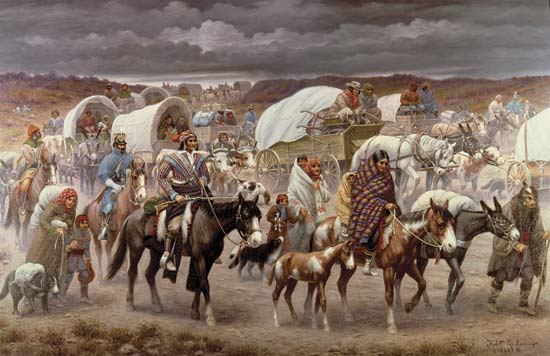
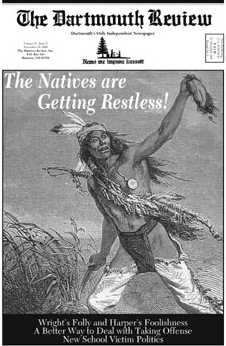
Through illustration, portraiture, photography, journalism, and film, generations of Native people have been haunted by the cultural stereotypes of the past five centuries. Seventeenth-century European illustrations of Iroquois scalpers, battle reenactments in Buffalo Bill’s Wild West shows, dime novels, and souvenir postcards, for instance, have shaped the public’s erroneous sentiments about Native Americans. Depending on the political agenda of the time—whether in Europe or North America—the evolution of Native identity in the popular press has been dominated by two extreme stereotypes: savage marauder or docile member of a conquered race.

In the United States, portraying Native Americans in a hostile light justified extreme measures in Indian policy, such as the use of brutal military force, land theft, and treaty violations. The idea of Indians as uncivilized and un-Christian also legitimized forced conversions, mandatory attendance at boarding schools, and other religious abuses.
Comment:  A Native links the "dirty savages and merciless killers" seen in the media with the "hollering, war whoops, and hand-to-mouth 'Indian' chanting" she received as a child. Many Natives could relate similar stories. So why are non-Natives still denying the harm of Native stereotyping? How arrogant do you have to be to say stereotyping isn't harmful when people tell you the harm explicitly?

Martin also links Native stereotyping to broad policy decisions: brutal military subjugation, forced religious conversions, abused children in boarding schools, etc. The media portrayed Indians as savages and that's all people knew about them. No doubt many Americans made the link explicit: "If they're going to act like savages, we'll treat them like savages."

And it's still happening today. Whenever a court decision or Congressional bill goes against Native interests, you can detect a whiff of stereotypical thinking. It goes something like this:

"These people live out in the desert somewhere, worshiping rocks and trees, and living off welfare checks. We don't have to treat them like full-fledged Americans because they aren't full-fledged Americans, really. They're more like the slaves in the Old South were--i.e., three-fifths of a person. So we'll give them three-fifths of the services we give to real Americans. They're so primitive and out-of-touch they probably won't even notice."

A good example is the $3.4 billion Cobell settlement. Most claimants thought they were entitled to tens or hundreds of thousands of dollars--a century-plus of royalties and interest. Instead they're getting tens or hundreds of dollars. It's because politicians are thinking they didn't really need or earn the money. "They're only savages scrabbling in the dirt somewhere, not real Americans with jobs and families. We took care of them as wards of the state and that's payment enough for them."

Why do we develop their sacred sites? Because their religions aren't "real" religions. Why do we use them as stereotypical logos and mascots? Because their feelings aren't "real" feelings. Savages aren't real people like you and me.

For more on the subject, see Conservatives Use "Language of Savagery" and Grinding Indians into the Ground.

Below:  "Early 20th-century postcard of Cree man in traditional dress on horseback."

June 12, 2011

Indian in Worse than Rotten, Ralph

Educator Debbie Reese notes another stereotype in a children's book:

Worse than Rotten, Ralph by Jack Gantos and Nicole Rubel


(Source: Debbie Reese's American Indians in Children's Literature, 6/10/11.)

Comment:  Ralph is the orange cat in the middle. In this scene, he's met up with some alley cats and gone to the park. There one cat steals a headdress from an Indian.

Let's deconstruct this scene.

First, what does the presence of an Indian chief tell us? A chief is walking around an urban park in regalia for no reason. Message: The chief is a comical character. The chief loses his headdress to a cat and tries to get it back. Message: The chief is a comical character. Having outsmarted the chief, the cat laughs at him. Message: The chief is a comical character. Finally, the chief waves a tomahawk at the cat. Message: The chief is a violent savage as well as a comical character.

Note that a Plains chief generally wears a headdress for ceremonial reasons. He wouldn't wear it around a park. He wouldn't wear it if he was going off to war, which is what the tomahawk suggests.

Moreover, I don't think tomahawks were common among the Plains Indians. Any way you look at it, juxtaposing a chief and a tomahawk in a peaceful setting is wrong.

Does the sign help?

The authors make a pretense of explaining the Indian's presence with the sign he carries: "See the Wild West Show!" What does this tell us about the Indian?

Well, he could be a modern Indian who's dressed up as a traditional Plains chief. Message: No one would recognize a modern Indian. Or he could be an actual Plains chief who's wandered into the story from another time and place. Message: Indians are people of the past. Or he could be a non-Indian who's dressed as a Plains chief to market the Wild West show. Message: Anyone can play an Indian.

None of these possibilities is a good one. Any way you look at it, the character is conveying the standard chief and tomahawk stereotypes. He's also sending other negative messages depending on how you interpret him.

Finally, let's pretend that there is a Wild West show in town and this Indian is one of the participants. In other words, let's take this illustration at face value. It is what it seems to be.

In addition to the problems listed above, the concept of a Wild West show is stereotypical. This was true even in the heyday of Buffalo Bill's Wild West shows. It was still true whenever this story took place--sometime in the mid-20th century, perhaps. And if there are any "Wild West shows" still operating, it's true today.

Even if a show presents a Plains chief exactly as he appeared in "real life," it would be stereotypical. Why? Because it's reinforcing a limited, one-dimensional idea of who Indians are. There are no Indians from the Tlingit, Hopi, Seminole, or Oneida tribe in a Wild West show. No Indians who are farmers, teachers, doctors, or lawyers. The Indians in these shows are almost always chiefs and warriors from Plains tribes.

That's a tiny slice of the totality of Native life across the Americas. Because Wild West shows reiterate and reinforce what everyone believes about Indians, these shows are stereotypical even if they're "true." The lack of breadth and depth, of balance, is what makes them stereotypical.

Conclusion

So we have a comical chief wandering around a park for no reason. He may be a primitive traditional Indians who's out of place, or a non-Indian who's playacting. And the show as well as the "Indian" is purely stereotypical.

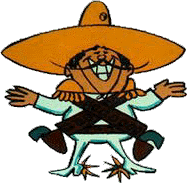
That's like three strikes in one illustration. Again, imagine if the illustration showed a Mexican peasant in a sombrero. Or an Asian peasant in a coolie hat. It would be so obviously wrong that no one would think about allowing it. But no one since the book was published in 1978 has thought to question the comical Indian chief.

For more on the subject, see Absolutely True Diary's Variant Covers and Roger Ebert Loves Chief Illiniwek.

Below:  "Hey, gringo, how come I'm not in this illustration too? I also like to walk around urban parks in a comically inappropriate costume."

May 16, 2011

How people get labeled "terrorists"

Native Americans endure 500 years of terrorism

By Tim GiagoWhen human beings can be labeled as less than human their deaths become meaningless. This is the apparent belief of the terrorists and the early settlers. By portraying all Indians as murdering savages, rapists, kidnappers and worse, the national media of the day laid the groundwork for Wounded Knee. In article after article urging the government to remove the Indian people by any means from their homelands, the media stood guilty of fomenting acts of terrorism.

Similar articles in the media and speeches in the mosques in the Nations of Islam expressed similar views of Americans. This laid the groundwork for 9/11. A lie repeated often enough becomes a fact in the minds of impressionable people. Indians are savages, Americans are infidels and Arabs are heathens. Do you see how this logic works?

Just as the Crusaders believed it was their Christian duty to conquer and kill those Arabs they considered as sub-humans and heathens, so too did America duplicate their misguided logic against the First Americans. The people of the Islamic Nations never forgave nor forgot. The Indian people have largely forgiven, but they have not forgotten. The Christians of the Crusade de-humanized the Arabs, the early Americans de-humanized the Indians and the People of Islam now de-humanize Westerners. It is a vicious cycle that is centuries old.

Just as news stories and movies about Arabs portrayed them as less than human, so did the media portray the indigenous people of America. Their lives then became expendable and meaningless and therefore easily sacrificed for what is believed to be a greater cause. Westerners are now fitted into this same category by the Islamic terrorists.
Comment:  I don't know why Giago capitalized "Nations of Islam," "Islamic Nations," and "People of Islam." I assume he's talking about the Islamic universe of nations and people. This is confusing since there's a much smaller organization called the Nation of Islam.

Regardless, Giago has succinctly explained how a society's propaganda machines work to demonize the people's enemies. Europeans began that process with Indians five centuries ago. We continued that process with blacks and other unwanted immigrants. Now we're doing it to Muslims while they do it to us.

Of course, there's at least one key difference. A small group of Muslim terrorists has attacked Americans on US soil once. In contrast, the US has invaded the Persian Gulf, Afghanistan, and Iraq and bombed Somalia, Sudan, and Libya, killing hundreds of thousands of innocent people, while supporting Israel's illegal occupation of Arab territory. Muslims have good reason to dislike Americans, if not the other way around.

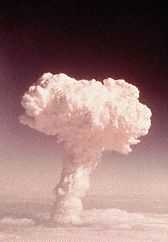
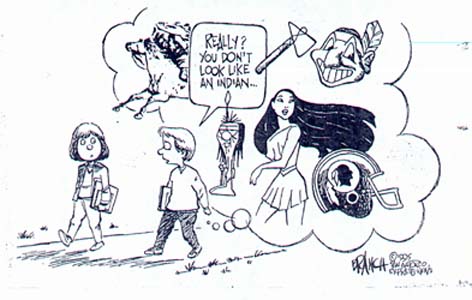
Anyway, this helps explain how we came to label Osama bin Laden, a real terrorist, with the codename "Geronimo," someone considered a terrorist at the time. And why we didn't choose a codename such as "Andrew Jackson," "Jefferson Davis," or "Harry Truman," who killed more civilians in one action (Hiroshima) than anyone in history. Everyone defines themselves as freedom fighters or heroes and the other guys as terrorists or villains.

For more on the subject, see Bin Laden, Geronimo, and King and Alternatives to "Geronimo" Codename.

Below:  The greatest instance of mass-murdering civilians in history.

May 04, 2011

Congress to examine "Geronimo" codename

Congress to Examine "Inappropriate" and "Devastating" Use of "Geronimo" Codename in bin Laden Mission

By Matthew JaffeThe Senate Indian Affairs committee will hold a hearing Thursday on racist Native American stereotypes, a hearing that will now also address the Osama bin Laden mission and the code-name Geronimo.

While the hearing was scheduled before the mission, a committee aide today said the linking of the name Geronimo with the world’s most wanted man is “inappropriate” and can have a “devastating” impact on kids.

“The hearing was scheduled well before the Osama bin Laden operation became news, but the concerns over the linking of the name of Geronimo, one of the greatest Native American heroes, with the most hated enemies of the United States is an example of the kinds of issues we intended to address at Thursday's hearing,” Loretta Tuell, the committee's chief counsel, said in a statement.

“These inappropriate uses of Native American icons and cultures are prevalent throughout our society, and the impacts to Native and non-Native children are devastating,” Tuell said. “We intend to open the forum to talk about them.”
What the hearing is really about:

Senate Committee on Indian Affairs to hold hearing on ‘Stolen Identities: The Impact of Racist Stereotypes on Indigenous People’

By USA Senator Daniel Kahikina AkakaThe Senate Committee on Indian Affairs will be holding an oversight hearing tomorrow on the depictions of Native peoples in American society and the effect they have on these communities and the American public in general. The Committee will explore how Indian mascots, common caricatures and prevalent mis-portrayals have far-reaching impacts on the identity and sense of self-worth of Native peoples and negatively impact how all Americans perceive and relate to each other.

“Our hearing is about the real harm that is done to all people, Native and non-Native alike, when mascots, movies and images reinforce the stereotypes and the lines that divide rather than unite us,” said Senator Daniel K. Akaka, Chairman of the Senate Committee on Indian Affairs.

Background

Wild West shows, Hollywood films, and Indigenous based mascots have shaped the perception of Indigenous peoples for over one hundred years. Early media forms generally presented Native Americans either as noble yet submissive warriors or as bloodthirsty savages. Emerging from these shows and films were Native American mascots. Research shows that Native American mascots have negative effects on Native students’ self-esteem and sense of worth and that exposure to Native American team mascots increases a person’s negative stereotyping of other races. The awareness of the impacts of these stereotypes, actions of governments, and the emergence of Indigenous actors and directors has greatly contributed to overturning a century of harmful stereotypes.
Comment:  A single hearing will barely scratch the surface of the surface of this topic. Congress could spend a year on it full-time and still have more to examine.

I don't expect much to come of this hearing. If it raises awareness among a few politicians or media types in Washington, that's about all we can hope for.

For more on the subject, see Apaches Demand Apology for Codename and Critics Slam "Geronimo" Codename.

December 13, 2010

19th-century cartoons about Indians

Super I.T.C.H., the International Team of Comics Historians, presents 19th-century images of Indians in comic strips and periodicals. Since there were no comic books then, I presume they mean "comic" as in "humorous." Most of these appeared in newspapers and magazines.

Selling Out the Red Man: American Advertisers Portray the NativesTo close out our series on Native American Heritage Month (until next year), we bring you artist Livingston Hopkins’ Big Scalper & Big Smoker.Thanksgiving with the NativesFor Thanksgiving Day and Native American Heritage Month, we bring you a few sample images from late nineteenth-century comic periodicals.Buffalo Bill & Queen Victoria, at Her Golden Jubilee, 1887For those who may have missed it, we re-present for Native American Heritage Month an article from this past spring, on how comic periodicals covered the 1887 tour of England by Buffalo Bill’s Wild West Show.Dime-Store Novel Kid Indian FightersFor Native American Heritage Month, we’ve been showing examples of how 19th-century American and European comic publishers presented indigenous people to the European-derived public.1870s:  The U.S. Government’s Wars Against Native AmericansWith the Civil War ended, the Union Army was free to concentrate on the conquest of Western native tribes (plus the re-conquest of tribes that had become “western”, by virtue of being forcibly re-settled west, after their lands in the east had been stolen).Cham’s “History of a Savage Nation,” 1846November is Native American Heritage Month, and so for the next several Mondays, I’ll be presenting early comic strip and cartoon depictions of the first Americans. As to be expected, these comics—created by and for the culture that was actively engaged in stealing native lands and decimating its population—tend to be racist and insulting.Comment:  Follow the links to see all the images.

A couple of interesting points:

1) The stereotypes we're familiar with today hadn't coalesced into convention then. At least half the images used a different set of stereotypes. These Indians were bald with a few feathers somehow rising from their heads. They had big ears and noses with rings in both. They were shirtless but covered with loosely draped robes rather than buckskin.


To me the key is the rings in the noses--a classic trait of black "savages." My guess is the artists were trying to make the Indians look as much like the dark, scary Africans we were "discovering" around the same time. As we learned from countless jungle movies, cartoons, and comics, these devils liked to boil people alive before eating them.

Long-haired Indians on horseback didn't necessarily have the "savage" cachet we associate with them now. The artists apparently reckoned that modeling Indians after Africans who were subhuman ape-men and cannibals would maximize the horror. Now these pseudo-Indians just look comically wrong.

2) Even then people understood the connection between stereotypes in the media and people's perceptions. How could they not, since it's self-evident?

Dime novels were the main form of mass entertainment then. They fed people, especially youngsters, a steady diet of titles such as "Ike the Indian Killer." This convinced people that Indians were relentless marauders and killers. Children grew up with these beliefs and stuck with them in the face of contradictory evidence.


The same thing happens today, of course. The funny thing is how some people (e.g., "Public" Causes Stereotypes? and Valenti:  Movies Are Just Movies) try to deny it. In the 19th century, Americans understood that stereotypes came from the media and influenced people's perceptions. How stupid do you have to be not to realize this 150 years later?!

This also contradicts the notion in Stereotypes Are Irrational But Normal and Stereotypes Okay in "Cultural Commons"?--that stereotypes are somehow a natural part of life. Wrong. The media created these stereotypes and force-fed them to the public for political and cultural reasons. Without this force-feeding, the stereotypes probably wouldn't exist. And people would see Indians as different but not necessarily inferior or evil.

For more on the subject, see Stereotypes Drive Racism in South Dakota, Why Minstrel Shows Are Wrong. For more on the subject in general, see A Brief History of Native Stereotyping and The Harm of Native Stereotyping:  Facts and Evidence.

November 27, 2010

Love/hate relationship with Indians

A review of Obama's new book Of Thee I Sing summarizes our conflicted views about Indians:

Of Thee I Sing: A Semiotic Review by Scott AndrewsAmerican mythology has been deeply conflicted about the original inhabitants of the continent since Day One of Contact. Americans have hated Indians and they have loved Indians. But, strangely, in both cases the Indian disappears from view.

The side of the American psyche that hated Indians wanted to clear them out of the way of westward expansion, even if that meant killing them all. Thus the Indian became, for many decades, the ubiquitous villain of American popular fiction and Hollywood Westerns. In contrast to the bloodthirsty savage, the American hero could look that much more heroic--and could be justified in killing Indians.

The side of the American psyche that loved Indians romanticized and envied them, and yet still imagined the Indians absent from the path of westward expansion. In American literature, sometimes the Indians disappeared voluntarily, because they did not want to live like their new neighbors. Sometimes the Indians disappeared tragically, perhaps from disease or even from hearts broken by the damage done to their communities. This passing was lamented by some Americans, and it was sometimes used to critique the American greed or violence or prejudice that so harassed Indians. But hardly ever in the American imagination did this critique result in the Indian not disappearing.

Sometimes what the American psyche hated about the Indian was also what it loved. The Indian Hater oftentimes justified his hatred by seeing the American as civilized and the Indian as savage. The task of transforming the landscape into European-style agricultural and urban landscapes was seen as a process of conquering nature. Since the original inhabitants of the land needed to be removed before the land could be transformed, the Haters equated Indians with the land or nature. Both needed to be conquered. They were not merely obstacles to expansion, but as “nature” they were the opposite of “civilization.” In his survey of Indians in American literature, Savagism and Civilization, Roy Harvey Pearce says that the Indian became an important symbol “for what he showed civilized men they were not and must not be” (5).

Meantime, the Indian Lover also equated Indians with the land or nature, but this time that was seen as a good thing. Many times the Indian Lover had grown tired of his own society. Like the Hater, the Lover associated “civilization” with European-style society, but unlike the Hater he saw “civilization” as corrupt or decadent. Pearce describes this as a type of “primitivism--the belief that other, simpler societies were somehow happier than one’s own” (136). The Indian Lover saw “nature” as the opposite of “civilization,” as pure and noble. He saw the Indian as the Noble Savage, and in so doing he also equated the Indian with nature.

However, despite his admiration for Indians, the Lover could not bring himself to live with them permanently or imagine a role for them in his society. Apparently, just because you love something doesn’t mean you want to live with it. And so even those writers who loved Indians rarely ever ended a story with the Indian characters still around--they either died or faded into the landscape, headed further West, making room for the tide of Americans.
Comment:  Indian lovers and haters correspond roughly to liberals and conservatives. But as Andrews notes, the outcomes of love and hate aren't much different.

Among the lovers we could include mascot worshipers, New Age wannabes, and hipsters in headdresses who think they're honoring Indians. The common denominator is that they love a fictional, romanticized version of Indians.

In contrast, they don't know or care about real Indians. They especially don't want to hear about anything negative like poverty, termination, boarding schools, broken treaties, or genocide. As long as they have their fantasies, they're happy to be ignorant.

For more on the subject, see Ups and Downs of Hollywood Indians and The Political Uses of Stereotyping.

October 12, 2010

Capitalism killed the Indians

Exposing the GOP's Shameful Historical Role in the Native American Genocide

How the Native American extermination campaigns merged the dangerous forces of a standing army with the business/political interests of the Republican Party.

By Thomas DiLorenzo


How the situation started:The real culture of violence in the American West of the latter half of the 19th Century sprang from the U.S. government’s policies toward the Plains Indians. It is untrue that white European settlers were always at war with Indians, as popular folklore contends.

Trade and cooperation with the Indians were much more common than conflict and violence through the first half of the 19th Century.

Terry Anderson and Fred McChesney relate how Thomas Jefferson found that during his time negotiation was the Europeans’ predominant means of acquiring land from Indians. By the 20th Century, some $800 million had been paid for Indian lands.
The first half of the 19th century gave us the War of 1812, the Black Hawk War, the Trail of Tears, and the Seminole Wars, so I'm not sure trade and cooperation were "much more common."

Perhaps trade and cooperation were much more common in the 18th century. In the first half of the 19th century, it was more like 50% cooperation and 50% conflict. In the last half of the 19th century, it became almost 100% conflict.


Civil War ended...what's next?

How the situation changed after the Civil War:A standing army, according to Anderson and McChesney, “creates a class of professional soldiers whose personal welfare increases with warfare, even if fighting is a negative-sum act for the population as a whole.”

The change from militia to a standing army took place in the American West immediately upon the conclusion of the War Between the States. The result, write Anderson and McChesney, was that white settlers and railroad corporations were able to socialize the costs of stealing Indian lands by using violence supplied by the U.S. Army.

On their own, they were much more likely to negotiate peacefully. Thus, “raid” replaced “trade” in white–Indian relations. Congress even voted in 1871 not to ratify any more Indian treaties, effectively announcing that it no longer sought peaceful relations with the Plains Indians.
Why the situation changed:On June 27, 1865, General William Tecumseh Sherman was given command of the Military District of the Missouri, which was one of the five military divisions into which the U.S. government had divided the country.

Sherman received this command for the purpose of commencing the 25-year war against the Plains Indians, primarily as a form of veiled subsidy to the government-subsidized railroad corporations and other politically connected corporations involved in building the transcontinental railroads.

These corporations were the financial backbone of the Republican Party. Indeed, in June 1861, Abraham Lincoln, former legal counsel of the Illinois Central Railroad, called a special emergency session of Congress not to deal with the two-month-old Civil War, but to commence work on the Pacific Railway Act.

Subsidizing the transcontinental railroads was a primary (if not the primary) objective of the new Republican Party.
And:Sherman wrote in his memoirs that as soon as the war ended, “My thoughts and feelings at once reverted to the construction of the great Pacific Railway. … I put myself in communication with the parties engaged in the work, visiting them in person, and assured them that I would afford them all possible assistance and encouragement.”

“We are not going to let a few thieving, ragged Indians check and stop the progress [of the railroads],” Sherman wrote to Ulysses S. Grant in 1867. [See Michael Fellman’s Citizen Sherman: A Life of William Tecumseh Sherman.]


How to eliminate the Indians

The final solution to the "Indian problem":President Grant made his old friend Sherman the army’s commanding general, and another Civil War luminary, General Phillip Sheridan, assumed command on the ground in the West.

“Thus the great triumvirate of the Union Civil War effort,” writes Sherman biographer Michael Fellman, “formulated and enacted military Indian policy until reaching, by the 1880s, what Sherman sometimes referred to as ‘the final solution of the Indian problem.’”

What Sherman called the “final solution of the Indian problem” involved “killing hostile Indians and segregating their pauperized survivors in remote places.”

“These men,” writes Fellman, “applied their shared ruthlessness, born of their Civil War experiences, against a people all three [men] despised. … Sherman’s overall policy was never accommodation and compromise, but vigorous war against the Indians,” whom he regarded as “a less-than-human and savage race.”

All of the other generals who took part in the Indian Wars were “like Sherman [and Sheridan], Civil War luminaries,” writes Sherman biographer John Marszalek. “Their names were familiar from Civil War battles: John Pope, O. O. Howard, Nelson A. Miles, Alfred H. Terry, E. O. C. Ord, C. C. Augur . . . Edward Canby . . . George Armstrong Custer and Benjamin Garrison.” General Winfield Scott Hancock also belongs on this list.
Not coincidentally, the second half of the 19th century is when the first inklings of mass media started appearing. Americans started seeing touring shows of paintings...dime novels...Wild West shows...and the first photographs. These featured cowboys and Indians prominently.

Our national mythology of cowboys and Indians came about precisely because we were prosecuting a war against the Indians. Thus we cast ourselves as the brave, noble cowboy-soldiers in the mold of George Armstrong Custer and Theodore Roosevelt. This model would become enshrined in the national consciousness by Western movies starring John Wayne and other cowboy heroes.

Meanwhile, we had to demonize the Indians so we had a "valid" reason to kill them. So we folded them all into a single set of Plains chief and warrior stereotypes. Because acknowledging that many tribes had signed treaties and were at peace with the US didn't fit the national narrative. And we started to demonize Indians with terms like "dirty," "thieving," "ragged," "degenerate," "vile," "bloodthirsty," and "murderous." Words that may have been neutral, like "redskin" or "squaw," started to become epithets.


Propaganda needed to prosecute war

The public had been divided on the Indian issue. The Indian Removal Act had passed by only one vote, and people were appalled at some of the Army massacres. The Nazi-style propaganda campaign swung public opinion against the Indians--just as it did the Jews half a century later. It made extermination seem like a sad but necessary choice.

Even artists (authors, poets, painters) who were usually sympathetic to the underdog chimed in with paeans to the vanishing Indian. The liberal/romantic/sentimental view was that Indians were doomed to disappear as a result of inevitable "natural" forces. The conservative/pragmatic/business position was that we had to get rid of the Indians by hook or crook.

Almost no one took the position that, hey, the Indians were here first, had a valid way of life, and signed treaties to guarantee their rights. Maybe we could practice what we preach and treat them with Christian kindness rather than destroy them as devils. You know, give them part of the country and coexist with them rather than kill them and take everything they own.

How the extermination was carried out:Sherman announced his objective as being “to prosecute the war with vindictive earnestness . . . till [the Indians] are obliterated or beg for mercy.” According to Fellman, Sherman gave “Sheridan prior authorization to slaughter as many women and children as well as men Sheridan or his subordinates felt was necessary when they attacked Indian villages.”

In case the media back East got wind of such atrocities, Sherman promised Sheridan that he would run interference against any complaints: “I will back you with my whole authority, and stand between you and any efforts that may be attempted in your rear to restrain your purpose or check your troops.” [Fellman’s Citizen Sherman]

Sherman and Sheridan’s troops conducted more than one thousand attacks on Indian villages, mostly in the winter months, when families were together. The U.S. army’s actions matched its leaders’ rhetoric of extermination.

As mentioned earlier, Sherman gave orders to kill everyone and everything, including dogs, and to burn everything that would burn so as to increase the likelihood that any survivors would starve or freeze to death.

The soldiers also waged a war of extermination on the buffalo, which was the Indians’ chief source of food, winter clothing, and other goods (the Indians even made fish hooks out of dried buffalo bones and bow strings out of sinews).


Genocide is as genocide does

This puts the lie to everyone who has claimed genocide wasn't an "official" American policy. Sure, Congress didn't pass a Kill the Indians Act, but who cares? The people in charge--Grant, Sherman, Sheridan, et al.--established US policy by their words and deeds.

They didn't need to pass a law to launch the Indian Wars. They did it by executive decisions and military orders. And their intent was plain: to figuratively or literally exterminate the Indians. To clear the land for railroads, ranchers, miners, settlers, and other "good Christian" capitalists.

For more on the subject, see:

Indian in the Living Room
Muslims killed thousands, Christians didn't?!
Review of Waterbuster
Tim Wise on Ward Churchill
America is Ground Zero to Indians

Etc.

August 02, 2010

Indian wannabes = celebrity wannabes

Fame!  I Wanna Live Forever:  How Narcissism Conquered Reality

Our celebrity-centered culture plunges us into a moral void. It offers the illusion of immortality and promotes self-love over the common good.

By Chris Hedges
Soldiers and Marines speak of entering combat as if they are entering a movie, although if they try to engage in movie-style heroics they often are killed. The difference between the celebrity-inspired heroics and the reality of war, which takes less than a minute in a firefight to grasp, is jolting. Wounded Marines booed and hissed John Wayne when he visited them in a hospital in World War II. They had uncovered the manipulation and self-delusion of celebrity culture. They understood that mass culture is a form of social control, a way to influence behavior that is self-destructive.

Neal Gabler writes in "Life: the Movie: How Entertainment Conquered Reality" that the power of celebrity culture means we often seek to enact the movies that play inside our heads. We become celebrities, at least privately, to ourselves. Celebrity culture is so ubiquitous that it has established perverse interior personal scripts and modes of speech through which our relationship with the world is often constructed. Gabler argues that celebrity culture is not a convergence between consumer culture and religion but instead is a hostile takeover of religion by celebrity culture. Commodities and celebrity culture alone define what it means to belong to American society, how we recognize our place in society and how we determine our spiritual life. Celebrity culture is about the denial of death. It is about the illusion of immortality. The portal to Valhalla is through the celebrity.
And:Celebrity culture encourages us to turn our love inward, to think of ourselves as potential celebrities who possess unique if unacknowledged gifts. It is the culture of narcissism. It is about the hyperinflation of the ordinary. The banal chatter of anyone, no matter how insipid, has in celebrity culture cosmic significance. This chatter fills the airwaves. Reality, however, exposes something very different. And the juxtaposition of the impossible illusions inspired by celebrity culture and our insignificant individual achievements leads to frustration, anger, insecurity and a fear of invalidation. It leads to an accelerated flight toward the celebrity culture, what Chris Rojek in his book "Celebrity" calls "the cult of distraction that valorizes the superficial, the gaudy, the domination of commodity culture."

This cult of distraction, as Rojek points out, masks the real disintegration of culture. It conceals the meaninglessness and emptiness of our own lives. It deflects the moral questions arising from mounting social injustice, growing inequalities, and costly imperial wars as well as economic and political corruption. Shamanism is not only the currency of celebrity culture; it is the currency of totalitarian culture. And as we sink into an economic and political morass, we are controlled, manipulated and distracted by the celluloid shadows on the wall of Plato's cave. The fantasy of celebrity culture is not designed simply to entertain. It is designed to keep us from fighting back, even, apparently, in death.
Comment:  Interesting that Hedges refers to indigenous cultures when he writes:Shamanism is not only the currency of celebrity culture; it is the currency of totalitarian culture.If he's talking about the phony shamanism of New Agers and their ilk, I tend to agree. In other words, this worship of the superficial and phony leads to bad results.

How is Hedges's analysis relevant to Newspaper Rock? As I've said before, America has a cowboy culture. We celebrate the rugged individualist, and the cowboy is the epitome of that.

We don't honor other people who had equally tough jobs: farmers, miners, steelworkers, et al. We've made the cowboy of legend into a historical celebrity. He and his pioneering associates (Daniel Boone, Davy Crockett) are our national heroes.

In the same way, the Indian of legend has become a historical celebrity. Where the cowboy represents the mainstream culture, though, the Indian represents the counterculture. He's the celebrity of choice when you want to show how cool, hip, and rebellious you are. Indians fought the status quo and so do today's contrarians--at least in their own minds.

Thus we get students clamoring for their Indian mascots. Hipsters wearing Plains-style headdresses. New Agers and wannabes appropriating Native religion and culture. They're arguably all part of the same vibe, which goes like this:My life is boring and mundane. I want to stand out and be noticed. I want to be special. More important, I want people to acknowledge and celebrate my specialness.

Getting on American Idol is too much work, but anyone can put on a costume and become an Indian. So look at me with my Indian mascot/headdress/ceremony! I'm a savage, a shaman, a wolf person, a spirit being! Unlike you squares with your suits and jobs, I'm wild and free! No one can tell me what to do because, in my own heart, I'm an Indian!
We see this most clearly when someone like Kesha dons a headdress and facepaint. She's practically screaming, "I'm not a two-bit pop star you'll soon forget. Look at me! See how daring I am to dress as an Indian? I'm a spectacle...a wild woman...a celebrity! I'm someone...remember me!"

Celebrities and (stereotypical) Indians are larger than life. They don't have to play by the rules. They're remembered for their greatness. Thus, Indian wannabeism = celebrity wannabeism. Not exactly, of course, but close enough.

For more on the subject, see Victor or Victim:  Our New National Anthem? and America's Cultural Mindset.

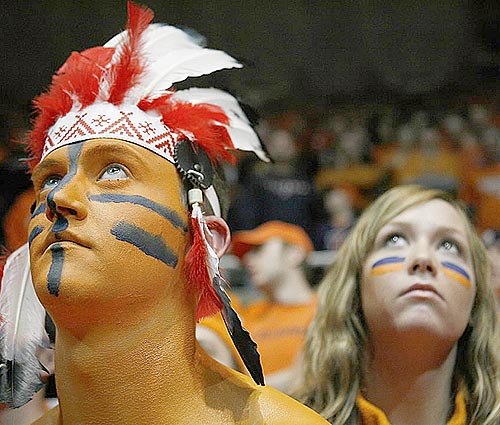
Below:  University of Illinois fans try to be something other than boring white people. I.e., to be brave and bold by proxy. "We're different...special...Indians!"

June 07, 2010

Stereotypes disappear "organically"?

To address the harm of Native stereotypes, I posted the following on Facebook:

Why do you think white men have broken so many treaties with Indians? It's because they consider Indians to be primitive people of the past--i.e., savages. It's because they believe the stereotypes.

Fight the stereotypes, change the perceptions, and recognize Indians as real people. Then our political, economic, and social systems will start giving Indians more respect.

Correspondent Michael Cooke responded as follows:Anytime a people explicitly abuses or exploits another people, it becomes necessary to dehumanize the people being abused or exploited. Not the other way around.

Your sense of causality is skewed.
Which led to the following debate:

Europeans conquered, then stereotyped?

No, Mike, your sense of history is skewed. As soon as Columbus discovered Indians, he started describing them as ignorant children rather than full-fledged people. That was before he decided to enslave them or his masters decided to conquer them.

In other words, the words (stereotypes) and actions go hand in hand. If anything, the stereotypes come first to justify the subsequent actions. If you're claiming they happen only after the fact, you're dead wrong.Rob, the point is that you're talking about history. Using this history to make a point about today is idiocy, the meme of saving and Christianizing savages has done a lot of damage, but it has no foothold in the modern world. That meme and anything comparable--is extinct.

The stereotypes that exist today are not comparable to what you are talking about, they do not offer license of a scale you speak of. To the extent they do, American Indians have it pretty easy easy compared to African Americans, who stereotyped as criminals, yield entire generations of African American men living in jail.

The problem with attacking stereotypes, is you end up also attacking yourself. As I'm a gay man, there's the stereotype of gay men as being flamboyantly effeminate. I'm not effeminate--but if I attack the portrayal of gay men as effeminate on television--what is the message I'm sending to the many Gay men that ARE effeminate? That they are wrong to be who they are?

And generally the problem with attacking stereotypes, is a huge issue of hypocrisy. If one stereotype is wrong, it's wrong to believe any stereotype, but that's not how the human mind is wired.

Stereotypes are conquered organically, my being openly gay, masculine and associating with non gay people is more effective than any protest--which just manufactures a new stereotype: "too sensitive." It's a tough thing to protest a stereotype because scale is critically important. Protesting in the streets suggests personal injury that simply is not credible. Letter writing, phone calls from political representatives--that's more appropriate a response suggesting: "we don't appreciate that"--which is perfectly reasonable.
Savage meme is "extinct"?!

Wrong again, Mike. The media portrays Indians as savages today, several times a week, frequently if not constantly. This is comparable in scope and magnitude to the portrayal of blacks as criminals.

The two stereotypes are similar and, in fact, related. They're both ways of portraying a major group of people as inferior and second-class. A bad person outside the bounds of society is a savage. Inside the bounds of society he's a criminal.

I've explained to you that we can overcome Native stereotypes the same way we overcame Irish, Jewish, and other stereotypes. Or are you claiming that American beliefs haven't shifted one iota since 1800 or 1900?

I've also explained to you that protests are a vital component of change. That no stereotypes have disappeared "organically" without accompanying action. If you disagree, give us an example of a negative stereotype that's vanished without any protests against it. Good luck with your answer...you'll need it.

You misread and misunderstood the sociologist's claims about gay acceptance, so it's no wonder you don't understand how social change works. Good thing you have me to explain it to you.

Letter writing and phone calls are both forms of protest. Once you agree that protests are good and useful, the question is merely what kind of protest is best. Go ahead and concede that protests are good and useful and then we'll discuss the details.Rob, I may not be right sometimes. But my perspective as a Gay person confronted personally with substantial prejudice and discrimination in life, unknown to you as a heterosexual white man, reflects real experience you could learn from if you could suspend your emotional need to be right all the time.

I've lived social change and been a part of it--a good sociologist would listen to me.

Can you name a single street protest over JUST Black stereotypes?

Jewish stereotypes?

Irish stereotypes?

Women stereotypes?

Protests in the streets require bigger problems than stereotype, like prejudice. Whether the prejudice or the stereotype came first--the problem, the prejudice, gets the attention, all the time, every time.

Malcolm X was talking about prejudice, double standards and equal rights--he certain held in contempt the idea Black people should give a flying fuck what White people thought.

Martin Luther King had a dream, not that stereotypes would cease to exist, but that legally and morally the law represented all men being created equal.

The stereotype of Indians as 'savages' never has a modern context and the stereotype has been thoroughly white washed with 'nobility' and 'spirituality' in modern fictions. Stereotypes divorced from the modern world cannot even be compared to stereotypes believed of living people today.
Rob gives examples, unlike Mike

You must be thinking of your emotional need to bolster your ego at others' expense, Mike. The vast majority of your comments are criticisms of my postings. Why don't you try saying something positive for once rather than sniping at me?

Did I say anything about street protests in this posting? Nope. You keep changing the subject when I kick your butt on the previous subject. Nice trick if you can get away with it.

Let's stick to the subjects at hand: Attacks on Indians preceded stereotypes? Wrong. "Savage" Indian stereotypes are historical and "extinct"? Wrong. You're batting .000 as far as I'm concerned.

Unlike you, I can give examples to bolster my position. For instance, when Mel Gibson, Don Imus, and Michael Richards made racist or stereotypical comments, people protested. I don't know if there was a street component to the protests, but it doesn't matter. A street component couldn't have hurt and might've helped.

In any case, the protests caused these figures to recant their remarks and apologize. Whether the protests would've worked even better with more or less of a street component is a detail. The key point is that they worked.

College students frequently protest against blackface parties and nooses hung in "fun" as well as anti-Indian incidents. Are you really ignorant of these protests? Here are a few of dozens of examples I could provide:

Racism and Anti-Racist Protests at U. of California, San Diego

Jim Crow-Style Justice in the "New South": On the March Against Racism

Racist graffiti at Olympic College elicits protest

Noose on Door at Columbia Prompts Campus Protest

Cambridge protests Islamophobia on campus

NAACP joins protest against Clinton nickname [Redskins]

Your "people protest prejudice, not stereotypes" is another dodge. First, you give no examples, just your opinion. That's basically worthless.

Second, people can and do protest both together. The stereotype is the marker of the prejudice, the face of it. No one protests prejudice in the abstract without giving an example of it. It's always, "Prejudice is bad, and riding in the back of the bus or sitting at a segregated counter proves it." Similarly, a Native protest might go, "Prejudice is bad, and stereotypical sports mascots and 'Dudesons' episodes prove it."


Read the sign, dudeson. Protests against "superficial" stereotypes and the underlying racism are inextricably bound. Experienced protesters understand this even if you don't. Perhaps that's because they've been protesting since the 1960s when you were in diapers.

Protests aren't informative?!

Protests can and do provide "new information." The information is that Native aren't dead and gone. That they don't look like Plains chiefs and braves. That they aren't drunk or high on some remote reservation. That they're modern-day people who live next door, watch the news, and get hurt by what they see. The "old information" is what the typical American believes, and a protest contradicts this with new information.

As excellent example of the efficacy of protests is how they've eliminated hundreds if not thousands of Indian mascots. You continue with your silly belief that these mascots would've faded away anyway and I'll keep restating the facts. Indians protested => mascots removed. Cause and effect. Case closed.

As for "My response suggested all stereotypes that have been undone, became undone without protest." Thanks for another of your "suggested" opinions. When you have any evidence for this opinion, feel free to provide it. Until then, let's reiterate that you haven't given us a single example of your claim.

I'm not even sure what "The stereotype of Indians as 'savages' never has a modern context" means. It sounds like academic bafflegab designed to obscure the fact that you don't know what you're talking about. Try again.

It also sounds wrong. As I said, the "savage" meme comes up frequently today, in subjects ranging from government funding to Indian gaming to entertainment. Since you don't even know if Indians are citizens, spare us your opinion on the so-called meme.

All I'm hearing from you is that Native stereotypes aren't significant so protests against them are useless overkill. Your ignorance on the first point renders everything else you've said null and void. You apparently don't have a clue how pervasive these stereotypes are.

When I posted something about hipster headdresses, you came up with excuses for them: Stereotypes Okay in "Cultural Commons"? and Headdresses = Fedoras? Now you're saying there are no "savage" stereotypes in a modern context such as a music festival, graduation ceremony, or fashion show. Since you've contradicted yourself, I guess you don't know what the hell you're saying.

Let's sum it up. I've been writing about Native stereotypes for almost two decades. I've been invited to speak at museums and conferences about the subject. You haven't. Until you know what you're talking about, don't bother us with more of your "opinions."

For more on the subject, see Valenti:  Movies Are Merely Movies and Do Protests Work?

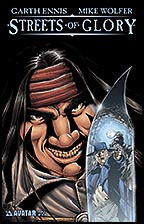
Below:  Some of the countless examples of the "savage Indian" meme today.


"Public" causes stereotypes?

Another comment on the debate in Valenti:  Movies Are Merely Movies:

"The public causes stereotypes, not the media." I love the image of parents telling toddlers on their laps that all Indians were chiefs who lived in teepees. Or hipsters in coffee shops debating whether Indian women are sexpots or "squaws." I love it, but it's comically stupid and absurd.

In reality, of course, the ratio of media impressions to personal conversations about Indians must be something like 1,000 or 10,000 to 1. That's a conservative estimate, I'd say. The actual ratio could be 1 million or 10 million to 1.

For more on the subject, see "What Americans Know ... Comes from Movies" and The Influence of Movies.

June 06, 2010

Valenti:  Movies are merely movies

Talent manager Michelle Shining Elk has gone out of her way to shield Saginaw Grant and the Dudesons from criticism of their participation in Cowboys & Findians. She posted this item on Facebook Sunday:The late Jack Valenti once told congress during a hearing that movies are merely movies. "I say, if people choose to believe movies are real then there is nothing we can do to save them."Another person who denies the obvious influence of movies. Another apologist for racism and stereotyping against minorities...sigh.

In response I posted this innocent query:

I wonder where Native stereotypes came from if not from old movies. I guess they spontaneously burst out of thin air?

This led to the following debate with her and others:Atta boy Rob! Good point, NOT!

There's this thing call the general public, or "main stream society." Wild west shows? Museum? Magazines, Picture books, etc. Oh but wait, movies have been around before man kind so you're right... first there was movie then man.

From Wild West Shows, from George Catlin, from Museums...and the public...

In addition Edward Curtis "staged" a lot of his photos of Natives yet wouldn't even do the decency to share their real names.
Rob replies

"The public" isn't an answer. People aren't born with knowledge of Indians. They get it from somewhere. The question is where.

Wild West shows were forerunners to Western movies. They stereotyped people in the exactly the same way--as whooping savages on the warpath. Indeed, their panoramic spectacles were similar to the big-screen experience. It's absurd to argue that one kind of phony show could influence beliefs but not the other.

Besides, few people have seen Wild West shows, so what's caused the stereotypes since the early 1900s? Why didn't they die out with the Wild West shows?

Museums? What museums? That must be a joke, since only a tiny fraction of Americans visit museums.

Magazines? What magazines? Another funny joke. The US magazine readership is small compared to US movie and TV audiences.

Besides, magazines and picture books are forms of media. Glad you agree with me that media is the problem. The only question is why you'll point to some forms of media but not others.

Edward Curtis photos are another form of media, thanks. Amazing that you think still photos would have an effect but not moving pictures. Explain to me why that is. I'd love to hear how one can affect public perceptions but not the other.


Toys are the source?Rob--I just said where they get the stereotypes, shows, and yes they still have Wild West shows at Knotts Berry Farm, Museums are the first place where movie producers go to get ideas about Indians--that their research and usually they have that non-native curator be their "cultural advisor" for their films. In a way, public pow-wows are damaging too, we need to educate, yet I hear too often that pow-wows are not a place to educate. Toy manufactures...people post about how damaging they are, yet "protestors" don't go after them, and that is produced all over the world. -- So that's where the stereotypes come from...I would say from toys on up...Last time I was at Knotts Berry Farm, the show didn't include Indians. It was more of a stunt show than a Wild West show. And only a tiny fraction of Americans have seen it. It's less than a drop in the bucket where the whole country is concerned.

I don't think I've seen a museum or curator listed as a source for a Native-themed drama. Museums certainly weren't a source for the Dudesons. And the point is that Americans don't visit museums, they watch movies and TV shows. These shows are conveying and perpetuating stereotypes even if the stereotypes originate somewhere else.

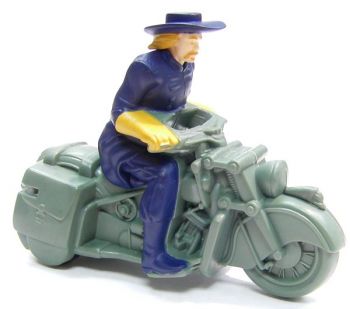
Toys? There was a huge outburst when McDonald's gave away a Custer toy with its Happy Meals in South Dakota. And another huge outburst at the King Philip's War game in New England, including a street rally in Providence. So you're flatly wrong about that.

Besides, people protest in proportion to the offense, and the Dudesons episode was the most offensive display of racism in recent memory. It's more deserving of protests than any toy I know of.

From toys on up...to stereotypical movies and TV shows like Cowboys & Findians. If that's what you mean, I agree.


The Valenti argument

Jack Valenti as a source for movie criticism...hysterical. Why don't you quote John Wayne too while you're at it?

If the choice is between non-Native movie apologist Jack Valenti and noted Native director Chris Eyre, I'll go with Eyre:Second to religion, I think movies have been the most damaging thing to Indians.Wild West shows are merely Wild West shows. Catlin paintings are merely Catlin paintings. Edward Curtis photos are merely Edward Curtis photos. Museums are merely museums. Magazines and picture books are merely magazines and picture books. Toys are merely toys.

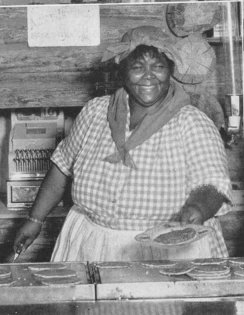
Heck, Stepin Fetchit and Aunt Jemima were merely Stepin Fetchit and Aunt Jemima. Minstrel shows were merely minstrel shows. Cross burnings were merely cross burnings. Etc.

So much for Valenti's childish defense of movies. We could apply it to every other form of media and "prove" that none of them have ever affected anyone's perceptions. We'd arrive at the absurd position that stereotypes can't exist because no form of media can convey them.

Still not clear why you're indicting every form of media but the most obvious one: the silver screen. I guess it's because you work in the industry. You're afraid to bite the hand that feeds you.

Fortunately, I don't face the same moral compromises. I call 'em like I see 'em. Repeat: The Dudesons episode was the most offensive display of racism in recent memory. Anyone who defends it deserves the "Uncle Tomahawk" label.


Shining Elk respondszzzzzzzzz You crackpot rhetoric is boring and tiresome Rob. You speak like a true white guy who doesn't get it and...well, you can't get it BECAUSE YOU ARE A WHITE GUY and have never lived life as an indian...

You are so stuck on the word stereotype--stereotype is just another word for DISCRIMINATION And seriously, like you can relate to anything we as Indians have experienced...as it relates to stereotypes and discrimination? Oh but wait, I'm sorry, you DO know what it's like to be discriminated against as an Indian by main stream society because you read about in a book or two and EVERYBODY knows how tight you are with your books and how everything that is written is the WORD. Just like the history books in school taught us the whole truth and nothing but the truth. I forget how brilliant you are with your books and all?!?!? Your ignorance slays me and your weird need to feel like you have the right to speak on matters like you know what you are talking about first hand perpetuates the ignorant stereotype that you fall into.
Sorry if I used too many big words and bored you, Michelle. Next time I'll try to write down to your level.

"Stereotype is just another word for discrimination"...that explains why some of us are protesting the Dudesons' stereotypes. It doesn't explain why you're defending them. I guess you don't mind discrimination any more than you mind stereotyping?

And...is that it? Thanks for proving you don't have a shred of an argument. You couldn't touch any of my claims, so you insulted me instead. A classic case of blaming the messenger for the message.

Or did you get a teenager to write your response for you? I can't tell since it sounds so juvenile. Books, education...ooh, scary! Really, your junior-high level of "debate" is sadly lacking.

Why don't you call MTV and ask them to give you, Saginaw Grant, and the Dudesons a humanitarian award? You know, for all you've done to promote accurate depictions of Indians in Hollywood? I'm sure they'd be willing to congratulate you for your apology on their behalf.

Yeah, movies and TV are harmless, parents are to blame...great. You couldn't have done better if they'd paid you to shill for them. You keep doing what you do best, Michelle...PR flacking for those who need it. Leave the reporting and analyzing to the rest of us.


Natives speak

Let's close with a few Native writers and thinkers who understand the problem better than you do. You know, the crackpots Natives whose views I share in my blog all the time? From The Harm of Native Stereotyping:  Facts and Evidence, enjoy!Beginning with Wild West shows and continuing with contemporary movies, television, and literature, the image of Indigenous Peoples has radically shifted from any reference to living people to a field of urban fantasy in which wish fulfillment replaces reality.

Dr. Cornel Pewewardy (Comanche/Kiowa), "Why Educators Can't Ignore Indian Mascots"

The media—radio, television, film—is powerful. The messages dominate our thinking, particularly when the viewer has little or no opportunity for firsthand observation. How many Americans see "Indians" anywhere but on the screen? And either way, who is able to distinguish fact from fiction?

Rennard Strickland, Ph.D, "Coyote Goes Hollywood," Native Peoples, 1/13/97

The film industry is arguably the most influential entity on the planet and is an almost universally accepted American icon. It shapes our views about almost everything, and American Indians are key players in the history and continuance of American film.

Paul Apodaca (Navajo/Mixton), "Apodaca: Hollywood Tragicomedy," Indian Country Today, 11/30/07
For more on the subject, see "What Americans Know ... Comes from Movies," Visual Verisimilitude in Movies, and "I Thought John Wayne Killed You All."

May 28, 2010

Children and Dudesons believe stereotypes

In a recent interview with Entertainment Weekly's PopWatch, the Dudesons talked about their show:

'The Dudesons in America' stuntman Jukka:  Finnish people heal pretty fast

Blogger Stephen, who originally brought the Dudesons to our attention, uses their own words to condemn them:

The Dudesons:  A RetrospectiveIn my mind, these quotes reveal three things about the Dudesons:

1. They thought of American Indians as a fundamental theme of America.

2. Their "research" consisted of simply brainstorming, stuff "we could think of," and gleaning ideas from "movies or cartoons."

3. They didn't think there was anything wrong with what they were doing.

Together, these three elements reveal a group of young men who were exposed to simple stereotypes and caricatures while growing up. They simply collected their thoughts, feelings, and childhood nostalgia for Indians, lumping them together into one hot mess known as "Cowboys and Findians."

Regardless of how you feel about the Dudesons or their honest intent, you have to agree that Indian stereotypes in popular culture played a fundamental role in the creation of this episode!

Cowboys and Findians is a perfect example of the pernicious nature of these stereotypes. Growing up in Finland, the Dudesons must have learned about America and American culture through cultural imports--particularly film and television. They probably received a steady stream of cowboy and Indian flicks (hence the stunt with the Findians trying to escape from jail). They only ever utilize the most salient and camera-friendly elements of native culture (feathers, totem poles, canoes, etc). And thanks to popular notions of noble savagery, the Dudesons' Indians are simultaneously savage and noble (catching fish with their mouths like wild beasts but also strong and brave with "balls of steel").

Lastly, they honestly didn't think they were ridiculing anyone because in their minds, the silly stunts and Indian motifs fit with what they learned growing up. How can you find something offensive if it feels so right and you know no alternative?

Right or wrong, the Dudesons would never have created this episode if it were not for the stereotypes that came before....
Comment:  Stephen calls this his Stereotypes Beget Stereotypes theory, which was the title of a recent posting of mine. His theory is obviously true. Like monkeys, people see something, they believe it, and they repeat it. When people repeat it often enough, it become the conventional wisdom--the standard way of thinking.

Maybe Buffalo Bill understood that he was promoting misleading Native stereotypes in his Wild West shows. Maybe the audiences understood it too--although I doubt it. But anyone who knew the truth of the situation died long ago.

Since then, people have been seeing and repeating Native stereotypes without the knowledge to separate truth from fiction. These days, a child's parents, teachers, friends, movies, TV shows, and books perpetuate the stereotypes without contradiction. Why would the child believe all these sources of information are lying?

It defies belief that our culture would engage in a society-wide propaganda effort to stereotype Indians. Yet that's essentially what's happening. Even most adults don't get it, so it's not surprising that children get taken in. They literally don't know any better.

Ignorant children and Dudesons

Most children don't know about the 560+ federally recognized tribes. They don't know about pre-Columbian civilizations, broken treaties, or termination policies. They know what they see. They go with the preponderance of evidence, a logical response in their situation.

If you see a hundred images of police officers helping people, you assume a police officer will help you when you need one. If you see a hundred images of planes flying, you assume the next plane you take will fly too. And if you see a hundred images of Plains Indians, you assume that's what an Indian looks like. Where there's smoke, there's fire.

Anyway, great analysis, Stephen. If everyone wrote more analyses like this and sent them to me, I could take a break now and then. So keep the good work!

For more on the Dudesons, see MTV vs. AIM on The Dudesons and The Dudesons, Polish Jokes, and Minstrel Shows. For more on what children think, see Students Draw What They Know and Seeing Indians Is Believing.

Below:  "All Indians paddle canoes."

March 22, 2009

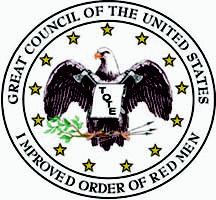
Improved Order of Red Men

Reflections on the 'Red Men'

Familiar downtown landmark holds hidden treasureMany years ago, where the MetroCenter mall now stands in downtown Binghamton, Red Men walked this land. They were led by a sachem, or chief. During ceremonies, they wore feather headdresses and held tomahawks. They measured time in "moons," and painted images on their lodge walls.

Truth be known, it wasn't really that many years ago. Their stomping ground was the Phil's Gift Shop building, and just to set the record straight, these were definitely not Native Americans!

In the early 1900s, 153-155 Washington St. was headquarters to a fraternal society, the Improved Order of Red Men. A quick check of IORM's original constitution reveals the irony--that in fact, only "white males of good moral character" were eligible to be "Red Men."

Originally, they were known as "Sons of Liberty," a secret society of colonists modeled after Native American tribes, that worked in resistance to the English Crown. As the story goes, in 1773 while British ships were moored off the coast of Boston, the Sons of Liberty, dressed as Native Americans, threw the famous Boston Tea Party.

After the American Revolution, the name was changed to "Order of Red Men" and membership steadily increased. By 1920, the organization had lodges in 46 states and would soon hit its peak with half a million members. Over the years, its members included George Washington, Thomas Jefferson, Franklin Roosevelt and constitution notwithstanding, even Richard Nixon.

Today, although greatly reduced in size, the IORM still exists. As stated on its Web site, the organization "is pledged to the high ideals of Freedom, Friendship and Charity."
Comment:  The Order of Red Men was an early example of Indian wannabe-ism. I noted its place in history in my essay The Political Uses of Stereotyping. I gave it a Stereotype of the Month entry when it came to my attention in 2004.

June 25, 2008

Mythologizing the American West

The Authentic History Center presents a good summary (with images) of the myth-making process that occurred after the Indian Wars.

The End of "The Indian Threat":  1881-1913

IntroductionIn the July 1891 edition of Century Magazine, an article appeared written by Major George W. Baird, in which he recounts his glory days as an Indian fighter under the command of General Nelson A. Miles. Illustrated with engravings by Frederic Remington, the article covers Mile's career from its beginning at Fort Dodge in 1874 to its conclusion six months earlier at Wounded Knee, where armed troops opened fire on a group of Big Foot's band of Lakota people killing 200-250 men, women and children who were illegally performing the Ghost Dance. Already by July 1891, Baird recognized that Wounded Knee represented the climax of what he called "the battle of civilization," and that the Indian threat in the West was now over. With White hegemony secured, Baird was now in a position to offer a more magnanimous approach to what remained of the "Indian problem":

There are but two goals for the Indians--civilization or annihilation...I feel for the Indians, not only friendly feeling but admiration for many of their qualities....The American people, those who really wish and hope to save the Indians from extinction and degradation, must be prepared to use great patience and summon all their wisdom.
The signal that a new day had come in the history of the West elicited two public responses. There was a new wave of reform, most evident in the creation of Indian boarding schools designed to civilize the Native through forced assimilation. And there was an acceleration of efforts to re-characterize this "battle of civilization" in the public imagination; to cast the Indian as an "other," distinct from Euro-American civilization and deserving of displacement to make the wilderness safe for the civilized farmer. Ever since 1881, when Sitting Bull surrendered at Fort Buford, every generation has recreated this historic conflict with the Plains Indians dramatically; in photographs, Wild West Shows, Victorian advertising, dime novels, paintings, early cinema, pulps, literature, comic books, movies, radio, and on television. That the Western genre of entertainment still thrives reflects the dominant culture's need to dramatize its history and to believe in the righteousness of that history's outcome. This section emphasizes the critical time period from 1881-1913, when the mythic American West became firmly entrenched in the popular imagination.
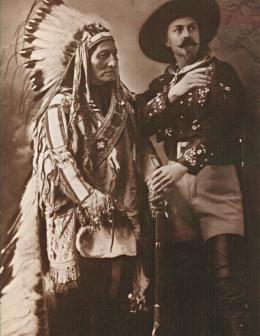
The Wild West ShowWhen Sitting Bull agreed to join Buffalo Bill's Wild West Show in 1885, he probably didn't realize he was about to make a major contribution to the stereotyping of the American Indian and the romanticizing of the American West in the popular imagination. Sitting Bull himself was a major attraction, as thousands of spectators turned out to catch a real-life glimpse of the infamous "Killer of Custer." A photograph of Sitting Bull with Buffalo Bill taken by William Cross in 1885 was one of the most popular souvenirs of the show. Invented in 1883 by Buffalo Bill, the Wild West Show became an enormous entertainment attraction well into the early Twentieth Century, particularly in the Eastern American cities. At the same time the real frontier was coming to a close, Eastern cities were filling up with native-born Americans and European immigrants who were wholly unfamiliar with the unique American frontier experience. Buffalo Bill and others gave it to them in the form of vaudeville-style theatrics that forever mythologized the West with their presentation of that rapidly vanishing way of life. Buffalo Bill even took his show to Europe in 1886, to wild acclaim.Victorian Trade Card AdvertisingWith the closing of the American frontier in the late Nineteenth Century and the success of the Wild West Show, Euro-Americans quickly came to see the Native American, especially the Plains Indian, in mythological terms, and as a people of the past. Once no longer a threat, the Noble Savage made a comeback. Though he never completely replaced the Ignoble Savage, the Noble Savage was appropriated to represent that vanishing culture, whose demise was inevitable, if tragic, given the march of White hegemony under the banner of manifest destiny. The demise of the Indian coincided with the rise of a new form of advertising; the Victorian trade card. These postcard-sized lithographed images were mass produced in the latter quarter of the Nineteenth Century and became the most important form of advertising of the era. They were widely distributed in stores and as premiums packaged with some products, and were collected by many Americans because of their often lush, colorful graphics. The manufacturers of trade cards catered to America's carnivalesque fascination with imagery, and they often mined the racial attitudes of the time to promote a sense of Euro-American middle class consumer solidarity. Blacks, Asians, Irish, and Indians were all marginalized in Victorian trade advertising in order to foster this sense of White American identity.Comment:  One thing missing from this analysis is the larger context. Perhaps because the owner doesn't have any artifacts or images from earlier times, he doesn't discuss earlier efforts at myth-making.

In fact, Euro-Americans have mythologized Indians ever since their first encounter. The Victorian Age may have been when this process culminated, but it began in the Age of Exploration. Every colonizer following Columbus had to deal with the "Indian problem." Namely, how to justify removing the human obstacles that were inconveniently in the way.

Remember the Boston Tea Party? The romantic odes to Pocahontas and Hiawatha? The paintings, statues, and coins with Indians representing "Liberty"? These were all part of the myth-making process.

I tried to explain how this happened in A Brief History of Native Stereotyping and why it happened in The Political Uses of Stereotyping. For more on the subject, check these postings out.