Showing posts with label Indian Wars. Show all posts

July 01, 2013

Town celebrates Indian killer Sheridan

Phil Sheridan Days returns to its former name

By Paul DaquilanteThe West Valley community of Sheridan has celebrated Sheridan Days each June for the past 14 years.

However, for more than 60 years—1934 to 1995—the event was known as Phil Sheridan Days. The celebration was named for a career U.S. Army officer stationed in the area before going on to become a celebrated Civil War general.

In a return to its past, Phil Sheridan Days will be held Thursday, June 20, through Sunday, June 23. But not without a sharply worded rebuke from the Confederated Tribes of Grand Ronde, which is asking organizers to reconsider on the grounds that Sheridan’s contempt for Native Americans was well-documented.
The rebute in question:Reference to Gen. Phil Sheridan was dropped at the joint request of the tribe and the popular casino it operates in Grand Ronde. Sheridan led a brutal military campaign against local tribes, making him a hated figure in their history, and the planning committee agreed to respect tribal wishes.

Reyn Leno, who chairs the Grand Ronde Tribal Council, termed the reversal of that decision this year a “sad commentary on the local community.” He said it showed a lack of respect for Sheridan’s neighboring tribal community.

“The Confederated Tribes of Grand Ronde is seriously disappointed in the decision to rename Sheridan Days to Phil Sheridan Days,” he said. “While the general may be lauded for his role in the Civil War, his treatment of Native Americans was shameful.”

He said the tribe is asking the committee to reconsider honoring a man responsible for indiscriminate hanging of tribal ancestors and credited with uttering the infamous quote, “The only good Indian is a dead one.”

Leno said the tribe was a proactive partner in the original change from Phil Sheridan to Sheridan Days.

“We have supported this community celebration over the last few years,” he said, making the change a slap in the face.
More on the man himself:

Philip SheridanIn August 1867, Grant appointed Sheridan to head the Department of the Missouri and pacify the Plains. His troops, even supplemented with state militia, were spread too thin to have any real effect. He conceived a strategy similar to the one he used in the Shenandoah Valley. In the Winter Campaign of 1868–69 he attacked the Cheyenne, Kiowa, and Comanche tribes in their winter quarters, taking their supplies and livestock and killing those who resisted, driving the rest back into their reservations. Professional hunters, trespassing on Indian land, killed over 4 million bison by 1874, and Sheridan applauded: "Let them kill, skin and sell until the buffalo is exterminated." When the Texas legislature considered outlawing bison poaching on tribal lands, Sheridan personally testified against it, suggesting that the legislature should give each of the hunters a medal, engraved with a dead buffalo on one side and a discouraged-looking Indian on the other.

Eventually the Indians returned to their designated reservations. Sheridan's department conducted the Red River War, the Ute War, and the Great Sioux War of 1876-77, which resulted in the death of a trusted subordinate, Lt. Col. George Armstrong Custer. The Indian raids subsided during the 1870s and were almost over by the early 1880s, as Sheridan became the commanding general of the U.S. Army.

Comanche Chief Tosawi reputedly told Sheridan in 1869, "Me, Tosawi; me good Injun," to which Sheridan supposedly replied, "The only good Indians I ever saw were dead." Biographer Roy Morris Jr. states that, nevertheless, history credits Sheridan with saying "The only good Indian is a dead Indian." This variation "has been used by friends and enemies ever since to characterize and castigate his Indian-fighting career."
Comment:  For more on related subjects, see Baseball Team Offers Custer Bobbleheads and Capitalism Killed the Indians.

October 12, 2010

Capitalism killed the Indians

Exposing the GOP's Shameful Historical Role in the Native American Genocide

How the Native American extermination campaigns merged the dangerous forces of a standing army with the business/political interests of the Republican Party.

By Thomas DiLorenzo


How the situation started:The real culture of violence in the American West of the latter half of the 19th Century sprang from the U.S. government’s policies toward the Plains Indians. It is untrue that white European settlers were always at war with Indians, as popular folklore contends.

Trade and cooperation with the Indians were much more common than conflict and violence through the first half of the 19th Century.

Terry Anderson and Fred McChesney relate how Thomas Jefferson found that during his time negotiation was the Europeans’ predominant means of acquiring land from Indians. By the 20th Century, some $800 million had been paid for Indian lands.
The first half of the 19th century gave us the War of 1812, the Black Hawk War, the Trail of Tears, and the Seminole Wars, so I'm not sure trade and cooperation were "much more common."

Perhaps trade and cooperation were much more common in the 18th century. In the first half of the 19th century, it was more like 50% cooperation and 50% conflict. In the last half of the 19th century, it became almost 100% conflict.
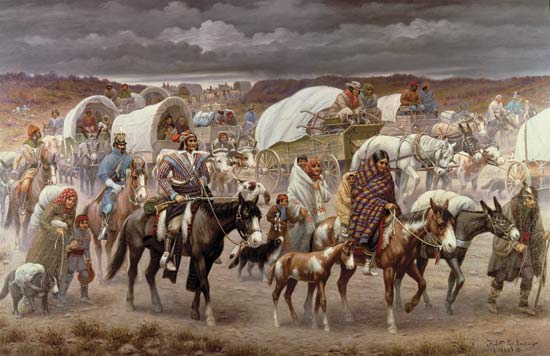


Civil War ended...what's next?

How the situation changed after the Civil War:A standing army, according to Anderson and McChesney, “creates a class of professional soldiers whose personal welfare increases with warfare, even if fighting is a negative-sum act for the population as a whole.”

The change from militia to a standing army took place in the American West immediately upon the conclusion of the War Between the States. The result, write Anderson and McChesney, was that white settlers and railroad corporations were able to socialize the costs of stealing Indian lands by using violence supplied by the U.S. Army.

On their own, they were much more likely to negotiate peacefully. Thus, “raid” replaced “trade” in white–Indian relations. Congress even voted in 1871 not to ratify any more Indian treaties, effectively announcing that it no longer sought peaceful relations with the Plains Indians.
Why the situation changed:On June 27, 1865, General William Tecumseh Sherman was given command of the Military District of the Missouri, which was one of the five military divisions into which the U.S. government had divided the country.

Sherman received this command for the purpose of commencing the 25-year war against the Plains Indians, primarily as a form of veiled subsidy to the government-subsidized railroad corporations and other politically connected corporations involved in building the transcontinental railroads.

These corporations were the financial backbone of the Republican Party. Indeed, in June 1861, Abraham Lincoln, former legal counsel of the Illinois Central Railroad, called a special emergency session of Congress not to deal with the two-month-old Civil War, but to commence work on the Pacific Railway Act.

Subsidizing the transcontinental railroads was a primary (if not the primary) objective of the new Republican Party.
And:Sherman wrote in his memoirs that as soon as the war ended, “My thoughts and feelings at once reverted to the construction of the great Pacific Railway. … I put myself in communication with the parties engaged in the work, visiting them in person, and assured them that I would afford them all possible assistance and encouragement.”

“We are not going to let a few thieving, ragged Indians check and stop the progress [of the railroads],” Sherman wrote to Ulysses S. Grant in 1867. [See Michael Fellman’s Citizen Sherman: A Life of William Tecumseh Sherman.]


How to eliminate the Indians

The final solution to the "Indian problem":President Grant made his old friend Sherman the army’s commanding general, and another Civil War luminary, General Phillip Sheridan, assumed command on the ground in the West.

“Thus the great triumvirate of the Union Civil War effort,” writes Sherman biographer Michael Fellman, “formulated and enacted military Indian policy until reaching, by the 1880s, what Sherman sometimes referred to as ‘the final solution of the Indian problem.’”

What Sherman called the “final solution of the Indian problem” involved “killing hostile Indians and segregating their pauperized survivors in remote places.”

“These men,” writes Fellman, “applied their shared ruthlessness, born of their Civil War experiences, against a people all three [men] despised. … Sherman’s overall policy was never accommodation and compromise, but vigorous war against the Indians,” whom he regarded as “a less-than-human and savage race.”

All of the other generals who took part in the Indian Wars were “like Sherman [and Sheridan], Civil War luminaries,” writes Sherman biographer John Marszalek. “Their names were familiar from Civil War battles: John Pope, O. O. Howard, Nelson A. Miles, Alfred H. Terry, E. O. C. Ord, C. C. Augur . . . Edward Canby . . . George Armstrong Custer and Benjamin Garrison.” General Winfield Scott Hancock also belongs on this list.
Not coincidentally, the second half of the 19th century is when the first inklings of mass media started appearing. Americans started seeing touring shows of paintings...dime novels...Wild West shows...and the first photographs. These featured cowboys and Indians prominently.

Our national mythology of cowboys and Indians came about precisely because we were prosecuting a war against the Indians. Thus we cast ourselves as the brave, noble cowboy-soldiers in the mold of George Armstrong Custer and Theodore Roosevelt. This model would become enshrined in the national consciousness by Western movies starring John Wayne and other cowboy heroes.

Meanwhile, we had to demonize the Indians so we had a "valid" reason to kill them. So we folded them all into a single set of Plains chief and warrior stereotypes. Because acknowledging that many tribes had signed treaties and were at peace with the US didn't fit the national narrative. And we started to demonize Indians with terms like "dirty," "thieving," "ragged," "degenerate," "vile," "bloodthirsty," and "murderous." Words that may have been neutral, like "redskin" or "squaw," started to become epithets.
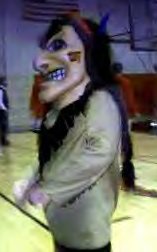


Propaganda needed to prosecute war

The public had been divided on the Indian issue. The Indian Removal Act had passed by only one vote, and people were appalled at some of the Army massacres. The Nazi-style propaganda campaign swung public opinion against the Indians--just as it did the Jews half a century later. It made extermination seem like a sad but necessary choice.

Even artists (authors, poets, painters) who were usually sympathetic to the underdog chimed in with paeans to the vanishing Indian. The liberal/romantic/sentimental view was that Indians were doomed to disappear as a result of inevitable "natural" forces. The conservative/pragmatic/business position was that we had to get rid of the Indians by hook or crook.

Almost no one took the position that, hey, the Indians were here first, had a valid way of life, and signed treaties to guarantee their rights. Maybe we could practice what we preach and treat them with Christian kindness rather than destroy them as devils. You know, give them part of the country and coexist with them rather than kill them and take everything they own.

How the extermination was carried out:Sherman announced his objective as being “to prosecute the war with vindictive earnestness . . . till [the Indians] are obliterated or beg for mercy.” According to Fellman, Sherman gave “Sheridan prior authorization to slaughter as many women and children as well as men Sheridan or his subordinates felt was necessary when they attacked Indian villages.”

In case the media back East got wind of such atrocities, Sherman promised Sheridan that he would run interference against any complaints: “I will back you with my whole authority, and stand between you and any efforts that may be attempted in your rear to restrain your purpose or check your troops.” [Fellman’s Citizen Sherman]

Sherman and Sheridan’s troops conducted more than one thousand attacks on Indian villages, mostly in the winter months, when families were together. The U.S. army’s actions matched its leaders’ rhetoric of extermination.

As mentioned earlier, Sherman gave orders to kill everyone and everything, including dogs, and to burn everything that would burn so as to increase the likelihood that any survivors would starve or freeze to death.

The soldiers also waged a war of extermination on the buffalo, which was the Indians’ chief source of food, winter clothing, and other goods (the Indians even made fish hooks out of dried buffalo bones and bow strings out of sinews).
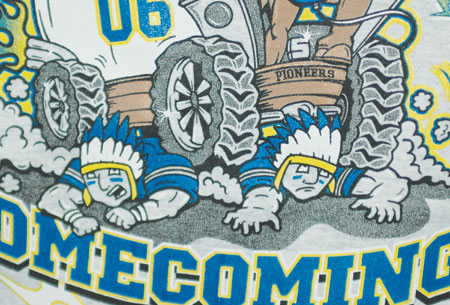

Genocide is as genocide does

This puts the lie to everyone who has claimed genocide wasn't an "official" American policy. Sure, Congress didn't pass a Kill the Indians Act, but who cares? The people in charge--Grant, Sherman, Sheridan, et al.--established US policy by their words and deeds.

They didn't need to pass a law to launch the Indian Wars. They did it by executive decisions and military orders. And their intent was plain: to figuratively or literally exterminate the Indians. To clear the land for railroads, ranchers, miners, settlers, and other "good Christian" capitalists.

For more on the subject, see:

Indian in the Living Room
Muslims killed thousands, Christians didn't?!
Review of Waterbuster
Tim Wise on Ward Churchill
America is Ground Zero to Indians

Etc.

March 14, 2010

Replace Grant on $50 bill?

A columnist makes the case for Ulysses S. Grant's greatness as president.

Who’s Buried in the History Books?

By Sean WilentzRONALD REAGAN deserves posterity’s honor, and so it makes sense that the capital’s airport and a major building there are named for him. But the proposal to substitute his image for that of Ulysses S. Grant on the $50 bill is a travesty that would dishonor the nation’s bedrock principles of union, freedom and equality—and damage its historical identity. Although slandered since his death, Grant, as general and as president, stood second only to Abraham Lincoln as the vindicator of those principles in the Civil War era.And:For Grant, Reconstruction always remained of paramount importance, and he remained steadfast, even when members of his own party turned their backs on the former slaves. After white supremacists slaughtered blacks and Republicans in Louisiana in 1873 and attempted a coup the following year, Grant took swift and forceful action to restore order and legitimate government. With the political tide running heavily against him, Grant still managed to see through to enactment the Civil Rights Act of 1875, which prohibited discrimination according to race in all public accommodations.

Grant did not confine his reformism to expanding and protecting the rights of the freed slaves. Disgusted at the inhumanity of the nation’s Indian policies, he called for “the proper treatment of the original occupants of this land,” and directed efforts to provide federal aid for food, clothing and schooling for the Indians as well as protection from violence. He also took strong and principled stands in favor of education reform and the separation of church and state.
Other sites chime in about Grant's noble intentions toward Indians:

Domestic AffairsNative American Policy

In his first inaugural address, Grant pledged to rethink the treatment of Native Americans, referring to them as "the original occupants of this land." He wanted to shift federal Indian policy toward what became known as the Peace Policy. This approach attempted to move Indians closer to white civilization (and ultimately U.S. citizenship) by housing them on reservations and helping them become farmers. To address corruption in federal Indian affairs, Grant created a new Board of Indian Commissioners headed by philanthropic leaders. The board recommended the government stop using political appointees as Indian agents. Grant adopted that recommendation and turned to missionaries--especially Quakers--and Army personnel to serve as agents.

However, these changes fell short of radically altering conditions for Native Americans in the United States. White settlers, with governmental support, continued to push Indians aside to take land, and they relied on the Army to prevent Indian attacks. At the same time, Native Americans on reservations had little chance of creating farms out of desolate pieces of land and were beset by poverty and desperation. While Grant's approach marked an improvement in U.S. Indian policy, it is remembered more for its good intentions than for lasting changes.
Ulysses S. GrantGrant's attempts to provide justice to Native Americans marked a radical reversal of what had long been the government's policy: "Wars of extermination ... are demoralizing and wicked," he nobly told Congress. The president lobbied, though not always successfully, to preserve Native American lands from encroachment by the westward advance of pioneers.Comment:  Wow. Those settlers pushed Indians aside? That was rude of them. Perhaps they needed an etiquette course from Emily Post.

And Grant "lobbied" to stop this rude behavior? Whom exactly did he lobby? Was someone else in charge of federal Indian policy? With all his executive powers, he couldn't do anything except lobby? Despite being Commander-in-Chief, he couldn't order the Army to act?

Poor guy! He wanted to help the Indians, but couldn't. Like Bush after receiving the August 2001 memo that Bin Laden was going to strike, he was powerless to do anything.

Assimilation is for Borg

A couple of problems with these claims about Grant. First, moving Indians "closer to white civilization (and ultimately U.S. citizenship) by housing them on reservations and helping them become farmers" was a negative policy, not a positive one. It meant breaking the treaties they signed, destroying their way of life, locking them up on barren land, and compelling them to change their culture and religion. It was part of the genocidal approach aptly characterized as "kill the Indian, save the man."

Second, was anything else happening during Grant's two terms (March 4, 1869–March 4, 1877)? Anything else these postings might've forgotten to mention? Perhaps the following?

Indian Wars Timeline
  • July 11, 1869: Battle of Summit Springs.
  • January 23, 1870: Marias Massacre.
  • April 30, 1871: Camp Grant Massacre.
  • 1872–1873: Modoc War.
  • December 28, 1872: Salt River Canyon Battle.
  • March 27, 1873: Battle of Turret Peak.
  • 1874–1875: Red River War.
  • June 27, 1874: Second Battle of Adobe Walls.
  • September 28, 1874: Battle of Palo Duro Canyon.
  • 1876–1877: Black Hills War.
  • March, 1876: Battle of Powder River.
  • June 17, 1876: Battle of Rosebud.
  • June 25-26, 1876: Battle of the Little Bighorn.
  • July 17, 1876: Battle at Warbonnet Creek.
  • September 8, 1876: Battle of Slim Buttes.
  • November 25, 1876: Dull Knife Fight.
  • 1877: Nez Perce War.
  • Grant the peacemaker?

    Oh, yeah...now I remember. Ulysses S. Grant was in charge of the freakin' military during eight bloody years of the Indian Wars. His so-called "Peace Policy" included many deadly attacks on and massacres of Indians.

    In one sense, his Peace Policy worked. "We are not going to let a few thieving, ragged Indians stop and check the progress of the railroad," General Sherman wrote to Grant in 1867. After his men killed them, the Indians definitely became more cooperative, as corpses often do.

    In other words, Grant's policy amounted to "the only good Indian is a dead Indian." Nice.

    "Thanks but no thanks for your so-called peace," I imagine the Indians responded. "Next time you want peace, how about if you actually seek it? How about if you don't launch wars to destroy our cultures, overthrow our governments, and impose your 'democracy' on us?

    "How about if you obey the treaties you negotiated and signed instead? You know, like the Treaty of Fort Laramie ratified just one year before you took office? Why haven't you enforced these treaties, you bloated bag of excrement?"

    I'm not in favor of replace Grant on the $50 bill with Reagan or anyone else. Several of our so-called "great" presidents earned their reputations via the death or destruction of Indians. But let's not ignore Grant's crimes too much. He was one of several men who waged ruthless war against the Indians. As much as anyone, he responsible for ending their independence.

    For more on the subject, see Mythologizing the American West and Fun 4th of July Facts.