By Rob CapricciosoThe Indian woman who fought the U.S. government—and won—has lost her battle with cancer. Blackfeet Nation tribal citizen Elouise Cobell passed away Sunday evening at age 65 in Great Falls, Montana. Diagnosed with cancer last year, Cobell reportedly had surgery in April at the Mayo Clinic in Rochester, Minn., for what she described then as “a serious cancer.” The type of cancer has not been released.
Born one of eight children on the Blackfeet Reservation on Nov. 5, 1945, Cobell was a great granddaughter of Mountain Chief, a historical Indian leader of the West, and was given the Indian name “Yellow Bird Woman.” She became well-known throughout the United States after she filed a historic lawsuit in 1996 with four other Native Americans, alleging that the federal government had mismanaged the trust funds of more than 500,000 American Indians. After a long court battle, Cobell and her lawyers agreed to a $3.4 billion settlement in December 2009 that Congress ratified in December of 2010. President Barack Obama then signed the agreement into law, and U.S. Senior District Judge Thomas F. Hogan granted final approval this June. Final financial awards are pending appeal due to some controversial aspects of the settlement. As the appeals process continues, U.S. Department of the Interior officials have been holding consultation sessions with tribal leaders and citizens on aspects of the agreement.
When Obama met with Cobell in the Oval Office last December, he lauded her hard work, and upon her death, issued the following statement: “Michelle and I were saddened to hear about the passing of Elouise Cobell yesterday. Elouise spoke out when she saw that the Interior Department had failed to account for billions of dollars that they were supposed to collect on behalf of more than 300,000 of her fellow Native Americans. Because she did, I was able to sign into law a piece of legislation that finally provided a measure of justice to those who were affected. That law also creates a scholarship fund to give more Native Americans access to higher education, and give tribes more control over their own lands. Elouise helped to strengthen the government to government relationship with Indian Country, and our thoughts and prayers are with her family, and all those who mourn her passing.”
Despite the controversies related to that settlement, Cobell was well-respected in Indian country because of her willingness to take on a battle so huge. Many times throughout her case, the federal government placed formidable roadblocks in her way, but she pressed on. Her lead lawyer, Dennis Gingold, called her a “warrior woman” soon after the settlement was announced.Elouise Cobell, lead plaintiff in Indian trust fund lawsuit, dies at 65In part, Ms. Cobell used funds from her own 1997 "Genius Grant” from the John D. and Catherine T. MacArthur Foundation's Fellows program to fund the cost of the lawsuit.
In 2005, she received a Cultural Freedom Fellowship from the Lannan Foundation, an award that cited her persistence in bringing to light the “more than a century of government malfeasance and dishonesty” with the government-run Indian Trust.
Two years later, she was one of 10 people given an AARP Impact Award (for making the world a better place), and in 2004 the National Center for American Indian Enterprise Development presented her with the Jay Silverheels Achievement Award. This year, she was named "Montana Citizen of the Year" by the Montana Trial Lawyers Association.
The Browning resident led a 15-year class-action lawsuit against the federal government that resulted in a $3.4 billion settlement approved by Congress late last year.
Cobell and the other plaintiffs sued the government for mismanaging the royalties of hundreds of thousands of individual Native American landowners.
Cobell and eight others will receive honorary degrees from Dartmouth at the college's June 12 commencement. Other recipients will include former President George H.W. Bush, comedian Conan O'Brien, actress Ruby Dee and New Yorker cartoonist Roz Chast.Comment: For more on the Cobell settlement, see Cobell Settlement Is No Victory and Obama Signs Cobell Settlement.
Cobell is no victoryHow can you morally bolster the Cobell settlement as any sort of victory in Native-United States relations? Do you feel no responsibility to this publication’s Native and non-Native readers?
Cobell, after 14 years of perseverance, is exhausted and due to her $15 million benefit from this case is severely biased when claiming that this will remove any sort of stain on the “national honor.” This settlement is a clear and utter abomination upon the definition and ideal of the American justice system.
You inserted quotation after quotation by senators and government officials that claim this is a fair settlement. How is any of it fair? How is it fair that the government does not have to be held accountable and admit the full amount of money that they have stolen from the individuals based upon the fact that they simply don’t want to? How is it fair that this same government acts as the defendant in the case and at the same time has the right to remove a judge when they don’t like his moral and ethical determinations? What other person accused of a crime would ever be allowed to do this?
This entire case boils down to the cliché of history repeating itself, the government yet again committing degradations and making up the rules to fit their agenda and Native peoples being left with no other choice than accepting whatever the offer no matter how minuscule. How is seven cents on the dollar a fair offer? Whose life will that change? In exchange for over 100 years of clear and distinct robbery the government is willing to offer an amount of money that won’t even last a month. [NCAI President] Jefferson Keel is wrong to state that this will somehow “settle historic injustices” or that this is an example of the government “meeting its obligations.” This is NOT bringing a close to an unfortunate chapter in American history, this is NOT a “fair deal,” this is NOT a “significant historic achievement,” this is NOT “honorable” or “responsible,” this is NOT “a major step forward,” this is NOT “victory for justice!”
Jen Bloom
Native American Studies Major
Bemidji State University
Bemidji, Minn.Comment: Interesting that Bloom criticized Indian Country Today for its previous article on the Cobell settlement. And interesting that ICT published this criticism.
Also interesting that one event can generate such divergent opinions. To some, settling the lawsuit after 15 years is a monumental achievement. To others, getting only a fraction of what they were owed is a monumental failure.
By Rob CapricciosoPresident Barack Obama signed the $3.4 billion Cobell settlement into law Dec. 8, signaling the end of one approval process necessary to get money into the hands of Indian class members. The ball now goes to the overseeing court, which is charged with ensuring the settlement is fair.
In a White House ceremony, the president signed off on Congress’ approval of a settlement to the long-running Cobell v. Salazar Indian trust fund lawsuit. The case was first filed in 1996, and went through numerous court proceedings until last December when the Obama administration announced a deal with Indian plaintiffs.And:Still, there are many in Indian country who do not see the terms as “a good deal for all.” Much of the concern centers on money, as many class members are expected to receive less than $2,000 under the plan, which designates a total of $1.5 billion for hundreds of thousands of class members to divide.
The plaintiffs had at times argued for a much larger financial settlement, but the leaders of the Cobell team decided that the terms involved in the Obama administration’s offer were the best that could be accomplished without continuing to fight for possibly many more years.Comment: For more on the subject, see Obama's and Cobell's Odd Behavior and Cobell Skit in Saturday Night Live.
By Jim KentObama made the suit disappear from the American political consciousness by giving the approximately 300,000 Native American plaintiffs $1.4 billion to divide among themselves. That's about $47,000 each - maximum. It's a nice piece of change if someone just walked up to you on the street and said: "Here's 47 Gs." It's chump change when you should have been getting $1,000 on land leases each month for decades and only received $70 per and a bureaucratic smile.
Odd behavior for a man who recently assured tribal leaders he would work with them to address the chronic problems of health care, economic development, land management and education in Indian Country.
"You will not be forgotten by this White House," Obama told Native American leaders. And, honestly, he didn't forget the Cobell lawsuit. He just forgot how to count.
Even more puzzling than Obama's behavior is that of Eloise Cobell, who called a $7 billion lawsuit settlement proposed in 2007 "an insult, plain and simple." Two years later she says $1.4 billion may "help break the cycle of poverty that has held too many families in poverty for generations."
Excuse me? Apparently, as "W" once negatively influenced people with his poor speech, Obama is doing the same with his poor math.Comment: To be fair, Elouise Cobell called the settlement a "bittersweet victory." But she accepted it rather than fighting on. Presumably she agreed to settle because she didn't think the plaintiffs could do any better.
Taylor Lautner hosted Saturday Night Live this week (airdate: 12/12/09). Nobody mentioned the Quileute Indians, but the Weekend Update segment did cover the Cobell settlement:
I've never seen "Billy Smith" before, but apparently he's a recurring character:
Billy SmithBilly Smith (played by Fred Armisen) is a Native American comedian who has performed stand-up on three Weekend Update episodes and made a small appearance in Liam Neeson's monologue in 2004. His jokes usually begin as fairly average stand-up jokes (why did the chicken cross the road?), but his punchlines suddenly veer into obscure references to Native American culture. This of course only results in confusion and nervous titters from the audience, at which point Billy Smith patiently explains the cultural reference so that the audience can understand the joke.Some thoughts on this character and skit:
With the straw hat and glasses, Billy Smith's appearance is decent. Only the long braid reminds us he's supposed to be an Indian.
His name is decent too. It's not the usual "funny Indian name" such as Billy Running Mouth or Chief Gag-a-Lot.
Smith has a stylized, formal way of talking. It's not as bad as the solemn chief-style talk you hear in movies and TV shows, but it's a little strange. One person on Facebook called it an "accent from fantasy land."
Maybe some Indians talked this way in the past, but nowadays an Indian accent is relatively rare. Indians pretty much talk just like everyone else.
The skit misstated the Cobell settlement, claiming every Indian will get a $1,000 check. No, only the Individual Indian Money account holders--maybe 1% of all Indians--will receive compensation.
Smith quickly veered from the Cobell settlement to tell his standard jokes. The punchlines were long, gobbledygook words from Smith's unidentified Indian culture. He translated them as a tree resin, a meal made of corn mash and rabbit, snowshoes made of porcupine quills, and an inflated skunk bladder. His final word supposedly meant "I'll be playing at the Mohegan Sun."
As usual, I'm not crazy about made-up words from made-up cultures. But at least the words translated to something realistic and non-stereotypical. Smith could've been talking about an Eastern Woodlands culture like the ones in New York state. He didn't joke about peace pipes, rain dances, or totem poles.
What it tells us
Saturday Night Live gave us a modern Indian character, which is still rare enough to deserve praise. But Billy Smith's quirks were enough to undercut any positive impact.
In addition to his speaking style, Smith's comedy routines are offputting. He comes across as a yokel who doesn't understand his urban audience. He uses odd Native words and cultural references and is surprised when listeners don't get them.
Apparently he's lived a sheltered reservation life and has little inkling of the wider world. Which is strange for a comedian who presumably plays the club circuit around the country. It's as if a Jed Clampett or Gomer Pyle left the boondocks to make his mark in comedy.
Even though this Indian looks and acts modern, he's woefully out of date. A 1960s Indian who left the rez might try these incomprehensible jokes, but today's Native comedians are as hip as anybody else. Which isn't surprising since they live in cities, drive SUVs or mini-vans, and run their own websites.
SNL left the impression that Indians are getting another government handout, which is bad enough. It also implied they're living rural, traditional lives that are out of touch with reality. I.e., they're stuck in some primitive backwater where things like computers, cellphones, and iPods don't exist.
On Facebook, Natives called this skit "lame," "stupid," "offensive," and "insulting." To me it's more lame than anything else. Note that you're not supposed to laugh at the comical Indian's jokes; you're supposed to laugh at the comical joke of an Indian. A skit making fun of an Indian's lack of awareness...how lame is that?
This skit is better than nothing, I suppose, but not a whole lot better. Shows like SNL can do much better. Put Charlie Hill or JR Redwater on the show and you'll see what a real Native comedian is like.
In the inevitable Twilight skit, Lautner played a teenage girl on "Team Edward" who argued with another girl on "Team Jacob." Again they didn't mention that the werewolf characters were Indians. Lautner looked suitably girlish in a long black wig, which viewers noted when he played an Indian boy in Twilight.
Anyway, Lautner showed a lot of charisma as well as some impressive martial arts moves. He probably deserves to be a budding star. In a few years he could be a leading man and action hero a la Tom Cruise. I could easily see him playing a Jackie Chan kind of role.
Good for him...but as I said before, a Native actor could've and should've been in this position. Hosting SNL, headlining the Tonight Show, getting starring roles such as the upcoming Max Steel. In other words, taking Hollywood by storm.
Just imagine if a Native actor were one of the hottest properties in the world. It could've triggered a paradigm shift in our perception of Indians. From isolated and out-of-date (Billy Smith) to cool and sexy (a Native in Lautner's place).
By Ann WoolnerIf the Indians had been AIG, the $3.4 billion settlement announced this week would have been many times larger. The real AIG--insurance giant American International Group Inc.--sopped up $180 billion in government aid after helping to create the economic havoc felt around the world.
The Indians sought no bailout, no handout when they filed suit in 1996 to claim royalties due them for oil, gas, timber, mining and grazing rights to lands allotted them under an 1887 agreement with the federal government. And:The government didn’t need precision when it doled out $180 billion to AIG and did it in a matter of days. Whether it was wise or foolish is beside the point.
The government had no obligation to do that. Or to bail out Chrysler or General Motors. It had no legal responsibility to rescue Wall Street’s hot-shot risk-takers.
The $3.4 billion the Indians got amounts to roughly a third of Goldman Sachs’s government bailout. It’s little more than one-tenth the loss the government expects to suffer from its AIG bailout.
Executives balk at the idea of capping pay at $500,000 in firms that haven’t repaid the government. The Indian settlement will come to $1,500 to $2,500 for most of the beneficiaries.Comment: To be clear, the Indian account holders didn't ask for a bailout. They asked only that the government calculate the money it owed them and then pay it.
But the accounting would've been difficult if not impossible. So the government had to come up with an arbitrary settlement figure.
The question is: Why didn't the government err on the generous side with Indian account holders the way it did with AIG and Goldman Sachs? Why not give them double or triple what they were owed as a penalty for the government's malfeasance? Why were the criminally negligent banks rewarded while the innocently victimized Indians weren't?
Answer: Because rich white people own and operate the banking firms. The rich white people in Congress protected their own while letting the poor brown people suffer. It's Hurricane Katrina all over again. Billions in taxcuts and bailouts for those who don't need them; pennies on the dollar for those who do.
On Wednesday's Jay Leno Show (airdate: 12/9/09), Jay Leno made a bad joke about the Cobell settlement. Here's the setup and the joke:LENO: Speaking of the budget, in his speech on the economy President Obama said this: "We have to continue to spend our way out of the recession." Now I don't know much about economics, but aren't we like a trillion dollars in debt? Spending our way out of the recession? Isn't that like trying to drink your way out of alcoholism?
LENO [shrugging]: I mean, I don't...I don't underst--[laughter and applause]
LENO: All right. I'm just saying.
LENO: And after a 13-year legal dispute over historical accounting mistakes by the Department of the Interior, the government has agreed to pay more than $3 billion in reparations to American Indians for the way they were treated. They're paying them $3 billion for the way they were treated.
LENO: To which black people said: "Hello?! Uh, Civil War?! Hello, slavery?! We're here!! Anybody!!"
KEVIN EUBANKS: I have a little Indian in me as well. [rimshot]
LENO [laughing]: Are you part Indian?!
KEVIN EUBANKS: I'm part--yes, I have a little Indian in me too.Comment: I'm sure Leno was just reading what some staff writer wrote for him. But wow...how stupid can you get?
He states that the government made accounting mistakes--true. Then he claims the settlement is for the way we treated Indians--false. The settlement is to pay for the accounting mistakes, big brain. Duhhh.
Unless Leno was referring to way the DOI "treated Indians" by losing their money, he misstated the case. Even if that's what he meant, "reparations" is absolutely the wrong word. When you pay someone what you owe them, it isn't reparations by any stretch of the imagination.
Besides, we know what Leno meant by his reference to black reparations for slavery. Blacks want reparations for the way we treated them...and so do Indians. Never mind the tedious business about the DOI's accounting mistakes. You know, the fact that the government was holding the Indians' own money in trust, not giving them taxpayers' money?
Sidekick Eubanks compounded the problem by claiming he's part Indian. The implication was that he's going to line up for a Cobell handout just like other Indians. In other words, that the settlement is a "politically correct" giveaway motivated by liberal guilt.
Perhaps Eubanks is part Indian, since many blacks are. Regardless, he won't get a penny of the settlement unless he's an Individual Indian Money (IIM) account holder. Neither will any other Indian.
Reactions on Facebook
Journalist Lise Balk King turned me on to Leno's bit 10 minutes before it aired on the West Coast, so I was able to TiVo it. Her initial reaction was: "Talk about misinformation for the millions watching Leno tonight...geez." Here are some of the ensuing comments on her posting:
What is the email address for Jay Leno? We need to let him know how wrong and offensive that view (joke) is.
We need to email and call the network tomorrow and make it known that a "correction" is expected ON AIR tomorrow night. I'll find the right people to contact and post their info...
It is insulting to Indian people and Black people. In the case of Indian people the settlement is about paying for damage done because of the mismanagement of land and money.
Jay should apologize for his lack of understanding. The Cobell settlement has the potential to be a major turning point in many Indian people's lives. Congress still must act, jokes based on lack of understanding hurt.
It was a joke, but not really. He segued into it after commenting on Obama's "spending your way out of a recession is like an alcoholic drinking their way out of alcoholism"...not a joke at all, a political commentary.
JAY LENO'S COMPANY CONTACT:
Big Dog Productions (818) 840-2299
This is the DIRECT phone number to the production department of the Jay Leno Show. Let's make their phones dance! Start now and leave messages.
To be clear, I am not saying Leno shouldn't have an opinion or make political commentary...it's all fair game...but he should get his facts straight! Being paid pennies on the dollar for mismanaged and missing trust funds is not "reparations" or any sort of "apology," and should not be misrepresented as such.
Don't apologize. Leno just any other responsible public figure has an obligation to get it right. We want to help him get it right.
Oh, I am definitely not apologizing...as a journalist, I want to be very clear and focused on the actual issue...and in this way Leno can't use the excuse of "it's political commentary, and not everyone will agree with me."
Many Indians are happy the US government finally settled the Cobell lawsuit. Not that many are happy with the settlement's details. Here are some reasons why:
For starters, the $3.4 billion settlement isn't as beneficial to the Indian account holders as I thought it was. Jacob T. Levy explains:
More on Cobell[T]he $3.4 billion headline figure for the settlement is misleading.
$1.4 billion will go to the plaintiffs. I think this is on the low end of conscionability: better than nothing, but nothing to be especially proud of on the government's part. I do think that the Clinton and Bush administrations bequeathed the Obama administration an exhausted plaintiff and plaintiff class, willing to settle for much less than they should have received.
$2 billion will go to a related cause: cleaning up the inalienable fractionated property holdings that plague Indian Country.Levy goes on to explain why buying the fractionated land is good. It should help Indians in the long run, but it won't pay the account holders for the money they lost.
So the account holders went from wanting $48 billion to hoping for $8 billion to settling for $1.4 billion. That's only three times the ridiculously low figure a judge said was proper. It's quite a comedown from the plaintiffs' original goals.
Some comments posted on Rob Capriccioso's article in Indian Country Today:To offer the documented heirs of an atrocity such a paltry payment is in line with the Colorado award of 1$ to Ward Churchill for "winning" the suit. If America truly wanted to settle the problem honorably America would pay enough for a genuine” capital nest egg” to those documented individuals who held out for so long and fought the fight so that they could start their business and feed their children.
A mere thousand dollars for each member, this is a national spit in the face of the Creator, the Son and the poor among our people and all living things. The IRA Tribal Governments shouldn't get one cent of this money to maintain the oppressive and repressive systematic Imperial structure of BIA and IRA that is killing our people, cultures and “Way of Life.”
Thank you Eloise Cobell for having the back bone to stand up to the Bureau and holding them accountable. We did not get what was entitled to us, but it was never for me, it was for our ancestors. They were the ones ripped off.Reactions from the AIM/activist end of the spectrum:
By Brenda NorrellThe same US government that brought us the home mortgage, seize-everything-you-have scam, and the bail-out-the-billionaires programs, now says it will benevolently buy up Indian land and give it back to Indians?
Right.
In the so-called settlement of the US Trust Fund lawsuit, the US says it plans to buy up Indian parcels and give the land back to Indian Nations.
The US has also made a big deal out of $1,000 or $1,500 payments to land owners for all the resources it has stolen.
What a joke. It is a bizarre agreement which prevents the US from paying Indian people what they are owed.Some comments from Norrell's readers:$47 billion gonna pay $1.4 and then use $2 billion to buy our lands ... dayum ... the fat takers are at work!!
Sounds like "fork tongue."
$2 billion to buy land from us? How much more land do they want to take away from us? They need to give back what was taken already, not thinking of making our reservations even smaller.
Do we have any tribal leadership that is going to back our interests? Or is it status quo?
That is just a drop in the bucket as far as I am concerned. That is only a portion of the interest that they are paying. The caretakers say their rent is way over due.
What about (1) the interest lost and (2) a penalty of mismanagement! Did I read individuals will receive $1,500? I wonder how much the lawyers will get off the top?
A prophecy says we will get our land back. It is just detail right now.
This deal smells as sweet as cow patties.Comment: There's only one problem with complaining about Indians getting the shaft. I haven't heard anyone suggest what the plaintiffs should've done differently. Hire better lawyers? Litigate for another 16 years? Hold out until the courts, Congress, and the public became so liberal they'd willingly pay 14 times what they're going to pay now? (48/3.4 = 14.1.) Wait for every account holder to die so the lawsuit became moot?
If someone came up with a solution that had a reasonable chance of working, I'd be the first to endorse it. Until that happens, this settlement is about the most the plaintiffs could accomplish. That's why we call it a "settlement"...because both sides have to settle for something they'd rather not.
Never too late to apologize?[D]o you think financial payments for events that occurred so long ago are justified/needed? Should financial reparations be extended to African-Americans for slavery? I know there are legal differences between the two cases, but there’s some moral symmetry… Comment: Here's the reply I posted:Actually, no, there are no similarities between the Cobell case and any reparations claims.
The Indians leased their land and the government held the payments in trust for them. Over the years the feds lost track of the money.
The settlement restores some of what the Indians are legally owed. It has nothing to do with reparations.
If you had a bank account and the government "lost" it after 50 or 100 years, would you shrug and say, "Oh, well...I don't want that old money anyway"? If so, you'd be about the only person in the world to feel that way.I suspect we'll be hearing a lot of "sticker shock" responses in the next few days and weeks. Especially from the usual conservative talking heads.
First they'll express outrage at the lawsuit's existence: "Where did this case come from? How come we've never heard of it? Is this some sort of scam or giveaway? Aren't the 'poor' Indians rich enough from casinos already?"
Then they'll express outrage at the settlement's amount: "$3.4 billion for a bunch of do-nothing, welfare-mooching socialists? Haven't we given these wretches enough? How long are we going to let them play the 'victim card' and bleed us for money?
"I guess they've found the perfect stooge in Barack Hussein Obama. They're playing on the Dems' liberal guilt to get a pile of cash they didn't earn. This is nothing but 'political correctness,' folks: paying reparations to the 'Injuns' to make us feel good about ourselves."
"We're fighting two wars, the economy's in the tank, socialized medicine is about to bankrupt us...but Barry wants to give a taxpayer bailout to a few whiny 'redskins'? Give me a break, people. This is the biggest pork-barrel scheme in the history of the world." (For the full effect, imagine Rush Limbaugh sneering these lines.)
Facts don't matter?
Forget about the facts of the case. Jagow quoted a good article on the subject after presumably reading it, then totally misstated the situation. If he can't get it right, imagine how Limbaugh and his fellow right-wing idiots will twist this case.
Maybe we'll be lucky and the largest government settlement in history will fly under their radar. But I wouldn't bet on it. Conservatives have attacked tribal sovereignty, legally-binding treaties, the reservation system, and Indian casinos as "reparations." I'm guessing they'll attack this settlement too.
Plaintiffs Compromise to Achieve Justice and Help Impoverished Indians, Ending 13-Year Battle with U.S. Departments of Interior and TreasuryThe American Indian Plaintiffs, in a long-running class action lawsuit against the federal government for mismanagement of the individual Indian trust, today announced a Settlement with the U.S. Department of the Interior and the U.S. Department of the Treasury.
Under the terms of the Settlement in Cobell v. Salazar, the federal government will create a $1.4 billion Trust Accounting and Administration Fund and a $2 billion Trust Land Consolidation Fund. The Settlement also creates a $60 million federal Indian Education Scholarship fund to improve access to higher education for Indian youth, and it includes a commitment by the federal government to appoint a commission that will oversee and monitor specific improvements in the Department's accounting for and management of individual Indian trust accounts and trust assets, going forward. This Settlement is believed to be the largest ever against the federal government and dwarfs the combined value of all judgments and Settlements of all Indian cases since the founding of this nation.
The agreement was announced today at a press conference at the Department of Interior by Elouise P. Cobell of Browning, MT, lead Plaintiff in the class action, U.S. Attorney General Eric H. Holder, Jr., and U.S. Secretary of Interior Kenneth L. Salazar.
"We have achieved a measure of justice and financial compensation for individual Indians whose trust accounts were mismanaged by our government," said Ms. Cobell, Executive Director of the Native American Community Development Corporation. "Indians did not receive the full financial Settlement they deserved, but we achieved the best Settlement we could. This is a bittersweet victory, at best, but it will mean a great deal to the tens of thousands of impoverished Indians entitled to share in its financial fruits, as well as to the Indian youth whose dreams for a better life including the possibility of one day attending college can now be realized."Obama administration moves to settle Cobell
By Rob CapricciosoThe litigation has centered on the argument that the government mismanaged billions of dollars in oil, gas, grazing, timber and other royalties overseen by the Interior for Indian trustees since 1887.
The case has gone through numerous appeals since it was first filed in 1996.
If the settlement is approved, a $1,000 check will be sent to each member of the class, said Associate Attorney General Tom Perrelli.
Then, a formula established by the U.S. District Court for the District of Columbia, the overseeing court, would provide more settlement funds to individual class members.
President Barack Obama said he was proud of the decision to settle.
“As a candidate, I heard from many in Indian country that the Cobell suit remained a stain on the nation-to-nation relationship I value so much,” the president said in a statement.
“I pledged my commitment to resolving this issue, and I am proud that my administration has taken this step today. …”
Elouise Cobell said that she was thankful to Interior for the gesture, adding she had thought the case would be settled long ago.
“Today we have an administration that is listening to us,” the lead plaintiff said. She had expressed dissatisfaction with the administration last spring that it had not focused on the issue more quickly.
Cobell said that there is “no doubt” that the settlement amount is “significantly less than the full accounting to with the class members are entitled.”
One settlement figure offered by lawyers for the Indian plaintiffs during legal proceedings was $47 billion.Some historical context on what the Indians could've and perhaps should've gotten:
Bush administration objects to Cobell data request Tuesday, September 11, 2007The Cobell plaintiffs, along with national Indian and tribal organizations, have called for a $27.5 billion payment, which includes interest. The figure is based on the assumption that a certain percentage of the $13 billion throughput was paid to the proper beneficiaries.
Independent experts have agreed that a settlement should be in the billions, with figures ranging from $6 billion to $10 billion. A bill that was introduced last year would have provided $8 billion to end the case.
The Bush administration, on the other hand, believes account holders are owed in the low millions. A counterproposal to the settlement bill would have provided up to $3.5 billion to end the Cobell case and extinguish any future damages claims.Comment: So the Indians got less than they thought they deserved: $27.5 to $48 billion. Less than independent experts thought they should get: $6-10 billion. And less than some members of Congress were willing to give them: $8 billion. But at least they'll get something.
In Indians to Get 1% of Money Owed, a judge ruled the Indians were due only $455 million. Fortunately, that ruling didn't stand, and the plaintiffs are getting eight times that amount. As with most settlements, the number could be better, but it could be worse.
After all the talking and consulting, this is a big achievement for the Obama administration. Much bigger than the tribal summit, which hasn't produced any concrete results yet. Obama has done what Clinton and Bush couldn't do: settle the trust-fund lawsuit.
This may be the most important piece of Indian legislation since Nixon signed his pro-Indian legislation in the early 1970s. Or at least since Reagan signed the Indian Gaming Regulatory Act in 1988. Kudos to Obama and everyone involved.
By Liz HalloranIn 2004, some estimates put the royalties owed at more than $137 billion. If it were only up to her, Cobell said Tuesday, she would have fought on for another 100 years to right the royalties wrong.
But other Indian leaders expressed relief at the long-sought settlement—and not just because the Obama White House had moved to devote money and effort to resolve the groundbreaking struggle.
The cost to the government to defend Cobell's class-action suit, coupled with the major issues it was set to resolve, had essentially brought to a halt government action on a host of other urgent issues in tribal communities—from law enforcement and water rights to health care and education.
Many tribal leaders and their legal representatives, stymied for years in their efforts to move other issues forward, had agitated for a settlement much earlier.
"The lawsuit created paralysis within the federal government's relationship with tribes in many areas," says Henry M. Buffalo Jr., a St. Paul lawyer representing Indian interests and member of the Red Cliff Band of Lake Superior Chippewa Indians.
"For many years, tribal leaders have been saying to the Cobell plaintiffs, 'You've got to get this settled,'" Buffalo says. "The [royalty] amounts are important, but from an operational standpoint, we needed to get it behind us."Comment: For more on the subject, see Obama to Settle Indian Trust Lawsuit.
Kempthorne’s last days marked by criticism over lavish spendingAccording to a report published Jan. 5 by The Washington Post, Kempthorne spent about $235,000 in taxpayer funds renovating a seldom used bathroom in his fifth-floor office. Interior officials told the paper that the renovations were made in 2008.
The expensive additions included the installation of a new shower, a refrigerator and a freezer. Wainscot wood panels, pricey tiles and monogrammed towels were also part of the package, according to the report.
The General Services Administration reportedly approved and partially funded the project, and an investigation by the department’s inspector general, Earl Devaney, found no wrongdoing on the secretary’s behalf because the GSA had approved the project.
Still, several news outlets and opinion leaders have derided what they’ve labeled lavish and unnecessary spending by Kempthorne, whose department encompasses the BIA.
Some American Indian leaders have found the bathroom imbroglio to be especially unsettling, since the interior, under Kempthorne, has argued that it should not have to pay financial settlements to American Indian plaintiffs of the ongoing Cobell v. Kempthorne trust fund lawsuit.
The case, which has gone through numerous appeals since it was first filed in 1996, involves approximately 500,000 American Indian plaintiffs who have made strong arguments that their trust assets have for decades been mismanaged by interior officials.
“I find it incredible that [Kempthorne] would spend so wastefully in this limited budget environment,” said W. Ron Allen, who serves on the executive board of the National Congress of American Indians and is chairman of the Jamestown S’Klallam Tribe.
“Indian country has so many needs, and it seems he has little qualms about just flushing our financial concerns down the toilet. … It’s not just him, either–but a host of government officials who just don’t care how they spend in the remaining days of an administration.”Comment: For more on the subject, see How the US Honors Indians and Bush Slaps Tribes in Face.
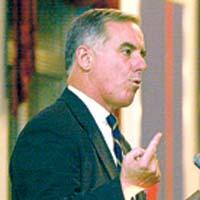
Obama organizer: American Indian votes crucialHoward Dean, chairman of the Democratic National Committee, rallied the crowd of more than 100 and said their communities will be crucial in electing Barack Obama.
"It is time to assume your rightful place in the political system of this country," Dean said.
Four or five Democratic senators owe their elections to Indian Country votes, Dean said.
Dean attacked Republican candidate John McCain, who led the Senate's Indian Affairs Committee, for his treatment of Eloise Cobell, the lead plaintiff in a multibillion-dollar Indian lawsuit against the federal government.
"He treated her like dirt. It was a disgrace. There's going to be a big difference between a John McCain presidency and a Barack Obama presidency for Indian Country," Dean said.