Showing posts with label treaties. Show all posts

September 18, 2014

"Nation to Nation" treaty exhibit

NMAI To Open New Exhibit Exploring Native and U.S. Relations

By Madeline McGillSince its opening, the National Museum of the American Indian (NMAI) has dedicated itself to the promotion of native identity and cultural understanding. Now celebrating the 10th anniversary of the D.C. museum, it is launching an ambitious exhibit this September that seeks to highlight the role of treaties between the United States and Native Nations.

Upon opening September 21, 2014, the exhibit “Nation to Nation: Treaties Between the United States and American Indian Nations,” will explore the Native diplomats and leaders who crafted some of the earliest agreements with the Founding Fathers.

Amongst the many artifacts expected to be on display, the exhibit will feature 8 prominent National Archive treaties from the approximately 374 ratified between the United States and Native Nations. These treaties will trace a timeline of diplomacy from first meetings to present, touching at the core of how U.S. and Native relations have impacted culture and development.

On September 8th, the NMAI welcomed the arrival of the Treaty of Canandaigua from the National Archives and Records Administration. Enacted between the Haudenosaunee (also known as the Six Nations or the Iroquois Confederacy) and the U.S., this treaty was signed by George Washington in 1794 to establish peace, friendship, and affirm land rights to the Haudenosaunee in modern day New York State.
Treaties Exhibit Ushers in 10 Years of American Indian Museum

By Bridget BowmanThe National Museum of the American Indian will open its first exhibit exploring the contentious issue of treaties between the U.S. government and Indian Nations next week.

“This exhibit is a tangible reminder of the federal government’s relationship with sovereign tribal nations of this country,” Senate Indian Affairs Chairman Jon Tester, D-Mont., said Thursday. “It’s also a reminder of the moral and legal obligations that the United States has to honor and uphold our treaties with Indian country.”

Tester addressed a group gathered at a day-long symposium at the museum discussing the exhibit. “Nation to Nation: Treaties Between the United States and American Indian Nations” opens Sept. 21, which is the 10th anniversary of the opening of the museum. The exhibit will continue until the fall of 2018.

Museum Director Kevin Gover said during a preview Tuesday that the display was years in the making and came at the request of a number of tribes and members of Congress.
Comment:  Some people live-tweeted comments during the day-long symposium discussing the exhibit. Here are the ones I retweeted:

Senator Jon Tester @SenatorTester · Sep 18
This exhibit is a tangible reminder of the federal government's relationship with the sovereign tribal nations. #NationToNation

Debbie Reese @debreese · Sep 18
Clinton: Early treaties re friendship became vehicles for land dispossession. #HonorTheTreaties #NationToNation

Mark Trahant @TrahantReports · Sep 18
Clinton: 1868 Ft Laramie, Lakota had won, US suing for peace. "If conquest" brings rights "we should be speaking Lakota."

Mark Trahant @TrahantReports · Sep 18
Clinton: IRA spurred "sovereign to sovereign" relationship req'g consent and negotiation. "Treatymaking is back." #HonorTheTreaties

Debbie Reese @debreese · Sep 18
Gover: Want to put concept of Native sovereignty into American's knowledge of American Indians. #NationToNation #HonorTheTreaties

Debbie Reese @debreese · Sep 18
Harjo: American's don't realize treaties are AMERICAN, too, made by American govt with Native Nations. #HonorTheTreaties #NationToNation

Debbie Reese @debreese · Sep 18
Gover: With tribes managing resources themselves, resources (salmon) are making comebacks. Good for all. #NationToNation #HonorTheTreaties

Debbie Reese @debreese · Sep 18
Listening to Macarro highlights (for me) how disgusting it is that California schools focus on missions. #NationToNation #HonorTheTreaties

Debbie Reese @debreese · Sep 18
Deloria: Task is to teach students that history matters to the present and future. #NationToNation

Debbie Reese @debreese · Sep 18
Cladoosby: Has US kept its word? George Washington made promises he didn't keep. #NationToNation #HonorTheTreaties

Debbie Reese @debreese · Sep 18
Cladoosby: "Sometimes I think we are more patriotic, maybe because we were on this land first, we love her more" #NationToNation

Mark Trahant @TrahantReports · Sep 18
"We can love this country despite the incredible, painful history ... despite promises not kept," Brian Cladoosby. #HonorTheTreaties

Debbie Reese @debreese · Sep 18
Gover: Congress apology to Am Indians, sponsored by Brownback, was buried, but signaled US beginning to acknowledge history

Mark Trahant @TrahantReports · Sep 18
Kevin Gover: NMAI act is an apology; yes US did these things. Thus the oppty to tell Native story and for US to listen. #HonorTheTreaties

Debbie Reese @debreese · Sep 18
Gover: History is being mis-taught in formal education systems in US. All of us have to un-learn those things. #NationToNation

Debbie Reese @debreese · Sep 18
Gover: Justice is achievable because Indians never give up. We always insist on a just outcome. #NationToNation

Debbie Reese @debreese · Sep 18
Harjo: Arguments that 'too much time has passed, therefore, move on' is bogus argument. Treaties matter. No end date. #NationToNation

You can see all the tweets on the symposium by searching the #NationToNation and #HonorTheTreaties hashtags in Twitter.

For more on treaties, see Myth of the Level Playing Field and Tamara Johnson Ad Sparks Outrage.

July 13, 2014

Myth of the level playing field

Conservatives often claim that racism is a thing of the past. That all races today are playing on a "level field." Here's a good takedown of that myth.

The level playing field myth

By âpihtawikosisânFirst, this [level playing field] argument invariably begins by acknowledging Europeans behaved very naughtily towards Indigenous peoples and that racism has certainly factored into that behaviour. Clark even mentions provincial and federal governments, so he does not contain these bad things in the distant past directly following Contact. Starting with this position allows one to recognize the racism and abuse inherent in the Residential School system, for example, while ignoring how contemporary Aboriginal child welfare policies are linked to that system.

However, in acknowledging the past but cutting it off from the present, there is a strong implication that at some point, Canada got itself sorted out and began dealing fairly with Indigenous peoples. The exact date of this occurrence is never mentioned, so the driving events that led to ‘the change’ vary greatly in the opinions of those making this claim. The idea is that policies and actions taken in the past were driven by inexcusable racism, whereas policies of today, if they fail Indigenous people, fail because of incompetence rather than malice or structural design.

This is a central pillar of the western liberal myth of a level playing field: recognizing that Indigenous peoples have legitimate grievances stemming from awful things that were done in the past, but that the advent of a modern democracy means that we are now all equals and we have an obligation to behave as such.

What this part of the argument always relies upon is the implicit notion that any remaining problems faced by Indigenous peoples stem from an inability for people living in Canada to commit to a standard of “equal citizenship and equality before the law.” This charge will be levied at First Nations leadership and Canadian politicians both. There is little need then to understand how historic injustice has molded and shaped conditions today, and continue to find structural expression within the Canadian context. There is even less need to deconstruct how ongoing injustices are inextricably rooted in that history. Instead, a bright line is drawn between the past and the present we could all be living in if only everyone embraced liberal democracy wholeheartedly.
Another posting has a complementary theme: how "human" or "equal" rights are different from indigenous rights. In other words, how Natives don't necessarily want or need a level playing field.

Human rights or Aboriginal rights?

Reflections on the UN Declaration on the Rights of Indigenous Peoples

By Peter Kulchyski
When I did read it closely, I found that the UN DRIP is a seriously flawed legal instrument. While it offers some specific language around Aboriginal rights issues, the DRIP reflects a notion that all this time Indigenous peoples around the world have been looking for human rights rather than Aboriginal rights. And the difference between these is not merely academic. Human rights, a product of the late 18th-century Enlightenment, are rights and freedoms that human beings enjoy inasmuch as they are human. They tend to be used to protect individuals and tend to be invoked in urban contexts. Everyone, on principle, has access to them. They reflect a universalizing notion of humanity and involve equal rights and freedoms that, at a minimum, all humans should enjoy. This includes Indigenous peoples inasmuch as they, too, are human.

Aboriginal rights, by contrast, are rights that only certain people, Indigenous peoples, have, by virtue of being Indigenous. In effect, Aboriginal rights reflect a notion of cultural particularism. Indigenous cultures have become threatened as colonialism left many Indigenous peoples as a minority in their own homelands. We do not all have Aboriginal rights, nor should we. Aboriginal rights stem from the struggles of Indigenous peoples. In a way, they could be seen as a specific form of customary rights, rights that developed over time through repeated practice of an activity, rather than abstract rights that reflect a notion of how all people are the same. Aboriginal rights have tended to be asserted in rural contexts and to emphasize social collectives.

This distinction is an important one, as human rights can be used in justifying attacks on Aboriginal rights. We saw this happen in 1968-69 with the White Paper, a set of policy proposals developed by the federal government that would have done away with the Aboriginal and treaty rights of Indigenous peoples in Canada by ensuring that they would become “equal” with all other Canadians. A human right to equality became the battering ram that threatened to destroy Aboriginal rights. Indigenous peoples in Canada fought a bitter but eventually successful struggle, momentously defeating the White Paper (at least as an official policy).
Kulchyski adds:In fact, most of the speeches that celebrated the passing of the DRIP tended to discuss it as an “extension” of the UN Universal Declaration of Human Rights. Extending universalism is tantamount to assimilation: it is the precise approach that Indigenous peoples have been fighting against for hundreds of years.Comment:  Natives are the original owners of the land, not a Johnny-come-lately minority that needs to embrace the Euro-American system of "equality." They belong to political entities that have government-to-government relationships with the US and Canada. As such, they have additional rights beyond a mere equality under the law.

It's wrong to pretend these political relationships don't exist, especially since they're enshrined in the US Constitution. If you don't like what the Constitution says, go ahead and amend it. Otherwise, keep your ignorant opinions to yourself.

For more on tribal sovereignty, see End Race Based Law Inc. and GOP Activist: "Sovereignty Is Bunk."

June 11, 2014

Tamara Johnson ad sparks outrage

Tamara Johnson election ad 'shocks' Anishinabek Nation

Chronicle Journal defends 'business relationship' with advertisersA full page Thunder Bay newspaper ad that appears to take aim at First Nations' treaty rights is sparking some outrage.

The ad, published in the Tuesday Chronicle-Journal by Libertarian candidate Tamara Johnson, has left some questioning why the paper agreed to run it.

"When I see things like that, it's just, it's stunning,” said Anishinabek Nation communications director Maurice Switzer.

Statements in the ad include: "Crown lands are public lands. Not native lands." "Help me stop this doctrine of entitlement."
Letter to the Thunder Bay Chronicle-JournalThis morning I read the following comments from your publisher on the CBC website:

“It’s important that we inform the public what … [the candidates'] opinions are … and when it’s advertising, it’s a business relationship. They write an ad and they let the community know what it is that they believe in.”

I understand and support wanting to provide accurate information of candidate’s opinion on a variety of platforms. I also understand that the advertising component is a business. However, I feel that media organizations have a responsibility in public trust.

The OPC (Ontario Press Council: Defending principles to inspire public trust) does list the Thunder Bay Chronicle-Journal as a news organization/member. Earlier today I took a look at the OPC website, as it pertains to advertising. In addition to the OPC viewing media organizations as a businesses, the website notes “As it considers it appropriate for media organizations to exercise wide latitude in expressing their opinions, no matter how controversial or unpopular, it believes it is only fair to extend such latitude to individuals who may wish to exercise it through advertising provided it does not generate hatred against another a person or group.” (http://ontpress.com/)

This is where the ad hits home for me. Many of the statements in the ad do generate hatred toward another group. The statements perpetuate stereotypes that continue to cause divide in Canadian society. The ad clearly gives the general impression that it is based on factual information.
A subsequent reaction:

Mayor Keith Hobbs calls Tamara Johnson's statements 'disgusting'

Thunder Bay mayor says he categorically rejects “damaging statements" made by Libertarian candidate“We have no room for that,” Hobbs said during an interview with Superior North radio show host Lisa Laco.

When asked about Johnston's Facebook page, where she and others have posted negative comments about Aboriginal people, Hobbs said, "I'll be quite blunt. I thought it was disgusting what she said."

Hobbs said the city has "done a lot of work ... with our respect campaign, Diversity Thunder Bay, [and] our race relations. We're making great strides and then you can have one person tear that down in an ad. We have a lot more work to do in the city obviously.”

Hobbs says it's shocking Johnson received as many votes as she did, "and that people got up and left their homes in the rain and voted for that kind of platform."

Johnson received 922 votes in Thursday's provincial election. Green Party candidate Joseph LeBlanc received 993, Conservative Derek Park received 985, New Democrat Andrew Foulds received 8,144 and Liberal Michael Gravelle received 15,503.
Comment:  As always, treaty rights are concessions given by one government to another via negotiations. They're a trade--some rights for others--not a gift. And they're based on a political relationship, not race.

For more on Native "special rights," see Resisting "Special Treatment" for Indians and Non-Indians Complain About Inequalities.

May 06, 2014

Tributes to Billy Frank Jr.

Billy Frank Jr.: Appreciating a Northwest civil rights legend

By Joel ConnellyBilly Frank Jr., was once considered an outlaw, poacher and scofflaw, arrested some 50 times—starting at the age of 14—for “illegally” fishing in waters where he had his home on the Nisqually River.

When his life ended Monday, at the age of 83, Frank had become a preeminent Washington civil rights leader, a Native American who replaced confrontation with cooperation in restoring the salmon runs that help define the Pacific Northwest.
Tribal fishing activist led fight resulting in 1974 Boldt decision

Billy Frank Jr., longtime chairman of Northwest Indian Fisheries Commission, dead at 83

By John Dodge
Billy Frank Jr., an iconic tribal leader and tireless advocate for treaty rights, healthy salmon runs and clean water, has died at age 83.

The Nisqually tribal member was longtime chairman of the Northwest Indian Fisheries Commission and a key figure in the Indian fish-ins of the 1960s and 1970s, which led to the court ruling known as the Boldt decision.
Billy Frank Jr., 1931-2014: ‘A Giant’ Will Be Missed

By Richard Walker“We in Indian country, collectively, will have to pick up the mantle,” state Sen. John McCoy, D-Tulalip, said.

A big mantle it is. In his 83 years, the Nisqually Tribe citizen defended treaty rights in the Northwest and indigenous sovereignty throughout Indian country, guided opposing sides to agreement on how to protect natural resources, helped bring down two dams on the Elwha River, produced an Emmy Award-winning series on Indian country. He chaired the Northwest Indian Fisheries Commission for 34 years, served as a trustee of The Evergreen State College for seven.

Frank, whose honors included the Albert Schweitzer Prize for Humanitarianism, was as comfortable in the Oval Office as he was in a tribal chairperson’s office.

“He was a giant in Indian country and we’re going to miss him,” McCoy said.
Billy Frank, Jr. Remembered by President Obama and Other Leaders

By Levi RickertStatement by the President on the Passing of Billy Frank, Jr.:

“I was saddened to learn of the passing of Billy Frank, Jr. – Chairman of the Northwest Indian Fisheries Commission and a member of the Nisqually Indian Tribe. Billy fought for treaty rights to fish the waters of the Pacific Northwest, a battle he finally won in 1974 after being arrested many times during tribal “fish-ins”. Today, thanks to his courage and determined effort, our resources are better protected, and more tribes are able to enjoy the rights preserved for them more than a century ago. Billy never stopped fighting to make sure future generations would be able to enjoy the outdoors as he did, and his passion on the issue of climate change should serve as an inspiration to us all. I extend my deepest sympathies to the Nisqually Indian Tribe, and to Billy’s family, and to his many friends who so greatly admired him.”
Comment:  For more on Billy Frank Jr., see Billy Frank Jr. Dies and Indians Named Conservation Heroes.

May 05, 2014

Billy Frank Jr. dies

Legendary Billy Frank, Jr.–Fighter for Indian Fishing Rights & Environment–Walks On

By Levi RickertBilly Frank, Jr., a tribal citizen of the Nisqually Tribe, who spent four decades fighting on behalf of Indian fishing rights and environmental, walked on this morning. He was 83.Billy Frank Jr., Nisqually elder who fought for treaty rights, dies

By Craig WelchBilly Frank Jr., a Nisqually elder and fisherman who served for more than half a century as the charismatic voice of Northwest tribes fighting to exercise their treaty rights, died early Monday, tribal officials and his family confirmed Monday.Comment:  For more on Billy Frank Jr., see Indians Named Conservation Heroes and First Drum Awards Announced.

February 20, 2014

"We must give the land back"

We must give the land back: America’s brutality toward Native Americans continues today

Americans have unjustly taken vast tracts of land. This Presidents' Day, let's uphold our treaties and return it

By Steven Salaita
The problems with invoking Native American genocide to rationalize Palestinian dispossession are legion. The most noteworthy problem speaks to the unresolved detritus of American history: Natives aren’t objects of the past; they are living communities whose numbers are growing.

It’s rarely a good idea to ask rhetorical questions that have literal answers. Yes, the United States absolutely should return stolen land to the Indians. That’s precisely what its treaty obligations require it to do.

The United States is a settler nation, but its history hasn’t been settled. Yet most people invoke Natives as if they lost a contest that entrapped them in the past—and this only if Natives are considered at all. As a result, most analyses of both domestic and foreign policies are inadequate, lacking a necessary context of continued colonization and resistance.

For Natives, political aspirations aren’t focused on accessing the mythologies of a multicultural America, but on the practices of sovereignty and self-determination, consecrated in treaty agreements (and, of course, in their actual histories). Treaties aren’t guidelines or suggestions; they are nation-to-nation agreements whose stipulations exist in perpetuity. That the federal government still ignores so many of those agreements indicates that colonization is not simply an American memory.
Comment:  Even if you don't think returning the land is practical, you could support Indian treaties in theory. You could say, "I recognize that treaties are the supreme law of the land. We should do everything in our power to implement them."

Naturally, most Americans don't think this way. In particular, I mean the conservative liars and hypocrites who say they support the Constitution. Especially those who say they support the Founders' "original intent."

No, they don't.

Obviously they don't support obeying lawful treaties and giving back the land. You can bet they wouldn't support other constitutional measures such as establishing a national bank, making the Louisiana Purchase, or emancipating the slaves. But they would support limiting voting to white property owners and keeping women and minorities in their second-class place. That's the "intent" they're happy to support.

For more on treaties, see "Got Land" Shirt Stirs Controversy and Canada Owes Billions for Unfulfilled Treaties.

January 17, 2014

Alternatives to "Got land?" shirt

Michelle Tittler seems to be the driving force behind the opposition to the "Got land?" Thank an Indian" apparel. In my posting on the subject, I wondered what kind of shirt she'd approve.

There's no need to speculate further. In the debate she launched on her End Race Based Law page in Facebook, her first comment was this:IMAGINE T-SHIRTS THAT SAID 'Got money? thank a white person"

this has got to go.
You are going to get that racist sweater out of your school.

You are going to make sure that NO child has to learn this bullying abusive racism from the natives.

How dare you!

This is enough now from their racist bullying dialogue.

Michele Tittler
My response:

"Thank a white person"? I think you mean "Thank a Canadian," since Canadian is a multicultural and multiethnic country. Indians as a group did give up their land, so the girl's shirt is accurate. Your proposed shirt isn't, since Canadians, not white people, paid for the land with money.

Thank whites?

Perhaps realizing her initial alternative sounded racist, Tittler tried again:


I don't think this is any better. True, it doesn't set up whites as the alternative to Indians. But it still blames Indians as a whole for their own problems.

Alas, every line in this proposed shirt is stupid or wrong or both. Let's see how:

  • Never paid for it? Never earned it? The first occupant of a place doesn't have to pay anyone since there was no previous owner. When humans spread into Europe and Asia for the first time, they also didn't pay anyone.

    Did the US pay anyone before it set up a base in Antarctica or landed on the moon? Why not? Because no one was there, dummy.

    Similarly, earning the land implies working with or for the previous owners. If there were no previous owners, it wouldn't have been possible to earn anything from them.

    In short, that's how reality works. Unless there's a prior agreement, the first person to find something gets it. Duhhh.

  • Never built anything on it? Not true, but more important, so what? Owning and developing land are two separate things. There's no requirement that land owners must develop their land.

  • Never contributed to others? You mean other than keeping the first colonists from dying of cold and hunger? Or fighting the Americans in the Revolutionary War and the War of 1812 alongside British Canadians?

    More important, "contributing to others" also isn't a requirement for owning land. Millions of landowners in the US and Canada do nothing on their property except live. Their land contributes nothing to other people.

  • "Stole it"? Uh, from whom? The animals?

    See previous answers about paying for and earning the land.

  • Even if the arguments are based on multiethnic Canada, the overall effect of these assertions is racist. Even if Tittler somehow managed to speak for Canadians of every color, she's still spewing venom at Indians and only Indians. That's discriminatory and therefore racist.

    Got education?

    There there are people who chimed in with alternatives such as "Got education? Thank a Canadian" or "Got money? Thank a Canadian." Let's use the first of these as an example.

    For starters, these people mean Western education, not education. Indians were well-educated about their own lives and environments. That's why they had to help the pitiful colonists who couldn't survive in America.

    Western education became necessary only when Euro-Americans conquered the Indians and stole their land. If the settlers had obeyed the treaties they signed, Natives might've managed for centuries without needing or wanting Western education.

    Assuming Western education is necessary now, Indians would've adapted the way all cultures do when they encounter other cultures. Both sides would've learned from the other and the sum would've been greater than the parts.

    The key point is that it would've been a mutual exchange of ideas between equals. The Indians would've traded resources for the white man's knowledge and vice versa. Canadians wouldn't have needed to give the Indians "free schools," which is undoubtedly what Tittler and company hate.

    All that was short-circuited, again, by the Euro-American conquest of the Indians and theft of their land. I don't know about Canada, but in the US, every one of the 400 broken treaties was an illegal act of piracy. If Indians still owned a third or whatever of the continent, you can bet they'd be exchanging education, jobs, technology, and so forth on an equal basis.

    All clear? For more on colonization, see:

    White democracy depends on exterminating Indians
    The #1 Thanksgiving myth
    Murphy: Natives dismiss Canada's generosity
    Black colonist excuses "Redskins," genocide
    Places Europeans actually discovered

    End Race Based Law Inc.

    The initial report about the "Got Land?" shirt controversy relied on quotes from Michelle Tittler. It described her thus:Tittler, from Vancouver, is a co-founder of a non-profit political organization called End Race-Based Laws, or ERBL Inc.Sounds more or less benign, right? Well, Native activists got into a Twitter war with Bonnie Allen of CBC, who published the article:

    Tanya Kappo ‏@Nehiyahskwew Jan 17
    #CBC interviewing a woman who spews vile hatred at First Nations is like asking the KKK in the 60s their opinion on civil rights. #GotLand

    Bonnie Allen ‏@bonnieallenCBC Jan 17
    @cmyrden when there are allegations of harassment, I try to find out who might be behind it and why. It's what journalists do.

    Coty S ‏@cytolysis Jan 17
    @bonnieallenCBC @cmyrden journalists also properly disclose these groups for what they are, which is not 'political activists'

    Sandy MacDonald ‏@SandyMacDon4ld Jan 16
    @bonnieallenCBC Thought you might be interested in the hate group run by your "Got Land?" interviewee:
    https://www.facebook.com/ENDRACEBASEDLAW/posts/445849455517293:0

    Bonnie Allen ‏@bonnieallenCBC Jan 16
    @SandyMacDon4ld I'm well aware of her campaign. That's why we interviewed her.

    âpihtawikosisân ‏@apihtawikosisan Jan 17
    @bonnieallenCBC @RMComedy @SandyMacDon4ld Hear that hate groups? CBC will give you a free platform if you've got an anti-Native campaign.

    Bonnie Allen ‏@bonnieallenCBC Jan 17
    @SandyMacDon4ld I was referencing her campaign to email & phone the school division; journalists MUST speak to people. That's our job.

    Martin Lukacs ‏@Martin_Lukacs Jan 17
    @bonnieallenCBC @apihtawikosisan @RMComedy journos should also critically couch interviews. Identify that she promotes racism & hate.

    Taiaiake Alfred ‏@Taiaiake Jan 17
    .@bonnieallenCBC Does @CBCNews give equal air time to Holocaust deniers & neo-Nazis when doing stories on Israel? Of course not. #hypocrite

    âpihtawikosisân ‏@apihtawikosisan Jan 17
    The idea that it is somehow balanced journalism to get a virulent racist on one side and a 13 year old native child on the other, is FUCKED.

    Rachel Ann Snow ‏@RachelAnnSnow Jan 17
    @bonnieallenCBC @apihtawikosisan @RMComedy then put in Tittler's full background and vested interests - do your due diligence.

    Tittler's record

    What racism and hatred are the activists talking about? Well, they uncovered Tittler's Facebook page:

    End Race Based Law inc."END RACE BASED LAW" is a dedicated to the discussion and process of reopening the Constitution to abolish race based law. One Nation, One law for all.A long thread on the shirt controversy.

    A Google doc that shows someone with the same last name--perhaps her husband or father--owns an oilsands company. Many Natives are vehemently opposed to harming the environment by dredging the oilsands.

    A sentencing record for what looks like harassment--fear of injury/damage by another person--by Tittler of others.

    For all we know, Tittler may be the only member of End Race Based Law. If she files a complaint with Canada's human rights commission, I guess it's news even if she's a lone crank.

    But her critics have a point. What qualifies her to be the spokesperson for anyone who has a problem with the shirt? And "co-founder of a nonprofit" is much too mild for someone who sounds like other anti-Indian activists. I.e., someone who wants to end tribal sovereignty and eliminate tribes as separate entities.

    Incidentally, journalist Suzette Brewer notes the basic problem with the notion of ending "race-based laws":For the Record: Federal Indian Law is NOT race-based. It's treaty based--the treaties that were signed giving Indian tribes access to health care and education, among other things, when they were forced to give up their lands. These organizations are very real and their language has started filtering into Supreme Court decisions.By "these organizations," Brewer means the conservative Christian groups who fought to remove Baby Veronica from her biological father. Like ERBL, these groups want to end tribal sovereignty so they can divide, conquer, and Christianize Indians.

    January 15, 2014

    "Got land?" shirt stirs controversy

    First Nation teen told not to wear 'Got Land?' shirt at school

    Controversy resolved after additional meetings with nearby First NationA Saskatchewan student was told not to wear a sweatshirt in school that has the words "Got Land? Thank an Indian" on it, although officials have since relented.

    Tenelle Starr, 13, is in Grade 8 and goes to school in Balcarres, about 90 kilometres northeast of Regina. She is a member of the nearby Star Blanket First Nation.

    "It supports our treaty and land rights ... It's important." Starr told CBC News Tuesday, as the issue over the message on her shirt reverberated at her school and online through her Facebook page.
    How did people react to this seemingly harmless shirt?Starr said she wore her new sweatshirt to school on the first day of classes after the Christmas break, with no problems.

    Since then, however, she was told other students had complained about the message on her sweater and was asked to change.

    "They told me to remove my sweater because it was offending other people," she said.

    Starr added that one of her teachers told her that some people viewed the message as racist.

    "I didn't think it was racist," she said, adding she was embarrassed by the request to change. Although she did wear a cousin's shirt on the day she was first asked to change, she wore the sweatshirt again on subsequent school days.
    The outcome:Controversy resolved

    Additional meetings between the school and leaders of the Star Blanket First Nation led to an understanding that Star's sweatshirt, and its message, were acceptable after all.

    "We're all on the same page," Sheldon Poitras, a council member from the reserve, told CBC News Tuesday night. "They're in full support of the students wearing that type of a T-shirt or sweater and they had no intention of infringing on anything."
    A happy ending?

    'Thank an Indian' shirt creator says orders flooding in

    Winnipegger Jeff Menard says he wants to give his people pride, not cash inThe Winnipeg man behind "Got land? Thank an Indian" shirts says his phone has been ringing off the hook since a Saskatchewan girl helped make the phrase famous.

    "Orders are just coming here left, right and centre," Jeff Menard told CBC News. "I'm being flooded with calls."

    Tenelle Starr, 13, recently ran into opposition wearing her pink "Got land?" sweatshirt to school in Balcarres, Sask., although people at the school eventually relented.

    Since Tuesday, her story has been on headlines and broadcasts across Canada.
    Alas, not quite.

    'Thank an Indian' shirt generates intense reactionStarr's Facebook page was then swamped with comments, many expressing support and admiration for what she did and others criticizing her.

    Joseph Gordon said his niece was bearing the scrutiny well.

    "She's fine," Gordon told CBC News Thursday. "She is a strong girl but she has a lot of people sheltering her and keeping this from her."

    There were also many negative and hurtful postings, which led to concerns.

    "It was racist remarks with attempts to shadow it in opinion but they were pretty forceful, pretty racist," Sheldon Poitras, a friend of the family and a member of the band council for the Star Blanket First Nation, told CBC News.

    "The family was concerned about Tenelle's safety."

    On advice from RCMP, the family decided to deactivate Starr's Facebook account. An officer from the File Hills detachment of the RCMP confirmed that an investigation had begun.

    Much of the online discussion dealt with people's perceptions of racism and what was conveyed by the message on the shirt.

    Some people felt linking current day land ownership with historic Indian treaties was inappropriate.

    Michele Tittler was posting on social media sites connected to the story. Tittler, from Vancouver, is a co-founder of a non-profit political organization called End Race-Based Laws, or ERBL Inc.

    "I was immensely offended," Tittler told CBC News Thursday, regarding the message of the shirt. "And I was going to do everything within my power to have that shirt banned from that school."

    Tittler said she had written to the Balcarres school and also sent notes to Facebook, complaining about the content on Starr's page.

    She is also planning to lodge a formal complaint with the Canadian Human Rights Commission, although it's not clear on what grounds. Tittler is, however, convinced that the message of the shirt is racist.

    "This is racism," she said. "Canadians are really getting sick of the double-standard. No white kid could walk into a school with a shirt that says that in reverse."
    Stupid people confuse "racial" (anything about race) and "racist" (discrimination based on race). Most racial topics aren't "racist"...duh.

    Indian treaties aren't racial at all. They're political agreements signed between one political entity and another.

    By one ranking, the least diverse countries in the world are North Korea, South Korea, Japan, Tunisia, and Italy. So if we signed a treaty with North Korea, would it be illegal because it was race-based? No. It would be a political agreement regardless of the signers' ethnicity.

    Indian treaties are like that. You could say they were politically and racially based because the political entities were often, but not always, a single race. But the fundamental basis for the agreements was political, not racial.

    Facts aren't racist

    I don't know how Tittler figures it's racist to make a factual statement about Indians. Is "Indians were the first Americans" racist? "Got land? Thank an Indian" is the same idea, only phrased differently.

    And I'm not sure what Tittler considers the reverse of "Got land? Thank an Indian." "Illegally obtained land? Thank a white man"?

    Perhaps she's thinking of something like "Founded the United States? Thank a white man" or "Invented penicillin? Thank a white man." But these were the work of particular white men, not all white men.

    Indeed, white men opposed the Greek and Roman civilizations...the Christian church...and the American revolution. I can't think of anything that every white person and no nonwhite person created or discovered.

    In contrast, every Indian was an owner/occupant of America before Columbus arrived. And no white man was. So this is something we can attribute to the entire group--unlike any discovery or invention by white men. Every piece of land in the Americas was either taken from Indians illegally or given by Indians legally.

    Shirt haters = mascot lovers

    The racist comments are about what you can expect whenever you take a pro-Indian position. Non-Indians seethe with racist resentment over the "special rights" and "government handouts" Indians supposedly get. They can't stand the idea that someone other than white Christians might be ahead.

    This racist attitude is the same force behind other stereotypical incidents. For instance, Thanksgiving pageants, Halloween costumes, and sports mascots.

    Non-Indians want to think, "We were friends with the Indians. We admired their courage and tenacity. We honor them because Americans are paragons of virtue who love everybody and do the right thing."

    The corollary is that they don't want to think, "We robbed the Indians of their land. We broke the treaties we signed because we're liars and cheaters. We captured or killed any Indians who refused to sign and surrender."

    I suspect there's a large overlap between people who'd hurl racist epithets at someone wearing a "Got land?" shirt and people who'd defend racist Indian mascots. As always, it's about upholding the American mythology of taming the wilderness, bringing civilization to the land, and earning God's blessing. Denouncing this shirt and worshiping a mascot are two sides of the same coin. They're both examples of protecting the Euro-Christian mentality and the power derived from it.

    January 14, 2014

    Neil Young's Honour the Treaties tour

    Canadian rocker Neil Young began his Honour the Treaties tour Sunday and it set off a war of words.

    Neil Young blasts oilsands expansion, launches fundraising tour

    4 concerts to fund First Nations legal fight against oilsands projectsCanadian rocker Neil Young blasted the Canadian government, saying it's "completely out of control" when it come to the environment and oilsands expansion, as he kicked off his Honour the Treaties tour in Toronto on Sunday.

    The singer, speaking to reporters before his Massey Hall concert, said he supports First Nations in their fight against expanding oilsands projects in Alberta because of their destructive impact on the environment.

    "I see a government completely out of control, and money is number one. Integrity isn't even on the map," he said.

    Young said he toured one of 50 oilsands sites with his son and was shocked at "the ugliest thing I've ever seen. It`s the greediest, most destructive and most disrespectful demonstration of something that has run amok."


    Neil Young Plays 'Honor the Treaties' Anti-Tar Sands Benefit TonightTonight, at Massey Hall in Toronto, rocker Neil Young will play the first of four dates in support of Athabasca Chipewyan First Nation Legal Defense. The concerts aim to raise awareness of and money for the legal struggle against expansion of tar sands extraction in Alberta.Neil Young blasts Harper government for allowing development of Alberta oilsands

    Neil Young benefit tour inspires ex-oilsands worker

    Proceeds from 4 concerts to go to Athabascan Chipewyan First Nation's fight against oilsands expansion

    Jobs vs. environment

    Here's Neil Young and the tribes vs. the government and the oil industry:

    Feds respond to Neil Young anti-oilsands tour 75

    By Jessica HumeResponding to Neil Young's anti-oilsands tour, the Prime Minister's Office says the rocker and political activist should mind his own carbon footprint before opposing projects it says present First Nations with economic opportunities unprecedented in Canada's history

    "The resource sector creates economic opportunities and employs tens of thousands of Canadians in high-wage jobs, contributing to a standard of living that is envied around the world and helping fund programs and services Canadians rely on," Prime Minister Stephen Harper's spokesman, Jason MacDonald, told QMI Agency.

    "Even the lifestyle of a rock star relies, to some degree, on the resources developed by thousands of hard-working Canadians every day," MacDonald noted.
    Neil Young responds to criticism from Prime Minister’s Office

    By John R. KennedyIn the PMO’s statement, issued on Sunday after Young held a press conference in Toronto, a spokesperson said the federal government has defended Canada’s natural resource sector as a fundamental part of the country’s economy.

    “Our issue is not whether the natural resource sector is a fundamental part of the country,” Young said Monday in a statement. “Our issue is with the government breaking treaties with the First Nation and plundering the natural resources the First Nation has rights to under the treaties.”

    The government also said it “recognizes the importance of developing resources responsibly and sustainably and we will continue to ensure that Canada’s environmental laws and regulations are rigorous.”

    Young shot back: “When people say one thing and do another, it is hypocrisy. Our Canadian environmental laws don’t matter if they are broken.”

    The Toronto-born singer also took note of the PMO’s comment that “even the lifestyle of a rock star relies, to some degree, on the resources developed by thousands of hard-working Canadians every day.”

    Young countered: “If rock stars need oil is an official response, how does that affect the treaties Mr. Harper’s government of Canada is breaking? Of course, rock stars don’t need oil. I drove my electric car from California to the Tar sands and on to Washington DC without using any oil at all and I’m a rock star. My car’s generator runs on biomass, one of several future fuels Canada should be developing for the Post Fossil Fuel Age. This age of renewable fuels could save our grandchildren from the ravages of Climate related disasters spawned by the Fossil Fuel Age; but we have to get started.”


    Neil Young: Blood of First Nations People Is on Canada's Hands

    By David P. BallUndeterred by Prime Minister Stephen Harper's rebuke that Neil Young's “rock star” lifestyle made him unfit to criticize Canada's oil sands, at his Toronto concert on Sunday night the legendary Canadian musician substituted Harper's name into his song 'Pocahontas,' which describes massacres against Indigenous Peoples.

    “Stephen Harper, Pocahontas and me,” the 68-year-old singer crooned to 2,700 fans in Toronto at the first show of his fundraising tour to support Athabasca Chipewyan First Nation's legal battle to halt the oil sands' expansion, which they argue has caused cancer rates to skyrocket and contaminated their lands and waters. In the street outside Massey Hall, dozens held a round dance--a fixture of the Idle No More movement that has swept the country over the past year.

    Only hours earlier, the Canadian music veteran issued his strongest words yet against his country's energy boom. He cited the statistic that oil sands-affected aboriginal communities have a cancer rate that is 30 percent higher than the rest of the population, including rare forms of the disease linked to petrochemical pollution.

    “People are dying of cancer because of this,” he told reporters. “All the First Nations people up there are threatened by this ... The atrocities that happened--they are much bigger than we can describe.”

    He also called the oil sands the “greediest, most destructive and most disrespectful demonstration of something that has run amok.”
    Neil Young's anti-oilsands comments draw fire from industry

    Petroleum producers says rock star's rhetoric is uninformed and divisiveThe oil industry is speaking out about negative comments made by rock star Neil Young during his benefit tour to help an Alberta First Nation.

    "Mr. Young may represent that rock stars don't need oil, but we would represent that Canadians very much do need oil," said David Collyer of the Canadian Association of Petroleum Producers (CAPP).

    He said the industry is proud of the positive relationships it has built with First Nations across Canada.

    "Certainly from time to time there are barriers to effective collaboration and engagement between industry and First Nations—we recognize that and we acknowledge it," said Collyer.

    He said those differences relate to education, culture, unresolved land claims and views regarding economic benefits and opportunities.

    "However, what Mr. Young and his colleagues fail to acknowledge is that in many causes, and in the face of those challenges, we've had many significant successes," said Collyer, pointing to jobs, contracts, cultural programs and infrastructure development.

    He said oilsands companies contract with aboriginal organizations for up to $1.8 billion a year for goods and services.
    Background info

    Neil Young tour: 5 facts about the First Nation he's singing for
    Athabasca Chipewyan First Nation has spent millions in legal fees fighting oilsands development

    Petropolis, Film Being Shown At Honour The Treaties Tour, Posted Online (VIDEO)

    For more on the subject, see 4th Annual Tar Sands Healing Walk and Cameron Criticizes Oilsands "Curse."

    Below:  "Chief Allan Adam, left, and Neil Young en route to Winnipeg during the Honour the Treaties tour. This picture was posted on Young's Facebook page, where he writes, 'Here's the Chief and yours truly outside Broken Canoe Trading Post. Big flurries fill the air. Honour the Treaties.'"

    October 01, 2013

    Government shutdown hits Indian tribes

    Government Shutdown Frustrates Tribal Leaders

    By Rob Capriccioso“What is just partisan game playing in Washington, D.C. is a battle for survival in Indian country where many of us barely subsist,” said Edward Thomas, president of the Central Council of Tlingit and Haida Indian Tribes. “Many of our 28,000 tribal citizens live at the very edge of survival and depend upon our tribe’s ability, with federal funding, to provide critical human services.

    “Any interruption in federal funding, especially for a self-governance tribe like ours without gaming or other substantial economic development, means we must borrow money–from an expensive line of credit we cannot afford–to meet our payroll obligations to child welfare workers, to job trainers, to housing workers, and to natural resource subsistence protection,” Thomas said.
    Shutdown hits vulnerable Indian tribes as basics such as foster care, nutrition threatened

    By Associated PressFor the 13,000 members of southeast Montana’s Crow Tribe, the budget impasse had immediate and far-reaching effects: Tribal leaders furloughed more than 300 workers Wednesday, citing the shutdown and earlier federal budget cuts.

    As a result, tribal programs including home health care for the elderly and disabled, bus service for rural areas, and a major irrigation project were suspended indefinitely.

    “It’s going to get hard,” said Shar Simpson, who leads the Crow’s home health care program. “We’re already taking calls from people saying, ‘Who’s going to take care of my mom? Who’s going to take care of my dad?’”
    Indian Country hit hard by government shutdown

    By Kevin Taylor and Jenni MonetThe federal government plays a critical role for the 1.7 million American Indians and Alaska Natives in the 566 federally-recognized tribes, providing key services that include health care, schools, social programs and law enforcement protection, all supported by its long-standing treaty obligations made with Native Americans.

    Some essential services will continue during the shutdown, such as law enforcement and firefighting, according to the Bureau of Indian Affairs. And the 176 Indian Health Service hospitals and clinics will stay open.

    But the shutdown means freezes have already been placed on nutrition programs, foster care payments, financial assistance for the poor and anti-elder abuse programs. Some tribes risk losing all their income in timber operations if federal employees aren't there. Vital contracts and grants will be stalled.
    NCAI urges Congress to reach budget deal

    By Peter L. MorrisThe failure to come to a budget agreement threatens the capacity of tribal governments to deliver basic governmental services to their citizens. The federal government has made treaty commitments to our people, and in return we ceded the vast lands that make up the United States. The immediate shutdown crisis poses very real threats to tribal governments and denies health, nutrition, and other basic services to the most vulnerable tribal citizens.

    Even if the shutdown is resolved soon, a greater crisis remains–both the House and Senate versions of the Continuing Resolution sustained the devastating FY 2013 sequestration cuts. The sequester has deeply affected tribal programs: the Indian Health Service, Indian education funding streams, law enforcement, infrastructure programs such as housing and road maintenance, Head Start, and others. These funding commitments serve some of our nation’s most vulnerable citizens and are part of the federal government’s trust responsibility to tribal nations.
    The survival of the Indian people is taking a new turn

    By Tim GiagoIt is quite easy for members of Congress to sit back on their fat haunches and not give a hoot for the health problems of the rest of Americans. After all, they have one of the best health care policies to be found in this country. In this land called America that touts itself as an example of democracy and fair play, there are more than 40 million Americans without health insurance who fall through the cracks.

    But this isn’t just happening on the local scene. There are thousands of Americans, white, black, Hispanic, Native American, etc., who will go hungry when the budget cuts on food stamps take place. It makes us wonder what in the world is happening to this country. It is well documented that the rich are growing richer while the poor are growing poorer, and that seems to be the new norm in this country.
    Why Race Matters in the Government Shutdown

    By Imara JonesAs the parts of the government affected by the shutdown disproportionately impact economic opportunity programs for the working poor, historically marginalized communities are likely to the feel the effects of a shutdown acutely as time goes on.

    What’s particularly distressing about the shuttering of the government is that it comes at a time when unemployment remains in the double digits for blacks and Latinos. As the Center for American Progress points out, federal, state and local governments since 2008 have eliminated 750,000 public sector jobs. Given unionization and strong anti-discriminatory hiring practices, people of color are more likely to have jobs in the public sector. This is particularly true for African-Americans, and it’s why joblessness remains so stubborn in communities of color.
    Comment:  A quote from lawyer Chris Stearns sums up a key issue:Perhaps it might be fair, if during a shutdown, Indian tribes got to take back our lands in lieu of payments.Many government benefits to tribes are the results of treaties. Which are supposedly the supreme law of the land.

    A treaty should trump any law or lack of law that cuts funding. Treaty benefits should be immune to political wrangling.

    Stearns may be joking, but his point is correct. If the US government doesn't fulfill its obligations to tribes, it should give back their land. No payments, no land.

    For more on the subject, see Republicans = Terrorists and Any Excuse to Hate Obama.

    April 28, 2013

    Canada owes billions for unfulfilled treaties

    Indigenous rights are the best defence against Canada's resource rush

    First Nations people–and the decision of Canadians to stand alongside them–will determine the fate of the planet

    By Martin LukacsIn a boardroom in a soaring high-rise on Wall Street, Indigenous activist Arthur Manuel is sitting across from one of the most powerful financial agents in North America.

    It's 2004, and Manuel is on a typical mission. Part of a line of distinguished Indigenous leaders from western Canada, Manuel is what you might call an economic hit-man for the right cause. A brilliant thinker trained in law, he has devoted himself to fighting Canada's policies toward Indigenous peoples by assailing the government where it hurts most–in its pocketbook.

    Which is why he secured a meeting in New York with a top-ranking official at Standard & Poor's, the influential credit agency that issues Canada's top-notch AAA rating. That's what assures investors that the country has its debts covered, that it is a safe and profitable place to do business.

    This coveted credit rating is Manuel's target. His line of attack is to try to lift the veil on Canada's dirty business secret: that contrary to the myth that Indigenous peoples leech off the state, resources taken from their lands have in fact been subsidizing the Canadian economy. In their haste to get at that wealth, the government has been flouting their own laws, ignoring Supreme Court decisions calling for the respect of Indigenous and treaty rights over large territories. Canada has become very rich, and Indigenous peoples very poor.

    In other words, Canada owes big. Some have even begun calculating how much. According to economist Fred Lazar, First Nations in northern Ontario alone are owed $32 billion for the last century of unfulfilled treaty promises to share revenue from resources. Manuel's argument is that this unpaid debt–a massive liability of trillions of dollars carried by the Canadian state, which it has deliberately failed to report–should be recognized as a risk to the country's credit rating.
    Comment:  For more on Idle No More, see Nishiyuu Walkers Arrive in Ottawa and Idle No More in Europe.

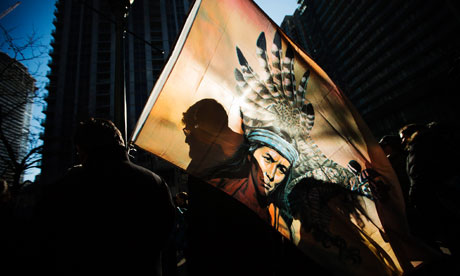
    Below:  "First Nations protesters are silhouetted against a flag as the take in a Idle No More demonstration in Toronto, January 16, 2013." (Mark Blinch/Reuters)

    April 16, 2013

    Canadian candidate quits over "hateful" comments

    B.C. NDP candidate quits over 'hateful' comments on 1st campaign day

    Controversial comments focus on First Nations, French-CanadiansThe B.C. NDP dropped Kelowna-Mission candidate Dayleen Van Ryswyk on the first day of the provincial election campaign over controversial comments made on a local media website.

    “Earlier today, I was made aware of unacceptable comments made by Kelowna-Mission NDP candidate Dayleen van Ryswyk,” NDP Leader Adrian Dix said in a written release. “I have accepted Van Ryswyk’s resignation. A new B.C. NDP candidate will be announced shortly.”

    He said mistakes happen, and that's how Van Ryswyk slipped through the vetting process despite posting comments on the internet blasting compensation paid to First Nations.

    The news comes after the B.C. Liberal issued a press release Tuesday morning calling for Van Ryswyk’s resignation. The party released a series of controversial blog posts attributed to Van Ryswyk.

    Some of Van Ryswyk's comments take aim at First Nations.

    “It’s not the status cards, it’s the fact that we have been paying out of the nose for generations for something that isn’t our doing,” reads one post on Castanet, an Okanagan area website. “If their ancestors sold out too cheap it’s not my fault and I shouldn’t have to be paying for any mistake or whatever you want to call it from my hard-earned money.”
    What Van Ryswyk doesn't understand is, Canadians are paying for the vast tracts of land they took from Indians, not reparations for their past actions. Duhhh.

    This story is ironic considering what the NDP stands for:

    New Democratic Party (Canada)The NDP evolved from a merger of the Canadian Labour Congress (CLC) and the Co-operative Commonwealth Federation (CCF). The CCF grew from populist, agrarian and socialist roots into a modern socialist party. Although the CCF was part of the Christian left and the Social Gospel movement, the NDP is secular and pluralistic. It has broadened to include concerns of the New Left, and advocates issues such as gay rights, international peace, and environmental stewardship.
    New Democrats today advocate, among other things:

    Reducing poverty in Canada
    Robust human rights protection
    Aboriginal peoples' treaty, land, and constitutional rights
    For more on Indian treaties, see Barton: Indians Fought to Keep Torturing and Idle No More's Goals.

    March 24, 2013

    Barton: Indians fought to keep torturing

    Christian Historian David Barton Defends The U.S. Genocide Of American Indians (Audio)

    By Michael AllenThis week on his 'WallBuilders Live' radio show, debunked Christian historian David Barton compared Native Americans of the 1700s to modern day terrorists and explained why the U.S. had to commit genocide of Native Americans (audio below).

    Barton said that Native Americans declared war on "all the white guys" because missionaries had tried to convince Indians to stop torturing their enemies.

    Barton claimed the Indians refused to stop torturing, so "we had to go in and we had to destroy Indian tribes all over until they" signed a treaty, reports RightWingWatch.org.

    Barton also claimed that the U.S. government had to kill buffalo in the west in order to destroy the Native Americans' supply line and bring the "Indians to their knees."

    "It's got to be based on what the enemy responds [to,] you cannot reason with certain types of terrorists; and see that's why we could not get the Indians to the table to negotiate with us on treaties until after we had thoroughly whipped so many tribes," said Barton.

    "What happened was the Indian leaders said 'they're trying to change our culture' and so they declared war on all the white guys and went after the white guys and that was King Philip's War. It was really trying to be civilized on one side and end torture and the Indians were threatened by the ending of torture and so we had to go in and we had to destroy Indian tribes all over until they said "oh, got the point, you're doing to us what we're doing to them, okay, we'll sign a treaty."


    Viewers respond

    People who watched Barton on YouTube responded with acerbic comments:I JUST LUV GUYS LIKE THIS IDIOT! It tells us heathen savages what CHRISTIAGONY is really all about...bigotry, racism and just downright ignorance!

    Once upon a time I may have bought into this, but these facts can be disputed simply by recognizing the the TRUST of the AMERICAN INDIAN was always BROKEN by WHILE SETTLERS, and what they agreed with was taken for GRANTED ...and GREED, and IGNORANCE was the COMMON RULE OF THE DAY, and it seems this type of PROPAGATION still PERPETUATES IGNORANCE.

    I am a Native American. Rather than using profanity to make an argument, I am going to make a logical rebuttal here. 1- The Native peoples of these lands had no interest in torturing anyone, certainly not like many Euro cultures have been so fond of historically doing. [Spanish Inquisition, Roman Empire crucifixions, drawing and quartering.] 2- Mr. Barton conveniently neglects to acknowledge that the Native peoples of this land were open to peaceable coexistence until greed ruined that idea.

    What do you expect from a right wing Christian? First the president's the anti Christ, now the indigenous Americans are terrorists, what's next? I can't wait to hear what these bigots have to say next it's entertaining haha.

    Christian Nazis.
    Comment:  The main and perhaps only reason Indians ever "declared war" on white men was because white men broke their promises and treaties.

    It's true white men wanted to destroy change every aspect of thousands of Native cultures, including some that occasionally practiced torture like Euro-Christians. But the idea that the Indians fought back in self-defense solely to protect the practice of torture is an obvious lie.

    Also note that many tribes, especially in the East, signed treaties before the white men defeated them. Not after, before. Again, Barton is flat-out lying. Perhaps that's not surprising since most conservative Christians are liars and hypocrites.

    For more on Barton, see Rick Perry Promotes Christian Bigotry. For more on Indians as terrorists, see Morris Mirror: Natives = "Terrorists" and Code Name: Geronimo to Be Released.


    December 29, 2012

    Idle No More's goals

    Idle No More Gaining Momentum and Forming Plan of Action“Idle No More calls on all people to join in a revolution which honors and fulfills Indigenous sovereignty and which protects the land and water. Colonization continues through attacks to Indigenous rights and damage to the land and water, which affects all people,” an Idle No More press release states. “Idle No More calls on all of us to repair these violations, live the spirit and intent of the treaty relationship, work towards justice in action, protect Mother Earth, and create sustainable, healthy communities.”And:“There have always been individuals and groups who have been working towards these goals–Idle No More seeks to create solidarity and further support these goals, and particularly encourages youth to become engaged in this movement, as the leaders of our future,” the press release states. “[Idle No More] also recognize that there may be backlash, and encourage people to stay strong and united in spirit.”

    The group, in an effort to unify its fronts, have released a plan of action:

    -- Support and encourage grassroots to create their own forums to learn more about Indigenous rights and responsibilities to Native nationhood via teach-ins, rallies and social media.

    -- Build relationships and create understanding with allies across Canada.

    -- Take steps to contribute to building relationships with international agencies such as the United Nations to raise awareness to the conditions indigenous people have been subjected to and assert sovereignty in the international arena.

    -- Acknowledge and honor the hard work of all grassroots people who have worked, and continue to work towards these goals and are the true inspiration.
    Those are rather broad, amorphous, and unquantifiable goals. They may take decades to achieve to everyone's satisfaction.

    A column makes similar points:

    Lakritz: Idle No More long on rhetoric, short on action

    By Naomi LakritzThe Idle No More movement should be specific about what they’re demanding. Otherwise, they’re doomed to go the way of the Occupy movement, which engaged in rhetoric akin to that emanating from the Idle No More folks, but in the end, faded away because they couldn’t delineate precisely what results they wanted to see happen.

    On Idle No More’s website, a woman named Tami Starlight alluded to this problem when she wrote in part: “Indigenous actions have been taking place since first contact. We need to build our own capacity as nations and confront the colonial systems we are all mired in. Rallies are just that—rallies. The same with petitions. Most have no bearing on anything and are not legally binding ... Promoting the false sense of accomplishment is problematic at best.”

    Idle No More’s action plan states: “Support and encourage grassroots to create their own forums to learn more about Indigenous rights and our responsibilities to our Nationhood via teach-ins, rallies and social media. Build relationships and create understanding with allies across Canada. Take steps to contribute to building relationships with international agencies such as the UN to raise awareness to the conditions Indigenous people have been subjected to and assert our sovereignty in the international arena. Acknowledge and honour the hard work of all grassroots people who have worked, and continue to work toward these goals—you are our inspiration.”

    These are not goals. This is talk. And talking should not be mistaken for action. Or, as another online poster commented below Starlight’s post: “What is the Plan beyond the points above? We need one.”
    Lakritz goes on to blame Natives for their own problems. I don't agree with that, in general, but she has a point about the lack of specific goals.

    More specifics

    A later posting is a bit more specific:

    First Nations chiefs contemplate “breach of treaty” declarations, indefinite economic disruptions

    By Jorge BarreraFirst Nations leaders have discussed plans to launch country-wide economic disruptions by the middle of January if Prime Minister Stephen Harper doesn’t agree to hunger-striking Attawapiskat Chief Theresa Spence’s demand for a treaty meeting, APTN National News has learned.

    During three days of meetings and teleconferences, chiefs from across the country discussed a plan setting Jan. 16 as the day to launch a campaign of indefinite economic disruptions, including railway and highway blockades, according to two chiefs who were involved in the talks who requested anonymity.

    “The people are restless, they are saying enough is enough,” said one chief, who was involved in the discussions. “Economic impacts are imminent if there is no response.”

    Chiefs were still finalizing details of their plans Monday evening and it remained unclear to what extent their discussed options would translate into the official position.

    Assembly of First Nations National Chief Shawn Atleo is expected to write Harper a letter outlining the chiefs’ position.

    Spence launched her hunger strike on Dec. 11 to force a meeting between Prime Minister Stephen Harper, Governor General David Johnston and First Nations leaders to discuss the state of the treaties. Spence said in a statement issued Monday that the aim of the meeting was to “re-establish” the treaty relationship and finally put First Nations people in their “rightful place back here in our homelands that we all call Canada.”
    And:During the discussions, some First Nations leaders suggested individual communities and treaty regions issue “breach of treaty” declarations beginning Jan. 1 and leading up to Jan. 16. Aside from blockades, chiefs discussed stepping up rallies at MP’s offices, continuing letter campaigns and launching Twitter bombs.

    “All we are doing is reasserting our own sovereign right and inherent right within this treaty,” said a second chief, who was also involved in the discussions. “The time has come that they need to see we are a sovereign entity, we have and always will be because of the relationship of treaty that was entered into by the Crown and numerous nations.”
    "Re-establish the treaty relationship" is a big goal too, but it's more finite and measurable than the previous goals. It's matched by a relatively clear threat: to issue "breach of treaty" declarations and back them up with more rallies, blockades, and other disruptions of everyday life.

    Finally, here's a much clearer statement of Idle No More's grievances and objectives:

    Idle No More: What do we want and where are we headed?

    By Pamela PalmaterThe Idle No More movement is part of a larger Indigenous movement that has been in the making for several years now. Indigenous activists all over the country have been monitoring the political and legal scene in Canada at both the federal and provincial levels and making a concerted effort to help inform First Nation community members and leaders about any potential threats. We noted a clear assimilation agenda that emerged within the Conservative government and we started planning on how we could address that if Prime Minister Harper insisted on putting his plan into action.

    We of course worked very hard to try all the usual channels to address our growing concerns, which included lobbying, letter-writing, testifying before Senate and Parliament, endless meetings with MPs, Senators, Ministers and others--all to no avail. The Harper government was not interested in talking to us, let alone consulting or getting our consent. Harper decided instead to use the Assembly of First Nations as his primary vehicle to call all the shots. Harper's government set the agenda, they drafted the joint action plans and they alone decided what was and was not on the table. In other words, Harper managed to bully his assimilation plan onto the First Nation agenda with hardly a squeak of opposition at the political level.

    At the co-called Crown-First Nation Gathering (CFNG) last January 2012, Harper promised First Nations his government would not unilaterally amend or repeal the Indian Act. After the CFNG, he broke that promise and proceeded with an aggressive legislative agenda that will include upwards of 14 bills that will devastate our First Nations in various ways. It is the White Paper 2012 with a twist--instead of it being a policy, like the 1969 White Paper, which wanted to assimilate Indians, Harper's plan will be law. This is the spark that ignited the Idle No More movement into action.

    We always knew action would be required at some point, but the legislation posed an imminent threat and required immediate mobilization. That is how a movement was born. In the early days, some were calling the Idle No More movement, some calling it an Indigenous rights movements, but we all agreed that we needed to immediately oppose Harper's assimilatory legislative agenda. So many of the early activities included teach-ins which helped explain the legislation's potential impacts on First Nations and more importantly, what we could do to oppose it.

    Early protests started out as opposing the massive omnibus Bill C-45, but later came to include the whole suite.
    And:When asked what do we want, that question can be answered in two parts:

    (1) In the short term, Canada must withdraw the suite of legislation impacting First Nations, amend those omnibus bills which threaten our lands and waters, and restore the funding that was cut to our First Nation advocacy organizations and communities;

    (2) In the long term, Canada must set up a Nation to Nation process whereby First Nations and Canada can address many of the long outstanding issues related to the implementation of treaties and sharing the lands and resources.

    Ultimately, we want to be free--free to govern ourselves as we choose; free to enjoy our identities, cultures, languages and traditions--i.e., to live the good life as we see fit. This means Canada must respect our sovereignty and get out of the business of managing our lives. Given that Canada has worked hard to put us in the situation we are in, Harper will have to come to table with some good faith and offer some solutions to address the current crisis facing many of our communities in relation to the basic essentials of life--water, sanitation, housing, and education. If Harper can do no more than appear at a meeting on January 24th as requested by the AFN, our most vulnerable citizens will not see justice.
    Withdraw the legislation and set up a nation-to-nation process...now those are concrete goals.

    For more on Idle No More, see Racism Against Idle No More and Idle No More in Los Angeles.

    December 11, 2012

    Origin of Idle No More

    How the "Idle No More" movement started:

    The tweet that sparked a movement

    By Kenneth JacksonSitting in her home in Edmonton Tanya Kappo typed #Idlenomore on her Twitter account on November 30th to promote an event of the same name happening in Alberta a few days later.

    It was retweeted by seven people.

    It was that tweet that started it all.

    And it shows no signs of letting up.

    Idle No More became more than just a phrase or name; it’s an all encompassing feeling of First Nation frustration that has taken on a life of its own on social media websites. And it was the name of a country-wide day of action in various cities Monday that saw thousands take part in demonstrations to voice their displeasure with the federal government over legislation they say aims to rob them of their identity, land and self-worth.


    What the movement wants:

    The natives are restless. Wondering why?

    By âpihtawikosisânAlthough thousands of indigenous people all over Canada rallied together under the banner of Idle No More on December 10th, there has been very little media coverage on the movement. Most of what is being said in the mainstream media is focused on Bill C-45. I’d like to make it clear…they’re getting it wrong.

    Chief Theresa Spence of Attawapiskat did not launch a hunger strike over a single piece of legislation. The women who are planning on supporting her in a nationwide fast, in relay, are not doing this because of a single piece of legislation. Canada, this is not just about Bill C-45.

    Then what? What is the problem?

    I’m going to go to the Idle No More page and click on “Manifesto.” I think it’s important you read this in its entirety rather than just have me excerpt it for you:

    We contend that:

    The Treaties are nation to nation agreements between Canada and First Nations who are sovereign nations. The Treaties are agreements that cannot be altered or broken by one side of the two Nations. The spirit and intent of the Treaty agreements meant that First Nations peoples would share the land, but retain their inherent rights to lands and resources. Instead, First Nations have experienced a history of colonization which has resulted in outstanding land claims, lack of resources and unequal funding for services such as education and housing.

    We contend that:

    Canada has become one of the wealthiest countries in the world by using the land and resources. Canadian mining, logging, oil and fishing companies are the most powerful in the world due to land and resources. Some of the poorest First Nations communities (such as Attawapiskat) have mines or other developments on their land but do not get a share of the profit. The taking of resources has left many lands and waters poisoned–the animals and plants are dying in many areas in Canada. We cannot live without the land and water. We have laws older than this colonial government about how to live with the land.

    We contend that:

    Currently, this government is trying to pass many laws so that reserve lands can also be bought and sold by big companies to get profit from resources. They are promising to share this time…Why would these promises be different from past promises? We will be left with nothing but poisoned water, land and air. This is an attempt to take away sovereignty and the inherent right to land and resources from First Nations peoples.

    We contend that:

    There are many examples of other countries moving towards sustainability, and we must demand sustainable development as well. We believe in healthy, just, equitable and sustainable communities and have a vision and plan of how to build them.

    Please join us in creating this vision.

    In short, this is what we have always been talking about. Whether the particular focus has been on housing, or education or the environment, or whatever else. What lies at the heart of all these issues is our relationship with Canada. And Canada? This relationship is abusive.
    Comment:  For more on the subject, see Idle No More Day of Action and Children Demand Fairness for Natives.

    December 10, 2012

    School board member questions tribal sovereignty

    School board member Henden questions tribal sovereignty

    By Richard WalkerNorth Kitsap School Board member Scott Henden said he can't accept the Suquamish Tribe’s sovereignty. And his views contributed to the postponement Nov. 8 of an interagency agreement regarding the Suquamish Tribe’s Chief Kitsap Academy, a school that offers the district’s Native students culturally based classes for which they can earn college credit.

    The agreement is between the Tribe, which operates the school; the school district, which shares students and resources with the academy; and Olympic College, which awards credit for classes taken.

    Henden expressed concern about language in the agreement referring to Suquamish as a “sovereign nation.” He also expressed concern about a reference to Suquamish’s “sovereign immunity,” which relates to a tribal government’s immunity against many lawsuits unless immunity is waived by the Tribe or Congress abrogates it.

    Henden first asked for a definition of sovereignty. “I know that’s something important to them. I’d like to know what that means in more detail … I’m not sure I understand the words they’re using. When they talk about sovereignty, what do they mean there? I really want to know, and what are we teaching our kids?” After some discussion, he stated, “I need to do some reading of my own. I guess I want to understand the issue better.” But then he went on to detail his views of sovereignty.

    “I understand they are federally recognized. I understand the, at least in part, the issue of Native abuse over the years. I won’t say I understand it totally by any means, but at least in part I understand some of their issues,” Henden said. “I have a problem understanding [in] any kind of English where those words go together and it means what we have. I don’t see them as a sovereign nation. Norway is a sovereign nation. And I don’t see why we need to agree to that so that we can have a contract with them.

    “If they are a sovereign nation, they’re self-sufficient, they’re self-funded, they’re self-protected and there are some things that go with it, at least in my mind. If somebody can give me something other than that in the dictionary that shows that putting those two words together means what we have, I’d be glad to see it.

    “They’re federally recognized, they have some immunity to govern themselves and those kind of things, I agree with that, but I can’t agree that they’re a sovereign nation. I’m not willing to do that.” He added, “If we want to say, ‘We recognize you’re [a] federally registered tribe,’ or something like that, I don’t have a problem. But I wouldn’t approve this contract with that language in there the way it reads.”

    Superintendent Patty Page advised Henden, “They are recognized as a sovereign nation,” to which Henden replied, “I cannot put those two words together by any kind of reasonable definition and say this fits. I mean, it doesn’t work for me. So, if a part of this thing is we have to include that, can we just include anything we want about their abilities or past? This isn’t part of this agreement. This is politics. Let’s leave the politics out of it. If we want to provide a program for Native kids to learn, that’s great. I’m totally in favor of that. I’m not in the politics side.”
    And:School board President Dan Weedin said the issue of sovereignty and sovereign immunity should not be “a deal breaker,” noting that the contract does not cost the district money and is “something that is good for kids.”

    Henden responded, “Here’s why it’s important to me. They have these things where they’ll put one student in a classroom, and they’ll change some data and one student will not know that everybody else has agreed to agree to something that is not true. And in my mind, this statement is not true. And it would be against my morals to say something is true and agree to it in a contract, and know very well it’s not, for me.”

    Weedin defended Suquamish’s sovereignty, saying, “It is true, based on what the federal government has said. The federal government has acknowledged that the Suquamish Tribe is a sovereign nation. If you want to disagree with what their definition is, that’s fine, but the federal government has stated this, so I guess I’m thinking it’s true.”

    Henden: “The federal government spends 16 billion dollars—trillion dollars—that they don’t have, so—.”

    Weedin: “That has nothing to do with them defining something. You can go off on a whole lot of tangents on the government, but what they’ve done is they’ve defined it and said it’s a sovereign nation, so whether they spend money that they don’t have has nothing to do with this.”

    Henden: “It might have something to do with their judgment.”

    Weedin: “We’re not making judgments on their judgment. We’re talking about what is law.”
    Comment:  The thinking behind Henden's "thinking" is pretty obvious. A few points:

  • Henden claims it's "politics" to include tribal sovereignty but not politics to leave it out? Wrong. It's political either way.

  • Henden equates tribal sovereignty with the "past," which means he doesn't want it in the present. He doesn't want tribes to be on an equal footing with states, he wants them to be inferior.

  • He also equates tribal sovereignty with treaty rights, which isn't exactly true. Tribes would have sovereign status even if they hadn't signed treaties. Indeed, some of them didn't sign treaties.

  • He's obviously upset about how much the federal government spends on tribes. That may be his primary motivation: to cut spending and make poor people suffer. Board president Weedin rightly pointed out that the spending level has nothing to do with whether tribes are sovereign. Treaties are what obligate the spending, not sovereignty.

  • Finally, Weedin is simply right on the facts. Tribal sovereignty is recognized in the Constitution just like freedom of the press and the regulation of commerce. You can argue about how these things are interpreted and implemented, but you can't argue with the fact of their existence.

  • For more on tribal sovereignty, see GOP Activist:  "Sovereignty Is Bunk" and Americans Support Tribal Sovereignty.

    Below:  I suspect this is part of why Henden opposes tribal sovereignty: because it means acknowledging that America was built on stolen Indian land.

    November 27, 2012

    2013 Sacagawea dollar reverse unveiled

    2013 Native American $1 Dollar Design Image

    By Darrin Lee UnserA new reverse design for the 2013 Native American $1 coin was unveiled by the United States Mint last week. The dollar design represents the theme of "The Delaware Treaty (1778)."

    Expected to debut early next year on new $1 coins, the design marks the fifth in a series of annually changing reverses to appear on Native American coinage. Congress mandated rotating dollar designs with the passage of the Native American $1 Coin Act.
    And:2013 Native American dollars feature a reverse design that is emblematic of the Delaware Treaty of 1778. After having declared independence just a few years before, the first formal treaty signed in the name of the United States was with an Indian tribe, the Delaware, at Fort Pitt (now Pittsburgh) on September 17, 1778.

    To signify that treaty, the dollar design shows images of a turkey, howling wolf and turtle. These three creatures are symbols of the clans of the Delaware Tribe. A string of thirteen stars surround the design representing the thirteen original colonies.


    Comment:  On the positive side, the design itself looks nice. I don't have any artistic complaints about it.

    But I wonder if the Delaware Treaty of 1778 is worth commemorating. I think the British signed treaties with the Indians before the Revolution, so it wasn't literally the first treaty.

    It was the first United States treaty, but other than that, I'm not sure it's historically important. In the articles I read, no one ever mentions it.

    And I question the use of three animals to depict the event. We're talking about Delaware leaders using their rhetorical skills and intellectual prowess to negotiate a legal document. And the best we can do to represent this act of statesmanship is a menagerie? Doesn't this convey the impression that Indians are animal-like?

    How about this? If you can't think of a sophisticated way to portray a Native event, don't portray it. In particular, don't use clichéd eagle, wolf, hawk, or bear symbols. Especially with such a tenuous connection to the event.

    In notational form:

    Delaware signed treaty => Delaware have clans => Clans based on animals => Pictures of animals

    So

    Delaware signed treaty => Pictures of animals?

    I don't consider that a great chain of reasoning. It's like saying:

    Lincoln wrote and delivered the Gettysburg Address => Lincoln was known as a rail-splitter => Picture of a log.

    Is a piece of wood the best representation of Lincoln's rhetorical achievement? No? The same applies to clan animals and a historic treaty signing.

    For more on the subject, see 2012 Sacagawea Dollar Reverse Unveiled and 2011 Sacagawea Dollar Reverse Unveiled.