Showing posts with label Founding Fathers. Show all posts

February 20, 2014

"We must give the land back"

We must give the land back: America’s brutality toward Native Americans continues today

Americans have unjustly taken vast tracts of land. This Presidents' Day, let's uphold our treaties and return it

By Steven Salaita
The problems with invoking Native American genocide to rationalize Palestinian dispossession are legion. The most noteworthy problem speaks to the unresolved detritus of American history: Natives aren’t objects of the past; they are living communities whose numbers are growing.

It’s rarely a good idea to ask rhetorical questions that have literal answers. Yes, the United States absolutely should return stolen land to the Indians. That’s precisely what its treaty obligations require it to do.

The United States is a settler nation, but its history hasn’t been settled. Yet most people invoke Natives as if they lost a contest that entrapped them in the past—and this only if Natives are considered at all. As a result, most analyses of both domestic and foreign policies are inadequate, lacking a necessary context of continued colonization and resistance.

For Natives, political aspirations aren’t focused on accessing the mythologies of a multicultural America, but on the practices of sovereignty and self-determination, consecrated in treaty agreements (and, of course, in their actual histories). Treaties aren’t guidelines or suggestions; they are nation-to-nation agreements whose stipulations exist in perpetuity. That the federal government still ignores so many of those agreements indicates that colonization is not simply an American memory.
Comment:  Even if you don't think returning the land is practical, you could support Indian treaties in theory. You could say, "I recognize that treaties are the supreme law of the land. We should do everything in our power to implement them."

Naturally, most Americans don't think this way. In particular, I mean the conservative liars and hypocrites who say they support the Constitution. Especially those who say they support the Founders' "original intent."

No, they don't.

Obviously they don't support obeying lawful treaties and giving back the land. You can bet they wouldn't support other constitutional measures such as establishing a national bank, making the Louisiana Purchase, or emancipating the slaves. But they would support limiting voting to white property owners and keeping women and minorities in their second-class place. That's the "intent" they're happy to support.

For more on treaties, see "Got Land" Shirt Stirs Controversy and Canada Owes Billions for Unfulfilled Treaties.

July 14, 2013

Genocidal quotes from Founding Fathers

Nice Day for a Genocide: Shocking Quotes on Indians By U.S. Leaders, Pt 1If it be the design of Providence to extirpate these Savages in order to make room for cultivators of the Earth, it seems not improbable that rum may be the appointed means.Benjamin Franklin, from his autobiography, 1750sThe immediate objectives are the total destruction and devastation of their settlements and the capture of as many prisoners of every age and sex as possible. It will be essential to ruin their crops in the ground and prevent their planting more.Orders of George Washington to General John Sullivan, May 31, 1779Is one of the fairest portions of the globe to remain in a state of nature, the haunt of a few wretched savages, when it seems destined by the Creator to give support to a large population and to be the seat of civilization?Governor William Henry Harrison, of the Indiana Territory (1800-1812) while defending displacement of the IndiansWhat is the right of the huntsman to the forest of a thousand miles over which he has accidentally ranged in quest of prey? Shall the fields and vallies, which a beneficent God has formed to teem with the life of innumerable multitudes, be condemned to everlasting barrenness?John Quincy Adams, 1802, when rationalizing territorial imperatives as God’s willThis unfortunate race, whom we had been taking so much pains to save and to civilize, have by their unexpected desertion and ferocious barbarities justified extermination and now await our decision on their fate.President Thomas Jefferson, The Papers of Thomas Jefferson, December 29, 1813The hunter or savage state requires a greater extent of territory to sustain it, than is compatible with the progress and just claims of civilized life, and must yield to it. Nothing is more certain, than, if the Indian tribes do not abandon that state, and become civilized, that they will decline, and become extinct. The hunter state, tho maintain’d by warlike spirits, presents but a feeble resistance to the more dense, compact, and powerful population of civilized man.James Monroe, in a letter to Andrew Jackson, October 5, 1817Comment:  For more on the Founding Fathers, see Native Activities in 1776 and Anti-Government Extremism = White Supremacy.

July 04, 2013

Native activities in 1776

Top 5 Historic Moments From 1776 for Natives: No Independence Day HereWhile the Founding Fathers were signing the Declaration of Independence purportedly in Philadelphia, Natives were fighting for their own independence and survival. Here are 5 things that were going on while the newly formed colonies declared their independence from Great Britain.

1. The Cherokee took a stand against white settlers in North Carolina led by Dragging Canoe and Abraham of Chilowee on July 20, 1776.

2. The Chickamauga Wars started in 1776. They were a continuation of the Cherokee struggle against white encroachment.

3. Because the British were using Indian troops, the Continental Congress, on May 25, 1776 thought “it was highly expedient to engage the Indians in the service of the United Colonies,” and tried recruiting 2,000 Indian soldiers.

4. Though some Natives were fighting alongside the colonies against Britain in the Revolutionary War, the history of which began in 1776 when the Oneida Indian Nation urged Americans to reoccupy an abandoned British fort in upstate New York.
Comment:  The fifth "moment" is the Native deaths caused by disease, which isn't a moment. But the first four remind us that Indians were part of the Revolutionary War story. They were active during the first Independence Day, not off-stage somewhere twiddling their thumbs.

Of course, they fought mostly on the British side. Which is understandable, since they had good evidence the American colonists were more rapacious than their British forefathers.

Meanwhile, Indians across the continent were living free and sovereign lives. Dealing with Spanish, French, and British colonizers, to be sure, but unaware of the American threat about to dwarf all others. Does any history book or documentary convey that in 1776, Indians owned and occupied most of North America?

For more on July 4th, see Why Indians Celebrate July 4th and No Independence Day Without Indians.

Below:  "British General Burgoyne addressing Native Americans to secure an alliance during the Revolutionary War."

June 16, 2013

Anti-government extremism = white supremacy

Anti-Government Extremism Has Roots in Prewar South

By Robert Parry[S]omething extreme has surfaced in modern American politics: an ideological hatred of government. From the Tea Party to libertarianism, there is a “principled” rejection—at least rhetorically—of almost everything that government does (outside of national security), and those views are no longer simply “fringe.” By and large, they have been embraced by the national Republican Party.

There has also been an effort to anchor these angry anti-government positions in the traditions of U.S. history. The Tea Party consciously adopted imagery and symbols from the Revolutionary War era to create an illusion that this contempt of government fits with the First Principles.

However, this right-wing revision of U.S. history is wildly askew if not upside-down. The Framers of the U.S. Constitution—and even many of their “anti-federalist” critics—were not hostile to an American government. They understood the difference between an English monarchy that denied them representation in Parliament and their own Republic.

Indeed, the key Framers—James Madison, George Washington and Alexander Hamilton—might be called pragmatic nationalists, eager to use the new Constitution, which centralized power at the national level, to build the young country and protect its fragile independence.

While these Framers later split over precise applications of the Constitution—Madison opposed Hamilton’s national bank, for instance—they accepted the need for a strong and effective federal government, unlike the weak, states’-rights-oriented Articles of Confederation.

More generally, the Founders recognized the need for order if their experiment in self-governance was to work. Even some of the more radical Founders, the likes of Sam Adams, supported the suppression of domestic disorders, such as Shays’ Rebellion in Massachusetts and the Whiskey Rebellion in Pennsylvania. The logic of Adams and his cohorts was that an uprising against a distant monarch was one thing, but taking up arms against your own republican government was something else.

But the Tea Partiers are not entirely wrong when they insist that their hatred of “guv-mint” has its roots in the Founding era. There was an American tradition that involved resisting a strong and effective national government. It was, however, not anchored in the principles of “liberty,” but rather in the practice of slavery.

The battle against the Constitution and later against an energetic federal government—the sort of nation-building especially envisioned by Washington and Hamilton—emanated from the fears of many Southern plantation owners that eventually the national political system would move to outlaw slavery and thus negate their massive investment in human bondage.

Their thinking was that the stronger the federal government became the more likely it would act to impose a national judgment against the South’s brutal institution of slavery. So, while the Southern argument was often couched in the rhetoric of “liberty,” i.e. the rights of states to set their own rules, the underlying point was the maintenance of slavery.
Comment:  For more on the Tea Party, see Racism in the Republican Primaries and Teabaggers Seek White Christian Rule.

April 08, 2013

Williamsburg teaches black, Native history

Colonial Williamsburg: Where the Tea Party gets schooled

There's lots of NRA and Tea Party garb in colonial Williamsburg. But the history has a confrontational new approach

By Andrew O'Hehir
You can still snack on butter-rich ginger cakes, go window-shopping for overpriced pewter ware and indulge in other old-timey pastimes in Colonial Williamsburg, and we did those things. But what I’ll never forget about that visit is sitting in stunned silence amid a crowd of 200 people, nearly all of them white, watching an African-American woman break down sobbing at the news that her children had just been sold at auction, while her husband describes the vicious whipping he received after a failed escape attempt. Yes, the chemistry between the intense emotion of the scene and the audience demographics bordered on the uncomfortable, but the effect also felt calculated. (Which may not have been the case with an infamous slave-auction re-enactment staged at Williamsburg in 1994, which led to considerable consciousness-raising.) It was one of the most powerful moments of live theater I’ve ever experienced.

This might sound far-fetched, but Colonial Williamsburg, in its subtly transformed 21st-century mode, feels like a covert battleground in America’s culture wars. It’s where an overwhelmingly white and conservative audience meets the post-Howard Zinn cutting edge of history. (How much attention they pay, and how much they like it, is another question altogether.) If your ideas about the place are based on that grade-school trip you took with your grandparents, I can assure you that the effect is pretty different now. Beneath its manicured and bewigged surfaces, Colonial Williamsburg is trying to break free of its stodgy traditions and bring its visitors face to face with the internal conflicts and contradictions of the Revolutionary War era and their ripple effects across politics and society today.

That wrenching scene backstage at the slave auction was the second of two episodes we watched about how the Revolutionary period affected the lives of African-Americans in Williamsburg, a city where black people, both free and enslaved, made up more than half the population in the 1770s. Later that day, we watched the second of two scenes about American Indians, in which warriors from the Chillicothe Shawnee people, who are holding the famous frontiersman Daniel Boone as a hostage, engage in a failed parley with an officer from George Washington’s Continental Army. The Shawnee men leave the gathering vowing to wage war against the perfidious “long knives,” or white American settlers, for control of the Ohio Valley, although they understand that the outcome might well be the destruction of their people.

These startling and even confrontational vignettes—part of a growing and evolving street-theater program called “Revolutionary City,” which explores the social conflict of the Revolutionary era from a variety of perspectives—are not isolated events. Over the last three decades, the Colonial Williamsburg Foundation, a nonprofit originally envisioned and endowed by John D. Rockefeller in the 1920s, has undergone a gradual but ambitious reinvention, fueled partly by changing cultural and social realities but also by a wealth of new historical research into the Colonial and Revolutionary periods. This conceptual reimagining, which has involved considerable collaboration with academic historians, seems to have accelerated rapidly since “Revolutionary City” was first introduced in 2006. (The American Indian programming we saw was introduced just two years ago.) Once concerned almost entirely with historical preservation, the foundation now sees its primary mission as “citizen education,” using “historically authentic stories” to illuminate contemporary issues. To put it another way, nearly the whole place feels like a teachable moment, from the time you leave the visitors center over a footbridge that nominally takes you backward into the past. (“1954: You tolerate segregated schools,” reads one inset in the bridge. “1920: You accept that women cannot vote or own property,” reads the next.)
Comment:  For more on the subject, see Studi and Bedard at Williamsburg and Blown Away by So Far From Scioto.

December 16, 2012

Brief history of the Second Amendment

The Unspeakable Original Intent of the Second Amendment

By Laurie Endicott ThomasTo understand the Second Amendment, you have to understand why the Constitution itself was written, and why it was subsequently amended. The desire for a national Constitution to replace the Articles of Confederation sprang from a debt crisis. To finance the Revolutionary War, the states and the Continental Congress had borrowed a lot of money. Afterward, the states had to raise taxes to pay off those loans, with interest. As a result, many small farmers lost their land or ended up in debtors' prison. Naturally, some people resisted the tax collectors. In Massachusetts, a Revolutionary war veteran named Daniel Shays led an uprising of state militiamen. A similar uprising, called the Whiskey Rebellion, took place in western Pennsylvania. Not only were poor people rising up in open revolt, but the wealthy citizens of the new nation were frustrated by a chaotic financial market. Lenders had no confidence that the state courts would enforce repayment of loans. As a result, people like James Madison, who later became known as the Father of the Constitution, couldn't get loans to buy new land on the frontier.

If the Constitution was intended to enable the state governments and the federal government to put down local rebellions, why did the Framers amend the Constitution to allow "the people" to bear arms? It's because the "well-regulated militia" that was described in the Second Amendment wasn't intended to be used against the federal, state, or local government. It was to be used against slaves and Indians.

Under English law, all able-bodied men had to respond to their local sheriff's request to serve in a posse to pursue criminal suspects. However, the kinds of weapons that a man was allowed to have depended on his social class and religion. These laws were adapted to serve the needs of the slave economy in colonies such as Virginia. A 1639 law in Virginia required young white men to be armed at public expense. By 1680, it was illegal for black men, slave or free, to carry weapons. Eventually, Virginia permitted black men who lived on frontier plantations to keep guns for defense against Indians.

The Second Amendment was not intended to enable ordinary people to attack the federal government or their state or local government. It was to enable whites to use violence against slaves and Indians.
The Real Rationale for the 2nd Amendment, That Right-Wingers Are Totally Ignorant About

A big obstacle to commonsense gun control is the Right’s false historical narrative that the Founders wanted an armed American public that could fight its own government.

By Robert Parry
The Second Amendment dealt with concerns about “security” and the need for trained militias to ensure what the Constitution called “domestic Tranquility.” There was also hesitancy among many Framers about the costs and risks from a large standing army, thus making militias composed of citizens an attractive alternative.

So, the Second Amendment read: “A well-regulated Militia, being necessary to the security of a free State, the right of the people to keep and bear Arms, shall not be infringed.” Contrary to some current right-wing fantasies about the Framers wanting to encourage popular uprisings over grievances, the language of the amendment is clearly aimed at maintaining order within the country.

That point was driven home by the actions of the Second Congress amid another uprising which erupted in 1791 in western Pennsylvania. This anti-tax revolt, known as the Whiskey Rebellion, prompted Congress in 1792 to expand on the idea of “a well-regulated militia” by passing the Militia Acts which required all military-age white males to obtain their own muskets and equipment for service in militias.

In 1794, President Washington, who was determined to demonstrate the young government’s resolve, led a combined force of state militias against the Whiskey rebels. Their revolt soon collapsed and order was restored, demonstrating how the Second Amendment helped serve the government in maintaining “security,” as the Amendment says.

Beyond this clear historical record—that the Framers’ intent was to create security for the new Republic, not promote armed rebellions—there is also the simple logic that the Framers represented the young nation’s aristocracy. Many, like Washington, owned vast tracts of land. They recognized that a strong central government and domestic tranquility were in their economic interests.

So, it would be counterintuitive—as well as anti-historical—to believe that Madison and Washington wanted to arm the population so the discontented could resist the constitutionally elected government. In reality, the Framers wanted to arm the people—at least the white males—so uprisings, whether economic clashes like Shays’ Rebellion, anti-tax protests like the Whiskey Rebellion, attacks by Native Americans or slave revolts, could be repulsed.
Gun-Rights Advocates Should Fear History of Second Amendment

By Saul CornellA cursory look at the history of the Second Amendment shows that regulation was a central part of its rationale—putting “well regulated” at the very start of the amendment was no accident. For instance, starting in the colonial period, states enacted a variety of “safe-storage” measures to deal with the danger posed by stored gunpowder. A 1786 law went as far as prohibiting the storage of a loaded gun in any building in Boston.

But many people who defend gun rights today are more than happy to skim over the first part of the amendment in their zeal to embrace the second. (The NRA itself literally chopped off that pesky first half when it chiseled the words on the face of its old headquarters.) As a result, our modern gun-rights ideology is often unmoored from any sense of corresponding civic obligation.

This ideology claims to rely heavily on the Second Amendment, and yet it is rooted not in the Founders’ vision, but in the insurrectionary ideas of Daniel Shays and those who rose up against the government of Massachusetts in 1786 and 1787. Indeed, there are gun-rights advocates today who think the Second Amendment actually gives them the right to take up arms against the government—but if that were true the Second Amendment would have repealed the Constitution’s treason clause, which defines treason as taking up arms against the government!

This is all so deeply twisted: after all, the Founders framed the Constitution in part as a response to the danger posed by Shays’ Rebellion.
Better gun control’s biggest obstacle

The Second Amendment's not to blame. It's how it's being interpreted by the Supreme Court

By Scott Lemieux
To understand the relative marginality of the Second Amendment, it is first of all important to distinguish between the Second Amendment and “the Second Amendment as it has been interpreted by a bare majority of the Supreme Court since 2008.” The text of the amendment does not explicitly bar any regulation of firearms. The famously enigmatic language of the amendment resists any determinate interpretation. The Amendment does state that “the right of the people to keep and bear Arms, shall not be infringed”—implying, in isolation, an individual right to posses firearms. This is the interpretation that prevailed 5-4 in D.C. v. Heller. But this language is preceded by describing a purpose (“A well regulated Militia, being necessary to the security of a free State”) that implies a collective right, or a right belonging to state governments. Before 2008, the sparse Supreme Court precedent in the area favored the latter interpretation, which does not foreclose even outright bans on the private possession of firearms as long as states are able to maintain militias. If Al Gore had won the electoral college as well as the popular vote in 2000, this interpretation of the amendment probably would have prevailed—and it could easily prevail again in a country in which there was a stronger commitment to regulate firearms. The interpretation of the Second Amendment endorsed by the Supreme Court in D.C. v. Heller was a political construction advanced by a powerful political movement, not a purely technical legal argument. Such constructions are always subject to revision as the personnel on the Court changes.

Moreover, it should also be remembered that Heller was a much narrower opinion than is commonly understood. Heller does foreclose an outright ban on handguns, but such bans were relatively rare at the local level (where, in a country with free movement between state borders, they are also less effective) and would be a non-starter at the federal level even had Heller come out the other way. But Justice Scalia’s opinion made it clear that the individual right to bear arms defined by the Court was far from absolute. “[N]othing in our opinion,” Justice Scalia wrote, “should be taken to cast doubt on longstanding prohibitions on the possession of firearms by felons and the mentally ill, or laws forbidding the carrying of firearms in sensitive places such as schools and government buildings, or laws imposing conditions and qualifications on the commercial sale of arms.” The only right clearly established by Heller was the right for a competent, law-abiding adult to possess some kind of handgun for “immediate self-defense” in one’s own residence.
Comment:  So the Founding Fathers passed the Second Amendment so ignorant bumpkins who couldn't even vote--if they didn't own property--could knock off them, the rich aristocrats who controlled the government? It sounds absurd if you think about it.

For more on the Second Amendment, see "A Well Regulated Militia...."

October 13, 2012

Constitution protects rich white minority

Can Democracy Be Workable?

By Peter d'ErricoIndigenous governments are often referred to as “tribal,” with pejorative implications. The claim that U.S. federal Indian law brought democracy to Native nations is echoed in the claim today that the U.S. is bringing democracy to the Middle East. In both contexts, a self-congratulatory attitude presumes to speak from a position of enlightenment. But what is enlightened about U.S. democracy?

People laud the U.S. Constitution for protecting minorities. If we remember that the Constitution was drafted when slavery was legal and neither women nor men without property could vote, we get a better sense of the “minority” the document was designed to protect. As Charles Beard argued in his 1935 Economic Interpretation of the Constitution of the United States, the framers were primarily interested in protecting their system of wealth. White male property owners were the real minority.

Beard’s view is reinforced by the fact that the Constitutional Convention was galvanized by two property-oriented circumstances. One was the rebellion of farmers and merchants in Western Massachusetts known as Shays’ Rebellion, against banks and courts enforcing mortgages. The other was the lure of Indian lands to be taken for colonization. This combination of threats to the wealthy on one hand and the hope of more wealth on the other was motivation for the framers to propose a central government with power to deal with rebels and Indians.
Comment:  When conservatives talk about "taking back the country," this is what they mean. They want white male property owners to rule the US like they did in 1776. Women and minorities should be seen and not heard while white males enjoy their wealth and power.

For more on the subject, see Santorum Blind to America's Sins and Teabaggers Seek White Christian Rule.

July 04, 2012

No Independence Day without Indians

Without the First Americans, There Would Be No U.S.A.

By Ruth HopkinsAs a kid, to me the Fourth of July was all about one thing: fireworks. I grew up in the country in the Dakotas, where lighting off fireworks was pretty much a rite of passage for reservation kids. Roman candles, firecrackers, smoke bombs, artillery shells, and oft dreaded bottle rockets are still sold from make shift stands and big top tents on rural roadsides all across the prairie. Sure, in school we read about George Washington, Paul Revere and the Revolutionary War, but as Natives, we felt pretty disconnected from mainstream American history.

I would later discover that Natives aren’t the only ones who fail to grasp the significance of our Indigenous ancestors in the history of the land that would later be called the United States of America. Those very textbooks are proof. In public schools, any mention of Natives is likely relegated to a few paragraphs about Thanksgiving, Pocahontas or Sacajawea. You might hear about The Battle of Little Big Horn in passing, but only as “Custer’s Last Stand.”

Natives aren’t given a lot of exposure in mainstream culture either. You’ll rarely, if ever, see a Native character on television or in the mainstream media. While we’ve made strides in representing ourselves positively on a national platform, we’ve got a ways to go to achieve accuracy in the depiction of us as a People. This is evidenced by false imagery that’s saturated pop culture, ala scantily clad white women in headdresses and war paint, and the tolerance of negative stereotypical mascots like the Cleveland Indians and the Washington Redskins.

In reality, Natives have played a pivotal role in American history and will continue to do so. There’s no doubt that European immigrants would not have survived long enough to form the 13 colonies but for the assistance of Natives on the east coast. Besides providing the first handouts to the starving and diseased European aliens who landed, Natives taught them how to fish, hunt, and plant foods in North America, how to build watercraft, and maneuver along Native trails.

Today, around half of the globe’s food supply comes from crops like corn and potatoes--which were originally cultivated by Natives. Cotton, a key fabric source, was also first grown by Natives. Medicines derived from Native plants were used by Natives in the Americas long before the arrival of Europeans.

That’s just the tip of the iceberg. Most Americans are completely clueless to the fact that the U.S. Constitution has a Native foundation. Ben Franklin, one America’s ‘founding fathers,’ modeled much of the Constitution after the Iroquois Confederacy. Even today, the way the congressional House of Representatives works with the Senate is rooted in how the Iroquois Confederacy was run.

Natives affected the revolutionary social concepts of early Americans too. Europeans who immigrated here came from countries that were monarchies. Their countries of origin were very socially stratified, with castes. In other words, if someone were born into poverty, they were likely doomed to remain such for life. For such a person, the option of earning an education or pursuing a gainful means of employment was extremely remote. Natives and their vast lands introduced Europeans to the concept of individual dignity and a person’s right to be free. For example, if a Native man didn’t wish to hunt or fight in battle, he wasn’t forced to do so. There were also Native women who became warriors and who held leadership positions within their Tribe. The concept of individual freedom, in the European mind, became one’s right to “life, liberty, and the pursuit of happiness.” Mixed with capitalistic greed, such liberty gave birth to the phenomena once known as ‘The American Dream.”
Comment:  For more on July 4th, see Indians Fought for American Independence and Indians Opposed American Independence.

March 07, 2012

Video game features Mohawk assassin

Assassin’s Creed III Features Mohawk HeroConsole gamers are drooling over the just-released details of the latest installment of the Assassin’s Creed series, and from the looks of it Natives have reason to celebrate as well. Information leaked to gaming sites describes a protagonist who is half white and half Mohawk embarking on a quest during the Revolutionary War. According to Examiner.com, the character is named Connor or Ratohnhake:ton (Ra-doon-ha-gay-doo), was raised by the Mohawk tribe and vows to fight the power after his village is burned down by white colonists. He carries two pistols, a bow, and a war hatchet.

Connor is an one of the Assassins, who, as established in previous games in the series, are in an eternal battle with the Knights Templar (or Templars). Previous editions of the game have been largely set in the so-called Holy Land (including Jerusalem) in the 12th century and in 15th and 16th-century Italy (Rome, Florence, Naples, Venice), with some journeys to places such as Constantinople (present-day Istanbul, Turkey) and Spain.

This is just about all the information we have, although we can also add some conventional wisdom based on the previous installments of the series: Don’t expect predictable choices for who will be the “good guys” and who will be bad. The gaming experts at IncGames discuss their hopes and expectations for the title, and they admit they were skeptical when they first heard it was to be set during the Revolutionary war. One of them offers this:

I appreciate concerns that AssThree could be at risk of turning into a nationalistic piece of trash like The Patriot, but development is being handled by a French-Canadian team who, let’s face it, are unlikely to be blinded by stars and stripes.

Further down in that discussion, another points out:

If you’re expecting AssThree to extol the virtues of Great American Heroes like George Washington, Thomas Jefferson, Ben Franklin, and John Adams, you may want to think again. In fact, if at least one or two favoured historical figures aren’t evil Templars, I’m going to be both surprised and disappointed.
Comment:  I haven't seen the game, but anyone who's an assassin is more of an anti-hero than a hero. Even if his cause is righteous, if "Connor" is a merciless killer, he'll fall within the "savage" stereotype.

For more on Native video games, see "Native Representations in Video Games" and "Racism, Stereotypes, and the Digitized Indian."

Below:  "From the Assassin's Creed III box cover."

January 01, 2012

Williams believed in Indian rights

A review of the book Roger Williams and the Creation of the American Soul. It notes his belief in the separation of church and state and his attitude toward Indians.

Roger Williams: The Great Separationist

By Joyce E. ChaplinThe authorities in Massachusetts were so outraged that having failed to arrest Williams, they tried to obliterate his new settlement. He went back to England to get a charter to protect his colony on his own terms: with a “hedge or wall of Separation between the Garden of the Church and the Wildernes of the world.” In several publications, he argued that the individual conscience should not—could not—be governed, let alone persecuted. If God was the ultimate punisher of sin, it was impious for humans to assume his authority. And it was “directly contrary to the nature of Christ Jesus . . . that throats of men should be torne out for his sake.”

Barry shows how controversial these beliefs were at the time, and in this way reinforces the standard image of Williams as an early proponent of liberty of conscience. But his emphasis on the English context for the controversy neglects Williams’s even bolder insistence that what was true for Christian Europeans was true for others, including Indians.

In his “Key Into the Language of America” (1643), a dictionary and a cultural anthropology of New England Indians, Williams called his native hosts and neighbors “Barbarians,” yet argued that they had consciences and rights as worthy of respect as anyone’s. He preached to the Indians, but thought that any coerced conversion of them would represent a false faith, an abomination to God. Nor did he think Indians should be deprived of their land. Against the near-universal assumption that America had more land than its indigenes needed or even knew about, he pointed out that they were “very exact and punctuall in the bounds of their Lands, belonging to this or that Prince or People.”

That was even more controversial than the doctrine of religious liberty among Christians. In the mid-1500s, a Catholic theologian, Bartolomé de Las Casas, had made a similar point. While cataloging Spanish atrocities against Indians, Las Casas defended them as inhabitants of a land to which they had rights, and said their lack of Christian faith did not justify abuse of them. Few were convinced. Consider the 18th-century Catholic missionary, Father Junípero Serra. He assumed that Spaniards had the right to take up land in California and that the church had the duty to reorganize Indians into Christian settlements, by force if necessary. Three thousand miles from Providence, at a rest stop on Interstate 280 in Northern California, a larger-than-life image of Serra faces the Pacific. Its back is turned against Williams’s far-off statue, as if also against his radical example of what New World societies might represent.

The United States is part Serra, part Williams. A “hedge or wall of Separation” between church and state was affirmed by the Constitution; rights for Indians were not. Williams would have considered it a battle half-won. He did not think an “American soul” needed to be created—such souls already existed within Indians. By largely confining Williams’s story to the establishment of liberties for America’s adopted populations, without equal attention to the defense of its indigenous inhabitants, Barry has perhaps underestimated his remarkable subject.
Comment:  For starters, Williams recognized the existence of Native land rights. This is something Americans are still stupid and ignorant about centuries later.

Equally important, he recognized the existence of Native religions. He felt Anglos had no right to forcibly convert Indians to Christianity.

Together, these beliefs refute the usual reason for excusing Euro-American genocide: that people didn't know any better then. That we can't judge them by our moral standards.

Of course they knew better, and of course we can judge them. Williams, Las Casas, and others recognized the crimes against Indians at the time. Nor was this some incredible feat of advanced thinking. It came straight from the Biblical injunctions not to kill, steal, or cheat. Anyone who wasn't a greedy, selfish hypocrite would've realized Christianity forbid harm to Indians.

But Williams wasn't flawless--as you may recall from Roger Williams, Slave Trader and Narragansett Official Opposes Williams Plaque. Like most people, he was a mixture of good and bad.

For more on evil Europeans, see "Man's Most Dangerous Myth" and Christians Reject Christ's Message.

Below:  "Roger Williams takes shelter with the Narragansett in 1636." (Stock Montage/Getty Images: Engraving based on a 19th-century painting by Alonzo Chappel.)

December 18, 2011

Palestinians and Indians "invented"?

Along with Rick Perry bashing gays, we recently heard Newt Gingrich bashing Palestinians.  He claimed they were an "invented" people--with no right to statehood, presumably.

Several postings rebuked Gingrich for his ignorance of Middle Eastern history.  Here's the best one I've read so far:

Newt Gingrich: ignoramus, cheat, cynic or all three?

By Uri Avnery
From its very beginning, the Zionist movement has denied the existence of the Palestinian people. It's an article of faith.

The reason is obvious: if there exists a Palestinian people, then the country the Zionists were about to take over was not empty. Zionism would entail an injustice of historic proportions. Being very idealistic persons, the original Zionists found a way out of this moral dilemma: they simply denied its existence. The winning slogan was "A land without a people for a people without a land."

So, who were these curious human beings they met when they came to the country? Oh, ah, well, they were just people who happened to be there, but not "a" people. Passers-by, so to speak. Later, the story goes, after we had made the desert bloom and turned an arid and neglected land into a paradise, Arabs from all over the region flocked to the country, and now they have the temerity--indeed the chutzpah--to claim that they constitute a Palestinian nation!

For many years after the founding of the state of Israel, this was the official line. Golda Meir famously exclaimed: "There is no such thing as a Palestinian people!" (To which I replied in the Knesset: "Mrs Prime Minister, perhaps you are right. Perhaps there really is no Palestinian people. But if millions of people mistakenly believe that they are a people, and behave like a people, then they are a people.")

A huge propaganda machine--both in Israel and abroad--was employed to "prove" that there was no Palestinian people. A lady called Joan Peters wrote a book (From Time Immemorial) proving that the riffraff calling themselves "Palestinians" had nothing to do with Palestine. They are nothing but interlopers and impostors. The book was immensely successful--until some experts took it apart and proved that the whole edifice of conclusive proofs was utter rubbish.
And:Nationalism is a relatively recent historical phenomenon. When a community decides to become a nation, it has to reinvent itself. That means inventing a national past, reshuffling historical facts (and non-facts) in order to create a coherent picture of a nation existing since antiquity. Hermann the Cherusker, member of a Germanic tribe who betrayed his Roman employers, became a "national" hero. Religious refugees who landed in America and destroyed the native population became a "nation." Members of an ethnic-religious diaspora formed themselves into a "Jewish nation." Many others did more or less the same.

Indeed, Newt would profit from reading a book by a Tel Aviv University professor, Shlomo Sand, a kosher Jew, whose Hebrew title speaks for itself: When and How the Jewish People was Invented?

Who are these Palestinians? About a hundred years ago, two young students in Istanbul, David Ben-Gurion and Yitzhak Ben-Zvi, the future prime minister and president (respectively) of Israel, wrote a treatise about the Palestinians. The population of this country, they said, has never changed. Only small elites were sometimes deported. The towns and villages never moved, as their names prove. Canaanites became Israelites, then Jews and Samaritans, then Christian Byzantines. With the Arab conquest, they slowly adopted the religion of Islam and the Arab culture. These are today's Palestinians. I tend to agree with them.

Parroting the straight Zionist propaganda line--by now discarded by most Zionists--Gingrich argues that there can be no Palestinian people because there never was a Palestinian state. The people in this country were just "Arabs" under Ottoman rule.

So what? I used to hear from French colonial masters that there is no Algerian people, because there never was an Algerian state, there was never even a united country called Algeria. Any takers for this theory now?

The name "Palestine" was mentioned by a Greek historian some 2,500 years ago. A "Duke of Palestine" is mentioned in the Talmud. When the Arabs conquered the country, they called it "Filastin", as they still do. The Arab national movement came into being all over the Arab world, including Palestine--at the same time as the Zionist movement--and strove for independence from the Ottoman Sultan.

For centuries, Palestine was considered a part of Greater Syria (the region known in Arabic as "al-Sham"). There was no formal distinction between Syrians, Lebanese, Palestinians and Jordanians. But when, after the collapse of the Ottoman Empire, the European powers divided the Arab world between them, a state called Palestine became a fact under the British Mandate, and the Arab Palestinian people established themselves as a separate nation with a national flag of their own. Many peoples in Europe, Asia, Africa and Latin America did the same, even without asking Gingrich for confirmation.

It would certainly be ironic if the members of the "invented" Palestinian nation were expected to ask for recognition from the members of the "invented" Jewish/Israeli nation, at the demand of a member of the "invented" American nation, a person who, by the way, is of mixed German, English, Scottish and Irish stock.
Comment:  Pundits have noted that many nations in Africa, Asia, and eastern Europe didn't consider themselves states until they became states in the 20th century.  No one has given a reason we should consider the Palestinians different from other people.

I've noted the similarities between the Palestinians and Indians before.  This is another area they have in common.  Right-wingers routinely claim that recently recognized tribes were "invented" to foist gaming on us.    Indeed, if they're fighting Indian rights as a whole, they claim all Indian "nations" were invented.  Not that Indians didn't exist, but that they weren't sovereign entities with well-defined governments or territories.  They were just primitive nomads wandering aimlessly like animals.

Steve Newcomb explains the root of this thinking:

In the chapter “Francisco de Vitoria and International Law” Anghie points out that Vitoria dealt with such topics as divine and natural law, sovereignty and culture, particularism and universalism. With these elements Vitoria conceptualized an international jurisprudence, and in the context of that thinking Vitoria treated idealized Spanish practices as “universally binding,” and hence binding on the Indians.Anghie says that “Indians are excluded [by Vitoria] from the realm of sovereignty, and Indian resistance to Spanish incursions becomes aggression which justifies the waging of a limitless war by a sovereign Spain against non-sovereign Indians.“ The “crucial issue,” according to Anghie, is the basis of the decision that the Indians were not sovereign: “Vitoria bases his conclusions that the Indians are not sovereign on the simple assertion that they are pagans.” In other words, Vitoria’s judgment was that the Indians were not sovereign because they were not Christians.Never mind that the Founding Fathers recognized Indian tribes as foreign nations and their rulers as kings.  And signed treaties with them exactly as if they were sovereign entities.  These right-wingers are so intellectually dishonest they don't even mention the word "treaty."

Clearly they don't consider tribal sovereignty a historic fact.  To them, it's a plot to take America away from the white Christians who founded it and give it back to the heathens and savages who wasted it.  And that's what pseudo-Zionists like Gingrich think about Palestinian statehood.  It's a plot to take Israel away from the white Jews who founded it and give it back to the Muslim heathens and savages who wasted it.  

In short, liberals who support indigenous rights for Indians and Palestinians are basically fighting a cultural war against the Biblical God.  The same Bible-based bigotry motivates the hatred of Indians and Palestinians.

America the invention

Comparing the Palestinians to Africans, Asians, eastern Europeans, or American Indians is one thing.  But why stop there?  The most telling comparison is between Palestinians and Americans.  Consider:

  • They were part of another empire for a century or two.

  • They spent decades establishing their own institutions and identities.

  • They finally got fed up and declared their independence as a sovereign state.

  • Which act of invention am I describing:  the founding of an American or Palestinian state?  What's the difference between the two?

    If anything, America is the much bigger "invention."  The British had no claim to North America before they invented one out of thin air.   Unlike the Indians and Palestinians, they hadn't occupied the land for thousands of years.  

    When the British did establish a foothold, they thought of themselves as colonists and subjects of the British Empire.  The idea of an American identity didn't occur to them until the last few years of colonization.  Indeed, the American nationality didn't exist until the Founders invented it on July 4, 1776.

    So the Palestinian aspirations for statehood are just like the American aspirations for statehood.  And Gingrich is a stupid idiot for not understanding this.


    August 25, 2011

    Teabaggers seek white Christian rule

    The latest studies on the Tea Party philosophy confirm what previous studies have shown: that the movement is primarily about reinforcing white Christian power at the expense of minorities.

    Crashing the Tea Party

    By David E. Campbell and Robert D. PutnamOur analysis casts doubt on the Tea Party’s “origin story.” Early on, Tea Partiers were often described as nonpartisan political neophytes. Actually, the Tea Party’s supporters today were highly partisan Republicans long before the Tea Party was born, and were more likely than others to have contacted government officials. In fact, past Republican affiliation is the single strongest predictor of Tea Party support today.

    What’s more, contrary to some accounts, the Tea Party is not a creature of the Great Recession. Many Americans have suffered in the last four years, but they are no more likely than anyone else to support the Tea Party. And while the public image of the Tea Party focuses on a desire to shrink government, concern over big government is hardly the only or even the most important predictor of Tea Party support among voters.

    So what do Tea Partiers have in common? They are overwhelmingly white, but even compared to other white Republicans, they had a low regard for immigrants and blacks long before Barack Obama was president, and they still do.

    More important, they were disproportionately social conservatives in 2006—opposing abortion, for example—and still are today. Next to being a Republican, the strongest predictor of being a Tea Party supporter today was a desire, back in 2006, to see religion play a prominent role in politics. And Tea Partiers continue to hold these views: they seek “deeply religious” elected officials, approve of religious leaders’ engaging in politics and want religion brought into political debates. The Tea Party’s generals may say their overriding concern is a smaller government, but not their rank and file, who are more concerned about putting God in government.
    "A low regard for immigrants and blacks." "Concerned about putting God in government." In other words, racial and religious bigots. That teabaggers have no prejudices and care only about the size of government is a bald-faced lie they've somehow perpetuated. And many naive, gullible voters have bought it.


    Study:  Tea Party Members Cultural Dispositions ‘Authoritarianism, Fear of Change, Libertarianism and Nativism’

    By Kyle LeightonWhat are the four primary characteristics most associated with those Americans sympathetic to the Tea Party? "Authoritarianism, ontological insecurity (fear of change), libertarianism and nativism." So says one of the many findings in a study presented to the American Sociological Association on Monday.In our follow-up poll, 84% of those positive towards the TPM [Tea Party members] said the Constitution should be interpreted "as the Founders intended," compared to only 34% of other respondents. Other respondents were also three times more likely not to have an opinion on the issue, highlighting the salience of the question for TPM supporters. Support for Constitutional principles is not absolute. TPM supporters were twice as likely than others to favor a constitutional amendment banning flag burning; many also support efforts to overturn citizenship as defined by the Fourteenth Amendment. That TPM supporters simultaneously want to honor the founders' Constitution and alter that same document highlights the political flexibility of the cultural symbols they draw on.Nativism translates to hatred of brown-skinned "foreigners" such as Latinos and Muslims. As does "original intent," which means restoring power to white property owners at the expense of women and minorities.

    And "political flexibility" is a euphemism for hypocrisy. You can be sure teabaggers are hypocritical on their so-called libertarianism too. They want a strong defense, Social Security and Medicare benefits, bans on abortion and gay marriage, and government promotion of Christianity.

    The fact that teabaggers even mention Christian is proof of their hypocrisy. True libertarians should be absolutely opposed to any religion in government. They shouldn't care whether America's leaders and principles are Christian, Muslim, or Buddhist as long as the government is small and weak. But teabaggers care very much about which religion governs America. They strongly prefer a white Christian government (George W. Bush) to a brown "Muslim" government (Barack Obama).


    What teabaggers really want

    What I Learned in Two Years at the Tea Party

    By Abe SauerThe Tea Party is no longer about economics, not that it ever solely was. At the larger rallies and for the cameras (CNN or laptop), they hold forth about founding fathers, liberty, spending, deficits, TARP, kicking cans down roads, taxes, living within means and fiscal responsibility. But when the lights are off, it's all about Jesus, with "God" thrown in, on occasion for Israel.

    Back in 2009, the movement appeared genuinely stumped with a conundrum of its key documents. Subservience to the Constitution of the United States of America was paramount, but then what to do about the Bible?

    So they've engineered a backstory that essentially proves the nation's founders were just conduits for God. Essentially, the Constitution is just the word of God passed down through guys who wore wigs and snazzy cuffed jackets.

    That the Tea Party is just a way to repackage the religious right has no better proof than Ralph Reed. In 2009, Reed took the tenets of his 90s-era Christian Coalition for his "Faith and Freedom Coalition," which is now a major player at Tea Party events.

    In April, in the high din of the Wisconsin budget debate, I attended a full day's meeting of the northeast Wisconsin Manitowoc Tea Party (now officially called the "Manitowoc County TEA-Movement"). It began with a prayer that included the statement that "we have neglected...the only nation founded on Christian principles."

    Held in a local hotel ballroom, the meeting consisted of info sessions and speakers. The "training" sessions were largely civic and cartographical—who's your rep, where to vote, that kind of thing. The day's speakers were a mix of community organizers and preachers. American Majority operatives did sessions on "The System" (smaller-government, term-limit doctrine) and "Social Media" ("How many here have a Twitter account?"). These info sessions were balanced by Jake Jacobs and Kyle Desjarlais.

    Jake Jacobs (Ph.D!) is the head of FreedomProject Education, which, not to get too into it, provides “a classical education in the tradition of America’s Founders." It is, essentially, as Jacobs out it in his exhaustive address, a curriculum about America's Judeo-Christian founding. (They are an arm of the American Opinion Foundation.) Jacobs' hour-long rant mixed historical evidence of the founding father's Christian intentions for America with conspiracy theories about Barack Obama and Columbia University, Bill Ayers, Sharia, Hitler, the Kentucky and Virginia acts of 1789, Sean Penn, his former students' persecution in college "for their Christian conservatism" and "how to refute the argument that Jesus was a socialist." (Which, by the way, is to note that "thou shall not steal" is a direct rebuttal to how "socialists despise private property." Jacobs' lessons (available online) are set up especially for home-schoolers.


    "Let's emulate our pioneering forefathers who cheated and killed the Indians because God told them to."

    Minuteman to Tea Party:  A Grassroots Rebranding

    By David HolthouseGrinning on the sidelines behind mirrored sunglasses was Glenn Spencer, the leader of the border vigilante group American Border Patrol and the owner of the Tea Party Nation rally site.

    Spencer informed Media Matters that he travels almost weekly to speak at Tea Party events, and that his ranch, the onetime vigilante outpost where Forde took shelter, is now a Tea Party rallying point. "Plans are for Tea Party groups to come to the ranch every week from now on," he said. "They are really fired up over the border issue."

    Despite his association with Forde and his well-documented history of bigoted ranting and "reconquista" conspiracy mongering, Spencer is a rising star in the Tea Party movement.

    He's not alone.

    Over the past two years, more than a dozen former border vigilante leaders have taken on key roles in the Tea Party movement. Some, like Spencer, continue to maintain their hard-core nativist personas. Others have sought to separate themselves from their Minuteman identities in pursuit of mainstream political legitmacy.
    Comment:  Minutemen want to stop immigration by any means necessary. They're one step away from militia men who talk about armed revolution and "joke" about killing Obama. These Klansmen, Neo-Nazis, and Christian "patriots" form the core of the Tea Party movement. Their goal is a Christian theocracy where white men rule.

    For more proof of the Tea Party's racism, see:

    Another poll proves teabaggers are racists
    Poll proves teabaggers are racists
    The evidence for teabagger racism

    For examples of this racism, see:

    Rick Perry promotes Christian bigotry
    Stossel:  Indians are biggest moochers
    White supremacists outnumber Muslim extremists
    Whites feel like a minority
    Fischer defends pro-genocide column
    Bachmann fibs about America's founding
    Obama's UN "coup" is "chilling"

    March 22, 2011

    Narragansett official opposes Williams plaque

    Narragansett Indians official against Roger Williams plaque

    By Paul DavisJohn Brown, the director of historic preservation for the Narragansett Indians, has asked the state to rethink plans for a historic plaque dedicated to the relationship between Roger Williams and the tribe.

    On Friday, Brown said he objects to the proposed content, which focuses on the sale of Native Americans into slavery at the end of King Philip’s War.

    The focus should be on the tribe’s early peaceful relationship with Williams, who started the Providence colony in 1636 on tribal land, he said.

    No matter what happened later, “those early dealings were honorable,” said Brown. “We’re not going to be involved in any character assassination.”
    And:Brown said Friday that a first-ever plaque about the tribe and the Colonists should start at the beginning of the story, when the dealings between the two parties were “honorable,” he said.

    “The tribe’s history should start from a point of strength, not weakness,” he said.

    The tribe, he added, provided Williams—banished from Massachusetts—with land, and offered to protect the early Colonists.

    “If there were ups and downs in that relationship, we will talk about that later.”
    RIC professor sees another, less heroic Roger Williams

    By Paul DavisSince he first trudged through the woods to found Providence, Roger Williams has been variously called an American statesman, a canny trader and a champion of religious freedom.

    Julianne Jennings, a Native American, would like to add a few more labels to the list.

    Indian fighter.

    Slave trader.

    “We have to stop the lying,” says Jennings, 48, an author and adjunct professor of anthropology at Rhode Island College.

    In her Non-Western Worlds Native Americans class, Jennings offers what she says is a “more balanced” view of New England’s feel-good, Indian summer past. Her goal? “To decolonize America’s classrooms.”

    As part of her effort, she’s urging the state Department of Transportation to erect a plaque on South Main Street, one designed to give Rhode Islanders a new––and darker––picture of the state’s founder.

    Relying on 17th-century letters and town hall records, Jennings says that Williams sent Indian prisoners from King Philip’s War to the Caribbean, Portugal, Spain and Africa, where they were sold as slaves.

    He was also a steely strategist during the bloody Pequot War, argues Jennings. At one point, she says, Williams told Massachusetts Gov. John Winthrop to attack a Pequot fort in Mystic, Conn., at night, so that the “English, being armed, may enter their houses and do what execution they please.”

    In May 1637, a band of New England Colonists did just that. They set Pequot dwellings on fire and shot the natives as they fled from their homes, killing hundreds of Indian men, women and children.

    Not everyone is comfortable with the new picture.

    “It’s certainly not the portrait we paint of Roger Williams,” says Mary A. Channing, president of the Roger Williams Family Association.

    “To call Williams an Indian hater is just plain wrong,” adds Rhode Island author and historian J. Stanley Lemons. In fact, Williams was responsible for 40 years of peace with the Narragansett Indians and other tribes. “Rhode Island did not have an Indian problem” until a Colonial militia from Connecticut, Plymouth and Massachusetts attacked the Narragansetts during King Philip’s War, he said. “Until then, Rhode Island was neutral.”

    Williams did participate in the sale of Indian captives, but the money was used by the Colonists to rebuild Providence, largely destroyed in the war. Although the Narragansetts did not harm Williams, they burned down his home, Lemons said. “He was a man of his time. There wasn’t anyone who didn’t believe in slavery” in the 1600s, he said. When he referred to Indians as “barbarians” and “savages,” he was only using the language of the time.

    “I’ve had people scream at me, ’How dare you do this!’” says Jennings, who is a member of the Cheroenhaka Nottoway tribe from Virginia.
    Comment:  I like the line about "the money was used by the Colonists to rebuild Providence." When Rhode Island sold human beings like cattle, they didn't blow the proceeds on opium or orgies. They used it productively. Well, that explains everything!

    So Williams believed in slavery and considered blacks and Indians subhumans. In short, he was a racist. But other than that, he was a great guy? Thanks for clearing that up.

    Plaques should tell truth

    So this would be the first plaque telling the history of Williams and the Narragansetts? And the Indians want it to be positive? This has nothing to do with the Narragansetts' desire to placate Rhode Island officials so the officials will let them open a casino, right?

    If you're not a Williams family member or apologist, who cares whether the first plaque is positive or negative? That's a trivial detail--if not a stalling technique or an underhanded dodge. People aren't going to read the plaques in chronological order and learn history that way. A plaque is a reminder of a particular event in a particular time and place, not a beginning-to-end textbook.

    The only question that matters is whether the plaque is historically accurate. If it is, then post it. If people can't handle the truth, too bad. With thousands of statues, monuments, and pageants reminding us how the Indians helped the colonists conquer them, we don't need more Pollyanna plaques.

    For more on the subject, see Roger Williams, Slave Trader and Fun 4th of July Facts.

    Below:  "Julianne Jennings at Prospect Park in Providence, where a statue of Roger Williams overlooks the city." (Bob Thayer/The Providence Journal)

    March 09, 2011

    Roger Williams, slave trader

    Roger Williams plaque under review

    By Paul DavisState officials met Tuesday to discuss a controversial plaque that will focus on Roger Williams’ efforts to sell Indian war captives into slavery.

    The Department of Transportation has agreed to erect a plaque in Providence, but has yet to agree on how it will look or where it will go.

    During a closed meeting, DOT officials talked about materials, size, design and location, but made no decisions, said DOT spokeswoman Dana Alexander Nolfe.

    Native American Julianne Jennings suggested the plaque a year ago.

    The public marker will be the first in the region dedicated to “an almost forgotten piece of New England history,” said Jennings, a former Rhode Island College professor now studying at the School of Human Evolution & Social Change in Tempe, Ariz.

    In 1636, Narragansett Indian Sachem Canonicus and his people gave Roger Williams the land that later became the Rhode Island colony, according to Jennings’ wording for the plaque.

    But, in just 40 years, “relations between the colony and the Narragansett Indians became strained as a result of frequent intercultural conflicts,” the text says.

    Those conflicts erupted into the bloody King Philip’s War, which raged for several years during the 1670s.

    After the fighting was over, Roger Williams and other Colonists held a town meeting on Aug. 14, 1676, Jennings said.

    The town was full of Indian prisoners, and “slavery was regarded a fit punishment” for their crimes, Jennings said. They were sent to the Caribbean, Portugal, Spain and Africa, where they were sold as slaves.
    Compare this to the conventional view of Roger Williams:

    Roger Williams (theologian)Roger Williams (circa 1603–between January and March 1683) was an English Protestant theologian who was an early proponent of religious freedom and the separation of church and state. In 1636, he began the colony of Providence Plantation, which provided a refuge for religious minorities. Williams started the first Baptist church in America, the First Baptist Church of Providence, before leaving to become a Seeker. He was a student of Native American languages and an advocate for fair dealings with Native Americans.

    Indian language and culture

    Williams intended to become a missionary to the Native Americans and set out to learn their language. He studied their language, customs, religion, family life and other aspects of their world. As a result he came to see their point of view about colonization and developed a deep appreciation of them as people. He wrote his A Key into the Language of America (1643) as a kind of phrase book coupled with observations about life and culture as an aid in communication with the Indians. In it he talked about everything from salutations in the first chapter to death and burial in chapter 32. The book also sought to instruct the English, who thought of themselves as vastly superior to the Native Americans, that they were mistaken. He repeatedly made the point that the Indians were just as good as the English, even superior in some respects.

    "Boast not proud English, of thy birth & blood;
    Thy brother Indian is by birth as Good.
    Of one blood God made Him, and Thee and All,
    As wise, as fair, as strong, as personal."

    Having learned their language and customs, Williams gave up the idea of being a missionary and never baptized a single Indian. He was severely criticized by the Puritans for failing to Christianize them, but Williams had arrived at the place in his own thinking that no valid church existed. He said he could have baptized the whole country, but it would have been hypocritical and false. He formed firm friendships and developed deep trust among the Native Americans, especially the Narragansetts. He was able to keep the peace between the Indians and English in Rhode Island for nearly forty years because of his constant mediation and negotiation. He twice surrendered himself as a hostage to the Indians to guarantee the safe return of a great sachem from a summons to a court: Pessicus in 1645 and Metacomet (King Philip) in 1671. He more than any other Englishman was trusted by the Native Americans and proved to be trustworthy. In the end King Philip’s War (1675–1676) was one of the bitterest events in his life as his efforts ended with the burning of Providence in March 1676, including his own house.
    Comment:  Curiously, Williams's Wikipedia entry doesn't mention the slavery incident. I wonder why not.

    Julianne Jennings is a friend who's appeared in this blog before. She led the protests against the King Philip's War game last year.

    For more on King Philip, see King Philip Chainsaw Sculpture and King Philip's War in After the Mayflower.

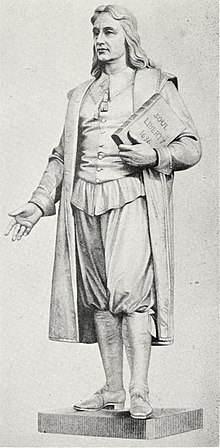
    Below:  Roger Williams statue by Franklin Simmons.

    January 24, 2011

    Bachmann fibs about America's founding

    Bachmann:  America Was Founded On Diversity (VIDEO)

    By Jillian RayfieldRep. Michele Bachmann (R-MN) had an interesting take this weekend on America's first European settlers, who she said "had different cultures, different backgrounds, different traditions."

    "How unique in all of the world, that one nation that was the resting point from people groups all across the world," she said. "It didn't matter the color of their skin, it didn't matter their language, it didn't matter their economic status."

    "Once you got here, we were all the same. Isn't that remarkable?" she asked.

    Speaking at an Iowans For Tax Relief event, Bachmann (R-MN) also noted how slavery was a "scourge" on American history, but added that "we also know that the very founders that wrote those documents worked tirelessly until slavery was no more in the United States."

    "And," she continued, "I think it is high time that we recognize the contribution of our forbearers who worked tirelessly--men like John Quincy Adams, who would not rest until slavery was extinguished in the country."

    It's true--Adams became a vocal opponent of slavery, especially during his time in the House of Representatives. But Adams was not one of the founders, nor did he live to see the Emancipation Proclamation signed in 1863 (he died in 1848).
    Comment:  Maybe Bachmann meant the Founders worked their slaves tirelessly until the end.

    Actually, "the very founders that wrote those documents" were dead long before slavery ended. For instance, Charles Carroll was the last signer of the Declaration of Independence to die. He died in 1832, 31 years before the Emancipation Proclamation.

    I'm not sure how prejudiced the Founders were against people who spoke languages such as German or Dutch. They were clearly prejudiced against the poor. "When the Constitution was written, only white male property owners (about 10 to 16 percent of the nation's population) had the vote," Infoplease.com reminds us. And they were clearly prejudiced against different races, including the blacks they enslaved and the Indians they killed.

    They also were prejudiced against people on the basis of religion, gender, and immigration status. Really, the only people they weren't prejudiced against were white Anglo-Saxon Protestants. You know, people exactly like themselves.

    Conservatives whitewash history

    It's hard to say who's the most ignorant leader of the Republican Tea Party--Glenn Beck? Sarah Palin?--but Bachmann is certainly a contender. In any case, this is yet another example of the conservatives' attempt to rewrite history. The goal, of course, to confirm that America belongs to its white male Christian minority. That the people who rule now deserve their white power and privilege. It's a milder form of the claim Palin made: that Americans are equal and accusations of racism are a ploy.

    We see these tactics constantly. In particular incidents such as these:

    Sanitizing Martin Luther King Jr.
    Obama's UN "coup" is "chilling"
    Conservatives think they're "natives"
    Obama smeared as Luo tribesman

    And in trying to shut down talk about race in general:

    Mentioning racism = dwelling on past?
    Conservatives hope minorities will forget
    Talking about racism perpetuates racism?!
    Americans refuse to acknowledge prejudice

    The goal in every case: to maintain the power of the people in charge.

    January 13, 2011

    Tennessee teabaggers want to rewrite textbooks

    Tea parties issue demands to Tennessee legislators

    Among 5 priorities, state group wants kinder treatment of Founding Fathers in history courses

    By Richard Locker
    The material calls for lawmakers to amend state laws governing school curriculums, and for textbook selection criteria to say that “No portrayal of minority experience in the history which actually occurred shall obscure the experience or contributions of the Founding Fathers, or the majority of citizens, including those who reached positions of leadership.”

    Fayette County attorney Hal Rounds, the group’s lead spokesman during the news conference, said the group wants to address “an awful lot of made-up criticism about, for instance, the founders intruding on the Indians or having slaves or being hypocrites in one way or another.

    “The thing we need to focus on about the founders is that, given the social structure of their time, they were revolutionaries who brought liberty into a world where it hadn’t existed, to everybody—not all equally instantly—and it was their progress that we need to look at,” said Rounds, whose website identifies him as a Vietnam War veteran of the Air Force and FedEx retiree who became a lawyer in 1995.
    ThinkProgess.org explains what's wrong with this effort:

    Tennessee Tea Party Demands School Curriculum Not Focus Too Much On The ‘Minority Experience’

    By Alex Seitz-WaldWhat “truth” do these conservative activists demand be taught? Apparently it doesn’t involve portrayals of the “minority experience” or anything else that might taint their mythical hagiographies of the Founding Fathers. At a press conference, the activists said they want a focus on the “progress” the Founders and “the majority of citizens” made, to the exclusion of supposedly “made-up criticism” about slavery and the treatment of Native Americans.

    It’s unclear what these activists think is “made-up” about the very real history of slavery in America or the very real intrusion on Native American lands by early American settlers.

    This effort could be dismissed as a the work of handful of obscure activists in Tennessee were it not part of a much larger conservative attempt to rewrite American history without all the unflattering bits. Like their supposed reverence for the Constitution, when conservatives speak warmly of American history, they tend to pick and choose only the parts which reflect their contemporary world-view—and they are equally eager to sanitize the parts that do not.
    Comment:  For more on rewriting textbooks, see Indians in Christian Textbooks and Conservatives Want Christian Textbooks. For more on the Tea Party version of history, see Tea Party Guide to American History and Teabaggers = Constitutional Hypocrites.

    October 05, 2010

    Tea Party Guide to American History

    Introducing:  The Tea Party Guide to American History!

    By Phil N. MoléHi Patriots:

    Tired of textbooks written by liberals who wipe their muddy feet on the American flag and won't be happy until all of our children are vegetarian, atheist, and gay? Then order the new 'Tea Party Guide to American History," and save your child from the siren call of socialist homosexuality.

    This book will teach your children no more or less than what they need to know to be able to have a defiant, admirably unreflective perspective on their country's history. Things like this:

    American Prehistory

    In 6,000 BC, the land containing the present-day United States was created, by God. Large masses of land surrounding the current Unites States were also created, for purposes known only in heaven.

    The land containing the United States was designated for a special purpose by God--a future safe haven for the teachings of Jesus, and a place where women shouldn’t be able to get abortions and men should never use condoms.

    Indians, aka “Native Americans”

    This is as good of a time as any to address the fact that there were people here before the European settlers arrived, namely, Indians. Some people call them “Native Americans,” but that’s a contradiction in terms, because America is a land of immigrants--you selfish, unpatriotic asshole Indians.

    Revisionist, America-hating liberals try to make it look like there were lots of Indians here who had a complex, vibrant culture, so we’d feel ashamed of ourselves for taking their land and eliminating them. But there totally weren’t that many. And according to the earliest documented evidence we’ve seen of their culture (a John Ford film made in Hollywood in the 1930s), these Indians really don’t come off well at all.

    Plus, haven’t we already paid enough homage to Indian culture? We’ve named subdivisions of retirement communities after them, and little league and professional sports teams, and we like drinking beer when a sports mascot in an Indian costume dances during halftime. What more do these ungrateful people want?
    Other highlights from this Tea Party textbook:The Revolutionary War and Early Days of the Republic

    Series of illustrations: George Washington and the cherry tree, George Washington in battle, and the American flag, flying high against a blue sky background. Take a moment to reflect on these images, and feel warm and good inside. This concludes the lesson on the Revolutionary Era.

    Civil War

    The War of Yankee Aggression, waged against helpless Southern states who only wanted limited government, states rights, and a nice sip of sweet tea. It wasn’t about slavery, and in fact, so-called slaves were better treated than most white males are--a trend that continues today. Slavery was possibly a little racist, in retrospect. But slavery ended with the Civil War, and so did racism.

    World War II

    There was a World War before this, and America won it.

    We won this one, too, but liberals keep whining about the fact that so many Japanese Americans were interned in camps. But eye witnesses at the time swear that all of the Japanese who were relocated looked A LOT like the perpetrators of the Pearl Harbor attacks. More disturbingly, they were sometimes overheard speaking a language that did not appear to be English. There were no more Pearl Harbor attacks after the internment--think about that.

    Feminism and Women’s Liberation

    Paved the way for Michele Bachmann and Sarah Palin, but otherwise an unmitigated disaster. Across the country, dinners languish uncooked, and undersexed men were forced to cheat or to visit prostitutes, which they never would have done otherwise, because men are awesome. And lots of women begin talking about how they want men to show their “feelings.” We’d been TRYING to show you how we felt, but then you passed sexual harassment laws.
    Comment:  This is only barely a satire. For starters, many creationists do believe God created the universe a few thousand years ago. Teaching about America's eons of geological and biological history violates their beliefs.

    Many people will denounce you if you claim pre-Columbian America was inhabited by sophisticated Indian nations with complex cultures. These people commonly assert that our country is God's gift to the world. They routinely attribute the American Revolution to a few great, freedom-loving men. As we saw in the Confederate History Month controversy, they deny the role of slavery in the Civil War. They defend the internment of Japanese Americans the way they defend the subjugation of Indians--e.g., it was "unfortunate but necessary." Etc.

    For more on conservative textbooks, see Indians in Christian Textbooks and Conservatives Want Christian Textbooks. For more on our national myth-making, see Why We Believe in Columbus and National Day of the American Cowboy. For more on American history in general, see Ten Little Pilgrims and Indians and Fun 4th of July Facts.

    July 04, 2010

    Happy Merciless Indian Savages Day!

    Some Native thoughts on Independence Day--aka the Fourth of You Lie. First, someone posted this on Facebook:Happy Merciless Indian Savages Day! Y'all be careful out there as you apply our rule of warfare ... you know, that "undistinguished destruction of all ages, sexes and conditions" thing that we do! ... Oh, and don't let the kids play with sparklers unattended.
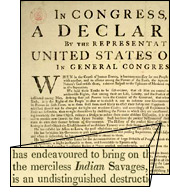
    Someone else posted this link to the White House:

    Message from the President Regarding Independence DayAmerica again faces a daunting set of challenges, yet our history shows these are not insurmountable. We need only to draw upon the perseverance of those before us ... our Founders who declared and fought for their ideals; our ancestors who emigrated here and struggled to build a better future for their children; and our pioneers and entrepreneurs who blazed trails that have continually expanded our horizons. Their spirit ... our spirit ... will guide our Nation now and in our bright future.As usual, Obama offers the pure "we're immigrants who settled the land" line. As usual, he slights Native Americans.

    A Facebook response to Obama's message:We're waiting!!!!

    Just as this day serves as a reminder of the immeasurable bravery of those who have made America what it is today, it also renews in us the solemn duty we share to ensure our nation lives up to its promise.
    Another person posted "an assertion of independence--and personal liberty--from a pre-colonial perspective":Treat all men alike. Give them all the same law. Give them all an even chance to live and grow. All men were made by the same Great Spirit Chief. They are all brothers. The Earth is the mother of all people, and all people should have equal rights upon it....Let me be a free man, free to travel, free to stop, free to work, free to trade...where I choose my own teachers, free to follow the religion of my fathers, free to think and talk and act for myself, and I will obey every law, or submit to the penalty.

    Chief Joseph of the Nez Perce
    Interesting that Chief Joseph had a better grasp of the American dream than his non-Indian contemporaries. They had barely freed the South's slaves and still treated women, minorities, and immigrants as subhuman species.
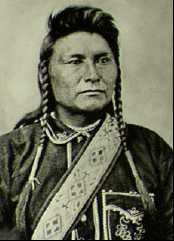


    When to start celebrating

    Finally, James Magaska Swan writes:

    When will our Native Brothers and Sisters recognize "Independence Day"?When the lands are given back to us, and we don't have to do fund raisers or occupations to get them back;

    When the buffalo are not hazed and killed by government agencies;

    When rocks are not sold as souvenirs on Alcatraz;

    When Indian names and images are not used as sports mascots or for commercial selling of products;

    When we can have equal time in our classrooms across the United States to learn and speak our languages so they are not lost forever;

    When we have funding in our schools so our children can learn;

    When all tribes can be "recognized";

    When we can keep our casino monies and take care of our own;

    When we all have health care, card carrying or not;

    When we can have statues that also commemorate our own people;

    When we can change historical markers to reflect the truth and not glamorize the murders;

    When we can see curriculum in our school books and classrooms that are not romanticized or glossed over when it comes to what really happened in and around Indian country;

    When we don't have to ask permission to hunt and gather for sustenance, ceremony, or for medicinal reasons;

    When all sacred sites are in place (and protected);

    When our ancestors remains or artifacts are uncovered, the corporation or construction companies JUST STOP and find a different place to build;
    and so forth. This is only about 40% of the list, which goes on too long to be truly effective as a piece of writing.

    I'd just like to note how Swan sees the big and small items as equally important. Indians want their land back, federal recognition, health care, education, and casino money. They also want sacred sites and remains protected, Indian stories told in schools and history displays, and an end to stereotypical Indian mascots and commercial products.

    Most Indians get it and most non-Indians don't, but these things are interrelated. Not romanticizing or stereotyping Indians means treating them as political, economic, and social equals--as sovereign people. The two go hand in hand.

    For more on the subject, see Tribes Celebrate July 4th and Fun 4th of July Facts.