Showing posts with label slavery. Show all posts

April 20, 2016

Tubman replaces Jackson on $20

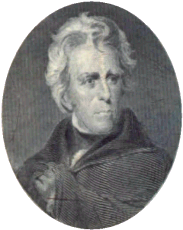
The news that the US would place Harriet Tubman on the front of the $20 bill and move Andrew Jackson to the back triggered a variety of responses.

Predictably, racist conservatives cried over the loss of one of their white male icons:

“We need Trump to stop all the PC crap”: Right-wing reaction to the Harriet Tubman $20 bill is (another) new low

Trump on Tubman: "pure political correctness." Trump on Jackson: "tremendous success."

The Best Conservative Reactions To Tubman Bumping Jackson From $20 Bill

Ann Coulter needs to stop: She and the rest of the clueless conservatives need to quit moaning about replacing Jackson with Tubman on $20 bill

Non-racists weigh in

Meanwhile, anyone with a cursory knowledge of history explained why Jackson should be banished:

Andrew Jackson was a slaver, ethnic cleanser, and tyrant. He deserves no place on our money.

Why Andrew Jackson never should have been on the $20 to begin with

Harriet Tubman to Share $20 Bill with President Who Called for Some Abolitionists to 'Atone ... With Their Lives'

Tubman’s In. Jackson’s Out. What’s It Mean?

Stop clinging to the Founding Fathers: The Andrew Jackson/Hamilton/Tubman debate is really about honest history

While others challenged the conservatives' blatant racism:

They only want to honor white men: The pathetic conservative meltdown over the Harriet Tubman $20 bill exposes the right’s petty identity politics

5 Questions for People Who Are Outraged Over Harriet Tubman on our $20 Bill

Natives approve

Natives overwhelming applauded the downgrading of the infamous Indian killer:

Native Americans applaud removing Jackson from $20 bill
4/21

But some wondered why Jackson wasn't paired with a famous Indian chief--since he's perhaps best-known for instigating the Trail of Tears:

A Native American Chief Should Have Replaced Andrew Jackson on the $20

For more on the subject, see Stanford Cancels Bloody Jackson Play and Indians on US Bank Notes.
December 18, 2015

Guns are central to America

White guys are killing us: Toxic, cowardly masculinity, our unhealable national illness

Race, guns and gender--the common denominator at the heart of so many problems--are what we need to talk about

By Chauncey DeVega
[T]here is another little-discussed factor that helps to explain America’s obsessive and near pathological gun culture, unwillingness to treat gun violence as a public health crisis, Right-wing domestic terrorism, and propensity for mass shootings. It transcends all of those issues. But this factor is usually treated as verboten, something to not be unspoken of, because of the rage, threats of violence, and animus it inspires.

The common denominator is white masculinity and the particular ways that it is connected to American gun culture and the color line.

The gun is central to the founding of an American society where hierarchies of race and gender were central to the country’s Herrenvolk white racial settler democratic project. America was born as, and remains, a culture and society dedicated to maintaining the dominance, privilege, and power of white men over people of color and women. This was not an accident, bug, or a glitch. It was a feature.

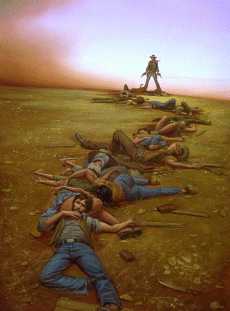
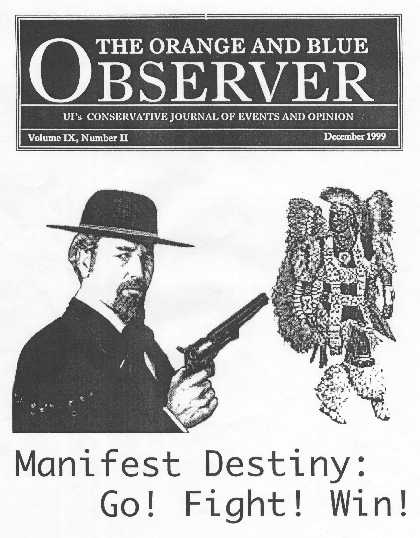
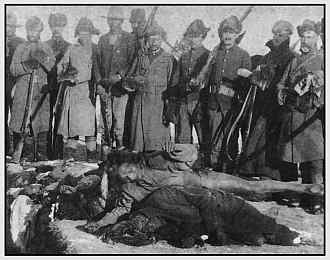
Guns helped White America to commit genocide against First Nations peoples and to steal land under the doctrine of Manifest Destiny. The gun maintained Southern society as a white over black racial military dictatorship. The gun was also a tool for white elites to control the working classes and poor.
Comment:  For more on gun control, see Guns as Penis Substitutes and Conservatives Let Mass Shootings Happen.

March 19, 2015

America's "intentional ignorance" about racism

Noam Chomsky: “Intentional ignorance” fuels American racism

Linguist and activist tackles America's original sin in new interview

By Luke Brinker
The harsh realities of American racism and how it functions are seldom acknowledged, Chomsky argues—the willful result of national myth-making and truth-shrouding.

“There is also a common variant of what has sometimes been called ‘intentional ignorance’ of what it is inconvenient to know: ‘Yes, bad things happened in the past, but let us put all of that behind us and march on to a glorious future, all sharing equally in the rights and opportunities of citizenry,’” he explains.

Intentional ignorance dates to the earliest days of settlement—when American colonists would reassure themselves that their displacement of Native Americans was part of a “humanitarian intervention” against “savagery”—and continues to the present day, undergirding discussions of African Americans’ alleged pathologies, for instance.

“The appalling statistics of today’s circumstances of African-American life can be confronted by other bitter residues of a shameful past, laments about black cultural inferiority, or worse, forgetting how our wealth and privilege was created in no small part by the centuries of torture and degradation of which we are the beneficiaries and they remain the victims,” Chomsky notes. “As for the very partial and hopelessly inadequate compensation that decency would require—that lies somewhere between the memory hole and anathema.”
Noam Chomsky on the Roots of American Racism

By George Yancy and Noam ChomskyG.Y.: This “intentional ignorance” regarding inconvenient truths about the suffering of African-Americans can also be used to frame the genocide of Native Americans. It was 18th century Swedish taxonomist Carolus Linnaeus who argued that Native Americans were governed by traits such as being “prone to anger,” a convenient myth for justifying the need for Native Americans to be “civilized” by whites. So, there are myths here as well. How does North America’s “amnesia” contribute to forms of racism directed uniquely toward Native Americans in our present moment and to their continual genocide?

N.C.: The useful myths began early on, and continue to the present. One of the first myths was formally established right after the King of England granted a Charter to the Massachusetts Bay Colony in 1629, declaring that conversion of the Indians to Christianity is “the principal end of this plantation.” The colonists at once created the Great Seal of the Colony, which depicts an Indian holding a spear pointing downward in a sign of peace, with a scroll coming from his mouth pleading with the colonists to “Come over and help us.” This may have been the first case of “humanitarian intervention”—and, curiously, it turned out like so many others.

Years later Supreme Court Justice Joseph Story mused about “the wisdom of Providence” that caused the natives to disappear like “the withered leaves of autumn” even though the colonists had “constantly respected” them. Needless to say, the colonists who did not choose “intentional ignorance” knew much better, and the most knowledgeable, like Gen. Henry Knox, the first secretary of war of the United States, described “the utter extirpation of all the Indians in most populous parts of the Union [by means] more destructive to the Indian natives than the conduct of the conquerors of Mexico and Peru.”

Knox went on to warn that “a future historian may mark the causes of this destruction of the human race in sable colors.” There were a few—very few—who did so, like the heroic Helen Jackson, who in 1880 provided a detailed account of that “sad revelation of broken faith, of violated treaties, and of inhuman acts of violence [that] will bring a flush of shame to the cheeks of those who love their country.” Jackson’s important book barely sold. She was neglected and dismissed in favor of the version presented by Theodore Roosevelt, who explained that “The expansion of the peoples of white, or European, blood during the past four centuries…has been fraught with lasting benefit to most of the peoples already dwelling in the lands over which the expansion took place,” notably those who had been “extirpated” or expelled to destitution and misery.

The national poet, Walt Whitman, captured the general understanding when he wrote that “The nigger, like the Injun, will be eliminated; it is the law of the races, history… A superior grade of rats come and then all the minor rats are cleared out.” It wasn’t until the 1960s that the scale of the atrocities and their character began to enter even scholarship, and to some extent popular consciousness, though there is a long way to go.

That’s only a bare beginning of the shocking record of the Anglosphere and its settler-colonial version of imperialism, a form of imperialism that leads quite naturally to the “utter extirpation” of the indigenous population—and to “intentional ignorance” on the part of beneficiaries of the crimes.

December 16, 2014

"America, nation of torturers"

America, nation of torturers: Stop saying “this isn’t who we are”—here’s the real truth

Terrible findings in the torture report "are not who we are," John Kerry claims. Well, here's a U.S. history lesson

By Charles Davis
It’s comforting for those whose actions are not aligned with their stated values to believe that what one does in real life is not what ultimately defines who one really is. It’s nice to think who we are is determined not by the things we did the day before, but by the stated ideals we hope to aspire to fulfill, starting tomorrow. In a nation-state founded by settler-colonial Protestants, the argument is familiar—it’s what’s deep down inside that gets one up into heaven, not the good or genocidal nature of what one does down here on Earth—and as with any half-decent lie, it’s relatable: as fallible human beings, we’d all rather like to believe that we’re not as bad as we are but as good as we say we would like to be.

While founded on the ethnic cleansing of the continent’s original inhabitants and the enslavement of its African workforce, the news—or rather, confirmation—that the CIA employed a revolting range of “enhanced” torture techniques in the wake of 9/11 is being portrayed by some as a vile exception to the United States’ otherwise exceptional history; a “stain on our values and history,” in the words of Senator Dianne Feinstein, whose committee released the report detailing the agency’s use of near-drownings and mock executions and sexual abuse to humiliate and demoralize a foreign “other” under the guise of gathering intelligence. These practices, the terrible things this country has again and again been shown to do, “are not who we are,” added Secretary of State John Kerry. Indeed, “the awful facts of this report” do not even “represent who they are,” he said of those awful people described in that report (“its important that this period not define the intelligence community in anyone’s mind,” he continued).

“Some of the actions that were taken were contrary to our values,” President Barack Obama chimed in, crediting his government with, as always, correcting its own mistakes (“They aren’t picking up prisoners anymore,” Senator James Risch explained to CNN. “What they do is when they identify a high-value target, the target is droned.”).

As a rhetorical ploy, it’s understandable: Saying the United States has always been garbage is not going to be terribly popular in a nation that still fondly refers to a group of sadistic slave-owners as its “founding fathers”—so politicians savvy enough to know that openly embracing torture is not a good look for the world’s leading state-sponsor of holier-than-thou rhetoric, appeal to a history and set of values that never was and never were in practice, as a way to give political cover to their middling, public relations-minded critiques of the national-security state’s least defensible excesses. It’s entirely false, this narrative of extreme goodness marked by occasional self-correcting imperfection, but it satisfies our national ego to think the American phoenix rises from a store of ethically traded gold, not a pile of rotting trash.
Comment:  For more on genocide, see Colonists Wanted Indians Dead and Lord Amherst's Genocidal Intent.

December 30, 2013

Ani DiFranco's white obliviousness

As you may have heard, Ani DiFranco, the white liberal feminist folk singer, got in trouble for scheduling a retreat at the slave-owning Nottoway Plantation in Louisiana. Some postings on the subject:

…But How Dare You Complain to Me: Ani DiFranco, White Obliviousness and Historical Memory

By Tim WiseDespite realizing that, as she put it, “tragedies on a massive scale are not easily dealt with or recovered from,” and that “pain is stored in places where great social ills have occurred,” DiFranco insists that her intentions were noble. Rather than utilizing Nottoway so as to forget the past, she was utilizing it so as to remember, because, and these are her words: “I believe that people must go to those places with awareness and with compassionate energy and meditate on what has happened and absorb some of the reverberating pain with their attention and their awareness.”

Sure, like Dachau, where I’m quite certain she would never have thought to schedule a writer’s retreat, even if she were in the middle of a European tour at the time, such that getting there would have been a cinch.

That not only DiFranco, but indeed most white people, would flinch at the analogy between Dachau and Nottoway is predictable and largely suggestive of the problem with white people, or at least our propensity for blinkered historical memory. That we cannot recognize the similarities between a forced labor camp in the U.S.—which Southern plantations were, by definition—and a forced labor camp like Dachau (which, unlike the more deliberative death camps operated by the Nazis, was mostly a site of detention rather than extermination), indicates our inability to squarely face the genocide, physical and cultural to which our people mostly assented for hundreds of years on this soil. We do not allow for the pain of black peoples to equate in our minds—or the larger national imagination—to the pain of European Jewry, no matter that the transcontinental slave trade resulted in the deaths of millions (on the forced marches to the African coast, at sea, and once in the so-called new world), and no matter that the system of white domination that was central to enslavement still operates, albeit in a different form, and that the legacy of slavery itself is still evident in patterns of wealth accumulation (and its opposite) very much operative in the 21st century.

While Germany has long confronted the horrific truth of its history, we still have not, principally because most white folks aren’t, by and large, up to the task. Indeed, in one of the most deliciously repulsive ironies in curricular history, one is far more likely to find an American classroom ruminating on the tragedy of the European Holocaust than its American counterparts, be they perpetrated against black folks or indigenous persons. In fact, and as I’ve noted elsewhere, one isn’t even allowed to equate these things, or even use the same words, like “Holocaust” (with a capital H, no less, and perhaps even a trademark symbol) or “genocide” to describe them, unless one wishes to face the wrath of American apologists, who equate nicely with the current operators of Nottoway, all of whom insist upon how humanely the slaves owned by John Hampden Randolph were treated.
Glamming Up Slavery: Ani DiFranco's Plantation Paradise

By Jessica Ann MitchellFeminist folk singer Ani Difranco has enraged fans by hosting her upcoming “Righteous Retreat” at Nottoway Plantation in Louisiana.

As someone that grew up in Georgia, I’ve seen that a lot of White southerners and northerners view plantations as glamorous vacation hubs. For many, plantations are serene settings for family gatherings, weddings and retreats. There are even housing communities that are presented as high class by adding “plantation” to the name.

The gruesome realities of plantations are almost non-existent in their minds because the pain is not tied to their historical framework. There is almost always a careful removal of a realistic identity of masters, their descendants and the privilege that comes along with the erasure of history. So when people like Thomas Jefferson are discussed, the excuse for his participation as a slaver owner/rapist is, “He was a man of his time.”

The focus now turns to his legacy as a founding father rather than as a racist, enslaver and sexual abuser. This history is often avoided or shunned which leads to the cloaking of actual events. It allows for privileged groups to remain unbothered by very meaningful lived experiences on terror filled plantations.

The focus on the lavish and decadent lifestyles of the plantation owners trumps the fact that patrons are directly basking in the riches accumulated from the mass enslavement of African American people. Some would like to think that times weren’t so hard for “the slaves.” The Nottoway Plantation’s website specifically states, “It is difficult to accurately assess the treatment of Randolph’s slaves; however, various records indicate that they were probably well treated for the time.”
DiFranco "apologizes"

Ani DiFranco’s faux-pology: White privilege and the year in race

With most white people not having to confront the true history of plantations, honesty about race remains elusive

By Brittney Cooper
We ended 2013, the 150th anniversary of the signing of the Emancipation Proclamation—a year in which one of the most popular movies, “12 Years a Slave,” chronicled the horrors of slavery in Louisiana—with Ani DiFranco huffily canceling her plan to host a “Righteous Retreat” for artists at Nottaway Plantation in New Orleans. That, ladies and gentlemen, sums up your year in race. I understand that most white people never have to think beyond notions of the idyllic and pastoral when it comes to plantations. That these places continue to represent sites of untold horror, violence and humiliation for black people is the very kind of knowledge against which white privilege inoculates.

The whole point of being white is that you are never supposed to feel uncomfortable in space. To the moon and back, the world is yours. This past year, “pure” white space has been procured and subsequently sanctified through the precious spilled blood of black bodies—Trayvon Martin, who got no justice; Jonathan Ferrell, who asked for help in the wrong neighborhood; Renisha McBride, who did the same.

In her faux-pology, which doubled as a notice of cancellation, DiFranco claimed to “get it.” But from her passive aggressive chastisement and her choice to accuse her naysayers on social media of engaging in “high velocity bitterness,” she obviously doesn’t really get it. She acknowledged that “the pain of slavery is real and runs very deep and very wide,” but saw as “very unfortunate” “what many have chosen to do with that pain.”

No doubt, Ani discovered this week, that social media is no country for white women’s foolishness on race. Unfortunately for her, she chose to launch this retreat at the same time that another unfortunate white feminist soul launched a twitter campaign called #stopblamingwhitewomenweneedunity. And after a year of looking at Miley Cyrus’ non-twerking ass, everyone has had enough.
And a broader look at what white feminists like DiFranco are doing:

A Year in Review: The Top 10 Most Racist/Privileged Things White Feminists Did in 2013In honor of the #stopblamingwhitewomenweneedunity hashtag (started via this Huffington Post article penned by the delightfully clueless Adele Wilde-Blavatsky) I’ve decided to put together a top ten honoring the many interesting methods white feminists employed this year to promote unity between themselves and feminists of color.

From refusing to defend feminists of color against attacks from the patriarchy (or from other white feminists for that matter), to deriding feminists of color for not being feminist enough, to blaming feminists of color’s oppressions on their own cultures (instead of, you know, patriarchy) white feminists sure have a funny way of expressing their desire for unity with feminists of color.
Even though this posting is mainly about white privilege as it relates to blacks, it applies to Native issues as well. The same power and privilege is behind Thanksgiving pageants, Halloween costumes and parties, and Indian team names and mascots. It's about reinforcing the American mythology of the benevolent European "settlers" who tamed the "wilderness" and brought civilization to the "New World."

November 27, 2013

"Ask a Slave" on Indians

YouTube Comedy 'Ask a Slave' Tackles the Thanksgiving Question: 'What About the Indians?'“Was your great-grandmother a Cherokee princess like mine? You can kind of see it in my cheekbones."

So launches the latest episode of Ask a Slave, the YouTube comedy series by comedian Azie Mira Dungey, an actress who spent two years playing a slave at George Washington’s plantation, Mount Vernon. So many absurd questions were posed to Dungey as she portrayed Caroline Branham, who “belonged” to Washington back in the 1700s, that she created the character of Lizzie May, “personal housemaid to president and Lady Washington,” as she puts it in her intro. “And I'm here to answer all of your questions.”

The episode posted on November 24 deals, fittingly, with Thanksgiving.

"I know you're a slave, but what about the Indians?” asks the aforementioned man whom Lizzie May dubs “Cheekbones.” “Do you know any?"

Luckily, she does.

"Well I don't know why y'all keep bringing up Indians,” says Lizzie May, after fielding a few Thanksgiving questions. “But it's a good thing I happen to have my dear friend Red Jacket here with me today."

Enter the Seneca leader Otetiani Sagoyewatha (which Lizzie can’t pronounce), using the English moniker given him for fighting on their side during the Revolutionary War. What ensues is not unlike the queries recounted last summer by a staffer at the information kiosk at the Montreal First Nations Festival in Montreal.

October 12, 2013

Republicans want to restore Confederacy

Columnist Dennis Hamill tells us what the government shutdown, aka the Obamacare battle, is all about:

Frightened white people in Congress who won't accept a black President are what's causing the deadlock

Even on Columbus Day extremist Republicans are stopping progress

By Dennis Hamill
[T]his isn’t about money, debt or deficit. It’s about race.

Five centuries after Columbus and his nervous white crew arrived, there is still a small crew of frightened white people in Congress who refuse to accept an America with a black man in charge.

These extremists have not yet been able to accept, even after two decisive national elections, that a black man occupies the White House.

For some of them, their single goal as members of Congress is to make this first African-American President fail.
A Southerner confirms the conservatives' irrational fear and loathing of minorities:

The irrational fear of President Obama

By Jonathan CapehartCapehart: The president and the Obama administration say the whole reason he did this is to get the 50 million Americans without health insurance to have health insurance.

Jackson: They figured out a way to get money out of the American people’s pockets. It won’t benefit—it’ll benefit a very small amount of people, and it’ll be the ones that are too lazy or unwilling to work, along with the millions and millions of illegal aliens in this country.

Capehart: You do know that the Affordable Care Act is not … undocumented workers are not eligible for Obamacare. That’s specific in the law.

Jackson: They can go into any Social security agency, welfare office, social services and they’re giving them stuff. They are handing it out to them left and right.

Capehart: What exactly are they handing out?

Jackson: Benefits! Look at them. They get food stamps. They get welfare, dependent children…. They help them with their housing, and they’re not even supposed to be in our country. They are here illegally, but, yet, they know how to work our system to get what they want. They want our health care. They want our food. They want our money, yet they don’t pay taxes. And they’ll look right at you and they’ll tell you, “No habla the English,” and laugh. But you understand what they’re saying. That really makes me angry.
As does this sign:

Arkansas Restaurant Sign Claims Obamacare Is 'America's Punishment For Slavery Years'


That pretty much says it all. Passing Obamacare = helping black and brown people = punishing white people. In short, those who oppose Obamacare are motivated by racism.

Racist Tea Party

Let's look more closely at the Republican Tea Party's racism. I added the red emphasis to highlight the key points.

Ex-GOP insider unloads: Blame “neo-Confederate insurrectionists” for shutdown!

"I would take Boehner drunk over Cruz sober," former 28-year GOP staffer-turned-author Mike Lofgren tells Salon

By Josh Eidelson
These people are basically neo-Confederate insurrectionists. They are in substantive rebellion against the orderly government of the country. And one of the things I noticed—and it’s something that’s very common in human beings—we all try to mollify or appease the crazy uncle at Thanksgiving dinner. You know, “Don’t make a scene.” Well, I noticed in the last few years of my service on the Hill that a number of Democrats seemed to be afraid of Republicans. And Obama pretty much wasted his first term trying to mollify them. I think he’s finally stumbled upon a strategy that’s better: simply not give them what they demand. Because this is a deliberate strategy to hold the government hostage.Pollsters: GOP will become even more extreme (if that’s possible)

New research suggests the factions currently leading the war on Obamacare will grow even more intransigent

By Steven Rosenfeld
Race is very much at play in right-wing politics and identity, the pollsters found.

“While few explicitly talk about Obama in racial terms, the base supporters are very conscious of being white in a country with growing minorities,” they said. They believe that “their party is losing to a Democratic Party of big government whose goal is to expand programs that mainly benefit minorities.”
And:Evangelicals were clearly the most aggrieved and discouraged GOP faction.

“They believe their towns, communities and schools are suffering from ‘culture rot’ that has invaded from the outside,” the 30-page analysis said. “The central focus here is homosexuality, but also the decline of homogenous small towns. They like the Tea Party because they stand up to the Democrats.”

Evangelicals are a third of the GOP base, the report said. More than three-quarters are married. More than 90 percent are white and older. Eighty percent vote only Republican. And like the other factions, they can’t stand President Obama, labeling him as a “liar” who panders to middle-class worries.
“I think that his picture of the people in this room would be that we’re all a bunch of racist, gun-clinging, flyover state, cowboy hat-wearing yokels—because we didn’t go to Harvard, and we’re not from New York, and we’re pretty white, we’re pretty middle-class,” said one man in Roanoke, Virginia. “We’re going to be in a very politically incorrect minority very soon,” added another, objecting to how the mainstream culture supports gays, schools allow same-sex teenagers to hold hands, and the political left beats up on them for anti-gay beliefs.

The notion that their corner of American life—described by a Virginian as “a little bubble”—is under attack extends to feeling “invaded” by immigrants, and taking offense that they have to tell their phones to talk to them in English, not Spanish. “Don’t come here and make me speak your language,” another man said.
Tea Party radicalism is misunderstood: Meet the “Newest Right”

Our sense of the force currently paralyzing the government is full of misconceptions--including what to call it

By Michael Lind
When the post-Civil War system broke down during the Civil Rights Revolution of the 1950s and 1960s, the South’s local notable class and its Northern and Western allies unexpectedly won a temporary three-decade reprieve, thanks to the “Reagan Democrats.” From the 1970s to the 2000s, white working-class voters alienated from the Democratic Party by civil rights and cultural liberalism made possible Republican presidential dominance from Reagan to George W. Bush and Republican dominance of Congress from 1994 to 2008. Because their politicians dominated the federal government much of the time, the conservative notables were less threatened by federal power, and some of them, like the second Bush, could even imagine a “governing conservatism” which, I have argued, sought to “Southernize” the entire U.S.

But then, by the 2000s, demography destroyed the temporary Nixon-to-Bush conservative majority (although conceivably it could enjoy an illusory Indian summer if Republicans pick up the Senate and retain the House in 2016). Absent ever-growing shares of the white vote, in the long run the Republican Party cannot win without attracting more black and Latino support.

That may well happen, in the long run. But right now most conservative white local notables in the South and elsewhere in the country don’t want black and Latino support. They would rather disenfranchise blacks and Latinos than compete for their votes. And they would rather dismantle the federal government than surrender their local power and privilege.

The political strategy of the Newest Right, then, is simply a new strategy for the very old, chiefly-Southern Jefferson-Jackson right. It is a perfectly rational strategy, given its goal: maximizing the political power and wealth of white local notables who find themselves living in states, and eventually a nation, with present or potential nonwhite majorities.


Christian delusions are driving the GOP insane

Why aren't Republicans more frightened of a shutdown and a default? Part of the reason is magical thinking

By Amanda Marcotte
The press often talks about the Tea Party like they’re secularist movement that is interested mainly in promoting “fiscal conservatism”, a vague notion that never actually seems to make good on the promise to save taxpayer money. The reality is much different: The Tea Party is actually driven primarily by fundamentalist Christians whose penchant for magical thinking and belief that they’re being guided by divine forces makes it tough for them to see the real world as it is.

It’s not just that the rogue’s gallery of congress people who are pushing the hardest for hostage-taking as a negotiation tactic also happens to be a bench full of Bible thumpers. Pew Research shows that people who align with the Tea Party are more likely to not only agree with the views of religious conservatives, but are likely to cite religious belief as their prime motivation for their political views. White evangelicals are the religious group most likely to approve of the Tea Party. Looking over the data, it becomes evident that the “Tea Party” is just a new name for the same old white fundamentalists who would rather burn this country to the ground than share it with everyone else, and this latest power play from the Republicans is, in essence, a move from that demographic to assert their “right” to control the country, even if their politicians aren’t in power.

It’s no surprise, under the circumstances, that a movement controlled by fundamentalist Christians would be oblivious to the very real dangers that their actions present. Fundamentalist religion is extremely good at convincing its followers to be more afraid of imaginary threats than real ones, and to engage in downright magical thinking about the possibility that their own choices could work out very badly. When you believe that forcing the government into default in an attempt to derail Obamacare is the Lord’s work, it’s very difficult for you to see that it could have very real, negative effects.

It’s hard for the Christian fundamentalists who run the Republican Party now to worry about the serious economic danger they’re putting the world in, because they are swept up in worrying that President Obama is an agent of the devil and that the world is on the verge of mayhem and apocalypse if they don’t “stop” him somehow, presumably be derailing the Affordable Care Act. Christian conservatives such as Ellis Washington are running around telling each other that the ACA will lead to “the systematic genocide of the weak, minorities, enfeebled, the elderly and political enemies of the God-state.” Twenty percent of Republicans believe Obama is the Antichrist. Washington Times columnist Jeffrey Kuhner argued that Obama is using his signature health care legislation to promote “the destruction of the family, Christian culture,” and demanded that Christians “need to engage in peaceful civil disobedience against President Obama’s signature health care law.”
"Neo-Confederate insurrectionists" isn't just rhetoric, as the flag-waving teabagger below demonstrated. The Republican Tea Party literally champions a Southern white Christian power structure where minorities are second-class citizens.


How Republicans became racists

How Racism Caused The Shutdown

By Zack BeauchampBy the Johnson-Goldwater election, it had become clear that overt racism and segregationism was politically doomed. Brown v. Board of Education and LBJ’s support for the 1964 Civil Rights Act saw to that. As this scary recognition dawned on Southern whites, they began searching for a new vehicle through which to shield themselves and their communities from the consequences of integration. The young conservative movement’s ringing endorsement of a minimalist federal government did the trick—it provided an on-face racially neutral language by which Southerners could argue against federal action aimed at integrating lily-white schools and neighborhoods.

Kevin Kruse, a Princeton historian whose work focuses on the South and the conservative movement, finds deep roots in segregationist thought for this turn. “In their own minds, segregationists were instead fighting for rights of their own,” Kruse suggests. These “rights” included “the ‘right’ to select their neighbors, their employees, and their children’s classmates, the ‘right’ to do as they pleased with their private property and personal businesses, and, perhaps, most important, the ‘right’ to remain free from what they saw as dangerous encroachments by the federal government.”
Modern GOP is still the party of Dixie

How the South poisons American conservatism and sabotages our politics

By Kim Messick
For black Americans slavery was a holocaust and a nightmare. For white Southerners it meant (among other things) living intimately with millions of human beings who were permanent outsiders—persons whose natural incapacities, as the white South saw them, meant they could never be trustworthy members of the community. For white supremacists, citizenship had one very definite condition of entry: white skin, and the potential for moral personality that came with it. The racial divide defined the difference between civilized society and the enthralled barbarism that lay beyond and beneath it.

It would be hard to overstate the influence of this experience on the mind of the South. For one thing, it meant that the white South was, in effect, a garrison state. White Southerners lived in close proximity to a large population they routinely abused, terrorized and defiled. Fear of black violence and revolt is a constant theme of white society before and after the Civil War. The South’s noisily martial version of patriotism has its roots here, as does the region’s love affair with guns. And there are obvious connections between these facts and its stubborn embrace of patriarchy and misogyny. (Does the name “Todd Akin” ring any bells?)

Of greater relevance to our present concerns, however, are the implications for the South’s political psychology. Here the region’s history as a slave society left a very particular imprint, one that lingered long after slavery and Jim Crow collapsed. I mean the habit of imagining society as a two-tiered structure, with the “normative” community on top and a degenerate class of outsiders below. The former consists of those who satisfy the prerequisites of citizenship, and can therefore be trusted to fulfill the social contract voluntarily; the latter of those whose inherent debilities ensure that coercion is the only reliable guarantee of cooperation.
This is a fraught subject, so I want to make my meaning clear. I am not arguing that all Southerners—or all conservatives—are racists or paranoids; I’m not even arguing that all Southerners are conservatives. (I myself would personally disprove that assertion.) Slavery, thankfully, disappeared long ago, and Jim Crow is now almost two generations behind us. Racism lingers on in the South as in America generally, but for the most part must now keep its head down and its voice low; it’s the vice that dare not speak its name. (This is not to deny, of course, that it retains considerable social valence.) What I am arguing is that a certain habit of thought, powerfully shaped by the experience of slavery, survived the passage of that curse and continues to influence some Southern conservatives to this day. It no longer takes the form of a blatant assertion that only the white race is worthy of social trust; its definition of the normative community has shifted. (Though it remains associated with racialist, or at least race-conscious, themes.) It is now more likely to define that community in ideological terms—to see it as consisting of those who endorse a particular view of government and its rightful relations with traditional mores and economic power. It has, however, retained certain aspects of its earlier, darker origins. It is still obsessed with purity—ideological if not racial—and still invests those it regards as impure with a harsh, acute animus. And it continues to equate difference with illegitimacy. Those on the outside—the liberals, the Democrats, the “socialists”—cannot be trusted partners in political life; they want only to undermine our institutions and must therefore be expelled from them.Tea party wants to take America back--to the 18th century

Their ultimate destination appears to be the 1780s and our dysfunctional government under the Articles of Confederation.

By Joseph J. Ellis
Clearly, most of the tea party radicals in the House of Representatives come from gerrymandered districts, which function as cocoons that resist penetration by alien ideas, like Keynesian economics, Darwinian evolution, global warming and yes, the potential popularity of Obamacare. They live in a parallel universe in which a rejection of any robust expression of government power is an unquestioned and unexamined article of faith.

Where does this irrational but obviously deep-felt impulse come from? Talk radio and Fox News obviously feed the beast. But the seminal convictions of the tea partiers defy any modern conceptions of government power. How far back in history do they want to take us?

My initial impression was that they wanted to repeal the 20th century. Radical Republicans of the tea party persuasion object to all federal programs that have an impact on our daily lives, including Medicare, Medicaid, Social Security and the Federal Reserve Board. Even though tea partiers, like all the rest of us, are beneficiaries of these federal programs, especially Medicare and Social Security, ideology trumps self-interest in their worldview, though one wonders how they would respond if they had their way and their Social Security checks stopped coming.

Now, I believe these radicals want to go even further back in time. Though it wouldn't be fair to pin a defense of slavery on them, they agree with the states' rights agenda of the Confederacy and resist the right of the federal government to make domestic policy, which is their visceral reason for loathing Obamacare.

But their ultimate destination, I believe, is the 1780s and our dysfunctional government under the Articles of Confederation. The states were sovereign in that post-revolutionary arrangement, and the federal government was virtually powerless. That is political paradise for the tea partiers, who might take comfort in the fact that their 18th century counterparts also refused to fund the national debt. Their core convictions are pre-Great Society, pre-New Deal, pre-Keynes, pre-Freud, pre-Darwin and pre-Constitution.


For more on conservative racism, see Shutdown = White Minority Asserting Power and "Defund Obamacare" = "Nigger, Nigger."

June 16, 2013

Anti-government extremism = white supremacy

Anti-Government Extremism Has Roots in Prewar South

By Robert Parry[S]omething extreme has surfaced in modern American politics: an ideological hatred of government. From the Tea Party to libertarianism, there is a “principled” rejection—at least rhetorically—of almost everything that government does (outside of national security), and those views are no longer simply “fringe.” By and large, they have been embraced by the national Republican Party.

There has also been an effort to anchor these angry anti-government positions in the traditions of U.S. history. The Tea Party consciously adopted imagery and symbols from the Revolutionary War era to create an illusion that this contempt of government fits with the First Principles.

However, this right-wing revision of U.S. history is wildly askew if not upside-down. The Framers of the U.S. Constitution—and even many of their “anti-federalist” critics—were not hostile to an American government. They understood the difference between an English monarchy that denied them representation in Parliament and their own Republic.

Indeed, the key Framers—James Madison, George Washington and Alexander Hamilton—might be called pragmatic nationalists, eager to use the new Constitution, which centralized power at the national level, to build the young country and protect its fragile independence.

While these Framers later split over precise applications of the Constitution—Madison opposed Hamilton’s national bank, for instance—they accepted the need for a strong and effective federal government, unlike the weak, states’-rights-oriented Articles of Confederation.

More generally, the Founders recognized the need for order if their experiment in self-governance was to work. Even some of the more radical Founders, the likes of Sam Adams, supported the suppression of domestic disorders, such as Shays’ Rebellion in Massachusetts and the Whiskey Rebellion in Pennsylvania. The logic of Adams and his cohorts was that an uprising against a distant monarch was one thing, but taking up arms against your own republican government was something else.

But the Tea Partiers are not entirely wrong when they insist that their hatred of “guv-mint” has its roots in the Founding era. There was an American tradition that involved resisting a strong and effective national government. It was, however, not anchored in the principles of “liberty,” but rather in the practice of slavery.

The battle against the Constitution and later against an energetic federal government—the sort of nation-building especially envisioned by Washington and Hamilton—emanated from the fears of many Southern plantation owners that eventually the national political system would move to outlaw slavery and thus negate their massive investment in human bondage.

Their thinking was that the stronger the federal government became the more likely it would act to impose a national judgment against the South’s brutal institution of slavery. So, while the Southern argument was often couched in the rhetoric of “liberty,” i.e. the rights of states to set their own rules, the underlying point was the maintenance of slavery.
Comment:  For more on the Tea Party, see Racism in the Republican Primaries and Teabaggers Seek White Christian Rule.

May 15, 2013

Freedom = slavery for California's Indians

Freedom for California’s Indians

By Stacey L. SmithOn April 27, 1863, nearly five months after President Abraham Lincoln issued the Emancipation Proclamation, California abolished its system of forced apprenticeship for American Indians. Under the apprenticeship provisions of the state’s Act for the Government and Protection of Indians, several thousand California Indians, mostly children, had suffered kidnapping, sale and involuntary servitude for over a decade.

Newly elected California Republicans, eager to bring California in line with the national march toward emancipation, agitated for two years in the early 1860s to repeal Indian apprenticeship. And yet those Republicans’ limited vision of Indian freedom—one in which Indians would be free to reap the fruits of their labor, but not free from the duty to labor altogether—made for an incomplete Indian Emancipation Proclamation. Although California was distant from the battlefields of the Civil War, the state endured its own struggle over freedom that paralleled that of the North and the South.

The Republican campaign to abolish Indian servitude ran up against nearly a century of coerced Indian labor in California. Under Spanish and Mexican rule, thousands of California Indians worked on missions and ranches, bound to their employment through a combination of economic necessity, captivity, physical compulsion and debt.

With the United States’ conquest of California in 1847, the discovery of gold in 1848 and the formation of a state government in 1849, new American lawmakers expanded and formalized Indian servitude to meet growing demands for labor. The 1850 Act for the Government and Protection of Indians authorized whites to hold Indian children as wards until they reached adulthood. Indian adults convicted of vagrancy or other crimes could be forced to work for whites who paid their bail.

Skyrocketing demand for farmworkers and domestic servants, combined with violence between Indians and invading whites in the northwestern part of the state, left Democrats in war-torn counties clamoring for the expansion of the 1850 Indian act. A “general system of peonage or apprenticeship” was the only way to quell Indian wars, one Democrat argued. A stint of involuntary labor would civilize Indians, establish them in “permanent and comfortable homes,” and provide white settlers with “profitable and convenient servants.” In 1860, Democrats proposed new amendments to the Act for the Government and Protection of Indians that allowed whites to bind Indian children as apprentices until they reached their mid-20s. Indian adults accused of being vagrants without steady employment, or taken as captives of war, could be apprenticed for 10-year terms. The amendments passed with little debate.

As the nation hurtled toward a war over slavery, Californians watched as their own state became a battleground over the future of human bondage. Apprenticeship laws aimed at “civilizing” the state’s Indians encouraged a robust and horrific slave trade in the northwestern counties. Frontier whites eagerly paid from $50 to $100 for Indian children to apprentice. Groups of kidnappers, dubbed “baby hunters” in the California press, supplied this market by attacking isolated Indian villages and snatching up children in the chaos of battle. Some assailants murdered Indian parents who refused to give up their children.
Comment:  This article's headline is misleading. The most important part of this article isn't how the system of involuntary servitude eventually ended. It's that it existed in the first place. "Involuntary Servitude for California's Indians" would be a better title.

At the time, of course, Californians thought they were freeing Indians from a life of savagery. By helping the white man help himself, that is. Hence my title for this posting: "Freedom = slavery for California's Indians."

For more on California's missions, see Time-Traveling Mission Play and Indians Protest Carmel Mission Stamp.

April 08, 2013

Williamsburg teaches black, Native history

Colonial Williamsburg: Where the Tea Party gets schooled

There's lots of NRA and Tea Party garb in colonial Williamsburg. But the history has a confrontational new approach

By Andrew O'Hehir
You can still snack on butter-rich ginger cakes, go window-shopping for overpriced pewter ware and indulge in other old-timey pastimes in Colonial Williamsburg, and we did those things. But what I’ll never forget about that visit is sitting in stunned silence amid a crowd of 200 people, nearly all of them white, watching an African-American woman break down sobbing at the news that her children had just been sold at auction, while her husband describes the vicious whipping he received after a failed escape attempt. Yes, the chemistry between the intense emotion of the scene and the audience demographics bordered on the uncomfortable, but the effect also felt calculated. (Which may not have been the case with an infamous slave-auction re-enactment staged at Williamsburg in 1994, which led to considerable consciousness-raising.) It was one of the most powerful moments of live theater I’ve ever experienced.

This might sound far-fetched, but Colonial Williamsburg, in its subtly transformed 21st-century mode, feels like a covert battleground in America’s culture wars. It’s where an overwhelmingly white and conservative audience meets the post-Howard Zinn cutting edge of history. (How much attention they pay, and how much they like it, is another question altogether.) If your ideas about the place are based on that grade-school trip you took with your grandparents, I can assure you that the effect is pretty different now. Beneath its manicured and bewigged surfaces, Colonial Williamsburg is trying to break free of its stodgy traditions and bring its visitors face to face with the internal conflicts and contradictions of the Revolutionary War era and their ripple effects across politics and society today.

That wrenching scene backstage at the slave auction was the second of two episodes we watched about how the Revolutionary period affected the lives of African-Americans in Williamsburg, a city where black people, both free and enslaved, made up more than half the population in the 1770s. Later that day, we watched the second of two scenes about American Indians, in which warriors from the Chillicothe Shawnee people, who are holding the famous frontiersman Daniel Boone as a hostage, engage in a failed parley with an officer from George Washington’s Continental Army. The Shawnee men leave the gathering vowing to wage war against the perfidious “long knives,” or white American settlers, for control of the Ohio Valley, although they understand that the outcome might well be the destruction of their people.

These startling and even confrontational vignettes—part of a growing and evolving street-theater program called “Revolutionary City,” which explores the social conflict of the Revolutionary era from a variety of perspectives—are not isolated events. Over the last three decades, the Colonial Williamsburg Foundation, a nonprofit originally envisioned and endowed by John D. Rockefeller in the 1920s, has undergone a gradual but ambitious reinvention, fueled partly by changing cultural and social realities but also by a wealth of new historical research into the Colonial and Revolutionary periods. This conceptual reimagining, which has involved considerable collaboration with academic historians, seems to have accelerated rapidly since “Revolutionary City” was first introduced in 2006. (The American Indian programming we saw was introduced just two years ago.) Once concerned almost entirely with historical preservation, the foundation now sees its primary mission as “citizen education,” using “historically authentic stories” to illuminate contemporary issues. To put it another way, nearly the whole place feels like a teachable moment, from the time you leave the visitors center over a footbridge that nominally takes you backward into the past. (“1954: You tolerate segregated schools,” reads one inset in the bridge. “1920: You accept that women cannot vote or own property,” reads the next.)
Comment:  For more on the subject, see Studi and Bedard at Williamsburg and Blown Away by So Far From Scioto.

October 09, 2011

Columbus the pedophile

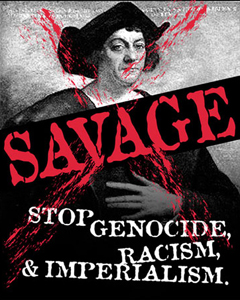
Op-Ed:  The True Story of “Columbus Day”

By Melvin MartinIt wasn’t until I went off to college in the mid-seventies and took several history courses where I learned, among other things about the man, that Columbus was undeniably a pedophile of the worst kind, a trafficker of little girls. Under the direct supervision of Columbus, native girls were sold into sexual slavery, with some of them as young as nine or ten years old being the most desired by so-called “dealers” and customers in this sickening trade. Columbus even remarked in a log book that he maintained where he stated: “A hundred castellanoes (a unit of Spanish coinage of that era, most often gold) are as easily obtained for a woman as for a farm, and it is very general and there are plenty of dealers who go about looking for girls, with those of the ages of nine to ten years being the most in demand.”

Sexual slavery is commonly defined as the exercise of any or all of the powers attached to the “right of ownership” over a person. It consists of the repeated violation or sexual abuse or coercing of a victim to provide sexual services to include rape by the captor. The crime has the disgusting character of a continuous offense. Via modern international law, the definition of sexual slavery includes situations where persons are forced into domestic servitude, marriage or any other types of forced labor involving sexual activity, as well as the trafficking of persons, women and children in particular. That such perversities were allowed and even encouraged as bonafide business practices under Columbus was due to the fact that the native people whom Columbus first encountered were wholly regarded as sub-human, as no more than animal-like beings to be used for any purpose.
Comment:  I'm not sure we can call Columbus a pedophile if he "only" sold young girls as sexual slaves. He was a pimp for pedophiles, certainly, but a pedophile himself? But since Martin wrote it, let's go with it for now.

For more on Columbus, see Textbooks Neuter Columbus Critiques and Europeans Hated Indians' Virtues.

March 09, 2011

Roger Williams, slave trader

Roger Williams plaque under review

By Paul DavisState officials met Tuesday to discuss a controversial plaque that will focus on Roger Williams’ efforts to sell Indian war captives into slavery.

The Department of Transportation has agreed to erect a plaque in Providence, but has yet to agree on how it will look or where it will go.

During a closed meeting, DOT officials talked about materials, size, design and location, but made no decisions, said DOT spokeswoman Dana Alexander Nolfe.

Native American Julianne Jennings suggested the plaque a year ago.

The public marker will be the first in the region dedicated to “an almost forgotten piece of New England history,” said Jennings, a former Rhode Island College professor now studying at the School of Human Evolution & Social Change in Tempe, Ariz.

In 1636, Narragansett Indian Sachem Canonicus and his people gave Roger Williams the land that later became the Rhode Island colony, according to Jennings’ wording for the plaque.

But, in just 40 years, “relations between the colony and the Narragansett Indians became strained as a result of frequent intercultural conflicts,” the text says.

Those conflicts erupted into the bloody King Philip’s War, which raged for several years during the 1670s.

After the fighting was over, Roger Williams and other Colonists held a town meeting on Aug. 14, 1676, Jennings said.

The town was full of Indian prisoners, and “slavery was regarded a fit punishment” for their crimes, Jennings said. They were sent to the Caribbean, Portugal, Spain and Africa, where they were sold as slaves.
Compare this to the conventional view of Roger Williams:

Roger Williams (theologian)Roger Williams (circa 1603–between January and March 1683) was an English Protestant theologian who was an early proponent of religious freedom and the separation of church and state. In 1636, he began the colony of Providence Plantation, which provided a refuge for religious minorities. Williams started the first Baptist church in America, the First Baptist Church of Providence, before leaving to become a Seeker. He was a student of Native American languages and an advocate for fair dealings with Native Americans.

Indian language and culture

Williams intended to become a missionary to the Native Americans and set out to learn their language. He studied their language, customs, religion, family life and other aspects of their world. As a result he came to see their point of view about colonization and developed a deep appreciation of them as people. He wrote his A Key into the Language of America (1643) as a kind of phrase book coupled with observations about life and culture as an aid in communication with the Indians. In it he talked about everything from salutations in the first chapter to death and burial in chapter 32. The book also sought to instruct the English, who thought of themselves as vastly superior to the Native Americans, that they were mistaken. He repeatedly made the point that the Indians were just as good as the English, even superior in some respects.

"Boast not proud English, of thy birth & blood;
Thy brother Indian is by birth as Good.
Of one blood God made Him, and Thee and All,
As wise, as fair, as strong, as personal."

Having learned their language and customs, Williams gave up the idea of being a missionary and never baptized a single Indian. He was severely criticized by the Puritans for failing to Christianize them, but Williams had arrived at the place in his own thinking that no valid church existed. He said he could have baptized the whole country, but it would have been hypocritical and false. He formed firm friendships and developed deep trust among the Native Americans, especially the Narragansetts. He was able to keep the peace between the Indians and English in Rhode Island for nearly forty years because of his constant mediation and negotiation. He twice surrendered himself as a hostage to the Indians to guarantee the safe return of a great sachem from a summons to a court: Pessicus in 1645 and Metacomet (King Philip) in 1671. He more than any other Englishman was trusted by the Native Americans and proved to be trustworthy. In the end King Philip’s War (1675–1676) was one of the bitterest events in his life as his efforts ended with the burning of Providence in March 1676, including his own house.
Comment:  Curiously, Williams's Wikipedia entry doesn't mention the slavery incident. I wonder why not.

Julianne Jennings is a friend who's appeared in this blog before. She led the protests against the King Philip's War game last year.

For more on King Philip, see King Philip Chainsaw Sculpture and King Philip's War in After the Mayflower.

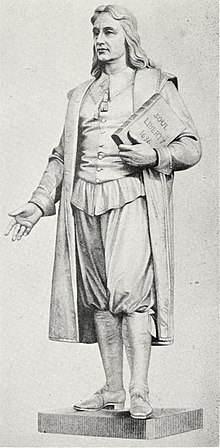
Below:  Roger Williams statue by Franklin Simmons.

January 24, 2011

Bachmann fibs about America's founding

Bachmann:  America Was Founded On Diversity (VIDEO)

By Jillian RayfieldRep. Michele Bachmann (R-MN) had an interesting take this weekend on America's first European settlers, who she said "had different cultures, different backgrounds, different traditions."

"How unique in all of the world, that one nation that was the resting point from people groups all across the world," she said. "It didn't matter the color of their skin, it didn't matter their language, it didn't matter their economic status."

"Once you got here, we were all the same. Isn't that remarkable?" she asked.

Speaking at an Iowans For Tax Relief event, Bachmann (R-MN) also noted how slavery was a "scourge" on American history, but added that "we also know that the very founders that wrote those documents worked tirelessly until slavery was no more in the United States."

"And," she continued, "I think it is high time that we recognize the contribution of our forbearers who worked tirelessly--men like John Quincy Adams, who would not rest until slavery was extinguished in the country."

It's true--Adams became a vocal opponent of slavery, especially during his time in the House of Representatives. But Adams was not one of the founders, nor did he live to see the Emancipation Proclamation signed in 1863 (he died in 1848).
Comment:  Maybe Bachmann meant the Founders worked their slaves tirelessly until the end.

Actually, "the very founders that wrote those documents" were dead long before slavery ended. For instance, Charles Carroll was the last signer of the Declaration of Independence to die. He died in 1832, 31 years before the Emancipation Proclamation.

I'm not sure how prejudiced the Founders were against people who spoke languages such as German or Dutch. They were clearly prejudiced against the poor. "When the Constitution was written, only white male property owners (about 10 to 16 percent of the nation's population) had the vote," Infoplease.com reminds us. And they were clearly prejudiced against different races, including the blacks they enslaved and the Indians they killed.

They also were prejudiced against people on the basis of religion, gender, and immigration status. Really, the only people they weren't prejudiced against were white Anglo-Saxon Protestants. You know, people exactly like themselves.

Conservatives whitewash history

It's hard to say who's the most ignorant leader of the Republican Tea Party--Glenn Beck? Sarah Palin?--but Bachmann is certainly a contender. In any case, this is yet another example of the conservatives' attempt to rewrite history. The goal, of course, to confirm that America belongs to its white male Christian minority. That the people who rule now deserve their white power and privilege. It's a milder form of the claim Palin made: that Americans are equal and accusations of racism are a ploy.

We see these tactics constantly. In particular incidents such as these:

Sanitizing Martin Luther King Jr.
Obama's UN "coup" is "chilling"
Conservatives think they're "natives"
Obama smeared as Luo tribesman

And in trying to shut down talk about race in general:

Mentioning racism = dwelling on past?
Conservatives hope minorities will forget
Talking about racism perpetuates racism?!
Americans refuse to acknowledge prejudice

The goal in every case: to maintain the power of the people in charge.

January 13, 2011

Tennessee teabaggers want to rewrite textbooks

Tea parties issue demands to Tennessee legislators

Among 5 priorities, state group wants kinder treatment of Founding Fathers in history courses

By Richard Locker
The material calls for lawmakers to amend state laws governing school curriculums, and for textbook selection criteria to say that “No portrayal of minority experience in the history which actually occurred shall obscure the experience or contributions of the Founding Fathers, or the majority of citizens, including those who reached positions of leadership.”

Fayette County attorney Hal Rounds, the group’s lead spokesman during the news conference, said the group wants to address “an awful lot of made-up criticism about, for instance, the founders intruding on the Indians or having slaves or being hypocrites in one way or another.

“The thing we need to focus on about the founders is that, given the social structure of their time, they were revolutionaries who brought liberty into a world where it hadn’t existed, to everybody—not all equally instantly—and it was their progress that we need to look at,” said Rounds, whose website identifies him as a Vietnam War veteran of the Air Force and FedEx retiree who became a lawyer in 1995.
ThinkProgess.org explains what's wrong with this effort:

Tennessee Tea Party Demands School Curriculum Not Focus Too Much On The ‘Minority Experience’

By Alex Seitz-WaldWhat “truth” do these conservative activists demand be taught? Apparently it doesn’t involve portrayals of the “minority experience” or anything else that might taint their mythical hagiographies of the Founding Fathers. At a press conference, the activists said they want a focus on the “progress” the Founders and “the majority of citizens” made, to the exclusion of supposedly “made-up criticism” about slavery and the treatment of Native Americans.

It’s unclear what these activists think is “made-up” about the very real history of slavery in America or the very real intrusion on Native American lands by early American settlers.

This effort could be dismissed as a the work of handful of obscure activists in Tennessee were it not part of a much larger conservative attempt to rewrite American history without all the unflattering bits. Like their supposed reverence for the Constitution, when conservatives speak warmly of American history, they tend to pick and choose only the parts which reflect their contemporary world-view—and they are equally eager to sanitize the parts that do not.
Comment:  For more on rewriting textbooks, see Indians in Christian Textbooks and Conservatives Want Christian Textbooks. For more on the Tea Party version of history, see Tea Party Guide to American History and Teabaggers = Constitutional Hypocrites.

July 21, 2008

Indians owned slaves

In a thread on the Colonization game at Racialicious, some presumably well-educated people didn't know that Indians owned slaves. For instance:And this argument that Native American’s owned slaves! I must have been asleep in history class that day. Could someone point me in the direction of some books/articles?The following articles explain the situation:

Slavery and Native Americans in British North America and the United States: 1600 to 1865Most Native American tribal groups practiced some form of slavery before the European introduction of African slavery into North America; but none exploited slave labor on a large scale. Indian groups frequently enslaved war captives whom they used for small-scale labor and in ritual sacrifice. Most of these so-called Indian slaves tended to live, however, on the fringes of Indian society. Although not much is known about them, there is little evidence that they were considered racially inferior to the Indians who held power over them. Nor did Indians buy and sell captives in the pre-colonial era, although they sometimes exchanged enslaved Indians with other tribes in peace gestures or in exchange for their own members. In fact, the word "slave" may not even accurately apply to these captive people.

The situation of enslaved Indians varied among the tribes. In many cases, enslaved captives were adopted into the tribes to replace warriors killed during a raid. Enslaved warriors sometimes endured mutilation or torture that could end in death as part of a grief ritual for relatives slain in battle. Some Indians cut off one foot of their captives to keep them from running away; others allowed enslaved captives to marry the widows of slain husbands. The Creek, for example, treated the children born of slaves and tribal members as full members of the tribe rather than as enslaved offspring. Some tribes held captives as hostages for payment. Other tribes practiced debt slavery or imposed slavery on tribal members who had committed crimes; but this status was only temporary as the enslaved worked off their obligations to the tribal society.
Slavery among Native AmericansThe Haida and Tlingit Indians who lived along southeast Alaska's coast were traditionally known as fierce warriors and slave-traders, raiding as far as California. Slavery was hereditary, the slaves being prisoners of war. Among some Pacific Northwest tribes, about a quarter of the population were slaves. Other slave-owning tribes of North America were, for example, Comanche of Texas, Creek of Georgia, the fishing societies, such as the Yurok, that lived along the coast from what is now Alaska to California, the Pawnee, and Klamath.

After 1800, the Cherokees and some other tribes started buying and using black slaves, a practice they continued after being relocated to Indian Territory in the 1830s.

The nature of slavery in Cherokee society often mirrored that of white slave-owning society. The law barred intermarriage of Cherokees and blacks, whether slave or free. Cherokee who aided slaves were punished with one hundred lashes on the back. In Cherokee society, blacks were barred from holding office, bearing arms, and owning property, and it was illegal to teach blacks to read and write.

By contrast, the Seminoles welcomed into their nation African Americans who had escaped slavery (Black Seminoles).
Comment:  As with warfare, the key point isn't that Indians engaged in the same practices as Europeans. It's that the Indian version was much less cruel and inhuman. A slave captured as the spoils of war and adopted into the tribe is a far cry from a slave abducted from his home, stripped of his humanity, and shipped across the ocean as chattel.