Showing posts with label missions. Show all posts

May 28, 2015

The Runaways in Zorro

Another old TV show I've seen recently is Zorro. For those who don't know it, it's basically a Western set in the Spanish colony of California.

The timeframe is unclear, but we can narrow it down. Some of the show is set in Los Angeles, which was founded in 1781. But the characters pay homage to Spain, not Mexico, which gained independence in 1821. So the stories take place sometime around 1800.

I saw only one Zorro episode involving Indians: The Runaways, which aired January 8, 1959. Indians must've been more common in reality than they were on the show. In fact, Wikipedia gives us some background on the era:

History of Hispanic and Latino AmericansSpanish colonization and governance (1765–1821)

During the last quarter of the 18th century, the first European settlements were established in California. Reacting to interest by Russia and possibly Great Britain in the fur-bearing animals of the Pacific coast, Spain created a series of Catholic missions, accompanied by troops and ranches, along the southern and central coast of California. These missions were intended to demonstrate the claim of the Spanish Crown to modern-day California.

The first quarter of the 19th century continued the slow colonization of the southern and central California coast by Spanish missionaries, ranchers, and troops. By 1820, Spanish influence was marked by the chain of missions reaching from San Diego to just north of today's San Francisco Bay area, and extended inland approximately 25 to 50 miles from the missions. Outside of this zone, perhaps 200,000 to 250,000 Native Americans were continuing to lead traditional lives.

Mexican era (1821–1846)

Substantial changes occurred during the second quarter of the 19th century. Mexican independence from Spain in 1821 marked the end of European rule in California; the missions faded in importance under Mexican control while ranching and trade increased. By the mid-1840s, the increased presence of Americans made the northern part of the state diverge from southern California, where the Spanish-speaking "Californios" dominated.

By 1846, California had a Spanish-speaking population of under 10,000, tiny even compared to the sparse population of states in Mexico proper. The "Californios," as they were known, consisted of about 800 families, mostly concentrated on a few large ranchos. About 1,300 Americans and a very mixed group of about 500 Europeans, scattered mostly from Monterey to Sacramento dominated trading as the Californios dominated ranching.
If the Spanish population was 10,000 in 1846, it must've been only a few thousand in 1800. So a few thousand Spaniards vs. 200,000 Indians. The Indians outnumbered the Spaniards by 100 to one...but on Zorro, it was the opposite.

Just two lovebirds

On to the episode in question:

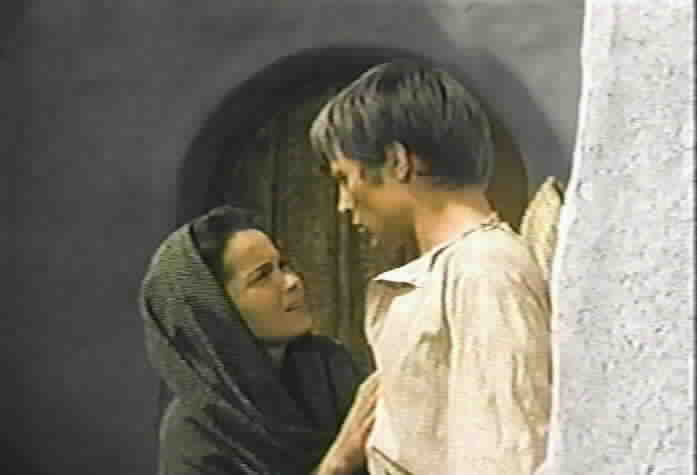
The RunawaysRomaldo and Buena, two indentured servants, want to get married, but must have the permission of their masters. Don Diego, Buena's master, gives his permission, but Romaldo's master Don Tomas does not. Diego [Zorro] must talk Romaldo out of his idea of running away with Buena. But Don Tomas's vaquero wants Buena for himself and lies and schemes to frustrate the young lovers' plans.Comment:  To be specific, Romaldo and Buena are indentured Indian servants. We learn Romaldo agreed to three years of slavery servitude service for schooling at the mission. Don Tomas seems to think he was doing Romaldo a favor with this deal. Romaldo doesn't disagree, except he wants to marry Buena while he completes his service.

"Romaldo" is kind of an odd name. I wonder if it was meant to evoke Ramona, probably the most famous story involving California Indians. Maybe the writer thought, "Should I name the characters Ramon or Ramona? Nah, too obvious. But Romaldo is close. Let's make the guy Romaldo."

How does the episode handle Indians? On the plus side, Romaldo and Buena talk, dress, and act like their Spanish counterparts. There's no Tonto talk, no feathers or leathers. That's good.

On the minus side, Buena and especially Romaldo look totally non-Native. Buena was played by Gloria Castillo, presumably a Latina based on her name. But Romaldo was played by Tim Pittman, who looked as Anglo-Saxon as his name sounds.


A bigger problem is the complete lack of historical context. No one questioned or even raised the status of California's Indians. What was the justification for the mission system? How was it working at that point? How did the Indians feel about it?

How many Indians had been forcibly converted to Christianity? How many had been indentured or enslaved? How many had been killed by disease? How many remained free? And so forth.

Even if we focus on Romaldo and Buena, the questions remain. Don Tomas made the indenture system sound voluntary, but was it? How did the pair come to be indentured? What were their alternatives? Where would they have been if they had "chosen" otherwise?

Don Tomas got three years of labor for the price of school tuition. I don't know the economics of that era, but it sounds like a good deal for him. In any era, a year's wages ought to equal many years of basic schooling (reading, writing, arithmetic).

In reality, the mission system was the beginning of the end for California Indians--the beginning of genocide. But you won't learn that on Zorro or any Western of the 1950s. Then as now, mass entertainment was about reinforcing America's founding myth. Namely, that the white man came to tame the wilderness and bring civilization to the savages.

You can watch the whole episode here:

The Runaways

For a better take on Zorro, read Isabel Allende's novel of the same name. For more on the subject, see California's 4th-Grade Mission Mythology.

March 29, 2015

California's 4th-grade mission mythology

Lying to Children About the California Missions and the Indians

By Deborah A. MirandaAll my life, I have heard only one story about California Indians: godless, dirty, stupid, primitive, ugly, passive, drunken, immoral, lazy, weak-willed people who might make good workers if properly trained and motivated. What kind of story is that to grow up with?

The story of the missionization of California.

In 1769, after missionizing much of Mexico, the Spaniards began to move up the west coast of North America in order to establish claims to rich resources and before other European nations could get a foothold. Together, the Franciscan priests and Spanish soldiers "built" a series of 21 missions along what is now coastal California. (California's Indigenous peoples, numbering more than 1 million at the time, did most of the actual labor.) These missions, some rehabilitated from melting adobe, others in near-original state, are now one of the state's biggest tourist attractions; in the little town of Carmel, Mission San Carlos Borromeo de Carmelo is the biggest attraction. Elsewhere, so-called Mission décor drenches Southern California, from restaurants to homes, apartment buildings, animal shelters, grocery stores, and post offices. In many neighborhoods, a bastardized Mission style is actually required by cities or neighborhood associations. Along with this visual mythology of adobe and red clay roof tiles comes the cultural storytelling that drains the missions of their brutal and bloody pasts for popular consumption.

In California schools, students come up against the "Mission Unit" in 4th grade, reinforcing the same lies those children have been breathing in most of their lives. Part of California's history curriculum, the unit is entrenched in the educational system and impossible to avoid, a powerfully authoritative indoctrination in Mission Mythology to which 4th graders have little if any resistance. Intense pressure is put upon students (and their parents) to create a "Mission Project" that glorifies the era and glosses over both Spanish and Mexican exploitation of Indians, as well as enslavement of those same Indians during U.S. rule. In other words, the Mission Unit is all too often a lesson in imperialism, racism, and Manifest Destiny rather than actually educational or a jumping-off point for critical thinking or accurate history.


I can confirm that my California school had a "mission" unit. I was in 5th grade, but it was a joint social studies class with grades 3-5 (experimental school). We divided into teams and made some sort of cutout missions, but nothing as good as these.

What's up with constructing missions, anyway? What about the White House, the Alamo, or Sutter's Mill? Why is a mission the only historical building constructed by California students?

Someone could make the case that this veers too far into state-sponsored religion. I mean, you could read the Bible or reenact a Catholic ceremony and claim it was for learning about California's mission era. Constructing a mission isn't much different.

For more on California's missions, see Indoctrinating Students About Missions.

Below:  Happy-go-lucky Indians Preaching and Farming at Mission Dolores by Anton Refregier. Former Rincon Annex Post Office, San Francisco, California.

March 23, 2013

Time-traveling Mission Play

San Gabriel revives historic 'Mission Play' for its centennial

First performance of the play since 1947

By Lauren Gold
After sitting dormant for more than six decades, the historic "Mission Play" has been revived and modernized, ready to be performed in two weeks as part of the city's centennial celebration.

The San Gabriel Mission Playhouse was built in 1927 specifically to house the "Mission Play," written in 1911 by Los Angeles Times columnist and Congressman John Steven McGroarty to tell the history of Father Junipero Serra and the founding of the California Missions.

"This was actually one of our priorities when we started planning the centennial celebration three-and-a-half years ago," said Mary Cammarano, co-chair of the city's Centennial Committee. "It is such an important part of our history, we're really thrilled."

The play was originally a pageant play with lengthy periods of song and dance, performed for the first time at the San Gabriel Mission in 1912. With the help of writer Nicole Avenia, creative consultant Tony Plana, producer Anna Cross and Director Jonathan Salisbury, it has been transformed and shortened to appeal to modern audiences for its first performance since 1947.

"The first play was like four hours and it could be very boring to people today," said San Gabriel resident Camila Alva Lopez, 74, who plays older Anita. "I think this new version will be more entertaining. People would walk out or fall asleep if they had to sit through the old version."

Salisbury said the modern "Mission Play" incorporates the many changes the community of San Gabriel has seen over the last 100 years, such as the growing Asian-American population, attitudes toward Native Americans and modern popular culture. The new play will include a more prominent love story between the two main characters, incorporate more of the Native American community and even have a hip-hop dance number. The story is also framed in modern day, as the audience follows a group of teenagers back in time to look at the Mission's history.

"We wanted to try to make it relevant to our community," Salisbury said.

The play will feature members of the local Gabrieleno-Tongva tribe as well as real historic artifacts from the city's museum.
Comment:  For more on California's missions, see Indians Protest Carmel Mission Stamp and Salinan Violin Stolen from Mission.

February 27, 2012

Indians protest Carmel Mission stamp

New stamp upsets local tribe

Amah Mutsun say picturesque Mission Carmel postage stamp leaves out brutal reality

By Blair Tellers
When sightseers tour the centuries-old Spanish mission tucked off Highway 1 in Carmel-by-the-Sea, it’s likely they’ll admire the red-tiled roofs, the chapel’s aesthetic facade, the prominent dome bell tower, the exquisite gardens or the vast collection of liturgical art.

For Louise Ramirez–a former Gilroy resident and Tribal Chairwoman of the Monterey-indigenous Ohlone/Costanoan-Esselen Nation–the landscape is far from romantic.
And:Citing “discomfort and concern with the unveiling of the stamp” in a Feb. 16 letter addressed to U.S. Postmaster General Patrick Donahue, Ramirez isn’t the only one who feels the mission is undeserving of a positive limelight. Her concerns are echoed by Valentin Lopez, 60, chairman of the Amah Mutsun Tribal Band.

While the Mutsun tribe is principally associated with Mission San Juan Bautista and the surrounding areas of Gilroy and Hollister, Lopez explains the Carmel Mission, “like the other Franciscan missions in California, was actively involved with the massacre and genocide of California Indians.”
The interesting part is the different interpretations of the stamp's significance:As of Monday, Ramirez and Lopez said the postmaster had not responded to their letters. In attempts to contact Donahue, the Dispatch was referred to Augustine Ruiz, postal spokesman for the Bay Valley District who said the concerns expressed by Ruiz and Lopez are “perfectly understandable.”

However, the U.S. Postal Service has no plans to halt the stamp’s release, he said.

“I understand it; I can empathize with it,” he said. “Anytime anything is introduced, there’s some element of controversy that’s usually attached to it.”

Ruiz reached out to the OCEN tribe in preparing for today’s ceremony. As tribal spokeswoman, Ramirez was invited to offer a blessing and prayer for her ancestors, followed by a speech in remembrance of her people.

Despite some opposition from her fellow OCEN members–many are practicing Catholics and did not approve of Ramirez “speaking against the missions”–Ramirez still accepted.

“I’m going to try, and hopefully I can get (the audience) to understand what we’ve been through, and what the missions have done to us,” she said. “It’s important that people know that we’re here. And if we refuse to attend these things, they’re never going to know we were there.”

In this particular case, Ruiz explained the stamp is meant to commemorate the Carmel Mission (formally known as Mission San Carlos Borromeo de Carmelo) for its architectural beauty and iconic place in California’s roster of historic buildings. It is the second oldest of California’s 21 missions and is often described as the most beautiful, Ruiz said.

The focus on architecture is elaborated in a U.S. Postal Service press release, which highlights the stamp’s colorful illustration depicting the church’s attractive façade. An earlier announcement released by the U.S. Postal Service Feb. 21 describes the mission as a landmark in California’s Spanish heritage.

While considered a bastion of California’s architectural landscape, “Spanish heritage” resonates differently for present day Native Americans.

For individuals such as Ramirez and Lopez, the phrase evokes a bitter reality of life beneath the Spanish Catholic regime; a subservient existence indigenous peoples were subjected to when European colonization of the Pacific coast began in the 1770s.
Comment:  I can see both sides of this conflict. On the one hand, the Spanish occupation was a terrible time for Indians. And the missions are symbols of the Euro-American onslaught. On the other hand, so are Columbus, Pilgrims, the Founding Fathers, cowboys, wagon trains, Mt. Rushmore, the national parks, and so forth and so on. I don't think we can exclude everything that has negative connotations for Indians or there'd be nothing left.

I'd say the Postal Service did okay with its revised press release. Don't celebrate Junipero Serra or the mission system because their primarily goal was to pacify and "civilize" the Indians. But go ahead and commemorate individual missions, on occasion, for their architectural and historical significance. Be sure to cover the bad as well as the good in the accompanying press materials.

For more on the missions, see Salinan Violin Stolen from Mission and Indoctrinating Students About Missions.

July 27, 2010

Salinan violin stolen from mission

Tribe hopes melody will summon precious violin

Recovering the 200-year-old instrument, stolen from a mission, is a matter of Salinan Indian pride.

By Steve Chawkins
Jose Maria Carabajal was toiling for the friars at Mission San Antonio on California's Central Coast when he first heard the exalted strains of a violin.

His people—the Salinan Indians—had been making music for thousands of years, but he'd never heard anything like the sounds soaring from the priest's polished chunk of wood and gut.

Intrigued, Carabajal decided to make his own. The instrument he crafted in 1798 from bay laurel and other native woods was solid enough to last more than two centuries and sweet enough to build a reputation of its own.

The Carabajal, as it came to be known, was handed down through generations. It was played at fiestas and in saloons, at Masses and barn dances. Salinans came to see it as an important piece of their past. Scholars saw it as a rare artifact of the Mission era.

Now it's gone—stolen from an unlocked display case at the mission's tiny museum seven years ago.
Comment:  For more on Natives and violins, see Violin Concerto with Lenape Melodies and Native Plays Toe-Tappin' Fiddle.

Below:  "John Warren, artistic director of the New World Baroque Orchestra, holds photographs he took of the Carabajal violin that was later stolen from the San Miguel Mission." (Anne Cusack, Los Angeles Times)

January 03, 2010

Indoctrinating students about missions

4th Grade California Mission Projects:  A Thought Experiment for Parents, Educators, and Students

By Deborah MirandaThe Mission Unit is a powerfully authoritative indoctrination in Mission Mythology against which fourth graders have little if any resistance, and intense pressure is put upon students (and their parents) to create a "Mission Project" that glorifies the era and glosses over both Spanish and Mexican exploitation of Indians, as well as American enslavement of those same Indians during American rule. For a 4th grade mother's take on the pressures and competitive aspects of the project, see Jennifer White's column "Fourth Grade Mission" at http://www.havingthreekids.com/onamission.html, where White writes, "Part of what’s making me so grumpy is that I don’t see any point to this project, any more than I saw the point of the shrunken-apple-head witch project, or the Halloween diorama project. Even if the missions are still relevant enough to justify this effort by all of the California fourth-graders and their families (and frankly, I’m not sure that they are), I just don’t see how building a model helps the kids understand the missions any better. I've thought about asking Riley's teacher, but I can't bring myself to question her on this sacred topic. It would be vaguely heretical. None of the other moms I talk to are sure what the point of the project is, either, but we’re all resigned to the idea that the mission model is like death and taxes--annoying, but unavoidable."

In other words, the Mission Unit is all too often a lesson in mindless competition, imperialism, racism, and Manifest Destiny than actually educational or a jumping off point for critical thinking or accurate history.

Can you imagine teaching about slavery in the U.S. South while simultaneously requiring each child to lovingly construct a plantation model, complete with happy darkies in the fields, white masters, overseers with whips, and human auctions? Or ask fourth graders to study the Holocaust by carefully designing detailed concentration camps, complete with gas chambers, heroic Nazi guards, crematoriums?
What's missing from the typical unit on missions:The first thing you might notice is an almost complete lack of focus on the ACTUAL HUMAN BEINGS whose lived and died in these Missions: California Indians. Over 500 different tribes existed in the lands now forming the State of California at first contact: about one million people. By the time the Missions closed, the Rancho (Mexican) era was over, and the Gold Rush (Americans) led to statehood, only 5-10,000 Indians remained alive. What happened to them? How did the Missions contribute to that devastation? What kind of “lives” did those Indians lead in the Missions that created a life-expectancy of about seven years old?

Secondly, you might notice a complete lack of reference to two crucial Mission actors: Priests, and Soldiers. On whose authority were these Missions ordered constructed? And hey–who constructed them, anyway? And why would Indians give up their freedom to become, essentially, slaves?

Who decided this was a good idea? How, exactly, was it carried out? In other words: let’s talk about VIOLENCE and RACISM.
Comment:  I believe I received a mission lesson in 5th grade, and made a mission model. If I learned anything from the lesson, I don't recall it.

For more on the subject, see Serra Almost a Saint and Fun Facts About Missions.

Below:  An alternative to the California flag that acknowledges the role of Indians.

August 27, 2009

Serra almost a saint

Junipero Serra needs just one more miracle

To be named a saint, the founder of California's missions has to be credited with a final marvel. One possibility: an artist who is still alive after losing a third of her skull in 14 brain surgeries.

By Steve Chawkins
At one point, he walked back to Mexico to lobby for a decree barring soldiers from sexually abusing native women.

Yet in his missions, flogging and shackling were common punishments. Indians who left were pursued and brought back--sometimes to die from European diseases that ran rampant.

The missions "almost failed to recognize inhabitants of this continent as being fully human," said Sister Kateri Mitchell, director of the Tekakwitha Conference, a Native American Catholic group.

Vaughn, who says that saints "are not perfect, but holy," has heard it all before. "You can't judge a 17th or 18th century figure by 21st century rules. How many of our Founding Fathers owned slaves?"

That argument has sparked dissent.

"Sainthood requires that Serra's experiences--especially those with the California Indians--transcend time and place," writes James A. Sandos, scholar of the Mission era at the University of Redlands. "Sainthood means that his is a universal example for all Catholics to follow."

In 1985, Pope John Paul II found that Serra had lived a life of "heroic virtue" and declared him "venerable." That triggered the hunt for two miracles--one for beatification and one for sainthood.
Comment:  Our Founding Fathers weren't saints, Father Vaughn. They were grossly imperfect humans who did bad as well as good things. If that's your best argument for canonizing Serra--that he, Washington, and Jefferson all enslaved people--you lose the debate.

By the way, many of the Founders knew slavery was wrong, but they were too selfish and greedy to end it. So your analogy fails for that reason too. Try again.

You say you've heard all the arguments for condemning Serra and his attitude toward Indians? I've heard all the arguments for excusing him and his attitude toward Indians. Any time you want me to kick your butt on the subject, just let me know.

If you study your own religion's history, you'll learn some Christians deplored the Spanish treatment of Indians almost from the beginning. In fact, the Church held debates on the morality of its actions in the 1500s. So spare us the ridiculous claim that people were unaware of what Jesus taught until the 20th century.

Ridiculous religion

The article also notes that the Church has exhumed Serra's body twice and shaved bits of his bones so people could have a piece of him. Those Christians are as superstitious as children with their lucky rabbit's feet. But they think it's weird that Indians hang dreamcatchers or carry medicine bags?!

The Church has devoted 10,000 pages and countless man-hours to proving Serra is a saint. Do Catholics think they'll defeat Jews and Muslims in heaven if they have more saints on their team? They already have thousands of them, so why would they expend so much effort to find one more?

Showing how screwy the canonization process is, Wikipedia reports that Christopher Columbus was "a candidate for sainthood in the Catholic Church in 1866." Yeah, because it was a miracle he blundered into the Americas on his way to Asia. And a miracle some indigenous wise man who saw the future didn't give him the same welcome as Magellan and Captain Cook.

For more on the subject, see Mural Depicts Subservient Indians and The Missions' Mission.

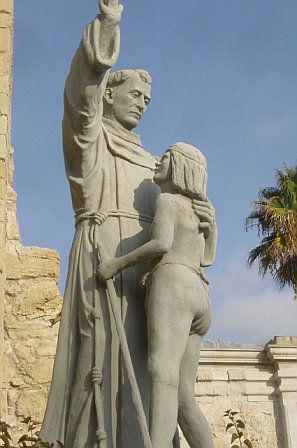
Below:  Junipero Serra fondles guides an Indian boy at Mission San Juan Capistrano.

January 29, 2009

Mural depicts subservient Indians

AIM West is asking a California high school to remove a stereotypical mural showing missionary masters and Indian servants. Here's a petition:

Removal of Sequoia High School Mural (Redwood City, CA)We are asking that Native Americans and members of the Sequoia High School Community who find the mural depicting California Natives as "servant boys" to Father Junipero Serra offensive and a glorification of our colonialism to please sign on to the e-petition request addressed to the school board.

Our request is for removal of the mural. California Natives are depicted as subservient and docile. In the mural of missionaries and native servants journeying through Redwood City, CA there is no indication of native women, children or native life in the mural. The clothing is inaccurate of Native dress and there is no evidence this "historical event" ever took place as depicted.
And some excerpts from a detailed explanation of the mural's problems by Mark Anquoe:

The Case to Remove the Junipero Serra Mural Installed at Sequoia High School, Redwood City CaliforniaThe mural depicting the Serra and Crespi expeditions at Sequoia High School reinforces an outdated historical mythology that does a profound disservice to the current student body. Such misrepresentation of the historical record ill-prepares Sequoia High School students for modern college academia and an American society that continues to move beyond the Eurocentric propaganda of years past.

The commonly accepted version of California history during America’s Jim Crow era (during which this mural was painted) described the state’s indigenous people as simple and primitive. The arrival of the Spanish in the 16th century and specifically the mission system of the 18th century was supposed to have brought the blessings of civilization and Christianity to the grateful natives who were hopelessly mired in the stone-age. European diseases, inadvertently introduced by the European immigrants, decimated the native population. The forces of Spain, followed quickly by those of the United States, civilized and developed California, all the while struggling to bring the surviving indigenous people into modern society.

The mission system in California was a joint venture between the Spanish military and the Catholic Franciscan order. While the friars aspired to lure the indigenous people into mission life with the promise of a heavenly afterlife, it was in fact the Spanish military that forcefully drove the California natives en masse to the missions. New arrivals were segregated by gender for the remainder of their lives unless a particular Native couple were allowed a Catholic marriage. Traditional family bonds were irrelevant and families were routinely split. Living quarters at the missions, in which the Native Americans were locked, except for mass and work, typically consisted of large common rooms containing a single open pit for a toilet. Native American men were starved and worked to death in the fields, being allowed less than a quarter (and often less than an eighth) of the caloric intake of an African slave during the same period performing the same work. It was simply cheaper to have the military supply more Native people from the surrounding countryside than to feed them. Contrasted with the relative good health of the free Native population, European diseases ran wild within the confinement of mission living conditions. The rape of Native American women by Spanish soldiers both within and outside of the missions was systematic and pervasive during this entire period. Life in the missions was brutal and short. The church’s own records show that deathrates within the missions consistently outstripped birthrates by as much as 800 percent and never less than 200 percent.
Comment:  You can see pictures of the mural if you click the second link (a PDF). It basically portrays a happy-go-lucky gathering of missionary leaders and Native followers. Anquoe's point is that the reality was anything but happy-go-lucky.

For more on the subject, see the Best Indian Monuments to Topple.

Below:  A statue at Mission San Juan Capistrano with a similar problem. "Save me, you big hunk of a white man, for I am a humble Indian boy who needs your loving touch."

July 03, 2008

Mission gets Native makeover

A meaningful rededication at San Gabriel MissionFollowing extensive research, native plants are being planted in the gardens surrounding the mission. To commemorate the garden renovation, members of the Gabrieleno Tongva San Gabriel Band of Mission Indians held a mid-morning ceremony June 27 to rededicate the gardens and the memorial erected in memory of their ancestors who built the mission.

"Here we are with the descendants of the ancestors for whom this memorial was dedicated," said Chief Anthony Morales Sr. during the ceremony. "Our parents, our grandparents inherited the mission cemetery. It's very meaningful, because now this garden here has our own native plants, our sages, our medicine plants."