Showing posts with label architecture. Show all posts

August 10, 2012

Navajo architect faces sexism

Female architect endures gender discrimination, opens firm

By Glenda Rae DavisTamarah Begay, 32, does not know how to make coffee but everyone she had worked for believed she did. This assumption was based on one factor--that she was a woman.

She was a woman that always found herself in meetings dominated by men. That was the case because she was always the only female architect.

In May and after 10 years of being asked to bring coffee, Begay has opened her own firm, called Indigenous Design Studio.

"I really have a big heart for architecture," said Begay, who is Naakai dine'e (Mexican clan) and born for Kinyaa'aanii (Towering House Clan). "I think architecture isn't about making money, it's about making communities better."
Comment:  For more on Navajo entrepreneurs, see Navajo Runs Turkish Restaurant in San Francisco and Navajo Businesses on the Net.

Below:  "Tamarah Begay recently opened her own architect firm called Indigenous Design Studio."

February 27, 2012

Indians protest Carmel Mission stamp

New stamp upsets local tribe

Amah Mutsun say picturesque Mission Carmel postage stamp leaves out brutal reality

By Blair Tellers
When sightseers tour the centuries-old Spanish mission tucked off Highway 1 in Carmel-by-the-Sea, it’s likely they’ll admire the red-tiled roofs, the chapel’s aesthetic facade, the prominent dome bell tower, the exquisite gardens or the vast collection of liturgical art.

For Louise Ramirez–a former Gilroy resident and Tribal Chairwoman of the Monterey-indigenous Ohlone/Costanoan-Esselen Nation–the landscape is far from romantic.
And:Citing “discomfort and concern with the unveiling of the stamp” in a Feb. 16 letter addressed to U.S. Postmaster General Patrick Donahue, Ramirez isn’t the only one who feels the mission is undeserving of a positive limelight. Her concerns are echoed by Valentin Lopez, 60, chairman of the Amah Mutsun Tribal Band.

While the Mutsun tribe is principally associated with Mission San Juan Bautista and the surrounding areas of Gilroy and Hollister, Lopez explains the Carmel Mission, “like the other Franciscan missions in California, was actively involved with the massacre and genocide of California Indians.”
The interesting part is the different interpretations of the stamp's significance:As of Monday, Ramirez and Lopez said the postmaster had not responded to their letters. In attempts to contact Donahue, the Dispatch was referred to Augustine Ruiz, postal spokesman for the Bay Valley District who said the concerns expressed by Ruiz and Lopez are “perfectly understandable.”

However, the U.S. Postal Service has no plans to halt the stamp’s release, he said.

“I understand it; I can empathize with it,” he said. “Anytime anything is introduced, there’s some element of controversy that’s usually attached to it.”

Ruiz reached out to the OCEN tribe in preparing for today’s ceremony. As tribal spokeswoman, Ramirez was invited to offer a blessing and prayer for her ancestors, followed by a speech in remembrance of her people.

Despite some opposition from her fellow OCEN members–many are practicing Catholics and did not approve of Ramirez “speaking against the missions”–Ramirez still accepted.

“I’m going to try, and hopefully I can get (the audience) to understand what we’ve been through, and what the missions have done to us,” she said. “It’s important that people know that we’re here. And if we refuse to attend these things, they’re never going to know we were there.”

In this particular case, Ruiz explained the stamp is meant to commemorate the Carmel Mission (formally known as Mission San Carlos Borromeo de Carmelo) for its architectural beauty and iconic place in California’s roster of historic buildings. It is the second oldest of California’s 21 missions and is often described as the most beautiful, Ruiz said.

The focus on architecture is elaborated in a U.S. Postal Service press release, which highlights the stamp’s colorful illustration depicting the church’s attractive façade. An earlier announcement released by the U.S. Postal Service Feb. 21 describes the mission as a landmark in California’s Spanish heritage.

While considered a bastion of California’s architectural landscape, “Spanish heritage” resonates differently for present day Native Americans.

For individuals such as Ramirez and Lopez, the phrase evokes a bitter reality of life beneath the Spanish Catholic regime; a subservient existence indigenous peoples were subjected to when European colonization of the Pacific coast began in the 1770s.
Comment:  I can see both sides of this conflict. On the one hand, the Spanish occupation was a terrible time for Indians. And the missions are symbols of the Euro-American onslaught. On the other hand, so are Columbus, Pilgrims, the Founding Fathers, cowboys, wagon trains, Mt. Rushmore, the national parks, and so forth and so on. I don't think we can exclude everything that has negative connotations for Indians or there'd be nothing left.

I'd say the Postal Service did okay with its revised press release. Don't celebrate Junipero Serra or the mission system because their primarily goal was to pacify and "civilize" the Indians. But go ahead and commemorate individual missions, on occasion, for their architectural and historical significance. Be sure to cover the bad as well as the good in the accompanying press materials.

For more on the missions, see Salinan Violin Stolen from Mission and Indoctrinating Students About Missions.

December 07, 2011

Hopi Village in Los Angeles

Curiosity for Rent:  Hopi bungalows in Echo Park

By R. Daniel FosterRonald Atwater stands in the Hopi Village, a dream his grandfather realized back in the 1930s. With his bear paw hand, Atwater lists eight properties built by his grandfather, H. Gale Atwater, and his father, Eugene Atwater, along Avon Park Terrace in Echo Park.

The best known are two Pueblo Revival properties with Mayan flourishes, designed by Robert Stacy-Judd, an architect known for exotic designs that cashed in on the Meso-American craze in the late 1920s. The three-bedroom rentals at 1431 and 1433 Avon Park Terrace stand fortress-like with massive wooden drain spouts, rough-hewn timber and thick, irregular-edged adobe parapets. Trim is painted bright orange and aqua.
Comment:  For more on Native-style architecture, see Ennis House for Sale and The Maya Revival Style.

September 11, 2011

Mohawk ironworkers helped build WTC

Anniversary of 9/11 Felt by Indian Construction Workers

By Eisa Nefertari UlenTen years ago—on the day everything changed for so many—women, children and grown men cried. Even tough men, men who worked with their hands or on big machines, men who wouldn’t ever let their wives see them cry, cried. Some of them were ironworkers, and many of them were Mohawk.

When New York City’s Twin Towers fell on September 11, 2001, pieces of Mohawk history fell, too. And now, as the rebuilding of lower Manhattan continues, those pieces are being put back, in steel and in stone. This is a shared history too few outside Native communities know. From 1966, when construction began on the Twin Towers, to 1972, when the South Tower opened, 10,000 people worked on one of the boldest construction projects in history, the tallest building in the world at that time. Men of Canada’s Kahnawake Reserve were among those 10,000—they helped build the World Trade Center up from the ground to the sky, from public controversy to iconic status, from a blueprint to a symbol of the greatest city on Earth.

Mohawk men also stood in the Pit, what would later be known as Ground Zero, and helped clean up after the terrorist attacks of 9/11. Most Americans don’t know that, either.
Comment:  For more on the subject, see 9th Annual Ironworkers Festival and Documentary About Brooklyn's Mohawks.

July 04, 2010

Detroit's stereotypical Penobscot Building

Blogger Stephen Bridenstine reviews the Penobscot Building in Detroit. The builders grew up in the Maine woods and named it after the tribe that lived there. But the building's Indian imagery mostly evokes the Plains or Great Lakes region.

Stephen includes a lot of images in his posting. Here's a typical one:


He nicely deconstructs what this building tells us:Once again, we have a prominent example of non-Native individuals appropriating an Indian style or motif to express their nostalgia for a long ago time (in this case, for the logging camps of northern Maine). Why couldn't they have used a Northwoods or lumberjack theme? Wouldn't that have been more appropriate considering their history?

It's unique that they specifically decided to go with the Penobscot name (based on the river, named after the tribe). But once again, the Indian designs come out as a complete grab bag of styles, designs, and symbolism very little of which has to do with the actual Penobscot people of northern Maine (who were certainly around in the 1920s to serve as design consultants!)

Why would the "Penobscot Building" include sculptures of Plains Indian style headdresses, southwest Indian geometric patterns, and animals ranging from foxes to turtles to eagles?

The answer is simple. The designers weren't actually going for a Penobscot theme but rather a generic "Indian" theme in which the most visually striking but culturally divergent elements are pulled together to fulfill the designers' notions of Indianness.

In so many ways, the Indian figures throughout the Penobscot Building represent America's thoughts and feelings about Native people in the early 20th century. The cold stone bodies represent a people immobile, stuck in place and unable to change. The stoic expressions represent a people devoid of emotion and sentiment, yet somehow appear both proud and sad. They are forever linked to both Nature and the primitive ways of the past. Like classical Greek columns or Gothic spires, they are rich with meaning and symbolism, put on display for all the world to see.

The Penobscot Building is above all an artifact. It is an item from the past whose elements can reveal the secrets of a time long ago.
Comment:  It's almost comical how Americans love their pan-Indian images centered around the Great Plains. The Penobscot is yet another example of how deeply rooted our stereotypical beliefs are.

How hard would it have been to get this building right? If you want a Penobscot theme, use Penobscot and Maine woods imagery. If you want a Great Lakes theme, call the building the Chippewa and use Chippewa and Great Lakes imagery. Whatever theme you choose, stick with it. Don't mix and match cultural images as if all Indians are the same.

For more on Native-themed architecture, see The Maya Revival Style.

June 19, 2009

Ennis House for sale

Frank Lloyd Wright home in Los Feliz is for sale to the right buyer

The 1924 Ennis House, heavily damaged in the Northridge quake and by rains, is being offered for $15 million. It's the largest of the architect's experimental 'textile block' houses.

By Martha Groves
Frank Lloyd Wright's Ennis House, a Los Feliz hilltop masterpiece composed of patterned and smooth concrete blocks that has been mightily threatened by man and Mother Nature, is being offered for sale at $15 million by the private foundation that has been restoring it.

The Maya-inspired estate, which is listed on the National Register of Historic Places, has been featured in films including "House on Haunted Hill," "Grand Canyon" and the futuristic "Blade Runner."

Inspired by the ruins of Uxmal, Mexico, the striking 6,000-square-foot estate consists of a main house and a smaller chauffeur's quarters, separated by a paved motor court. Wright's notion was to craft an organic structure that literally seemed to rise from the site. Workers extracted decomposed granite from the property to use in many of the 27,000 blocks.

Ultimately, the goal is to fulfill Wright's prophecy, as laid out in a 1924 letter to the Ennises. "You see, the final result is going to stand on that hill a hundred years or more. Long after we are all gone, it will be pointed out as the Ennis house and pilgrimages will be made to it by lovers of the beautiful from everywhere."

January 05, 2009

The Maya Revival Style

Mayan RevivalMaya(n) Revival architecture refers to modern architecture and decorative arts that draw inspiration from the architecture and iconography of pre-Columbian Mesoamerican cultures. Though the term refers specifically to the Maya civilization of southern Mexico and Central America, in practice this revivalist style frequently blends Maya architectural and artistic motifs with those of other Mesoamerican cultures, particularly the central Mexican architectural styling from the Aztec period as exhibited by the Mexica and other Nahua groups. Although there were mutual influences between these original and otherwise distinct and richly varied pre-Columbian artistic traditions, the syncretism of these modern reproductions is often an ahistorical one.

Two prominent architects that worked in this style are Frank Lloyd Wright and Robert Stacy-Judd. Wright's Hollyhock House copied the shape of temples from Palenque, the Imperial Hotel in Tokyo was in the shape of a Mesoamerican pyramid, the massive pyramid of Beth Sholom Synagogue with its geometric roof detailing is perhaps the most direct Wright evocation of Maya form, while the Ennis House is built from concrete textile blocks that evoke the geometric patterning on the façades of Uxmal buildings. The façade and furniture for Stacy-Judd's Aztec Hotel incorporated abstract patterns that were loosely inspired by Maya hieroglyphs.
Below:  Frank Lloyd Wright's Hollyhock House.

September 01, 2008

Schools with Native designs

Tribal schools expand role preserving native cultures

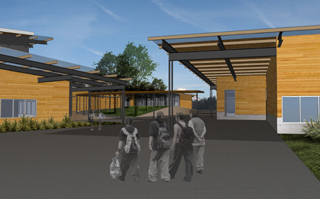
New designs focus on symbolism, tribal rituals and eco-friendly features A new K-12 school now under construction near Auburn by the Muckleshoot Indian Tribe will be rich in symbolism, referencing the geography of the tribe’s land between two rivers as well as the path that children take toward adulthood. The school will also pay tribute to the four seasons.

The design of each building in the four-building complex will support tribal identity and traditions. And each building will represent a step in the development of a child, a deliberate hierarchy that brings children into contact with older children and ultimately adults. An exterior fire pit and story circle as well as a freestanding fireplace in the library will support the tribe’s oral tradition.
Another example:The Chief Leschi School of the Puyallup Tribe likewise makes extensive use of wood.

A sacred circle at the center of the campus acknowledges an orientation of the four directions and a belief that life is a journey from east to west, infancy to old age, as the sun crosses the sky. The building forms that radiate from the circle incorporate universal elements of the sea, the valley and mountain into a unified whole.
And:More than most non-natives, tribal communities value their geographical place because it is inevitably linked with their culture. The spirituality of the place informs the communities’ beliefs and rituals.

Wisconsin’s Indian Community School meanders ribbon-like for a quarter of a mile on a 124-acre site that includes wetlands, hills, prairies and woodlands.

At one end of the building, an amphitheater around a tree symbolizes the tradition of oral history for the Oneida, Menomonee and Stockbridge-Munsee Indian tribes. Metal beams in the ceiling near the main doorway represent the migratory paths of birds and a breakout classroom overlooks wetlands.
Comment:  Compare the Native approach to schools with the Western approach described in Deconstructing the Classroom. Notice any difference?

Needless to say, all this effort to incorporate traditional values into Native schools is happening because of Indian gaming.