Showing posts with label Andrew Jackson. Show all posts

April 25, 2016

Webb defends Jackson's genocidal actions

Following up on the decision to put Harriet Tubman on the $20 bill, former senator Jim Webb tried to defend Andrew Jackson.

Jim Webb claims uninformed 'political correctness' used to denigrate Andrew Jackson

By Meteor Blades

Webb's claim:Robert Remini, Jackson’s most prominent biographer, wrote that his intent was to end the increasingly bloody Indian Wars and to protect the Indians from certain annihilation at the hands of an ever-expanding frontier population.The reality:As for Jackson’s alleged desire to protect the Indians from clashes with whites, it should not be forgotten that the forcible cession of millions of acres of Indian land was one of Jackson’s claims to fame. He did it to make space for white settlers throughout the South and for his personal profit in the real estate boom that followed the Indians’ ceding of land at gunpoint.

When the Tennessee River Valley in what is now Alabama was ceded, Jackson and his favored pals took 45,000 acres for themselves. As Steve Innskeep pointed out last year, “Jackson both created and scored in the greatest real estate bubble in the history of the United States up to that time.”

Indians who had allied themselves with Jackson in the so-called Red Stick Creek War were much praised by him, but when they later sought government payment for losses incurred in their support of Jackson, he told the secretary of war that their claims were a “complete tissue of groundless falsehood.”
Comment:  Give Webb a Stereotype of the Month nomination for his ignorance of the definition of genocide, and for minimizing Jackson's genocidal actions. Removing the Indians was about stealing their land and eliminating them, not keeping them from harm.

April 20, 2016

Tubman replaces Jackson on $20

The news that the US would place Harriet Tubman on the front of the $20 bill and move Andrew Jackson to the back triggered a variety of responses.

Predictably, racist conservatives cried over the loss of one of their white male icons:

“We need Trump to stop all the PC crap”: Right-wing reaction to the Harriet Tubman $20 bill is (another) new low

Trump on Tubman: "pure political correctness." Trump on Jackson: "tremendous success."

The Best Conservative Reactions To Tubman Bumping Jackson From $20 Bill

Ann Coulter needs to stop: She and the rest of the clueless conservatives need to quit moaning about replacing Jackson with Tubman on $20 bill

Non-racists weigh in

Meanwhile, anyone with a cursory knowledge of history explained why Jackson should be banished:

Andrew Jackson was a slaver, ethnic cleanser, and tyrant. He deserves no place on our money.

Why Andrew Jackson never should have been on the $20 to begin with

Harriet Tubman to Share $20 Bill with President Who Called for Some Abolitionists to 'Atone ... With Their Lives'

Tubman’s In. Jackson’s Out. What’s It Mean?

Stop clinging to the Founding Fathers: The Andrew Jackson/Hamilton/Tubman debate is really about honest history

While others challenged the conservatives' blatant racism:

They only want to honor white men: The pathetic conservative meltdown over the Harriet Tubman $20 bill exposes the right’s petty identity politics

5 Questions for People Who Are Outraged Over Harriet Tubman on our $20 Bill

Natives approve

Natives overwhelming applauded the downgrading of the infamous Indian killer:

Native Americans applaud removing Jackson from $20 bill
4/21

But some wondered why Jackson wasn't paired with a famous Indian chief--since he's perhaps best-known for instigating the Trail of Tears:

A Native American Chief Should Have Replaced Andrew Jackson on the $20

For more on the subject, see Stanford Cancels Bloody Jackson Play and Indians on US Bank Notes.

November 01, 2014

Stanford cancels Bloody Jackson play

Controversial Jackson Musical at Stanford University CanceledAt the Fountain, a student group at Stanford University in California, was going to put on a production of Bloody Bloody Andrew Jackson, a musical that American Indian groups have opposed—including the Stanford American Indian Organization.

After a number of conversations between At the Fountain and the SAIO, the musical was canceled. According to Kelly Gregg, director of on-campus activities for At the Fountain Theatricals, “students from At the Fountain as well as SAIO have turned this potentially divisive situation into a learning experience to increase conversations on campus (and, potentially, nationally) about the intersection of art and cultures,” she said in an email. “Together with Stanford’s Asian American Theatre Project (AATP) and Comparative Studies in Race and Ethnicity department (CSRE), ATF and SAIO have launched a series of programming exploring representation of minority groups and political correctness in theater and the media called Who Can Speak for Whom.”

“Between the efforts with Stanford American Indian Organization, and the team that was planning to produce the play, we ultimately were able to convince them to not produce this piece,” said Dahlton Brown, co-chair of the Stanford American Indian Organization. “After hearing our concerns as Native American leaders here at Stanford, they concluded it would be in everyone’s best interest that the play not be produced. While yes, this is a controversial issue, this production will not be happening here on the Stanford University campus.”
Comment:  A previous article, "Natives Oppose Stanford Musical," told the beginnings of this controversy. But Indian Country Today apparently took it down.

For more on the subject, see Bloody Jackson, Family Guy, and Archie Bunker and Why No Bloody Jackson Protests?

June 22, 2014

Bloody Jackson, Family Guy, and Archie Bunker

A long but must-read column addresses many of the points I've raised here over the years. Check it out.

Commentary: 'Fashionable Bigotry' Creeps into Twin Cities Theatre Scene

By Rob CallahanI went to see "Bloody Bloody Andrew Jackson" by Minneapolis Musical Theatre, not because I wanted to give the show any ink, or because I thought I'd have anything more to add, but because the controversy surrounding its treatment of Native people was relevant to a topic I've been tracking. In short, this was a show that pitted an emo version of America's seventh president against a bunch of white people playing Indians. They were resplendent in fringed blankets, buckskin and other such Native equivalents to the trappings of blackface. The show also had performers chanting for the death of Indians, and there was a big song and dance number celebrating genocide.

So, yeah. Pretty racist, but the company and their communication team adamantly denied that allegation and the local critics were divided on the issue, so I had to see for myself. Was this all in harmless fun, was it completely racist, or was it what the kids these days refer to as "fashionable bigotry?" That raised even more questions, not the least of which was ...

Can racism be done ironically?

Fashionable bigotry (also called "hipster racism" or "ironic racism") is this strange, newish phenomenon that's been popping up all over the arts and entertainment industry. You've got the Flaming Lips, Macklemore, Fallin, Ullman and Silverman to name a few. Count Tarantino in, too, as he's basically the modern godfather of the stuff. You pretty much see it all over.

Here in the Twin Cities, we like to think our enlightened arts scene is immune to this sort of thing, but it looks like we're wrong. We dealt with Tomahawk Tassels and 'Miss Saigon' last year, there was that one uncomfortable portrayal in "A Very Die Hard Christmas" back in December, and now we've had "Bloody Bloody Andrew Jackson." For all I know, there may be others. This is just the stuff I've seen in my time as an arts writer, so my list may not be comprehensive. I've seen a lot of shows, but I don't see them all and I haven't been in the game that long.

As for what constitutes hipster racism, there are a couple of telltale signs. Sometimes it's just the intentional evocation of racism, but in a way that's supposed to come off as edgy and self-aware. It's a brand of racism that's meant solely to get attention, to get people talking about it and bring them out to see it. In this context, it's the performing arts equivalent of clickbait. The perpetrator probably doesn't actually believe in it, but if we think they do and we can't stop talking about them, then it's served its purpose.

When it gets worse is when it's employed another way, when ironic racism gets conjured up under the premise that genuine racism simply isn't real. The perpetrator believes it's no longer taken seriously, or it's simply obsolete in our modern post-racial society. In essence, the argument is that this can't be real racism, because racism like this doesn't happen anymore. By this reasoning, the perpetrator may excuse the meanest, most offensive racist nonsense imaginable while arguing that it doesn't matter because, obviously, no one's actually offended. By extension, anyone who does claim to be offended must be wrong, or perhaps they just don't get the joke. In essence, if someone's ironic racism offends you, it's because you're not smart enough.

That's one of a few de rigueur responses you'll see trotted out whenever people raise concerns over this type of material. Another is the tried and true tactic of crying wolf (or, in this case, crying censorship,) in which the perpetrator misrepresents his critics, and yet another is one in which the perpetrator misrepresents himself or his work.

It's a kind of deflection technique, arguing that a person can get away with it because someone else did, this one time, a while back in a completely different context. Seth MacFarlane, for example, is known for defending "Family Guy" on the basis that "All in the Family" was offensive, too. To him, the clueless bigotry of Peter Griffin is analogous to the clueless bigotry of Archie Bunker. If one was just fine, so must be the other.

Does the Archie Bunker defense work?

In the case of "Bloody Bloody Andrew Jackson," MMT artistic director Steven Meerdink took a page from MacFarlane's book and called the show "kind of a 'Family Guy' viewpoint of history." He constructed a sort of Aunt Sally defense for his interpretation of the character on the merits of someone else's entirely dissimilar character. Meerdink cites Peter Griffin as this rebooted Andrew Jackson's source material, and MacFarlane defaults to Archie Bunker. The inferred argument, that Jackson is based on a perfectly acceptable different bigot who, in turn, is based on another perfectly acceptable even more different bigot, is a bit of a stretch. It only works if you stick to the most superficial similarities.

That's because there's a reason why pop culture historians laud Archie Bunker: He was a pioneering character who turned the popular American sitcom into a mainstream venue for the discussion of some serious, heavy topics. This show wanted its audience to have hard conversations, and it used humor to soften the impact and keep those conversations going. Yes, Archie Bunker was a bigot, but he was also the butt of the joke. He was awful, but his awfulness always had consequences. That was the show's moral. In every way, he was a mirror in which mainstream America could gaze upon its own reflection, comfortably acknowledge the blemishes and hopefully deal with them.
Callahan goes on to address the white privilege behind the play and the "talk-back" session the theater held:Two Hennepin Theatre Trust employees were in the audience. They cut her off two other times, alleging that she was threatening to somehow ban or censor their production, and a group of white men directly behind me displayed exactly zero qualms about interrupting her once more after that. To be clear, she wasn't raising her voice. She wasn't making accusations. I never once heard her so much as allude to bans or censorship. Each time she was interrupted, she was calmly responding to a direct question. (Or trying to, anyway.)

If you've followed the follow up chatter out there, you've seen a lot of talk about the effects of privilege on that talk-back session: the privilege of ignorance of consequences, the privilege to silence your detractors, to cloak that silence under the guise of an open forum, and so on. Regardless of where you fell in the debate, you couldn't deny that privilege fueled it.

That's the thing about privilege. It shows itself in many ways. This time, it just happened to pop up as a group of authoritative white people publicly tag-teaming a lone woman of color, and being so oblivious to the prevailing power dynamic that it never occurred to them that this was a problem, or that the reporter in the room might notice.

How Are We Privileged?

The fact that "Bloody Bloody Andrew Jackson"'s first act couldn't make it five minutes (literally, I timed it) without a racial slur is troubling. That the critics in town can't agree over whether or not the show was racist? That's more than troubling. It's also ignorant and, as much as I hate to say it, cowardly.

Pay attention, fellow critics, because this is what people mean when they call us privileged: We have the privilege of watching ninety uninterrupted minutes of dictionary definition racism, then going back to the public and telling them we didn't see anything wrong. We ought to try and shake that privilege off. Now is as good a time as any to shed the subjectivity and pomp of the values dissonance that muddles our work.
Comment:  For more on white privilege, see Whites Are Blind to Their Privilege and Conservatives Champion White Privilege.

March 31, 2014

Indians on US bank notes

$5 Indian NoteIn 1899, the U.S. Mint issued the first and only bank note to feature a Native American as the central portrait: Running Antelope, a celebrated chief of the Uncpapa band of Sioux.

Old and rare paper notes like this unique $5 silver certificate are amazing works of art. The intricate detail of Chief Running Antelope’s facial features and headdress are absolutely stunning. This unique bill caused quite a scandal when it was issued due to a mistake of the Bureau of Engraving and Printing, who used the headdress of a rival tribe, the Pawnee, on Running Antelope.

This beautiful note was the first and only U.S. paper currency to feature a Native American.

Issued for only a short time, the $5 Indian Head Note is extremely rare and in high demand. Order yours today!


We don't have any other examples of Indians on bank notes--yet. But there's an obvious choice for such a note.

Kick Andrew Jackson Off the $20 Bill!

By Jillian KeenanIt was unfathomable that thousands of Native American men, women, and children were forced to march West, sometimes freezing to death or starving because U.S. soldiers wouldn’t let them bring extra food or blankets. It was hard to hear that the Choctaw Nation lost up to a third of its population on the death march. It was disorienting to learn that what amounted to ethnic cleansing had come at the insistence of an American president.

But then it was lunchtime, and we pulled out our wallets in the cafeteria. Andrew Jackson was there, staring out from every $20 bill. We had been carrying around portraits of a mass murderer all along, and had no idea.

Andrew Jackson engineered a genocide. He shouldn’t be on our currency.
10 Natives Who Should Replace Andrew Jackson on the $20 BillSo why would this country pay homage to such a man on its currency. Jackson has graced the $20 bill since 1929, replacing 24th President Grover Cleveland.

So we’ve compiled a list of just 10 Natives who could take Jackson’s place on the $20 bill. Who do you think it should be?

Sequoyah, born in Tennessee sometime between 1760 and 1780, was a skilled blacksmith, silversmith and engraver who wanted a way to sign his name on his work. By 1809, he was working on a written syllabary—or a symbol for every Cherokee word. He soon turned to phonetic symbols that represented the 85 distinct syllables in the Native language.


Comment:  For more on currency, see 2016 Sacagawea Dollar Designs and Aboriginal Art Removed from Canada's $20 Bill.

May 06, 2013

No more Jefferson-Jackson Day dinners

It’s time for Democrats to ditch Andrew Jackson

As Biden speaks at event named for Old Hickory tonight, more appalling stories show party should dump him as icon

By Steve Yoder
Spring means that appeals for money are bursting forth from both major political parties. It also means Democratic officials in states and counties around the country are busy getting people out to their major fundraiser, the Jefferson-Jackson Day Dinner. And they’re bringing in the big guns: Vice President Joe Biden will keynote the South Carolina Democrats’ dinner tonight.

But after an election in which Democrats rode a wave of minority support to keep the White House and Senate, party activists should wonder about one of the founders for whom that event is named. If branding matters, then the tradition of honoring perhaps the most systematic violator of human rights for America’s nonwhites should finally run its course.

Renowned journalist T.D. Allman’s gripping Finding Florida: The True History of the Sunshine State argues that brutality was a habit of mind for party icon Andrew Jackson long before he laid the groundwork, as President, for the Trail of Tears, the thousand-mile death march that killed 4000 Cherokees in 1838−39.
And:But is it unfair to hold Jackson to today’s standards? It would be—had Jackson’s contemporaries not tried their best to stop him. Cave documents a campaign against Jackson’s Indian removal policy that continued throughout the 1830s; one signature petition from New York City was 47 yards long. From 1830 to 1842, 85 percent of opposition Whig Party congressional votes on removal were cast in opposition to Jackson’s policy, according to a 1993 journal article by historian Fred Rolater. And Allman describes an 1837 investigation by Congressman William Jay concluding that Jackson’s destruction of the Negro Fort constituted an illegal use of taxpayer funds to support slavery.

Today, Democrats sound open to reconsidering whether honoring Jackson still makes sense. In Jackson’s home state of Tennessee, party spokesman Brandon Puttbrese says, “I think we welcome these kinds of conversations about our history. What he did in office…these are not things we should proud of, but they’re definitely things we must learn from.” But if so, why keep Jackson as the party’s brand? “One explanation might just be inertia—it’s been that way forever, so it’s still that way,” says Puttbrese.

In Arkansas, party representative Candace Martin acknowledges that “If you look at the overall values of the Democratic party, then Andrew Jackson probably would not be representative…. It’s maybe something that we should be debating.”

And a Democratic official in one state who didn’t want to be named thinks Jackson’s days are numbered as a fundraising brand: “When I think of Andrew Jackson, I automatically think ‘Trail of Tears’…” the official says. “If a bunch of people in my generation were creating this dinner, I don’t think we would name it the Jefferson-Jackson Day dinner. I think a lot of things that happen in politics are just like, ‘well that’s the way it’s always been.’”
And:Should Jackson’s history matter to Democrats? If not, it’s hard to explain why Republicans went to such lengths before the presidential campaigns in both 2008 and 2012 to paint themselves as the historic defenders of minority rights by recounting the crimes of southern Democrats before the civil rights era. Today’s Democrats play into their hands by continuing to embrace Jackson; in the battle for minority votes, branding could prove to be the difference.

State parties have dumped Jackson before. In 1978, Minnesota Democrats renamed their Jefferson-Jackson dinner for Hubert Humphrey. Oklahoma Democrats replaced him with former Majority Leader Carl Albert in the 1990s. And in 2010, the North Dakota party picked legendary Senator Quentin Burdick as the fundraiser’s namesake instead.

With Republicans also raising money with Lincoln-Reagan dinners this spring, Democrats have to take a harder look at what the past means for their future. If so, they’ll find it’s not hard to do better. Roosevelt-Kennedy has a nice ring to it.
Comment:  Jefferson wasn't all he's made out to be, either. He owned slaves and wanted the Indians removed, making him Jackson's spiritual father. He's not a great fit with today's Democrats, since he favored small government and opposed big spending projects.

But the Jefferson-Jackson Day dinners are pretty weak evidence of "liberal racism." As the article indicates, most Democrats probably accept the name without thought. As with a dubious sports team nickname or geographic place name, inertia is largely responsible for keeping it in place.

It's like using a $20 bill with Jackson's picture on it, or driving on a freeway named for Jackson. Most people don't even think about it. Even if you cared, it would require a lot of effort to avoid Jackson's name and image, and it wouldn't have much effect. So I don't blame people for ignoring his presence throughout our culture.

That said, this name is something party leaders can easily change without harming anyone's sensibilities. "Roosevelt-Kennedy" does indeed have a nice ring to it. Or Democrats could abandon the "two presidents" convention and call the event something else. Maybe the Power to the People Dinner or the Ninety-Nine Percent Dinner.

For more on Andrew Jackson, see Most Overrated Presidents and "Most Terrifying Man Ever Elected President"

February 18, 2013

Most overrated presidents

Happy Presidents’ Day! Meet The Five Most Overrated American Presidents

By Ian MillhiserAmericans love to rank things. So lists of the best presidents in American history frequently allow historians to duke it out over whether George Washington, Abraham Lincoln or Franklin Delano Roosevelt should be remembered as our nation’s greatest leader. Meanwhile, recently departed President George W. Bush already ranks close to the top in polls of historians asked to rank the worst president in American history. Rather than wade into the thicket of which men best or worst served their nation during their time in the White House, we would like to offer a different kind of list. Here are five presidents who routinely rank far above what their performance in office deserves in surveys considering presidential performance:

1. Andrew Jackson

The Democratic Party frequently hosts Jefferson-Jackson Dinners honoring President Jackson and another historic president who is also on this list. It should reconsider this practice, as Jackson’s policy towards Native Americans was only a few steps shy of genocidal. In theory, President Jackson’s Indian Removal Act, permitted him to negotiate voluntary agreements with tribes in the southeastern United States encouraging them to exchange their eastern lands for new territory in the west. In reality, Jackson’s forced migration policy was anything but voluntary. By his last year in office, 46,000 Native Americans were removed from their lands, opening up tens of millions of acres to white settlement and slave-worked agriculture. As many as a quarter of the southeastern Cherokee people died of cold, hunger, and disease in the Trail of Tears march that began shortly after Jackson left the White House.

2. Ronald Reagan

3. Woodrow Wilson

4. Thomas Jefferson


Like Wilson, Jefferson’s legacy is far more mixed than malign, as no one can question the significance of his contributions to American history—beginning with the document that declared us an independent nation. Yet Jefferson’s most important accomplishment as president was also the most important flip-flop in American history. During the Washington Administration, Jefferson led a losing faction seeking to constrain federal power to foster the nation’s economic growth far beyond the limits contained in the Constitution’s text. This narrow vision of the Constitution initially led him to oppose the Louisiana Purchase as president, although he eventually relented and doubled the size of the United States in the process.

5. James Madison
Comment:  The comments about the Louisiana Purchase ignore the fact that the land belonged to the Indians, not the French or Spanish. The comments also ignore the many unfortunate consequences. Here's a summary of them:

The Louisiana PurchaseOn April 30, 1803, the United States government made one of the greatest land transactions of all time when it purchased from the French Republic for $15 million dollars, a piece of real estate extending from the Gulf of Mexico north to Canada, and from the Mississippi River Basin west to the Rocky Mountains. Called the Louisiana Purchase, this transaction added 830,000 square miles of uncharted wilderness to the territory of the United States.

The Louisiana Purchase opened the west for settlement by Europeans and Americans and had grave implications for American Indians, who would soon find their ancestral homelands taken from them. It allowed for the extension of slavery, brought an end to French and Spanish domination in Arkansas and allowed a diversity of settlers to develop and perpetuate their own cultures in the six distinct geographic regions of the state.
For more on the subject, see "Most Terrifying Man Ever Elected President" and Best and Worst Presidents for Indians.

September 11, 2012

"Most Terrifying Man Ever Elected President"

Andrew Jackson: Worst and Most Terrifying U.S. PresidentHe won the top spot on our worst U.S. presidents list and on September 10 Cracked.com featured a video titled “Andrew Jackson: Most Terrifying Man Ever Elected President,” which was certainly true for Native Americans. He earned nicknames like “Indian killer” and “Sharp Knife” and was a proponent of Indian removal.

The video describes the number of duels Jackson took part in—anywhere from 13 to in the hundreds—and talks about his other nickname, “Old Hickory,” which Cracked says is because of the hickory cane he carried. Other sources say he earned the nickname because of his toughness, which the video demonstrates.

The seventh president of the United States, who graces our $20 bills, earned his “Sharp Knife” nickname from the Cherokee according to Amargi who wrote an article on the website Unsettling America: Decolonization in Theory & Practice.

“He was also the founder of the Democratic Party, demonstrating that genocide against indigenous people is a nonpartisan issue,” Amargi wrote. “His first effort at Indian fighting was waging a war against the Creeks. President Jefferson had appointed him to appropriate Creek and Cherokee lands. In his brutal military campaigns against Indians, Andrew Jackson recommended that troops systematically kill Indian women and children after massacres in order to complete the extermination. The Creeks lost 23 million acres of land in southern Georgia and central Alabama, paving the way for cotton plantation slavery. His frontier warfare and subsequent ‘negotiations’ opened up much of the southeast U.S. to settler colonialism.”
Comment:  For more on Andrew Jackson, see Gingrich Cheers Killing of Indians and Indians, Terrorists = US Enemies.

January 18, 2012

Gingrich cheers killing of Indians

Newt Gingrich Loves Indian Killer Andrew Jackson

By Gale Courey ToensingThere’s a saying that those who forget history are doomed to repeat it. Republican presidential hopeful Newt Gingrich, a historian, hasn’t forgotten the past; in fact, he’d like to repeat it. Particularly Andrew Jackson’s “kill thine enemy” approach.

At the umpteenth Republican debate in front of a packed audience at the Myrtle Beach Convention Center in Myrtle Beach, South Carolina, on January 16, Gingrich conjured up the spirit of Andrew Jackson, America’s seventh president, as a model for the way the U.S. should approach its “enemies” today.

“We’re in South Carolina,” Gingrich told the crowd, as if they needed to be reminded of where they were. “South Carolina and the Revolutionary War had a young 13-year-old named Andrew Jackson. He was sabred by a British officer and wore a scar his whole life. Andrew Jackson had a pretty clear cut idea about America’s enemies: Kill them!” The crowd roared its approval.

Although Gingrich’s spiritual journey has taken him through a cafeteria of Christian variations from Lutheranism to being a Southern Baptist to his current status as a Catholic, there is no sign of Christian forgiveness or mercy in his appropriation of Jackson’s attitude toward “enemies.”

Jackson, historians and just about every American Indian in the universe will recall, was the architect of the Indian Removal Act, America’s legalization of ethnic cleansing. He signed the legislation on May 28, 1830. The Indian Removal Act resulted seven years later in the removal of 46,000 Indigenous Peoples from the lands east of the Mississippi, and opened up 25 million acres of land “to white settlement and to slavery,” according to PBS. The area was home to the Cherokee, Creek, Choctaw, Chickasaw and Seminole nations.
Newt Gingrich, Andrew Jackson & the Metaphysics of (Neo)Indian-Hating

By AmargiNewt Gingrich, a former History Professor, apparently understands U.S. history and politics better than I had given him credit for. In the Republican debate on January 17th, when asked by the moderator if Taliban leader Mullah Mohammed Omar was in Pakistan, would he support a similar attack to what Obama did to Bin Laden? He replied, “Andrew Jackson had a pretty clear cut idea about America’s enemies . . . KILL THEM.” The crowed went wild with applause. Andrew Jackson truly is a historical figure whose influences on U.S. Empire and colonial escapades persists even today.

Andrew Jackson was a wealthy slave owner and infamous Indian killer, gaining the nickname “Sharp Knife” from the Cherokee. He was also the founder of the Democratic Party, demonstrating that genocide against Indigenous People is a nonpartisan issue. His first effort at Indian fighting was waging a war against the Creeks. President Jefferson had appointed him to appropriate Creek and Cherokee lands. In his brutal military campaigns against Indians, “Andrew Jackson recommended that troops systematically kill Indian women and children after massacres in order to complete the extermination.” The Creeks lost 23 million acres of land in southern Georgia and central Alabama, paving the way for cotton plantation slavery. His frontier warfare and subsequent “negotiations” opened up much of the Southeast U.S. to settler colonialism.
And:How does this relate to the current US wars in Afghanistan and Pakistan? What links Andrew Jackson’s Indian Wars to the war mongering wet dreams of Newt Gingrich? In his book Facing West, Drinnon shows how U.S. Indian Wars lead the way for U.S. Empire building globally, “All along, the obverse of Indian-hating had been the metaphysics of empire-building—the backwoods “captain in the vanguard of conquering civilization” merely became the overseas outrider of the same empire.” Once conquest of the West had reached the Pacific, it kept spreading from Hawaii, Guam, the Philippines, Vietnam, Iraq, Afghanistan… onward. Speaking of U.S. atrocities in Vietnam Drinnon writes:

But the massacres at My Lai and all the forgotten My Khes in Vietnam had a basic continuity with those of Moros on Jolo and of Filipinos on Samar at the turn of the century, and of Native Americans on the main land earlier—all the Wounded Knees, Sand Creeks, and Bad Axes. That linkage of atrocities over time and space reveals underlying themes and fundamental patterns of the national history that lawmakers, generals, and so many other compatriots were eager to forget.

The recent video of Marines urinating on the dead bodies of supposed Taliban fighters follows the long tradition of defecation upon and mutilation of Native People by U.S. Soldiers. Rick Perry, another Republican Presidential candidate, shared his insight into the matter, revealing the predator nature of colonialism and U.S. Empire. Arguing in defense of the Marines he maintained that when you are in war, things like this happen. Apparently, “history kind of backs up” peeing on corpses and, “to call it a criminal act, I think, is over the top.”

I think Andrew Jackson would be proud that his example would still inspire Marines today.
Comment:  This kind of "thinking" is exactly how Osama bin Laden got codenamed "Geronimo." Any other explanation is rubbish.

That Gingrich thinks Indians were (and are?) savages who deserve killing is stereotypical if not racist thinking. For that he gets a Stereotype of the Month nomination.

For more on the subject, see Indians, Terrorists = US Enemies and Seminoles Compared to Al Qaeda.

June 07, 2011

Indians, terrorists = US enemies

Legal Scholar Matthew Fletcher on Government Slurs of Indians and U.S. Law

By Gale Courey ToensingComing on the heels of the Geronimo/bin Laden Incident, what do you make of the government’s expropriation of indigenous history—using Geronimo as the code name for Osama bin Laden, and then citing the Jackson’s murderous actions against the Seminoles and Brits as a precedent for the prosecution of Al Qaeda suspects?

Generations of West Point officers learn about war from studying the “Indian wars,” and so it would make perfect sense for them to draw an analogy between Indians and al Qaeda. The military tradition is that the Indians were the bad guys, they were savage and engaged in non-traditional, even scary warfare, and that they had no rights under the U.S. Constitution. As such, they were fair game for anything—anything at all—the U.S. military wanted to do to them. Preemptive attacks on unarmed women and children like Wounded Knee, indefinite detention in concentration camps like Fort Sill, mass executions for trumped up war crimes like at Fort Snelling all of it legally justifiable from the point of the view of the military. Same is true in the Department of Justice, where in the days following 9/11, Bush Administration attorneys like John Yoo (now a Berkeley law professor) and Jay Bybee (now a Ninth Circuit judge) argued that the President needed no authorization from Congress to engage in torture, establish military jails and commissions to house and try al Qaeda suspects, etc., through extensive reliance on Indian war-related “precedents” involving self-serving legal opinions about the Modocs, the Seminoles, the Dakota at Fort Snelling, and others. It was Yoo and Bybee who authored so many of the so-called “torture papers” who first explicitly compared the Seminoles and other tribes to al Qaeda. The military prosecutors are just cribbing from them.
Comment:  This analysis nicely summarizes how the US military really feels about Indians. It's a good reason for discounting the talk about "honoring" Indians because they're brave and noble. Yeah, they're brave and noble...terrorists.

We killed them for terrorizing, scalping, and murdering us. Now that they're dead and (mostly) gone, we salute them for their terrorist-like abilities. If you want to frighten al-Qaeda, what better way than with an Indian missile or helicopter or codename? It takes a terrorist to scare a terrorist.

It's like honoring a grizzly bear or another deadly predator. When it's about to eat you, you don't "honor" it for its bravery and nobility. You shoot it and kill it. Once you skin it and turn it into a rug, then you honor it. It's brave and noble because it took you, someone even braver and nobler, to conquer it.

For more on the subject, see How People Get Labeled "Terrorists," Obama:  Bin Laden Was "Geronimo," and Seminoles Compared to Al Qaeda.

March 24, 2011

Seminoles compared to al Qaeda

A Miami Herald article demonstrates the near-constant racism and stereotyping against Indians. Indianz.com offers a good summary of this article:

Seminole Tribe 'offended' by military comparison to terroristsThe Seminole Tribe of Florida will ask the Department of Defense to withdraw portions of a brief that compared Seminole ancestors to the terrorist group al-Qaeda.

The comparison showed up in a case in the U.S. Court of Military Commissions Review. Government lawyers likened the situation to the treatment of two British men who were hanged in 1818 for helping the Seminoles resist the U.S. military.

“Not only was the Seminole belligerency unlawful, but, much like modern-day al Qaeda, the very way in which the Seminoles waged war against U.S. targets itself violate the customs and usages of war," the brief stated.

The argument drew an angry response from the tribe. “To equate the historic struggle of our ancestors in resisting General Andrew Jackson’s unlawful invasion of our homeland to al Qaeda terrorism is a vicious distortion of well-documented history,” general counsel Jim Shore told The Miami Herald.

“The Government’s strained comparison of Native Americans to al Qaeda is disrespectful to our Tribe, all American Indians and our American Indian military veterans, as well as those in active military service,” Shore added.

After the National Congress of American Indians complained, government attorneys submitted another brief in which they said they weren't trying to "equates" the behavior of the Seminoles to those of al-Qaeda. The brief also said the government “in no way questions or impugns the valor, bravery and honorable military service of Native Americans, past and present."
In the original article, a professor rips the government's claims:

War court filing comparing Seminoles to al Qaeda stirs protest

By Carole RosenbergDavis, the history professor, calls the comparison “ridiculous.”

“One can make the argument that al Qaeda is the aggressors,” he told The Miami Herald from Gainesville, “but the Seminoles were the innocent targets.”

“It was Jackson invading the territory of a sovereign country, Spain, and he’s executing within that territory citizens of another sovereign country, Britain.”
Some commenters on Facebook also ripped the government's claims:It is amazing that such terrible acts can be perpetrated against Native Americans and that rights and ways of life can be so profoundly reduced and yet the victims in such circumstances are portrayed as demons. It hurts my heart to think about it too.

Really? I don't get it. Ridiculous. I am less insulted by the blatant disrespect [than] I am by the brutal distortion of logic. A far more fitting comparison to al Qaeda is Andrew Jackson himself. Jackson, Kit Carson, and their compatriots...Manifest Destiny...wtf is that if not a campaign of terror?

Absurd how settler societies create discourses of criminality against those very same people they victimize. Israel constantly uses this same al Qaeda script against the Palestinians.

Interested parties are doing the same thing to the history of labor. When someone takes all your stuff and forces you into poverty, fighting back gets you labeled a terrorist. This is the logic of the folks in power in so many of our states now.
Comment:  So the comparison isn't only insulting, it's factually wrong. Florida was part of a foreign country when Jackson invaded it in 1818. When you invade and occupy foreign territory (e.g., Israel in 1967, Bush in 2003), you don't get to dictate your foe's defensive strategy. You're at fault and you deserve whatever punishment you get for your aggression.

For more on Andrew Jackson, see Why No Bloody Jackson Protests? and Andrew Jackson Institute Fights Seminoles.

P.S. The "Indian country" tag on this posting is for any US reference to Indians or Indian country as a military enemy.

February 21, 2011

Happy Presidents Day 2011!

Two weeks ago some Lakota Indians protested a "Wizard of Oz" play because of L. Frank Baum's editorials 120 years ago. Their goal is apparently to banish The Wizard of Oz from our culture to teach Baum a lesson. Too bad he's been dead for 96 years and probably won't get the message.

In their honor, I posted the following suggestion on Facebook for Presidents Day: Let's also remove the anti-Indian presidents from our currency, Mt. Rushmore, the history books, etc.This led to a brief discussion:Rob, let's not forget that the slaughter of indigenous peoples, or the slavery of "lesser" people has been the cornerstone to this fine democracy--which recognizes the rights of all men (women excluded for obvious reasons...wink wink).That's why we need to eliminate these presidents!While you're at it let's not forget those 38 warriors who died by hanging in the largest mass hanging in the history of the US, their death warrant signed by none other than "Honest" Abe Lincoln.I'm including Washington, Jefferson, Jackson, Lincoln, and T. Roosevelt among the presidents to be eliminated along with Baum.OK. Can we then replace Andrew Jackson on the twenty with Richard Nixon?Yes, we can put Nixon on the $20 for his support of indigenous rights. Right after we remove The Wizard of Oz from every bookstore and DVD store.

For more on the subject, see Liberation Day, not Presidents Day and Fun Fourth of July Facts.

P.S. Needless to say, neither the presidents nor Baum's beloved children's story are going anywhere anytime soon. Protesting them is roughly equivalent to protesting the ocean's tides.

October 02, 2010

Why no Bloody Jackson protests?

Down with ‘Jackson’

By Eric R. LocklearThe following appears on the website for “Bloody Bloody Andrew Jackson”--bloodybloodyandrewjackson.com--“Broadway is heralding ‘Bloody Bloody Andrew Jackson.’ The New York Times and Rolling Stone called it ‘the season’s best musical.’ Now, by populist demand, their bloody brilliant show is packing up its tight, tight jeans and heading to Broadway! In ‘Bloody Bloody Andrew Jackson’ (BBAJ), rising star Benjamin Walker reprises his role as America’s first political maverick. A.J. kicked British butt, shafted the Indians and smacked down the Spaniards all in the name of these United States--who cares if he didn’t have permission?”

Why is this atrocity not receiving the same airplay as the mosque proposed for New York’s Ground Zero?
And:It is without question inappropriate for any effort to have been put forth to make humorous the genocide of our ancestors. I ask Indian country in full united force to bombard the media heralding the absurdity and disrespect demonstrated by this stage play. I ask Indian country to open wide your emotion (without violence) against the proposed Oct. 13, 2010 Broadway opening of this contemptuous ideal.

I would love to see funding in Indian country generated to somehow publicly dismiss this production on Broadway. Our more affluent tribal populations and organizations might consider making something happen to speak for the dead in “BBAJ” and cry “bloody, bloody” murder. My spirit cringes that an acronym is being used to reference the deliberate and systematic destruction of our people.
Comment:  I agree with Locklear's conclusion. This play sounds as bad as MTV's Dudesons episode and worse than Bloomberg's anti-Indian remarks. Yet no one except a few writers is protesting it.

As Oneida representative Ray Halbritter said, everyone should be protesting these egregious examples of stereotyping. So where is he, the AIM activists, and everyone else? Thousands of New York tastemakers are seeing this play and learning from it. A protest outside the theater in the media capital of the world would draw a huge amount of attention.

Locklear also writes:The decision to popularize the murderer Andrew Jackson is a bold move of malice and hatred.I don't know if I'd go that far, but it's definitely part of our myth-making process. Ultimately it celebrates the Euro-American conquest of the ignorant Indians.

We put Jackson on the stage and the $20 bill because he's our idea of a hero. Like Daniel Boone and Davy Crockett--the fictional versions, anyway--he tamed the West and thwart the Indians.

The play is also more evidence that people don't care about Indians. A show about a slaveowner and buffoonish slaves wouldn't get this much acclaim. But Indians--like cavemen and pirates--are "safe" targets for satire.

For more on the subject, see Racism in Bloody Bloody Andrew Jackson and Stereotypes in Bloody Bloody Andrew Jackson.

September 07, 2010

Racism in Bloody, Bloody Andrew Jackson

Play satirizes Jackson, but insults Native Americans

By Albert BenderThe play, although claiming to be satirical, is an extreme exercise in racism, in that all the Native American characters are demeaned and caricatured. Historic Indian leaders are portrayed as slow–witted and dull-minded, ever ready to sell their tribal homelands for a few paltry blankets and dream catchers. The great Muscogee Creek patriot Menawa, who fought Jackson’s forces at the Battle of Horseshoe Bend in 1814 and was wounded seven times, is depicted wearing a dime-store headdress and signing a treaty he refused to even consider (keep in mind that Jackson’s armies were composed overwhelmingly of Tennesseans). The valiant, iconic Sauk leader Black Hawk, who fought a war to hold his ancestral lands in 1832 against the American military juggernaut, is seen as a traitorous collaborator disposing of his tribe’s birthright.

The drama is permeated with crude, artless anti-Indian humor. Euro-American audiences have frolicked at this dreadful performance in its off-Broadway run, to the extent that an internationally prominent Native American literary figure, a good friend of mine who attended the play to review it, left halfway through the performance because she felt in physical jeopardy.

Some critics have pointed out in defense of this sordid drama that other groups are also lampooned—Spaniards, gays, Southerners in general and rich whites. But where are the black people? Jackson was as much pro-slavery as he was anti-Indian, and the Hermitage was maintained by African-American slaves. There are no black characters in the play at all, much less any demeaning African-American stereotypes. Can anyone imagine a white audience in this day and time evincing riotous, knee-slapping guffaws at the portrayal of demeaning stereotypes of African-Americans or any other race in this country? If there had been even one demeaning stereotype of black Americans, there would have been a national uproar.
Comment:  The same analysis applies to The Dudesons and every other "spoof" or "satire" we've seen recently. As you probably know, I've ripped the "satire" argument in postings such as these:

Deadliest Warrior vs. The Dudesons
The Dudesons, Polish jokes, and minstrel shows
Okay to stereotype in "satires"?

Again, the key point that no "spoof" defender has ever addressed: "If there had been even one demeaning stereotype of black Americans, there would have been a national uproar." Yet we not only tolerate the equivalent Native stereotypes, we defend and champion them. Why is racism against one American minority still perfectly acceptable?

For more on the play, see Stereotypes in Bloody, Bloody Andrew Jackson and Bloody, Bloody Andrew Jackson Reviewed.

August 21, 2010

Yesterday's Cherokees = today's Muslims

Andrew Jackson's AmericaThe Cherokees evoked much sympathy because they basically played by all the rules as laid out by the lately Americans. They were farmers. They sent their kids to school. They had a written language, and a published newspaper. They sided with Andrew Jackson against the Creeks. They converted to Christianity. They intermarried with whites. They practiced slavery (Around 8 percent of them were slave-owners.) If you were looking for a group who was quickly assimilating into this new, insurgent America, the Cherokee were the "model minority" of their day.

But it didn't matter. White farmers in Georgia did not want to assimilate the Cherokee, they wanted to rob them.
How yesterday's bigotry against Cherokees is the same as today's bigotry against Muslims:[Americans] are not being led astray. They are not being distracted from "important issues" or divided from their "real interests." This is their "important issue." This is their "real interest."

The prospect of Muslims assimilating will not subdue them. To the contrary, the last thing they want is their kid competing with yours. Their hypocrisy is stunning: These are the ghosts who burned black Wall Street, who pilfered the "Five Civilized Tribes," who recoil at gays attempting to build family. And so on. They claim to fear the immigrant clinging to his language. No. What they fear is the immigrant learning theirs. Much like Barack Obama scares them more than any New Black Panther, Cordoba House is more terrifying than any iteration of radical jihad.
Comment:  The protests against mosques across the country shows this issue has nothing to do with "sensitivity" to 9/11 victims.

I've said it before and I'll say it again. The same people who think Obama is a Kenyan and a Muslim are protesting illegal immigration, ethnic studies, gay marriage, healthcare reform, welfare spending, Indian gaming, and tribal sovereignty. They're also defending our constitutional right to say the n-word (Sarah Palin) and to discriminate against blacks (Rand Paul). The common denominator is bigotry against anyone who isn't a white Christian heterosexual--i.e., the so-called "real Americans."

For more on the subject, see:

Angry white Christians want country back
White conservatives "angry about racism"
Paper-checkers = birthers = teabaggers
Klansmen, militias, and teabaggers

Below:  The changing face of bigotry.

August 05, 2010

Andrew Jackson Institute fights Seminoles

Feds:  Florida Tribes Play Fast and Loose with Gaming

IRS agents probe Seminoles and Miccosukees over payments, taxes

By Kenric Ward
Critics of Indian gaming say that tribal claims of "sovereign" status have led to abuses.

Mark Thibault, president of the Miami-based Andrew Jackson Institute, which opposes Indian casinos, said, "Florida Indian gaming has been playing by its own rules for decades. This hurts everyone but the tribes."

Controversial as the Miccosukees' tax-free claim may sound, Thibault said, "That is something every other native tribe in America does."

As for the investigation into Seminole vendor payments, Thibault likens the tribe's practices to "money laundering--both with the use of double bookkeeping and illegal distributions."

"All of this hurts every honest taxpayer in Florida," the Miami attorney said.

But Thibault says more damage is inflicted on the tribes' competitors.

"What has not been reported is the damage being done to the pari-mutuel industry of Florida. These operations are forced to fight an uphill battle with one hand tied behind their back.
More on the Andrew Jackson Institute:The Andrew Jackson Institute is a not-for profit organization set up to expose corruption in the Indian gaming industry. We oppose special rights and privileges for any group of Americans based on skin-color or national origin. We support repeal of the Federal 1988 Indian Gaming Regulatory Act (IGRA) and oppose the proposed Florida State Gaming Compact with the Seminole Indian Tribe.And:The Seminoles claim that they are a "Sovereign Nation" and thus entitled to special rights. Why then are Seminole Indians entitled to vote in U.S. and Florida Elections, entitled to welfare payments and entitled to workmen's compensation? Floridians are not allowed to vote in their tribal elections! Seminoles are either citizens of their "Sovereign Nation" or citizens of the United States. Why do they have it both ways? It is un-American to grant any special class of people extraordinary rights because of the color of their skin or the history of their people.Comment:  The point here isn't to go into all gaming battles the Seminoles have fought. It's to discuss the Andrew Jackson Institute.

These people have named themselves after the most notorious Indian fighter in US history. The president who forced the Seminoles on a death-march to Oklahoma and assaulted anyone who refused to go. If there's a better way to say, "We want the Seminoles dead or gone," I'm not sure what it is.

Here we see a typical "anti-gaming" group in action. Thibault has no problem with Florida's parimutuel industry; indeed, he wants it to expand. He doesn't oppose gaming, he opposes Indian involvement in gaming. Like almost every other anti-gaming group, these people are really anti-Indian.

The courts and I have debated and dismissed the special rights arguments hundreds of times before. Yet these stupid ignoramuses keep making it. Clearly they won't be happy until Congress eliminates tribal sovereignty and terminates the tribes. That's their goal, not curtailing gaming.

Kill the Seminole, save the man?

Like Andrew Jackson, the Andrew Jackson Institute wants to kill Indians figuratively if not literally. It wants to destroy the Indians' governments and cultures so they become exactly like every other American. In the old days people called this attitude "Kill the Indian, save the man." Today we call it racist and genocidal.

So don't let the Institute's talk about gaming issues fool you. These people don't care about fine-tuning gaming laws or regulations. They're bigots who are out to exterminate tribes any way they can.

For more on the subject, see Columnist Shows How Racists View Indians and The Facts About Indian Gaming.

Below:  The Andrew Jackson Institute's masthead and mascot.

July 06, 2010

Stereotypes in Bloody Bloody Andrew Jackson

I haven't seen the play Bloody Bloody Andrew Jackson, but I've posted about it before. A previous review made it sound like a clever satire, but didn't discuss the actual Native content. Now Steve Newcomb rectifies that omission:

‘Bloody Bloody Andrew Jackson’

By Steven NewcombThe reviews have been quite positive and the play ran through the end of June.

From an American Indian perspective, however, “Bloody Bloody Andrew Jackson” is a racist and dehumanizing portrayal of American Indians. It is an effort to be humorous by using and reinforcing the worst stereotypes of American Indians, and working them to great effect and laughter among the non-Indian audience. It does so by evoking the false images of Indian people that continue to permeate the mass culture of American society.

At the outset, the play portrays Jackson as a child, witnessing and experiencing his parents being killed by Indians (shot in the back with arrows). Thus, Jackson is immediately cast as a sympathetic figure in the eyes of the audience, while the Indians are framed as cold-blooded killers.

Historically, however, Jackson’s father, Andrew Jackson Sr., injured himself while lifting a log and died in 1767, at the age of 29, a month before Jackson was born. His mother also was not killed by Indians; she died of cholera while tending to wounded soldiers in the Revolutionary War. Clearly, historical accuracy was the last thing on the mind of the writers.

“Bloody Bloody Andrew Jackson” is said to be an effort to greatly entertain while drawing parallels between Jackson’s era and what’s going on today, with issues of populism, banking, the Washington elite, taxation and terrorism. In keeping with the last analogy, however, this means that the ones being associated with the issues of “terrorists” and “terrorism” are the Indians on the “frontier” who were attempting to defend their traditional lands and territories from American colonization. Jackson’s militaristic and bloody actions were his means of attempting to grow “the homeland” of the United States.

The play makes no effort to accurately contextualize what Indian nations and peoples were facing during Jackson’s era, and the script refers repeatedly to Jackson wanting to get the land “back” from the Indians. As if the Indians had taken it away from the whites to begin with, and Jackson was trying to win it back.

In another effort to be funny, the writers have “Indian” warriors (white cast members) dancing across the stage in drag, to illustrate what exactly is never made clear. Andrew Jackson captures an Indian infant as “a souvenir” of battle, and takes the child home to his wife Rachel. Later the boy comes on stage dressed in the ridiculous stereotypical attire that non-Indians associate with Indian people, and in another effort at humor Jackson mildly reprimands the child for a pastime of “scalping squirrels,” which would not meet with Rachel’s approval.

The play dehumanizes the Indian characters by characterizing them as stupid, and willing to sell their lands for a few blankets so long as you throw in some “dream catchers.” Having white actors in black face would be the equivalent of what Timbers and Friedman have done to American Indians in “Bloody Bloody Andrew Jackson.”
Comment:  There's more, but you get the idea. Newcomb has done a fine job of dissecting the play.

And...wow. The non-Indian reviewer totally ignored its anti-Indian bias.

I guess he was thinking like a typical Dudeson. Namely, if it's a minstrel-like show that claims to be satirizing something, it's okay to stereotype Indians. Never mind that none of the offensive portrayals actually challenge our preexisting notions about Indians.

This is what you get when you don't think critically about the issues: a play that influences thousands of New York City's cognoscenti. How many of these intellectuals and taste-makers went away thinking, "That play's portrayal of Indians was wrong"? And how many went away thinking, "Indians as chiefs, warriors, scalpers, killers...yeah"?

For more on the subject, see Native Plays and Other Stage Shows.

May 26, 2010

The three anti-Indian amigos

My posting about Custer's Last Stand and Ethnic Studies generated the following dialogue on Facebook:Custer got owned! Ha! Good riddance!

I've had in the back of my mind to do a Custer comic, simply because he really was quite a spectacular asshole of an anti-hero.

Him and that horrible guy who at Sand Creek...Chivington...Mr. "Nits-Make-Lice." Uff, the very name makes me squirm.

Chivington!!! Grrrrr!!! He made me stay up all night drawing very very very angry pictures when I was a little girl, accidentally watched Soldier Blue. Man I was PISSED!!!
Someone probably could do a good satirical comic book, video, or skit featuring Andrew Jackson, John Chivington, and Custer as the three anti-Indian amigos.*Chuckle*...jeezus, talk about Axis of Evil...Chivington probably changed his name from Smith or Jones so it would sound like knives being sharpened.

In the novel Custer's Luck, Custer survives Little Bighorn, is elected president, and becomes a Kennedy-style leader. It's actually well-done and plausible, believe it or not.What we hear even less of than Wounded Knee and Little Big Horn is the Sand Creek Massacre. Chivington rots in hell...And HE WAS A CLERGYMAN!

It's too easy to use Custer as a symbol. He was very complicated, and unlike many generals of his day (Sherman, Sheridan) he did not hate all Indians. He also almost missed being at the Little Bighorn because he was in Washington testifying how Indian agents were cheating the Indians. Custer is too complex to just be set up as a cardboard target.
It may be too easy to use Custer as a symbol, but 1) he brought it on himself, and 2) Americans have been using him as a symbol of heroism ever since Little Bighorn. It's only fair that Indians get to use him as a counter-symbol.

Besides, I'm mostly talking about the symbolism of Custer's Last Stand, not Custer himself. In mentioning Skimin's alternate history novel, I said something positive about Custer the man. I understand he's more than just a cardboard target, which is why I posted Custer's Anti-Indian Reputation.

For more on the subject, see Custer Country in Montana and Dan Simmons Tackles Black Hills.


May 20, 2010

Replace Jackson on $20 bill?

Students seek to put Chief Joseph on $20 bill

By Kristen CatesStudents at Hays-Lodgepole High School are doing their part to promote using more images of Native Americans on items printed by the federal government—most notably the $20 bill.

Sandra Sather-Westley, a reading and literacy teacher at the high school, encouraged her students to research and write about the controversy that for years has surrounded having an image of President Andrew Jackson's face on the $20 bill. She also asked the students to come up with a better person to be represented.
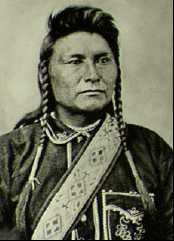
And:The result of the students' research and writing is a petition that they are sending out to every Native American agency, legislator and state official they could think of, seeking to have Chief Joseph, the legendary leader of the Nez Perce, replace Jackson on the $20 bill.

Sather-Westley said this isn't necessarily a new idea. Over the years, people campaigned for President Ronald Reagan and civil-rights activist Dr. Martin Luther King Jr. to be placed on the $20 bill.
And:Chief Joseph wasn't the only name tossed in the hat. Students researched Native American leaders such as Geronimo and Sacagawea—a dollar coin already features her image—but came to the consensus that Chief Joseph was the best choice.

"He was more comfortable to whites and spoke about peace," Sather-Westley said. "There's really quite an undercurrent. We don't feel that Andrew Jackson is representative of the best."
Comment:  My Native contacts occasionally express disgust at the idea of having Jackson on their money. I'd say it's time to stop celebrating his expansion of America at the expense of the Indians.

Chief Joseph seems like a good, safe choice to replace him. Sitting Bull, Geronimo, Crazy Horse, and Tecumseh would be too radical for today's Americans.

For more on the subject, see Replace Grant on $50 Bill? and Review of RELENTLESS PURSUIT.

Below:  Out with the Indian hater...


and in with the peacemaker?

April 07, 2010

Bloody Bloody Andrew Jackson reviewed

NY Review:  'Bloody Bloody Andrew Jackson'

Center Theatre Group and Les Freres Corbusier at the Public Theater

Reviewed by David Sheward
After a sold-out run last May as part of the Public Theater's Public LAB season, "Bloody Bloody Andrew Jackson" is back in a rocking and roaring staging by Alex Timbers, ready to rip through your senses and political perceptions. This irreverent history lesson on our seventh president combines fact with outrageous lampoon and offers savage commentary on America's past and present.

In Timbers' whacked-out book, the language is contemporary. Jackson is a spoiled rock star, slaughtering Indians as a charismatic general and then challenging the Washington aristocracy as a populist candidate. He pouts like a teenager when he doesn't get his way and erupts with fury when the Supreme Court declares his merciless Native American relocation programs unconstitutional. The Oval Office becomes a frat house as Jackson encourages female cheerleaders to make out with each other (shades of the recent Republican National Committee bondage scandal), and the show's band is enlisted as his Cabinet. "So we'll ruin the bank/And we'll cripple the courts/And we'll take on the world/For America's sake," he sings with egotistical bravado.

But this is much more than an extended "Saturday Night Live" skit. Timbers' wild script and Michael Friedman's hard-driving score make sharp points about the messy way our country was founded and grew, as well as the complexities of democratic government. "I don't think you people know what you want," Jackson yells at some White House tourists after claiming that he represents their views.

When the piece premiered in Los Angeles in January 2008, Jackson could have been seen as a 19th-century version of George W. Bush, running the national agenda like an out-of-control cowboy. Today, with the advent of the Tea Party movement, the wicked parody is even more relevant. The simplistic speeches and rock anthems to populism sound as if they could be heard at a Sarah Palin rally.
Comment:  For more on the subject, see Musical Comedy About Jackson and Native Plays and Other Stage Shows.