Showing posts with label Chief Joseph. Show all posts

March 16, 2015

Running Zack in Saved by the Bell

I didn't watch Saved by the Bell when it was on the air. But every long-running show has to have an "Indian" episode, it seems, and Saved by the Bell had one too.

Here's the basic idea:

Running Zack (24 Nov. 1990)If Zack wants to run the track meet, he better prepare his ancestry report where he gets help from an Indian.Running ZackZack fails his family heritage presentation. Unless he can make it up, he is off the track team. His teacher Miss Wentworth arranges a tutor for Zack named Chief Henry, who happens to be a Native American. Zack soon learns about his own Native American heritage, but does not feel like going to the upcoming track rally when tragedy strikes.From what I read, fans seem to think Running Zack was one of the worst episodes ever. The whole series seems to be written for juvenile pre-teens, but I don't think Running Zack is worse than other Native-themed episodes I've seen. I'd say it's mediocre rather than terrible.

Let's go through the major plot points and compare what the critics have said:

episode #29 ‘Running Zack.’

Saved by the Bell Season 2, Episode 13: “Running Zack”

Running Zack

to my impressions.

First presentation

  • Miss Wentworth's students have to do a family-tree presentation, which involves talking for 30 seconds in front of the class. That's more like something you'd do in 3rd grade than in high school, but hey...this is a compressed TV sitcom, so never mind.

  • Zack finds an old photo of an Indian. His mother told him the Indian was a distant relative. That's good enough for Zack to base a half-assed report on.

    This is roughly the rationale given by wannabes such as Ward Churchill, Elizabeth Warren, and Johnny Depp. Claiming Native ancestry based on a hypothetical ancestor in one's family lore is common. If a kid is lazy and doesn't do his homework, he could easily seize on such a story for a class report.

    A couple of people said Zack is clearly Nordic (or Anglo-Saxon, or Aryan) and couldn't be Native. But he didn't declare himself to be Native because of one ancestor. He could have a distant Native ancestor in his family tree. And since the assignment apparently was to talk about one of his ancestors, he was doing what he was told.

  • Zack gives a perfunctory talk using Screech as his assistant. Zack draws "war paint" on Screech and gives him a toy tomahawk. Screech stands like a cigar-store Indian and talks like Tonto.


    Yes, it's a stereotypical if not racist presentation. But Zack is supposed to be ignorant about Indians at this point. Since Running Zack aired two years before Dances with Wolves, and kids are still dressing and acting this way today, it's not an terribly unbelievable report. Many people, especially naive youngsters, really are this dumb and foolish.

  • Meeting Chief Henry

  • Miss Wentworth sends Zack to meet her friend Chief Henry. The critics wondered how they could've met. Perhaps at UCLA, since he said he went there. It's totally normal to meet Indians in everyday life, especially in an urban environment such as Los Angeles. The real issue isn't how they met, but why people are questioning it.

    Critics also wondered about his "Chief Henry" name. Yes, it's a stereotypical name for someone who isn't a chief. But it could just be a nickname. If that were the only problem, I'd call the episode a success.

    More important than these points is the overall impression Henry makes. He's played by Dehl Berti, a Chiricahua Apache actor. That's good; no redface casting here. He dresses and acts like a beach bum, not a wise elder or shaman. He punctures Zack's ignorance about Indians several times--for instance, saying he learned beading in a class at UCLA, not from his elders.

    Except for the minor details noted above, and too many Native artifacts lying around, I'd say this is an above-average TV portrayal. In fact, I'm not sure I can think of a better one in a sitcom before 1990.


  • Zack finds his ancestor's photo in a book and goes back to Chief Henry to learn more. Again, the Indian confounds Zack's expectations. Henry gives Zack a beaded headband and the name "Running Zack" before heading out to surf.

    Critics complained that Running Zack is a stereotypical "Indian name." True, but Henry knew Zack was a runner. I think Henry was playing with Zack--giving him a faux name to match his hobby. I don't think it was supposed to be a genuine naming ceremony.

  • Second presentation

  • Zack does a makeup presentation in a full buckskin costume, headdress, and warpaint. This is perhaps the most offensive thing in Running Zack. He's read the books and learned about his ancestor...but he still comes to class in the most stereotypical outfit possible? He apparently hasn't learned a thing about how Indians look.

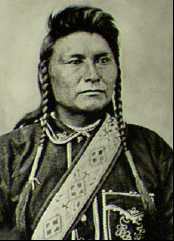
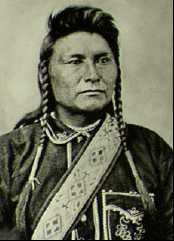
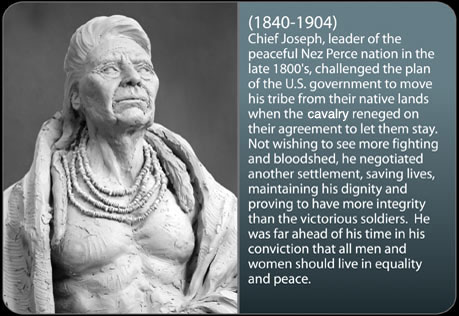
  • Despite the ridiculous outfit, Zack gives a decent summary of his ancestor, who turns out to be Chief Joseph of the Nez Perce. Zack names a real Indian from a real tribe and gives his real history, including his "I will fight no more forever" line.

    That's a nice dollop of history for a lowbrow comedy. It's more than you'll get from most shows, even today, with their no-name or fictional tribes.


  • Chief Henry dies suddenly. The critics asked why. It could be anything--it doesn't matter what. The critics said Zack didn't know him long enough to grieve. True, but sometimes you can connect deeply with a person in just a few minutes. This was clearly meant to be like that.

    Again, compressed sitcom. I think the episode wanted us to imagine Chief Henry had two long soulful meetings with Zack. That they didn't appear on screen is a limitation of the format.

  • Chief Henry's ghost

  • Chief Henry's ghost visits Zack while he's asleep. He's dressed in a white suit and talks about getting his wings and enjoying his afterlife. Critics said that sounded like Christianity rather than a Native religion.

    True, but Henry could've been Christian or a Native/Christian blend. Again, it subverts expectations not to have Henry mouth platitudes about the Great Spirit or the happy hunting grounds.

    One also could connect the ghost to the idea that all Indians have supernatural powers, but I don't think the show was suggesting that. I took it as more of a dream sequence, even though Zack seemed fully awake. I guess there was a whiff of Indians = supernatural, but not enough to bother me.


  • Other aspects of Running Zack were arguably worse than the Native storyline. Screech's malapropisms and misunderstandings are stupid rather than funny. Jessie's stalking Lisa because Lisa's ancestors were slaves and Jessie's were slavetraders is also stupid rather than funny. No one feels incredible guilt because a few of their ancestors did something bad hundreds of years ago.

    Let's sum it up. First presentation: Intentionally racist and bad. Meetings with Chief Henry: Good. Second presentation: Bad looks, good words. Meeting with Chief Henry's ghost: Not bad.

    On a scale of 1-10, I'd call that a 5 or 6. Which means mediocre, not terrible.

    Overall, Running Zack was poor, but not because of the Indian bits. I think those were some of its more interesting parts. I'd give the episode a grade of C or C-, not an F.

    August 12, 2011

    Cougars named after chiefs

    Big Cats at Cincinnati Zoo Named After Famous Chiefs

    By Carol BerryThey were honored Native leaders—Tecumseh of the Shawnee and Chief Joseph of the Nez Perce.

    Their 21st century namesakes in Cincinnati, Ohio are, however, furry members of the biological family felidae, which also includes cheetahs, tigers, and the domestic cat.

    Appropriateness or lack thereof aside, the two male cougars in the Cincinnati Zoo named Tecumseh and Joseph are part of a new exhibit that will offer a close-up look at the cats, according to the Cincinnati Enquirer.
    Below:  "The Cincinnati Zoo's Chief Joseph and Tecumseh were born September 19, 2010."

    July 14, 2011

    Billy Ray Cyrus gets Native tattoos

    Billy Ray Cyrus--Cyrus Pays Tattoo Tribute To Native American LegendsCountry star Billy Ray Cyrus has paid tribute to his Native American heroes with tattoos on his forearms.

    The Achy Breaky Heart singer reveals he had Chief Joseph and Geronimo inked last year (10) during a 48-hour period.

    He says, "I've just always had a great deal of respect for Native Americans; I'm part Cherokee myself."
    Comment:  For more on the subject, see Miley Cyrus, Cherokee? and Miley Cyrus Loves Dreamcatchers.

    March 29, 2011

    Debating Chief Joseph's cuneiform tablet

    Indian Country Today recently posted an article on Chief Joseph's Cuneiform Tablet, a subject I covered a year ago:

    Where Did Chief Joseph Get His Mesopotamian Tablet?

    I answered the title question on Facebook:

    Brought from the Old World a few decades earlier as a souvenir; traded or lost until it reached Joseph. Not proof that ancient Sumerians visited America. That's my theory, anyway.

    This led to the following debate with "Rick":Rob I'm prone to beleive Joseph's version of the story. But I may be biased in this respect he was my G.Great Grandmother's cousin! Did you read the article?Yes, I read it. And I've heard of the story before. "White men had come among his ancestors long ago" could mean a small party of Europeans crossing the continent in the 1700s. It's still consistent with my theory.Explain the legends of white skinned tribal member in the far north from before the Mayflower landed on the East coast! And don't forget the rune stone found on the continent and the inscription rock in the eastern seaboard that seem to have ancient Hebrew and Phonecian writings. I'll stick with Joseph's version!My version is Joseph's version. 100-150 years ago is "long ago" in pre-industrial terms.

    Earlier is possible too

    Sure, some Vikings or other pre-Columbian explorers could've brought the tablet with them. This still contradicts the implied claim that ancient Sumerians visited America. There's no reason to believe this theory except an unreliable interpretation of Joseph's vague words.Consider that he said those words around 1880 and he was talking long long before his time which would add conservatively more than 200 or 3000 years I would bet. Remember that the tribes had tales about great monsters walking on two legs and hairy beasts with long noses and horns (tusks?) that would imply that the collective memory of the tribes could reach back thousands of years not hundreds! Vikings would not be carrying worthless to them tablets around the world on their small sail boats. And the Irish explorers left no records so we don't know on that count!A Viking or other explorer could've had a personal keepsake that seemed "worthless" to others. Such as an old tablet found in a raid or bought in a marketplace in eastern Europe.

    Sumerians wouldn't have visited America and left zero archaeological evidence except one tablet. A cross-country expedition that reached Idaho or wherever should've left several traces.

    All this is speculation based on some white man's interpretation of Joseph's words "long ago." (Is that a direct quote or a paraphrase? Who knows?) It could refer to 3,000 years ago, or to 100 years ago. We simply don't know.

    Without further evidence, I'm going with the simplest explanation. I.e., mine. <g>

    To sum it up, any pre- or post-Columbian explorer could've brought the tablet to Joseph's ancestors. Someone visiting a couple of centuries before Joseph's time seems most likely to me.

    For another claim about a non-Sumerian explorer, see New Films on Prince Madoc.

    May 20, 2010

    Replace Jackson on $20 bill?

    Students seek to put Chief Joseph on $20 bill

    By Kristen CatesStudents at Hays-Lodgepole High School are doing their part to promote using more images of Native Americans on items printed by the federal government—most notably the $20 bill.

    Sandra Sather-Westley, a reading and literacy teacher at the high school, encouraged her students to research and write about the controversy that for years has surrounded having an image of President Andrew Jackson's face on the $20 bill. She also asked the students to come up with a better person to be represented.
    And:The result of the students' research and writing is a petition that they are sending out to every Native American agency, legislator and state official they could think of, seeking to have Chief Joseph, the legendary leader of the Nez Perce, replace Jackson on the $20 bill.

    Sather-Westley said this isn't necessarily a new idea. Over the years, people campaigned for President Ronald Reagan and civil-rights activist Dr. Martin Luther King Jr. to be placed on the $20 bill.
    And:Chief Joseph wasn't the only name tossed in the hat. Students researched Native American leaders such as Geronimo and Sacagawea—a dollar coin already features her image—but came to the consensus that Chief Joseph was the best choice.

    "He was more comfortable to whites and spoke about peace," Sather-Westley said. "There's really quite an undercurrent. We don't feel that Andrew Jackson is representative of the best."
    Comment:  My Native contacts occasionally express disgust at the idea of having Jackson on their money. I'd say it's time to stop celebrating his expansion of America at the expense of the Indians.

    Chief Joseph seems like a good, safe choice to replace him. Sitting Bull, Geronimo, Crazy Horse, and Tecumseh would be too radical for today's Americans.

    For more on the subject, see Replace Grant on $50 Bill? and Review of RELENTLESS PURSUIT.

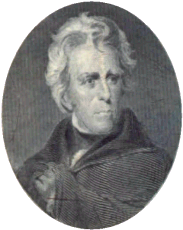
    Below:  Out with the Indian hater...


    and in with the peacemaker?

    January 21, 2010

    Review of RELENTLESS PURSUIT

    RELENTLESS PURSUIT: The True Story of the Nez Perce War of 1877 may be the best Native-themed comic book no one has ever heard of.

    I mean that almost literally. As far as I can tell, there isn't a single posting about it on the Internet. This one will be first.

    The four-issue mini-series was written and drawn by Jeff Kear and published by Slave Labor Graphics in 1989. As the subtitle indicates, it tells the Nez Perce story: from Joseph's becoming chief to his "I will fight no more forever" surrender.

    RELENTLESS PURSUIT is good for several reasons:

  • Kear produced it with sensitivity and care. Even though he's white, it tells the story from a Native point of view. As far I can tell, it's free of mistakes and stereotypes.

  • In most accounts of Indian history, the reader is like an observer far above the scene. This series puts you in the middle of the action, as if you're talking, fighting, and running with the Indians.

  • Kear's rough black-and-white art works well for this kind of story. It almost feels as though the comic was printed from sketches done in person.


  • Enjoyable and educational, too

    Among the things I learned from the comics were:

  • The whites' idea of negotiation was to insist in increasingly firm tones that the Nez Perce had to leave their ancient homeland in Oregon's Wallowa Valley.

  • Joseph was only one of several Nez Perce leaders at the time. Some wanted to give up, some wanted to fight, and some wanted to flee.

  • The Indians fought several running battles with their pursuers. These battles consisted of a dozen or so people shooting at each other through the rocks and trees.

  • The Indians generally outfought or outfoxed their pursuers. They eventually had to surrender because other tribes stopped helping them and it became too hard to run with women and children.

  • Only a couple things marred this otherwise fine series. Occasionally I found it hard to tell the Nez Perce leaders apart. In the fourth issue, Kear switches from mostly pictures with some text to mostly text with some pictures. This probably was a move to cut costs, but it makes the conclusion less effective.

    Perhaps the best part is that RELENTLESS PURSUIT is inexpensive. You can get the whole series for less than $9.00 plus shipping at Mile High Comics. These days, $9 will buy you only two empty-headed superhero comics plus change.

    In short, anyone who likes Native-themed comics should get RELENTLESS PURSUIT. For more on the subject, see Comic Books Featuring Indians.

    January 10, 2010

    Chief Joseph's cuneiform tablet

    Another article claims a Eurasian (Hindu, Turkish, etc.) origin for Native peoples and cultures. But this one appears to be based on a fact:

    A Common History of Assyrians and Native Americans

    By Benjamin DanialiMary Gindling of History Mysteries writes:
    "The chief said that the tablet had been passed down in his family for many generations, and that they had inherited it from their white ancestors. Chief Joseph said that white men had come among his ancestors long ago, and had taught his people many things. His story echoes those told by Native Americans in both North and South America about white culture bringers. But in this case, Joseph had a souvenir to demonstrate the truth of his story."The ancient tablet inscribed in cuneiform and made of baked clay is one inch square in size. The translation by Professor Robert Blggs of Chicago revealed it to be a receipt for a lamb, dated in the year that Enmahgalanna was installed as high priestess of Nanna, or about 2042 B.C. The tablet was presumed to have been made in southern Iraq.
    I hadn't heard about Chief Joseph's tablet before. I wondered if it was another von Däniken-style hoax. But other sources confirm the tablet's existence:

    Where did Chief Joseph get a cuniform tablet?Among the effects of Chief Joseph, the famed leader of the Nez Perce Indians, was a clay tablet bearing a cuneiform inscription. The tablet transmits no startling message, being merely a receipt for one lamb changing hands. But where did a Northwest Indian chief get a 3,000year-old tablet? The tablet first came to light around 1878, long before cuneiform tablets became common on the artifacts market. Still, it could have been a gift from some missionary or tourist--or even planted as a hoax.

    (Park, Edwards; "Where Did Chief Joseph Get a Cuneiform Tablet?" Smithsonian Magazine, 9:36, February 1979)
    Chief Joseph and a Mesopotamian tabletA note of passing interest in this respect concerns Chief Joseph. After his surrender in 1877, he gave a pendant to General Miles, and this object eventually found its way to West Point. A few years ago it was examined and turned out to be a Mesopotamian tablet recording the sale of livestock, a disturbing anomaly and an undeniable fact that should have been grasped at once by Christian fundamentalists and Mormons. How this tablet got into Joseph's family and became an heirloom is a matter of some speculation, telling us that our view of Western Hemisphere prehistory is not as complete as we might think.

    (Red Earth, White Lies by Vine Delora Jr., page 48)
    Another posting argues that the tablet is difficult to explain, so it proves that "white strangers" visited the Indians in prehistoric times:

    History mystery:  Chief Joseph's cuneiform tablet

    By Mary GindlingThe chief said that the tablet had been passed down in his family for many generations, and that they had inherited it from their white ancestors. Chief Joseph said that white men had come among his ancestors long ago, and had taught his people many things. His story echoes those told by Native Americans in both North and South America about white culture bringers. But in this case, Joseph had a souvenir to demonstrate the truth of his story.

    There are several puzzling things about Chief Joseph's tablet. Cuneiform tablets were still relatively rare in 1877, especially in the American West. It is highly unlikely that some acquaintance of the Nez Perce chief would have had such an object to begin with and, if so, Joseph certainly would have said so. Chief Joseph was a man of honor. He would have had little to gain by saying that his family had possessed the tablet for many generations if, in fact, he had gotten it from some missionary or trader.

    The mundane nature of the contents of the tablet argues against forgery. Cuneiform had only been deciphered in 1846 and the process was far from complete even in 1877, so a would-be forger would have had to be an extremely well educated individual familiar not only with the ancient language itself, but with the shape of the tablets created by the ancient scribes.
    Comment:  We can dismiss the Assyrian claim out of hand:

    1) I don't think the Assyrians in northern Iraq had ocean-going vessels. The Phoenicians did, but I'm not sure their ships were sturdy enough to cross the Atlantic. And Phoenicians would've used Phoenician writing, not Assyrian writing.

    2) An Assyrian could've passed the tablet to anyone in Europe, Asia, or Africa. It's ridiculous to claim a single Assyrian tablet proves the presence of Assyrians.

    3) The tablet's nature (an inch-square receipt for a lamb) suggests it was a souvenir, not a working document. If you're crossing the ocean for some reason, do you carry a receipt for a lamb you bought several years ago? It sounds exactly like something you'd buy in a curio shop: a mysterious talisman from the exotic "Orient."

    The tablet explained

    So where did the tablet come from? Chief Joseph supposedly said that "white men had come among his ancestors long ago." Even if that were true, consider a few early visits by white men:

    Awesome America--OregonThe first white explorers came to Oregon by sea. Spain sent Juan Cabrillo, in 1542. Bartolomé Ferrelo, reached the southwestern coast in 1543 looking for a passageway between the Pacific and Atlantic oceans, the Northwest Passage. In 1776, the British sent James Cook to the Northwest to search for the Northwest Passage and to claim the land for Great Britain.It's not hard to imagine that one of these visitors had a cuneiform souvenir and traded or lost it when he visited the Northwest. That would account for the white men among Chief Joseph's ancestors.

    Even the Lewis and Clark expedition, supposedly the first white men to visit the Northwest over land, happened a couple of generations before Chief Joseph's birth. One of them, or one of the fur trappers who followed, could've given the tablet to, say, Chief Joseph's grandparents. It's easy to imagine their telling young Joseph about the white men who came among his ancestors long ago. They could've exaggerated the story, or he could've misheard or misremembered it.

    Even if Chief Joseph sincerely believed the tablet came from the distant past, that doesn't mean it did. You see stories like this unraveled all the time on antiques shows. Someone brings in a "priceless heirloom" and says it's been in the family since Colonial days. No, says the appraiser, it's a knockoff made by a souvenir manufacturer 40 years ago.

    Either explanation seems far more plausible than what these articles are suggesting. Namely, that a group of Assyrians crossed the Mediterranean Sea, the Atlantic Ocean, and the North America continent 3,000 years, reached the Oregon/Idaho region, and left no trace except a lamb receipt they just happened to be carrying. I'd believe Chief Joseph pulled a prank on the white man before I'd believe that.

    For more on a related subject, see New Films on Prince Madoc and Welsh Society Wants Madoc Plaque.

    January 02, 2010

    Remember Them includes Indians

    Oakland to honor 25 leaders in huge sculpture

    By Carolyn JonesOakland's version of Mount Rushmore will rise this year in an Uptown park: a towering, ponderous monument to great leaders that organizers hope will inspire schoolchildren and awe tourists.

    The $7 million monument, "Remember Them," features 25 famous people who fought for peace or human rights. They're an unlikely crew, ranging from Winston Churchill to Malcolm X to Harvey Milk to Mother Teresa, soon to be joined in eternity.

    The monument, to be installed in a park next to the Fox Theater, will be one of the largest bronze sculptures in the United States. It will be three stories tall, weigh about 25 tons and span 90 feet--a third the length of a football field.
    The list of leaders from the statue's official website:

    Abraham Lincoln
    César Chávez
    Coretta Scott King
    Elie Wiesel
    Franklin Delano Roosevelt
    Frederick Douglas
    Harvey Milk
    Chief Joseph
    Malcolm X
    Martin Luther King Jr.
    Maya Angelou
    Mahatma Gandhi
    Nelson Mandela
    Oskar Schindler
    Ralph Abernathy
    Unknown rebel of Tiananmen Square
    Rigoberta Menchú Tum
    Rosa Parks
    Shirin Ebadi
    Susan B. Anthony
    Mother Teresa
    Thich Nhat Hanh
    Winston Churchill
    Helen Keller
    Ruby Bridges


    Comment:  This is a great list of people to honor. And with two of the 25 slots, Indians are getting their fair share of attention.

    I like the sculpture's look, too. The heads emerging from a towering mass--as if they're emerging from a multitude of people who also worked for peace and human rights.

    Some commenters on this article called the sculpture a waste of taxpayers' money. Apparently they didn't or couldn't read the part about its being funded with private donations. And some complained about the omission of Jesus and other Christian figures. Obviously the sculpture represents the modern era (since the Civil War), not all of human history.

    My only criticism is that there are too many representatives from the black Civil Rights movement (six) and too few from outside the US (eight). Looking at a list of Nobel Peace Prize winners and others, the monument could've included Jimmy Carter, Pope John Paul II, Kofi Annan, Aung San Suu Kyi, the Dalai Lama, Lech Walesa, Andrei Sakharov, Dag Hammarskjöld, and Albert Schweitzer. The inclusion of people who fought for the Jews against the Nazis is good, but the monument should include people who fought Communism as well.

    For more on monuments, see Best Indian Monuments to Topple.

    Below:  "Artist Mario Chiodo admired Abraham Lincoln enough to give him center stage in one of his 'Remember Them' monuments. Others in this piece include Rigoberta Menchu Tum, Cesar Chavez, Malcolm X, Sir Winston Churchill and Susan B. Anthony."

    (Photo: Lance Iversen/The Chronicle)

    March 14, 2009

    Chief Joseph on good intentions

    A quote from André P. Cramblit on Facebook:Good words do not last long unless they amount to something. Words do not pay for my dead people. They do not pay for my country, now overrun by white men. They do not protect my father's grave. They do not pay for all my horses and cattle. Good words cannot give my back my children. Good words will not give my people good health and stop them from dying. Good words will not get my people a home where they can live in peace and take care of themselves. I am tired of talk that comes to nothing. It makes my heart sick when I remember all the good words and all the broken promises. There has been too much talking by men who had no right to talk. It does not require many words to speak the truth.

    Chief Joseph
    Comment:  For more on the subject, see Apology Is Meaningless and Apologies Aren't Enough.