Showing posts with label July 4th. Show all posts

July 04, 2013

America's "colorblind racism"

Don’t call it “Independence Day”

I love July 4. But what is “independence,” if full freedom still doesn't exist for everyone in this country?

By Edward Wyckoff Williams
Comedian Chris Rock sparked a debate a year ago today, when he tweeted: “Happy white people’s independence day! The slaves weren’t free but I’m sure they enjoyed fireworks.” The sentiment expressed in Rock’s comments reflect the profundity of racial inequalities by challenging Americans to remember the stark realities of the past.

Recently, liberals and conservatives alike were outraged by the revelation that the National Security Agency, under the auspices of the Patriot Act, were collecting phone records and data on millions of citizens. The thought of the government recording their intimate calls outraged their sensibilities and sparked a national debate. Likewise, following an outcry from angry travelers, changes have been introduced to curb post-9/11 Transportation Security Administration practices that allow airport security to aggressively search, screen and frisk flight passengers.

This is what one may call “white people problems.”

For, you see, young black boys and black men in the Bronx and Brooklyn are stopped and frisked by police while walking to McDonald’s. They are criminalized and stigmatized—seen as suspicious and treated without respect. This culture is so deeply embedded that both police and citizens alike regard Skittles as a deadly weapon when held in a black boy’s hand.
And:Let me be clear, Bloomberg is not a Ku Klux Klan member. He may not harbor ill will or intentional dislike for racial minorities, and blacks in particular. But he’s a racist nonetheless. His actions, attitude and statements reflect the essence of what sociologist Eduardo Bonilla-Silva termed “colorblind racism.” In his book “Racism Without Racists: Colorblind Racism and the Persistence of Racial Inequality in the United States,” Bonilla-Silva explains that the “post-racial” form of racism is one that disavows individual racism, yet serves to perpetuate a hierarchy of white privilege in our society.

The author identifies four central frames at the core of colorblind racism: 1) abstract liberalism, 2) naturalization, 3) cultural racism and 4) minimization of racism.

In the Age of Obama, each has become more prevalent in America’s sociopolitical debates.

“Abstract liberalism” reflects the libertarian philosophy that social policy should not be engineered to achieve equal outcomes. “Naturalization” follows by allowing whites to justify inequitable outcomes as being the result of natural occurrences. “Cultural racism” uses loosely based facts and social phenomena to dismiss racial disparities. (e.g., “Mexicans do not put much emphasis on education” or “Blacks have too many babies”). “Minimization of racism” suggests discrimination is no longer a major problem by emphasizing the progress made. (The minimization theory can most recently be seen in the Supreme Court’s 5-4 decision invalidating Section 4 of the Voting Rights Act, in which Chief Justice Roberts admitted that though racism still exists in the South, the very safeguards that achieved progress were no longer necessary.)
Comment:  For more on July 4th, see Why Indians Celebrate July 4th and No Independence Day Without Indians.

Mixed feelings about July 4th

Do American Indians celebrate the 4th of July?

By Dennis ZotighToday tribes hold ceremonies and celebrations on or near Independence Day for different reasons. The Lumbee of North Carolina and Mattaponi of Virginia use this time as a homecoming for tribal members to renew cultural and family ties. The Kiowa Tribe of Oklahoma holds Gourd Clan ceremonies on the 4th of July because the holiday coincides with their Sun Dance, which once took place during the hottest part of the year. The Lakota of South Dakota and Cheyenne of Oklahoma continue to have some of their annual Sun Dances on the weekends closest to the 4th of July to coincide with the celebration of their New Year. Some American Indians do not celebrate the 4th of July because of the negative consequences to Indian people throughout history, while others simply get together with family and have cookouts, like many non-Native American citizens.

Fast forward to the present: To find out how American Indians across the country spend their 4th of July, we went to Facebook. This handful of replies represents both the diversity of responses we received and the direction of the discussion:

Taos, New Mexico: Taos is a very close knit community, and even more so at Taos Pueblo nearby. Both have had many citizens serve in America's military in the heartfelt belief that they are protecting our nation. One of our honored tribal elders is Tony Reyna, 97, who survived the Bataan Death March in World War II. I have been told many times that, for us, the idea of protection goes deeper than for most Americans, because this land is where our people emerged, and that any threat to it is met from a place of deep, deep meaning. People here celebrate Independence Day pretty much as they do everywhere. It's a day off, and there are parades and fireworks displays. But for many we remember WWII, Korea, Vietnam, Iraq and Afghanistan, and the sacrifices our people made. I wish all people could remember that, especially those who allow blind bigotry and hate to cloud their judgment.

Parshall, North Dakota, and the Three Affiliated Tribes: The 4th is the celebration of independence, which Native people have practiced as sovereign nations for generations.

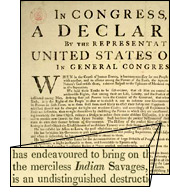
Shawnee, Oklahoma: No, I do not celebrate Independence Day, simply because the Declaration of Independence labels my people "our enemies, the merciless savages of our frontiers." You notice they were already calling the frontiers "ours" when the land was not theirs. Because I do not celebrate Independence Day does not mean I am not proud of our Native American veterans and soldiers. I am very proud of them and of the fact almost all Native American families have a family member who is a veteran and/or an active member in the Armed Forces.

Anadarko, Oklahoma: I am Kiowa/Delaware/Absentee Shawnee, my mom is a Kiowa/Comanche, my uncle is a vet, as many of my other relatives are, as well as my stepdad (Comanche/Caddo). My Delaware grandma always said, “This is not our holiday. Out of respect we will honor their day, because our people helped them.” She said, “I will mourn on this day.” She would wear a black dress that day.
Comment:  I suspect the mixed opinions are similar across Indian country. Enjoy the day off, celebrate Native soldiers and freedom, but don't acknowledge the United States for what it did to Indians.

For more on July 4th, see Why Indians Celebrate July 4th and No Independence Day Without Indians.

Below:  "Pawnee Indian Homecoming recognizes returning veterans. Pawnee, Oklahoma. This year's homecoming takes place July 4 through 7. (Photo courtesy of Pius Spottedhorsechief, vice president of the Pawnee Indian Veterans.)

Native activities in 1776

Top 5 Historic Moments From 1776 for Natives: No Independence Day HereWhile the Founding Fathers were signing the Declaration of Independence purportedly in Philadelphia, Natives were fighting for their own independence and survival. Here are 5 things that were going on while the newly formed colonies declared their independence from Great Britain.

1. The Cherokee took a stand against white settlers in North Carolina led by Dragging Canoe and Abraham of Chilowee on July 20, 1776.

2. The Chickamauga Wars started in 1776. They were a continuation of the Cherokee struggle against white encroachment.

3. Because the British were using Indian troops, the Continental Congress, on May 25, 1776 thought “it was highly expedient to engage the Indians in the service of the United Colonies,” and tried recruiting 2,000 Indian soldiers.

4. Though some Natives were fighting alongside the colonies against Britain in the Revolutionary War, the history of which began in 1776 when the Oneida Indian Nation urged Americans to reoccupy an abandoned British fort in upstate New York.
Comment:  The fifth "moment" is the Native deaths caused by disease, which isn't a moment. But the first four remind us that Indians were part of the Revolutionary War story. They were active during the first Independence Day, not off-stage somewhere twiddling their thumbs.

Of course, they fought mostly on the British side. Which is understandable, since they had good evidence the American colonists were more rapacious than their British forefathers.

Meanwhile, Indians across the continent were living free and sovereign lives. Dealing with Spanish, French, and British colonizers, to be sure, but unaware of the American threat about to dwarf all others. Does any history book or documentary convey that in 1776, Indians owned and occupied most of North America?

For more on July 4th, see Why Indians Celebrate July 4th and No Independence Day Without Indians.

Below:  "British General Burgoyne addressing Native Americans to secure an alliance during the Revolutionary War."

July 05, 2012

Trail of Tears fireworks

Someone posted this photo of a box of fireworks on Reddit, and Native Appropriations reposted it.

Making light of, trivializing, and commercializing the Trail of Tears are the obvious problems here. The subtle problem is deciphering the connection between the fleeing Cherokees, the fireworks product, and the "30 Shots" slogan.

The message I'm getting is, "Ignite the fireworks and watch the flaming balls shoot. Scary and powerful enough to send savages fleeing." As if forcing people to run is a desirable outcome--a reason to celebrate.

For more on trivializing the Trail of Tears, see "Mail of Tears" and "Trail of Tears" Halloween Costume.

July 04, 2012

Why Indians celebrate July 4th

A Native American Take on Independence

By Krissy Clark"Kill the Indian to save the man"--that oppressive motto led to restrictions on his tribe's native language and native customs. The federal government forced Indian children to go to churches and boarding schools where they were re-educated and stripped of their cultural traditions.

So it makes sense that, growing up, the Fourth of July would be a dark day for Hudson, a sad tribute to the country that tried and tried again to exterminate its native people and their culture. But it wasn't--for Hudson, the Fourth meant "summertime, family, fireworks. You can't wait for the fireworks. As a kid you look forward to that celebration."

Hudson was not alone. Across the Fort Berthold Reservation--what was left of it--people partied on the Fourth of July. Sno Cones and barbecues, weaved together with older, indigenous traditions like powwows that would last deep into the night.

At the center of the festivities was the drum. "The beat of the drum means everything in the powwow," Hudson says. "It signifies the heart beat of a people. There are different types of dances, ceremonies, give-aways, acknowledgements."

So why were they celebrating?

"You know, this is the classic case of making something positive out of really desperate situations," says Matthew Dennis, a professor of U.S. history who studies the way Americans celebrate national holidays. He says we can learn a lot about ourselves as a country by looking at how the Fourth is celebrated on reservations like Fort Berthold.

"It is those who have struggled the most, and who've been forced to be the most creative, that have the most to teach us," Dennis says. "Forgiveness without forgetting, incredible creativity and resilience."

To understand what Dennis means, we need to go back to the late 19th and early 20th century, when reservations like Fort Berthold were under severe federal rule. At one point, the reservation's white superintendent issued a declaration that read like this: "Dancing, exchanging of presents, traveling from one dance to another, and dancing feasts are not to be carried to excess."

The superintendent decreed that permission for all traditional dances must be obtained in writing--but, Dennis says, there was a kicker: He didn't object to gatherings that were on the Fourth of July.

The Fourth of July, after all, was the time to teach Indians how to become good Americans. Some Indian children were even reassigned new birthdays to coincide with the Fourth.

So the Mandan and Hidatsa people who lived at Fort Berthold decided that if the Fourth of July was one of the few occasions when they could celebrate their native customs, then why not celebrate the Fourth of July? By the early 1900s, the Fourth had become a big day on the reservation, Dennis says, starting at dawn and lasting well in to the evening with traditional dances and ceremonies.

"All kinds of singing and dancing, exchanging of gifts," he says. "They would visit friends, initiate people into societies and do all the sorts of things that they were ordinarily prevented from doing, under the cover of this patriotic celebration."
Reason There Are a Lot of 4th of July Powwows

By Dennis ZotighIn 1883 the Indian Religious Crimes Code (Prucha, 'Documents' p. 160-161) was developed by Secretary of the Interior Henry Teller as a means to prohibit Native American ceremonial activity under pain of imprisonment. Teller's general guidelines to all Indian agents ordered them to discontinue dances and feasts. Enforced in reservations as Department of Interior, Office of Indian Affairs policy, Indian ceremonies were banned, religious practices disrupted, and sacred objects destroyed or confiscated.

Indian ceremonial activities were prohibited under threats of imprisonment and/or withholding of rations. The Secretary of the Interior issued this Code of Regulations in 1884, 1894 and 1904 through Indian Affairs Commissioner's circulars and Indian agent directives. In turn, Indian superintendents and agents implemented the code until 1936. In this 50 year period, Indian spiritual ceremonies such as the Sun Dance and Ghost Dance were held in secret or ceased to exist.

Some tribes continued their ceremonials during the 4th of July under the disguise of telling their agents they were celebrating American Independence Day. Usually the American flag was displayed in a prominent position to support this claim. Otherwise many of these tribal ceremonies would have also ceased to exist.

Sad, huh?
Comment:  For another reason Indians celebrate July 4th, see July 4th Means Fireworks. For more on the subject, see Tribes Celebrate July 4th.

No Independence Day without Indians

Without the First Americans, There Would Be No U.S.A.

By Ruth HopkinsAs a kid, to me the Fourth of July was all about one thing: fireworks. I grew up in the country in the Dakotas, where lighting off fireworks was pretty much a rite of passage for reservation kids. Roman candles, firecrackers, smoke bombs, artillery shells, and oft dreaded bottle rockets are still sold from make shift stands and big top tents on rural roadsides all across the prairie. Sure, in school we read about George Washington, Paul Revere and the Revolutionary War, but as Natives, we felt pretty disconnected from mainstream American history.

I would later discover that Natives aren’t the only ones who fail to grasp the significance of our Indigenous ancestors in the history of the land that would later be called the United States of America. Those very textbooks are proof. In public schools, any mention of Natives is likely relegated to a few paragraphs about Thanksgiving, Pocahontas or Sacajawea. You might hear about The Battle of Little Big Horn in passing, but only as “Custer’s Last Stand.”

Natives aren’t given a lot of exposure in mainstream culture either. You’ll rarely, if ever, see a Native character on television or in the mainstream media. While we’ve made strides in representing ourselves positively on a national platform, we’ve got a ways to go to achieve accuracy in the depiction of us as a People. This is evidenced by false imagery that’s saturated pop culture, ala scantily clad white women in headdresses and war paint, and the tolerance of negative stereotypical mascots like the Cleveland Indians and the Washington Redskins.

In reality, Natives have played a pivotal role in American history and will continue to do so. There’s no doubt that European immigrants would not have survived long enough to form the 13 colonies but for the assistance of Natives on the east coast. Besides providing the first handouts to the starving and diseased European aliens who landed, Natives taught them how to fish, hunt, and plant foods in North America, how to build watercraft, and maneuver along Native trails.

Today, around half of the globe’s food supply comes from crops like corn and potatoes--which were originally cultivated by Natives. Cotton, a key fabric source, was also first grown by Natives. Medicines derived from Native plants were used by Natives in the Americas long before the arrival of Europeans.

That’s just the tip of the iceberg. Most Americans are completely clueless to the fact that the U.S. Constitution has a Native foundation. Ben Franklin, one America’s ‘founding fathers,’ modeled much of the Constitution after the Iroquois Confederacy. Even today, the way the congressional House of Representatives works with the Senate is rooted in how the Iroquois Confederacy was run.

Natives affected the revolutionary social concepts of early Americans too. Europeans who immigrated here came from countries that were monarchies. Their countries of origin were very socially stratified, with castes. In other words, if someone were born into poverty, they were likely doomed to remain such for life. For such a person, the option of earning an education or pursuing a gainful means of employment was extremely remote. Natives and their vast lands introduced Europeans to the concept of individual dignity and a person’s right to be free. For example, if a Native man didn’t wish to hunt or fight in battle, he wasn’t forced to do so. There were also Native women who became warriors and who held leadership positions within their Tribe. The concept of individual freedom, in the European mind, became one’s right to “life, liberty, and the pursuit of happiness.” Mixed with capitalistic greed, such liberty gave birth to the phenomena once known as ‘The American Dream.”
Comment:  For more on July 4th, see Indians Fought for American Independence and Indians Opposed American Independence.

July 4th means fireworks

More Pow, More Wow! Fireworks Have Turned Into a Good Seasonal Business for Many Tribes

By Tanya LeeWith the July 4 holiday approaching, thousands of visitors are expected to flock to reservations in the West in search of fireworks they cannot buy at home. There they will often find the spectacular devices the federal government classifies as 1.4G or consumer fireworks, formerly called Class C—bottle rockets, Roman candles, mortar shells, M-80s and blackjacks. The Snoqualmie Indian Tribe sells “some fireworks with more gunpowder, more bang than the ‘safe and sane’ devices” allowed by the state of Washington, says Matt Mattson, tribal administrator.

Within the bounds of the federal regulations, states—and most tribes—may set their own rules. States that allow fireworks usually also allow local municipalities to further restrict which fireworks may be purchased and discharged.

States that ban all fireworks include Delaware, Massachusetts, New Jersey and New York. More than 40 states allow all or some consumer fireworks. Some states restrict the sale of consumer fireworks to those considered “safe and sane,” which are those that do not fly or explode, such as fountains, sparklers, wheels, smoke bombs, strobes and ground spinners. Firecrackers, rockets, missiles, mines, shells, aerial cakes, flying spinners and Roman candles are not considered “safe and sane” as a rule, though states set their own criteria for those.

Indian tribes are subject only to federal fireworks regulations. Some restrict the sale of fireworks to tribal entities, while others allow individual tribal members to sell fireworks and yet others allow nontribal members to sell the devices on the reservation. Fireworks may not be discharged on Bureau of Indian Affairs property, and most tribes forbid their discharge in tribal housing areas.
Below:  "The Snoqualmie Tribe opened a fireworks tent for the first time this year. It will be located in the lower parking lot of the Snoqualmie Casino from June 24 through July 5." (Jamie Martin)


Fireworks, Freedom and Feeling Up: The Significance of the Fourth in 600 Words

By Gyasi RossStill, the Fourth of July was about freedom.

It was freedom of a different kind. Many of the families who had fireworks stands were poor; we celebrated our freedom from poverty for a little while. After all, fireworks were a great source of economic development on the rez. There were a not a whole lot of other opportunities there; we knew that we could count on the two “F” words to stabilize the family income: fishing and fireworks. The way it went is that the families with fireworks stands would typically struggle to find a way to pay their fireworks tax to the Tribe, and then go get a thousand dollars or so worth of fireworks from a wholesaler on consignment. Drug-dealer style. There was interest involved, and a certain amount of fear because “What if we don’t sell as much as we borrow?” Still, it was rez-style capitalism, and was a huge part of the tribal economy at the time.

Fireworks paid for many Indian kids’ school clothes—taking back America one white customer at a time.
Comment:  For another reason Indians celebrate July 4th, see Why Indians Celebrate July 4th. For more on the subject, see Tribes Sell Fireworks.

Indians need an independence day

Some Indians don't celebrate July 4th. Here's why:

When Will Indians Get Their Independence Day?

By Simon Moya-Smith“You know, I don’t celebrate the Fourth,” I said. “It’s not my holiday.”

“What in God’s name is wrong with you?” he bellowed. “This is the time of year that we celebrate our divorce from those damn Brits!”

The bartender eyed me warily as I stood and approached the bar with my drink and my half-devoured burger. I took a seat next to the dingy dullard.

“Well, I’m Lakota,” I said peacefully.

“What? … What’s that?” he asked.

“You see! That’s exactly why we call ourselves Indians. You don’t know us by nation unless it’s Cherokee or Navajo, and then oftentimes your people claim to be one!”

The man just glared at me and now I had the full attention of the bar.

“I don’t celebrate the Fourth because we, American Indians, haven’t had our Independence Day yet. We, unlike you guys, are still under the cloud of a taxing and tyrannical foreign government.”
For more on July 4th, see Three Words in Declaration of Independence and The 4th of You Lie.

July 09, 2011

Three words in Declaration of Independence

A woman wrote about her family tradition of reading the Declaration of Independence on the Fourth of July:

The Damaging Three Words of the Declaration of Independence

By Alison OwingsEventually, however, we get to "domestic Insurrections amongst us," and here it comes, the phrase that distresses me so much after spending close to a decade meeting, and listening to, Native Americans, that I can barely stand to read it, nor type it.

"... the merciless Indian Savages."

Say what? From the elegantly-quotable Jefferson? Yes. "... the merciless Indian Savages, whose known Rule of Warfare, is an undistinguished Destruction, of all Ages, Sexes and Conditions."

While Native Americans celebrate this 4th of July weekend, probably with hotdogs and fireworks, and possibly a powwow (as far as I know, the day has not attained the level of dislike or dismissal in Indian country that there is towards Columbus Day), I wonder whether we might all read the Declaration of Independence out loud, consider what that three word phrase wrought, not to mention the words about "undistinguished Destruction." Destruction of who by whom? Native people, among others, may ask.


Pretty innocuous stuff, you might say. The Founding Fathers had a problem with Indians...so? Newspaper Rock readers see more inflammatory comments almost every day. And this appeared in the Huffington Post, that bastion of the "liberal media."

According to Owings, here's what happened:

The Declaration of Independence, Jefferson’s “Merciless Indian Savages,” and Getting Flamed on Huffington Post

By Alison OwingsMention of “merciless Indian savage” kicked up such a huge and ferocious storm that I have not read all the comments: 3,187 of them when I last checked.

Of the many I did read, a majority were wagging finger-ish. “Didn’t I realize that the Declaration reflected thinking in the 18th century, not the 21st?” “Didn’t I know that the passage I quoted is part of a long list of grievances against King George III?” “Please be aware that Jefferson owned slaves…” To which I say, “Duh, duh, and duh.”

Some comments were shocking by perspective alone. Common themes: Look what Indians did to settlers, savagely and mercilessly, wrote several people. Jefferson was right! Or, “Jefferson was referring only to Indians in western settlements”—(“Nothing in that statement shows a belief that ALL Indians were merciless or even savage,” wrote nullcodes). Or, “Now Indians can go to college for free.” A person with the handle of jdjay comments, “There were some pretty evil tribes but focusing on the bad ones as being representa­tive of the whole is obviously not an objectivel­y Christian or spiritual approach.”

Here sunshine14 steps in: “Does not matter if their [sic] were evil tribes or good tribes, not our land was it, regardless­?” This rankles Syllogizer. “You are ignoring the facts that even Tocquevill­e pointed out: the Indians did not even HAVE a concept of land ownership when the Europeans arrived. So no, the land was not ‘stolen’, since it wasn’t ‘owned’ in the first place.”

Oh, Lordy. That one drew a lot of heat.

Thankfully, a number of people, including many self-identified as Native, challenged the challengers, and the challengers’ challengers. One gentleman (as I think of him) took on a creep who wrote that my essay, meant for the 4th of July of all days, was “treasonous.” Eek.
Comment:  "Treasonous," eh? Thanks for that deep understanding of the 1st Amendment, fella.

As you can see, there's so much ignorance among Americans, even liberal ones. So much denial of America's genocidal past.

We could rebut all the anti-Indian arguments, but why bother? Sunshine14's point is the basic one to remember. Regardless of the details, Europeans invaded a foreign land and conquered its people. The Indians correctly assumed these attacks would destroy their way of life and fought back in self-defense.

For more on our genocidal history, see US Condemned Indians to Diabetes and Scalia Demands Written Policies.

July 29, 2010

Half-naked "chief" in Mass. parade

Debate renews over 'Indian' in Needham's parade

By Katrina BallardWhen a couple new to Needham attended the town’s annual Fourth of July parade for the first time this year, they were shocked to see Fred Muzi, retired owner of Muzi Ford, dressed in a feather headdress with his skin painted red, riding bareback on a horse.

“We enjoyed the parade a lot, but when our 4-year-old daughter turned to us and asked why that man had paint all over him, we felt really uncomfortable,” said Emily Rothman, who moved to Needham five months ago with her husband, Greg Banks.

Their concerns—expressed in a letter to a local newspaper and a phone call to a tribal chief on Cape Cod—have renewed an off-and-on debate within town over whether the half-century parade staple should continue.

“We do know this is a tradition many people in Needham enjoy and find harmless, and it does seem like Mr. Muzi has the best intention,” said Rothman. “However, when people paint their skin to look like individuals of another race for entertainment purposes, it’s off base.”
And:Rothman also contacted Linda Morceau, chief of the Chappiquiddic tribe based in Cape Cod.

“There are no good reasons for someone that is not Native American to dress up as though they are Native American,” said Morceau, a substance abuse and family councilor at Peaceful Gathering Place in Wareham. “The only group of people that are still open season for being made fun of that way are Native Americans. We need to step up and say this is offensive.”

Morceau compared Muzi’s costume, which she says makes fun of her sacred dress, to putting on blackface.

“If you want to honor the Native American, you bring in a Native American,” she said. “You don’t bring in a white person, put on a black face, and say you’re honoring African Americans.”
Comment:  So much wrong here:

  • Wearing a Plains headdress in a Massachusetts parade.

  • Buying the headdress in a non-Native national park. Even if it's Indian-made, I doubt the maker intended Muzi to wear it like a Halloween costume.

  • I cant tell how red Muzi is in the video, but he's wearing facepaint and he's almost naked. Neither of these came from an Indian-made headdress in a national park. Muzi is presenting a pure stereotype so viewers can "enjoy" the idea of a savage Indian chief.

    For more on the subject, see The "Honor" of a Plains Chief, Why Hipster Headdresses Aren't Okay, and A Brief History of Redface.

  • July 04, 2010

    Happy Merciless Indian Savages Day!

    Some Native thoughts on Independence Day--aka the Fourth of You Lie. First, someone posted this on Facebook:Happy Merciless Indian Savages Day! Y'all be careful out there as you apply our rule of warfare ... you know, that "undistinguished destruction of all ages, sexes and conditions" thing that we do! ... Oh, and don't let the kids play with sparklers unattended.
    Someone else posted this link to the White House:

    Message from the President Regarding Independence DayAmerica again faces a daunting set of challenges, yet our history shows these are not insurmountable. We need only to draw upon the perseverance of those before us ... our Founders who declared and fought for their ideals; our ancestors who emigrated here and struggled to build a better future for their children; and our pioneers and entrepreneurs who blazed trails that have continually expanded our horizons. Their spirit ... our spirit ... will guide our Nation now and in our bright future.As usual, Obama offers the pure "we're immigrants who settled the land" line. As usual, he slights Native Americans.

    A Facebook response to Obama's message:We're waiting!!!!

    Just as this day serves as a reminder of the immeasurable bravery of those who have made America what it is today, it also renews in us the solemn duty we share to ensure our nation lives up to its promise.
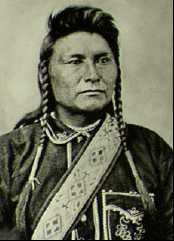
    Another person posted "an assertion of independence--and personal liberty--from a pre-colonial perspective":Treat all men alike. Give them all the same law. Give them all an even chance to live and grow. All men were made by the same Great Spirit Chief. They are all brothers. The Earth is the mother of all people, and all people should have equal rights upon it....Let me be a free man, free to travel, free to stop, free to work, free to trade...where I choose my own teachers, free to follow the religion of my fathers, free to think and talk and act for myself, and I will obey every law, or submit to the penalty.

    Chief Joseph of the Nez Perce
    Interesting that Chief Joseph had a better grasp of the American dream than his non-Indian contemporaries. They had barely freed the South's slaves and still treated women, minorities, and immigrants as subhuman species.


    When to start celebrating

    Finally, James Magaska Swan writes:

    When will our Native Brothers and Sisters recognize "Independence Day"?When the lands are given back to us, and we don't have to do fund raisers or occupations to get them back;

    When the buffalo are not hazed and killed by government agencies;

    When rocks are not sold as souvenirs on Alcatraz;

    When Indian names and images are not used as sports mascots or for commercial selling of products;

    When we can have equal time in our classrooms across the United States to learn and speak our languages so they are not lost forever;

    When we have funding in our schools so our children can learn;

    When all tribes can be "recognized";

    When we can keep our casino monies and take care of our own;

    When we all have health care, card carrying or not;

    When we can have statues that also commemorate our own people;

    When we can change historical markers to reflect the truth and not glamorize the murders;

    When we can see curriculum in our school books and classrooms that are not romanticized or glossed over when it comes to what really happened in and around Indian country;

    When we don't have to ask permission to hunt and gather for sustenance, ceremony, or for medicinal reasons;

    When all sacred sites are in place (and protected);

    When our ancestors remains or artifacts are uncovered, the corporation or construction companies JUST STOP and find a different place to build;
    and so forth. This is only about 40% of the list, which goes on too long to be truly effective as a piece of writing.

    I'd just like to note how Swan sees the big and small items as equally important. Indians want their land back, federal recognition, health care, education, and casino money. They also want sacred sites and remains protected, Indian stories told in schools and history displays, and an end to stereotypical Indian mascots and commercial products.

    Most Indians get it and most non-Indians don't, but these things are interrelated. Not romanticizing or stereotyping Indians means treating them as political, economic, and social equals--as sovereign people. The two go hand in hand.

    For more on the subject, see Tribes Celebrate July 4th and Fun 4th of July Facts.

    July 04, 2009

    Tribes celebrate July 4th

    A Native American Take on Independence

    By Krissy Clark[I]t makes sense that, growing up, the Fourth of July would be a dark day for Hudson, a sad tribute to the country that tried and tried again to exterminate its native people and their culture. But it wasn't--for Hudson, the Fourth meant "summertime, family, fireworks. You can't wait for the fireworks. As a kid you look forward to that celebration."

    Hudson was not alone. Across the Fort Berthold Reservation--what was left of it--people partied on the Fourth of July. Sno Cones and barbecues, weaved together with older, indigenous traditions like powwows that would last deep into the night.
    And:And not just on the Fort Berthold Reservation. For more than a century, the Fourth of July has been a big day across Indian country. The Quapaw in Oklahoma, the Ojibwe in Minnesota and the Northern Cheyenne in Montana are just a few of the tribes that have established big rodeos and powwows on the Fourth--celebrating the day, but making it their own.

    Of course, not all tribes or all Indian people have embraced the holiday in the same way. The Onondaga of upstate New York decided a few years ago to stop observing the Fourth of July altogether. Right after America declared independence in 1776, George Washington ordered Onondaga villages to be destroyed--they were in the way of the new country.
    Comment:  For more on the subject, see The 4th of You Lie and No Holiday for Indians.

    July 04, 2008

    The 4th of You Lie

    An essay makes the point that "independence" and "freedom" don't necessarily mean the same things to America's first inhabitants.

    "The 4th of You Lie" by Jimmie Beason (Osage/Mvskoke)Every year on the 4th of You Lie (July), patriotic Americans engage in their multiple colored foray of pyromania by blowing up fireworks to celebrate the birth of the United Snakes.

    This is appropriate as it's a metaphor for Indigenous genocide. The fuse of colonization was lit and exploded with Manifest Destiny and conquest ripping through OUR freedom; a true Freedom that existed for thousands of years before the European invasion of our continent.

    Amerikkka's policies toward us have done nothing to help, only to destroy. Treaties were made and signed with the "utmost honor" only to be broken. In 1492, it is estimated that 5 million Native people inhabited the Western Hemisphere. By the 1800's our population was reduced to 600,000. At the end of the 19th century--250,000.
    Comment:  An op-ed piece in the LA Times claims the "Declaration of Independence's vision endures." I can't argue with that. As specified in the Declaration, the threat of "merciless savages" has been a guiding force throughout US history. It's responsible for the genocide of Native Americans, slavery and its continuation until the Civil War, Jim Crow laws against minorities, prejudice and hate against immigrants, isolationism and xenophobia, the red scare and the nuclear arms race, and the Vietnam War.

    It's still responsible for much: our paltry foreign-aid budget and colossal military budget, our anti-immigration hysteria, our war on drugs and drug users, our fear of homosexuals with their "lifestyle" and "agenda," our disdain for "welfare queens" and "gangsta rappers"--indeed, for any minorities (e.g., Jeremiah Wright, Michelle Obama) who don't play by the white man's rules. Not to mention the Bush administration's promotion of torture, the Guantánamo Bay concentration camp, the illegal invasion of Iraq, the phony war on terrorism, and the ongoing violation of our constitutional rights.

    Yep, it's good to know so many of our present policies are based on the Puritans' self-righteous certainty of their superiority over everyone, especially the Indians. That vision of a white male Christian dominion over the world endures. So let's all raise a glass and toast another glorious 4th of July.

    Old vision:


    New vision:


    Old vision = new vision:


    July 03, 2008

    Tribes sell fireworks

    Tulalip Tribes' Boom City draws thousands to its fireworks boothsRows of fireworks stands stood 10 wide and 15 deep, all constructed of plywood boards tacked together and splashed with colorful paint.

    Inside were people who know the fireworks business, people who have spent decades learning it.

    These 154 booths make up Boom City on the Tulalip Tribes reservation.

    "These few weeks a year it really does become its own city," said Mike Dunn, who has sold fireworks at the Marysville-area reservation for more than 30 years.
    Fireworks Sold on Tribal Land: Illegal in AZ, ImperialWith the 4th of July right around the corner, some folks are in the market for fireworks. While the sparklers are illegal in Arizona and parts of California, they can easily be bought on tribal land.

    "There's this thing going around, the illegals, which that's anywhere from things that go in the sky and blow up. Everything here is 'safe and sane' not insane," says fireworks vendor, Izzy England. He and his family sell their merchandise on the Quechan reservation.