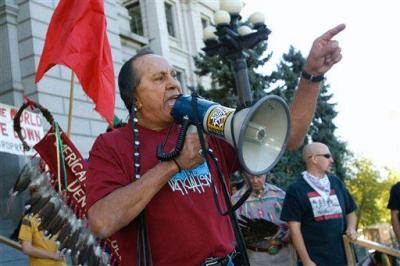
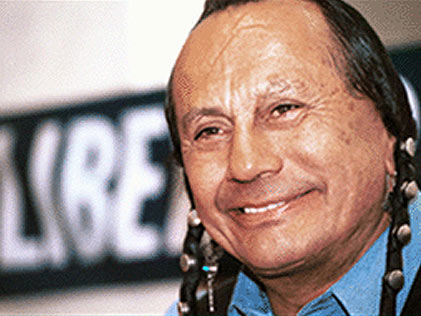
Showing posts with label Russell Means. Show all posts

January 19, 2016

Means: Geronimo had 100+ errors

Hollywood v. Indians: Russell Means, The Great Mystery and Adam Sandler's Dreck

By Bayard JohnsonRussell came over for dinner one evening and sat down at the table, hardly speaking, staring into space. He was in another world. After a while he sat up straighter, cleared his throat, and came back to our kitchen table. “Got a look at the GERONIMO script,” he said. “It’s the worst piece of trash I’ve ever seen.” I can’t remember how many factual errors about Indians were written into the script. It was a staggering number, over 100. Everything about the script reflected an attempt by non-Indians, who knew nothing about Indians or their culture or beliefs or ways of life, to make money off the popular current interest in movies about American Indians. There was no attempt by the filmmakers to learn anything factual about Indians, or to represent them on screen with any accuracy whatsoever, according to Russell’s reading of the script.Means said he wouldn't do anything about it. The Great Mystery would take care of the problem:How was the Great Mystery going to take care of GERONIMO? I must’ve looked dubious. “If you look at the history of Hollywood,” said Russell, “you’ll see that recent movies that have treated Indians with respect—LAST OF THE MOHICANS, LITTLE BIG MAN, THE OUTLAW JOSIE WALES, DANCES WITH WOLVES—have all done well at the box office. Those like GERONIMO, which trampled roughshod over Indian culture, were box office disasters. Just wait, said Russell. You’ll see.

The numbers became clear later in 1993. GERONIMO cost $35 million to produce. The picture grossed $18 million, meaning that everyone who tried to exploit Indian culture to make money lost their ass instead.
Of course, Means also told us what he thought the best Native movies of the 1990s were:Last of the Mohicans and the best one of them all, Pocahontas.Not Dances with Wolves or Smoke Signals but Pocahontas, which must've had hundreds if not thousands of historical errors. So take his claims with a grain of salt.

For more on Russell Means, see Means on His Acting Career and Means on Native Movies.

November 22, 2014

Do powwows cause cultural decline?

A Facebook discussion from a couple of years ago:Here is an honest question. I am curious about many Natives who dance pow wow, yet grew up on the Navajo, Hopi or Apache reservations. Why dance Sioux and plains when clearly you are not? Why sing pow wow music when there are songs in your own language? Please shed some light. This is not designed to be harmful, but to gain truth. With respect, can you please let me in on this?Powwows have become pan-Indian events where people can share cultures with their fellow Indians. Tribes from California to Maine hold powwows now even though they didn't do these dances and songs traditionally.Now Russell Means had an article that spoke of this, there are essays on this topic so I am not alone. This is a question many wanted to ask but were too afraid to in fear of getting their faces slapped. Do you have these articles? What is your stance??

Is there a loss of culture through pan Indian, and does it deconstruct the sovereignty as much was stripped in the boarding school era?
Ideally, each tribe would revel in its own culture. But I think it's about a century too late for that. Powwows are a longstanding tradition for many tribes now.

It's hard to say what the effect is from the outside. On the one hand, there may be some loss of a tribe's unique traditions. You know, as they're replaced by the time and effort spent on powwows. On the other hand, participating in powwows may strengthen the members' pan-Indian identity. Which may lead to a renewed interest in their own cultures.

So it may weaken the tribal identity in some cases and strengthen it in others. I don't know enough to generalize more than that.

P.S. Since I'm not sure if powwows cause any harm overall, I wouldn't say they're anything like the assimilation done via boarding schools. I'd say that was much worse.In a way these are most welcome as many who have survived the abuses of boarding school or working to reclaim elements of native culture that can be perpetuated for the generations to come. However I would like to see many languages and cultures also perpetuated so that many think natives have a firm and current grasp of their cultural and linguistic beliefs, rather than the appropriation of others (plains) yet I need more time to learn of this movement. As of many cultures around the world tribes unite and ideas of diverse culture are shared! and people and language go forward. Pow wows may be another example of the progression of forward movement of culture and the people wanting to be in this moment and say they are still here in full force! Great perspective, Russell Means thoughts on the Pan Indian movement were not as favorable.

Do you happen to have Russell Means' essay on the Pan Indian movement? Read it a time back in my undergrad and now cannot find it
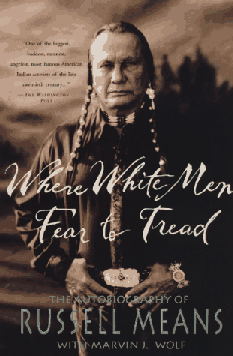
Where White Men Fear to Tread

H-Net Discussion Networks--Readings on Powwows (2 replies)Russell Means broadly comments on just about everything, including powwows. See _Where White Men Fear to Tread: The Autobiography of Russell Means_, with Marvin J. Wolf (St. Martin's Griffin, 1995), 69, 538. Means sees (or at least in one moment saw) powwows as "mockeries of our culture" and as "the lazy way to be an Indian." Naturally, many people disagree with this assessment.I think Means has a point, but it's ridiculous to blame the decline of Native cultures on powwows. One, a lot of forces were at work against tribes during the 20th century. Two, tribes have revived since the 1970s with new laws protecting sovereignty as well as Indian gaming. And yet powwows continue unabated. So the powwow/decline correlation no longer exists, if it ever did.
November 10, 2013

Wandering Bear in Curb Your Enthusiasm

For those unfamiliar with the HBO TV series Curb Your Enthusiasm, here's a description:

Curb Your EnthusiasmThe plots and subplots of the episodes are established in an outline written by David and the dialogue is largely improvised by the actors (a technique known as retroscripting). As with Seinfeld, the subject matter in Curb Your Enthusiasm often involves the minutiae of daily life, and plots often revolve around Larry David's many faux pas and his problems with certain social conventions and expectations, as well as his annoyance with other people's behavior. The character has a hard time letting such annoyances go unexpressed, which often leads him into awkward situations.Wandering Bear, an episode that first aired February 29, 2004, had a Native theme. I watched it a few years ago. Here are a couple of synopses:

Curb Your Enthusiasm: Wandering BearLarry (Larry David) and Jeff (Jeff Garlin) order a tape of "College Girls Gone Wild," and have it sent to Larry's office, so as to avoid embarrassment. Cheryl (Cheryl Hines) tells Larry about the poison oak in their backyard, and Larry decides to call Wandering Bear (Native American actor/activist Russell Means), who did some work for the Jeff and Susie (Susie Essman), for which he was never paid in full. Cheryl also complains that Larry hasn't had sex with her for a long time. She's no longer taking birth control, so Larry has to use a condom. Jeff comes to his rescue with some "Everlast" condoms, which promise that the user is "never gonna stop." Larry explains that he would prefer a condom called "Get it Over With." "How long do you think I wanna do that for?" he asks Jeff. "It gets boring." Larry somehow uses the condom incorrectly, which causes a surprising malady for Cheryl.Wandering BearWandering Bear is the eighth episode of Curb Your Enthusiasm Season 4. It is the thirty-eighth episode overall.

Description

Larry calls Native American plant expert Wandering Bear to get rid of the poison oak in their backyard. Cheryl stops taking her birth control so Larry needs to use condoms. As a result Larry doesn't want to have sex, but Jeff Greene gives him some condoms which have a numbing ingredient to make him last longer. Larry puts the condom on inside out and completely numbs Cheryl's vagina. Wandering Bear ends up discovering this and remedies Cheryl's problem.


Comment:  Overall, Wandering Bear's treatment of Natives was decent. Not perfect, but better than average.

True, the character's "Wandering Bear" name was phony. What, no first name such as Russell? And the drum that sounded whenever he shared his Native lore was blatantly stereotypical.

Other than that, though, he was a modern-day Indian. He spoke, dressed, and acted like a normal person. He was a landscape gardener in Beverly Hills, a job and location where you never see Indians.

His ability to produce an herbal remedy and calm a growling dog were sketchy. But they could stem from his outdoors work as a naturalist. The show veered close to implying he was a mystical medicine man, but didn't cross the line.

My grade for the show's Native bits: B or B+.

June 07, 2013

Tatanka Means in Tiger Eyes

Tatanka Means Rises to Next Level With 'Tiger Eyes'

By Valerie TalimanThe film, based on the 1981 bestseller, centers on 17-year-old Davey (played by Gossip Girl’s Willa Holland) who is coping with the violent death of her father while helping her depressed mother raise her younger brother. Struggling with grief, they move to New Mexico, where Davey meets Wolf while exploring canyons.

In his glowing review of the film, Peter Travers of Rolling Stone magazine describes Means as the “gamechanger.”

Travers writes: “Everything is being thrown at Davey at once, a new life, a new school, a new friend in Jane, a burgeoning alcoholic played wonderfully by Elise Eberle. The gamechanger for Davey is meeting Martin (Tatanka Means), a Native American known as Wolf. He calls her Tiger. And their romantic connection is handled with rare delicacy by both actors. Wolf is also dealing with sorrow, his father Willie is battling cancer in a local hospital. That Willie is played by Russell Means, the noted political activist and Tatanka's real-life father, brings their scenes together a touching gravity. That Russell Means died shortly after filming is beyond reckoning.”

Tiger Eyes was directed by Judy Blume’s son, Lawrence, 49, who co-wrote the script with his mother. They spent 23 days shooting on location near Los Alamos, New Mexico, where Judy Blume once lived.

When asked how they selected Means for the role of Wolf, Lawrence Blume said, “Our casting director said she knew of a young actor who might be great for the part. We brought him in for an audition and were just blown away. Judy and I looked at each other as soon as he finished reading and said 'That’s Wolf!'"
Sounds good, but not everyone agrees:

Tiger Eyes

By Jessica ShawLet me preface this slam by apologizing to both my 9-year-old self who loved the coming-of-age novel on which this wreck was based, and to Judy Blume, the high priestess of pubescent Jersey girls who authored said teen masterpiece. As at least half the women you know could tell you, Tiger Eyes tells the story of Davey (Arrow’s Willa Holland, making the best of it), who moves to New Mexico with her basket case of a mother (Felicity’s Amy Jo Johnson) after her father is murdered and falls for a nature boy named Wolf (Tatanka Means, lacking one iota of chemistry with his costar). Sadly, this adaptation by first time director Lawrence Blume (yes, Judy's son, in case you were wondering how he landed such a plum gig) is laughably, amateurishly, and Hallmark-Movie-Channel bad. I lost count of how many times poor Holland was forced to do her best pensive-stare-into-the-New-Mexico-yonder. Making matters worse, some of the more daring storylines from when the novel was published back in 1981 (a high school girl getting drunk at school!) come off like a cheesy afterschool special. Best to forget the movie version exists and keep your happy childhood memories intact. C–Comment:  For more on the subject, see Tatanka Means in Banshee and From More than Frybread to Tiger Eyes.

May 09, 2013

2013 NAMMY nominations

Nelly Furtado, Tony Duncan, Rickey Medlocke, Radmilla Cody to Boost NAMA 2013On Friday, May 10, when the Native American Music Awards are handed out in some 35 categories, the cast of leading Native musicians will be joined on stage by pop star Nelly Furtado and Chinese singer Ayi Jihu, who was described by the BBC as "China's Madonna."

Rickey Medlocke, founder of Blackfoot and current guitarist for Lynyrd Skynyrd, and Grammy Award–winner Joanne Shenandoah will induct the late Russell Means into the Native American Music Awards Hall of Fame. Though primarily known as an actor and activist, Means released two discs that married his words to diverse styles of music. Means described the material on Electric Warrior (1993) and The Radical (1995) as "rap-ajo."

Acts scheduled to perform include Big River Cree, Buddy Big Mountain, Edmund Bull, Indian Elvis, Fawn Wood, CC Murdock, Jana, Joseph FireCrow, and Blackfoot. Grammy nominee Radmilla Cody, who is nominated for three NAMA awards, will sing solo, and also perform with Artist of the Year nominee Tony Duncan and his group Estun-Bah.

Furtado, who brought the hoop dancing skills of Tony Duncan to international prominence with her "Big Hoops" video, will receive the Living Legend Award. Duncan has become a regular presence on stage with Furtado, dancing to "Big Hoops" at high-profile performances that include MTV’s Video Music Awards, the Billboard Music Awards, The Tonight Show. Ayi Jihu will join fashion designer Angela DeMontigny and musician Terri-Lynn Williams-Davidson in presenting an award.
Comment:  For more on the NAMMYs, see Russell Means Honored for "Rap-ajo" and Edwards and Secola in NAMA Hall of Fame.

Below:  "Nelly Furtado with Tony Duncan in 2012. The two-time Grammy winner holds Duncan's 'Earth Warrior,' nominated for the NAMA Record of the Year."

April 24, 2013

Russell Means honored for "rap-ajo"

The Late Russell Means to be Inducted into the Native American Music Awards Hall of FameAs a musician, Russell Means released two national recordings, the 16 track Electric Warrior, on Warrior Records in 1993, and The Radical, released on the American Indian Music Company, Inc., in 1995. He described his music as a Tribal Experience that included all genres of music; Classical, Country & Western Rock-n-Roll, Hard Rock, Hip-Hop, R&B, Jazz and the Blues. He called his own music and words, Rap-ajo because he said, “It's my version of Rap.”

The 14th Annual Native American Music Awards will be inducting the late American Indian activist, actor, and musician, Russell Means, into the Native American Music Awards Hall of Fame on May 10 at the Seneca Niagara Hotel & Casino in Niagara Falls, New York.

The New York Times described him as, "the charismatic Oglala Sioux who helped revive the warrior image of the American Indian in the 1970s with protests that called attention to the nation's history of injustices against its indigenous peoples". The LA Times called him, "the most famous American Indian since Sitting Bull and Crazy Horse." Means is remembered as an "Oglala Lakota patriot and freedom fighter" by his family.

An inspirational visionary, Russell Means, passed away in October of 2012 at his ranch in Porcupine, South Dakota at the age of 72.
Comment:  For more on Russell Means, see Russell Means Was a Fighter and Russell Means's Funeral.

Below:  "Russell Means with Senator Ted Kennedy."

February 27, 2013

40th anniversary of Wounded Knee II

Gunfire, Chants Mark Wounded Knee Anniversary

By Kristi EatonA Pine Ridge Indian Reservation resident who found herself in the middle of the 1973 Wounded Knee occupation said Wednesday amid ceremonial gunfire and chants that little has changed since the fatal standoff.

Faith White Dress was on the Pine Ridge Indian Reservation 40 years ago when about 200 members of the American Indian Movement and their supporters huddled in houses, some with guns, to protest alleged corruption within the tribal government. Two Native Americans were killed, an activist went missing and a federal agent was wounded.

White Dress and others gathered Wednesday to remember the fatal 71-day standoff. During gunfire to mark the anniversary of the start of the occupation, she said the Oglala Sioux Tribe is still struggling.

"Unemployment is so high and the oppression is still so bad," she said. "I don't think it's going to take violence. It's going to take a gathering to determine how to bring jobs here. We need libraries. We need more of our children to have a better future."

Hundreds of people walked from nearby villages to the site of the occupation, drumming and chanting. Once at the site, the same place where in 1890 soldiers slaughtered an estimated 300 Native American men, women and children, AIM and their supporters continued to drum and chant and fire off gunshots into the air.

This year's events include memorials for AIM's charismatic leader, Russell Means, who died in October at age 72 after batting throat cancer. This is the first anniversary of the occupation since Means' death.

About 200 people gathered at a high school on Pine Ridge for the second of four planned ceremonies to honor Means. Friends, family and colleagues recalled Means as a man who taught his people how to stand up for themselves.

"He was articulate ... a proud Lakota," said Oglala Sioux president Bryan Brewer. "Today he is a version of our modern day Crazy Horse."
Ceremonial Walk Commemorates Wounded Knee Anniversary

By Derek OlsonForty years ago, the American Indian Movement took over the village of Wounded Knee. Protesters spoke out against what they called a corrupt tribal government and discriminatory federal practices. On Wednesday, a number of events marked the anniversary including a walk to the spot where it all took place.
Shortly after 9 a.m. on Wednesday, a group of people gathered in the village of Porcupine on the Pine Ridge Indian Reservation.

"Today, we are here to commemorate the activities that occurred in 1973," AIM supporter Edgar Bear Runner said.

It's one of four groups walking to Wounded Knee. For those in Porcupine, it's an eight mile journey in a wind making it feel much colder than 30.

"Despite the cold temperatures, we walk in their honor and in their memory," Bear Runner said.
Pride and heartbreak in anniversary of occupation

Why Wounded Knee II matters

AIM–Wounded Knee II, 40 years later

By Chase Iron EyesSo, AIM is not a legacy; AIM is living. AIM is because of the Native Youth Council, NYC was because of Treaty Councils, Treaty Councils were because of Warrior Societies, Warrior Societies were because of great men like Sitting Bull and Tecumseh and the Peacemaker, great men were because of great women. Since contact our spiritual movement has taken many pan-Indigenous forms and will never die. When we come together we literally shake the world. Tribal Colleges are because of AIM, Language revitalization is because of AIM, Indigenous Education is because of AIM, Ceremony is out in the open because of AIM, Native Youth Movement, HonorEarth, IEN, LRI, Owe Aku, IdleNoMore, and all the grassroots movements we rely on are because AIM fired warning shots to the world that Indigenous peoples are on the rise. All of our movements are constantly evolving into other forces.

It is clear to me that Indigenous peoples should take their place in leading and working with all of humanity. Race is of course a human construct as we are surely all indigenous meaning coming from the universe with spiritual covenants to the land and each other. We are in a state of emergency right now with the Keystone XL pipeline, the petro-backed banking system bound to collapse, drinking water being wasted and poisoned for the benefit of the greedy carbon economy. uranium mining in our territories, sacred sites facing destruction and so on. This I believe to be our role as Indigenous peoples: to share our beautiful world with that of the purported colonizer. They came here to feed an insatiable greed for riches and self but I think they were sent to learn how to respect sacred sites, the land, the water, other humans, other world views, other beings, to learn what true civilization looks like. So let’s honor today and make the most of every day. We are all seeking a spiritual revolution.
Comment:  For more on AIM, see Russell Means Was a Fighter and AIM Leads March for Traversie.

February 25, 2013

Racism at the 2013 Oscars

5 Racist Things at the 2013 Oscars

By Andrea Quijada and Malkia Cyril1. 9 Year old black actress of Beasts of Southern Wild, youngest nominee ever, called a cunt by the Onion.

2. There Was No Band to Drown Out Seth MacFarlane's Racist Comments

Come on! Some people had Jaws theme music attack them just because they were saying a long-winded thank you! Yet not even one lonely flute interrupted Seth. Over and over again we were abandoned by a symphony of musical bystanders who forced us to listen to comments like:

"[Django Unchained] is the story of a man fighting to get back his woman, who's been subjected to unthinkable violence. Or as Chris Brown and Rihanna call it, a date movie."

"If you bumped into Don Cheadle in the studio lot, would you try and free him?" (on Daniel Day Lewis and his method acting)

"We’ve reached that point where Javier Bardem, Salma Hayek, or Penelope Cruz takes the stage and we have no idea what they’re saying but we don’t care because they’re so attractive."

“Denzel has a great sense of humor. He did all those Nutty Professor movies.” (on Denzel Washington/Eddie Murphy)

3. White Directors Win Oscars for Movies About Race, but Don't Use Their Platform to Address Racism

Yay! There’s a private club for white men who make movies about people of color (or star as them, too). It’s called the Academy Awards. Between the awards won for the movies Lincoln, Argo, and Zero Dark Thirty, the white directors of these films about African American slavery, Iran, and the U.S. led-war on terror failed to grasp that the white supremacy that was so useful in creating their winning dramatic storylines is the very same white supremacy that stuffed the Academy ballot box to begin with. Why can't these directors be more like Marlon Brando?

4. Invisible in Memoriam: The People of Color the Academy's Memorial Missed

In case you watched the Memoriam, you might not be aware that people of color live, work, and die in Hollywood, too. Here are some people we wanted to say goodbye to:

Guadalupe "Lupe" Ontiveros (September 17, 1942 – July 26, 2012) was an American film and television actress. Ontiveros acted in numerous films like Selena and television shows. She was nominated for an Emmy Award for her work on Desperate Housewives.

Russell Charles Means (November 10, 1939 – October 22, 2012) was an Oglala Sioux activist for the rights of Native American people and libertarian political activist. Means was best known for his roles in films such as The Last of Mohicans; Natural Born Killers; and Pocahontas.

Sherman Alexander Hemsley (February 1, 1938 – July 24, 2012) was an American actor, who starred in several movies and television shows. He is best known for his role as George Jefferson on the CBS television series All in the Family and The Jeffersons, and as Deacon Ernest Frye on the NBC series Amen.

Donna Summer (December 31, 1948 – May 17, 2012) was an American singer and songwriter who gained prominence during the disco era of the late 1970s. She won the Best Original Song Academy Award for "Last Dance."

5. They Didn't Tell Us the Oscar is Mexican!
Oscar Snubs Provide Fruitful Lesson

The awards show's failure to memorialize more black stars reminds us why Black History Month is vital.

By Nsenga K. Burton
During February, there has been a lot of discussion about whether Black History Month is still relevant or needed, particularly because of the "racial progress" that blacks have made over the last few decades. In the Huffington Post, Trudy Bourgeois writes that "Black History Month Needs to Go" for a variety of reasons, including the fact that there isn't a "White History Month," and black history should be incorporated into classrooms and event programming throughout the year.

Bourgeois' comments demonstrate a profound lapse in judgment by failing to recognize how white privilege and power operate in this country, like the ability to eliminate ethnic-studies courses even in states where white students are the minority, and by promoting the far-fetched idea that those in power would believe it's their responsibility to incorporate Black History Month programming year-round. Call me crazy, but if black folks waited for nonblacks to take care of our needs, which actually benefit all of society (civil rights, black history), we'd still be in shackles and having separate and unequal access to pretty much everything.

One need only look at the 2013 Academy Awards to understand why Black History Month is needed, along with a concerted effort by all Americans to ensure that black history is included in course curricula, event programming and major publications throughout the year. At the Oscars, while there is a lot of uncertainty about who will go home with a golden statue, one thing is certain every year: the "In Memoriam" section of the show, which highlights actors who have passed away in the previous year. Each year, like clockwork, the producers of the Oscars know it is coming, and they fail to remember important black actors who not only have had commercial and critical success but also have made great contributions to the acting community.
And:The academy didn't just forget black folks; it also forgot Latina actress Lupe Ontiveros, who starred in numerous films, including Selena (1997) and As Good as It Gets (1997). Native American actor-activist Russell Means starred in films like The Last of the Mohicans (1992) and Natural Born Killers (1994) and was the voice of Powhatan in Walt Disney's Pocahontas (1995). Ontiveros and Means starred in major Hollywood films--some Academy Award-winning--yet they were forgotten.Comment:  Natives were wondering if the Oscars would acknowledge Russell Means. The answer was no. Once again there were no Indians in view at the Oscars.

I don't know if Helmsley and Summer belonged there. They were well-known but not as movie people. But Ontiveros and Means arguably belonged.

For more on the problems with this year's Oscar ceremony, see Sexism at the 2013 Oscars. For more on the Oscars, see Blackface at the Oscars and No Indians at the 2011 Oscars.

October 25, 2012

Russell Means was a fighter

After Russell Means's death, many people reminisced about his life. The following postings typify what they said:

Russell Means: By No Means a Perfect Man, Yet He was Our Strong Voice

By Levi RickertThough he walked on early Monday morning from complications of cancer, the tenacious spirit he possessed will live on in many modern warriors who still have a lot of work to do to make this country a better place for American Indians.

Make no mistake about it, Means was a confrontational American Indian warrior. He was one who did not like to back down. Sometimes in leadership, circumstances dictate action. Such was the case when the American Indian Movement arrived at the Bureau of Indian Affairs building in Washington with the Trail of Broken Treaties caravan with a twenty-point position paper. Having been promised a meeting with BIA officials, they felt double-crossed when there would be no meeting. Late in the afternoon, Means and Dennis Banks decided to "occupy" the building when they were told the police were on the way to remove the American Indian Movement members. The confrontational occupation drew national attention to living conditions of American Indians and broken treaties.

The fight inside of Means became his calling card. The tenacity Means possessed led the Washington Post to call him the "…biggest, baddest, meanest, angriest, most famous American Indian activist of the late 20th century."

This same tenacity allowed him to fight cancer vigorously after he was first diagnosed in July 2011. Perhaps, a person with lesser will would have given up earlier, as do many people. Even while living with a life-threatening illness, Means realized there is still much work that needs to be done to improve American Indians lives - even with the advent of casinos and other tribal enterprises. There are still way too many American Indians suffering in the United States. Russell Means understood this to the end of his life on this earth.

This sheer fight he had on the inside is what made Means great and perhaps will become his lasting legacy.
Indian Country Reacts to Russell Means’ PassingMichael Mann, director of “Last of the Mohicans”

The Wall Street Journal did an interview with Mann and asked him: What were your thoughts when you found out he had passed away?

“Well, I knew it was coming about a week ago. Because there had been an email exchange with his wife. He wanted to get back and die at Pine Ridge…First of all he was way too young. 72 is young. Way too young to pass away,” Mann told the Journal. “He’s an iconic person. He’s lived through so much…What this guy stood for, the courage he had, and who they took on, in the 60, 70s and 80s—[American Indian activist Leonard] Peltier is still in prison. It’s a struggle that’s 400 years old. And Russell was fighting that battle every day of his life.”

Robert Chanate, a member of the Kiowa Nation

Says Means “led from the front and took the same risks as anyone else. Whether that meant going to jail, standing vigil in uncomfortable weather or carrying out tasks while exhausted, Russell Means wasn’t one to skip out on us. Many times we’d complete a rally and Russell would jump in his van to travel to a different state so he could fulfill another request for his support.”

Glenn Morris, of the American Indian Movement of Colorado

“In recognition of one of the primary, visionary leaders in beginning the contemporary work of international indigenous peoples’ liberation, of which we are all beneficiaries. Without Russell, it is doubtful that many of us who do this work would have had the honor of continuing to defend our peoples in this way. Indigenous leaders, ranging from Rigoberta Menchu Tum, to Subcomandante Marcos to Evo Morales, have said that their work was inspired and motivated by the words, actions and example of Russell Means. May we all remember the historic contributions of Russell Means to the freedom and self-determination of all indigenous peoples, everywhere.”
Russell Means, Lightning and Sexiness: The Toughest Indian in the Whole Wide World

By Gyasi Ross regardless of questions about his approach, he was a warrior that worked diligently and passionately for the betterment of Native people. He loved Native people profoundly. He knew that we deserved better, but we had to demand better.

I see Russell Means as the Indigenous equivalent of Malcolm X. See, the truth is that Native people needed (and still need) the fiery doppelganger of thoughtful, mainstream organizations like National Congress of American Indians in the same way that Martin Luther King, Jr. needed Malcolm X and Stokely Carmichael. Whereas National Congress of American Indians speaks politely and eloquently, using big words and paperwork to demand that the United States give Native people our just due, Russell Means was the person with the chip on his shoulder that would simply smack those dirty thieves in the mouth and take as much of that “just due” as he could. The truth is that these approaches need each other—they are not at odds. Neither approach is perfect, but both approaches are needed for Native peoples’ success and survival.

Symbiotic. Both necessary. Complementary.

Russell Means was loud. And eloquent. And flawed. And dangerous. And sexy. He made the image of a huge Native male being politically active something acceptable, even ideal. He wasn’t a bookworm that people could easily ignore—he spoke loudly, and powerfully—so much confidence in himself that those that were threatened by him just wished that they’d hear some bad news about him someday so they could stop hearing about him. “Y’know that Russell Means was in a plane crash…” Never happened; heck, he even whooped cancer for a long time. Sexy. Long hair, leather jackets, brown skin—he was the image of a Native person that all of us have, whether it’s politically correct to say so or not. Men wanted to be him, women wanted to be with him—the Indigenous James Bond. At a time of lagging self-esteem for Indigenous people, where we were taught to believe, after 500 years of ugly genocide, forced assimilation and conquest, that everything “Native” was ugly, dirty, evil, stupid, he made “looking Indian” cool again.

He made being Native sexy. Imperfect, but a start to reclaiming our collective sense of self-worth.

Every single Native person on this continent owes him a debt of gratitude. Thank you Russell Means—the toughest Indian in the world.
Comment:  For more on Russell Means, see Means Has Cancer Again and Means Releases New Book Online.

Russell Means's funeral

Family of Russell Means sing on horseback in 12-hour memorial for the American Indian activist and star of Last of the MohicansIn the company of more than 1,000 mourners chanting and singing for their fallen Native American hero, a riderless horse escorted the remains of Russell Means to his first of four memorials on Wednesday.

Carried to a 12-hour service at South Dakota's Little Wound High School, the smell of burning sage, sweetgrass and cedar wafted through the air as a spiritual cleansing and healing, honouring the 72-year-old chief.
And:Invitations to his memorial written by family described him as an 'Oglala Lakota patriot and freedom fighter.'

'Prayers were offered outside with a drum and honor songs, then he was escorted in with his wife, Pearl and all his children and grandchildren,' Mean's sister-in-law Natalie Hand told Indian Country Today. 'The ceremony will go on into the night. After that, his family and close relatives among the Oglalas will be carrying his ashes up to the Black Hills and scattering his ashes at Yellow Thunder Camp.'


Russell Means Farewell: Son Cradles His Father on Final JourneyThis moving image from yesterday’s honoring ceremony for Russell Means shows one of his sons, Tatanka Means, carrying his father’s urn into the Little Wound High School in Kyle, South Dakota on the Pine Ridge Indian Reservation.

The 12-hour service was attended by more than 1,000 family members, friends and supporters. The ceremony was led by Sundance Chief Leonard Crow Dog, who was with Means when he walked on. He said Means’ soul would travel over four days to the spirit realm, known in Lakota tradition as Happy Hunting Grounds.
Comment:  For more on Russell Means, see Russell Means Was a Fighter and Russell Means Dies.

Below:  "Tatanka Means, a son of Russell Means, carries the urn with Means' ashes into Little Wound High School in Kyle, South Dakota on October 24." (Aaron Rosenblatt/Rapid City Journal)

October 22, 2012

Russell Means dies

Russell Means, Indian activist, actor, dies at 72

Means died early Monday at his ranch in in Porcupine, S.D., Oglala Sioux Tribe spokeswoman Donna Solomon said.Russell Means, a former American Indian Movement activist who helped lead the 1973 uprising at Wounded Knee, reveled in stirring up attention and appeared in several Hollywood films, has died. He was 72.

Means died early Monday at his ranch in in Porcupine, S.D., Oglala Sioux Tribe spokeswoman Donna Solomon said.

Means, a Wanblee native who grew up in the San Francisco area, announced in August 2011 that he had developed inoperable throat cancer. He told The Associated Press he was forgoing mainstream medical treatments in favor of traditional American Indian remedies and alternative treatments away from his home on the Pine Ridge Indian Reservation.

Means was an early leader of AIM and led its armed occupation of the South Dakota town of Wounded Knee, a 71-day siege that included several gunbattles with federal officers. He was often embroiled in controversy, partly because of AIM's alleged involvement in the 1975 slaying of Annie Mae Aquash. But Means was also known for his role in the movie “The Last of the Mohicans” and had run unsuccessfully for the Libertarian nomination for president in 1988.
Russell Means, Who Clashed With Law as He Fought for Indians, Is Dead at 72

By Robert D. McFaddenStrapping, and ruggedly handsome in buckskins, with a scarred face, piercing dark eyes and raven braids that dangled to the waist, Mr. Means was, by his own account, a magnet for trouble — addicted to drugs and alcohol in his early years and later arrested repeatedly in violent clashes with rivals and the law. He was tried for abetting a murder, shot several times, stabbed once and imprisoned for a year for rioting.

He styled himself a throwback to ancestors who resisted the westward expansion of the American frontier. With theatrical protests that brought national attention to poverty and discrimination suffered by his people, he became arguably the nation’s best-known Indian since Sitting Bull and Crazy Horse.

But critics, including many Indians, called him a tireless self-promoter who capitalized on his angry-rebel notoriety by running quixotic races for the presidency and the governorship of New Mexico, by acting in dozens of movies — notably in a principal role in “The Last of the Mohicans” (1992) — and by writing and recording music commercially with Indian warrior and heritage themes.

He rose to national attention as a leader of the American Indian Movement in 1970 by directing a band of Indian protesters who seized the Mayflower II ship replica at Plymouth, Mass., on Thanksgiving Day. The boisterous confrontation between Indians and costumed “Pilgrims” attracted network television coverage and made Mr. Means an overnight hero to dissident Indians and sympathetic whites.

Later, he orchestrated an Indian prayer vigil atop the federal monument of sculptured presidential heads at Mount Rushmore, S.D., to dramatize Lakota claims to Black Hills land. In 1972, he organized cross-country caravans converging on Washington to protest a century of broken treaties, and led an occupation of the Bureau of Indian Affairs. He also attacked the “Chief Wahoo” mascot of the Cleveland Indians baseball team, a toothy Indian caricature that he called racist and demeaning. It is still used.

And in a 1973 protest covered by the national news media for months, he led hundreds of Indians and white sympathizers in an occupation of Wounded Knee, S.D., site of the 1890 massacre of some 350 Lakota men, women and children in the last major conflict of the American Indian wars. The protesters demanded strict federal adherence to old Indian treaties, and an end to what they called corrupt tribal governments.
Comment:  For more on Russell Means, see Means Has Cancer Again and Means Releases New Book Online.

October 11, 2012

Means has cancer again

American Indian Movement Veteran Russell Means Fights Cancer Again

By Levi RickertThe past two years have been a struggle for Russell Means, Lakota, as he has vigorously fought cancer.

On Monday the family of Russell Means released an email revealing that the American Indian Movement veteran is again fighting cancer. While sent by his family, the content of the email was written by Means, in the first-person. Here is the text of the email:

Hau Mi Takuyeyapi, hello my relatives.

I know many are concerned about my health and I want to thank you for your strong prayers and for all the ceremonies taking place on my behalf.

On August 20, I learned I have new cancer spots. I am in Scottsdale, AZ where I have fantastic medical teams utilizing both alternative and western applications. We are working toward a good solid program that will enable me to come home to my ranch on the Pine Ridge Sioux Indian Reservation within the next few weeks.

I am sorry I am not available for comments as I need all of my energy to fight for my life once again. I love you and look forward to regaining my life.

May the Great Mystery continue to guide and protect the paths of you and your loved ones.


As indicated in the message, Means does not disclose the location of the cancer in his body. In July 2011, he was diagnosed with esophagus cancer and elected not have surgery which would have required removal of a major portion of his tongue. He depended on alternative medicine, including American Indian ceremonial remedies.
Native Sun News: Activist Russell Means battling cancer again

Comment:  For more on Russell Means, see Means Releases New Book Online and Oglala Sioux Tribe Honors Means.

Below:  "Longtime activist and actor Russell Means, Oglala Lakota, speaks at the Dakota Conference on the campus of Augustana College in Sioux Falls April 27." (Stew Magnuson)

July 28, 2012

Means releases new book online

Russell Means Releases New Book Online Russell Means has released his latest book, "If You've Forgotten the Names of the Clouds, You've Lost Your Way: An Introduction to American Indian Thought and Philosophy," online.

Means, who was one of the leaders of the American Indian Movement during the Wounded Knee siege in 1973, released "Where White Men Fear to Tread: The Autobiography of Russell Means" in 1995.

His latest endeavor was co-written by Bayard Johnson. "If You've Forgotten the Names of the Clouds, You've Lost Your Way" takes the reader on a journey into the intriguing and little understood belief system and world view shared by many American Indians and other indigenous people around the world.

The American Indian way of living has almost nothing in common with the patriarchal philosophies and religions of Europe and Asia, and this book helps explain the violent clash of cultures that continues to erupt between indigenous and industrial societies whenever they come into contact anywhere in the world.
Comment:  For more on Russell Means, see Oglala Sioux Tribe Honors Means and Means at Wounded Knee Conference.

June 27, 2012

Oglala Sioux Tribe honors Means

Oglala Sioux Tribe honors Russell MeansThe Oglala Sioux Tribe in South Dakota is honoring former American Indian Movement leader Russell Means.

Means is a member of the tribe and gained national fame in the 1970s for his political activism related to the American Indian Movement. He helped lead the 71-day uprising at Wounded Knee in 1973. Means has gone on to become an actor in films such as “The Last of the Mohicans” and “Pocahontas.”

Oglala Sioux President John Yellow Bird Steele declared June 26, 2012, as “Russell Means Day” to honor Means’ “accomplishments, dedication and patriotism” to the tribe.

The signed proclamation was given to Means at the conclusion of a walk on Tuesday that commemorated the many people killed on the reservation during the 1970s.
Comment:  Steven Lewis Simpson, the Scottish director of Rez Bomb, was traveling with us in South Dakota. He's close to Means and mentioned this honoring ceremony.

He said it was significant that Steele, who ran against Means for the tribal chairmanship, was participating. It's an example of two old enemies coming together, even if for political reasons.

Anyway, Simpson regretted that he couldn't attend the ceremony because he was with us. He thought he might catch a bit of hell from Means because of it.

For more on Russell Means, see Means at Wounded Knee Conference and Means Says He's Cancer-Free.

Below:  Means before he lost weight due to cancer.

April 28, 2012

Means at Wounded Knee conference

Old divisions flare as AIM leaders reunite

Wounded Knee siege of 1973 still raw topic

By Peter HarrimanOld hatred dies hard.

Many of the archetypal survivors of the 1973 Wounded Knee occupation met again Friday at Augustana College’s Center for Western Studies for the 44th annual Dakota Conference.

They were joined by a second generation in Denise Maloney, daughter of slain Indian activist Anna Mae Aquash. Maloney addressed the gathering via Skype. Also there was John Trimbach, son of FBI agent Joseph Trimbach. John’s book, “American Indian Mafia,” denigrates the American Indian Movement’s key leaders, including Russell Means, Dennis Banks and Clyde Bellecourt.

The three AIM icons attended conference sessions throughout the day. Means gave the keynote address Friday evening.
And:Trimbach called the AIM leaders “liars, thieves and killers.” He said much of Means’ book, “Where White Men Fear to Tread,” was “hot air,” but added, “I believe Russell when he said he and Dennis Banks could make people disappear.”

Like Banks, Means did not joust with Trimbach. Indeed, he was out of the room during much of the attack Trimbach directed at him. But Means had his own criticism of the conference and offered his own view of what the Wounded Knee occupation and AIM accomplished.

He called the conference “a South Dakota academics’ mutual masturbation society. It’s exactly the way South Dakota wants Indian history to be interpreted.”

Means said the international attention drawn to the lengthy Wounded Knee occupation was the spark that “brought about the international political sophistication of Indian people.

“I went up and down this hemisphere looking for that spark. I thought I found it in Nicaragua, but I was wrong. I thought I found it in the Northwest Territories, but I was wrong,” he said.

Then he said he looked to his own Oglala Lakota tribe at Pine Ridge.

Trimbach said academic history is complicit in perpetuating an incorrect view of AIM, “the most falsified movement in American history.” Means criticized a lack of a definitive academic history of AIM. He said it was a foundation of the effort of tribes in the 20th century to assert sovereignty.

“If you want to be sovereign, you have to act sovereign,” he said.
Native Sun News: Conference opens wounds of Wounded Knee

By Karin EagleAn incident more representative of the mixed bag of emotions the conference stirred up occurred during a discussion Means participated in that led to questions posed by Stew Magnuson, author of “The Death of Raymond Yellow Thunder: And Other True Stories from the Nebraska-Pine Ridge Border Towns,” which highlights the racial tension found around the reservations in South Dakota.

Magnuson, who participated in the conference as a keynote speaker during the first night’s dinner presentation, questioned Means about Ray Robinson, a black civil rights activist who traveled to Wounded Knee in 1973.

Robinson has never been heard from or located since.

Means responded by standing and addressing Magnuson: “I’m going to tell you this–no charges from 1974 to 2002. Did anyone hear of Ray Robinson? Did anyone ever shoot him, stab him, beat him or disappear him?”

“It was a generation later that the badmouthing of Wounded Knee continues,” Means said. “You and people like you are to perpetuate this erroneous image you have of who we are. And I’m sick and tired of you bringing up these false accusations based on what? Nothing!’”

Means further expressed his anger that AIM has been repeatedly associated with Robinson’s disappearance.
Means: Sovereignty benefits U.S.

By Peter HarrimanIn a rambling 90-minute address Friday evening that wove personal history with highlights of the American Indian Movement, famed AIM leader and activist Russell Means on reiterated themes he advanced earlier in the day at Augustana College’s annual Dakota Conference, which focused on the 1973 Wounded Knee occupation.

In a keynote address in a packed Reconciliation Chapel, Means said AIM and its occupation of Wounded Knee in 1973 ignited a spark of Indian sovereignty.

He also maintained that will work to the benefit of the U.S. in general.

Means said when he led a delegation of traditional tribal people to Washington, D.C., and created the Republic of Lacotah in 2007, claiming he was severing tribal ties with U.S. treaties and restoring traditional tribal governments, he was carrying out his greatest personal legacy from Wounded Knee.

“I hope young people latch on to this. I know someone will. Some student 20 or 30 years from now,” will see the significance of the sovereignty initiative in that, Means said.

“Continually allowing of your government to violate the Constitution of the United States of America on a daily basis with us has caught up with you, hasn’t it?” Means said of government failings in living up to tribal treaty obligations.

“Your representatives don’t care. Your Supreme Court is political, not judicial. Your president is a quasi-king.

“You’re the new Indians,” he said, throwing his arms wide. “Welcome aboard.”
Comment:  Judging by the article, Means isn't clear on how Indian sovereignty will benefit Americans. I guess he's saying it provides an alternate model that isn't a corrupt failure.

But many tribes use a standard chairperson/council/court system of checks and balances, just like the US. And many tribal governments are supposedly corrupt or at least unresponsive to the people.

I wonder which tribal governments does Means consider the ideal? Other than his own nonexistent Republic of Lakotah, that is.

For more on the subject, see Wounded Knee II's Positive Effects and Controversy in Wounded Knee.

March 21, 2012

Means says he's cancer-free

Native Sun News: Russell Means goes back to his 'normal' lifeRussell Means says he is still cancer-free and will forever be unaffected by the dread disease.

Means, who is Oglala Lakota, was diagnosed last summer with what was then referred to as “terminal” esophageal cancer. In December, the actor and former American Indian Movement activist claimed victory over his affliction partially by way of “Indian prayer and Indian medicine.”

“The cancer’s gone–I don’t have to worry about that,” Means said from his wife Pearl’s familial home in Santa Fe.

“I beat it, it’s gone,” he said firmly.
Comment:  For more on Russell Means, see Means Cured of Cancer? and Means Receives Lifetime Achievement Award.

December 15, 2011

Means cured of cancer?

Native Sun News:  Russell Means claims victory over cancer

By Jesse AbernathyIn a remarkable turn of events, actor and American Indian activist Russell Means says he has defeated throat cancer.

This reversal of fortune is nothing short of a miracle. Means was diagnosed this summer with what was then essentially referred to as incurable, or inoperable, esophageal cancer. His physician gave him mere days to live at the time, he said. “The prognosis was grim,” Means told Tom Lawrence of the Mitchell Daily.

In a Dec. 8 telephone interview from his seasonal home in Scottsdale, Means spoke in a clear, robust voice--a stark contrast to his last Native Sun News interview in August, when his tones were made fragile and husky by the disease.

“I won the battle, man--I’m cancer-free,” he declared victoriously. “The doctor told me the day before yesterday that ‘Mr. Means, you will not die of cancer’.”

The triumph in Means’ voice was unmistakable.

Means, an enrolled member of the Oglala Sioux Tribe, partially attributes his amazing recovery to the outpouring of support--in the form of supplication--from all of the multifaceted corners of the globe.

“I beat it with prayer--prayer from all over the world from all the different disciplines,” he said.

“And Indian prayer,” Means added. “Indian prayer and Indian medicine,” he said, in referencing his primary spiritual and cultural connection to his Lakota brethren.
Comment:  For more on Russell Means, see Means Receives Lifetime Achievement Award and Means Is "Riddle Wrapped in Enigma."

November 14, 2011

Means receives lifetime achievement award

Russell Means Receives Red Nation Film Lifetime Achievement AwardRussell Means received the "Oyate Wayanka Po Win Lifetime Achievement Award" at the 8th Annual Red Nation Film Festival gala last Monday in Los Angeles, California.

Means, who was diagnosed with terminal cancer of his esophagus in July, attended the gala event with his wife, Pearl.

Since July Means has undergone extensive tomotherapy, an intensity modulated radiation treatment, at the Sunridge Medical Wellness Center in Scottsdale, Arizona. In addition, Means has participated in several traditional Indigenous ceremonies provided by Oglala and Navajo medicine men.

Means gained international fame as one of the most prominent American Indian Movement leaders during the 1970s. Since then, he has worked for American Indian rights and human rights throughout Indian Country and in other spots around the world.

In the early 1990s, Means became a Hollywood actor. Since 1992, he has appeared in "The Last of the Mohicans," "Pathfinder," "Natural Born Killers," "Windrunner: A Spirited Journey," "Thomas and the Magic Railroad." His served as the voice of Chief Powhatan in "Pocahontas" in the hit 1995 Disney movie.
Comment:  For more on Russell Means, see Means Is "Riddle Wrapped in Enigma" and Means's Tumor Has Shrunk.

Below:  Russell and Pearl Means.

October 10, 2011

Means is "riddle wrapped in enigma"

Notes from Indian Country:  The enigma of AIM leader Russell Means

By Tim Giago (Nanwica Kciji)In 1976 while the United States was celebrating its 200th birthday, Means looked at the Mount Rushmore National Memorial through the eyes of an oppressed people and labeled it “The Shrine of Hypocrisy.” He added, “And I intend to blow out the candles on America’s birthday cake.”

Along with Dennis Banks and Vernon and Clyde Bellecourt, Means co-founded the American Indian Movement. They began their adventures by tailing the police cars in Minneapolis armed with cameras and watching for any sign of the outrageous actions that police department was inflicting upon Native Americans. The Movement soon caught the eye of Native Americans everywhere and AIM became the point-man for the feelings of us all.

But somewhere along the way the Movement turned to violence beginning with its November 1972 takeover of the Bureau of Indian Affairs building in Washington, D. C. where irreplaceable and valuable records vital to the lives of so many Native Americans were trashed and destroyed.

Several more acts of violence ensued over the coming years including the takeover, trashing and murders that took place inside of the occupied buildings at Wounded Knee. I, along with many other Native Americans lost heart and faith in AIM after that, but I still held a deep admiration for Russell Means through it all because I believe his intentions were genuine, but somehow his followers just got out of hand. AIM really had no credentials for membership and it attracted a wild assortment of members seeking thrills more than social justice along with those who sincerely believed in its goals. It also attracted several FBI informants which eventually led to the murder of Anna Mae Pictou Aquash near Wanblee, South Dakota on the Pine Ridge Reservation when the AIM leadership suspected her of being such an informant.

Like the enigma he was, Means often went from the practical to the ridiculous, but he always held the courage of his convictions. He sincerely believed that it was his goal in life to crush the bureaucracy that covertly impoverished and attempted to annihilate the cultures of his people.
Comment:  For more on Russell Means, see Means's Tumor Has Shrunk and Banks Visits Ailing Means.

September 23, 2011

Means's tumor has shrunk

Russell Means Updates His Condition:  Tumor Diminished Significantly

By Levi RickertIn July, legendary American Indian Member leader, Russell Means, Lakota, was diagnosed with esophagus cancer and elected not have surgery which would have required removal of a major portion of his tongue.

Means is currently undergoing extensive tomotherapy, an intensity modulated radiation treatment, at the Sunridge Medical Wellness Center in Scottsdale, Arizona.
And in a letter from Means himself:I just received good news, the tumor in my throat has diminished significantly. I have my voice back and my ability to swallow is back up to around 90 percent (coming from about zero, for a while only water could get through).

So please continue those prayers and keep that love coming my way because in the end you are all part of the Great Mystery.
Evidence that Means is thinking ahead:

John Trudell, Russell Means Join Maidu at Indigenous Peoples Days

By Tsi Akim Maidu TribeIn a rare public appearance, long time Native American political activists John Trudell and Russell Means will join local Tsi Akim Maidu tribal members and native leaders at the 12th annual Indigenous Peoples Days. They and Q'ero healers from Peru, Maori of New Zealand, and Hopi of Arizona will gather with native and non native people to focus on 'healing soul wounds', learn about local native history, and honor native language and culture through ceremony, discussion circles, traditional music and dance.

The four day event takes place Friday, October 7 through Monday, October 10 at a variety of venues in the Grass Valley-Nevada City area. Public events Saturday through Monday will be at Sycamore Ranch Park, midway between Grass Valley and Marysville. All events except the John Trudell concert are free and open to the public.
Comment:  For more on Russell Means, see Banks Visits Ailing Means and Russell Means Has Terminal Cancer.