Showing posts with label Batman. Show all posts

January 25, 2015

Spirit of the Beast in Batman

A posting about a 1991 Batman comics notes its Native subject matter.

2015 31 Days of Comics–First Comic You Ever Bought

By Brian CroninLuckily, as I noted, I had been reading comics for years at this point, so I was not thrown, because otherwise, beginning with part 3 of a three-parter involving Batman teaming up with an 130-year-old Native American Shaman to stop the man’s grandson from killing people as part of a ritual that involved retrieving ancient Native American relics probably wouldn’t be the place to start reading Batman comic books.Comment:  I haven't read this storyline. But based on the page below, it's a mess.

The grandson is wearing a kachina-style mask. That would place him in one of the Pueblo tribes of the Southwest. But they'd consider it sacrilegious to wear a mask for anything but a sacred ceremony.

The grandfather invokes "Manitou" as the grandson tries to kill him with a tomahawk. Both cultural references come from the Eastern Woodlands--the opposite side of the country from the Southwest.

The other Indians are wearing bandanas, which was typical of the traditional Navajo and Apache. These tribes live near the pueblos but aren't Pueblo tribes themselves. And the don't wear bandanas anymore.

For that matter, Indians don't use tomahawks anymore unless they're reenacting their culture in a show. So everything about the story seems flawed. It includes stereotypes from at least three cultures, none of which match.


The three-parter

ComicVine.com gives a synopsis of the whole story:Batman #462--Spirit of the Beast, Part 1: To Live and Die in California

Batman found one of Bruce Wayne's friends dying of an axe wound. He followed a lead to San Francisco. He was on the scene when another was attacked, but he couldn't stop it. Native Americans were taking back artifacts that the white man had taken from them.

Batman #463--Spirit of the Beast, Part 2: Ghost

Batman followed another lead into Death Valley. He stopped the Indians from killing one of their own, an elderly blind man. The old man told Batman what was going on. They went after the rogue Indian preparing for a ritual.

Batman #464--Spirit of the Beast, Part 3: Sacrifice

Batman and the old man stopped the ritual and saved the hostages. Batman left him there to die (he was over 130 years old) and went home (taking the man's dog).
If the tribe lives in Death Valley, all the cultural references are wrong. Death Valley tribes don't have kachinas, don't invoke Manitou, and don't wear bandanas.

The plot is the oldest cliché in the book. Someone did something bad to the Indians, so a shaman or demon or ghost vows revenge and returns to kill people.

I don't know if there was anything supernatural in this three-parter. Typically the "bad" Indians pretend to be spirits but turn out to be thugs.

I gather the grandfather inspired his grandson to kidnap people and perform deadly rituals. Then the grandfather turned against the cause and was thrown out.

The deadly-ritual part is standard fare, even though it's badly stereotypical. No Indians are performing any rites except the benign ones they've performed for centuries.

Having the grandfather turn against his followers is a slight twist, but probably not enough to justify the story. These stories usually pit a "good" Indian against a "bad" one who's the black sheep of the family.

Bottom line: Unless your story offers some incredible take on the tired "revenge from the past" plot, you probably should avoid it. I doubt Batman #462-464 is an exception to this rule.

November 21, 2014

Chief Standing Pat in Batman

With the Batman series finally being released on DVD, it's a good opportunity to look back at one stereotypical two-parter. Here's how it starts:

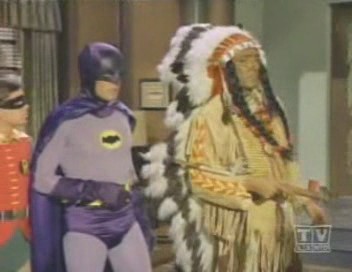
The Great Escape/The Great Train RobberyThat conniving cowboy of crime, Shame, breaks jail with the trusty aide of his fiancee, Calamity Jan, and her mom, Frontier Fanny, in a Sherman tank. At Police Headquarters, The Batman and Robin gets a message from Shame announcing his plans to steal a rock and roll from The Gotham City Stage. While The Caped Crusader and The Boy Wonder race back to The Batcave to consult The Batcomputer, Shame hides out at Gotham City Central Park Stables, where he is introduced to the members of his new posse: Standing Pat, a giant indian who converses in signals issued by his cigar; and Fernado Ricardo Enrique Dominquez (Fred for short), a Mexican with a British accent.Comment:  A Plains Indian in traditional clothing with a phony name played by a non-Native actor...that was par for the course in the 1960s.

True, some dramas, including Westerns such as Bonanza, had begun to address the problems. Even comedies such as The Munsters were giving Indians a slightly modern edge.

Other than including an Indian at all, there doesn't seem to be much to recommend Batman's treatment of Indians. Other shows were just as bad.

September 07, 2014

Racist superhero comics in Cracked

The title of this piece isn't quite accurate. It should be something like "Dozens of Shockingly Racist Scenes in 5 Famous Superhero Series."

Many of the scenes are from the World War II era, when Americans were fighting the Germans and Japanese, so the racism is somewhat understandable. A few are from the ignorant but well-meaning 1960s and 1970s. In a couple of cases I don't agree with the author--such as the X-Men's use of racial slurs to argue against racism.

Racist and stereotypical depictions of Indians make more than their fair share of appearances. Let's take a look:

5 Shockingly Racist Scenes in Famous Superhero Comics

By Seanbaby#5. The Justice League

It's unusual for an elite group of whites to be racist, but the Justice League had some problems with it. For starters, even their space aliens were Aryan. When Hanna Barbera adapted them into a cartoon in the '70s, animators had to invent four ethnic members just so they wouldn't burn through their supply of "flesh" paint in the first season. If you're not familiar, the racial heroes added to the Super Friends were:

1. A Native American named Apache Chief who wasn't either of those things.
Bruce Wayne became a bat to strike fear into the hearts of Gotham criminals, but in China, bats are often considered good luck. So Batman may have decided to murder a few hundred of their people to clear up any confusion. And speaking of confusion, here's the kind of interaction Batman has with Native Americans:There were people on the Justice League with racism that didn't even make sense. Green Lantern is a space policeman. Most of his coworkers and friends are jellyfish or cosmic squirrels, and yet he had no idea what to do when he met a real-life Earth Eskimo.Yes, Hal Jordan had an Eskimo sidekick he called "PIEFACE." And that nickname fucking stuck. Thomas Kalmaku walked around for decades answering to PIEFACE. It was such a bizarrely offensive character that when Filmation created a Green Lantern cartoon in the '60s, they replaced him with a blue (probably) alien boy named Kai Ro. Hal wasn't as aggressively racist towards him, but their relationship was far from appropriate.

Superman handled most racial situations perfectly. He made it through WWII and Korea without calling anyone names and he didn't even ask to touch Black Lois' hair. If he had one cultural kryptonite, it was that he wasn't great with Indians.
In a story called "Superman, Indian Chief!", Superman was called in to settle a property dispute in Metropolis. An evil mogul discovered, through distant Native American ancestry, that he owned all the city's land. He instantly began extorting the citizens of Metropolis and proudly bragged about it right to Superman's face. It was almost suicidally evil, and here's how Superman handled it:Superman had any number of option--everything from diplomacy to super hypnosis to super ventriloquism to punching the evil dick into the sun. He went with: running back in time to screw the Indians out of their land 300 years ago. He didn't even have to think about it. He was already jogging through the 1800s before the guy was done with his threat. Say what you want about Aquaman and Wonder Woman shrieking "Jap!" for the better part of a decade; Superman wove his racism into the very fabric of his universe's chronosphere.

#4. The X-Men

Like the Justice League, most of the X-Men's cultural diversity came in one explosion of poorly thought out ethnic characters. For example, James Proudstar. He's a Native American with the power of being pretty tough and tracking. Almost as if a racist thought, "What super powers would be handy if you had to, like, be an Indian all day?" And sure enough, when we meet him, he's having a wrestling match with a buffalo. A wrestling match with a buffalo.


Actually, the original Thunderbird was John Proudstar. His brother James became Thunderbird after John died.

And yes, a buffalo on the Apache reservation is fairly ridiculous. It's theoretically possible but extremely unlikely.#1. The Marvel Family


Comment:  Seanbaby criticizes other portrayals in the Marvel Family comics, but not the Native portrayals. The Native examples are sidelights, and they're self-explanatory.

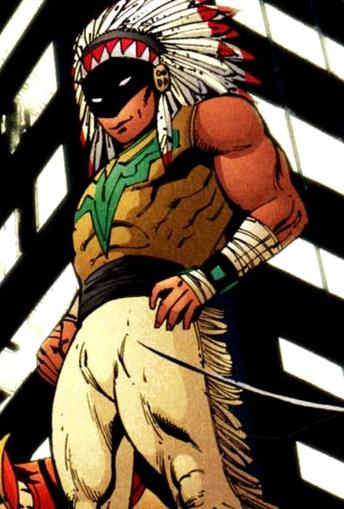
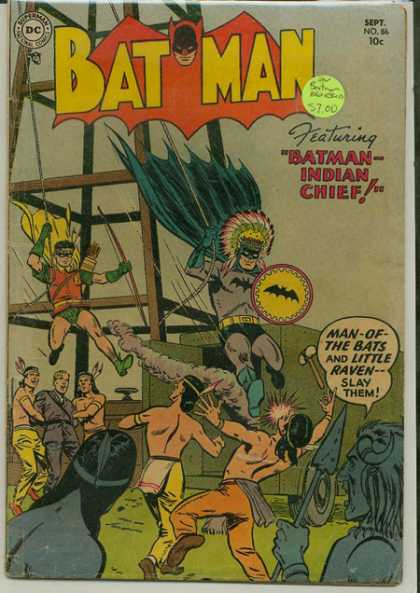
Unfortunately, it's still not uncommon to see Native characters wearing headdresses and buckskins, or half-naked, or both. Yes, even in the 2010s. For instance, Grant Morrison re-introduced Chief Man-of-Bats, the Native Batman, a few years ago. (Man-of-Bats may have debuted in the Batman story pictured above.)

February 26, 2012

Cannibals in ALL-STAR WESTERN #6

Comic Book Review: ‘All-Star Western’ #6

By Scott West‘All-Star Western’ #5 left bounty hunter Jonah Hex and his unlikely partner, Doctor Amadeus Arkham, trapped in a cave beneath Gotham City. Hounded by a cannibalistic tribe of natives and facing monstrous subterranean creatures, all will be lost if the pair can’t find their way back to the surface.

As the issue opens, Hex is facing off against the enormous prehistoric bat that attacked at the finale of last issue. The vicious killer makes short work of the flying rodent. His victory earns him the respect of the cannibal tribe and the natives lead Hex and Arkham back to an opening to the surface.
Confirming that the "natives" are Indians:

ALL-STAR WESTERN #6Jonah Hex fights a giant bat to the death! But even with his winged foe slain, will he and Amadeus Arkham survive being trapped in a cave with the lost tribe of Miagani Indians?Comment:  How many stereotypes can we find in these brief descriptions?

1) A lost tribe of cannibal Indians. Not in Central America but (presumably) in the New York area where Gotham City is located.

2) Living underground because they're creatures of darkness and mystery. Like, well, bats. Unlike people, I guess the "Miagani" don't need the surface with its food and sunshine.

3) Probably fearing and worshiping the giant bat. You know, the way natives supposedly worshiped King Kong, volcanoes, and anything else they didn't understand. Because they're ignorant and superstitious--unlike civilized white men.

4) From the cover, it appears they're half-naked and wearing bat hoods. Because barbaric cannibals wouldn't think of climbing out of their holes and joining the world of 2012 with its cars and computers. No, they're happier living in perpetual blackness and eating people.

Sheesh. How come it's never a sophisticated Indian with technology and a PhD who discovers a primitive race of Caucasians? Oh, yeah...because that would contradict our dominant American narrative and make white people uncomfortable. Never mind.

For more on the subject, see BATMAN INC. #7's Cover and Anthro in RETURN OF BRUCE WAYNE #1.

July 03, 2011

BATMAN INC. #7's cover

The reviews of BATMAN INC. #7 have been glowing. The only obvious problem is the cover. Stereotypical much? How many Natives have you seen riding a buffalo?


Someone on Facebook questioned this position:None, I agree on the stereotypical part, but it's a story. I like the artwork. If stories are to be told including Native peoples should they be portrayed in some other fashion? I think if it's a positive subject and not showing them as brainless savages, I think it's not bad.We're talking only about the cover at the moment. Not the interior story.

A "chief" riding a buffalo is close enough to a brainless savage. How else to tell the story on the cover? Put them all on horses or motorcycles. Show the Batmobile racing against a pickup truck. Or do something other than the "riding" motif. But don't make the Indian look like a primitive beast-master.I do see your point. Why does he have to wear a feather bonnet? Why can't he wear black leather instead of buckskin. Regardless, I'm still curious to see how the writer makes these characters out to be.The headdress is a legacy from the character's origin in the 1950s. But yes, they could've changed it.

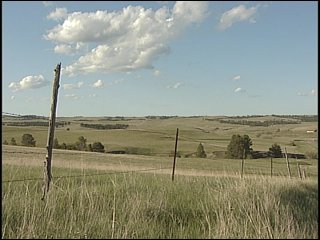
Note also the barren desert background with the fantastic rock formations. This is typical of the land in northern Arizona and southern Utah. In contrast, the South Dakota landscape consists of rolling, grassy plains.


The message is clear. Indians live in remote, barren places because they live remote, barren lives. They're "out there" somewhere, choosing to live in isolation. They're not part of the American mainstream.

That's what most people believe, anyway--even though 70% of Indians live in urban places. Our mythology tells us that Indians are wild in every way: wearing wild costumes, communing with wild creatures, and living in wild places. They're wild, primitive, and savage.

For more on Grant Morrison's comics, see Indian in RETURN OF BRUCE WAYNE #4 and Chief Man-of-the-Bats.

July 02, 2011

Reviews of BATMAN INC. #7

The BATMAN INC. comic book is showcasing "Batmen" from around the world. Issue #7 features Chief Man-of-Bats and his sidekick Raven, a Lakota dynamic duo.

Wednesday Comics Review:  Batman Incorporated #7 And FF #5

By Rich JohnstonIn Batman, we meet the Sioux Indian chief and Batman Inc operative, Man-Of-Bats, working as a hospital doctor and running a shoddy-in-comparison Batman operation. His dilapidated operation in comparison to Bruce Wayne’s Gotham is demonstrated time after time in quite comic fashion, a shoddy pick up truck painted black with a Bat logo painted on the side, and a Bat Cave that’s not only not hidden, but a log cabin with a big sign outside, with tour offers for $15. “Batman On A Budget.”Batman Incorporated #7 Review

By Erik NorrisThe only crime committed with this issue of Batman, Inc. is that it doesn't set up more adventures for Man-of-Bats and his son, Raven. Grant Morrison's handling of these two characters in this issue has quickly placed them as my two favorites in this extended Incorporated cast.

Up until this point, Morrison has only shown us a sliver of what these characters are like when operating away from Batman's large, looming shadow. And while Batman does obviously show face here in issue #7, it's the parts before his arrival which are truly special. In some ways, South Dakota is almost worst off than Gotham. Instead of gimmicky villains causing terrorism, South Dakota is plagued by extreme poverty. It's a facet of this issue that Morrison plays up in order to show the humanitarian qualities that Man-of-Bats and Raven show for their community.


Batman Incorporated #7–Review

By Minhquan NguyenMorrison has always made sure each of these Batman candidates has enough grit and chops to deserve the distinction, and Man of Bats is no different. This is a man who says, without irony, “I’ll put the first five of you in full body casts for eighteen months. Even wounded.” And by wounded he means gruesomely stabbed in the gut. Good Lord, this guy fought in Iraq and came home to work as a doctor on his reservation—how can you not respect that?

Each of these Batmen represent an aspect of the original: Nightrunner protects the people who revile him; El Gaucho puts fighting for justice over his debonair, billionaire lifestyle; Man of Bats polices his select domain to protect it from itself. Placing that domain on a Native American reservation could’ve opened the story to any number of politically dicey clichés, but Morrison avoids them by giving everyone some measure of depth, even Sam Black Elk, who despite being a dog-kicking, drug-dealing, wannabe gangster lord, offers a surprisingly credible motivation for his gang: they fight “the laws that keep us down.”
BATMAN INCORPORATED #7

By Greg McElhattonPlease, DC, please? A Man-of-Bats mini-series once "Batman Incorporated" is over? Based on this issue alone, I'd be down for it and then some. This is great stuff.Comment:  I haven't read this issue yet, but I saw some pages online. It looks decent--a realistic take on reservation life. In contrast to, say, SCALPED, where the tribal chief is a mobster who kills and scalps people. And where the majority of characters are criminals, thugs, and lowlifes.

For more on the subject, see Indian in RETURN OF BRUCE WAYNE #4 and Chief Man-of-the-Bats.

September 15, 2010

Minorities in First Wave universe

I recently reread BATMAN/DOC SAVAGE SPECIAL #1 and FIRST WAVE #1, the first two books of DC's First Wave universe. Based on this rereading, I can talk about the new universe with more authority.

  • In the First Wave preview ad, Rima the Jungle Girl is described as "Native South American" and "clearly native." Really? With her white hair and Caucasian features, she doesn't look clearly Native to me. In fact, she looks like every white man's fantasy of a "Native woman": someone who's Hollywood beautiful, sexy, and dressed in revealing clothes. And remote and exotic enough to make her even more tempting than the typical white-bread starlet.

  • In an interview, writer Brian Azzarello says First Wave's Black Canary will be a person of color. The preview ad implies she'll be an Asian Indian.

  • First Wave's Blackhawks feature a new generation of hotshot pilots. They include Henry Biggs (African American), Ant Manson (Australian aborigine), Wu Cheng (Chinese), and Jenny Cloud (great-granddaughter of Johnny Cloud, Native World War II flying ace).

    These characters actually appear in the last panel of FIRST WAVE #1. Alas...in the preview ad, Jenny Cloud is holding a hawk, which seems stereotypical.

  • The preview ad describes Doc Savage as "mixed race" to explain his bronze skin. What's he a mix of: the dark-skinned Caucasians living around the Mediterranean? Unless the comics identify and explore his ethnic roots (African? Asian?), this is pure tokenism.

    Timeframe

  • The comics have an Art Deco/noir look and feel, which I think is meant to obscure their timeframe. Despite this, the stories are set in the present day (or close to it). The key indicator is the technology on view: cellphones, color TVs, and cassette-tape players. These scenes wouldn't have been possible before the 1990s or thereabouts.

    The only counter-clue comes when a reporter asks Doc Savage, "Your latest breakthrough--you really believe space flight is doable?" But it's not clear what this refers to. To any manned space flight (which began in 1961 in our reality)? Or to something more ambitious like sustained space flight to Mars and beyond?

  • The clincher is Jenny Cloud. She can't be the great-granddaughter of a WW II fighter unless the comics are set in the present or near past. Or unless she pulled an "X-Men" and traveled from a possible future to the WW II era.

  • Therefore, Micah Wright's comment:That's not Batman of today's Batman, it's Azzarello's version of 1939 Batman hanging out with 1939 Doc Savage, 1939 Crimson Avenger, and the 1939 Spirit (or whatever year) point being this series takes place in THAT era, NOT in current day.is sadly off the mark. This is an alternate version of 2010 or thereabouts, minus most of the computer technology, not 1939. It's Azzarello's version of the old Batman in a new setting.

    Implications

  • Azzarello obviously felt the need to update Black Canary and the Blackhawks with ethnic roots. Since this is basically an Elseworlds situation, he could've done the same with Batman and the supporting characters. Make First Wave's world as multicultural as it really is in 2010 (not 1939, again).

  • No doubt licensing issues prevent DC from tampering with Doc Savage or the Spirit. But Azzarello might've done what Howard Chaykin did with the Shadow in 1986: downplayed the old supporting cast in favor of a new supporting cast. It wouldn't hurt Doc Savage to have a few assistants who aren't Anglo-Saxon men.

  • Since the timeframe is the present rather than 1939, the half-naked Amazon Indians with bones through their noses are more stereotypical than I thought. Were these Indians dressing up for tourists before meeting with Avatar's James Cameron or using Google Earth to fight rapacious corporations? News flash: Most Amazon Indians are not headhunting savages from an old movie serial these days.

    To give you an example people are familiar with, look at today's cop shows. Most have a substantial number of minority characters: as law enforcement personnel and as criminals. Why? Because the field of cops and robbers is pretty well integrated these days. If an era of Irish policemen chasing Italian gangsters ever existed, it ended 50 or 75 years ago.

    Micah Wright says DC is striving for a "League of Extraordinary Gentlemen" milieu, where the best pulp heroes come together in new/old stories. Problem with that is that it exalts pulp's white-dominated racial politics along with its white-dominated architecture, fashion, and slang. Going back to a pseudo-1939, even if it's really 2010, is like going back to the Jim Crow South. Unless you deconstruct the era's race, gender, and class issues, you're basically touting the white status quo. That wasn't good in 1939 and it isn't any better in 2010.

    Conclusion

    To be fair, Azzarello is trying to make First Wave more multicultural. But he could've done much more than he did in the first two issues. Having read Chris Claremont's X-MEN and Roy Thomas's ALL-STAR SQUADRON, I'm not particularly impressed with the results.

    Sure, the comics that focus on Black Canary, Rima, and the Blackhawks may be better. But it seems the big (white male) three--Batman, Doc Savage, and the Spirit--will predominate. Since the first two issues were mediocre at best, I won't be around to see if the series improves.

    For more on the subject, see Cameron's and Weaver's Anti-Dam Films and Comic Books Featuring Indians.

  • August 07, 2010

    Indian in RETURN OF BRUCE WAYNE #4

    Batman has been tripping through time in THE RETURN OF BRUCE WAYNE mini-series. I was wondering if he'd encounter any Indians. Answer: Yes, in issue #4.

    Batman: The Return of Bruce WayneBatman: The Return of Bruce Wayne is a 6-issue American comic book limited series published by DC Comics beginning in May 2010, written by Grant Morrison and featuring a team of rotating artists starting with Chris Sprouse and Frazer Irving.

    The series picks up from Batman and Robin #12. The series will detail the journey Bruce Wayne takes through the timestream of the DC Universe after being deposited in the distant past by Darkseid in Final Crisis. Wayne will have to overcome amnesia and "history itself" in order to make his way back to present-day Gotham City and retake his rightful place as Batman. The series will run for six issues, each covering a different time period. The time periods will be that of prehistory, the witch hunts, pirates at sea, the wild west, the noir era, and present day Gotham.
    The premise of #4:By the late 19th century, a group of Gotham criminals had incurred the ire of caped mystery horseman. So they hired the deadliest gunman in the Americas to defend them: the man known as Jonah Hex.Batman: The Return of Bruce Wayne #4--ReviewThe Story:  As he bounces through time, Bruce Wayne ends up in the Old West where he tangles with a familiar face.

    What’s Good:  It was kinda cool to see a Batman-Lone Ranger mash-up.

    What’s Not So Good:  What is the deal with the Native American guy? I found myself scratching my head a LOT while reading this issue and really didn’t enjoy the experience at all.

    I also don’t understand why Jonah Hex needed to be in this issue. The movie already tanked! Since Morrison was completely neglecting the main story, why not do something cool and have Bruce and Jonah play a bit of cat-n-mouse in some old canyon? That would have been a lot more fun. And I thought Gotham was an east coast town? This whole thing is written as if it took place in 1870s Arizona.
    Blogger Greg Burgas adds:The Indian's switch from "bad" guy to "good" guy makes no sense, but he's a minor character so I don't worry about it too much.

    I'm also not sure why Jonah Hex needs to be in this issue. He doesn't seem terribly necessary. I guess if a DC comic takes place in the Old West, even in an eastern city like Gotham, Hex needs to make an appearance!
    Comment:  Does RETURN OF BRUCE WAYNE #4 really take place in the Old West? Jonah Hex is a post-Civil War figure. If the story was set in, say, 1870, would Gotham City look like a Western town with a lot of single-story wooden buildings? Wouldn't it look more like the Chicago or New York of 1870, with a lot of brick and mortar buildings and nascent skyscrapers?

    I think of the Old West as being pre-Civil War. I guess you could call the post-Civil War era the Wild West, though it grew progressively less wild. More to the point, A Wild West story has to take place in the West. Gotham City is an Atlantic seaport located in New Jersey or thereabouts. There's no such thing as the Wild East.

    Since I'm not spending $4.00 for a single comic book, I glanced at this issue in the comic-book shop. The young Indian man appears on 4-5 pages. He has his long hair tied behind his head and is dressed like a respectable citizen in silk shirt and pants. Kudos for not making him look stereotypical, at least.

    White man's history

    In this series, we see how the myth-making process works. What historical representatives does writer Grant Morrison have Bruce Wayne meet and become? Cavemen, Pilgrims, pirates, cowboys and Indians, and gangsters and G-Men. If you were to look at comic strips or Halloween costumes of America's past, these would be five of the leading subjects. (Never mind that America didn't have any cavemen.)

    To many people, this is a fair approximation of what American history is about. Morrison could've had Bruce Wayne interact with farmers, abolitionists, labor unions, suffragettes, or civil rights leaders. He could've had Bruce Wayne fight in the War of 1812, the Mexican War, or the Spanish-American War.

    But that wouldn't have sent the right message about America. Instead, Morrison focused on some of our mythical heroes. These people embody our romantic vision of America, Morrison is saying, and Batman belongs among them.

    In this context, it's unsurprising that an Indian appeared as a minor figure. It's even unsurprising that his role was morally ambiguous. This is kind of how we view Indians: as minor players in the white man's American history.

    For more on the subject, see How America Became Cowboy Country and Movies Convey "America's Master Narrative." For more on Natives and comics books, see Comic Books Featuring Indians.

    March 23, 2010

    Indians in FIRST WAVE #1

    Bought the first issue of FIRST WAVE, the new DC Comics series that features pulp heroes in a shared universe. The players include Doc Savage, the Spirit, Batman...and Rima the Jungle Girl.

    The story included three pages of Amazon Indians, with some European bad guys interrogating a captive chief. Rima appeared on the last of these pages as a spectator in a canoe.

    I can't say there was anything terribly wrong with these scenes. The Indians looked a little scary--hooded eyes and bones through noses--but nothing too stereotypical.

    Of course, the meta-message doesn't look promising. Indians as lackeys of white men. No Indians with individual personalities. Rima the "white Indian" as the only jungle dweller who matters.

    And why stop there? FIRST WAVE #1 has no female or minority characters who matter. Just the usual roundup of white Anglo-Saxon Protestants. No doubt the original pulp stories were white-male fantasies, but does an Obama-era comic have to emulate them?

    Since these are new versions of the characters with no connection to the old versions, why couldn't DC update their heritage? Batman could be Latino, the Spirit could be Asian, and Doc Savage's team could include women and blacks. And Rima could be a genuine black-haired Native. Not only wouldn't this harm the storytelling, but it would make it more interesting.

    Anyway, Rags Morales's artwork was nice, but Brian Azzarello's script was only average. At $3.99 a shot, I plan to skip this series, and you should too.

    For more on the subject, see Comic Books Featuring Indians.

    March 01, 2010

    Chief Man-of-the-Bats

    In Chief Man-of-the-Bats: Year One, blogger J. Caleb Mozzocco writes about Chief Man-of-the-Bats, the Native American Batman.

    A bit of background on this character:

    Chief Man-of-BatsAlong with his sidekick, Raven Red, he is a Native American member of the Batmen of All Nations.Chief Man-of-BatsReal Name: Chief Great Eagle
    Aliases: Man-of-the-Bats
    Occupation: Crimefighter
    Marital Status: Unknown
    Known Relatives: Red Raven (Little Eagle; son)
    Group Affiliation: formerly Club of Heroes
    Hair: Black
    First Appearance: Batman #86 (September 1954)


    Comment:  I've seen the comical cover before, but I don't know if I ever read a reprint of BATMAN #86. But Mozzocco describes what happens.

    It seems Batman and Robin are flying over middle America in their Batplane when they spot someone on horseback. They follow him to a cave where they discover...Chief Man-of-Bats and Little Raven!

    "Villainous Black Elk and his raiders have been terrorizing the countryside," says Man-of-Bats. He's referring not to the Lakota holy man but to a typical Indian savage. Black Elk wounded Man-of-Bats so Man-of-Bats can't appear in public without revealing his secret identity. Batman takes his place and thwarts the evildoers while preserving Man-of-Bats identity.

    Let's skip over the predictable stereotypes: chiefs, teepees, half-naked warriors, buckskins, feathers, bows and arrows, horses, etc. The story is set in freakin' 1954. How ignorant do you have to be think 1) the stereotypes are valid and 2) they apply to Eisenhower-era Indians?

    Really, not a single Indian has learned about shirts and jeans, pistols and rifles, or cars and trucks since the end of the Indian Wars 65 years earlier?! And I suppose blacks still wear grass skirts and bones in their noses when they're not happy-go-lucky slaves? Can you say "racist"?

    Chief Man-of-the-Bats returns

    In 2007, Grant Morrison updated the Batmen of All Nations in BATMAN #667-669. I haven't read that either, but Mozzocco provides some details. Chief Man-of-the-Bats has a modified chief's outfit that's somewhat better but still stereotypical. His skin is a bold shade of read, which is flatly wrong. He denies he's a hero and acts more like a vicious vigilante. And he gets drunk often enough that his sidekick thinks it's a problem.

    Thanks for the update, Morrison. Instead of being a one-dimensional stereotype, Chief Man-of-the-Bats is now a two-dimensional stereotype. In another 50 years, maybe he'll become a real person with more than a silly name and costume.

    For more on the subject, see Comic Books Featuring Indians.