Showing posts with label Superman. Show all posts

October 17, 2014

Jor-El's lucky Superman guess


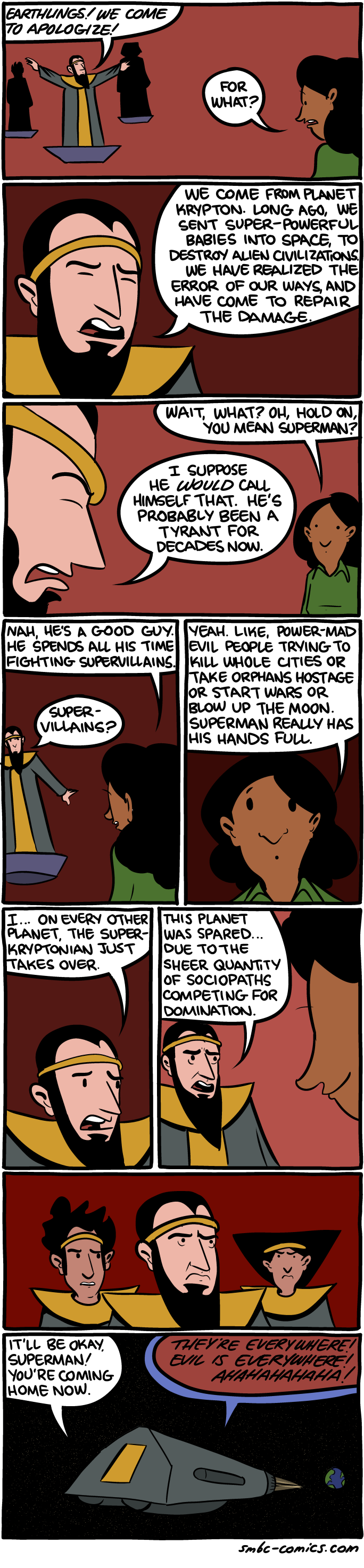
This cartoons raises a good point. Jor-El sent the rocket to Earth and assumed the super-baby would grow up to be a wise and benevolent hero. I.e., that the maxim "absolute power corrupts absolutely" wouldn't apply in this case.

In other words, he gambled the fate of an entire world on his understanding of an alien race's psychology. He wasn't an anthropologist and he studied us only through a telescope, but that was enough info for him.

This seems like history's luckiest guess to me. Jor-El's arrogant assumptions could've gone wrong in so many ways. The cartoons suggests a likely outcome.

The equivalent would be if I watched a documentary on a primitive South Seas tribe, then sent them Christianity or television or credit cards to "help" them. My intent was good, so what could possibly go wrong?

At least Abin Sur could claim his ring probed Hal Jordan's mind and determined he was noble and selfless. Although the whole Parallax storyline calls that into question. But Jor-El didn't have any such mind-reading or future-predicting powers.

For more on Superman, see Racist Superhero Comics in Cracked and Superior Powers Don't Change Society.

September 07, 2014

Racist superhero comics in Cracked

The title of this piece isn't quite accurate. It should be something like "Dozens of Shockingly Racist Scenes in 5 Famous Superhero Series."

Many of the scenes are from the World War II era, when Americans were fighting the Germans and Japanese, so the racism is somewhat understandable. A few are from the ignorant but well-meaning 1960s and 1970s. In a couple of cases I don't agree with the author--such as the X-Men's use of racial slurs to argue against racism.

Racist and stereotypical depictions of Indians make more than their fair share of appearances. Let's take a look:

5 Shockingly Racist Scenes in Famous Superhero Comics

By Seanbaby#5. The Justice League

It's unusual for an elite group of whites to be racist, but the Justice League had some problems with it. For starters, even their space aliens were Aryan. When Hanna Barbera adapted them into a cartoon in the '70s, animators had to invent four ethnic members just so they wouldn't burn through their supply of "flesh" paint in the first season. If you're not familiar, the racial heroes added to the Super Friends were:

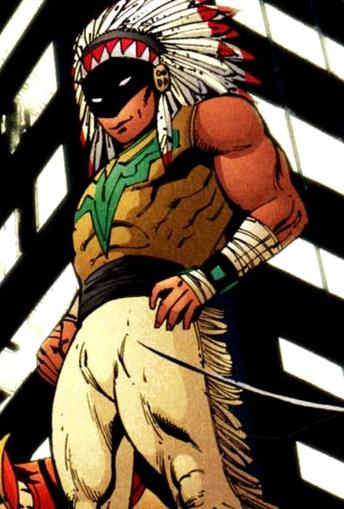
1. A Native American named Apache Chief who wasn't either of those things.
Bruce Wayne became a bat to strike fear into the hearts of Gotham criminals, but in China, bats are often considered good luck. So Batman may have decided to murder a few hundred of their people to clear up any confusion. And speaking of confusion, here's the kind of interaction Batman has with Native Americans:There were people on the Justice League with racism that didn't even make sense. Green Lantern is a space policeman. Most of his coworkers and friends are jellyfish or cosmic squirrels, and yet he had no idea what to do when he met a real-life Earth Eskimo.Yes, Hal Jordan had an Eskimo sidekick he called "PIEFACE." And that nickname fucking stuck. Thomas Kalmaku walked around for decades answering to PIEFACE. It was such a bizarrely offensive character that when Filmation created a Green Lantern cartoon in the '60s, they replaced him with a blue (probably) alien boy named Kai Ro. Hal wasn't as aggressively racist towards him, but their relationship was far from appropriate.

Superman handled most racial situations perfectly. He made it through WWII and Korea without calling anyone names and he didn't even ask to touch Black Lois' hair. If he had one cultural kryptonite, it was that he wasn't great with Indians.
In a story called "Superman, Indian Chief!", Superman was called in to settle a property dispute in Metropolis. An evil mogul discovered, through distant Native American ancestry, that he owned all the city's land. He instantly began extorting the citizens of Metropolis and proudly bragged about it right to Superman's face. It was almost suicidally evil, and here's how Superman handled it:Superman had any number of option--everything from diplomacy to super hypnosis to super ventriloquism to punching the evil dick into the sun. He went with: running back in time to screw the Indians out of their land 300 years ago. He didn't even have to think about it. He was already jogging through the 1800s before the guy was done with his threat. Say what you want about Aquaman and Wonder Woman shrieking "Jap!" for the better part of a decade; Superman wove his racism into the very fabric of his universe's chronosphere.

#4. The X-Men

Like the Justice League, most of the X-Men's cultural diversity came in one explosion of poorly thought out ethnic characters. For example, James Proudstar. He's a Native American with the power of being pretty tough and tracking. Almost as if a racist thought, "What super powers would be handy if you had to, like, be an Indian all day?" And sure enough, when we meet him, he's having a wrestling match with a buffalo. A wrestling match with a buffalo.


Actually, the original Thunderbird was John Proudstar. His brother James became Thunderbird after John died.

And yes, a buffalo on the Apache reservation is fairly ridiculous. It's theoretically possible but extremely unlikely.#1. The Marvel Family


Comment:  Seanbaby criticizes other portrayals in the Marvel Family comics, but not the Native portrayals. The Native examples are sidelights, and they're self-explanatory.

Unfortunately, it's still not uncommon to see Native characters wearing headdresses and buckskins, or half-naked, or both. Yes, even in the 2010s. For instance, Grant Morrison re-introduced Chief Man-of-Bats, the Native Batman, a few years ago. (Man-of-Bats may have debuted in the Batman story pictured above.)

August 29, 2014

Superior powers don't change society

A Facebook discussion began with a bit on Superman. Specifically, in the Peace on Earth graphic novel:

Superman learns there's hunger in the world--duh!--so he decides to end it singlehandedly. He starts delivering food everywhere, but a couple of Third World forces oppose him--because it's to their advantage to keep their people hungry.

Does Superman take out those forces? Or simply avoid those countries while he continues helping people elsewhere? No, he gives up. Because comic books can't handle the idea that god-like beings would change the world in fundamental ways.Weird.He ends up teaching kids one by one how to grow food using his childhood farming skills. Following the old "teach a person to fish" idea. This teaching project is never mentioned again.

It obviously was a half-hearted attempt to deal with the social issues comics normally avoid. There's no good solution to this storytelling problem. Either superheroes transform the world beyond recognition, or comics remain unrealistic fairy tales for kids.It's just weird that they wouldn't go with option #2 and just blame the idea's failings on human vice. To have Superman "give up" and do nothing just seems fundamentally flawed.

But you see the same thing in sci-fi where revolutionary new technologies are invented or discovered and then essentially have no effect on life anywhere.
I think the in-story explanation for Superman's resignation was that "human vice" made the project untenable. I.e., that too many people would undermine his noble efforts for selfish reasons.

Which might be a realistic outcome if he'd fought world hunger for 10-20 years and found he wasn't getting anywhere. But to literally encounter two minor setbacks and give up on saving millions of lives? No.

Federation = paradise?

Speaking of sci-fi and revolutionary technologies:

Yeah, Star Trek's magic food-and-object replicator should've changed the Federation beyond recognition. No farming communities, no Quark's bar, no illegal gun-running, etc. Why bother when you can make your own food, drink, or weapons in the privacy of your home?

Every Federation world that embraces technology should be a paradise. Which probably explains why we don't see much of Earth in Trek stories. No one dares to portray a world without poverty, hunger, or conflict.They did show Earth in a number of episodes and it IS a paradise where people, it would seem, largely do whatever they feel like doing without needing to have occupations or obligations.Outside of Enterprise, the Academy, and time-travel stories, I'd say they didn't show much of Earth. Certainly not in the 23rd and 24th centuries.

Yeah, Earth is supposed to be a paradise. So...can people have an unlimited number of children, or what? What prevents a large number of obligation-free people from engaging in constant sex, drugs, and virtual realities? There's presumably a world government with a president...so what political issues do they fight over during elections?

Where are all the other paradise worlds and empires, since they all have the same technology? How does the ability to replicate an infinite amount of resources affect the Klingons, Romulans, Cardassians, et al.? Why were they fighting over quadrotriticale when the Federation could whip up as much of it as anyone could eat?

None of the shows address any of this. And the same applies to energy (antimatter power generation) and transportation (teleportation). These technologies should cause radical transformations in every known civilization.

Trading without money?

Let's see...there's no money, although characters have talked about saving credits and doubling salaries. No money means no real economy. So how do countries and planets engage in trade? If they need a limited resource such as dilithium, how does it get allocated to interested parties?

Earth's government undertakes huge projects such as building and running Starfleet. Does it still tax people, and what do they pay with? If not, how do resources flow to the government? Do billions of people each donate 10% of their nonexistent money to the government voluntarily, or what?

As I said, no one involved in Trek has even begun to describe how this so-called paradise would work. They can't because it would mean declaring capitalism is bad and unlimited sex and drugs are good. Hence my previous comment: "No one dares to portray a world without poverty, hunger, or conflict."Yes, because that would be [gasp] COMMUNISM!

Which I gather is what The Federation essentially is. If you have 100% renewable energy and replicators that can make anything you need, why do you need an economy OR taxes?
I assume replicators just rearrange molecules. If they can actually change lead into gold--or gold latinum--that's another whole problem. So there should still be scarce resources. Dilithium and other minerals are the usual example.

And that means trade, which is a constant factor in the Trek stories. But trade of what? Is everything done on a barter basis? That's unworkable for any group larger than a few hundred people, but I'd love to see it explained on a planetary scale.

An enterprise such as Starfleet requires millions of people to plan, design, build, and maintain things, even if you can replicate the raw materials. It requires ditch diggers, gardeners, plumbers, electricians, and many other jobs that aren't that popular without money. Who's doing all this dirty work?

Are people literally choosing these careers out of love, with no remuneration other than a pat on the back? Because so many people prefer physical labor to unlimited sex and drugs? And does the number of workers needed magically equal the number of people seeking work? Yeah, right...tell me another fairy tale.

Communism? I don't think communism has ever worked on a large scale. So again, tell me how it functions in the Federation. Show it to me on screen or in a novel and then I'll believe it.

For more on Star Trek, see Colonialism Inspired Science Fiction and Star Trek vs. Star Wars.
January 23, 2014

Superman taught Alexie to read

Superman and Me

By Sherman AlexieI learned to read with a Superman comic book. Simple enough, I suppose. I cannot recall which particular Superman comic book I read, nor can I remember which villain he fought in that issue. I cannot remember the plot, nor the means by which I obtained the comic book. What I can remember is this: I was 3 years old, a Spokane Indian boy living with his family on the Spokane Indian Reservation in eastern Washington state. We were poor by most standards, but one of my parents usually managed to find some minimum-wage job or another, which made us middle-class by reservation standards. I had a brother and three sisters. We lived on a combination of irregular paychecks, hope, fear and government surplus food.And:At the same time I was seeing the world in paragraphs, I also picked up that Superman comic book. Each panel, complete with picture, dialogue and narrative was a three-dimensional paragraph. In one panel, Superman breaks through a door. His suit is red, blue and yellow. The brown door shatters into many pieces. I look at the narrative above the picture. I cannot read the words, but I assume it tells me that "Superman is breaking down the door." Aloud, I pretend to read the words and say, "Superman is breaking down the door." Words, dialogue, also float out of Superman's mouth. Because he is breaking down the door, I assume he says, "I am breaking down the door." Once again, I pretend to read the words and say aloud, "I am breaking down the door" In this way, I learned to read.

August 26, 2013

Superman the Inca emperor

The 15 Worst Batman/Superman Stories Ever Told

By Rob Bricken5) "Superman’s Secret Kingdom!"

When Superman goes missing while searching for a crook in South America, Batman and Robin look for their friend. They are a touch surprised to discover him ruling a primitive Incan tribe after an exploding volcano gave him amnesia (#supermanproblems). The Incans, who had a legend about just this sort of thing, immediately crowned him their king. This in no way explains how the crook has become Superman’s advisor, though, and of course he immediately advises Superman to have the Dynamic Duo killed. Batman and Robin escape and paint a picture of Clark Kent turning into Superman, which is all it takes to restore his memory. (WF #111)
Comment:  It goes without saying that this premise is racist. The existence of a hidden tribe, and its acceptance of a white ruler, serve to "otherize" the Indians.

In reality, Superman and Batman could find descendants of the Inca in the government, the police force, and the rest of Peruvian society. But to comic-book readers, as to most Americans, Indians exist only in remote and primitive tribes untouched by civilization.

For more on primitive South American Indians, see Natural History Museum in Bob's Burgers and Cannibal Indians in Green Inferno.

February 11, 2012

The new Super-Chief

Here's a new comic-book character I learned about from the Jacque La Grange interview:

Saganowahna of WisconsinAt the beginning of Superman #709, a new young Super-Chief is seen thanking Superman for an assist on capturing runaway supervillains in the Colorado desert. Superman refers to him as "Saganowahna," and the young man claims that he gains his powers from a "manitou stone" he wears around his wrist; he claims that some believe the stone to be Kryptonian in origin, though Superman is skeptical of the idea. Evidently, the powers have a set time limit for daily use.

Saganowahna wears a uniform consisting of a red jacket with a yellow symbol on the back, a white shirt, black tights, and red boots. He is a Native American man who wears a mohawk. It is insinuated that Saganowahna is a Wisconsin native, because he invites Superman to visit Green Bay the next time the Metropolis Meteors play against the Green Bay Packers.

This new Super-Chief later accepts membership in Superman's new team, the Supermen of America.


Comment:  This Super-Chief seems less stereotypical than the previous one. But a couple problems:

1) The name "Saganowahna" sounds like it comes from one of the Algonquian languages in the New York area. Of course, one Oneida tribe did move to Wisconsin. And a New Yorker could move to Wisconsin as well, or enroll in a Wisconsin school.

Or the creators could be continuing their mix-and-match stereotyping. You know, the idea that all Indian cultures are the same. That you can take a name from one culture and apply it to someone from another culture.

2) I'm not sure I've ever seen a modern Indian wear a Mohawk. If it's supposed to be a reference to Saganowahna's Iroquois heritage, it doesn't quite work. Again, he's in Wisconsin while the Mohawks and other Haudenosaunee tribes are in upstate New York.

But overall, it looks like an improvement over the angry young military vet in the buffalo headdress. Good!

For more on the subject, see Super-Chief Lives.

June 29, 2010

Superman goes walkabout

A new storyline is about to begin in the SUPERMAN comic book:

Superman to Visit Small-Town America—And You Can Invite Him to Your Town!

Does your town have a story to tell? Superman could be a part of it.

By John R. PlattFor the next 12 months, Superman is going to be criss-crossing America, and if you're lucky, he could be visiting your town.

It's all part of a year-long storyline called "Grounded" that starts later this month in Superman No. 700. As part of the celebration for this anniversary issue, DC Comics will send their famous blue-clad superhero "through the streets, roads, highways, homes, farms, suburbs and inner cities of America."

The goal is to tell stories where Superman isn't fighting super-villains but meeting the real heroes and finding out about the real issues facing towns across the country.
Superman could visit a reservation too. Here's how:Do you think your town has a story to tell? Just send DC Comics an essay (75-1000 words) saying why. But don't delay. The contest opens July 1, but it ends on July 12.Comment:  Natives, write an essay on why Superman should visit your reservation. It would be great publicity for your tribe if he did.

Man, I could knock a story like this out of the ballpark. Superman involved in a human drama on the rez. Or a murder mystery. Or a supernatural thriller. Or a standard clash with a super-villain. Too bad they aren't looking for story ideas or guest writers.

So Superman will spend a year walking across the US to discover the nation's heart and soul. No word on whether he'll spend an equal amount of time walking across Africa or Asia--you know, where large numbers of nonwhite people actually need help. Or if he'll have time to fight world hunger, poverty, or disease while catering to America's middle-class angst.

It'll be interesting to see the race and class of the characters featured. I suspect there'll be a lot of heartwarming stories about people who need a job, a heart transplant, or a loan to save the family farm. And not a lot about, say, racial tensions between whites, Latinos, and Indians in Western border towns.

This reminds me of SUPERMAN: PEACE ON EARTH, when Superman took his first and last stab at addressing world hunger. He actually dropped in on a Navajo elder in Monument Valley for a couple panels. Alas, Supes gave up the effort after a minor setback or two. He decided teaching a few American kids how to farm was better than alleviating famine in some African country whose name he couldn't pronounce.

Below:  "Yes, I'm named for the Nietzschean Superman who decides right and wrong for himself. What's your point?"


What's a superhero to do?

I just read the aforementioned SUPERMAN #700. Superman has been off in space, and when he returns, people complain that he doesn't seem to care about Joe and Jane Average. The central drama occurs when a woman slaps him for not being around to diagnose her husband's illness with his x-ray vision.

Does she have a point? Superman could save a lot of lives if he devoted himself to medicine. But he wouldn't have much time to stop natural disasters, bank robberies, or the occasional mad scientist. What should his priorities be?

In the real world, superheroes would do cost-benefit analyses of how best to use their powers. Stopping cataclysms such as an alien invasion, a meteor strike, or a killer tidal wave probably would come first. After that, you could argue that a powerful superhero should start tackling large-scale projects. Stop the threat of nuclear proliferation. Overthrow tyrannical governments. End civil wars. Find a cure for AIDS. Replant vanishing rainforests. Clean up ocean pollution. Develop alternative energy sources (e.g., build satellites to relay microwaves from the sun). Etc.

Why doesn't Superman do any of these things? Because like most Americans, he lives in a cocoon of white privilege. So do the writers, editors, and publishers who tell his stories. They prefer escapist fantasies where political and social problems don't exist. Where the toughest decision they have to make is whether to spend $100 on comic books, video games, or other luxuries.

The whole genre of superhero comics is kind of a joke. Its divorce from reality is why it appeals mainly to nerds and fanboys and not adults (especially women) who appreciate literature. For every WATCHMEN or DARK KNIGHT RETURNS there must be a hundred series such as WAR OF THE SUPERMEN, DARKEST NIGHT, SECRET INVASION, BRAND NEW DAY, RED HULK, and so forth and so on.

For more on the subject, see DC's "Green, Pink, and Blue Characters" and The Seminal Moment in GREEN LANTERN #76.

Below:  "Sorry, I won't have time to save lives in Africa or Asia for the next year or so. I'll be too busy strolling across America to assuage my feelings of white, middle-class guilt."