Showing posts with label Ojibwe. Show all posts
Showing posts with label Ojibwe. Show all posts
August 20, 2016
Chippewa adoption in The Good Wife
The Good Wife: A Weird Year (5.22)The lawsuit that hangs over Alicia's head: The $6-million suit that's on the periphery of the episode and gets the central story rolling has been a recurring plot point this season. Alicia is being blamed for David Lee's attempted bribery of the Chippewa Nation, which screwed up an adoption. Why? Because Lockhart-Gardner bribed an associate with a partnership to secure his testimony pinning the blame on Alicia. Some of the facts of the case are based on Adoptive Couple v. Baby Girl, in which a couple from South Carolina adopted a child in 2009. Two years later, the child's biological father, a member of the Cherokee Nation, contested the adoption on the grounds that he wasn't properly notified, and the Indian Child Welfare Act (ICWA) set guidelines for how parental rights for members of Native-American tribes can be relinquished. In a 5-4 decision, the U.S. Supreme Court ruled the relevant sections of the ICWA do not apply when the parent in question never had custody of the child. In 2013, the adoption of "Baby Veronica" was finalized.


March 08, 2016
Whiskey Jack in American Gods
With Starz planning a TV series of Neil Gaiman's American Gods, it's a good time to review the novel's Native aspects. It's been awhile since I read it, but I believe Whiskey Jack is the most prominent Native character:
WisakedjakWisakedjak (Wìsakedjàk in Algonquin, Wīhsakecāhkw in Cree and Wiisagejaak in Oji-cree) is the Crane Manitou found in northern Algonquian and Dene storytelling, similar to the trickster god Nanabozho in Ojibwa aadizookaanan (sacred stories) and Inktonme in Assiniboine myth. He is generally portrayed as being responsible for a great flood which destroyed the world originally made by the Creator, as well as the one who created the current world with magic, either on his own or with powers given to him by the Creator for that specific purpose.
Wisakedjak is a character in the book American Gods by Neil Gaiman, where he is frequently referred to as "Whiskey Jack" as a corruption of the name. In the book, he appears as a native old man, who lives in a mobile home, somewhere near a Lakota reservation in the badlands with Johnney Appleseed. Comment: For more on Neil Gaiman, see Gaiman Wrong on Graveyard Book and Neil Gaiman on "Dead Indians."
Wisakedjak
Wisakedjak is a character in the book American Gods by Neil Gaiman, where he is frequently referred to as "Whiskey Jack" as a corruption of the name. In the book, he appears as a native old man, who lives in a mobile home, somewhere near a Lakota reservation in the badlands with Johnney Appleseed.
October 19, 2015
1/8 Chippewa in Crazy Ex-Girlfriend
The new CW TV show Crazy Ex-Girlfriend is good. Here are a couple of reviews that capture its quirky qualities:
Crazy Ex-Girlfriend is a smart, dark delight
Crazy Ex-Girlfriend Series Premiere Recap: It’s Where Dreams Live
For Newspaper Rock, the relevant issue is the character Darryl Whitefeather:Darryl Whitefeather
Hometown: Scarsdale, New York
In The CW’s new comedy “Crazy Ex-Girlfriend,” Peter Gardner plays Darryl, Rebecca’s boss at a West Covina law firm. Darryl grew up in Orange County and considers himself very cultured and intellectual, a cut above the usual West Covina resident. He loves Rebecca because she is smart and well-educated, and he thinks she gives his firm instant credibility. 
The problem is that he's 1/8th Chippewa, or so he says. This leads to several stereotype problems:
He doesn't look Native and he doesn't identify himself as an enrolled member of a tribe. These things aren't requirements, but they raise red or at least yellow flags.
His "Whitefeather" name is more of a stereotype than a real name--though a few Natives have names like it.
He wants to be called "Chief," though no one's doing it yet.
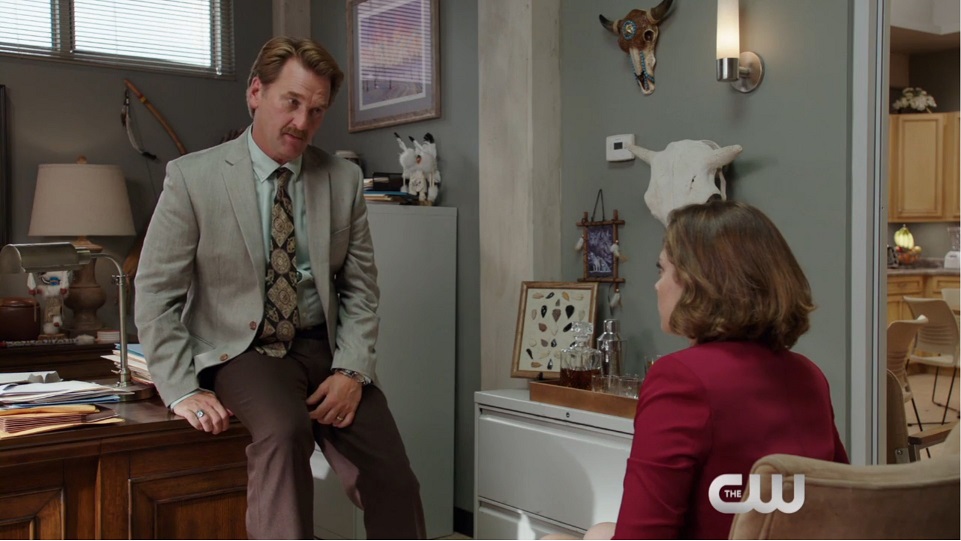
His office is a kitschy nightmare of Native items: wolf paintings, arrowheads, buffalo skulls, a dreamcatcher, a drum, a bow and arrows, a kachina-style figurine, a portrait of a chief, etc. Then there's his tie that sports Native basket patterns. None of this has anything to do with a genuine Chippewa culture.
He proves to be insensitive when he praises Rebecca because she's Jewish. And he proves to be buffoonish when he starts crying over his pending divorce.
You can watch a video about Darryl Whitefeather, with glimpses of his first appearance, here:
Crazy Ex-Girlfriend--Full One Eighth
As with his "Whitefeather" name and "Chief" title, his office is within the realm of possibility. A small percentage of people who claim to be Native will go overboard with displays like this. They're presumably overcompensating to banish doubts about their authenticity.
Analysis
Darryl and Rebecca comment on the wolf paintings, so it's not as if the kitsch goes unnoticed. But that's it for the Native commentary. And that lack of commentary is a problem.
If you know anything about genuine Native cultures, you may snicker at Darryl's "wannabe" attitude. But most people don't know anything about genuine Native cultures, so they may take him at face value. They may say to themselves, "Okay, this is how a 1/8 Chippewa would act. Nothing strange here, just a guy trying to get in touch with his roots."
That's what's missing from this caricature of a character: someone who explicitly says it's wrong. When Darryl makes a thoughtless Jewish comment, Rebecca pushes back against it. But no one challenges Darryl's "Native" gimmickry the same way.
Without that, what are viewers supposed to think about Darryl the 1/8 Chippewa? Is he a real Native who's overcompensating? Or a "pretendian" who's trying to pass a la Ward Churchill, Johnny Depp, and Elizabeth Warren? There's no way to tell because the situation is unclear and no one clarifies it.
There's a huge difference between satirizing a real Indian and satirizing a phony one. Someone needs to take a stand re Darryl if this subplot is to continue. Michael Stivic noted Archie Bunker's foibles on All in the Family and that kind of response is needed here too.
Crazy Ex-Girlfriend is a smart, dark delight
Crazy Ex-Girlfriend Series Premiere Recap: It’s Where Dreams Live
For Newspaper Rock, the relevant issue is the character Darryl Whitefeather:
Hometown: Scarsdale, New York
In The CW’s new comedy “Crazy Ex-Girlfriend,” Peter Gardner plays Darryl, Rebecca’s boss at a West Covina law firm. Darryl grew up in Orange County and considers himself very cultured and intellectual, a cut above the usual West Covina resident. He loves Rebecca because she is smart and well-educated, and he thinks she gives his firm instant credibility.
The problem is that he's 1/8th Chippewa, or so he says. This leads to several stereotype problems:
You can watch a video about Darryl Whitefeather, with glimpses of his first appearance, here:
Crazy Ex-Girlfriend--Full One Eighth
As with his "Whitefeather" name and "Chief" title, his office is within the realm of possibility. A small percentage of people who claim to be Native will go overboard with displays like this. They're presumably overcompensating to banish doubts about their authenticity.
Analysis
Darryl and Rebecca comment on the wolf paintings, so it's not as if the kitsch goes unnoticed. But that's it for the Native commentary. And that lack of commentary is a problem.
If you know anything about genuine Native cultures, you may snicker at Darryl's "wannabe" attitude. But most people don't know anything about genuine Native cultures, so they may take him at face value. They may say to themselves, "Okay, this is how a 1/8 Chippewa would act. Nothing strange here, just a guy trying to get in touch with his roots."
That's what's missing from this caricature of a character: someone who explicitly says it's wrong. When Darryl makes a thoughtless Jewish comment, Rebecca pushes back against it. But no one challenges Darryl's "Native" gimmickry the same way.
Without that, what are viewers supposed to think about Darryl the 1/8 Chippewa? Is he a real Native who's overcompensating? Or a "pretendian" who's trying to pass a la Ward Churchill, Johnny Depp, and Elizabeth Warren? There's no way to tell because the situation is unclear and no one clarifies it.
There's a huge difference between satirizing a real Indian and satirizing a phony one. Someone needs to take a stand re Darryl if this subplot is to continue. Michael Stivic noted Archie Bunker's foibles on All in the Family and that kind of response is needed here too.
June 03, 2014
Chief apologizes for CFO's slurs
Interesting twist on the CFO Leaves Racist Phone Message story from last week:
Sault chief apologizes for racial slurs
By Susan FieldIn response to racial slurs made by a member of his tribe, a Native American chief has apologized to the Saginaw Chippewa Indian Tribe in Mt. Pleasant.
Chief Aaron Payment of the Sault Ste. Marie Tribe, confirmed that ACD.net chief financial officer Kirk Shewchuck is a member of his tribe and has expressed apologies for the “irresponsible statements” made by Shewchuck accidentally in a voice mail after he apparently thought he disconnected a call to a Tribal department in May. But Shewchuck wasn't alone:Last week, Saginaw Chippewa Tribal Chief Steve Pego declined to meet with senior management of ACD.net to discuss the message, which included statements from more than one person, calling Natives “redmen” and “f**king Indians.”
Tribal leaders refused to honor the request after learning that several key executives with the company were allegedly talking in the phone message, Cloutier said. Comment: Since several people were involved, Shewchuck's heritage isn't exactly relevant. But it's certainly a curious development. It sounds like a classic case of internalized racism to me.
Sault chief apologizes for racial slurs
By Susan Field
Chief Aaron Payment of the Sault Ste. Marie Tribe, confirmed that ACD.net chief financial officer Kirk Shewchuck is a member of his tribe and has expressed apologies for the “irresponsible statements” made by Shewchuck accidentally in a voice mail after he apparently thought he disconnected a call to a Tribal department in May.
Tribal leaders refused to honor the request after learning that several key executives with the company were allegedly talking in the phone message, Cloutier said.
September 02, 2013
Native Starwatchers Project
SCSU professor Annette Lee helps viewers see the sky as Native Americans did
By Ann WesselWhen Annette Lee dims the dome and brings up the stars in St. Cloud State University’s planetarium, she adds a new layer of understanding to the night sky as she describes astronomical phenomena, traces Greek and Roman constellations with a red light and then overlays images corresponding to Native American constellations.
The Big Dipper that is part of the constellation Ursa Major also forms the fisher, called Ojiig in Ojibwe. The dipper’s ladle forms the curve of the fisher’s tail.
Lee, assistant professor of astronomy and physics, explained to a room full of teachers attending a summer conference at St. Cloud State, that in Ojibwe culture the fisher is a clever, fierce and brave animal and a good fighter. It climbed a pine tree and jumped through a hole in the sky to bring back the birds and, therefore, the spring. Fishers are constantly on the move, sleeping for only a few hours before returning to the hunt. Like the fisher, the Big Dipper is constantly on the move in the sky.
On the Dakota star map, the Big Dipper contains the Blue Spirit Woman, who helps newborns pass from the star world to Earth and back again.
Through the Native Starwatchers Project, Lee has introduced audiences in Minnesota and throughout the U.S. to some Dakota and Ojibwe constellations and the stories they carry. Minnesota teachers are tuning in because state science standards require instructors to show how people from other cultures, including the state’s American Indian tribes, have contributed to science.
“I think it’s important for people to understand that although the mainstream science uses European and Greek (constellations), it’s important to know it comes from a certain culture,” Lee said later. “There are many ways of knowing, and that’s just one way.” Comment: For more on Native astronomy, see NMAI Launches Maya Website and Sacred Native Meteorites.

By Ann Wessel
The Big Dipper that is part of the constellation Ursa Major also forms the fisher, called Ojiig in Ojibwe. The dipper’s ladle forms the curve of the fisher’s tail.
Lee, assistant professor of astronomy and physics, explained to a room full of teachers attending a summer conference at St. Cloud State, that in Ojibwe culture the fisher is a clever, fierce and brave animal and a good fighter. It climbed a pine tree and jumped through a hole in the sky to bring back the birds and, therefore, the spring. Fishers are constantly on the move, sleeping for only a few hours before returning to the hunt. Like the fisher, the Big Dipper is constantly on the move in the sky.
On the Dakota star map, the Big Dipper contains the Blue Spirit Woman, who helps newborns pass from the star world to Earth and back again.
Through the Native Starwatchers Project, Lee has introduced audiences in Minnesota and throughout the U.S. to some Dakota and Ojibwe constellations and the stories they carry. Minnesota teachers are tuning in because state science standards require instructors to show how people from other cultures, including the state’s American Indian tribes, have contributed to science.
“I think it’s important for people to understand that although the mainstream science uses European and Greek (constellations), it’s important to know it comes from a certain culture,” Lee said later. “There are many ways of knowing, and that’s just one way.”
August 30, 2013
Saginaw Chippewa tribe named grand marshals
Central Michigan University names entire Saginaw Chippewa Indian Tribe grand marshals for 2013 homecoming parade
By Lindsay KnakeAn entire Indian nation will serve as Central Michigan University's 2013 homecoming grand marshals.
The Saginaw Chippewa Indian Tribe, which calls Isabella County home along with CMU, will lead the Oct. 19 homecoming parade and bless both the CMU and Northern Illinois University football teams with drum songs prior to the 3 p.m. game at Kelly/Shorts Stadium.
“It is an honor and privilege,” said Dennis V. Kequom Sr., Saginaw Chippewa Indian Tribe chief. “For the tribe, it’s always a very strong sense of appreciation to be recognized for the work we do and the involvement we have in the community. It’s a very proud distinction.”
George E. Ross, CMU president, said the university's partnership with the tribe has provided educational and cultural opportunities, such as tribal professionals lecturing in classes and sending tribal students to study at CMU.
CMU's athletic mascot is the Chippewas. Comment: That's how you honor Indians: by actually honoring Indians. You know, the real live ones, not the white men in phony costumes or the big-nosed caricatures on your uniforms. Few pro or college teams with Native nicknames do this.
For more on the subject, see Chippewas Approve CMU's Nickname.

By Lindsay Knake
The Saginaw Chippewa Indian Tribe, which calls Isabella County home along with CMU, will lead the Oct. 19 homecoming parade and bless both the CMU and Northern Illinois University football teams with drum songs prior to the 3 p.m. game at Kelly/Shorts Stadium.
“It is an honor and privilege,” said Dennis V. Kequom Sr., Saginaw Chippewa Indian Tribe chief. “For the tribe, it’s always a very strong sense of appreciation to be recognized for the work we do and the involvement we have in the community. It’s a very proud distinction.”
George E. Ross, CMU president, said the university's partnership with the tribe has provided educational and cultural opportunities, such as tribal professionals lecturing in classes and sending tribal students to study at CMU.
CMU's athletic mascot is the Chippewas.
For more on the subject, see Chippewas Approve CMU's Nickname.
August 24, 2013
Review of Lone Ranger: Vendetta
The Lone Ranger: VendettaThe Masked Man in a brand-new adventure! From out of the past comes a mysterious killer systematically murdering anyone with a connection to the Masked Rider of the Plains former identity. When all signs point to Butch Cavendish, a man long dead, The Lone Ranger finds himself trapped in a deadly game of cat and mouse with the life of his faithful Indian companion hanging in the balance! Some reviewsThe single best Lone Ranger story ever!, May 23, 2012
This book is amazing. Simply amazing. Long-time Lone Ranger fans will appreciate that Mr. Hopkins keeps the characters intact here, while putting a more adult spin on the legend. This is what the movie should be like. Sadly, Howard is no longer with us, but this book is, arguably, his crowning achievement in his excellent body of work. I encourage anyone who loves a good Western and the character of The Lone Ranger to go purchase this book immediately!
What the new movie should be, but most assuredly won't, May 28, 2012
This book was amazing! An earlier review described the tone of this story very well, so I won't belabor the point here. Suffice it to say that the tone works extremely well. Now, die-hard fans might be bothered by the fact that Tonto doesn't speak in broken English, but I personally think I would've been more bothered if he had. It may be true to the source material, but it has such negative overtones that it would have been a distraction. But:Good, but ending was rushed, March 12, 2013
Great theme and good reading. However, after a consistent pace, the ending was way too rushed. Too mature for children.
Hi YO So So !!, March 5, 2013
In an attempt to take away some of the straight shooter, super clean heroics of the original, the character becomes somewhat pointless to the story. I found myself at the end of the story asking what the Lone Ranger really did here and the answer is not much.
A pleasant read but unsatisfying to a true fan. Rob's review
I'll have to go with the negative reviews on this one. Vendetta was mildly enjoyable but ultimately unsatisfying.
The villainness was the most interesting character. She was the kind of sociopathic serial killer we see in modern fiction, but not in Westerns. She'd sleep with anyone, then kill him (or anyone) if he looked at her wrong.
The Lone Ranger and Tonto seem two-dimensional to me, at best. At least Tonto is more or less a full partner to the Ranger, not a sidekick. Still, it's the Ranger's story, so Tonto gets less exposure, as usual.
Apparently this Tonto is the original Potawatomi version. He does have a couple of good moments.
At one point, they're sitting by a campfire at night. The Ranger asks Tonto what he sees in the flames, leading to this exchange:TONTO: I see ghosts, Kemosabe.
RANGER: Ghosts?
TONTO: The ghosts of the Bodéwadmi, the keepers of the fire. They ride with frozen thunder across the black sky forest, the way they once rode the trails and plains. Proud. Free. The world closed in on them and now they are nearly gone. I feel their isolation, their separation from the soil and the lands. They scream their silent pleas to Kichimanido. This may be the longest speech Tonto has ever uttered. It's also the first time I recall his referring to his particular culture, not a generic culture. It's noteworthy for both reasons.
Tonto's background
A posting explains that Bodéwadmi is the Indian version of the Anglicized name "Potawatomi." So Tonto is really talking like a Potawatomi, for once.
“Bode wad mi” PotawatomiThe Potawatomi “Bode wad mi” are one of the three original tribes of Michigan. The Potawatomi “Bode wad mi” along with the Odawa/Ottawa and the Ojibwa/Chippewa are known as the people of the Three Fires. They call themselves Anishinabe. The Potawatomi “Bode wad mi” are the “Keepers of the Fire.”
On August 29, 1821, the Bode wad mi, Odawa and Ojibwa ("The People of the Three Fires") held council with representatives of the United States government and signed a treaty, which left them only five reservations, and certain land grants in Michigan. Many were moved to Oklahoma and Kansas territories. Those who would not leave were driven out by military force or hid away from the government. Small bands traveled to Northeast Wisconsin, the Upper Peninsula of Michigan and Canada.
All of the Anishinabe (Bode wad mi, Ojibwa and Odawa) lived in the eastern part of North America. After various wars and migrations, the tribes moved to the Great Lakes Area. The oldest brother, Chippewa (Ojibwa), was given the responsibility of Keeper of the Faith. The middle brother, Ottawa (Odawa), was the Keeper of the Trade, and the youngest brother, Potawatomi, was responsible for keeping the Sacred Fire; hence the name, "Keeper of the Fire."
Long ago, the Potawatomi depended on nature to survive. They lived a nomadic life. They hunted, fished, grew crops and gathered food to eat. After they were forced onto reservations, they lived through years of poverty. At times during the early 1900s, they hardly had enough to eat.
The early Potawatomi people were a part of the Eastern Woodlands group of Native Americans. By many accounts, the people were fairly short with a stocky build. They were a fun-loving people who enjoyed practical jokes. Women were modest in both the clothes they wore and in their actions. The men and women both normally wore their hair long. During times of war, the men shaved their heads except for a small scalp lock on top. Women usually wore their hair in a single braid down their backs.
The Potawatomi’s love of nature and family was at the center of their way of life. This is evident throughout their early history, through their spiritual lives, and in all other areas of their village life such as their food, clothes, homes, tools, and transportation.
The Potawatomi people wore clothing that was very simple. During the summer, the men often wore clothes made out of red or blue cloth. In the winter some wore decorated buffalo robes. To keep warm during the winter, men wore leggings made of buckskin or cloth. They also wore these for special dances. When playing games like lacrosse, men wore breechcloths and deerskin moccasins.
After the hunters returned with the animals they had killed, the hides would be removed and then women would prepare the hides so that clothing could be made from them. Much of the Potawatomi clothing was made from these hides.
Women wore knee length dresses with petticoats underneath. They sometimes wore bonnets or scarves on their heads. They made their skirts and sleeveless dresses so that they draped over their shoulders and were held in place by a belt at their waist. If they needed to sew pieces together, they used thread made from plant fibers or strips of hide tied in place. These clothes were often decorated with different designs using porcupine quills or beads.
Men and women greased their hair and painted their skin for special occasions. Men tattooed their bodies with different designs. 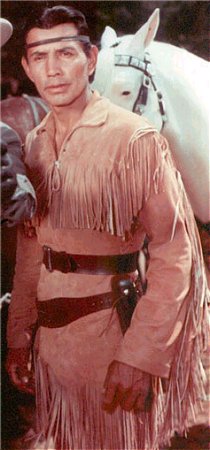
You can see that Tonto doesn't look much like this description of Potawatomi men. But the main point is that the Potawatomi have a distinct culture that isn't Lakota, Apache, or anything else. And for the most part, the original Tonto and this Tonto aren't wildly inconsistent with Potawatomi culture.
The Great Spirit
As for Kichimanido:
Legendary Native American Figures: Gitchi ManitouTribal affiliation: Ojibwe, Algonquin, Ottawa, Potawatomi, Menominee, Kickapoo, Sauk-Fox, Mohican, Mohegan, Shawnee, Cree
Alternate spellings: Gichi Manidoo, Gchi Mnidoo, Kichi Manido, etc.
Gitchi Manitou is the great creator god of the Anishinaabe and many neighboring Algonquian tribes. The name literally means Great Spirit, a common phrase used to address God in many Native American cultures.
As in other Algonquian tribes, the Great Spirit is abstract, benevolent, does not directly interact with humans, and is rarely if ever personified in Anishinabe myths--originally, Gitchi Manitou did not even have a gender (although with the introduction of English and its gender-specific pronouns, Gitchi Manitou began to be referred to as "he.") It is Gitchi Manitou who created the world, though some details of making the world as we know it today were delegated to the culture hero Nanabozho. "Gitchi Manitou" (or one of its many variant spellings) was used as a translation for "God" in early translations of the Bible into Ojibway, and today many Ojibway people consider Gitchi Manitou and the Christian God to be one and the same.
Gitchi Manitou is the great creator god of the Anishinaabe and many neighboring Algonquian tribes. The name literally means Great Spirit, a common phrase used to address God in many Native American cultures. I'm not sure Tonto has ever referred to the "Great Spirit" or "Creator" before. I'm pretty sure he's never referred to Gitchi Manitou before. So that's another first.
There's even a partial explanation for what Tonto is doing in Texas. His people were driven into Oklahoma and from there he roamed the Southwest. None of this is in the Lone Ranger mythos, but we can imagine it.
That one paragraph is about all the culture Tonto expresses, so it isn't much. But compared to other versions of Tonto, it's a step forward.
Tonto talk
As you can see from the quote above, Tonto's speech is more or less normal. Later, he notes how he speaks "Tonto style" intentionally--to fool the white man into thinking he's dumb. That's a brilliant explanation of Tonto's speech pattern. All future creators of Lone Ranger stories should adopt it immediately if they feel the need to make Tonto sound "tonto" (Spanish for "dumb").
Unfortunately, the villainess captures Tonto and uses him to lure the Ranger. It isn't Tonto's fault; he's rescuing someone in a hotel room when she stumbles across him. But we end up in the same place as so many other Westerns--with the white man as the hero who has to save his Native friend, sidekick, or maiden.
In short, I'd give this book about a 7.0 of 10. Unless you're a Lone Ranger fan, you can safely skip it.
For more on Tonto, see Skyhawk: Depp Dishonored Indians and 33 Tonto Comic-Book Covers.
This book is amazing. Simply amazing. Long-time Lone Ranger fans will appreciate that Mr. Hopkins keeps the characters intact here, while putting a more adult spin on the legend. This is what the movie should be like. Sadly, Howard is no longer with us, but this book is, arguably, his crowning achievement in his excellent body of work. I encourage anyone who loves a good Western and the character of The Lone Ranger to go purchase this book immediately!
What the new movie should be, but most assuredly won't, May 28, 2012
This book was amazing! An earlier review described the tone of this story very well, so I won't belabor the point here. Suffice it to say that the tone works extremely well. Now, die-hard fans might be bothered by the fact that Tonto doesn't speak in broken English, but I personally think I would've been more bothered if he had. It may be true to the source material, but it has such negative overtones that it would have been a distraction.
Great theme and good reading. However, after a consistent pace, the ending was way too rushed. Too mature for children.
Hi YO So So !!, March 5, 2013
In an attempt to take away some of the straight shooter, super clean heroics of the original, the character becomes somewhat pointless to the story. I found myself at the end of the story asking what the Lone Ranger really did here and the answer is not much.
A pleasant read but unsatisfying to a true fan.
I'll have to go with the negative reviews on this one. Vendetta was mildly enjoyable but ultimately unsatisfying.
The villainness was the most interesting character. She was the kind of sociopathic serial killer we see in modern fiction, but not in Westerns. She'd sleep with anyone, then kill him (or anyone) if he looked at her wrong.
The Lone Ranger and Tonto seem two-dimensional to me, at best. At least Tonto is more or less a full partner to the Ranger, not a sidekick. Still, it's the Ranger's story, so Tonto gets less exposure, as usual.
Apparently this Tonto is the original Potawatomi version. He does have a couple of good moments.
At one point, they're sitting by a campfire at night. The Ranger asks Tonto what he sees in the flames, leading to this exchange:
RANGER: Ghosts?
TONTO: The ghosts of the Bodéwadmi, the keepers of the fire. They ride with frozen thunder across the black sky forest, the way they once rode the trails and plains. Proud. Free. The world closed in on them and now they are nearly gone. I feel their isolation, their separation from the soil and the lands. They scream their silent pleas to Kichimanido.
Tonto's background
A posting explains that Bodéwadmi is the Indian version of the Anglicized name "Potawatomi." So Tonto is really talking like a Potawatomi, for once.
“Bode wad mi” Potawatomi
On August 29, 1821, the Bode wad mi, Odawa and Ojibwa ("The People of the Three Fires") held council with representatives of the United States government and signed a treaty, which left them only five reservations, and certain land grants in Michigan. Many were moved to Oklahoma and Kansas territories. Those who would not leave were driven out by military force or hid away from the government. Small bands traveled to Northeast Wisconsin, the Upper Peninsula of Michigan and Canada.
All of the Anishinabe (Bode wad mi, Ojibwa and Odawa) lived in the eastern part of North America. After various wars and migrations, the tribes moved to the Great Lakes Area. The oldest brother, Chippewa (Ojibwa), was given the responsibility of Keeper of the Faith. The middle brother, Ottawa (Odawa), was the Keeper of the Trade, and the youngest brother, Potawatomi, was responsible for keeping the Sacred Fire; hence the name, "Keeper of the Fire."
Long ago, the Potawatomi depended on nature to survive. They lived a nomadic life. They hunted, fished, grew crops and gathered food to eat. After they were forced onto reservations, they lived through years of poverty. At times during the early 1900s, they hardly had enough to eat.
The early Potawatomi people were a part of the Eastern Woodlands group of Native Americans. By many accounts, the people were fairly short with a stocky build. They were a fun-loving people who enjoyed practical jokes. Women were modest in both the clothes they wore and in their actions. The men and women both normally wore their hair long. During times of war, the men shaved their heads except for a small scalp lock on top. Women usually wore their hair in a single braid down their backs.
The Potawatomi’s love of nature and family was at the center of their way of life. This is evident throughout their early history, through their spiritual lives, and in all other areas of their village life such as their food, clothes, homes, tools, and transportation.
The Potawatomi people wore clothing that was very simple. During the summer, the men often wore clothes made out of red or blue cloth. In the winter some wore decorated buffalo robes. To keep warm during the winter, men wore leggings made of buckskin or cloth. They also wore these for special dances. When playing games like lacrosse, men wore breechcloths and deerskin moccasins.
After the hunters returned with the animals they had killed, the hides would be removed and then women would prepare the hides so that clothing could be made from them. Much of the Potawatomi clothing was made from these hides.
Women wore knee length dresses with petticoats underneath. They sometimes wore bonnets or scarves on their heads. They made their skirts and sleeveless dresses so that they draped over their shoulders and were held in place by a belt at their waist. If they needed to sew pieces together, they used thread made from plant fibers or strips of hide tied in place. These clothes were often decorated with different designs using porcupine quills or beads.
Men and women greased their hair and painted their skin for special occasions. Men tattooed their bodies with different designs.
You can see that Tonto doesn't look much like this description of Potawatomi men. But the main point is that the Potawatomi have a distinct culture that isn't Lakota, Apache, or anything else. And for the most part, the original Tonto and this Tonto aren't wildly inconsistent with Potawatomi culture.
The Great Spirit
As for Kichimanido:
Legendary Native American Figures: Gitchi Manitou
Alternate spellings: Gichi Manidoo, Gchi Mnidoo, Kichi Manido, etc.
Gitchi Manitou is the great creator god of the Anishinaabe and many neighboring Algonquian tribes. The name literally means Great Spirit, a common phrase used to address God in many Native American cultures.
As in other Algonquian tribes, the Great Spirit is abstract, benevolent, does not directly interact with humans, and is rarely if ever personified in Anishinabe myths--originally, Gitchi Manitou did not even have a gender (although with the introduction of English and its gender-specific pronouns, Gitchi Manitou began to be referred to as "he.") It is Gitchi Manitou who created the world, though some details of making the world as we know it today were delegated to the culture hero Nanabozho. "Gitchi Manitou" (or one of its many variant spellings) was used as a translation for "God" in early translations of the Bible into Ojibway, and today many Ojibway people consider Gitchi Manitou and the Christian God to be one and the same.
Gitchi Manitou is the great creator god of the Anishinaabe and many neighboring Algonquian tribes. The name literally means Great Spirit, a common phrase used to address God in many Native American cultures.
There's even a partial explanation for what Tonto is doing in Texas. His people were driven into Oklahoma and from there he roamed the Southwest. None of this is in the Lone Ranger mythos, but we can imagine it.
That one paragraph is about all the culture Tonto expresses, so it isn't much. But compared to other versions of Tonto, it's a step forward.
Tonto talk
As you can see from the quote above, Tonto's speech is more or less normal. Later, he notes how he speaks "Tonto style" intentionally--to fool the white man into thinking he's dumb. That's a brilliant explanation of Tonto's speech pattern. All future creators of Lone Ranger stories should adopt it immediately if they feel the need to make Tonto sound "tonto" (Spanish for "dumb").
Unfortunately, the villainess captures Tonto and uses him to lure the Ranger. It isn't Tonto's fault; he's rescuing someone in a hotel room when she stumbles across him. But we end up in the same place as so many other Westerns--with the white man as the hero who has to save his Native friend, sidekick, or maiden.
In short, I'd give this book about a 7.0 of 10. Unless you're a Lone Ranger fan, you can safely skip it.
For more on Tonto, see Skyhawk: Depp Dishonored Indians and 33 Tonto Comic-Book Covers.
April 30, 2013
First American Indian poet
National Poetry Month: Jane Johnston Schoolcraft, the First American Indian Poet
By Mark FogartyOjibwe poet Jane Johnston Schoolcraft set many precedents during her short life in the Midwest in the early 1800s.
“The first known American Indian literary writer, the first known Indian woman writer, by some measures the first known Indian poet, the first known poet to write poems in a Native American language, and the first known American Indian to write out traditional Indian stories,” as her modern-day editor Robert Dale Parker puts it.
Born on January 31, 1800 in what is today Sault Ste. Marie, Michigan, Schoolcraft was known primarily by the names of her white father and then her white husband. But in truth she moved fluidly between two cultures and never forgot her Indian name, Bamewawagezhikaquay (Woman of the Sound the Stars Make Rushing Through the Sky). She wrote poems in her original language, though only a few survive; defended her American Indian grandfather against attacks on his reputation; dreamed of a place that had “no laws to treat my people ill,” and proudly noted one poem as being “by an Ojibwa female pen.”
Schoolcraft’s story provides an appealing example of the literary sleuthing required to lift her out of the obscurity she had been in for more than 150 years following her death on May 22, 1842. In addition to her literary accomplishments—which Parker puts in the same league as early Puritan poet Anne Bradstreet and Phillis Wheatley, an early African-American poet—Schoolcraft suffered a life of keen pain and loss. Today her significance to Indian poetry in general and Ojibwe poetry in particular is becoming more and more widely recognized. Comment: For more on Native literature, see Stories in a New Skin and Erdrich Wins Rough Rider Award.

By Mark Fogarty
“The first known American Indian literary writer, the first known Indian woman writer, by some measures the first known Indian poet, the first known poet to write poems in a Native American language, and the first known American Indian to write out traditional Indian stories,” as her modern-day editor Robert Dale Parker puts it.
Born on January 31, 1800 in what is today Sault Ste. Marie, Michigan, Schoolcraft was known primarily by the names of her white father and then her white husband. But in truth she moved fluidly between two cultures and never forgot her Indian name, Bamewawagezhikaquay (Woman of the Sound the Stars Make Rushing Through the Sky). She wrote poems in her original language, though only a few survive; defended her American Indian grandfather against attacks on his reputation; dreamed of a place that had “no laws to treat my people ill,” and proudly noted one poem as being “by an Ojibwa female pen.”
Schoolcraft’s story provides an appealing example of the literary sleuthing required to lift her out of the obscurity she had been in for more than 150 years following her death on May 22, 1842. In addition to her literary accomplishments—which Parker puts in the same league as early Puritan poet Anne Bradstreet and Phillis Wheatley, an early African-American poet—Schoolcraft suffered a life of keen pain and loss. Today her significance to Indian poetry in general and Ojibwe poetry in particular is becoming more and more widely recognized.
February 26, 2013
Dahmen the first Native supermodel?
Reclaiming Her Identity: A Conversation With Native Adoptee and Author Susan Fedorko
By Anne MinardSusan Fedorko was 40 years old when she found her birth family—or rather, when a long-lost sister found her. Her first book, Cricket: Secret Child of a Sixties Supermodel (Outskirts Press, 2012) chronicles Fedorko’s journey from Native American adoptee-turned “white” mother and wife, to a person reunited with her extended family. That family hails from the Grand Portage Indian Reservation people on her mother’s side and the White Earth Nation on her father’s, both Chippewa/Ojibwe. In an unexpected twist, Fedorko discovered that just a few years after her birth, her birth mother—Cathee Dahmen—had become an immensely popular supermodel, probably the first Native American woman to attain that status.
How did you react when you first realized who your birth mother was, and how do you look at it now?
As an adoptee, you fantasize about who your birth parents could be. What did they look like? What were they like? What types of jobs did they have? You imagine that you may get photos of them someday, normal photos. Perhaps they would be blowing out birthday candles, sitting on the couch with a sibling, standing near a Christmas tree. Some of the very first images I saw of my birth mom were on the cover of Vogue and Harper’s Bazaar. I was flooded with new images of Cathee for the first few months; she was photographed by some of the very best fashion photographers in the world. The very first images that I saw, I studied them intensely. I could see myself in those photos.… I could also see her in both my daughters. Comment: I posted this article just for the claim that Cathee Dahmen was the first Native supermodel. I never heard of her, so I doubt most people would call her a supermodel.
Wikipedia seems to concur:
Supermodels1960s–1970s
In February 1968, an article in Glamour described 19 models as "supermodels," of whom were: Cheryl Tiegs, Verushka, Lisa Palmer, Peggy Moffitt, Susan Murray, Twiggy, Susan Harnett, Marisa Berenson, Gretchen Harris, Heide Wiedeck, Irish Bianchi, Hiroko Matsumoto, Anne DeZagher, Kathie Carpenter, Jean Shrimpton, Jean Patchett, Benedetta Barzini, Claudia Duxbury, and Agneta Frieberg.
Iman is considered to have been the first supermodel of color. No mention of Dahmen in this posting.
Twiggy, Verushka, and Cheryl Tiegs are the ones I think of when I think of the first supermodels in the 1960s. And Iman is who I think of as the first supermodel of color. I don't think there's been a Native supermodel yet or we'd have heard of her.
For more on the subject, see Watchman the First Native Supermodel?

By Anne Minard
How did you react when you first realized who your birth mother was, and how do you look at it now?
As an adoptee, you fantasize about who your birth parents could be. What did they look like? What were they like? What types of jobs did they have? You imagine that you may get photos of them someday, normal photos. Perhaps they would be blowing out birthday candles, sitting on the couch with a sibling, standing near a Christmas tree. Some of the very first images I saw of my birth mom were on the cover of Vogue and Harper’s Bazaar. I was flooded with new images of Cathee for the first few months; she was photographed by some of the very best fashion photographers in the world. The very first images that I saw, I studied them intensely. I could see myself in those photos.… I could also see her in both my daughters.
Wikipedia seems to concur:
Supermodels
In February 1968, an article in Glamour described 19 models as "supermodels," of whom were: Cheryl Tiegs, Verushka, Lisa Palmer, Peggy Moffitt, Susan Murray, Twiggy, Susan Harnett, Marisa Berenson, Gretchen Harris, Heide Wiedeck, Irish Bianchi, Hiroko Matsumoto, Anne DeZagher, Kathie Carpenter, Jean Shrimpton, Jean Patchett, Benedetta Barzini, Claudia Duxbury, and Agneta Frieberg.
Iman is considered to have been the first supermodel of color.
Twiggy, Verushka, and Cheryl Tiegs are the ones I think of when I think of the first supermodels in the 1960s. And Iman is who I think of as the first supermodel of color. I don't think there's been a Native supermodel yet or we'd have heard of her.
For more on the subject, see Watchman the First Native Supermodel?
February 20, 2013
Chippewas approve CMU's nickname
Tribe supports Native American mascots
By Paul Lukas[I]t's true that there are some Native Americans who are fine with the use of Native imagery in sports. In central Michigan, for example, the Saginaw Chippewa Indian Tribe recently announced that it had no problem with a local high school whose teams are called the Warriors.
I was curious to learn more, so I contacted the Saginaw Chippewas and spoke with their public relations director, Frank Cloutier. Here's how our conversation went:
Uni Watch: First, for people who aren't familiar with the Saginaw Chippewas, please tell me a bit about your tribe.
Frank Cloutier: Our tribe was formed with the ratification of our constitution in 1936. We have 3,292 members, and we live in the territories called the Isabella Federal Indian Reserve in Mount Pleasant, Mich., just north of Lansing. We have the fifth- or sixth-largest Indian-owned casino in the Midwest, so we're rather successful when it comes to our economic growth and development.
But it's not just about gaming for us--it's about our culture. We have a very rich, diverse culture, which is showcased in a world-class, award-winning cultural museum on our reservation. So the situation regarding mascots and team names piques our interest.
Many of the people taking part in this debate see it as a black-and-white issue. Either they're completely opposed to all uses of Native American imagery, or they have no problem with any of it. What's your position, or your tribe's position, on that?
It's very, very clear for us, because we've worked with so many institutions in our area. Our position is that if it's not derogatory and it's being used appropriately, with an opportunity to share or cross-share our culture, then it's fine. There's nothing derogatory about "Warriors" or "Braves." There's nothing derogatory about "Indian." But terms like "Redskin" or "Half-Breed," those are derogatory terms to us.
So when the Michigan Department of Civil Rights recently filed a complaint with the U.S. Department of Education, claiming that Native American mascots and nicknames are inherently harmful to Native children, you don't agree with that?
In the study they used, they said these Native children who go to these schools with these mascots are "marginalized." But if you look at generational trauma and the way Native peoples were treated 300 years ago, it wasn't until 1924 that we were formally recognized as human beings, and we didn't get the chance to vote until after women did. That's what makes these kids feel marginalized -- the way their culture and their people were treated. I don't believe that a menacing-looking brave on the backboard of a basketball hoop is going to marginalize that child as much as that generational trauma.
That said, however, I believe that these schools using these images have an obligation to talk about the truth of Native American history. One of the largest genocides in world history happened right here on American soil, and it happened to Native Americans. So it's important to talk about the true history about the settling of the United States, and to talk about those things that happened to Native Americans that are often not talked about.
If Native children are struggling, hopefully this kind of education and outreach and help identify why, instead of having us blame it on a mascot.
So when you say it's fine to use non-derogatory imagery as long as it's being used appropriately, you're saying that part of that "appropriate use" is educational content about Native Americans?
Yes. For example, in 2003 we entered into an articulation agreement with Central Michigan University, because they were the Chippewas. As part of that agreement, the tribe and the university each has an obligation. Every year I go in and address every freshman athletic student about our culture and what it means to be a Chippewa, and about the proud, competitive nature of our people. We explain that it's not about war paint and fake feathers. It's about honoring the triumph of these resilient, competitive people.
They also have areas on campus that are dedicated to the presence of the Chippewa Nation. So it's a good cross-cultural exchange. And when they go out there and compete, they're Chippewas, they're fighting like a Chippewa, fighting to win. We've made that university our school of choice for Native Americans, because our tribal community is close by, so we can help support those Native students.
What if a high school or university wasn't interested in doing these types of cultural exchanges and educational efforts? What would your feelings be about their use of Native imagery?
It would be completely different. If they're not willing to celebrate and show the culture, they shouldn't have the privilege of depicting it. Natives respond
All this sounds good, but when this link was posted on Facebook, people (including me) had more to say:Why do people always ask why bigotry isn't given an equal voice, why the side of bigotry got ignored in some article? So, we know from the first paragraph that the whole article is about giving a fair shake to bigotry? That doesn't even make sense. Bigotry in the form of Native American logos and mascots has been the dominant voice long enough! It's time to end that domination, to give voice to the historically voiceless.
Fortunately, this Uncle Tomahawk speaks only for the corporate entity that employs him. 1) This bunch, which is essentially a casino, a huge budget and a little land, cross-markets off of CMU (2) Fortunately, no people with any pride call themselves "Chippewa" (3) Their leadership is largely composed of a bunch of pathetic Republicans.
I also think it points to a much deeper issue if the only opportunity Native people have to educate about our cultures and communities is in the context of sports mascots.
Yeah, what this clown means by "cultural exchange" is having to explain why some white kid in a Halloween costume can't ride in on a horse and fire flaming arrows from the 50 yard line at a cowboy cut-out ... in upper Michigan.
Mr. Cloutier has the right to say whatever he wants, but it’s pretty clear here that he views his tribe’s culture primarily as a commodity to be sold.
Article has some interesting ideas, and I think it does try to highlight an opportunity for cooperation. Unfortunately, the title is a bit misleading as it almost attempts to claim the Chippewa support any mascot, regardless of how its used.
I feel like this, like S.L. Price's very misleading article for SI, will be something for mascot supporters to turn to and generalize the views of ALL Native Americans.
Unfortunately this is going to be the arguing point of many appropriators in the future. "Well, that tribe is OK with mascots, so what's YOUR problem?" *sigh* How many schools meet the Saginaw Chippewas' standard of respecting and educating people about Native cultures? One in a hundred? The headline should be: "Tribe Opposes Native Mascots Except in Extraordinary Circumstances."
"I also think it points to a much deeper issue if the only opportunity Native people have to educate about our cultures and communities is in the context of sports mascots."
Good point. Why aren't schools teaching Native history and culture anyway? If a school was teaching these things already, would the Chippewas still feel a mascot was desirable?
Sounds like the Chippewas are saying mascots are good only as a bargaining chip. Which isn't much of an argument for mascots.
What about other Ojibwe?Whether or not one tribe or another gives their permission for their tribe to be represented as a mascot or not has no bearing on the negative ramifications that stem from the mascots use.
I think it is sick that one band gets to decide that the Chippewa name (though a false one) is appropriate to be used as a mascot while the rest of the "Chippewa" bands are against it. Who are they to decide that "Chippewa," which hundreds of thousands of people identify as, is to be used this way? To be quite honest, as an Ojibwe, it pisses me off.
I replied on Twitter that not all "Chippewas" approve of the name/logo use, just one rich tribe. It just goes to show what a complex issue racist sports logos are. Love that one tribe (Saginaw Chippewa) can sign away rights to something that other Ojibwe/Anishinabwe don't have to approve, know about or even agree to, yet we still get to be bombarded with the images.
Last time I checked these collaborator sell outs do not speak for the other Bands of Anishinabe people in Canada, Michigan, Wisconsin, the Dakotas and Minnesota and they are neglecting their payoffs, you know the scholarships for tribal members, the cut of the trademark and copy rights and merchandising. Let's reiterate the gaming connection. The Saginaw Chippewas have to please Michigan's legislators and voters if they don't want their casino business harmed. There's a conflict of interest here that other Ojibwe people and tribes don't have.
Nevertheless, if there's a right way to do an Indian mascot, CMU seems to be doing it:I graduated from CMU about a year ago and I've always been impressed with the relationship between the school and the SCIT tribe. CMU is very conscientious about how the Chippewa image is portrayed by students, any offensive nonsense like dressing in feathers and war paint is strictly forbidden. Unlike at my younger sisters' high school and middle school, where their mascots are the Braves and Warriors and the still have an Indian head logo and mascot...
Imagine my surprise when my tribe shows up on one of my favorite pages!
Alright, I'm going to say this. Frank Cloutier is the head of PR for our tribe. This interview is the official tribal opinion, approved by tribal council, this may or may not reflect Frank's personal position. And it certainly DOES NOT reflect the opinion of all members of the Saginaw Chippewa Indian Tribe! Believe me, give us a generation and the younger ones will have these nicknames gone, if they aren't already.
CMU gave up their Native mascot in 1989. Their current mascot is a "flying C," yes the letter C. Their nickname is the Chippewas. While I vehemently oppose the nickname, I will give props to the several tribal council members over the last two decades or so. They have built up a relationship with CMU--they have tribal exhibits in their basketball facility, they have a 30-foot blown up photo of a fancy shawl dancers, next to other athletes in their athletic facility. A few years ago, they repatriated remains to us and we WALKED the remains to the rez, and university officials (president, provost, etc) attended. They have an annual powwow and the University helps and supports it (at other MI universities, Native student orgs are pretty much on their own for powwow). These may seem like small efforts, but they are HUGE in Mt. Pleasant--where there's been a historical disconnect between the university and the rez. I wonder how much of that has been from tribal leaders using the nickname as leverage. Certainly, CMU can do more but things are getting better.
I remember 10 years or so ago, a CMU freshman dressed as a "Chippewa" to a football game. He had fake warpaint, a macaroni breastplate, and was doing war whoops. He was publicly rebuked by fellow students. He may have been required to attend a Native class or something. Maybe a decade or so before that, a bunch of students did something similar and apparently they got sent to the rez to have dinner with one of my cousins, who gave them a Anishinaabekwe lecture on respect, according to my mother. We take care of stereotypical b.s. As I've said before, I don't think neutral names such as "Indians" or "Chippewas" are that bad by themselves. On the other hand, I don't like anything that perpetuates the "Indian as warrior" stereotype.
Anyway, as this posting shows, even when a tribe approves the mascot, the issue isn't cut-and-dried. We've also seen that with the FSU Seminole case.
For more on Indian mascots, see Semipro Team Uses Chief Wahoo and NMAI Symposium on Racist Mascots.
By Paul Lukas
I was curious to learn more, so I contacted the Saginaw Chippewas and spoke with their public relations director, Frank Cloutier. Here's how our conversation went:
Uni Watch: First, for people who aren't familiar with the Saginaw Chippewas, please tell me a bit about your tribe.
Frank Cloutier: Our tribe was formed with the ratification of our constitution in 1936. We have 3,292 members, and we live in the territories called the Isabella Federal Indian Reserve in Mount Pleasant, Mich., just north of Lansing. We have the fifth- or sixth-largest Indian-owned casino in the Midwest, so we're rather successful when it comes to our economic growth and development.
But it's not just about gaming for us--it's about our culture. We have a very rich, diverse culture, which is showcased in a world-class, award-winning cultural museum on our reservation. So the situation regarding mascots and team names piques our interest.
Many of the people taking part in this debate see it as a black-and-white issue. Either they're completely opposed to all uses of Native American imagery, or they have no problem with any of it. What's your position, or your tribe's position, on that?
It's very, very clear for us, because we've worked with so many institutions in our area. Our position is that if it's not derogatory and it's being used appropriately, with an opportunity to share or cross-share our culture, then it's fine. There's nothing derogatory about "Warriors" or "Braves." There's nothing derogatory about "Indian." But terms like "Redskin" or "Half-Breed," those are derogatory terms to us.
So when the Michigan Department of Civil Rights recently filed a complaint with the U.S. Department of Education, claiming that Native American mascots and nicknames are inherently harmful to Native children, you don't agree with that?
In the study they used, they said these Native children who go to these schools with these mascots are "marginalized." But if you look at generational trauma and the way Native peoples were treated 300 years ago, it wasn't until 1924 that we were formally recognized as human beings, and we didn't get the chance to vote until after women did. That's what makes these kids feel marginalized -- the way their culture and their people were treated. I don't believe that a menacing-looking brave on the backboard of a basketball hoop is going to marginalize that child as much as that generational trauma.
That said, however, I believe that these schools using these images have an obligation to talk about the truth of Native American history. One of the largest genocides in world history happened right here on American soil, and it happened to Native Americans. So it's important to talk about the true history about the settling of the United States, and to talk about those things that happened to Native Americans that are often not talked about.
If Native children are struggling, hopefully this kind of education and outreach and help identify why, instead of having us blame it on a mascot.
So when you say it's fine to use non-derogatory imagery as long as it's being used appropriately, you're saying that part of that "appropriate use" is educational content about Native Americans?
Yes. For example, in 2003 we entered into an articulation agreement with Central Michigan University, because they were the Chippewas. As part of that agreement, the tribe and the university each has an obligation. Every year I go in and address every freshman athletic student about our culture and what it means to be a Chippewa, and about the proud, competitive nature of our people. We explain that it's not about war paint and fake feathers. It's about honoring the triumph of these resilient, competitive people.
They also have areas on campus that are dedicated to the presence of the Chippewa Nation. So it's a good cross-cultural exchange. And when they go out there and compete, they're Chippewas, they're fighting like a Chippewa, fighting to win. We've made that university our school of choice for Native Americans, because our tribal community is close by, so we can help support those Native students.
What if a high school or university wasn't interested in doing these types of cultural exchanges and educational efforts? What would your feelings be about their use of Native imagery?
It would be completely different. If they're not willing to celebrate and show the culture, they shouldn't have the privilege of depicting it.
All this sounds good, but when this link was posted on Facebook, people (including me) had more to say:
Fortunately, this Uncle Tomahawk speaks only for the corporate entity that employs him. 1) This bunch, which is essentially a casino, a huge budget and a little land, cross-markets off of CMU (2) Fortunately, no people with any pride call themselves "Chippewa" (3) Their leadership is largely composed of a bunch of pathetic Republicans.
I also think it points to a much deeper issue if the only opportunity Native people have to educate about our cultures and communities is in the context of sports mascots.
Yeah, what this clown means by "cultural exchange" is having to explain why some white kid in a Halloween costume can't ride in on a horse and fire flaming arrows from the 50 yard line at a cowboy cut-out ... in upper Michigan.
Mr. Cloutier has the right to say whatever he wants, but it’s pretty clear here that he views his tribe’s culture primarily as a commodity to be sold.
Article has some interesting ideas, and I think it does try to highlight an opportunity for cooperation. Unfortunately, the title is a bit misleading as it almost attempts to claim the Chippewa support any mascot, regardless of how its used.
I feel like this, like S.L. Price's very misleading article for SI, will be something for mascot supporters to turn to and generalize the views of ALL Native Americans.
Unfortunately this is going to be the arguing point of many appropriators in the future. "Well, that tribe is OK with mascots, so what's YOUR problem?" *sigh*
"I also think it points to a much deeper issue if the only opportunity Native people have to educate about our cultures and communities is in the context of sports mascots."
Good point. Why aren't schools teaching Native history and culture anyway? If a school was teaching these things already, would the Chippewas still feel a mascot was desirable?
Sounds like the Chippewas are saying mascots are good only as a bargaining chip. Which isn't much of an argument for mascots.
What about other Ojibwe?
I think it is sick that one band gets to decide that the Chippewa name (though a false one) is appropriate to be used as a mascot while the rest of the "Chippewa" bands are against it. Who are they to decide that "Chippewa," which hundreds of thousands of people identify as, is to be used this way? To be quite honest, as an Ojibwe, it pisses me off.
I replied on Twitter that not all "Chippewas" approve of the name/logo use, just one rich tribe. It just goes to show what a complex issue racist sports logos are. Love that one tribe (Saginaw Chippewa) can sign away rights to something that other Ojibwe/Anishinabwe don't have to approve, know about or even agree to, yet we still get to be bombarded with the images.
Last time I checked these collaborator sell outs do not speak for the other Bands of Anishinabe people in Canada, Michigan, Wisconsin, the Dakotas and Minnesota and they are neglecting their payoffs, you know the scholarships for tribal members, the cut of the trademark and copy rights and merchandising.
Nevertheless, if there's a right way to do an Indian mascot, CMU seems to be doing it:
Imagine my surprise when my tribe shows up on one of my favorite pages!
Alright, I'm going to say this. Frank Cloutier is the head of PR for our tribe. This interview is the official tribal opinion, approved by tribal council, this may or may not reflect Frank's personal position. And it certainly DOES NOT reflect the opinion of all members of the Saginaw Chippewa Indian Tribe! Believe me, give us a generation and the younger ones will have these nicknames gone, if they aren't already.
CMU gave up their Native mascot in 1989. Their current mascot is a "flying C," yes the letter C. Their nickname is the Chippewas. While I vehemently oppose the nickname, I will give props to the several tribal council members over the last two decades or so. They have built up a relationship with CMU--they have tribal exhibits in their basketball facility, they have a 30-foot blown up photo of a fancy shawl dancers, next to other athletes in their athletic facility. A few years ago, they repatriated remains to us and we WALKED the remains to the rez, and university officials (president, provost, etc) attended. They have an annual powwow and the University helps and supports it (at other MI universities, Native student orgs are pretty much on their own for powwow). These may seem like small efforts, but they are HUGE in Mt. Pleasant--where there's been a historical disconnect between the university and the rez. I wonder how much of that has been from tribal leaders using the nickname as leverage. Certainly, CMU can do more but things are getting better.
I remember 10 years or so ago, a CMU freshman dressed as a "Chippewa" to a football game. He had fake warpaint, a macaroni breastplate, and was doing war whoops. He was publicly rebuked by fellow students. He may have been required to attend a Native class or something. Maybe a decade or so before that, a bunch of students did something similar and apparently they got sent to the rez to have dinner with one of my cousins, who gave them a Anishinaabekwe lecture on respect, according to my mother. We take care of stereotypical b.s.
Anyway, as this posting shows, even when a tribe approves the mascot, the issue isn't cut-and-dried. We've also seen that with the FSU Seminole case.
For more on Indian mascots, see Semipro Team Uses Chief Wahoo and NMAI Symposium on Racist Mascots.
December 12, 2012
Religious war on Ojibwe reservation?
Will Arson Attack Cause Holy War Between Born-Agains and Natives?
By Mary Annette PemberThe Big Drum house was so much more than a building—it contained the stories and memories of our people,” says Lac Courte Oreilles Band of Ojibwe tribal member Jackie Cadotte. “Some remember sitting on their father’s laps during ceremonies there. I was just devastated when I found out it was burned.”
On the night of July 17 and early morning of July 18, six suspicious fires destroyed three traditional ceremonial structures on the Lac Courte Oreilles Band of Lake Superior Ojibwe (LCO) reservation in northern Wisconsin, and two other structures were also severely damaged. The destroyed buildings included a ceremonial lodge, historic home for generations of big drum ceremonies and two private sweat lodges. A big drum dance ring as well as a structure at the pow wow grounds, home of the long-running Honor the Earth pow wow was damaged. An RV that served as the residence for Paul DeMain, a longtime journalist on LCO, was completely destroyed, and the main building on his property, home to News From Indian Country was also partially burned.
Most of the burned structures were used for traditional ceremonies and healing, and DeMain says the message is clear: “Someone is attacking traditionalism in the community.”
Just a few weeks after the arson incidents, efforts to rebuild the Big Drum lodge were already moving forward. Watching the demolition of the remaining bits of the house, Cadotte fought back tears. “Maybe now we can begin healing and moving forward from this thing,” she said, adding that the burning of spiritual items and places is “like what the missionaries did to our people long ago.”
Christopher Grover, an LCO tribal member, was reportedly arrested not long after as a “person of interest” in the cases. Grover, 38, has ties to local evangelicals who embrace elements of a growing ideological movement that has been known to equate traditional Native spirituality with a dangerous form of idolatry, even witchcraft. This idolatry, some believe, is responsible for the social ills in Indian country. Comment: For more on the subject, see Christian Flyer Calls Lakota Rite "Satanic" and Library Blocks "Occult" Native Websites.
Below: "The historic dance house was a total loss and had to be torn down." (Mary Annette Pember)

By Mary Annette Pember
On the night of July 17 and early morning of July 18, six suspicious fires destroyed three traditional ceremonial structures on the Lac Courte Oreilles Band of Lake Superior Ojibwe (LCO) reservation in northern Wisconsin, and two other structures were also severely damaged. The destroyed buildings included a ceremonial lodge, historic home for generations of big drum ceremonies and two private sweat lodges. A big drum dance ring as well as a structure at the pow wow grounds, home of the long-running Honor the Earth pow wow was damaged. An RV that served as the residence for Paul DeMain, a longtime journalist on LCO, was completely destroyed, and the main building on his property, home to News From Indian Country was also partially burned.
Most of the burned structures were used for traditional ceremonies and healing, and DeMain says the message is clear: “Someone is attacking traditionalism in the community.”
Just a few weeks after the arson incidents, efforts to rebuild the Big Drum lodge were already moving forward. Watching the demolition of the remaining bits of the house, Cadotte fought back tears. “Maybe now we can begin healing and moving forward from this thing,” she said, adding that the burning of spiritual items and places is “like what the missionaries did to our people long ago.”
Christopher Grover, an LCO tribal member, was reportedly arrested not long after as a “person of interest” in the cases. Grover, 38, has ties to local evangelicals who embrace elements of a growing ideological movement that has been known to equate traditional Native spirituality with a dangerous form of idolatry, even witchcraft. This idolatry, some believe, is responsible for the social ills in Indian country.
Below: "The historic dance house was a total loss and had to be torn down." (Mary Annette Pember)
November 05, 2012
Green Party's VP candidate is Chippewa
Green Party VP Candidate Talks American Indian Roots & Real Action for the Future
By Rob CapricciosoGreen Party vice-presidential candidate Cheri Honkala says her Chippewa heritage is a part of her biography that few people this year have asked her about during her run for the White House—even though it has influenced almost every aspect of her life’s work and many facets of her personal life, too.
From fighting for environmental justice to struggling with extreme poverty to coping with an early childhood rife with domestic violence to having a brother who committed suicide, Honkala says her story mirrors that of many American Indians today.
It’s a reality that few mainstream politicians share, and she believes it is important for Native people to support candidates who understand them from personal experience.
“The Democrats and Republicans have thrown indigenous people down the stairs time and again,” Honkala says. “It’s only when we say ‘no, this is enough, I am leaving this abusive relationship’ that we can truly be free.”
But can a third party, itself struggling for widespread recognition, really be a beacon of light for Indian country?
Honkala says yes, and shared her strong thoughts on the two-party system, compromised values, and tribal involvement in politics in a pre-election interview with Indian Country Today Media Network. And:How does this ‘warrior’ philosophy influence your politics?
It’s time we go back to our roots where we live communally and collectively. We need to focus on the real priorities in life. We need to stand up for what is right. That is what the Green Party platform is all about.
Are there many Native Americans in the Green Party?
I think that Winona LaDuke [who is Anishinaabe and who ran as a Green Party vice-presidential candidate with Ralph Nader in 1996 and 2000] really paved the way. She brought in a lot of Natives to the party. Other folks, including myself, have worked hard to connect with tribal communities. I hope to see in the years to come an even bigger increase because neither the Democrats nor the Republicans have similar values to most indigenous people. The Greens value the Earth and the climate. They value taking care of each other. They value culture and sovereignty.
It is a matter of mass education [to get more people involved], which is quite difficult in this era of corporate funding of American elections. The Democrats in particular have worked hard to keep away Third Party ideas, especially among tribes. They have paid lip service to issues that many tribal citizens care about, like climate change, but they haven’t taken strong action on it. Comment: Writer Cappricioso told me Honkala had nothing but good words for LaDuke, while LaDuke hadn't commented on Honkala. I'm guessing LaDuke doesn't want to talk about her Green run for vice president since she endorsed Obama.
For more on Winona LaDuke, see Winona LaDuke Changed Our World and Warrant Issued for LaDuke.
Below: "Jill Stein and Cheri Honkala sit outside the debate in Hempstead, Long Island."

By Rob Capriccioso
From fighting for environmental justice to struggling with extreme poverty to coping with an early childhood rife with domestic violence to having a brother who committed suicide, Honkala says her story mirrors that of many American Indians today.
It’s a reality that few mainstream politicians share, and she believes it is important for Native people to support candidates who understand them from personal experience.
“The Democrats and Republicans have thrown indigenous people down the stairs time and again,” Honkala says. “It’s only when we say ‘no, this is enough, I am leaving this abusive relationship’ that we can truly be free.”
But can a third party, itself struggling for widespread recognition, really be a beacon of light for Indian country?
Honkala says yes, and shared her strong thoughts on the two-party system, compromised values, and tribal involvement in politics in a pre-election interview with Indian Country Today Media Network.
It’s time we go back to our roots where we live communally and collectively. We need to focus on the real priorities in life. We need to stand up for what is right. That is what the Green Party platform is all about.
Are there many Native Americans in the Green Party?
I think that Winona LaDuke [who is Anishinaabe and who ran as a Green Party vice-presidential candidate with Ralph Nader in 1996 and 2000] really paved the way. She brought in a lot of Natives to the party. Other folks, including myself, have worked hard to connect with tribal communities. I hope to see in the years to come an even bigger increase because neither the Democrats nor the Republicans have similar values to most indigenous people. The Greens value the Earth and the climate. They value taking care of each other. They value culture and sovereignty.
It is a matter of mass education [to get more people involved], which is quite difficult in this era of corporate funding of American elections. The Democrats in particular have worked hard to keep away Third Party ideas, especially among tribes. They have paid lip service to issues that many tribal citizens care about, like climate change, but they haven’t taken strong action on it.
For more on Winona LaDuke, see Winona LaDuke Changed Our World and Warrant Issued for LaDuke.
Below: "Jill Stein and Cheri Honkala sit outside the debate in Hempstead, Long Island."
October 10, 2012
Erdrich's novel is book award finalist
Louise Erdrich Novel The Round House Finalist for National Book AwardFamed Ojibwe author Louise Erdrich’s latest novel, published this month, is on the short list for a National Book Award, the National Book Foundation announced on October 10.
The Round House (HarperCollinsPublishers, 2012) joins four other finalists in the fiction category, including This Is How You Lose Her (Riverhead Books, Penguin Group USA), by Junot Díaz, the Dominican-American author who last week was awarded a so-called genius grant by the MacArthur Foundation.
The other fiction nominees are A Hologram for the King (McSweeney’s Books), by Dave Eggers; Billy Lynn’s Long Halftime Walk (Ecco, an imprint of HarperCollinsPublishers), by Ben Fountain; and The Yellow Birds (Little, Brown and Company), by Kevin Powers.
Erdrich’s story, though fictional, is especially timely considering recent news about the Violence Against Women Act (VAWA) and revelations of rampant sexual abuse on at least one reserve. It’s the second in a trilogy begun in 2008 with The Plague of Doves (a Pulitzer Prize finalist, also published by HarperCollins), and unfolds in the aftermath of the rape of Geraldine Coutts on her North Dakota Ojibwe reservation in 1988. Her 13-year-old son, Joe, takes revenge into his own hands as he watches, helpless, while his mother succumbs to the emotional injuries wrought by trauma. Comment: For more on Louise Erdrich, see Louise Erdrich's Birchbark Books and Alexie and Erdrich Deserve Nobel Prizes.

The Round House (HarperCollinsPublishers, 2012) joins four other finalists in the fiction category, including This Is How You Lose Her (Riverhead Books, Penguin Group USA), by Junot Díaz, the Dominican-American author who last week was awarded a so-called genius grant by the MacArthur Foundation.
The other fiction nominees are A Hologram for the King (McSweeney’s Books), by Dave Eggers; Billy Lynn’s Long Halftime Walk (Ecco, an imprint of HarperCollinsPublishers), by Ben Fountain; and The Yellow Birds (Little, Brown and Company), by Kevin Powers.
Erdrich’s story, though fictional, is especially timely considering recent news about the Violence Against Women Act (VAWA) and revelations of rampant sexual abuse on at least one reserve. It’s the second in a trilogy begun in 2008 with The Plague of Doves (a Pulitzer Prize finalist, also published by HarperCollins), and unfolds in the aftermath of the rape of Geraldine Coutts on her North Dakota Ojibwe reservation in 1988. Her 13-year-old son, Joe, takes revenge into his own hands as he watches, helpless, while his mother succumbs to the emotional injuries wrought by trauma.
September 22, 2012
Parent calls Chippewa girls "thieves"
Racially-Charged Incident at Middle School Volleyball Tournament in Minot, ND: Turtle Mountain Chippewa Parents and Community Want Answers
By Ruth HopkinsFarrah Reopelle is the mother of Rylan Reopelle, a 13 year old girl who is part of the Turtle Mountain Community Middle School volleyball team. She spoke with Lastrealindians about the events in question. The Reopelles are Native American and live on the reservation in Belcourt, ND.
“I went to go watch my daughter's games and when I got there they were halfway finished with the first game. Once the game was over, the team came and sat in my area of the gym where their personal belongings were as well. As I sat there visiting with my daughter about her game, some girls came over to the coach and told her that a white iPod was stolen from one of the locker rooms. When the girls were leaving, they noticed one of our girls from the Belcourt team with a white iPod and immediately put the blame on her. About five minutes later a police officer and the director of the tournament came up to the coach and young girl, demanding that she give up the white iPod.”
Ms. Reopelle continues: “After the police officer inspected the iPod, he then went onto search a few of the [other] girls’ bags, continuing his search for the missing iPod. No other team was approached with this nor were any other teams’ bags inspected or searched, only Belcourt's. When the police officer was done searching the bags he left with the director of the tournament. Also, the police officer did not have the common courtesy to pull the coach aside and search bags in a separate room besides the gymnasium where a lot of other people were. It was actually pretty humiliating to witness.”
After these events, the girls on the Belcourt team were then expected to play in a game in another gym on the same campus. They lost that game. Farrah says her daughter came to her in tears afterward.
“My daughter was balling and so upset she could hardly even get the words out to speak. She said one parent from another team had come up to her and called her a "f***ing thief" and that the team members were nothing but "f***ing thieves." My sister grabbed Rylan and brought her out to the commons area to point out the parent that said this but she was nowhere in sight. We told the coach what had happened, so the coach gathered all the girls to bring them outside to wait for the bus. Upon waiting, that same parent came walking up to enter the school and started talking all kinds of filth. Saying things like, "You're all ***ing thieves," "go back to where you came from," and "we don't owe you anything," calling out my sister, and flipping us off. At this point I was on my phone trying to find the number to the police department in Minot and called dispatch. While speaking to dispatch, some of the girls from the Mandan team had come outside and were throwing grapes at myself, while I was completely oblivious as I was furious and on the phone with dispatch.” Comment: Assuming and declaring that Indians are thieves is stereotypical, of course. It's a variant of the savage and uncivilized Indian stereotypes.
For more racist incidents, see Poster Compares Abortion to Genocide and Legion "Joke" About Murdering Indians.
By Ruth Hopkins
“I went to go watch my daughter's games and when I got there they were halfway finished with the first game. Once the game was over, the team came and sat in my area of the gym where their personal belongings were as well. As I sat there visiting with my daughter about her game, some girls came over to the coach and told her that a white iPod was stolen from one of the locker rooms. When the girls were leaving, they noticed one of our girls from the Belcourt team with a white iPod and immediately put the blame on her. About five minutes later a police officer and the director of the tournament came up to the coach and young girl, demanding that she give up the white iPod.”
Ms. Reopelle continues: “After the police officer inspected the iPod, he then went onto search a few of the [other] girls’ bags, continuing his search for the missing iPod. No other team was approached with this nor were any other teams’ bags inspected or searched, only Belcourt's. When the police officer was done searching the bags he left with the director of the tournament. Also, the police officer did not have the common courtesy to pull the coach aside and search bags in a separate room besides the gymnasium where a lot of other people were. It was actually pretty humiliating to witness.”
After these events, the girls on the Belcourt team were then expected to play in a game in another gym on the same campus. They lost that game. Farrah says her daughter came to her in tears afterward.
“My daughter was balling and so upset she could hardly even get the words out to speak. She said one parent from another team had come up to her and called her a "f***ing thief" and that the team members were nothing but "f***ing thieves." My sister grabbed Rylan and brought her out to the commons area to point out the parent that said this but she was nowhere in sight. We told the coach what had happened, so the coach gathered all the girls to bring them outside to wait for the bus. Upon waiting, that same parent came walking up to enter the school and started talking all kinds of filth. Saying things like, "You're all ***ing thieves," "go back to where you came from," and "we don't owe you anything," calling out my sister, and flipping us off. At this point I was on my phone trying to find the number to the police department in Minot and called dispatch. While speaking to dispatch, some of the girls from the Mandan team had come outside and were throwing grapes at myself, while I was completely oblivious as I was furious and on the phone with dispatch.”
For more racist incidents, see Poster Compares Abortion to Genocide and Legion "Joke" About Murdering Indians.
July 01, 2012
Anton Treuer wins Award of Merit
Ojibwe Author Anton Treuer Wins Major AwardOjibwe author Anton Treuer has won an Award of Merit from the American Association for State and Local History (AASLH) for historical preservation, the group announced.
Treuer is the author of The Assassination of Hole in the Day (Borealis Books, 2010), which explores what led to the murder of the controversial Ojibwe chief of the title. Guiding his people through the initial years of white occupation and dispossession, Hole in the Day “created a new kind of leadership for the Ojibwe,” the association said in a media release.
The award comes 144 years almost to the day after Hole in the Day was assassinated on June 27, 1868, by at least 12 Ojibwe men who accosted him as he traveled to Washington, D.C. to contest the removal of the Mississippi Ojibwe to the White Earth Reservation. Treuer, a professor of Ojibwe at Bemidji State University, has written nine books, including the recent Everything You Wanted to Know About Indians But Were Afraid to Ask and Ojibwe in Minnesota.
The Assassination of Hole in the Day takes an in-depth look at the underlying reasons for the chief’s killing, including “personal jealousy, retribution for his claiming to be head chief of the Ojibwe, retaliation for the attacks he fomented in 1862, or reprisal for his attempts to keep mixed-blood Ojibwe off the White Earth Reservation,” the AASLH said. “Still later, investigators found evidence of a more disturbing plot involving some of his closest colleagues: the business elite at Crow Wing.” Comment: I've posted about Anton's brother David Treuer before. For more on him, see Is Elizabeth Warren Native? and Rez Life Avoids Poverty Porn.

Treuer is the author of The Assassination of Hole in the Day (Borealis Books, 2010), which explores what led to the murder of the controversial Ojibwe chief of the title. Guiding his people through the initial years of white occupation and dispossession, Hole in the Day “created a new kind of leadership for the Ojibwe,” the association said in a media release.
The award comes 144 years almost to the day after Hole in the Day was assassinated on June 27, 1868, by at least 12 Ojibwe men who accosted him as he traveled to Washington, D.C. to contest the removal of the Mississippi Ojibwe to the White Earth Reservation. Treuer, a professor of Ojibwe at Bemidji State University, has written nine books, including the recent Everything You Wanted to Know About Indians But Were Afraid to Ask and Ojibwe in Minnesota.
The Assassination of Hole in the Day takes an in-depth look at the underlying reasons for the chief’s killing, including “personal jealousy, retribution for his claiming to be head chief of the Ojibwe, retaliation for the attacks he fomented in 1862, or reprisal for his attempts to keep mixed-blood Ojibwe off the White Earth Reservation,” the AASLH said. “Still later, investigators found evidence of a more disturbing plot involving some of his closest colleagues: the business elite at Crow Wing.”
April 06, 2012
Rez Life avoids poverty porn
In New Book, Novelist David Treuer Explores Past, Present and Future of Reservations
By Heather SteinbergerWhen anthropologist and novelist David Treuer heard that 16-year-old high-school student Jeff Weise had killed nine people and then himself on northern Minnesota’s Red Lake Indian Reservation on March 21, 2005, he was utterly dismayed—and not only because this was the worst school shooting since the 1999 tragedy at Columbine High School in Littleton, Colorado. He was also appalled at how the story was being told.
“When you compare it to Columbine, the story was presented in such a different way,” recalls Treuer, an Ojibwe Indian who grew up on the nearby Leech Lake reservation. “No one evoked race, class or geography with Columbine. When I talked to my editor, I was so angry…as if [those three factors] explained what happened! The way the story was told, it didn’t begin to explain Red Lake. My editor said, ‘Then what’s the story? And who will write it?’
“I said, ‘I’ll do it. I don’t know what the story is, but it’s not that.”
So began Treuer’s road to Rez Life: An Indian’s Journey Through Reservation Life, which Atlantic Monthly Press published in February. The book, which took him five years to research and write, blends history, journalism and memoir as he explores—and celebrates—the complexity of America’s reservations, delving into issues such as tribal sovereignty, treaty rights, gaming, public policy and the relationship between Native peoples, the states in which their reservations lie and the U.S. government.
“Writing this book was hard,” he says. “I’m not interested in platitudes. I want to tell the real story; [life on the reservation is] no single experience. I’m so sick of poverty porn…rez porn.… And it really makes me mad to watch people ‘cathart’ about how awful it is.
“We [Native people] are not exempt either. We’re all trained to see one thing. I wanted the book to look at things differently.” And:Through his own connections to reservation life, and through his exhaustive research, Treuer says he uncovered an important truth about reservations, one that is not often addressed when the mainstream media remains focused on poverty and social ills. “The thing about reservations is that they creatively and chaotically continue to live, and that is no small achievement. That our communities continue to survive is miraculous. The story is not what we have lost, but what we have maintained.”
Yet there are threats. Treuer says one of the largest is assimilation. “No one wants to have a frank discussion about it. It’s divisive. [But] a lot of our real-world issues stem from our families becoming weak, from losing our language and culture. We didn’t have control for so long, and that’s still ongoing. We need to frame ourselves and our problems in our own language.”
In other words, taking control means more than fighting for better government representation and building successful local economies. It means reclaiming a sense of self and of community that lies deeper than race. Cultural identity, Treuer notes, is not the same as ethnicity.
A related threat is how Native people define themselves. According to Treuer, the current popular definitions aren’t working. “Everyone thinks poor equals Indian. As a middle-class Indian, I don’t agree. And people think rez equals Indian, but…there’s a diaspora. It’s ridiculous.” Comment: For examples of poverty porn, see the SCALPED comic book and the Children of the Plains TV special.
Someone told me Rez Life is a good book. I'll have to check it out.
For more on David Treuer, see Treuer Recommends Cultural Tests.

By Heather Steinberger
“When you compare it to Columbine, the story was presented in such a different way,” recalls Treuer, an Ojibwe Indian who grew up on the nearby Leech Lake reservation. “No one evoked race, class or geography with Columbine. When I talked to my editor, I was so angry…as if [those three factors] explained what happened! The way the story was told, it didn’t begin to explain Red Lake. My editor said, ‘Then what’s the story? And who will write it?’
“I said, ‘I’ll do it. I don’t know what the story is, but it’s not that.”
So began Treuer’s road to Rez Life: An Indian’s Journey Through Reservation Life, which Atlantic Monthly Press published in February. The book, which took him five years to research and write, blends history, journalism and memoir as he explores—and celebrates—the complexity of America’s reservations, delving into issues such as tribal sovereignty, treaty rights, gaming, public policy and the relationship between Native peoples, the states in which their reservations lie and the U.S. government.
“Writing this book was hard,” he says. “I’m not interested in platitudes. I want to tell the real story; [life on the reservation is] no single experience. I’m so sick of poverty porn…rez porn.… And it really makes me mad to watch people ‘cathart’ about how awful it is.
“We [Native people] are not exempt either. We’re all trained to see one thing. I wanted the book to look at things differently.”
Yet there are threats. Treuer says one of the largest is assimilation. “No one wants to have a frank discussion about it. It’s divisive. [But] a lot of our real-world issues stem from our families becoming weak, from losing our language and culture. We didn’t have control for so long, and that’s still ongoing. We need to frame ourselves and our problems in our own language.”
In other words, taking control means more than fighting for better government representation and building successful local economies. It means reclaiming a sense of self and of community that lies deeper than race. Cultural identity, Treuer notes, is not the same as ethnicity.
A related threat is how Native people define themselves. According to Treuer, the current popular definitions aren’t working. “Everyone thinks poor equals Indian. As a middle-class Indian, I don’t agree. And people think rez equals Indian, but…there’s a diaspora. It’s ridiculous.”
Someone told me Rez Life is a good book. I'll have to check it out.
For more on David Treuer, see Treuer Recommends Cultural Tests.
March 18, 2012
Chippewa Graphics
Printer moves beyond ink
By Todd NelsonA turnaround story is rolling off the presses at Chippewa Graphics as the American Indian-owned commercial printer invests in new equipment, expands beyond printing and transitions to third-generation ownership.
Like many printers, Chippewa Graphics lost business in the recession, which only added to the challenges posed by the industry's longer-term transformation from higher-margin craft to cut-rate commodity. The company cut jobs and reduced pay for remaining employees.
But Chippewa Graphics has rebounded, posting profits in the past two years. Pay cuts have been restored as the company worked to transform itself from an ink-and-paper based printer to a print marketing services company.
To that end, Chippewa Graphics has brought in a new $860,000 offset press that will improve productivity and lower costs while offering new services to clients in new markets, such as printing packaging and inserts for pharmaceutical companies. Comment: For more on Chippewa businesses, see Minority Construction Firm of the Year and Chippewa Inventor Has 35 Patents.
Below: "Randy Blackorbay, president of Chippewa Graphics and Skyblue Graphic Services, and Robert Blackorbay, general manager, in their plant in New Hope. The younger Blackorbay is in a three-year leadership development program that is part of the company’s transition plan." (Joel Koyama/Star Tribune)

By Todd Nelson
Like many printers, Chippewa Graphics lost business in the recession, which only added to the challenges posed by the industry's longer-term transformation from higher-margin craft to cut-rate commodity. The company cut jobs and reduced pay for remaining employees.
But Chippewa Graphics has rebounded, posting profits in the past two years. Pay cuts have been restored as the company worked to transform itself from an ink-and-paper based printer to a print marketing services company.
To that end, Chippewa Graphics has brought in a new $860,000 offset press that will improve productivity and lower costs while offering new services to clients in new markets, such as printing packaging and inserts for pharmaceutical companies.
Below: "Randy Blackorbay, president of Chippewa Graphics and Skyblue Graphic Services, and Robert Blackorbay, general manager, in their plant in New Hope. The younger Blackorbay is in a three-year leadership development program that is part of the company’s transition plan." (Joel Koyama/Star Tribune)
February 17, 2012
Ojibwe boxer is Influential Woman
She’s a Knockout: Ojibwe Boxer Mary Spencer Is a Leader With InfluenceThe Canadian Association for the Advancement of Women and Sport and Physical Activity (CAAWS) has named 20 women in its Most Influential Women in Sport and Physical Activity list for 2011, and Mary Spencer, Ojibwe, is one of the honorees.
Spencer, of the Cape Croker Ojibwe First Nation in Ontario, is Canada’s powerhouse pugilist. She’s an eight-time national champion, five-time Pan-American Games champion, and three-time world champion—that’s a lot of metal in her trophy collection, with some heavier elements expected to be added soon. Ringside pundits and experts see her medaling, likely taking gold, at the London Olympic Games this summer, when women’s boxing makes it debut. Comment: For more on Indians and boxing, see Vilche the "Eskimo Warrior" and Yup'ik Kickboxer Champion.
Below: "Boxer Mary Spencer, Ojibwe, is an eight-time national champion, five-time Pan American Games champion, and three-time world champion."

Spencer, of the Cape Croker Ojibwe First Nation in Ontario, is Canada’s powerhouse pugilist. She’s an eight-time national champion, five-time Pan-American Games champion, and three-time world champion—that’s a lot of metal in her trophy collection, with some heavier elements expected to be added soon. Ringside pundits and experts see her medaling, likely taking gold, at the London Olympic Games this summer, when women’s boxing makes it debut.
Below: "Boxer Mary Spencer, Ojibwe, is an eight-time national champion, five-time Pan American Games champion, and three-time world champion."
December 26, 2011
First tribal park open to public
Public national park is a tribal first
By Don BehmIn a first for the U.S., the Red Cliff Chippewa is creating Frog Bay Tribal National Park on nearly 89 acres of its reservation and opening the lakeshore property and its views of the Apostle Islands to the public.
The park's canopy of old towering trees--hemlock, white pine, white spruce, balsam fir, yellow birch and white cedar--marks a healthy and diverse boreal forest community, uncommon in Wisconsin even before settlement, Red Cliff Natural Resources Administrator Chad Abel said.
"This is a rare gem," Abel said.
There is no other tribally owned or controlled park in the U.S. open to the public, according to the National Park Service. Comment: For more on national parks, see Doig Reserve Plans Tribal Park and Indians Left Out at National Parks.

By Don Behm
The park's canopy of old towering trees--hemlock, white pine, white spruce, balsam fir, yellow birch and white cedar--marks a healthy and diverse boreal forest community, uncommon in Wisconsin even before settlement, Red Cliff Natural Resources Administrator Chad Abel said.
"This is a rare gem," Abel said.
There is no other tribally owned or controlled park in the U.S. open to the public, according to the National Park Service.
December 14, 2011
Louise Erdrich's Birchbark Books
An article on a well-known bookstore in Indian country:
Shelf-Promotion: Famed Novelist Louise Erdrich’s Bookstore Stocks Great Native Books
By Stephanie WoodardI confess: I love Ojibwe novelist Louise Erdrich’s Minneapolis shop, Birchbark Books, and you can, too. In fact, you can admit to anything you want there, in an honest-to-God confessional Erdrich rescued from a bar and set up in one corner of her multilevel bookstore. You can find Birchbark Books in a tiny strip of stores in a leafy neighborhood, along with Bockley Gallery, which often exhibits Native artists.
The cozy store offers lots of spots where shoppers can enjoy a rich array of images and experiences. Kids can climb into a toy-filled, tree house–like loft, while adults curl up and read in sunny corners. If you want absolution for anything, take a seat in the confessional, which Erdrich has renamed “the forgiveness booth.”
“You can be absolved right away there without having to say thousands of Hail Marys,” she says. “It’s about taking away shame. Of course, it’s the Catholic Church that most needs to be forgiven for what it did to Native people in the name of assimilation.” And:Atop one bookcase are red-willow baskets by Georgianna Houle and by Curtis and Debi LaRoque, all from Turtle Mountain Band of Chippewa Indians, Erdrich’s home community. Alongside them are containers by Pat and Gage Kruse, a father and son from Red Cliff Band of Lake Superior Chippewa, who use birch bark for the vessels you’ll find at Birchbark Books, as well as for detailed bark paintings represented by Bockley Gallery. Star quilts hang from the bookshop’s rafters, and silver pieces by jewelers Mitchell Zephier, Lakota, and Josef Reiter, Anishinaabe, gleam in a glass-fronted case. Look for Reiter’s reproductions of Erdrich’s lucky feather earrings; when you wear them, she claims, wondrous things occur.
The store attracts clients from the Minneapolis Native community, reservations across the country and tourists from all over the globe. “They are attracted by Louise’s reputation,” says store manager Susan White. “She is truly beloved.” Customers know they will find books that are tasteful and accurate, White adds. They might even run into the novelist at the store, though Erdrich says her schedule is “unpredictable.”
The store specializes in Native writers and subjects in several categories: fiction and poetry; memoir and biography; Native studies; indigenous-language books and instructional materials primarily in Dakota, Lakota and Ojibwe; picture books for children; and young-adult volumes. It’s a small selection, tucked into every nook and cranny of the 850-square-foot store, but a fine one. “People come here to feel there’s a person behind what’s on our shelves,” says Erdrich. The store’s book buyer, Nathan Pederson, explains that deciding what to offer is a “happy science.” He sifts through data, figuring out what’s selling, but also trying to ensure that customers will come across items they never knew they needed. Comment: For more on Louise Erdrich, see Louise Erdrich Wants PEACE PARTY and Minnesota's Native Literary Community.

Shelf-Promotion: Famed Novelist Louise Erdrich’s Bookstore Stocks Great Native Books
By Stephanie Woodard
The cozy store offers lots of spots where shoppers can enjoy a rich array of images and experiences. Kids can climb into a toy-filled, tree house–like loft, while adults curl up and read in sunny corners. If you want absolution for anything, take a seat in the confessional, which Erdrich has renamed “the forgiveness booth.”
“You can be absolved right away there without having to say thousands of Hail Marys,” she says. “It’s about taking away shame. Of course, it’s the Catholic Church that most needs to be forgiven for what it did to Native people in the name of assimilation.”
The store attracts clients from the Minneapolis Native community, reservations across the country and tourists from all over the globe. “They are attracted by Louise’s reputation,” says store manager Susan White. “She is truly beloved.” Customers know they will find books that are tasteful and accurate, White adds. They might even run into the novelist at the store, though Erdrich says her schedule is “unpredictable.”
The store specializes in Native writers and subjects in several categories: fiction and poetry; memoir and biography; Native studies; indigenous-language books and instructional materials primarily in Dakota, Lakota and Ojibwe; picture books for children; and young-adult volumes. It’s a small selection, tucked into every nook and cranny of the 850-square-foot store, but a fine one. “People come here to feel there’s a person behind what’s on our shelves,” says Erdrich. The store’s book buyer, Nathan Pederson, explains that deciding what to offer is a “happy science.” He sifts through data, figuring out what’s selling, but also trying to ensure that customers will come across items they never knew they needed.
Subscribe to:
Posts (Atom)