Showing posts with label astronomy. Show all posts

September 02, 2013

Native Starwatchers Project

SCSU professor Annette Lee helps viewers see the sky as Native Americans did

By Ann WesselWhen Annette Lee dims the dome and brings up the stars in St. Cloud State University’s planetarium, she adds a new layer of understanding to the night sky as she describes astronomical phenomena, traces Greek and Roman constellations with a red light and then overlays images corresponding to Native American constellations.

The Big Dipper that is part of the constellation Ursa Major also forms the fisher, called Ojiig in Ojibwe. The dipper’s ladle forms the curve of the fisher’s tail.

Lee, assistant professor of astronomy and physics, explained to a room full of teachers attending a summer conference at St. Cloud State, that in Ojibwe culture the fisher is a clever, fierce and brave animal and a good fighter. It climbed a pine tree and jumped through a hole in the sky to bring back the birds and, therefore, the spring. Fishers are constantly on the move, sleeping for only a few hours before returning to the hunt. Like the fisher, the Big Dipper is constantly on the move in the sky.

On the Dakota star map, the Big Dipper contains the Blue Spirit Woman, who helps newborns pass from the star world to Earth and back again.

Through the Native Starwatchers Project, Lee has introduced audiences in Minnesota and throughout the U.S. to some Dakota and Ojibwe constellations and the stories they carry. Minnesota teachers are tuning in because state science standards require instructors to show how people from other cultures, including the state’s American Indian tribes, have contributed to science.

“I think it’s important for people to understand that although the mainstream science uses European and Greek (constellations), it’s important to know it comes from a certain culture,” Lee said later. “There are many ways of knowing, and that’s just one way.”
Comment:  For more on Native astronomy, see NMAI Launches Maya Website and Sacred Native Meteorites.

December 28, 2012

NMAI launches Maya website

Museum of the American Indian launches website on astronomy and Maya mathematicsMembers of the Mayan ethnics from Yucatan, Chiapas and Guatemala launched the website “Living the Mayan time, sun, corn and Calendar,” which aims to provide teachers and high school students with content in Maya Astronomy and Mathematics.

In the framework of the Maya Culture Festival 2012 the director of the Exploratorium Museum in San Francisco, Isabel Hawkins, presented the website produced by the Smithsonian National Museum of the American Indian in Washington.

The website (http://maya.nmai.si.edu/), with versions in English and Spanish, has as its main objective to help and provide teachers at high school level an easy reference of the contents mentioned to relay this knowledge to new generations.

“It is an effort that brought the work of more than 130 people, of which 95 percent belong to the Maya indigenous from Yucatan, Chiapas and Guatemala, who worked to create a web page that highlights the ancestral knowledge of this civilization in areas as astronomy and the calendar, the site will provide interactive tools in Maya Math lessons for children and high school teachers,” declared Isabel Hawkins.
Comment:  For more on 2012, see Maya Era Ends Without Incident and NASA Debunks Apocalypse Scare.

October 16, 2012

Sacred Native meteorites

Sacred Meteorites Under Glass: Tribes and First Nations Fight for Spiritual IntegrityIn the Native community, deep-space rocks are not just astronomical curiosities; they are sacred objects. The recent sale of a piece of the Willamette Meteorite, revered by the Grand Ronde tribes of Oregon, and the Cree struggle to retrieve a 330-pound meteorite that is house in an Alberta museum, are raising ire in Indian country on both sides of the 49th Parallel. When pieces of Turtle Island’s most famous meteorite, the Willamette, came up for auction on October 14 in New York City, the news did not go over well in Indian country.

“We’re deeply saddened that any individual organization would be so insensitive to Native American spirituality and culture as to traffic in the sale of a sacred and historic artifact, which is what the tribe considers any parts of Tomanowos,” said Dean Rhodes, publications coordinator for the Confederated Tribes of Grand Ronde in Oregon.
And:The sacred status of meteorites is much in the news, as spotlighted by the recent discovery of a statue thought to be of a Buddhist god, carved out of a rare ataxite meteorite. And currently, the Cree of Alberta are battling the Royal Alberta Museum for the sacred pahpamiyhaw asiniy, a 330-pound meteorite that is 4.5 billion years old.

Unlike the Willamette, this meteor’s descent was widely witnessed, with the rock landing hundreds of years ago in a blaze of light near what is today Hardisty, Alberta, CBC News said. The Cree say it contains the face of the Creator, but the museum wants to keep it on display as one of Canada’s largest meteorites.
Comment:  For more on Natives and meteorites, see Peary's Inuit Family and Friends.

Below:  "Piece of Willamette Meteorite that sold for $2,000 via Heritage Auctions."

May 19, 2012

Native attitudes toward eclipses

Avert Your Eyes: Eclipse Viewing Taboo in Navajo and Other CulturesWhile millions around the world will flock to view the annular solar eclipse on Sunday at sunset, many who are smack in the middle of its shadowy path will avert their eyes. Eclipses are a bad omen in much of Indian country, and the indigenous world in general, from the Navajo to the Maya.

It’s not easy to obtain information about astronomy from the Navajo this time of year; such things belong to storytelling season, during the winter months, said Rudy Begay, a Navajo cultural resource specialist consulting with various federal programs.

“The moon and the sun are sacred the way they were created, and you are not supposed to watch the moon or look at, stare at it for a long time,” he told Indian Country Today Media Network. “It affects your mind and your body. Especially for a woman that’s carrying a baby. Because when there is an eclipse either lunar or solar, this is a sacred time where the sun, the moon and the earth is kind of like in an intimate position when they line up, so it’s such a sacred thing that’s happening, you don’t look at those things that are happening out in the sky.”

If a pregnant woman sees an eclipse of any kind, be it solar or lunar, it might “affect the mind of the woman or also in the future it will affect the health of the baby,” Begay said, and a special ceremony must be conducted to rid them of the influence.

During an eclipse, “every man, woman and child—they have to show reverence, and they don’t eat, they don’t drink water, they just go into the house until it passes,” Begay said. “And then they show respect for the moon and the sun.”

The Maya too, found eclipses to be disturbing. Although many representations of eclipses appear in Mayan art, such events were generally understood to portend bad tidings.

“Solar eclipses, known as chi’ ibal kin, or ‘to eat the sun,’ were a particular cause for distress among the Maya people,” the website Starteach.com notes. Mayan priests went to great lengths to predict eclipses and calculate all manner of astronomical phenomena.
Experts: Eclipse a good test of cultural relevance

By Cindy YurthWhen Robert Johnson was a boy on Black Mesa, you knew an eclipse was starting by the hush that fell over the land.

People hurried to corral their livestock, ran inside, woke up sleeping relatives, built a fire and prayed.

No food was consumed, and even the livestock were prevented from eating or drinking, as it could contaminate their flesh and make them unfit for human consumption when they were eventually slaughtered.

When an annular solar eclipse is visible from the Navajo Nation Sunday, May 20, "it will be interesting to see how many people still observe the old ways," said Johnson, now the cultural specialist at the Navajo Nation Museum. "I doubt there are many."

If only a minority of Navajos observe what was one of the strictest taboos in the old religion, "I'm afraid our culture is already gone," Johnson said.
Arizona tribes talk significance of solar eclipseMany American Indian tribes view the sun and moon as cultural deities but the beliefs among northern Arizona's tribes and individual members don't all signal a need to stay clear of the ring eclipse, or annular solar eclipse, that hasn't been seen in the U.S. since 1994. Whitethorne says he will use the opportunity to read the first book he authored and illustrated 20 years ago, "Sunpainters: Eclipse of the Navajo Sun," to his grandchildren.

Carletta Tilousi of the Havasupai Tribe has no plans to go out of her way to watch it. Even if she did, it would be nothing more than a glance, she said.

"In our tradition they tell us as children not to look at the moon because it's such a powerful energy that if you gaze upon it too long, it can bring bad dreams," she said.

In the Hualapai culture, blocking out the sun could be interpreted as a bad omen, said tribal member Wilfred Whatoname Sr.

"We may have done something wrong to make that happen," he said. "That doesn't happen often, so people are led to believe that maybe we should take care of our lives a lot better."

Staring at the eclipsed sun can indeed cause a serious eye injury, and some Navajos have linked exposure to it to birth defects, or other physical and mental ailments. Whitethorne's grandfather covered the food and water outside their hogan decades ago to keep anything the livestock could eat or drink from being exposed to the eclipse as well, he said.
Comment:  For more on the subject, see Astro-Tourism at Pyramid Lake.

Below:  "These Mexican ceramic ornaments are typical of the prevalence of eclipses in indigenous art."

May 15, 2012

Astro-tourism at Pyramid Lake

Astro-Tourism Hits Pyramid Lake

The planets are literally aligning this weekend over a crowd of 8,000 people who will be on Native American lands that have been closed to crowds like this for more than two decades.

By Kyril (Ky) Plaskon
The planets are literally aligning this weekend over a crowd of 8,000 people who will be on Native American lands that have been closed to crowds like this for more than two decades.

“It is a significant moment, it is the alignment of the three heavenly bodies that sustain our life,” said Paul West of Symbiosis, a 6-day music festival that will rock and sway the Pyramid Lake Paiute Tribal lands starting Wednesday.

Symbiosis is a festival that moves and according to celestial and other epic scenic locations. This time, that celestial scene appearing in the Reno area is the position of the moon in front of the sun, an eclipse that begins shortly after 5 p.m., Sunday. Only a few places are graced with being able to take advantage of this astro-tourism.

The Reno area is one of only four places in the nation where this eclipse, called an “annular eclipse” will be fully visible.
Comment:  For more on Native-themed festivals, see Balloon Festival in Monument Valley and 2011 South Dakota Festival of Books.

November 10, 2011

Asteroids named for Indians

With an asteroid almost crashing into the earth Tuesday, Indian Country Today reviewed the asteroids named for Indians:

Asteroids with American Indian Names, and Video of YU55Yesterday we brought you three of them—Navajo, Hopi and Pocahontas—and a subsequent search turned up a few more.

“In keeping with astronomical tradition, discoverers of minor planets are accorded the privilege of proposing names for their discoveries,” said Gareth Williams, associate director of the Minor Planet Center of the International Astronomical Union, the Paris-based organization that oversees the naming of such things. ”I’m not sure how many names are derived from Native American sources, but I can add 5460 Tsenaat’a'i, which is (supposedly) the Navajo word for ‘flying rock.’”

The others that Williams unearthed:

  • Asteroid 2270, Yazhi, the Navajo word for ‘little one’

  • Asteroid 3307 Athabasca, ancestors of the Navajo and Apache

  • Asteroid 10039 Keet Seel, prehistoric cliff-dwelling, occupied by ancestors of the Hopi

  • Asteroid 19407 Standing Bear, Ponca chief, the first American Indian to be granted the rights of a U.S. citizen, and a legal advocate for Natives

  • Asteroid 145475 Rehoboth, a school that primarily serves Native American families
  • Comment:  ICT missed the names noted in Asteroids Given Luiseño Names.

    For more on Indians and astronomy, see Kitt Peak Observatory on Tohono O'odham Land and The Constellation Indus.

    October 22, 2011

    Native meteor lore

    Orionid Meteor Shower and the Great Leader TecumsehThe great Shawnee leader Tecumseh’s very name means Shooting Star, or literally, The Panther Passing Across, due to the brightness of a meteor that streaked across the sky as the newborn cried out.

    Indigenous shooting-star legends abound, from the Hopi tale of a boy and his mother who hitched a ride on a meteor to the Sun’s house so that the boy could find out who his father was, to the Mi’kmaq tale of Feather Woman and her son, banished from the sky by the Morning Star and sent back to earth as a shooting star.

    Meteor showers, or shooting stars, have many meanings in indigenous lore. Meteors have also brought bad omens, cured illness and fought off demons.

    “Different Native American tribes had different explanations for what things like these were,” writes a blogger at the Ohio State University College of Engineering. “Some thought that meteors were omens of sickness and death, others believed that they were spirits on their way to the afterlife. One belief that I found particularly interesting was the Kiliwa belief that meteors were the urine of the constellations Xsmii.”
    Comment:  For more on Native astronomy, see Navajo/Zuni Astronomer and Wolf Moon in Teen Wolf.

    August 08, 2011

    Navajo/Zuni astronomer

    The Native Astronomer

    By Michelle TiradoAlthough the job of the astronomer is a lot less lonely than it used to be—they spend far fewer long nights looking into telescopes in remote observatories and far more days in laboratories and research centers crunching numbers, analyzing data and collaborating with other astronomers—Dennis Lamenti (Navajo/Zuni) has had to deal with a different kind of loneliness: being one among too few Native American astronomers. In fact, as far as he knows, he is the only one in the contiguous United States with or working toward a Ph.D. in astronomy.And:There are a couple of programs out there created to attract more into the field. One is the Navajo-Hopi Astronomy Outreach Program at Lowell Observatory in northern Arizona. The program, started about 15 years ago, pairs astronomers with elementary and secondary school teachers at tribal schools. The astronomers go to the schools several times during the year to discuss astronomy topics and engage the students with hands-on activities. Five schools participated in the program last year, and three are on board this year.Comment:  For more on Native astronomy, see Kitt Peak Observatory on Tohono O'odham Land and Asteroids Given Luiseño Names.

    June 16, 2011

    Wolf Moon in Teen Wolf

    Exclusive:  Producer Jeff Davis and Director Russell Mulcahy Talk TEEN WOLF

    By Christina RadishAs the creator and executive producer of the MTV series Teen Wolf, Jeff Davis has developed a re-imagining of the iconic ‘80s film that is darker, sexier and edgier than the original.

    At the show’s press day, Jeff Davis and Russell Mulcahy talked to Collider in this exclusive interview about bringing this show to life for MTV, how important it was to establish the look of the werewolves, developing their werewolf mythology, the fact that Season 1 will have many twists and turns, all the behind the scenes features they already have planned for the DVD release, and their excitement to take the series to Comic-Con in San Diego.
    The key point for us:Were there things that you specifically wanted to make sure that you kept with werewolf mythology, and were there things that you wanted to add that were new?

    DAVIS:  Absolutely! Shape shifter myths are pretty much found in every culture and every society. It’s pretty extraordinary. The pilot we actually named “Wolf Moon” because the cycles of the moon are actually all named from Native American history. In January, wolves would howl outside of the villages because they were hungry. So, January was named Wolf Moon.
    More information on the so-called Wolf Moon from FarmersAlmanac.com:

    Full Moon Names and Their MeaningsFull Moon names date back to Native Americans, of what is now the northern and eastern United States. The tribes kept track of the seasons by giving distinctive names to each recurring full Moon. Their names were applied to the entire month in which each occurred. There was some variation in the Moon names, but in general, the same ones were current throughout the Algonquin tribes from New England to Lake Superior. European settlers followed that custom and created some of their own names. Since the lunar month is only 29 days long on the average, the full Moon dates shift from year to year. Here is the Farmers Almanac’s list of the full Moon names.

    • Full Wolf Moon--January Amid the cold and deep snows of midwinter, the wolf packs howled hungrily outside Indian villages. Thus, the name for January’s full Moon. Sometimes it was also referred to as the Old Moon, or the Moon After Yule. Some called it the Full Snow Moon, but most tribes applied that name to the next Moon.
    Comment:  At least the Farmers Almanac attributed the moon names to a particular region rather than all of Native America. That's more than Davis and Mulcahy did.

    But I doubt the Farmers Almanac has the slightest credibility when it comes to Native lore. I'm guessing it's been repeating these "moon" stories for decades or centuries since someone made them up.

    Here's a list of American Indian Moons from 29 tribal cultures. The cultures include half a dozen in the Almanac's New England to Lake Superior range, and specifically the Algonquin. So how many used the term "Wolf Moon"?

    Answer: Zero. The Algonquin name for January is squochee kesos, meaning "sun has not strength to thaw." The only January name that even mentions wolves is the Sioux "wolves run together." The Cheyenne use this as one of their names for December.

    What "Wolf Moon" tells us

    "Wolf Moon" seems to be a myth, perhaps concocted by the Farmers Almanac. It continues because most people think Indians have one continent-wide culture. And it apparently involves a lot of wolf worship. When Indians aren't running or dancing with wolves, they're soaring like eagles or hawks. Or running like buffalo.

    This bit of stereotyping sends a lot of messages. Native religion is nothing more than animal worship. Indians have a mystical connection with nature. Indians are more animal-like than "real people." Indians lead romantic lives of following their hearts and their "spirit guides." No mentions of smallpox, broken treaties, or genocide here!

    The image below kind of says it all. The Wolf Moon concept, supposed used in the East, is represented by a Plains chief. It doesn't matter whether the term is accurate or where it's used. It's all about homogenizing and romanticizing Indians, which is part of denying their modern-day existence and diversity.

    No doubt Davis and Mulcahy didn't intend these messages. But I bet they didn't do anything to contradict them, either. I bet there's no Indian in Teen Wolf to explain "Wolf Moon," say it's limited to a certain region or made up by the Farmers Almanac, and give an authentic Native term instead. Because it's easier to keep Indians invisible and contribute to the problem.

    For more on the subject, see Twilight Ruining Indians' Reputation? and Differeing Views of Wolves.

    P.S. This posting is not to be confused with Moon Wolf in UNCANNY X-MEN.


    February 11, 2011

    The constellation Indus

    A Native Facebook friend recently said she's getting a tattoo with stars. I'm interested in Natives and astronomy, and that reminded me of a little-known constellation.

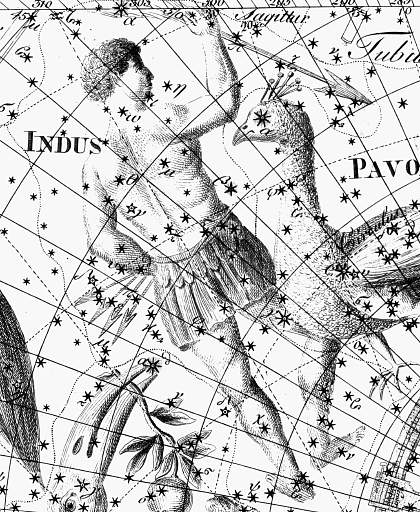
    Indus (constellation)Indus is a constellation in the southern sky. Created in the sixteenth century, it represents an Indian, a word that could refer at the time to any native of Asia or the Americas.

    Notable features

    The brightest star in the constellation, Alpha Indi, is visual magnitude 3.11.

    Epsilon Indi is one of the closest stars to Earth, approximately 11.82 light years away. The system has been discovered to contain a pair of binary brown dwarfs, and has long been a prime candidate in SETI studies.

    History

    The constellation was one of twelve created by Petrus Plancius from the observations of Pieter Dirkszoon Keyser and Frederick de Houtman and it first appeared on a 35-cm diameter celestial globe published in 1597 (or 1598) in Amsterdam by Plancius with Jodocus Hondius. The first depiction of this constellation in a celestial atlas was in Johann Bayer's Uranometria of 1603. Plancius portrayed the figure as a nude male with arrows in both hands but no bow.

    Indus in Military

    USS Indus (AKN-1) is a United States Navy ship.
    Indus the IndianIt is not known whether he is supposed to be a native of the East Indies, or possibly southern Africa or Madagascar (where the Dutch fleet stayed for several months on their way east); perhaps the figure is symbolic, representing all the indigenous peoples the explorers encountered on their various travels, from South America to the Indies. The constellation’s brightest stars are of third magnitude, but none are named.Comment:  For more on the subject, see Asteroids Given Luiseño Names.

    Below:  "Indus, an Indian holding a spear and arrows, as shown in the Uranographia of Johann Bode."

    November 28, 2010

    Kitt Peak Observatory on Tohono O'odham land

    Tribe paved way for stellar research

    A journey back in time to discover the roots of Kitt Peak observatory

    By Jacelle Ramon-Sauberan
    March 15, 1960, was a cool, clear day in southern Arizona. That morning, about 50 people drove up the winding road to the top of Kitt Peak, 56 miles southwest of Tucson. These scientists, politicians, military officers and members of the Tohono O’odham Nation had gathered to dedicate the country’s first national observatory.

    They listened to William W. Morgan, a professor of astronomy at the University of Chicago, deliver the official address. After the ceremony, the visitors ate lunch and toured the mountain.

    The dedication of the Kitt Peak National Observatory tied two cultures together—one with ancient roots in the Southwest, the other with modern eyes on the universe. Helmut Abt, an astronomer at Kitt Peak, played a key role in establishing a modern observatory on the Tohono O’odham’s (then called the Papago) ancestral homeland.

    “Kitt Peak observatory is very successful on the mountain, and they (Tohono O’odham) have gotten something in return,” Abt said.
    Comment:  For a more troubling observatory story, see Myopic Mt. Graham Observatory and University of Arizona vs. Apaches.

    April 08, 2009

    Asteroids given Luiseño names

    Observatory names three asteroids for tribal wordsThe Palomar Observatory is honoring the area's native people by using Luiseño words to name three asteroids discovered by one of its scientists.

    The asteroids, rocky objects less than a mile across that orbit the sun and sometimes cross the Earth's path, will be named after the words from creation stories from the Luiseño Indians, who live in the areas surrounding Palomar Mountain.

    The asteroids, discovered about 20 years ago, were recently named Tukmit, which means Father Sky, Tomaiyowit, which means Earth Mother, and Kwiila, or black oak, one of the First People descended from Father Sky and Earth Mother.

    In the creation story, the First People became all the people, animals, plants and inanimate objects of the earth.

    The asteroids were named with the help of the Pauma band, Luiseño Indians who began working with the observatory about two years ago as it was planning a casino expansion. Observatory staff members struck up a relationship with the tribe's education department.
    REGION:  Asteroids named in Luiseno language

    Discoverer says she wanted to honor local tribesBy giving three asteroids American Indian names, astronomers at the Palomar Observatory and tribal leaders said Tuesday they hope to spark new interest in an ancient local culture.

    The three asteroids discovered with the 200-inch telescope atop Palomar Mountain were named after figures in the Luiseno tribe's story of creation: Tukmit, Tomaiyowit and Kwiila.

    "As we try to teach our culture to our kids, this is very significant to us," said Chris Devers, chairman of the Pauma Band of Mission Indians, whose reservation is a few miles down the mountain in Pauma Valley.

    Devers said the Luisenos, the original inhabitants of Palomar Mountain and Pauma Valley, believed that Tukmit, or Father Sky, was made from nothingness and together with Tomaiyowit, Earth Mother, bore the first people.

    Kwiila, or black oak, was one of the first people in their creation story, he said.