Showing posts with label Chief Wahoo. Show all posts

July 09, 2014

SF Giants to ban headdresses?

Sell Out, Die, or Survive: What We've Learned From the SF Giants Fiasco

By April NegretteLast week at a San Francisco Giants game, I and a male friend, Kimball Bighorse, were thrown out of AT&T Park. We were not thrown out for being drunk and obnoxious towards other fans; nor for starting a fight or laying hands on anybody. We weren’t even thrown out for being that one person who doesn’t know you don’t touch a ball from the stands while it’s still in play. We were thrown out for telling a non-Native fan to take his costume headdress off, on “Native American Heritage Night” of all nights.

Although I wish this had been an isolated event of racism towards Native people, it’s only one of many examples of the issues we are trying to combat currently. Dan Snyder, owner of the Washington R*dskins, has stated that there are “real issues” and “real-life needs” of Native people that we should be focusing on, not this trivial name. He’s simultaneously right and wrong.

Of course there are other, more physical, needs of Native people. But how are we supposed to combat youth suicide rates, depression, and drug and alcohol abuse when our children grow up seeing themselves are as inferior and their cultures depicted as comical? How are we supposed to be taken seriously when trying to negotiate land, water and treaty rights when society views us as subhuman? High school students make posters for homecoming that say things like "Go Bulldogs, Beat the Indians." Without those land, water and treaty rights, how are we suppose to combat poverty and homelessness when we have no means to do so? You either sell out to American society and culture, you die, or you survive to fight another day.

Fighting another day to me looks like standing up in the face of ignorance and the misunderstandings because of our cultural barrier. It’s like what they say at the airport—If you see something, say something. I’m not saying to start a brawl or humiliate some stranger who doesn’t understand the implications of their actions; educate them instead. If you come at people from a loving place you are more likely to be heard. One man I approached actually took his headdress off—without me asking—and gave me a hug and thanked me for explaining it to him.
San Francisco Giants Made Colossal Error in Warbonnet Fiasco

By Andre CramblitThis year they seem to be doing well on the field. It is off the field that they have problems. Ironically on Native American Heritage Night two American Indians (April Negrette and Kimball Bighorse) were accosted by SF Giants security over a headdress that was being worn by a non-Native fan. They were wronged and physically harmed during this unnecessary and preventable event. Both parties should have been treated in the same manner by Security: Bighorse and Negrette should not have been the only participants to be forcefully handcuffed, detained, and asked to leave the game. I feel that Mr. Bighorse and Ms. Negrette, were punished for speaking out about the harms of Native mascotry while the true wrong-doers were allowed their dignity, their bodies and their well-being to be uninjured.

Native Americans should be able to not only attend events free of harmful cultural misappropriation, in addition to being able to speak out about the desecration of Native cultures, people, and sacred items. American Indians have the same right and protection of the 1st amendment, as do other US citizens. Additionally, we have the Indian Civil Rights Act and the American Indian Religious Freedom Act. These acts provide additionally support to Natives in exercising their rights. Speaking up should not have to be an act of courage.

Security for the Giants organization at ATT Park treated the parties involved in this dispute differently. Ignoring the concerns of the Native peoples involved in this incident highlights the lack of awareness around freedom of speech concerning Native Americans. It is my hope that the Giants organization will educate their personnel on how this has been an example of HATE SPEECH, as much as wearing blackface, and should be treated as such.
Below:  The headdress in question as photographed by Negrette.


Change in policy?

This incident could lead to a first in major league sports:

San Francisco Giants considering ban on culturally insensitive attire

By Erik BradyThe San Francisco Giants are considering a policy that could prohibit fans from wearing items such as fake headdresses in what American Indian activist Suzan Shown Harjo believes would be a first for a major-league sports franchise.

The proposed policy, which is still in the working stages, could potentially say that fans who wear culturally insensitive attire to games or use culturally insensitive language could be asked to stop by Giants security or potentially be asked to leave the stadium.

Staci Slaughter, Giants senior vice president, communications, and senior advisor to the CEO, said the Giants have policies about obscene language and offensive signs.

“We are considering expanding the policy to be more explicit about culturally insensitive signs and articles of clothing,” she told USA TODAY Sports.
A critic tries to question the proposed policy:

Without Feathers: The Flap Over Native American Regalia at the Ballpark Reveals a Deeper Hypocrisy

By Joe Eskenazi[I]n a hypothetical situation resembling the one on Native American Heritage Night, a ballpark ethicist is in for a challenge. If a person who appears to be a Native American and a person who appears to be some other race are wearing identical Native American outfits, would it be considered "arbitrary" to single out solely the second individual as "culturally insensitive"?

Perhaps so, says Moskovitz. "That might be deemed arbitrary. They're both expressing something. There's a vagueness problem."

That vagueness would allow the Giants to potentially take action against fans wearing just about anything. But, in all likelihood, the people wearing the most offensive clothing of all will get a free pass.

Giants' spokeswoman Shana Daum admits that, "given what transpired on Native American Heritage Night," ballpark policy was due for a change. So, what would happen if a fan gallivanted into the stadium wearing a shirt or a cap depicting a caricature of a leering, Indian Sambo with fire engine-red skin?

Well, Daum says, that could be a problem. "If it was offensive to someone in the park, we'd have to take a look," she says.

Well, it is offensive. To a lot of people in the park. And it's also the Major League-licensed logo of the Cleveland Indians.
Comment:  Eskenazi seems to think this change in policy would be difficult to enforce. But is it really a change? I bet the stadium security would object to shirts showing a lynched black man, an aborted fetus, Muhammad as a terrorist, a long list of racial and sexual epithets, etc. I'd be amazed if they were free-speech purists who let people wear literally anything.

What Eskenazi seems to object to is adding racist and stereotypical Native images to the (probable) class of banned words and images. Because he isn't used to thinking of his beloved Native icons as racist and stereotypical. Well, too bad for him. His ignorance of what constitutes a racist or stereotypical problem is his problem, not ours.

Case studies

Let's go through the hypothetical examples he offers.

Eskenazi's first case is easily answered. The issue is stereotyping Natives by wearing Plains headdresses. The vast majority of Natives aren't from a Plains culture. And if they were, they wouldn't have earned the right to wear a headdress anywhere, much less to a casual sporting event.

So it doesn't matter if the wearer is Native or not. In something like 99.99% of the cases, the person shouldn't be wearing a headdress, period.

A rule that correctly targets the 9,999 people out of 10,000 who shouldn't wear a headdress isn't "arbitrary." On the contrary, it's so well-defined and precise that it may be the least arbitrary rule in the stadium.

Again, don't wear a headdress unless you're a Plains Indian who's earned the right to wear one. That includes any young non-Plains Indians who think it's hip to wear one.

Eskenazi's second case is the interesting one. Should the Giants ban apparel with Chief Wahoo logos? I'd say yes, because they're racist and stereotypical.

But I doubt the Giants would agree. They suffer from the same myopia as the Cleveland Indians and everyone else in Major League Baseball. That will change as the protests against Chief Wahoo continue.

June 25, 2014

Chief Wahoo faces trademark lawsuit

Native American Group Mounts $9B Lawsuit Against Cleveland Indians

By Dan KedmeyA Native American advocacy group called “People Not Mascots” is seeking $9 billion in damages against Major League Baseball’s Cleveland Indians.

‘We’re basing it on a hundred years of disparity, racism, exploitation and profiteering,” Robert Roche, the group’s leader, told CBS News’ Cleveland affiliate. Roche decided to press the issue after the U.S. Patent and Trademark Office stripped the Washington Redskins of its trademark last Wednesday, deeming the team name a “racial slur.”

The lawsuit will also target the team’s logo and mascot, Chief Wahoo. “It’s been offensive since day one,” said Roche. “We are not mascots. My children are not mascots. We are people.”

The campaign to remove Native American caricatures from team names and logos has built up steam in recent weeks, with 50 Senators petitioning National Football League commissioner Roger Goodell to change the name of the Redskins. The Redskins vowed to appeal the USPTO ruling.
Washington Redskins' trademark revocation means Chief Wahoo is on borrowed time--Bill Livingston

By Bill LivingstonIn 1992, the Indians' last season at their Tucson training camp, I visited an Indian reservation near Hi Corbett Field, carrying a team schedule with Wahoo on it to see what they thought of him.

It was not much.

The March 15, 1992 column, written from the Yaqui reservation, is not available online, although it can be found in The Plain Dealer historical archives online.

"Yes, I feel resentment. Very much so," said Anselmo Valencia, the then 70-year-old chief of the tribe. "Do I look like that? Do my people? Some of the older people here, when they first heard of the Cleveland Indians, were very proud. They thought they were all real Indians. When I told them they are almost all white people and black people, they were very offended."

Valencia spoke of the rock singer Ritchie Valens, who was almost certainly part-Yaqui, and of the light heavyweight boxer, Yaqui Lopez. "Our young people do not worship our own heroes," he said. "They see Indians portrayed in a comical way by baseball teams and other sports."

The Cleveland Indians never meant Wahoo to be offensive, of course. But, on Indian land, speaking to a real chief, asking real Indians what they thought of him, I felt deeply embarrassed.

No such stereotype could possibly exist of African-Americans or Hispanic men. They have the votes at the ballot box. That makes Wahoo a case not only of racism, but of bullying.
Comment:  Among Indian team names and mascots, the biggest offenders include Chief Illiniwek, the Fighting Sioux, the Washington Redskins, and Chief Wahoo. That's two down, two to go.

May 04, 2014

#Dechief Nike Twitterstorm

Nike's continuing sales of Chief Wahoo apparel and its failure to heed a Native protest led to another "Twitterstorm" of criticism.

Nike Responds to EONM ProtestIn a protest outside Nike headquarters in Beaverton, Oregon, on May 1, at least 15 protestors stood in front of the Nike swoosh image and held signs up saying “Nike No Wahoo” and the word “Racist” with Wahoo’s logo above the word. EONM also started a social media campaign on Twitter with the hashtag #Dechief and launched the Facebook event page “#Dechief Nike Twitterstorm.”

“We ask that Nike live up to its dedication to inclusion,” said the groups' co-founder Jacqueline Keller. “Profiting from Native Mascotry is not being diverse; it is not being inclusive. Selling items, such as a zip-up jacket, that is dually marked with ‘Chief Wahoo’ and the Nike ‘Swoosh’ makes a powerful allied statement about Nike's stance. It strongly suggests that Nike is excluding legitimate Native American concerns about the derogatory and offensive nature of Native stereotyping.”

Keeler's group plans to target companies that produce offensive gear and team owners, like Dan Snyder, who allow the use of Native imagery.

“The fact that Nike is selling items that feed into the hostility toward Native Americans is really troubling," Keeler said in a news release. "Major businesses profit off of caricatures of our people. It would not be acceptable for any other group to be portrayed like this."
Redskins not only team targeted for Indian nickname

By Erik BradyDennis Brown meticulously unstitched the Chief Wahoo emblem on the sleeve of his Cleveland Indians jersey a night before leaving to visit their spring training camp in March, mixing fashion statement with political manifesto.

The longtime Cleveland sports fan tweeted a picture meant mostly for his friends, as he had few followers. But re-tweets gave the missing logo larger circulation, where it struck a nerve. Angry Clevelanders called Brown a traitor and a moron and, oddly, a communist.

It wasn't just that Brown had "de-chiefed" the jersey—his term of art. The real power of the image resides in the outline of emptiness of the threads left behind. The mind's eye can still see the big-toothed, idiot-grinning, red-faced caricature, even if all that actually remains is its ghostly outline.

A grass-roots movement inspired by Brown gained momentum on social media over the weekend as thousands using the hashtag #DeChief called on the Cleveland team to retire Chief Wahoo—and on Nike to stop producing merchandise with that logo. Jacqueline Keeler, a founding member of an activist group called Eradicating Offensive Native Mascotry, said her group borrowed the DeChief idea from Brown and called on fans to make it a trending topic on Twitter. The hashtag was used 4,236 times from noon Saturday to noon Sunday.
A tiny sample of the Nike-related tweets:

.:Mags Uncivilized.: ‏@Creekleo May 4
#DeChief #Nike because many folks don't know Native Americans actually exist here and now! #NotYourMascot

☀️LadyJudi ✌️ ‏@LadyJudi May 4
So for @Nike to sell @Indians Wahoo gear goes against those values of the N7 fund and shows it is about the $ and not the people #DeChief

BlueCornComics ‏@bluecorncomics May 4
The logical conclusion of @Nike's argument is that they'd sell any derogatory mascot if asked to do so. #dechief http://eonm.org/2014/05/native-americans-respond-to-nikes-refusal-to-stop-selling-chief-wahoo-products/

May 02, 2014

Nike rebuffs Chief Wahoo protest

Nike responds to Chief Wahoo protest

By Matthew KishNike on Friday issued a statement in response to a Native American group that wants Nike to stop selling merchandise with the Chief Wahoo logo of the Cleveland Indians.

The group protested Thursday outside the Nike headquarters in Washington County.

"Nike has a contractual partnership with Major League Baseball as the licensing agent for MLB team-approved marks," Nike said in the statement. "Each MLB team is responsible for choosing their team logos and marks and we understand that the Cleveland Indians are engaging their fans and the local community in conversation concerning their logo.

"Nike has a long history of supporting the Native American community and we encourage the teams and leagues to engage in constructive dialogue with their communities."

Nike is known for its commitment to diversity.
I doubt Nike's reply satisfied anyone, as a few tweets suggested:

BlueCornComics ‏@bluecorncomics May 2
@jfkeeler Not a great response. Nike could challenge MLB themselves rather than wait for Natives to do it. Every contract has loopholes.

BlueCornComics ‏@bluecorncomics May 2
@richardkoyd @jfkeeler Natives have protested Chief Wahoo for 40+ years. What's Nike's excuse for signing the contract in the first place?

BlueCornComics ‏@bluecorncomics May 2
@jfkeeler Obviously, no sports team or supplier (Nike) cared about anti-mascot sentiment until Natives like you began protesting loudly.

Mike Wise ‏@MikeWiseguy May 3
@EONMassoc @Love2BFree2BMe It's like opening a foundation so brand survives. N7 gives them enough goodwill to still profit off a slur.

Nike statement on Chief Wahoo notes Major League Baseball contract

By Allan BrettmanNike's history of supporting the Native American community includes the N7 Fund, started in 2000 to support health promotion and disease prevention programs. Proceeds from the products designed through N7 are given to youth sport and physical activity programs in Native communities across North America through the N7 Fund. The fund has raised more than $2 million.

Jacqueline Keeler, a Portland woman who is spokesperson for the Native group, responded to Nike's statement Friday with a written statement saying, "We feel Nike's argument makes no sense because the logical conclusion to it is that they would sell any derogatory mascot if asked to do so no matter how badly it reflects upon their brand."

Keeler's statement also says the Native community in Cleveland "has been outspoken on the issue of Chief Wahoo for 45 years and the opinions of the community have been ignored and no meaningful dialogue has occurred. This despite the National Congress of American Indian's (national organization that represents the majority of Native people in the United States) calls since 1969 to stop the use of Native Mascots, especially Chief Wahoo which is a horrible caricature that dehumanizes Native people."
Native Americans Respond to Nike’s Refusal to Stop Selling Chief Wahoo Products

For more on Chief Wahoo, see Natives Demand Nike "De-Chief" and Chief Wahoo Hurts Bottom Line.

April 30, 2014

Why no NFL crackdown on racism?

As expected, critics have noted the contrast between the NBA's ban on Donald Sterling and the NFL's embrace of Dan Snyder:

Members of Congress link NBA’s Sterling controversy to NFL’s debate over Redskins

By Aaron C. DavisA victory over racism in the NBA? How about the NFL and the Redskins? That’s the link made Wednesday by members of Congress who are set on forcing the Washington team to abandon its controversial name.

Del. Eleanor Holmes Norton (D), the District’s nonvoting member of Congress, sought to capi­tal­ize on the National Basketball Association’s swift action against Los Angeles Clippers owner Donald Sterling, saying the National Football League could learn a lesson about dealing with racism in its ranks.

Norton called on NFL Commissioner Roger Goodell to follow the “moral example” of NBA Commissioner Adam Silver, who on Tuesday banned Sterling for life from the league over comments about African Americans.

“It shows a big difference between two major sports leaders,” Norton said in an interview. “One was willing to act and clearly separate his league from racism. The other is appearing to condone it by not even requesting [Redskins owner Daniel] Snyder to change the name.”

Senate Majority Leader Harry M. Reid (D-Nev.) went further, saying that national outrage should now be directed toward the NFL for its refusal to change the name of the Washington Redskins.

“How long will the NFL continue to do nothing—zero—as one of its teams bears a name that inflicts so much pain on Native Americans?” Reid asked.
The NBA won't tolerate racism, so why does the NFL tolerate 'Redskins'?

By Chris Feliciano ArnoldIf the NBA is finally willing to take a stand against owners spewing racist bile in private conversations, how can the NFL continue to defend Daniel Snyder, the owner of the Washington Redskins, which continues to use a name and logo widely seen as disrespectful to Native Americans? Oh yeah, money. Washington’s team was ranked third on Forbes’ list of the most valuable NFL franchises in 2013 with an estimated worth of $1.7 billion.

Granted, Sterling and Snyder are not a perfect bigot-to-bigot comparison. Sterling’s 19th century plantation worldview is especially stomach-churning given that African Americans represent the majority of the NBA’s players, stars and legends—and a vital fan base. Snyder, on the other hand, is free to profit from racial exploitation of a people who remain among the most marginalized in our society. (One problem is the lack of Native American representation in the NFL. According to 2013 data, Native American representation among league management is well below 1%, with similarly low numbers among players, coaches and management across the league.)

The Sterling debacle should give NFL Commissioner Roger Goodell inspiration to emulate Silver. While the term “redskin” is relatively innocuous in its historical context, time has rendered it a relic that reinforces offensive Wild West stereotypes. A white billionaire’s determination to exploit those stereotypes reduces years of genocide against Native Americans to a crude exercise in branding. The name has incited debate for more than 20 years, but the NBA’s action against Sterling opens the door for Goodell to leverage his power and demonstrate that no single franchise, no matter how profitable, trumps the values of the entire league.

If that were the happen, the Sterling circus could usher in a better era in American pro sports, pressuring other franchises to follow suit by retiring names and mascots like the Cleveland Indians’ “Chief Wahoo,” a gross caricature that has been protested for years.


NBA Rejects Racism, MLB And NFL Continue Their Silence

By Chris WeigantThe Cleveland Indians seem to be slowly getting rid of this blatantly racist image, and replacing it with a block letter "C." But the image still appears on the Indian's official homepage, and still appears on team uniforms and team merchandise sold to the public. Why is this not considered universally unacceptable, when a basketball team owner just got a lifetime ban for something he said in private to his girlfriend?

The Washington Redskins and Chief Wahoo are not something said in private. They are as public as it gets. Millions of dollars are made each year by the sale of merchandise with these names and logos prominently appearing. Yet the leagues do nothing.

It's not like they are unaware that people are offended, either. The Redskins are in a legal battle against a group which is trying to get their trademark revoked (for being patently offensive), and members of Congress have weighed in on the controversy by asking the team owner to change the name. The Redskins are well aware of the problem. The team owner refuses to budge. The league remains mostly silent. Silence, in this instance, equals consent. Why is blatant racism unacceptable when directed against African Americans but acceptable when directed against Native Americans? You'll have to ask the leaders of the NFL and MLB, because I have no answer to that question.

There are other team names and logos which use Native American names and images (the Chiefs and the Braves, to name two). However, the Redskins and Chief Wahoo are the worst examples. The Braves retired their mascot ("Chief Noc-A-Homa"... get it?), but still do an awfully offensive "tomahawk chop" chant at their home games.
First Nations and the repugnant, racist side of pro sports

By Michael BabadTo recap, the National Basketball Association won justifiable praise this week when it banned Donald Sterling, the owner of the Los Angeles Clippers, for racist comments about African Americans in a private conversation caught on tape and made public.

This wasn’t lost on First Nations, who have long suffered open racism as society tolerates pro club names like the Washington Redskins, the Atlanta Braves and the Kansas City Chiefs.

Not to mention the Cleveland Indians and their repugnant caricature of a smiling Chief Wahoo. The club has now playing up a new logo–a big C–but reportedly the other will still exist.

There is pressure on Washington to change the club’s name, but there’s no sign of that happening. Indeed, owner Dan Snyder has reportedly said he won’t.


No tolerance for racism (against blacks)

Some thoughts on why black players spoke out against Sterling:

Sterling's Comments, Snyder's Condescension: Two Sides of Same Coin

By Jacqueline KeelerWhen comparing the differences in response to the NBA’s banning of racist L.A. Clippers owner Don Sterling to NFL Commissioner Goodell’s support of Washington Redsk*ns owner Dan Snyder, we must look at the ways in which racist stereotyping of Native people is seen as more acceptable than that of African Americans and other ethnic groups in the United States. We also must look at why Black players and sponsors do not take racism against Native people as seriously as racism against other Americans. We must ask, Why is it okay for Dan Snyder to talk down to Native concerns about using a racial slur as the name of his team and for our fellow Americans of color to ignore us?

When Snyder says, “WE’LL NEVER CHANGE THE NAME. It’s that simple. Never—you can use caps,” and Sterling says “We live in a culture, we have to live within that culture. I DON’T WANT TO CHANGE,” we are looking at two sides of the same coin. It is in direct contrast to President Obama’s refrain from his 2008 election night acceptance speech, “Change is coming to America.” An America built on the invention of the very concept of “race” to uphold the dual practices of slavery and land theft that lies at the very foundation of this colonial-settler country that is now threatened by a Black President, Black athletic excellence and success and Native people asserting control over their representations in the media and in sports.

Cliven Bundy wondered in a taped interview if Black people “were better off as slaves” and accused them of being welfare freeloaders--Cliven Bundy, a white man who has been grazing for free for 20 years on land half the size of Rhode Island and owes the U.S. one million dollars in fees and fines. You can see how little many in the United States have moved on from the Civil War, the rupture that was the first real attack on the slavery/land theft complex that birthed this country.

I thought a lot about the differences in American perspectives—particularly those of Black Americans, like the Washington Redsk*ns player DeAngelo Hall, who said earlier this year in an interview with Mike Hill of Fox Sports, “They probably should [change the name], but they won’t for awhile at least.” He then backtracked on this rather tepid support of Native American concerns after ostensibly receiving pressure from Snyder, saying, “I can’t claim to understand where they’re coming from or their viewpoint, so for me to say what’s right or wrong or what should be changed is out of my pay grade. That decision ultimately--you know me, all teammates and I have stayed away from this topic. It’s one where you really can’t be right.”
Short version: Because America has repudiated explicit racism against blacks but not Indians.


Bad people vs. flawed system

And some thoughts on why many people spoke out against Cliven Bundy and Donald Sterling:

This Town Needs a Better Class of Racist

It's easy for polite American society to condemn Cliven Bundy and banish Donald Sterling while turning away from the elegant, monstrous racism that remains.

By Ta-Nehisi Coates
The problem with Bundy isn't that he is a racist but that he is an oafish racist. The elegant racist knows how to injure non-white people while never summoning the specter of white guilt.

The problem with Cliven Bundy isn't that he is a racist but that he is an oafish racist. He invokes the crudest stereotypes, like cotton picking. This makes white people feel bad. The elegant racist knows how to injure non-white people while never summoning the specter of white guilt. Elegant racism requires plausible deniability, as when Reagan just happened to stumble into the Neshoba County fair and mention state's rights. Oafish racism leaves no escape hatch, as when Trent Lott praised Strom Thurmond's singularly segregationist candidacy.
And:Like Cliven Bundy, Donald Sterling confirms our comfortable view of racists. Donald Sterling is a "bad person." He's mean to women. He carouses with prostitutes. He uses the word "nigger." He fits our idea of what an actual racist must look like: snarling, villainous, immoral, ignorant, gauche. That the actual racism that Sterling long practiced, that this society has long practiced (and is still practicing) must attract significantly less note. That is because to see racism in all its elegance is to implicate not just its active practitioners, but to implicate ourselves.

How can it be that in a "black league," as Charles Barkley calls the NBA, an on-the-record structural racist like Donald Sterling was allowed to thrive? Everyone now wants to speak to Elgin Baylor. Where were all these people before? Where was Kevin Johnson? Where was the Los Angeles NAACP? When Donald Sterling was driving black tenants out of his buildings, where was David Stern?

Far better to implicate Donald Sterling and be done with the whole business. Far better to banish Cliven Bundy and table the uncomfortable reality of our political system.
Comment:  This applies to the Washington Redskins, Chief Wahoo, and other examples of sports stereotyping. "They didn't mean any harm," people tell themselves about the offenders. "They didn't attack or insult Indians. They're just thinking about their teams, their fans, and 'tradition.' As long as no one's compared to a slave or treated like an animal, what's the problem?"

And so the racism in America continues. Perpetuated by people who assure themselves they aren't racists. "It's bad people like Bundy and Sterling who are the problem, not me."

For more on the subject, see What Bundy and Sterling Tell Us and First Sterling, Then Snyder?

April 28, 2014

Natives demand Nike "de-chief"

Native Americans Demand Nike “#Dechief”–Stop Selling Grotesque “Chief Wahoo” ProductsEradicating Offensive Native Mascotry, a group of Native parents and their allies from across the country are calling on Nike, Inc. to stop selling products that feature the Cleveland Indians’ mascot Chief Wahoo. EONM has launched a Facebook event page “#Dechief Nike Twitterstorm” to trend the Twitter hashtag #Dechief and demand Nike remove the grotesque caricature, Chief Wahoo Nike from its products.

“Dechiefed” hats, jerseys and jackets of Cleveland fans have been featured on social media where photos of team gear with Chief Wahoo removed are posted accompanied by the hashtag #dechiefwahoo.

The groups asks that Nike live up to its dedication to inclusion, “We want it [diversity and inclusion] to drip over everything Nike does!” and follow the Cleveland fans’ lead and “dechief” their own products. It should be noted that even the Cleveland team, itself, has substituted a red letter “C” for Chief Wahoo on its uniforms.

Profiting from Native Mascotry in not being diverse; it is not being inclusive. Selling items, such as a zip-up jacket with the “Chief Wahoo” and the Nike “Swoosh” makes a powerful statement about Nike’s stance, according the leaders of the group.


Native American group asks Nike to stop selling Chief Wahoo gear

By Allan BrettmanThe news release also notes that Nike sells branded merchandise for the Washington, D.C., football team and Florida State University, both of which use Native imagery.

The news release says the group Eradicating Offensive Native Mascotry “will be holding local protests at the Nike World Headquarters this week in Beaverton, Oregon and conducting a social media campaign to trend the #Dechief hashtag begun by Cleveland Indians fan Dennis Brown."

The release was written by Jacqueline Keeler of Portland, who in April wrote an article in Salon.com, "My life as a Cleveland Indian: The enduring disgrace of racist sports mascots."

Neither Nike nor the Cleveland Indians responded to requests for comment Monday.

Keeler said in a follow-up email Monday morning that the organization has more than 600 members in a Facebook group. She said the group also has received support from the National Congress of American Indians and from Asian American allies at 18 Million Rising and Hyphen magazine.
Comment:  For more on Chief Wahoo, see Chief Wahoo Hurts Bottom Line and 42nd Annual Chief Wahoo Protest.

April 16, 2014

Chief Wahoo hurts bottom line

Following the 42nd Annual Chief Wahoo Protest, some arguments against the stereotypical mascot:

The Wahoo debate has changed, but where do the Indians stand?

By Craig LyndallThere’s something vastly different about the Chief Wahoo debate this year. The protests have been going on at Opening Day for years, but the movement spawned a new arm since last season. There’s a new @DeChiefWahoo Twitter account that doesn’t have a ton of followers, but don’t be mistaken: This debate has moved beyond those activists directly impacted and into the fan base. Last week, I spoke with Brian Spaeth about the film he was making at the, but he never even had a chance to get any footage out before a photo from the scene by Peter Pattakos of Cleveland Frowns went viral. This site and others have talked about the Cleveland Indians and Chief Wahoo plenty already, so I’ll skip covering that same ground again. There’s one overriding feeling that I can’t help but focus on: The Cleveland Indians—most notable the Dolan family—is failing to lead on this issue.

I can’t figure out how this will ever end well for the Dolan family. By sitting in the background and seemingly waiting for the world to impact them, they’re failing to control the message. Just this morning, it’s being reported on NPR that ESPN has removed Chief Wahoo as an image by which they might use to talk about the team. Check another box for someone other than those most responsible for Wahoo having more of a stance. The Indians have taken an issue and decided pretty much not to have a stance on it at all. It’s a failure by the Cleveland Indians. They’ve lost control of the message. In fact, they don’t have a message at all and it will be a bigger and bigger problem going forward.
Native Mascots: Cleveland Is Not Rocking, Neither is Kansas City, Washington, Atlanta

By Todd BennettTo wear this garb is to disavow knowledge, easily discovered, that proves Native Americans were systematically persecuted. It is to ignore the messages of peace, and the contributions to farming, and the myriad survival techniques that were based on respect for all of God’s creatures, not just the capitalistic. It would not be acceptable to have a mascot of an African American man wearing a gold tooth and name your team the Thugs, or a Mexican with sunglasses and name the team the Cartels, so why is portraying natives to be savages acceptable? It isn’t.

The tragedy of stereotypes is not just the prejudice they foster, but the beautiful truths they obfuscate. If you want to make a respectful mascot based on the culture of a fascinating and by and large peaceful people, a screaming savage is not where you start. If you want to accurately portray the vast majority of Native American culture in one symbol, don’t start with an arrow, start with a big, red, striking …

Heart.


The bottom line

The Cleveland Indians’ controversial mascot is hurting their bottom line

By Jeff YangTripathi and Lewis began their project by exploring the direct financial impact on teams that break with tradition by changing a mascot, starting with an analysis of college athletics, for which they had a much larger sample pool.

“In college basketball, you have quite a few teams that originally had a Native American mascot, but at some point decided to abandon it,” says Tripathi—including Illinois and Stanford, but also many others, like Syracuse, whose mascot from 1931 to 1978 was an “Indian Chief” called the “Saltine Warrior”; St. John’s, who were nicknamed the Redmen from the 1920s until 1994, and who had a Native American mascot through the ’60s and ’70s; Marquette University, which retired its mascot “Willie Wampum” in 1971, and renamed their team from the Warriors to the Golden Eagles in 1994; and Miami University of Ohio, which in 1997 went from the Redskins to the RedHawks.

“Given that we were doing a statistical model, it made sense to start with colleges, because we had tons of schools to work with,” says Tripathi. “And we also had great data: In the NCAA, because of Title IX, teams have to put all of their revenue data out there in public.”

What Tripathi and Lewis found was that, after accounting for factors like a team’s past performance, market size, and median income of the schools’ fanbases, in the short term, teams that eliminated a Native American mascot experienced a small, measurable revenue hit—but over the long term, the decision ended up boosting a school’s revenue. They surmised that this was due to a number of factors, including the elimination of negative publicity, expansion of the potential fan base, and subsequent implementation of new mascots with greater merchandising power.
Study: Teams with Native American mascots end up losing millions

By Kenley YoungIf negative public opinion about Native American mascots can't dissuade pro sports teams from using them, then maybe a study about the money they're losing because of those mascots will change their minds.

Just how much? It's apparently in the millions of dollars, according to research from Emory University.

It's a lot to go through, but the website Quartz summarizes it this way:Examining the financial performance over the past dozen years for four teams--the Kansas City Chiefs and the Washington Redskins in the NFL, and the Atlanta Braves and Cleveland Indians in Major League Baseball--revealed the eye-opening result that having a Native American mascot appears to cost professional sports teams millions of dollars in annual revenue--at least $1.6 million per year in the NFL, and $2.6 million per year for MLB's Braves and Indians.
Comment:  So...whether the argument is moral or financial, supporters of Chief Wahoo and other Indian mascots lose. There's literally no excuse for keep these racist caricatures.

April 04, 2014

42nd annual Chief Wahoo protest

Native Americans, others protest Indians’ logo

By Associated PressAs excited baseball fans, many of them wearing Cleveland’s smiling Chief Wahoo logo, headed into Progressive Field for Friday’s home opener, a smaller group stood by unable to share their enthusiasm.

Holding hand-painted signs that read, “We Are Not Honored,” and “Our Children Are Not Mascots,” a contingent of Native Americans and some of their supporters demonstrated against the Indians’ use of their red-faced Wahoo logo.

The protesters, who have been gathering outside the ballpark’s entrances on opening day for years to voice their displeasure about the team’s use of the long-standing logo, stayed behind barricades as Indians fans walked by for the game against the Minnesota Twins.

Robert Roche, executive director of the American Indian Education Center, is adamant the team should abolish the logo permanently.

“The issue is simple,” said the 66-year-old Roche, his hair braided with white threads. “We are not mascots. I’m nobody’s mascot. My children are not mascots. It mocks us as a race of people. It mocks our religion.”
But it was one particular face-off that kicked this story into high gear on the Internet:

Redface has another big day at the ballpark in Cleveland

By Cleveland FrownsAbout 45 minutes before the first pitch of the Cleveland Indians’ home opener on Friday against the Minnesota Twins, I took the below photo just outside of Gate C at Progressive Field, where a protest against the Cleveland team’s name and Chief Wahoo logo was being held by a group organized by the local chapter of the American Indian Movement (AIM).

Pictured at left is Robert Roche, a Chiricahua Apache tribe member, AIM member, Executive Director of the American Indian Education Center in Parma, Ohio, and more. At right is Cleveland Indians baseball fan Pedro Rodriguez, who is not a Native American.

Shortly after snapping the photo I posted it to the Cleveland Frowns Twitter account from where it was quickly picked up by a number of national outlets, including Deadspin, Fox Sports, NBC Sports, SB Nation, Sports Illustrated, USA Today, and Yahoo. Scene’s Sam Allard, who also witnessed this confrontation, posted some pictures of his own along with a first-person account and roundup of responses to the anti-Wahoo protesters.


"It's Not Racist!" And Other Responses to Wahoo Protesters at Home Opener

By Sam AllardThe crazy thing about this afternoon's protest in general and the encounter above specifically was the lengths to which the Pro-Wahoo crowd is prepared to go (and here I primarily mean logical lengths) to deny the legitimacy of those offended by the logo.

The staunch, redfaced Rodriguez refused to acknowledge that the Native American man standing before him—Robert Roche, of the Apache Nation—could possibly take offense. Rorche literally told him he was offended by Chief Wahoo and the use of tribal feathers and redface, and Rodriguez just kept shaking his head.

It's actually a shame for the civil Wahoo supporters that their comrades put on such an embarrassing and primitive display this afternoon. Only twice in three hours did Pro-Wahoo folks talk politely with the protesters about the root of their opposition and try to explain their own difficulties with the dehumanizing logo. (One man turned his Wahoo hat around as a little peace offering).

For the most part, though, passers-by hurled insults. A handful of boozy risk-takers sporting "Keep the Chief" tees walked directly in front of those holding signs, to taunt. Others distributed individual middle-fingers to each protester while inviting them to fuck themselves. Others launched the familiar hate speech—"Go back to the reservation," etc.
Cleveland American Indian Education Center’s Robert Roche: “Don’t Honor Us!”

By Levi RickertRobert Roche has been involved with the Cleveland urban American Indian organization since his college days some 45 years ago. He is now the executive director of the American Indian Education Center, which once was the Cleveland American Indian Center.

As a young man, he met American Indian Movement leader Russell Means, who was running the Cleveland American Indian Center then. He became good friends with Means. Even way back then the American Indian community in Cleveland opposed the name of the Cleveland major league baseball name. The organization filed a lawsuit to have the name changed.

Fast-forward to this past Friday, Roche was still fighting the name. Roche is Chiricahua Apache, the tribe that produced the likes of Geronimo and Cochise.
Video: AIM's ‘Chief Wahoo’ Protest Fights Fans' BacklashThe protest against the Cleveland Indians’ logo, Chief Wahoo, continued in Cleveland yesterday and was captured in a 26-minute video.Chief Wahoo's Waterloo: A Photo from Protests Outside the Indians' Home Opener Goes Viral and the Debate Over the Team's Logo Grows

Photo goes viral

Am I a prophet? A time-traveling cartoonist? (toon, photo)

By Lalo AlcarazOne of my preferred topics for editorial cartoons has always been American mistreatment of indigenous people. Nothing makes me feel better than dreaming up a solid cartoon that reminds us all about the sordid history of our country’s crimes against Indians. The only thing more satisfying is seeing my ideas validated.

This weekend POCHO Florida Burro Jefe Santino J. Rivera sent me a “heads-up” about a Tweet featuring one of these editorial cartoons. I clicked the link and just about fell out of my chair.

The graphic in the Tweet was a side-by-side presentation of my cartoon showing a Native American confronting an Indian-mascot-garbed sports fan next to a photograph of a Native American confronting an Indian-mascot-garbed sports fan (image, above.)

They are eerily similar. The strange part was that I drew my cartoon in 2002, and the photo was taken last week in Cleveland, home of the Cleveland “Indians.”


My tweet on the subject:

Cleveland Wahoo fans say they're not to blame. They're just imitating Indians like Heidi Klum, Christina Fallin, Harry Styles, Cher, et al.

If seeing a redface caricature face to face with a real Indian doesn't do the trick, nothing will. These articles and images should convince everyone that we're never going to talk people out of their racist beliefs.

Mascot supporters are blind, deaf, and dumb to their own ignorance. They can't argue the facts so they argue their emotions. They're like Christians, children, or dogs whose basic argument is "Because!" (The dog barks his answer, but that's what it amounts to.)

Or as I wrote to one Wahoo lover:

Really? You think protesting this horrible racist stereotype is a matter of "political correctness"? What would it take for Cleveland fans to admit that something is racist: a massacre or lynching with bodies?

What we need to do is influence the media and shame the corporate masters, including advertisers. They're the ones who can stand aloof and make semi-rational decisions.

April 02, 2014

De-Chiefing the Cleveland Indians

As another baseball season begins, activists are gearing up to give Chief Wahoo the same treatment they've given the Washington Redskins.

100 Years of Insult: Ban the Cleveland Indians Name and Logo

By Michelle JacobsWords are powerful because they conjure images and ideas. The “Indians” team name was adopted because it evoked particular meanings for sports enthusiasts--aggression, bravery, dedication, and pride. Such images of American Indians seem honorable when American history is ignored. The fact is that references to Indian “aggression” were used to justify the genocide and colonization of U.S. indigenous peoples. That reference now puts a different spin on the use of “Indians” as an athletic team name--one that exists alongside aggressive animals, like Lions, Tigers, and Bears.

Calling Cleveland’s professional baseball team the “Indians” does not only equate American Indian people with ferocious animals in the symbolic realm. It affects the everyday lives of American Indians because stereotypical ideas about Indians, embedded in the culture for hundreds of years, have replaced genuine concerns for the identities, communities, and cultures of American Indian people. The treatment of American Indian protestors outside the Cleveland baseball stadium illustrates this point. Protestors witness first-hand how the purportedly "harmless" team name causes baseball fans to callously disregard the history and humanity of American Indian people. They angrily yell insults like "Go back to where you came from!" and "We won, so get lost!” at protestors. They also don feathers and face paint for entertainment purposes, although these items are sacred to American Indian people. Fans supporting their much adored “Tribe” simultaneously snub their noses at (or flip the bird to) actual Indians struggling to convey a simple message: We are people, not mascots.
Time to banish all Native American mascots, including Chief Wahoo

By Cynthia ConnollyConsidering the Cleveland Indians name began just 25 years after the Wounded Knee Massacre, I’m not entirely sure what part of history this mascot (Chief Wahoo) is trying to honor. To put this into perspective, there will never be a time when it’s OK for sports teams in Germany to be called the Jews.

In a 2012 interview, Bob DiBiasio, Senior Vice President of Public Affairs for the Cleveland Indians commented that fans do not associate the logo with actual Native Americans. He stated, “When people look at our logo, we believe they think baseball.” This is troublesome considering it is impossible to honor a group of people if one does not even think about them. DiBiasio’s statement makes it clear that the mascot is not intended to honor or represent anything; it is simply a brand and marketing tool for Cleveland baseball.

However, Native people cannot afford to serve as the brand for sports teams. Not when in 2010 the Pine Ridge Reservation declared a state of emergency due to unprecedented youth suicide rates. Not when Native women are 2.5 times more likely to be raped. Not when Natives have the highest poverty rate than any other race in this country.

The use of Native mascots generates a great deal of apathy, making it difficult for anyone to take our socio-economic issues seriously when all they know are costume headdresses, the tomahawk chop, and Chief Wahoo. We simply cannot allow America use our name and image whenever and however they choose for their entertainment. Especially when they don’t even think of us. They only think of baseball.


Words plus action

People aren't just analyzing why Chief Wahoo and other mascots are wrong, they're taking action:

Cleveland Councilman Zack Reed says Chief Wahoo is the 'red Sambo,' calls for city to ban logo from public spaces (VIDEO)

By Leila AtassiCleveland City Councilman Zack Reed is calling for the city to ban the display of the Cleveland Indians’ mascot Chief Wahoo on public property, arguing that the grinning, Native American mascot is the red equivalent of the racist, turn-of-the century “Sambo” caricature.

During the miscellaneous comments portion of Monday night’s council meeting, Reed said that he has been barraged by emails and phone calls from worldwide associates since the seemingly perennial controversy over Wahoo erupted in the news in recent weeks. The world outside of Cleveland, Reed said, sees Wahoo as an unquestionably racist and demeaning icon.

“(Wahoo supporters) may say that inside Cleveland, 90 percent say ‘keep it,’” Reed said. “But they don’t tell you that outside of our footprint, the vast majority of people believe it should go.”
And:Johnson pre-empted the usual criticism that city officials should spend their time worrying about more pressing matters, such as “homicides, chuckholes and empty houses.”

He said that he remembers when society made the same arguments about Sambo and Jim Crow and other racially denigrating iconography.

But today, after the great sacrifices made in the name of the Civil Rights movement, “no one would dare place an African American caricature on a sports team,” he said.

“So is this as important as homicides?” Johnson said. “Yes. Because it deals with the death of character and the disrespect of a people. Even if they don’t find it insensitive, I do. And that’s why I think it’s time to retire Chief Wahoo.”
Hail To De-Chiefing

Some fans are quietly removing Chief Wahoo logos from apparel they've bought

By Paul Lukas
The Cleveland Indians' home opener is Friday afternoon, and many fans will no doubt show up wearing Indians jerseys and caps. But at least some of those fans may be wearing Indians gear that they've modified in a very specific way: by removing the Chief Wahoo logo.

This is the "de-Chiefing" phenomenon, a form of silent protest by a small but growing number of Indians fans who love their team but are opposed to the Wahoo logo, which they view as an offensive caricature. They say they're not accusing pro-Wahoo fans of being racists or telling them what they should or shouldn't wear. They've simply made a decision not to wear the Chief themselves.

De-Chiefing has been taking place under the radar for at least a few years now, and it's not clear who started it. But the practice first began attracting public attention a few weeks ago, when an Indians fan named Dennis Brown was preparing to visit the team's spring training facility in Goodyear, Ariz., and tweeted a photo showing how he'd removed the Wahoo sleeve patch from his jersey, leaving a Wahoo-shaped scar on the sleeve:
Brown's tweet quickly generated reaction among pro- and anti-Wahoo factions on social media. ... A few days later a new Twitter account called @DeChiefWahoo appeared (it's not clear who runs it) and began encouraging like-minded fans to share photos of their Wahoo-less gear.Demonstrators to target Chief Wahoo at Cleveland Indians home opener

By Mark NaymikNative Americans and others who believe the Cleveland Indians' mascot, Chief Wahoo, is a demeaning caricature plan to demonstrate outside Progressive Field on Friday during the baseball team's home opener.

Organizers behind the demonstration have tried to rally people against Wahoo on opening day for more than 20 years, though team owners and baseball fans have generally ignored them. In some years, only a handful of demonstrators have stood with signs against Wahoo.

Organizers hope to find greater support this year because of the renewed attention Wahoo has received in the growing national debate over sports mascots and names sparked by the NFL's Washington Redskins' controversy.

The Plain Dealer editorial board recently called on the Cleveland Indians' owners to drop the smiling, big-toothed, big-nosed cartoon Indian, which has been used for more than 60 years.

January 19, 2014

Mascot love = lack of empathy

Win Today, Lose Tomorrow

Why Republicans Protect the "Honor" of Offensive Team Names

By Jeremiah Goulka
Every once in a while a small controversy comes along that helps explain a big problem. This National Football League season has provided such a controversy. The name of Washington D.C.'s football team, the Redskins, is under fire. "Redskins" is an offensive term and therefore inappropriate for the team representing our nation’s capital. That's kind of obvious, right?

Most Republicans don't think so. They defend the name, as they do other Native American-based team names, such as the college football champion Florida State Seminoles, calling them tokens of "honor." They claim that the names celebrate a "heritage" and "tradition" of "bravery" and "warrior-spirit," and they publicly wonder: What's the problem?

The Onion, that fine news source, captured it in one neat, snide sentence: "A new study... confirmed that the name of the Washington Redskins is only offensive if you take any amount of time whatsoever to think about its actual meaning." So what's keeping Republicans from thinking about it?

For one thing, Republicans tend to wear a set of blinders, crafted and actively maintained by the party's functionaries and its media priesthood. They also suffer from mental roadblocks shared by American whites more generally, including a thin, often myth-based “knowledge” about Native Americans. Collectively, all of this blinds Republicans to what it's like to be on the receiving end of power at home and abroad.

That said, the GOP's power brokers know the party is facing a demographic time bomb, so why do they let their media minions form an offensive line to protect the Redskins name? Nationally, the Republicans’ short-term hopes and long-term survival may hinge on whether they can manage to make the party welcoming to non-whites. Yet they proudly wear these blinders, as I once did, continuing to "honor" American Indians--as they never would a team called the Whiteskins, the Brownskins, the Blackskins, or the Yellowskins. Here’s a little breakdown on why.
Some excerpts from Goulka's analysis:Blinder 1: Intent Is Everything

Again and again, Republicans in the media sound this chord, effectively saying that if there is no intent to harm, then there’s no foul.

Blinder 2: The Messengers

See a common thread here? Democrats. Liberals. Progressives. Minorities. The Left.

The other team.

These messengers could say that the sky is blue, and the natural Republican inclination would be to think that they were lying for partisan gain. The Enemy is relentless, implacable, and vast. It must be stopped.

Blinder 3: The First Amendment Right to Offend

Here's the rhetorical formula: Sure, some people offend others on purpose, and yes they're jerks, but most people don't. It's too bad if you're offended, but what’s important is to protect the constitutional right to offend--because isn't that what the First Amendment is actually all about?

Blinder 4: Feelings are for Sissies

The implication is clear: Feelings are for losers--that is, liberals, those sensitivity-preaching, holier-than-thou, bleeding-heart, sad sacks of emotions. Grow a pair.
Goulka's conclusion:So why don't Republicans just cave on this one and stop looking like jerks? Even conservative columnist Charles Krauthammer recognizes that the name "Redskins" is defunct. What do they have to lose?

To recognize that names matter, however, means recognizing that human experience matters--not just the experiences of approved people, but of all people. Republican ideology is based on protecting its in-group, fighting off solidarity with out-groups, and claiming that success and failure in American life is a moral story of meritocracy alone--to the extent, of course, that government regulations don't get in the way.

As much as Republicans may formulaically say that they care about everyone, the party is scared to death of empathy. It could lead Republicans to get past their false moral narrative and see the many ways that their policies harm minorities, women, and the poor. Empathy could even lead Republicans into embarrassing historical terrain where they might learn that, through germs and violence, whites killed off millions of Indians, and that "Manifest Destiny" is just a marketing catchphrase hiding the fact that the United States broke off from one empire and immediately started its own on this continent. And once they recognize that, they might even start noticing our empire abroad or getting serious about equality at home. Next thing you know, they might start pushing to increase taxes on the rich and funding for Food Stamps or Head Start or Medicaid... Republican Armageddon.


(Art by Michael Darmody, a student at San Juan College.)

Turning against mascots

Goulka doesn't say how it happened, but he apparently went through a conversion from mascot lover to mascot hater.

Even Indians go through this process sometimes. Some of them like or are indifferent to mascots until they experience the harm firsthand.

Here's one Native woman's explanation of why she came to oppose mascots:

Indian Mascots, a Privileged Fight

By Autumn White EyesMy first term at Dartmouth College in the fall of 2010 changed my thoughts on the Indian mascot. Loud music and girls in skimpy costumes filled Fraternity Row, it was just like any other Halloween night on a college campus. It was my first time stepping into a fraternity; I was excited and nervous, my only plans were to have fun. The first fraternity basement I stepped into, I saw a white man standing next to a pong table with a fake headdress, or “war bonnet,” as we call it. I couldn’t help but be angry, my new home and community put an image in my face that I didn’t know how to respond to. I left the fraternity with my friends to avoid the scene. As we made our way to another part of campus, a white girl in a skimpy Indian costume walked towards us. Oh hell no! were the first words that came into my mind. This time I could not control my rage. I screamed at her, “What the fuck do you know about being Native you dumb white bitch?”

That night was a turning point for me. Why was I so angry? Because she didn’t know. She has no idea know what it’s like to grow up Lakota, or on a reservation where every day can be a struggle to survive. She doesn’t know what it’s like to be around alcoholism, domestic violence, poverty, or rape. It was then that I realized that I wanted people to know it offended me. Their Halloween costumes offended me. Their Indian mascots offended me. Even their fake native jewelry and moccasins offended me.

I searched for the words to describe why the Indian mascot offended me in many different articles I read, both politically correct and empathetic ones. After my research and talking with Preston about his poem, I’ve realized that fighting the Indian Mascot is a privileged fight. It is a battle Natives fight when they are privileged enough to be experiencing life away from their homelands for once. In these environments the Indian mascot is often the predominant representation for Native people. If I had gone to a school closer to home, I would not be writing this reflection; it is likely that I would still feel indifferent towards the mascot. If I hadn’t gone to Dartmouth, I may have been able to focus more on the poverty and domestic violence prevalent in my community. Instead, I am in an environment where many of my peers lack the basic knowledge of who my people are. While I didn’t know how to react to their blatant racism, they didn’t know how to respond to my existence.
Comment:  I'll spell out the connection between these two columns. Most Americans don't recognize or understand the Indians' continued existence. As far as they're concerned, Indians are primitive and superstitious savages who vanished or should've vanished long ago.

This is particularly true among conservatives whose attitude is "America, right or wrong!" They refuse to acknowledge the land thefts and massacres that enriched their ancestors.

When Indians are fictional characters to you, you don't take them seriously. You don't "feel their pain," much less the need to do anything about it. Indians are like sick and hungry Third World castoffs--poor creatures that are somebody else's responsibility, not ours.

To paraphrase Goulka, "Americans are scared to death of empathy. It could lead them to get past their false moral narrative and see the many ways that their policies harm minorities, women, and the poor." And that, not just the elimination of mascots, would help Indians tremendously. That's what the mascot fight is really about: getting Americans to realize Indians are real people with real problems.

1948 broadcast proves mascots' racism

"Tribal Warfare": Listen To The 1948 Radio Broadcasts Of The Cleveland Indians-Boston Braves World Series

By Doug BrownThe Cleveland Indians beat the Boston Braves to win their last World Series in 1948 and, man, the radio broadcaster had a field day with the matchup of two teams with Native American-themed names. The series was "tribal warfare," their stadiums were "wigwams," and Cleveland would be "smoking the peace pipe" if they keep Boston "penned up in the reservation" unless their "chief medicine man" comes up with the "proper potion" prior to game five, according to announcer Mel Allen. Broadcasting standards really were different 65 years ago.

Audio from two games of the 1948 World Series--games one and five, the two games the Indians lost in the six-game series--popped up on YouTube today and they're well-worth a listen for nostalgic Cleveland sports fans, and those interested in some good ole' fashion racial stereotyping. And while you're listening, open this recent story about the Indians phasing out Chief Wahoo, and Scene's takedown of the racist logo.
Comment:  Mascot lovers are the ones being politically correct when they claim they're "honoring" Indians. Until recently, every mascot was a savage on the warpath. As this posting suggests.

This is what Indian mascots are: a compendium of mistakes and stereotypes that homogenize hundreds of diverse cultures into a mass of savage warriors. There's no honor in any of this stereotyping; it's pure racism.

Every mascot from the first part of the 20th century has a history like this. This history is usually 50-75 years of ugly mockery--of faux "Indians" gyrating, whooping, and chopping like crazed killers.

Only recently have professional and college teams wised up and realized their mascots were racist. Only then did they make up the "honoring" argument and try to sell it.

But no sensible person is buying it. A dignified and noble Indian is a PR person's spin on the real mascot, who is a savage through and through.

January 09, 2014

Cleveland Indians demote Chief Wahoo

Cleveland Indians demote Chief Wahoo logo

By David BrownChief Wahoo, the smiling symbol of the Cleveland Indians since the 1940s who is beloved by many but deemed to be racist by others, is being replaced as a primary logo, uniform expert Paul Lukas reported Wednesday. Instead, the team will emphasize a block letter "C" they introduced in recent seasons. The Indians aren't eliminating the Chief—the home uniform will continue to feature him on caps and jersey sleeves—but fans will see less of him overall.And more important, the explanation:While the Indians never come out and say they're marginalizing the Chief, they seem to be continuing a trend of de-emphasizing him. They've reduced his visibility at spring training in Arizona, where more Native Americans live. They don't use him at every opportunity to publicize team events or programs anymore. They've also surveyed their fans asking their feelings on the Chief, as if to gain "permission" to make a change.

While it would seem that most of their hardcore supporters also support the Chief—or at least are neutral about him—other factions consider Wahoo to be an overtly racist caricature that demeans Native Americans. By moving to marginalize the Chief, the Indians can have it every possible way: Fans can buy more stuff with the hyped-up block "C" if they like. Fans still will be able to buy Chief Wahoo stuff in case they're afraid it's going out of style or will be taken away. It can even be used as clothing of defiance!

Simultaneously, the Indians can appear to be subtly appeasing those against use of the Chief while also being sensitive to Chief loyalists by keeping items with his kisser stocked in their stores.

It's a sound strategy, even if it's just a stopgap and they have to make a more permanent decision on the Chief someday. Cleveland's situation is probably different from that which faces the NFL's Washington Redskins. At some point in the future, it's going to become too socially unacceptable for the Redskins to keep their nickname. They'll be forced to change. The Indians have more wriggle room because the Chief is just a logo. He can hide.
Cleveland Indians Slowly Phasing out Chief WahooA block “C” is not the sexiest logo, but it’s a change in the right direction.

The Cleveland Indians have slowly phased out its Chief Wahoo logo in favor of that big C, but the team hasn’t eliminated the Chief completely. The smiling Indian caricature, deemed racist by many, will remain on the caps and jersey sleeves of its home uniform.

Although there’s been no official statement from the organization, the trend toward de-emphasizing Wahoo is continuing. The logo on the caps has changed, the team reduced the logo’s visibility at spring training, and they don’t promote the Chief like they did during past publicity events.

The New Republic reports that Curtis Danberg, the Indians’ senior director of communications, said that there is not any sudden move to ditch the chief and that their decision to phase out the logo is unrelated to anything in the news, in other words the “Redskins” debate. “There is no conspiracy theory,” Danberg said.
Indians: No plans to phase out Chief Wahoo

By The Sports XchangeThe Cleveland Indians on Thursday denied reports the team is looking to phase out the Chief Wahoo logo, but acknowledged the logo being used by Major League Baseball might change.

Curtis Danburg, the Indians' director of communications, said the club is not looking to phase out the Chief Wahoo logo anytime soon, Cleveland.com reported.


Pundits respond

Cleveland Indians must end offensive use of Chief Wahoo—or seek blessing of Penobscot Nation

By Ed RiceThe original nickname “Indians,” officially adopted in 1915, owes to Penobscot Nation tribesman Louis Francis Sockalexis, who played with the then-Cleveland Spiders from 1897-99.

Sockalexis, a Penobscot from the Indian Island reserve on the Penobscot River near Old Town, was the sensation of professional baseball for three incredible months in 1897. Sockalexis was the first known Native American to play Major League baseball, was the undeniable inspiration for the team’s nickname, and endured horrific Jackie Robinson-style racial prejudice 50 years before Robinson that goes completely unrecognized today.
And:So, how does the Penobscot Nation feel about this? Well, actually, the Cleveland team already knows.

In 2000, the Penobscot Indian Nation Council sent the Cleveland Indians organization a resolution, asking the team to cease and desist from using the symbol Chief Wahoo to represent the nickname “Indians,” which the team proudly acknowledges in its literature was inspired by Sockalexis.

The resolution was ignored.
Give Chief Wahoo the Justine Sacco treatment: Fire the racist mascot

By Matthew FleischerWatching the aftermath of Lukas’ report has been unsettling. Indians Director of Communications Curtis Danburg went to great pains to insist to the local news, “There's no process to eliminate Chief Wahoo." A Cleveland Plain Dealer reporter subsequently attempted to assuage fans, “Don’t worry ... the Cleveland Indians are not looking to phase out the logo any time soon.”

These efforts to pacify fans about Wahoo’s fate are clearly disingenuous. The team has been subtly toning down his presence since 2009, when Wahoo was first replaced by a “C” on the team’s away batting helmets. Last year he was gone from the home helmets too. Recently unveiled designs show he’s nowhere to be seen in the team’s spring training jerseys; not surprising, perhaps, since the team plays in Arizona—you know, where lots of actual Indians live.

The Cleveland Indians know full well their mascot is racist, which is why all this equivocating to pacify insensitive local sensibilities is so disturbing. And the team knows this issue is much bigger than Cleveland.

We live in a hyper-connected media-saturated world, a world that loves its sports. That means every time a Cleveland shortstop makes a spectacular play, we see Chief Wahoo on “SportsCenter.” It means when Cleveland plays in a high-profile game, we see Wahoo’s face splashed across television and newspapers in the run-up to the game.
Dropping Chief Wahoo is big step forward for Cleveland team

It's a preemptive move by Cleveland in response to pressure on Washington NFL team, Ian Campeau says

By Ian Campeau
The Cleveland Indians are dropping Chief Wahoo as their primary logo.

It's a gigantic step in the right direction to retire the extremely racist caricatured depiction of a First Nation person.

I believe this is a preemptive move by the Cleveland Major League Baseball organization in response to the pressure that the Washington NFL organization has received over the past year.

It's a good move, and in the right direction, but for now the logo will remain on caps and jersey sleeves.​ And we're still being stereotyped and labelled as "Indians" by the organization. They’re still exploiting us for non-indigenous profit by using the name. It’s still robbing us of our individual nationhood.

Until the team name is changed to something that doesn't marginalize by race, it will continue to receive criticism.
Comment:  I presume Ed Rice is making his Penobscot proposal with his tongue in cheek. In reality, of course, it doesn't matter which Indian or Indians the team was named after. Chief Wahoo came after Louis Sockalexis and isn't directly related to him.

Moreover, regardless of the origin of the name and logo, the team is located in Ohio, not Maine. And it plays for national audiences. So the name and logo aren't local issues.

In other words, moral "ownership" of the name and logo belongs to all Native Americans, not just the Penobscots. Every Native has a right to demand that Cleveland change the name and especially the racist logo. If the Penobscots said they didn't mind Chief Wahoo, the proper response would be, "So? Many Natives and non-Natives find him offensive."

October 25, 2013

Cleveland asks fans about Chief Wahoo

Cleveland Indians soliciting fans for their opinions on smiling “Chief Wahoo” logo

By Associated PressThe Indians are asking some fans for their opinions on the team’s “Chief Wahoo” logo.

As part of their annual postseason survey to gauge fan satisfaction, the team is asking fans for feedback on a variety of topics including in-game experience, uniforms and Cleveland’s smiling Indians logo, a caricature some of have labeled offensive. In the survey, fans are asked to give their stance on five statements regarding the logo. The survey asks for similar responses—on a standard, five-choice scale—on the team’s “Block C” and “Script Indians logo.”

The Indians have no immediate plans to change any of their logos.

And although not connected, the Indians’ review of their fans’ attitudes about the logos comes as the Washington Redskins are being pressured to change their nickname.
Stay or Go? Indians Fans Asked About Chief Wahoo Logo

By P.J. ZieglerThe Cleveland Indians are directly asking fans about the Chief Wahoo logo in an online survey that is circulating following the 2013 season.

The survey is used to provide the best fan experience possible and this isn’t the first time the team has asked fans about their opinion on the logo.
The Indians are surveying attitudes about Chief Wahoo


Wahoo is going, going...

Is Chief Wahoo Finally on the Way Out?

By Chris Creamer

Are “Chief Wahoo’s” days as the Cleveland Indians primary method of branding over?

It certainly feels that way.

After years and years of *very slowly* removing the Chief bit-by-bit, the controversial logo has very suddenly been almost completely eliminated for all things Cleveland Indians over the past few months.

We got our first hint that something may be on the way when coming into 2013 the Indians stopped wearing “Wahoo” on their batting helmets altogether. The Chief had previously been worn on the batting helmet every game, home-and-away, up until 2009 when it was suddenly erased from road games. In 2013 it was taken off helmets for home games as well, replaced with the simple block, red “C” logo:

Creamer's conclusion:

Is a change coming? Maybe not “officially”, the team has said in the past to SportsLogos.Net that the logo isn’t going anywhere anytime soon… but with all the attention over the Washington Redskins name lately plus these pieces of evidence shown above I’d be surprised if we see very much of the Chief, if at all for the 2014 season and beyond. Good news for most.

But Wahoo isn't problematical?

A later posting addresses the previous posting:

Cleveland Indians: "Chief Wahoo" Has Been Demoted, But Not Because Logo Is Racist

By Marc TracyCurtis Danberg, the Indians’ senior director of communications, told me Wednesday afternoon that there is not any sudden move to ditch the chief, who remains, he said, one of the three logos, along with what he called the “script Indians” and the “block C.” “It’s not reacting to anything in the news,” he said, acknowledging the controversy over the Washington football team’s name. “There’s no conspiracy theory here.” He declined to comment on the broader question of whether Chief Wahoo should and will stick around in this climate. He insisted, in a way that didn’t contradict Sportslogos.net’s account, that there has been a gradual move toward the block C, but that, he said, is more about “celebrating Cleveland.”

He did say something very interesting, however, when I brought up the new spring training uniforms. “Spring training’s a different animal,” he said, “and when we’ve been in Arizona, we’ve really focused on the block C—being in that region, in that area, we’re certainly cognizant of that.” In other words, it is apparently one thing to use the chief while in the eastern Midwest, but quite another to use him in the southwest, where (whispered voice) there are actual Native Americans. And the first year the Indians did spring training in Goodyear, Arizona, after having spent the past decade-and-a-half in Florida, was … 2009, the year they first started playing around with the block C in a bigger way. Cynical? Democratic? Whatever it takes to ditch Chief Wahoo.
Comment:  So the Cleveland Indians aren't reacting to the news? But they may be reacting to the decades of anti-Wahoo protests, which aren't exactly news? Okay.

In any case, it seems Chief Wahoo is on his way out. Nobody is screaming to retain their beloved logo and nobody is dying from his omission. Every mascot change should be this easy.

October 03, 2013

Wahoos caught on national TV

With all the talk about the Washington Redskins recently, let's not forget the other horrendous ethnic slur against Indians:

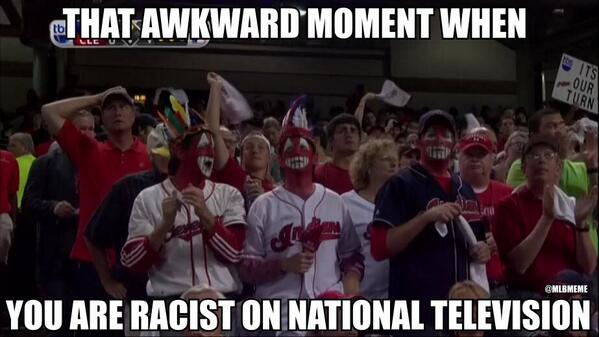
An odious scene: Indians fans wore redface to last night’s game

By Craig CalcaterraI saw these guys on last night’s broadcast. Hat tip to Ted Berg of USA Today for getting the screen cap:We wouldn’t accept it if these guys showed up at a party in blackface. We wouldn’t cite “tradition” or “enthusiasm” and act as if it wasn’t racist for them to do so. If they wore blackface at a ballpark I am pretty confident that security would have them removed, for their safety among other reasons.

But to pull Indian redface in Cleveland? Hey, no worries. Go Tribe. Quit your complaining, Calcaterra. Indeed, I’m assuming that for even mentioning this I will be accused of being an overly-sensitive P.C. liberal who doesn’t understand that no one finds this offensive and, hey, my Native American father-in-law has no problem with it. If they decided not to go the ad hominem route they’d probably offer something like, “hey, he’s on the caps. So obviously it’s about team spirit, not racism. It’s just a cartoon character, so it’s not offensive.”

But of course it is offensive. And disgraceful. And as long as the Cleveland Indians continue to use Chief Wahoo as their mascot and primary logo, idiots like these three will believe that it is socially acceptable to do with Indians that which we would never tolerate if it was done with other races. They will be given the official cover to make specious arguments excusing their racist acts.
Why Did TBS Show Cleveland Fans Dressed Up In Redface?

By Travis WaldronFans obviously don’t see much of a problem with this sort of dress-up, because they do it at Indians games and Washington Redskins games and at other sporting events featuring Native Americans. They Tomahawk Chop and depict Native Americans getting slaughtered and all sorts of other ignorant things because they are fans and because the appropriation of Native American imagery and culture in sports, not to mention in the rest of society, has desensitized them to the fact that Native Americans deserve respect. We’d never be OK with this if it was another racial minority being depicted, if fans showed up to games wearing blackface.

And neither would TBS. So why did they choose to focus on these fans? One possible explanation is that TBS itself is particularly desensitized to the whole issue because it used to be closely affiliated with another team that appropriates Native American culture. TBS’ founder, Ted Turner, used to own the Atlanta Braves, and the network used to broadcast the Braves’ every game. TBS played a major part in making the Tomahawk Chop a thing during the Braves’ worst-to-first playoff run in 1991 and during Atlanta’s incredible stretch of 15 consecutive division titles thereafter. If TBS doesn’t see a problem with this sort of dress-up, it isn’t hard to understand why.
Indians fans' redface raises eyebrows

Comment:  This should be the next target of the activists targeting the Washington Redskins. Heck, they should target both offenses simultaneously to take advantage of the growing concern about mascots.

For more on Chief Wahoo, see Make Indians' Owner into Mascot and Semipro Team Uses Chief Wahoo.

May 10, 2013

Make Indians' owner into mascot

Artists, Call for Entries: Make Larry Dolan into Grinning Idiot MascotThis is Larry Dolan. Dolan owns the Cleveland Indians. He’s the guy who makes money from selling t-shirts with grotesque, offensive characterizations of native Americans on them, at least he’s the main one.

I hate the Cleveland Indian’s logo. I have some close friends in Cleveland that are native American and they hate it also. It’s embarrassing for the region. It’s embarrassing for humanity. I could forgive Cleveland for this logo if it was 1929, but it’s 2013 for Christ’s sake—mocking victims of genocide just isn’t cool anymore. Somehow though, Cleveland’s mascot exists in this vacuum where racial sensitivities haven’t evolved since Gone with the Wind premiered.

Anyway, I have an idea. I need your help. I want to commission an artist to do a grotesque, mocking caricature of Larry Dolan that I can print on some t-shirts and sell to other people that are offended by his profiteering from humiliating and stereotyping an oppressed minority group. Now, I realize it won’t ever be as hurtful, since people like Dolan, a lawyer who attended St. Ignatius prep school, haven’t had to endure 100s of years of human rights abuses. But what can we do?

Anyway if you are an artist or know an artist who is up to the task, we’re looking for a cartoon image of Dolan in the style of Chief Wahoo, the more insulting the better. I can pay $100, which isn’t much. But also, if any sympathetic readers want to donate to this campaign, using the Paypal link on the right hand side of the website, I’ll add that to the pot and give it to the designer.
Artist Call: Make Cleveland Indians Owner Into 'Grinning Idiot Mascot'

Comment:  For more on Chief Wahoo, see Semipro Team Uses Chief Wahoo and The Most Racist Pro Sports Logo.

February 19, 2013

Semipro team uses Chief Wahoo

Local baseball team's mascot draws criticism from Chumash leaders

Chumash leaders hope the team will replace its logo—a caricature of a Native American

By Bob Cuddy
Chumash leaders are asking a North County semi-pro baseball team to change its logo, which it says is demeaning to Native Americans.

The mascot for the North County Indians is a grinning, bright-red, Native American caricature that is based on the Cleveland Indians mascot, Chief Wahoo.

That mascot also has drawn criticism over the years, as have various similar logos from professional sports to Little League. The best-known pro sports teams that still have such logos are the Indians, Atlanta Braves, and Washington Redskins. All remain controversial.

Although the discussion has raged nationally for decades, it is new in San Luis Obispo County and was triggered by the North County Indians’ move from Santa Maria to Templeton.

The Indians played their first summer in Templeton last year but had been active in Santa Maria for more than 40 years.

The symbol is “degrading, immoral, racist, (and) disrespectful,” according to Fred Collins, tribal administrator of the Northern Chumash Tribal Council.

The Indians’ Facebook page has received similar comments, calling for a change in its “disrespectful” and “offensive” mascot.
Comment:  You can confirm the Templeton Indians use of Chief Wahoo on their website:

North County Indians Baseball Club Store

This logo isn't just "based on" Chief Wahoo. It is Chief Wahoo. If the Cleveland Indians knew about this, I'd bet they'd order Templeton to change its logo.

For more on Chief Wahoo, see The Most Racist Pro Sports Logo and 40th Annual Chief Wahoo Protest.

April 25, 2012

The most racist pro sports logo

A long article covers the Chief Wahoo issue well:

The Curse of Chief Wahoo

Are we paying the price for embracing America's last acceptable racist symbol?

By Peter Pattakos
In 1991, the Committee of 500 Years of Dignity and Resistance was formed in response to the celebration of the 500th anniversary of Christopher Columbus' arrival in the Western Hemisphere. Its purpose was to educate the public on "the truth about Columbus" from the perspective of Native Americans. Today, the Cleveland-based organization's focus is decidedly more narrow: They're committed to seeing Cleveland's Major League Baseball club drop the use of Chief Wahoo and its 97-year-old nickname.

It's not the most visible of movements, and it seeps into the public consciousness only for one afternoon each year. This time, a group of about 20 took part in the protest, marching outside Progressive Field and bellowing slogans like "Enjoy the Game, Change the Logo." Some placed pieces of Easter candy where arriving fans could find them; attached to each marshmallow Peep was one in a series of fortune-cookie messages: "Would Jesus Wear Wahoo?" "People, Not Mascots." "The Louis Sockalexis Myth Is a Lie."

The ballclub—and most of its fans—is not hearing any of it.

"I love Chief Wahoo," Diane McMaster-Murphy exclaims, smacking a Peep off the post where a protester had placed it. "I'm an American," adds the 57-year old white lady from Akron, adding a twist of patriotism to an otherwise indiscernible molecule of logic.

Six and a half decades after its creation, the Chief remains the only professional sports logo in the Western world that caricaturizes a race of people. But in the land of Wahoo, no reason is still reason enough.
And:[T]o Dr. David Pilgrim, an expert in racial imagery, the symbol is a "red Sambo" that hardly differs from the caricatures of blacks popular in the Jim Crow era in which Wahoo was created—a time when such depictions of minority races were popularly used to inflame prejudice and justify discriminatory laws and behavior.

A sociology professor at Ferris State University in Michigan, Pilgrim is also the founder and curator of the school's Jim Crow Museum of Racist Memorabilia. There, an astonishing 7,000 piece (and growing) collection of artifacts depicts the history of racist portrayals of minorities in American popular culture.

"These were caricatures with a purpose: to legitimize patterns of prejudice, discrimination, and segregation," says Pilgrim. "These caricatures don't just exist to exist; they both reflect and shape attitudes toward a group."

Pilgrim explains how the exaggerated features serve their discriminatory purpose by emphasizing the differences of the depicted race, thereby reinforcing the idea that the caricaturized race is inferior. He cites a passage from renowned author Julius Lester that gets right to the point, underscoring Wahoo protester Villafane's concern for her grandchildren:

"When I read Little Black Sambo as a child," Lester wrote, "I had no choice but to identify with him because I am black and so was he ... [With this image], society had made it clear to me [that the exaggerated features] represented my racial inferiority—the black, black skin, the eyes shining white, the red protruding lips. I did not feel good about myself as a black child looking at those pictures."


A researcher discusses the origin of the Cleveland Indians name:He presents evidence that the franchise was renamed the Indians by sportswriters—not to honor Sockalexis, but to recall the sensational "fun" that he would inspire in crowds some 15 years earlier, when newspapermen would jokingly refer to the club as the "Cleveland Indians," even though it was formally named the Spiders.

Of course, it didn't hurt that the new name also happened to reinforce the image of Natives as anachronistic savages, the ballclub a fearsome force to be reckoned with. "In place of the Naps, we'll have the Indians, on the warpath all the time, and eager for scalps to dangle at their belts," wrote the Cleveland Leader in announcing the name change on January 17, 1915. In fact, none of the reports from the four daily Cleveland newspapers even mentions Sockalexis, but each is replete with negative stereotypes.

The Plain Dealer of the same day included a cartoon titled "Ki Yi Waugh Woop! They're Indians." The panel depicts, among other things, a frowning umpire scolding a Native American who says to him, "WUKWOG-O."

"When you talk to me, talk English, you wukoig," the ump replies. (The cartoon helpfully explains of "wukoig": "That last word is in Indian.")
Recall that this was only 25 years after Wounded Knee. It's obvious the Cleveland team wanted to memorialize the destruction of the Indians. So did other American institutions.

"We won, they lost," the thinking went. "We were the good guys, they were the bad guys. They got what they deserved for being un-Christian and un-American. Now we can laugh at them like we laugh at unruly children and pets."

So there was no "honor" or "respect" in the name or mascot. The so-called honor people talk about now was a recent invention to erase the team's racist history. It's a blatant "cover your ass" move. "Let's make up something about respect," the owners tell themselves, "to divert attention from our Sambo-like mascot."

Other mascots are disappearing from the landscape, but not Chief Wahoo:So why no traction with Wahoo, a symbol arguably much more offensive than any of the rest? Call it a unique inertia, created by a combination of Native Americans' status as a tiny, relatively invisible minority; the traditional "cowboys and Indians" view of Natives' status as an enemy of American civilization; the innocent, if ignorant, elements of Cleveland's attachment to Wahoo as a symbol of a beloved baseball team; and a relative lack of awareness of the symbol's racist origins. Of course, there's also the fact that professional teams, unlike colleges and high schools, are owned by private individuals, most of whom happen to be white.

David Currie, a 73-year-old Euclid resident who identifies himself as "a WASP through and through," joins the Wahoo protesters every year because he believes the symbol is an embarrassment to his hometown. You'd never see a team called the Cleveland Negros or the Cleveland Jews, accompanied by a caricature of the race, he says. "There's no difference between blackface and redface. One is just as wrong as the other. It's just that here there's nobody to beat you up for wearing the redface."

Wahoo, incidentally, is all but nonexistent in the Indians' spring-training home of Goodyear, Arizona, where the Native American population is significantly higher than it is on the modern-day shores of Lake Erie.
Gee, I wonder why the team doesn't use Chief Wahoo in Indian country? Talk about your tacit admission that the mascot is racist and stereotypical.

Why don't the cowardly team officials just say what they're thinking? "We know Chief Wahoo is a racist affront to Indians, but there aren't enough Indians in Cleveland to matter. As long as they don't have the numbers to shut us down, we'll continue to offend them."

Then there's the infamous Sports Illustrated poll, which I and others have lambasted:"Eighty-three percent of Indians on reservations said leave it alone, so leave it alone!" Booms shouted during a recent radio debate on the issue. To Booms, opposition to Chief Wahoo is "liberal nonsense."

Yet others are less convinced by the SI poll. "If you're going to trust a Sports Illustrated report on Native American issues, you might as well have Redbook report on the logging industry," says Farrar.

A group of 34 sociologists who organized to immediately challenge the survey pointed to other studies that reached opposite results. They also note that SI never disclosed how the poll was conducted, how participants were recruited, or what questions were asked. And more pertinent to Wahoo: There's nothing contained in the SI report to suggest its poll results distinguished between team names and symbols, nor between caricatures like Wahoo and more realistic representations. In fact, the report's penultimate paragraph concludes by noting that "many Native Americans find the mascots and imagery more offensive than the names."

Many anti-Wahoo activists are loath to engage any evidence of Native support for symbols like Wahoo. Andy Baskin, a morning personality at 92.3 and sports director at Cleveland's NewsNet5, recently spoke on his radio show about visiting a reservation in the Southwest and seeing children wearing Chief Wahoo hats.

"There were African Americans who were OK with sitting on the back of the bus too," Farrar responds.
Comment:  Any Indians who support Chief Wahoo or other stereotypical mascots are ignoramuses. They're literally ignorant of the documented harm of Native stereotyping.

The Jim Crow comparison is an apt one. These people are apparently content to be mindless savages in the eyes of most Americans.

Anyway, good article. For more on Chief Wahoo, see 40th Annual Chief Wahoo Protest and Gaillard's Use of Chief Wahoo.