Showing posts with label Donald Sterling. Show all posts

May 03, 2014

Sterling = scapegoat for racism

One pundit notes the righteous reactions to Donald Sterling's racist comments. He says they show how we're not willing to go any deeper, to tackle systemic racism in our culture.

Donald Sterling, ritual scapegoat

Shaming an old creep for his outmoded bigotry was empty political theater, and did nothing to address real racism

By Andrew O'Hehir
No one’s heart should bleed for Donald Sterling—and pretty much no one’s does. Even Fox News, Rush Limbaugh and the New York Post have made little or no effort to defend the disgraced owner of the Los Angeles Clippers, whose public banishment by NBA commissioner Adam Silver, and public shaming by the mainstream media, was the principal vaudeville act in this week’s American political theater. Indeed, the entire purpose of the Sterling episode, from a societal point of view, was to demonstrate that we can all unite in viewing him as a dreadful person, and righteously proclaiming that his brand of cranky-old-guy racism, so reminiscent (for many white people) of debauched great-uncles at family gatherings, is no longer acceptable.

Sterling, to put it simply, is a scapegoat, whose ritual sacrifice may make us feel better about ourselves but does absolutely nothing to address the bizarre racial dynamics of American professional sports, and still less the institutional racism of our society. His only defenders are a handful of right-wing Twitter trolls who misunderstand the constitutional guarantee of free speech, or who fail to grasp that the NBA is not some socialistic Big Brother nanny state, but rather a private billionaires’ club with wide latitude to set and enforce its own rules, capricious or otherwise. It’s easy to mock those people, but in their bewildered fashion they’re flailing toward a valid point: Sterling was punished for making private remarks that threatened to embarrass the NBA’s burgeoning global brand, but only because they wound up on TMZ and fueled a zillion tabloid news stories. Sterling’s well-documented history of alleged racial discrimination and noxious racial attitudes—encompassing not just words but illegal conduct that injured real people in the real world—never caused that kind of stink, and didn’t matter.

I’m not defending Sterling in the slightest by saying that this saga does not in fact show America at its best, and does not demonstrate how far we have come and what enlightened attitudes we now hold. It demonstrates something entirely different: Our eagerness to be distracted by symbolic narratives that embody a lot less meaning than they seem to, rather than confronting conditions of genuine social crisis and economic contradiction. We love the Sterling drama precisely because it’s a great story, with undertones of 18th-century comic opera: The aging lecher, representative of the ancien rĂ©gime, who throws over his wife for the younger mistress, who turns out to be a complicated character possessed of her own agenda; the private utterance (in French farce it would be a letter) whose revelation strips the ancient troglodyte of his power and reduces him to bathos. All that’s needed is the Figaro, the younger lover with a democratic spirit who sweeps up the girl and sets everything right. That would be us.

None of this, frankly, has anything to do with anything. It’s empty feel-good, just like the portrayal of Adam Silver as some kind of civil-rights hero, taking a courageous stand against the second coming of the Confederacy. I have no reason to doubt that Silver is a decent person with progressive racial views—one would hope so, at the head of a sport dominated for decades by African-American stars—but the encomiums heaped upon him this week feel like desperate projection. What I saw on television the other day was a CEO zealously protecting his immensely lucrative global business from the damage caused, in effect, by a rogue employee. As the International Business Times’ careful reporting of the story suggests, Silver initially contemplated a much lighter penalty for Sterling—after all, Silver’s mentor and predecessor David Stern had tolerated an overtly racist owner for many years. Faced with a possible player revolt, the flight of corporate sponsors and widespread public outrage, Silver was literally compelled to inflict the maximum penalty.
Another pundit says we're lucky to see even this much of an outcry against racism. The do-nothing apologists among us would excuse and ignore Sterling if they could.

Donald Sterling’s “slippery slope”: The limits of our new anti-racist consensus

Sure, everyone condemned the Clippers owner's racist remarks. But why is it so hard for some people to go further?

By Elias Isquith
Fox News’ favorite legal scholar and Civil War revisionist Andrew Napolitano, for example, soon penned an Op-Ed for the conservative network’s website making essentially the same argument, claiming that Sterling—like Cliven Bundy before him—was a real jerk, but still deserved his right to free speech. Unlike Cuban, Napolitano is a former judge, so he was savvy enough to note that the NBA is not a wing of the government and is thus not subject to the same First Amendment restrictions. “[The NBA] is free to pull the trigger of punishment to which Sterling consented,” Napolitano granted. Still, he claimed, “it needn’t do so.” Why not? Because the “most effective equalizer for hatred is the free market,” which would, he wrote, “remedy Sterling’s hatred far more effectively than the NBA” by forcing the octogenarian and reportedly cancer-stricken billionaire to sell the team, lest he endure “catastrophic” financial losses.

Cuban and Napolitano, then, were more or less on the same page: In the interest of free speech (which doesn’t really apply in this situation but, y’know, whatever) the best course of action to take in regard to Donald Sterling was to do nothing at all and either hope for, or expect, the best. “What to do with them because of their speech?” Napolitano wrote of Bundy and Sterling. “Nothing,” he explained. “I mean nothing.” Unlike other developed nations, apparently, you’re allowed to be a moron in America. And let’s not forget those slippery slopes, either.
And:Taken together, these pseudo-defenses of Sterling hardly constitute a consensus of enough scope to rival what still remains the mainstream response to the Sterling recording, that he is an odious racist whom the NBA should’ve booted long, long ago and still can’t get rid of soon enough. But they do show that, if you scratch just a little past surface, you’ll find Americans aren’t actually as “evolved” on the issue of race as the intensity of the Sterling demonization might lead you to believe. For many Americans—mostly but not exclusively Republicans and conservatives—what Sterling said is to be condemned (“to be sure,” as many of the authors mentioned above like to say), but not in the same way that, say, shoplifting or speeding is, with material consequences. Instead, Sterling-style racism should be considered as a kind of extreme faux pas, as if it were essentially no different from texting in a movie theater or lecherously staring at your friend’s partner on a dinner date.

Ta-Nehisi Coates of the Atlantic recently described Sterling’s sin as an act of “oafish racism,” a ham-fisted and unsophisticated style of bigotry that most Americans are happy to condemn while leaving “elegant racism”—manifested in dog-whistles, redlining, and the carceral state—untouched. This isn’t an objection I expected to levy against the clear-eyed and unflinching Coates, but I think that in this regard he may actually be giving us too much credit. It’s true that many or even most of us find Sterling’s oafish racism contemptible; but as Cuban, Napolitano, Zeiser and the rest show, even that sentiment isn’t as widespread as you’d hope. Few will outright defend Donald Sterling, sure. But some of the most influential among us are seemingly willing to walk up to the precipice of that very, very slippery slope.
Comment:  There's no right or wrong answer here; both pundits have valid points. But I feel more sympathy for Isquith's position. I'm glad Sterling triggered a discussion of race, no matter how superficial it was. I'm not sad because it didn't lead to a deeper examination of racism in America.

As with almost any subject today, you have to get half the country to admit there's a problem before you can do anything about it. That's about where we are with racism. Until naysayers realize that Paula Deen, Phil Robertson, Cliven Bundy, Donald Sterling, and the rest represent the mainstream, not the fringe, we won't get anywhere on the subject of race.

For more on the subject, see What Bundy and Sterling Tell Us.

May 01, 2014

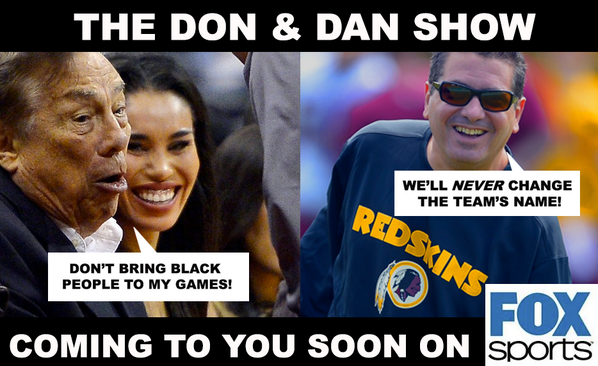
Images compare Snyder to Sterling

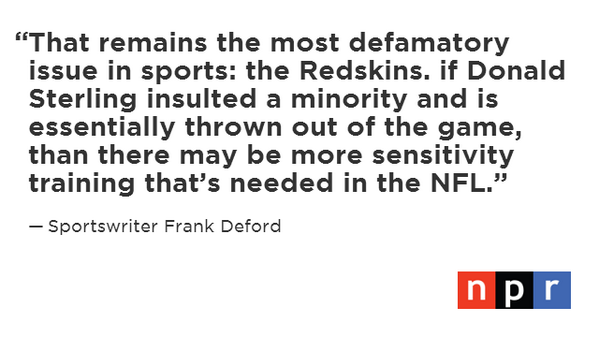
The hits keep coming for Redskins owner Dan Snyder as critics compare him to Donald Sterling. There's enough outrage for me to do an all-image posting:


For more on the subject, see Why No NFL Crackdown on Racism? and First Sterling, Then Snyder?

April 30, 2014

Why no NFL crackdown on racism?

As expected, critics have noted the contrast between the NBA's ban on Donald Sterling and the NFL's embrace of Dan Snyder:

Members of Congress link NBA’s Sterling controversy to NFL’s debate over Redskins

By Aaron C. DavisA victory over racism in the NBA? How about the NFL and the Redskins? That’s the link made Wednesday by members of Congress who are set on forcing the Washington team to abandon its controversial name.

Del. Eleanor Holmes Norton (D), the District’s nonvoting member of Congress, sought to capi­tal­ize on the National Basketball Association’s swift action against Los Angeles Clippers owner Donald Sterling, saying the National Football League could learn a lesson about dealing with racism in its ranks.

Norton called on NFL Commissioner Roger Goodell to follow the “moral example” of NBA Commissioner Adam Silver, who on Tuesday banned Sterling for life from the league over comments about African Americans.

“It shows a big difference between two major sports leaders,” Norton said in an interview. “One was willing to act and clearly separate his league from racism. The other is appearing to condone it by not even requesting [Redskins owner Daniel] Snyder to change the name.”

Senate Majority Leader Harry M. Reid (D-Nev.) went further, saying that national outrage should now be directed toward the NFL for its refusal to change the name of the Washington Redskins.

“How long will the NFL continue to do nothing—zero—as one of its teams bears a name that inflicts so much pain on Native Americans?” Reid asked.
The NBA won't tolerate racism, so why does the NFL tolerate 'Redskins'?

By Chris Feliciano ArnoldIf the NBA is finally willing to take a stand against owners spewing racist bile in private conversations, how can the NFL continue to defend Daniel Snyder, the owner of the Washington Redskins, which continues to use a name and logo widely seen as disrespectful to Native Americans? Oh yeah, money. Washington’s team was ranked third on Forbes’ list of the most valuable NFL franchises in 2013 with an estimated worth of $1.7 billion.

Granted, Sterling and Snyder are not a perfect bigot-to-bigot comparison. Sterling’s 19th century plantation worldview is especially stomach-churning given that African Americans represent the majority of the NBA’s players, stars and legends—and a vital fan base. Snyder, on the other hand, is free to profit from racial exploitation of a people who remain among the most marginalized in our society. (One problem is the lack of Native American representation in the NFL. According to 2013 data, Native American representation among league management is well below 1%, with similarly low numbers among players, coaches and management across the league.)

The Sterling debacle should give NFL Commissioner Roger Goodell inspiration to emulate Silver. While the term “redskin” is relatively innocuous in its historical context, time has rendered it a relic that reinforces offensive Wild West stereotypes. A white billionaire’s determination to exploit those stereotypes reduces years of genocide against Native Americans to a crude exercise in branding. The name has incited debate for more than 20 years, but the NBA’s action against Sterling opens the door for Goodell to leverage his power and demonstrate that no single franchise, no matter how profitable, trumps the values of the entire league.

If that were the happen, the Sterling circus could usher in a better era in American pro sports, pressuring other franchises to follow suit by retiring names and mascots like the Cleveland Indians’ “Chief Wahoo,” a gross caricature that has been protested for years.


NBA Rejects Racism, MLB And NFL Continue Their Silence

By Chris WeigantThe Cleveland Indians seem to be slowly getting rid of this blatantly racist image, and replacing it with a block letter "C." But the image still appears on the Indian's official homepage, and still appears on team uniforms and team merchandise sold to the public. Why is this not considered universally unacceptable, when a basketball team owner just got a lifetime ban for something he said in private to his girlfriend?

The Washington Redskins and Chief Wahoo are not something said in private. They are as public as it gets. Millions of dollars are made each year by the sale of merchandise with these names and logos prominently appearing. Yet the leagues do nothing.

It's not like they are unaware that people are offended, either. The Redskins are in a legal battle against a group which is trying to get their trademark revoked (for being patently offensive), and members of Congress have weighed in on the controversy by asking the team owner to change the name. The Redskins are well aware of the problem. The team owner refuses to budge. The league remains mostly silent. Silence, in this instance, equals consent. Why is blatant racism unacceptable when directed against African Americans but acceptable when directed against Native Americans? You'll have to ask the leaders of the NFL and MLB, because I have no answer to that question.

There are other team names and logos which use Native American names and images (the Chiefs and the Braves, to name two). However, the Redskins and Chief Wahoo are the worst examples. The Braves retired their mascot ("Chief Noc-A-Homa"... get it?), but still do an awfully offensive "tomahawk chop" chant at their home games.
First Nations and the repugnant, racist side of pro sports

By Michael BabadTo recap, the National Basketball Association won justifiable praise this week when it banned Donald Sterling, the owner of the Los Angeles Clippers, for racist comments about African Americans in a private conversation caught on tape and made public.

This wasn’t lost on First Nations, who have long suffered open racism as society tolerates pro club names like the Washington Redskins, the Atlanta Braves and the Kansas City Chiefs.

Not to mention the Cleveland Indians and their repugnant caricature of a smiling Chief Wahoo. The club has now playing up a new logo–a big C–but reportedly the other will still exist.

There is pressure on Washington to change the club’s name, but there’s no sign of that happening. Indeed, owner Dan Snyder has reportedly said he won’t.


No tolerance for racism (against blacks)

Some thoughts on why black players spoke out against Sterling:

Sterling's Comments, Snyder's Condescension: Two Sides of Same Coin

By Jacqueline KeelerWhen comparing the differences in response to the NBA’s banning of racist L.A. Clippers owner Don Sterling to NFL Commissioner Goodell’s support of Washington Redsk*ns owner Dan Snyder, we must look at the ways in which racist stereotyping of Native people is seen as more acceptable than that of African Americans and other ethnic groups in the United States. We also must look at why Black players and sponsors do not take racism against Native people as seriously as racism against other Americans. We must ask, Why is it okay for Dan Snyder to talk down to Native concerns about using a racial slur as the name of his team and for our fellow Americans of color to ignore us?

When Snyder says, “WE’LL NEVER CHANGE THE NAME. It’s that simple. Never—you can use caps,” and Sterling says “We live in a culture, we have to live within that culture. I DON’T WANT TO CHANGE,” we are looking at two sides of the same coin. It is in direct contrast to President Obama’s refrain from his 2008 election night acceptance speech, “Change is coming to America.” An America built on the invention of the very concept of “race” to uphold the dual practices of slavery and land theft that lies at the very foundation of this colonial-settler country that is now threatened by a Black President, Black athletic excellence and success and Native people asserting control over their representations in the media and in sports.

Cliven Bundy wondered in a taped interview if Black people “were better off as slaves” and accused them of being welfare freeloaders--Cliven Bundy, a white man who has been grazing for free for 20 years on land half the size of Rhode Island and owes the U.S. one million dollars in fees and fines. You can see how little many in the United States have moved on from the Civil War, the rupture that was the first real attack on the slavery/land theft complex that birthed this country.

I thought a lot about the differences in American perspectives—particularly those of Black Americans, like the Washington Redsk*ns player DeAngelo Hall, who said earlier this year in an interview with Mike Hill of Fox Sports, “They probably should [change the name], but they won’t for awhile at least.” He then backtracked on this rather tepid support of Native American concerns after ostensibly receiving pressure from Snyder, saying, “I can’t claim to understand where they’re coming from or their viewpoint, so for me to say what’s right or wrong or what should be changed is out of my pay grade. That decision ultimately--you know me, all teammates and I have stayed away from this topic. It’s one where you really can’t be right.”
Short version: Because America has repudiated explicit racism against blacks but not Indians.


Bad people vs. flawed system

And some thoughts on why many people spoke out against Cliven Bundy and Donald Sterling:

This Town Needs a Better Class of Racist

It's easy for polite American society to condemn Cliven Bundy and banish Donald Sterling while turning away from the elegant, monstrous racism that remains.

By Ta-Nehisi Coates
The problem with Bundy isn't that he is a racist but that he is an oafish racist. The elegant racist knows how to injure non-white people while never summoning the specter of white guilt.

The problem with Cliven Bundy isn't that he is a racist but that he is an oafish racist. He invokes the crudest stereotypes, like cotton picking. This makes white people feel bad. The elegant racist knows how to injure non-white people while never summoning the specter of white guilt. Elegant racism requires plausible deniability, as when Reagan just happened to stumble into the Neshoba County fair and mention state's rights. Oafish racism leaves no escape hatch, as when Trent Lott praised Strom Thurmond's singularly segregationist candidacy.
And:Like Cliven Bundy, Donald Sterling confirms our comfortable view of racists. Donald Sterling is a "bad person." He's mean to women. He carouses with prostitutes. He uses the word "nigger." He fits our idea of what an actual racist must look like: snarling, villainous, immoral, ignorant, gauche. That the actual racism that Sterling long practiced, that this society has long practiced (and is still practicing) must attract significantly less note. That is because to see racism in all its elegance is to implicate not just its active practitioners, but to implicate ourselves.

How can it be that in a "black league," as Charles Barkley calls the NBA, an on-the-record structural racist like Donald Sterling was allowed to thrive? Everyone now wants to speak to Elgin Baylor. Where were all these people before? Where was Kevin Johnson? Where was the Los Angeles NAACP? When Donald Sterling was driving black tenants out of his buildings, where was David Stern?

Far better to implicate Donald Sterling and be done with the whole business. Far better to banish Cliven Bundy and table the uncomfortable reality of our political system.
Comment:  This applies to the Washington Redskins, Chief Wahoo, and other examples of sports stereotyping. "They didn't mean any harm," people tell themselves about the offenders. "They didn't attack or insult Indians. They're just thinking about their teams, their fans, and 'tradition.' As long as no one's compared to a slave or treated like an animal, what's the problem?"

And so the racism in America continues. Perpetuated by people who assure themselves they aren't racists. "It's bad people like Bundy and Sterling who are the problem, not me."

For more on the subject, see What Bundy and Sterling Tell Us and First Sterling, Then Snyder?

April 29, 2014

What Bundy and Sterling tell us

The paternalism of rich white men aka the 1%:

Donald Sterling’s disgusting 1 percent ramblings: Let’s pity the racist billionaire

Donald Sterling's racism is cut from the GOP playbook--a classic case of "makers vs. takers" delusion

By Paul Rosenberg
DS: You just, do I know? I support them and give them food, and clothes, and cars, and houses. Who gives it to them? Does someone else give it to them? Do I know that I have—Who makes the game? Do I make the game, or do they make the game? Is there 30 owners, that created the league? (emphasis added)

Excuse me. Donald Sterling gives the players on his team food? Clothes? Cars? Houses? They don’t work their asses off earning what they buy for themselves, building on a lifetime of hard work and practice, and years of unmitigated exploitation as unpaid athletes along the way?

Does anyone other than Sterling have the slightest difficulty in hearing how much he sounds like a classic 19th century slave owner, talking about everything he’s done for his ungrateful slaves?

Certainly his question, “Who makes the game?” recalls the slaveholders’ delusion that they alone created the enormous wealth they enjoyed. It was a believable fiction, I suppose, if first you absolutely convinced yourself that the slaves who did all the actual work were not people at all, but mere property, nothing more than livestock, really. One has to wonder: Is that what Sterling thinks of the men who play on his team today?
Donald Sterling and Cliven Bundy’s ignorant paternalism: Angry old white men gone wild, again!

Donald Sterling’s racial views are worse than Cliven Bundy’s, yet some on the right defend the racist billionaire

By Joan Walsh
It’s just another episode of “Angry Old White Men Gone Wild,” but the two men’s sins aren’t the same. Racism wasn’t entirely shocking coming from the not-too-sharp Nevada cattleman who seems to have marinated in the paranoid anti-government thinking that’s taken hold in marginal white communities. Its crude expression was much more disturbing coming from the powerful, wealthy Sterling.

But there’s more than simple anti-black racism linking the views of Bundy and Sterling. They share an ignorant, self-serving paternalism.
And:Comparing the situation of Sterling’s players—talented, wealthy athletes with agents and contracts—to slavery is silly. Still, a twisted and racist paternalism links Cliven Bundy’s slavery rant with Sterling’s talk about his players. “I give them food, and clothes, and cars, and houses” is only a few bad leaps of logic away from slavery being good for black people because it gave them “homes with their chickens and their gardens and their children around them, and their man having something to do.” In both cases, black people are simple, passive and not entirely capable of caring for themselves. They should be grateful for the good will of the men who exploit their labor and accept their position at the bottom of society, because they’re not meant for more than that.

Of course I’d say it’s the players who give Sterling food, and clothes, and cars, and houses. Without their labor, their talent and their extraordinary dedication to do everything it takes to win, Donald Sterling wouldn’t have a basketball team. Now, he’d still have food and clothes and cars and houses, because he’s a predatory real estate mogul who paid $2.725 million to settle a Justice Department suit that accused him of driving African-Americans, Latinos and families with children out of his apartment complexes.


Systemic racism

White racism won’t just die off: No utopia awaits when retrograde attitudes like Donald Sterling and Cliven Bundy’s are gone

Sterling and Bundy belong to a different generation, but Paul Ryan and the Supreme Court are enshrining white power

By Brittney Cooper
The staggering political and historical amnesia that allowed six justices to co-sign such a policy caused Justice Sonia Sotomayor to both write and read a 58-page dissent before the court. Sotomayor rightfully suggested that those, like Chief Justice John Roberts, who believe racial discrimination will end by restricting the right of race to be a consideration hold a “sentiment out of touch with reality.” Such a view reminds me of my academic colleagues who put the term “race” in scare quotations, and tell themselves that because race is a social construction–a biological fiction–that they no longer have to think about the real material impact that centuries of race-based discourse have had on constructing a racist world.

“Race matters,” Sotomayor wrote. And “the way to stop discrimination on the basis of race is to speak openly and candidly on the subject of race, and to apply the Constitution with eyes open to the unfortunate effects of centuries of racial discrimination.”

The dangerous, backward and wrongheaded thinking of Cliven Bundy and Donald Sterling represent just two of the most obvious iterations of these kinds of “unfortunate effects.” And we are powerless to advocate for ourselves against systemic expressions of such thinking because the Supreme Court has chosen a “see no evil, hear no evil” approach to the problem.

Though the racial views of Bundy/Sterling on one hand and the Supreme Court on the other exist rhetorically at opposite ends of the spectrum, both point to an insidious and unchecked march of continued racism that disadvantages and harms black people, in particular. Bundy/Sterling vocally promote the kind of racial thinking that makes even the most conservative white person cringe, while Chief Justice John Roberts and five other justices promote the kind of colorblind view that seems to represent the highest expression of our national understandings of liberty and justice for all.

However, what Sterling’s and Bundy’s views demonstrate is the extent to which retrograde racial attitudes are alive and well among white men with money, power and control over the livelihoods of black people. And what the Supreme Court’s abdication of responsibility suggests is that the government has no responsibility to remedy the discrimination that clearly still exists in institutions that are run largely by white men who belong to the same generation and school of thought as Bundy and Sterling.
Donald Sterling was more than just a “painful episode”

The Clippers owner has been publicly shamed and banned from the NBA. But that won't fix the root of the problem

By Roxane Gay
For now, the NBA’s punishment is, like the security theater to which we are subjected at airports, an elaborate performance. “Look,” the NBA is saying, “look how quickly we have dispatched with this racist aberration in our midst.” Unfortunately, it is not a new revelation that Donald Sterling is racist (and sexist). He is not an aberration. He has been made to pay for his racism twice before—in 2003 and 2009—in housing discrimination lawsuits, which are far graver infractions than his racist comments and behavior over the years. The NBA simply remained silent in 2003 and 2009 because there wasn’t yet enough public outrage for them to have to perform some kind of response. It took a splashy gossip spill from TMZ (and what an unexpected meter of justice that site is) for Sterling to face any kind of comeuppance that is not really comeuppance.

There has been and there will continue to be vigorous discussions about race in America. I worry that little will come of these discussions because we aren’t addressing what must be done to change the current racial climate. Donald Sterling’s lack of interest in having black people at Clippers’ games is on par with rancher Cliven Bundy’s nostalgia for slavery as a means of giving black folk something to do. These men’s racial attitudes are troubling and indicative of the racist beliefs far too many people hold. More important, these men and their ilk are propped up by a system for which the consequences for extolling such beliefs are painfully inadequate. They are propped up by a system that enables voter suppression, segregation, the retrenchment of affirmative action supported by even the Supreme Court, a glass ceiling in far too many industries, and the list goes on.

What truly worries me, though, is that far too many people seem surprised when racists like Sterling or Bundy are revealed, as if these men are closer to the exception than the rule. What worries me is that I am not at all surprised when these men are revealed for who they truly are. What worries me is that “post-racial” America is not that different from the Americas that have preceded us, and it might not ever be.
Comment:  Bundy and Sterling have been rich and racist most of their lives. They've been acting on their racist beliefs all this time. Sterling even had a record of housing discrimination. Yet most of us are just learning about this racism, just reacting to it now.

Both cases are great examples of how systemic racism surrounds us. People like Bundy and Sterling are in charge of the large powerful entities--government, business, the military, churches, the media--that dominate our lives. And this power is mostly invisible to the naked eye.

What matters isn't whether our next-door neighbor is considerate or not. What matters is who's in charge of things such as defense, finance, taxation, health, welfare, education, and the environment. And the answer is generally rich white men who support the military-industrial complex run by other rich white men. They decide who gets most of society's benefits, and it's them, not us.

For more on systemic racism, see Whites Think They're Losing to Blacks and Educating DMarks About Systemic Racism.

First Sterling, then Snyder?

Many people noted the irony of the NBA's cracking down on Donald Sterling's racism while the NFL supports Dan Snyder's racism. Some tweets and images on the subject:

Dave Zirin ‏@EdgeofSports Apr 26
It's very difficult to look at universal condemnation of Donald Sterling's racism and not think about the pass given to Dan Snyder.


BlueCornComics ‏@bluecorncomics
Dan Snyder, say hello and good-bye to @NBA owner Donald Sterling. P.S. You're next. #Redskins #NotYourMascot #ChangetheName

BlueCornComics ‏@bluecorncomics
Why not "Sterling didn't mean any harm, he's helping black people, there are more important things to worry about"? Because #racism is EVIL.

BlueCornComics ‏@bluecorncomics
That shiver you just felt was every sports team owner with a racist Indian mascot wondering if he's the next Donald Sterling. #ChangetheName


Unless it's the Redskins and Chief Wahoo? Time to start applying our disapproval of racism to every sports team in America.

Getting the ball rolling

The first of what undoubtedly will be many postings on the subject:

Will Sterling lifetime ban push Redskins issue to critical mass?

By Mike FlorioTo no surprise, Oneida Indian Nation opted to use the penalties imposed on Sterling as a reason to draw more attention to the lingering controversy involving the Redskins name.

“In banning Clippers owner Donald Sterling, NBA Commissioner Adam Silver and other NBA team owners have taken a courageous stand against racism in professional sports, acknowledging that professional leagues cannot be a platform to promote bigotry,” Oneida Indian Nation Representative Ray Halbritter said in a release. “In taking such appropriate disciplinary action, the NBA has shown leagues like the NFL that they have a moral responsibility to take disciplinary action against people like Dan Snyder, who also continues to proudly promote bigotry with the use of a dictionary-defined racial slur as his team’s name.”

While it’s unlikely that the Sterling situation will nudge the Redskins name controversy toward a critical mass, the unwillingness of the NBA to tolerate an owner expressing racist views behind closed doors highlights the question of whether and to what extent the NFL is willing to tolerate a situation where reasonable minds may differ on the existence of overt racism.

Dear R*dskins Stars: The Clippers Show You Don't Have to Fear Your Owner

For more on the subject, see What Bundy and Sterling Tell Us and NBA Bans Sterling for Life.

NBA bans Sterling for life

The outcome of the fast-moving Donald Sterling story:

NBA commissioner bans Clippers owner Sterling, pushes to 'force a sale' of team

The lesson of Bundy and Sterling—your racist friend isn't okay anymore

By Matthew YglesiasIn a Facebook post, Bundy's daughter slammed conservatives like Hannity. "What does this have to do with land rights issues?" She asked. Historically speaking, the answer to that question is, to say the least, complicated. But the more immediate answer is simple: by and large, America isn't willing to tolerate a racist friend anymore.Sorry, racist friends!

Twitter Explodes With Hilarious First Amendment Fails Over Racist Clippers Owner’s Ban

"I'm no racist but...," said almost every conservative on the Internet.

Donald Sterling’s stunning comeuppance: The supreme satisfaction of swift action

NBA's Adam Silver brought a tone of moral outrage. Now owners should reckon with something else: The other victims

By Joan Walsh
In the end it likely came down to money, not morality. Donald Sterling’s racism had already cost the Los Angeles Clippers a dozen sponsors, Coach Doc Rivers had already made it known he would not return to the team next year, and more trouble was coming. But NBA commissioner Adam Silver brought a tone of moral outrage in delivering the toughest judgment possible against Sterling Tuesday afternoon: banning him for life from any involvement with the team and the NBA, fining him the maximum $2.5 million and urging NBA owners (the only ones with the power) to force a sale. “I fully expect to get the support I need to from other owners to remove him,” Silver declared.

It was a satisfying moment: Rarely do we see racists get such a quick comeuppance. Silver seemed genuinely, personally aggrieved by Sterling’s disgusting comments about African-Americans in a league that runs on black labor, talent and fandom. He praised great black NBA pioneers including Earl Lloyd, Chuck Cooper, Sweetwater Clifton and “the great Bill Russell.” His quick, tough action earned him praise from NBA Players Association advisor Kevin Johnson, also the mayor of Sacramento. “Today the players believe the commissioner has done his duty,” Johnson declared in a press conference following Silver’s announcement. “He is not just the owners’ commissioner, he is also the players’ commissioner.”

Still, Silver’s tough sanctions against Sterling can’t erase the fact that the NBA did nothing about earlier allegations of Sterling’s racism and ignored his ugly off the court behavior as a slumlord repeatedly charged with discriminating against black and Latino tenants. In fact, the bold move almost served to underscore how long the league had looked away from the festering sore that was Donald Sterling. Taking questions after his announcement, Silver said, “I can’t speak to past actions. When we had evidence, we acted on it.” He added that he only considered Sterling’s recently recorded racism in deciding on his lifetime ban, but said the owners would consider the entire record when deciding whether to force him to sell the team.
Why Donald Sterling’s inevitable downfall is proof that the “outrage machine” actually works

Pundits love to mock Twitter's ability to stoke anger—but the rapid fall of a corrupt NBA owner shows its value

By Andrew Leonard
Yes, people, this is for real: When the ad money starts drying up, shit is about to go down. Donald Sterling is now in the fight for his professional life.

But why now? Everyone who seriously follows the NBA has known for decades that Donald Sterling is a horrible human being, a bigot and an abuser of women. Eight years ago, Bomani Jones wrote a piece for ESPN lamenting that a man who had settled the largest housing discrimination suit ever brought by the Department of Justice, could skate by without any sanction from the NBA. Sterling managed to be both an abominable person and the worst owner in professional sports (as measured by wins and losses) and yet his position was still untouchable. So what’s so different today, that the release of one audiotape could set off an avalanche of fury so apparently meaningful? Why are a few words so much more hurtful than actual deeds?

The amplifying power of social media has to be part of the answer. Of course, it’s not the whole answer. The narrative of race in America is always a touchy subtext in the NBA, a league in which the teams are 70 percent African-American, but the ownership is overwhelmingly white and male. The smoking-gun nature of the audio recording speaks more directly to our hearts than any Department of Justice legal filing ever could. And the simple fact that the NBA world had its full attention focused on the most thrilling first round of competition anybody can recall in recent NBA history has certainly helped focus the media’s attention. A zillion TV cameras were already pointed at these playoffs. You want drama? You got it.

But just as “black Twitter” forced the murder of Trayvon Martin into the mainstream; and just as social media took Romney’s 47 percent video and spread it instantly to an entire electorate; so to has the ubiquitous transmission of TMZ’s Sterling scoop meant that the man’s racism—and, by extension, the beating heart of racial privilege in America—was front and center in everyone’s news feed and timeline.
For more on the subject, see Natives Condemn Sterling's Comments and Sterling: Don't Bring Blacks to Games.

April 28, 2014

Sterling: Don't bring blacks to games

Cliven Bundy the welfare cowboy must've been overjoyed to find himself bumped out of the news this week. Clippers owner Donald Sterling took his place with a racist and sexist tirade caught on tape.

A sampling of Sterling postings, with my comments:

Report: Clippers owner Donald Sterling caught on tape telling his girlfriend to not bring African-Americans to 'my games'

Clippers owner Donald Sterling can't be a racist. Some of his best friends and basketball players are black!

Your Complete Quotable Guide To Decades Of Donald Sterling's Racism


Digging deeper

Why Is the NAACP In Bed With Racist Donald Sterling?

NAACP On Sterling: Local Chapters Need 'Better Vetting Process' For Awards

Ya think?!

Maybe give the award to someone who hasn't donated big bucks to your cause. #conflictofinterest

Conservatives Called Him A Democrat, But Sterling Is Registered Republican

Sordid Subplot Appears To Show Another Ugly Side Of Donald Sterling

Let's not forget that he's a sexist pig as well as a racist pig.

Donald Sterling’s girlfriend has magical racism powers!

Maybe Stiviano should get the NAACP's award for exposing racism against blacks.

For more on conservative racism, see Bundy the Conservative Racist and The Science of Conservative Racism.

Natives condemn Sterling's comments

Chumash Casino Yanks Sponsorship of LA ClippersThe tribal-owned Chumash Casino announced Monday it was ending sponsorship of the Los Angeles Clippers basketball team in the wake of racist comments attributed to team owner Donald Sterling.

Sterling is alleged to have made the comments in a recorded conversation with a woman. Portions of that conversation were released over the weekend by TMZ and Deadspin, leading to a national outcry.

Chumash Tribal Chairman Vincent Armenta released the following statement:

“We’ve always been proud supporters of the Los Angeles Clippers, however, the recent statements attributed to the Clippers’ owner have forced us to reconsider our relationship. We remain supportive of the members of the team and we wish them the very best going forward. As a group that has long been marginalized itself, the Santa Ynez Band of Chumash Indians and the Chumash Casino Resort are especially sensitive to maintaining the dignity of all people. We cannot ignore any statement that causes harm or hurts any group. As a result, we’re withdrawing our sponsorship of the Clippers organization.“

Other businesses are also ending sponsorships with the Clippers including used car dealership chain CarMax.
NCAI Condemns Sterling’s Comments: “No Place In Modern Society For That Kind Of Hatred And Discrimination.”The National Congress of American Indians (NCAI) released the following statement in response to the ongoing situation around the Los Angeles Clippers:

“NCAI condemns Donald Sterling’s appalling comments regarding African Americans. There is no place in modern society for that kind of hatred and discrimination. We also want to applaud the many athletes, sportscasters, corporations, and individuals who have spoken out against Sterling and his comments. It is encouraging to see so many people standing together and declaring that this behavior is unacceptable.

“NCAI is no stranger to facing down racism and ignorance in American sports. Every incident of hate and racism–whether a singular incident or the repeated, high-profile use of offensive words and images–is unacceptable and has no place in the 21st Century. We will continue to support the LA Clippers players and fans as they face the fallout from Sterling’s words and we will continue to fight for a world in which no race or ethnic group is treated in this way.”
Comment:  For more on the subject, see Sterling: Don't Bring Blacks to Games.

Below:  The Chumash Casino.