Showing posts with label basketball. Show all posts

April 29, 2014

What Bundy and Sterling tell us

The paternalism of rich white men aka the 1%:

Donald Sterling’s disgusting 1 percent ramblings: Let’s pity the racist billionaire

Donald Sterling's racism is cut from the GOP playbook--a classic case of "makers vs. takers" delusion

By Paul Rosenberg
DS: You just, do I know? I support them and give them food, and clothes, and cars, and houses. Who gives it to them? Does someone else give it to them? Do I know that I have—Who makes the game? Do I make the game, or do they make the game? Is there 30 owners, that created the league? (emphasis added)

Excuse me. Donald Sterling gives the players on his team food? Clothes? Cars? Houses? They don’t work their asses off earning what they buy for themselves, building on a lifetime of hard work and practice, and years of unmitigated exploitation as unpaid athletes along the way?

Does anyone other than Sterling have the slightest difficulty in hearing how much he sounds like a classic 19th century slave owner, talking about everything he’s done for his ungrateful slaves?

Certainly his question, “Who makes the game?” recalls the slaveholders’ delusion that they alone created the enormous wealth they enjoyed. It was a believable fiction, I suppose, if first you absolutely convinced yourself that the slaves who did all the actual work were not people at all, but mere property, nothing more than livestock, really. One has to wonder: Is that what Sterling thinks of the men who play on his team today?
Donald Sterling and Cliven Bundy’s ignorant paternalism: Angry old white men gone wild, again!

Donald Sterling’s racial views are worse than Cliven Bundy’s, yet some on the right defend the racist billionaire

By Joan Walsh
It’s just another episode of “Angry Old White Men Gone Wild,” but the two men’s sins aren’t the same. Racism wasn’t entirely shocking coming from the not-too-sharp Nevada cattleman who seems to have marinated in the paranoid anti-government thinking that’s taken hold in marginal white communities. Its crude expression was much more disturbing coming from the powerful, wealthy Sterling.

But there’s more than simple anti-black racism linking the views of Bundy and Sterling. They share an ignorant, self-serving paternalism.
And:Comparing the situation of Sterling’s players—talented, wealthy athletes with agents and contracts—to slavery is silly. Still, a twisted and racist paternalism links Cliven Bundy’s slavery rant with Sterling’s talk about his players. “I give them food, and clothes, and cars, and houses” is only a few bad leaps of logic away from slavery being good for black people because it gave them “homes with their chickens and their gardens and their children around them, and their man having something to do.” In both cases, black people are simple, passive and not entirely capable of caring for themselves. They should be grateful for the good will of the men who exploit their labor and accept their position at the bottom of society, because they’re not meant for more than that.

Of course I’d say it’s the players who give Sterling food, and clothes, and cars, and houses. Without their labor, their talent and their extraordinary dedication to do everything it takes to win, Donald Sterling wouldn’t have a basketball team. Now, he’d still have food and clothes and cars and houses, because he’s a predatory real estate mogul who paid $2.725 million to settle a Justice Department suit that accused him of driving African-Americans, Latinos and families with children out of his apartment complexes.


Systemic racism

White racism won’t just die off: No utopia awaits when retrograde attitudes like Donald Sterling and Cliven Bundy’s are gone

Sterling and Bundy belong to a different generation, but Paul Ryan and the Supreme Court are enshrining white power

By Brittney Cooper
The staggering political and historical amnesia that allowed six justices to co-sign such a policy caused Justice Sonia Sotomayor to both write and read a 58-page dissent before the court. Sotomayor rightfully suggested that those, like Chief Justice John Roberts, who believe racial discrimination will end by restricting the right of race to be a consideration hold a “sentiment out of touch with reality.” Such a view reminds me of my academic colleagues who put the term “race” in scare quotations, and tell themselves that because race is a social construction–a biological fiction–that they no longer have to think about the real material impact that centuries of race-based discourse have had on constructing a racist world.

“Race matters,” Sotomayor wrote. And “the way to stop discrimination on the basis of race is to speak openly and candidly on the subject of race, and to apply the Constitution with eyes open to the unfortunate effects of centuries of racial discrimination.”

The dangerous, backward and wrongheaded thinking of Cliven Bundy and Donald Sterling represent just two of the most obvious iterations of these kinds of “unfortunate effects.” And we are powerless to advocate for ourselves against systemic expressions of such thinking because the Supreme Court has chosen a “see no evil, hear no evil” approach to the problem.

Though the racial views of Bundy/Sterling on one hand and the Supreme Court on the other exist rhetorically at opposite ends of the spectrum, both point to an insidious and unchecked march of continued racism that disadvantages and harms black people, in particular. Bundy/Sterling vocally promote the kind of racial thinking that makes even the most conservative white person cringe, while Chief Justice John Roberts and five other justices promote the kind of colorblind view that seems to represent the highest expression of our national understandings of liberty and justice for all.

However, what Sterling’s and Bundy’s views demonstrate is the extent to which retrograde racial attitudes are alive and well among white men with money, power and control over the livelihoods of black people. And what the Supreme Court’s abdication of responsibility suggests is that the government has no responsibility to remedy the discrimination that clearly still exists in institutions that are run largely by white men who belong to the same generation and school of thought as Bundy and Sterling.
Donald Sterling was more than just a “painful episode”

The Clippers owner has been publicly shamed and banned from the NBA. But that won't fix the root of the problem

By Roxane Gay
For now, the NBA’s punishment is, like the security theater to which we are subjected at airports, an elaborate performance. “Look,” the NBA is saying, “look how quickly we have dispatched with this racist aberration in our midst.” Unfortunately, it is not a new revelation that Donald Sterling is racist (and sexist). He is not an aberration. He has been made to pay for his racism twice before—in 2003 and 2009—in housing discrimination lawsuits, which are far graver infractions than his racist comments and behavior over the years. The NBA simply remained silent in 2003 and 2009 because there wasn’t yet enough public outrage for them to have to perform some kind of response. It took a splashy gossip spill from TMZ (and what an unexpected meter of justice that site is) for Sterling to face any kind of comeuppance that is not really comeuppance.

There has been and there will continue to be vigorous discussions about race in America. I worry that little will come of these discussions because we aren’t addressing what must be done to change the current racial climate. Donald Sterling’s lack of interest in having black people at Clippers’ games is on par with rancher Cliven Bundy’s nostalgia for slavery as a means of giving black folk something to do. These men’s racial attitudes are troubling and indicative of the racist beliefs far too many people hold. More important, these men and their ilk are propped up by a system for which the consequences for extolling such beliefs are painfully inadequate. They are propped up by a system that enables voter suppression, segregation, the retrenchment of affirmative action supported by even the Supreme Court, a glass ceiling in far too many industries, and the list goes on.

What truly worries me, though, is that far too many people seem surprised when racists like Sterling or Bundy are revealed, as if these men are closer to the exception than the rule. What worries me is that I am not at all surprised when these men are revealed for who they truly are. What worries me is that “post-racial” America is not that different from the Americas that have preceded us, and it might not ever be.
Comment:  Bundy and Sterling have been rich and racist most of their lives. They've been acting on their racist beliefs all this time. Sterling even had a record of housing discrimination. Yet most of us are just learning about this racism, just reacting to it now.

Both cases are great examples of how systemic racism surrounds us. People like Bundy and Sterling are in charge of the large powerful entities--government, business, the military, churches, the media--that dominate our lives. And this power is mostly invisible to the naked eye.

What matters isn't whether our next-door neighbor is considerate or not. What matters is who's in charge of things such as defense, finance, taxation, health, welfare, education, and the environment. And the answer is generally rich white men who support the military-industrial complex run by other rich white men. They decide who gets most of society's benefits, and it's them, not us.

For more on systemic racism, see Whites Think They're Losing to Blacks and Educating DMarks About Systemic Racism.

First Sterling, then Snyder?

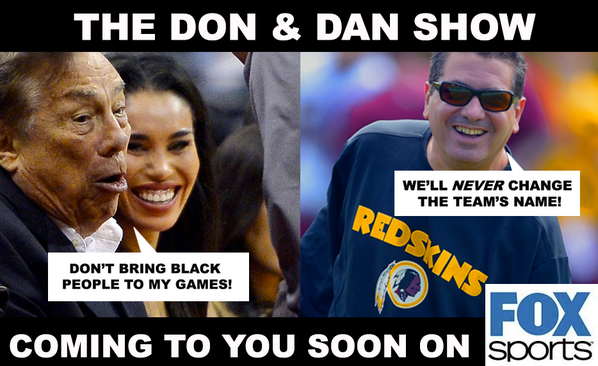
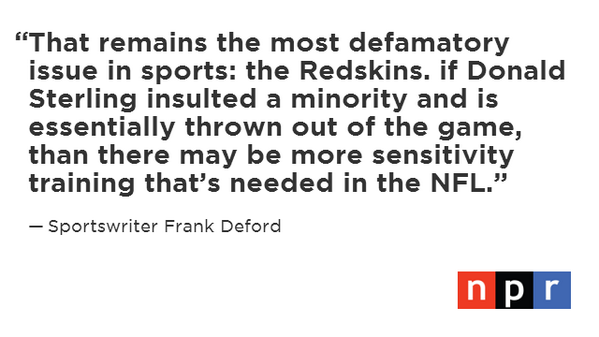
Many people noted the irony of the NBA's cracking down on Donald Sterling's racism while the NFL supports Dan Snyder's racism. Some tweets and images on the subject:

Dave Zirin ‏@EdgeofSports Apr 26
It's very difficult to look at universal condemnation of Donald Sterling's racism and not think about the pass given to Dan Snyder.


BlueCornComics ‏@bluecorncomics
Dan Snyder, say hello and good-bye to @NBA owner Donald Sterling. P.S. You're next. #Redskins #NotYourMascot #ChangetheName

BlueCornComics ‏@bluecorncomics
Why not "Sterling didn't mean any harm, he's helping black people, there are more important things to worry about"? Because #racism is EVIL.

BlueCornComics ‏@bluecorncomics
That shiver you just felt was every sports team owner with a racist Indian mascot wondering if he's the next Donald Sterling. #ChangetheName


Unless it's the Redskins and Chief Wahoo? Time to start applying our disapproval of racism to every sports team in America.

Getting the ball rolling

The first of what undoubtedly will be many postings on the subject:

Will Sterling lifetime ban push Redskins issue to critical mass?

By Mike FlorioTo no surprise, Oneida Indian Nation opted to use the penalties imposed on Sterling as a reason to draw more attention to the lingering controversy involving the Redskins name.

“In banning Clippers owner Donald Sterling, NBA Commissioner Adam Silver and other NBA team owners have taken a courageous stand against racism in professional sports, acknowledging that professional leagues cannot be a platform to promote bigotry,” Oneida Indian Nation Representative Ray Halbritter said in a release. “In taking such appropriate disciplinary action, the NBA has shown leagues like the NFL that they have a moral responsibility to take disciplinary action against people like Dan Snyder, who also continues to proudly promote bigotry with the use of a dictionary-defined racial slur as his team’s name.”

While it’s unlikely that the Sterling situation will nudge the Redskins name controversy toward a critical mass, the unwillingness of the NBA to tolerate an owner expressing racist views behind closed doors highlights the question of whether and to what extent the NFL is willing to tolerate a situation where reasonable minds may differ on the existence of overt racism.

Dear R*dskins Stars: The Clippers Show You Don't Have to Fear Your Owner

For more on the subject, see What Bundy and Sterling Tell Us and NBA Bans Sterling for Life.

NBA bans Sterling for life

The outcome of the fast-moving Donald Sterling story:

NBA commissioner bans Clippers owner Sterling, pushes to 'force a sale' of team

The lesson of Bundy and Sterling—your racist friend isn't okay anymore

By Matthew YglesiasIn a Facebook post, Bundy's daughter slammed conservatives like Hannity. "What does this have to do with land rights issues?" She asked. Historically speaking, the answer to that question is, to say the least, complicated. But the more immediate answer is simple: by and large, America isn't willing to tolerate a racist friend anymore.Sorry, racist friends!

Twitter Explodes With Hilarious First Amendment Fails Over Racist Clippers Owner’s Ban

"I'm no racist but...," said almost every conservative on the Internet.

Donald Sterling’s stunning comeuppance: The supreme satisfaction of swift action

NBA's Adam Silver brought a tone of moral outrage. Now owners should reckon with something else: The other victims

By Joan Walsh
In the end it likely came down to money, not morality. Donald Sterling’s racism had already cost the Los Angeles Clippers a dozen sponsors, Coach Doc Rivers had already made it known he would not return to the team next year, and more trouble was coming. But NBA commissioner Adam Silver brought a tone of moral outrage in delivering the toughest judgment possible against Sterling Tuesday afternoon: banning him for life from any involvement with the team and the NBA, fining him the maximum $2.5 million and urging NBA owners (the only ones with the power) to force a sale. “I fully expect to get the support I need to from other owners to remove him,” Silver declared.

It was a satisfying moment: Rarely do we see racists get such a quick comeuppance. Silver seemed genuinely, personally aggrieved by Sterling’s disgusting comments about African-Americans in a league that runs on black labor, talent and fandom. He praised great black NBA pioneers including Earl Lloyd, Chuck Cooper, Sweetwater Clifton and “the great Bill Russell.” His quick, tough action earned him praise from NBA Players Association advisor Kevin Johnson, also the mayor of Sacramento. “Today the players believe the commissioner has done his duty,” Johnson declared in a press conference following Silver’s announcement. “He is not just the owners’ commissioner, he is also the players’ commissioner.”

Still, Silver’s tough sanctions against Sterling can’t erase the fact that the NBA did nothing about earlier allegations of Sterling’s racism and ignored his ugly off the court behavior as a slumlord repeatedly charged with discriminating against black and Latino tenants. In fact, the bold move almost served to underscore how long the league had looked away from the festering sore that was Donald Sterling. Taking questions after his announcement, Silver said, “I can’t speak to past actions. When we had evidence, we acted on it.” He added that he only considered Sterling’s recently recorded racism in deciding on his lifetime ban, but said the owners would consider the entire record when deciding whether to force him to sell the team.
Why Donald Sterling’s inevitable downfall is proof that the “outrage machine” actually works

Pundits love to mock Twitter's ability to stoke anger—but the rapid fall of a corrupt NBA owner shows its value

By Andrew Leonard
Yes, people, this is for real: When the ad money starts drying up, shit is about to go down. Donald Sterling is now in the fight for his professional life.

But why now? Everyone who seriously follows the NBA has known for decades that Donald Sterling is a horrible human being, a bigot and an abuser of women. Eight years ago, Bomani Jones wrote a piece for ESPN lamenting that a man who had settled the largest housing discrimination suit ever brought by the Department of Justice, could skate by without any sanction from the NBA. Sterling managed to be both an abominable person and the worst owner in professional sports (as measured by wins and losses) and yet his position was still untouchable. So what’s so different today, that the release of one audiotape could set off an avalanche of fury so apparently meaningful? Why are a few words so much more hurtful than actual deeds?

The amplifying power of social media has to be part of the answer. Of course, it’s not the whole answer. The narrative of race in America is always a touchy subtext in the NBA, a league in which the teams are 70 percent African-American, but the ownership is overwhelmingly white and male. The smoking-gun nature of the audio recording speaks more directly to our hearts than any Department of Justice legal filing ever could. And the simple fact that the NBA world had its full attention focused on the most thrilling first round of competition anybody can recall in recent NBA history has certainly helped focus the media’s attention. A zillion TV cameras were already pointed at these playoffs. You want drama? You got it.

But just as “black Twitter” forced the murder of Trayvon Martin into the mainstream; and just as social media took Romney’s 47 percent video and spread it instantly to an entire electorate; so to has the ubiquitous transmission of TMZ’s Sterling scoop meant that the man’s racism—and, by extension, the beating heart of racial privilege in America—was front and center in everyone’s news feed and timeline.
For more on the subject, see Natives Condemn Sterling's Comments and Sterling: Don't Bring Blacks to Games.

April 28, 2014

Sterling: Don't bring blacks to games

Cliven Bundy the welfare cowboy must've been overjoyed to find himself bumped out of the news this week. Clippers owner Donald Sterling took his place with a racist and sexist tirade caught on tape.

A sampling of Sterling postings, with my comments:

Report: Clippers owner Donald Sterling caught on tape telling his girlfriend to not bring African-Americans to 'my games'

Clippers owner Donald Sterling can't be a racist. Some of his best friends and basketball players are black!

Your Complete Quotable Guide To Decades Of Donald Sterling's Racism


Digging deeper

Why Is the NAACP In Bed With Racist Donald Sterling?

NAACP On Sterling: Local Chapters Need 'Better Vetting Process' For Awards

Ya think?!

Maybe give the award to someone who hasn't donated big bucks to your cause. #conflictofinterest

Conservatives Called Him A Democrat, But Sterling Is Registered Republican

Sordid Subplot Appears To Show Another Ugly Side Of Donald Sterling

Let's not forget that he's a sexist pig as well as a racist pig.

Donald Sterling’s girlfriend has magical racism powers!

Maybe Stiviano should get the NAACP's award for exposing racism against blacks.

For more on conservative racism, see Bundy the Conservative Racist and The Science of Conservative Racism.

Natives condemn Sterling's comments

Chumash Casino Yanks Sponsorship of LA ClippersThe tribal-owned Chumash Casino announced Monday it was ending sponsorship of the Los Angeles Clippers basketball team in the wake of racist comments attributed to team owner Donald Sterling.

Sterling is alleged to have made the comments in a recorded conversation with a woman. Portions of that conversation were released over the weekend by TMZ and Deadspin, leading to a national outcry.

Chumash Tribal Chairman Vincent Armenta released the following statement:

“We’ve always been proud supporters of the Los Angeles Clippers, however, the recent statements attributed to the Clippers’ owner have forced us to reconsider our relationship. We remain supportive of the members of the team and we wish them the very best going forward. As a group that has long been marginalized itself, the Santa Ynez Band of Chumash Indians and the Chumash Casino Resort are especially sensitive to maintaining the dignity of all people. We cannot ignore any statement that causes harm or hurts any group. As a result, we’re withdrawing our sponsorship of the Clippers organization.“

Other businesses are also ending sponsorships with the Clippers including used car dealership chain CarMax.
NCAI Condemns Sterling’s Comments: “No Place In Modern Society For That Kind Of Hatred And Discrimination.”The National Congress of American Indians (NCAI) released the following statement in response to the ongoing situation around the Los Angeles Clippers:

“NCAI condemns Donald Sterling’s appalling comments regarding African Americans. There is no place in modern society for that kind of hatred and discrimination. We also want to applaud the many athletes, sportscasters, corporations, and individuals who have spoken out against Sterling and his comments. It is encouraging to see so many people standing together and declaring that this behavior is unacceptable.

“NCAI is no stranger to facing down racism and ignorance in American sports. Every incident of hate and racism–whether a singular incident or the repeated, high-profile use of offensive words and images–is unacceptable and has no place in the 21st Century. We will continue to support the LA Clippers players and fans as they face the fallout from Sterling’s words and we will continue to fight for a world in which no race or ethnic group is treated in this way.”
Comment:  For more on the subject, see Sterling: Don't Bring Blacks to Games.

Below:  The Chumash Casino.

September 12, 2013

Native movies of note--September 2013

Editorial: Film provides true look into reservation communityPride and Basketball is a documentary that highlights the role that basketball plays for the community of Lame Deer, Mont. located on the Northern Cheyenne Reservation, as told from the perspective of current players, past greats, and community members. Pine Ridge: Venice ReviewThe Bottom Line
A familiar style of magic-hour ethnography yields some entrancing and unflinching visions of American margins.
‘Bury My Heart With Tonawanda’ selected for two film festivalsIt is the story of a young man with Down syndrome who escapes while being transported to a home for the insane in the late 1800s and finds his way into Western New York’s Native American community.

July 16, 2013

Shoni Schimmel wins gold medal

Shoni Schimmel Wins GOLD as USA Defeats Russia–First American Indian WUG Gold Medalist

By Brent CahweeThe United States women's university basketball team defeated the host country and home favorite Russia in the gold medal game at the 2013 World University Games by a final score of 90-71.

With the win, the USA women became the first country to win the gold medal a record nine times in this event and this was also their third straight gold medal, they won in 2011 and 2009. Leading the way for the American squad was Bria Hartley UCONN, she scored 17 points and had one assist.

Indian country's own Shoni Schimmel, Louisville, from the Umatilla Indian Reservation, saw limited action in the final few rounds of the tournament but finally got on the court at about the four minute mark in the fourth quarter. Although she didn't finish with any points in this particular game Shoni made huge contributions for the USA ladies in the early rounds of the tournament. In the opening round, Shoni had a game high nine assist and added thirteen points which sparked a record run for the US team as they finished the game with thirty-four assist in a win over Mali which beat a previous Team USA record of twenty-seven. In the next game against the Czech Republic Shoni contributed six points and against Brazil Shoni added four points and four assist in that contest.
And:With the win over the Russians, Shoni becomes the first American Indian, for women's university basketball, to earn a gold medal at these university games. Former Arizona State standout Ryneldi Becenti, Navajo, played for the 1993 USA Women's squad that earned a bronze medal. Both ladies remain as the only American Indian participants for the USA world university team.Comment:  For more on Shoni Schimmel, see Schimmel Sisters Inspire Native Girls and Schimmel Sisters Advance to Final Four.

Below:  "Shoni Schimmel (center) shows off her GOLD with teammates."

April 12, 2013

Schimmel sisters inspire Native girls

A Tough End to a Brilliant Season: Louisville and the Schimmel Sisters Fall to UConn in National Title GameDespite a quick start, the Louisville women were defeated last night in the 2013 NCAA Women's Basketball Championship Final by perennial powerhouse UConn, 93-60. The game was contested in New Orleans, and the victory gives the Huskies an eighth title, tying them with the Tennessee Lady Volunteers for most all-time.

After the Cardinals built a 14-10 lead with just under 14 minutes to play in the first half, the offensive juggernaut that is UConn went on a tear, running off 19 unanswered points. The teams headed to their locker rooms at halftime with the Lady Huskies leading by a wide 48-29 margin.

The feisty Cards made a spirited effort in the second half, but the lead was too much. UConn was too much. "The gutsy No. 5 seed Cardinals at last ran into a giant they couldn't topple," notes espnW's Mechelle Voepel.

UConn's freshman phenom Breanna Stewart was unstoppable and named the game's MVP. She finished with 23 points--18 in the first half--and nine rebounds. And UConn made 13 three-pointers, a championship game record, doing to Louisville what the Cardinals had done to Baylor.

The loss ended an unprecedented tournament run by Louisville. The Cardinals became the first No. 5 seed to make the championship game, pulling off one of the greatest--if not the greatest--upsets in tournament history when they beat Brittney Griner and Baylor in the regional semifinals.


Hoop Dreams: Schimmel Sisters Inspiring Girls on the Rez

By Mary Kim Titla“I heard about them from the kids and teachers at school,” said Mariah Kozie, 15, about the Schimmel sisters, Shoni and Jude, who led fifth-seeded Louisville on an unprecedented run to the 2013 NCAA women’s championship game, played April 9.

Kozie watched the game Tuesday night with her 10-year-old sister Tana at their grandmother’s home on the San Carlos Apache Reservation.

“It’s good that they’re playing. They’re like our role models,” said Aaliyah Haozous, 11, who lives a few miles away. Haozous watched the game with her nine-year-old sister Ariel.

“They’re like us (playing rez ball). They play like boys,” said Dana Dosela, 17, who watched the game in another part of the Apache reservation.

The Kozie and Haozous girls and Dosela all have hoop dreams. They say watching the Schimmel sisters has given them hope.

“If they can do it, anybody can do it,” said Dosela. “It makes me want to be like them. They never give up,” said Kozie.
Commentary
Shoni and Jude Schimmel are Examples of What is Right about Indian Country

By Levi RickertA group of American Indian musicians who are on the "All My Relations" tour this week stopped by a McDonald's in Montana so that one could turn on her laptop and they could watch Tuesday night's NCAA Women's Basketball National Championship game ESPN stream.

They did not want to miss watching Shoni and Jude Schimmel, two tribal members of the Confederated Tribe of Umatilla Indians, based in Pendleton, Oregon play for the fifth seeded Louisville Cardinal women's team on the biggest stage in collegiate basketball.

The Schimmel sisters have had that type of effect on American Indians as their team upset Baylor, Tennessee and Cal in the NCAA tournament because they exemplify what is right about Indian country.

Unfortunately, the Schimmel sisters' magical season ended on Tuesday night.

Regardless, the Schimmel sisters may be the hottest item in Indian country today. They showed other American Indians how to live their dreams and how to excel. The Schimmel sisters are the only American Indians to ever play in a NCAA Division 1 basketball title game.

What is particularly gratifying about the Schimmel sisters is the sheer inspiration they now generate for other America Indian people particularly American Indian youth. One can only hope young Indian girls and boys everywhere are now saying: "If Shoni and Jude can do it, so can I."
Comment:  For more on the subject, see Tribes Should Support Native Talent and Schimmel Sisters Advance to Final Four.

Below:  "Mariah Kozie, a varsity basketball player at San Carlos High School, watches the NCAA Women's Basketball Championship game with her younger sister Tana. Both want to play college ball some day." (Mary Kim Titla)

April 01, 2013

Schimmel sisters advance to Final Four

'One of the Biggest Upsets in History': Native Guard Shoni Schimmel Drives Louisville Past Top-Seeded BaylorThat just happened. The Louisville Cardinals women's hoops squad knocked off the top-seeded Baylor Lady Bears last night in a Sweet Sixteen matchup in the NCAA women's basketball tournament, pulling off one of the biggest upsets in the history of the competition.

It's no surprise that the Louisville women were a 24-point underdog to Baylor in Las Vegas casinos, according to gambling expert R.J. Bell of Pregame.com. Considered a lock for the Final Four -- and prohibitive favorites to win a second straight championship--All-American Brittney Griner, the second-highest scoring player in NCAA history, and her Lady Bears got bounced 82-81, though, by fifth-seeded Louisville in the NCAA regional semifinal.

Leading the charge for the U of L was, again, All-Everything point guard Shoni Schimmel. She drained five three-pointers and hit from everywhere else closer to the hoop, finishing with a team-high 22 points. Shoni's sister and super sixth-woman, Jude Schimmel, added six points, five rebounds and three assists, tied for tops on the team. The Schimmel sisters are from the Confederated Tribes of the Umatilla Reservation in Oregon.
Below:  "Louisville's Shoni Schimmel (center) reacts after a shot over Baylor's Brittney Griner (left) in the second half Sunday. Schimmel scored 22 points as the Cardinals upset the Bears." (Alonzo Adams/The Associated Press)


Umatilla Tribe's Schimmel Sisters Shine as Louisville Upsets Powerhouse Baylor

By Levi RickertLouisville erupted with glee in March Madness as their men's NCAA basketball team made it to the Final Four and their women's team NCAA basketball team hours later made it to the Elite Eight in the women's tournament.

Indian country was proud Sunday evening as the two Schimmel sisters, tribal members of the Confederated Tribes of the Umatilla Reservation, helped their collegiate women's basketball team, the Louisville Cardinals, defeat the defending national champion Baylor in a stunning 82-81 upset.

Point guard Shoni Schimmel, junior, was the Cardinal's leading scorer as she scored 22 points in 30 minutes of play before fouling out in the fourth quarter. Her younger sister, Jude, played 28 minutes and scored 6 points, five rebounds and three assists.

They played before a national television audience on ESPN2 in the NCAA women's regional tournament in the Sweet Sixteen. Baylor went into Sunday's games with 32 straight victories and boasted what many consider to be the greatest women's basketball player of all time in Brittney Grinner, which made Louisville's victory that much more dramatic.
Guest Commentary
Schimmel Shocks the World!

By Brent CahweeIn a sport which rarely sees upsets on the magnitude that the men's college basketball tournament experiences, Shoni Schimmel and the Louisville Cardinals did just that in the women's "Sweet 16" round competition of the NCAA's Division I national tournament. The Cardinals upset the number one overall seed of the tournament and defending national champions Baylor Bears by a final score of 82-81 in what some sports analyst are calling the biggest upset in women's college basketball history.

What makes this victory so unique isn't the fact that women's college basketball hasn't ever seen women's teams go undefeated before or teams with less than a handful of losses over a few years, UConn, Tennessee. What makes this victory so special is who it was against as well. The All Everything athlete known as Brittany Griner, who has projected women's basketball into mainstream sports coverage like no other athlete before her. At a towering 6' 8" inches tall, Griner commands respect in preparation so much that teams have thrown every possible offense and defense to neutralize her presence only to come up with the same results as teams before them, a loss. Over the past two seasons the Bears have a combined 74-2 record that includes a perfect season last year but remember, this is "March Madness", it's what the NCAA brands their tournament that I am sure they coined to represent the men's college basketball game. Upsets just don't happen in women's basketball, we see the same 4 to 5 programs in the women's championship game year in and year out that has frankly put the women's tournament on snooze control.
But apparently not getting the memo that teams are supposed to politely take the ceremonial loss to Baylor, so the NCAA and its sponsors can use Griner in every marketing promo on their march to the Final Four games, were the Louisville Cardinals and Indian country's very own Shoni Schimmel.

Schimmel, a junior guard who comes from the Umatilla reservation in Oregon, has had a well documented basketball career that started on the reservation and now has taken her to the biggest stage of college basketball. She has even had a documentary made about her career to this point called "Off the Rez," that has won a few awards and it was even shown at the prestigious Tribeca Film festival in New York back in 2011. When I watching this game and watched Shoni handle the ball like a Bob Cousy and launch three point shots from the range that only the likes of NBA three point specialist shoot from I was sitting there thinking to myself that this isn't shocking at all
Schimmels do it again

Final Four! Shoni Schimmel Surges, Louisville Knocks Off Tennessee and Advances to the SemifinalsUnstoppable? Shoni Schimmel scored 24 points and the soaring Louisville Cardinals beat second-seeded Tennessee 86-78 last night to earn the school's second trip to the Final Four, continuing a captivating postseason run.

The Cardinals became only the second No. 5 seed to reach the national semifinals, joining Southwest Missouri State's 2001 team that featured guard Jackie Stiles, the all-time leading scorer in NCAA history. (It should be highlighted that the U of L knocked off Baylor, featuring Brittney Griner, second to only Stiles all-time in NCAA scoring, this year to advance to the Elite Eight.) Only seven teams outside of the top four seeds have ever made it to the Final Four since the NCAA tournament started in 1982.
Comment:  For more on the Schimmel sisters, see Preview of Off the Rez and "Superstar" Native Basketball Player.

March 29, 2013

Trail of Tears basketball tweet

Rep. Bruce Braley Apologizes for ‘#TrailOfTears’ Tweet

By John ParkinsonRep. Don Young might not be the only member of Congress in need of some sensitivity training.

After the Ohio State Buckeyes beat the Arizona Wildcats Thursday night in the college basketball tournament with a tie-breaking 3-pointer from LaQuinton Ross with 2.1 seconds left on the clock, Rep. Bruce Braley, D-Iowa, tweeted: “It’s official. Ohio State is the luckiest team in the tournament. #TrailOfTears.”

That #TrailOfTears hashtag quickly drew a negative response on Twitter, prompting Braley to delete the tweet within an hour. It was archived, nevertheless.

Braley, who is serving his fourth term in the House, then attempted to clarify his intent with a tweet-pology in the wee hours of the morning, explaining that he was identifying with the pain of Iowa State fans who suffered defeat at the hands of Ohio State last week.

“The ‘tears’ I was referring to were the tears of [Iowa State] Cyclone fans. I have removed the tweet & apologize to anyone who was offended,” Braley, 55, tweeted.
Comment:  Much like Indians forced to relocate or die, disappointed basketball fans cry.

"I'm so upset," said one grieving fan. "I feel like I've been raped, tortured, and thrown in the oven to die."

"I feel like I've died of smallpox and left my children to starve before the white man could even reach my village and rape me to death," said another.

Braley's tweet is eligible for the Stereotype of the Month contest because it implies the Trail of Tears is a trivial matter. In other words, that Native concerns don't matter--perhaps that Indians don't even exist anymore. Why else would you use one of their worst catastrophes as a joking matter?

For more misuses of the Trail of Tears, see Trail of Tears Fireworks and "Mail of Tears."

January 22, 2013

Phil Jackson supports college fund

Phil Jackson Volunteers for American Indian Fundraiser

Online fundraising campaign offers two fans a chance to spend a day with Jackson

By Dillon Tabish
Ever wonder what it would be like to spend a day with the Zen Master?

Lakeside resident and legendary basketball coach Phil Jackson is offering a lucky fan the chance to hang out in Los Angeles and talk about his storied professional basketball career.

Jackson has teamed up with the online company Omaze for a fundraising campaign supporting the American Indian College Fund, a nationwide organization that provides financial aid to Native students who cannot afford a higher education.

Contestants can enter to win here. The contest is currently slated to end on Feb. 8. One donated entry is $10. For those who purchase five or more, the cost drops to $8 per entry and 10 or more entries are $7 each.
NBA Coach Phil Jackson to Raise Money for American Indian College Fund

Comment:  For more on Phil Jackson, see Lakers Practice at Pechanga.

March 28, 2012

Menominee wood in Final Four floor

Final Four floor makers courting perfection

By Tom WeirThe maple came from the 235,000 acres of Wisconsin forest owned by Menominee Tribal Enterprises. The Menominee Tribe has about 4,000 people living on the reservation, and about 500 work in its sawmill or as loggers.

The Menominees are the longest continual inhabitants of Wisconsin, an indigenous tribe that dates back at least 10,000 years. They were nearly forced to migrate to Minnesota in the mid-1800s, but a treaty with the U.S. government was renegotiated, and they stayed after Congress agreed they could cut lumber on a sustainable basis.

The Menominee's leader at the time, Chief Oshkosh, instilled the idea of timber preservation and rotating logging areas that the tribe still follows.

Menominee sales representative Joe Besaw, who was born on the reservation, says of Oshkosh: "He's the one who said to cut only the sick and the dead and the dying trees. You cut only the worst, and over time your forest gets better and better."
Comment:  For more on the Menominee, see Girl Punished for Speaking Menominee and Selling Beer with Chief Oshkosh.

March 26, 2012

Clippers Native American Heritage Day

Los Angeles American Indians Participate at LA Clippers GameThe Los Angeles Clippers may have danced after their 101-85 victory over the Memphis Grizzlies this past Saturday night, but there were others dancing during half time of the National Basketball Association game.

Saturday, March 24 was billed as Clippers Native American Heritage Day in Los Angeles. This was the third year in a row the Los Angeles Clippers have sponsored a Native American Heritage Day.

Over 300 American Indians people primarily from low income homes attended the game. Most of the families who attended came from the Los Angeles metropolitan area, though one California based tribe sent some tribal citizens who traveled 300 miles round trip.

“We have had some great testimonial stories from the parents who told the ticket coordinator, Tracy Perez, that she would never have been able to take her kids to such an event because of the cost,” commented Ron Andrade, director of the Los Angeles City/County Native American Indian Commission.
Comment:  For more on Indians and pro basketball, see Lakers Practice at Pechanga and Clippers Cursed by Indians?

Below:  "Some 70 American Indians dressed in full regalia drummed, sang and danced during half time."

November 28, 2011

Robinson speaks for Big Brothers Big Sisters

Big Brothers Big Sisters Draft Basketball Star Tahnee Robinson as Spokesperson

By Brian DaffronMany recognize Tahnee Robinson for playing guard for the University of Nevada and for being the first American Indian to be drafted by the WNBA. However, these accomplishments may not have happened if it wasn’t for her coaches and parents serving as her mentors. Now, Robinson has a chance to serve as a mentor by being the official spokesperson for Big Brothers Big Sisters (BBBS).

“Mentoring is about putting a child on a path to success and giving kids the power to believe that they can achieve their dreams,” Robinson said in a statement released by BBBS. “While I was fortunate enough to count my parents as my true mentors, I will always do whatever it takes to make sure kids have the mentorship and tools they deserve, and the Big Brothers Big Sisters organization does that better than anyone.”


Comment:  For more on Tahnee Robinson, see Tahnee Robinson Is Sullivan Award Finalist and WNBA Drafts 1st "Full-Blooded" Native.

August 01, 2011

Echo-Hawk’s Nike N7 t-shirt design

Nike N7 collection featuring designs by Bunky Echo-HawkBunky Echo-Hawk, of the Pawnee Nation in Oklahoma and Yakama Nation in Washington, is a graduate of the Institute of American Indian Arts who is focused on fine art, graphic design, photography, creative writing, traditional singing and dancing, community outreach and a unique style of “live art” aimed at merging his traditional values with art for greater purpose.

Echo-Hawk’s design for the Nike N7 collection T-shirts focuses on the traditional native warrior holding a basketball in a strike pose, embodying his belief, and interpretation of Nike N7, that there is a warrior within every athlete. Echo-Hawk portrays the warrior with an eagle feather standing straight up within a roach head dress, and scalp feathers positioned to the side of his head. The warrior is positioned in the basketball triple threat stance, which readies the athlete for any move he or she needs to make next--shoot, pass or dribble. Celestial stars embrace the warrior in the design, providing a connection to the earth. The T-shirts designed by Echo-Hawk are made with organic cotton and will be available in challenge red and dark grey heather for women and challenge red and dark turquoise for men.
Comment:  For more on the subject, see Echo-Hawk's Art Confronts Stereotypes and Obama Portrait Puts Echo-Hawk on Map.

July 29, 2011

Super dunker Kenny Dobbs

The Inspiring Bounce-Back Story of Super Dunker, Kenny Dobbs

By Bryan AbramsKenny Dobbs can fly. When he jumps with a basketball either in his hand or in his sights (many of his dunks have him chasing a ball in midair), he appears to be floating. He has mastered this ability after years of intense training, dissecting the physics and physiology of dunking with the focus of an artist—or a madman. After years of physical, mental and spiritual training, Dobbs is arguably the greatest dunker in the world, perhaps one of the greatest ever. His vertical leap is 48 inches, as good or better than NBA dunk champions Michael Jordan, Spud Webb and Vince Carter in their primes. He has traveled the world showcasing his talents, from south Florida to South America, from Rome to Romania as a celebrity dunker for both the NBA and Sprite. He displayed his dunking abilities at this year’s NBA All-Star Weekend, and was asked to be a featured talent in the biggest-selling basketball video game on the planet, NBA 2K12. This past May, he beat two of the best dunkers in the world by wowing judges at the Ball Up’s Air Up There Slam Dunk Contest in Los Angeles. One of those judges was 1992 NBA dunk champion Cedric Ceballos. Another was a doctor by the name of Julius Erving.

Kenny Dobbs can also change lives. He has traveled across the country to speak to and on behalf of kids on reservations as an employee of the Division of Behavioral Health Services for the state of Arizona. For three years he served as the chairman on the Arizona State Youth Advisory Council for Alcohol and Substance Abuse Prevention. He is currently serving as an ambassador’s for Nike’s N7 division and the Native American Basketball Invitational (NABI) Foundation. With NABI, Dobbs created the UpRise Youth Motivational Presentations to educate kids on Native lands. He knows that if you want to grab a kid’s attention, flying is a good way to do it.

Kenny Dobbs, member of the Choctaw Nation of Oklahoma, Phoenix resident, proud son, brother, father and husband, is 27 years old. And he is lucky to be alive.
Comment:  For more on Native basketball stars, see Nike Signs Tahnee Robinson and "Superstar" Native Basketball Player.

Below:  "Dobbs was headed down a very bad road until he lifted himself up by dunking a basketball. Now he’s trying to raise up Native youths around the world."

April 29, 2011

Off the Rez is lacking

Nice to see some critical comments about Off the Rez after all the acclaim it's received:

"Off the Rez" Inspires, Though Off the Mark

By Tara Polen[I]t is hard to gloss over what is lacking.

The film takes some its gravitas from the accusation of discrimination against Native Americans. Some of this is legitimate; there are historical references to Ceci’s experiences growing up as an athlete that are doubtless true, that she was discouraged and outright denied opportunities because of her race.

But the notion that Shoni continues to face discrimination as a Native American—that accusation falls short in the film. The only examples given are weak: supposedly biased calls by referees during games, or implied excess physicality from opposing teams, these are not enough to make the point. Any fan of basketball knows that these are regular occurrences in any game anywhere across the country—at all levels of play.
And:[W]here is the explanation for Shoni’s eventual choice of Louisville? While building up the pressure and leading the audience along as Shoni’s college choice becomes more and more of a pressing issue (eventually she remains the last one of the top 100 ranked in her class not to have declared her intended school), the final announcement is anti-climactic.

We are simply told during Shoni’s high school graduation ceremony that she will go to Louisville; there is no elucidation, no further understanding for the viewer.
A more positive review, plus an interesting tidbit about the film's production:

Film Premiere:  Off the Rez Is Hoop Dreams Meets Glory Road

By Aron Phillips“The mother-daughter relationship is so complicated,” says Kelly Ripa, co-host of LIVE! with Regis and Kelly and executive producer of the film. While many people might see Ceci--a former high school basketball star in her own right--living vicariously through her children for the opportunities that weren’t afforded to her, Ripa notes that it becomes evident that her children are actually living through her.

While the basketball highlights are incredible--Shoni finished her senior year averaging 29.8 points, 9.0 rebounds, 7.3 assists and 5.5 steals along with 2,120 points for her career, ranking her sixth on Oregon’s all-time scoring list--it’s the story that keeps you glued to the screen. As so many people before her were said to be “conditioned to fail,” Shoni becomes larger than the game she loves; a symbol for her teammates, her family and Native Americans all over. A modern-day Jackie Robinson.
Comment:  I didn't know Kelly Ripa had any interest in Natives, basketball, or film production. It would be nice if she used her star power to get a few Natives on her show.

For more on the subject, see Hock on Off the Rez and Preview of Off the Rez.

April 25, 2011

Hock on Off the Rez

An interview about the new documentary Off the Rez makes some interesting points about rez life:

New Movie:  Off the Rez

Another great hoops documentary from the creator of Through the Fire.

By Sam Riches
SLAM:  Did you see similarities in the social and economic challenges faced by Shoni and her family in comparison to the issues faced by Sebastian Telfair and his family in Through the Fire?

JH:  I think our society as a whole is set up in a way to keep the people oppressed on the reservation and in the inner city ghettos. Geographically, psychologically, economically, the system that we operate under is set up to keep those people there while the people with the resources and the power keep what they have. In recent decades, people in the hood have been able to break out of the invisible walls that enclose the ghettos, though the odds against them are still huge. On the reservation, the invisible wall that separates them from the outside world is even more impenetrable. So to try to break out of the psychological and economic confines of the reservation is so difficult, especially if you want to do it on your own terms, without compromising who you are or what you represent. That’s what Shoni’s family was trying to do, and it was very inspiring to watch.

SLAM:  How important is basketball for the youth on the reservations?

JH:  On the rez, they talk about basketball as a way to battle for their tribe’s dignity. To take your best five and travel to another reservation or take on some team from the outside, that’s a tremendous source of pride for them. And it makes the game matter so much.

SLAM:  Why did you want to tell this story?

JH:  Partly, I wanted to shine a light on the forgotten hood. The reservation is just another manifestation of the hood in America, only it exists so far out of the light of the mainstream that people don’t know about it. I didn’t know much about it, but I was curious, and I found a family that believed in something and was trying to accomplish something I could relate to. So I just stayed with it and now, two and a half years later, we have the movie.
Comment:  For more on the subject, see Preview of Off the Rez and "Superstar" Native Basketball Player.

April 14, 2011

Nike signs Tahnee Robinson

A column explains a subtle point in the WNBA's drafting of Tahnee Robinson:

Biggest Little Sports Column:  Tahnee + Nike + N7 = #Winning

By Dan HinxmanGive Nike credit: The apparel giant understands marketing.

Third-round WNBA draft picks don't get sponsorship deals. Nevada's Tahnee Robinson was a third-round pick on Monday by the Phoenix Mercury, which then traded her to the Connecticut Sun.

She was the first WNBA draftee in Wolf Pack history, but that's not why Nike signed her to a two-year contract soon afterward.

No, this marriage is all about timing.

Nike launched the N7 campaign in 2007. N7, according to its website, is Nike's "commitment to bring sport and all of its benefits to Native American and Aboriginal communities in the USA and Canada."

You'd be hard-pressed to find a marketing campaign that is as noble as N7. And that's more than just a little important to Robinson, who could be found signing endless autographs and posing for photos at the Wolf Pack's Native American Day games the last two seasons.

As Robinson's status as one of the top players in women's college basketball has grown, so, too, has her responsibility. And it's one she takes on fully and with a great deal of pride.

As the first full-blooded Native American to be drafted by a WNBA team, Robinson can take that responsibility to a national audience. And Nike will be riding shotgun.

"They're definitely going to use me to reach out as much as possible, being the first Native American drafted and the first from Nevada," Robinson said Tuesday. "... without Nike, there's no way my story can be heard. I hope to promote N7 more and reach out to as many people as possible."

It's fitting, too, and no coincidence that Robinson ended up with the Sun. The franchise is owned by the Mohegan Sun casino, which is owned by the Mohegan tribe. Nike isn't the only one that understands marketing.

Robinson still must go through training camp and fight for a roster spot. It's no given she'll make the team, but the combination of landing with the Sun and partnering with N7 gives her a foot in the door.
Comment:  For more on the Nike connection, see Oregon State's Nike N7 Game and Nike to Promote Native Health.

April 11, 2011

WNBA drafts 1st "full-blooded" Native

Nevada basketball:  Robinson makes WNBA history as first full-blooded Native American to be drafted

By Jim KrajewskiNevada senior Tahnee Robinson described being drafted as "overwhelming."

The guard was the 31st overall pick in the WNBA draft on Monday. She was selected by the Phoenix Mercury and immediately traded to the Connecticut Sun for a third-round pick next year.
And:Robinson is the first full-blooded Native American player drafted by the WNBA. She is descended from several tribes, her mother is Pawnee and Eastern Shoshone and her father is Northern Cheyenne and Sioux. Her family still lives on the Wind River Reservation in Fort Washakie, Wyo., the same reservation where she grew up.I believe Indian Country Today doesn't allow the word "full-blooded," so it phrased the news a bit differently:

Tahnee Robinson Makes WNBA HistoryJim Krajewski of RGJ.com reported that University of Nevada senior Tahnee Robinson has become (among quite a few firsts) the first entirely American Indian to be drafted in the WNBA. The superstar guard was the 31st overall pick in the draft on Monday, selected by the Phoenix Mercury and then traded to the Connecticut Sun for a third-round pick next year.

Robinson is originally from the Wind River Reservation in Fort Washakie, Wyoming. Her mother is Pawnee and Eastern Shoshone, and her father is Northern Cheyenne and Sioux. On Wyoming’s Star-Tribune’s website, Jack Nowlin wrote that Robinson is the first Wyoming-born player ever drafted by the WNBA (she is also the first player from the University of Nevada ever selected.)
Comment:  For starters, full-blooded Indians are pretty rare these days. And few people can be that sure of their heritage.

If you go back eight generations, you'd have 256 ancestors. How many people know their family trees perfectly and can swear they have no ancestors from another race?

More to the point, tribes don't distinguish between full-blooded and part-blooded members. (In theory, that is. In reality, one group may be prejudiced against another.) People are bound to the tribe by historical and cultural as well as biological ties.

Therefore, many Indians would say her "blood" doesn't matter. If she was raised in the cultures(s), she's an Indian regardless of her blood.

Changing "full-blooded" to "entirely" doesn't make the point any clearer. If anything, it makes it less clear. Someone who's only 1/16 Indian by blood could be "entirely" Indian by upbringing. And the other way around: Someone who's full-blooded could be entirely non-Indian by upbringing.

The real "first" worth noting would be the first Indian drafted by the WNBA. In other words, the first tribally enrolled member regardless of blood. Robinson may be the first to qualify for that too, although the articles don't say. But being the first "full-blooded" Indian is a rather minor first.

For more on Robinson, see Tahnee Robinson Is Sullivan Award Finalist.