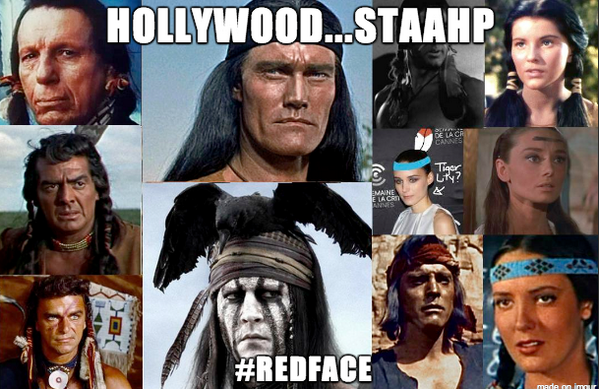
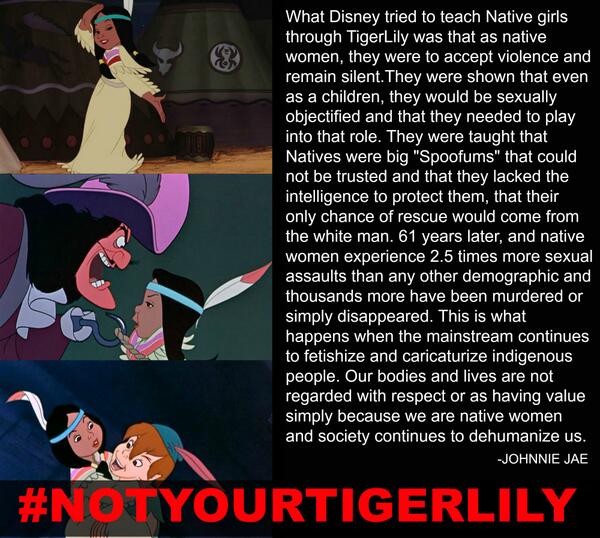
Showing posts with label redface. Show all posts

January 01, 2016

Appaloosa Horse Club in Rose Parade

Another Rose Parade, another stereotypical display of "Indians."


Apparently the Calizona Appaloosa Horse Club dressed as (their idea of) Nez Perce Indians to honor the Nez Perce history with Appaloosas. A Facebook video shows a 15-second snippet of their ride. Here are some photos taken from the video.
And an album of photos from an Old Spanish Days ride on August 7 of last year. Which may have been a precursor to the Rose Parade ride.

According to those who contacted the club, none of the riders were Native. Most dressed as stereotypical chiefs and maidens in "leathers and feathers," although a few women wore Nez Perce-style hats.


A behind-the-scenes photo makes it clearer that these people are dressing in wigs and makeup--i.e., redface. As someone wrote to the Tournament of Roses:We HATED the disgusting display of the fake Indian "performers" put on by the Calizona Appaloosa Horse Club during the Rose Parade yesterday. In 2016 you would think that educated people would know better than to make a mockery of a sacred culture by donning ridiculous wigs, face paint and fake sacred regalia. This was such an ugly insult to Native Americans. It's most disturbing and disappointing that an organization such as the Rose Parade would actually INVITE these buffoons to prance around in their caricature costumes and expect Native American people to feel "honored" by that. Please issue an apology and omit this ignorant group of people from the 2017 Rose Parade roster. Otherwise, it will be evident that the Tournament of Roses is run by supporters of racism and ignorance. Thank you.

Finally, the Nez Perce denied they gave the horse club any sort of permission or approval:

Nez Perce Did Not Give Horse Club Blessing to Play Indian at Rose Parade, Tribe Says

Oops. For more on stereotypical parades, see Debating an "Arab" Parade Float and Columnist Defends Mummers Parade.

December 13, 2015

Adam Sandler's wife in redface

On Facebook, Jacqueline Keeler wrote:Here's a recent photo of Adam Sandler and his wife who played "Wears No Bra." She is Italian American but they obviously painted her brown for the role. She was in #Redface to play a role originally titled "Sits on Face." I heard the entire scene was filmed--where she had to squat and pee while smoking the pipe by a tipi. They only showed the first part in the final cut.

Comment:  For more on Adam Sandler, see Video Response to Ridiculous 6 and Scathing Reviews for Ridiculous 6.

November 26, 2015

Indian costumes at annual Turkey Trot

Native American Activists Plan to Protest Redface Runners at Long Beach Turkey Trot

By Gabriel San RomanEvery Thanksgiving, runners head to Long Beach's annual Turkey Trot looking to put a dent in the calorie bombs sure to be gobbled up later in the day. They come by the thousands donning silly turkey hats with others wearing spoon and fork costumes. Too cute! Others, sadly, sport feather headdresses, sexy PocaHotties loincloths and war paint in a nauseating display of redface.

Native American activists are planning to protest this year's Turkey Trot, though, to put the brakes on redface runners. "Conquering our image is another form of colonization that began with the theft of our lands," says protest organizer Tahesha K. Christensen. "Redfacing is racist and it is no different than blackface, or making fun of Jews, Asians, or any other cultural group."

Christensen, a Native American of the Omaha Tribe, originally just wanted to find a charitable 5K around town to jog in when she heard about the Turkey Trot. Anna Christensen, Tahesha's mom and a Native activist in her own right, cautioned about the rampant redface she'd see. The would-be Turkey Trotter checked out the event's webpage and was mortified at all the photos of people playing Indian.

"It made me very angry and it really was painful to see all of those people so disrespectful to our Native cultures," she says. Christensen made polite pleas on the Turkey Trot's promotional page only to get blocked from commenting further.


And at the event itself:

Protesters want no Native American costumes at Long Beach Turkey Trot

By Andrew EdwardsA small group of protestors gathered near the beachfront site of the Long Beach Turkey Trot and called for ban against Native American-themed costumes at the event.

The protestors consider the wearing of such costumes disrespectful to Native Americans and their cultures.

“I got to speak with the organizer and I got to ask him if he would kindly ban the costumes, and he said he’s not in a position to do that just yet, but he understands our concerns,” said Gray Wolf, a protester who said he’s active with the American Indian Movement. “I think we made a little headway.”

Such costumes were a rare sight at Thursday’s event. A reporter observed about five people among an estimated 4,000 attendees who donned feathered headware that somewhat resembled ceremonial Native American attire. Many more people wore hats resembling Thanksgiving turkeys.
Comment:  The above image shows what past Turkey Trots were like. In fact, this photo may have inspired activists to launch a protest on Facebook and in person.

August 08, 2015

Hockey ad features stereotypical "Indians"

Shawinigan's new marketing campaign 'an insult' to First Nations

By Sunaya SapurjiIt should come as little surprise that the Shawinigan Cataractes–a team with a chief logo and a caricature mascot named Thomas Hawk (aka Tomahawk)–would take yet another insensitive misstep.

Their latest in cultural appropriation comes in the form of an ill-guided marketing campaign which features three players: captain Anthony Beauvillier, Alexis D’Aoust and Samuel Girard–none of whom identify as First Nations–dressed up in the stereotypical warrior motif complete with war paint and braided hair with beads and feathers in team colours.

It’s stunning to think someone with the Quebec league team thought this was a good idea.

The slogan for the campaign is the equally tone deaf: “My History. My Colours.”

Former Halifax Mooseheads captain Trey Lewis, a Mi'kmaq from the Elsipogtog First Nation in New Brunswick, can’t understand how anyone with the team thought this would be a positive marketing tool. He said it might have been different if the players were themselves First Nations or if the team was on or, at very least, associated with one of the reserves in the area.

“It’s disrespectful,” Lewis said. “To be marketing a team with First Nations imagery, I think they could have come up with a better idea to help promote their hockey team.

“In this day and age you have music festivals like Osheaga and Tomorrowland that are banning people from wearing Native American headdresses because it’s offensive.”
Comment:  For more on the subject, see More Festivals Ban Native Headdresses and David Guetta's Racist Pocahottie Promotion.

August 07, 2015

MSU students protest Boy Scouts

Members of the Indigenous Graduate Student Collective stage protest on NOAC

By Matthew Argillander and Ryan KryskaIf you've been on MSU's campus this week, you have most likely noticed the presence of the Boy Scouts of America and the Order of the Arrow for their centennial exhibition.

After Phillip Rice, a music composition graduate student and member of the Order of the Arrow, sent an opinion letter to The State News expressing displeasure with the event being held at MSU, Shelbi Meissner, a member of the Indigenous Graduate Student Collective and descendent of the Luiseno and CupeƱo in Southern-California, teamed up with Rice at Spartan Statue to protest the group's use of Native American culture and imagery.

One of the main reasons Meissner, a philosophy graduate student, cited for protesting was the presence of teepees and individuals wearing headdresses around campus.

"They have a racist caricature of a native man in a headdress that they claim is no longer one of their insignias, but it has been flying on a hot air balloon around campus as well as on a lot of the banners that have come in here," Meissner said. "As a Native American woman I find it highly offensive, and as a member of this community I feel really offended that MSU would host a group like this without any regard for how it would make a lot of students and faculty feel."
Students paint the Rock discouraging Boy Scout use of Native American culture on campus

By Catherine Ferland and Ryan KryskaAmidst the 2015 National Order of the Arrow Conference on campus this week, students have taken issue to the Boy Scout's use of Native American culture and imagery.

Anthropology senior Hayley Cook and alumnus Dan Grenzicki set out to paint the Rock on Farm Lane at 11 p.m. on Thursday. Their goal was to raise awareness of Native American cultural appropriation onset by the Boy Scouts of America.
Some reactions from Scouts:John Quimby, an Eagle Scout from Conn., said, “I’ve grown up in the Native community. It is just a touchy subject and it should be changed. They are trying to go for an image that is old and outdated. What I was taught in Boy Scouts and what I learned at the powwows were completely different.”

Quimby said he has spent a lot of time at powwows and was adopted into Native American tribes, even though he is of Filipino descent.

Jasper Wallen, 19-year-old assistant Scoutmaster from Idaho, said, “I don't always feel happy about the ways that we act as Native Americans. But we do have Native American tribe leaders that watch over and make sure that we are doing it respectfully. It is not really the racist thing that a lot of people think.”

Cooper Hanks, 15-year-old Life Scout from Idaho, said, “It is not offensive, it is more an inclusion. It is like any Christian group that tries to bring people in. Let's learn about each others religions and beliefs and be respectful. Even if you don't believe in it, see what they see and don’t be negative.”


"Let's learn"...about stereotypes

A Boy Scout mother explains what's wrong with the Order of the Arrow (OA):

Boys Scouts Order of the Arrow Guilty of Cultural Appropriation

By Ozheebeegay IkweOne of the adults who is actively involved in our troop described the OA “tapping out” ceremony to me. Imagine my surprise when he said there will be “Indians on canoes.” I asked him which tribe was involved, and he replied that the boys dress up like Indians for the OA ceremony. And so it began… I wrote him a heartfelt letter explaining why cultural appropriation is wrong. I communicated to him that wearing redface isn’t ok. I included a mini history lesson, shared some personal experiences, and touched on US policy dealing with Indigenous people. I even admitted to him that I myself, a multi-racial person, haven’t always been aware of cultural appropriation and its harmful effects. He did not directly address my concerns, but responded by saying there are tough requirements to even be nominated for OA, and scouters take it quite seriously. “It is not something they just do for fun.” He also stated that he believes they “use our Native Americans as role models.” He asked me to check out the OA because he knows the sincerity and quality of the scouts and scouters who participate.

So I did what he asked me to. The Order of the Arrow has been around for 99 years. According to what I read online, Edson and Goodman, the founders of OA, researched the language and traditions of the Lenni Lenape people. They wanted to include “Indian lore” in the OA to make the organization more appealing to the youth. This was during a time when our loved ones and ancestors were being taken from their families, assimilated, and “civilized.” This was during a time when Native people were considered less than human. While Native children in residential schools had their culture and language beaten from them, the Boy Scouts were using the language and their version of “Indian culture” in their OA ceremony. In fact, it wasn’t until 1978 that the American Indian Religious Freedom act was passed. That means non-Native members of the BSA were conducting their “Indian” ceremonies when Indigenous people in the United States didn’t even have the freedom of religion and culture that other people in the United States enjoyed.

As I searched Google images of the OA and watched YouTube videos of the OA ceremonies, I became even more uncomfortable. In fact, I feel the OA ceremony is downright offensive. At the Wahissa lodge OA, they don headdresses, face paint, sit and sing around a big drum, and dance with a pipe. At other OA ceremonies, they mix West Coast native art and plains style headdresses. Ironically, some of these “Indian” ceremonies are held in churches and priests are involved. It appears there is ongoing use of the big drum, hand drum, pipe, “eagle feather,” and headdress within the OA. Use of these items by Boy Scouts indicates that there is very little understanding of the Native people they claim to admire and respect.

I have been told that if we are not using these sacred objects as they are intended, we aren’t walking the walk. Along with carrying and using these items, comes a great deal of responsibility. Not just anyone should have them. I want my children to know the truth that is the Drum, Pipe, and Eagle Feather. I want them to understand that traditional ways are not a costume or boy scout initiation. They are alive, they are sacred. An Elder often reminds me that before we were born, we all had something in common. We listened to the heart beat for nine months. We didn’t know how to speak, think, or see. I believe that drum is the heartbeat that is alive in all of us. I believe it is to be loved and respected.

There is nothing honorable about an honor society appropriating culture.
A discussion of these postings on Facebook:The problem is so much larger than mascots. Little is said about the role of the Boy Scouts and summer camps in maintaining stereotypes. It needs to be made clear that there is no way for non-natives to "respectfully" appropriate native culture. While we all enjoy the benefits of globalization that bring us the food and music of the world, no one would think of "playing" at being Mexican, Asian or African, no matter how carefully researched for authenticity in apparel, adornment, and speech. Why are Native Americans different? Because modern indigenous peoples are otherwise invisible to Euro-Americans, while the stereotypes are everywhere.Right. A key question to ask these "respectful" people is:

There are 567 recognized tribes and many more throughout North and South America. There are literally thousands of them. How do you respectfully portray these thousand of diverse cultures in your program? Or are you inevitably relying on a few stereotypes--chiefs, arrows, etc.--that homogenize Native cultures and situate them in the distant past?

I'd be amazed if the Boy Scouts picked random tribes from Alaska, Greenland, Quebec, Nova Scotia, Ohio, Texas, Puerto Rico, Guatemala, Panama, Venezuela, Bolivia, and so forth and taught THEIR cultures. I'm guessing that'll never happen.

The founders supposedly researched the Lenni Lenape...but now the activities involve generic or Plains stereotypes. The Scouts may be respectful, but what they're respecting is false and misleading stereotypes.

We don't care about their intent; we care about the misinformation they're spreading. That and only that is the issue here.

For more on Scouts, see Boy Scount "Indian Dance Team" and Order of the Arrow's Indian Play.

July 31, 2015

Town cancels "Indian attack" race

This week's Internet outrage came courtesy of a race in a Kentucky town:

Enter the James Ray 5K to be chased by Native American reenactors

By Larry VaughtIt’s not hard to find a 5K race in this area. Most weekends, especially at this time of year, there is at least one local road race.

However, it’s not every day you can find a 5K—or any race—where American Indians reenactors will chase you to the finish line. Yet that’s exactly what you’ll get Aug. 15 at the James Ray 5K—Indian Attack in Harrodsburg.

“It’s all part of the Pioneer Days weekend,” said race director Terry Wasson.

Last year the event wanted to come up with something to make its 3.1-mile event unique from other races. That’s how the idea of having American Indians reenactors chase runners near the finish line originated, and Wasson said it went over so well that the same plan is in place for this year’s race.

“We’re getting set up for this again,” she said. “The (American Indians reenactors) will chase runners, and it seemed to be something that everybody really enjoyed last year. It was a big hit and came off as unique as we had hoped it would.”

If that’s not enough, Wasson said there will also be a “fort” at the finish line for runners to go into to help portray what it was like for James Ray.


Internet doesn't approve

Ky. festival scraps “Indian Attack” from 5K

By Chris KenningMounting criticism has led a Harrodsburg, Ky. pioneer-themed festival to scrap plans for a 5K run featuring Native American reenactors who chase runners.

An online registration form for the “James Ray 5K--‘Indian Attack’” race suggests runners come in costume and tells them they “can either run or walk, but don’t be surprised if you encounter some obstacles and come under attack when Indians chase you to the finish!”

The Aug. 15 race is to be part of the annual Mercer County Pioneer Days celebration. Race director Terry Wasson did not respond to requests by the Courier-Journal for an interview, but she told the Advocate Messenger newspaper this week that the idea was “a big hit” last year that organizers decided to do it again this year.

But outrage began building online this week. On Thursday, the Indian Country Today Media Network quoted University of Montana Assistant Professor of Native American Studies Theo Van Alst as saying that “in the end, it’s a celebration of the Indian removal of the area.”
Goodbye, Redface Race: 'Indian Attack' Pulled From 5K Run Amid Mounting Pressure

By Simon Moya-SmithSeemingly in response to a tidal wave of opposition, county officials in Kentucky on Thursday pulled a controversial element from its annual 5K race that was widely accosted as racially offensive to Native Americans.

Until Thursday, the “James Ray 5K Indian Attack” race, slated to take place in Harrodsburg, Kentucky, was to include a group of Native American reenactors in redface and dressed in faux Native American garb. The 'Indians' were to chase runners into the safety of an imitation fort at the end of the race, according to reports. The race, which is named for celebrated Indian fighter General James Ray who relocated as a teenager to Kentucky from North Carolina, remains scheduled for August 15.

"All concerns expressed on the James Ray 5K have been heard and the race has been altered accordingly," county officials wrote on its Facebook page. "As stated, we have altered the race to address the concerns brought to our attention. That means there are no Native Americans chasing in the race."

On Thursday, social media was abuzz with responses to the race many considered racist.


Red-face race? “Indian Attack” 5K in Kentucky canceled after Internet clues city in to the sheer awfulness of the idea

Organizers of Harrodsburg's "Pioneer Days" apparently thought this was a good idea, despite it being 2015 and all

Indians on the warpath!

Adrienne Keene explains what's wrong with this event:

James Ray “Indian Attack” 5k: Family fun for everyone!

By Adrienne Keene“General James Ray came to Fort Harrod in Mercer County at age 14 or 15 in 1775 from North Carolina with a party led by Daniel Boone. He served as an Indian spy and hunter for Fort Harrod, served in the campaigns against the American Indians and served several years in the Kentucky Legislature. He also reportedly raced with Blackfish Indian warriors to sound a danger signal to the settlers.”

Question: is this a case of a grammar error or am I correct in reading that James Ray was an Indian hunter? Like, he hunted Indians? Wow. In any case he “served in campaigns against American Indians.” GREAT. LET’S CELEBRATE THAT DUDE.

I just want to break this down for you. A town in Kentucky, which I’m guessing is not a completely Native town, signally how they were physically killed and/or relocated (ie CHASED) out of that land, holds a “pioneer days” festival to “celebrate” that history, complete with a 5k named after a guy who’s job it was to kill Indians…and decided that the best way to “honor” that history was to have white people dress up as the worst Indian stereotypes and chase runners into a fort. And not one single person thought that was a bad idea. In fact, it was so great they did it again!

Speaking of doing it again, here are some choice quotes from the article last year (where the photo at the top comes from):

“Dressed as Native America warriors, Nick Laymon and Kayla Slone giggled as they waited to swoop down with a little extra “fuel” at the James Ray 5K’s finish line. Veins popped out of Laymon’s neck as he and Slone bellowed and shrieked, inspiring more laughter than fear as they chased runners all the way to the finish line.”

Always the “warriors”–what makes them warriors? Like, honestly. Always warriors and princesses. But the “veins popp[ing] out” of his neck? What’s the point of that detail? To make him seem more savage and war-like? Gross.
Comment:  To be clear, the town canceled only the "Indian attack" portion of the 5K. The 5K is still on, as far as we know, but without the reenactors in redface.

Judging by the links below, there's a boomlet of white folks dressing up as Indians in historical pageants. Is this really happening?

For more on redface, see Wyoming Pageant Features Whites in Redface and Ontario Camps Feature Mock Ceremonies.

July 18, 2015

Wyoming pageant features whites in redface

Wearing ‘red face’: A changed perspective

By Caitlin TanUnfortunately, there is one other event that makes the entire Green River Rendezvous Days controversial. The last day a play is put on called the “Pageant.” Basically it reenacts the meeting and trading of the mountain men and Native Americans.

The controversial part is the cast is made up almost entirely of white Pinedalians. The mountain men simply dress-up in buckskin hide outfits and fur hats; however, the Native American actors not only wear buckskin outfits, but their faces are painted a deep brown, almost red color, and they either wear black wigs or dye their hair crispy black.

I regret to say I have worn the latter costume in past years.

My only defense is I grew up in the town, submersed in the culture and simply did not know better. The entire town participates and people see the event as a fun, innocent celebration, and in some ways it is, but the ‘red face’ is simply taking it a step too far.

Even worse, Rendezvous involves excessive drinking; thus, many people painted-up in ‘red face’ are running around drunk, “playing” the roles of Native Americans.

Again, I painfully have to admit I used to do this.
Her conclusion:Therefore, white people dressing-up like Natives–painting their skin dark and attempting to reenact the culture–is simply a sad disgrace.

Changing my standards on this issue was incredibly difficult–I feel like I am saying goodbye to a part of myself forever; however, it is liberating to now stand for something that is morally correct and sensitive to another culture.
Comment:  Good for her!

For more on redface, see Ontario Camps Feature Mock Ceremonies and Sandler Crew "Bronzed" Native Actress.

July 15, 2015

Ontario camps feature mock ceremonies

Chief insulted by mock Indigenous ceremonies at two Ontario summer camps

By Julien GignacTwo southwestern Ontario summer camps catering to non-Indigenous boys aged seven to 16 conduct Indigenous-themed rituals, which include dancing around fires wearing headdresses, painted faces and bodies.

Kilcoo Camp in Minden, Ont. and Camp Ponacka situated near Bancroft, Ont. are privately owned and operated camps for boys which cost roughly $4,000 a month.

Neither shy away from taking part in practices that could be considered off-colour to Canadians according to pictures lifted from their websites that reveal campers and camp directors themselves donning headdresses and Indigenous regalia.

Some have painted their bodies red. Others can be seen standing stoically around towering fires.

Chief Lance Haymond of the Eagle Village First Nation in Kipawa, Quebec finds it offensive.

“Redface to them may be a sign of respect for our culture, but to me it’s an insult,” said Haymond. “I think there are two options: stop doing it, or bring in First Nations people who are close to the camp and work with them to bring in a cultural component that does not make a mockery of our culture.”

April 24, 2015

Sandler crew "bronzed" Navajo actress

Navajo Actress Explains Why She Left Adam Sandler 'Ridiculous 6' Set

"That's not comedy when it comes to Native American stereotypes because we're always portrayed as the 'drunk Indian,' and that's just perpetuating those stereotypes," Allie Young says

By Daniel Kreps
After a dozen Native Americans hired to play extras on Adam Sandler's Netflix-produced western Ridiculous 6 ditched the set, one Navajo actress named Allie Young sat down with MSNBC to discuss the many reasons why they decided to leave the production. In addition to the script that they found offensive and disrespectful, the extras felt that the comedy–a play on The Magnificent Seven–furthered century-old stereotypes about Native Americans, Mediate reports.

"I'm full-blooded Navajo and they bronzed me. I was quite confused," Young said of the makeup department darkening her skin to make her look more stereotypically like a Native American. Young also revealed that the film's cultural consultant was the first person to leave the set. "That says something when the cultural advisor for the film quits because he's offended," she said.

Much has been made of the script giving characters names like "Beaver Breath" and "No Bra," but that was just the tip of how offensively the production viewed Native American women. "There was one instance where one of the Native American women, played by a white actress, is passed out on the ground and the group of white men are throwing liquor on her and she jumps up and starts dancing with everybody else," Young says of her breaking point to leave the film. "That's not comedy when it comes to Native American stereotypes because we're always portrayed as the 'drunk Indian,' and that's just perpetuating those stereotypes."
We Talked to a Native American Actress Who Walked Off Adam Sandler's Movie

By Zach SchonfeldIn a conversation with Newsweek, extra Allie Young, who is full-blooded Navajo, explained why she objected to the film, which has been picked up to premiere on Netflix next year.

"I take this very personally because my little brother committed suicide when he was 17 because of racism," Young said. "In his suicide note, he said, 'It's hard to stay alive when you're brown and gifted.' I want to take a stand for native and indigenous youth. I want them to see their people portrayed as something better."

An aspiring screenwriter and founder of the Survival of the First Voices festival, Young researched Hollywood depictions of Native Americans when she was a student at Dartmouth. She jumped at the chance to be an extra in The Ridiculous Six because she wanted to see how things had changed. She soon realized they hadn't much at all.

"At one point early on I was going in to makeup and being bronzed, and the wardrobe was not Apache traditional wear," Young explained. "I'm full-blooded Navajo. I was a little bit confused as to why I was being bronzed. I'm light-skinned. Maybe they wanted me to look darker."

The script posed more issues, including offensive names for indigenous women, like "Beaver's Breath" and "Wears No Bra." In one scene, a Native American women is passed out on the ground. A group of white men pours liquor on her, and she wakes up and starts dancing. "In Indian country, we're battling that issue right now," Young said. "It's 2.5 times more likely for an indigenous woman to be raped or sexually assaulted. Movies like this perpetuate that and just add to the stereotypes of our native women."
Comment:  A full-blooded Navajo made darker? Subjected to "redface" even though she's already "red"?

How exactly does this contribute to Sandler's "humor"? Answer: It doesn't.

It's clearly an attempt to make the Indians stranger and more exotic. That is, to make them less human and more animal-like. To "other" them.

There's no explanation for this other than racism. Indians look dark, according to the filmmakers, and white people don't. Which is why activists have rightly labeled Adam Sandler and Netflix racist.

For more on Adam Sandler, see Natives Quit Adam Sandler Movie.

April 23, 2015

Natives quit Adam Sandler movie

Native Actors Walk off Set of Adam Sandler Movie After Insults to Women, Elders

By Vincent SchillingApproximately a dozen Native actors and actresses, as well as the Native cultural advisor, left the set of Adam Sandler’s newest film production, The Ridiculous Six, on Wednesday. The actors, who were primarily from the Navajo nation, left the set after the satirical western’s script repeatedly insulted native women and elders and grossly misrepresented Apache culture.

The examples of disrespect included Native women’s names such as Beaver’s Breath and No Bra, an actress portraying an Apache woman squatting and urinating while smoking a peace pipe, and feathers inappropriately positioned on a teepee.

The film, which is said to be a spoof of The Magnificent Seven and was written by Adam Sandler and his frequent collaborator Tim Herlihy, is currently under production by Happy Madison Productions for a Netflix-only release. The movie will star Adam Sandler, Nick Nolte, Steve Buscemi, Dan Aykroyd, Jon Lovitz and Vanilla Ice.

Among the actors who walked off the set were Navajo Nation tribal members Loren Anthony, who is also the lead singer of the metal band Bloodline, and film student Allison Young. Anthony says that though he understands the movie is a comedy, the portrayal of the Apache was severely negligent and the insults to women were more than enough reason to walk off the set.
American Indian actors quit Adam Sandler movie over names

By Russell ContrerasGoldie Tom, another extra who departed the set Wednesday, said producers told the group to leave if they felt offended and that script changes were not up for debate.

"This just shows that Hollywood has not changed at all," Tom said.

She added the production had a number of non-Native American actors portraying American Indians, a long-standing complaint about the movie industry.

The actors said a Native American consultant hired by the production also walked off the set.


Native American Actors Walk Off Adam Sandler Set in Protest

Netflix defends film as "a broad satire of Western movies and the stereotypes they popularized"

By Jon Blistein
Netflix has defended Adam Sandler and his upcoming movie The Ridiculous Six after roughly a dozen Native Americans actors and actresses, as well as the film's Native cultural adviser, walked off the New Mexico set, claiming the script was offensive and disrespectful, Deadline reports.

Per Indian Country Today Media Network, the performers, who were primarily from the Navajo nation, took issue with jokes that insulted native women (characters were given names like Beaver's Breath and No Bra) and misrepresented Apache culture (one shot called for a woman to be simultaneously urinating and smoking a peace pipe). Others also pointed out that everything from the costumes to the positioning of feathers on a teepee was inaccurate, if not inappropriate.

While neither Sandler nor anyone from his production company, Happy Madison, have commented on the incident so far, a spokesperson for Netflix said: "The movie has ridiculous in the title for a reason: because it is ridiculous. It is a broad satire of Western movies and the stereotypes they popularized, featuring a diverse cast that is not only part of—but in on—the joke."

Those that walked off the Ridiculous Six set said they received similar, if not more curt, responses from producers after voicing their concerns. David Hill, a 74-year-old man of Choctaw descent, compared their arguments to those Washington Redskins owner Dan Snyder uses to defend the team's outdated name, while Allison Young, Navajo, told ICTMN: "They just told us, 'If you guys are so sensitive, you should leave.' I was just standing there and got emotional and teary-eyed. I didn’t want to cry but the feeling just came over me. This is supposed to be a comedy that makes you laugh. A film like this should not make someone feel this way."
Native American extras storm off set of new Adam Sandler film over racist jokes that called woman 'Badger Breath' and made fun of their culture

By Chris SpargoMaking matters worse says Anthony is that no one felt like they were being listened to by the production team.

'They just treated us as if we should just be on the side,' said Anthony.

'When we did speak with the main director, he was trying to say the disrespect was not intentional and this was a comedy.'

The cultural adviser meanwhile asked to speak to Sandler according to one extra, but was refused, and when that extra, Goldie Tom, later complained, she was told; 'It's in the script and we are not going to change it.'
Video: Adam Sandler's Producer To Native Actors: 'Sensitive? You Can Leave'

By Vincent SchillingIn an exclusive video obtained by one of the actors on set, Goldie Tom, Native Actors discuss their disappointment on the set of the Adam Sandler movie. During the discussion one of the producers tells the actors, “Here’s the thing, If you are overly sensitive about it… then you should probably leave.”

The actors are visibly frustrated at the remarks.


Adam Sandler film angers some Native American actors

Native American cast leaves Adam Sandler flick: ‘Nothing has changed—we’re still just Hollywood Indians’

March 11, 2015

Unbreakable Kimmy Schmidt just a comedy?

I haven't watched The Unbreakable Kimmy Schmidt yet. But a posting about it in Facebook's Eradicating Offensive Native Mascotry group led to this debate:I think y'all have too much time on your hands to worry about racism in comedy. Seriously? You're taking comedy seriously? LOL!

...just curious how you felt when 1491s did full on Black face to illustrate the point about Red face...
Why would we take representations in comedy less seriously than elsewhere? It's media and it's pervasive. This is how most people learn about Indians: from what they see in movies and on TV.

This whole mascotry cause is devoted primarily to representations in sports. Is that a serious field? More serious than comedic TV?

I'd argue that they're both unimportant in the grand scheme of things. But they're both important to the issue of Native representations because of their influence.

Is a product package important? How about a fashion show? A college frat party? A Halloween costume? Give us some important examples of racism--as opposed to these "unimportant" examples.

P.S. I appreciate what the 1491s did because they were trying to make a point. Unlike comedies such as this one.

Trying to make a point?...how do you know this comedy is not trying to make a point?

Idk. What is appropriate comedy about Indians?

What is your solution?
I'm sure they were trying to make a point. Just as hipsters are trying to make a point about how "tribal" they are by wearing Plains headdresses. And how mascot lovers are trying to show how much they "honor and respect" Indians with their clown costumes.

As always, the issue isn't what they intended in their little minds. It's what results on the screen or at an event.What if there are Indian comedy writers for this show? Would it be ok?

How is the comedy hurtful? I have known people who have been in this country for decades, since the 1970's and who still do not speak a bit of English. I have known fair skinned Indians who have passed themselves off as White...actually I know a lot of people like that, especially the richer ones! I have seen Black, Asian, Latin, Native American men go coo coo for White ladies, and it certainly makes me smirk when I see that.
What's my solution? Better comedy.

Native writers would do better in general. But this show may have had a Native writer or two.

They don't get a pass just because they're Native. Same as the Natives who declare they love the "Redskins." It's the results that matter, not the intent.

My blog has 79 postings on "humor" going back 10 years. I'm not going to repeat them all in a tiny Facebook box. Read what I and others have written on the subject for years. Assume we've thought about the issues in depth.

Meanwhile, what's your solution for Jane Krakowski getting another acting role that should've gone to a Native? Are you okay with being invisible? People like me are offering critiques and solutions while you're accepting the status quo.

Comedy is tricky?Comedy is a tricky thing...different people find different things funny.

Which Native actor who looks White should have gotten the role? Suggestions please...

...and if you want to change the story line, what makes you think that your story line would be funny?

Better comedy, btw, is not a solution.

Rob...I am afraid you are stuck in the good ol George Bush mentality of us vs them...geez, lighten up, fella! Been hanging around Russell Means too much perhaps? LOL!
So far I've seen five criticisms of Jane Krakowski playing a Native. No one has said this storyline was funny.

Have you seen light-skinned Natives with dark-skinned parents? In particular, light-skinned Natives with eastern European features? Because that's the issue here--not merely light-skinned Natives.

What's the harm? You mean besides Krakowski taking a role from a Native actor? The harm is depicting, for perhaps the 10,000th time, that being Native is something a white person can do by putting on a costume and some jewelry. Krakowski is engaging in redface by pretending to be Native.

I'm a writer and I've proved I can write funny characters without engaging in redface. Which is a point you haven't addressed. Having white actor play a Native is the same thing we've complained about for decades. Did you miss these complaints? Because there are thousands if not millions of them in existence.

Another thing you're missing is that it takes no effort for a white actress to pass as white, so there's no comedy or drama there. If the actress were Irene Bedard or Kimberly Guerrero, as one critic suggested, she'd have to struggle to look white. The contrast between what she was trying to achieve and what she actually achieved might be funny.

I'm still waiting for your answer on which instances of racism we should criticize if not TV shows? Mascots? Product packages? Fashion shows? College frat parties? Halloween costumes? Go ahead and address each of these so we'll know what we should and shouldn't protest.

The only "us vs. them" here is Natives who want better representations vs. Hollywood which refuses to represent them better. I'll gladly take the Native side in that battle. You can stick with the "it's just comedy" Hollywood status quo that keeps Natives invisible in the media.

Conclusion

After the debate, a few final thoughts.

Obviously, as critics have said, Kimmy Schmidt was trying to explore the issue of Natives who want to and can pass for white. It's a legitimate topic--for some show, at least. But it raises questions.

One, what is it doing in this show? Critics have noted how Krakowski's character could be any ethnicity. She could be Greek, like creator Tina Fey, trying to fit into the non-Greek world. She could be Ukrainian, Brazilian, or Australian.

Remember how Crocodile Dundee had trouble fitting in in New York City? One doesn't need to engage in redface, brownface, or blackface to play a fish out of water. Even if someone has the same skin color as the majority, her language, culture, or religion can set her apart.

It seems the writers added this subplot because one or two of them are Native. That's not a great reason. The subplot doesn't flow naturally from the premise. As critics noted, it feels tacked on.

Two, it's true an actress such as Irene Bedard might look "too Native" to pass comfortably as white. Using someone like her might make the subplot difficult to pull off. Kimberly Guerrero doesn't look traditionally Native, I'd say, but some actresses do.

Okay, but there are thousands of Latina and multiracial actresses who have Native blood. As we've seen on countless shows, they can pass for many ethnicities. Many of them have experienced exactly the plight of Krakowski's character. In one context, they seem Hispanic, or whatever their predominant ethnicity is. In another, they seem white.

That's the kind of actress who should've gotten this role. Not the lily-white Krakowski. Krakowski was cast because she's white and she's Tina Fey's colleague. Not because she has any affinity for a "white Indian" role.

For more on Unbreakable Kimmy Schmidt, see Jane Krakowski in Unbreakable Kimmy Schmidt.

March 10, 2015

Jane Krakowski in Unbreakable Kimmy Schmidt

What’s Up With the Native American Subplot on Unbreakable Kimmy Schmidt?

By Libby HillUnbreakable Kimmy Schmidt, Netflix’s new series with a 30 Rock sensibility, is the show of the moment. It premiered to glowing reviews last Friday, with critics largely agreeing: It was “winning,” "very funny,” and “daftly effervescent.” But because the show is a delight to watch on so many levels, most reviews also swept one persistent plot point under the rug: Jacqueline Voorhees’s odd, irrelevant, and ultimately offensive Native American past.

Here’s the problem: In the third episode, the audience learns that Kimmy’s boss, Voorhees, is secretly a Native American. This revelation would be one thing on its own, but Jacqueline is played by the very white, very blonde Jane Krakowski. The episode includes flashbacks to her adolescence, where Jacqueline (then called Jackie Lynn) is still played by Krakowski, with lip service played to her dyeing her hair blonde and getting blue contacts—but these are subtle details.

When addressed, the subplot is passingly called “bizarre” and “inexplicable,” but most critics decide to leave all mention of it out—good or bad. At the panel for the show at this year’s Television Critics Association press tour, Kimmy Schmidt co-creator Robert Carlock explained the story line, but his argument reads like the rough equivalent of, Well, I have Native American friends: “We have a couple of writers on staff with Native American heritage […] So we felt like we had a little room to go in that direction.” He further explains: “Wouldn’t that be a crazy A-to-Z for her to deal with that, and maybe reconcile with it, and re-embrace who she really is, ultimately.” Basically, he's explaining, they wanted to give her a sympathetic background.

Carlock positions the decision as a narrative choice. But this specific backstory is most frustrating because it doesn’t serve a purpose, either narratively or comedically. There must be more compelling (and funnier!) ways to give Jacqueline a backstory that don’t require sloppily marginalizing a group of people who are already as marginalized as you can get. It’s especially disappointing because Unbreakable Kimmy Schmidt so deftly integrates race in other instances, mainly in the latter half of its first season. The most prominent example comes when Kimmy’s African-American roommate, Titus, gets a job that requires him to dress as a werewolf. The punch line: He discovers he gets better treatment from strangers while in a monster costume than he does as a black man. The point is sharp, and it works largely because Titus is the one pointing out the discrepancies. This is precisely what isn’t happening when it comes to the dynamic between Jackie Lynn and her parents.
In Which I Explore the Native Cameo in Unbreakable Kimmy Schmidt or Troll The Respawn Jeremy If You're Gonna Do This Story Lets Do It Right

By Cutcha Risling BaldySo yes, Jenna (sorry, she’s called Jacqueline in this show although she will always be Jenna Maroney to me…) is a secret Native American. Not like “Top Secret” where she sometimes puts on her Pendleton jacket and heads out to fight colonization or to try and push secret government agencies for more money for language revitalization… but a secret Native American because she thinks the path to prosperity is to become an upper east side wife and upper east side wives are white… and blonde so she decides not to be Native American anymore, at least not in the “I have brown hair and brown eyes and respect my parents” kind of way.The biggest problem with this:CON: Jacqueline is played by a white actress pretending to be a Native person who is pretending to be white.

WHAT THE WRITERS NEED TO KNOW: Lots of white people have played Indian people in movies… on TV… on the radio… at sporting events… and even if you don’t want it to, it adds a layer of disingenuousness to your story. When white actresses are given the leeway to play Native it hearkens back to these days where any actor could play native by slapping a headband on or crying for the spoiling of the earth on TV commercials (stop littering. You are making the Natives sad). It might not be “fair” or “what you intended” but this is the way that it is when white people play Natives… and it will be this way until we get more positive representations of Native people, by Native people, with Native people. That’s what you’re signing up for with this story writers, deal with it.
Her conclusion:I know people are (understandably) somewhat upset about this tongue in cheek portrayal of Nativeness on this very white show in a very white universe. I sometimes think that it’s just reflective of how exhausting modern, privileged, white centered comedy is. It’s always outside looking in. It’s always “look at my privilege, be awash in my privilege, watch my privilege allow me to make whatever jokes I want or to write whatever I want because I want to oh and by the way here's where i say sorry if you were offended.” It’s so tongue in cheek that it can be exhausting–especially when that’s all there is. (It's the reason why those pointed lines that make fun of this privilege are so exciting for people. It's also why people think they can get away with the other problematic portrayals of race on the show "but we made a joke about privilege, so we can now make this problematic character speak in a funny accent...).”

The Unbearable Whiteness Of Unbreakable Kimmy Schmidt—Tina Fey's Racist New Show

By Ijeoma OluoI've never seen a show with such a diverse cast that was written so obviously and exclusively for privileged white people.

I was (and still am) a huge fan of 30 Rock. The show about a fictional late night TV show with a hilarious crew of neurotic misfits skyrocketed Tina Fey to stardom as one of the best comedic writers of our day. So when I heard that Tina Fey had a new show, Unbreakable Kimmy Schmidt, and it was available for binge-watching on Netflix, I was beyond excited. I settled in with my laptop, snacks on hand, prepared to laugh.

I was not prepared for how incredibly tired, hack, and downright offensive this show would be when it comes to race. I've never seen a show with such a diverse cast that was written so obviously and exclusively for privileged white people. Unbreakable Kimmy Schmidt is the story of a young woman who was abducted as a teenager into a religious cult and forced to live underground with three other women for 15 years. After she is freed, she moves to New York to start a new life. Hilarity ensues. Or, racism ensues. I guess it depends on what you find funny.
Is Jane Krakowski Native American? As A Mixed Race Woman, I Question Her 'Kimmy Schmidt' Character's Past

By Mallory CarraAll that being said, I appreciate more diversity on TV in any form and Unbreakable Kimmy Schmidt is certainly doing its part—Kimmy’s roommate Titus is African American and her love interest Dong is Vietnamese. But I’m not sure the Krakowski-as-a-Native-American storyline should be included in that. It’s a joke that gets old quickly and is unnecessary—Jacqueline could’ve been Russian or have any other ethnic background. She didn’t have to be Native American. Co-creator Robert Carlock tried to justify Jacqueline’s Native American backstory at the Television Critics Association press tour, saying, “We have a couple of writers on staff with Native American heritage. So we felt like we had a little room to go in that direction.” But that doesn’t quite work for me.

It’s also not the best timing for a joke like this, coming after #OscarsSoWhite and the big push for Hollywood to embrace diversity on-screen and off. I mean, already we’ve seen white British actor Adam Rayner being cast as an Arab in Tyrant and David Schwimmer land the role of famous Armenian Robert Kardashian in the upcoming American Crime Story. For all of Kimmy Schmidt’s contributions to inclusiveness, casting white actors in ethnic roles is not the path to diversity.
'Unbreakable Kimmy Schmidt' Has Two Native American Actors. It Needed ThreeUpadhyaya sees the Native storyline as a troubling way to make a simple point: "'Why does it matter where I’m from? It’s where I’m going that counts,' Jacqueline asks. Sure, yes. That seems to be the character’s central philosophy. But we probably could have gotten there in a different, less whitewashy way."

Here's another way we could have gotten there: Keep the Native American character, and hire a Native American actress, one who looks like she might share a single gene with pappy Gil Birmingham, to play her. Irene Bedard and Kimberly Norris Guerrero are contemporaries of Krakowski, either of them with dyed-blonde hair would be funny—funnier than a white woman playing a Native who is passing as white. When a character is passing as another race, the comedic question is Who does she think she's fooling? But instead of a joke within the narrative, any moderately intelligent viewer is more likely to feel like the show's creators are trying to pull a fast one: Do they really expect us to believe she's Native American?

Krakowski, though, is a selling-point of the show; she comes with the fairy dust of 30 Rock and Ally McBeal on her. Tina Fey and company would sooner rewrite the character than replace her with a Native actress. So perhaps they should have rewritten the character. As much as we like—correction: we love—seeing Gil Birmingham and Sheri Foster in a sitcom, watching them pretend to be Jacqueline's biological family is unsettling, on more than one level.

As Libby Hill says in the conclusion of her Vulture article, "What's most disheartening about this isn't that it exists, it's that apparently, nobody thought it would raise alarms at all."
Comment:  For more on the subject, see White Males Still Dominate Hollywood and Race at the 2015 Oscars.

January 18, 2015

Jimmy P. flops at box office

When the movie Jimmy P. came out in 2013, I discussed the redface casting of Benicio Del Toro as a Blackfeet Indian. Now the movie has made it to Japan, or something, because a recent article raised the issue again.

Jimmy. P: ‘not one actual Native American could be found to play the lead role?’

By Giovanni FazioDel Toro, for his part, put in some work trying to master a proper Blackfoot tribe accent, but the result is more than a little off-putting. His pattern of speech is so painfully laconic and halting that it almost comes off as a caricature, especially since all the other Native Americans cast in the film sound much more contemporary and colloquial. It’s unfortunate that this wasn’t noticed by French director Arnaud Desplechin (“Kings and Queens”)—this is his first attempt at an English-language film. Furthermore, the issues of racial discrimination that are raised tend to lose their bite when apparently not one actual Native American actor could be found to play the lead role. A Freudian slip?Comment:  In the past, Desplechin said they couldn't find any Native actors while Del Toro said it was a money issue. I ripped these positions in Director: Native Actors Lack "Charisma."

Then I could only guess how badly Jimmy. P would do at the box office. Now we know. Box Office Mojo reports that it earned a pathetic $24,329. Not $24 million, $24 thousand.

So much for all the asinine claims that Del Toro is a big star who could earn big bucks for investors. The producers could've cast anyone, even me, and the movie would've earned just as much. Someone could've earned $24K by screening home movies of pets and babies.

The fallacy of the big-name actor strikes again. These actors are worthless from a financial standpoint--at least in movies like this one. There's no financial reason--none--for hiring Del Toro rather than a Native actor for Jimmy P.

The producers hired him because they were "familiar" or "comfortable" with him. In other words, because he was white like them. That's a typical example of discriminating on the basis of race, or racism.

October 12, 2014

Redskins fans show their "respect"

As usual, Redskins fans showed how they "honor" and "respect" Indians:


As one critic put it:My hometown football team sure loves to honor Native Americans. Our fans are so respectful of Native American culture that some of them showed up to the game in Arizona today in traditional red face and headdress. Indigenous people must feel so honored by this display. I am so glad we honor Native Americans like this right before Columbus Day. Native Americans should be thanking us for honoring them like this instead of complaining about REDSKINS.My version of this image:


Comment:  For more on the subject, see Navajo President Sits with Snyder and Natives Protest Redskins in Phoenix.

September 21, 2014

Shriners as Indians, Arabs, and clowns

Shriners Play Indian in ND Parade; Should Stick to ClowningAs part of an annual parade we are told is organized by a man named Scott Johnson in the capitol city of the State of North Dakota, a float full of White guys all in Red Face, donning fake headdresses--in the present day--actually made it all the way through with out being booed, pelted with eggs or confronted to have their mock head-dresses removed. Seriously. This is 2014 and in this part of the USA, Native Americans and forward thinking, socially conscious people are subjected yearly to this annual Parade. The parade float was sponsored by the Bismarck Masons and the Bismarck-Mandan Shriners. The Shriners are known throughout the country as people who usually dress up as clowns and do good will wherever they are, but in North Dakota I guess they also think they can dress up as Indians, Orientals, and Arabs. They seem to have fit in perfectly with the annual racially charged themes in which White appropriation of non-White cultures and/or Peoples is encouraged and celebrated. The Mandan Indian Shriners (who apparently were on the float) have units in their organization with names such as the Arab Patrol, Oriental Band, and maybe other 1950s White privilege influenced unit names and practices of their El Zagal Shriner organization, founded in 1942 by A.B. Welch. From the links below it is clear that White people have been playing Indian in North Dakota since the early 1900s.Comment:  For more on the subject, see Debating an "Arab" Parade Float.

July 24, 2014

Can kids appropriate Native culture?

When is it cultural appropriation and when is it just kids playing dress-up?

By Ariel Meadow StallingsLast week on Offbeat Mama we ran a sponsored post for a family photographer, which featured this image.Within a day, we'd gotten two comments about it. The first very articulately raised the issue of cultural appropriation: "I know that other people probably disagree, but the first photo makes me sad. Adrienne says it better than I can." The second comment (from a different reader) was less articulate, snarkily asking the photographer if she "has the kids do hipster blackface as well?"

Both comments were removed (as per our comment policy on sponsored posts), but we also swapped out the photo.

But the issue of cultural appropriation is huge and important, so I sent this follow-up message to the more articulate of the two commenters:About your comment below on Offbeat Mama: the photo you were concerned about has been removed from the post, but I wanted to follow up with you via email. A sponsored post isn't the best place get into a whole discussion about race and cultural appropriation, but I'd love the opportunity to dive into this more.

I'm totally 100% with you on how the hipster trends of cultural appropriation are problematic (it's something we've talked a LOT about on Offbeat Bride), but I'm confused about how a photo of the children reflects this.

So, for starters, we don't know anything about the cultural background of these children—they could be half or a quarter Native. By accusing them of appropriation, there are some serious assumptions being made about people of mixed race backgrounds looking a certain way. For that matter, they could have a non-blood relative or family friend who is Native American who gifted this headdress. We simply have no way of knowing.

That said, even assuming they ARE white and have no personal connections to Native culture, I'm confused at how children involved in imaginative play can be considered hipster-ish cultural appropriation. Children engage in fantasy play all the time, including cultural play like pretending to be everything from Eskimos to French bakers to Aboriginal hunters to Russian spies. By saying these children are somehow guilty of appropriating for fashion or appearance feels like it's suggesting that children are only allowed to play-act their own personal experiences.

Shouldn't we be encouraging children to learn and explore other cultural experiences through play? Where-as status-seeking adults may wear a head-dress out of some sort of ironic fashion statement, it feels like these kids are potentially playing dress up in the same way they would by wearing a sombrero they brought home from a family vacation to Mexico, or a pair of little leiderhosen from Germany. I totally understand the issues of genocide and colonialism—but imaginative play feels like the perfect time to talk to kids about these issues.

Anyway, I'd love to hear your thoughts. Again—we're definitely batting for the same team here, but I'm really struggling with the idea that we're now accusing children of being culturally appropriative fashionista hipsters. Help me understand?
Comment:  Wow, so much wrongness in Ms. Stallings's attempt to under the issues. I think I can help her as much as the commenter did--if not more so.

For starters, why dismiss the other commenter's question: "Has the kids do hipster blackface as well?" Because you don't like snark? Or poor grammar? That's not much of an excuse.

Dressing up like a 19th-century Indian is exactly like dressing up as 19th-century black slave. They were the norm 150 years ago...yet they're both limited if not false representations of an entire race of people.

You're into kids exploring other times and cultures...so would you let them dress up in blackface as slaves? It's a legitimate question and a simple one to answer. So which is: Yes or no?

If your answer is no, how can it be yes in the case of Natives? The two cases are the same. That you may think they're different is indicative of the problem.

As we've said many times before, the children's race is irrelevant. One, even if they're part or all Native, they're unlikely to belong to the few tribes that wear these headdresses. Two and more important, they're not items meant to be worn by children. If being Native is your excuse, your excuse fails, because Native children wouldn't dress like this.

Eskimo race = spy occupation?

Your comment, "Children engage in fantasy play all the time, including cultural play like pretending to be everything from Eskimos to French bakers to Aboriginal hunters to Russian spies," just shows the depth of the problem.

FYI, Eskimos and Aborigines aren't cultures, they're races. Playacting a race you know nothing about is almost certain to be a farce and a mockery. That's why we've invented pejorative terms--blackface, yellowface, and redface--to describe the practice.

Bakers, hunters, and spies are occupations, not cultures or races. As an example, an "Eskimo" can be anything from a baker to a hunter to a spy also. The fact that you've assigned these occupations to other cultures but assumed an "Eskimo" is self-explanatory is exactly the problem. To you, an Eskimo is a parka-wearing, igloo-building, harpoon-throwing savage--not a doctor or lawyer or any kind of modern person.

You continue, "Shouldn't we be encouraging children to learn and explore other cultural experiences through play?" Perhaps, if they're exploring how today's Native people can be poets or brain surgeons or rocket scientists. But that's not what you have in mind, is it? You're talking about reinforcing racist stereotypes from a couple of centuries ago. There's no "culture" today where Natives dress up like half-naked savages.

And there's no value in pretending to belong to the tiny subset of Natives who dressed like this centuries ago. This is a fantasy of another culture, not an actual culture. You're perpetuating a lie by letting kids act as if this is a true representation of the myriads of Native cultures that once lived across the continent.

The only part you got right is this one: "I'm really struggling with the idea that we're now accusing children of being culturally appropriative fashionista hipsters." "Hipster" isn't the right word for children who innocently ape the adults who stereotype Natives. Adults let them dress this way and surely didn't educate them about why it's problematical. The kids' actions are wrong but it's their parents and teachers who are to blame for it.

Another posting:

Helpful hints for would-be anti-racist, Indigenous Solidarity activists, by Josdadalv

helps make the point visually. These kids are as close to *a* Native culture--remember, there are thousands of these cultures--as this cat is to a deer. Even if the chose the best deer costume available and sincerely believes it represents a deer, it doesn't. It's a joke and an insult to anyone who knows real deer.


For more on the subject, see SF Giants to Ban Headdresses? and Why Pharrell's Headdress Was Wrong.

July 04, 2014

Big Heap Herman in The Munsters

The Munsters: Big Heap HermanWhen the Munsters go on vacation to Buffalo Valley, Herman gets off at rest stop in Indian Flats, where he gets left behind. When he wanders into a Indian Village, an elder of the tribe thinks that Herman is an ancient spirit leader, back to revitalize his tribe's way of life.

Episode Info

Episode number: 2x18
Production Number: 27028
Airdate: Thursday January 20th, 1966


Comment:  Needless to say, this episode is ridiculous, for several reasons:

  • The name "Buffalo Valley" and the "Indian Flats" train station are meant to suggest a remote and "wild" West. This is the only place where Indians exist, according to many Americans.

    Indeed, when Herman discovers the tribal village, he says it's one of the "lost Indian tribes" he was reading about. Implying that normal Indian tribes don't exist anymore.

  • The "tribe" has the usual teepees, headdresses, buckskins, warpaint, and drums, but also a totem pole topped by an image of Herman. Because all tribes are defined by teepees and totem poles, I guess.

  • The actors playing the Indians include Ned Romero ("Wonga"), whose ancestry is Chitimacha Native American. The rest are whites in makeup and wigs.

    Romero's sidekick "Manikoo" is played by Len Lesser, a Jewish actor who often portrayed Eastern European types. Manikoo even sounds like a fast-talking hustler from New Jersey. It's a ridiculous characterization for an Indian.

    The Indians reveal that they're 1960s hep cats who are just pretending to be traditionalists for the tourists. Apparently this is an attempt to inoculate the creators from charges of racist stereotyping.

    In other words, the creators wanted to assure viewers they were "just kidding." Like any good hipsters these days, they presented the racism, then tried to wink it away. Like, "We wanted you to laugh at the Indians, but not to criticize us, because we know the faux Indians were laughable."

  • Seeing that Herman resembles an ancient god or "spirit leader" the tribe decides to marry him to an Indian maiden. Herman is a big goof, but he acts even more stupidly than usual. He goes along with the Indians without a qualm, despite the fact that he's happily married.

    Wonga is uncertain about this gambit. Maybe Herman really will bring the tribe good fortune. If not, he says, the Indians can perform the marriage ceremony three times a day for the tourists.

    The whole concept of the tribe as a tourist destination is ridiculous. What tourists? They're in the middle of nowhere, six miles from a lonely train station where no one stops. How could this possibly be a money-making venture?

  • The episode is a curiosity. On the one hand, it presents a traditional tribe based on dozens of the most blatant stereotypes. On the other, a couple of its Indians talk like regular people: modernists who mock their own traditions.

    As I said before, it's like trying to have your cake and eat it too. But it signals a transition in movies and TV: from Indians as primitive people of the past to Indians who are nominally part of the present.

    April 08, 2014

    Peruvian TV character Paisana Jacinta

    Indigenous Lawmaker Wants Racist Anti-Indigenous TV Show Off the Air

    By Rick KearnsThe Peruvian TV character known as “Paisana Jacinta” is racist and insulting to indigenous people according to Congresswoman Hilaria Supa, a Quechua leader and human rights activist.

    Supa publicly called on the Frequencia Latina Channel on March 24 to remove the “Paisana Jacinta” show from the air.

    According to various sources, the character Jacinta is an indigenous Andean woman who comes from the mountains to the city of Lima to find work. The story arc of each episode involves Jacinta getting fooled, tricked or swindled by a variety of people. The role of Jacinta is played by comedian Jorge Benevides who has been accused of racism for his role as “El Negro Mama” (the Black Mama in English) as part of a general comedy show.

    As “El Negro Mama” Benevides wore blackface and used a prosthetic nose and lips to portray the character who was described as being dishonest and stupid according to sources. The character was taken off the air and in 2013 Frequencia Latina was fined 74,000 Soles (approximately $27,000 U.S. dollars) for its failure to apologize to the Afro-Peruvian community. But Benevides and Frequencia Latina returned with the controversial indigenous character this year.

    March 14, 2014

    Redeeming Tiger Lily in Pan

    While some people slammed the whitewashing of Tiger Lily in the upcoming Pan movie, others took a broader view of the racial issues:

    If Joe Wright’s ‘Pan’ Wants to Be “Multi-Racial,” Why Cast Rooney Mara as Tiger Lily?

    By Kate Erbland“Wright is planning to create a world that very international and multi-racial, effectively challenging audiences’ preconceived notions of Neverland and reimagining the environment.” “Rooney Mara is in negotiations to play Tiger Lily.”

    Do these two statements seem at odds with each other? The Wrap reported both--in the same story!--yesterday, as part of a casting bit that passes along word that Mara is reportedly in negotiations to take on the role of Tiger Lily in one of the many Peter Pan “reimaginings” flying around Hollywood. Director Joe Wright has steadily been lining up other interested talents for his Pan, and while there is a touch of international appeal here (one of them is Australian!), it certainly seems out of touch and frankly incorrect to tout that a film that seems poised to star Mara, Hugh Jackman, and Garrett Hedlund is somehow “multi-racial.”
    Rooney Mara Cast As Tiger Lily, Wariness Ensues

    By Lexi NisitaWarner Bros. appears to have anticipated this controversy—and rightly so. According to Variety, "The world being created is multi-racial/international—and a very different character than previously imagined." That, in and of itself, is not necessarily a problem. In fact, it sounds nice! In order to make the Peter Pan story into something progressive and relatable instead of an outdated, racist mess, you'd basically have to rewrite the entire thing. Re-imagining that world in a way that doesn't treat Native American characters like mythical creatures and preserving the core of the story while casting in a modern, colorblind way (Ć  la Shonda Rhimes, perhaps) would restore a lot of our faith in Hollywood. It might work, but we're putting an emphasis on the might, because this is dangerous territory and it could also go very, very wrong. Re-imagining a story to remove unfortunate racial stereotypes is a worthwhile endeavor, but re-imagining a Native American character as a white character is not a step in the right direction, unless it's coupled by a lot of bold choices in the opposite direction. Almost everyone in mainstream cinema is already conceived of as white, to begin with...so, that's not a very imaginative way of doing anything, is it?

    First, there's the issue that Native American people are hugely underrepresented in Hollywood as actors (and as characters). In a perfect world, people of a variety of different races would be cast in a variety of different roles—roles that aren't defined by the character's racial identity. But, that's not the world we live in. Instead, many non-white actors and actresses only get leading roles in movies that specifically deal with racial themes or require a specific ethnicity to be represented, for some reason. So, it only aggravates the problem when even for those roles, white actors are cast.
    Rooney Mara’s Casting Isn’t the Only Problem With ‘Peter Pan’s’ Native American Character, Tiger Lily

    By Tyler CoatesWhat’s astounding, of course, is that the outrage is about a white woman playing the character Tiger Lily rather than the fact that Tiger Lily is part of the new script at all. The character is not a particularly sensitive or sophisticated representation of a Native American woman; after all, the idea of a Scottish author adding a tribe of indigenous Americans to his fairy-tale land is a little uncomfortable, no? Especially given that Barrie’s name for the group is the Piccanniny Tribe. From their earliest appearance in Barrie’s 1904 play, Peter Pan; or, the Boy Who Wouldn’t Grow Up, the Picanniny Tribe was depicted in typical stereotypical fashion: wearing pelts and feathers in their hair, communicating in guttural grunts. Disney’s popular animated film version was not better; while Tiger Lily herself is visibly Native American, she doesn’t utter a line of dialogue. And let’s not forget the 1954 Broadway musical version of Peter Pan, which featured a Nordic Tiger Lily and the song “Ugg-a-Wug.”

    Many other modern Peter Pan retellings, from Steven Spielberg’s Hook to Dave Barry and Ridley Pearson’s Peter and the Starcatchers series (and the subsequent Tony-winning play based upon the first book), have removed the Native American elements entirely, which is all probably for the best. It’s not that Native Americans don’t deserve to be depicted in the story; the question is: why have the Indians, representative of the English fascination with Native Americans, remained in the various adaptations of Peter Pan throughout the years in the first place?

    The point is, the whitewashing of Tiger Lily and the Native American tribe is nothing new; if anything, it has its roots in J. M. Barrie’s own vision for the Peter Pan story. The Indians are the other, a fantasy-land version of a real, diverse group of individuals. That they have been depicted with such ruthless stereotypes is an unfortunate truth born out of the unsophisticated mindset of the time in which these characters were created.

    If Pan does anything right, it’ll strike the notion that Tiger Lily is an Indian princess at all. Sure, if her “tribe” is in fact indigenous to Neverland, it would have been nice to see an actor of color play the part. But that the post-Victorian concept of Native Americans is still so deeply intertwined with Neverland’s indigenous peoples is an issue; if Pan does its job well as a reimagination of this classic story and its characters, it’ll treat Tiger Lily as a literary figure with more respect than previous films, theater productions, and books. After all, in this new, imaginative vision of Neverland—a fictional place, after all—all bets are off, and Joe Wright and his team could potentially improve upon over a hundred years of negative stereotypes of indigenous peoples.
    Comment:  Until Pan casts its first person of color in a major role, the "multiracial" claim is a joke. Indeed, it may be an outright lie intended to ward off criticism.

    I tend to agree with these critics. It's not enough to say Tiger Lily is Native, so she should remain Native. You have to consider the whole context: namely, Peter, Wendy, and the boys as white saviors and the Indians as primitive savages. No matter who plays Tiger Lily, these problems will remain.

    I tweeted some thoughts on these issues:

    New "Peter Pan" to be set in WW II era. So the Indians will be soldiers, factory workers, etc. in Western clothes?

    Good writing could redeem the Lone Ranger's Tonto. The savage Indians of Neverland are irredeemable. They should be changed or eliminated.

    Make the savages a band of pirates, cavemen, Greeks, or whatever. If no leathers and feathers, they won't "read" as Indians.

    Indians aren't essential to story. A white or Native woman could lead generic tribesmen. But if they're Native, cast Natives.

    Heck, turn Peter Pan's "Indians" into a multicultural band of hipsters a la Coachella. Then cast a Native actress as the tribe's leader.

    No matter who plays Tiger Lily, Neverland's Indians = primitive people of the past. Literally fantasy figures divorced from tribal reality.

    Tiger Lily vs. Tonto

    Casting Rooney Mara as Tiger Lily has obvious has parallels with casting Johnny Depp as Tonto. But there are key differences:

  • The Lone Ranger is a reality-based story. Peter Pan is a fantasy.

  • You can argue that Westerns featuring traditional Indians don't help today's Native people. They reinforce rather than dispel the age-old stereotypes of Indians as primitive people of the past. Americans are already inundated with images of Indians as chiefs and warriors; they don't need any more.

    But if you're making a Western for whatever reason, traditional Indians are appropriate. They belong in such a story. Leaving them out is arguably worse than putting them in.

    In contrast, Peter Pan's Neverland adventures first appeared in 1904, in a story set in that era. Indians then were adopting Western clothes and lifestyles. They were no longer warriors in buckskins hunting animals and enemies.

    You could argue for including 20th-century Indians in a 20th-century Peter Pan. But no one has done that before, or is proposing that here. Inevitably, any Indians in Peter Pan will be fantasy figures like the story's mermaids, fairies, and pirates.

  • The Lone Ranger's "faithful Indian companion" is integral to the story. The Indians in Peter Pan aren't.

  • Without Tonto, the Ranger is just another gun-slinging lawman. His partnership with Tonto is arguably his defining trait.

    In contrast, J.M. Barrie wanted any old band of brutes to add exotic "color." As the "Piccaninny" name indicates, he didn't care whether they were African or Native American.

    Their role in the story is minor and can easily be omitted. Indeed, creators have done versions of Peter Pan without the Indians, which proves they're unnecessary.

    In short, hanging on to these stereotypical savages would be a mistake. Unless Tiger Lily is a sophisticated Native woman without a savage tribe, I don't see a good way to redeem her.

    For more on the subject, see Tiger Lily in Peter Pan: An Allegory of Anglo-Indian Relations.

    Below:  Carsen Grey (Haida) as Tiger Lily.

    March 13, 2014

    Whitewashing Tiger Lily in Pan

    More on the controversial casting of Rooney Mara as Tiger Lily in Pan:

    White Woman Rooney Mara Might Play Tiger Lily in Pan, Because 2015 Needed Its Own The Lone Ranger

    By Rebecca PahleTo recap what we know about Pan so far: It’s a Peter Pan origin story. It’s directed by Joe Wright (Pride and Prejudice, Hanna, Atonement) and so far stars Hugh Jackman as Blackbeard and a Garrett Hedlund as a young’n'sexy pre-Captain Captain Hook. Deadline described it as a film in which Peter is the “savior of the natives” of Neverland, which I was a little skeptical of, because what movie, in the 21st century, would be so blatantly, toxically racist, on top of clueless enough to think that “Peter Pan, savior of the natives” is an OK thing to present to an audience of millions, many of them children?

    Apparently I may have been a little overly optimistic there. Because also falling under the “blatant, toxic, racist, clueless” category: Whitewashing Tiger Lily. I should have seen this coming. Star Trek Into Darkness. The Lone Ranger. Teenage Mutant Ninja Turtles. What a sweet summer child I was.

    The way Peter Pan author J.M. Barrie originally wrote his story’s Native Americans wasn’t exactly fair to begin with. They’re stereotypes: Violent, compared to animals, and frequently referred to as “savages.” It’s tough to watch “What Makes the Red Man Red?” from Disney’s animated Peter Pan without wincing.

    But Tiger Lily being a problematic character isn’t an excuse to cast a non-Native American actress. Rather, it’s the same as it was with The Lone Ranger: The key to bringing a racial caricature forward to the modern day isn’t to disregard that person’s race but to change the character so they’re not a racial caricature. Jesus Christ. It’s not that hard. There’s something to be said for “loyalty to source material,” but early 1900s racism is not one of the things you need to keep.


    "Tiger Lily Doesn’t Equal Human Torch" plus a very long rant

    By Felicia DayBottom line, actors of ethnicity don’t get a lot of work to begin with. And that very fact creates a scarcity in the number of actors of different ethnicities to choose from when casting. It’s a chicken and the egg syndrome. In what instance can you point out a role where a Native American actress has a chance to be a lead in any movie? Almost none. So why chase a dream that doesn’t seem like it could come true, because the system would never allow it?

    It’s a self-perpetuating reality we live with, so the only way to change it is to break the norm, and cast more leading characters with more diversity. At the very least give roles that are intended to be ethnically diverse to ethnically diverse actors, I mean, BARE MINIMUM, PEOPLE.

    So for me, the opportunity to give a leading role that could be a Native American, a possible protagonist role that the audience could relate to and live the story through, to a white actor, is kind of shitty and backwards to me. And that’s why I posted my initial tweet.

    To compare Tiger Lily being cast as a white women to Human Torch or Heimdall being cast as an African-American is not equivalent, because I don’t think this issue is about violating or adhering to “lore,” I think it’s about providing more representation. And that’s why I think that the Human Torch being cast as African-American is an awesome thing, because that move evolves Hollywood and storytelling and the Marvel universe.

    Remember in the past, lead characters were most likely written as white in the first place, because they were created in an even more white-centric world. Fantastic Four debuted in 1961, segregation was outlawed in 1964. You can’t say that the culture at large at the time didn’t influence the creator’s choices when making these characters! Fast forward fifty years, the culture at large NOW doesn’t match up with the lore from before, and we should be open to changing it.

    Tiger Lily, in the book, is actually portrayed in an EXTREMELY racist way. But hey, it could be a great opportunity to re-invent the character as a Native American to be proud of, rather than dodge the issue entirely, and take the role away and give it to a white woman.

    Why NOT re-imagine Tiger Lily so that the audience can fall in love with and admire a woman of color? Or reimagine a superhero as an African-American, one among a TON of white ones we see every day? Let’s show the audience that they can live through anyone’s eyes!


    Whitewashing, Colonialism, and Hollywood, Oh My!

    By Samantha EstoestaThis is not the first time that Hollywood prefers, or specifically asks for, actors or actresses who are white to play roles of characters who are people of color. Who can forget the casting call for Katniss Everdeen in the Hunger Games trilogy, specifically asking for actresses of white heritage or that the only actor who is a person of color in M. Night Shyamalan’s The Last Airbender (a tale that specifically focuses on persons of Central Asian, Inuit, South Asian, and Tibetan heritage) plays the villain, Zuko? There is even a list of the 25 infamous Yellow face performances in film.

    Before someone starts telling me that Mara is chosen for the role because there are not enough actresses of Native heritage to play the role, here are seven fantastic Native actress that could have played the part: Julia Jones, Amber Midthunder, Teneil Whickeyjack, Roseanne Supernault, Q’orianka Kilcher, Shauna Baker, and Shannon Baker.

    Listen, Hollywood, you liking and taking the histories of peoples only to transform those incredibly important histories into a bottom line is just another form of colonialism. Instead stripping people of color of the natural resources (things incredibly important to their existence as a people and their very histories) on the land that they inhibit in exchange for trinkets and small pox, you take their histories, transform it into a Hallmark-esque movie, only to vehemently refuse to give any proceeds back to the people.

    We see this every day as people of color, be it Katy Perry dressing like Geisha, Lime Crime’s China Doll make-up line, the ridiculous number of Bindi-wearing white celebrities, and ever-popular “Sexy Squaw” Halloween costume.


    Comment:  A couple of tweets on the subject:

    tara zhaabowekwe ‏@zhaabowekwe Mar 13
    Whether it's Johnny Depp or Rooney Mara, #redface is a disgrace. We're people, #NotYourTigerLily #NotYourStereotype and #NotYourMascot.

    Mags ‏@Creekleo Mar 13
    Native American women are depicted in movies as beautiful maidens sexually available to white men #NotYourTigerLily

    The last point is a good one. No matter who plays Tiger Lily, she'd better not be a typical "Indian princess" from the 20th century or before. I.e., someone who's basically a damsel in distress and a prize for the white hero (or white viewers).

    For more on the subject, see Tiger Lily in Peter Pan: An Allegory of Anglo-Indian Relations.